Bankruptcy at an Illinois retirement community has financial impact on residents and families too

Chicago Tribune

Bankruptcy at an Illinois retirement community has financial impact on residents and families too

Robert McCoppin, Chicago Tribune – November 15, 2023

Stacey Wescott/Chicago Tribune/TNS

At age 88, World War II veteran Robert Kroll moved to Friendship Village of Schaumburg, Illinois, a retirement community where he would be taken care of until death, and so his children would get their inheritance after he died.

He paid an entrance fee of $124,000, plus about $2,400 a month, to guarantee that he would always get housing and medical care even if he ran out of money, with the understanding that his family would get 90% of his remaining entrance fee after expenses upon his passing.

Kroll died in 2019, but his family still hasn’t gotten their money back. In June, Friendship Village, citing problems caused by the COVID pandemic, filed for Chapter 11 bankruptcy, in which officials say operations will continue as usual, but with some debts unpaid. A company has bid $115 million to buy the facility, but the bankruptcy proposal includes only $2 million to pay back families of former residents — about 10% of what is owed.

“Our family has been waiting for four years with no resolution,” Kroll’s daughter, Michelle Barnes, told the Tribune. “I wanted to share our story to help inform the public and put pressure on our politicians to change the laws in Illinois that will protect seniors from this type of deception in the future.”

Her dispute is over Friendship Village’s policy of only paying back entry fees upon the resale of a resident’s unit. The facility — the largest not-for-profit retirement community in Illinois, with 815 units — didn’t resell Kroll’s one-bedroom unit, so hadn’t paid his family back.

Now that Friendship Village has entered bankruptcy, families of former residents are unlikely to ever receive full repayment, which Barnes and other families see as a betrayal of what they were promised.

Friendship Village officials say the contracts were clear about the arrangement, which had worked well for decades since the retirement community opened in 1977.

“We never expected this to happen,” CEO Mike Flynn said.

Friendship Village provides a full continuum of care from independent living to assisted living and skilled nursing residences. It has a three out of five star overall rating from Medicare.gov, and residents and others the Tribune interviewed spoke highly of the staff and facilities there.

But in 2020, COVID was particularly deadly for older victims, and prompted Illinois Gov. J.B. Pritzker to close general access to nursing facilities. That prevented Friendship Village from showing its units to new customers, and prevented the sale of what normally was a turnover of some 100 units a year. Some expenses increased while demand for nursing homes dropped.

The owner of Friendship Village, Evangelical Retirement Homes of Greater Chicago, estimated allowed claims by bondholders total almost $132 million, for current residents $78 million, and for former residents $20 million. But the bond debt is secured, meaning its repayment is backed by the collateral of the property itself.

The facility has more than 200 creditors, including dozens of residents and family members, many owed hundreds of thousands of dollars.

Because Friendship Village is deemed a not-for-profit business, it does not pay property taxes. It did pay $23 million in employee compensation in 2022, including $406,000 to its prior CEO, Stephen Yencheck. Bankruptcy attorney Bruce Dopke reported he’s been paid $350,000 for legal services, and would be paid for any additional costs. Before bankruptcy, the company had a prospective buyer, but the deal fell through.

The amount available to repay debtors depends on the amount offered by a buyer in auction. The highest bid was recently reported at $115 million by Encore Healthcare Services of New York.

“It would have been nice if somebody stepped up and honored the entrance fee refund,” Flynn said. “That didn’t happen, but at least they’re getting something.”

Besides former residents like Kroll, current residents are also worried about their investment.

Ed and Toby Gordon, age 88 and 87, respectively, moved into Friendship Village in January, in part to be close to their daughter, Michelle Miller, and because they knew they would need more care. They paid more than $300,000 as an entrance fee, Miller said. Under the bankruptcy proposal, residents who die or leave would be repaid over about 16 years.

Miller is upset that her parents did not know about the facility’s dire financial situation.

“My parents should have known how bad those numbers were,” she said, “because they could have been renters instead.”

Residents are concerned that they won’t get the continuing care they expected and won’t get the refunds they were guaranteed. “A lot of people are just scared and don’t know what’s going to happen to them,” she said.

Friendship Village issued a statement reassuring residents that they will be taken care of.

Within the new ownership contract, the statement read, “there are provisions to take care of the current residents who entered the community under an entrance fee agreement for the rest of their lives, regardless of the level of care needed. There is also a benevolent fund that has been doubled by the new owner for those who run out of money through no fault of their own.”

In response to complaints even before the bankruptcy, state Rep. Michelle Mussman, a Democrat whose northwest suburban district includes Friendship Village, introduced a bill that would require repayment of entrance fees in order of those who leave, rather than upon resale of each individual’s unit.

But after getting pushback from the industry, Mussman is taking a step back and talking to stakeholders. Chronological repayment may not be as fair to residents who paid for more desirable units that sell faster, and may impair the ability to care for residents still living there, Mussman said.

“It’s not perfect,” she said. “We’ve not been able to find the right combination that would work.”

Angela Schnepf, president and CEO of LeadingAge Illinois, which represents the senior care industry, said entrance fees are like an insurance policy. The community takes on the risk of caring for residents even if they run out of money, while residents carry the risk of not getting their fee back until their units sell.

She said some residents see the queue system as paying other residents when their own unit sells.

“If their neighbor gets their refund sooner just because they put their unit up for sale sooner, they find this very unfair,” Schnepf said.

If retirement communities were forced to pay back before selling units, she said, it might put them at financial risk.

But under the current arrangement, current and former residents are at risk because of the bankruptcy. A creditors’ committee continues to investigate the management of funds in the case.

The next court hearing to consider the bankruptcy terms is set for Nov. 22 in federal court in Chicago. The proposed repayment plan is subject to a vote by creditors and is scheduled to be ruled on Jan. 17 by U.S. Judge Timothy Barnes.

More broadly, the problems facing Friendship Village also face Life Plan or Continuing Care Retirement Communities in general.

Several such not-for-proft communities nationwide have fallen into financial distress recently and been acquired by for-profit companies, said Dan Hermann, president and CEO of Ziegler, which has provided financing to senior living businesses, including Friendship Village.

The for-profit companies can offer efficiencies by providing their own ancillary services such as pharmacy and tech work, and tighter staffing.

An underlying problem, Hermann said, is that Illinois for years has had low reimbursement rates for Medicaid residents, which make up a significant portion of some retirement communities like Friendship Village.

Sir David Attenborough makes bold statement about the future of humanity: ‘This needs to be shared as much as possible’

The Cool Down

Sir David Attenborough makes bold statement about the future of humanity: ‘This needs to be shared as much as possible’

Erin Feiger – November 15, 2023

The voice of “Planet Earth” has spoken, and it brings a dire warning and a plea.

Sir David Attenborough, British biologist, natural historian, and narrator of the beloved television series “Planet Earth,” among many other things, spoke about the state of the planet.

The video was shared to X, formerly known as Twitter, and is just over a minute long, yet carries a warning spanning millions of years.

“‘Please make no mistake. Climate change is the biggest threat to global security that modern humans have ever faced.’ Sir David Attenborough,” reads the caption above the video.

The Attenborough quote — which is spoken at the end of the video — is then followed by words from the poster: “No time to wait. #ActOnClimate.”

As for the video itself, Attenborough explains that due to increased warming, “Our atmosphere now contains concentrations of carbon dioxide that have not been equaled for millions of years.”

He continues to say that we are close to reaching tipping points that, once passed, will send global temperatures spiraling.

“If we continue on our current path,” he warns, “We will face the collapse of everything that gives us our security. Food production, access to fresh water, habitable ambient temperatures, and ocean food chains, and if the natural world can no longer support the most basic of our needs, then much of the rest of civilization will quickly break down.” 

His warning is not unfounded either, as there are more and more examples of ocean food chains at risk, dangerous extreme temperatures, decreasing water access, and loss of essential ecosystems like glaciers.

While the video and the warning came with the usual level of naysaying and denial, many viewers seemed to hear the message loud and clear.

“The feeling of shouting into a void,” lamented one viewer. “He’s absolutely correct, but no one is listening.”

“This needs to be shared as much as possible,” said another. “Humanity has to realize, we are all in trouble…earth is home to all of us.”

Paper: Invasive Asian Ticks Kill Cattle in Ohio

Field & Stream

Paper: Invasive Asian Ticks Kill Cattle in Ohio

Travis Hall – November 15, 2023

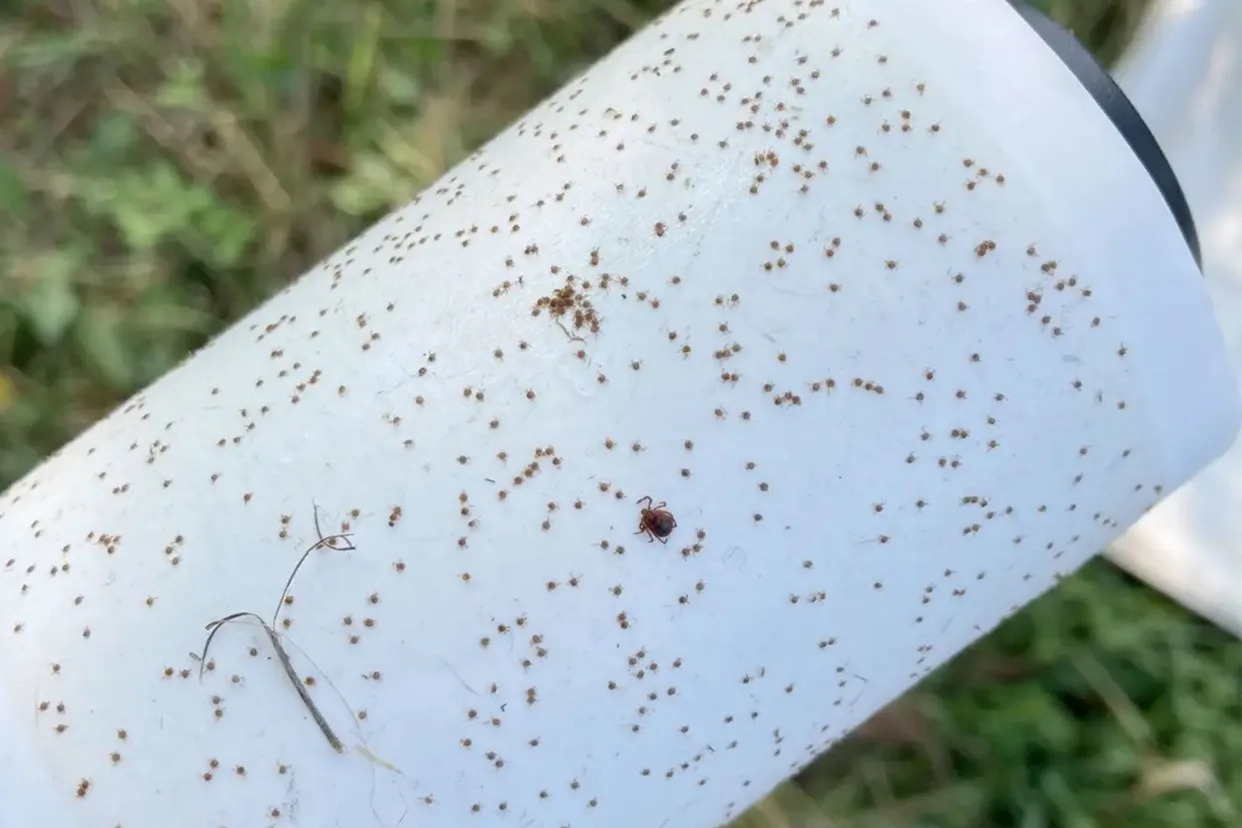
Ticks on a lent roller.
One of the cows reportedly suffered as many as 10,000 tick bites.

Asian longhorned ticks (ALTs) have been spreading across the Eastern and Midwestern U.S. since at least 2017, according to the Center for Disease Prevention (CDC), and the pests’ numbers are now on the rise in Ohio—a recent study from the Ohio State University reveals. According to the study’s authors, 9,287 invasive ticks were removed from a farm in eastern Ohio in the summer of 2021 after three cattle were reported dead from tick bites by the landowner.

During the study—lead-authored by Ohio State Assistant Professor of Veterinary Preventive Medicine Risa Pesapane—scientists continued to monitor the invasive tick population after most of the pests were killed off with pesticides. They found that the Asian longhorn ticks returned to the pasture and continued to spread in June 2022, despite the tick control efforts undertaken in 2021.

“You cannot spray your way out of an Asian longhorned tick infestation,” Pesapane said in a Nov. 3 news release. “They are going to spread to pretty much every part of Ohio and they are going to be a long-term management problem. There is no getting rid of them.”

Pesapane said that the cattle killed during the 2021 ALT infestation in eastern Ohio sustained thousands of tick bites. “One of those was a healthy male bull, about 5 years old,” she said in the press release. “Enormous. To have been taken down by exsanguination by ticks, you can imagine that was tens of thousands of ticks on one animal.” The term “exsanguination” refers to the action of draining a person, animal, or organ of the blood needed to sustain life.

On its website, the CDC says that ALTs, native to east Asia, have spread to 19 U.S. states since they were first reported in New Jersey in 2017. The list includes Arkansas, Connecticut, Delaware, Georgia, Indiana, Kentucky, Maryland, Massachusetts, Missouri, New Jersey, New York, North Carolina, Ohio, Pennsylvania, Rhode Island, South Carolina, Tennessee, Virginia, and West Virginia.

According to Pesapane, the invasive tick’s rapid spread lies in its ability to reproduce asexually, without mating. “There are no other ticks in North America that do that. So they can just march on, with exponential growth, without any limitation of having to find a mate,” Pesapane said. “Where the habitat is ideal, and anecdotally it seems that un-mowed pastures are an ideal location, there’s little stopping them from generating these huge numbers.”

Read Next: Is Whitetail Deer Blood the Key to Fighting Lyme Disease in Humans?

The CDC is urging anyone who finds an Asian longhorn tick on a person, pet, or on livestock, to remove the pest as quickly as possible. “Save the tick in rubbing alcohol in a jar or a ziplock bag,” the agency advises, “then contact your health department about steps you can take to prevent tick bites and tickborne diseases.

U.S. and China reach a deal on fighting climate change. Here’s what it means.

Yahoo! News

U.S. and China reach a deal on fighting climate change. Here’s what it means.

Ben Adler, Senior Editor – November 15, 2023

John Kerry shakes hands with Xie Zhenhua in front of U.S. and Chinese flags.
U.S. Special Presidential Envoy for Climate John Kerry shakes hands with his Chinese counterpart Xie Zhenhua before a meeting in Beijing, China, July 17. (Valerie Volcovici/Reuters) (REUTERS)

The United States and China may be at odds over everything from the Russia-Ukraine war to the status of Taiwan, but the world’s two largest economies just showed they can still work together on climate change.

The two superpowers jointly announced on Wednesday that they’ve agreed to a deal to rapidly increase the share of energy that comes from renewable sources and to reduce greenhouse gas emissions that cause global warming.

What’s in the deal

The key new components are:

  • Committing to helping the world triple renewable energy capacity by 2030.
  • Reducing power sector emissions by the end of the decade.
  • Reducing future emissions of methane, a powerful greenhouse gas.
  • Halting deforestation by 2030.
The timing
Rows of solar panels in a field against a cloudy sky.
Bifacial photovoltaic solar panels at the Roadrunner solar plant, owned and operated by Enel Green Power, near McCamey, Texas, Nov. 10. (Jordan Vonderhaar/Bloomberg via Getty Images) (Bloomberg via Getty Images)
  • The deal comes as scientists express growing alarm over the quickly escalating increases in warming and effects witnessed throughout the year, such as more extreme heat waves, wildfires and storms.
  • October was just the world’s fifth consecutive month of record-high global average temperatures.
  • The U.S. National Climate Assessment released Tuesday finds climate change is now affecting every region of the country, with growing health and economic costs.
  • The next round of U.N. climate negotiations, called COP28, is set to begin on Nov. 30 in Dubai. More than 60 countries, including the U.S., have recently called for the agreement produced there to include the tripling of renewable energy goals. The G20 also embraced that target in September.

Recommended reading

What it means for climate change
A full moon hovers near the horizon against a blue sky behind a wind farm with several dozen windmills visible in a mountainous area.
The full moon sets behind a wind farm in the Mojave Desert in California, Jan. 8, 2004. (Toby Melville/Reuters) (REUTERS)
  • Experts are hailing Wednesday’s announcement as a welcome sign.
  • “It’s very promising to see the U.S. and China diplomatically engaging on climate change again, after the broader challenges in the relationship sort of brought that to a halt,” Pete Ogden, vice president for climate and environment at the United Nations Foundation, told Yahoo News. “To see that re-energized going into the COP is encouraging and hopefully something they can build on.”
  • But while the potential impact is huge, other experts note that the actual emissions reductions from this agreement is unclear.
  • “Since China’s power sector emissions are so large, any decline this decade could avoid a lot of emissions,” Jake Schmidt, senior strategic director for international climate at the Natural Resources Defense Council, told Yahoo News.

Brazil: Health warnings as country gripped by ‘unbearable’ heatwave

BBC News

Brazil: Health warnings as country gripped by ‘unbearable’ heatwave

Kathryn Armstrong – BBC News – November 15, 2023

Red alerts have been issued for almost 3,000 towns and cities across Brazil, which have been experiencing an unprecedented heatwave.

Rio de Janeiro recorded 42.5C on Sunday – a record for November – and high humidity on Tuesday meant that it felt like 58.5C, municipal authorities said.

More than a hundred million people have been affected by the heat, which is expected to last until at least Friday.

Officials have attributed it to the El Niño phenomenon and climate change.

The city of São Paulo saw average temperatures of 37.3C on Tuesday afternoon, the National Institute of Meteorology (Inmet) reported.

“I’m exhausted, it’s hard,” Riquelme da Silva, 22, told AFP news agency on the streets there.

“When I get home, it’s cold water, otherwise I can’t even get up because I’m so tired. It’s even hard to sleep.”

Dora, a 60-year-old street vendor, described the heat as “unbearable” for those who worked outside.

A man cools down in a fountain during a heatwave in Rio de Janeiro
The authorities have attributed the heatwave to the El Niño phenomenon and climate change

Inmet has issued red alerts for a large part of the country. These indicate that temperatures may be 5C above average for longer than five days and could pose a serious danger to health.

The heatwave, which comes more than a month before the beginning of summer in the southern hemisphere, has seen Brazil’s energy consumption soar to record levels as people try to keep themselves cool.

Inmet research released last week showed that the average temperature in the country had been above the historical average from July to October.

Extreme weather is becoming more frequent and more intense in many places around the world because of climate change.

According to scientists, heatwaves are becoming longer and more intense in many places and this is expected to continue whilst humans keep releasing planet-warming greenhouse gases.

Meanwhile, the Earth is currently in an El Niño weather phase, during which time global temperatures typically increase.

A man drinks water on the street in Sao Paulo
The heatwave is expected to last until at least Friday

Heat projected to kill nearly five times more people by 2050

AFP

Heat projected to kill nearly five times more people by 2050

Daniel Lawler – November 15, 2023

Scientists have warned that the number of heat-related deaths will sore in the coming decades if the world does not decrease its carbon emissions (DAVID SWANSON)

Nearly five times more people will likely die due to extreme heat in the coming decades, an international team of experts said Wednesday, warning that without action on climate change the “health of humanity is at grave risk”.

Lethal heat was just one of the many ways the world’s still-increasing use of fossil fuels threatens human health, according to The Lancet Countdown, a major annual assessment carried out by leading researchers and institutions.

More common droughts will put millions at risk of starving, mosquitoes spreading farther than ever before will take infectious diseases with them, and health systems will struggle to cope with the burden, the researchers warned.

The dire assessment comes during what is expected to be the hottest year in human history — just last week, Europe’s climate monitor declared that last month was the warmest October on record.

It also comes ahead of the COP28 climate talks in Dubai later this month, which will for the first time host a “health day” on December 3 as experts try to shine a light on global warming’s impact on health.

Despite growing calls for global action, energy-related carbon emissions hit new highs last year, the Lancet Countdown report said, singling out still-massive government subsidies and private bank investments into planet-heating fossil fuels.

– ‘Crisis on top of a crisis’ –

Last year people worldwide were exposed to an average of 86 days of life-threatening temperatures, according to the Lancet Countdown study. Around 60 percent of those days were made more than twice as likely due to climate change, it said.

The number of people over 65 who died from heat rose by 85 percent from 1991-2000 to 2013-2022, it added.

“However these impacts that we are seeing today could be just an early symptom of a very dangerous future,” Lancet Countdown’s executive director Marina Romanello said.

Under a scenario in which the world warms by two degrees Celsius by the end of the century — it is currently on track for 2.7C — annual heat-related deaths were projected to increase 370 percent by 2050. That marks a 4.7-fold increase.

Around 520 million more people will experience moderate or severe food insecurity by mid-century, according to the projections.

And mosquito-borne infectious diseases will continue to spread into new areas. The transmission of dengue would increase by 36 percent under a 2C warming scenario, according to the study.

Meanwhile, more than a quarter of cities surveyed by the researchers said they were worried that climate change would overwhelm their capacity to cope.

“We’re facing a crisis on top of a crisis,” said Lancet Countdown’s Georgiana Gordon-Strachan, whose homeland Jamaica is currently in the middle of a dengue outbreak.

“People living in poorer countries, who are often least responsible for greenhouse gas emissions, are bearing the brunt of the health impacts,” she said.

– ‘Moving in the wrong direction’ –

World Health Organization chief Tedros Adhanom Ghebreyesus told an online conference launching the Lancet Countdown report that limiting warming to the Paris agreement target of 1.5C is a “public health imperative”.

“The world is moving in the wrong direction, unable to curb its addiction to fossil fuels and leaving vulnerable communities behind in the much-needed energy transition,” Tedros said.

On Tuesday, the UN warned that countries’ current pledges will cut global carbon emissions by just two percent by 2030 from 2019 levels — far short of the 43 percent drop needed to limit warming to 1.5C.

Romanello cautioned that if more progress is not made on emissions, then “the growing emphasis on health within climate change negotiations risks being just empty words”.

However there are “glimmers of hope”, she added.

The number of global deaths linked to air pollution from fossil fuels has fallen 16 percent since 2005, mostly thanks to efforts to reduce the impact of coal burning, the report said.

Global investment in green energy rose by 15 percent to $1.6 trillion last year, compared to $1 trillion for fossil fuels.

And if people changed to healthier, lower-carbon diets it would prevent up to 12 million deaths a year, at the same reducing emissions from dairy and red meat production by 57 percent, the report said.

‘Devastating toll’ of climate change now impacting ‘all regions’ of the U.S., Biden says

Yahoo! News

‘Devastating toll’ of climate change now impacting ‘all regions’ of the U.S., Biden says

The federal government’s fifth National Climate Assessment, released Tuesday, details how climate change is affecting every corner of the country.

Ben Adler, Senior Editor – November 14, 2023

Every region of the United States is now seeing rapid warming due to climate change, according to the federal government’s fifth National Climate Assessment, which was released Tuesday.

“I’ve seen firsthand what the report makes clear: the devastating toll of climate change. And its existential threat to all of us,” President Biden said from the White House Tuesday morning. “I’ve walked the streets of Louisiana, New Jersey, New York, Florida, Puerto Rico, where historic floods and hurricanes wiped out homes, hospitals, houses of worship.”

“This assessment shows us in clear scientific terms that climate change is impacting all regions, all sectors of the United States — not just some, all,” he added.

The report lays out in stark detail how climate change is already harming communities nationwide.

“Climate change is finally moving from an abstract future issue to a present, concrete, relevant issue. It’s happening right now,” the report’s lead author, Katharine Hayhoe, chief scientist at the Nature Conservancy and a professor at Texas Tech University, said in a statement.

Here are the key takeaways from the assessment.

Everyone is feeling the heat
National Park Service Rangers pose for a photo next to a sign showing a temperature of 132 degrees.
National Park Service Rangers Gia Ponce (left) and Christina Caparelli are photographed by Ranger Nicole Bernard next to a digital display of an unofficial heat reading at Furnace Creek Visitor Center in Death Valley National Park in Death Valley, Calif., on July 16. (Ronda Churchill / AFP via Getty Images) (AFP via Getty Images)

This year is on pace to be the warmest on record globally, and in the U.S., the heat is being felt nationwide, according to the report, which the federal government is required by law to produce every five years:

  • Every single region has higher average temperatures today than it did between 1951 and 1980.
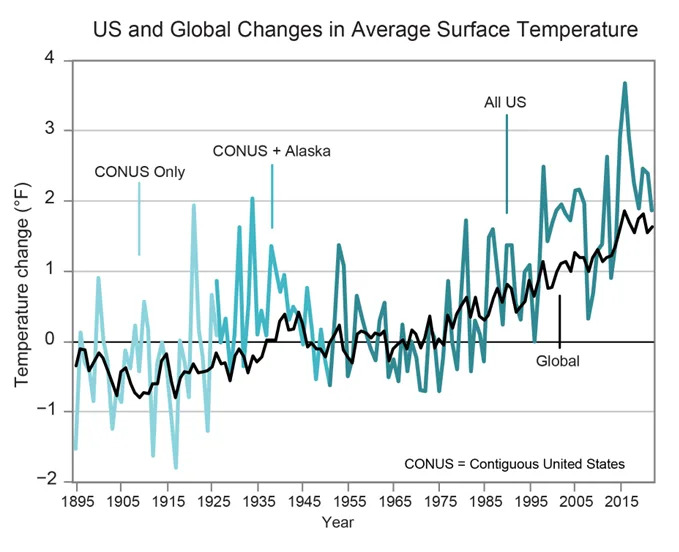
  • The U.S. is warming faster than most of the world. Since 1970, the Lower 48 states have warmed by 2.5 degrees Fahrenheit, and Alaska by 4.2 degrees Fahrenheit, compared with the global average temperature rise of 1.7 degrees Fahrenheit.
  • Phoenix set a record this year with 54 days of high temperatures of 110 degrees Fahrenheit or greater, including 31 straight days over 110.
  • In Alaska, melting glaciers, thawing permafrost and disappearing sea ice are destroying the hunting and fishing-dependent economy. Some Indigenous communities may need to be relocated to flee rising sea levels.
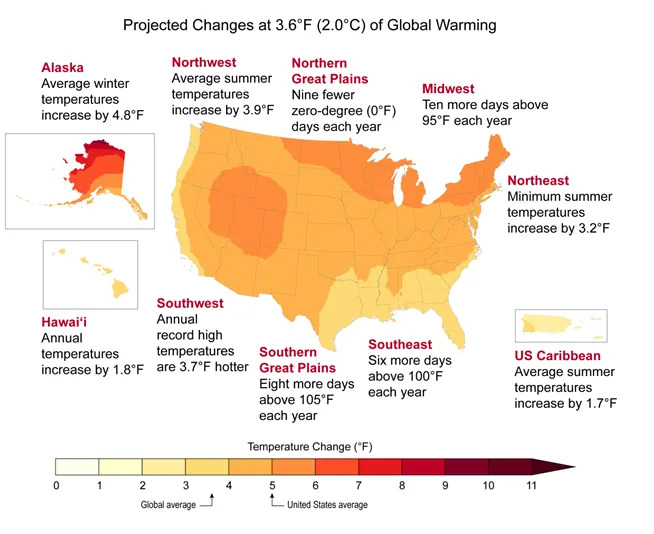
  • Since warming is happening faster at higher latitudes, the report projects that the U.S. will warm about 40% more than the global average in the future.

Recommended reading

CBS News: 2023 ‘virtually certain’ to be warmest year recorded, climate agency says

South Florida Sun-Sentinel: Hot nights in South Florida: Nighttime low temperature set record high this weekend

‘Heavy precipitation events are increasing’
Vehicles make their way through floodwater.
Vehicles make their way through floodwater in Brooklyn, N.Y., on Sept. 29. (Ed Jones / AFP via Getty Images) (AFP via Getty Images)

Warmer air holds more moisture, so climate change is throwing the water cycle out of whack, researchers say. Since 2000, the western half of the country has endured a two-decade megadrought that has threatened freshwater supplies for millions of people.

But while annual rainfall has decreased in much of that region, the entire country has seen an increase in heavy precipitation events. As a result, this year saw a series of sometimes deadly flash floods from California to Vermont.

Hurricanes, which draw power from warm ocean waters, are also increasingly powerful, thanks in part to hotter ocean temperatures. (In July, the all-time record-high ocean temperature was set at 101.1 degrees Fahrenheit off of Florida’s Gulf Coast.)

‘More severe wildfires’
Burned trees in a forest.
Burned trees from recent wildfires stand in a forest in Fort Chipewyan, Alberta, Canada, on Sept. 3. The United States has been inundated with wildfire smoke from Canada this year. (Victor R. Caivano/AP Photo) (ASSOCIATED PRESS)

Warmer temperatures and dried-out vegetation from drought lead to more frequent and severe wildfires. Wildfires and the smoke they create have been an increasingly prevalent and severe problem in the West in recent years, but this summer the Northeast and Midwest were also at times enveloped in thick smoke from Canada’s record-setting wildfire season.

An economic toll

The report notes a sharp rise in the number of billion-dollar disasters in the U.S., with one occurring every three weeks since 2018. In the 1980s, the country experienced a billion-dollar weather disaster once every four months, according to the assessment.

“Extreme events cost the U.S. close to $150 billion each year — a conservative estimate that does not account for loss of life, health care-related costs or damages to ecosystem services,” the report stated.

Growing threats

The report also identifies frequent flooding due to sea-level rise and more powerful storms as a threat to low-lying regions across the country. Health risks, such as food and water contamination, increased air pollution from smoke, dust and pollen are also expected to worsen.

“Climate change threatens vital infrastructure that moves people and goods, powers homes and businesses, and delivers public services,” the report states.

The U.S. has begun to combat climate change
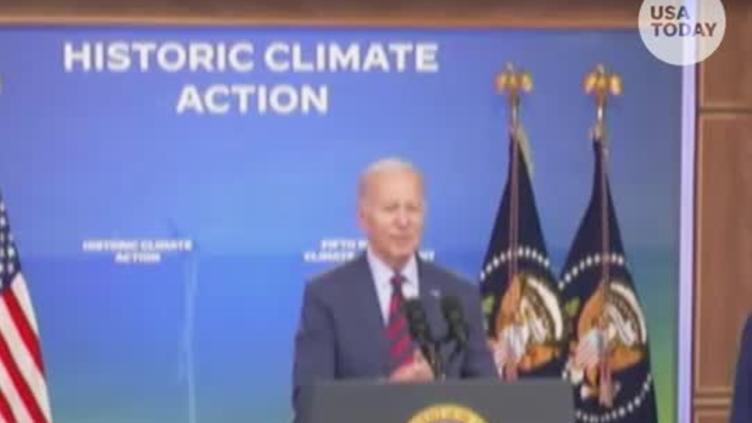
President Joe Biden delivers remarks beneath signage that reads: Historic Climate Action.
President Joe Biden delivers remarks on his administration’s actions to address the climate crisis in the South Court Auditorium of the White House on Tuesday. (Saul Loeb/AFP via Getty Images) (AFP via Getty Images)

The report also notes that U.S. greenhouse gas emissions dropped 12% between 2005 and 2019 thanks to the adoption of renewable energy sources like wind and solar energy.

The Biden administration has attempted to build on this progress through regulatory measures, like stiff new fuel efficiency standards for cars and trucks. And Congress approved $369 billion for investments in clean energy and electric vehicles in the Inflation Reduction Act. But those measures are only projected to cut emissions by 40% by 2030, not the 50% Biden has pledged to the international community.

A need to adapt, and to act

States and cities across the country have begun retrofitting infrastructure to meet the challenges of climate change, and measures such as enhanced storm drain capacity and improved forest management have increased in every region since the last assessment in 2018, according to the assessment.

But the report finds that faster, more ambitious adaptation investments are needed to minimize the still-growing costs of climate change.

No place in the US is safe from the climate crisis, but a new report shows where it’s most severe

CNN

No place in the US is safe from the climate crisis, but a new report shows where it’s most severe

Ella Nilsen – November 14, 2023

The effects of a rapidly warming climate are being felt in every corner of the US and will worsen over the next 10 years with continued fossil fuel use , according to a stark new report from federal agencies.

The Fifth National Climate Assessment, a congressionally mandated report due roughly every five years, warned that even though planet-warming pollution in the US is slowly decreasing, it is not happening nearly fast enough to meet the nation’s targets, nor is it in line with the UN-sanctioned goal to limit global warming to 1.5 degrees Celsius – a threshold beyond which scientists warn life on Earth will struggle to cope.

This year’s assessment reflects the reality that Americans can increasingly see and feel climate impacts in their own communities, said Katharine Hayhoe, a distinguished climate scientist at Texas Tech University and contributor to the report.

“Climate change is affecting every aspect of our lives,” Hayhoe told CNN.

Some of the report’s sweeping conclusions remain painfully familiar: No part of the US is truly safe from climate disasters; slashing fossil fuel use is critical to limit the consequences, but we’re not doing it fast enough; and every fraction of a degree of warming leads to more intense impacts.

But there are some important new additions: Scientists can now say with more confidence when the climate crisis has made rainstorms, hurricanes and wildfires stronger or more frequent, long-term drought more severe and heat more deadly.

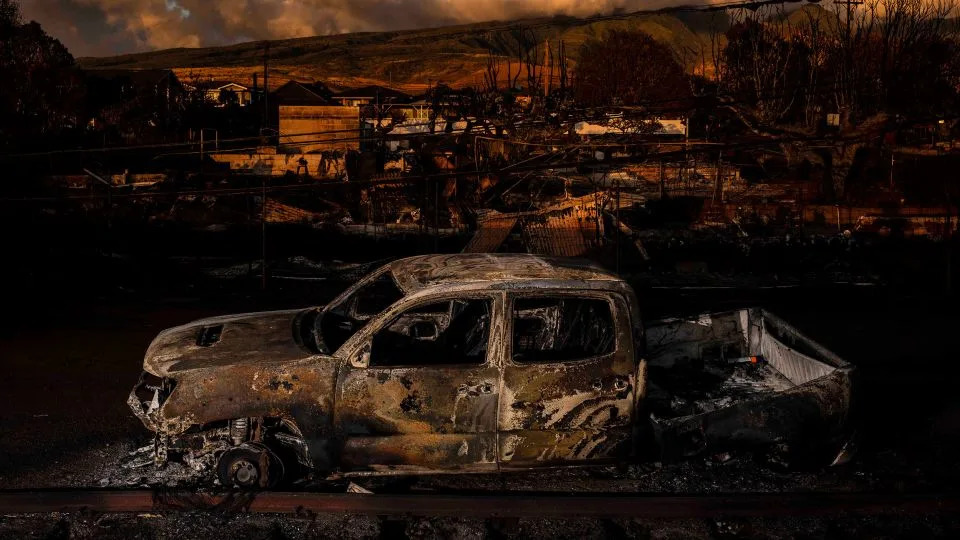
The remains of a vehicle in a burned neighborhood after wildfires in Lahaina in Maui, Hawaii, on August 18. - Bryan Anselm/New Jersey State Council for the Arts Fellowship/Redux
The remains of a vehicle in a burned neighborhood after wildfires in Lahaina in Maui, Hawaii, on August 18. – Bryan Anselm/New Jersey State Council for the Arts Fellowship/Redux

This summer alone, the Phoenix area baked through a record 31 consecutive days above 110 degrees, a shocking heatwave that was partly responsible for more than 500 heat-related deaths in Maricopa County in 2023 – its deadliest year for heat on record.

In July, a torrential rainstorm deluged parts of Vermont in deadly floodwaters. Then in August, Maui was devastated by a fast-moving wildfire and Florida’s Gulf Coast was slammed by its second major hurricane in two years.

President Joe Biden will deliver remarks on Tuesday and is expected to unveil more than $6 billion in funding to strengthen climate resilience “by bolstering America’s electric grid, investing in water infrastructure upgrades, reducing flood risk to communities, and advancing environmental justice for all,” an administration official said.

The US needs “a transformation of the global economy on a size and scale that’s never occurred in human history” to “create a livable future for ourselves and our children,” White House senior climate adviser John Podesta told reporters.

Here are five significant takeaways from the federal government’s sweeping climate report.

It’s easier to pinpoint which disasters were made worse by climate change

The latest report contains an important advancement in what’s called “attribution science” – scientists can more definitively show how climate change is affecting extreme events, like heatwaves, droughts to hurricanes and severe rainstorms.

Climate change doesn’t cause things like hurricanes or wildfires, but it can make them more intense or more frequent.

For instance, warmer oceans and air temperatures mean hurricanes are getting stronger faster and dumping more rainfall when they slam ashore. And hotter and drier conditions from climate change can help vegetation and trees become tinderboxes, turning wildfires into megafires that spin out of control.

“Now thanks to the field of attribution, we can make specific statements,” Hayhoe said, saying attribution can help pinpoint certain areas of a city that are now more likely to flood due to the effects of climate change. “The field of attribution has advanced significantly over the last five years, and that really helps people connect the dots.”

All regions are feeling climate change, but some more severely

There is no place immune from climate change, Biden administration officials and the report’s scientists emphasized, and this summer’s extreme weather was a deadly reminder.

Some states – including California, Florida, Louisiana and Texas – are facing more significant storms and extreme swings in precipitation.

Landlocked states won’t have to adapt to sea level rise, though some – including Appalachian states like Kentucky and West Virginia – have seen devastating flooding from rainstorms.

And states in the north are grappling with an increase in tick-borne diseases, less snow, and stronger rainstorms.

“There is no place that is not at risk, but there are some that are more or less at risk,” Hayhoe told CNN. “That is a factor of both the increasingly frequent and severe weather and climate extremes you’re exposed to, as well as how prepared (cities and states) are.”

Climate change is exacting a massive economic toll

Climate shocks on the economy are happening more frequently, the report said, evidenced by the new record this year for the number of extreme weather disasters costing at least $1 billion. And disaster experts have spent the last year warning the US is only beginning to see the economic fallout of the climate crisis.

Climate risks are hitting the housing market in the form of skyrocketing homeowners’ insurance rates. Some insurers have pulled out of high-risk states altogether.

Stronger storms wiping out certain crops or extreme heat killing livestock can send food prices soaring. And in the Southwest, the report’s researchers found that hotter temperatures in the future could lead to a 25% loss of physical work capacity for agricultural workers from July to September.

The US is cutting planet-warming pollution, but not nearly fast enough

Unlike the world’s other top polluters – China and India – planet-warming pollution in the US is declining. But it’s not happening nearly fast enough to stabilize the planet’s warming or meet the United States’ international climate commitments, the report explains.

The country’s annual greenhouse gas emissions fell 12% between 2005 and 2019, driven in large part by the electricity sector moving away from coal and toward renewable energy and methane gas, the latter of which is still a fossil fuel that has a significant global warming effect.

The decline is good news for the climate crisis, but look at the fine print and the picture is mixed.

The report finds US planet-warming emissions “remain substantial” and would have to sharply decline by 6% annually on average to be in line with the international 1.5-degree goal. To put that cut into perspective, US emissions decreased by less than 1% per year between 2005 and 2019 – a tiny annual drop.

Water – too much and not enough – is a huge problem for the US

One of the report’s biggest takeaways centers on the precarious future of water in the US, and how parts of the country are facing a future with either extreme drought and water insecurity, or more flooding and sea level rise.

Drought and less snowpack are huge threats to Southwest communities in particular. The report’s Southwest chapter, led by Arizona State University climate scientist Dave White, found the region was significantly drier from 1991 to 2020 than the three decades before.

White said that’s an ominous sign as the planet continues to warm, with significant threats to snowpack in California’s Sierra Nevada mountains and the Rockies – both of which provide crucial freshwater in the West.

White added that a lack of freshwater in the region also has significant economic and agricultural impacts, as it supports cities, farms, and Native American tribes.

“Mountains are our natural reservoirs in the region,” White told CNN. “Climate impacts on that mountain snowpack have really significant negative effects for the way our infrastructure operates. It’s just critical for us to protect those resources.”

CNN’s Donald Judd contributed to this report.

Who’s to blame for climate change? Scientists don’t hold back in new federal report.

USA Today

Who’s to blame for climate change? Scientists don’t hold back in new federal report.

Dinah Voyles Pulver and Doyle Rice – November 14, 2023 President Joe Biden slams 'MAGA Republican leaders,' claims they deny climate change

Climate change is here and prompting unprecedented actions in every state to curb the greenhouse gas emissions fueling warming temperatures, but a new federal report out Tuesday says bigger, bolder steps are needed.

After several years of work by more than 500 authors from every state, Puerto Rico, the Virgin Islands, and Guam, the White House released the massive Fifth National Climate Assessment.

In remarks Tuesday morning, President Joe Biden announced more than $6 billion to bolster the electric grid, update water infrastructure, reduce flooding, and advance environmental justice.

“This assessment shows us in clear scientific terms, that climate change is impacting all regions, all sectors of the United States,” Biden said. “We’ve come to the point where it’s foolish for anyone to deny the impacts of climate change anymore.”

The assessment includes more evidence than ever before to demonstrate the cause and effects of the changing climate, said L. Ruby Leung, one of its authors. It also breaks from previous reports by saying unequivocally that humans are responsible for changes to Earth’s climate.

“It’s important for us to recognize that how much climate change we will be experiencing in the future depends on the choices that we make now,” said Leung, a climate scientist at the Pacific Northwest National Laboratory and lead author on the earth sciences chapter.

All of the impacts people are feeling, like sea level rise and extreme weather events, she said “are tied to the global warming level, to how warm the earth becomes,” Leung said. “And that depends very much on the level of CO2 concentration in the atmosphere.”

In other news, the United Nations released its latest analysis of national climate plans on Tuesday morning and found them “strikingly misaligned” with science. “The chasm between need and action is more menacing than ever,” said Secretary-General António Guterres. “It’s time for a climate ambition supernova in every country, city and sector.”

The impacts of climate change are felt in every corner of the country, the latest National Climate Assessment finds
What is the 2023 National Climate Assessment?

The massive assessment describes the climate and economic impacts Americans will see if further action is not taken to address climate change. The report, issued roughly every four years, was mandated by Congress in the late 1980s and is meant as a reference for the president, Congress, and the public.

“Too many people still think of climate change as an issue that’s distanced from us in space or time or relevance,” said Katharine Hayhoe, an author of the report and chief scientist at The Nature Conservancy.

The assessment “clearly explains how climate change is affecting us here in the places where we live, both now and in the future and across every sector of human and natural society,” Hayhoe said. It also shows that “the risks matter and so do our choices.”

Climate Nexus, a nonprofit communications organization, said the new report is “essential reading,” because it highlights the seriousness of current impacts and shows the existing pace of adaptation isn’t enough to keep pace with future climate changes.

“Without deeper cuts in global net greenhouse gas emissions and accelerated adaptation efforts, severe climate risks to the United States will continue to grow,” the report states. “Each additional increment of warming is expected to lead to more damage and greater economic losses.”

However, greater reductions in carbon emissions could reduce the risks and impacts, and have immediate health and economic benefits, the report states.

Another heat record? Earth is historically and alarmingly hot. Now what?

What are the effects of climate change?

Millions are experiencing more extreme heat waves, with warmer temperatures and longer-lasting heat waves, the report states. It adds climate changes are apparent in every region of the country.

Among the noted effects:

◾ The number of nights with minimum low temperatures at or above 70 degrees has increased compared to 1901-1960 in every corner of the country except the northern Great Plains and Alaska.

◾ Average annual precipitation is increasing in most regions, except the Northwest, Southwest, and Hawaii.

◾ Heavier precipitation events are increasing everywhere except Hawaii and the Caribbean.

◾ Relative sea levels are increasing along much of the coast, except for Oregon, Washington, and Alaska.

◾ In the 1980s, the country experienced on average a $1 billion disaster every four months but now experiences one every three weeks. This year, the country has set a new record with 25 billion-dollar disasters.

Fishers and the warming climate Climb aboard four fishing boats with us to see how America’s warming waters are changing

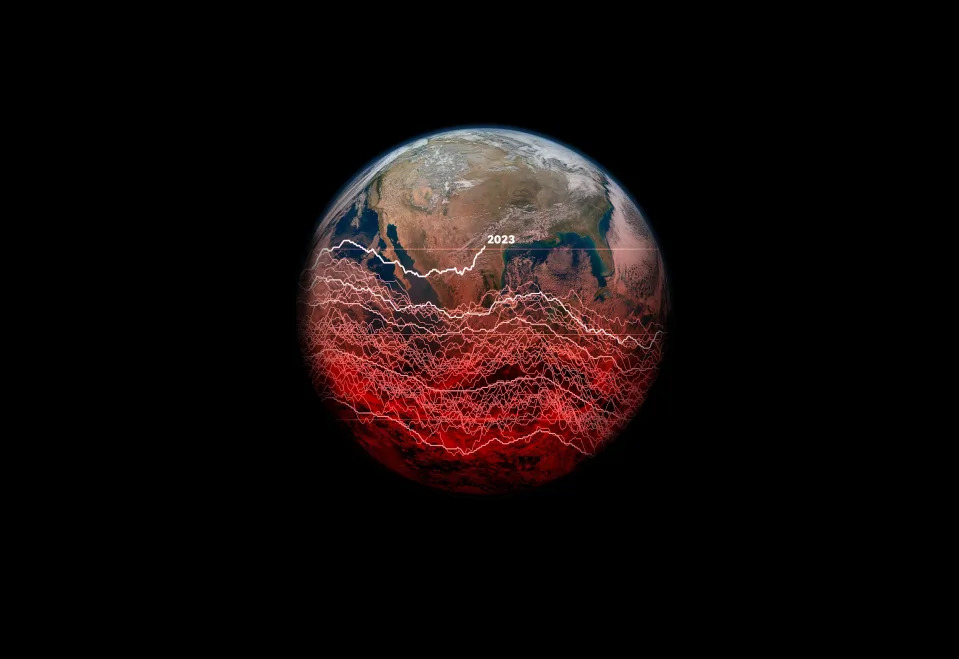
Climate scientists around the world say 2023 is almost certain to be the globe’s warmest year in recorded human history. The global mean temperature through October was 1.4 Celsius (more than 2.5 degrees Fahrenheit) above the preindustrial average.

So far this year, the nation is experiencing its 11th warmest year on record through October, according to the National Oceanic and Atmospheric Administration. However, 12 states are experiencing their warmest or second warmest year on record.

Growing evidence that humans are changing the climate

This assessment is most notable for the certainty scientists have gained about warming and its impacts, said Leung, who served as the lead author for the report’s Earth Systems Processes chapter, which lays the scientific groundwork and is used to illustrate points throughout the report.

The chapter, a collaboration among more than a dozen authors, was intended to answer such questions as whether humans are causing global warming, whether warming is changing extreme weather and climate events and how much warming the planet might expect to see.

In prior reports, scientists often hedged their statements, for example saying they were 90% sure humans were responsible for the changes being seen,” Leung said. “In this NCA 5 report, we are now saying that we are totally sure.”

Starting from the 1900s, the observed warming has been caused by human activities, she said. “It’s definitive.”

Another key difference is scientists reduced by 50% the uncertainty in how much temperatures would warm if the concentration of carbon dioxide in the atmosphere doubles, she said. In previous assessments that number had hovered around a range from 2.7 degrees to 8 degrees. “It was a pretty big range,” she said. “Our goal has always been to narrow this down.”

Thanks to the increase in instrumental observations, satellite data, the study of the paleoclimate, and higher resolution computer modeling, scientists now have amassed more evidence than ever before, giving them more certainty, she said. “Now we can say that the global warming that is caused by a doubling of the CO2 in the atmosphere should be between 4.5 degrees Fahrenheit and 7.2 degrees Fahrenheit.”

The Fifth National Climate Assessment shows the U.S. has warmed rapidly since the 1970s.
Reducing greenhouse gas emissions

Efforts to adapt to climate change, reduce net greenhouse gas emissions, and be more energy efficient are underway in every U.S. region and have expanded since 2018, the report concludes.

Greenhouse gas emissions in the U.S. fell 12% between 2005 and 2019, mostly driven by changes in the way electricity is produced, the assessment concluded. The nation burns less coal, but more natural gas, which is cleaner. Because of the electrical industry’s 40% reduction in emissions, the transportation sector took the lead as the industry with the most emissions.

Growth in the capacity of wind, solar, and battery storage is supported by the falling costs of those technologies, and that ultimately means even more emissions reductions, the report states. For example, wind and solar energy costs have dropped 70% and 90%, respectively.

While the options for cleaner technologies and lower energy use have expanded, the authors found they aren’t happening fast enough for the nation to meet the goal of achieving a carbon-neutral energy system.

Without deeper cuts in global net greenhouse gas emissions and accelerated adaptation efforts, the scientists found severe climate risks to the United States will continue to grow. Each additional increment of warming is expected to lead to more damage and greater economic losses compared to previous increments of warming, and the risks of catastrophic consequences also increase.

But the report also finds that reducing greenhouse gas emissions and removing carbon dioxide from the atmosphere can limit future warming and associated increases in many risks, and bring immediate health and economic benefits.

What others are saying about the report:

The scientific assessment is “the latest in a series of alarm bells and illustrates that the changes we’re living through are unprecedented in human history,” said Kristina Dahl, a principal climate scientist at the Union of Concerned Scientists and a contributor to the report. “The science is irrefutable: we must swiftly reduce heat-trapping emissions and enact transformational climate adaptation policies in every region of the country to limit the stampede of devastating events and the toll each one takes on our lives and the economy.”

The report illustrates three things, said Arati Prabhakar, director of the White House Office of Science and Technology Policy.

◾ The events Americans have already experienced firsthand are “unfolding as predicted.”

◾ Communities in every state and territory have taken action.

◾ People across the nation can use the assessment to take future actions.

For example, Prabhakar said the report could be used by a water utility manager in Chicago trying to understand extreme rainfall, an urban planner deciding where to locate cooling centers in Texas, or a manager of a Southeastern hospital trying to get ahead of the diseases ticks and mosquitoes are bringing into their region as a result of the changing climate.

What an increase of 3.6 degrees Fahrenheit over pre-industrial temperatures would feel like in the United States.

Why Aren’t More People Getting Married? Ask Women What Dating Is Like.

By Anna Louie Sussman – November 11, 2023

An illustration of a woman surrounded by small men.
Credit…Wesley Allsbrook

Ms. Sussman writes about gender, dating and reproduction.Sign up for the Opinion Today newsletter  Get expert analysis of the news and a guide to the big ideas shaping the world every weekday morning. Get it sent to your inbox.

Sarah Camino had been in a relationship for two years when she found out she was pregnant. The father, whom she met while they were both working at a restaurant in Times Square, was initially excited. But he had been using drugs lately, and had been fired from his last four jobs; when she ventured that she was scared she might wind up raising the child alone, he got defensive and walked out. She and her daughter now live in Florida with her parents, and he is not a part of their lives.

Ms. Camino, a beautician and hospitality worker, checks all the boxes of the demographic that has been targeted for advice in recent months by an array of columnists and authors, who have argued for the promotion and prioritizing of marriage, sometimes for the sake of overall happiness, but more often for the sake of children’s well-being.

She’s a 37-year-old single mother without a college degree. She cares deeply about her child’s happiness and about providing her with a good future. When I asked what she made of the advice to get married, though, she was skeptical. “I don’t think things are perfect like that,” she told me. She had planned to stay with the father, but that’s not how it happened. “I didn’t think he was gonna leave me like this,” she said.

The most recent wave of commenters have tended to position themselves as iconoclasts speaking hard truths: Two-parent families often result in better outcomes for kids, writes Megan McArdle, in The Washington Post, but “for various reasons,” she goes on, this “is too often left unsaid” — even though policy wonks, and the pundits who trumpet their ideas, have been telling (straight) people to get married for the sake of their children for decades. Brad Wilcox of the Institute for Family Studies, who recently scoffed at “the notion that love, not marriage, makes a family,” has a forthcoming book titled “Get Married: Why Americans Must Defy the Elites, Forge Strong Families, and Save Civilization.” All of these scolds typically rely on the same batch of academic studies, now compiled by economist Melissa Kearney in her new book “The Two-Parent Privilege: How Americans Stopped Getting Married and Started Falling Behind,” which show that kids with two parents fare better on a variety of life outcomes than those raised by single parents, who are overwhelmingly women.

This may well be true. But harping on people to get married from high up in the ivory tower fails to engage with the reality on the ground that heterosexual women from many walks of life confront: that is, the state of men today. Having written about gender, dating, and reproduction for years, I’m struck by how blithely these admonitions to get married skate over people’s lived experience. A more granular look at what the reality of dating looks and feels like for straight women can go a long way toward explaining why marriage rates are lower than policy scholars would prefer.

On the rare occasions that women are actually asked about their experiences with relationships, the answers are rarely what anyone wants to hear. In the late 1990s, the sociologists Kathryn Edin and Maria Kefalas interviewed 162 low-income single mothers in Camden, N.J., and Philadelphia to understand why they had children without being married. “Money is seldom the primary reason” why mothers say they are no longer with their children’s fathers. Instead, mothers point to “far more serious” offenses: “It is the drug and alcohol abuse, the criminal behavior and consequent incarceration, the repeated infidelity, and the patterns of intimate violence that are the villains looming largest in poor mothers’ accounts of relational failure.”

But it doesn’t take behavior this harmful to discourage marriage; often, simple compatibility or constancy can be elusive. Ms. Camino, for her part, has dabbled in dating since her partner left, but hasn’t yet met anyone who shares her values, someone who’s funny and — she hesitates to use the word “feminist” — but a man who won’t just roll his eyes and say something about being on her period whenever she voices an opinion. The last person she went out with “ghosted” her, disappearing without warning after four months of dating. “There are women that are just out here trying, and the men aren’t ready,” she told me. “They don’t care, most of them.” Who, exactly, is Ms. Camino supposed to marry?

For as long as people have been promoting marriage, they have also been observing that a good man is hard to find (see: William Julius Wilson, or early Nora Ephron). But what was once dismissed as the complaint of “picky” women is now supported by a raft of data. The same pundits plugging marriage also bemoan the crisis among men and boys, what has come to be known as “male drift” — men turning away from college, dropping out of the work force, or failing to look after their health. Ms. Kearney, for example, acknowledges that improving men’s economic position, especially men without college degrees, is an important step toward making them more attractive partners.

But even this nod ignores the qualitative aspect of the dating experience — the part that’s hard to cover in surveys, or address with policy. Daniel Cox, a senior fellow at the American Enterprise Institute who recently surveyed more than 5,000 Americans about dating and relationships, found that nearly half of college-educated women said they were single because they had trouble finding someone who meets their expectations, versus one-third of men. The in-depth interviews, he said, “were even more dispiriting.” For a variety of reasons — mixed messages from the broader culture about toughness and vulnerability, the activity-oriented nature of male friendships — it seems that by the time men begin dating, they are relatively “limited in their ability and willingness to be fully emotionally present and available,” he said.

Navigating interpersonal relationships in a time of evolving gender norms and expectations “requires a level of emotional sensitivity that I think some men probably just lack, or they don’t have the experience,” he added. He had recently read about a high school creative writing assignment in which boys and girls were asked to imagine a day from the perspective of the opposite sex. While girls wrote detailed essays showing they had already spent significant time thinking about the subject, many boys simply refused to do the exercise, or did so resentfully. Mr. Cox likened that to heterosexual relationships today: “The girls do extra and the boys do little or nothing.”

Marriage proponents often contrast the stable relationship patterns of the college-educated with the instability of the less-educated, but a bachelor’s degree is hardly a guarantee of a ring. The Yale anthropologist Marcia Inhorn’s recent book, “Motherhood on Ice: The Mating Gap and Why Women Freeze Their Eggs,” argues that educated women freeze their eggs because they’re unable to find a suitable male partner: Ms. Inhorn points to a large gap in the number of college-educated women versus college-educated men during their reproductive years — on the order of several million.

But Ms. Inhorn’s book goes beyond these quantitative mismatches to document the qualitative experience of women who are actively searching for partners — the frustration, hurt and disappointment. “Almost without exception,” she writes, “women in this study were ‘trying hard’ to find a loving partner,” mostly through dating sites and apps. Women in their late 30s reported “online ageism,” others described removing their Ph.D from their profiles so as not to intimidate potential dates; still others found that men were often commitment-averse.

The behaviors were ubiquitous enough that Ms. Inhorn compiled a sort of taxonomy of cads, such as the “Alpha males” who “want to be challenged by work, not by their partners” or the “Polyamorous men” who claim “that their multiple attachments to women are all ‘committed.’” Her breakdown — table 1.1 in the book — reads like a rigorous academic version of all the complaints you’ve ever heard from your single female friends.

One of these friends, with whom I went to college, would like nothing more than to be married. She’s beautiful and successful, and not, as far as I can tell, overly “picky.” She has had long-term relationships in the past, and cherishes the intimacy and stability they provide. To that end, she keeps a post-it note on a bulletin board. On it, she has drawn out 10 lines of 10 circles each. Every time she goes on a date with someone new, she fills in a circle. She’s committed to going on at least a hundred dates as she searches for a male partner with whom she can have a family. In two years, she’s filled in nearly half of the circles, and she’s still single. It’s like an SAT test form where every answer is incorrect. When she asks her male friends to set her up with their friends, they consistently tell her that no one they know would be good enough for her. “It’s like, how bad are you guys?” she marvels.

To be sure, many men are fantastic people and partners, and I’m sure many women are loathsome, creepy or otherwise disrespectful. Many of us know these terrific men — they’re our friends, our relatives, our colleagues — and would love to meet someone similar. Relationships are an important part of life; companionship is lovely and a natural human desire. But rather than chiding people (mostly women, mostly single moms) to get married “for the children,” how about a little empathy that we’re living through a juncture where various forces at play have made meaningful companionship hard to find?

There are policy solutions that can help everyone: family allowances to curb child poverty, child care to support working and single parents, retraining out-of-work men, higher ed reform for people who want to attend college but can’t afford the cost. In the process, these policies might encourage marriage by providing economic stability. But to truly address the decline in heterosexual marriage, we must attend to the details — to acknowledge the qualitative aspects of relationship formation. And, in particular, we should listen to the experiences of women who are attempting to find partners. We should care about the interior lives, not just the educational attainment or the employment status, of the men who could be those partners.

All of this is a much trickier proposition, with no clear policy solution in sight. It requires taking the stories of single women seriously, and not treating them as punchlines — something for which there is little historical precedent, but which a handful of scholars are slowly beginning to do. But unless we pay attention to the granular experiences of people in the dating trenches, simply advising people to marry is not only, frankly, obnoxious for the many women out there trying — it’s also just not going to work.