MEXICO CITY — Thousands of demonstrators cloaked in pink marched through cities in Mexico and abroad on Sunday in what they called a “march for democracy” targeting the country’s ruling party in advance of the country’s June 2 elections.
The demonstrations called by Mexico’s opposition parties advocated for free and fair elections in the Latin American nation and railed against corruption the same day presidential front-runner Claudia Sheinbaum officially registered as a candidate for ruling party Morena.
Sheinbaum is largely seen as a continuation candidate of Mexico’s highly popular populist leader Andrés Manuel López Obrador. He’s adored by many voters who say he bucked the country’s elite parties from power in 2018 and represents the working class.
But the 70-year-old president has also been accused of making moves that endanger the country’s democracy. Last year, the leader slashed funding for the country’s electoral agency, the National Electoral Institute, and weakened oversight of campaign spending, something INE’s head said could “wind up poisoning democracy itself.” The agency’s color, pink, has been used as a symbol by demonstrators.
López Obrador has also attacked journalists in hours-long press briefings, has frequently attacked Mexico’s judiciary and claimed judges are part of a conservative conspiracy against his administration.
In Mexico City on Sunday, thousands of people dressed in pink flocked to the the city’s main plaza roaring “get López out.” Others carried signs reading “the power of the people is greater than the people in power.”
Among the opposition organizations marching were National Civic Front, Yes for Mexico, Citizen Power, Civil Society Mexico, UNE Mexico and United for Mexico.
“Democracy doesn’t solve lack of water, it doesn’t solve hunger, it doesn’t solve a lot of things. But without democracy you can’t solve anything,” said Enrique de la Madrid Cordero, a prominent politician from the Institutional Revolutionary Party, or PRI, in a video posted to social media calling for people to join the protests.
The PRI held uninterrupted power in Mexico for more than 70 years.
Marches were organized in a hundred cities across the country, and in other cities in the United States and Spain.
Still, the president remains highly popular and his ally Sheinbaum appears set to coast easily into the presidency. She leads polls by a whopping 64% over her closest competition, Xóchitl Gálvez, who has polled at 31% of the votes.
López Obrador railed against the protests during is Friday morning press briefing, questioning whether the organizers cared about democracy.
“They are calling the demonstration to defend corruption, they are looking for the return of the corrupt, although they say they care about democracy,” he said.
Presidential greatness is rarely fixed in stone – changing attitudes on racial injustice and leadership qualities lead to dramatic shifts
George R. Goethals, University of Richmond – February 18, 2024
A statue of Abraham Lincoln, the 16th president of the United States, sits in the Lincoln Memorial in Washington. Historians consistently have given Lincoln, the Great Emancipator, their highest rating because of his leadership during the Civil War. Jakub Porzycki/NurPhoto via Getty Images
Every American president has landed in the history books. And historians’ assessments of their performance have been generally consistent over time. But some presidents’ rankings have changed as the nation – and historians themselves – reassessed the country’s values and priorities.
At the other end of the ranking, Presidents Ulysses S. Grant and Warren Harding were labeled “failure.”
There have been numerous surveys ranking presidents since then, including a 1962 survey by Arthur Schlesinger Jr., which showed Jackson dropping into a “near great” category.
Changing views shift rankings
While the surveys point to Americans’ evolving social attitudes, with implications for our electoral politics and governance, they don’t always ask historians the same questions. Some simply ask them to rank presidents. Others ask them to also judge specific aspects of leadership, such as economic policy or international diplomacy.
Despite the relative stability of the ratings across surveys – especially at the top, where Lincoln, Washington and Roosevelt consistently hold sway – there have been some dramatic changes. C-SPAN’s four surveys on presidential leadership, for example, show some shifts in historians’ ranking of presidents over time.
Since 2000, the cable network has polled prominent historians every time there has been a change in administrations. So, C-SPAN conducted surveys in 2009, 2017 and 2021 as well.
The surveys offer not only an overall ranking of presidents, but also rankings in each of the following 10 categories: public persuasion, crisis leadership, economic management, moral authority, international relations, administrative skills, relations with Congress, vision and agenda setting, pursuance of equal justice for all, and performance within the context of the times.
While Lincoln has ranked at the top of each survey, the two presidents who served right before him – Franklin Pierce and James Buchanan, both sympathetic to slavery – and his immediate successor, white supremacist Andrew Johnson, have consistently ranked at the bottom. Donald Trump debuted in C-SPAN’s 2021 survey near the bottom. He was ranked 41st of 45 presidents.
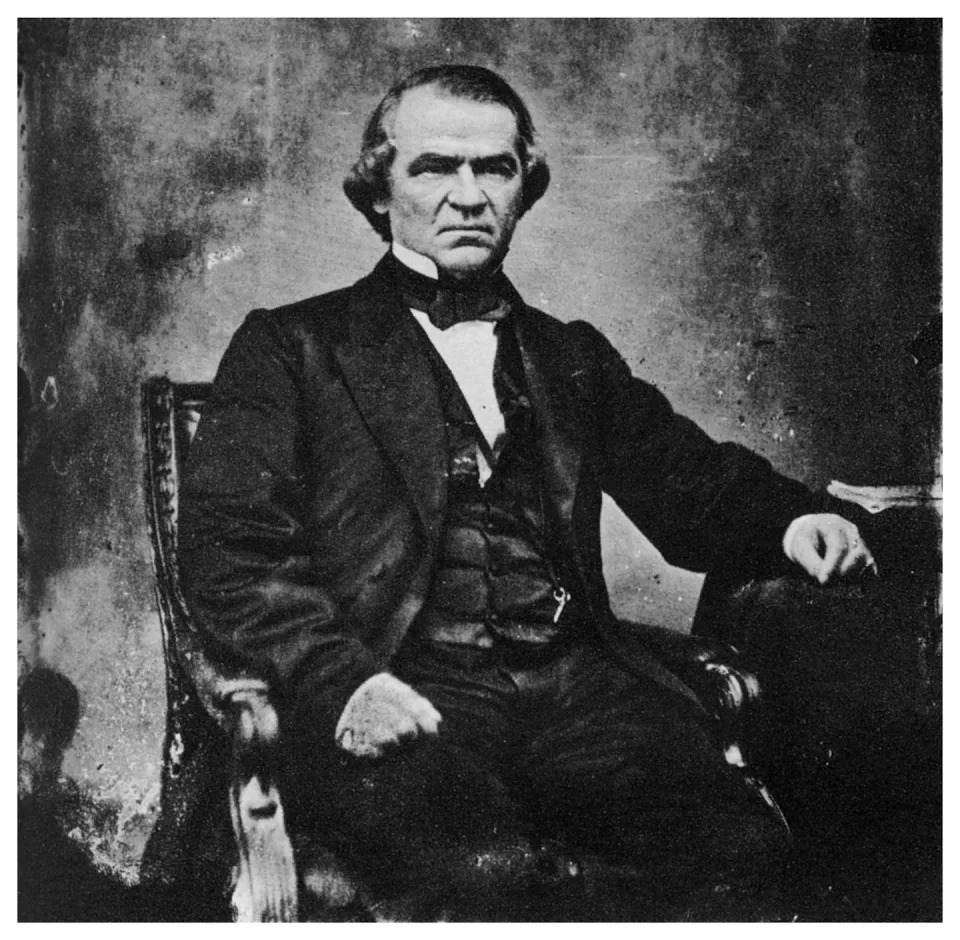
Andrew Johnson was Abraham Lincoln’s vice president and successor. As president, he vetoed legislation designed to help African Americans during Reconstruction. The Print Collector/ Hulton Archive via Getty Images
What is a good leader?
As a social psychologist and leadership scholar at the University of Richmond’s Jepson School of Leadership Studies, with long-standing interests in presidential leadership, I believe these surveys can be best understood in terms of psychologist Dean Keith Simonton’s model of evaluating presidents.
He maintains that historians generally view leaders, including presidents, positively to the extent that they fit a deeply ingrained image of someone who is strong, active and good. And that image comes to mind when they think of attributes and events linked to a president that suggest he was a good leader. Examples include how long he served, whether he was a war hero and whether he was assassinated, and in that sense, was a martyr.
On the other hand, historians also easily recall scandals, such as Richard Nixon’s Watergate and Harding’s Teapot Dome. These detract from these presidents’ “good” image, as evidenced by Nixon’s and Harding’s rankings of 31st and 37th, respectively, in C-SPAN’s 2021 survey.
Race matters
In recent years, presidents’ positions on race and racism have been important factors in historians’ evaluations of their records. For example, Wilson’s rather startling efforts to segregate federal offices and the military are becoming more widely known as scholars explore that aspect of his presidency.
His actions in that regard may overshadow his international idealism, which favored morality over materialism and has been viewed positively. He is no longer considered one of our “great” presidents. In Schlesinger Sr.’s 1948 survey, he ranked fourth of 29 presidents. But in 2021, historians ranked him 13th of 45 for C-SPAN.
Jackson dropped the most in C-SPAN’s surveys, from 13th in 2000 to 22nd in 2021. His commitment to Indian removal from Southern and Midwestern states, not unique for the time, and the resulting Trail of Tears – the forced and violent relocation of Native Americans from their homelands – are important topics in today’s political discussions.
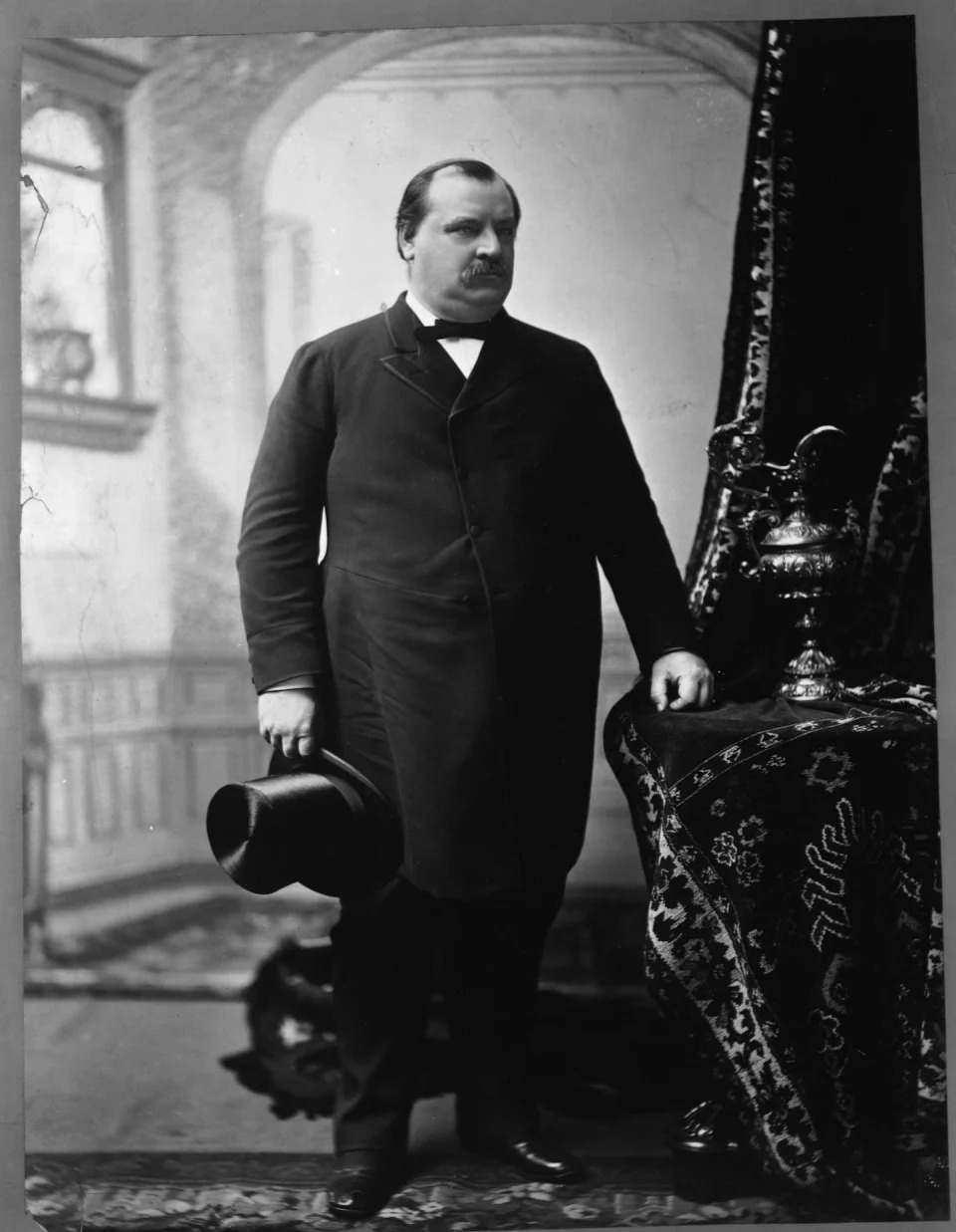
President Grover Cleveland, in office from 1885 to 1889 and 1893 to 1897, opposed efforts to integrate schools or give African Americans, whom he considered inferior to white people, voting rights. Library of Congress/Corbis/VCG via Getty Images
Several other presidents who lost ground, including James Polk, Zachary Taylor, Rutherford B. Hayes and Grover Cleveland, were associated with efforts to extend slavery or with failure to protect African Americans following Reconstruction.
Then there is the case of Grant. Ranked at the bottom as a failure in the mid-20th century, he had the largest ranking change of any president in the C-SPAN surveys. He jumped 13 places from 33rd in 2000 to 20th in 2021. He had already moved up from second-to-last place in the 1948 and 1962 Schlesinger surveys to somewhere in the bottom quartile in 2000, to a position in 2021 where more presidents ranked worse than he did.
The 2021 C-SPAN survey ranks Grant sixth on “pursued equal justice for all,” behind only Lincoln, Lyndon Johnson, Barack Obama, Harry Truman and Jimmy Carter. Given the centrality of equal justice, which may overshadow whatever connection Grant may have had to scandals in his administration, such as Crédit Mobilier and the Whiskey Ring, Grant rises in historians’ overall evaluation.
Moral authority
This all suggests historians have quite simple ways of evaluating presidents. We have an image of the ideal leader. Just a few pieces of information relating to that ideal make a big difference in whether we view presidents as fitting or not fitting that image. This is particularly true of our perception of how good they were. Presidents’ moral commitments speak loudly to whether or not we view them as good.
Interestingly, on the quality of “moral authority” in the C-SPAN surveys from 2000 to 2021, Grant’s ranking rose 14 rungs, from 31st to 17th, even more than it did on “pursued equal justice for all,” where it rose 12 rungs, from 18th to sixth. Wilson and Jackson dropped 13 and 18 places, respectively, on “moral authority.”
Clearly, moral judgments loom large in historians’ assessments of presidential leadership.
Ulysses S. Grant, once ranked poorly by historians, now gets high marks. His advocacy for African American voting rights stands out among his efforts for the freedmen during Reconstruction. Print Collector/Hulton Archive via Getty Images
New presidential rankings place Obama in top 10, Reagan and Trump below Biden
Michael Lee – February 18, 2024
New presidential rankings place Obama in top 10, Reagan and Trump below Biden
A new ranking of presidents by a group of self-styled experts determined that Abraham Lincoln is America’s greatest president, while Donald Trump ranks last.
Lincoln topped the list of presidents in the 2024 Presidential Greatness Project expert survey for the third time, following his top spot in the rankings in the 2015 and 2018 versions of the survey.
According to a release from the Presidential Greatness Project, which touts itself as the “foremost organization of social science experts in presidential politics,” the 154 respondents to the survey included “current and recent members of the Presidents & Executive Politics Section of the American Political Science Association…as well as scholars who have recently published peer-reviewed academic research in key related scholarly journals or academic presses.”
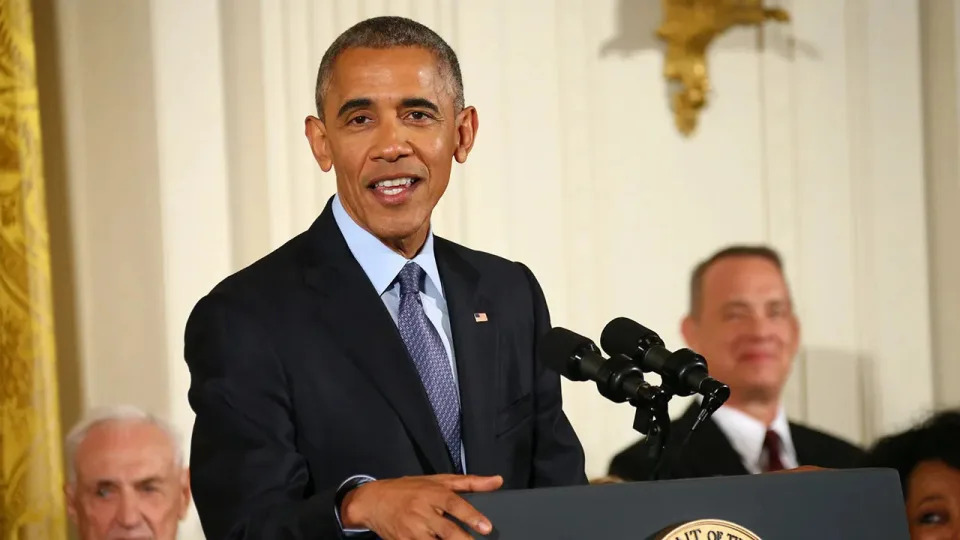
Former Presidents Barack Obama, Ronald Reagan and Donald Trump, and President Biden
The respondents were asked to rank presidents on a scale of 0-100, with 0 being a failure, 50 being average and 100 being great. Rounding out the top five in the rankings were Franklin Delano Roosevelt at number two, George Washington at three, Theodore Roosevelt at four, and Thomas Jefferson at five.
Trump was ranked in last place in the survey, being ranked worse than James Buchanan at 44, Andrew Johnson at 43, Franklin Peirce at 42, and William Henry Harrison at 41.
Respondents were also tracked by their political affiliation and ideology, which the release argues did not “tend to make a major difference overall” in the rankings, though there were some outliers, mainly with recent presidents.
Abraham Lincoln topped the list of presidents once again.
Ronald Reagan, George W. Bush and Trump were more likely to be ranked higher by conservatives or Republicans, with Reagan being ranked an average of 5th by Republicans respondents, Bush 19th and Trump 41st. Among Democrat respondents, Reagan was rated an average of 18th, Bush 33rd and Trump 45th.
A similar partisan divide was noticeable for Barack Obama and President Biden, who ranked an average of 6th and 13th, respectively, among Democrat respondents, and 15th and 30th by Republicans. Bill Clinton, a Democrat, was ranked higher by Republican respondents (10th) than he was by Democrats (12th).
President Obama
The divide resulted in an overall ranking of 7th for Obama, 12th for Clinton, 14th for Biden, 16th for Reagan and 32nd for Bush.
Single family homes in the Elm Trails development near San Antonio, Texas, on Tuesday, Feb. 13, 2024. (Josh Huskin/The New York Times)
Robert Lanter lives in a 600-square-foot house that can be traversed in five seconds and vacuumed from a single outlet. He doesn’t have a coffee table in the living room because it would obstruct the front door. When relatives come to visit, Lanter says jokingly, but only partly, they have to tour one at time.
Each of these details amounts to something bigger, for Lanter’s life and the U.S. housing market: a house under $300,000, something increasingly hard to find. That price allowed Lanter, a 63-year-old retired nurse, to buy a new single-family home in a subdivision in Redmond, Oregon, about 30 minutes outside Bend, where he is from and which is, along with its surrounding area, one of Oregon’s most expensive housing markets.
Lanter’s house could easily fit on a flatbed truck, and it is dwarfed by the two-story suburban homes that prevail on the blocks around him. But, in fact, there are even smaller homes in his subdivision, Cinder Butte, which was developed by a local builder called Hayden Homes. Some of his neighbors live in houses that total just 400 square feet — a 20-by-20-foot house attached to a 20-by-20-foot garage.
This is not a colony of “tiny houses,” popular among minimalists and aesthetes looking to simplify their lives. For Lanter and his neighbors, it’s a chance to hold on to ownership.
Lanter, who is recently divorced, came back to central Oregon from a condominium in Portland only to discover that home prices had surged beyond his reach. He has owned several larger homes over the years and said he began his recent search looking for a three-bedroom house.
“I did not want to rent,” he said after a five-minute tour of his “media room” (a small desk with a laptop) and bedroom (barely fits a queen). After being an owner for 40 years, the idea of being a tenant felt like a backslide.
And after living on the 17th floor of a Portland condominium, he had ruled out attached and high-rise buildings, which he described as a series of rules and awkward interactions that made him feel as though he never really owned the place.
There was the time he sold a sofa, and the front desk attendant scolded him for moving it down the elevator without alerting management a day in advance. Or the times he came home to find someone parked in the spot he owned and paid property taxes on. Try to imagine a random driver parking in a house’s driveway, he said — there’s no way.
A single-family home means “less people’s hands in your life,” Lanter said.
He wanted the four unshared walls of the American idyll, even if those walls had minimal space between them and were a couch length from his neighbor.
A Chance at Ownership
Several colliding trends — economic, demographic and regulatory — have made smaller units like Lanter’s the future of American housing, or at least a more significant part of it. Over the past decade, as the cost of housing exploded, homebuilders have methodically nipped their dwellings to keep prices in reach of buyers. The downsizing accelerated last year, when the interest rate on a 30-year fixed rate mortgage reached a two-decade high, just shy of 8%.
Mortgage rates have fallen since, and sales, especially of new homes, are beginning to thaw from the anemic pace of last year. Even so, a move toward smaller, affordable homes — in some cases smaller than a studio apartment — seems poised to outlast the mortgage spike, reshaping the housing market for years to come and changing notions of what a middle-class life looks like.
“This is the front end of what we are going to see,” said Ken Perlman, a managing principal at John Burns Research and Consulting.
Extremely small homes have long been an object of curiosity and fodder for internet content; their tight proportions seem to say large things about their occupants. On social media and blogs, influencers swipe at American gluttony and extol the virtues of a life with less carbon and clutter than the standard two-car suburb.
Now, in the same way décor trends make their way from design magazines to Ikea, mini homes are showing up in the kinds of subdivisions and exurbs where buyers used to travel for maximum space.
The shift is a response to conditions that are found in cities across America: Neighborhoods that used to be affordable are being gentrified, while new condominiums and subdivisions mostly target the upper end of the market, endangering the supply of “starter homes” in reach of first-time buyers. That developers are addressing this conundrum with very small homes could be viewed as yet another example of middle-class diminishment. But buyers say it has helped them get on the first rung of the housing market.
“They should help out more people that are young like us to buy houses,” said Caleb Rodriguez, a 22-year-old in San Antonio.
Rodriguez recently moved into a new community outside San Antonio called Elm Trails, which was developed by Lennar Corp., one of the country’s largest homebuilders. His house sits in a line of mini dwellings, the smallest of which is just 350 square feet.
On a recent evening after work, neighbors were walking dogs and chatting along a row of beige, gray and olive-green two-story homes of the same shape. The development has a pond where residents picnic and catch bass and catfish. The houses do not have garages, and their driveways are wide enough for one vehicle or two motorcycles — proportions that pushed the sale prices to well under $200,000.
“I wanted to own, and this was the cheapest I could get,” said Rodriguez, who moved in this month and works at a poultry processing plant in nearby Seguin, Texas. He paid $145,000 and hopes the house can be a step toward wealth building. Maybe in a few years he will move and rent it out, Rodriguez said.
Homes under 500 square feet are not taking over anytime soon: They are less than 1% of the new homes built in America, according to Zonda, a housing data and consulting firm. Even Lanter, who evangelizes about his newly low heating bill and the freedom of shedding stuff, said he would have preferred something bigger, around 800 square feet, if he could find it.
While these floor plans might be an edge-case offering reserved for certain kinds of buyers — “Divorced … divorced … really divorced,” Lanter said as he pointed to the small homes around him — they are part of a clear trend. Various surveys from private consultants and organizations like the National Association of Home Builders, along with interviews with architects and developers, all show a push toward much smaller designs.
“Their existence is telling,” said Ali Wolf, chief economist of Zonda. “All the uncertainty over the past few years has just reinforced the desire for homeownership, but land and material prices have gone up too much. So something has to give, and what builders are doing now is testing the market and asking what is going to work.”
Builders are substituting side yards for backyards, kitchen bars for dining rooms. Suburban neighborhoods have had a boom in adjoined townhouses, along with small-lot single family homes that often have shared yards and no more than a few feet between them — a kind of mash-up of the suburb and the urban rowhouse.
The great compression is being encouraged by state and local governments. To reduce housing costs, or at least keep them from rising so fast, governments around the country have passed hundreds of new bills that make it easier for builders to erect smaller units at greater densities. Some cities and states, like Oregon, have essentially banned single-family zoning rules that for generations defined the suburban form.
These new rules have been rolled out gradually over years and with varying degrees of effectiveness. What has changed recently is that builders are much more willing to push smaller dwellings because they have no other way to reach a large number of buyers.
“There is a market opportunity and people are using it,” said Michael Andersen, a senior researcher at Sightline Institute, a Seattle think tank focused on housing and sustainability.
Big House on a Little Lot
American homes have long been larger on average than those in other developed countries. For most of the past century, the country’s appetite for size has only grown.
The Cape Cods in Levittown, New York — often considered the model post-World War II suburb — were typically about 750 square feet, roomy for a one-bedroom apartment but small for a free-standing house with two bedrooms. Today, though, the median American home size is about 2,200 square feet, up from around 1,500 in the 1960s. Lot sizes have remained more or less the same, which means the typical home is built to maximize the size of the kitchen and bedrooms even as its yard contracts.
The expansion came despite a profound shift in household composition. Over the past half-century, America has gone from a country in which the predominant homebuyer was a nuclear family with about three children to one in which singles, empty nesters and couples without children have become a much larger share of the population. Meanwhile, housing costs shot up in recent years as cities around the nation grappled with a persistent housing shortage and a surge in demand from millennial and Gen Z buyers.
This has created a mismatched market in which members of the Baby Boom generation are disproportionately living in larger homes without children, while many millennial couples with children are in smaller houses or in rental apartments, struggling to buy their first home.
Even buyers who are willing to move across state lines are finding that affordable housing markets are increasingly hard to find. In the Bend area where Lanter lives, housing costs have been pushed up by out-of-state buyers, many from California, who have flocked to the area to buy second homes or work there remotely.
The influx of money has helped raise the median home price to almost $700,000 from a little over $400,000 in 2020, according to Redfin. Driving through the downtown on a snowy afternoon recently, Deborah Flagan, a vice president at Hayden Homes, pointed left and right at storefronts that used to be boarded and are now part of a vibrant ecosystem of retailers that includes numerous high-end coffee shops, a “foot spa” and a bar where people drink craft beer and throw axes at wall-mounted targets.
The upscaling extends well beyond downtown to adjacent neighborhoods, where the small-footprint “mill houses” that once served a blue-collar workforce now sit on land that is so valuable they are being slowly erased by two-story moderns with seven-figure sales prices. Toward the end of the snowy driving tour, Flagan pointed toward one of those old mill houses — a compact ranch-style home with fading yellow paint and a white picket fence pocked with broken boards. She estimated it was no more than 800 square feet, and framed it as an example of the small and affordably priced housing whose stock needs to be rebuilt.
“What we are doing now is what they were doing then,” she said.
Four Walls, Close Together
Hayden builds about 2,000 homes a year throughout the Pacific Northwest. Its business model is to deliver middle-income housing that local workers can afford, Flagan said, and it does this by skipping larger cities like Portland and Seattle in favor of lower-cost exurbs like Redmond (where the company is based).
Like a lot of builders, Hayden has spent the past few years whittling back sizes on its bread-and-butter offering of one- and two-story homes between 1,400 and 2,500 square feet. But because its buyers are so price-sensitive, it decided to go further. After rates began rising, Hayden redesigned a portion of Cinder Butte — the Redmond subdivision where Lanter lives — for homes between 400 and 880 square feet.
Most of Cinder Butte looks like any subdivision anywhere: A mix of one- and two-story homes that have faux exterior shutters and fill out their lots. The corner where Lanter lives is strikingly different, however, with a line of cinched homes that front the main road into the development and have driveways in a back alley.
The alley is where neighbors say hi and bye, Lanter said. And because nobody has much space, people often throw parties in their garages.
The smaller houses sold well, so Hayden has now expanded on the idea. It recently began a new development in Albany, Oregon, in which a third of the 176 homes are planned to be under 1,000 square feet. “Our buyers would rather live in a small home than rent,” Flagan said.
A decade ago, Jesse Russell was a former reality TV producer looking to get started in real estate. He had just moved back to Bend (his hometown) from Los Angeles, and began with a plot of two dozen 500-square-foot cottages sprinkled around a pond and common gardens. When he pitched it at community meetings, “the overwhelming sentiment was, ‘Nobody is going to live in a house that small,’” he said.
Then the units sold out, and his investors nearly doubled their money in two years.
Russell’s company, Hiatus Homes, has since built about three dozen more homes that range from 400 square feet to 900 square feet, and he has 100 more in development — a thriving business. How does he feel about subdivision builders’ getting into a business that used to belong to smaller companies like his?
“I love it!” he said. “I hope that at some point a tiny house just becomes another thing. It’s like, ‘Oh, that’s a duplex, that’s a townhouse, that’s a single-family house, and that over there is a cottage.’ It just becomes another type of housing you get to select.”
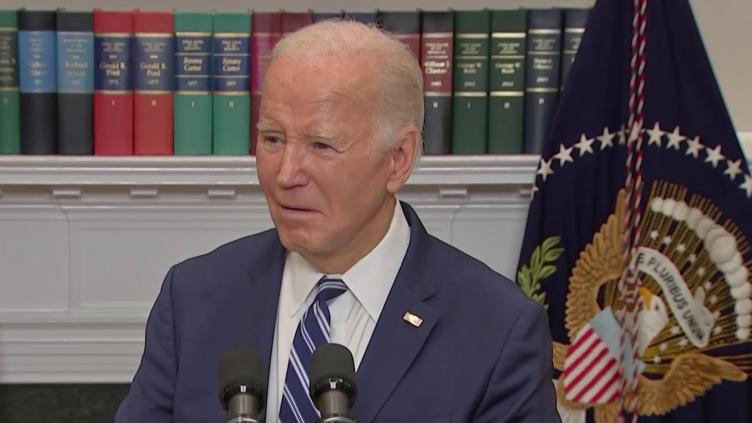
“First of all, there is no nuclear threat to the people of America or anywhere else in the world with what Russia is doing at the moment, No. 1,” Biden said in remarks from the White House when asked if he was concerned about Russia’s potential anti-satellite capability.
“No. 2, anything they’re doing or they will do relates to satellites in space and damaging those satellites potentially,” he added. “No. 3, there’s no evidence they’ve made a decision to go forward with anything in space either.”
The question came after Biden spoke about the death of Russian opposition leader Alexei Navalny, accusing Russian President Vladimir Putin of being responsible for Navalny’s death in a Siberian prison Friday.
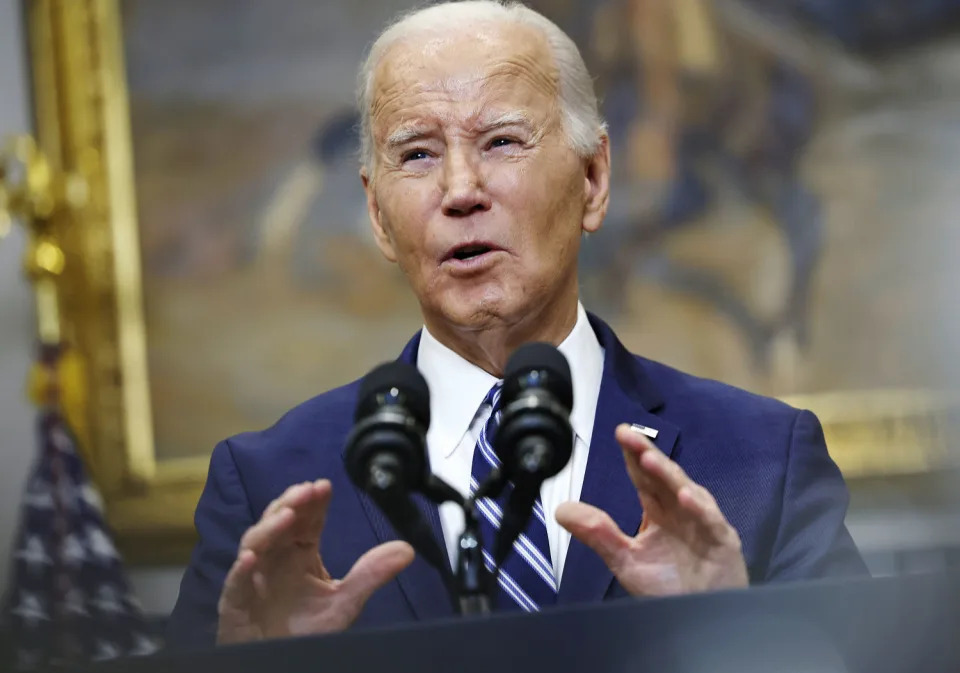
President Joe Biden at the White House on Feb. 16, 2024. (Anna Moneymaker / Getty Images)
Biden’s national security adviser, Jake Sullivan, briefed top House leaders behind closed doors Thursday on Capitol Hill about the Russian threat. National Security Council spokesman John Kirby also confirmed Thursday at the White House briefing that the threat is “related to an anti-satellite capability that Russia is developing.”
“First, this is not an active capability that’s been deployed, and though Russia’s pursuit of this particular capability is troubling, there is no immediate threat to anyone’s safety,” Kirby told reporters. “We are not talking about a weapon that can be used to attack human beings or cause physical destruction here on Earth. That said, we’ve been closely monitoring this Russian activity and we will continue to take it very seriously.”
In response, Biden has directed a series of actions, Kirby said, including additional briefings to members of Congress and direct diplomatic engagement with Russia as well as with U.S. allies and other countries.
A U.S. official and congressional official familiar with the intelligence told NBC News on Thursday that the threat is a Russian nuclear-powered space asset that could be weaponized rather than a nuclear bomb that Russia is trying to send into space. Russia is making headway, although it has not fielded the capability, officials said.
NBC News has reported that arms experts believe the threat is likely a nuclear-powered satellite that might be able to carry a high-powered jammer that could block satellite communications for long periods, according to a 2019 essay in The Space Review, an online publication, that was widely shared among experts following this week’s news.
Russian Deputy Foreign Minister Sergei Ryabkov characterized the U.S. information as a “malicious fabrication,” according to Russian state-run news agency Tass.
Information about the threat surfaced after House Intelligence Committee Chairman Mike Turner, R-Ohio, released a cryptic statement Wednesday that called on the White House to declassify information about an unnamed “serious national security threat.”
Sullivan later said he had already planned on briefing top leaders in the House on Thursday.
CNN host threatens to cut off interview with Texas Republican
Tara Suter – February 13, 2024
CNN host Brianna Keilar threatened to cut off an interview with Rep. Beth Van Duyne (R-Texas) Thursday after the representative interrupted her multiple times.
Keilar was interviewing Van Duyne on “CNN News Central” and questioning her about a Senate bill with Israel and Ukraine aid. Keilar noted that Speaker of the House Mike Johnson (R-La.) has criticized the bill for not including border security provisions.
Van Duyne then brought up Republicans’ border security bill, House Resolution 2, and said it would get rid of “catch and release,” or the humanitarian parole of migrants. She also spoke about her time as mayor of Irving, Texas and the partnership she had with Immigration and Customs Enforcement (ICE) while in that role.
“Let me stop and ask you about this, a couple things,” Keilar stated. “First off, illegal immigrants’ criminal conviction rate is 45 percent below that of native-born Americans in your state, just to be clear.
“When you raise the specter of, ‘They create so many crimes, they’re convicted,’” Keilar said. “I mean, when it comes to violent crimes, property crimes, homicides, sex crimes, you’ve talked in the past about rapes, the numbers just don’t support that. But let’s focus on ‘catch and release.’”
Van Duyne then began to interrupt Keilar, causing the two women to talk over each other. Keilar then attempted to bring up the topic of “catch and release” again, noting that when examining the practice, “you have to look at what’s causing it, and it’s a judicial backlog.” She also pointed to the recently failed bipartisan foreign aid and border deal, which would have clamped down on the practice of humanitarian parole.
“[A]ctually, it wouldn’t have,” Van Duyne cut in and began interrupting Keilar again, repeatedly disagreeing with her.
The two began to talk over each other again, leading to Keilar stating that if Van Duyne wouldn’t let her speak, she would “cut the interview off.”
“And I will let you speak and finish sentences,” Keilar said.
Three reasons why so many migrants want to cross from Mexico to US
By Bernd Debusmann Jr, Washington– February 7, 2024
Getty Images
Migrant arrivals at the border have risen to record highs during President Joe Biden’s administration, a massive political headache for him ahead of the election.
Polls suggest that more than two-thirds of Americans disapprove of Mr Biden’s handling of the issue.
His likely opponent in November’s presidential election, Donald Trump, has this week condemned a cross-party bill trying to address the problem, saying it’s not tough enough.
But it’s not just Republicans who are unhappy about the influx. Democratic mayors in cities struggling to cope with the numbers are also making their feelings known.
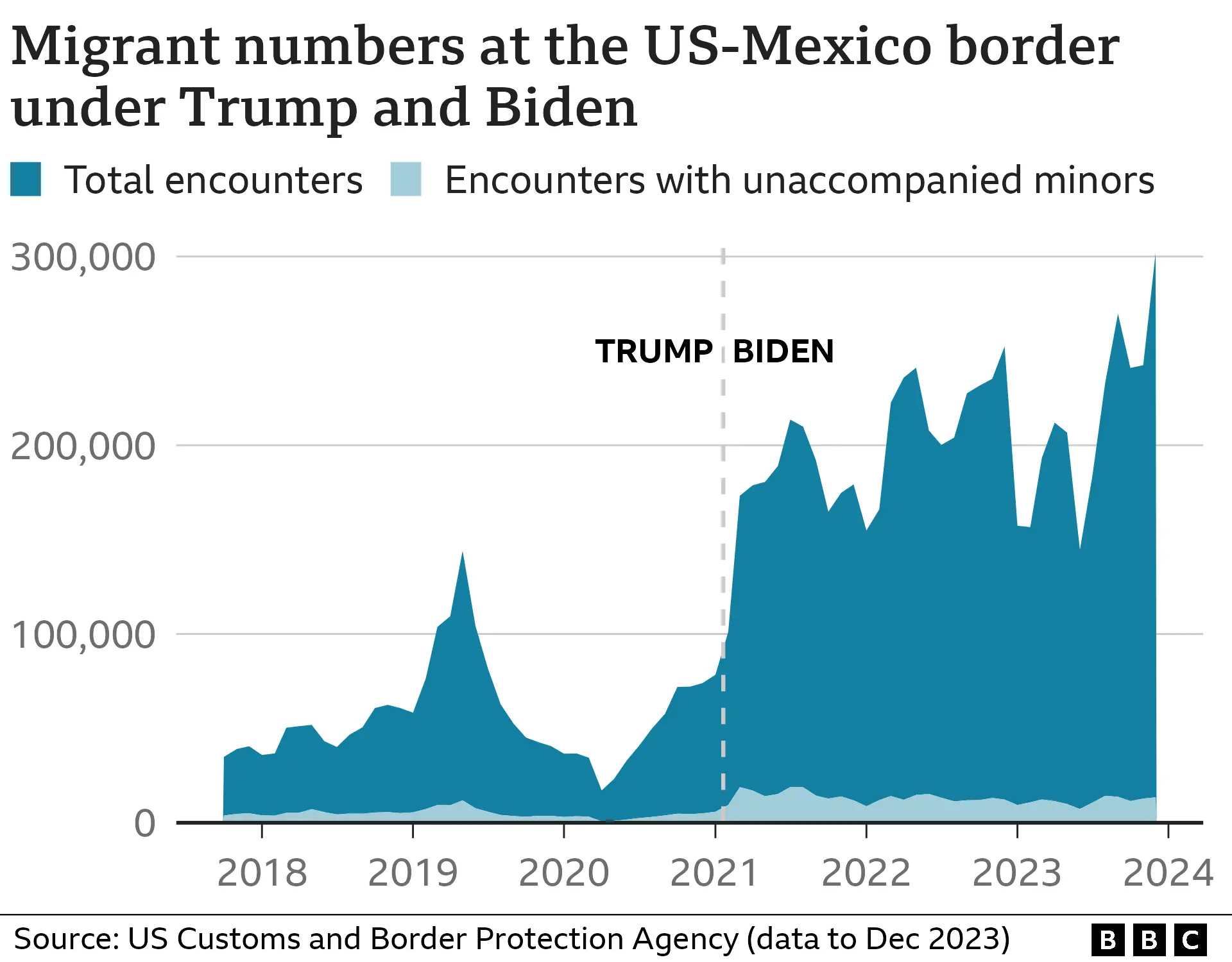
More than 6.3 million migrants have been detained crossing into the US illegally under Biden, a higher number than under Trump, Obama or George W Bush.
The reasons for the spike are complex, with some factors pre-dating this government and beyond the control of the US. We asked experts what’s going on.
1. Pent-up demand after lockdown
The number began to rise in 2018, largely driven by Central Americans fleeing a series of complex crises including gang violence, poverty, political repression and natural disasters. Detentions fell again in the summer of 2019, which US officials credited to increased enforcement by Mexico and Guatemala.
The most drastic reduction took place in early 2020, when pandemic-era restrictions led to a drastic reduction of over 53% between March and April that year.
Since these measures were lifted in early 2021, the numbers have steadily risen, reaching an all-time high of just over 302,000 in December 2023.
“That’s when we began to see an increase again, primarily of Central Americans after mobility restrictions [there] and across the region began to ease,” said Ariel Ruiz Soto, a policy analyst at the Washington DC-headquartered Migration Policy Institute.
“That’s also when the bigger change happened and we began to see much more diversified flows, starting with Venezuela, but also Colombia, Ecuador and places further away.”
Migrants now come from as far afield as West Africa, India and the Middle East.
Of migrants from outside the Americas, the greatest increase comes from China. More than 37,000 Chinese nationals were detained at the US-Mexico border last year, about 50 times the figure from two years ago.
2. Global migration trends
The increases in migrant figures seen at the US-Mexico border seen in the last several years also come at a time when, globally, migration to rich countries is at an all-time high.
Statistics from the Organisation for Economic Co-operation and Development (OECD) released late last year show that 6.1m new permanent migrants moved to its 38 member states in 2022 – a 26% increase over 2021 and 14% higher than in 2019.
The number of people granted asylum in the US doubled in 2022, driven in large part by migrants from Venezuela, Nicaragua and Cuba. The US is second only to Germany now in levels of humanitarian migration.
“We are experiencing displacement around the world at a level never seen in recorded history, and people are turning up at our southern border for a variety of different reasons,” explained Jorge Loweree, managing director of programmes at the American Immigration Council, a Washington-based non-profit and advocacy group.
“There are four failed states in our hemisphere alone.”
The switch in the White House in 2021 also contributed, say some experts.
A key message from President Trump, even if it never became a reality, was the building of a border wall and increased deportations.
The headlines created by the separation of children from their detained parents, decried by many as cruel, added to the impression that the US was closing its border.
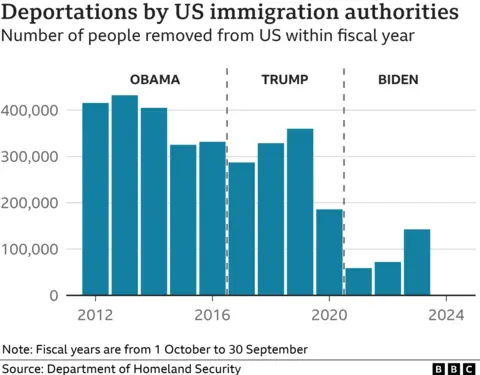
Under President Biden there was a change of tone and of policy. Deportations fell and “deterrent-focused” policies such as the rapid removal of migrants to Mexico and the building of a border wall ended.
Migrants were paroled into the US to await immigration court dates – a process which can often take years.
People trying to cross the border during this time told the BBC they thought that entering and staying in the US was going to be easier now. And human smugglers took advantage of a change in presidency to create a sense of urgency among migrants that they should hurry to the border.
“Part of it is that they think they can just come. I think that’s just what they’re being told,” said Alex Cuic, an immigration lawyer and professor at Case Western Reserve University in Ohio.
“They feel like there’s a pathway to come here,” he added. “It’s almost like an invite.”
Conversely, some immigration activists have criticised the Biden administration and US lawmakers from both parties for failing to pass meaningful immigration reform.
The last major overhaul of the system was more than 30 years ago and now the cross-party bill presented to Congress this week looks doomed due to Republican opposition.
Behind the border mess: Open GOP rebellion against McConnell
Burgess Everett – February 7, 2024
Senate Minority Leader Mitch McConnell, R-Ky., speaks during a news conference on border security, following the Senate policy luncheon at the Capitol in Washington, Tuesday, Feb. 6, 2024. (AP Photo/Jose Luis Magana)
Conservative hardliners once celebrated Mitch McConnell for wrestling the federal judiciary to the right and thwarting progressive hopes.
Now he is under open attack from the right for even trying to work with Democrats on the border.
The Senate GOP leader is facing internal resistance not seen in more than a year as Republicans descend into discord over two issues they once demanded be linked: border security and the war in Ukraine.
McConnell, now nearing his 82nd birthday, is determined to fund the Ukrainian war effort, a push his allies have depicted as legacy-defining. But now that his party is set on Wednesday to reject a bipartisan trade of tougher border policies for war funding, his far-right critics are speaking out more loudly: Several held a press conference Tuesday where they denounced his handling of the border talks, with Sen. Ted Cruz (R-Texas) calling on McConnell to step down.
In an interview, McConnell rejected the criticism and said his antagonists fail to recognize the reality of divided government.
“I’ve had a small group of persistent critics the whole time I’ve been in this job. They had their shot,” McConnell said, referring to Sen. Rick Scott’s (R-Fla.) challenge to his leadership in 2022.
“The reason we’ve been talking about the border is because they wanted to, the persistent critics,” he added. “You can’t pass a bill without dealing with a Democratic president and a Democratic Senate.”
Despite that pragmatism, McConnell’s job is only getting harder. If he runs for another term in leadership next year, a tougher fight than Scott gave him seems almost inevitable.
That is in part because of Donald Trump, whom McConnell barely acknowledges after criticizing his role in the Capitol riot of Jan. 6, 2021. The former president played a leading role in killing the border deal and has called consistently for McConnell’s ouster. And at this time next year, Trump could well be back in the White House.
More and more of Senate Republicans’ internal strife is seeping out into public view, exposing years-old beefs that are still simmering. Sen. Mike Lee (R-Utah) posted a fundraising link asking donors to “kill this border bill” in the middle of a closed-door GOP meeting on Monday and demanded “new leadership,” while Sen. Ron Johnson (R-Wis.) memed McConnell as Charlie Brown whiffing on an attempt to kick a football held by Sen. Kyrsten Sinema (I-Ariz.).
“I’ve been super unhappy since this started,” Johnson said in an interview. “Leader McConnell completely blew this.”
Trump and Speaker Mike Johnson helped squash the border bill’s prospects in the House while Ron Johnson, Lee, Cruz, Scott and Sen. J.D. Vance (R-Ohio) pummeled it on TV and social media. The intensity of that assault turned many GOP senators sour on a border security deal that would have amounted to the most conservative immigration bill backed by a Democratic president in a generation — a bill they once said was the key to unlocking Ukraine aid.
Though McConnell touted the work of Sen. James Lankford (R-Okla.) and the bill’s endorsement by the Border Patrol union, he conceded what was obvious by Monday night: This legislation is dead.
“The reason we ended up where we are is the members decided, since it was never going to become law, they didn’t want to deal with it,” McConnell said in the interview. “I don’t know who is at fault here, in terms of trying to cast public blame.”
At Tuesday’s party meeting, Cruz told McConnell that the border deal was indefensible, while Sen. Lisa Murkowski (R-Alaska) questioned why the GOP would walk away from it, according to two people familiar with the meeting. That followed a Monday evening private meeting where Johnson got into a near-shouting match with Sen. Todd Young (R-Ind.), one of several senators who has tried to rebut Trump’s influence on the party.
Young played down the spat afterward: “Ron and I have a very good relationship. We can be very candid with one another.”
McConnell’s loud critics are among those most responsible for raising opposition to the border deal, attacking its provisions while the text was being finalized. They raised such a ruckus that none of McConnell’s potential successors as leader — Sens. John Barrasso (R-Wyo.), John Cornyn (R-Texas) and John Thune (R-S.D.) — offered to support it.
McConnell can’t be ejected spontaneously like a House speaker, meaning his job is safe until the end of the year. He also has major sway over the Senate Leadership Fund, a super PAC that may have to help Cruz, Scott and other Republicans win reelection.
And McConnell is not without defenders. Sen. Lindsey Graham (R-S.C.) said any attempt to blame McConnell for the border crackup is “a bit misplaced.”
Indeed, McConnell was OK with just approving foreign aid back in the fall, but agreed to link it to border security after rank-and-file Republicans grew eager to extract concessions from Democrats in order to get Ukraine money.
“It’s not James’ fault, he did the best he could under the circumstances. It’s not Mitch’s fault,” said Sen. John Kennedy (R-La.).
The historical record holds plenty of quotes from McConnell’s current critics asking for stronger border policy during the Trump administration. Many of them now have since changed their tune to say Biden doesn’t need new laws at all to enforce border security.
“We all wanted to see border security. And I think a lot of our members were demanding that in exchange for the rest of the funding. That’s an issue our conference needs to be aware of,” said Sen. Joni Ernst (R-Iowa), the No. 4 leader. “The conference wanted border security.”
The animosity McConnell now faces from Ron Johnson, Lee and others isn’t new either: They’ve questioned Senate GOP leadership’s decisions for years.
Ron Johnson’s been a thorn in McConnell’s side for years, particularly after many Republicans abandoned his reelection bid in 2016. Cruz has sparred with McConnell since getting to the Senate in 2013, Lee frequently breaks with leadership and a number of newer GOP senators voted for Scott over McConnell in 2022.
One GOP senator, granted anonymity to assess the situation candidly, said that the new wave of attacks could be happening because McConnell’s opponents sense weakness — or just out of “personal pique” over years-old disagreements.
“For three months it’s been nothing but border and Ukraine, border and Ukraine, border and Ukraine. I don’t know how many speeches I’ve heard … and now all of a sudden, it’s: ‘We’re not going to do that,’” said Sen. Josh Hawley (R-Mo.), another of the McConnell critics. “It just seems like total chaos to me.”
Either way, the 180 among many Republicans is evidence of a major drift away from McConnell’s style of Republicanism and toward Trump’s. McConnell hasn’t talked to Trump since the Jan. 6 riot and tried to turn the party in a surprisingly deal-centric direction during the first two years of President Joe Biden’s presidency.
Just two years ago, debt ceiling increases, gun safety and infrastructure laws passed with McConnell’s blessing — all a reflection of his view that protecting the filibuster requires working with Democrats on bipartisan bills.
Now the reality is that Trump, the likely nominee, doesn’t want a deal that Republicans set out to secure four months ago. Deal-making without Trump’s blessing appears impossible, and that’s a challenging dynamic for the longtime GOP leader.
“This wasn’t good for him. This wasn’t good for any of us,” said Sen. Tommy Tuberville (R-Ala.) of McConnell, whom he backed in 2022. “And I’m not gonna say he’s the total cause of it, but we got to have a better plan. This didn’t work out for us.”
74 percent of Republicans say it’s fine for Trump to be dictator for a day
Lauren Irwin – February 7, 2024
A new survey found that a majority of Republicans say it is fine for former President Trump to be a dictator for the day if he wins the presidential election.
The survey from the University of Massachusetts Amherst and YouGov found that 74 percent of Republican voters said it would be a good idea if Trump follows through on his remarks in which he said he would be a dictator only on the first day of his second term. Twenty-six percent of Republicans say it would be a bad thing.
Thirty-six percent of independent voters said it would be good, while 65 percent said it would be a bad idea.
Democrats were much more opposed. Only 13 percent of Democratic respondents said it would be a good idea for the country if Trump fulfilled his vow to be dictator for a day, while 87 percent said it would be a bad idea.
Trump has said in the past that he would not be a dictator if he were reelected, “except for day one.” On the campaign trail in Iowa in December, Trump doubled down on his claims that he would close the border and be “drilling, drilling, drilling” on his first day back in office.
“After that, I’m not a dictator,” he told Sean Hannity of Fox News.
The remarks have fueled concern for Democrats and even some Republicans that a second Trump term could threaten democracy, as he has threatened to abuse power and target people who have disagreed with him.
The former president is currently defending himself against 91 criminal charges among four state and federal criminal indictments. He is the front-runner to become the GOP’s nominee for the 2024 presidential election.
According to the survey, voters are split on whether they believe Trump is guilty of charges that he tried to overturn the results of the 2020 presidential election.
Fifty-eight percent of respondents said Trump is likely guilty, while 42 percent said they believe he is innocent. Seventy-two percent of Republican voters said they think the former president is innocent.
The survey was conducted Jan. 25-30 among 1,064 respondents. It has a margin of error of 3.7 percent.
Biden blames Trump for sinking bipartisan immigration bill
By Steve Holland – February 6, 2024
WASHINGTON (Reuters) -U.S. President Joe Biden said on Tuesday that the bipartisan immigration bill is falling apart under political pressure from Republican rival Donald Trump and vowed to hit the road to remind voters who was to blame if it fails.
“All indications are this bill won’t even move forward to the Senate floor. Why? The simple reason: Donald Trump,” Biden said. “Because Donald Trump thinks it’s bad for him politically.”
Concerns over immigration have become a top issue in this year’s election campaign, with Trump preparing for a likely November rematch with Biden. Trump has been pushing congressional Republicans to reject the bipartisan border security deal unveiled on Sunday.
A spokesperson for Trump did not immediately respond to a request for comment.
Biden’s vow to make the Republican ex-president’s efforts to kill the bill a major theme of his reelection campaign is a risky bet given polls showing that Americans give Biden low grades for his handling of border security and immigration.
The Democratic president’s approval rating sank to 38% in January as concerns over immigration flared, the latest Reuters/Ipsos poll showed.
Biden has grappled with record numbers of migrants caught illegally crossing the U.S.-Mexico border during his presidency. Republicans contend that Biden should have kept the restrictive policies of Trump.
In December, encounters averaged more than 9,500 per day, according to U.S. government statistics, but have dropped steeply in about the last month.
Biden will test whether blaming Trump for thwarting a bipartisan compromise can help change American minds.
“I’ll be taking this issue to the country and the voters are gonna know that…just at the moment we’re going to secure the border and fund these other programs Trump and the MAGA Republicans said no because they’re afraid of Donald Trump,” Biden said at the White House.
The $118 billion bill, which also includes aid for Israel and Ukraine as it fights a Russian invasion, is quickly losing support on Capitol Hill. House of Representatives Republicans have declared it dead on arrival, and more than 20 Republican senators have said the measure is not strict enough.
Several Democrats have also opposed the bill because they say some of its measures treat migrants too harshly.
Biden didn’t mention the Democratic opposition, but blamed Republicans for buckling under the pressure from Trump, who he said was reaching out to Republican lawmakers to “intimidate them to vote against this proposal.”
“Frankly, they owe it to the American people to show some spine and do what they know to be right,” Biden said.
Senate Majority Leader Chuck Schumer on Tuesday also took aim at Trump over the mounting opposition to the border security deal.
“Donald Trump would rather keep the chaos at the border so he can exploit it on the campaign trail instead of letting the Senate do the right thing and fix it,” Schumer said.
(Reporting by Steve Holland and Jarrett Renshaw; Writing by Jarrett Renshaw; Editing by Trevor Hunnicut and Leslie Adler)









 Getty Images