Michigan family mourns loved one who came to Naples to help, acquires deadly infection
Liz Freeman, Naples Daily News – October 20, 2022
A Michigan man who came to Naples to help a friend in the aftermath of Hurricane Ian died from a deadly bacteria that lives in standing water.
James Hewitt, of Jenison, Mich., fell in the water while helping a friend with his boat and he scratched his leg, according to FOX 17 in western Michigan.
He put anti-bacteria ointment on the wound and thought that was enough, his fiancé, Leah Dalano, told the news station.
“He just helped so many people, that’s just what he wanted to do,” Delano told FOX17.
The hull of a sail boat destroyed by Hurricane Ian sits among other debris by Naples Bay near 10th Avenue South in Naples, FL, on Tuesday, October 4, 2022.
Hewitt went to a hospital after his leg had become swollen and he was in pain.
That’s when doctors diagnosed the infection as vibrio vulnificus, a bacteria found in warm salty or brackish waters that can enter the body through open wounds.
“It goes after your vital organs and it leaves you with horrible blisters near the area,” Delano told FOX 17. “He got scratched on his leg and it was unrecognizable.”
One of his sons, Kendall Smoes, posted on his Facebook page five days ago that his father fought hard but died peacefully with his family and his fiancé by his side. Smoes could not be reached for comment.
The state Department of Health in Collier put out an advisory Oct. 4 about the danger of vibrio vulnificus and how the bacteria can grow quickly. Sewage spills in coastal waters caused by Ian can increase the bacteria levels.
“Vibrio vulnificus can cause and infection of the skin when open wounds are exposed to warm sea water,” the advisory said. “These infections may lead to skin breakdown and ulcers. Anyone can get vibrio vulnificus infection; however infections can be severe for people with weakened immune systems, especially people who have chronic liver disease or take medications that lower the body’s ability to fight germs.”
Since the beginning of 2022, there have been three cases in Collier and 28 in Lee County. Statewide there have been 64 cases, according to the state health department’s reportable disease website.
There is one case of vibrio vulnificus reported this month in Collier that is tied to Ian, according to Kristine Hollingsworth, spokeswoman for the state health department in Collier
She could not disclose details. It is unrelated to the recent vibrio vulnificus death of Hewitt, who came to Naples from Michigan.
“The person from Michigan would count as a case for Michigan (state of residency), even though we did the investigation,” she said.
Vibrio vulnificus can invade the bloodstream, causing a severe life-threatening illness with symptoms like fever, chills, decreased blood pressure (septic shock), and blistering skin lesions.
It does not spread person-to-person. If someone is concerned that they may have been exposed to vibrio vulnificus and experiencing symptoms, they should seek medical care.
Study: Cancer-causing gas leaking from CA stoves, pipes
Drew Costley – October 20, 2022
Gas stoves in California homes are leaking cancer-causing benzene, researchers found in a new study published on Thursday, though they say more research is needed to understand how many homes have leaks.
In the study, published in Environmental Science and Technology on Thursday, researchers also estimated that over 4 tons of benzene per year are being leaked into the atmosphere from outdoor pipes that deliver the gas to buildings around California — the equivalent to the benzene emissions from nearly 60,000 vehicles. And those emissions are unaccounted for by the state.
The researchers collected samples of gas from 159 homes in different regions of California and measured to see what types of gases were being emitted into homes when stoves were off. They found that all of the samples they tested had hazardous air pollutants, like benzene, toluene, ethylbenzene and xylene (BTEX), all of which can have adverse health effects in humans with chronic exposure or acute exposure in larger amounts.
Of most concern to the researchers was benzene, a known carcinogen that can lead to leukemia and other cancers and blood disorders, according to the National Cancer Institute.
The finding could have major implications for indoor and outdoor air quality in California, which has the second highest level of residential natural gas use in the United States.
“What our science shows is that people in California are exposed to potentially hazardous levels of benzene from the gas that is piped into their homes,” said Drew Michanowicz, a study co-author and senior scientist at PSE Healthy Energy, an energy research and policy institute. “We hope that policymakers will consider this data when they are making policy to ensure current and future policies are health-protective in light of this new research.” 0:01 0:38 Scroll back up to restore default view.
Homes in the Greater Los Angeles, the North San Fernando Valley, and the San Clarita Valley areas had the highest benzene in gas levels. Leaks from stoves in these regions could emit enough benzene to significantly exceed the limit determined to be safe by the California Office of Environmental Health Hazards Assessment.
This finding in particular didn’t surprise residents and health care workers in the region who spoke to The Associated Press about the study. That’s because many of them experienced the largest-known natural gas leak in the nation in Aliso Canyon in 2015.
Back then, 100,000 tons of methane and other gases, including benzene, leaked from a failed well operated by Southern California Gas Co. It took nearly four months to get the leak under control and resulted in headaches, nausea and nose bleeds.
Dr. Jeffrey Nordella was a physician at an urgent care in the region during this time and remembers being puzzled by the variety of symptoms patients were experiencing. “I didn’t have much to offer them,” except to help them try to detox from the exposures, he said.
That was an acute exposure of a large amount of benzene, which is different from chronic exposure to smaller amounts, but “remember what the World Health Organization said: there’s no safe level of benzene,” he said.
Kyoko Hibino was one of the residents exposed to toxic air pollution as a result of the Aliso Canyon gas leak. After the leak, she started having a persistent cough and nosebleeds and eventually was diagnosed with breast cancer, which has also been linked to benzene exposure. Her cats also started having nosebleeds and one recently passed away from leukemia.
“I’d say let’s take this study really seriously and understand how bad (benzene exposure) is,” she said.
Trump drops F-bombs and shares potentially sensitive information in newly released audio
Stephen Proctor – October 19, 2022
Previously unheard audio featuring former President Donald Trump aired Tuesday on Anderson Cooper 360. Famed journalist Bob Woodward recorded 20 conversations he had with the former president, with Trump’s knowledge, from 2016 through 2020. Trump, who is facing possible legal peril for taking classified documents when he left office, appears in one recording to share sensitive information with Woodward.
“I have built a weapons system that nobody’s ever had in this country before,” Trump said. “We have stuff that you haven’t even seen or heard about. We have stuff that Putin and Xi have never heard about before.”
Trump also spoke of Russia’s nuclear capabilities.
“Getting along with Russia is a good thing, not a bad thing, alright?” Trump said. “Especially because they have 1,332 nuclear f***ing warheads.”
Throughout his presidency, Trump was criticized for his apparent affinity for authoritarian leaders, which he spoke about to Woodward.
“It’s funny, the relationships I have, the tougher and meaner they are, the better I get along with them. You know? Explain that to me someday, OK,” Trump said. “But maybe it’s not a bad thing. The easy ones are the ones I maybe don’t like as much or don’t get along with as much.”
In another recording, Trump brags about how he handled being impeached, while at the same time taking shots at two of his predecessors who also faced impeachment.
“There’s nobody that’s tougher than me,” Trump said. “Nobody’s tougher than me. You asked me about impeachment. I’m under impeachment, and you said, you know, you just act like you won the f***ing race. Nixon was in a corner with his thumb in his mouth. Bill Clinton took it very, very hard. I just do things, OK?”
In 2016, Woodward asked then-candidate Trump about having his staff sign non-disclosure agreements. Woodward recorded Trump talking to his staff about who had and who had not yet signed one. Trump was confident in the effectiveness of these agreements at the time, but a multitude of former officials wrote tell-all books after leaving the administration.
Woodward plans to release the more than eight hours of recordings as an audiobook titled The Trump Tapes on Oct. 25.
A Trump aide was caught on security camera moving boxes from a Mar-a-Lago storage room before and after the DOJ subpoenaed Trump for top-secret documents: NYT
Cheryl Teh – October 13, 2022
Donald Trump at Mar-a-Lago.NICHOLAS KAMM/AFP via Getty Images A Trump aide was caught on security camera moving boxes from a Mar-a-Lago storage room before and after the DOJ subpoenaed Trump for top-secret documents: NYT
Walt Nauta, a longtime Trump aide, was seen moving boxes out from a storage room the FBI searched.
The incidents were caught on security footage, The New York Times reported.
Nauta was seen moving boxes before and after the DOJ demanded top-secret files be returned in May.
A Trump aide was caught on security camera moving boxes out of a storage room in Mar-a-Lago, per a report from The New York Times. The Times did not view the security footage and Insider was not independently able to verify its contents.
The Times spoke to three people familiar with the matter, who said longtime Trump staffer Walt Nauta was seen on Mar-a-Lago’s security footage moving boxes out of a storage room that was later searched by the FBI. This took place both before and after the Department of Justice issued a subpoena in May ordering Trump to hand over classified documents, per the NYT’s sources.
Intrigue has swirled around what was kept in the storage room, and whether anything was removed from it before the DOJ searched Trump’s property. The Times’ piece dropped hours after The Washington Post reported that Trump himself explicitly directed employees to move boxes of White House documents from the storage room. These boxes were taken from the storage area to the former president’s private residence after Trump advisers received the DOJ’s subpoena in May, per The Post.
The FBI also interviewed Nauta several times before it raided Mar-a-Lago on August 8, according to one of The Times’ sources.
The DOJ is currently investigating whether Trump broke three federal laws — including the Espionage Act — by keeping the files at his Florida residence. In an August court filing, the Justice Department said it had evidence “that government records were likely concealed and removed” from the storage room at Mar-a-Lago, and that “efforts were likely taken to obstruct the government’s investigation.”
Nauta’s lawyer, Stanley Woodward Jr., declined to comment on The Times’ reporting. Taylor Budowich, Trump’s spokesman at his post-presidential press office, told The Times the Biden administration was “colluding with the media through targeted leaks in an overt and illegal act of intimidation and tampering.”
Budowich and Woodward Jr. did not immediately respond to Insider’s requests for comment.
Republicans Plan to Use Debt Limit Leverage to Reduce Social Security, Medicare: Report
Michael Rainey – October 12, 2022
Republicans in the House are planning to use a potential showdown next year over raising the federal debt limit to make changes in Social Security and Medicare, Bloomberg’s Jack Fitzpatrick reports.
The developing plan hinges on Republicans winning control of the House in the midterm elections, an outcome that is looking likely. Four GOP lawmakers who are vying for leadership of the House Budget Committee in the event of a Republican victory told Fitzpatrick that the need to raise the debt ceiling could give them the leverage they need to force Democrats to make concessions.
“The debt limit is clearly one of those tools that Republicans — that a Republican-controlled Congress — will use to make sure that we do everything we can to make this economy strong,” Rep. Jason Smith (R-MO), the senior Republican on the current Budget Committee, said.
Republicans are still discussing exactly what changes they might try to enact. “What would we consider a win?” said Rep. Lloyd Smucker (R-PA), who is interested in the top spot on the Budget Committee. “What would we consider to be a fiscally responsible budget?”
Although the details are still up in the air, one theme is clear: House Republicans want to reduce federal spending, and the major entitlement programs are a target. Rep. Buddy Carter (R-GA) Carter said that Republicans’ “main focus has got to be on nondiscretionary — it’s got to be on entitlements.”
Shrinking the safety net: One option reportedly being discussed is raising the eligibility age for Social Security and Medicare, the two largest mandatory spending programs. Each faces financial squeezes in the coming years as the baby boomers age and continue to retire. Under current rules, the Social Security system would be forced to cut benefits starting in 2034, while Medicare could run short of funds by 2028.
Earlier this year, the Republican Study Committee released a plan to raise the eligibility age for Social Security to 70 and the eligibility age for Medicare to 67. The increases would be phased in over time and once the target is reached, the eligibility age would then be indexed to life expectancy. The lawmakers also called for increased means testing in the Medicare program, and a privatization option for Social Security.
Other options being considered include more stringent work requirements and income limits for what Smith called “welfare programs,” including the Supplemental Nutrition Assistance Program more commonly known as food stamps. And new caps on discretionary spending could limit spending increases over 10 years.
One thing that won’t be cut: defense spending. Rep. Jodey Arrington (R-TX) told Bloomberg that he wants to cut nondefense spending in order to provide more money for the military.
Willing to risk “catastrophe”? Republicans say they are leery about pushing too far in their demands, but many experts think that any effort to use the debt limit as leverage in negotiations is unacceptably risky. Treasury Secretary Janet Yellen has warned that defaulting on U.S. debt payments — which would occur if the U.S. failed to raise the debt ceiling — would cause a “catastrophe” in the global economy.
Speaker Nancy Pelosi (D-CA) accused the GOP of taking huge risks in order to cut important social programs. “House Republicans are openly threatening to cause an economic catastrophe in order to realize their obsession with slashing Medicare and Social Security,” a Pelosi spokesperson told Bloomberg. “As House Republican leaders’ own words constantly reveal, dismantling the pillars of American seniors’ financial security is not a fringe view in the extreme MAGA House GOP, it is a broadly held obsession at the core of their legislative agenda.”
House Budget Committee Chair John Yarmuth (D-KY) also criticized Republican plans. “Holding the full faith and credit of the United States hostage to implement an extreme and unpopular agenda is not governing, it’s desperation,” Yarmuth said in a statement. “Congressional Republicans are so hellbent on gutting Social Security and ending Medicare as we know it that they are willing to risk economic catastrophe to get it done. This is a desperate attempt to shower the wealthy and big corporations with even more tax giveaways by intentionally sacrificing the needs of American families.”
Democrats do have one option for disarming Republicans ahead of a debt ceiling showdown: They could attempt to raise the ceiling on their own during the lame-duck session at the end of the year, potentially denying the GOP the use of that weapon. But both Yarmuth and Sen. Tim Kaine (D-VA) told Bloomberg there has been no discussion among Democrats about such a plan.
The bottom line: Taking a page from the tea party playbook from a decade ago, expect to see Republicans attempting to force spending reductions in the next Congress — reductions that could involve fundamental changes in the way the country’s top safety net programs operate.
Members of Nevada Senate candidate’s family endorse opponent
Gabe Stern – October 12, 2022
RENO, Nev. (AP) — Less than a month before Election Day, 14 members of Nevada Republican Senate candidate Adam Laxalt’s family sent a letter endorsing his opponent, Democratic U.S. Sen. Catherine Cortez Masto.
“We staunchly believe that Catherine is well equipped with her own ‘Nevada grit’ — a quality that she will take forward in representation of our home state for six more years across the halls of Congress,” the letter states.
Instead, it talks of Cortez Masto’s understanding of “the daily realities of dogged hard work” and mentions her experience in public education as well as her commitment to law enforcement.
The family members also wrote that Cortez Masto’s career demonstrates she is “an authentic advocate of Nevada.”
It marks the second time that some of Laxalt’s family has endorsed his opponent. During his unsuccessful gubernatorial run in 2018, a dozen family members endorsed Democrat Steve Sisolak in an op-ed to the Reno Gazette-Journal. That letter more explicitly criticized Laxalt, saying he “leveraged and exploited” the family name throughout his campaign.
That letter prompted 22 of his family members to send another op-ed, defending Laxalt and calling the other letter “vicious and entirely baseless.”
The grandson of former U.S. Sen. and Nevada Gov. Paul Laxalt and the son of former Sen. Pete Domenici, R-New Mexico, Laxalt is seen by many as the best opportunity for Republicans to pick up a seat that could give them the majority in the Senate.
In a tweet on Wednesday afternoon, Laxalt said it is “not surprising” that family members, most of whom he said are Democrats, are supporting Cortez Masto.
“They think that Nevada & our country are heading in the right direction. I believe Nevadans don’t agree,” he said.
The Laxalt family joins a growing list of endorsers from across the aisle, Cortez Masto spokesperson Sigalle Reshef said in a statement, citing law enforcement organizations and rural lawmakers who have endorsed the Democratic candidate.
Stern is a corps member for the Associated Press/Report for America Statehouse News Initiative. Report for America is a nonprofit national service program that places journalists in local newsrooms to report on undercovered issues.
Spanish Vineyards Use Solar Panels to Protect Wine Grapes
By Paige Bennett, Edited by Irma Omerhodzic – October 12, 2022
As global wineries are hit with impacts of climate change, a new project called Winesolar in Spain is innovating ways for vineyards to protect their grapes while also generating clean energy.
Iberdrola, an energy company based in Bilbao, Spain, has created a shelter for growing wine grapes at vineyards in Guadamur. The shelter is made with a few solar panels that generate about 40 kW of energy, which will be used by the González Byass and Grupo Emperador wineries. The solar panel shelter creates a microclimate by shading or exposing plants from the sun and offering some relief from high temperatures while also minimizing evaporation after watering crops.
While combining solar energy and agricultural land is not new, one component that makes the Winesolar project stand out is that it will have a tracking system, with trackers from PVH, that uses artificial intelligence (AI) to determine the most efficient solar panel positioning over the vines at any time, according to Iberdrola. Techedge, an IT firm, will help the solar panel project further the wineries’ agricultural goals.
Sensors in the vineyards will record data including soil humidity, wind conditions, solar radiation, and even vine thickness to find the optimal position for the solar panels, giving the vines a fighting chance against the effects of climate change.
“The installation will help to improve the quality of the grapes, allow a more efficient use of the land, reduce the consumption of irrigation water and improve the crop’s resistance to climatic conditions in the face of rising temperatures and increasingly frequent heat waves,” Iberdrola explained in a statement.
While the project is a small pilot, Iberdrola has plans to expand the idea into other Spanish vineyards, in addition to adding another 1,500 megawatts of solar panels across Spain. The company has installed 2,200 MW so far in 2022 and installed 800 MW last year, as CleanTechnica reported.
The project is an example of growing interest in agrovoltaics, or a balance between photovoltaic energy and agriculture through the installation of solar panels on farms. Agrovoltaic projects are meant to improve sustainability and make farming more efficient. While it isn’t a new concept — it was first conceived in the early 1980s — it has become increasingly popular in recent years for its potential environmental and economical benefits.
“When it comes to the environment, the main benefit of agrovoltaics is that it reduces greenhouse gas emissions from the agricultural sector,” Iberdrola said on its website. “What’s more, the dual use of land for both agriculture and for energy relieves pressure on ecosystems and biodiversity, which are affected when cultivation areas are expanded.”
Climate change is causing more billion-dollar weather disasters
David Knowles, Senior Editor – October 12, 2022
When Hurricane Ian barreled into Florida’s Gulf Coast last month, it became the 15th extreme weather event in the U.S. this year to rack up damages totaling more than $1 billion. Climate change, data shows, is helping to make expensive disasters much more frequent in recent years.
“In the last five years [2017-2021], there were just 18 days on average between billion-dollar disasters—compared to 82 days in the 1980s,” Climate Central, a consortium of scientists and journalists, found in a new analysis posted to its website.
This year’s extreme weather disasters in the U.S. have resulted in over 340 deaths, the NOAA said, and the financial toll is still being tallied. The insurance losses alone from Hurricane Ian are projected to cost between $53 billion and $74 billion, according to an estimate by RMS, a risk modeling company. In addition to that staggering sum, the National Flood Insurance Program could face an extra $10 billion in losses, Insurance Business America reported.
“The number and cost of weather and climate disasters are increasing in the United States due to a combination of increased exposure (i.e., more assets at risk), vulnerability (i.e., how much damage a hazard of given intensity — wind speed or flood depth, for example — causes at a location), and climate change is also supercharging the increasing frequency and intensity of certain types of extreme weather that lead to billion-dollar disasters — most notably the rise in vulnerability to drought, lengthening wildfire seasons in the western states, and the potential for extremely heavy rainfall becoming more common in the eastern states,” Adam Smith, a climatologist at the National Centers for Environmental Information and a lead analyst on the NOAA’s findings on $1 billion disasters, told Yahoo news in an email. “Sea level rise is worsening hurricane storm surge flooding.”
While climate change is not the sole cause of events like hurricanes, drought, rainfall or wildfires, ample scientific research has shown that rising global temperatures are amplifying all of them, making each potentially more destructive.
Workers clearing debris in Fort Myers, Fla., in the wake of Hurricane Ian, Oct. 1. (Giorgio Viera/AFP)
“The year-to-date average temperature for the contiguous U.S. was 56.8 degrees F — 1.7 degrees above average — ranking in the warmest third of the YTD record. California and Florida saw their third- and fourth-warmest January-through-September periods on record, respectively,” the NOAA stated on its website.
Across the West, nearly 1,000 heat records were broken in early September, the NOAA said, a month that will go down as the fifth-warmest on record. In all, the last seven years have been the warmest on record, according to data from NASA, the NOAA and Berkeley Earth.
The Intergovernmental Panel on Climate Change has for years been sounding the alarm about the risks related to global temperature rise and tried to convince world governments to agree to limit greenhouse gas emissions so as to keep average temperatures from rising above 1.5 degrees Celsius (2.7 degrees Fahrenheit) above preindustrial levels.
In its most recent report, which was issued in February, the IPCC reiterated that the planet could expect an increase in the kinds of severe weather consequences seen in recent years that have been liked to climate change.
“This report is a dire warning about the consequences of inaction,” Hoesung Lee, chair of the IPCC, said in a statement that accompanied the release of the report. “It shows that climate change is a grave and mounting threat to our well-being and a healthy planet. Our actions today will shape how people adapt and nature responds to increasing climate risks.”
Hurricane Ian exposed a flood insurance nightmare for homeowners in Florida
Phil McCausland – October 11, 2022
Hurricane Ian’s storm surge brought numerous feet of water into homes on Florida’s west coast, and left behind mold, muck, mud and a flood insurance nightmare for residents who want to rebuild.
Many Floridians who suffered extensive flooding did not carry a separate flood insurance policy to cover the damage caused by the deadly storm. It’s left homeowners — and even renters — with a hefty and, possibly, life-changing expense that could decide whether they are rendered homeless.
Susan Cavanaugh and her two kids are living through that ordeal after the first floor of their home on Sanibel Island, where all three live and work, was engulfed by the storm surge. While going through a costly divorce earlier this year, Cavanaugh’s flood insurance coverage lapsed.
Now she doesn’t know how to get her family back into their home without an insurance check to pay for contractors and building materials.
“I can only do so much as a single mom,” said Cavanaugh, who is staying in a motel and is unsure where to live next. “We just want to go back to the house. It’s been deemed structurally sound, but we have to get it back online and it’s not just a cosmetic issue. It’s going to take blood, sweat and tears and it’s going to take a lot of muscle and a lot of work to get there.”
Image: Resident Pamela Brislin who has lived on Sanibel Island since 2020 cleans up the damage from Hurricane Ian, on Oct. 6, 2022, in Sanibel Island, Fla. (Scott Smith / AP)
Sanibel Island last month suffered a direct hit from the Category 4 storm and the surge of water, up to 15 feet in some places, it brought from the gulf into people’s homes. The community remains inaccessible by car, forcing many to pay boat captains to ferry them to begin the cleanup.
Cavanaugh is not alone in facing flood damage without the backing of insurance coverage. Many people in the small coastal community, which faces the Gulf of Mexico southwest of Fort Myers, did not have flood insurance coverage.
What’s more, Sanibel Island is a microcosm of a greater insurance challenge facing Florida and the country.
Only about 18.5% of homes in Florida counties that faced a mandatory or voluntary evacuation order the evening before Hurricane Ian landed had a flood insurance policy with the National Flood Insurance Program, the federal government program administered by FEMA, according to an analysis conducted by the risk management consulting firm Milliman. Even in designated flood hazard zones within those counties, fewer than half of the homes had a policy on file.
It appears that, despite an increased occurrence of devastating flood events, a declining percentage of people nationwide have flood insurance policies. The number of policies maintained by the National Flood Insurance Program has declined by nearly 700,000 since 2008, according to data acquired from the federal agency.
“There are many factors that influence this drop in policyholders, including the economic impact of the pandemic, the housing market, affordability, or purchasing flood insurance from the private market,” David Maurstad, the senior executive of the National Flood Insurance Program, said in a statement.
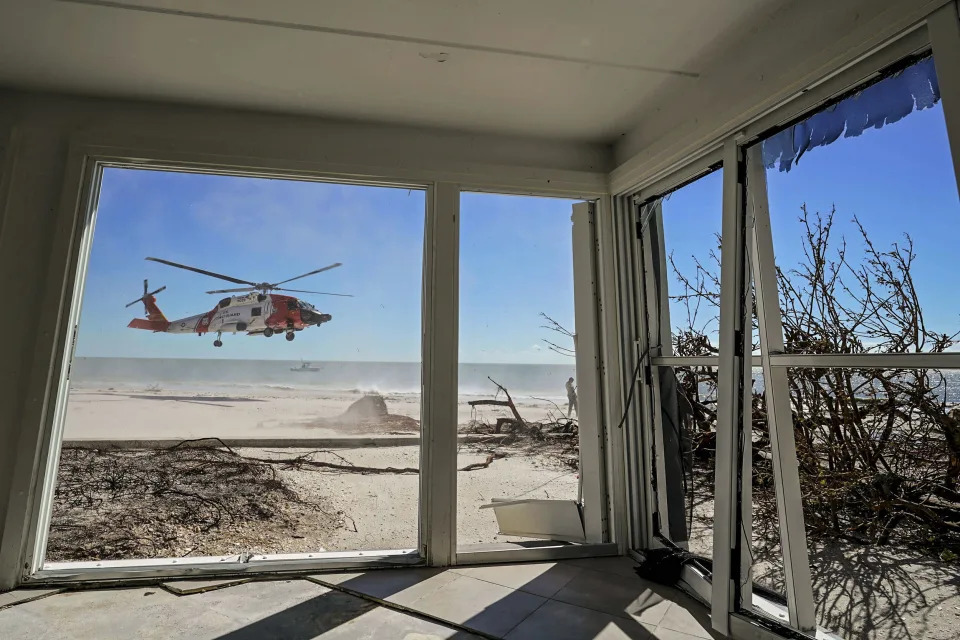
Image: A U.S. Coast Guard helicopter takes off, seen from inside a home damaged by Hurricane Ian on Sanibel Island, Fla., on Sept. 30, 2022. (Steve Helber / AP filw)
He said that FEMA “continues to market the flood insurance product throughout the country” in an effort “to increase the number of properties covered by flood insurance.” Currently about 5 million policies are under the National Flood Insurance Program, which was created in the 1960s because the private insurance market increasingly declined to cover flood events.
It’s an expensive undertaking for the federal government. Since 2008, the program has paid out $40.1 billion to slightly more than 910,000 claims, according to FEMA’s data, and the agency still owes about $20 billion to the U.S. Treasury after borrowing funds to pay out many of those claims.
With climate change leading to more dangerous storms and expanding the risk of flooding, the U.S. and its coastal communities are beginning to suffer the pitfalls of building in flood-prone areas.
“The risk is there as weather losses are on the rise,” said Lynne McChristian, the director of the Office of Risk Management & Insurance Research at the University of Illinois, “and those exposures are growing because we’re building more expensive things in the most vulnerable areas.”
That has become a growing challenge for FEMA, as it often provides aid to communities prone to flooding. It has hoped that more people in these areas would sign up for insurance — especially those in flood-prone areas. FEMA guidelines have gone so far as to refuse aid to those who have received funds from the federal agency for flooding in the past if they have not picked up flood insurance coverage in the meantime.
“I think anybody who lives near water should certainly purchase flood insurance because it’s your No. 1 tool to help protect your family and your home after the storm,” FEMA administrator Deanne Criswell told CNN last week.
Image: Damaged vehicles and debris are seen on Sanibel Island, Fla., during Hurricane Ian. (Chuck Larsen / SantivaChronicle.com via AP)
One significant issue is that many homeowners assume a typical homeowner’s insurance policy covers floods. Florida law requires insurers to inform their clients about the coverage gap, but many Floridians expressed surprise to find their policy did not cover flooding.
One Florida requirement is that each policy at issuance and renewal must include in at least 18-point bold font four sentences warning that a separate flood policy is necessary. “Your homeowner’s insurance policy does not include coverage for damage resulting from a flood even if hurricane winds and rain caused the flood to occur,” the warning text states.
“I think people might read them less now because it’s all electronic,” McChristian said of the policies and the warnings. “Regulators in several states have tried to do it, but it’s not moving the needle.”
Affordability also remains an essential reason many gave for forgoing flood insurance. The average cost of flood insurance from the National Flood Insurance Program is $995 a year, according to Forbes Advisor analysis. That number can fluctuate depending on the location and floodwater risk the home faces, and it is an additional cost on top of other homeowner policies. That can make it unaffordable or, at the very least, a burden.
Although mortgage companies often require coverage upon purchase of a home in areas prone to flooding, some allow their coverage to lapse as costs have gone up. Others, who own their homes outright, no longer have to maintain that coverage.
Leslie Weyhrich said that she and her husband decided to cut back on insurance coverage for their second home on Sanibel Island in May after 15 years of holding a policy. Each year the price grew astronomically and they knew they would be facing another massive cost for a needed roof repair. Now they will be stuck footing the bill for much of the damage themselves.
“It went up significantly, maybe about five or six years ago,” said Weyhrich. “But every year that bill came due, we discussed whether it was worth it or not because the deductibles were so high, it didn’t cover as much as it used to and it just made less fiscal sense.”
But decisions like these could prove existential for many on the island and for communities across Florida, and it is an issue that is unlikely to be sorted in the near term and could lead to litigation.
“Half the people I’ve talked to on this island are uninsured for flooding and that is absolutely terrifying,” said Chuck Bergstrom, a realtor on Sanibel Island who stayed in his home through the storm. “And whether you have it or not, these insurance companies aren’t here to help these folks right now. They’ll negotiate as hard as they can.”
Those who have flood coverage are also gearing up for their own insurance nightmare as they debate with their carriers whether a home’s damage was caused by floodwaters or the hurricane’s wind.
The separate policies means companies on both sides are likely to have a drawn-out battle that could become litigious.
“The lawyers are going to have a field day with this,” Bergstrom added. “I mean, who pays for what exactly?”
Ian Urbina, Outlaw Ocean Project, Contributor – October 10, 2022
Cambodian migrant workers on a Thai fishing ship wait during an inspection. (Fábio Nascimento/The Outlaw Ocean Project, Thailand)
While forced labor still exists throughout the world, one place where it’s especially pervasive is the South China Sea — especially in the Thai fishing fleet, according to a 2016 investigation by the New York Times. Partly this is because in a typical year, Thailand’s fishing industry is short about fifty thousand mariners, according to the U.N. in 2014. As a result, tens of thousands of migrants from Cambodia, Laos and Myanmar are whisked into Thailand each year to make up this chronic shortfall. Then, unscrupulous captains buy and sell the men and boys like chattel.
With fewer fish close to shore, maritime labor researchers predict that more boats will resort to venturing farther out to sea, making the mistreatment of migrants more likely. The work aboard the fishing boats is brutal. And in this bloated, inefficient and barely profitable national fleet at a time of rising fuel prices, captains require crew members to simply do what they are told, and have little patience for complaints, no matter how long the hours, how little the food, or how paltry the pay. In short, these captains rely on sea slaves.
The Outlaw Ocean Project, a nonprofit journalism organization based in Washington, D.C., got onboard a Thai distant-water vessel that uses enslaved labor. There, three dozen Cambodian boys and men worked barefoot all day and into the night on the deck of a purse seiner fishing ship.
The third episode of the podcast series “The Outlaw Ocean,” from CBC Podcasts and the L.A. Times, tells the harrowing stories of sea slavery.
Rain or shine, shifts were between 18 and 20 hours long. At night, the crew members cast their nets when the small silver fish they target — mostly jack mackerel and herring — are more reflective and easier to spot in darker waters. During the day, when the sun is high, temperatures topped 100 degrees Fahrenheit, but the crew members worked nonstop. Drinking water was tightly rationed. If they were not fishing, the workers sorted their catch and mended their nets, which are prone to ripping.
One boy, his shirt smudged with fish guts, proudly showed off his missing two fingers, severed by a net that had coiled around a spinning crank. Cre members’ hands, which virtually never fully dried, had open wounds, slit from fish scales and torn from the nets’ friction. Infections areconstant. Captains never lack amphetamines to help the crews work longer, but they rarely stock antibiotics for infected wounds.
A Cambodian worker on a Thai fishing ship. (Fábio Nascimento/The Outlaw Ocean Project, Thailand)
On boats like these, deckhands areoften beaten for small transgressions, like fixing a torn net too slowly or mistakenly placing a mackerel into a bucket of sablefish. Dispatched into the unknown, they are beyond where society could help them, usually on so-called ghost ships — unregistered vessels that the Thai government has no ability to track. Deckhandstypically do not speak the language of their Thai captains, do not know how to swim, and, being from inland villages, sometimes have never seen the sea before.
Virtually all of the crew has a debt to clear, part of their indentured servitude, a “travel now, pay later” labor system that requires working to pay off the money they often had to borrow to sneak illegally into a new country. The debt just becomes more elusive once they leave land.
There is a modern assumption, especially in the West, that we got rid of slavery. But debt bondage is still very much present. The Cambodian boys and men who are held captive are killed if they try to escape. This is what modern-day slavery looks like. Until we modernize our understanding of that, we won’t know how to identify it, much less do anything about it.
(Ian Urbina is the director of the Outlaw Ocean Project, a nonprofit journalism organization based in Washington, D.C., that focuses on environmental and human rights concerns at sea globally)