I’m homeless in California. And I have an easy, cost-free solution to homelessness

The Sacramento Bee – Opinion

I’m homeless in California. And I have an easy, cost-free solution to homelessness | Opinion

Lydia Blumberg – January 8, 2023
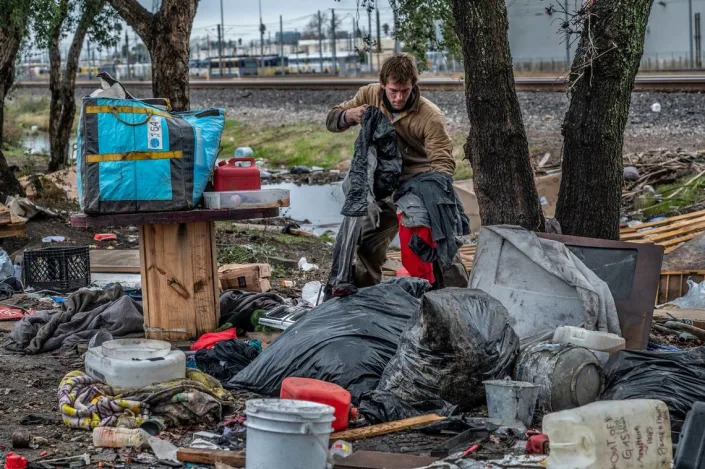
Renée C. Byer/rbyer@sacbee.com

I and my fellow residents of Wood Street Commons, an unhoused community in Oakland, believe politicians pushing sweeps of homeless encampments are only making things worse.

One thing that would dramatically improve the lives of unhoused people in California could be done today, wouldn’t cost taxpayers any money and would require no effort by politicians or city workers. It’s as simple as a governor or mayor uttering three words: Stop sweeps now.

Each time a homeless camp is dismantled, people’s lives are destroyed. All the effort we put into creating a home — we do not actually consider ourselves homeless because our camp is our home — is wiped away. Our worldly possessions, including identification, medical records, family heirlooms, clothing, electronics, furniture, instruments, bedding, tents, tools and other items that we use to earn income, are literally thrown into garbage trucks. Our handmade shelters are smashed by giant machines as we watch.

Opinion

How is this acceptable? How can the people who order and carry out sweeps live with themselves?

Each time a homeless camp is dismantled, its residents face more obstacles to overcoming what put them on the street in the first place. We create camps as a way to create stability, cultivate community, and accrue needed resources to pull ourselves up by our own bootstraps. Destroying camps pushes us down and forces us to start over, with nowhere to go and often with nothing but the clothes on our backs.

Any politician who pledges to end homelessness in one breath and then pledges to rid the streets of encampments in the next — looking at you, Gov. Gavin Newsom — is completely out of his mind.

The billions spent “helping” the homeless are profoundly undermined by the daily aggression of sweeps, which many unhoused people experience several times a year. Take it from us, the real experts on this issue: Sweeps make homelessness more entrenched.

Sweeps are also an enormous waste of taxpayer money. A 2021 sweep in Los Angeles’ Echo Park, where which roughly 200 people were removed in a violent show of police force, cost an estimated $2 million. That’s nearly $10,000 per person! These are people whose lives were destroyed at an expense that could have housed them for months.

Yet city leaders declared the Echo Park sweep a rousing success, claiming nearly everyone from the camp was placed in temporary housing. But UCLA studies conducted a year later found that only a dozen or so of them remained in temporary housing. Of the rest, four were placed in permanent housing; seven died; and most returned to the streets.

Large cities routinely sweep one or more camps per day, meaning this cruelty is repeated thousands of times each year across the state and country. Sweeps don’t get rid of camps; they just move them around, causing chaos and wasting millions in the process.

A growing body of research illustrates why we should not only keep camps intact; we should actually encourage and celebrate them. That may sound crazy to many readers, but it couldn’t be more logical.

First, the idea that camps equal crime is a myth that has been dispelled. Researchers have in fact found that clearing homeless camps is associated with an increase in overdoses, hospitalizations and mortality.

In a review of research on the topic, the U.S. Department of Housing and Urban Development noted that emergency shelters are unavailable, inaccessible or inhospitable to many unhoused people.

“Encampments may be the best alternative among a limited set of options,” the HUD report said.

It’s important to consider why people choose camps over other alternatives. Most temporary shelter facilities, and many of the permanent housing options designed to house the unhoused, come with a long list of rules that make them a little too much like prison. Among the most common rules are those limiting guests, spouses, pets, cooking, decorations and more possessions than can fit in a suitcase.

Tiny homes and sheds — the latest trends — are often placed like barracks on asphalt lots, surrounded by barbed wire and staffed by rude security guards. Would you give up your freedom to move to one of these places?

Humans need more than food, water and shelter. Autonomy and a sense of belonging are equally important to survival — and are actually the keys to recovery for people who have had a hard time in life. The impersonal facilities that we’re asked to move into are not designed with this in mind.

But autonomy and belonging are the essence of what camps are about. We camp together because it is essential to our physical and mental survival.

Our community on Wood Street in Oakland has recently been subjected to devastating sweeps. Caltrans has cleared an enormous section of the camp.

But the part that remains is stronger than ever. We cook for each other, distribute clothing and bedding, build our own tiny homes, play music, help each other heal, and host cultural events that have been attended by hundreds of housed residents. We see ourselves as part of a movement redefining the identity of American cities for the better: an identity based on an ethos of interdependence rather than the cult of independence that defines the world of the housed.

The last bit of land that we occupy on Wood Street is slated for clearance on Monday. We’ve been trying to work with Oakland officials to find a place where we can set up a new community and begin to rebuild yet again, but they refuse to cooperate. The city loves to tell us where we can’t be but has yet to tell us where we can be.

We do not accept this, which is why we’re taking matters into our own hands. We recently rode our bikes to the Capitol in Sacramento to speak with lawmakers there, and we will continue to press the case at City Hall. We will not be denied the essential human right to exist and exert our free will.

This piece was authored by Lydia Blumberg and other residents of Wood Street Commons, a settlement of unconventionally housed residents in West Oakland founded on the idea of “homeless helping the homeless.”

Come to the ‘war cry party’: How social media helped drive mayhem in Brazil

The Washington Post

Come to the ‘war cry party’: How social media helped drive mayhem in Brazil

Elizabeth Dwoskin – January 8, 2023

Supporters of former president Jair Bolsonaro clash with police during a protest outside the Planalto Palace in Brasilia on Sunday. (Eraldo Peres/AP)

In the weeks leading up to Sunday’s violent attacks on Brazil’s congress and other government buildings, the country’s social media channels surged with calls to attack gas stations, refineries and other infrastructure, as well as for people to come to a “war cry party in the capital,” according to Brazilian social media researchers.

Online influencers who deny the results of the country’s recent presidential election used a particular phrase to summon “patriots” to what they called a “Festa da Selma” – tweaking the word “selva,” a military term for war cry, by substituting an “m” for the “v” in hopes of avoiding detection from Brazilian authorities, who have wide latitude to arrest people for “anti-democratic” postings online. “Festa” is the Portuguese word for “party.”

Organizers on Telegram posted dates, times and routes for “Liberty Caravans” that would pick people up in at least six Brazilian states and ferry them to the party, according to posts viewed by The Washington Post. One post said, “Attention Patriots! We are organizing for a thousand buses. We need 2 million people in Brasilia.”

That online activism culminated in busloads of people landing in the capital Sunday, where they stormed and vandalized three major government buildings, reportedly setting fires and stealing weapons in the most significant assault on the country’s democratic institutions since the country’s 1964 military coup.

Brazilian analysts have long warned of the risk in Brazil of an incident akin to the Jan. 6, 2021, insurrection at the U.S. Capitol. In the months and weeks leading up to the country’s presidential election in October – in which leftist Luiz Inácio Lula da Silva defeated the right-wing incumbent, Jair Bolsonaro – social media channels were flooded with disinformation, along with calls in Portuguese to “Stop the Steal” and cries for a military coup should Bolsonaro lose the election.

On TikTok, researchers found that five out of eight of the top search results for the keyword “ballots” were for terms such as “rigged ballots” and “ballots being manipulated.” At the same time, Facebook and Instagram directed thousands of users who plugged in basic search terms about the election toward groups questioning the integrity of the vote. On Telegram, an organizing hub for Brazil’s far right, a viral video taken down by authorities called for the murder of the children of leftist Lula supporters.

In the days following the final election tally on Oct. 30, Bolsonaro supporters who rejected the results blocked major highways across the country. These blockades morphed into demonstrations in dozens of cities, where supporters camped out in front of military bases for weeks. Some held signs saying “Stolen Election” in English, a testament to the close ties between right-wing movements in both countries.

Though Lula’s inauguration last week took place largely without incident, calls for violence and destruction have accelerated online in recent weeks, said researcher Michele Prado, an independent analyst who studies digital movements and the Brazilian far right.

“For years now, our country has been going through a very strong process of radicalizing people to extremist views – principally online,” she said. “But in the last two weeks, I’ve seen ever-growing calls from people incentivizing extremism and calling for direct action to dismantle public infrastructure. Basically, people are saying we need to stop the country in its tracks and generate chaos.”

Posts demanding a coup, along with common pro-Bolsonaro hashtags claiming “election fraud,” and “stolen election,” have circulated on all social media services. The most violent rhetoric as well as the most direct organizing has taken place on the largely unmoderated messaging service Telegram.

Researchers in Brazil said Twitter in particular was a place to watch because it is heavily used by a circle of right-wing influencers – Bolsonaro allies who continue to promote election fraud narratives. Several influencers have had their accounts banned in Brazil and now reside in the United States. Bolsonaro himself was on vacation in Florida on Sunday.

Billionaire Elon Musk, who completed his acquisition of Twitter in late October, fired the company’s entire staff in Brazil except for a few salespeople, said a person familiar with the firings who spoke on the condition of anonymity to describe sensitive matters. Among those fired in early November included eight people, based in Sao Paulo, who moderated content on the platform to catch posts that broke its rules against incitement to violence and misinformation, the person said. The person said they were not aware of any teams actively moderating rule-breaking content on Twitter in Brazil.

Criticism specifically targeting Alexandre de Moraes, a judge at the Superior Electoral Court and the Supreme Federal Court who is despised by Bolsonaro supporters because he has blocked many prominent right-wing leaders from posting online, have also stepped up since the election, Prado and others said.

Footage circulating on social media from Sunday’s demonstration showed rioters pulling a chair from a government building, upon which they placed the seal of the Brazilian republic. One rioter shouted, “Look everyone, it’s Big Alexander’s chair!,” using a derogatory nickname for Moraes. Expletives followed, according to the video. It could not be confirmed if the chair had been taken from Moraes’s chambers.

Despite their seeming similarities, Brazilian researchers said, Bolsonaro supporters are careful not to draw too many comparisons to Jan. 6 in the United States because doing so could trigger arrest for inciting anti-democratic acts, a crime in Brazil. If Jan. 6 is referenced, as it was in a handful of posts this week, the utterances appear in code, said Viktor Chagas, a professor at Fluminense Federal University in Rio de Janeiro state who researches online, far-right movements.

Still, Chagas said, Sunday’s riot was “a clear attempt to emulate the invasion of the U.S. Capitol, as a reproduction of Trumpist movements and a symbolic signal of strength and transnational connections from the global far-right.”

Chagas noted that Jan. 9 is an important nationalist symbol in Brazil, marking the day the country’s first ruler, Emperor Dom Pedro I, declared that he would not return to Portugal, in what is popularly known as “I Will Stay” Day.

“It is as if Bolsonarists were equating Bolsonaro with D. Pedro I, and indicating that the former government will remain,” he said. Some posts have also referenced “I will stay day,” indicating that the demonstrations would probably continue through Monday, he added.

In a tweet on Sunday, Bolsonaro – a prolific social media user who has been relatively quiet since his election defeat – denounced the attacks: “Peaceful demonstrations, by law, are part of democracy,” he tweeted, hours after the assault began. “However, depredations and invasions of public buildings as occurred today, as well as those practiced by the left in 2013 and 2017, were outside of the law.”

Brazilian researchers said that among Bolsonaro supporters, a counternarrative had begun to circulate Sunday, blaming the Lula government and people from Lula’s party for infiltrating peaceful, democratic demonstrations to turn the country against supporters of Bolsonaro. The counternarrative also had echoes of the Jan. 6 insurrection, in which many Trump supporters blamed left-wing activists for the violence.

The mayhem Sunday was “a disaster,” said Paulo Figueiredo Filho, a presenter for the right-wing channel Jovem Pan who lives in Florida and has had his social media accounts canceled by Moraes. “It is Moraes’s wet dream.”

The ‘runner’s high’ may result from molecules called cannabinoids – the body’s own version of THC and CBD

The Conversation

The ‘runner’s high’ may result from molecules called cannabinoids – the body’s own version of THC and CBD

Hilary A. Marusak, Assistant Professor of Psychiatry and Behavioral Neurosciences, Wayne State University – January 7, 2023

Exercise spurs the release of the body's natural cannabinoids, which have myriad benefits for mental health and stress relief. <a href=
Exercise spurs the release of the body’s natural cannabinoids, which have myriad benefits for mental health and stress relief. Luca Sage/Stone via Getty Images

Many people have experienced reductions in stress, pain and anxiety and sometimes even euphoria after exercise. What’s behind this so-called “runner’s high”? New research on the neuroscience of exercise may surprise you.

The “runner’s high” has long been attributed to endorphins. These are chemicals produced naturally in the body of humans and other animals after exercise and in response to pain or stress.

However, new research from my lab summarizes nearly two decades of work on this topic. We found that exercise reliably increases levels of the body’s endocannabinoids – which are molecules that work to maintain balance in the brain and body – a process called “homeostasis.” This natural chemical boost may better explain some of the beneficial effects of exercise on brain and body.

I am a neuroscientist at the Wayne State University School of Medicine. My lab studies brain development and mental health, as well as the role of the endocannabinoid system in stress regulation and anxiety disorders in children and adolescents.

This research has implications for everyone who exercises with the aim of reducing stress and should serve as a motivator for those who don’t regularly exercise.

Health benefits of exercise

Several decades of research has shown that exercise is beneficial for physical health. These studies find a consistent link between varying amounts of physical activity and reduced risk of premature death and dozens of chronic health conditions, including diabeteshypertensioncancer and heart disease.

While cannabinoids are produced in cannabis, the marijuana plant, they are also made in the human body. <a href=
While cannabinoids are produced in cannabis, the marijuana plant, they are also made in the human body. Iuliia Bondar/Moment via Getty Images

More recently – over about the past two decades – mounting research shows that exercise is also highly beneficial for mental health. In fact, regular exercise is associated with lower symptoms of anxiety, depression, Parkinson’s disease and other common mental health or neurological problems. Consistent exercise is also linked to better cognitive performance, improved mood, lower stress and higher self-esteem.

It is not yet clear what is behind these mental health boosts. We do know that exercise has a variety of effects on the brain, including raising metabolism and blood flow, promoting the formation of new brain cells – a process called neurogenesis – and increasing the release of several chemicals in the brain.

Some of these chemicals are called neurotrophic factors, such as brain-derived neurotrophic factor. BDNF is intricately involved in brain “plasticity,” or changes in activity of brain cells, including those related to learning and memory.

Scientists have also shown that exercise increases blood levels of endorphins, one of the body’s natural opioids. Opioids are chemicals that work in the brain and have a variety of effects, including helping to relieve pain. Some early research in the 1980s contributed to the long-standing popular belief that this endorphin release is related to the euphoric feeling known as the runner’s high.

However, scientists have long questioned the role of endorphins in the runner’s high sensation, in part because endorphins cannot cross into the brain through the blood-brain barrier, which protects the brain from toxins and pathogens. So endorphins are not likely to be the main driver for the beneficial effects of exercise on mood and mental state.

This is where our research and that of others points to the role of our body’s natural versions of cannabinoids, called endocannabinoids.

The surprising role of endocannabinoids

You may be familiar with cannabinoids such as tetrahydrocannabinol – better known as THC – the psychoactive compound in cannabis (from the Cannabis sativa L. plant) that causes people to feel high. Or you may have heard of cannabidiol, commonly known as CBD, an extract of cannabis that is infused in some foods, medicines, oils and many other products.

But many people do not realize that humans also create their own versions of these chemicals, called endocannabinoids. These are tiny molecules made of lipids – or fats – that circulate in the brain and body; “endo” refers to those produced in the body rather than from a plant or in a lab.

Endocannabinoids work on cannabinoid receptors throughout the brain and body. They cause a variety of effects, including pain relief, reduction of anxiety and stress and enhanced learning and memory. They also affect hunger, inflammation and immune functioning. Endocannabinoid levels can be influenced by food, time of day, exercise, obesity, injury, inflammation and stress.

It’s worth noting that one should not be tempted to forgo a run or bike ride and resort to smoking or ingesting cannabis instead. Endocannabinoids lack the unwanted effects that come with getting high, such as mental impairment.

Understanding the runner’s high

Studies in humans and in animal models are pointing to endocannabinoids – not endorphins – as the star players in the runner’s high.

These elegant studies demonstrate that when opioid receptors are blocked – in one example by a drug called naltrexone – people still experienced euphoria and reduced pain and anxiety after exercise. On the flip side, the studies showed that blocking the effects of cannabinoid receptors reduced the beneficial effects of exercise on euphoria, pain and anxiety.

While several studies have shown that exercise increases the levels of endocannabinoids circulating in the blood, some have reported inconsistent findings, or that different endocannabinoids produce varying effects. We also don’t know yet if all types of exercise, such as cycling, running or resistance exercise like weightlifting, produce similar results. And it is an open question whether people with and without preexisting health conditions like depression, PTSD or fibromyalgia experience the same endocannabinoid boosts.

To address these questions, an undergraduate student in my lab, Shreya Desai, led a systematic review and meta-analysis of 33 published studies on the impact of exercise on endocannabinoid levels. We compared the effects of an “acute” exercise session – like going for a 30-minute run or cycle – with the effects of “chronic” programs, such as a 10-week running or weightlifting program. We separated them out because different levels and patterns of exertion could have very distinct effects on endocannabinoid responses.

We found that acute exercise consistently boosted endocannabinoid levels across studies. The effects were most consistent for a chemical messenger known as anandamide – the so-called “bliss” molecule, which was named, in part, for its positive effects on mood.

Interestingly, we observed this exercise-related boost in endocannabinoids across different types of exercise, including running, swimming and weightlifting, and across individuals with and without preexisting health conditions. Although only a few studies looked at intensity and duration of exercise, it appears that moderate levels of exercise intensity – such as cycling or running – are more effective than lower-intensity exercise – like walking at slow speeds or low incline – when it comes to raising endocannabinoid levels. This suggests that it is important to keep your heart rate elevated – that is, between about 70% and 80% of age-adjusted maximum heart rate – for at least 30 minutes to reap the full benefits.

There are still a lot of questions about the links between endocannabinoids and beneficial effects from exercise. For example, we didn’t see consistent effects for how a chronic exercise regimen, such as a six-week cycling program, might affect resting endocannabinoid levels. Likewise, it isn’t yet clear what the minimum amount of exercise is to get a boost in endocannabinoids, and how long these compounds remain elevated after acute exercise.

Despite these open questions, these findings bring researchers one step closer to understanding how exercise benefits brain and body. And they offer an important motivator for making time for exercise during the rush of the holidays.

Read more:

Joe Biden Wants to Change Social Security: Will the New Congress Help With Reform Efforts?

Motley Fool

Joe Biden Wants to Change Social Security: Will the New Congress Help With Reform Efforts?

By Sean Williams – January 7, 2023

KEY POINTS
  • Social Security is facing a $20.4 trillion funding shortfall through 2096 that, if left unattended, could lead to sweeping benefit cuts.
  • Prior to his election as president, Joe Biden unveiled a four-point plan to reform Social Security.
  • Despite a new Congress taking shape just days ago, altering Social Security is highly unlikely.
Social Security is in trouble, and President Biden believes he has the ideal plan to fix it.

In November, nearly 66 million Americans, many of whom are aged 62 and over, received a Social Security benefit. For the 48.5 million who are retired workers, these payouts are widely viewed as a necessity to cover their expenses. 

But despite providing a financial foundation for our nation’s retirees, America’s top retirement program finds itself in deep trouble. President Joe Biden believes he has the solution that can resolve what ails Social Security, but he’s going to need the help of newly elected lawmakers to fix it.President Joe Biden delivering remarks in the East Room of the White House.

PRESIDENT BIDEN DELIVERING REMARKS. IMAGE SOURCE: OFFICIAL WHITE HOUSE PHOTO BY ADAM SCHULTZ.

Retired workers could be less than 12 years away from having their benefits cut

For each of the past 83 years, the Social Security Board of Trustees has released a report that’s examined the financial status of the program over the short term (the next 10 years) and long term (75 years following the release of a report). The Trustees Report effectively acts as Social Security’s balance sheet and allows anyone to see how revenue is collected and where those dollars end up.

In addition to backward-looking financial data, the Trustees Report factors in changing macroeconomic and demographic factors to determine the financial health of Social Security.

The 2022 Trustees Report showed that Social Security had dug its largest hole yet: an estimated $20.4 trillion funding shortfall through 2096. For what it’s worth, every Trustees Report since 1985 has projected a long-term funding shortfall.

Social Security’s increasingly dire financial footing is primarily a result of demographic shifts. Examples include historically low U.S. birth rates, a near-halving in net immigration into the country over two decades, and growing income inequality, among other factors. With these changes weighing on the worker-to-beneficiary ratio, it would appear the program’s financial foundation will only worsen.

Based on last year’s projections, the asset reserves for the Old-Age and Survivors Insurance Trust Fund (OASI) are expected to run out in 2034. The OASI is the Trust responsible for paying benefits to 48.5 million retired workers each month, as well as nearly 5.9 million survivors of deceased workers. If this excess cash were to be exhausted within the next 12 years, the Trustees believe an across-the-board benefit cut of 23% would be necessary to sustain payouts through 2096. For context, a 23% benefit cut would reduce the average Social Security check by roughly $420 per month (In January 2023 dollars), or $5,000 per year.

While Social Security is in no danger whatsoever of becoming insolvent, the size of Social Security checks paid to retired workers 12 years from now is very much in question.A Social Security card wedged between a fanned assortment of cash bills.

IMAGE SOURCE: GETTY IMAGES.

Joe Biden has proposed sweeping reforms for Social Security

In 2020, prior to his election as president, then-candidate Joe Biden released a plan he believed would strengthen Social Security for decades to come. Although there are four Social Security changes Biden is seeking, two stand out as key to shoring up the program.

This biggest Social Security change proposed by Biden would tackle income inequality head-on and generate a lot of extra revenue.

In 2023, Social Security’s 12.4% payroll tax is applicable to earned income between $0.01 and $160,200. “Earned income” means wages and salary but not any sort of investment income. Approximately 94% of all working Americans earns less than the maximum taxable earnings cap (the $160,200 figure). For the other 6% of workers, earned income above this $160,200 level is exempt from the payroll tax.

Joe Biden’s proposal would create a doughnut hole between the maximum taxable earnings cap and $400,000 where earned income would remain exempt, as well as reinstate the payroll tax on earned income above $400,000. Since the maximum taxable earnings cap tends to rise over time with inflation, this doughnut hole would eventually close decades down the line. This immediate increase in payroll tax revenue should push back the asset reserve depletion date of the OASI.

The other notable Social Security change President Biden is seeking is the replacement of the program’s measure of inflation.

Since 1975, the Consumer Price Index for Urban Wage Earners and Clerical Workers (CPI-W) has been used to determine Social Security’s annual cost-of-living adjustment (COLA). Unfortunately, as its name implies, this is a price-measuring index focused on the spending habits of “urban wage earners and clerical workers.” In other words, people who generally aren’t receiving a Social Security benefit.

Biden would like to see the Consumer Price Index for the Elderly (CPI-E) used to calculate COLA instead of the CPI-W. The CPI-E specifically tracks the spending habits of older Americans, which would likely provide a larger annual cost-of-living adjustment.

Is a new Congress the recipe Biden needs to reform Social Security?

The challenge for Joe Biden — and frankly, every other president for more than three decades — is that he needs the support of lawmakers in Congress to amend the Social Security Act. Just a few days ago, the 118th Congress officially took shape.

The big question is: Will this new Congress work with the president to effect Social Security reform? If I were to give the Magic 8 Ball a shake, the “All signs point to no” answer would almost assuredly pop up.

Whereas the previous Congress featured a razor-thin majority in the U.S. Senate for Democrats, as well as a modest majority in the House of Representatives, the new Congress features a shift to a slight majority in the House for Republicans.

Democrats and Republicans both agree that Social Security needs attention. However, they’ve approached their respective fixes from completely different viewpoints. Whereas Biden’s proposal seeks to raise additional revenue from high-earners and boost benefits for low-earning workers, the Republican solution aims to increase the full retirement age and shift the inflationary measure to the Chained CPI. Without getting too far into the weeds, the GOP plan focuses on reducing long-term outlays to save Social Security money. In short, both parties have solutions that work, albeit on very different timelines and with ideologically opposite approaches.

The other challenge for Biden is getting the necessary votes in the Senate to amend Social Security. In the upper house of Congress, 60 votes are needed to amend America’s top retirement program. Since neither party has controlled at least 60 votes in the Senate since 1979, it means all legislation proposing to alter Social Security would require bipartisan support. Garnering that support has proved virtually impossible for every president since Ronald Reagan.

Though a new Congress has taken shape, Biden’s Social Security changes are extremely unlikely to find legislative support.

Warning about aquifer’s decline sets up big fight in Kansas

Associated Press

Warning about aquifer’s decline sets up big fight in Kansas

John Hanna – January 6, 2023

Lee Reeve poses for a photo at the cattle feedyard and ethanol plant operated by his family Thursday, Jan. 5, 2023, near Garden City, Kan. Reeve sees language by the Kansas Water Authority on controlling groundwater use in western Kansas as "toxic,"as the Kansas Legislature looks to take up ways to address depletion of the Ogallala Aquifer in the upcoming session. (AP Photo/Charlie Riedel)
Lee Reeve poses for a photo at the cattle feedyard and ethanol plant operated by his family Thursday, Jan. 5, 2023, near Garden City, Kan. Reeve sees language by the Kansas Water Authority on controlling groundwater use in western Kansas as “toxic,”as the Kansas Legislature looks to take up ways to address depletion of the Ogallala Aquifer in the upcoming session. (AP Photo/Charlie Riedel)
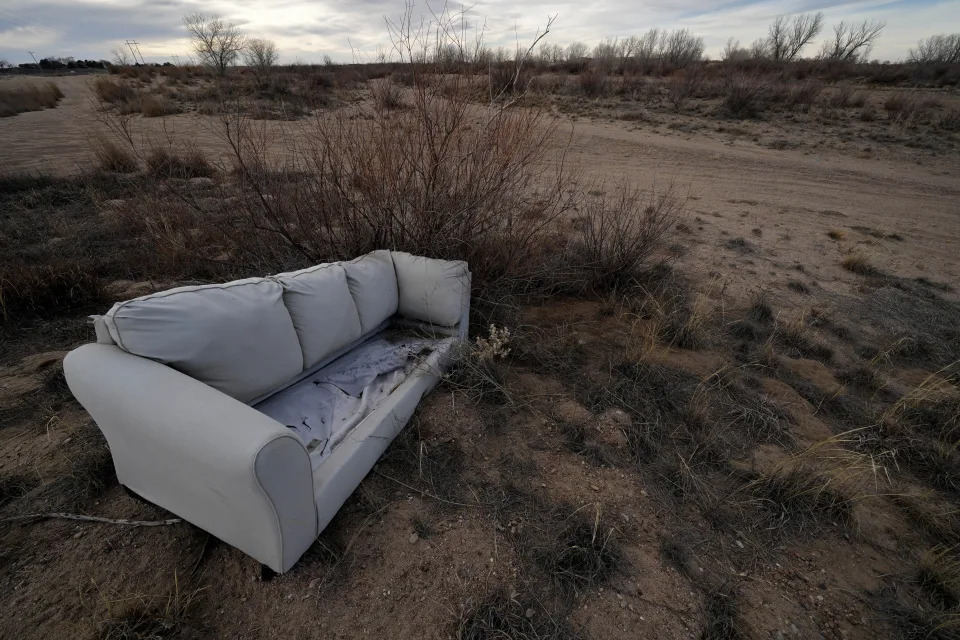
A discarded couch litters the dry bed of the Arkansas River Thursday, Jan. 5, 2023, near Garden City, Kan. The river in western Kansas is mostly dry after decades of extensive groundwater use and periodic droughts. Lawmakers are looking to take up groundwater issues in western Kansas in the upcoming session as the Kansas Water Authority is urging stricter usage measures to try to slow the steady decline of water levels in the Ogallala Aquifer. (AP Photo/Charlie Riedel)
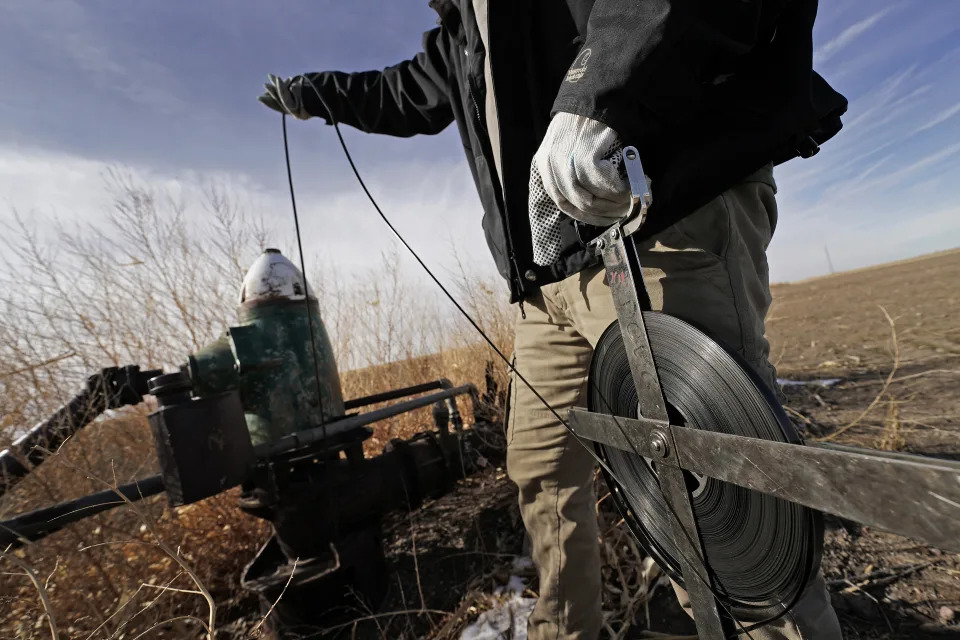
Kansas Geological Survey field research technician Connor Umbrell measures water levels in an irrigation well Thursday, Jan. 5, 2023, near Marienthal, Kan. Lawmakers are looking to take up groundwater issues in western Kansas in the upcoming session as the Kansas Water Authority is urging stricter usage measures to try to slow the steady decline of water levels in the Ogallala Aquifer. (AP Photo/Charlie Riedel)

TOPEKA, Kan. (AP) — Kansas water experts are sounding an alarm decades in the making: Farmers and ranchers in the state’s western half must stop pumping more water out of a vast aquifer than nature puts back each year or risk the economic collapse of a region important to the U.S. food supply.

That warning is setting up a big and messy fight for the annual session of the Kansas Legislature set to open Monday.

The Kansas Water Authority is telling lawmakers that Kansas needs to break sharply with its decadeslong policy of slowing depletion while still allowing water levels to drop in the Ogallala Aquifer. The aquifer covers roughly 175,000 square miles (453,000 square kilometers) in the western and Great Plains states of Texas, New Mexico, Oklahoma, Kansas, Colorado, Nebraska, Wyoming and South Dakota.

Most of those states have areas where depletion is a problem, but the call in Kansas to “halt” the declines has farmers, ranchers and politically influential agriculture groups preparing to battle proposals that would give them less control over water and possibly could force them to cultivate fewer acres, buy expensive new equipment or turn on a dime to grow different crops.- ADVERTISEMENT -https://s.yimg.com/rq/darla/4-10-1/html/r-sf-flx.html

Imposing the Water Authority’s policy means agribusinesses that drive the region’s economy would have to consume less water — perhaps as much as 30% less in some areas. Lawmakers also would have to decide whether local officials would keep driving conservation efforts or if the state would be in charge.

“The easy part was making the statement. That didn’t cost anybody anything,” said Clay Scott, who farms in southwestern Kansas. “We’re going to have to start paying for it, and we have to decide how that gets divvied up.”

Kansas produces more than 20% of the nation’s wheat and has about 18% of the cattle being fed in the U.S. The western third of Kansas, home to most of its portion of the Ogallala, accounts for 60% of the value of all Kansas crops and livestock. That’s possible because of the water.

The recommendation on the Ogallala from the water authority, a planning and advisory commission, is a response to data showing that since widespread pumping began around 1940, much of the Ogallala has lost at least 30% ofits available water and more than 60% in places in western Kansas. The Kansas Geological Survey had a team in western Kansas this week to measure well depths for updated figures.

“There are wells that are starting to run dry already, so this isn’t a distant problem in some areas,” said Tom Buller, executive director of the Kansas Rural Center, a nonprofit that promotes sustainable agriculture and family farming. “There isn’t a lot of time to solve the problem.”

The Water Authority’s recommendation comes as much of the western U.S. continues to suffer through a megadrought fueled by climate change. Parts of Kansas have had drought conditions for a year, and more than half the state has been in extreme drought since mid-September.

The U.S. Bureau of Reclamation is currently working on a plan to cut water use from the Colorado River in western states by 15%, and Arizona is restricting large-scale farming. Nebraska last year launched a $500 million canal project to divert water from the South Platte River in Colorado.

“We are told that the future, due to climate change, is going to get warmer and drier in western Kansas,” said Connie Owen, director of the Kansas Water Office, which oversees long-term plans for preserving water. “That is making things worse, which is all the more reason that we have to deal with this now.”

There’s broad agreement, including among powerful agriculture groups and nervous farmers and ranchers, that Kansas needs to extend the aquifer’s life.

But the path forward isn’t yet clear for Democratic Gov. Laura Kelly and the Republican-controlled Legislature.

In a pre-session interview, Kelly promised only to get affected parties together to negotiate a comprehensive solution. She added that following her narrow reelection in November, “I’ve got some political capital to spend to deal with what will be a very contentious issue.”

Depletion of the Ogallala was one reason that in the Kansas House, the Water Committee last year considered a 283-page bipartisan proposal to set aside $49 million a year for conservation efforts and other programs. The measure also would have reorganized those programs and made the official who grants rights to use water independent of the state Department of Agriculture. In addition, it would have curbed the power of big irrigators in local districts that manage groundwater use, including from the Ogallala.

Opponents included the Kansas Farm Bureau and the Kansas Livestock Association. Nothing ultimately passed after critics accused supporters of drafting it largely in secret. The committee’s chair later retired.

The new Water Committee chair, Republican Rep. Jim Minnix, a southwestern Kansas farmer, said he hopes to work on incentives for local officials to be more aggressive about water conservation.

The state allows local districts to set restrictions, and one in northwest Kansas gets high marks from water experts and officials for cutting water use. In one area of 99 square miles (256 square kilometers), it set water-use rules, sought to cut consumption 20% and reduced it 35% over the past decade, according to Manager Shannon Kenyon.

Kenyon prizes local control but said the state should take charge where local officials haven’t pursued enough conservation.

If local officials allow the water dry up, she said, “They are going to kill the economy in the state of Kansas,” Kenyon said.

Some western Kansas farmers argue that the state’s best move is to ramp up education about ways to conserve water and provide incentives to help farmers adopt them. Several of them, as well as local water officials, said agriculture has become more careful with water over the past several decades through new technology, new crop varieties and better farming practices.

Lee Reeve, whose family has farmed near Garden City in southwest Kansas for more than 100 years and now operates a cattle feed yard and ethanol plant, sees the Water Authority’s language on halting depletion as “toxic,” noting that farmers already are suspicious of government programs.

“There’s just enough of this scare stuff out there that it’s hard to get through to people that, ‘Hey, there are things we can do,’” he said.

Germ Experts Share How Often You Should Really Be Washing Your Sheets

Parade

Germ Experts Share How Often You Should Really Be Washing Your Sheets

Emily Laurence – January 6, 2023

It’s probably more often than you think.

A recent survey conducted in the UK found that almost half of single men wash their sheets once every four months. How do your bed linen habits compare? Maybe you aren’t quite as neglectful as these bachelors and are in the habit of washing your sheets once a month. Or maybe you don’t have a set schedule; you can just tell when it’s time.

According to germ experts (yep, they exist), it’s important to wash your sheets regularly. Otherwise, you’ll be sleeping in a bed of bacteria—literally. But how often should you really change your sheets? Keep reading to find out.

Related: 10 Cleaning Hacks to Save You Time and Money! Quick Tips To Keep Your Household Clean and Running Smoothly

How Often Should You Wash Your Sheets?

While there aren’t any scientific studies on people’s bed linens at home, Dr. Charles Gerba, PhD., a professor of virology in the Department of Environmental Science at The University of Arizona, says that there have been studies of sheets in hospitals. Dr. Gerba says that these studies have found that bacteria from the human skin is transferred to bedding and about one-third of this bacteria is fecal bacteria (E.coli). “Fungi also appears to be common,” he adds.

“Sheets are a great place for bacteria to reside and grow. All they need are water and food, which our bodies provide,” says Jason Tetro, a scientist and author of The Germ Files. If you go too long without washing your sheets, Tetro says that the bacteria will continue to grow, which could then potentially lead to skin irritation and possibly infection.

Related: Hold Up—These Surprising Effective Home Cleaning Hacks Use Ketchup, Mayo and What Else?!

Tetro says that in a laboratory, bacteria can multiply as quickly as every 20 minutes. In the real world, he says it takes several hours. With this in mind, Tetro recommends washing your sheets every two weeks. If you tend to sweat in bed or eat in bed, both experts recommend washing them even more often. “What matters more is the amount of bacteria transferred—the inoculum if you wish,” Tetro says. “If you are not sweating much, the inoculum won’t be too significant from night to night and two weeks should be sufficient. If you tend to sweat a significant amount, then the nightly inoculum goes up and you may want to clean them every week.”

Interestingly, Tetro says that polyester has been found to hold more bacteria than cotton. “It also took in more of the body’s natural secretions meaning the bacteria would be able to grow to higher numbers,” he adds. So if your sheets are made of polyester, you may want to wash your sheets more often.

Related: These 50 Best Decluttering Tips Will Help You Get Organized at Last!

What About Pillowcases, Blankets and Comforters?

You may want to wash your pillowcases even more often than you wash your sheets. Dr. Gerba says that’s where most bacteria and fungi are found.

As for comforters, duvets and throw blankets, Tetro says that anything that comes in direct contact with the skin regularly should be washed as frequently as your sheets. But if your throw blankets or comforter is coming into contact with the sheets instead of your skin, he says they can be washed less frequently, roughly once a month.

Even with all this in mind, if you’re still debating whether or not you should throw your bed linens in the wash, Tetro says to give them a sniff. “One can never discount the smell test,” he says. “Bacteria tend to stink once they get to high enough numbers. If your sheets—and clothes for that matter—tend to have an odor, then there’s a good likelihood that there’s a high bacterial count and a wash may be needed.”

Put this advice into practice and you’ll be able to sleep easy. (And maybe pass the info along to the single men in your life too.)

Next up, check out these viral TikTok cleaning hacks that actually work.

Sources

Great Salt Lake on track to disappear in five years, scientists warn

The Washington Post

Great Salt Lake on track to disappear in five years, scientists warn

Sarah Kaplan and Brady Dennis, Washington Post – January 6, 2023

MAGNA, UTAH – AUGUST 02: Park visitors walk along a section of the Great Salt Lake that used to be underwater at the Great Salt Lake State Park on August 02, 2021 near Magna, Utah. As severe drought continues to take hold in the western United States, water levels at the Great Salt Lake, the largest saltwater lake in the Western Hemisphere, have dropped to the lowest levels ever recorded. The lake fell below 4194.4 feet in the past week after years of decline from its highest level recorded in 1986 with 4211.65 feet. Further decline of the lake’s water levels could result in an increase in water salinity and could generate dust from the exposed lakebed that could impact air quality in the area. The lake does not supply water or generate electricity for nearby communities but it does provide a natural habitat for migrating birds and other wildlife. According to the U.S. Drought Monitor, 99 percent of Utah is experiencing extreme drought conditions. (Photo by Justin Sullivan/Getty Images) (Justin Sullivan via Getty Images)

Without dramatic cuts to water consumption, Utah’s Great Salt Lake is on track to disappear within five years, a dire new report warns, imperiling ecosystems and exposing millions of people to toxic dust from the drying lake bed.

The report, led by researchers at Brigham Young University and published this week, found that unsustainable water use has shrunk the lake to just 37 percent of its former volume. The West’s ongoing mega-drought – a crisis made worse by climate change – has accelerated its decline to rates far faster than scientists had predicted.

But current conservation measures are critically insufficient to replace the roughly 40 billion gallons of water the lake has lost annually since 2020, the scientists said.

The report calls on Utah and nearby states to curb water consumption by a third to a half, allowing 2.5 million acre feet of water to flow from streams and rivers directly into the lake for the next couple of years. Otherwise, it said, the Great Salt Lake is headed for irreversible collapse.

“This is a crisis,” said Brigham Young University ecologist Ben Abbott, a lead author of the report. “The ecosystem is on life support, [and] we need to have this emergency intervention to make sure it doesn’t disappear.”

Scientists and officials have long recognized that water in the Great Salt Lake watershed is overallocated, – more water has been guaranteed to people and businesses than falls as rain and snow each year.

Agriculture accounts for more than 70 percent of the state’s water use – much of it going to grow hay and alfalfa to feed livestock. Another 9 percent is taken up by mineral extraction. Cities use another 9 percent to run power plants and irrigate lawns.

There are so many claims on the state’s rivers and streams that, by the time they reach the Great Salt Lake, there’s very little water left.

Over the last three years, the report says, the lake has received less than a third of its normal stream flow because so much water has been diverted for other purposes. In 2022, its surface sank to a record low, 10 feet below what is considered a minimum healthy level.

With less freshwater flowing in, the lake has grown so salty that it’s becoming toxic even to the native brine shrimp and flies that evolved to live there, Abbott said. This in turn endangers the 10 million birds that rely on the lake for a rest stop as they migrate across the continent each year.

The vanishing lake may short-circuit the weather system that cycles rain and snow from the lake to the mountains and back again, depriving Utah’s storied ski slopes. It threatens a billion-dollar industry extracting magnesium, lithium and other critical minerals from the brine.

It has also exposed more than 800 square miles of sediments laced with arsenic, mercury and other dangerous substances, which can be picked up by wind and blown into the lungs of some 2.5 million people living near the lakeshore.

“Nanoparticles of dust have potential to cause just as much harm if they come from dry lake bed as from a tailpipe or a smokestack,” said Brian Moench, president of Utah Physicians for a Healthy Environment. He called the shrinking of the lake a “bona fide, documented, unquestionable health hazard.”

Dried-up saline lakes are hot spots for dangerous air pollution. Nearly a century after Owens Lake in southern California was drained to provide water to Los Angeles County in the 1920s, it was still the largest source of hazardous dust in the country, according to the U.S. Geological Survey. The pollution has been linked to high rates of asthma, heart and lung disease and early deaths.

Kevin Perry, an atmospheric scientist at the University of Utah who studies pollution from the receding lake, said about 90 percent of the lake bed is protected by a thin crust of salt that keeps dust from escaping. But the longer the lake remains dry, the more that crust will erode, exposing more dangerous sediments to the air.

“You see this wall of dust coming off the lake, and it reduces horizontal visibility sometimes to less than a mile,” Perry said. The impact might only last a couple hours at a time, he said, but the consequences can be profound.

Perry and other researchers have mapped the location and elevation of the dust hot spots, he said, and the results show that the problem is unlikely to abate anytime soon. The lake would need to rise roughly 14 feet to cover 80 percent of current hot spots, Perry said, or about 10 feet to submerge half of them.

Even researchers have been taken aback by the rapid pace of the Great Salt Lake’s decline, Abbott said. Most scientific models projected that the shrinking would slow as the lake became smaller and saltier, since saltwater evaporates less readily than freshwater.

But human-caused climate change, driven mostly by burning fossil fuels, has increased average temperatures in northern Utah by about 4 degrees Fahrenheit since the early 1900s and made the region more prone to drought, the report said. Studies suggest this warming accounts for about 9 percent of the decline in stream flows into the lake. Satellite surveys also show significant declines in groundwater beneath the lake, as ongoing drought depletes the region’s aquifers.

If humans weren’t using so much water, the lake might be able to withstand these shifts in climate, Abbott said. But the combined pressure of drought and overconsumption is proving to be more than it can bear.

Candice Hasenyager, the director of the Utah Division of Water Resources, said Utahns are becoming increasingly aware of the urgency of the lake’s decline. Last year, the Utah legislature passed numerous bills aimed at conservation, including a $40 million trust intended to help the ailing lake. Gov. Spencer Cox (R) recently proposed another massive infusion of funding for water management and conservation.

“We don’t have the luxury to have one solution,” but curbing water demand is essential, Hasenyager said. “We live in a desert, in one of the driest states in the nation, and we need to reduce the amount of water we use.”

Yet recent efforts haven’t kept up with the accelerating crisis. Abbott and his colleagues found that Utah’s new conservation laws increased stream flow to Great Salt Lake by less than 100,000 acre feet in 2022 – a tiny fraction of the 2.5 million acre feet increase that’s needed to bring the lake back to a healthy minimum level.

“Among legislators and decision-makers there is still a very prevalent narrative of ‘let’s put in place conservation measures so over the next couple of decades the Great Salt Lake can recover,'” Abbott said. “But we don’t have that time.”

“This isn’t business as usual,” he added. “This is an emergency rescue plan.”

The new report, drafted by more than 30 scientists from 11 universities, advocacy groups and other research institutions, recommends that Cox authorize emergency releases from Utah’s reservoirs to get the lake up to a safe level over the next two years.

This would require as much as a 50 percent cut in the amount of water the state uses each year, requiring investment from federal agencies on down to local governments, church leaders and community groups.

For decades, Abbott said, officials have prioritized human uses for all the water that trickles through the Great Salt Lake watershed.

Until last year, the lake itself wasn’t even considered a legitimate recipient of any water that fell in the region. If a farmer chose not to use some of their shares, allowing that water to flow to the lake and the surrounding ecosystem, they risked losing their water rights in the future.

“We have to shift from thinking of nature as a commodity, as a natural resource, to what we’ve learned over the last 50 years in ecology, and what Indigenous cultures have always known,” Abbott said. “Humans depend on the environment. . . . We have to think about, ‘What does the lake need to be healthy?’ and manage our water use with what remains.”

The weather this year has given Utah a prime opportunity to, in Abbott’s words, “put the lake first.” After a series of December storms, the state’s snowpack is already at 170 percent of normal January levels. If that snow persists and precipitation continues through the rest of the winter, it would enable the state to set aside millions of acre feet of water for the lake without making such drastic cuts to consumption.

“I’m generally optimistic,” said Hasenyager, the water resources director. “I don’t think we are past a point of no return – yet.”

A young father died after toxic mold grew in the walls of his family home.

Insider

A young father died after toxic mold grew in the walls of his family home. Here’s how to spot signs of mold, and how to stay safe.

Andrea Michelson and Leah Rosenbaum – January 5, 2023

A young father died after toxic mold grew in the walls of his family home. Here’s how to spot signs of mold, and how to stay safe.
Christian Childers, 26, is survived by his fiancee and young sons. He tried to clean up the mold before he fell ill.Courtesy of Lorie Peterson
  • 26-year-old Christian Childers died Monday after long-term exposure to toxic mold.
  • Mold grew in his family’s home after flooding from Hurricane Ian last September.
  • Childers’ asthma made him particularly susceptible to health risks from mold.

Instead of spending time with his family at home, 26-year-old Christian Childers spent Christmas Eve in the hospital in a medically induced coma after a severe asthma attack led to cardiac arrest. The potential cause of this asthma attack: toxic mold that had been growing in his apartment for months.

Christian Childers and his fiancée Kendra Elliot first noticed the mold growing after Hurricane Ian flooded their home in September, Elliot told NBC affiliate WBBH-TV.

Despite attempts to get in contact with FEMA and the Red Cross, the family was forced to live with the mold for months, according to a GoFundMe set up by a family friend. The couple moved their family of five into the living room to avoid the toxic growth, but the mold continued to affect Childers, who had asthma and had to go to the hospital multiple times.

On December 24, Childers suffered an asthma flare-up and was struggling to breathe, Elliot told WBBH-TV. They went to his parents house, where he still wasn’t able to catch his breath, and then to the emergency room.

“They were on their way to the emergency room, and they didn’t make it,” Elliot told the local news station. “They had to pull into a fire station, and he went into cardiac arrest. He died, and they had to work on him for an hour to get his heartbeat back before they got him on the way to the hospital.”

Childers was initially put into a medically induced coma in the hospital to give his body a chance to recover from a hypoxic brain issue caused by a lack of oxygen, but on January 2 he died.

Additionally, during Childers’ hospital stay the family’s landlord sent them an eviction notice, which has been reviewed by Insider. Lorie Peterson, a friend of the family, said Elliot and her mother and two sons are still searching for a new place to live.

Mold is particularly dangerous for people with lung diseases like asthma
Mold stains on a damp wall.
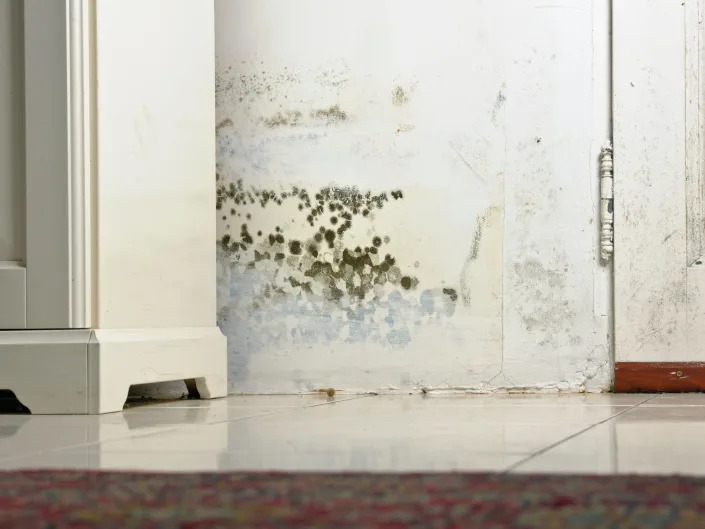
Mold stains on a damp wall.Ekspansio/Getty Images

Mold growth in the home is usually related to excess moisture in the environment — for instance, a Category 4 storm can cause plenty of water-related damage. Some molds can release toxins into the air, which can irritate the lungs, but not all molds found in the home are toxic.

While most people won’t suffer health effects from living in a home with small amounts of mold, it can be dangerous for people with lung diseases or people who are immunocompromised.

People with asthma, chronic obstructive pulmonary disease (COPD), or compromised immune systems should not stay in a moldy home, even while it is being cleaned, according to the Centers for Disease Control and Prevention (CDC). Severe reactions to mold can include fevers and shortness of breath.

Otherwise healthy people can experience symptoms from mold exposure including coughing and wheezing.

What to do if there is mold in your home

The best way to stop mold exposure is prevent it from growing in the first place.

The CDC recommends that people control humidity levels in their homes through ventilating bathrooms, laundry and cooking areas; promptly fix leaks; and thoroughly clean and dry after flooding. Using an air conditioner or dehumidifier during humid and warm months can be helpful, as well as avoiding carpeting rooms that may gather moisture, like bathrooms.

If, however, you can already see or smell mold in your home, it’s best to get professional help. Mold growth can be removed with commercial cleaning products, soap and water, or a solution of water and bleach (no more than 1 cup of bleach per gallon of water). While it’s possible to clean up mold on your own, anyone with extensive mold growth or preexisting health conditions that would make them sensitive to mold should vacate the home and let a professional handle the cleanup.

Mexico arrests Ovidio Guzman, son of ‘El Chapo,’ city engulfed by violence

Reuters

Mexico arrests Ovidio Guzman, son of ‘El Chapo,’ city engulfed by violence

Lizbeth Diaz and Dave Graham – January 5, 2023

Mexico arrests Ovidio Guzman, son of 'El Chapo,' in Culiacan

MEXICO CITY (Reuters) -Mexican drug cartel leader Ovidio Guzman, a son of jailed kingpin Joaquin “El Chapo” Guzman, was arrested, unleashing a violent backlash by gang gunmen on Thursday that shut the airport in the city of Culiacan as authorities told residents to stay indoors.

Defense Minister Luis Cresencio Sandoval told a news conference that security forces had captured the 32-year-old senior member of the Sinaloa Cartel. The arrest comes three years after an attempt to detain him ended in humiliation for the government.

Ovidio was now being held in the capital Mexico City, Sandoval said.

Videos shared on social media, which Reuters was unable to immediately verify, appeared to show heavy fighting overnight in Culiacan, the main city in the northern state of Sinaloa, with the sky lit up by helicopter gunfire.

The city’s airport was the target of violence, with Mexican airline Aeromexico saying one of its planes had been hit by gunfire ahead of a scheduled flight to Mexico City. No-one was hurt, it said. The airport was closed until Thursday night.

Ovidio, who has become a key figure in the cartel since the arrest of his father, was briefly detained in 2019 but was quickly released to end violent retribution in Culiacan from his gang. The incident was an embarrassing setback for the government of President Andres Manuel Lopez Obrador.

His latest capture comes before a North American leaders’ summit in Mexico City next week, which U.S. President Joe Biden will attend and at which security issues are on the agenda.

One of the Mexican officials said Guzman’s arrest was likely to prove a welcome addition to U.S.-Mexico cooperation on security ahead of Biden’s visit.

The United States had offered a $5 million reward for information leading to the arrest or conviction of Ovidio.

It not yet clear whether Ovidio will be extradited to the United States like his father, who is serving a life sentence at Colorado’s Supermax, the most secure U.S. federal prison.

A surge in overdose deaths in the United States, fueled by the synthetic opioid fentanyl, has led to increased pressure on Mexico to combat the organizations – such as the Sinaloa Cartel – responsible for producing and shipping the drug.

The cartel is one of the world’s most powerful narcotics trafficking organizations.

For Tomas Guevara, a security expert at the Autonomous University of Sinaloa, Guzman’s arrest helps save face for Mexican law enforcement following the humiliation of having to let El Chapo’s son go in 2019.

“The detention of Ovidio is finally the culmination of something that was planned three years ago,” he said.

It might also herald a change in approach by the government, Guevara added, after criticism from many security experts that Lopez Obrador was soft on the cartels, an accusation he denies.

The president argues the confrontational tactics of his predecessors were unsuccessful and only caused more bloodshed, saying he would instead pursue a strategy of “hugs not bullets.”

RESIDENTS URGED TO STAY INDOORS

On Thursday morning, security forces were attempting to contain a violent reaction to the arrest in the Culiacan area by Guzman’s associates.

Burned vehicles were scattered on the streets and heavily armed law enforcement patrolled in pickup trucks.

“We continue to work on controlling the situation,” said Cristobal Castaneda, Sinaloa’s public security chief.

Local government urged people to stay indoors and said schools and administrative offices were closed due to the violence. Street blockades had also been erected.

“We ask the citizens of Culiacan not to leave home due to the blockades that have occurred in different parts of the city,” Culiacan Mayor Juan de Dios Gamez wrote on Twitter.

Joaquin Guzman, 65, was convicted in New York in 2019 of trafficking billions of dollars of drugs to the United States and conspiring to murder enemies.

Eduardo Guerrero, director of Lantia Consulting which analyzes Mexican organized crime, said that recent pressure from the Biden administration to target the Sinaloa Cartel had likely motivated Mexico to go after Guzman.

But he warned that while Ovidio’s capture was likely to weaken that cartel, it could help their main rival, the notoriously violent Jalisco New Generation Cartel.

“It’s very important the government bear in mind that the weakening of the Sinaloa Cartel may also bring about an even greater expansion, a greater presence of the Jalisco Cartel.

(Reporting by Lizbeth Diaz, Dave Graham and Diego Ore, additional reporting by Tomas Bravo, Kylie Madry and Jackie Botts, Writing by Stephen EisenhammerEditing by Alistair Bell)

Incoming Iowa attorney general Brenna Bird tells 19 staffers to resign

The Des Moines Register

Incoming Iowa attorney general Brenna Bird tells 19 staffers to resign

Jared Strong/Capital Dispatch – January 3, 2023

The incoming, newly elected Iowa attorney general has asked for the resignations of 19 current staffers, including many in leadership positions but also some longtime staff attorneys, according to Lynn Hicks, a spokesperson for the office who was among those asked to resign.

Brenna Bird, a Republican county attorney who defeated longtime Attorney General Tom Miller, a Democrat, in the November election, requested the resignations on Dec. 22, according to letters obtained by Iowa Capital Dispatch.

“We appreciate your past service to the State of Iowa,” wrote Sam Langholz, whom Bird has selected as her chief deputy when she takes control of the office next week. “But the people of Iowa have elected a new attorney general. To best serve them — and to do the things she told Iowans she would do — the Attorney General-Elect is realigning the office and building a new team that matches her vision for the office.”

Bird pledged during her election campaign to more vigorously defend laws enacted by the Republican-controlled Legislature and to challenge policies enacted by President Joe Biden, a Democrat.

Langholz, former senior counsel for Gov. Kim Reynolds, has worked for the attorney general’s office for about two years and has helped defend against challenges to the governor’s policies and administrative actions.

His letter to 19 of his colleagues asked that their resignations be effective at 8:30 a.m. Jan. 3, at the latest.

“We are timing this transition date and time so that you will receive holiday pay on January 2, regular pay for 30 minutes on January 3, and your normal health insurance coverage for the month of January,” Langholz wrote.

He said the notices of resignation were due on Dec. 28 — six days after the letters were sent.

Hicks, who is Miller’s chief of staff, is among at least 10 who have acquiesced to the requests or had already planned to resign, according to copies of the resignation letters and other information he provided to Capital Dispatch with the consent of the employees. He identified a total of 13 of those asked to resign.

The 19 employees represent less than 10% of the total staff, which has about 150 assistant attorneys general and more than 200 people total, according to state salary records.

Replacing top staffers is common when someone new is elected to a statewide executive position, especially when they are tied to a different political party. However, the letters also targeted attorneys more closely involved in litigating cases, several of whom have been with the office for more than two decades.

“It has been my great honor serving the people of the state of Iowa — particularly the most vulnerable amongst us including older Iowans, veterans, and other at-risk individuals — and am disappointed that I was asked to resign,” wrote Chantelle Smith, an assistant attorney general whose focus is elder abuse and who has been employed by the office since about 2000, according to state records.

Hicks said others who were asked to resign include:

  • Nathan Blake, the chief deputy attorney general.
  • Jessica Whitney, the deputy attorney general for public protection and the director of the office’s Consumer Protection Division.
  • Matt Gannon, the first assistant attorney general, who wrote in his resignation letter: “I wish you success. I have my doubts.”
  • Chandlor Collins, director of the Human Services Division.
  • Emily Willits, director of the Licensing and Administrative Law Division.
  • Sandi Tibbetts Murphydirector of the Crime Victim Assistance Division who wrote in her resignation letter: “It has been a singular honor to serve the people of Iowa, and specifically victims of crime, as part of this Division and I hope that its groundbreaking and pivotal work continues unabated.” Bird has said she might overhaul the division, given her experience prosecuting crimes and interacting with victims of those crimes.
  • Heather Adams, an assistant attorney general who specializes in licensing and administrative law and public health who had worked for the office since 1994. She told Capital Dispatch: “I do not know why I was asked to resign. I, too, was deeply disappointed to be asked to submit my resignation. I have faithfully served the office, the public, and my public health clients for nearly 30 years — in a nonpartisan manner.”
  • Mari Culver, an assistant attorney general who specializes in consumer protection. She is the spouse of former Iowa Gov. Chet Culver, a Democrat.
  • Ashlee Kieler, a communications specialist who had already submitted her resignation.
  • Ellen Ramsey-Kacena, an assistant attorney general who specializes in human services and family law.
  • Donn Stanley, an assistant attorney general who specializes in consumer protection. Stanley has worked for the office for about two decades and previously held leadership roles. He also took a leave of absence from the office to be campaign manager for Gov. Culver in 2010.
  • Sharon Wegner, an assistant attorney general in the Special Litigation Division.
Iowa Attorney General Brenna Bird, who took office Tuesday.

Langholz noted that Miller also installed his “own team” to lead the office after he was first elected in 1978, based on media accounts at the time, and that the number of requested resignations are less than 8% of the total staff. They are at-will employees and “can be terminated at any time and for any lawful reason,” Langholz said.

“To implement her vision for the office, the Attorney General-elect will build a new team that shares her goals and values,” according to a prepared statement Langholz provided. “The Attorney General-elect appreciates the service to Iowa from the individuals leaving the office.”