Gov. Katie Hobbs issued a ‘wake-up call’ on groundwater. Is anyone listening?

AZ Central – The Arizona Republic

Gov. Katie Hobbs issued a ‘wake-up call’ on groundwater. Is anyone listening?

Joanna Allhands, Arizona Republic – January 11, 2023

Gov. Katie Hobbs give her State of the State address to the Arizona House of Representatives during the opening session of the 56th Legislature on Jan. 9, 2023, in Phoenix.

Gov. Katie Hobbs called it a “wake-up call” on water.

Whether it is remains to be seen.

The newly elected governor spent a good chunk of her first State of the State address talking about the “challenge of our time: Arizona’s decades-long drought, over usage of the Colorado River, and the combined ramifications on our water supply, our forests and our communities.”

She released a long-awaited model that shows parts of the far West Valley don’t have enough groundwater to sustain all users for the long term (more on that in a second).

And she called for swift action – particularly to address rural groundwater problems that have been festering for decades.

It’s the right tone, but will lawmakers agree?

Hobbs struck the tone that many in the water community have long sought from elected leaders – one that noted we’re not playing around, that there are consequential decisions we must make (and soon) to protect our dwindling water supplies.

But how willing is the Legislature to play along?

As infrastructure crumbles:Small towns face escalating water fees

There have been rumors aplenty about what may or may not be addressed this session, and right now, there are few answers, particularly on how far lawmakers might be willing to go on water regulation, something they have resisted for years.

Former Rep. Regina Cobb got nowhere on an effort to give rural communities more tools to manage groundwater use and more flexibility to choose which measures best fit their circumstances.

Retooled legislation is expected again this session, with more detail on how these new authorities would work with existing regulations.

And Hobbs is clearly pressing to have this discussion.

Hobbs’ council must have clear goals, deadlines

She told lawmakers she would convene a council to study ways to modernize and expand the Groundwater Management Act of 1980, which created Irrigation Non-expansion Areas and Active Management Areas, as well as an Assured Water Supply program that requires new subdivisions to prove they have a 100-year water supply before lots can be platted.

Hobbs also promised to include money in her proposed budget, due to be released later this week, to support rural communities that want to form Active Management Areas, the state’s most stringent form of groundwater regulation.

Granted, her predecessor created a council to study urban and rural groundwater management, but without strong direction and deadlines, it was generally where ideas went to die.

Hobbs cannot make the same mistake.

What if fast-growing areas can’t grow?

Because, as she correctly noted, real issues are beginning to manifest – even in metro Phoenix, where groundwater management is most robust.

Don’t overlook the significance of the report Hobbs released, one that she and others have claimed was withheld by former Gov. Doug Ducey.

The report found that the Lower Hassayampa groundwater subbasin – which contains Buckeye, one of the fastest-growing cities in the nation – is 4.4 million acre-feet shy of the groundwater it needs to service users for the long haul.

That’s roughly half of what a similar model found in the Pinal Active Management Area south of metro Phoenix. But presuming the state Department of Water Resources treats the Hassayampa subbasin’s imbalance the same way – meaning, it no longer allows developers to grow solely on groundwater – that could have major implications for Buckeye and the massive housing projects that have been proposed nearby.

New subdivisions would all but be shut down in that subbasin, under the state’s Assured Water Supply program, unless developers can secure and count renewable supplies toward their certificates, which are required to plat lots.

Arizona needed a call to arms. Now what?

Whether it’s real or not, there is a lot of fear that lawmakers will try to loosen the rules this session to maintain the status quo on growth in the outskirts, which has heavily relied on groundwater. Hobbs could certainly veto any such effort.

But if we agree to abide by the rules – and we should, because loosening them now would be disastrous for our negotiating position on even more painful Colorado River cuts – we’re going to have to rethink a lot of assumptions about how we continue to grow.

This is not going to be easy work.

Especially if Hobbs’ speech was not the wake-up call she hoped it would be. Or if Rep. Gail Griffin, the chair of the House natural resources committee, continues to be the brick wall upon which all new water regulation explodes.

The governor will need allies willing to go around that wall, if it remains.

But give Hobbs credit for issuing a call to arms. The days of allowing 80% of the state to pump indiscriminately, without ground rules to protect everyone, are over.

And even in areas with regulation, we need to up our game.
Arizona says developers lack groundwater for big growth dreams in the desert west of Phoenix

AZ Central – The Arizona Republic

Arizona says developers lack groundwater for big growth dreams in the desert west of Phoenix

Brandon Loomis, Arizona Republic – January 11, 2023

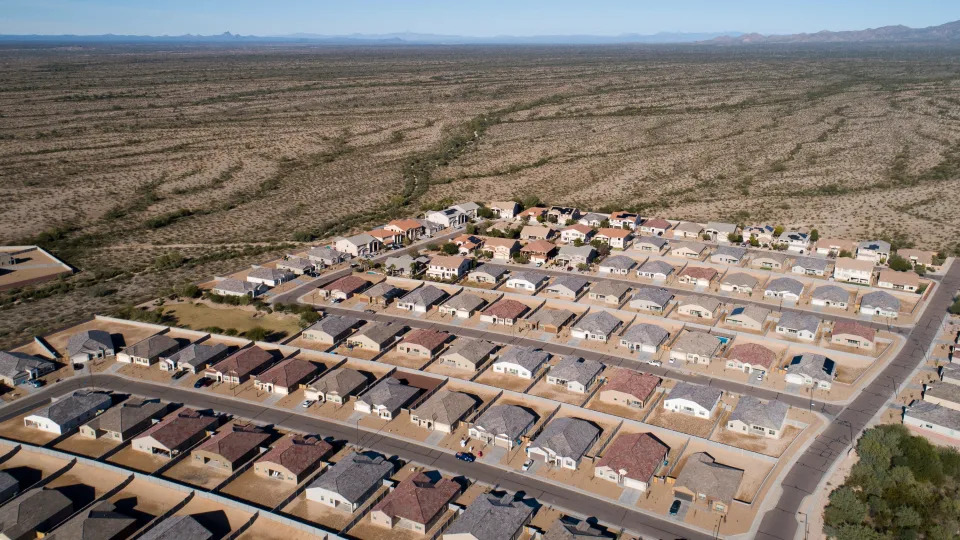
The Tartesso community development borders the desert in Buckeye. It's one of the last noticeable developments on the way out of the Phoenix area.
The Tartesso community development borders the desert in Buckeye. It’s one of the last noticeable developments on the way out of the Phoenix area.

A newly released state report on groundwater supplies under the desert west of Phoenix signals difficulty ahead for developers wishing to build hundreds of thousands of homes there.

It also signals the start of an effort by Arizona’s new governor to shore up groundwater management statewide.

Gov. Katie Hobbs released the modeling report Monday afternoon, and it shows that plans to add homes for more than 800,000 people west of the White Tank Mountains will require other water sources if they are to go forward.

The Arizona Department of Water Resources had developed the model showing inadequate water for much of the development envisioned as far-west suburbs, but had not released it during then-Gov. Doug Ducey’s term. Hobbs mentioned it during her State of the State address, along with other initiatives, including a new council dedicated to updating the state’s 1980 groundwater protection act for a new era of scarcity.

Hobbs also announced a new Governor’s Office of Resiliency, coordinating agencies, tribal governments and experts in finding land, water and energy solutions for the state.

“We must talk about the challenge of our time: Arizona’s decades-long drought, over-usage of the Colorado River, and the combined ramifications on our water supply, our forests, and our communities,” the governor said.

In the case of development on the western edges of the urban area, the information her team released makes clear that developers who own desert expanses largely in Buckeye’s planning area north of Interstate 10 and west and north of the White Tank Mountains will need more water to make their visions come true.

The report, called the Lower Hassayampa Sub-basin Groundwater Model, finds that projected growth would more than double groundwater use and put it out of balance by 15%. The state’s groundwater law requires developers in the Phoenix area to get state certificates of assured water supplies extending out 100 years before they can build.

Arizona Water Resources Director Tom Buschatzke on Monday said he would not issue new certificates for the area unless developers find secure water sources in addition to the local groundwater.

‘Breathing room’:Buckeye adopts a plan to find more water as city rapidly expands

New homes will need new water sources

Some of the Buckeye subdivisions in the area already have certifications for homes that Buschatzke estimated number in the thousands, and that will combine to add 50,000 acre-feet of demand in a basin that already uses 123,000 acre-feet. The aquifer apparently can bear that amount, but not the 100,000 acre-foot demand that department analysts have attributed to hundreds of thousands more homes envisioned for the zone.

The Howard Hughes Corp. is a major player in the area, with 100,000 homes planned on 37,000 acres in the Teravalis development, formerly called Douglas Ranch.

The question of where developers might get the water to support such vast housing tracts has previously presented a mystery, with some developers merely saying they were confident in their prospects. The report the state released this week provides an initial answer: They won’t be finding that water solely in the aquifer below the land. Instead, they will have to find new ways of importing and possibly recycling water if they want to build out the property.

“Some of the big plans that are out there for master-planned communities will need to find other water supplies or other solutions,” Buschatzke said.

Contacted on Tuesday, Howard Hughes Corp. did not respond to an interview request, but did provide a statement from Phoenix Region President Heath Melton: “We support the Governor’s initiative to proactively manage Arizona’s future water supply and will continue to be a collaborative partner with our elected officials, civic agencies, and community stakeholders to drive forward the most modern water management and conservation techniques and help ensure a prosperous and sustainable future for the West Valley, Arizona, and the greater Southwest.”

For now, the groundwater deficiency could stall much building on the Valley’s far west side. But it also could foreshadow a push for big new infrastructure projects, such as an ocean desalination plant and pipeline proposal that a state water finance board has agreed to evaluate. That proposal, led by an Israeli company that has built or operated desalination plants around the world, would pipe water north from Mexico and through Buckeye on its way to the Central Arizona Project canal.

Other options include moving water from other areas, such as the Harquahala Valley to the west, or recycling wastewater, Buschatzke said. Those options could take years, though.

Buckeye officials sent a statement to The Arizona Republic saying they need time to study the report but will work to ensure sustainable growth: “Buckeye is committed to responsible and sustainable growth and working to ensure we have adequate water for new businesses and residents, while protecting our existing customers.”

New growth:Where will water come from for the massive community planned for Buckeye?

Researcher: Finding water won’t be cheap or easy

Arizona State University water researcher Kathleen Ferris had called for the groundwater report’s release, and on Tuesday said she was delighted that Hobbs made it public. Ferris, with the school’s Kyl Center for Water Policy, is a past director of the Department of Water Resources and helped craft the 1980 groundwater law that requires a 100-year supply for new development.

“It’s a hugely important step,” Ferris said. “As the governor said, It’s about transparency and knowledge. We should not be allowing this growth to occur when the water isn’t there.”

Ferris said she counts herself among skeptics who don’t believe a desalination plant will come online quickly. The Colorado River’s drought-reduced storage means it can’t provide excess water to soon fill the gap in groundwater supplies, either. It doesn’t mean Buckeye can’t grow, she said, but finding the water to do so won’t be cheap or easy.

She cautioned, too, that other cities with stronger water portfolios are also on the lookout to snap up new water to secure their own futures.

Beyond Buckeye, Ferris said, Hobbs is right to push for better groundwater management statewide. The 1980 law applied mostly to urban areas, leaving vast areas of rural Arizona unregulated. The whole state doesn’t necessarily need the same 100-year-supply rule, Ferris said, but groundwater users everywhere should be responsible for tracking and reporting what they use. That would help the state know when it must act to conserve stressed aquifers, as it did this winter by halting expansion of irrigated farming around Kingman.

Any effort to address rural groundwater with statewide regulations is bound to face resistance in the Arizona Legislature, where lawmakers for several years have declined to extend state regulations to areas including Kingman. Voters in Cochise County approved a limited management area in November for one groundwater basin.

Whatever happens, Ferris said, the state is due for an honest conversation about where and by how much it can grow. She hopes the governor’s announcement is the start of such a reckoning. “We just can’t have subdivisions approved (solely) on groundwater,” she said.

One advocate for updating and strengthening groundwater protections around the state says she is encouraged that Hobbs has started her administration with moves to do just that.

“We are really encouraged and grateful that water is a top priority,” said Haley Paul, an Audubon Society regional policy director who co-chairs the Water for Arizona coalition.

The Hassayampa groundwater report demonstrates that Arizona needs to do something different now that it can’t rely on excess Colorado River water to backfill pumped groundwater, Paul said. Following a similar finding that has led groundwater depletion to limit Pinal County growth, she said, the report is “a reality check” on unlimited growth in the desert.

Brandon Loomis covers environmental and climate issues for The Arizona Republic and azcentral.com.

Environmental coverage on azcentral.com and in The Arizona Republic is supported by a grant from the Nina Mason Pulliam Charitable Trust. 

Explainer-Why U.S. flights were grounded by a FAA system outage

Reuters

Explainer-Why U.S. flights were grounded by a FAA system outage

January 11, 2023

(Reuters) – The Federal Aviation Administration (FAA) allowed some flights to resume after an outage of the system that alerts pilots to any obstructions before take-off had earlier forced the civil aviation regulator to ground all aircraft in the United States.

Over 4,000 flights were delayed and more than 600 canceled because of the outage as of early Wednesday morning. U.S. flights were slowly beginning to resume departures as a ground stop was lifted.

Here is a brief summary of what the pilot warning system does, what we know about what went wrong and background about the safety notices provided to pilots, known as NOTAM.

WHAT HAPPENED?

The FAA system that is meant to distribute notices to pilots on hazards failed at about 2 a.m. Eastern Time, officials said.

The FAA ordered airlines to put a halt on all domestic departures until 9 a.m. Eastern time while it tested whether crews had managed to restore the system and bring it back online.

The White House said that U.S. President Joe Biden had been briefed on the outage by Secretary of Transportation Pete Buttigieg. “There is no evidence of a cyberattack at this point,” White House Press Secretary Karine Jean-Pierre said in a tweet. The U.S. Department of Transportation is conducting an investigation, she said.

WHAT IS A NOTAM?

The system that failed on Wednesday is part of a nearly century-old practice originally known as Notices to Airmen – originally modeled on a system for notices to mariners.

The system, which was changed to be called “Notices to Air Missions” in 2021, is meant to alert pilots to hazards, everything from snow, volcanic ash or birds near an airport.

It also provides information on closed runways and temporary air restrictions.

The NOTAMs sent by the U.S. Federal Aviation Administration are part of a global safety system managed through the United Nations’ aviation agency.

Pilots are required to review the notices, either printed on paper or on an iPad, before take-off.

The information provided can run up to 200 pages for long-haul international flights.

NOTAMs are written in a kind of encoded shorthand that had been originally designed to make communication more efficient.

HOW HAS THE SYSTEM CHANGED?

The U.N. Civil Aviation Organization (ICAO) has been leading an effort to overhaul the system to make it easier for airlines and pilots to filter the most important warnings and present them in clearer language.

In July 2017, an Air Canada jet landed on the wrong runway at San Francisco’s airport and came within seconds of colliding with four other planes.

The notice of the closure of one of the two runways at the airport had been flagged in the pre-flight NOTAM – on page eight of a 27-page briefing – and missed by the pilots.

The incident, and the information overload that pilots complain the system encourages, prompted the effort to change the way the system operates.

“(NOTAMs) are just a bunch of garbage that nobody pays any attention to,” U.S. National Transportation Safety Board Chairman Robert Sumwalt said at a 2018 hearing on the Air Canada incident, which helped spur a global campaign for change.

FAA officials have been involved in efforts to modernize the system in recent years.

(Reporting by Nathan Gomes and Abhijith Ganapavaram in Bengaluru, Editing by Kevin Krolicki and Nick Zieminski)

US official warns of risks posed by heavy electric vehicles

Associated Press

US official warns of risks posed by heavy electric vehicles

Tom Krisher – January 11, 2023

FILE – Jennifer Homendy of the National Transportation Safety Board speaks during a news conference, Oct. 3, 2019, in Windsor Locks, Conn. On Wednesday, Jan. 11, 2023, Homendy, the chairwoman of the National Transportation Safety Board, said she is concerned about the risk that heavy electric vehicles pose if they collide with lighter vehicles. (AP Photo/Chris Ehrmann, File) (ASSOCIATED PRESS)

DETROIT (AP) — The head of the National Transportation Safety Board expressed concern Wednesday about the safety risks that heavy electric vehicles pose if they collide with lighter vehicles.

The official, Jennifer Homendy, raised the issue in a speech in Washington to the Transportation Research Board. She noted, by way of example, that an electric GMC Hummer weighs about 9,000 pounds (4,000 kilograms), with a battery pack that alone is 2,900 pounds (1,300 kilograms) — roughly the entire weight of a typical Honda Civic.

“I’m concerned about the increased risk of severe injury and death for all road users from heavier curb weights and increasing size, power, and performance of vehicles on our roads, including electric vehicles,” Homendy said in remarks prepared for the group.

The extra weight that EVs typically carry stems from the outsize mass of their batteries. To achieve 300 or more miles (480 or more kilometers) of range per charge from an EV, batteries have to weigh thousands of pounds.

Some battery chemistries being developed have the potential to pack more energy into less mass. But for now, there’s a mismatch in weight between EVs and smaller internal combustion vehicles. EVs also deliver instant power to their wheels, making them accelerate faster in most cases than most gas-powered cars, trucks and SUVs.

Homendy said she was encouraged by the Biden administration’s plans to phase out carbon emissions from vehicles to deal with the climate crisis. But she said she still worries about safety risks resulting from a proliferation of EVs on roads ands highways.

“We have to be careful that we aren’t also creating unintended consequences: More death on our roads,” she said. “Safety, especially when it comes to new transportation policies and new technologies, cannot be overlooked.”

Homendy noted that Ford’s F-150 Lightning EV pickup is 2,000 to 3,000 pounds (900 to 1,350 kilograms) heavier than the same model’s combustion version. The Mustang Mach E electric SUV and the Volvo XC40 EV, she said, are roughly 33% heavier than their gasoline counterparts.

“That has a significant impact on safety for all road users,” Homendy added.

The NTSB investigates transportation crashes but has no authority to make regulations. For vehicles, such authority rests largely with the National Highway Traffic Safety Administration.

Even apart from EVs, the nation’s roads are crowded with heavy vehicles, thanks to a decadelong boom in sales of larger cars, trucks and SUVs that’s led to extreme mismatches in collisions with smaller vehicles. But electric vehicles are typically much heavier than even the largest trucks and SUVs that are powered by gasoline or diesel.

Michael Brooks, executive director of the nonprofit Center for Auto Safety, said he, too, is concerned about the weight of EVs because buyers seem to be demanding a range of 300 or more miles per charge, requiring heavy batteries.

Setting up a charging network to accommodate that may be a mistake from a safety perspective, Brooks said.

“These bigger, heavier batteries are going to cause more damage,” he said. “It’s a simple matter of mass and speed.”

Brooks said he knows of little research done on the safety risks of increasing vehicle weights. In 2011, the National Bureau of Economic Research published a paper that said being hit by a vehicle with an added 1,000 pounds increases by 47% the probability of being killed in a crash.

He points out that electric vehicles have very high horsepower ratings, allowing them to accelerate quickly even in crowded urban areas. “People are not trained to handle that type of acceleration. It’s just not something that drivers are used to doing,” Brooks said.

Also, many newer electric SUVs are tall with limited visibility that poses risks to pedestrians or drivers of smaller vehicles, he said.

Sales of new electric vehicles in the U.S. rose nearly 65% last year to 807,000 — about 5.8% of all new vehicle sales. The Biden administration has set a goal of having EVs reach 50% of new vehicle sales by 2030 and is offering tax credits of up to $7,500 to get there. The consulting firm LMC Automotive has made a more modest prediction: It expects EVs to make up one-third of the new-vehicle market by 2030.

Comet last seen during Ice Age will be visible over Idaho. Here’s when and how to watch

Idaho Statesman

Comet last seen during Ice Age will be visible over Idaho. Here’s when and how to watch

Shaun Goodwin, Patrick McCreless, Genevieve Belmaker – January 11, 2023

A comet last visible by the naked eye when Neanderthals roamed the Earth should be observable in Idaho skies again soon.

The comet C/2022 E3 (ZTF) is passing through the inner solar system and will get closest to the sun on Jan. 12, according to space.com. The comet will continue to travel near the Earth, making its closest passage between Feb. 1 and Feb. 2.

The comet could be visible to the naked eye if it continues to brighten. Such a sight can be difficult to predict for comets, space.com states. However, even if the comet does dim a bit, it should still be visible with binoculars or a telescope for several days around its approach.

Though ancient, C/2022 E3 (ZTF) was only discovered by astronomers at the Zwicky Transient Facility at CalTech in March 2022. The facility operates at the Palomar Observatory at California’s Palomar Mountain, about 90 minutes northeast of San Diego.

The comet has a period of about 50,000 years, NASA Jet Propulsion Laboratory states. As such, the last time the comet came so close to the sun and Earth was during the last Ice Age, when humans and Neanderthals existed on the planet at the same time.

It was reported in the scientific journal Space in early January 2023.

How to watch

According to NASA, observers in Idaho and throughout the northern hemisphere should be able to find the comet in the morning sky as it travels northwest in late January.

Viewers should look for the comet when the moon is dim in the sky. The new moon on Jan. 21 will offer an excellent opportunity. Although the National Weather Service only provides accurate day-by-day forecasts five days out, the Climate Prediction Center predicts a 40-50% higher-than-normal chance for rain in the next eight to 14 days.

Although a higher chance of precipitation does not necessarily mean more cloud cover, clouds form when the atmosphere reaches its saturation point; more moisture in the atmosphere means a higher chance for clouds.

Brian Jackson, an associate professor at Boise State’s Physics Department, has previously told the Idaho Statesman that Camel’s Back Park in North Boise is an excellent spot to look toward the night sky. The park allows watchers to turn their backs on the light pollution from Boise and look out toward the Boise Mountains.

Jackson also recommended the Central Idaho Dark Sky Reserve in the Sun Valley, which offers one of the darkest night skies in the United States. The Light Pollution Map website also shows the best spots in Idaho to escape light pollution.

Weather Service meteorologist Josh Smith told the Statesman that Bogus Basin is an excellent place to stargaze and look for comets if there is cloud cover. Bogus Basin’s base sits at 5,800 feet, meaning it should be above any low cloud ceiling above the Treasure Valley.

What are comets?

Comets consist of ice and frozen gases, along with rocks and dust left after the solar system’s formation more than 4 billion years ago. They orbit the sun in highly elliptical orbits. When a comet approaches the sun, it heats up quickly, causing some ice to turn into gas. This heated gas and dust are what form a comet’s tail.

A green comet that takes about 50,000 years to complete its orbit around the sun will come closest to Earth for the first time since the Stone Age

Insider

A green comet that takes about 50,000 years to complete its orbit around the sun will come closest to Earth for the first time since the Stone Age

Kenneth Niemeyer and Morgan McFall-Johnsen – January 10, 2023

A comet in the sky.
A green comet named C/2022 E3 (ZTF) is expected to be about 26 million miles from Earth on February 2.Mike Hankey
  • A green comet named C/2022 E3 (ZTF) is approaching Earth, according to NASA.
  • The comet most recently passed our planet 50,000 years ago, during the last Ice Age, according to astronomers.
  • The comet is expected to be visible at night as it swings past Earth in early February.

A green comet is set to pass by Earth for the first time since the Stone Age, according to NASA‘s Jet Propulsion Laboratory, and it may be visible in the skies in late January and early February.

Astronomers discovered the comet, a ball of ice named C/2022 E3 (ZTF), in March 2022. They’d never seen it before, because it takes an incredibly long time to circle the sun, completing an orbit over tens of thousands of years. Modern astronomy didn’t exist last time this comet was in our neighborhood.

The comet is expected to be about 26 million miles from Earth on February 2. That would be the closest it has been to the Earth in 50,000 years, according to astronomers.

Back then, a period known as the Upper Paleolithic era, was when humans are believed to have left Africa and settled in Asia and Europe. Neanderthals still walked the Earth. The planet was in the middle of an Ice Age.

Neanderthal
Hyperrealistic face of a neanderthal male is displayed in a cave in the new Neanderthal Museum in northern Croatia.REUTERS/Nikola Solic

The icy cosmic visitor will pass our planet at nearly 109 times the average distance of the moon, but the comet is burning so bright that it could still be visible in the night sky.

“Comets are notoriously unpredictable, but if this one continues its current trend in brightness, it’ll be easy to spot with binoculars, and it’s just possible it could become visible to the unaided eye under dark skies,” NASA wrote in an update on December 29.

How, where, and when to spot comet C/2022 E3 (ZTF)

In the Northern Hemisphere, the green comet should be visible just before dawn in late January. At first, spotting it may require a telescope, but as it approaches Earth NASA expects viewers can see it with binoculars.

“The new long-period comet has brightened substantially and is now sweeping across the northern constellation Corona Borealis in predawn skies,” NASA said in a news release December 24. At that time, it was still too dim to see with a telescope.

A completely darkened new moon could provide ideal dark skies for spying the comet on January 21.

In the Southern Hemisphere, the green cosmic snowball will be visible in early February.

Why the comet is green
green comet in space
Another green comet, called ISON, passed Earth in 2013.NASA

The comet has a “greenish coma, short broad dust tail, and long faint ion tail,” according to NASA.

Many comets glow green. Laboratory research has linked this aura to a reactive molecule called dicarbon, which emits green light as sunlight decays it.

Dicarbon is common in comets, but it’s not usually found in their tails. That’s why the coma — the haze surrounding the ball of frozen gas, dust, and rock at the center of a comet — is glowing green, while the tail remains white.

The comet likely came from the mysterious Oort Cloud
voyager 1 spacecraft location left solar system heliosheath nasa jpl pia17046red full
The Oort Cloud is the most distant part of the solar system.NASA/JPL-Caltech

Experts told USA Today that the comet most likely came from the Oort Cloud, the farthest region of the solar system, which NASA describes as a “big, thick-walled bubble made of icy pieces of space debris the sizes of mountains and sometimes larger.”

The Oort Cloud is the most distant part of our solar system, encircling everything like a “giant spherical shell,” according to NASA. It’s so far away that astronomers measures its distance in astronomical units (AU). One AU is the distance between Earth and the sun. The inner edge of the Oort Cloud is 2,000 to 5,000 AU away.

That distance means astronomers have never observed an object in the Oort Cloud, so it’s still a “theoretical concept,” according to NASA. But astronomers suspect many far-traveling comets like C/2022 E3 (ZTF) come from there.

The comet won’t return for another 50,000 years — if ever

This is your only chance to see comet C/2022 E3 (ZTF), and may be the last chance humanity ever gets.

“We don’t have an estimate for the furthest it will get from the Earth yet—estimates vary—but if it does return it won’t be for at least 50,000 years,” Jessica Lee, an astronomer at Royal Observatory Greenwich, told Newsweek.

“Some predictions suggest that the orbit of this comet is so eccentric it’s no longer in an orbit—so it’s not going to return at all and will just keep going,” she added.

Correction: January 9, 2023 — A photo caption in an earlier version of this story misstated when the comet C/2022 E3 (ZTF) is expected to get to 26 million miles from Earth. It is February 2, 2023, not 2022.

Editor’s Note: This story has been updated with additional information about the comet and how to see it.

2022 was the 5th warmest year on record, adding further evidence of climate change

Yahoo! News

2022 was the 5th warmest year on record, adding further evidence of climate change

The last 8 years have been the warmest 8 on record, the report from the European Union’s Copernicus Climate Change Service said.

David Knowles, Senior Editor – January 10, 2023

Motorists drive west toward the setting sun.
Motorists drive west toward the setting sun in Long Beach, Calif., during a September heat wave. (Luis Sinco/Los Angeles Times via Getty Images)

Planet Earth experienced its fifth warmest year in recorded history in 2022, adding to a streak in which the last eight years have been the hottest on record, thanks to climate change caused by the burning of fossil fuels.

The 2022 finding was released Tuesday by the European Union’s Copernicus Climate Change Service, an independent nongovernmental organization. The only years hotter than 2022 in recorded history have been 2016, 2020, 2019 and 2017, the group said.

The cause of rising temperatures has long been established. Hundreds of thousands of scientific studies over decades have concluded that the burning of fossil fuels releases greenhouse gases into the Earth’s atmosphere that trap the sun’s ultraviolet radiation and result in warming. While government action around the world has begun to try to limit the emissions causing climate change, the pace of that effort has so far failed to keep temperatures from continuing to rise.

Carbon dioxide concentrations rose by approximately 2.1 parts per million and methane rose by around 12 parts per billion, resulting in an average of approximately 417 ppm for carbon dioxide and 1,894 ppb for methane.

“For both gases these are the highest concentrations from the satellite record,” the Copernicus Climate Change Service wrote in its report. “By including other records, they are the highest levels for over 2 million years for carbon dioxide and over 800,000 years for methane.”

The European Union's Copernicus Climate Change Service shares its findings on the global climate for 2022.
Some of the findings on 2022 global changes in climate from a study by the European Union’s Copernicus Climate Change Service. (Reuters)

Average global temperatures have risen by 2.1 degrees Fahrenheit since the start of the Industrial Revolution. Climate scientists say that is enough to have set off a cascade of consequences, many of which were seen around the world last year.

Climate change has been linked to drought, increased wildfire activity, inundating rains that result in flash flooding, wetter hurricanes that ramp up more quickly, melting ice caps and glaciers that help result in rising sea levels, crop loss, deadly heat waves and the instability of the polar vortex.

Since carbon atoms released into the atmosphere through the burning of fossil fuels can remain there for hundreds of years, the so-called greenhouse effect causing temperatures to rise is expected to continue to worsen over the coming decades, absent a coordinated global effort to dramatically curb emissions.

In April, when the United Nations Intergovernmental Panel on Climate Change released its sixth assessment report on the state of the climate, U.N. Secretary-General António Guterres summed up the findings.

“We are on a fast track to climate disaster: Major cities under water. Unprecedented heat-waves. Terrifying storms. Widespread water shortages. The extinction of a million species of plants and animals,” Guterres said in a written statement.

President Biden slams ‘reckless bill’ from Republicans to reverse funding for the IRS and its 87,000 new hires — here’s how it could impact you

Money Wise

President Biden slams ‘reckless bill’ from Republicans to reverse funding for the IRS and its 87,000 new hires — here’s how it could impact you

Serah Louis – January 11, 2023

President Biden slams ‘reckless bill’ from Republicans to reverse funding for the IRS and its 87,000 new hires — here's how it could impact you
President Biden slams ‘reckless bill’ from Republicans to reverse funding for the IRS and its 87,000 new hires — here’s how it could impact you

Washington’s lawmakers have come back from their holiday break swinging.

After a days-long speaker standoff, Republicans in the House have moved on to their next priority: clawing back funds from the IRS.

President Joe Biden had included increased funding for the IRS in the Inflation Reduction Act to help the agency catch sneaky tax evaders — especially those high-earners who love to find loopholes. Advocates believe the increased funding could raise as much as $1 trillion by forcing tax cheats to pay their dues, especially after years of budget cuts have gutted the system.

But on Jan. 9, Republicans introduced and passed a bill to rescind that $80 billion in funding.

While it’s likely to be struck down by the Democrat-controlled Senate, and Biden’s office has already voiced his intentions to veto “this reckless bill” if it makes it to his desk, it’s still a strong statement from Republican lawmakers.

Meanwhile, at the center of this political football is an overworked and understaffed tax agency. And whoever wins the power struggle in Washington, experts say taxpayers could be the ones left holding the bag.

The IRS desperately needs the support

The $80 billion in funding spread over the next 10 years would help the IRS modernize its infrastructure, increase enforcement and replace its aging workforce (50,000 of the IRS’s 80,000 workers are expected to leave in the next five years).

A Treasury Department report from May 2021 estimates the extra money would allow the agency to hire around 87,000 new employees — which could include revenue agents and customer service and IT staff — by 2031.

The agency has reportedly been underfunded by about 20% for a decade — leading it to cut back on both staff and technology updates.

Bogged down by a processing system that’s more than half a century old and a backlog that includes millions of unprocessed paper filings, the IRS has been in need of more resources and support for a while.

The customer service department has been woefully short-staffed as well. During the 2022 filing season, the IRS received around 73 million phone calls from taxpayers — but only 10% were actually answered.

“The combination of more than 21 million unprocessed paper tax returns, more than 14 million math error notices, eight-month backlogs in processing taxpayer correspondence, and extraordinary difficulty reaching the IRS by phone made this filing season particularly challenging,” national taxpayer advocate Erin M. Collins wrote in her 2022 midyear report to Congress.

On top of these issues, former IRS Commissioner Charles Rettig estimated in 2021 that the agency is losing $1 trillion in unpaid taxes each year — particularly due to evasion from the rich and big businesses. He also indicated they could be slipping through the cracks in part due to the lightly regulated cryptocurrency market, foreign source income and abuse of pass-through provisions.

Rettig has long pushed for increased funding “to bring on the fire-breathing dragons” to take cheaters to task.

Could bolstering enforcement do more harm than good?

Supporters argue the funding will help close the “tax gap” by helping catch more evaders.

From the total $80 billion, $45.6 billion has been allotted for increased enforcement — which would go toward hiring more enforcement agents, providing legal support and investing in “investigative technology” to determine who should or shouldn’t be audited.

But not everyone is thrilled with the news.

“They’re not going to get this ‘magic money,’” Brian Reardon told Bloomberg. Reardon is the president of the S Corporation Association, which represents small, privately-owned businesses that pass taxes onto their shareholders.

“If you dial up enforcement on people who are otherwise following the rules and paying what they owe, you create resentment and anger. You undermine people’s confidence in the tax system.”

However, the Biden administration maintains that the increased enforcement will be focused on the ultra wealthy and large corporations, and isn’t intended for small businesses or households who earn less than $400,000 a year.

Research from the Department of Treasury indicates that the top 1% of Americans could be dodging as much as $163 billion in taxes each year.

That being said, if the increased budget is approved, Eli Akhavan, a partner at Steptoe & Johnson in New York, says he expects audits will go up. But he’s been telling his wealthy clients they “have nothing to worry about other than some headaches,” provided they’re following good advice and have their “ducks in a row.”

“If there’s nothing to find, there’s nothing to find,” Akhavan says.

John Deere will let US farmers repair their own equipment

Endgadget

John Deere will let US farmers repair their own equipment

The deal comes amid political pressure over right to repair measures.

Jon Fingas, Reporter – January 9, 2023

Jon G. Fuller/VW Pics/Universal Images Group via Getty Images

John Deere has been one of the stauncher opponents of right to repair regulation, but it’s now willing to make some concessions. Deere & Company has signed a memorandum of understanding with the American Farm Bureau Federation (AFBF) that lets US farmers and independent repair shops fix equipment, rather than requiring the use of authorized parts and service centers. Users will have access to official diagnostics, manuals, tools and training. Deere will let owners disable electronic locks, and won’t bar people from legally obtaining repair resources even if the company no longer offers them.

The agreement includes some protections for the equipment maker. John Deere won’t be required to “divulge trade secrets,” or to allow repairs that might disable emissions controls, remove safety features or modify power levels. Unsurprisingly, fixes also can’t violate the law.

The memorandum is effective as of January 8th, although John Deere didn’t detail exactly how or when it would alter its practices. We’ve asked the company for comment. In a statement, senior VP Dave Gilmore said the company was looking forward to working with customers and the ABFB in the “months and years ahead” to provide repair facilities.

The pact is characterized as a “voluntary” private arrangement. However, it comes alongside mounting political pressure that effectively gave John Deere little choice but to improve repairability. President Biden ordered the Federal Trade Commission to draft right to repair regulation in 2021, while states like New York have passed their own (sometimes weakened) legislation. If Deere doesn’t act, it risks legal battles that could limit where and how it does business in the country.

As it stands, the farm equipment maker isn’t alone in responding to government action. AppleGoogleSamsung and other tech brands now have do-it-yourself repair programs in place. Microsoft will offer Surface parts to users later this year.

US Department of Agriculture approves first-ever vaccine for honeybees

Endgadget

US Department of Agriculture approves first-ever vaccine for honeybees

The drug could protect bees from American foulbrood, a bacteria that can devastate entire colonies.

Igor Bonifacic, Weekend Editor – January 8, 2023

NurPhoto via Getty Images

The humble honeybee hasn’t had an easy go of things recently. Between climate change, habitat destruction, pesticide use and attrition from diseases, one of the planet’s most important pollinators has seen its numbers decline dramatically in recent years. All of that bodes poorly for us humans. In the US, honeybees are essential to about one-third of the fruit and produce Americans eat. But the good news is that a solution to one of the problems affecting honeybees is making its way to farmers.

This week, for the first time, the US Department of Agriculture granted conditional approval for an insect vaccine. A biotech firm named Dalan Animal Health recently developed a prophylactic vaccine to protect honeybees from American foulbrood disease. The drug contains dead Paenibacillus larvae, the bacteria that causes the illness.

Thankfully, the vaccine won’t require beekeepers to jab entire colonies of individual insects with the world’s smallest syringe. Instead, administering the drug involves mixing it in with the queen feed worker bees eat. The vaccine then makes its way into the “royal jelly” the drones to feed their queen. Her offspring will then be born with some immunity against the harmful bacteria.

The treatment represents a breakthrough for a few reasons. As The New York Times explains, scientists previously thought it was impossible for insects to obtain immunity to diseases because they don’t produce antibodies like humans and animals. However, after identifying the protein that prompts an immune response in bees, researchers realized they could protect an entire hive through a single queen. The vaccine is also a far more humane treatment for American foulbrood. The disease can easily wipe out colonies of 60,000 bees at once, and it often leaves beekeepers with one choice: burn the infected hives to save what they can.

Dr. Annette Kleiser, the CEO of Dalan, told The Times the company hopes to use the vaccine as a blueprint for other treatments to protect honeybees. “Bees are livestock and should have the same modern tools to care for them and protect them that we have for our chickens, cats, dogs and so on,” she said. “We’re really hoping we’re going to change the industry now.”