America Has a Debt Problem, and the Answer to It Starts With Form 1040
Binyamin Applebaum – January 25, 2023
Mr. Appelbaum is a member of the editorial board.
Credit…Illustration by Rebecca Chew/The New York Times; photograph by TokenPhoto, via Getty Images
Washington’s favorite show, “Debt Ceiling Chicken,” is playing again in the big white theater on Capitol Hill. And once again, it is diverting attention from the fact that the United States really does have a debt problem.
Republicans and Democrats in recent decades have hewed to a kind of grand bargain, raising spending and cutting taxes, and papering over the difference with a lot of borrowed money.
From 1972 to 2021, the government, on average, spent about 20.8 percent of gross domestic product while collecting about 17.3 percent of G.D.P. in revenue. It covered the gap with $31.4 trillion in i.o.u.s — the federal debt.
The government relies on this borrowed money to function, and for decades, it has defied a variety of dire predictions about the likely consequences. Notably, there’s no sign that Washington is exhausting Wall Street’s willingness to lend. In financial markets, U.S. Treasuries remain the ultimate comfort food. There’s also little evidence the government’s gargantuan appetite is making it harder for businesses or individuals to get loans, which could impede economic growth.
But the federal debt still carries a hefty price tag.
The most immediate problem with the government’s reliance on borrowed money is the regular opportunity it provides for Republicans to engage in blackmail. Congress imposes a statutory limit on federal borrowing, known as the debt ceiling. The government hit that limit this month, meaning the total amount of spending approved by Congress now requires borrowing in excess of that amount.
Raising the ceiling ought to be a formality, since it simply allows the government to meet the obligations Congress already has approved. But House Republicans say they won’t raise it without a deal to cut future spending.
The Biden administration is rightly insistent that it won’t pay Congress to do its job, as the Obama administration agreed to do in 2011.
After all, Americans don’t want large spending cuts. The vast majority of federal spending is supported by most Americans. About 63 cents of every federal dollar goes to mandatory programs, the largest of which, Social Security and Medicare, are wildly popular. Others, like Obamacare subsidies, are less popular, but there’s no need to speculate about what would happen if Republicans tried to cut the program. They’ve tried and failed repeatedly. An additional 15 cents goes to discretionary programs. The big-ticket items, like health care for veterans, highway construction and subsidies for law enforcement, are pretty popular, too. The rest is the defense budget and interest payments.
Indeed, Americans need more federal spending. The United States invests far less than other wealthy nations in providing its citizens with the basic resources necessary to lead productive lives. Millions of Americans live without health insurance. People need more help to care for their children and older family members. They need help to go to college and to retire. Measured as a share of G.D.P., public spending in the other Group of 7 nations is, on average, more than 50 percent higher than in the United States.
But Democrats ought to emphasize a distinction between resisting Republican demands and defending the government’s current borrowing habits. There is another, better way to fund public spending: collecting more money in taxes.
In recent decades, proponents of more spending have largely treated tax policy as a separate battle — one that they’ve been willing to lose.
They need to start fighting and winning both.
It costs money to borrow money. Interest payments require the government to raise more money to deliver the same goods and services. Using taxes to pay for public services means that the government can do more.
The United States paid $475 billion in interest on its debts last fiscal year, which ran through September. That was a record, and it will soon be broken. In the first quarter of this fiscal year, the government paid $210 billion.
The payments aren’t all that high by historical standards. Measured as a share of economic output, they remain well below the levels reached in the 1990s. Last year, federal interest outlays equaled 1.6 percent of G.D.P., compared with the high-water mark of 3.2 percent in 1991. But that mark, too, may soon be exceeded. The Congressional Budget Office projects that federal interest payments will reach 3.3 percent of G.D.P. by 2032, and it estimates interest payments might reach 7.2 percent of G.D.P. by 2052.
That’s a lot of money that could be put to better use.
Borrowing also exacerbates economic inequality. Instead of collecting higher taxes from the wealthy, the government is paying interest to them — some rich people are, after all, the ones investing in Treasuries.
If the debt ceiling serves any purpose, it is the occasional opportunity for Congress to step back and consider the sum of all its fiscal policies.
The nation is borrowing too much but not because it is spending too much.
The real crisis is the need to collect more money in taxes.
US governor defends ban on African American history course
January 23, 2023
The Republican leader of the US state of Florida defended his ban on an African American studies course Monday, railing against its pushing of “social justice” topics such as “queer theory.”
“We want education, not indoctrination. If you fall on the side of indoctrination, we’re going to decline. If it’s education, then we will do (it),” Governor Ron DeSantis, who is considered one of the favorites for his party’s 2024 presidential nomination, told reporters.
“This course on Black history: what is one of the lessons about? Queer theory. Now who would say that an important part of Black history is queer theory? That is somebody pushing an agenda on our kids,” he added.
The class covers more than 400 years of African American history and is being rolled out as part a nationwide “advanced placement” program giving high school students the chance to take college-level subjects before graduation.
But Florida’s Department of Education has objected to the inclusion of “Black Queer Studies” and topics such as Black feminism and the alleged promotion of critical race theory, an academic discipline investigating systemic racism in American society.
Officials have also complained about its approach to the debate over reparations — the argument for compensating Black Americans for slavery — telling organizers the program violated state law and rejecting its inclusion in Florida schools.
DeSantis has seen his political stock rise following a big election win in November and he is now considered former president Donald Trump’s main rival in the race for the 2024 Republican nomination.
He has gained support on the right for his hardline stances on “culture war” issues such as public health restrictions during the pandemic and alleged “woke” indoctrination in education.
He argued Monday that the purpose of education was the “pursuit of truth,” and not to use schools as “an instrument of what they consider social justice and social change.”
“We believe in teaching kids facts and how to think, but we don’t believe they should have an agenda imposed on them,” DeSantis said. “When you try to use Black history to shoehorn in queer theory, you are clearly trying to use that for political purposes.”
The decision to block the course has been met with outrage from the American Civil Liberties Union, which said DeSantis had “no right to censor speech he disagrees with” while Vice President Kamala Harris said at the weekend anyone banning teaching US history “has no right to shape America’s future.”
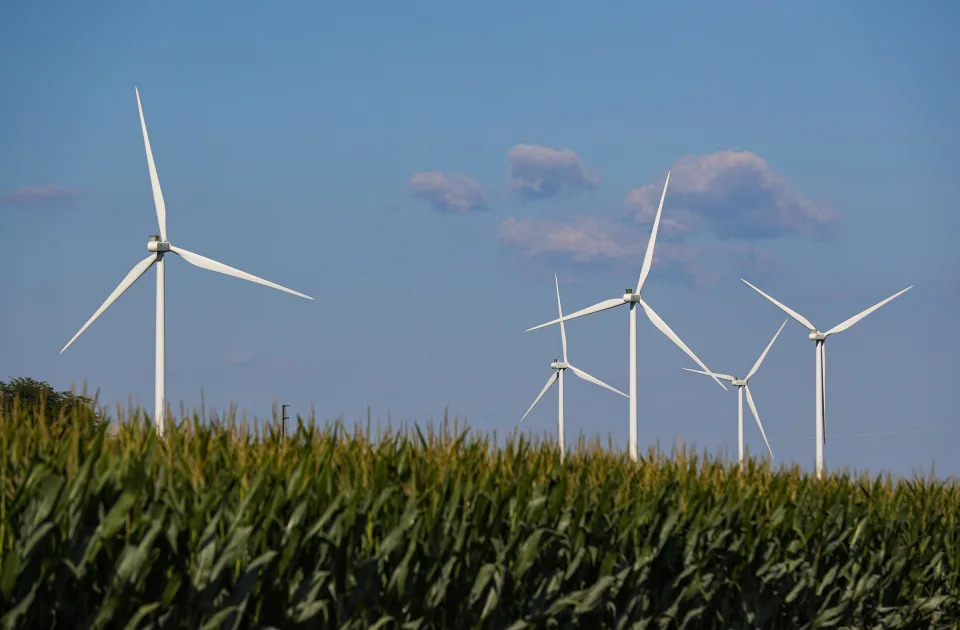
Scrub Hub: Passing a wind farm, I see some turbines spinning and others motionless. Why?
Karl Schneider, Indianapolis Star – January 23, 2023
Wind farms are becoming more common in Indiana. The state already boasts the fourth largest “farm” in the U.S. and produces nearly 3,500 megawatts of wind energy, with more on the horizon.
The towering windmills reaching up to the sky produce slightly more than 9% of all the electricity used in the state. That’s enough to power more than 1 million homes, according to the American Clean Power Association.
With more projects in the works that will produce another 302 megawatts, and a handful of bills proposed in this session of the General Assembly, wind power is likely to continue to grow across the state. And with the increasing presence of the conspicuous energy generators comes some curiosity.
So, for this edition of Scrub Hub, we took to our trusty submission form and chose a question from Teresa, who asked: Why are the wind turbines not turning right now?
Wind turbines operate in a rural area north of Lafayette, Indiana, on Wednesday, August 4, 2021.
It’s possible for the blades on wind turbines to reach up to speeds of 200 mph, so it may seem odd when some are spinning very quickly while the blades on others nearby are not moving.
We dug around in some state, federal and industry reports and reached out to academic experts in energy technology to determine why some turbines in a wind farm spin while others remain still.
Short Answer: The turbine is down for maintenance
Wind turbines, like all machines, need both scheduled and unscheduled maintenance. In some instances that explains why some are operating but not others.
The basic components of a wind turbine are the visible tower and rotor blades, as well as the gearbox and generator located at the top of the tower.
Scheduled maintenance helps prevent wear and tear from breaking parts and unscheduled maintenance occurs when the turbine experiences any of a number of failures.
Regular preventative maintenance can include periodic equipment inspection, oil and filter changes, calibration and adjustment of various parts, as well as replacing brake pads and seals. General housekeeping and blade cleaning can also temporarily keep a turbine from spinning.
In larger wind farms, several turbines on a circuit can be inoperable and not spinning because they are all down for maintenance, said John Roudebush, program chair of Ivy Tech College’s Energy Technology program.
Long answer: Curtailment, congestion and wind speed
Energy transmission in Indiana is run through the Midcontinent Independent System Operator, commonly known as MISO. The group manages the flow of electricity by balancing demand versus what’s being generated, which means there are times where excess electricity is being produced.
“(Sometimes) we don’t need the power as demand is down or another power plant is selling power to the customers instead,” Roudebush wrote in an email. “Power plants compete on the grid. A coal plant, a natural gas plant, or a wind farm will all bid to sell power during some part of the day and MISO will pick the cheapest bid for the day. Generally, wind is the cheapest but not always.”
John Hall, assistant professor at the University of Buffalo’s Engineering and Applied Sciences, focuses his research on the technical aspects of wind energy. While some wind turbines will operate normally, he said others may be stopped to match production with grid demand.
“Basically, you have the utility company distributing power and buying and selling in real time,” Hall said. “Based on how much they need, wind farms would turn turbines off accordingly.”
The industry calls a wind turbine that is not spinning “parked,” Hall said, and this is done with a braking system that holds the rotor in place. Once energy demand rises, the brake is released and almost immediately the turbine starts delivering electricity to the grid again.
Another obvious answer to why the turbines may not be spinning is that the wind speed is not high enough.
Generally, turbines can generate power with wind speeds as low as 5 mph. If speeds fall below that, there just isn’t enough to turn the sometimes massive blades.
On the other hand, wind that is too fast can cause damages to the turbines, so operators of wind farms will park the rotors until the wind calms down. Turbines generally shut down when wind speeds hit about 55 mph.
“The system is not designed for that, so they shut it down,” Hall said. “That’s OK because we rarely get winds over that speed, and it would not be worthwhile to design for that for the few instances.”
To help improve the efficiency of wind farms, Hall said banking excess power is a huge research area right now.
“There are studies on new battery technology and super capacitors and different ways to get around that issue,” Hall said.
Another solution for storing excess electricity is by making hydrogen, Hall said. Wind farm operators would be able to create hydrogen and store it for use later when the grid demand increases.
While fossil fuel plants may be more responsive to the constantly moving supply and demand for electricity, Hall said the future depends on renewables.
“If folks are concerned about climate and want a better future for the next generation and everything, renewable energy like wind and hydro-electric and tidal power are all really not just sources of energy but vital to perhaps our existence,” Hall said.
Karl Schneider is an IndyStar environment reporter.
IndyStar’s environmental reporting project is made possible through the generous support of the nonprofit Nina Mason Pulliam Charitable Trust.
Native Hawaiians flock to Las Vegas for affordable living
Jennifer Sinco Kelleher – January 22, 2023
Doreen Hall Vann walks with son Zaiden after tryouts for a club baseball team Saturday, Jan. 21, 2023, in Las Vegas. In 2019 Vann moved from Hawaii to Las Vegas to be closer to her daughter in Seattle. (AP Photo/John Locher)Doreen Hall Vann wathes her son Zaiden during tryouts for a club baseball team Saturday, Jan. 21, 2023, in Las Vegas. In 2019 Vann moved from Hawaii to Las Vegas to be closer to her daughter in Seattle. (AP Photo/John Locher)
KAPOLEI, Hawaii (AP) — Kona Purdy never wanted to live anywhere but Hawaii. As a Native Hawaiian, he wanted his children to grow up like he did: rooted in their culture, and nourished by the mountains and ocean.
But raising a family in Hawaii meant squeezing nine people into a four-bedroom house — rented with extended family — in Waipahu, a Honolulu suburb. It felt cramped, but the Purdys accepted that this was the price to survive in their homeland.
“We stuffed ourselves into one room,” Purdy said of his four-member family’s living arrangements.
Their share of the monthly rent was $2,300. When rent increased, the Purdys realized that they could no longer afford to live in Hawaii.
“I was so busy working, trying to make ends meet,” he said. “We never took our kids out to the beach. We didn’t go hiking.”
It’s increasingly common for Hawaii residents to be priced out of the Aloha State, where the median price for a single-family home topped $900,000 during the pandemic. On Oahu, the most populous island and where Honolulu is, the median price is more than $1 million.
Many residents work in low-wage service jobs, and the financial strain is especially significant for Hawaii’s Indigenous people. A state analysis published last year showed that a single person working 40 hours a week would need to earn $18 an hour to pay for housing and other necessities in Hawaii, but the state minimum wage is currently $12 an hour.
Many, like the Purdys, have headed to Las Vegas.
According to 2021 population estimates from the U.S. Census Bureau, the biggest growth of Native Hawaiian and other Pacific Islander populations was in Clark County, Nevada, which includes Las Vegas, and Sacramento County, California. The biggest decline of Native Hawaiian residents was in Honolulu.
Hawaii residents are spending on average 42.06% of their income on rent, which is the highest of any state, according to a Forbes Home analysis. California ranks second, but at a much smaller proportion of income going toward rent: 28.47%.
Estimates from the American Community Survey showed that in 2011, there were about 296,400 Native Hawaiians in Hawaii and about 221,600 on the continental U.S. Just a decade later, those numbers flipped. In 2021, there were about 309,800 Native Hawaiians in Hawaii and about 370,000 in other states.
“There’s no Hawaii without Hawaiians,” said Honolulu City Council Chair Tommy Waters, who is Native Hawaiian. His five siblings have all moved to the continental U.S. “That’s just incredibly sad to me, that Hawaiians cannot afford to live in Hawaii.”
Las Vegas was desirable to the Purdys because it’s a popular vacation destination for Hawaii residents, which meant family would likely visit often. Also, the cost of living is significantly lower.
So in 2017, they uprooted their family and moved to Henderson, a Las Vegas suburb in Clark County, where they could afford to rent a two-bedroom apartment for $1,000 a month.
Far from Hawaii’s shores, they felt like “fish out of water,” Purdy said.
“So it’s real ‘eha,’” Purdy said, using the Hawaiian word for painful, “because you do get disconnected from the land, which we’re so connected to, being born and raised here.”
But even though they were nearly 3,000 miles from home, Hawaiian culture was all around them. Thanks to many other transplants, the Las Vegas area is full of restaurants catering to Hawaiian taste and cultural events expressing Hawaiian pride.
There’s even a real estate brokerage that helps families relocate from the islands — run by mostly former Hawaii residents.
“You go into any store in any part of the valley and you’ll find someone from Hawaii working there or shopping there,” Purdy said.
A three-bedroom home priced at $300,000 in a Las Vegas suburb would be $1.2 million in Honolulu, said Terry Nacion, a Native Hawaiian realtor. She left Hawaii for Las Vegas in 2003 because home ownership felt unattainable. “Back home, you either had to have your home passed down to you or you have to work four jobs,” she said.
A few months after they moved, about 20 other relatives, including Purdy’s mother, uncle and sister Lindsay Villarimo, followed them.
“Over time, it just became exhausting trying to make ends meet,” said Villarimo. “It’s heartbreaking that’s the choice we make. The majority of us, I think we just got priced out of home.” When Villarimo and her family decided to move to Nevada, her husband Henry had never even left Hawaii.
Las Vegas’ affordability was “liberating,” she said. With cheaper rent and groceries, and no state income tax, she could stretch her paycheck further.
“We were just living it up in the dollar store,” she said. In Hawaii, that type of store doesn’t exist.
For Hawaii residents, the draw to Las Vegas can all be traced back to a downtown hotel that opened in 1975, author Dennis M. Ogawa said.
The hotel originally catered to Californians, but he struggled to get business. Reminded of gambling’s popularity in Hawaii, it shifted focus to visitors from the islands. “Aloha Spoken Here” became the hotel’s slogan.
In 2019, Doreen Hall Vann decided to move to Las Vegas to be closer to her daughter, who had moved to Seattle for more job opportunities.
On Facebook, she gushed about how much cheaper everything was, from bread to rent. But she started to worry about staying connected to her culture while living far from home, especially because she uprooted her son, who was then 6 years old, from his Hawaiian language immersion school.
“It’s just like when you give birth and you cut your umbilical cord. For us Native Hawaiians, our ‘piko’ is the source of life,” Hall Vann said, using the Hawaiian word for navel or umbilical cord. “When we move off island … we are disconnected because we’re not on our land anymore.”
But in her new home, she found she had more time and less stress.
“I was so busy back home trying to make a living,” she said. “When I moved to Vegas, it really put a pause in my life and I could see things a lot clearer.”
That allowed her to get involved in the Las Vegas Hawaiian Civic Club, where she now teaches Hawaiian.
“We have our people, our home, our community is thriving,” she said.
In Las Vegas, Purdy’s children began to learn hula and the family enjoyed “hoolaulea,” cultural festivals that were bigger than celebrations back in Hawaii.
But in August 2021, exactly four years after leaving Hawaii, the Purdys moved back home.
Purdy said that his wife wanted to take care of her mother, who began showing signs of dementia. Their daughter also got accepted to Kamehameha Schools, a highly selective and relatively affordable private school system that gives admissions preference to students with Hawaiian ancestry.
The family moved to Kapolei, a Honolulu suburb not far from where they once lived, to share a five-bedroom house with their extended family. Now that the Purdys have three children, they rent two of the bedrooms.
Purdy is trying to find time to take his kids to hula lessons. Since moving back, the family has only been to the beach once.
“It’s a grind, it’s hard, it’s really expensive,” he said. “But I also feel like we’re exactly where we’re supposed to be right now.”
‘I had no choice’: For many homeless people, O’Hare has become a nighttime refuge
Adriana Pérez, Chicago Tribune – January 22, 2023
Norbert Pikula, 77, had been sleeping on a friend’s sofa every night for the last six months. But when his friend was admitted to the hospital a few weeks ago, Pikula’s fragile world turned upside down and he had nowhere to sleep.
So now he uses his senior citizen CTA pass to ride to O’Hare International Airport and spend the night there. His situation mirrors that of countless other homeless people who sleep at the airport to stay warm and safe during the winter.
“I had no choice,” Pikula told the Tribune on Thursday. He was on his way to open a bank account after eating his usual weekday lunch at Providence Soup Kitchen in St. Stanislaus Kostka Catholic Church.
According to a report from the Chicago Coalition for the Homeless, an estimated 65,611 people experienced homelessness in Chicago in 2020, an estimate different from that offered by the U.S. Department of Housing and Urban Development because it takes into account people living doubled up or temporarily staying with others.
And while sheltering at the airport isn’t new, said Jessica Dubuar, director of health and specialty services of Haymarket Center, which has conducted outreach operations out of O’Hare to address homelessness in public transportation since 1990, the steadily increasing number of people doing it is.
“We saw over 600 unique individuals that we engaged with. We also had almost 14,000 encounters with them throughout the calendar year,” she said. Compared with previous years, that number illustrates an uptick: In 2021, there were 11,196 recorded encounters. In 2020 — the beginning of the pandemic — saw 12,270 encounters. In 2019, they recorded 9,975 encounters. In 2018, it was 8,132.
“This is not a new situation at the airport. It’s one that many organizations and city departments have been aware of and have been devoting resources to for 30 plus years,” Dubuar said. “As the years have gone on, we definitely see a pattern of the number of folks who are coming to the airport — I would even just call it a spike in the numbers of folks that we’re seeing at the airport when the weather turns cold.”
Advocates offer a couple of reasons for why more people are seeking shelter at O’Hare. Sarah Boone of the Chicago Housing Initiative who created a GoFundMe to help Pikula raise money, said there are three realities facing the homeless population right now: the number of beds in homeless shelters was decreased at the beginning of the COVID-19 pandemic and never restored, migrants who have recently arrived in Chicago are increasingly using homeless shelters as well, and homeless shelters across the city are overwhelmed.
And on the ground at O’Hare, workers offer another possible explanation. Jessy Pearl, a Transportation Security Administration agent who works at the airport, said she has noticed an uptick in the homeless population sheltering there since Delta Air Lines moved out of Terminal 2 and into Terminal 5.
“There’s more homeless people — more activity is concentrated at Terminal 2, since there’s less passenger traffic,” especially in the early afternoon, Pearl told the Tribune. “I’ve worked at the airport long enough to know that more homeless people have been around the CTA and arrivals area ever since the pandemic started. More so lately, since Delta moved to Terminal 5.”
According to a statement by the Chicago Department of Aviation (CDA), which manages O’Hare, the department is “aware of the increasing population of unsheltered individuals at O’Hare International Airport. It’s a common occurrence at this airport and airports nationwide when temperatures drop in the winter months. Airport leadership and staff on the ground continue collaboration with the Department of Family and Support Services (DFSS) and their delegate agencies to provide 24/7 outreach to unsheltered residents at O’Hare.
“Outreach professionals engage with individuals experiencing homelessness at O’Hare and conduct needs assessments. If the individual chooses to accept assistance, outreach professionals connect them with appropriate services and shelters, including necessary referrals and transportation. The CDA is committed to working with fellow city departments and community partners to support those in need and connect them with all available resources in Chicago.”
Pikula has been sleeping at the airport for the last two weeks or so, said Boone. And he’s been carrying around his belongings all day as he moves around the city. “I think it’s wearing on him,” she added.
Boone said she met Pikula at Holy Trinity Russian Orthodox Cathedral in Ukrainian Village where free food is offered on Saturdays. Her organization shows up to soup kitchens and places where there’s free food to connect homeless people with necessary services in the city and tend to their needs.
“I tried to get him to go to the hospital across the street, because you can go to the ER to call the shelters. And he didn’t want to do that because the wait is so long,” Boone said. “So we tried calling 311. And he kind of just said he’d prefer to be at the airport than at the shelters. So then I went home and I just thought about it. And I was like, we should do a GoFundMe. I’ve never done this before. But what if it works?”
Pikula said he is looking for a more permanent housing situation than couch surfing or spending nights at O’Hare. He’s hoping to find a studio or one-bedroom apartment in Wicker Park, Logan Square, Avondale or Garfield Park. That’s where his friends from the soup kitchens he visits live, so he wants to be close by.
A Polish American who grew up in Chicago, Pikula previously worked as a baker and security guard. He is on the waiting list for senior Chicago Housing Authority housing and subsidized Catholic Charities senior apartments. So far, he has had no luck finding a place to live.
During the pandemic, many homeless people turned to the CTA for shelter, and service providers set up at the Forest Park Blue Line station. But as the effects of the pandemic continue to limit housing, needs at the other end of the line also became evident.
Off the Blue Line O’Hare stop, to the left, a sign for the Haymarket Center O’Hare Outreach sticks out of the wall. A man was waiting to go in Thursday morning as he charged his cellphone.
The program assists homeless clients and passengers seeking shelter at the airport. It also approaches issues regarding alcohol and substance abuse, housing and income. Dubuar described what a client may find in the 24/7 office at O’Hare.
“We have a number of resources available on site from, food and coffee, water, hand sanitizer, masks … those things. We also have clothing available, hygiene products and a few other things,” she said. “What we’ll also do is invite people to come in and sit down and talk to us. And we do a small assessment with them, exploring all sorts of things from health care, mental health care, substance use, benefits and IDs and all of those things.”
The O’Hare Outreach program is funded by the Chicago Department of Aviation and carried out in cooperation with the Department of Family Support Services and a host of other community partners, such as shelter providers, substance use treatment providers and — importantly — housing programs.
“The complexity of the (needs of) folks we’re seeing has increased and, (in) the number of encounters, that’s really where you see that reflected,” Dubuar said. “This isn’t just a ‘somebody needs a sandwich today’ and that’s it, that’s all they needed. Because I think that we have folks, their needs are complex and navigating through these systems is hard and they need as much support as they can possibly get.”
While Dubuar couldn’t confirm whether there is a more concentrated homeless population in specific airport terminals, she said it’s possible that changes in the airport complex layout influence where homeless people spend their time.
“Individuals who come to the airport for shelter do learn the system and do see when there are construction projects or changes to how the space is being monitored with our partners from CPD and the Department of Aviation,” she said. “And so it is it is highly possible that there are going to be some folks who are visible because certain areas are under construction or maybe not being monitored as much as possible.”
On Friday morning, as the sun rose, a few scattered people in O’Hare’s Terminal 2 rustled in their sleep. They were slowly waking up. Some of them might have had canceled or delayed flights. Others, though, were homeless and had sought a warm place to spend the night.
A police officer approached a person who was lying by the windows in the arrivals area of Terminal 2. He asked if they were OK. “Just try not to fall sleep,” he said. “Stay awake.”
Pikula and other homeless people will likely keep searching for a more stable situation than sleeping at the airport every night. Even as they seek support services, though, continuing to sleep at the airport seems, in Pikula’s words, the only option in terms of surviving cold winter nights.
“I’ll be honest with you, my life has not been rosy,” Pikula said. “It’s been a fighting life.”
It’s hard to say how long it takes, on average, for a homeless person in Chicago to find stable housing, Dubuar said.
“As with most social services, benefits and resources, it’s about eligibility and availability,” she said. “Sometimes it’s a matter of the stars aligning.”
Military probing whether cancers linked to nuclear silo work
Tara Copp – January 22, 2023
FILE – An inert Minuteman III missile is seen in a training launch tube at Minot Air Force Base, N.D., June 25, 2014. Nine military officers who had worked decades ago at a nuclear missile base in Montana, home to a vast field of 150 Minuteman III intercontinental ballistic missile silos, have been diagnosed with blood cancer and there are “indications” the disease may be linked to their service, according to military briefing slides obtained by The Associated Press. One of the officers has died. (AP Photo/Charlie Riedel, File) (ASSOCIATED PRESS)
WASHINGTON (AP) — Nine military officers who had worked decades ago at a nuclear missile base in Montana have been diagnosed with blood cancer and there are “indications” the disease may be linked to their service, according to military briefing slides obtained by The Associated Press. One of the officers has died.
All of the officers, known as missileers, were assigned as many as 25 years ago to Malmstrom Air Force Base, home to a vast field of 150 Minuteman III intercontinental ballistic missile silos. The nine officers were diagnosed with non-Hodgkin lymphoma, according to a January briefing by U.S. Space Force Lt. Col. Daniel Sebeck.
Missileers ride caged elevators deep underground into a small operations bunker encased in a thick wall of concrete and steel. They remain there sometimes for days, ready to turn the launch keys if ordered to by the president.
“There are indications of a possible association between cancer and missile combat crew service at Malmstrom AFB,” Sebeck said in slides presented to his Space Force unit this month. The “disproportionate number of missileers presenting with cancer, specifically lymphoma” was concerning, he said.
Sebeck declined to comment when contacted by email by the AP on Saturday, saying the slides were “predecisional.” In the slides, he said the issue was important to the Space Force because as many as 455 former missileers are now serving as Space Force officers, including at least four of the nine identified in the slides.
In a statement to the AP, Air Force spokeswoman Ann Stefanek said that “senior leaders are aware of the concerns raised about the possible association of cancer related to missile combat crew members at Malmstrom AFB.”
Stefanek added: “The information in this briefing has been shared with the Department of the Air Force surgeon general and our medical professionals are working to gather data and understand more.”
Non-Hodgkin lymphoma, which according to the American Cancer Society affects an estimated 19 out of every 100,000 people in the U.S. annually, is a blood cancer that uses the body’s infection-fighting lymph system to spread.
For comparison, only about 3,300 troops are based at Malmstrom at a time, and only about 400 of those are assigned either as missileers or as support for those operators. It is one of three bases in the U.S. that operate a total of 400 siloed Minutemen III ICBMs, including fields at Minot Air Force Base in North Dakota and F.E. Warren Air Force Base in Wyoming.
The median age for adult non-Hodgkin lymphoma is 67, according to the National Institutes of Health. The former missileers affected are far younger. Officers are often in their 20s when they are assigned duty watch; the officer who died, who was not identified, was a Space Force officer assigned to Schreiver Space Force Base in Colorado with the rank of major, a rank typically achieved in a service member’s 30s. Two of the others are in the same Space Force unit with the rank of lieutenant colonel, which is typically reached in a service member’s early 40s.
It’s not the first time the military has been alerted to multiple cancer cases at Malmstrom. In 2001 the Air Force Institute for Operational Health investigated the base after 14 cancers of various types were reported among missileers who had served there, including two cases of non-Hodgkin lymphoma.
But the review found the base was environmentally safe and that “sometimes illnesses tend to occur by chance alone.” The report lamented that the list of those diagnosed had been collected because it “perpetuates the level of concern.”
The discovery of new cases comes as the U.S. government has shown more openness to acknowledging the environmental hazards, or toxic exposures, troops may face while serving.
In her statement to the AP, Air Force spokeswoman Stefanek said, “We are heartbroken for all who have lost loved ones or are currently facing cancer of any kind.”
It was not clear whether some of the nine officers identified in the January briefing slides, whose diagnoses occurred between 1997 and 2007, overlap some of the cases identified in the Air Force’s 2001 investigation. It’s also not known if there were similar reports of cancers at other nuclear silo bases or whether that is being investigated by the Air Force.
“Missileers have always been concerned about known hazards, such as exposure to chemicals, asbestos, polychlorinated biphenyls, lead and other hazardous material in the work environment,” Sebeck said in the January slides. “All missileers should be screened and tracked for the rest of their lives.”
Last year President Joe Biden signed the PACT Act, which greatly expanded the the types of illnesses and toxic exposures that would be considered presumptive — meaning a service member or veterans would not face an uphill battle to convince the government that the injury was tied to their military service in order to received covered care.
Western Kansas farmers are pushing to save the Ogallala Aquifer before it’s too late
David Condos – January 22, 2023
David Condos/Kansas News Service
Travis Leonard had seen all the signs.
Plummeting water levels. Clogged sprayer nozzles. Then as drought parched southwest Kansas this fall, the well next to his farmhouse in Haskell County began pumping up a muck of sand instead of clear water.
After more than six decades of irrigating the family’s grain field, he shut the well down for the last time.
“I just took a deep breath,” Leonard said, “knowing this is the last crop that I’m going to have here that has water on it.”
Leonard remembers when the underground water supply seemed endless. When he took over the farm 16 years ago, it had more than a dozen irrigation wells pumping. Today, it’s down to three.
A decade or two from now, he figures, his area won’t have any irrigation wells left.
“We didn’t have any idea when it was going to end, but that day is coming,” Leonard said. “It will happen to everybody eventually.”
Fly over these dry plains and you won’t see many rushing rivers or glimmering lakes. You’ll see circles. Mile after mile of green geometric crop fields spun into the near-desert landscape by wells that tap water hidden beneath the surface and the center pivot irrigation sprayers splayed around them.
But across western Kansas, more and more wells sit abandoned as underground water levels drop and drop some more. Vast swaths of the region have seen more than half of their water disappear since the dawn of irrigation. Wallace County on the Colorado state line has lost roughly 80%.
The subterranean reservoirs of the sprawling Ogallala Aquifer make life possible here — from powering the multibillion-dollar agricultural economy to filling up cups at the kitchen sink.
But after decades of large-scale crop irrigation, that water is running out. And now farmers and state leaders struggle to agree on how to save the future of life in western Kansas without choking the livelihoods of the people who live here.
The good news? There’s still time. After all, an aquifer that’s half-empty is also half-full.
Even with all the depletion, billions and billions of gallons remain stored away in the Ogallala’s craggy layers of saturated rock. And a new effort in west-central Kansas aims to save more of what’s left.
Katie Durham, who leads that groundwater management district, said it’s not too late to preserve the aquifer — and the western Kansas farms, businesses and communities that depend on it — for future generations.
But only if big changes start now.
“This is do or die,” Durham said. “Water is everything out here. … We would not be here without it.”
Now or never
In a wood-paneled room at the Scott County fairgrounds, dozens of farmers gather for the first public hearing to discuss this latest effort in west-central Kansas. It’s called a local enhanced management area, or LEMA, and it’s been nearly a decade in the making.
The plan is to get farmers to cut irrigation by an average of 10% over the next five years in four western Kansas counties — Wallace, Greeley, Scott and Lane. Those counties have been some of the hardest hit by aquifer declines, losing nearly two-thirds of their water since irrigation began.
And the flow of moisture that’s trickling back down to refill the aquifer is a drop in the bucket. Across the four counties, the amount of water pumped up is nearly 10 times the amount that seeps back underground from rain and snow.
Any change is hard, Durham said, and discussions about using less water in a place with so little precipitation are bound to be prickly. But she said the alternative — a depleted aquifer that can’t support any irrigation — would essentially end life in western Kansas as we know it.
Residents and businesses leaving town. Empty storefronts on Main Street.
“It would be devastating,” Durham said. “You would see the exact thing that we’re trying to prevent.”
The LEMA plan would customize each farmer’s water limits on a case-by-case basis. Those who have been pumping the most would need to cut irrigation by up to 25%. Others who have been voluntarily conserving the most water already might not need to make any changes.
Data from the Kansas Geological Survey shows that the four counties would need to reduce pumping by one-third to stop the aquifer’s depletion over the next decade. In drought conditions like we’re seeing now, they would need to cut pumping by half.
So trimming irrigation by 10% isn’t going to solve the problem permanently. But, Durham said, it’s a start. If this plan can double the aquifer’s lifespan, that could mean it’s still around for the grandchildren of the people who make those changes today.
“This is a huge and significant step,” Durham said, “toward changing what this part of western Kansas could look like in 50 years.”
If the state approves the plan after its second public hearing in early February, it would likely go into effect from the beginning of this year through 2027. Farmers would be able to use their five-year water allotment as they wish, meaning they could pump extra during a dry year as long as they irrigate less in a subsequent year to even things out.
The key to this LEMA program is putting water conservation decisions in the hands of a local board, rather than the state. But that doesn’t mean it’s all kumbaya.
Water has long been a point of contention in dry western Kansas. That’s because water means money. Even as wells run out, pumping the aquifer continues to prop up the regional economy — from corn and wheat growers to irrigation equipment dealers to cattle feedlots.
The groundwater district proposing the new LEMA is the smallest in western Kansas, but it still covers more than one million acres and nearly 2,000 wells. With that many voices in the discussion, it can be a challenge to get everyone on board.
Many irrigators remain wary of any program that might force them to use less water.
Lane County farmer Camron Shay came to the hearing with his own concerns about how the limits could be fair for everyone across a region that has so much diversity in how much water has been used, how much water is needed to nurture a crop and how much water is left.
“It can’t just be done by a bunch of activists,” Shay said, “who come in and don’t know what they’re talking about and strong arm it and do radical things.”
But the locally driven approach of the LEMA may help ease those fears. That was the point of the public hearing and the series of community meetings that came before. After getting some of his questions answered, Shay said, he walked away feeling better about the plan.
“We all know that we have a groundwater problem,” he said. “I don’t know if there’s a good solution for it, but these guys look like they’re at least trying.”
Proof of concept
Fortunately, farmers in the four counties don’t have to look far to find examples of how these irrigation limits work in the real world.
The state’s first LEMA began in a small portion of northwest Kansas a decade ago. The plan was to reduce irrigation by 20%. When the results came in, farmers ended up cutting pumping by nearly one-third. And some of those farmers actually saw profits go upas they spent less to pump water and buy seed and fertilizer.
That initial LEMA was deemed so successful that a similar plan to cover parts of 10 northwest Kansas counties went into effect five years ago — although that expansion faced a lawsuit from dozens of irrigators who said it infringed on their water rights — and was recently renewed for another five years.
And right next to where the new limits are proposed, Wichita County started its own LEMA two years ago to cut irrigation by 25%.
That’s where Brian Bauck sat in a combine harvesting his last cornfield of the year.
Most of his fields are now non-irrigated, or dryland, and the sections that see a center pivot get less water than they did decades ago. So the past year of drought has left its mark.
As he makes one last pass with his combine, its wide green header has to skim the ground to reach the rows of short corn plants out the front window. It scoops up its fair share of dry tumbleweeds that have blown in with the punishing winds, too.
But thanks to new drought-tolerant seed varieties and farming practices that conserve soil and moisture, he had crops to harvest on just about every acre this season.
“It feels great,” Bauck said. “Anytime you can get something, even though it may not be what you wanted, tells you that you’re probably doing a few things right.”
So far, Wichita County’s irrigation restrictions appear to be making a dent in depletion. Countywide aquifer declines averaged 0.54 feet per year from 2010 to 2017, according to Kansas Geological Survey data. But from 2018 to 2021, the county lost an average of 0.09 feet per year. As the programs produce more real-world data, it might reassure crop growers in neighboring areas that irrigation reductions are worth a shot.
Farmers are naturally independent thinkers, Bauck said, so it’s always a challenge when somebody comes in and tries to tell them how to do their jobs. He used to be skeptical about irrigation cuts too.
And changing farmers’ mindsets about water use isn’t a simple task because their livelihoods are at stake. In a dry year like this, turning the sprayer on could make the difference between growing some crops or none at all.
But, he said, the golden kernels filling his grain tank prove that farming with less irrigation can work in western Kansas, even in a historically dry season.
It shows that a future with less water may not be painless, but it is possible. And in western Kansas, he said, it’s a matter of survival.
“Regardless of whether somebody likes it or not,” Bauck said, “we’ve got to do something in order to extend the life of this aquifer, or it’s not gonna be there.”
Gallons and dollars
Another reason for urgency? Climate change. As the H2O buffet dwindles down, Kansas heats up.
With dry western weather shifting eastward, more of the state will likely face a future with worse droughts and less precipitation — a process called aridification.
Vaishali Sharda, assistant professor of biological and agricultural engineering at Kansas State University, studies how a drier, hotter future threatens the state’s farms. Aridification paired with a declining aquifer, she said, sets up a potential time bomb for western Kansas agriculture.
“There is no guessing,” Sharda said. “If we continue irrigating at the pace at which we have done in the past, the Ogallala won’t be able to sustain it.”
Even if irrigators could save a relatively small percentage of the water they’ve been using, the impact could be enormous — simply because of how many gallons we’re talking about.
In the four counties with the proposed LEMA, for instance, 94% of all water used goes to irrigate crops.
Statewide, roughly three-fourths of all water used in Kansas comes from the High Plains aquifer, and nearly all of that goes to irrigation. Over the course of a year, that averages out to 2.5 billion gallons of groundwater used to water crops each day.
But finding consensus on new rules to curb aquifer use is an uphill climb when using that water is the foundation that virtually everything else in western Kansas is built on.
Take southwest Kansas. It has — and uses — the biggest chunk of the state’s aquifer. And its agriculture relies more on irrigation than anywhere else in Kansas. Cattle feedlots, meatpacking plants and dairy farms all depend on the corn feed that’s grown here.
District director Mark Rude expects conversations about irrigation limits — maybe even a new LEMA — to start back up in his district over the next few years. And the district recently began sending its irrigators detailed reports about their water use and comparing it to their neighbors in an attempt to get farmers to change their mindsets.
But even with more information about depletion and conservation than ever, he still believes his members aren’t ready for widespread irrigation cuts. Strict rules to save the aquifer don’t make sense, he said, if they come at the expense of the economy.
“To get growth,” Rude said, “you’ve got to have water.”
He’s exploring a plan to bring in water from the Missouri River — potentially flowing across the state in an aqueduct hundreds of miles long — to replace what’s lost in the Ogallala.
While the district hasn’t figured out how to make that plan’s $18 billion price tag financially feasible, he said, it might be the only way to keep the region’s industries — from corn to cattle to ethanol — booming for future decades.
Converting western Kansas to dryland farming may be sustainable, he said, but it would mean a smaller economy with fewer jobs and fewer people in a region where most counties already struggle with population decline.
The real question, he said, is what kind of economic future does western Kansas want to sustain?
“It’s important that we not forget that what we’re trying to preserve here is not only the community as a whole,” Rude said, “but the business strategy, the overall viability of that community.”
But whether or not a groundwater district or state entity decides to impose irrigation limits, farmers across western Kansas are already adjusting to the realities of a life with less water — because they have to.
Many have adopted smarter irrigation technology, such as soil moisture sensors and systems that customize irrigation rates across a field. Some have switched to crops that require less water than corn, such as cotton.
Others have stopped irrigating entirely on a majority of their acres. That’s the case for Leonard, the farmer with the dry well whose land lies within the southwest Kansas groundwater district.
The thought of leaving irrigation behind, he said, doesn’t have to be scary. In a way, it’s coming full circle.
When his great-grandfather started the Leonard farm, there wasn’t an irrigation well or center pivot in sight. And by the time he retires, Leonard expects his entire farm will return to its dryland roots.
“Life will go on,” Leonard said. “We’re still running a farm here. And it looks a little bit different than it used to but we’re still doing what we love.”
David Condos covers western Kansas for High Plains Public Radio and the Kansas News Service.
The Kansas News Service is a collaboration of KCUR, Kansas Public Radio, KMUW and High Plains Public Radio focused on health, the social determinants of health and their connection to public policy.
Losing their religion: why US churches are on the decline
Adam Gabbatt – January 22, 2023
Photograph: Ed Jones/AFP/Getty Images
Churches are closing at rapid numbers in the US, researchers say, as congregations dwindle across the country and a younger generation of Americans abandon Christianity altogether – even as faith continues to dominate American politics.
As the US adjusts to an increasingly non-religious population, thousands of churches are closing each year in the country – a figure that experts believe may have accelerated since the Covid-19 pandemic.
The situation means some hard decisions for pastors, who have to decide when a dwindling congregation is no longer sustainable. But it has also created a boom market for those wanting to buy churches, with former houses of worship now finding new life.
About 4,500 Protestant churches closed in 2019, the last year data is available, with about 3,000 new churches opening, according to Lifeway Research. It was the first time the number of churches in the US hadn’t grown since the evangelical firm started studying the topic. With the pandemic speeding up a broader trend of Americans turning away from Christianity, researchers say the closures will only have accelerated.
“The closures, even for a temporary period of time, impacted a lot of churches. People breaking that habit of attending church means a lot of churches had to work hard to get people back to attending again,” said Scott McConnell, executive director at Lifeway Research.
“In the last three years, all signs are pointing to a continued pace of closures probably similar to 2019 or possibly higher, as there’s been a really rapid rise in American individuals who say they’re not religious.”
Protestant pastors reported that typical church attendance is only 85% of pre-pandemic levels, McConnell said, while research by the Survey Center on American Life and the University of Chicago found that in spring 2022 67% of Americans reported attending church at least once a year, compared with 75% before the pandemic.
But while Covid-19 may have accelerated the decline, there is a broader, long-running trend of people moving away from religion. In 2017 Lifeway surveyed young adults aged between 18 and 22 who had attended church regularly, for at least a year during high school. The firm found that seven out of 10 had stopped attending church regularly.
The younger generation just doesn’t feel like they’re being accepted in a church environment or some of their choices aren’t being accepted
Scott McConnell, Lifeway Research
Some of the reasons were “logistical”, McConnell said, as people moved away for college or started jobs which made it difficult to attend church.
“But some of the other answers are not so much logistics. One of the top answers was church members seem to be judgmental or hypocritical,” McConnell said.
“And so the younger generation just doesn’t feel like they’re being accepted in a church environment or some of their choices aren’t being accepted by those at church.”
About a quarter of the young adults who dropped out of church said they disagreed with their church’s stance on political and social issues, McConnell said.
A study by Pew Research found that the number of Americans who identified as Christian was 64% in 2020, with 30% of the US population being classed as “religiously unaffiliated”. About 6% of Americans identified with Judaism, Islam, Hinduism and Buddhism.
“Since the 1990s, large numbers of Americans have left Christianity to join the growing ranks of US adults who describe their religious identity as atheist, agnostic or ‘nothing in particular’,” Pew wrote.
“This accelerating trend is reshaping the US religious landscape.”
In 1972 92% of Americans said they were Christian, Pew reported, but by 2070 that number will drop to below 50% – and the number of “religiously unaffiliated” Americans – or ‘nones’ will probably outnumber those adhering to Christianity.
Stephen Bullivant, author of Nonverts: The Making of Ex-Christian America and professor of theology and the sociology of religion at St Mary’s University, said in the Christian world it had been a generational change.
While grandparents might have been regular churchgoers, their children would say they believe in God, but not go to church regularly. By the time millennials came round, they had little experience or relationship with churchgoing or religion.
In the Catholic church, in particular, the sexual abuse scandal may have driven away people who had only a tenuous connection to the faith.
“The other thing is the pandemic,” Bullivant said.
“A lot of people who were weakly attached, to suddenly have months of not going, they’re then thinking: ‘Well we don’t really need to go,’ or ‘We’ve found something else to do,’ or thinking: ‘It was hard enough dragging the kids along then, we really ought to start going again … next week.’”
Bullivant said most other countries saw a move away from religion earlier than the US, but the US had particular circumstances that slowed things down.
“Canada, Britain, France, Australia, New Zealand, the nones rise much earlier, the wake of the 1960s the baby boom generation, this kind of big, growing separation of kind of traditional Christian moral morality,” Bullivant said.
“What happens in America that I think dampens down the rise of the nones is the cold war. Because in America, unlike in Britain, there’s a very explicit kind of ‘Christian America’ versus godless communism framing, and to be non-religious is to be un-American.
“I think that dampens it down until you get the millennial generation for whom the cold war is just a vague memory from their early childhood.”
When people leave, congregations dwindle. And when that gets to a critical point, churches close. That has led to a flood of churches available for sale, and a range of opportunities for the once holy buildings.
Brian Dolehide, managing director of AD Advisors, a real estate company that specializes in church sales, said the last 10 years had seen a spike in sales. Frequently churches become housing or care homes, while some of the churches are bought by other churches wanting to expand.
But selling a church isn’t like selling a house or a business. Frequently the sellers want a buyer who plans to use the church for a good cause: Dolehide said he had recently sold a church in El Paso which is now used as housing for recent immigrants, and a convent in Pittsburgh which will be used as affordable housing.
“The faith-based transaction is so different in so many ways from the for-profit transaction. We’re not looking to profit from our transactions, we’re looking for the best use that reflects the last 50 years or 100 years use if possible.”
The closures aren’t spread evenly through the country.
In Texas, John Muzyka said there were fewer churches for sale than at any point in the last 15 years. He believes that is partly down to Texas’s response to the pandemic, where the governor allowed churches to open in May 2020, even when the number of new Covid cases was extremely high.
“I would say if a church stayed closed for more than a year, it was really hard to get those people to come back. When you were closed for three months, you were able to get over it,” Muzyka said.
That aside, closures are often due to a failure of churches to adapt.
“A church will go through a life cycle. At some point, maybe the congregation ages out, maybe they stop reaching young families.
“If the church ages and doesn’t reach young people, or the demographics change and they don’t figure out how to reach the new demographic, that church ends up closing.
“Yes, there’s financial pressures that will close a church, but oftentimes, it’s more that they didn’t figure out how to change when the community changed, or they didn’t have enough young people to continue the congregation for the next generation.”
It’s mid-January and the Great Lakes are virtually ice-free. That’s a problem.
Caitlin Looby – January 20, 2023
It’s the middle of January, and the Great Lakes are basically ice-free.
Ice has been slow to form this year, with only 3.2% of the lakes covered as of Jan. 19. That’s a near-record low, and roughly 18% below average for this time of year.
And while it’s still unclear how things will shake out for the rest of the season, no ice isn’t a good thing for the lakes’ ecosystem. It can even stir up dangerous waves and lake-effect snowstorms.
So, what happens when the lakes are ice-free? What does it mean for the lakes’ food web? Is climate change to blame?
Here are five things you should know.
Ice fishermen stay close to shore Wednesday, January 18, 2023 on Green Bay off of Bay Shore Park in New Franken, Wis. Ice has been slow to form this year with only 3 percent of the lakes covered as of Jan. 13. The near-record low is roughly 18 percent below average for this time of year. Lake whitefish, a mainstay in the lakes’ fishing industry and an important food source for other fish like walleye, are one of the many Great Lakes fish that will be impacted by less ice cover.Lake whitefish spawn in the fall in nearshore areas, leaving the eggs to incubate over the winter months. Without ice, strong winds and waves can stir up the sediment, reducing the number of fish that are hatched in the spring.
Ice cover is at a near-record low, but things can change
The U.S. National Ice Center Forecast releases a seasonal outlook at the beginning of December, which showed a mix of predictions. According to the forecast, Lakes Michigan, Erie and Ontario are predicted to have less ice, while Lake Superior is expected to be above normal. Lake Huron is expected to have an average year.
But this three-month prediction has a great deal of uncertainty, and much can change, said Ayumi Fujisaki Manome, a scientist at the Cooperative Institute for Great Lakes Research at the University of Michigan who models ice cover and hazardous weather across the lakes.
Ice growth is pretty dynamic; it’s course can realign in a matter of days, especially on the shallower lakes.
Ice cover jumped up to 7% on average across all the lakes after the December cold snap, for example, but then quickly fell as milder temperatures rolled in. The change was especially pronounced on Lake Erie, where ice cover rose to 23% and now sits at around 3%. Lake Erie typically freezes over the quickest and has the most ice cover because it’s the shallowest of the Great Lakes.
Lake Michigan saw more than 7.5% ice coverage after the December cold spell, and measured at nearly 3.2 percent last Friday. Nearly all of that ice is in the bay of Green Bay.
Less ice cover doesn’t mean that residents around the Great Lakes are getting an easier winter. In fact it can be the opposite.
In the winter, when cold, dry air masses move across the lakes, they pick up water along the way through evaporation. When the air mass hits land, it drops all that water through lake-effect snow.
Ice cover acts as a shield, stopping water from evaporating off the lake, Fujisaki Manome said. So, when there is less ice people around the lakes typically see more lake-effect snow.
Most lake evaporation actually happens in the fall and winter months opposed to the summer, Fujisaki Manome said.
Little ice cover can be disastrous
This winter has already proven how dangerous lake-effect snow can be.
At the end of November, more than six feet of snow fell on Buffalo, N.Y., which sits on the shores of Lake Erie. A few weeks later on Dec. 23, more than four feet of snow covered the city and surrounding areas once again. The storm resulted in 44 deaths in Erie and Niagara counties, which sit on Lakes Erie and Ontario, respectively.
During stormy winter months, ice cover tempers waves. When there is low ice cover, waves can be much larger, leading to lakeshore flooding and erosion. That happened in January 2020 along Lake Michigan’s southwestern shoreline. Record high lake levels mixed with winds whipped up 15-foot waves that flooded shorelines, leading Gov. Tony Evers to declare a state of emergency for Milwaukee, Racine and Kenosha counties.
And while less ice may seem like a good thing for the lakes’ shipping industry, those waves can create dangerous conditions.
The Great Lakes are losing ice with climate change
The Great Lakes have been losing ice for the past five decades, a trend that scientists say will likely continue.
Personnel from the U.S. Coast Guard cutter Mobile Bay walk in the ice Wednesday, January 18, 2023 on Green Bay about 10 miles north of Green Bay, Wis. Ice has been slow to form this year with only 3 percent of the lakes covered as of Jan. 13. The near-record low is roughly 18 percent below average for this time of year.
Of the last 25 years, 64% had below-average ice, said Michael Notaro, the director of the Center on Climatic Research at the University of Wisconsin-Madison. The steepest declines have been in the north, including Lake Superior, northern Lake Michigan and Huron, and in nearshore areas.
But this also comes with a lot of ups and downs, largely because warming is causing the jet stream to “meander,” Fujisaki Manome said.
There is a lot of year-to-year variability with ice cover spiking in years like 2014, 2015 and 2019 where the lakes were almost completely iced over.
No ice makes waves in the lakes’ ecosystems
A downturn in ice coverage due to climate change will likely have cascading effects on the lakes’ ecosystems.
Lake whitefish, a mainstay in the lakes’ fishing industry and an important food source for other fish like walleye, are one of the many Great Lakes fish that will be impacted, said Ed Rutherford, a fishery biologist who also works at the Great Lakes Environmental Research Laboratory.
Lake whitefish spawn in the fall in nearshore areas, leaving the eggs to incubate over the winter months. When ice isn’t there, strong winds and waves can stir up the sediment, reducing the number of fish that are hatched in the spring, Rutherford said.
Walleye and yellow perch also need extended winters, he said. If they don’t get enough time to overwinter in cold water, their eggs will be a lot smaller, making it harder for them to survive.
Declining ice cover on the lakes is also delaying the southward migration of dabbling ducks, a group of ducks that include Mallards, out of the Great Lakes in the fall and winter, Notaro said. And if the ducks spend more time in the region it will increase the foraging pressure on inland wetlands.
Warming lakes and a loss of ice cover over time also will be coupled with more extreme rainfall, likely inciting more harmful algae blooms, said Notaro. These blooms largely form from agricultural runoff, creating thick, green mats on the lake surface that can be toxic to humans and pets.
Lakes Erie and Michigan are plagued with these blooms every summer. And now, blooms are cropping up in Lake Superior for the first time are raising alarm.
“Even deep, cold Lake Superior has been experiencing significant algae blooms since 2018, which is quite atypical,” Notaro said.
There is still a big question mark on the extent of the changes that will happen to the lakes’ ecosystem and food web as ice cover continues to decline. That’s because scientists can’t get out and sample the lakes in the harsh winter months.
“Unless we can keep climate change in check… it will have changes that we anticipate and others that we don’t know about yet,” Rutherford said.
Caitlin Looby is a Report for America corps member who writes about the environment and the Great Lakes.
It Would Be Nice If Republicans Would Actually Read A Bill
Bruce Maiman – January 19, 2023
From left to right: House Majority Whip Tom Emmer (R-Minn.) talks to reporters during a news conference with Rep. Anthony D’Esposito (R-N.Y.), Rep. Michael Cloud (R-La.) and House Majority Leader Steve Scalise (R-La.) on Jan. 10 in Washington, D.C.
While President Joe Biden’s document drama puts him in a tricky political situation, let’s not lose sight of the Republican Party’s “to be continued” style of incompetent governance.
Looking back at their first two weeks running the House of Representatives, you have to conclude one of two things: Either Republicans are stupid, or they think their constituents are.
Voters sent a clear message in the midterms: We’re tired of “crazy.” We want bipartisanship, not extremism.
Moreover, supporters of abortion rights, angered by the Supreme Court’s unraveling of Roe v. Wade, turned out in droves and delivered several key elections for Democrats, according to CNN exit polling. Republicans surely would have liked to win some of those districts, no?
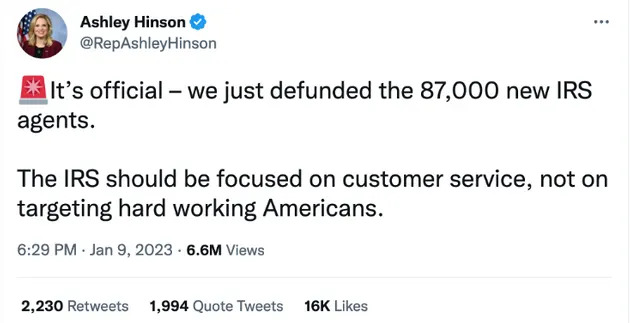
Week two: Republicans passed a pair of anti-abortion bills and, in a real insult to everyone’s intelligence, voted to repeal tens of billions of dollars in IRS funding via the so-called Family and Small Business Taxpayer Protection Act. Consider this tweet from Rep. Ashley Hinson (R), of Iowa’s 2nd Congressional District:
A screenshot of a tweet from Rep. Ashley Hinson (R-Iowa).
A screenshot of a tweet from Rep. Ashley Hinson (R-Iowa).
Look, you can have your opinion on abortion, and maybe you like the extremists, but can someone please read a bill? Or at least listen to some “Schoolhouse Rock”?
You have to love how these hoopleheads clamored for a rule requiring bills to be released at least 72 hours before a floor vote so lawmakers would have ample time to read them. At the same time, they had seven months to read the Inflation Reduction Act, but evidently couldn’t pencil that in. Passed in August, the act explains — justifies, really — its nearly $80 billion in IRS funding.
Incidentally, Democrats implemented that 72-hour rule in 2019 when Republicans rammed through a tax bill just hours after introducing a final version.
Hinson is probably just repeating what Republican leaders are saying now. Or what any Republican with a pulse was shrieking lastsummer. Or the howls of the campaign ads and political mailers you might have seen ahead of the November midterms: Eighty-seven thousand new IRS agents to audit small businesses and hard-working Americans!
Even seasoned Republicans like Sen. Lindsey Graham (R-S.C.), Sen. Ted Cruz (R-Texas) and House Speaker Kevin McCarthy (R-Calif.), who you’d think would know to read a bill, have been in full scaremongering mode, all deploying the same talking points.
Here’s the reality: The IRS is understaffed, overwhelmed and digitally dated. Thirty years ago, the IRS had 117,000 employees. Today, it has 78,000. It faces an expected wave of 50,000 retirements this decade. Its budget has been slashed by nearly 20% since 2010.
These circumstances have created a massive backlog. For example, according to the Treasury Department, nearly 200 million taxpayers called the IRS for assistance in the first half of 2021. There were 15,000 employees available to assist them. That’s one person for every 13,000 calls.
Funding from the Inflation Reduction Act aims to address these shortfalls by hiring 87,000 new IRS employees ― over the next 10 years, not all at once. And most of the hires will be to replace all those retirees.
So, dear Republican voter, did your favorite lawmaker explain any of that to you? No? Why not?
Will all the money go toward hiring IRS agents to audit taxpayers? Nope.
· $45.6 billion will go toward hiring more enforcement agents, shoring up legal support and investing in “investigative technology.”
· $25.3 billion will cover routine costs, like rent, facilities, printing and postage.
· $3 billion will go to customer services, such as prefiling assistance and education, and the possibility of creating a free direct e-file program.
· $5 billion will go toward modernizing the IRS’s business systems and customer service technology. Some agency computers still use programming language that dates back to the 1960s.
So, Republican voter: Why didn’t your favorite lawmakers explain that? Maybe they didn’t read the bill ― or reports from the Government Accountability Office, the Treasury Department, the Congressional Research Service or the Congressional Budget Office, or even a letter from Treasury Secretary Janet Yellen to the IRS commissioner, affirming these commitments ― which means they didn’t do their job. Maybe they’re just repeating someone else’s talking points. Maybe they’re stupid enough to believe those talking points ― or maybe they think you are. Maybe they think you’re too lazy to do your own research to learn what’s in the legislation.
Feel better?
Audits have declined most dramatically for the wealthy. For example: In 2012, the percentage of companies with at least $20 billion in assets subjected to audit was 93%. By 2020, it was just 38%.
The resulting tax gap — what people owe versus what they pay — is estimated to be more than $600 billion. Much of this is due to drastic cuts in the IRS’s budget, courtesy of Tea Party fanatics a decade ago.
Since then, the number of IRS auditors has fallen by more than 40% even as the tax code has gotten more complex. The agency’s auditors are no match for the battery of pricey accountants and tax attorneys who help the affluent avoid or evade their tax obligations.
Sidebar: In the past decade, the tax code has been amended or revised more than 4,000 times. Keep in mind that the agency doesn’t make those changes; Congress does. So while Congress was making tax law more complex, it gelded the agency tasked with tending to its directives.
The poster boy for this is former President Donald Trump. We still don’t know why the IRS didn’tenforce its own policy of mandatory audits of the sitting president.
If you hate paying taxes, you should really hate the people who don’t pay their fair share. If the uber-wealthy don’t pay all the taxes they legally owe, guess who makes up the difference through higher tax rates? You and me. As Leona Helmsley supposedly said, “Only the little people pay taxes.”
Taxes are monies we pay for services we say we want. Less tax revenue means more borrowing to pay for those services, which increases the deficit.
In fact, the Congressional Budget Office notes that without the new funding, the deficit would actually grow by about $114 billion over the next decade. In other words, the repeal would cost more than the actual funding. How’s that for stupid?
Sorry, but I don’t like being robbed by tax cheats. I want lots of IRS agents to keep them from picking my pocket. There is another consequence to all this neutering: The worse IRS customer service gets, the more cheating the wealthy can get away with, causing the rest of us to become more resentful toward and fearful of the agency.
The idea of the “overbearing IRS” is just another shibboleth Republicans use to rile up their base for the benefit of the GOP’s fat cats while securing votes for reelection. No honest, conscientious American has anything to fear from the IRS. Indeed, polls have repeatedly shown that most Americans regard paying taxes as a civicduty.
Remember: This month, a New York judge fined the Trump Organization $1.6 million (the max allowed by law) after convictions on 17 counts of tax fraud. Meanwhile, Trump’s longtime chief financial officer Allen Weisselberg drew five months in prison for his involvement in the tax scams. These are the people who hate and fear the IRS.
How can Republicans continually whine about the deficit when they’re trying to undercut the means to collect the money that would help reduce it?
They whine about waste, but they waste time and tax dollars on votes for bills they know won’t go anywhere in the Senate, let alone survive a presidential veto. Where do they think the funding for their pork projects comes from? Magic?
Maybe you think taxes should be higher or lower, or that we should have a more simplified tax code. But so long as we have taxes (and unless you want anarchy, we need taxes), we’ll need an agency to manage and administer those monies, and to ensure that citizens and businesses are playing by the rules. And that agency must be properly staffed and funded.
House Republicans claim they want the IRS to function better. If they want a smaller, more efficient and effective government, they should be the first ones to leave ― especially the ones running interference and engaging in performance politics solely to score cheap points.
Unless, of course, we learn that the IRS funded Hunter Biden’s laptop. Ah, it’s all coming together now!