3 Chicago-area oil refineries that dump toxic chemicals into Lake Michigan and other waterways are among worst polluters in US, study shows
Michael Hawthorne, Chicago Tribune – January 27, 2023
Oil refineries are dumping massive amounts of toxic chemicals and heavy metals into the Great Lakes and the nation’s rivers with little, if any, oversight from government regulators, according to a new analysis that found some of the worst polluters are in the Chicago area.
During 2021 alone, 81 refineries in the United States that treat waste on-site released 1.6 billion pounds of chlorides, sulfates and other dissolved solids harmful to fish and other aquatic life, the nonprofit Environmental Integrity Project determined in its review of federal data.
The refineries also collectively discharged 60,000 pounds of selenium, an element that can mutate fish, and 15.7 million pounds of nitrogen, which contributes to water-fouling algae blooms and dead zones in important fisheries such as the Great Lakes, Chesapeake Bay and the Gulf of Mexico.
Most of the refineries are in low-income, predominantly Black and Latino communities that face disproportionate health risks from industrial pollution.
Some refinery pollution is legal because federal and state officials have failed to limit it, despite requirements in the 1972 Clean Water Act mandating a review of standards for various chemicals and metals at least every five years based on the latest science and improvements in water treatment technology.
“You have refineries that may look like they are complying with the law, but the standards are decades old and really don’t require very much,” said Eric Schaeffer, the group’s executive director and former chief of civil enforcement at the U.S. Environmental Protection Agency.
Three Chicago-area refineries — BP Whiting in Indiana, ExxonMobil Joliet and Citgo in Lemont — highlight the consequences of lax regulations and weak enforcement, Schaeffer said Thursday during an online news conference.
Even when limits are in place, oil companies often pay minimal fines for violating the law. Some aren’t penalized at all.
The Joliet refinery, on the Des Plaines River southwest of the city, exceeded its permitted levels of pollution 40 times between 2019 and 2021, federal records show. Neither federal nor state officials have sued ExxonMobil or fined the company for its repeated infractions.
Only three other refineries discharged more selenium than BP Whiting, located on the southwest shore of Lake Michigan about 8 miles from one of Chicago’s water intake cribs. Small doses of the element are healthy, but higher levels can cause hair and nail loss, gastrointestinal distress, dizziness and tremors.
Citgo Lemont and ExxonMobil Joliet ranked fifth and ninth for selenium pollution, respectively, the analysis showed.
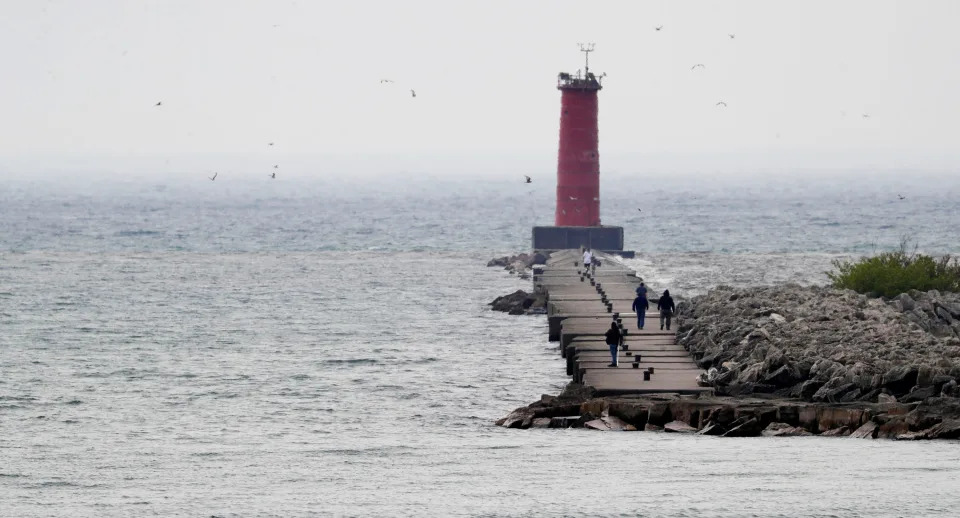
A public beach near the Whiting refinery is a popular spot for surfers drawn by big waves when winter winds whip down Lake Michigan from Canada.
Mitch McNeil, chairman of the local chapter of Surfrider, a nonprofit advocacy group, said he and other surfers have suffered eye, ear and urinary tract infections and gastrointestinal illnesses after swimming in dark brown water that smells alternately like metal, sewage, petroleum and a used ashtray.
“People always ask us why we keep surfing in dirty water,” McNeil said. “Our response is we surf in it but you drink it, so you should be just as concerned as we are.”
BP routinely faces scrutiny about air pollution from the Whiting refinery. Water pollution hasn’t drawn as much attention since the Chicago Tribune reported in 2007 that Indiana regulators were planning to relax limits on the refinery’s discharges of ammonia, brain-damaging mercury and suspended solids — tiny particles of sewage sludge.
The company later backed down and vowed to abide by the terms of its existing permit.
Responding to the new analysis of federal data, BP said it will “continue to operate consistent with its permit as part of our commitment to safe, compliant and reliable operations, not just at Whiting refinery but at every facility BP operates around the world.”
Speaking on behalf of the oil industry in general, the American Petroleum Institute did not directly answer questions about the lack of standards for selenium and other pollutants.
“Our industry takes seriously its obligation to protect our nation’s waters and adheres to strict local, state and federal requirements to ensure water is properly treated and tested prior to leaving a facility,” Will Hupman, the trade group’s vice president of downstream policy said in a statement.
Schaeffer noted that federal pollution standards for refineries and several other industry sectors haven’t been updated since Ronald Reagan was president during the 1980s.
Federal judges are taking notice. Calling existing standards out of date is a “charitable understatement,” a federal appellate court concluded after the EPA in 2019 updated its 1982 limits on water pollution from coal-fired power plants.
Environmental groups asked EPA Administrator Michael Regan in 2021 why the agency had fallen so far behind in meeting its legal obligations under the Clean Water Act. The EPA acknowledged the letter but didn’t respond.
An EPA spokesman said the agency is aware of the new pollution analysis “and will review and respond accordingly.”
Most of the top polluting refineries are in California or along the Gulf of Mexico in Texas and Louisiana. Also in the top 10 is a Phillips 66 refinery on the Mississippi River in Wood River, a small, heavily industrialized Illinois city upstream from St. Louis.
The Wood River refinery released more fish-harming nickel than any of the other facilities reviewed. It also ranked among the top 10 for discharges of selenium, nitrogen and total dissolved solids.
For people who live near refineries, the new report reflects what they see, smell and breathe — and ingest when eating locally caught fish or while swimming.
Gina Ramirez grew up on Chicago’s Southeast Side and often visits Whihala Beach in Whiting, 2 miles up the lakeshore from the BP refinery. Nowadays her son joins her.
“To think that we are recreating among some of the most polluted waters is terrifying,” said Ramirez, an outreach manager at the nonprofit Natural Resources Defense Council and senior adviser to the Southeast Environmental Task Force. “U.S. EPA needs to step up.”
John Beard, a former refinery worker who leads the Port Arthur Community Action Network in Texas, said communities like his rely on the EPA to enforce air and water laws because they can’t afford to fight for a cleaner environment.
“(Oil companies) don’t build these facilities in Beverly Hills, or River Oaks (in Houston) or Madison Avenue,” Beard said. “They don’t build in communities of affluence that have the ways and means to go about seeking justice and correction.”
“Many people say we need the jobs and we need all these products (oil companies) produce,” Beard added. “That’s true. But we don’t need the pollution that comes with it, and they can do better.”
Arizona is not out of water, despite all those headlines you might read
Joanna Allhands, Arizona Republic – January 25, 2023
Michael Rudolph (Dynamite Water) loads his water truck at the Scottsdale fill station on Dec. 29, 2022, located northwest of the intersection of Pima and Jomax roads in Scottsdale, Ariz. Rudolph was delivering water to a client in Rio Verde Foothills.
The national press has had a field day with two not-so-positive Arizona water stories.
About 500 homes in the unincorporated community of Rio Verde Foothills can no longer haul water from Scottsdale, the neighboring city to the south.
Meanwhile, a state-produced model has found that the area north and west of Buckeye does not have enough groundwater to support future massive developments.
They’re alarming stories, but the coverage has piled on the hyperbole. Some headlines have made it sound as if an entire “Arizona town” was cut off.
The Colorado River – once 40% of the state’s water supply – is dwindling. About 80% of Arizona and about 20% of its population has no rules on groundwater pumping, which is draining many of our rural aquifers.
Add in these troubles sprouting in metro Phoenix, an area covered by the state’s most stringent groundwater management rules, and we’ve got urgent issues that require urgent responses.
But the headlines make it sound as if we’re completely botching our jobs as water stewards.
Most metro Phoenix cities have spent decades storing water underground for a (non-)rainy day, for example. They have long recycled most of their wastewater, though we don’t yet drink it.
And while much of the coverage has focused on the fact that there isn’t enough water in parts of the far West Valley to support thousands of acres of future development, it glosses over why that growth may never occur:
Because we had the foresight decades ago to create an assured water supply program, which requires builders to prove they have secured enough water for the long haul before they can plat lots.
We have water protections. They need shoring up
Is that program fail proof? No.
The root cause of Rio Verde Foothills’ water problems is that state law allows property owners to subdivide land into less than six lots and avoid requirements to prove they have secured a 100-year water supply.
Homes were built solely on the promise of hauled water. The potential risk of such a deal was glossed over with homeowners. And despite all the negative coverage lately, people are still building in the area.
It doesn’t matter that these so-called wildcat lot splits encompass a fraction of the homes we build every year. Or that not all homes in Rio Verde Foothills are affected, just those that relied on Scottsdale for hauled water.
The headlines on repeat are that Arizona doesn’t have enough water to grow or even sustain existing residents.
The story is more nuanced than the headlines
The full story is more nuanced.
Water is still being hauled to Rio Verde Foothills, albeit from other spotty sources that are vastly more expensive. Residents haven’t lost water; they’ve lost access to cheap water.
That is unlikely to change if EPCOR, a private water provider, is given the green light in April to more permanently serve these residents. Solving the affordability problem won’t be easy.
Meanwhile, on the far west side of the Valley, developers either must find renewable water sources to build on large swaths of open desert or find affordable ways to grow closer in areas with the capacity to serve new residents.
Fixing the cracks through which some development has fallen would be a good start.
In Rio Verde Foothills, the solution cannot simply be to force Scottsdale to serve non-residents. We need to tackle the root problem, which means we need to rein in wildcat lot splits.
Lawmakers could change how we define “subdivisions” – that might be the cleanest fix. Or they could give counties more power to say no to homes that plan to haul water, particularly in areas like Rio Verde Foothills where groundwater is spotty.
In the West Valley, lawmakers must address a proliferation of “build-to-rent” homes, which are touted as a much-needed affordable housing alternative but also aren’t required to prove a long-term water supply before building.
If civic and elected leaders want to counter the narrative that Arizona is irresponsible, they need to get better at telling the full story – which, yes, means more clearly touting the things we’ve done well.
But because perception is reality in water, and virtually everyone else has similar success stories, they also need a clear plan – shared loudly and on repeat – for how they intend to up our game.
Rural resentment has become a central fact of American politics — in particular, a pillar of support for the rise of right-wing extremism. As the Republican Party has moved ever further into MAGAland, it has lost votes among educated suburban voters; but this has been offset by a drastic rightward shift in rural areas, which in some places has gone so far that the Democrats who remain face intimidation and are afraid to reveal their party affiliation.
But is this shift permanent? Can anything be done to assuage rural rage?
The answer will depend on two things: whether it’s possible to improve rural lives and restore rural communities, and whether the voters in these communities will give politicians credit for any improvements that do take place.
This week my colleague Thomas B. Edsall surveyed research on the rural Republican shift. I was struck by his summary of work by Katherine J. Cramer, who attributes rural resentment to perceptions that rural areas are ignored by policymakers, don’t get their fair share of resources and are disrespected by “city folks.”
As it happens, all three perceptions are largely wrong. I’m sure that my saying this will generate a tidal wave of hate mail, and lecturing rural Americans about policy reality isn’t going to move their votes. Nonetheless, it’s important to get our facts straight.
The truth is that ever since the New Deal rural America has received special treatment from policymakers. It’s not just farm subsidies, which ballooned under Donald Trump to the point where they accounted for around 40 percent of total farm income. Rural America also benefits from special programs that support housing, utilities and business in general.
In terms of resources, major federal programs disproportionately benefit rural areas, in part because such areas have a disproportionate number of seniors receiving Social Security and Medicare. But even means-tested programs — programs that Republicans often disparage as “welfare” — tilt rural. Notably, at this point rural Americans are more likely than urban Americans to be on Medicaid and receive food stamps.
And because rural America is poorer than urban America, it pays much less per person in federal taxes, so in practice major metropolitan areas hugely subsidize the countryside. These subsidies don’t just support incomes, they support economies: Government and the so-called health care and social assistance sector each employ more people in rural America than agriculture, and what do you think pays for those jobs?
What about rural perceptions of being disrespected? Well, many people have negative views about people with different lifestyles; that’s human nature. There is, however, an unwritten rule in American politics that it’s OK for politicians to seek rural votes by insulting big cities and their residents, but it would be unforgivable for urban politicians to return the favor. “I have to go to New York City soon,” tweeted J.D. Vance during his senatorial campaign. “I have heard it’s disgusting and violent there.” Can you imagine, say, Chuck Schumer saying something similar about rural Ohio, even as a joke?
So the ostensible justifications for rural resentment don’t withstand scrutiny — but that doesn’t mean things are fine. A changing economy has increasingly favored metropolitan areas with large college-educated work forces over small towns. The rural working-age population has been declining, leaving seniors behind. Rural men in their prime working years are much more likely than their metropolitan counterparts to not be working. Rural woes are real.
Ironically, however, the policy agenda of the party most rural voters support would make things even worse, slashing the safety-net programs these voters depend on. And Democrats shouldn’t be afraid to point this out.
But can they also have a positive agenda for rural renewal? As The Washington Post’s Greg Sargent recently pointed out, the infrastructure spending bills enacted under President Biden, while primarily intended to address climate change, will also create large numbers of blue-collar jobs in rural areas and small cities. They are, in practice, a form of the “place-based industrial policy” some economists have urged to fight America’s growing geographic disparities.
Will they work? The economic forces that have been hollowing out rural America are deep and not easily countered. But it’s certainly worth trying.
But even if these policies improve rural fortunes, will Democrats get any credit? It’s easy to be cynical. Sarah Huckabee Sanders, the new governor of Arkansas, has pledged to get the “bureaucratic tyrants” of Washington “out of your wallets”; in 2019 the federal government spent almost twice as much in Arkansas as it collected in taxes, de facto providing the average Arkansas resident with $5,500 in aid. So even if Democratic policies greatly improve rural lives, will rural voters notice?
Still, anything that helps reverse rural America’s decline would be a good thing in itself. And maybe, just maybe, reducing the heartland’s economic desperation will also help reverse its political radicalization.
How Barr’s Quest to Find Flaws in the Russia Inquiry Unraveled
The review by John Durham at one point veered into a criminal investigation related to Donald Trump himself, even as it failed to find wrongdoing in the origins of the Russia inquiry.
Charlie Savage, Adam Goldman and Katie Benner – January 26, 2023
The veteran prosecutor John H. Durham was given the job of determining whether there was any wrongdoing behind the investigation into the 2016 Trump campaign’s ties to Russia.Credit…Samuel Corum for The New York Times
WASHINGTON — It became a regular litany of grievances from President Donald J. Trump and his supporters: The investigation into his 2016 campaign’s ties to Russia was a witch hunt, they maintained, that had been opened without any solid basis, went on too long and found no proof of collusion.
Egged on by Mr. Trump, Attorney General William P. Barr set out in 2019 to dig into their shared theory that the Russia investigation likely stemmed from a conspiracy by intelligence or law enforcement agencies. To lead the inquiry, Mr. Barr turned to a hard-nosed prosecutor named John H. Durham, and later granted him special counsel status to carry on after Mr. Trump left office.
But after almost four years — far longer than the Russia investigation itself — Mr. Durham’s work is coming to an end without uncovering anything like the deep state plot alleged by Mr. Trump and suspected by Mr. Barr.
Moreover, a months long review by The New York Times found that the main thrust of the Durham inquiry was marked by some of the very same flaws — including a strained justification for opening it and its role in fueling partisan conspiracy theories that would never be charged in court — that Trump allies claim characterized the Russia investigation.
Interviews by The Times with more than a dozen current and former officials have revealed an array of previously unreported episodes that show how the Durham inquiry became roiled by internal dissent and ethical disputes as it went unsuccessfully down one path after another even as Mr. Trump and Mr. Barr promoted a misleading narrative of its progress.
Mr. Barr and Mr. Durham never disclosed that their inquiry expanded in the fall of 2019, based on a tip from Italian officials, to include a criminal investigation into suspicious financial dealings related to Mr. Trump. The specifics of the tip and how they handled the investigation remain unclear, but Mr. Durham brought no charges over it.
Mr. Durham used Russian intelligence memos — suspected by other U.S. officials of containing disinformation — to gain access to emails of an aide to George Soros, the financier and philanthropist who is a favorite target of the American right and Russian state media. Mr. Durham used grand jury powers to keep pursuing the emails even after a judge twice rejected his request for access to them. The emails yielded no evidence that Mr. Durham has cited in any case he pursued.
There were deeper internal fractures on the Durham team than previously known. The publicly unexplained resignation in 2020 of his No. 2 and longtime aide, Nora R. Dannehy, was the culmination of a series of disputes between them over prosecutorial ethics. A year later, two more prosecutors strongly objected to plans to indict a lawyer with ties to Hillary Clinton’s 2016 campaign based on evidence they warned was too flimsy, and one left the team in protest of Mr. Durham’s decision to proceed anyway. (A jury swiftly acquitted the lawyer.)
Now, as Mr. Durham works on a final report, the interviews by The Times provide new details of how he and Mr. Barr sought to recast the scrutiny of the 2016 Trump campaign’s myriad if murky links to Russia as unjustified and itself a crime.
Mr. Barr, Mr. Durham and Ms. Dannehy declined to comment. The current and former officials who discussed the investigation all spoke on the condition of anonymity because of the legal, political and intelligence sensitivities surrounding the topic.
A year into the Durham inquiry, Mr. Barr declared that the attempt “to get to the bottom of what happened” in 2016 “cannot be, and it will not be, a tit-for-tat exercise. We are not going to lower the standards just to achieve a result.”
But Robert Luskin, a criminal defense lawyer and former Justice Department prosecutor who represented two witnesses Mr. Durham interviewed, said that he had a hard time squaring Mr. Durham’s prior reputation as an independent-minded straight shooter with his end-of-career conduct as Mr. Barr’s special counsel.
“This stuff has my head spinning,” Mr. Luskin said. “When did these guys drink the Kool-Aid, and who served it to them?”
Attorney General William P. Barr took office in 2019 with suspicions about the origins of the Russia investigation. Credit…Doug Mills/The New York Times
An Odd Couple
A month after Mr. Barr was confirmed as attorney general in February 2019, the special counsel Robert S. Mueller III ended the Russia investigation and turned in his report without charging any Trump associates with engaging in a criminal conspiracy with Moscow over its covert operation to help Mr. Trump win the 2016 election.
That spring, Mr. Barr assigned Mr. Durham to scour the origins of the Russia investigation for wrongdoing, telling Fox News that he wanted to know if “officials abused their power and put their thumb on the scale” in deciding to pursue the investigation. “A lot of the answers have been inadequate, and some of the explanations I’ve gotten don’t hang together,” he added.
While attorneys general overseeing politically sensitive inquiries tend to keep their distance from the investigators, Mr. Durham visited Mr. Barr in his office for at times weekly updates and consultations about his day-to-day work. They also sometimes dined and sipped Scotch together, people familiar with their work said.
In some ways, they were an odd match. Taciturn and media-averse, the goateed Mr. Durham had spent more than three decades as a prosecutor before Mr. Trump appointed him the U.S. attorney for Connecticut. Administrations of both parties had assigned him to investigate potential official wrongdoing, like allegations of corrupt ties between mafia informants and F.B.I. agents, and the C.I.A.’s torture of terrorism detainees and destruction of evidence.
By contrast, the vocal and domineering Mr. Barr has never prosecuted a case and is known for using his law enforcement platform to opine on culture-war issues and politics. He had effectively auditioned to be Mr. Trump’s attorney general by asserting to a New York Times reporter that there was more basis to investigate Mrs. Clinton than Mr. Trump’s “so-called ‘collusion’” with Russia, and by writing a memo suggesting a way to shield Mr. Trump from scrutiny for obstruction of justice.
But the two shared a worldview: They are both Catholic conservatives and Republicans, born two months apart in 1950. As a career federal prosecutor, Mr. Durham already revered the office of the attorney general, people who know him say. And as he was drawn into Mr. Barr’s personal orbit, Mr. Durham came to embrace that particular attorney general’s intense feelings about the Russia investigation.
President Donald J. Trump openly suggested that Mr. Durham should charge his adversaries with crimes. Credit…Doug Mills/The New York Times
‘The Thinnest of Suspicions’
At the time Mr. Barr was confirmed, he told aides that he already suspected that intelligence abuses played a role in igniting the Russia investigation — and that unearthing any wrongdoing would be a priority.
In May 2019, soon after giving Mr. Durham his assignment, Mr. Barr summoned the head of the National Security Agency, Paul M. Nakasone, to his office. In front of several aides, Mr. Barr demanded that the N.S.A. cooperate with the Durham inquiry.
Referring to the C.I.A. and British spies, Mr. Barr also said he suspected that the N.S.A.’s “friends” had helped instigate the Russia investigation by targeting the Trump campaign, aides briefed on the meeting said. And repeating a sexual vulgarity, he warned that if the N.S.A. wronged him by not doing all it could to help Mr. Durham, Mr. Barr would do the same to the agency.
Mr. Barr’s insistence about what he had surmised bewildered intelligence officials. But Mr. Durham spent his first months looking for any evidence that the origin of the Russia investigation involved an intelligence operation targeting the Trump campaign.
Mr. Durham’s team spent long hours combing the C.I.A.’s files but found no way to support the allegation. Mr. Barr and Mr. Durham traveled abroad together to press British and Italian officials to reveal everything their agencies had gleaned about the Trump campaign and relayed to the United States, but both allied governments denied they had done any such thing. Top British intelligence officials expressed indignation to their U.S. counterparts about the accusation, three former U.S. officials said.
Mr. Durham and Mr. Barr had not yet given up when a new problem arose: In early December, the Justice Department’s independent inspector general, Michael E. Horowitz, completed his own report on the origins of the Russia investigation.
But the broader findings contradicted Mr. Trump’s accusations and the rationale for Mr. Durham’s inquiry. Mr. Horowitz found no evidence that F.B.I. actions were politically motivated. And he concluded that the investigation’s basis — an Australian diplomat’s tip that a Trump campaign adviser had seemed to disclose advance knowledge that Russia would release hacked Democratic emails — had been sufficient to lawfully open it.
Michael Horowitz, the Justice Department’s inspector general, found no evidence that the F.B.I.’s actions in opening the investigation into the Trump campaign’s ties to Russia were politically motivated.Credit…Anna Moneymaker/The New York Times
The week before Mr. Horowitz released the report, he and aides came to Mr. Durham’s offices — nondescript suites on two floors of a building in northeast Washington — to go over it.
Mr. Durham lobbied Mr. Horowitz to drop his finding that the diplomat’s tip had been sufficient for the F.B.I. to open its “full” counterintelligence investigation, arguing that it was enough at most for a “preliminary” inquiry, according to officials. But Mr. Horowitz did not change his mind.
That weekend, Mr. Barr and Mr. Durham decided to weigh in publicly to shape the narrative on their terms.
Minutes before the inspector general’s report went online, Mr. Barr issued a statement contradicting Mr. Horowitz’s major finding, declaring that the F.B.I. opened the investigation “on the thinnest of suspicions that, in my view, were insufficient.” He would later tell Fox News that the investigation began “without any basis,” as if the diplomat’s tip never happened.
Mr. Trump also weighed in, telling reporters that the details of the inspector general’s report were “far worse than anything I would have even imagined,” adding: “I look forward to the Durham report, which is coming out in the not-too-distant future. It’s got its own information, which is this information plus, plus, plus.”
And the Justice Department sent reporters a statement from Mr. Durham that clashed with both Justice Department principles about not discussing ongoing investigations and his personal reputation as particularly tight-lipped. He said he disagreed with Mr. Horowitz’s conclusions about the Russia investigation’s origins, citing his own access to more information and “evidence collected to date.”
But as Mr. Durham’s inquiry proceeded, he never presented any evidence contradicting Mr. Horowitz’s factual findings about the basis on which F.B.I. officials opened the investigation.
By summer 2020, it was clear that the hunt for evidence supporting Mr. Barr’s hunch about intelligence abuses had failed. But he waited until after the 2020 election to publicly concede that there had turned out to be no sign of “foreign government activity” and that the C.I.A. had “stayed in its lane” after all.
Mr. Barr later wrote that his relationship with Mr. Trump eroded because his “failure to deliver scalps in time for the election.”Credit…Anna Moneymaker for The New York Times
An Awkward Tip
On one of Mr. Barr and Mr. Durham’s trips to Europe, according to people familiar with the matter, Italian officials — while denying any role in setting off the Russia investigation — unexpectedly offered a potentially explosive tip linking Mr. Trump to certain suspected financial crimes.
Mr. Barr and Mr. Durham decided that the tip was too serious and credible to ignore. But rather than assign it to another prosecutor, Mr. Barr had Mr. Durham investigate the matter himself — giving him criminal prosecution powers for the first time — even though the possible wrongdoing by Mr. Trump did not fall squarely within Mr. Durham’s assignment to scrutinize the origins of the Russia inquiry, the people said.
Mr. Durham never filed charges, and it remains unclear what level of an investigation it was, what steps he took, what he learned and whether anyone at the White House ever found out. The extraordinary fact that Mr. Durham opened a criminal investigation that included scrutinizing Mr. Trump has remained secret.
But in October 2019, a garbled echo became public. The Times reported that Mr. Durham’s administrative review of the Russia inquiry had evolved to include a criminal investigation, while saying it was not clear what the suspected crime was. Citing their own sources, manyothernewsoutlets confirmed the development.
The news reports, however, were all framed around the erroneous assumption that the criminal investigation must mean Mr. Durham had found evidence of potential crimes by officials involved in the Russia inquiry. Mr. Barr, who weighed in publicly about the Durham inquiry at regular intervals in ways that advanced a pro-Trump narrative, chose in this instance not to clarify what was really happening.
By the spring and summer of 2020, with Mr. Trump’s re-election campaign in full swing, the Durham investigation’s “failure to deliver scalps in time for the election” began to erode Mr. Barr’s relationship with Mr. Trump, Mr. Barr wrote in his memoir.
Mr. Trump was stoking a belief among his supporters that Mr. Durham might charge former President Barack Obama and former Vice President Joseph R. Biden Jr. That proved too much for Mr. Barr, who in May 2020 clarified that “our concern of potential criminality is focused on others.”
Even so, in August, Mr. Trump lashed out in a Fox interview, asserting that Mr. Obama and Mr. Biden, along with top F.B.I. and intelligence officials, had been caught in “the single biggest political crime in the history of our country” and the only thing stopping charges would be if Mr. Barr and Mr. Durham wanted to be “politically correct.”
Against that backdrop, Mr. Barr and Mr. Durham did not shut down their inquiry when the search for intelligence abuses hit a dead end. With the inspector general’s inquiry complete, they turned to a new rationale: a hunt for a basis to accuse the Clinton campaign of conspiring to defraud the government by manufacturing the suspicions that the Trump campaign had colluded with Russia, along with scrutinizing what the F.B.I. and intelligence officials knew about the Clinton campaign’s actions.
Mr. Durham also developed an indirect method to impute political bias to law enforcement officials: comparing the Justice Department’s aggressive response to suspicions of links between Mr. Trump and Russia with its more cautious and skeptical reaction to various Clinton-related suspicions.
He examined an investigation into the Clinton Foundation’s finances in which the F.B.I.’s repeated requests for a subpoena were denied. He also scrutinized how the F.B.I. gave Mrs. Clinton a “defensive briefing” about suspicions that a foreign government might be trying to influence her campaign through donations, but did not inform Mr. Trump about suspicions that Russia might be conspiring with people associated with his campaign.
The Durham inquiry looked for evidence that Hillary Clinton’s 2016 presidential campaign had conspired to frame Donald J. Trump.Credit…Doug mills/The New York Times
Dubious Intelligence
During the Russia investigation, the F.B.I. used claims from what turned out to be a dubious source, the Steele dossier — opposition research indirectly funded by the Clinton campaign — in its botched applications to wiretap a former Trump campaign aide.
The Durham investigation did something with parallels to that incident.
In Mr. Durham’s case, the dubious sources were memos, whose credibility the intelligence community doubted, written by Russian intelligence analysts and discussing purported conversations involving American victims of Russian hacking, according to people familiar with the matter.
The memos were part of a trove provided to the C.I.A. by a Dutch spy agency, which had infiltrated the servers of its Russian counterpart. The memos were said to make demonstrably inconsistent, inaccurate or exaggerated claims, and some U.S. analysts believed Russia may have deliberately seeded them with disinformation.
Mr. Durham wanted to use the memos, which included descriptions of Americans discussing a purported plan by Mrs. Clinton to attack Mr. Trump by linking him to Russia’s hacking and releasing in 2016 of Democratic emails, to pursue the theory that the Clinton campaign conspired to frame Mr. Trump. And in doing so, Mr. Durham sought to use the memos as justification to get access to the private communications of an American citizen.
One purported hacking victim identified in the memos was Leonard Benardo, the executive vice president of the Open Society Foundations, a pro-democracy organization whose Hungarian-born founder, Mr. Soros, has been vilified by the far right.
In 2017, The Washington Post reported that the Russian memos included a claim that Mr. Benardo and a Democratic member of Congress, Representative Debbie Wasserman Schultz of Florida, had discussed how Loretta E. Lynch, the Obama-era attorney general, had supposedly promised to keep the investigation into Mrs. Clinton’s emails from going too far.
But Mr. Benardo and Ms. Wasserman Schultz said they had never even met, let alone communicated about Mrs. Clinton’s emails.
Mr. Durham set out to prove that the memos described real conversations, according to people familiar with the matter. He sent a prosecutor on his team, Andrew DeFilippis, to ask Judge Beryl A. Howell, the chief judge of the Federal District Court in Washington, for an order allowing them to seize information about Mr. Benardo’s emails.
But Judge Howell decided that the Russian memo was too weak a basis to intrude on Mr. Benardo’s privacy, they said. Mr. Durham then personally appeared before her and urged her to reconsider, but she again ruled against him.
Rather than dropping the idea, Mr. Durham sidestepped Judge Howell’s ruling by invoking grand-jury power to demand documents and testimony directly from Mr. Soros’s foundation and Mr. Benardo about his emails, the people said. (It is unclear whether Mr. Durham served them with a subpoena or instead threatened to do so if they did not cooperate.)
Rather than fighting in court, the foundation and Mr. Benardo quietly complied, according to people familiar with the matter. But for Mr. Durham, the result appears to have been another dead end.
In a statement provided to The Times by Mr. Soros’s foundation, Mr. Benardo reiterated that he never met or corresponded with Ms. Wasserman Schultz, and said that “if such documentation exists, it’s of course made up.”
Nora R. Dannehy in 2009. A longtime aide to Mr. Durham, Ms. Dannehy resigned from his team in 2020 after disputes with him over prosecutorial ethics.Credit…Mark Wilson/Getty Images
Internal Strife
As the focus of the Durham investigation shifted, cracks formed inside the team. Mr. Durham’s deputy, Ms. Dannehy, a longtime close colleague, increasingly argued with him in front of other prosecutors and F.B.I. agents about legal ethics.
Ms. Dannehy had independent standing as a respected prosecutor. In 2008, Attorney General Michael B. Mukasey assigned her to investigate whether to charge senior Bush administration officials with crimes related to a scandal over the firing of U.S. attorneys; she decided in 2010 that no charges were warranted.
Now, Ms. Dannehy complained to Mr. Durham about how Mr. Barr kept hinting darkly in public about the direction of their investigation. In April 2020, for example, he suggested to Fox News that officials could be prosecuted, saying that “the evidence shows that we are not dealing with just mistakes or sloppiness. There is something far more troubling here.”
Ms. Dannehy urged Mr. Durham to ask the attorney general to adhere to Justice Department policy and not discuss the investigation publicly. But Mr. Durham proved unwilling to challenge him.
The strains grew when Mr. Durham used grand jury powers to go after Mr. Benardo’s emails. Ms. Dannehy opposed that tactic and told colleagues that Mr. Durham had taken that step without telling her.
By summer 2020, with Election Day approaching, Mr. Barr pressed Mr. Durham to draft a potential interim report centered on the Clinton campaign and F.B.I. gullibility or willful blindness.
On Sept. 10, 2020, Ms. Dannehy discovered that other members of the team had written a draft report that Mr. Durham had not told her about, according to people briefed on their ensuing argument.
Ms. Dannehy erupted, according to people familiar with the matter. She told Mr. Durham that no report should be issued before the investigation was complete and especially not just before an election — and denounced the draft for taking disputed information at face value. She sent colleagues a memo detailing those concerns and resigned.
Cracks formed in Mr. Durham’s team as the scope of his investigation shifted. Credit…Manuel Balce Ceneta/Associated Press
Two people close to Mr. Barr said he had pressed for the draft to evaluate what a report on preliminary findings would look like and what evidence would need to be declassified. But they insisted that he intended any release to come during the summer or after the Nov. 3 election — not soon before Election Day.
In any case, in late September 2020, about two weeks after Ms. Dannehy quit, someone leaked to a Fox Business personality that Mr. Durham would not issue any interim report, disappointing Trump supporters hoping for a pre-Election Day bombshell.
Stymied by the decision not to issue an interim Durham report, John Ratcliffe, Mr. Trump’s national intelligence director, tried another way to inject some of the same information into the campaign.
Over the objections of Gina Haspel, the C.I.A. director, Mr. Ratcliffe declassified nearly 1,000 pages of intelligence material before the election for Mr. Durham to use. Notably, in that fight, Mr. Barr sided with Ms. Haspel on one matter that is said to be particularly sensitive and that remained classified, according to two people familiar with the dispute.
Mr. Ratcliffe also disclosed in a letter to a senator that “Russian intelligence analysis” claimed that on July 26, 2016, Mrs. Clinton had approved a campaign plan to stir up a scandal tying Mr. Trump to Russia.
The disclosure infuriated Dutch intelligence officials, who had provided the memos under strictest confidence.
Mr. Durham accused Michael Sussmann of lying in a meeting with an F.B.I. official. He was acquitted.Credit…Samuel Corum for The New York Times
‘Fanning the Flames’
Late in the summer of 2021, Mr. Durham prepared to indict Michael Sussmann, a cybersecurity lawyer who had represented Democrats in their dealings with the F.B.I. about Russia’s hacking of their emails. Two prosecutors on Mr. Durham’s team — Anthony Scarpelli and Neeraj N. Patel — objected, according to people familiar with the matter.
Five years earlier, Mr. Sussmann had relayed a tip to the bureau about odd internet data that a group of data scientists contended could reflect hidden communications between the Trump Organization and Alfa Bank of Russia. The F.B.I., which by then had already launched its Russia investigation, briefly looked at the allegation but dismissed it.
Mr. Durham accused Mr. Sussmann of lying to an F.B.I. official by saying he was not conveying the tip for a client; the prosecutor maintained Mr. Sussmann was there in part for the Clinton campaign.
Mr. Scarpelli and Mr. Patel argued to Mr. Durham that the evidence was too thin to charge Mr. Sussmann and that such a case would not normally be prosecuted, people familiar with the matter said. Given the intense scrutiny it would receive, they also warned that an acquittal would undermine public faith in their investigation and federal law enforcement.
When Mr. Durham did not change course, Mr. Scarpelli quit in protest, people familiar with the matter said. Mr. Patel left soon after to take a different job. Both declined to comment.
The charge against Mr. Sussmann was narrow, but the Durham team used it to make public large amounts of information insinuating what Mr. Durham never charged: that Clinton campaign associates conspired to gin up an F.B.I. investigation into Mr. Trump based on a knowingly false allegation.
Trial testimony, however, showed that while Mrs. Clinton and her campaign manager hoped Mr. Sussmann would persuade reporters to write articles about Alfa Bank, they did not want him to take the information to the F.B.I. And prosecutors presented no evidence that he or campaign officials had believed the data scientists’ complex theory was false.
After Mr. Sussmann’s acquittal, Mr. Barr, by then out of office for more than a year, suggested that using the courts to advance a politically charged narrative was a goal in itself. Mr. Durham “accomplished something far more important” than a conviction, Mr. Barr told Fox News, asserting that the case had “crystallized the central role played by the Hillary campaign in launching as a dirty trick the whole Russiagate collusion narrative and fanning the flames of it.”
And he predicted that a subsequent trial, concerning a Russia analyst who was a researcher for the Steele dossier, would also “get the story out” and “further amplify these themes and the role the F.B.I. leadership played in this, which is increasingly looking fishy and inexplicable.”
Mr. Durham’s prosecution of Igor Danchenko, a Russia analyst who was a researcher for the Steele dossier, ended in acquittal. Credit…Chip Somodevilla/Getty Images
That case involved Igor Danchenko, who had told the F.B.I. that the dossier exaggerated the credibility of gossip and speculation. Mr. Durham charged him with lying about two sources. He was acquitted, too.
The two failed cases are likely to be Mr. Durham’s last courtroom acts as a prosecutor. Bringing demonstrably weak cases stood in contrast to how he once talked about his prosecutorial philosophy.
James Farmer, a retired prosecutor who worked with Mr. Durham on several major investigations, recalled him as a neutral actor who said that if there were nothing to charge, they would not strain to prosecute. “That’s what I heard, time and again,” Mr. Farmer said.
Delivering the closing arguments in the Danchenko trial, Mr. Durham defended his investigation to the jury, denying that his appointment by Mr. Barr had been tainted by politics.
He asserted that Mr. Mueller had concluded “there’s no evidence of collusion here or conspiracy” — a formulation that echoed Mr. Trump’s distortion of the Russia investigation’s complex findings — and added: “Is it the wrong question to ask, well, then how did this get started? Respectfully, that’s not the case.”
US moves to protect Minnesota wilderness from planned mine
Steve Karnowski – January 26, 2023
Area Wilderness in northeastern Minnesota. The Biden administration moved Thursday, Jan. 26, 2023, to protect the pristine Boundary Waters Canoe Area Wilderness in northeastern Minnesota from future mining, dealing a potentially fatal blow to the proposed Twin Metals copper-nickel project. (AP Photo/Steve Karnowski, File)Supporters of the Campaign to Save the Boundary Waters drive past the residence of Minnesota Gov. Tim Walz as part of an Earth Day drive-in rally to Protect the Boundary Waters Canoe Area Wilderness on April 22, 2020, in St. Paul, Minn. The Biden administration moved Thursday, Jan. 26, 2023, to protect the pristine Boundary Waters Canoe Area Wilderness in northeastern Minnesota from future mining, dealing a potentially fatal blow to the proposed Twin Metals copper-nickel project. (AP Photo/Jim Mone, File)
ST. PAUL, Minn. (AP) — The Biden administration moved Thursday to protect northeastern Minnesota’s pristine Boundary Waters Canoe Area Wilderness from future mining, dealing a potentially fatal blow to a copper-nickel project.
Interior Secretary Deb Haaland signed an order closing over 350 square miles (900 square kilometers) of the Superior National Forest, in the Rainy River Watershed around the town of Ely, to mineral and geothermal leasing for 20 years, the longest period the department can sequester the land without congressional approval.
The order is “subject to existing valid rights,” but the Biden administration contends that Twin Metals Minnesota lost its rights last year, when the department rescinded a Trump administration decision to reinstate federal mineral rights leases that were critical to the project. Twin Metals, which is owned by the Chilean mining giant Antofagasta, filed suit in August to try to reclaim those rights, and reaffirmed Tuesday that it’s not giving up despite its latest setback.
“Protecting a place like Boundary Waters is key to supporting the health of the watershed and its surrounding wildlife, upholding our Tribal trust and treaty responsibilities, and boosting the local recreation economy,” Haaland said in a statement. “With an eye toward protecting this special place for future generations, I have made this decision using the best available science and extensive public input.”
Critics of the project hailed the decision as a massive victory and called for permanent protections for the wilderness. But supporters of Twin Metals said the order runs counter to the administration’s stated goal of increasing domestic supplies of metals that are critical to the clean energy economy.
“The Boundary Waters is a paradise of woods and water. It is an ecological marvel, a world-class outdoor destination, and an economic engine for hundreds of businesses and many thousands of people,” Becky Rom, national chair of the Campaign to Save the Boundary Waters, said in a statement.
The proposed underground mine would be built southeast of Ely, near Birch Lake, which flows into the Boundary Waters. The project has been battered by shifting political winds. The Obama administration, in its final weeks, chose not to renew the two leases, which had dated back more than 50 years. The Trump administration reversed that decision and reinstated the leases. But the Biden administration canceled the leases last January after the U.S. Forest Service in October 2021 relaunched the review and public engagement process for the 20-year mining moratorium.
While the Biden administration last year committed itself to expanding domestic sources of critical minerals and metals needed for electric vehicles and renewable energy, it made clear Thursday that it considers Boundary Waters to be a unique area worthy of special protections. A day ago, the administration said it would reinstate restrictions on road-building and logging in the country’s largest national forest, the Tongass National Forest in Alaska.
Twin Metals said it was “deeply disappointed and stunned” over the moratorium.
“This region sits on top of one of the world’s largest deposits of critical minerals that are vital in meeting our nation’s goals to transition to a clean energy future, to create American jobs, to strengthen our national security and to bolster domestic supply chains,” the company said in a statement. “We believe our project plays a critical role in addressing all of these priorities, and we remain committed to enforcing Twin Metals’ rights.”
Twin Metals says it can mine safely without generating acid mine drainage that the Biden administration and environmentalists say makes the $1.7 billion project an unacceptable risk to the wilderness. Twin Metals says its design would limit the exposure of the sulfide-bearing ore to the effects of air and water. And it says the mine would create more than 750 high-wage mining jobs plus 1,500 spinoff jobs in the region.
Republican U.S. Rep. Pete Stauber, who represents northeastern Minnesota, condemned the decision as “an attack on our way of life” that will benefit only foreign suppliers such as China that have fewer labor and environmental protections. “America needs to develop our vast mineral wealth, right here at home, with high-wage, union protected jobs,” he said in a statement.
“Ultimately, this sends a chilling message to hardworking Minnesotans who need the widespread economic benefits of mining in our state and sends an even harsher message to the business community that they cannot expect fair treatment in Minnesota or the United States,” the Jobs for Minnesotans coalition of business and labor groups said in a statement.
While Democratic U.S. Rep. Betty McCollum, who represents the St. Paul area, applauded the order, she also warned in a statement that a future administration could reverse the decision.
The 1,700 square mile (4,400 square kilometer) Boundary Waters Canoe Area is the most-visited federally designated wilderness area in the U.S. It draws more than 150,000 visitors from around the world who paddle its more than 1,200 miles (1,900 kilometers) of canoe routes and over 1,100 lakes. According to the Interior Department, it contributes over $17 million annually to the outdoor recreation and tourism economy in northeastern Minnesota. Three Ojibwe tribes exercise treaty rights in the area covered by the moratorium.
The order does not affect two other proposed copper-nickel projects in northeastern Minnesota — the PolyMet mine near Babbitt and Hoyt Lakes and the Talon Metals mine near Tamarack — which lie in different watersheds.
Fox’s ‘Straight News’ Anchor Harris Faulkner Lets Rick Scott Peddle His Medicare Lie
Justin Baragona – January 26, 2023
Fox News
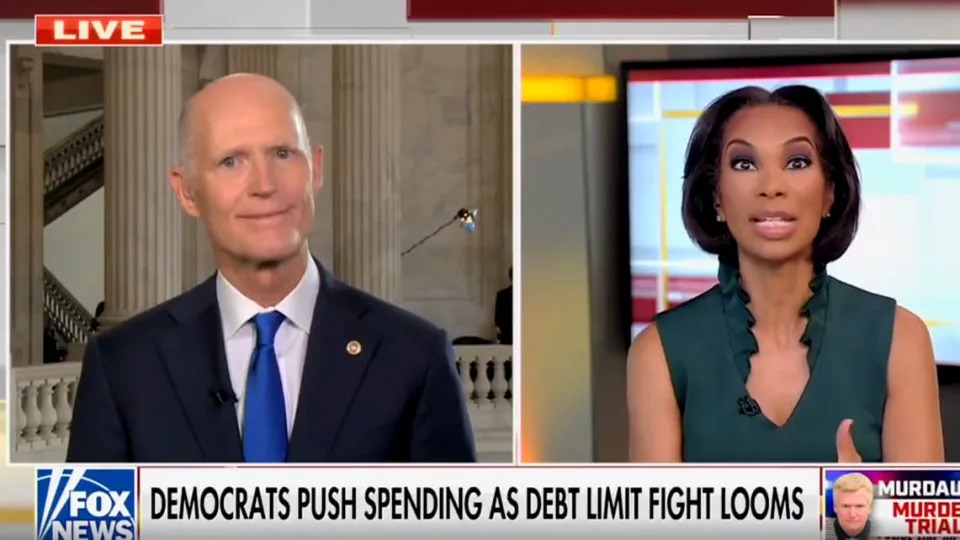
Fox News anchor Harris Faulkner on Thursday allowed Sen. Rick Scott (R-FL) to repeatedly push the lie that Democrats slashed hundreds of billions of dollars in funding for Medicare—even though that spurious claim had been debunked months ago.
In fact, not only did Faulkner—often labeled one of Fox’s “straight news” anchors—allow Scott’s falsehood to slide, she wondered how the Florida lawmaker would be able to work with Democrats since they’re “incapable of telling the truth.”
With the GOP now holding a slim majority in the House, the party has shifted much of its focus to austerity and pushing spending cuts across the board. Despite insisting during the midterms that they wouldn’t target Social Security and Medicare, House Republicans are now leveraging the fight over the debt ceiling to explicitly weigh proposals that would slash these entitlement programs.
Faulkner, who began her Thursday program by decrying the Democratic “spend, spend, spend” agenda amid rising debt, sounded the alarm over the “alarming” crisis facing entitlement programs. She aired a clip of President Joe Biden accusing Scott and Republicans of looking to reduce Social Security and Medicare.
“I don’t know one Republican, including me—we would never cut Medicare or Social Security. I’m gonna do everything I can to make sure there are no cuts in Medicare or Social Security,” the senator exclaimed. “But let’s remember, the Democrats, they all voted to cut $280 billion out of Medicare last September and Biden signed it.”
“Yes,” Faulkner empathically agreed.
“Let’s just remember—$280 billion they cut, and they want to say other people will do it,” Scott continued.
Though the Fox anchor heartily endorsed Scott’s assertion, fact-checkers knocked downthis claim last year—which centers on provisions in the Inflation Reduction Act that allows Medicare to negotiate drug prices with manufacturers.
According to government budget scorers, the Democratic-led bill that passed last year would save taxpayers anywhere between $237 billion and $288 billion due to pharmaceutical companies agreeing to lower prices on medications for Medicare patients. Still, Scott—whose GOP policy agenda last year drewwidespread criticism for proposing to cut Social Security—insisted at the time that this was a reduction in benefits.
CNN anchor Dana Bash, meanwhile, pushed back against his talking points during an interview last October, telling Scott that the legislation “allowed for negotiation for prescription drug prices, which would ultimately bring down the price and the costs for Medicare consumers.”Faulkner, however, was content to let Scott’s lie stand on Thursday.
Having already agreed with him once, the Fox anchor teed the Florida Republican up for a second round by airing comments from a Fox Business host who accused Democrats of “lying through their teeth” about the debt ceiling and Republicans’ stance on entitlements.
“I have to get your reaction to that because you have to negotiate with these people and you hear Larry Kudlow describing Democrats as they’re incapable of telling the truth about what we owe,” Faulkner declared.
After Scott grumbled that “they are not going to be honest with the American public,” the wealthiest U.S. senator expressed concern that “Wall Street has done really well” while average Americans suffer.
“That’s a flip of what the rhetoric is, isn’t it?” Faulkner reacted. “Democrats are looking across the aisle at you as Republicans and saying we are the ones who care about the middle class and seniors, but now what we’re seeing is that’s not actually true!”
Scott then repeated his false claim about Medicare cuts.
“They cut Medicare, Harris! They cut Medicare just four months ago,” They cut $280 billion out of Medicare, and they wanna say we want to cut it? No, I’m gonna fight like hell to make sure we preserve Medicare and Social Security because we can, we should, and we owe it to our seniors, but we have to do it by living within our means.”
Rather than correct the record, the Fox News anchor instead said that “everybody” has to live within a budget before moving on to Biden’s classified documents scandal.
The Colorado River is overused and shrinking. Inside the crisis transforming the Southwest
Ian James, Molly Hennessy-Fiske, January 26, 2023
(Luis Sinco / Los Angeles Times)
The Colorado River begins as melting snow, trickling from forested peaks and coursing in streams that gather in the meadows and valleys of the Rocky Mountains.
Like arteries, its major tributaries take shape across Colorado, Wyoming, Utah and New Mexico, coming together in a great river like no other — a river that travels more than 1,400 miles and has defined the rise of the American Southwest over the last century.
Water diverted from the river has enabled agriculture to spread across 5 million acres of farmland and has fed the growth of cities from Denver to Los Angeles, supplying about 40 million people. Harnessing the river’s bounty has provided the foundation for life and the economy across seven states and northern Mexico.
But the region has for years depended too heavily on the river, taking more than its flows can support. And in recent years, the river’s water-generating heart in the Rocky Mountains has begun to fail.
The Colorado River can no longer withstand the unbridled thirst of the arid West.
A century ago, the signing of the Colorado River Compact divided the water among the states. The agreement established a system that overpromised what the river could provide. That system, after years of warnings from scientists and insufficient efforts to adapt, is now colliding with the reality of a river that is overused and shrinking.
In the last 23 years, as rising temperatures fueled by the burning of fossil fuels have intensified the worst drought in centuries, the flow of the Colorado has declined about 20%.
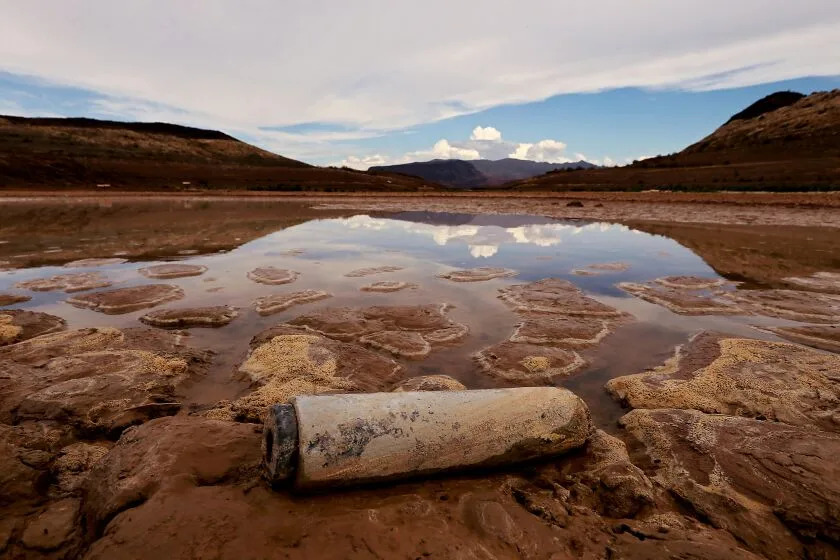
Reservoirs have dropped to record-low levels, and the shortage continues to worsen. Scarcity is pushing the region toward a water reckoning.
The looming consequences include major cuts in the supplies used for growing crops and sustaining cities. How those water reductions are divided among states, water districts and tribes has yet to be determined, and could end up being negotiated, dictated by the federal government or fought in court. But the need to shrink overall water use will probably result in less water flowing to farms, more water restrictions for residents and fewer green lawns, while also bringing calls for limiting growth, shifting away from thirsty crops like alfalfa, and dedicating less water to golf courses and other water-guzzling businesses.
The Colorado River Basin, which stretches from Wyoming to northern Mexico, is facing unresolved questions about how to adapt, at what cost, and where the cuts will fall the hardest.
The task of downsizing water use is complicated by an allocation system that promised now-nonexistent water on paper, as well as a legal system that benefits those with the oldest, most senior water rights.
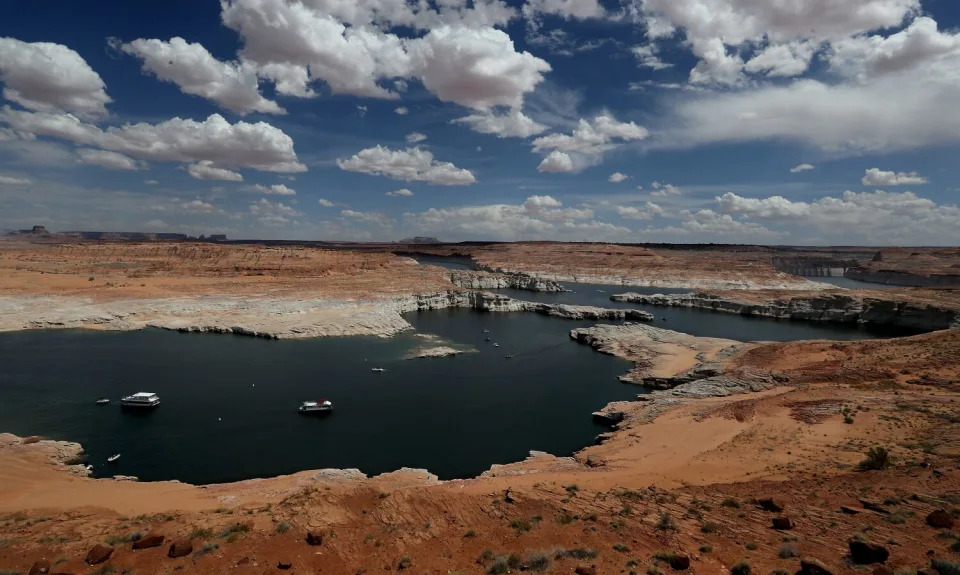
White surfaces along the banks show previous water levels in Lake Powell on May 16. (Luis Sinco / Los Angeles Times)
Over the last several years, managers of water agencies have reached deals to take less water from the river. But those reductions haven’t been nearly enough to halt the river’s spiral toward potential collapse.
As Lake Mead, the nation’s largest reservoir, continues to decline toward “dead pool” levels, the need to rein in water demands is growing urgent.
Efforts to adapt will require difficult decisions about how to deal with the reductions and limit the damage to communities, the economy and the river’s already degraded ecosystems. Adapting may also drive a fundamental rethinking of how the river is managed and used, redrawing a system that is out of balance. This reckoning with the reality of the river’s limits is about to transform the landscape of the Southwest.
Navigating through a forest of snow-covered pines, Brian Domonkos skied up to a site high in the Rocky Mountains, the source of the Colorado River.
He had come to check the snowpack at an isolated stand of monitoring equipment near Berthoud Pass, Colo., where the day before 5 inches of snow had fallen.
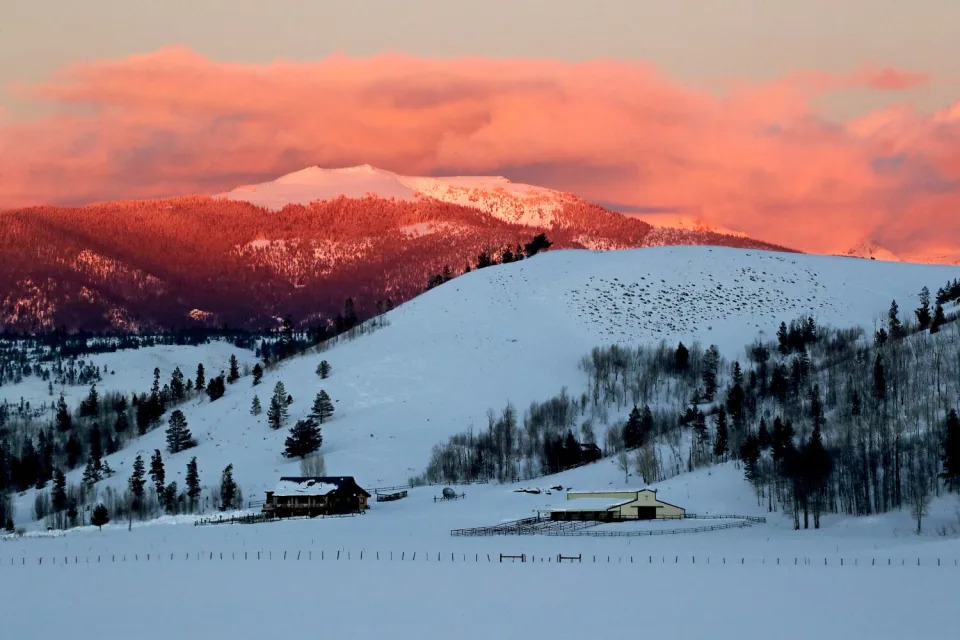
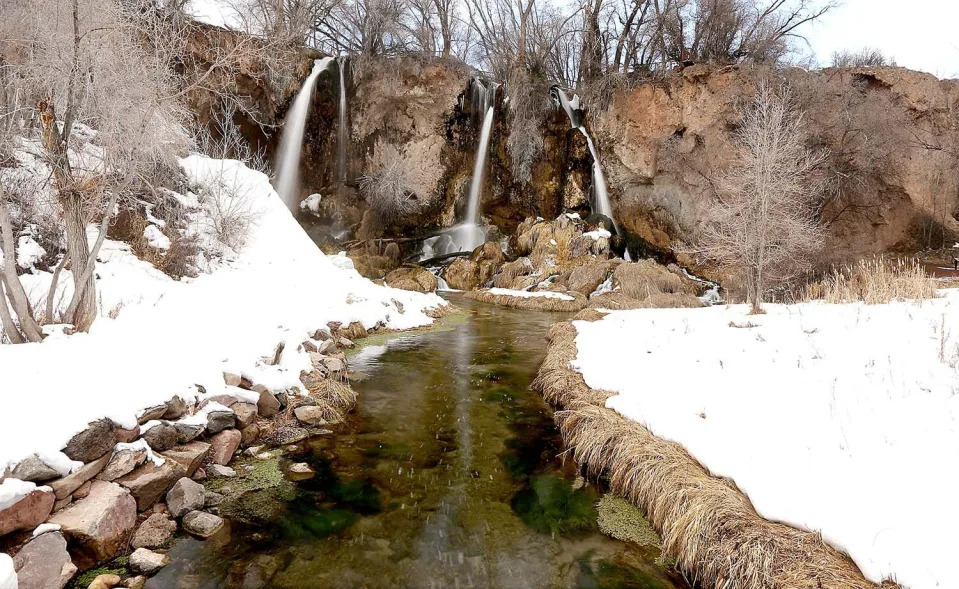
The foothills of the Rocky Mountains shelter a ranch near the headwaters of the Colorado River. (Luis Sinco / Los Angeles Times)Rifle Falls sets a wintry scene near the community of Rifle, Colo., at the headwaters of the Colorado River. (Luis Sinco / Los Angeles Times)
“I hope this holds on a little while longer,” said Domonkos, a snow survey supervisor for the federal Natural Resources Conservation Service. He was concerned that even with the snowfall, Colorado seemed headed for a below-average snow year.
Last spring, the snowpack across the Upper Colorado River Basin stood at 86% of average. By the end of July, however, the melting snow brought runoff that measured just 67% of average.
This pattern has emerged year after year in the river’s headwaters. A near-average snowpack has often translated into meager flows in the Colorado River and its tributaries.
This winter, storms have brought an above-average snowpack in the watershed. But that snow can go only so far in boosting reservoirs that have been dropping for more than two decades.
Average temperatures across the upper watershed — where most of the river’s flow originates — have risen about 3 degrees since 1970. That has contributed to the driest 22-year period in at least 1,200 years.
With higher temperatures, trees and other plants have been absorbing more water, and more moisture has been evaporating off the landscape.
In recent years, long dry spells in the mountains have left the soils parched. And when the snow has melted in the spring, the amount of runoff flowing in streams has often been diminished.
“We are seeing less water,” Domonkos said. “And we’re going to have to adapt.”
The river’s mainstem takes shape in Rocky Mountain National Park, winding through an alpine valley, then flows into reservoirs and meanders through ranchlands.
On one of these ranches, Wendy Thompson can see the river standing outside her house. She walked to the banks, where muddy brown water flowed swiftly past.
“This time of year, it ought to be another foot, 2 feet deeper,” Thompson said.
Clumps of snow cling to dry foliage along the banks of the Colorado River near Dotsero, Colo. (Luis Sinco / Los Angeles Times)
Thompson is 67 and remembers much more snow in Colorado when she was growing up. The flooding river used to swell across the pastures.
“In 1985 was the last time we really had a flood here,” she said.
Upstream diversions and dry years have left the river smaller. Some sections on her ranch now usually flow less than 2 feet deep.
In late spring and early summer, Thompson pumped from the river to irrigate her hay fields, and sold the crop to other ranchers.
Many ranchers have had less water for their pastures lately, and some have sold cattle to reduce their herds.
“Everyone knows that we’re dry,” Thompson said. “In this area, when there’s no water, you just don’t irrigate.”
Upstream from western Colorado’s ranchlands, water is diverted and routed to the east, flowing through a series of tunnels that pass beneath the Continental Divide to supply Denver and other growing Front Range cities. Two new reservoir projects are under construction to hold more water — the Chimney Hollow Reservoir and the expansion of Gross Reservoir.
The diversions from Grand Lake are a source of concern for Ken Fucik, a retired environmental scientist and board member of the Upper Colorado River Watershed Group. He said he is worried about water quality and recent algae blooms in the lake and adjacent reservoirs.
Fucik questioned whether the new reservoir projects make sense when the river’s existing reservoirs are rapidly declining.
“Where is that water going to come from?” he said.
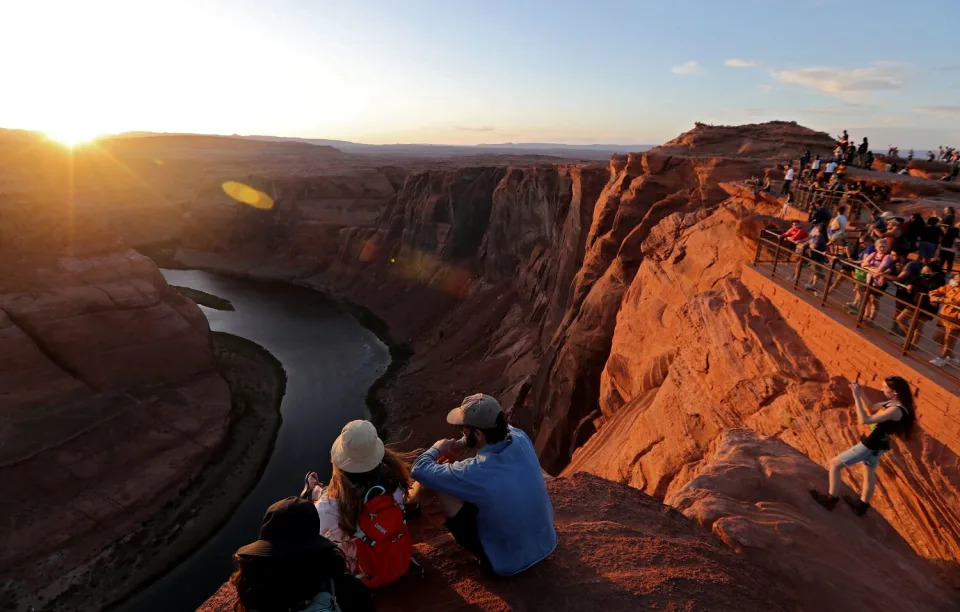
Scores of visitors get a view and pictures of the sun setting on Horseshoe Bend on the Colorado River near Page, Ariz., the gateway to the Glen Canyon Dam Recreation Area. (Luis Sinco / Los Angeles Times)
For more than a century, the history of the Colorado River has been shaped by monumental human efforts to control and exploit its waters to the maximum.
Indigenous peoples have lived along the river and its tributaries for thousands of years, adorning rocks on canyon walls with petroglyphs and pictographs.
The river’s Spanish name, colorado, or red, described the muddy, silt-laden waters that coursed through canyons.
In the mid-1800s, as white settlers moved west, steamboats chugged up the lower Colorado River, paddlewheels turning. Settlers began diverting water from streams and rivers, taking water rights under the prior appropriation system — “first in time, first in right.”
Water was seen as a source of wealth to be seized. The great ambition of politicians, engineers and fortune-seekers was to tame the river and harness its water.
In the early 1900s, they focused on building irrigation projects to “reclaim” the arid lands, a phrase central to the purpose of the Reclamation Service, which was created in 1902 under President Theodore Roosevelt and which later became the Bureau of Reclamation.
From the beginning, some warned against relying too heavily on the river. John Wesley Powell, leader of the historic 1869 expedition down the river through the Grand Canyon, famously told attendees at an 1893 irrigation congress in Los Angeles: “I tell you, gentlemen, you are piling up a heritage of conflict and litigation over water rights, for there is not sufficient water to supply these lands.”
Before the signing of the 1922 Colorado River Compact, some scientists warned that there was insufficient water, but those warnings went unheeded.
The compact apportioned the river “in perpetuity,” allocating 7.5 million acre-feet of water for the Upper Basin states — Colorado, Wyoming, Utah and New Mexico — and 7.5 million acre-feet for the Lower Basin states of California, Arizona and Nevada. Mexico later secured 1.5 million acre-feet under a 1944 treaty.
The river was divided among the states during an especially wet period in the early 20th century.
Visitors walk around Hoover Dam, where severe and prolonged drought conditions have exposed the rocky sides of Black Canyon and the intake towers that feed the dam’s power generators. (Luis Sinco / Los Angeles Times)
Hoover Dam was built during the Great Depression in the 1930s. Workers finished pouring the concrete at Glen Canyon Dam in 1963. As described by Los Angeles Times columnist Michael Hiltzik, the dams and reservoirs “created only the illusion of abundant water, not the reality.”
Over the last half a century, so much water has been diverted that for many years the river has been entirely used up, leaving dusty stretches of desert where it once flowed to the sea in Mexico.
Even in the 1980s, when plentiful water filled the reservoirs, some presciently warned that the Colorado could not withstand all the demands placed upon it.
In the seminal 1986 book “Cadillac Desert,” Marc Reisner predicted chronic shortages in the years to come, saying the region had already begun to “founder on the Era of Limits.”
The strains on the river have grown more acute with humanity’s heating of the planet. In the 1990s and 2000s, scientists repeatedly warned that chronic overuse of the river combined with the effects of climate change would probably drain reservoirs to dangerously low levels.
During the last decade, scientists have found that roughly half the decline in the river’s flow has been due to higher temperatures; that climate change is driving the aridification of the Southwest; and that for each additional 1 degree Celsius (1.8 degrees Fahrenheit), the river’s average flow is likely to decrease about 9%.
The drying of the Colorado’s upper reaches has shrunk the flow and accelerated the declines of Lake Powell and Lake Mead.
The system of dividing the water, including the agreement signed a century ago, was designed for a climate that no longer exists, said Becky Bolinger, assistant state climatologist at the Colorado Climate Center. Continuing this pattern of overuse, she said, is like depleting a bank account by overspending, edging closer to bankruptcy.
“It’s not going to work for anybody,” Bolinger said. “What we really need to do is just completely readjust the budget.”
The federal government has begun to lay the groundwork for scaling back water use.
Interior Department officials have said annual diversions need to be reduced by 2 million to 4 million acre-feet, or about 15% to 30%. They have urged the seven states that rely on the river to reach a consensus, while warning they may need to impose cuts.
So far, negotiators for states and water agencies have failed to agree on how to share such large reductions. Some fear these disputes could lead to lawsuits.
As the reservoirs’ levels continue to drop, time is swiftly running out.
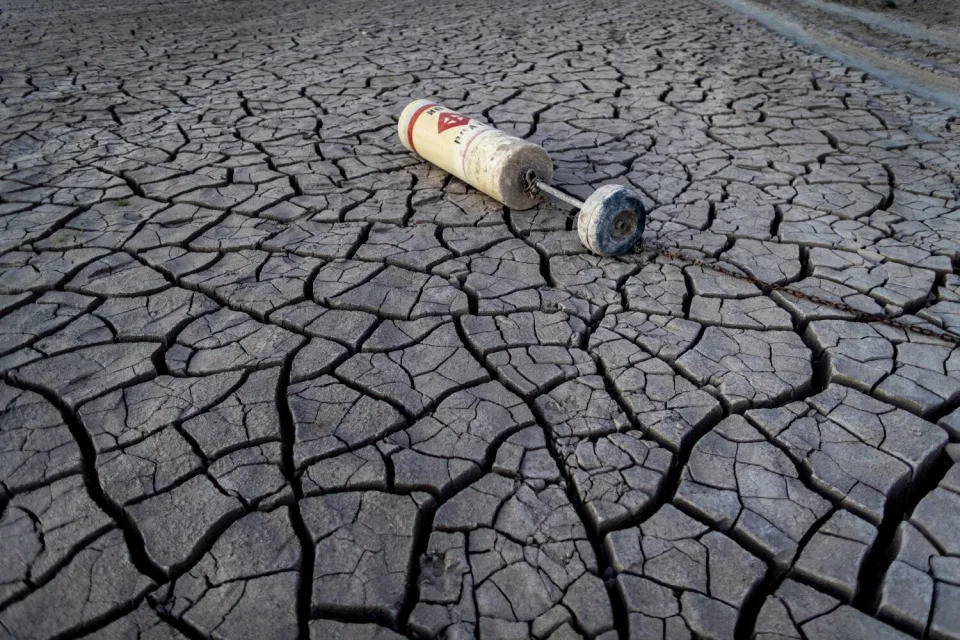
A buoy lies on a dried mud flat at a shuttered marina at drought-stricken Lake Mead. (Gina Ferazzi / Los Angeles Times)
“We have got to put the kibosh on these extra water uses right now, the uses of water beyond what’s being supplied. Either we stop them or nature will,” said Brad Udall, a water and climate scientist at Colorado State University. “Make no mistake. This is a full-on five-alarm fire going on right now.”
The Colorado River has reached this critical stage in a decade when extreme droughts have shrunk other rivers to historic lows around the world, from the Mississippi and the Rio Grande to the Yangtze in China, and the Danube and Rhine in Europe.
Research has shown that climate change is intensifying the water cycle, bringing more intense and frequent droughts, as well as more intense rainfall and floods. In one recent study, researchers found that streams in the western and southern United States have been drying over the last 70 years, with flow data revealing longer and more severe low-flow periods.
Even as wet and dry cycles continue to come and go, the Colorado River is on a long-term downward trend of aridification because of higher temperatures, Udall said.
“It’s fundamentally changing, and it’s not going to go back to how it was before,” Udall said. “We’re going to have to talk about permanent reductions in water use.”
‘A perfect storm for the whole food system right now’: One of the world’s largest fertilizer companies warns that every country—even those in Europe—is facing a food crisis
Tristan Bove – January 26, 2023
The Ukraine war upended the global economy in many ways. Energy markets have been among the most affected, with declining Russian oil and natural gas exports to the West sparking a domino effect of fuel crises worldwide. But the war has also warped another critical facet of the global economy: food.
Prior to the war, Russia and Ukraine were global breadbaskets as top producers and exporters of wheat, sunflower seeds, and barley. The fighting ended up aggravating hunger and food crises in low-income countries that are dependent on imports. But both Russia and Ukraine are also key cogs in the global fertilizer industry, and the war has triggered a shortage of the critical commodity that few people consider but is nevertheless essential to global food security.
Much as Russian President Vladimir Putin leveraged the world’s reliance on his country’s fossil fuels to weaponize energy supplies during the war, he is doing something very similar with fertilizer and food, Svein Tore Holsether, CEO of Norwegian chemical company Yara International, among the world’s largest fertilizer producers and suppliers, told the Financial Times in an interview published Thursday.
Putin’s energy gambit, which sent fossil fuel prices soaring and left Europe on the brink of recession last year, has so far not gone as expected, with a warm winter working against him and Europe able to buy natural gas from elsewhere. But Holsether warned the world’s reliance on Russia for fertilizer threatens more disruption of food supply, adding to existing challenges of logistics bottlenecks and climate change.
“If you look at the role that we have allowed Russia to have in global food supply, we depend on them. How did that happen? What kind of weapon is that? And Putin is weaponizing food,” Holsether said.
“It is sort of a perfect storm for the whole food system right now: very challenging in Europe, of course, with higher prices; even worse in other parts of the world where a human being dies every four seconds as a result of hunger,” he added.
Global fertilizer crisis
When natural gas prices surged last year after Russia invaded Ukraine, so did prices for fertilizer, which manufacturers such as Yara produce with ammonia and nitrogen obtained as a byproduct from natural gas. Fertilizer prices had already begun increasing in 2021 due to high energy costs and supply-chain issues.
Declining natural gas prices and weak demand among farmers have eased pressures somewhat over the past few months. Earlier this month, fertilizer prices fell to their lowest level in nearly two years in tandem with natural gas prices. But despite falling prices, Holsether insists that the global fertilizer market is precarious, and countries should shift from relying on Russian natural gas, to safeguard their agricultural industries.
“Putin has weaponized energy and they’re weaponizing food as well,” Holsether told the BBC at last week’s World Economic Forum in Davos, Switzerland. “It’s the saying, ‘Fool me once, shame on you. Fool me twice, shame on me.’”
Fertilizer prices remain high by historical standards, and the World Bank warned earlier this month that global supply is still tight due to the war, production cuts in Europe, and stricter export controls in China.
Averting a food crisis
If fertilizer is in short supply or prices remain unaffordable to many countries, farmers may be unable to keep their soil fertile enough for crops.
Concerns over fertilizer have taken center stage in recent weeks in Africa, which is heavily reliant on Russian food imports, and where agricultural production has taken a blow in recent years due to drought in many countries. The eastern Horn of Africa—including Somalia, Sudan, and Kenya—has been particularly hard-hit, as it is likely on the verge of a sixth straight failed rainy season, the worst drought conditions in 70 years of recorded data.
Securing additional sources of fertilizer was the cornerstone of a $2.5 billion U.S. food assistance package to Africa signed last month, while Treasury Secretary Janet Yellen noted the importance of stabilizing fertilizer supply in Africa multiple times during a visit to Zambia this week.
“Now we’re in 2023, it’s tragic and shouldn’t be like that,” Holsether told the FT about the state of global hunger. “That should be a very strong reminder of the need to have a more robust food system—from a climate perspective, from a logistics perspective, but also from a political perspective.”
Holsether said that all countries must become more self-sufficient with their food production. For fertilizer, he touted the promise of “green fertilizers” that use hydrogen and renewable energy to produce ammonia rather than natural gas, saying that clean and local solutions are critical to decoupling the global food system from Russia’s war.
Holsether also warned that European nations should not rely on their wealth to avert a food or fertilizer crisis. Like with natural gas, Europe has in recent months turned to the U.S. for nitrogen to replace Russian imports, but Holsether warned that Europe buying its way out of a food crisis is no remedy for global food insecurity.
“Yes. Not near term…there will be a shortage and there will be a global auction for food—but Europe is a wealthy part of the world,” Holsether said when asked if Europe should be concerned for its food security.
“But we need to think it through,” he added, saying that Europe buying food and fertilizer products from other countries will only create more global supply shortages and take away from other countries in dire need.
“In terms of food and food security, when you have that, you see wars or mass migrations, extremism, all these things,” he said.
Democrats revel in the GOP’s ‘doozy’ of an idea for a national sales tax
Ben Werschkul, Washington Correspondent – January 25, 2023
It’s a bill that is opposed by Speaker Kevin McCarthy (R-CA), unlikely to pass the GOP-controlled House of Representatives, and has approximately 0% chance of becoming law anytime soon.
But Democrats don’t want to stop talking about the Republicans’ proposal to replace income taxes with a national sales tax.
“This so-called fair tax plan is the craziest yet. It’s a real doozy,” Chuck Schumer said on Wednesday as the Senate Majority Leader took time out of his schedule to appear alongside House Democratic Leader Hakeem Jeffries (D-NY) for a press conference devoted to the subject. “Just the biggest lollapalooza I have ever seen around here.”
President Biden is also set to focus on the subject in a big way in a speech Thursday in Springfield, Virginia, with White House aides promising a contrast between the Democratic and GOP economic agendas that they hope voters will remember in coming years.
Senate Majority Leader Chuck Schumer (D-NY), left, meets with Hakeem Jeffries (D-NY), the leader the House Democratic Caucus, in Schumer’s office on Capitol Hill in December. (REUTERS/Evelyn Hockstein)
Rep. Earl L. “Buddy” Carter (R-GA) is the leading proponent of the idea and pushed back in a statement to Yahoo Finance, saying “Washington Democrats are fear-mongering about this bill because it takes power away from the federal government and puts it in the hands of the American people.”
Yet even voices sympathetic to Republicans urge the party to back away.
Grover Norquist, a tax reduction advocate, told Semafor it was “a political gift to Biden and the Democrats;” the conservative Wall Street Journal editorial page called it “masochism;” and Steve Forbes of flat tax fame called it a “belated, but huge Christmas present” for Democrats.
To top it off, Larry Kudlow, the former Director of Donald Trump’s National Economic Council, said it “really is a lousy idea” when he interviewed McCarthy on Tuesday.
The bill would eliminate all income taxes — from the payroll tax to corporate taxes to personal income taxes and more — and would also eliminate the Internal Revenue Service, just the latest salvo in the GOP’s feud with the tax-collection agency.
And while Americans may like the idea of no longer filling out tax forms each April, the bill would replace the trillions of dollars lost with a national sales tax.
The rate would begin at 23% in 2025 and could increase. An analysis of the plan from the Brookings Institution found that a rate around 30% — on top of existing state sales taxes — would be needed to cover the losses.
Rep. Buddy Carter (R-GA) during a budget hearing in 2022. (Roberto Schmidt-Pool/Getty Images)
Economists have also criticized the plan for lowering the the tax burden from high-income earners and corporations and shifting the onus to middle- and lower-class Americans who spend a much higher percentage of their monthly income on goods and services.
The Tax Policy Center found the idea would be a hike for 80% of Americans and a tax cut for the richest Americans. The top 20% would go from paying 84.2% of all federal income taxes to 65.1% under a theoretical federal retail sales tax.
But now, a full vote seems less likely in the near future. Three New York Republicans have already announced their opposition to the proposal and those “no” votes along with McCarthy would mean the bill would likely be defeated if put up for a full House vote.
Carter maintains that the bill removes complexity from the tax code, will encourage economic growth, and is better for working Americans. But the Georgia Congressman doesn’t seem to be expecting a floor vote soon.
“I’m excited for open debate on this legislation and for it to go through the committee process,” he said, adding it will be an opportunity for “a transparent discussion” about improving the tax system.
‘Go home and tell your moms’
Meanwhile, the unlikelihood of a national sales tax doesn’t seem to be dampening Democrats’ enthusiasm for discussing the issue.
During a recent speech, President Biden sarcastically proclaimed: “National sales tax, that’s a great idea…go home and tell your moms, they’re going to be really excited about that.”
On Capitol Hill, Sen. Jon Tester (D-MT) sent a letter to Senate leadership Tuesday, pledging “I will take on anyone” to stop the idea while his colleagues like Sens. Elizabeth Warren (D-MA) and Chris Murphy (D-CT) have taken to Twitter to mock the proposal.
“You wonder who is sitting in some dungeon, some laboratory, some basement cooking up these extreme ideas to try jam them down the throats of the American people,” added Leader Jeffries Wednesday.
It was former Georgia Congressman John Linder who first proposed the idea in 1999 and later co-authored a book called “The Fair Tax Book: Saying Goodbye to the Income Tax and the IRS.”
“The only tax collector that the consumer would ever see is the smiling face behind the register at the local grocery store,” Linder said in 2000 about the proposal that has been periodically revived over the last 20 year without ever gaining widespread Republican support.
Ben Werschkul is Washington correspondent for Yahoo Finance.
Startup aims to convert invasive zebra mussels in Lake Michigan into a renewable product
Alex Garner – January 25, 2023
Zebra mussels are an invasive species in the US.
PLYMOUTH, Wisc.— AntiMussel hopes to mitigate trillions of invasive zebra mussels infiltrating the Great Lakes by harvesting them for use in paper and pharmaceutical products.
The Plymouth, Wisc.-based startup, which has raised nearly $20,000 in funding and placed second at county and regional pitch competitions, will launch a pilot program this spring to remove the mollusk from Lake Michigan.
In a 250-square-meter and 80-foot-deep area, AntiMussel will connect a suction to the lake floor and transport them to shore. Wind speed and water temperature data will also be collected.
AntiMussel hopes to use the abundance of zebra mussels as a renewable resource for calcium carbonate, which is typically processed from limestone into varying products like Tums, white melamine paint and plastic.
Ideally, the company wants to create a renewable calcium carbonate product with a corporate partner.
A view of the Sheboygan lighthouse as seen, Tuesday, May 31, 2022, in Sheboygan, Wis. A search for a man who was last seen near a break wall on Lake Michigan will continue today, according to the Sheboygan Fire Department
“I want to skip that 6 to 8 million years of geology that it takes to make limestone and instead remove the mussels from the lake where we don’t want them, process them, and we end up with a ground calcium carbonate material that is exactly what is being sold on the market now,” Tyler Rezachek, AntiMussel founder and U.S. veteran, said.
Participating in the pitch competitions helped Rezachek connect with University of Wisconsin-Milwaukee professors, who will take him along on a research boat this spring to study zebra mussels, too.
“I was really kind of an entrepreneur in search of a problem,” Rezachek said about starting AntiMussel. “And zebra mussels (have) been something that I’ve heard about my whole life but never heard anything else about other than how to stop them from spreading.”
Zebra mussels were likely brought to the Great Lakes from Europe and Asia via ship ballast water in the 1980s. Since then, they’ve completely invaded the region and have riddled waterways feeding into the Mississippi River and western states Texas and California, according to the U.S. Geological Survey.
They negatively impact ecosystems in several ways, like outcompeting and incapacitating native mussel and other aquatic species.
Additionally, a female zebra mussel can release up to 1 million eggs per year once reaching reproductive age of two, according to the National Parks Service.
Not much can be done to remove them once a large population has invaded a lake or river.
“At this point, they’re so well established that I could have boats out there sucking zebra mussels all day every day and probably never put a dent in the population,” he said.
Today, an estimated 300 to 750 trillion zebra mussels are in the Great Lakes.
Zebra mussels can also overwhelm commercial, agricultural, forestry and aquaculture industries in the state, according to the Wisconsin Department of Natural Resources.
They also burden taxpayers.
According to some estimates, broad removal and resulting increases in water bills can cost taxpayers up to $1.5 billion a year.
Rezachek said only 3% of the costs is dedicated to preventing further spread.
According to Rezachek, efforts to get rid of zebra mussels center on taking them off infrastructure, like applying chemicals or pressure washing, rather than completely removing them from the water.
“None of those solutions stop mussels from reproducing or remove the resulting shell,” he said. “They just push them away.”
A young woman checks over her cell phone while getting some beach time in at Deland Park, Saturday, July 9, 2022, in Sheboygan, Wis.
The remaining shells wash onto beaches.
“We can’t walk on a lot of beaches on Lake Michigan now because they’re covered in mussel shells, and they’re razor sharp and they’ll cut your feet and your dog’s feet,” Rezachek said. “And they’re just going to keep collecting there, and the waves just keep pushing them on the beaches. So, unless we remove those in mass, we can never make beaches reusable for people again.”
Heavily infested water bodies like Lake Michigan are beyond the point for a complete elimination of zebra mussels, but there is still hope for smaller lakes.
While AntiMussel will focus on the Great Lakes, it also hopes to conduct customer surveys to see if landowners across the state need zebra mussel clean-ups on private beaches or in lakes.
“The smaller lakes that maybe only have a few thousand mussels in them, they’re not lost,” Rezachek said. “We can get those back and eliminate the mussels there, but then we have to stop them from getting there.”
To help prevent the spread, the National Parks Service suggests boaters drain boats, motors and livewells (circulating tank) before leaving an area of water, wash boats and trailers, and let them dry for at least five days before taking the boat out again because zebra mussels, dependent on water currents and transportation, can infest boat motors and livewells.