New College conservative board votes to abolish DEI office
Curt Anderson and Jocelyn Gecker – February 28, 2023
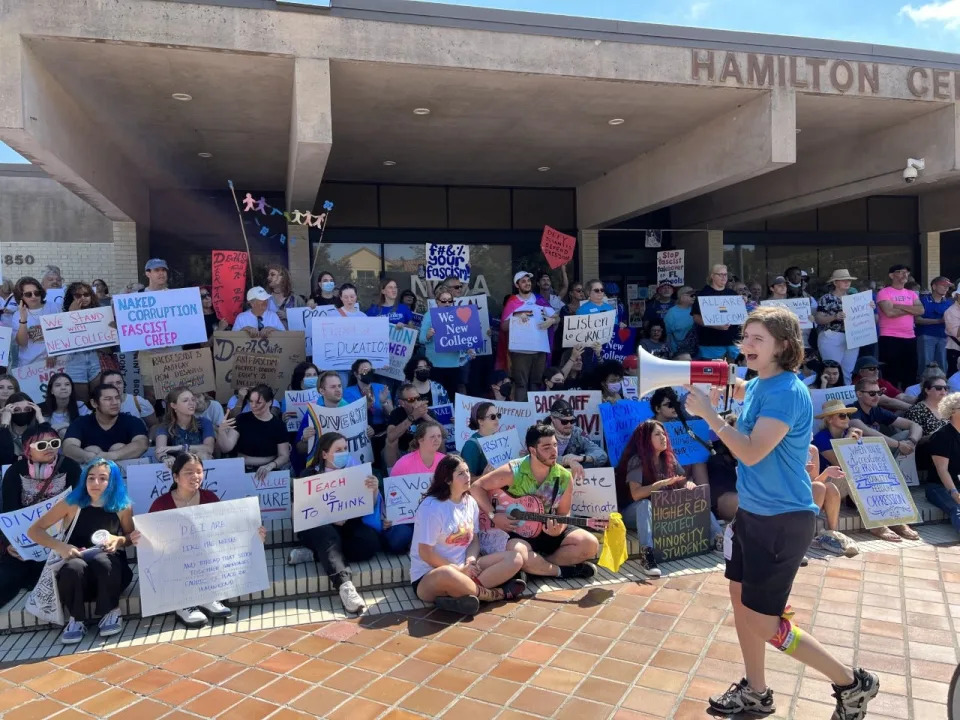
A group of parents of New College of Florida current students and one recent alum protest dressed as handmaids from Margaret Atwood’s “The Handmaid’s Tale,” ahead of a meeting by the college’s board of trustees, Tuesday, Feb. 28, 2023, in Sarasota, Fla. A sign in German addressed to Florida Governor Ron DeSantis, reads, “DeSantis, Are you copying the Nazis?” The conservative-dominated board of trustees of Florida’s public honors college was meeting Tuesday to take up a measure making wholesale changes in the school’s diversity, equity and inclusion programs and offices.(AP Photo/Rebecca Blackwell)A person cheers as New College of Florida students and supporters protest ahead of a meeting by the college’s board of trustees, Tuesday, Feb. 28, 2023, in Sarasota, Fla. The conservative-dominated board of trustees of Florida’s public honors college was meeting Tuesday to take up a measure making wholesale changes in the school’s diversity, equity and inclusion programs and offices.(AP Photo/Rebecca Blackwell)New College of Florida’s Interim President Richard Corcoran, center, listens during a meeting of the college’s board of trustees, alongside trustee Matthew Spalding, left, Tuesday, Feb. 28, 2023, in Sarasota, Fla. The conservative-dominated board of trustees of Florida’s public honors college was meeting Tuesday to take up measures making changesNew College of Florida students and supporters protest ahead of a meeting by the college’s board of trustees, Tuesday, Feb. 28, 2023, in Sarasota, Fla. The conservative-dominated board of trustees of Florida’s public honors college was meeting Tuesday to take up a measure making wholesale changes in the school’s diversity, equity and inclusionNew College of Florida students and supporters protest ahead of a meeting by the college’s board of trustees, Tuesday, Feb. 28, 2023, in Sarasota, Fla. The conservative-dominated board of trustees of Florida’s public honors college was meeting Tuesday to take up a measure making wholesale changes in the school’s diversity, equity and inclusion programs and offices. (AP Photo/Rebecca Blackwell)New College Conservatives Protest New College of Florida students and supporters protest ahead of a meeting by the college’s board of trustees, Tuesday, Feb. 28, 2023, in Sarasota, Fla. The conservative-dominated board of trustees of Florida’s public honors college was meeting Tuesday to take up a measure making wholesale changes in the school’s diversity, equity and inclusion programs and offices. (AP Photo/Rebecca Blackwell)Two members of a group of parents of New College of Florida current students and a recent alum who came dressed as handmaids from Margaret Atwood’s “The Handmaid’s Tale,” talk together as they wait to give public comment during a meeting of the college’s board of trustees, Tuesday, Feb. 28, 2023, in Sarasota, Fla. The conservative-dominated board of trustees of Florida’s public honors college was meeting Tuesday to take up measures making changes in the school’s diversity, equity and inclusion programs and offices.(AP Photo/Rebecca Blackwell)
New College of Florida students and supporters protest ahead of a meeting by the college’s board of trustees, Tuesday, Feb. 28, 2023, in Sarasota, Fla. The conservative-dominated board of trustees of Florida’s public honors college was meeting Tuesday to take up a measure making wholesale changes in the school’s diversity, equity and inclusion programs and offices. (AP Photo/Rebecca Blackwell)
SARASOTA, Fla. (AP) — Trustees picked by Republican Gov. Ron DeSantis to oversee New College of Florida voted Tuesday to abolish its small office that handles diversity, equity and inclusion programs targeted by conservatives throughout the state university system.
The trustees voted 9-3 to get rid of the school’s Office of Outreach and Inclusive Excellence, with four full-time staff positions to be transferred elsewhere to vacant jobs. The board also voted to permit interim President Richard Corcoran to consider ending a single online mandatory employee diversity training program that few actually take.
“This is not a very impressive DEI bureaucracy, is what I’m seeing,” said student body president Grace Keenan, who is a trustee and was not appointed by DeSantis. “Any DEI practices we do have here are all about inclusion. We don’t discriminate against anyone here.”
Although they are relatively small programs, some of the seven new trustees at the historically progressive college said it was important to take a stand on issues they believe cause discrimination based on racial, gender, LGBTQ and other group identities rather than focusing on a student, faculty or staff member’s individual merit.
“I think it’s important that we take a position,” said trustee Christopher Rufo, a conservative activist on education issues nationally. “It is essential to say we are taking this mandate seriously.”
The decision comes as DeSantis, widely expected to seek the GOP presidential nomination in 2024, has said a key goal for Florida’s higher education system is to defund DEI programs so they “whither on the vine” on campuses. DeSantis is backing a measure introduced for the upcoming legislative session to prevent colleges and universities from promoting, supporting or maintaining programs related to DEI or critical race theory.
The trustees’ vote to abolish the New College DEI office and transfer staff to other positions will save about $250,000 a year, according to documents provided at Tuesday’s meeting. Although that amount may seem relatively minor, supporters of the change said it will send a message.
“This is a question of what is being imposed and advocated, supported and funded, by the college,” said trustee Matthew Spalding. “If it’s a minor situation, it should be abolished.”
The trustee meeting drew a crowd of about 300 protesters before it began, holding signs that read, “Our Students Are Not Political Pawns” and, “If you’re not outraged, you’re not paying attention,” among others.
Chai Leffler, a third-year student, said he came from a southern, conservative family where being gay was difficult, but New College changed his life.
“I was taught how to love myself again and to stand up for myself like we all are today,” Leffler said. “I understand we are everything DeSantis hates.”
New College, nestled along Sarasota Bay, has fewer than 1,000 students. It was founded in 1960 as a private school in part by funding from the United Church of Christ, said Rev. John Dorhauer, the church’s president and general minister. Dorhauer gave public testimony at the meeting and spoke to the protesters about the “moral outrage” he feels at the changes being made by the conservative trustees chosen by DeSantis.
“The long arc of history will grind you into dust, and they (students) will win this battle and you will be remembered for the sycophants you are,” he told the trustees.
Emotional meeting ends with DeSantis’ New College of Florida board abolishing diversity office
Zac Anderson, USA TODAY NETWORK – March 1, 2023
Gov. Ron DeSantis proposes a plan to remove and reform diversity-based education programs
Governor Ron DeSantis plans to remove and reform education programs that focus on diversity, equity and inclusion initiatives from state universities.
New College of Florida’s Board of Trustees abolished the office handling diversity, equity and inclusion programs during a contentious and emotional meeting Tuesday that included testimony from students worried that a board reshaped by Gov. Ron DeSantis is making the school unwelcoming to minorities.
DeSantis appointed six members to New College’s board on Jan. 6 in an effort to transform the school, putting the small Sarasota institution at the center of the GOP’s nationwide pushback on education policies aimed at supporting historically marginalized groups, including racial minorities and LGBTQ individuals.
Eliminating diversity, equity and inclusion (DEI) initiatives − which have become a major flashpoint for conservatives and a target of DeSantis throughout Florida’s public university system − is among the first substantive actions by New College’s revamped board, which also fired the former president last month and hired DeSantis ally Richard Corcoran as interim president. Corcoran’s first board meeting was Tuesday.
Among DeSantis’ New College board appointees is prominent conservative activist Christopher Rufo, who pushed at his first meeting on Jan. 31 to abolish diversity programs.
The board opted to wait until more research could be done. College administrator Brad Thiessen presented the results of his DEI review Tuesday, delving into everything from faculty training to hiring practices and student admissions.
Thiessen said there was little mandatory diversity training and that only recently had prospective faculty been asked to submit a statement in their job application outlining how they would promote diversity.
Richard Corcoran the new interim president of New College of Florida was not welcomed by the majority of students and adult speakers.
Additionally, only one of the employees in the Office of Outreach and Inclusive Excellence was primarily focused on DEI programs. The others managed grants, worked on community outreach and performed other activities that aren’t controversial.
That led Trustees Grace Keenan and Matthew Lepinski to question whether the impacts of the DEI programs had been overstated.
“I’m concerned that we’re solving a problem that isn’t serious, or doesn’t really exist,” Lepinski said.
Keenan wondered if the board was spending a lot of time and energy on something that was relatively limited in scope. She suggested that the effort spent weeding out DEI programs was out of proportion to the amount of DEI that actually exists on campus.
“This is not a very impressive DEI bureaucracy,” Keenan said.
Keenan, Lipinski and Trustee Mary Ruiz voted against eliminating the diversity office.
Conservative appointee Christopher Rufo: DEI efforts discriminatory
Rufo conceded that DEI isn’t as deeply embedded in the college’s practices as he expected, but said it was still important to remove it on “principle.” Rufo and Trustee Matthew Spalding both suggested it is discriminatory to take race into account when setting the college’s priorities.
“It treats people differently on the basis of their skin color,” Rufo said.
“This is discrimination, it should be gone,” Spalding added.
The majority of trustees voted to have Corcoran move forward with eliminating the Office of Outreach and Inclusive Excellence, which handles DEI programs. The Office’s four employees will be offered other jobs.
New College students protest before a board of trustees meeting on campus Tuesday.
Trustees also voted to eliminate the diversity statement when hiring faculty and to direct Corcoran to consider adopting a prohibition on diversity training for employees.
Additionally, the board voted to have Corcoran create a school policy that prohibits spending money on any DEI efforts.
Under the new regulation, DEI will be defined to include “any effort to manipulate or otherwise influence the composition of the faculty or student body with reference to race, sex, color, or ethnicity.”
The definition of DEI also would include: “Any effort to promote as the official position of the administration, the college, or any administrative unit thereof, a particular, widely contested opinion referencing unconscious or implicit bias, cultural appropriation, allyship, transgender ideology, microaggressions, group marginalization, anti-racism, systemic oppression, social justice, intersectionality, neo-pronouns, heteronormativity, disparate impact, gender theory, racial or sexual privilege, or any related formulation of these concepts.”
The rollback of New College’s diversity programs came at the end of a 3-1/2-hour meeting that featured emotional testimony for students, parents and others. About 200 people attended the meeting.
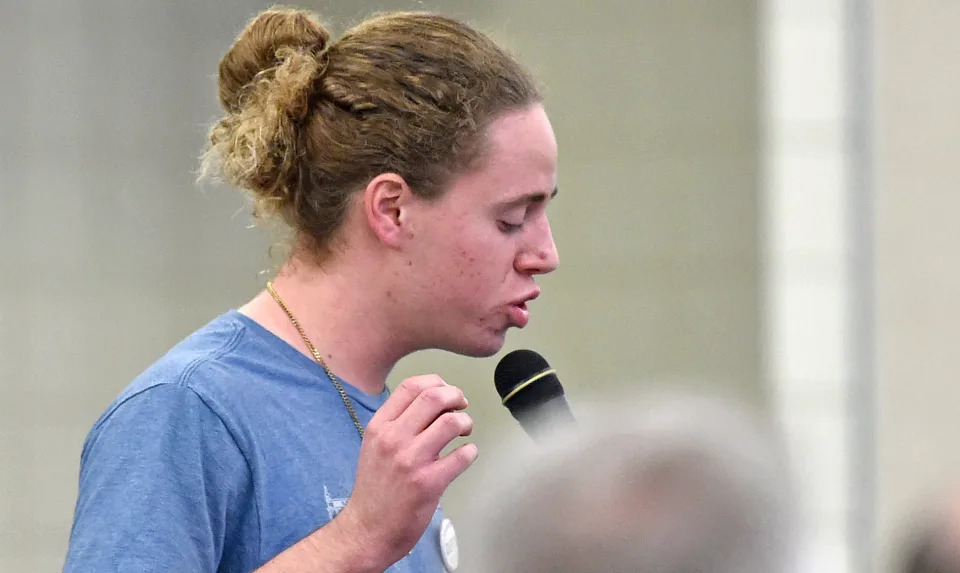
Economics and finance student Joshua Epstein, 17, argued diversity programs are important at a meeting of the board of trustees of New College of Florida Feb. 28, 2023. The board votes to abolish the school’s office handling diversity, equity and inclusion programs.
Where is New College of Florida?
New College of Florida is in Sarasota, in the central part of the state just south of Tampa on the Gulf Coast. The college bills itself as a community of “Free Thinkers, Risk Takers and Trailblazers,” and invites prospective New College students to “discover a public arts and science education driven by your curiosity, career aspirations, and individual learning style.”
Parents, students decry abolishing diversity programs
Economics and finance student Joshua Epstein, 17, said he graduates next year and plans to become a corporate lawyer or banker.
“Folks, I am so far from woke,” Epstein said.
Yet Epstein argued that the school’s diversity programs are important. Epstein said his grandparents on his father’s side survived the Holocaust and his grandfather on his mother’s side was a tank commander in the Israeli Army “where he fought for the survival of a Jewish state to fight to have a place where I’d be safe from persecution if people ever saw Jews as less than human again.”
“Today I fear that other groups of people are being seen as less than human; today I fear that we may eliminate the office that ensures that the composition of our classrooms resemble that of our great nation,” Esptein added.
The concerns raised by the public extended beyond eliminating diversity programs to DeSantis’ broader effort to reshape the school, Corcoran’s $699,000 base salary and other issues.
Corcoran thanked DeSantis during his first public remarks as interim president, saying the governor has “a heartfelt desire to have New College be a leader” in liberal arts education.
Earlier in the day students joined religious and political leaders in a large protest before the board meeting.
About 300 people gathered in front of the Hamilton Center on New College’s Sarasota campus to again criticize DeSantis’ conservative takeover of the school and vow continued resistance. Many of the speakers were minority students who criticized the push to eliminate the Office of Outreach and Inclusive Excellence.
Lianna Paton, a minority student in her first year at New College, said targeting DEI programs is an attempt to suppress and “erase students of color.”
“You do not get to say diversity is divisive when its very existence is what makes communities like my own feel welcome and safe,” Paton said.
New College supporters protested before a board of trustees meeting on campus Tuesday.
Members of the crowd held up signs saying “Black history is American history” and “Jesus was/is woke.”
Chai Leffler, 21, a gay third year New College student, said he struggled with his sexuality growing up and went through a dark time in high school. He went to a youth center in Sarasota where he met New College students who made him feel welcome.
“There’s one thing they cannot change,” Leffler said. “Us. We the students of New College are the spirit of New College and we will not let that be taken away from us.
Church leader accuses DeSantis’ of prioritizing presidential ambitions
Rev. Dr. John C. Dorhauer leads the church that helped found New College as a private school in 1960 before it became part of the state university system. He said he is outraged by what DeSantis is doing to the school.
“I want to express my moral outrage at Gov. DeSantis willing to compromise and sacrifice the future, the vision, the hopes, the dreams and the safety of the students on this campus for his aspirations to serve as president,” Dorhauer said.
Dorhauer’s United Church of Crist provided funding to create New College and church members were active in the school during its early days.
Dorhauer also spoke at the board meeting, where he told trustees that their actions will be judged harshly by history.
“The long arc of history will grind you into dust and… you will be remembered for the sycophants that you are,” he said. “That’s what history does.”
Republicans seize on train derailment to go after Buttigieg
Yasmeen Abutaleb, Ian Duncan and Justine McDaniel – March 1, 2023
Transportation Secretary Pete Buttigieg and other federal officials examine a burned Norfolk Southern rail car in East Palestine, Ohio. (Allie Vugrincic/AP)
Republicans are seizing on the train derailment in East Palestine, Ohio, to ramp up their attacks against Transportation Secretary Pete Buttigieg, saying he is promoting his own agenda at the expense of families who are grappling with a toxic chemical accident in their backyard.
The Transportation Department does not have primary responsibility for the cleanup, and Buttigieg and his supporters are firing back, suggesting the GOP has other motives for its focus on him. The secretary, who sought the presidency in 2020, has taken the unusual step of responding directly to some of his critics, including Sen. Marco Rubio (R-Fla.), former president Donald Trump and Senate Minority Leader Mitch McConnell (R-Ky.).
The result is an unusually personal and, on occasion, vitriolic back-and-forth involving a transportation secretary who is also a rising star in his party, potential candidate for higher office and prominent gay official – far from the usual technocratic and logistical debates that surround the Transportation Department.
“I’ve never heard this level of criticism against another secretary, ever, and I’ve been following this a long time,” said Ray LaHood, a former Republican congressman who served as transportation secretary under President Barack Obama. “I’ve never seen it like this before. This is pure politics.”
Buttigieg has faced GOP criticism before, notably during supply chain disruptions early in Biden’s presidency and the failure of a federal aviation safety system in January. But people close to the transportation secretary say the attacks on him since the derailment have risen to a new level, noting that the Environmental Protection Agency, which is in charge of the response to the derailment, has taken far less heat.
Though part of a broader GOP criticism of the administration’s response to the derailment, the attacks on Buttigieg have in some cases been strikingly personal. Rubio tweeted that Buttigieg is “an incompetent who is focused solely on his fantasies about his political future & needs to be fired.” McConnell said on the Senate floor that Buttigieg is “more interested in pursuing press coverage for woke initiatives and climate nonsense than in attending to the basic elements of his day job.”
Some critics suggest Buttigieg should have been on the scene earlier – he visited East Palestine on Feb. 23, almost three weeks after the accident – but many of the accusations lack specificity, instead taking the secretary to task largely for his broader positions on issues such as the climate.
Buttigieg is one of the Biden administration’s most visible messengers, a deft debater who, unlike many Democrats, is often willing to appear on Fox News and other conservative outlets to advocate the White House’s priorities. A surprise star of the 2020 Democratic primaries, he moved last year from deep-red Indiana to the bluer state of Michigan, fueling speculation about further political ambitions.
Jeffrey Shane, a senior Transportation Department official during the presidency of George W. Bush, said that is one reason Buttigieg is receiving this level of attention. “Because his last act was running for president, Secretary Buttigieg is an unusually high-profile person to have the DOT job,” Shane said. “That visibility, together with genuine challenges in transportation and a toxic atmosphere in Washington, have combined to make this a difficult time.”
The White House argues that the administration implemented a by-the-book response to the train derailment, quickly dispatching federal experts from numerous agencies. The derailment itself did not harm or kill anyone, but some of the rail cars were carrying hazardous chemicals that leaked and burned in a massive fire.
Three days after the crash, officials decided to release vinyl chloride from five rail cars to prevent them from exploding, a controversial decision that spewed more chemicals into the air and yielded photos of an ominous-looking black plume looming over East Palestine.
The Transportation Department, while concerned with the conditions leading to the crash, did not have a central role in the response. The department did send experts to help the National Transportation Safety Board investigate, and the head of the Federal Railroad Administration, part of the Transportation Department, has also visited the scene.
Buttigieg has conceded that he should have spoken out sooner to convey his concern about the accident and the people in the area. “That’s a lesson learned for me,” he told CBS News.
While the Transportation Department is weighing new safety rules in the accident’s aftermath, it is the EPA that is the lead federal agency on the ground, monitoring toxins and overseeing the cleanup effort by Norfolk Southern, the company that operated the train. Still, Republicans have not gone after EPA Administrator Michael Regan or other federal officials in the same way they have targeted Buttigieg.
Some conservatives have tried making a broader argument – that Biden and his team do not care about East Palestine because it is a Republican, rural, largely White town. “Is it because these are not their voters?” Fox News host Tucker Carlson asked Sen. J.D. Vance (R-Ohio), who agreed.
Others have taken it further, taking the opportunity to wrap Buttigieg’s sexual orientation into their criticism. Donald Trump Jr., the former president’s son, said late last month that Buttigieg got his job solely because Democrats wanted to give a role to “the gay guy.” Long before the derailment, some Republicans mocked Buttigieg’s decision to take paternity leave after his twins were born and to bring his husband, Chasten, with him on a military jet.
That has led to allegations that the post-derailment criticism stems in part from homophobia.
“Whether it’s sickening attacks on his family or disrespecting a community’s pain with failed attempts at exploitation as a political prop, nothing saps credibility like following debunked smears with even more debunked smears,” deputy White House press secretary Andrew Bates said in a statement.
In East Palestine last month, former New York mayor Rudy Giuliani cited Buttigieg’s paternity leave as he criticized him for purportedly taking too long to visit the town. Giuliani, a Trump ally, referred to his own experience leading New York at the time of the Sept. 11, 2001, terrorist attacks.
“One of the main rules in investigating a murder is: Every day you miss is one more day inactive,” Giuliani said in an interview. “It’s quite obvious that this mayor, who accomplished nothing as the mayor of a tiny town not much bigger than a New York City apartment building, seems to have no expertise.” Buttigieg was mayor of South Bend, Ind., when he launched his presidential bid in 2019.
Buttigieg has hit back directly against many of the attacks, an unusual approach for top officials, who often seek to remain above the fray. He has coupled that with invitations to his critics to help craft new rail safety guidelines, arguing that Republicans are at fault for blocking previous safety rules related to railways and chemical spills.
He accused Rubio of sending out a letter two years ago that was drafted by railway lobbyists. The senator responded that Buttigieg was “m.i.a. on the derailment” and was lying about the letter.
Buttigieg retorted: “The facts don’t lie. The 2021 letter you signed was obviously drafted by railroad industry lobbyists. It supports waivers that would reduce visual track inspections. Now: will you vote to help us toughen rail safety accountability and fines, or not?”
After McConnell’s floor speech accusing Buttigieg of pursuing “woke initiatives” and “climate nonsense,” Buttigieg cited a bridge in Kentucky that had benefited from the bipartisan infrastructure law, which the Transportation Department is helping implement.
“Respectfully, the Brent Spence Bridge we’re funding in Kentucky is hardly a ‘woke initiative.’ Fighting climate change isn’t ‘nonsense,'” Buttigieg tweeted. “And Leader McConnell could be enormously helpful by joining us in standing up to the railroad industry lobby to make hazardous trains safer.”
Republicans on the House Oversight Committee, meanwhile, said they were opening an investigation of the derailment and sent a letter seeking records from Buttigieg. “You ignored the catastrophe for over a week,” the letter said, accusing Transportation Department leadership of “apathy in the face of this emergency.”
Rep. Jamie B. Raskin (D-Md.) and other Democrats fired back that the letter “failed to ask a single legitimate question” about the cause of the derailment.
“If Committee Republicans are serious about uncovering the truth, it must do so by conducting thorough, fact-based oversight, which includes seeking answers from Norfolk Southern about its potentially harmful policies and ongoing efforts to influence federal railroad safety measures,” they wrote.
Biden administration officials note that the United States experiences about 1,000 derailments a year. They say they responded almost instantly to this one.
EPA personnel arrived at the crash site in the middle of the night on Feb. 4, a few hours after the train derailed, and began monitoring the air and water. The next morning, the NTSB, an independent agency, announced its investigation and was set to meet with local officials; the agency held two news briefings in East Palestine in the first three days of the crisis.
Ohio Gov. Mike DeWine, a Republican, has praised the administration’s response, telling reporters on Feb. 14 that Biden had offered federal help but that he had not taken the president up on it because the situation was under control.
As media attention on the derailment exploded that week, DeWine moved to secure more aid, and the administration sent teams from the Centers for Disease Control and Prevention, the Department of Health and Human Services and the Federal Emergency Management Agency.
In the past, transportation secretaries have sometimes visited disaster scenes, most often after incidents involving fatalities. In those cases, they have often waited several days to avoid causing a distraction and impeding the on-the-ground response.
Federico Peña, transportation secretary under President Bill Clinton, said he went to several accident scenes, adding that seeing the trauma firsthand enabled him to better push for improved safety measures.
Both Peña and LaHood also used disasters as springboards for efforts to overhaul transportation safety regulations, a playbook Buttigieg now seems to be using. Some Republicans, despite their criticism of his performance, have signaled a willingness to take part in such a push.
On Wednesday, Vance and Rubio sponsored bipartisan legislation that would advance many of the rail safety initiatives supported by the Transportation Department.
The Washington Post’s Meryl Kornfield contributed to this report.
For starters, a 2019 study of nearly 200,000 adults found that those who had a healthier lifestyle were less likely to develop dementia over the course of eight years, even if they were genetically at risk for dementia — and a 2020 study came to a similar conclusion. Beyond general healthy habits, though, specific activities have been shown to boost brainpower and prevent cognitive decline: brain exercises.
Do brain exercises work?
Probably — but it’s complicated. “Memory is not one thing, but it’s a combination of different things so when we talk about exercises or training for memory, I think it depends on what type of memory we’re referring to,” says Zaldy S. Tan, M.D., M.P.H., the director of the Cedars-Sinai Health System Memory and Aging Program. Consider a trip to the grocery store: Remembering what you intended to buy without having a list to look at requires an ability to recall things. Remembering the layout of the store and where to find things requires more of a visual/spatial memory. Running into a peer from elementary school, remembering how you know them and holding a conversation requires a quick processing speed on top of recall.
Unfortunately, it can be difficult to study the effects that certain activities have on our brain. It’s not as simple as say, watching someone practice bicep curls every day and seeing their muscle girth increase over time. “The things that we’re engaged in on a day-to-day basis that are not specific to deliberately improving our memory — for example, reading a book, attending classes at a junior college because we’re interested, listening to NPR or something else that will expand your view of the world or watching documentaries — those are all great, but they haven’t been studied for us to conclusively say that if you do all of these things, you’re less likely to develop memory problems,” says Dr. Tan. “Speed of information processing can be enhanced by cognitive training by computer-based tests, for example, but it doesn’t necessarily mean that you’re going to be less likely to develop Alzheimer’s disease or other forms of dementia.”
That said, engaging in certain exercises (even if they’re specific to one type of memory skill) can’t hurt and may even help you in the long run. “Increasing these synaptic connections — increasing these areas of connections in the brain — that might help build reserve,” says Douglas Scharre, M.D., the director of The Ohio State Wexner Medical Center Division of Cognitive Neurology. “If, in the future, you have unfortunate issues that affect the brain, such as strokes or dementia conditions, you’d have a little bit more reserved.”
Brain exercises for memory to do at home
Your best bet is to all different kinds of things that exercise your brain in different ways. “Variety is great,” says Dr. Scharre. “The more you do with your brain, typically, the better it is.” This list of exercises for your brain can help get you started.
1. Work out
It seems one of the best things you can do for better cognition is physical exercise. It increases blood flow to the brain; reduces the risk of stroke, high blood pressure and diabetes (three risk factors for developing memory problems); and lowers inflammation oxidation (which has also been implicated in dementia), according to Dr. Tan. In fact, a 2023 study of nearly 1,300 women age 65 and older found that for every 31 minutes of moderate-to-vigorous physical activity a participant did every day, she had a 21% lower risk of developing dementia. Meanwhile, a 2022 meta-analysis concluded that people who regularly participated in walking, running, swimming, bicycling, dancing, yoga, sports and exercise machines had a 17% lower risk of developing dementia than those who didn’t. New to exercise and not sure where to start? Check out our list of the 10 best cardio exercises to try at home or in a gym.
2. Play a sport
If you want to take the benefits of exercise to a whole new level, consider a sport that requires you to play with other people. On top of the physical exercise, research shows that sports require you to make quick decisions and solve problems (Where is my teammate? Should I run faster? Which strategic play might work best right now?) and give you the opportunity to socialize with others, Dr. Scharre points out. “The whole brain is working really well, and it’s a great whole-brain activity,” he says.
3. Socialize
Seriously, getting together with other people is extremely good for your brain. “You have to use your eyes to see their expressions and nonverbal communications. You pick up things that way, and you make judgements,” explains Dr. Scharre. “They tell a story, you’re reminiscing and think, Oh, in regard to that topic, I have a great story to tell, and then you share your story. You go back and forth with this thing called discourse. You’re using your language, you’re using your vision, you’re using your hearing. All these parts of the brain are being involved and integrated.” If you can’t meet in person, pick up the phone and call someone — you’ll give a little brain boost to both of you.
4. Do some math
The next time you open the calculator app on your phone, research suggests you might want to pause for a second and decide if the math problem at hand is something you can solve without technology. In fact, one study found that senior citizens who given basic math and reading problems to work on every day for six months experienced boosts in processing speed and executive function.
5. Learn a new language
Knowing two languages allows you to connect with others you may not have communicated with before, makes travel easier and supports a healthy brain. A 2020 meta-analysis found that people who are bilingual develop dementia at a later age than people who only speak one language. It may sound like a big commitment, but we found the best language-learning apps to get you started — and some are totally free.
6. Become a puzzler
Doing a variety of puzzles is the key here since different ones engage different parts of your brain, but number games, crosswords and jigsaw puzzles may be particularly helpful. “Sudoku is great for logic — that’s the frontal part of the brain. Crosswords increase your abilities to store vocabulary and think of words on your verbal side,” says Dr. Scharre. “Jigsaw puzzles may be more of a visual/spatial thing.”
7. Play an instrument
Performing music requires you to mix the physicality of touch with remembering and hearing — in a short amount of time. One study even found that people over age 60 who took piano lessons scored higher on tests of episodic memory and attention six months later than people who didn’t. Episodic memories are things we remember that happened in the past (whether it be 30 years ago or 30 days ago).
8. Meditate
In one study, people with mild cognitive impairment or mild Alzheimer’s disease who did 30 minutes of guided meditations every day for six months showed slower degeneration in crucial brain areas than people who didn’t. New to meditation? We researched a whole bunch of meditation apps and compiled a list of the best ones to help lower anxiety.
9. Stimulate your senses
Opt for activities that require you to use several of your senses. For instance, when baking an apple pie, you might feel the dough as you form the crust, hear and smell the apples sizzle on the stove if you pre-cook them, visually pay attention to what you’re doing as you assemble everything and then, of course, taste the fruit of your labor. Research suggests that when senses interact it helps us remember things better.
10. Sleep
You may not think of it as a brain exercise, but high-quality sleep is essential for our brains to function at their best. In fact, sleep helps “improve memory recall, regulate metabolism and reduce mental fatigue,” according to one research analysis. While we’re snoozing, our brain is busy removing toxins and reorganizing itself so if you don’t get at least 7 hours of high-quality shuteye night after night, don’t be surprised if you experience brain fog among other problems. If your sleep routine could use a little refresh, try these strategies for resetting your nights.
The bottom line: “The thing with dementia is that there is a pathologic mechanism to it, meaning for Alzheimer’s for example, you develop amyloid plaques and tangles,” says Dr. Tan. “Just doing cognitive training isn’t going to prevent you from having those things, but it might help you reduce the risk of developing symptoms.” So, it’s important to engage your brain in a variety of different ways right now so you have a little more leverage if things go south later on. Along those same lines, remember that your brain works with nearly every other system in your body — it’s not a soloist. “If your heart is unhealthy, that can affect the brain because the brain is the organ that needs the most oxygen in your system,” says Dr. Tan. “If your kidneys are not functioning well, then you accumulate more toxins that the kidneys filter from the blood. If your gastrointestinal tract is not healthy, then you won’t absorb the micronutrients that the brain needs to stay healthy.” Everything is connected so remember that when you’re trying to protect your brain, it’s best to focus on whole-body health.
‘Trans people go to dances and find joy and are whole’: A mom’s viral photos of her daughter send a powerful message
Beth Greenfield, Senior Editor – February 28, 2023
Jaime Bruesehoff recently shared side-by-side photos of her daughter Rebekah, one at age 10 and one at 16, to show that trans people “find joy and are whole people.” (Photo: Twitter/Jaime Brusehoff)
Rebekah Bruesehoff may only be 16 years old, but she’s spent almost half her life publicly fighting for her rights as a transgender person.
It’s why her supportive, activist mom Jamie took a moment this week to tweet a joyous photo of Rebekah in a green gown and holding white flowers, primped and ready to attend a high school dance — an update to one that went viral in 2017, of Rebekah at a rally holding a sign that read, cheekily, “I’m the scary transgender person the media warned you about.” That image appears alongside the new one.
“There’s this juxtaposition,” Jamie tells Yahoo Life, referring both to the two photos and her daughter’s life. “The photo from six years ago popped up in my memories, and I was struck: It feels so long ago and like it was just yesterday.” When the photo came up, she says, she was at a nail salon with Rebekah, who was getting a manicure before her sophomore cotillion. Sharing both photos, Jamie explains, felt like an opportunity to show a more well-rounded view of her teen, who plays field hockey and loves musical theater.
“She’s spent six years fighting publicly — but she’s also just a teen going to a fun dance,” she says. “That’s so much of what the Twitter thread was about… that trans people go to dances and find joy and are whole people, and that trans people are more than just their fights for rights and for life.”
The original photo of Rebekah, then 10, holding the sign inspired by a story she had found online, was snapped just before a protest in Jersey City, N.J., over the Trump administration rescinding federal support for transgender students. The tween was asked to speak in front of the crowd of 200, which she agreed to, and then her mom posted the image to Facebook, where it “went crazy viral.”
Looking back now, says Jamie, “It’s certainly not what any of us had planned. But what was really powerful was to see her use her voice and say, ‘I deserve a safe school.’ But even more impactful for her was she heard the voices of the other people… trans kids who were not supported, trans adults… it was the first time, at 10 years old, that she realized how good she had it and how much work we had to do.”
That idea, of work left to do, is especially important now, says Jaime on Twitter: “In ways, things are worse than I could have imagined 6 years ago… and yet she continues to resist with advocacy, speaking and education. She resists with her joy, she resists by growing into this beautiful young woman that so many wish she wouldn’t have the chance to become.”
She’s referring to the unprecedented number of anti-trans and anti-gay bills popping up across the country: Just two months into 2023, LGBTQ-rights organization the Human Rights Campaign (HRC) is tracking 340 anti-LGBTQ bills introduced at state levels, 150 of which would specifically restrict the rights of transgender people, 90 of which would prevent trans youth from being able to access gender-affirming medical care; two have become law, in Utah and South Dakota.
“Things are pretty awful right now,” Jaime tells Yahoo Life. “We live in New Jersey … so there’s some privilege and some level of safety that comes with that — and also, you’re not safe anywhere, we know that. My heart breaks for all transgender young people. Their identities are being used as a political football.”
Because Rebekah is an athlete — and luckily having a “really positive experience” on her hockey team — her family “really jumped into” having public conversations supporting transgender athletes, only to see “attacks on health care getting worse by the day,” she says, adding “it’s become very clear” that the anti-trans fight “is not about protecting children. It never has been. It’s about political power and removing transgender people from public life.
But even in New Jersey, where there are some protections in place — like state’s LGBTQ-inclusive school curriculum and the Babs Siperstien Law, which allows people to change their gender identity on their birth certificate without “proof of surgery” — there’s no way to fully escape the national rhetoric.
“What people don’t understand is that young people are impacted by these messages … They are seeing what’s happening, watching their identity be banned from public conversations in schools,” she says. “People, even in states like New Jersey and New York, know what’s going on. And for a young person to see their identity being debated on every front? That’s exhausting.”
Luckily, the mom notes of her daughter, “Rebekah is a big joy-as-resistance kind of person. She focuses on the positive, has friends, loves to laugh. It’s how she, I think, sustains herself.” She also recognizes her relative privilege: “She’s white, she exists within the gender expectations people have for girls and she has supportive parents who have been behind her and who have resources.”
Rebekah’s glowing spirit, her mom says, has powerfully influenced the entire family — including her “super-supportive” brothers, ages 8 and 13, and her father, a Lutheran pastor who, Jaime says, “preaches the gospel … that calls for us to work towards justice.” She adds that “he preaches the message of inclusion and of celebration of LGBTQ+ people.
But it’s Jamie, who identifies as “queer” and uses “she/they” pronouns (including on her website and social media profiles), who might be most influenced by her teen’s courage.
“I’m bisexual,” she tells Yahoo Life. “I came out more publicly in 2018. I think there was some part of doing this work, of advocating for my daughter to show up in all her authenticity, that started to feel inauthentic for me not to share.” As for her use of she/they, which is new as of about a year, Jamie adds, it’s one way she is “continuing to break down those boxes of gender, and understand myself in the fullness of who I am. ‘They’ feels really great.
“I think with me sharing my identity as a bisexual person and my identity not as nonbinary, but as someone who feels constrained by the gender binary, and I think watching Rebekah live her life as who she knows herself to be and the positive impact it’s had,” she says, “I know that showing up as ourself changes the world.”
A sunken boat reemerges in September 2022 in Lake Mead National Recreation Area, Nevada, after unprecedented drought. (David McNew/Getty Images)
Much of the Northern Hemisphere is struggling with drought or the threat of drought, as Europe experiences an unusually warm, precipitation-free winter and swaths of the American West remain mired in an epic megadrought.
But it’s not just those pockets feeling the pain in the U.S. Most of the Western United States is in some form of drought, with areas of extreme drought concentrated in the Great Plains and Texas. A 23-year megadrought has left the Southwest at the driest it is estimated to have ever been in 1,200 years, based on tree-ring data.
That’s very bad news for Texas cotton farmers. The New York Times recently reported that “2022 was a disaster for upland cotton in Texas,” leading to short supplies and high prices of tampons and cloth diapers, among other products. “In the biggest loss on record, Texas farmers abandoned 74 percent of their planted crops — nearly six million acres — because of heat and parched soil, hallmarks of a megadrought made worse by climate change,” the Times noted.
Even recent heavy storms in California haven’t brought the state out of drought, because the precipitation deficit is so big.
A car drives through a flooded road in Gilroy, Calif., in January. (Michael Ho Wai Lee/SOPA Images/LightRocket via Getty Images)
“I want to be clear that these storms — and the likely rain and snow we may get over the next few weeks — did not, nor will they fully, end the drought, at least not yet,” Yana Garcia, secretary of the California Environmental Protection Agency, said last Wednesday. “We’re in better shape than we were two months ago, but we’re not out of the woods.”
Just days earlier, Lake Powell, the second-largest U.S. reservoir, dropped to a new record low. Powell is created by a Colorado River dam along the Arizona-Utah border, and if the reservoir goes much lower, experts warn, water won’t be able to pass through it. Millions of people who rely on the Colorado would then lose access to their water supply.
“If you can’t get water out of the dam, it means everyone downstream doesn’t get water,” Brad Udall, a water and climate scientist at Colorado State University, told USA Today. “That includes agriculture, cities like Los Angeles, San Diego and Phoenix.” The hydroelectric power plant for which the dam was constructed would also cease to function.
When the current 23-year megadrought plaguing the American West began, Lake Powell and Lake Mead — the largest U.S. reservoir, also on the Colorado — were 95% full. Now, they’re one-quarter full, according to Udall.
Logs and driftwood on Sept. 8, 2022, near Hite, Utah, remain where they settled when Lake Powell was at its highest-ever water level. (David McNew/Getty Images)
In order to prevent what one California official calls “a doomsday scenario,” the Department of the Interior will have to impose reductions in water allotments for downriver users.
Scientists say that the underlying conditions — growing demand for water and naturally occurring periodic drought — are being exacerbated by climate change. Warmer temperatures cause more water to evaporate, making both droughts and heavy precipitation more extreme. Climate change makes droughts “more frequent, longer, and more severe,” according to the U.S. Geological Survey.
“It’s unfortunate that the largely natural occurrence of a drought has coincided with this increasing warming due to greenhouse gases,” Flavio Lehner, a professor of atmospheric sciences at Cornell University, said. “That has brought everything to a head much earlier than people thought it would.”
In Europe, an unusually warm, dry winter has forced ski resorts in the Alps to close for lack of snow, and left the canals of Venice running dry in Italy. Some of the city’s iconic gondolas are stuck in the mud. Europe experienced its third-warmest January on record, France has seen a record dry spell of 31 days without rain, and the Alps have received less than half their normal snowfall so far this winter.
Last Wednesday, Britain’s National Drought Group warned that one hot, dry spell would return England to the severe drought conditions it endured last summer.
Low water levels at Baitings Reservoir on Aug. 12, 2022, reveal an ancient packhorse bridge amid a heatwave in the U.K. at Ripponden, West Yorkshire. (Christopher Furlong/Getty Images)
The threat goes beyond tourism: A study published last month by researchers from Graz University of Technology in Austria warned that Europe’s drinking water supply has become “very precarious.” Much of Europe has been in a drought since 2018, and a review of satellite data of groundwater confirmed acute shortages in parts of France, Italy and Germany.
“A few years ago, I would never have imagined that water would be a problem here in Europe,” Torsten Mayer-Gürr, one of the researchers, said.
This development follows a summer of record-breaking heat waves and droughts that left thousands dead across the continent, as well as the worst wildfire season on record. Europe’s hot, dry summer coincided with acute droughts in the U.S. — even in normally wet regions like the Northeast — and in Asia. The dropping water levels revealed buried artifacts, including the wreckage of a German World War II warship in Serbia, dead bodies in Lake Mead and ancient Buddhist statues in China’s Yangtze River.
Last summer’s drought across the Northern Hemisphere was made 20 times more likely by climate change, according to an October 2022 study by World Weather Attribution, a group of international scientists who explore the link between global warming and the increasingly frequent and severe extreme weather events it causes.
An emaciated cow stands at the bottom of a water pan that has been dried up for 4 months, in Iresteno, a town bordering Ethiopia, on Sept. 1, 2022. (Yasuyoshi Chiba/AFP via Getty Images)
The worst impacts of ongoing drought are being felt in the Horn of Africa, where millions of residents in Ethiopia, Kenya and Somalia are contending with food insecurity due to poor harvests. The region faces a forecast of a sixth consecutive low rainy season this spring.
Meanwhile, it’s summer in the Southern Hemisphere, and crop yields are being diminished by drought there as well. Argentina is a leading exporter of soy and corn, but its production is being drastically reduced this year as extremely high temperatures exacerbate a drought.
Climate scientists say that adaptation to climate change-related droughts is essential, including reducing water usage and building new infrastructure, like aquifers, to better manage water resources.
Are Cashews Actually Good for You? Registered Dietitians Share What You Need To Know
Emily Laurence – February 27, 2023
Find out how eating them regularly can impact your body.
Trying to get to the end of the debate about whether cashews are good for you can make you feel a little, well, nuts. Similar to potatoes and pickles, cashews are a food there’s a lot of confusion over when it comes to its health benefits (and even what it is—cashews are technically drupes, not nuts).
It’s time to put an end to the questioning. According to both registered dietitian Isabel Smith, RD, CDN and Foodtrainers founderLauren Slayton, MS, RD, cashews are definitely a nutrient-rich food and have many health benefits.
First things first: What does the nutritional breakdown of cashews look like? Here’s the breakdown per 1 oz of cashews, per the USDA.
Calories: 157
Fat: 12 g
Sodium: 3 mg
Potassium: 187 mg
Carbohydrates: 9 g
Protein: 9 g
7 Benefits of Eating Cashews, According to Dietitians
1. They provide the body with energy
Half a cup of cashews has roughly seven grams of protein—a key nutrient that provides the body with energy. So if you’re looking for a quick snack to help you push through an afternoon slump or to help your body recover after a workout, a handful of cashews can be a good one to go for.
2. Incorporating cashews into your meal will keep you feeling full longer
In addition to protein, both dietitians say that cashew nuts are a good source of unsaturated fats. Both protein and unsaturated fats are important for satiety. If you have a piece of toast for breakfast, you’ll likely find yourself hungry shortly after. But if you spread cashew butter on it, you’ll be full for longer thanks to these two key nutrients.
3. Cashews are good for your heart
The unsaturated fats in cashew nuts don’t just help with satiety; Smith and Slayton both say that they’re good for heart health too. Smith points to scientific studies showing that a diet that includes unsaturated fats is linked to lower inflammation, improved blood pressure and lower cholesterol.
If you want to incorporate cashew nuts into your diet with the intention of supporting your heart, Slayton says to make sure you stick with unsalted ones, which are lower in sodium.
There’s another way that cashew nuts support brain health. Slayton says that they contain selenium, a nutrient that’s linked to supporting memory and cognition. “Additionally, they contain phenolic acids that have protective brain benefits and may even decrease or prevent beta-amyloid plaques in the brain,” Smith says. “Plus, they contain different vitamins and minerals, all supporting brain health, including vitamin E, magnesium, copper, and zinc.” Add it to your list of brain-healthy foods, right along with salmon, eggs and berries!
6. They help prevent high levels of chronic inflammation
Many of the nutrients in cashew nuts—including their unsaturated fats and polyphenols (a type of antioxidant)—are linked to lowering chronic inflammation, which benefits the body as a whole. High levels of inflammation can lead to a wide range of health problems, including certain cancers, neurological decline and chronic pain, which is why it’s so beneficial to eat a diet rich in anti-inflammatory foods, including cashews.
7. Eating cashews supports digestive health
Slayton says that cashews contain two nutrients that are majorly good for digestion: fiber and magnesium. Fiber is important for adding bulk to stool and keeping the digestive system functioning properly while magnesium is linked to reducing constipation.
The exception to this is if you are sensitive to FODMAPs, foods that are tougher for the body to digest. Smith points out that cashews are a high-FODMAP food so anyone on a low-FODMAP diet should either avoid or minimize their consumption.
Tips for Integrating Cashews Into Your Diet
When shopping for cashew nuts, Slayton reiterates her advice about sticking to ones that are unsalted, which are lower in sodium. Smith adds that it’s also a good idea to avoid cashews that are roasted in oil, as the type of oil used tends to be inflammatory.
Smith also says to avoid bulk bins. “I know they are often more convenient and cheaper, but nuts in bulk bins are consistently exposed to air which can lead to them going bad and oxidizing before you even get to take them home,” she explains.
In terms of incorporating cashew nuts into your diet, there’s no shortage of ways to do so. Cashews can be enjoyed on their own or used as an ingredient in many dishes, including oatmeal, yogurt, stir-fry, chicken dishes and salads. “Cashews have a creamy quality. Soaked and blended cashews are good for plant-based dressings and dips,” Slayton recommends. This is why cashews are often used as the base for many vegan kinds of cheese. You can also find cashew butter at most grocery stores, which can taste delicious on toast, on sweet potatoes or paired with a banana.
However you decide to integrate cashew nuts into your life, your whole body will benefit. Consider the debate on whether or not they’re healthy officially settled.
As climate change alters Michigan forests, some work to see if and how the woods can adapt
Keith Matheny, Detroit Free Press – February 27, 2023
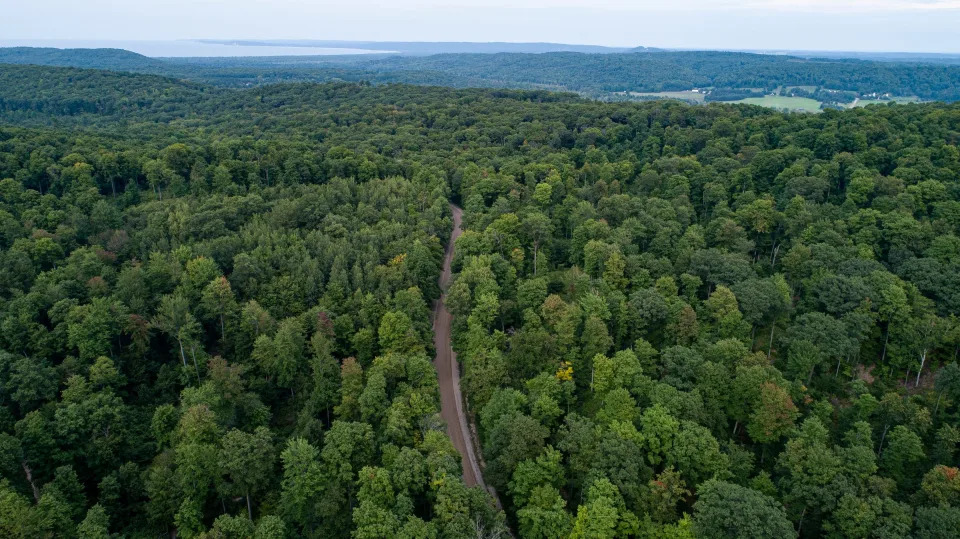
It’s as integral a part of Michigan’s fabric as its lakes and rivers: more than 20 million acres of forest land − the hickory and oak trees of southern Michigan giving way to forests of sugar maple, birch and evergreens that surround northbound travelers.
But a warming climate is harming and transforming the woods, with further, even more dramatic impacts projected by near the end of the century.
Michigan has perhaps the most exceptional forest makeup in North America, as boundaries of multiple forest types converge here: The vast boreal forest, its cold-hardy conifer trees stretching far into Canada, dips into the Upper Peninsula and northern Michigan. A diverse mixed zone then gives way to the great Eastern Broadleaf Forest across the central and southern Lower Peninsula, dominated by beech, maple, oak and hickory trees. Even the grassland prairies of the Plains states extend into far southwest Michigan.
It’s the changes happening first at these border zones that give Michigan a front-row seat to climate change impacts on the forest the rest of the 21st century.
Climate change carries a host of stresses for the woods. Milder winters are leading to earlier, longer growing seasons, often better news for invasive, undesirable shrubs and weeds than for desired tree species. Less-frigid winters also improve invasive insects’ survival, fueling a northward migration of problems such as emerald ash borer, hemlock wooly adelgid and beech bark disease, which is caused by an interaction between an insect and fungus. And the hotter, drier conditions many scientists predict in coming decades will leave the tree species dominating the far north struggling to adapt.
“We expect to see species range shifts − species at the southern edge of their ranges, those boreal-associated species like black spruce, quaking aspen and white birch, may lose suitable habitat in the state,” said Ryan Toot, a watershed forestry specialist with the U.S. Forest Service based in St. Paul, Minnesota.
That’s messing with one of Michigan’s most golden of gooses. The forest products industry provides 96,000 jobs and contributes $20 billion annually to Michigan’s economy, according to the Michigan Department of Natural Resources. The north woods are a vital part of hunting, fishing and other tourism that brings in more than $20 billion more.
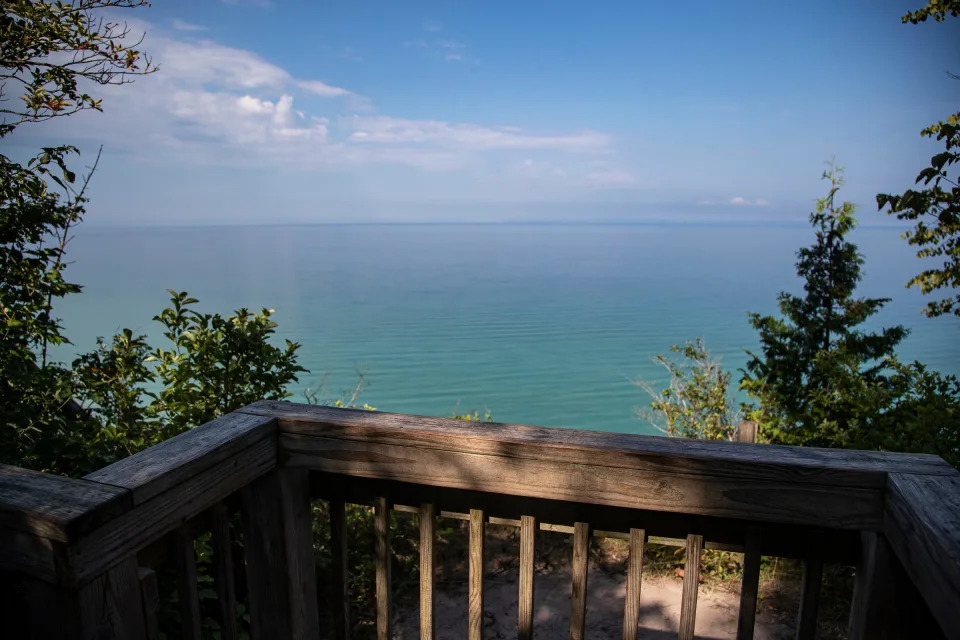
A view of Lake Michigan at the Clay Cliffs Natural Area in Leland on Wednesday, Aug. 24, 2022. (Photo: Junfu Han, Detroit Free Press)
University of Michigan forestry ecologist Peter Reich this month published the findings of a five-year study exposing seedling trees of the boreal and mixed hardwoods forest in northeastern Minnesota to increased temperatures and decreased summer rainfall — mimicking the projected warming and conditions under two different scenarios, one where considerable effort is made to reduce greenhouse gas emissions driving climate change; another with more business-as-usual emissions. They found even the more modest emissions scenarios had a devastating effect on the young trees.
“The prognosis for the forest is not great,” said Reich, director of the University of Michigan’s Institute for Global Change Biology.
“It may be we are at a tipping point beyond which these northern species just can’t hack it. Nature is really resilient, but we are pushing it really far, maybe up to its boundaries.”
Reich has been experimenting in the boreal forest in northeastern Minnesota for 14 years, trying to better understand how oncoming climate change is going to influence the forest in the transition zone where colder and more temperate tree species converge.
“We see that many of these spruce and fir forests are doing poorly,” he said. “But temperature is changing, precipitation is changing, fire regimes are changing. There are more insects, we’ve changed management, there is rising CO2, there is changing ozone pollution — it’s hard to know which one of those is driving the change when you just observe forests.”
So Reich and his research team set out to control particular variables. They installed heat lamps and underground warming cables in outdoor plots, exposing nine species of seedlings to increased temperatures over the ambient weather: boreal species, including white spruce, balsam fir, jack pine and paper birch; and more temperate species, including white pine, red oak, burr oak, sugar maple and red maple.
Two levels of potential 21st-century climate warming were used: roughly 1.6 degrees Celsius (about 2.9 degrees Fahrenheit) and roughly 3.1 C (about 5.6 F) above ambient temperatures.
“Unfortunately, you’re going to get to either one (of those temperature increases) in any scenario that’s realistic,” Reich said.
“You can think of it as what we are going to get to in 40 or 50 years if we slow down climate change, versus if we don’t.”
On some seedling plots, the researchers also captured some of the summer rains, preventing the water from reaching the young trees’ roots, to simulate drier conditions that could be coming with later-century warming. Control plots were also planted, allowing seedlings of the same tree species to experience natural conditions.
The findings surprised Reich and his team. Even the more modest levels of warming had a big impact.
“Even the spruce and fir, which are the most boreal of the species, we thought they would do a little bit more poorly with 1.5 degrees Celsius warming — maybe 5% or 10% slower growth and 5% or 10% more mortality,” he said. “But fir in particular had 30% to 40% poorer growth and survival. Quite a dramatic change with what’s not really a very big temperature change.”
While more southerly tree species might one day expand their ranges northward to exploit where boreal species are failing, that’s not likely to be an orderly transition.
“What’s going to fill the gap are shrubs — either native shrubs or invasive shrubs, the buckthorns and honeysuckles of the world, expanding north,” Reich said.
“You might end up with a forest zone that for the next 50, 100, 150 years is kind of trashy — is neither economically nor ecologically what we want.
“You’re not going to get any two-by-fours out of buckthorn.”
The ‘climate change help desk’ for foresters
The U.S. Forest Service has been thinking about climate change’s impacts on the woods longer than most. It founded the Northern Institute of Applied Climate Science in 2009, a collaborative effort among the service, universities, conservation organizations, the forest industry and landowners to develop adaptation strategies for the changing landscape.
“NIACS is like the climate change help desk, or a climate change phone-a-friend service, for land managers of all kinds, all across the Midwest and Northeast,” said Stephen Handler, a climate change specialist for NIACS based at the Forest Service’s Northern Research Station in Houghton.
“When we started at NIACS with this interest of educating people about climate change impacts and thinking about how to adapt, we were in front of a lot of critical audiences. And now, more often, it’s more like folks are drawing us in. Saying ‘We are ready to talk about this. We recognize things are shifting and we need to be agile and keep up with the change.’ “
The group provides the best, most recent available science to whoever asks: the timber industry, state natural resources agencies, parks managers, private landowners. It includes regional evaluations of which tree species are expected to adapt poorly to climate change, which are expected to do better and perhaps expand their ranges, and those in the middle. Through checklists, interested parties can conduct their own vulnerability assessments.
“They are making the choices for themselves, which we think is the appropriate way to go,” he said. “Because every land manager is going to have a different appetite for risk and a different set of values.”
Family and small private landowners account for about 54% of forest land ownership in Michigan. How climate change’s impacts on the woods are responded to is largely in the hands of individuals, families, companies and communities.
“You’re going to have a pretty diverse set of choices being made across the landscape − preservation in some areas, encouraging change in other areas, a lot of places in the middle,” Handler said. “That could be a strength.”
Is assisted migration part of the answer?
A great debate among those who care about the climate-changed forest is how much attention and effort should be spent on trying to maintain what exists in an area now and how much should be devoted to preparation for what may better fit future conditions.
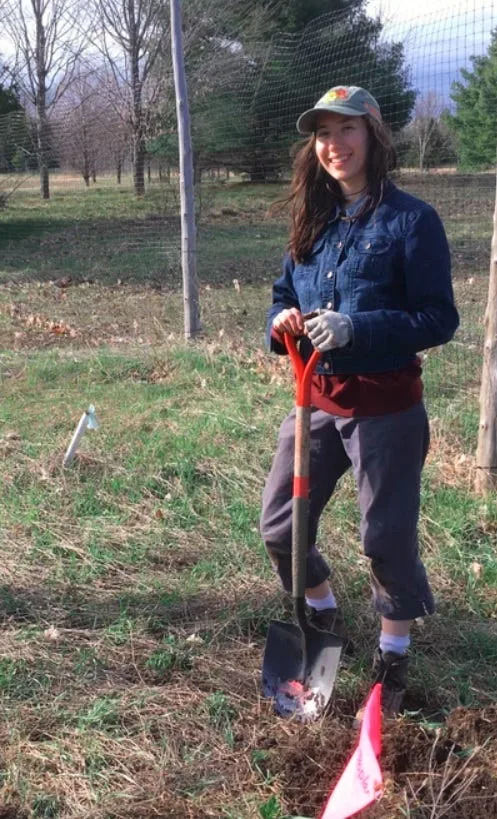
NIACS climate adaptation specialist Madeline Baroli, founder of the Assisted Tree Range Expansion Project, pauses during planting in northwest Lower Michigan in the spring of 2020.
Madeline Baroli has her boots on the ground and her hands dirty, conducting a big experiment across northwest Lower Michigan to help clarify the answer. Baroli, a NIACS climate adaptation specialist, also founded the Assisted Tree Range Expansion Project, a community science experiment that started in 2020 from her postgraduate work with the Leelanau, Grand Traverse and Benzie county conservation districts.
“Really, it’s all about supporting the resilience of our forests by planting and monitoring certain select tree species that are projected to have future suitable habitat in this region,” she said.
The nuances can get controversial. In some parts of the country, transplants introducing new tree types generated backlash. Others are experimenting with the concept of assisted population migration — taking existing tree species in northern Michigan, such as white pine, but introducing the genetics of trees of that species grown in, say, Ohio or Kentucky, trees more adapted to a warmer climate.
Baroli’s focus, instead, is on what scientists call assisted range expansion, taking trees already in Michigan but whose range stops only partway up the Lower Peninsula, and planting them farther north.
“So we’re really just expanding that bubble, that range a little farther, to match what the projections from the U.S. Forest Service Climate Change Tree Atlas have modeled,” she said.
The six trees selected for the initial plantings were selected using those models and through conversations with local professional foresters and other natural resources professionals, she said. The first trees chosen for the project were shagbark hickory, tulip trees, sassafras, black tupelo, hackberry and swamp white oak.
Baroli noted that the trees already have some presence Up North, and would potentially be more established there were it not for the fragmentation of their range by highways and agriculture in the southern and mid-Lower Peninsula.
“That’s where I feel we really sort of owe it to the forest to lend a helping hand − because we’ve also altered the landscape in such a way that it limits natural range expansion,” she said.
The first plantings were in the spring of 2020 − just as COVID-19 began to disrupt life.
“We were doing our tree sale, selling the seedlings and trying to get the word out there,” she said. “Luckily, everybody was migrating online, and looking for socially distant things to do. So we really had a pretty successful first two seasons.”
Over 2020 and 2021, more than 2,000 trees were planted by individuals, community groups and families. Baroli did not yet have figures for plantings from this spring.
People are asked to report over time how the trees’ growth progresses.
“What I hope, what’s really important, is just keeping forests as forests,” Baroli said. “At the end of the day, we aren’t really in control of exactly what a forest is going to look like or be − we can’t be. The idea is to reduce that fragmentation … ensure the forests themselves have a chance to adapt, on their own with our help.”
Deer, disease amplifying tree threats
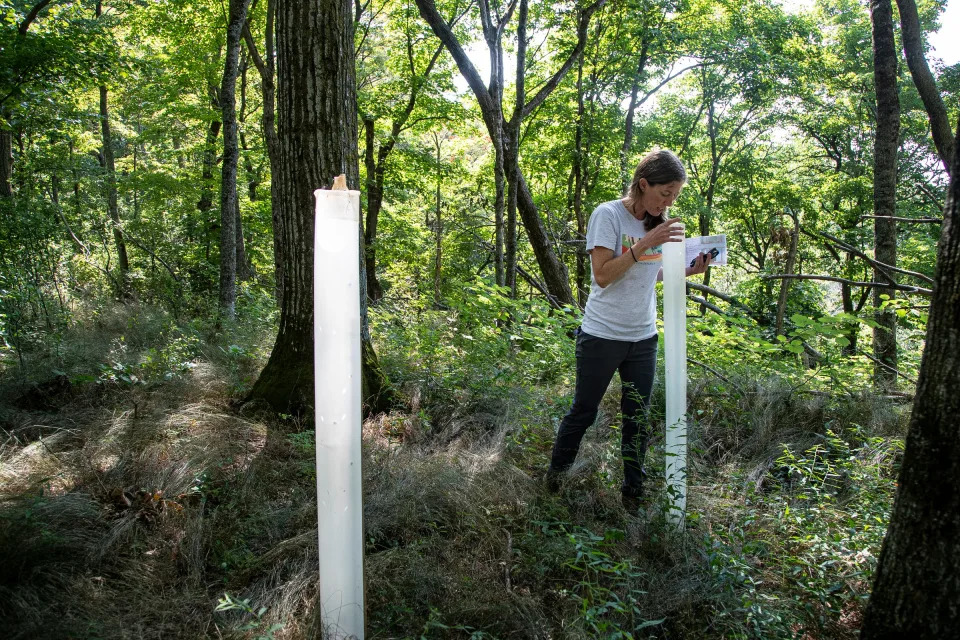
Visitors to the Leelanau Conservancy’s Palmer Woods, a natural area of more than 1,000 acres, have seen something different in recent years: Young trees with protective tubes around their trunks and a large, 35-acre portion of the preserve surrounded by a large wire fence.
It’s all efforts to curb what’s one of the biggest killers of young trees in the region: deer munching on them.
“A lot of the seedlings don’t really have the chance to get to the adult stage,” said Becky Hill, director of natural areas and preserves for the conservancy. “In some of the forests where we have heavy (deer) browsing, you see a lot of adult trees and a lot of seedlings, but not a lot of in-between trees.”
Becky Hill, Leelanau Conservancy’s Director of Natural Areas and Preserves checks on the growth of a sassafras tree in a protective tube at the Whaleback Natural Area in Leland on Wednesday, August 24, 2022. The Conservancy planted around 200 trees this past spring.
It’s a problem expected to worsen as the region further warms. Milder winters will allow more deer to survive, breed and then feed on the young trees.
“Foresters have a really keen eye on how that next generation of trees is coming in,” Baroli said. “Young trees are more sensitive to things than older trees. First off, the deer love them; they are great deer food. And we have a huge deer population.
“If they are eating those young trees, those young trees aren’t growing up into a future forest. And then if you just have older trees dying off, it’s a problem.”
Beech trees might be nearly doomed
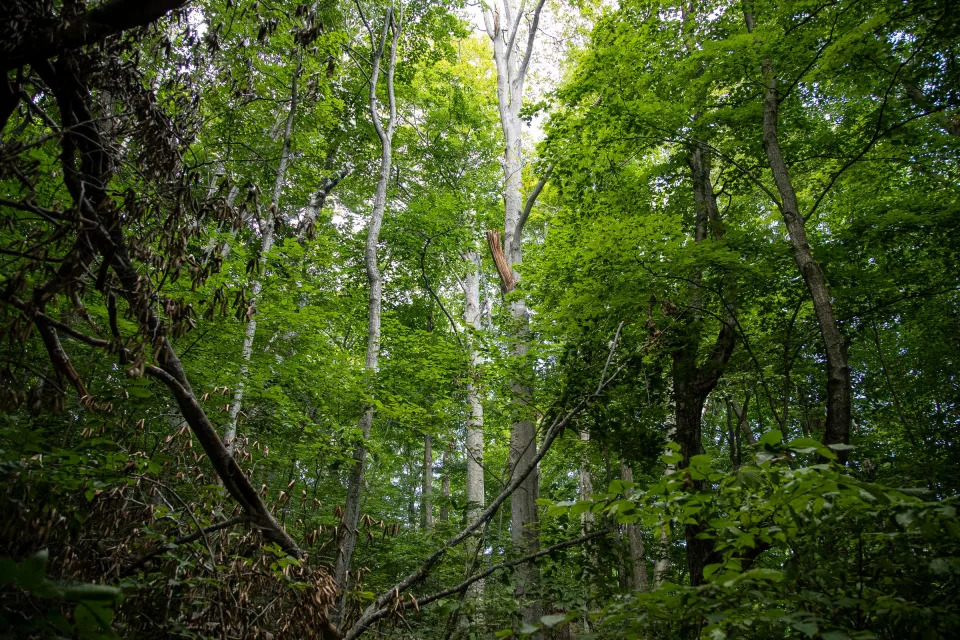
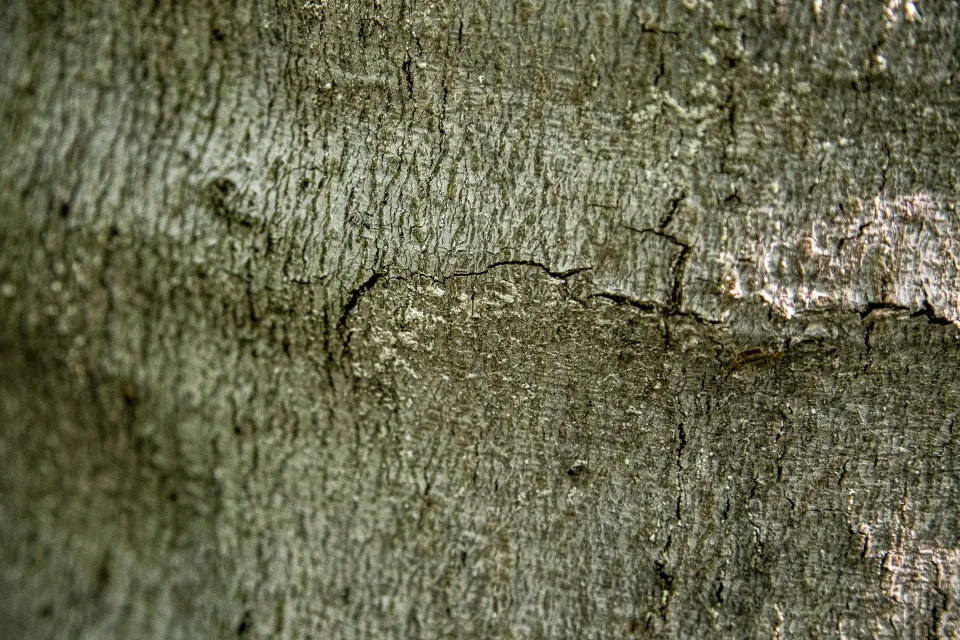
Another pest devastating trees in the region is beech bark disease. A tiny insect called a scale wounds the tree by piercing its bark with sharp mouth parts and sucking out sap. A type of fungus can then enter and infect the tree, weakening it over years until mature trees, almost hollowed out, snap dead.
Milder winters predicted in future warming scenarios will allow more of the insects to survive and infect trees.
“It’s pretty much devasted the population of beech; we are expecting 99% (beech tree) die-off,” Baroli said.
A dead beech tree in the center at the Clay Cliffs Natural Area in Leland on Wednesday, August 24, 2022.White fuzzy scale insects on the trunk of a beech tree at the Clay Cliffs Natural Area in Leland on Wednesday, August 24, 2022.
Emerald ash borer is similarly killing millions of ash trees across Michigan.
The Leelanau Conservancy is using the unfortunate circumstance to adopt some of the NIACS’s recommended population migration trees prepared for a warmer climate.
“When we have a die-off where a lot of beech and ash have died, suddenly in our forest we might have a sunny opening,” Hill said. “There are certain species that really need more sunshine to get established − cherries, oaks, other types of species that thrive in those conditions. If we can help get them established, that succession of growth will happen over time.”
The conservancy also hopes to use new tree planting to combat the invasive autumn olive, a shrub “that just takes over fields to the point where you see these autumn olive forests,” she said.
“We’re hoping to get some species growing in there, to get established and maybe help shade out some of the invasive shrubs while creating good wildlife habitat.”
The changing climate is bringing ecological changes “so rapidly,” Hill said.
“It just feels like it’s harder,” she said. “You see the decline of bird species, insects, they are having a hard time keeping up with all of these drastic changes.”
The Michigan forest of 2100 − what will it look like?
Reich envisions a significantly transformed northern Michigan woods by century’s end.
“My hunch is by 2100, we’ll lose most of the spruce and fir,” he said. “We might lose some of the white cedar. The forests will be scrubbier and more open. They may still have a mix of species but will be less diverse … a few areas that are sandier and drier may even convert to grasslands.”
Those changes will have unpredictable impacts on animal habitat, the state’s timber industry and how people can use the forests for recreation.
And it may become a negative feedback loop, accelerating and worsening climate change. Forests take carbon out of the atmosphere and store it in soils and roots and their wood.
Leelanau Conservancy’s Palmer Woods Forest Reserve in Maple City on Wednesday, Aug. 24, 2022.
Peat forests, the wet fens prevalent in the Upper Peninsula, make up only 3% of the globe’s forest land but store 30% of soil carbon. A square meter of U.P. or Canadian peatland holds five times the carbon as a square meter of Amazon rainforest.
In a 2020 U.S. Forest Service study similar to Reich’s, peatlands were exposed to controlled, increased temperatures. The results showed the warming causes peatlands to release carbon faster than anticipated, converting them from carbon-storers to carbon-emitters.
“It could be a double-whammy; instead of helping slow climate change, they would be accelerating it,” Reich said.
Tree planting and assisted migration approaches can have some local benefits. But those are ultimately just Band-Aids, he said.
“In order to maintain the economic value of our forests, we do need to manage them to try to make them as resilient as possible in the face of these changes,” he said. “But there are real limits to how much we can do. There are vast forests out there — we don’t have the personnel or the money to try to thin all of the forests and replant them.
“We really need to work at the root cause of this problem, which is climate change.”
Extreme heat is a health crisis, Columbia experts say
Isabella O’Malley – February 27, 2023
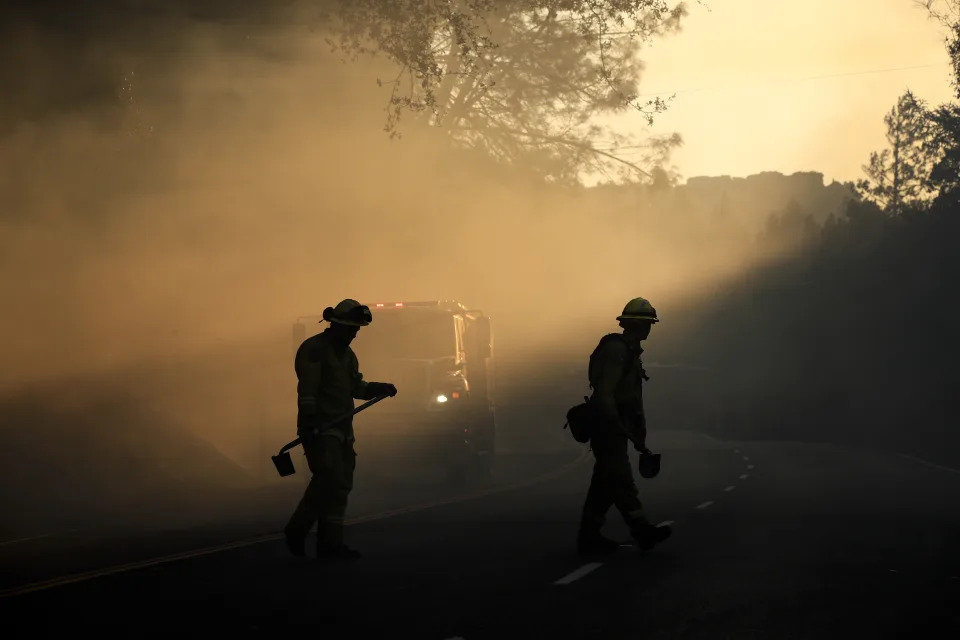
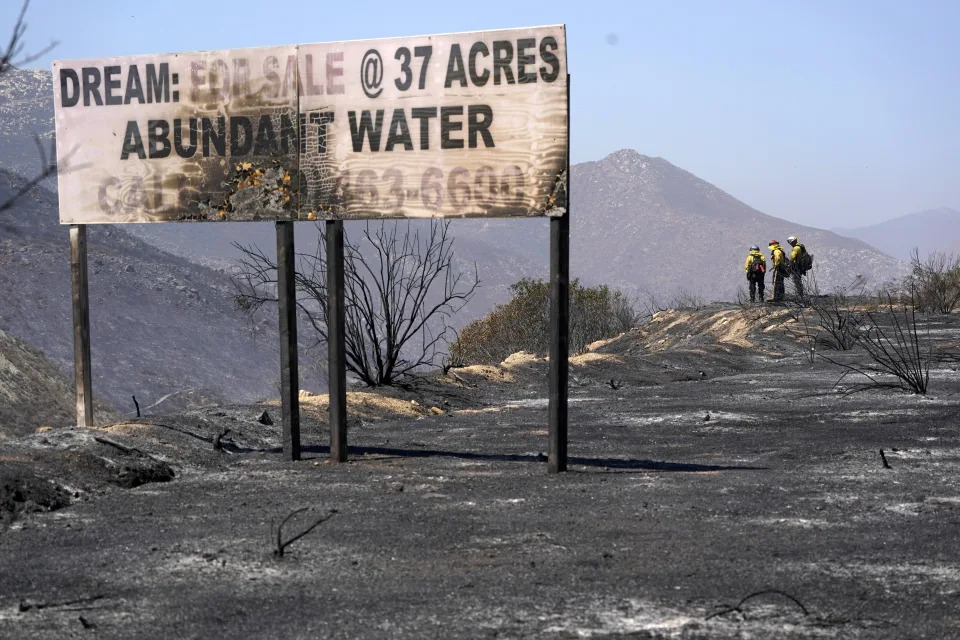
Two firefighters watch for spot fires, Oct. 13, 2017, near Calistoga, Calif. (AP Photo/Jae C. Hong, file)Farmer Barry Evans examines the soil at a cotton crop he shredded and planted over with wheat, Oct. 3, 2022, in Kress, Texas. (AP Photo/Eric Gay, file)Fire crews work a wildfire on Sept. 1, 2022, near Dulzura, Calif. (AP Photo/Gregory Bull, file)
The record-breaking heat Earth endured during the summer of 2022 will be repeated without a robust international effort to address climate change, a panel of scientists warned Monday.
Heat-related deaths, wildfires, extreme rainfall, and persistent drought are expected to become increasingly severe as both ocean and atmospheric temperatures continue to rise, the experts said. Even if all greenhouse gas emissions ceased today, Earth will continue to warm for several decades.
The presentation, “Earth Series Virtual: Blazing Temperatures, Broken Records,” featured a multidisciplinary panel of scientific experts from Columbia University.
Radley Horton, a research professor at Columbia’s Lamont-Doherty Earth Observatory, stated that human-induced climate change has caused the global average atmospheric temperature to warm by about 2 degrees (1.1 degrees Celsius) in the last several decades.
“One of the key takeaways is that a little bit of change in global temperature has an enormous impact,” said Horton. Some of the main consequences include longer and more intense heat waves that are hitting increasingly larger areas.
Additionally, Horton said, certain climate models have underestimated just how extreme certain events can be, such as the European heat wave of 2022 and the Pacific Northwest heat wave of 2021.
“We are locked into a lot of additional climate hazards, there is no way around it,” said Horton.
Diana Hernandez, Associate Professor of Sociomedical Sciences at the Columbia Mailman School of Public Health, is researching how certain vulnerabilities, such as medical conditions or access to energy, could be affected by changing climate domestically and internationally. The expected impacts include shade inequalities, urban heat islands, and inequitable access to energy-powered medical devices.
“The climate is changing, and we are not adapted to be able to deal with it from a health perspective,” said Cecilia Sorensen, a physician and associate professor of Environmental Health Sciences at the Columbia University Medical Center.
Sorensen noted that she and colleagues referred to summer as “trauma season” early in her career, even before she focused on the health impacts of climate change. “We used to get inundated with patients … people coming in with heart attacks and asthma exacerbations.”
Despite the foreboding climate projections, the panelists expressed hope that considerable strides can be made to minimize future climate impacts related to extreme heat.
Hernandez said a community-focused approach, especially with an emphasis on engagement that is inclusive, will be successful in implementing a wide range of climate adaptation strategies.
Sorenson said one solution that can be implemented by hospitals is developing emergency room protocols to treat a large influx of patients suffering from heat stroke or related conditions during extreme weather. Improved communications are also needed to increase awareness about the medical risks of extreme heat and how impacts can be prevented, she said.
“Within the problem lies the solution,” said Sorensen.
Associated Press climate and environmental coverage receives support from several private foundations. See more about AP’s climate initiative here. The AP is solely responsible for all content.
During the month of January there were 367 encounters, more than the past 12 years of January totals combined, said Ryan Brissette in a press release for the Swanton border patrol.
The number of border patrol encounters in Swanton started to climb in July 2022. During the seven-month window through January 2023, there have been 2,070 instances of illegal crossings. In that same period, there were 258 the year prior and 225 the year before that.
Northern and Southern borders see uptick in rescues
The uptick is causing problems for officials, especially considering dangerously cold temperatures that have put border crossers’ and border control agents’ lives at risk. Brissette noted -4 degree temperatures and “life-saving aid” that was provided during encounters in Newport, Vermont, and Burke, New York.
“It cannot be stressed enough: not only is it unlawful to circumvent legal means of entry into the United States, but it is extremely dangerous, particularly in adverse weather conditions, which our Swanton Sector has in incredible abundance,” Swanton Sector Chief Patrol Agent Robert N. Garcia said in a press release.
The southern border has also seen an increase in rescues, as the U.S. places a renewed emphasis on rescuing migrants and historically high numbers of immigrants seek asylum at U.S. borders.
5,336 migrants rescued at southern border in fiscal year 2020.
12,857 migrants rescued at southern border in fiscal year 2021.
22,014 migrants rescued at southern border in fiscal year 2022, which ended in September.
In fiscal 2021, agents at the southern border tallied 568 migrant deaths, the highest ever recorded.
Most of the deaths (219) were attributed to “environmental exposure-heat” as people trek through blazing terrain in Arizona and Texas. Agents also counted 86 deaths as “water-related” as migrants try to cross canals or the swift-moving Rio Grande, which divides the U.S. and Mexico.
Immigration advocates and experts believe the border death toll is much higher, and the federal system for death data long failed to include many border deaths.
There are no clear-cut answers as to why people are crossing as the circumstances differ for each person or group, said Steven Bansbach, a public affairs officer for U.S. Customs and Border Protection. Many are being dropped off near the border by car and then proceeding across land on foot, he said.
https://flo.uri.sh/visualisation/12838349/embed
Among the border crossers are family groups that include infants and children who are particularly vulnerable to the cold. Bansbach said many are crossing at night while cold and sleep deprived, all of which can be disorienting.
Looking at the countries of origin of encounters involving the border patrol in Swanton, a vast majority are from Mexico. Among the 1,513 encounters from October through January, 945 originated from Mexico.
“They may be trying to find a path of least resistance to enter into the U.S.,” Bansbach surmised. “And they may know there’s a conundrum at the southwest border and so they may find that the northern border they may sneak across to have a better advantage.”