America is refusing to do the one simple thing that would solve the Great People Shortage

Business Insider

America is refusing to do the one simple thing that would solve the Great People Shortage

Gaby Del Valle – May 4, 2023

A US factory with immigrant employees multiplying
The US needs more workers or it will face serious economic chaos. There’s a clear fix: more immigration.Tyler Le/Insider

Two simple words: more immigrants

America needs more workers.

The United States is already running low on critical positions such as nurses, home-health aides, farmworkers, and truckers. And there are fewer young people on the way to make up the difference: The National Bureau of Economic Research found that birth rates in the US have declined by nearly 20% since 2007, while the fertility rate has been below the replacement level for decades.

That means that unless people start having a lot more kids, the US population could eventually start to shrink — just like China’s population has. The problem, though, isn’t just a smaller population, but an aging one. With fewer people to pay into Social Security to support the growing number of retirees and fewer workers in critical industries, including healthcare and agriculture, a declining population would have devastating consequences for the American economy.

“This is the issue of the future, because this is going to become the first-order issue for all kinds of industries in America,” Lant Pritchett, a development economist and RISE Research director at Oxford University’s Blavatnik School of Government, told me. “They just won’t be able to attract workers.”

Politicians have suggested various ways to encourage people to have more children: “We will support baby bonuses for a new baby boom,” former President Donald Trump said at a conference in March. But even if these policies went into effect, we’d still have to wait for those kids to grow up before they could enter the workforce. The labor imbalance is already here, and the economy needs more workers now. That’s why a growing number of demographers, economists, and business executives support letting more immigrants into the US as a more immediate way to fill in the gaps. President Joe Biden’s economic advisors even said in March that more legal immigration is needed to boost the economy. And while immigration is a politically touchy solution, the quickly aging US economy is running out of options to keep itself afloat.

“The only solution is more workers,” Pritchett said.

America’s People Shortage

The US fertility rate first dipped below the replacement level — the rate needed to sustain the population, which is about 2.1 births per woman — in the 1970s. After rebounding in the 1990s and early 2000s, the rate began a steady decline in 2007 that has not reversed. While the US population has managed to avoid an outright drop, population growth reached an unprecedented low of 0.12% in 2021. Some of this loss can be attributed to the deaths of over 1 million Americans during the pandemic, but the COVID crisis only exacerbated preexisting demographic trends. Americans are getting older: The median age of the US population has increased by roughly 3.5 years since 2000, according to the Census Bureau, and 2021 saw the largest upward shift in the population age ever recorded.

According to estimates, these trends won’t reverse anytime soon. The Congressional Budget Office estimated this year that population growth will slow between 2023 and 2053, and that by 2042, any growth will be from immigration, not births. Kenneth Johnson, a professor of sociology and a senior demographer at the University of New Hampshire, pointed out that the demographic mismatch is even more dire when you look at county-by-county data. Deaths outnumbered births in two-thirds of US counties in 2021, creating a phenomenon that demographers call “natural decrease.” Even before the pandemic, roughly half of all US counties had more deaths than births, he said.

Johnson said that one big debate among demographers is whether people are simply delaying having children or just putting it off altogether. It’s possible that a combination of factors, including the lingering effects of the Great Recession, coupled with crushing student-loan debt, the rising cost of housing, and the pandemic simply pushed back the timeline for many people to have children. After all, birth rates did rise slightly in 2021, likely because of stimulus payments and the flexibility of remote work. But Johnson told me, “Right now, my impression is that a fair number of those babies aren’t going to be born.”

Policymakers and economists have suggested myriad ways to increase the number of babies people are having — ranging from “baby bonds” to a stronger social-safety net. But some ideas to boost fertility come with a sinister undercurrent. The preoccupation with increasing birth rates has particularly taken hold on the political right, which has long had a fascination with the racist conspiracy theory that there is a global plot to “replace” white Americans with immigrants. Trump’s baby-boom plan, for instance, may have been inspired by Hungary’s family-planning program, which is designed to encourage white heterosexual couples to have more children. “Migration for us is surrender,” Hungary’s far-right Prime Minister Viktor Orbán said in 2019.

Kenneth Johnson, University of New Hampshire

The pronatalist movement, which argues that people should be having more babies, has also grabbed hold in Silicon Valley — but some of its adherents don’t believe that just anyone should be having children. Tech billionaires like Elon Musk (who has 10 children) have become convinced that they need to have lots of children to save the human race. And one Silicon Valley couple has started a campaign to encourage more people like themselves to have children, speaking openly about their use of reproduction technology to select embryos based on genetic testing.

But so far, policies designed to induce people into having more kids have been a bust. Japan has struggled with a declining birthrate for decades despite efforts to encourage families to have more children. Earlier this year, Prime Minister Fumio Kishida warned that Japan was “on the brink of not being able to maintain social functions” due to population decline, adding that it was “now or never” to solve the problem. China’s population is both aging and shrinking as well, and after decades of restrictive family-planning policies, the country is trying to change course. In recent years, China has reversed its notorious “one-child policy” and started restricting abortions for “nonmedical reasons.” But the country’s population is still declining.

How immigration can boost the economy

In the face of looming population decline and resulting labor shortages, there is a clear answer staring the US in the face: immigration. Allowing more people to become Americans would not only help immediately alleviate some of the labor shortages plaguing the US economy but would also help to stem some of the country’s long-term population decline. Historically, the median age of immigrants has been younger than the median American age. And people of working age — meaning those between 18 and 64 — comprised 77% of the immigrant population in 2021, compared to just 59% of the US-born population that same year. Immigrants, Johnson said, “bring not only themselves,” but also the potential for more children, further boosting the US population and productivity.

Though current immigration rates — particularly the number of migrants apprehended at the border — are the subject of contentious national debate, recent Census data shows that the total number of immigrants arriving in the country isn’t enough to offset population losses. Between 2021 and 2022, the number of immigrants in the 20 most-populous counties in the country nearly tripled, but most of those counties still saw their overall populations decline. Despite increased immigration, Los Angeles County’s population declined by 90,000 people in 2022 — and by 180,000 people the previous year.

In order to truly prevent a people shortage, the US will need to let more people into the country. And there’s already evidence that immigrants can help boost local economies — and transform entire cities. Immigrants are 80% more likely to start a business than people born in the US, and recent data shows that they’ve started more than 25% of businesses in seven of the eight fastest-growing sectors of the US economy. Because of that, research has found that immigrants actually create more jobs than they take. Plus, across the US, several key industries — including agriculture, meatpacking, manufacturing, and healthcare — depend on immigrant labor. And if we boost immigration rates, the incoming workers could help ease labor shortages in these critical fields.
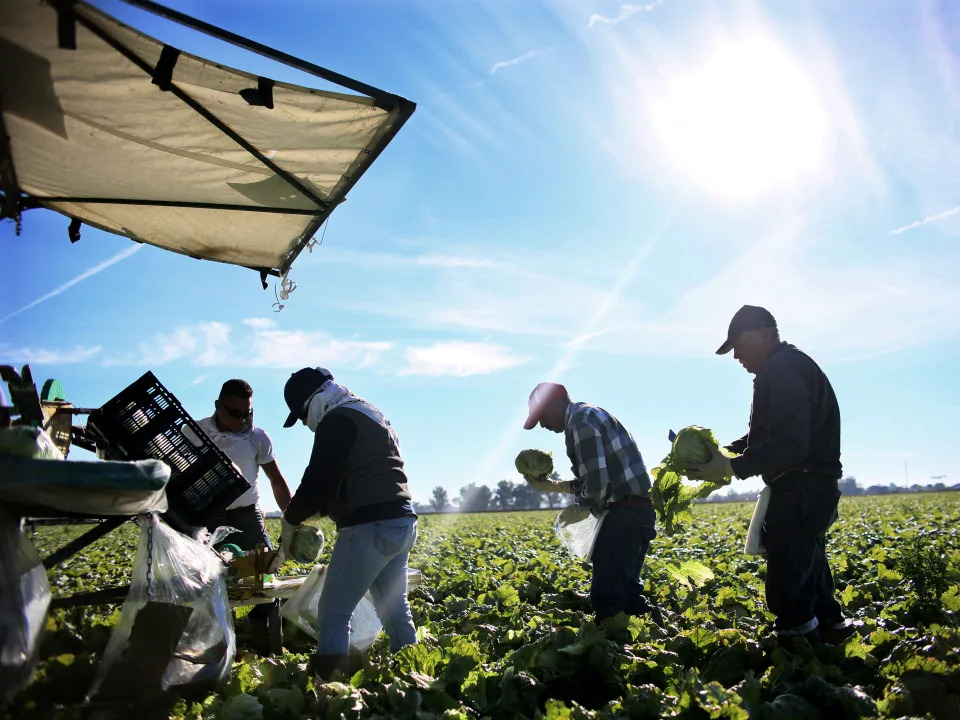
Mexican farm workers harvest cabbages in a sunny field in California
Critical industries such as agriculture and healthcare rely on immigrant labor.Sandy Huffaker/AFP via Getty Images

From central Indiana to New York City, businesses are struggling because they can’t hire enough workers to fill their open roles. “If we don’t do this and have a positive conversation about immigration today, it will continue to crush Hoosier households and economy,” Patrick Tamm, the president and CEO of the Indiana Restaurant and Lodging Association, told a local publication.

Take Utica, New York. The city’s population declined from 100,410 people in 1960 to just over 60,500 in 2000. But instead of facing extinction, the postindustrial city’s population slowly began rebounding in the 1990s with the arrival of Bosnian immigrants fleeing the Yugoslav Wars, who were followed by refugees from Myanmar in the 2000s and, more recently, Bantu refugees from Somalia. The city’s relatively low cost of living has made it a hub for people fleeing conflicts around the world, who resettle with the help of refugee-aid organizations. Though the city’s population still hovers around 60,000, it would be much lower if not for the resettled refugees and their families who now make up about 25% of Utica’s population.

“The refugee population has helped the city’s economy tremendously,” Brian Thomas, the commissioner of Utica’s Department of Urban and Economic Development, told CNBC.

Political compromise? 

Immigration has, of course, been a political hot potato for decades. One 2022 survey found that one-third of Americans and two-thirds of Republicans believe in tenets of the so-called “Great Replacement” theory. A February Gallup poll found that just 28% of responding Americans are satisfied with our current immigration rates, and most of those who are dissatisfied want immigration to decrease. But even without a huge overhaul of the entire system, there are clear solutions that could help welcome more talented, much-needed workers to America.

One way the US could encourage more immigration is by focusing on temporary visas for specific industries that need workers. Japan took this approach and quietly opened itself to foreign workers in 2019 when it began allowing “specific skilled workers” in 14 key industries. These workers are allowed to stay in the country for up to five years on temporary labor visas — but they aren’t allowed to bring their families. Lawmakers hoped that the policy would attract around 345,000 workers in a five-year period, or an average of 5,750 people each month. Pritchett said this model could also work in the United States.

“A lot of people in the world would love to come work in a high-productivity place and would be more than willing to do so not in an exploitative way, but on a term-limited basis,” he told me.

There are already two guest-worker programs in the United States: the H-2A program for temporary agricultural laborers and the H-2B program for temporary non-agricultural workers. Both programs give temporary work visas to people tied to specific employers. The current programs are not perfect, however, and workers on H-2A and H-2B visas have sounded the alarm over squalid living conditions, wage theft, and exploitation. And the treatment of workers in the country on temporary visas has been a problem for decades. For these programs to be expanded, there would need to be significant safeguards in place to ensure workers aren’t exploited.

And there are other approaches that could work. Tara Watson, an economist and the director of the Center on Children and Families at the Brookings Institution, said that solutions focused on bringing people here on a long-term basis are more in line with what the US needs. “I’d rather see more expansion on the permanent side than the temporary side, because I think the challenges that we’re facing are long-run challenges and they really require long-run solutions,” Watson said.

She said that a good place to start would be expanding both family- and employment-based migration by simply allocating more visas in each category. Scaling up both programs would make an immediate difference, she said. Other simple solutions include lifting the cap on the number of skill-based green cards issued to immigrants from each country and letting people on nonimmigrant visas renew their status in the United States, rather than having to leave the country to do so.

Regardless of the approach, the biggest hurdle is a matter of political will. “I think there will be some resistance to this as a solution,” said Watson. “But I also think it’s essentially an imperative.” After all, the US is running out of options, and soon its growing people shortage is going to spell economic disaster.

Watson said that the economic forces will eventually overwhelm the “white-nationalist far right” that has “played an outsize influence” on the immigration debate. “If we don’t solve this problem in the next couple of years, it’s going to come to a head,” she said.

Gaby Del Valle is a writer and reporter living in Brooklyn. She coauthors the immigration newsletter BORDER/LINES.

Flood insurance costs will soar in Florida. See the expected increases in your ZIP code

Miami Herald

Flood insurance costs will soar in Florida. See the expected increases in your ZIP code

Nicolas Rivero – May 4, 2023

Brace for a few years of flood insurance rate hikes, South Florida. And they’re going to be steep — doubling, even tripling for thousands of homeowners.

FEMA has changed the way it calculates flood insurance prices. Instead of relying on old flood zone maps covering broad areas, it’s now basing premium prices on a wider range of factors, like an individual property’s distance from the ocean, rainfall levels and the cost to rebuild a home.

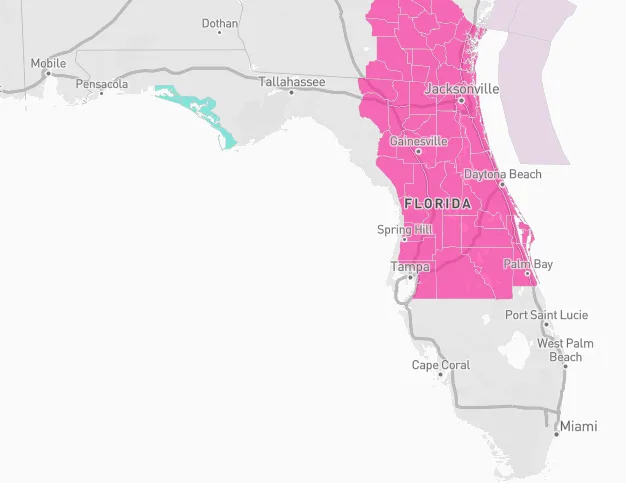
Last month, for the first time, FEMA shared estimates for what that will mean for the average flood insurance premium by ZIP code. For the worst-hit ZIP code in South Florida — 33469, a stretch of coastal Palm Beach County that covers parts of Jupiter and Tequesta — that will mean a 342% premium increase, on average.

In the most expensive ZIP code for flood insurance in South Florida — 33149, which covers Key Biscayne — average premiums will rise north of $7,000 a year.

How your costs compare

Type in your ZIP code to see what is happening to flood insurance costs in your community.

Some important qualifiers: The premium hikes won’t hit all at once for existing policyholders, and not everyone will see an increase. FEMA estimates that about 20% of Florida policyholders will actually see their premiums drop under the new pricing regime, known as Risk Rating 2.0.

For those with current federal flood policies, the good news is that the rate won’t immediately skyrocket. Congress has capped price hikes at 18% per year. The bad news is, you might see that flood insurance premium go up 18% every year for several years until it reaches the new Risk Rating 2.0 calculation for your home.

If you’re buying a new flood insurance policy, however, you’ll get hit with the new premium all at once. Since April 2022, new policyholders have had to enroll at the full Risk Rating 2.0 price.

FEMA says the new premiums reflect the reality of Florida’s increasing flood risk, as people continue to build homes in flood-prone areas and climate change raises sea levels and makes “rain bomb” events, like the 1,000-year floods that recently inundated Fort Lauderdale, more common.

The agency also argues that the new premium regime is more fair. “The new methodology allows FEMA to equitably distribute premiums across all policyholders based on the value of their home and the unique flood risk of their property. Currently, many policyholders with lower-value homes are paying more than they should and policyholders with higher-value homes are paying less than they should,” FEMA wrote in an April 2021 press release announcing the change.

Mortgage lenders and banks often require that home and property owners get federal flood insurance. Although Florida has the highest number of policies in the country, roughly 4 out of 5 Florida homes aren’t covered. Emergency management experts warn that just about anyone in a state vulnerable to hurricanes and heavy rains should get it.

The number of Florida flood insurance policies is likely to rise. This year, Florida lawmakers passed a bill requiring anyone with hurricane and wind policies from Citizens Insurance to also get flood insurance. That affects 1.2 million Citizens policyholders in the state.

Across South Florida, the biggest premium hikes will go to policyholders in the Keys, South Miami-Dade and coastal Broward and Palm Beach counties. Rates will remain relatively stable in North Dade and inland Broward and Palm Beach.

The 10 biggest premium hikes in South Florida affect ZIP codes up and down the coastline from Summerland Key to Jupiter — and three ZIP codes in inland Miami-Dade County.

Those hikes will eventually lead to average increases in annual insurance bills as high as $4,056 in ZIP code 33036, which covers Islamorada. But the increases will phase in gradually. In ZIP code 33469, which covers parts of Jupiter and Tequesta, the average policyholder will see eight straight years of 18% insurance hikes before their premiums stabilize at the new Risk Rating 2.0 level.

Under the new risk rating regime, the highest average premiums in South Florida will all be in ZIP codes in Miami-Dade and Monroe counties. Key Biscayne, Islamorada, Marathon, Miami Beach, North Bay Village, Bal Harbor, Surfside, and Sunny Isles will be among the most expensive areas to insure against flooding in South Florida.

Key Biscayne will have the sixth highest insurance premiums of any ZIP code in the state.

In Miami-Dade, the biggest premium increases are coming in the southern part of the county, in ZIP codes where home prices are particularly high (33146, i.e. Coral Gables) or where premiums have been historically low (33033, i.e. Leisure City and 33170, which runs west from Goulds to the Everglades).

In Broward, the biggest premium increases are concentrated on the coast, especially in ZIP codes surrounding Fort Lauderdale. ZIP code 33315, which covers Edgewood, one of the worst-hit neighborhoods in the Fort Lauderdale floods, will see a relatively modest 64% premium hike. But a few miles north in ZIP code 33305, premiums are expected to double on average.

This climate report is funded by Florida International University, the Knight Foundation and the David and Christina Martin Family Foundation in partnership with Journalism Funding Partners. The Miami Herald retains editorial control of all content.

GOP Lawmaker’s Wild Claim About Those Who ‘Hate Homosexuals’ Causes Literal Jaw-Drop

HuffPost

GOP Lawmaker’s Wild Claim About Those Who ‘Hate Homosexuals’ Causes Literal Jaw-Drop

Ed Mazza – May 3, 2023

Fox News Flips Over ‘Woke’ Legos

The right-wing network has added another new enemy to its list — the Lego toy company.

There was a jaw-dropping moment on the floor of the Florida House of Representatives this week after a Republican lawmaker’s comment about who really hates the LGBTQ+ community.

“ISIS, the Taliban and al Qaeda. Those are the folks who discriminate,” state Rep. Jeff Holcomb said Monday. “Our terrorist enemies hate homosexuals more than we do.”

It’s not clear if he misspoke or intended to say it like that, but he was speaking in support of a bill that urges Congress to prohibit “woke social engineering and experimentation” that are “eroding” the military.

The implication that Republicans hate the gay community ― but terrorists hate them even more ― led to gasps in the audience, while Democratic Rep. Kelly Skidmore’s jaw literally dropped:

Holcomb, who is in the Navy Reserve, continued by quoting the Navy creed: “I am committed to excellence and fair treatment of all.”

‘Older generations are so confused’: A young woman on TikTok says Gen Z, Millennials don’t share the same work ethic as Boomers

Money Wise

‘Older generations are so confused’: A young woman on TikTok says Gen Z, Millennials don’t share the same work ethic as Boomers — 3 reasons why she might be onto something

Vishesh Raisinghani – May 3, 2023

Generational grumble is old as time itself.

There’s probably a cave painting about how the younger generation had ruined the hunter-gatherer economy with their “fancy agriculture.” Since then, every successive generation has found a new medium to express their disappointment with ‘them young’uns.’

A recent example comes from the comment section on TikTok, which recently erupted when a young lady explained why Gen Z and Millennials don’t exactly share the same values regarding work.

“Older generations are so confused about why we don’t want to work hard anymore or prioritize our careers,” Demi Kotsoris said in the clip “We know how short life is now.”

Kotsoris goes on to explain that the pandemic and greater access to information have reshaped the perspective of younger generations and made them question whether work should be the center of their lives.

Of course, the response was heated. “This mindset is so [‘you only live once’] that you will regret those decisions later,” says one comment on Kotsoris’ video.

“People are just SELFISH & LAZY NOW,” says another.

But the replies may have missed the point of the video. Here’s why Kotsoris’ message resonates with so many younger workers and why her experience highlights some deeper truths about modern work.

Work isn’t as rewarding anymore

For Baby Boomers, there were clear rewards for working hard. Putting in an average amount of effort allowed a typical worker to buy a nice home, raise children comfortably and travel the world. In the 1980s, the average home price was just four or five times the median income. Now, it’s closer to 7.5 times.

Having a college degree was also far more rare in the 80s. Now, nearly everyone in the job market has a degree so its value has been eroded. Meanwhile, the dollar has been eroded too. Wages haven’t kept up with inflation for decades, so an hour of work today isn’t worth as much as an hour of work in the 80s.

Upward mobility has declined too. A person born in a middle-class family in the 1940s was 93% likely to outearn their parents by the age of 30. For those born in the 1990s, that rate is just 45%.

Some Boomers could beat the odds and create generational wealth by investing in stocks. However, even that is not as easy as it used to be. The S&P 500 was trading at around 10 times its earnings during the 1980s. It’s now trading in the low-20s.

The relationship with corporations has changed

The employee-employer relationship has also changed since the 80s. Defined-benefit pension plans are nearly extinct. A major corporation that went public before the 1970s was 92% likely to survive the next five years. By the early 2000s, the rate had dropped to 63%.

Unions have also declined, which means workers now have far less bargaining power than their parents.

All these factors have made younger workers question the value of company loyalty and lifelong careers.

The pandemic altered perspective

The global pandemic may also have shifted work culture

This is true across generations because the crisis triggered a retirement boom too. Meanwhile, younger workers saw how short life can be, and how easily their lifestyle can be disrupted by a global crisis like a pandemic or climate change. A study by Deloitte found that Gen Z and Millennials are more likely to prioritize work-life balance, flexible work arrangements, and purposeful work.

The pandemic highlighted that remote work is a viable option for many companies. In fact, a survey by Buffer found that 98% of remote workers would like to continue working remotely at least some of the time for the rest of their careers.

Large portion of Florida under red flag warning. What’s that mean?

The Florida Times – Union

Large portion of Florida under red flag warning. What’s that mean?

Cheryl McCloud, Florida Times-Union – May 3, 2023

red flag warning is in effect for much of Florida today.

The warning is in effect for Northeast and Central Florida from noon to 7 p.m. In some locations, the warning is in effect until 8 p.m., according to the National Weather Service.

Low humidity, breezy winds and critically dry conditions prompted the warning.

Winds of 15 mph are expected to be out of the west today, with gusts up to 25 mph. Relative humidity is forecast to be 20 percent to 30 percent.

Giant mats lurk off Florida: Giant mats of sargassum are off Florida coast and have beached in spurts but will peak soon

What to know about sargassum: Sargassum seaweed being seen in Florida. Here’s where it’s going and when it will be worst

What is a red flag warning?
Much of Florida is under a red flag warning May 3, 2023.

A red flag warning means warm temperatures, very low humidity, and stronger winds are expected to combine to produce an increased risk of fire danger, according to the National Weather Service.

Conditions also can cause reignition of any smoldering fires started by recent lightning strikes.

What are the dangers with a red flag warning?

Wildfires can grow quickly under these conditions.

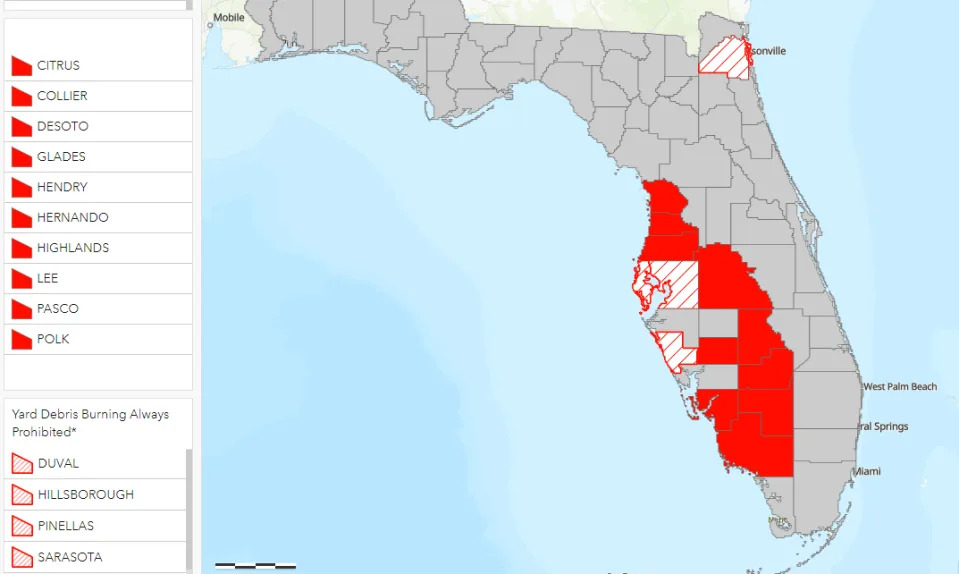
What Florida counties are under a burn ban?
Conditions in Florida prompted a red flag warning for much of the state May 3, 2023. Burn bans in effect.

The Florida Forest Service reports the following counties are under a burn ban as of May 1:

  • Citrus
  • Collier
  • Desoto
  • Glades
  • Hendry
  • Hernando
  • Highlands
  • Lee
  • Pasco
  • Polk

Burning of yard debris is prohibited year-round under county ordinance in these locations:

  • Duval
  • Hillsborough
  • Pinellas
  • Sarasota
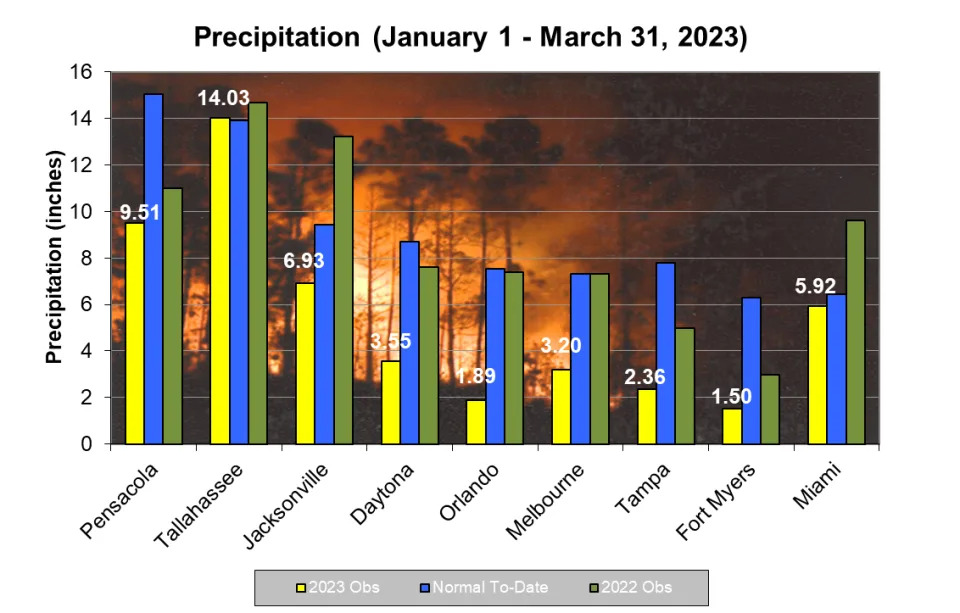
How dry is it in Florida?
Florida rainfall around the state from Jan. 1 through March 31, 2023.

As La Niña  continues to make itself felt, for the southeastern U.S., that includes a dry and warm winter and a potentially active wildfire season for Florida, according to the Florida Forest Service.

A combination of above-average temperatures and below-average precipitation was in the forecast throughout all North Florida through March.

There may be good news on the horizon: The drought coverage and intensity may have peaked across Florida in recent past weeks, according to the Climate Prediction Center. 

What should you do when under a red flag warning?
  • If you are allowed to burn in your area, all burn barrels must be covered with a weighted metal cover, with holes no larger than 3/4 of an inch.
  • Do not throw cigarettes or matches out of a moving vehicle. They may ignite dry grass on the side of the road and become a wildfire.
  • Extinguish all outdoor fires properly. Drown fires with plenty of water and stir to make sure everything is cold to the touch. Dunk charcoal in water until cold. Do not throw live charcoal on the ground and leave it.
  • Never leave a fire unattended. Sparks or embers can blow into leaves or grass, ignite a fire, and quickly spread.
Where are active wildfires in Florida?

There are 42 active fires covering more than 5,000 acres currently across the state. The Florida Forest Service maintains a map showing the location, size and percentage contained of current wildfires.

‘Poor people are not stupid’: I grew up in poverty, earned $14 an hour, and inherited $150,000. Here’s what I have learned from my windfall.

MarketWatch – The Moneyist

‘Poor people are not stupid’: I grew up in poverty, earned $14 an hour, and inherited $150,000. Here’s what I have learned from my windfall.

Quentin Fottrell – May 3, 2023

‘When I open my accounts and see how they are growing it really fills me with a sense of pride and determination.’
‘My tiny house has been one of the greatest decisions I’ve ever made, and has truly changed my whole mindset on what makes me happy.’ MARKETWATCH

In September 2018, this woman from Texas, then 36, wrote to the Moneyist to ask how she should invest her windfall — over $150,000. It was small by some people’s standards, but it was life-changing to her. She didn’t have a college degree, said she would never earn more than $30,000 a year, and worked full-time for $15 an hour, in addition to a part-time job at $10 an hour. She paid $1,050 a month in rent. 

She paid off her car, and bought a “tiny home,” which she owns free and clear, she wrote in an update a year later. She deposited $70,000 in a high-yield online savings account. She topped up her retirement portfolio and invested $30,000 into emerging markets. She maxed out her IRA and invested $10,000 between very safe dividend stocks and ETFs. She also spent $7,000 on dental work in Mexico.

And today? Five years after her first letter, she has updated MarketWatch readers on her progress, and what she learned from this experience:

Dear Moneyist,

There are a lot more Americans making less than $50,000 a year than there are those who make more. I feel like we aren’t really represented in the financial-advice world. I’d love to see more columns helping people to invest $25-$100 when they can. It’s empowering to invest. I might never be a Warren Buffet, but when I open my accounts and see how they are growing it really fills me with a sense of pride and determination. 

As to how I’m doing? Beautifully. I hate to say it but the pandemic was a blessing to me personally. I feel terrible saying that because of the loss and devastation so many others suffered and are still suffering because of it, but for me, the pandemic opened up a world of possibilities. A job opportunity landed in my lap because of the shutdown, and I’m making almost $4,000 a month now after taxes. 

Yes, me! I’ve never made so much money before (outside of the inheritance I received). I am still frugal and live off of about $1,800 a month, and that includes health insurance, long-term disability insurance, full-coverage car insurance, and pet insurance! Everything else goes to savings and investments. I won’t say what it is I’m doing because it might identify me, but I will say it is a job that allows me to be happy every second I’m “working.”

My tiny house has been one of the greatest decisions I’ve ever made, and has truly changed my whole mindset on what makes me happy. As I’ve lived in it I’ve altered certain parts of the design to be more efficient, and I can honestly say I intend to live tiny until some mobility issue — hopefully age-related and not an accident of some kind! — forces me back into a more conventional dwelling. Tiny living forces you to be mindful. Not only of your space, but also of yourself, and how you live in your space. It might sound strange to hear, but living tiny has truly made me a better person and improved my quality of life in ways other than financial. 

I would like to address some of the comments I read in response to your previous article on my letter. While most were truly supportive others were coming from a place of judgment and condescension. I’d like to thank everyone who wished me well, and for them to know that their words meant a lot to me. That people took time out of their day to read about me and wish me well was uplifting. I send them all virtual hugs and hope each and everyone is happy and healthy. 

However, I’d also like to address some of the comments that were less encouraging. Several people insisted that my letter was obviously fake because of how well I wrote, and that someone with my education level could not possibly be in the financial situation I’m in. I was less hurt by this attitude as I was utterly astounded by it. That people genuinely believe the educated cannot struggle financially just floored me. 

‘There are more ‘poor’ Americans than there are ‘rich’ Americans, and we are not stupid or lazy. We’re trying to make it work.’

Poor people are not stupid. We’re not illiterate country bumpkins struggling to figure out how to work a computer. We’re the nurse that lives down the street with two roommates to be able to afford rent. We’re the teachers still living with their parents because they can’t find enough roommates to qualify for an apartment. We’re the cops working at Home Depot on the side trying to save up for a baby. We’re the lawyers doing Uber just to afford student-loan payments. There are more “poor” Americans than there are “rich” Americans, and we are not stupid or lazy. We’re trying to make it work — usually by having 2-3 jobs. 

There is a financial crisis in this country. I believe it comes from unchecked capitalism. When corporations are allowed to buy up single-dwelling homes and drastically raise rents, and banks/lending institutions are allowed to prey on people with obscenely high interest rates, you foster an environment of exploitation. Our society allows for the targeting of young people before they even graduate high school. Credit-card companies and college-loan institutions begin preying on people as soon as they hit 18. If their parents are financially illiterate, and considering most public schools rarely teach financial literacy, too many young people start out life with insane amounts of debt. Additionally, wages have not kept pace with the cost of living in this country, and you have a lot of educated “poor” people. 

I just could not believe those comments that insisted this story was fake because I was too educated to be poor. Then I was mad. Mad because that stereotype is what prevents a lot of change from taking place. Nothing is ever going to get better if we keep thinking the worst of each other. 

Anyway, I again want to thank you for thinking of me and sharing my story. Hopefully it helped more people. As I said before, investing is truly empowering. I didn’t know that before, but I know it now, and I wish it for many more Americans. 

Sincerely, 

Not Quite As Low Income, But I’m Still A Couponing Lady

Dear Not Quite As Low Income,

Thank you for your insightful and eloquent letter. Your words and story continue to inspire me, and I hope will inspire many others out there in America who never had a head start in life and/or continue to face financial struggles. I wish you the best of everything in your life, and I hope more good things continue to happen to you.

Former GOP Lawmaker Rips Republicans With ‘Simple’ Answer To Gun Violence

HuffPost

Former GOP Lawmaker Rips Republicans With ‘Simple’ Answer To Gun Violence

Lee Moran – May 2, 2023

Another Day, Another Mass Shooting

Former Rep. David Jolly (R-Fla.) on Monday suggested a “simple” political solution to America’s gun violence.

“I would say the political answer to gun violence in America is never again elect a Republican. It’s that simple,” Jolly told MSNBC’s Nicolle Wallace during an analysis of the latest mass shooting in Texas in which five people were killed.

“They are bad-faith actors,” Jolly, who left the GOP in 2018, said of his former Republican colleagues, further slamming them for focusing on “motive as opposed to the means.”

“Listen, there is no motive that can accomplish gun violence without the means and the means is the weapon and the access to that weapon and in cases like we just saw, to weapons of war,” he explained.

Jolly noted a general consensus nationwide about “common sense measures” for gun control but said he felt “we need to get more aggressive” and talk about “licensing and registration” and much deeper background checks.

How is your REM sleep? If you’re feeling tired you might not be getting enough.

USA Today

How is your REM sleep? If you’re feeling tired you might not be getting enough.

Daryl Austin – May 2, 2023

A 2021 phone poll revealed that only 34% of Americans “sometimes” remember their dreams. About 1 in 10 say they “almost always” can, and the same percentage say they “never” do. Explanations for such varied recall abilities come down to the quality of one’s sleep, the number of hours one spends sleeping and during what stage of sleep one wakes up.

REM sleep is the stage in which one dreams and it gets a lot of attention, often from those looking to improve their sleep. But experts say all stages of sleep are important for getting proper restrejuvenation and development.

What is REM sleep?

REM (rapid eye movement) sleep is a stage of semi-deep sleep, often referred to as “paradoxical sleep,” and is “a state of sleep when brain activity shows similar patterns as being awake,” says Wendy Troxel, PhD, a sleep expert at the RAND Corporation and author of “Sharing the Covers: Every Couple’s Guide to Better Sleep.”

According to the National Institute of Health, the initial stages of REM sleep occur about 90 minutes after falling asleep and come and go throughout the night.

What Happens During REM Sleep

During REM sleep, one’s brain is very active, “but the body is essentially paralyzed,” or in a state of sleep paralysis, says Troxel. That state of being is important, because REM sleep is also the sleep stage in which most dreams occur, so one’s muscle paralysis is believed to be the body’s way of protecting itself from acting out one’s dream. “Dreams do occur in other stages of sleep,” explains Troxel, “but the most vivid and often bizarre types of dreams tend to occur in REM.”

Indeed, people who wake up during other sleep stages can rarely recall what their dreams were about. But one study found that a whopping 80% of people who wake during the REM phase of their sleep can remember their dreams well.

The REM stage of sleeping is also when other vital functions occur. “REM sleep is particularly important for memory consolidation, emotional processing and brain development,” says Troxel.

During a full night’s rest, most people experience five stages of sleep: Stages 1 and 2 are considered lighter sleep phases where one drifts between being asleep and being awake. Stages 3 and 4 are where the deepest levels of sleep occur; they are considered the “healing” stages of sleep as that’s when breathing, body temperature, and one’s heart rate are at their lowest levels and one’s muscles are relaxed enough for tissue growth and repair to occur. REM sleep is Stage 5, and exists somewhere between the body’s deepest levels of sleep and wakefulness.

“We enter sleep in the lighter stages of non-REM sleep and slowly descend into the deeper stages of non-REM sleep, followed by an episode of REM, and the cycle repeats several times throughout the night,” explains Troxel.

And just as a healthy eating diet is not comprised of any one food group alone, “healthy sleep is comprised of all stages of sleep, including REM,” explains Troxel. “It’s a myth that REM sleep is more or less important than any other stage of sleep, including light or deep non-REM sleep.”

How to fall asleep easier? Here’s 5 tips to hit the pillow faster and wake up more refreshed.

How much REM sleep do we need?

The amount of REM sleep one needs varies with age. While brains are developing, such as in children and infants, more REM sleep is needed. Newborn babies are thought to spend about 8 hours in REM sleep every night. But people require less REM sleep as they age and most adults average only about 2 hours of REM sleep each night.

What’s more, just because some people who wake during a REM stage of sleeping often remember their dreams, doesn’t mean that failing to recall one’s dream is any indication that you aren’t getting enough REM sleep – you may have simply woken up during a less dreamy stage of sleeping.

“Rather than getting too hung up on whether you are getting enough REM sleep or deep sleep,” advises Troxel, “the best strategy is to follow some basic healthy sleep habits which promote overall good sleep quality during all sleep stages.”

Such healthy habits include adhering to a consistent sleep schedule, following a familiar wind-down routine every night before bed, keeping the lights low in the evening and avoiding alcohol, caffeine or exposure to the blue light of technology too close to bedtime. “Our bodies and brains function optimally when we achieve adequate sleep duration,” Troxel says. “That’s sleep that is appropriately timed, relatively consistent and is of good quality.”

Learn more about your sleep, here.

Can’t remember your dreams? Here 10 tips to help your dream recall.

What is sleep apnea? This sleep disorder could be the reason you’re always tired.

Feeling like you can’t move in the morning? It could be sleep paralysis.

Feeling tired? Humans may need more sleep during the winter, new study suggests

What is sleep hygiene? What to know to do it right and some tips for better sleep.

Why do people sleepwalk? The details you need to know and how to address it in your life.

This woman was told her mortgage was paid off: 10 years later, she received a foreclosure notice in the mail. She decided to fight.

MarketWatch – The Human Cost

This woman was told her mortgage was paid off: 10 years later, she received a foreclosure notice in the mail. She decided to fight.

Aarthi Swaminathan – May 2, 2023

Mortgages originated in the early 2000’s and largely forgotten are now being pursued by debt collectors. Government officials are concerned.
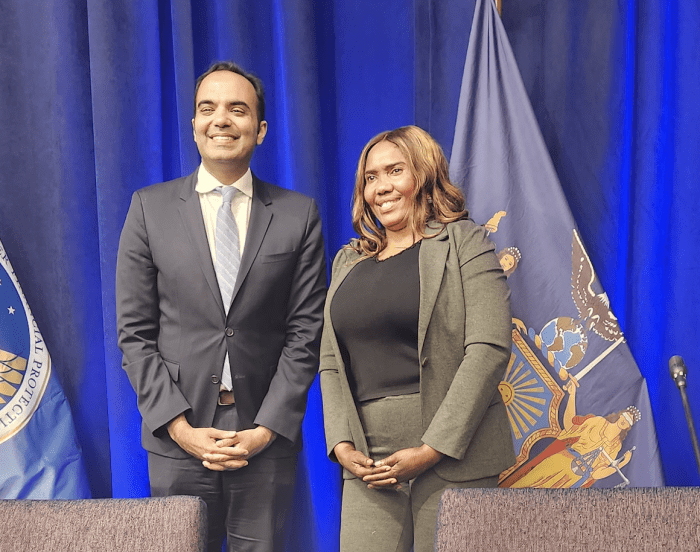
Rohit Chopra, director of the Consumer Financial Protection Bureau, stands beside homeowner Rose Prophete during a field hearing in Brooklyn, N.Y. PHOTO: LEGAL SERVICES NYC

Rose Prophete bought her home in Canarsie, Brooklyn, N.Y. in May 2005. She thought she had paid off her loans until recently, when a company approached her about a debt she thought she had settled a long time ago.

The company expected Prophete to pay up over $130,000, or face foreclosure.

When refinancing her mortgage on the home, Prophete had split her mortgage into two. Prophete said she had been erroneously told that her second mortgage was paid off. That debt, having laid dormant for years, was now being pursued by a debt-collection firm.

Prophete is one of 13 plaintiffs in a 2021 federal lawsuit against the firm, and she recently testified at a field hearing into “zombie debts” held by the Consumer Financial Protection Bureau, a government agency responsible for consumer protection in the financial-services sector.

The CFPB last week announced that it was issuing legal guidance for debt collectors trying to collect on mortgages that were long considered forgiven by borrowers, who in particular had no notices or statements sent over a decade about outstanding debt.

‘This is really frustrating — I don’t want to lose my home.’— Rose Prophete, who bought her home in Brooklyn, N.Y. in May 2005

The federal agency said that a debt collector “who brings or threatens to bring a state-court foreclosure action to collect a time-barred mortgage debt may violate the Fair Debt Collection Practices Act.” Time-barred refers to debt whose statute of limitations has run out.

“Debt collectors do not get to claim ignorance of the law or ignorance of the debt’s age,” Rohit Chopra, director of the CFPB, said during the hearing. “If the statute of limitations has expired, taking legal action threatening to bring a suit of foreclosure may be illegal no matter what the debt collector claims to have known. This is the law.”

Prophete, a Haitian immigrant and a hospital technician, said during the CFPB hearing that she had worked three jobs to afford the two-family Brooklyn home, on top of taking care of small children. 

According to the lawsuit, a little more than a year after they completed the purchase, the broker who arranged the financing suggested she refinance the mortgage to lower her monthly payments. She agreed to refinance her mortgage into two, as the broker told her that this “financing structure would be the most financially advantageous to her,” per the filing. The first loan was for $504,000 and the second for $63,000 with an interest rate of 9%.

‘Debt collectors do not get to claim ignorance of the law or ignorance of the debt’s age.’— Rohit Chopra, director of the CFPB, speaking about the Fair Debt Collection Practices Act

After a couple of years, she received a note from her first lender that the second loan was fulfilled — that she didn’t need to pay for it. She said she didn’t receive any statements for the second mortgage, so she focused on paying off her first one, the lawsuit said.

She said she never heard back from the mortgage servicer, until over a decade later, in March 2021, when she received a foreclosure notice in the mail. The creditor was attempting to collect on payments due from Jan. 1, 2009 to the date of filing in 2021. The payments had ballooned from $63,000 to over $130,000, according to the lawsuit.

“This is really frustrating — I don’t want to lose my home,” Prophete said during the field hearing. 

New York Attorney General Leticia James, who also spoke during the hearing, said that debt-collection firms were engaged in “predatory practices” to “rob individuals of the equity in their home.” 

Debt buyers were acquiring these mortgages “often for pennies on the dollar,” James said, and they were now suing homeowners and “seeking to exploit rising housing values by reviving the long-dormant zombie debt.” 

“I find this practice predatory and abusive and an affront to the American dream of sustainable home ownership,” she added. “I will fight this despicable practice.”

Cancer-causing toxins are in shampoos, body lotions, and cleaning products. Here’s what experts want you to know

Fortune

Cancer-causing toxins are in shampoos, body lotions, and cleaning products. Here’s what experts want you to know

Robin Dodson, Ruthann Rudel, Megan R. Schwarzman, The Conversation – May 2, 2023

Getty Images

The big idea

Consumer products released more than 5,000 tons of chemicals in 2020 inside California homes and workplaces that are known to cause cancer, adversely affect sexual function and fertility in adults or harm developing fetuses, according to our newly published study.

We found that many household products like shampoos, body lotions, cleaners and mothballs release toxic volatile organic compounds, or VOCs, into indoor air. In addition, we identified toxic VOCs that are prevalent in products heavily used by workers on the job, such as cleaning fluids, adhesives, paint removers and nail polish. However, gaps in laws that govern ingredient disclosure mean that neither consumers nor workers generally know what is in the products they use.

For this study we analyzed data from the California Air Resources Board (CARB), which tracks VOCs released from consumer products in an effort to reduce smog. The agency periodically surveys companies that sell products in California, collecting information on concentrations of VOCs used in everything from hair spray to windshield wiper fluid.

We cross-referenced the most recent data with a list of chemicals identified as carcinogens or reproductive/developmental toxicants under California’s right-to-know law, Proposition 65. This measure, enacted in 1986, requires businesses to notify Californians about significant exposure to chemicals that are known to cause cancer, birth defects or other reproductive harms.

We found 33 toxic VOCs present in consumer products. Over 100 consumer products covered by the CARB contain VOCs listed under Prop 65.

Of these, we identified 30 product types and 11 chemicals that we see as high priorities for either reformulation with safer alternatives or regulatory action because of the chemicals’ high toxicity and widespread use.

Why it matters

Our study identifies consumer products containing carcinogens and reproductive and developmental toxicants that are widely used at home and in the workplace. Consumers have limited information about these products’ ingredients.

We also found that people are likely co-exposed to many hazardous chemicals together as mixtures through use of many different products, which often contain many chemicals of health concern. For example, janitors might use a combination of general cleaners, degreasers, detergents and other maintenance products. This could expose them to more than 20 different Prop 65-listed VOCs.

Similarly, people experience aggregate exposures to the same chemical from multiple sources. Methanol, which is listed under Prop 65 for developmental toxicity, was found in 58 product categories. Diethanolamine, a chemical frequently used in products like shampoos that are creamy or foamy, appeared in 40 different product categories. Canada and the European Union prohibit its use in cosmetics because it can react with other ingredients to form chemicals that may cause cancer.

Some chemicals, such as N-methyl-2-pyrrolidone and ethylene gylcol, are listed under Prop 65 because they are reproductive or developmental toxicants. Yet they appeared widely in goods such as personal care products, cleansers and art supplies that are routinely used by children or people who are pregnant.

Our findings could help state and federal agencies strengthen chemical regulations. We identified five chemicals – cumene, 1,3-dichloropropene, diethanolamine, ethylene oxide and styrene – as high-priority targets for risk evaluation and management under the Toxic Substances Control Act by the U.S. Environmental Protection Agency.

What still isn’t known

Our analysis of the CARB data on volatile toxicants does not paint a complete picture. Many toxic chemicals, such as lead, PFAS and bisphenol A (BPA), don’t have to be reported to the Air Resources Board because they are not volatile, meaning that they don’t readily turn from liquid to gas at room temperature.

In addition, we were not able to identify specific products of concern because the agency aggregates data over whole categories of products.

What other research is being done

Studies have shown that women generally use more cosmetic, personal care and cleaning products than men, so they are likely to be more highly exposed to harmful chemicals in these categories. Further, women working in settings like nail salons may be exposed from products used both personally and professionally.

Research by members of our team has also shown that product use varies by race and ethnicity, partly due to racialized beauty standards. Policy interventions could be tailored to prioritize these potentially more-highly exposed groups.

Ultimately, a right-to-know law like Prop 65 can only go so far in addressing toxics in products. We’ve found in other research that some manufacturers do choose to reformulate their products to avoid Prop 65 chemicals, rather than having to warn customers about toxic ingredients.

But Prop 65 does not ban or restrict any chemicals, and there is no requirement for manufacturers to choose safer substitutes. We believe our new analysis points to the need for national action that ensures consumers and workers alike have safer products.

Dr. Kristin Knox at the Silent Spring Institute contributed to this article.

Robin Dodson, Adjunct Assistant Professor of Environmental Health, Boston UniversityMegan R. Schwarzman, Associate Project Scientist and Continuing Lecturer in Environmental Health Sciences, University of California, Berkeley, and Ruthann Rudel, Visiting Scholar, Social Science Environmental Health Research Institute, Northeastern University, Northeastern University

This article is republished from The Conversation under a Creative Commons license. Read the original article.