Struggles continue for thousands in Florida 8 months after Hurricane Ian as new storm season looms
Curt Anderson – May 28, 2023
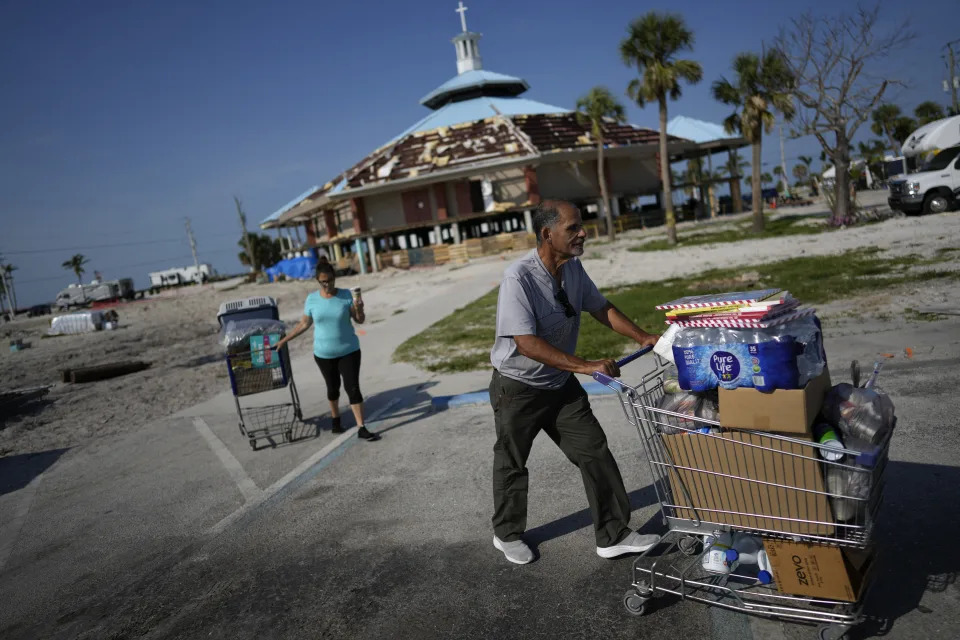
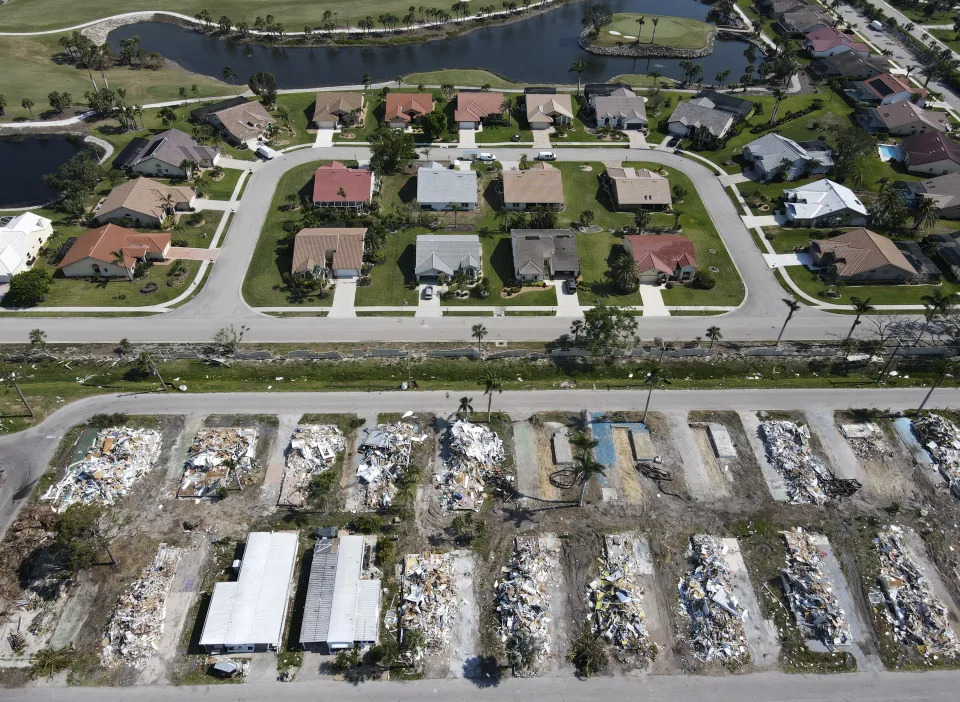
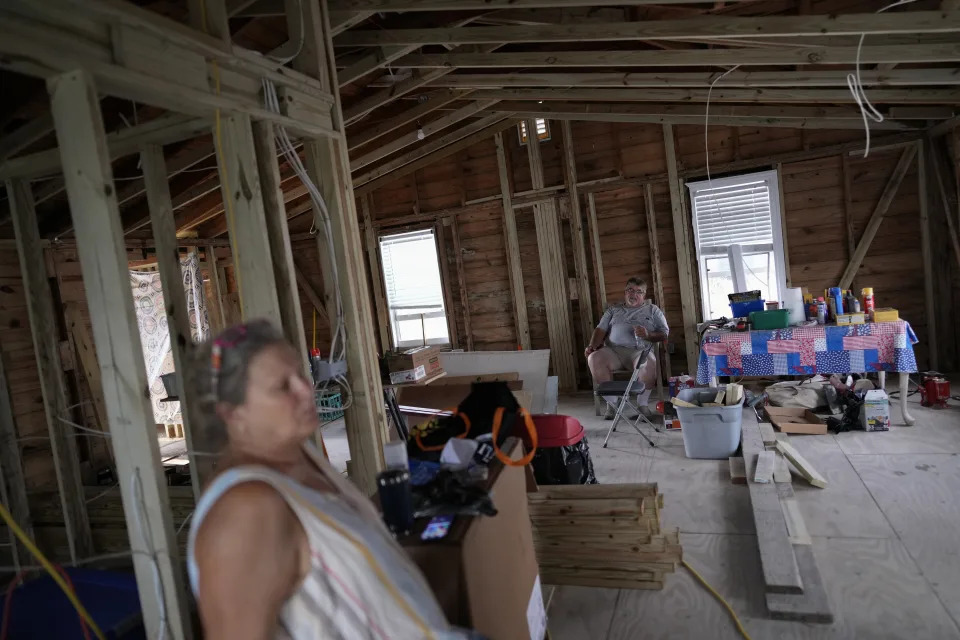
A skeleton in sunglasses sits beside a sign reading “Just waiting for the insurance check,” outside the closed Kona Kai Motel on Sanibel Island, Fla., Thursday, May 11, 2023. In Sanibel, the lingering damage is not quite as widespread as in Fort Myers Beach, but many businesses remain shuttered as they are repaired and storm debris is everywhere. Seven local retail stores have moved into a shopping center in mainland Fort Myers, hoping to continue to operate while awaiting insurance payouts, construction permits, or both before returning to the island. (AP Photo/Rebecca Blackwell)In this drone photo, restaurants operate from food trucks with outdoor seating in the Times Square area, where many businesses were completely destroyed during Hurricane Ian, in Fort Myers Beach, Fla., Wednesday, May 10, 2023. With this year’s Atlantic hurricane season officially beginning June 1, recovery is far from complete in hard-hit Fort Myers Beach, Sanibel and Pine Island. Blank concrete slabs reveal where buildings, many of them once charming, decades-old structures that gave the towns their relaxed beach vibe, were washed away or torn down. (AP Photo/Rebecca Blackwell)Omar Del Rio, a civil engineer currently subcontracted to FEMA, and his wife Maria wheel shopping carts full of groceries and supplies to their car as they leave the free food pantry operating underneath the heavily damaged Beach Baptist Church in Fort Myers Beach, Fla., Thursday, May 11, 2023. Before Hurricane Ian devastated Fort Myers Beach in 2022, the Del Rios rented an apartment on the island, living near the rented homes of their adult son and daughter, who each lived with their spouse and three children. All three homes were lost in the storm, and the six adults and six children were forced to spend months living together in one camper. (AP Photo/Rebecca Blackwell)In this photo taken with a drone, the remains of homes demolished after sustaining heavy damage in Hurricane Ian are seen in Tropicana Sands mobile home park, bottom, in Fort Myers, Fla., Wednesday, May 10, 2023. More than seven months after the storm, crews continue removing debris after demolishing all but a handful of the hundreds of manufactured homes in the community marketed to active adults ages 55 and up. The state estimated the total insured loss from Ian in Florida was almost $14 billion, with more than 143,000 claims still open without payment or claims paid but not fully settled as of March 9. (AP Photo/Rebecca Blackwell)Jacquelyn and Timothy Velazquez sit inside the gutted shell of their 910 square foot two-bedroom home, which was damaged when Hurricane Ian’s storm surge rose to within inches of the ceiling, in Fort Myers Beach, Fla., Wednesday, May 24, 2023. The couple has laid down new flooring, but is still battling with their insurance company to have the damage to the leaking roof covered, while waiting on permits for the renovation work. (AP Photo/Rebecca Blackwell)
FORT MYERS BEACH, Fla. (AP) — Eight months ago, chef Michael Cellura had a restaurant job and had just moved into a fancy new camper home on Fort Myers Beach. Now, after Hurricane Ian swept all that away, he lives in his older Infiniti sedan with a 15-year-old long-haired chihuahua named Ginger.
Like hundreds of others, Cellura was left homeless after the Category 5 hurricane blasted the barrier island last September with ferocious winds and storm surge as high as 15 feet (4 meters). Like many, he’s struggled to navigate insurance payouts, understand federal and state assistance bureaucracy and simply find a place to shower.
“There’s a lot of us like me that are displaced. Nowhere to go,” Cellura, 58, said during a recent interview next to his car, sitting in a commercial parking lot along with other storm survivors housed in recreational vehicles, a converted school bus, even a shipping container. “There’s a lot of homeless out here, a lot of people living in tents, a lot of people struggling.”
Recovery is far from complete in hard-hit Fort Myers Beach, Sanibel and Pine Island, with this year’s Atlantic hurricane season officially beginning June 1. The National Oceanic and Atmospheric Administration is forecasting a roughly average tropical storm season forecast of 12 to 17 named storms, five to nine becoming hurricanes and one to four powering into major hurricanes with winds greater than 110 mph (177 kph).
Another weather pattern that can suppress Atlantic storms is the El Nino warming expected this year in the Pacific Ocean, experts say. Yet the increasingly warmer water in the Atlantic basin fueled by climate change could offset the El Nino effect, scientists say.
In southwest Florida, piles of debris are everywhere. Demolition and construction work is ongoing across the region. Trucks filled with sand rumble to renourish the eroded beaches. Blank concrete slabs reveal where buildings, many of them once charming, decades-old structures that gave the towns their relaxed beach vibe, were washed away or torn down.
Some people, like Fort Myers Beach resident Jacquelyn Velazquez, are living in campers or tents on their property while they await sluggish insurance checks or building permits to restore their lives.
“It’s, you know, it’s in the snap of the finger. Your life is never going to be the same,” she said next to her camper, provided under a state program. “It’s not the things that you lose. It’s just trying to get back to some normalcy.”
Ian claimed more than 156 lives in the U.S., the vast majority in Florida, according to a comprehensive NOAA report on the hurricane. In hard-hit Lee County — location of Fort Myers Beach and the other seaside towns — 36 people died from drowning in storm surge and more than 52,000 structures suffered damage, including more than 19,000 destroyed or severely damaged, a NOAA report found.
Even with state and federal help, the scale of the disaster has overwhelmed these small towns that were not prepared to deal with so many problems at once, said Chris Holley, former interim Fort Myers Beach town manager.
“Probably the biggest challenge is the craziness of the debris removal process. We’ll be at it for another six months,” Holley said. “Permitting is a huge, huge problem for a small town. The staff just couldn’t handle it.”
Then there’s battles with insurance companies and navigating how to obtain state and federal aid, which is running into the billions of dollars. Robert Burton and his partner Cindy Lewis, both 71 and from Ohio, whose mobile home was totaled by storm surge, spent months living with friends and family until finally a small apartment was provided through the Federal Emergency Management Agency. They can stay there until March 2024 while they look for a new home.
Their mobile home park next to the causeway to Sanibel is a ghost town, filled with flooded-out homes soon to be demolished, many of them with ruined furniture inside, clothes still in closets, art still on the walls. Most homes had at least three feet of water inside.
“No one has a home. That park will not be reopened as a residential community,” Lewis said. “So everybody lost.”
The state Office of Insurance Regulation estimated the total insured loss from Ian in Florida was almost $14 billion, with more than 143,000 claims still open without payment or claims paid but not fully settled as of March 9.
With so many people in limbo, places like the heavily damaged Beach Baptist Church in Fort Myers Beach provide a lifeline, with a food pantry, a hot lunch stand, showers and even laundry facilities for anyone to use. Pastor Shawn Critser said about 1,200 families per month are being served at the church through donated goods.
“We’re not emergency feeding now. We’re in disaster recovery mode,” Critser said. “We want to see this continue. We want to have a constant presence.”
In nearby Sanibel, the lingering damage is not quite as widespread although many businesses remain shuttered as they are repaired and storm debris is everywhere. Seven local retail stores have moved into a shopping center in mainland Fort Myers, hoping to continue to operate while awaiting insurance payouts, construction permits, or both before returning to the island.
They call themselves the “Sanibel Seven,” said Rebecca Binkowski, owner of MacIntosh Books and Paper that has been a Sanibel fixture since 1960. She said her store had no flood insurance and lost about $100,000 worth of books and furnishings in the storm.
“The fact of the matter is, we can get our businesses back up and running but without hotels to put people in, without our community moving back, it’s going to be hard to do business,” she said. “You hope this is still a strong community.”
Yet, the sense among many survivors is one of hope for the future, even if it looks very different.
Cellura, the chef living in his car, has a new job at another location of the Nauti Parrot restaurant on the mainland. Insurance only paid off the outstanding loan amount on his destroyed camper and he didn’t qualify for FEMA aid, leaving him with virtually nothing to start over and apartment rents rising fast.
But, after 22 years on the island, he’s not giving up.
“I believe that things will work out. I’m strong. I’m a survivor,” he said. “Every day I wake up, it’s another day to just continue on and try to make things better.”
AP visual journalist Laura Bargfeld and photographer Rebecca Blackwell contributed to this story.
State Farm will no longer accept applications for homeowners insurance in California, citing wildfire risk
Julia Jacobo – May 28, 2023
One of the largest insurance agencies in the country will no longer accept applications for home and business insurance in California due to wildfire risks and the cost of rebuilding.
State Farm has ceased new applications, including all business and personal lines property and casualty insurance, starting Saturday, the company announced in a press release.
PHOTO: The headquarters for State Farm Insurance is shown in Bloomington, Illinois. (Google Maps Street View)
Existing customers will not be affected, and the company will continue to offer auto insurance in the state, according to the release.
The insurance agency cited “historic increases in construction costs outpacing inflation, rapidly growing catastrophe exposure, and a challenging reinsurance market” for its decision.
State Farm said while it takes its responsibility to manage risk “seriously” and will continue to work with state policymakers and the California Department of Insurance to help build market capacity in California, the decision was necessary to ensure the company remains in good financial standing.
“It’s necessary to take these actions now to improve the company’s financial strength,” the statement read. “We will continue to evaluate our approach based on changing market conditions. State Farm® independent contractor agents licensed and authorized in California will continue to serve existing customers for these products and new customers for products not impacted by this decision.”
PHOTO: In this Sept. 7, 2022, file photo, a property destroyed by Mosquito Fire is shown in the Michigan Bluff neighborhood of Foresthill, in Placer County, Calif. (Fred Greaves/Reuters, FILE)
A decadeslong megadrought and climate change have been exacerbating wildfire risk in California in recent years. Severe drought during the winter is leading to matchbox conditions in the dry season, allowing intense wildfires to ignite with the slightest spark.
The warm, dry climate that serves as fuel for wildfires is typical for much of the West, but hotter overall temperatures on Earth are increasing wildfire risk in the region.
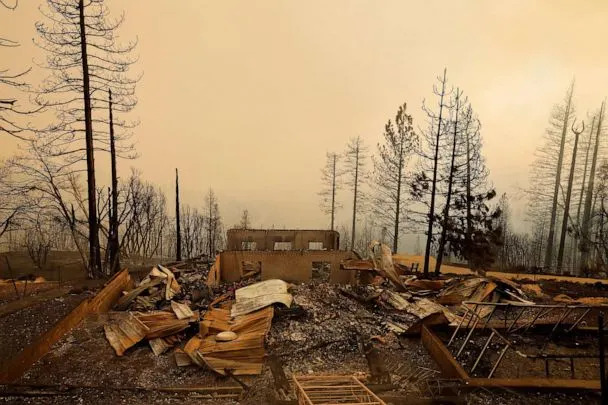
Last year, the Mosquito Fire destroyed dozens of homes in El Dorado and Placer counties. In 2021, the Dixie Fire destroyed more than 100 homes in the town of Greenville.
The Creek Fire in 2020 became the largest single fire in California history, damaging or destroying nearly 1,000 structures and burning through about 380,000 acres.
PHOTO: In this Sept. 24, 2021, file photo a burned residence is shown in Greenville, Calif. The Dixie fire has burned almost 1 million acres and remains at 94% containment after burning through 5 counties and more than 1,000 homes. (Josh Edelson/AFP via Getty Images, FILE)
Rebuilding from wildfire destruction is expensive, expensive, experts have found.
The reconstruction costs from the 2022 Coastal Fire in Southern California were estimated to be $530 million, and only 20 homes were destroyed, according to a report by property solutions firm CoreLogic.
In addition, the nationwide impact of California’s 2018 wildfire season — which included the Camp Fire, the most destructive in California history — totaled $148.5 billion in economic damage, according to a study by the University College London.
PHOTO: In this Sept. 8, 2020, file photo, a home is engulfed in flames during the ‘Creek Fire’ in the Tollhouse area of unincorporated Fresno County, Calif. (Josh Edelson/AFP via Getty Images, FILE)
The state’s FAIR Plan provides basic fire insurance coverage for high-risk properties when traditional insurance companies will not, but that plan is the last resort, Janet Ruiz, director of strategic communication for the Insurance Information Institute, told ABC San Francisco station KGO.
“It’s a basic policy, only covers fire – you have to get a wraparound policy too to cover theft and liability,” she said.
NC Governor declares ‘state of emergency’ due to GOP school voucher expansion, tax cuts
T. Keung Hui – May 22, 2023
Kaitlin McKeown
Democratic Gov. Roy Cooper declared Monday that “public education in North Carolina is facing a state of emergency” in the face of “extreme legislation” being promoted by Republican state lawmakers.
In a video posted online Monday, Cooper said GOP lawmakers are “starving” public schools and “dropping an atomic bomb on public education” with plans to further cut taxes and increase funding for private school vouchers. He said the public needs to speak out against the changes before they’re adopted in the state budget.
“It’s clear that the Republican legislature is aiming to choke the life out of public education,” Cooper said. “I am declaring this state of emergency because you need to know what’s happening.
“If you care about public schools in North Carolina, it’s time to take immediate action and tell them to stop the damage that will set back our schools for a generation.”
Cooper’s speech comes as Republican legislative leaders are negotiating a state budget deal for the next two years that includes tax cuts and expansion of private school vouchers. The GOP has a legislative supermajority, so it can adopt a spending plan and other legislation without needing Cooper’s support.
The governor will hold public events across the state in the days ahead to call on parents, educators and business leaders to speak against the GOP proposals, the Associated Press reported.
Cooper, who can’t run again for a third consecutive term, has been losing political power. Last week, seven Democrats joined Republicans in passing the Senate budget proposal.
“Meaningless publicity stunts do nothing to improve educational outcomes in our state,” Randy Brechbiel, a spokesman for Senate leader Phil Berger, said in a statement Monday. “The House and Senate will continue working together to put forward budget proposals that address the needs of students and parents.”
‘Our teachers deserve better’
Under the Senate budget, average teacher pay would increase 4.5% over the next two years with the biggest increase going toward beginning educators. The House GOP budget had average 10.2% raises for teachers over the next two years.
Cooper has advocated for 18% raises for teachers over the next two years.
“Our teachers deserve better pay and more respect but the legislature wants to give them neither one,” Cooper said.
The $250 pay raise that the Senate would provide veteran teachers over the next two years “is a slap in the face,” Cooper said. He said the proposed Senate pay raise will not help the state deal with the thousands of teacher vacancies.
‘Cut public schools to the bone’
The Senate GOP budget would also expand the Opportunity Scholarship program so that any family, regardless of its income, would qualify to apply for vouchers to attend a K-12 private school.
Republicans point out that public education spending would grow by several hundred million dollars a year annually in their competing plans. And GOP leaders consider expansion of the private-school vouchers program part of a philosophy to give all children access to education options — whatever the source — to help them succeed.
But an Office of State Budget and Management analysis says the bill could cost traditional public schools $200 million in state funding, rural counties being particularly hard hit.
The Senate budget would also accelerate the tax cuts that Republicans put in previous budgets.
Cooper accused GOP lawmakers of wanting to help millionaires by giving them more tax cuts and making it possible for them to get private school vouchers. Currently, the Opportunity Scholarship program is limited to lower-to-middle-income families.
GOP lawmakers are choosing corporations and millionaires over public schools, the governor charged.
“Public school superintendents are telling me they’ll likely have to cut public schools to the bone — eliminate early college, AP and gifted courses, art, music, sports — if the legislature keeps draining funds to pay for private schools and those massive tax breaks,” Cooper said.
Trump Rolled Back Decades Of Clean Water Protections. The Supreme Court Just Went Even Further.
Alexander C. Kaufman, Chris D’Angelo – May 26, 2023
More than three decades ago, a Michigan man named John Rapanos tried to fill in three wetlands on his property to make way for a shopping center. State regulators warned him that doing so was illegal without federal Clean Water Act permits. Rapanos argued that you couldn’t navigate a boat from his wetlands to a federal waterway, so the Environmental Protection Agency had no jurisdiction on his land. When Rapanos ignored the EPA’s cease-and-desist letters, the government successfully brought a civil lawsuit against him, which he then vowed to “fight to the death.”
Instead, he made it all the way to the nation’s highest court. In a split decision in 2006, the Supreme Court overturned the judgment against Rapanos, but did not reach a majority ruling on whether wetlands that flowed into federally regulated “waters of the United States” qualified for the same protections.
In 2016, President Barack Obama sought to answer that question with a new EPA rule extending the Clean Water Act of 1972 to include millions of acres of marshes, bogs and lagoons whose water — and any pollution added to it — channel into already federally regulated waterways.
Republicans chided the move as a federal land grab, while environmentalists cheered what they saw as a reasonable interpretation of the decadesold law through the lens of the latest science shows about hydrology and the increasing threat of extreme droughts and toxic algae blooms.
In 2020, President Donald Trump rolled back much of the rule’s protections, slashing the total protected area of wetlands roughly in half. In 2022, President Joe Biden moved to restore the Obama-era rule.
On Thursday, the Supreme Court’s new right-wing supermajority revisited the 2006 decision to strike down federal protections for virtually all the wetlands Trump deregulated — and then some, eliminating even the few safeguards the Republican administration tried to preserve.
An environmental advocate holds up a sign during a rally outside the Supreme Court in October. (Photo by Paul Morigi/Getty Images for Protect our Waters)
An environmental advocate holds up a sign during a rally outside the Supreme Court in October. (Photo by Paul Morigi/Getty Images for Protect our Waters)
The 5-4 decision — written by Justice Samuel Alito, and joined by Justices John Roberts, Clarence Thomas, Neil Gorsuch and Amy Coney Barrett — revoked the Clean Water Act’s authority over at least 59 million acres of wetlands across the U.S., according to an estimate by the environmental group Earthjustice.
“You’re going to see the Clean Water Act significantly scaled back in terms of coverage,” said Duke McCall, a partner who specializes in federal water rules at the law firm Morgan Lewis. “The impacted waters are going to be significantly narrowed.”
The Obama administration included any wetlands linked to existing federal waterways via underground aquifers or streams. The Trump EPA narrowed the scope to only include wetlands with visible surface connections to rivers, lakes and other long-standing “waters of the United States.” But the Republican administration made an exception for wetlands cut off from federal waterways via a berm, bridge or other artificial barrier.
The court granted no such leeway, instead dismantling nearly half a century of established federal jurisdiction over wetlands — a fact that conservative Justice Brett Kavanaugh noted in his dissenting opinion.
At the very least, the ruling takes the U.S. back to the mid-1970s, to the early days of the Clean Water Act, said Emily Hammond, an energy and environmental law professor at George Washington University. But Hammond stressed it could be worse than that, noting that the majority’s opinion repeatedly cites the Supreme Court’s 1870 decision in The Daniel Ball case, which found that waterways are “navigable” only if they are “navigable in fact” and used for interstate or foreign commerce.
“It’s always been understood, I think, by courts and by Congress and by agencies that when Congress used the term ‘waters of the United States’ it meant to go further than that ‘navigable in fact’ standard that Daniel Ball stood for,” Hammond said. “To see the majority now citing that old decision suggests their eye is to shrink the scope of the Clean Water Act down back to where it would have been before we had a Clean Water Act.”
“In some ways, this takes us back that far,” Hammond said, referring to the 1870 case.
Kavanaugh wrote that while the last eight previous administrations dating back to 1977 “maintained dramatically different views of how to regulate the environment, including under the Clean Water Act,” all of them “recognized as a matter of law that the Clean Water Act’s coverage of adjacent wetlands means more than adjoining wetlands and also includes wetlands separated from covered waters by man-made dikes or barriers, natural river berms, beach dunes, or the like.”
Thursday’s ruling, he argued, will have “negative consequences for waters” across the country.
“By narrowing the Act’s coverage of wetlands to only adjoining wetlands, the Court’s new test will leave some long-regulated adjacent wetlands no longer covered by the Clean Water Act, with significant repercussions for water quality and flood control throughout the United States,” Kavanaugh wrote.
Michael and Chantell Sackett of Priest Lake, Idaho, pose for a photo in front of the Supreme Court in Washington on Oct. 14, 2011. The Supreme Court on Thursday, May 25, 2023, made it harder for the federal government to police water pollution in a decision that strips protections from wetlands that are isolated from larger bodies of water. The justices boosted property rights over concerns about clean water in a ruling in favor of an Idaho couple who sought to build a house near Priest Lake in the state’s panhandle.More
Michael and Chantell Sackett of Priest Lake, Idaho, pose for a photo in front of the Supreme Court in Washington on Oct. 14, 2011. The Supreme Court on Thursday, May 25, 2023, made it harder for the federal government to police water pollution in a decision that strips protections from wetlands that are isolated from larger bodies of water. The justices boosted property rights over concerns about clean water in a ruling in favor of an Idaho couple who sought to build a house near Priest Lake in the state’s panhandle.
The ruling is part of what liberal Justice Elena Kagan views as a clear trend by the court to curb the federal government’s legal authority to regulate pollution in an era of dramatic ecological upheaval — when other countries are taking drastic steps to preserve some semblance of nature’s current biodiversity and order. Last year, the Supreme Court drastically limited EPA’s authority to curb power plant emissions under the Clean Air Act.
“The vice in both instances is the same: the Court’s appointment of itself as the national decision-maker on environmental policy,” Kagan wrote. “So I’ll conclude, sadly, by repeating what I wrote last year, with the replacement of only a single word. ‘[T]he Court substitutes its own ideas about policymaking for Congress’s. The Court will not allow the Clean [Water] Act to work as Congress instructed. The Court, rather than Congress, will decide how much regulation is too much.’”
Last year, the Supreme Court took the unusual step of hearing a case on a defunct power plant regulation — the high court typically rejects suits with no active legal bearing — in what was widely seen as an attempt to preemptively stop the Biden administration from reviving a controversial Obama-era rule. The court’s six conservative justices, including Kavanaugh, ruled in favor of permanently sealing off the legal avenue the Obama administration took to justify parts of its Clean Power Plan regulation.
The conservative justices’ apparent partisan agenda is hardly the only perceived conflict of interest sowing mistrust in the nation’s highest court. The Trump-appointed Barrett, whose father spent much of his career working for Royal Dutch Shell, declined to recuse herself from key cases involving the oil giant, even as Justice Samuel Alito stepped aside over his disclosed investments in oil and companies.
The investigative news outlet ProPublica published a series of exposés over the past month revealing that Thomas, who was appointed by President George H. W. Bush, failed to disclose private jet trips and land deals he received from billionaire real-estate developer Harlan Crow. The National Multifamily Housing Council, which has close ties to Crow — the CEO of Crow Holdings Inc. is also the chair of that group, and three of Crow’s companies are dues-paying members — filed an amicus brief on an earlier iteration of this case, as HuffPost’s Paul Blumenthal reported.
Republican lawmakers celebrated Thursday’s decision as a win for family farmers crushed under the boot of regulators seeking to make living off the land ever harder and more complicated.
“In a huge win for farmers, ranchers, small business owners, and families — the Supreme Court has ditched the Obama/Biden WOTUS rule overreach once and for all,” Rep. Sam Graves (R-Mo.) wrote in a statement.
But while “farmers and small business owners have been held up” as the most sympathetic victims of purported government overreach, McCall said “developers are a huge affected group who have been strong opponents” of expanded wetland protections.
Another way that Thursday’s ruling turns the clock back to before the Clean Water Act was passed in 1972 is by effectively restoring a variable patchwork of state water rules, Hammond said.
“The Clean Water Act was designed of course to create some floor among the states so that we wouldn’t have the race to the bottom, polluters moving to states where they could pollute more because the policies were more lenient,” they said. “This decision so dramatically undermines the Clean Water Act that we do in a sense go back to the times of significant disparities among the states in terms of protections for our waters.”
“These kinds of decisions are starting to add up,” Hammond added. “There’s no doubt there will be cumulative impacts and we’ll see shifts as a result.”
CORRECTION: A previous version of this story suggested the facts of the Rapanos case occurred in the 2000s. They occurred in the 1980s.
These Science-Backed Supplements May Help Ease Joint Pain, According to Experts
Adele Jackson-Gibson – May 25, 2023
The 10 Best Supplements to Improve Joint HealthYulia Lisitsa – Getty Images
“Hearst Magazines and Yahoo may earn commission or revenue on some items through these links.”
We updated this article in May 2023 to add more information about each featured product, based on extensive research done by our team.
Anyone who’s experienced joint pain in their life knows how frustrating it can be. Even the most basic activities can be painful when your joint are stiff, inflamed, and achy. Although the pain can be temporary, like the kind of soreness you might feel after a long day being desk-bound, it can also stem from a chronic condition. In fact, about one in four adults with arthritis, or 15 million people, report experiencing severe joint pain. Thankfully, the best joint supplements might help.
Of course, for some people, relief can come in the form of over-the-counter medications like acetaminophen (Tylenol), ibuprofen (Advil, Motrin IB), and naproxen (Aleve), which can help lessen pain and reduce inflammation. However, long-term use of these painkillers can come with unpleasant side-effects.
That’s why many physicians suggest exploring other strategies to find relief. For example, eating a balanced diet rich in anti-inflammatory foods, strength training, and maintaining your ideal weight are “the most effective and proven way[s] to improve the symptoms of osteoarthritis,” says Elizabeth Matzkin, M.D., the surgical director of Women’s Musculoskeletal Health at Brigham and Women’s Hospital.
Meet the Experts:Elizabeth Matzkin, M.D., the surgical director of Women’s Musculoskeletal Health at Brigham and Women’s Hospital; Thomas Wnorowski Ph.D., a clinical and biomedical nutritionist and the lead researcher of the Neurolipid Research Foundation in Millville, NJ; Jordan Mazur, M.S., R.D., the coordinator of performance nutrition for the San Fransisco 49ers; Valentina Duong, A.P.D., owner of the Strength Dietitian; Kendra Clifford, N.D., a naturopathic doctor and birth doula at Uxbridge Chiropractic Centre in Ontario; Nicole M. Avena, Ph.D., a nutrition consultant and assistant professor of neuroscience at the Mount Sinai School of Medicine.
In addition to making lifestyle changes, some people turn to supplements to improve the health of their joints. But before you rush to the vitamin aisle of your pharmacy, beware: Not all of these supplements are the joint-relieving panaceas that they claim to be. And with so many options out there, sifting through the supplement aisle is definitely not a walk in the park—which is why we’ve done the work for you and found quality joint supplements recommended by medical pros to ease pain and improve your overall joint health. Before you shop, though, always consult your doctor and do your research to determine what’s best for you.
Ahead, check out expert-recommended supplements to help improve your joint health.
Dietary supplements are products intended to supplement the diet. They are not medicines and are not intended to treat, diagnose, mitigate, prevent, or cure diseases. Be cautious about taking dietary supplements if you are pregnant or nursing. Also, be careful about giving supplements to a child, unless recommended by their healthcare provider.
Collagen Peptides Powder
“Taking 20 to 30 grams of high-quality collagen [peptides] is a good preventative measure to provide the body what it needs to synthesize collagen, an important protein for joint and ligament health,” says Jordan Mazur, M.S., R.D., the coordinator of performance nutrition for the San Fransisco 49ers. He prefers this brand which has been certified and tested by NSF International and contains 11.9g of collagen peptides per scoop.
Though palmitoylethanolamide (PEA) is still being researched, some studies have suggested its potential for improving lower back pain and chronic pelvic pain. Nootropic Depot’s capsules are manufactured in facilities that are GMP-certified, with each capsule containing 400 mg of PEA. There is no recommended dosage for this particular nutrient, but 300 mg to 600 mg of PEA have been shown to be effective in certain cases. If you want to try this supplement, ask your doctor what dosage they recommend.
This nutrient is best absorbed when combined with black pepper (or piperine), which this brand includes. Experts from the Arthritis Foundation suggest that 100 mg daily can help ease osteoarthritis pain. Tribe’s vegan capsules contain 112.5mg per serving. The company also produces its supplements in Good Manufacturing Practice (GMP) approved facilities.
Joint Collagen Tablets Advanced Formula + Boswellia
This product contains collagen, boswellia, and turmeric—three joint health powerhouses. Nicole M. Avena, Ph.D., a nutrition consultant and assistant professor of neuroscience at the Mount Sinai School of Medicine, likes Youtheory’s variety because the company has been in the collagen supplement game for a long time. “Their ingredients are sourced from all over the world to ensure the highest quality, and their products are manufactured in their own facility,” says Avena. Youtheory’s facility is also Good Manufacturing Practice (GMP) certified.
Shop NowJoint Collagen Tablets Advanced Formula + Boswellia$18.17amazon.comProduct Shot ImageMore
Omega Triple Super Strength Fish Oil Capsules
Blackmores’ fish oil contains 540mg of EPA and 36 mg of DHA, making it a solid choice among fish oil supplements. Bonus: This is an Australian brand, which is worth noting because the Australian government regulates “complementary medicines” (aka supplements) as rigorously as they do pharmaceutical drugs. Blackmore also makes their products in GMP-certified facilities, which is another major plus.
Shop NowOmega Triple Super Strength Fish Oil Capsules$41.43amazon.comProduct Shot ImageMore
Super EPA & DHA Supplement
Thorne is a well-respected supplement brand that has had partnerships with the Mayo Clinic and has certifications from GMP and NSF. Its fish oil product “Super EPA” packs a decent serving of pain-relieving goodness: 425mg of EPA and 270mg of DHA per capsule.
Shop NowSuper EPA & DHA Supplement$36.00iherb.comProduct Shot ImageMore
Vitamin D3 Supplement
Nordic Naturals provides 1,000 IU of D3 that is non-GMO and third-party tested. The National Institutes of Health (NIH) recommends adults ages 19-70 get at least 800 IUs a day, which means this supplement’s got you covered.
Longvida comes recommended by Thomas Wnorowski Ph.D., a clinical and biomedical nutritionist and the lead researcher of the Neurolipid Research Foundation in Millville, NJ. It’s a “clean and effective source” of curcumin. This brand provides 400mg of “bioavailable” curcumin per capsule, which means your body will be able absorb most of the nutrients. The Arthritis Foundation says that the best dosage of curcumin to alleviate arthritis pain is 500 mg twice daily, but that amount might vary according to your needs.
Omgea-3 fats typically come from fish, but vegetarians or vegans can still find omega-3 supplements that are suitable with their diet. This pick from Deva is vegan-friendly, providing 500mg of DHA and EPA derived from algae oil instead of fish. The supplements are also produced in an FDA-inspected facility under GMP regulations.
Shop NowVegan Omega-3 DHA EPA$31.69amazon.comProduct Shot ImageMore
Devil’s Claw Dietary Supplement
This vegetarian formula contains 575mg of devil’s claw per capsule. While recommended dosages vary, experts at the Arthritis Foundation suggest adults take 750mg to 1,000mg three times a day. But again, consult your physician before deciding how much to take. Dosage aside, what’s great about Greenbush’s devil’s claw is that it was produced in FDA-inspected plants under GMP guidelines.
Just because a supplement has solid research backing it, that doesn’t mean whatever you find on the shelves of your pharmacy will be effective. For one thing, “products can have a wide range of dosages of their active ingredients,”says Kendra Clifford, N.D., a naturopathic doctor and birth doula at Uxbridge Chiropractic Centre in Ontario. “[But] in order for a supplement to work, there needs to be an effective dosage.”
While you can find general dosage recommendations from reliable sources like the Arthritis Foundation, an effective dose for you really depends on your condition, adds Clifford. A convo with your physician can help you figure out the right amount.
Once you nail that down, it’s time to select the brand. Keep in mind that the Food and Drug Administration (FDA) regulates dietary supplements under a different set of regulations than those covering “conventional” foods and drug products. You’ll want to find labels that have stamps of approval from third-party certification programs like Consumer Lab, NSF International, the US Pharmacopeial Convention (USP), or Good Manufacturing Practice to ensure that there are no harmful ingredients and that the product contains everything it claims to have.
Are joint supplements really effective?
It depends. In many cases, the research is mixed, so there are no definitive answers. For example, glucosamine and chondroitin are often touted for their joint pain-relieving abilities, but according to the American Academy of Orthopaedic Surgeons, these supplements are not much more effective than a placebo in treating arthritis pain. On the flip side, the Arthritis Foundation suggests otherwise and includes both glucosamine and chondroitin on its list of supplements that can help with arthritis symptoms.
The good news is, there are supplements out there that have less conflicting evidence, meaning they may be worth a try.
Which joint supplements have proven benefits?
So far, research shows that the supplements below may help improve joint pain and overall joint health:
✔️ Curcumin: This is the active compound in turmeric that gives the spice its flavor and color. It’s known for its anti-inflammatory effects, as it disrupts pro-inflammatory cells in the body, according to Wnorowski.
✔️ Boswellia: Boswellia serrata or Indian frankincense is one of those dark horses in the world of anti-inflammatories. According to the Arthritis Foundation, it works by blocking the enzymes that turn your food into the molecules that attack your joints. In 2018, researchers who conducted a systematic review of 20 osteoarthritis-relieving supplements found that boswellia extract was a standout for easing joint pain.
✔️ Collagen: One of the keys to preventing joint pain is to protect the cushy cartilage that protects your bones. Cartilage is partially made of a protein called collagen, which “plays a major role in the proper maintenance and strength of joint and ligament health,” says Mazur. A 2014 review suggests that collagen can protect cartilage, relieve pain, and potentially increase the strength of your bones.
✔️ Fish oil: The omega-3 fatty acids in fish oil have been extensively studied for their anti-inflammatory effects for many conditions, including arthritis. Some researchers have found that people suffering from osteoarthritis who took 200 mg of EPA and 400 mg of DHA (fish oil’s active ingredients) daily for 16 weeks experienced less chronic pain. Fish oil has also been proven to be an effective treatment for gout, a common but complex form of arthritis where symptoms tend to be more sudden and severe. For an effective fish oil supplement, you’ll want to find a brand that contains a minimum of 500mg of combined EPA and DHA, says Valentina Duong, A.P.D., owner of the Strength Dietitian.
✔️ Vitamin D: It won’t take the place of OTC painkillers, but it is vital for strong bones—including the ones that make up your joints. According to the National Institutes of Health (NIH), Vitamin D helps you absorb calcium, one of the major building blocks of your bones. It also regulates phosphate, which allows you to contract the muscles that move the bones of your joints.
Many of us need more of this essential nutrient. “Lower levels [of vitamin D] may result in bone, joint, and muscle pain,” says Kendra Clifford, N.D., a naturopathic doctor and birth doula at Uxbridge Chiropractic Centre in Ontario. “Bone aches can often be difficult to distinguish from muscle aches, therefore, vitamin D deficiency can be the direct cause of pain in many individuals.”
✔️ PEA: Palmitoylethanolamide was discovered in the 1950s as a potent anti-inflammatory, and it’s still being studied for its pain-relieving potential. Several studies have found that PEA can assist people with lower back pain and chronic pelvic pain. Clifford has found in her practice that PEA “is very well tolerated and can be used in at risk populations—such as those on a large number of medications—where typical pain relievers have a large number of adverse effects.”
✔️ Devil’s claw: Derived from a plant native to South Africa, this is a popular supplement in France and Germany to treat inflammation, arthritis, headaches, and low back pain. Taking devil’s claw for 8 to 12 weeks can reduce pain and improve joint function in people with osteoarthritis.
How we chose the best joint supplements
We consulted Elizabeth Matzkin, M.D., the surgical director of Women’s Musculoskeletal Health at Brigham and Women’s Hospital; Thomas Wnorowski Ph.D., a clinical and biomedical nutritionist and the lead researcher of the Neurolipid Research Foundation in Millville, NJ; Jordan Mazur, M.S., R.D., the coordinator of performance nutrition for the San Fransisco 49ers; Valentina Duong, A.P.D., owner of the Strength Dietitian; Kendra Clifford, N.D., a naturopathic doctor and birth doula at Uxbridge Chiropractic Centre in Ontario; and Nicole M. Avena, Ph.D., a nutrition consultant and assistant professor of neuroscience at the Mount Sinai School of Medicine. We also combed through countless ratings, reviews, and product specs online.
Why trust us
For more than 70 years, Prevention has been a leading provider of trustworthy health information, empowering readers with practical strategies to improve their physical, mental, and emotional well-being. Our editors interview medical experts to help guide our health-focused product selections. Prevention also examines hundreds of reviews—and often conducts personal testing done by our staff—to help you make informed decisions.
‘It’s not their money’: Older Americans worried debt default means no Social Security
Peter Charalamboust – May 23, 2023
‘It’s not their money’: Older Americans worried debt default means no Social Security
If the United States defaults on its financial obligations, millions of Americans might not be able to pay their bills as well.
With Social Security and other government benefits at risk amid a political stalemate over the government’s debt ceiling, experts and older Americans told ABC News that the consequences of the impasse in Washington could be dire, including for older Americans who need the money to pay for basic needs such as food, housing or health care costs.
A quarter of Americans over age 65 rely on Social Security to provide at least 90% of their family income, according to the Social Security Administration.
PHOTO: President Joe Biden walks to the White House after landing on the South Lawn aboard Marine One, May 21, 2023 in Washington, DC. (Samuel Corum/Getty Images)
Fred Gurner, 86, of New York, told ABC News that he uses his Social Security payment for his $800 rent. But now there is real risk that his payment might not come in time in June — when the Treasury Department says the government might not be able to send him the money he counts on.
“It’s very stressful, gives me a heart attack,” Gurner said about how the issue has become politicized.
How are Social Security payments affected by the debt ceiling?
Since 2001, the United States has spent more money than revenue it has taken in overall.
To cover the difference, the United States Treasury issues debt through securities, according to University of Pennsylvania’s Wharton School of Business professor Olivia Mitchell. Backed by the United States, those securities are happily bought by investors who see it as a safe guarantee they’ll get paid back with interest.
However, the United States and Denmark are the only two countries to limit the amount of debt the government can issue, known as a debt ceiling, Mitchell noted.
Lawmakers can pass new laws that require government spending, but the debt ceiling will remain in place until lawmakers vote to increase it. That has happened 78 separate times in the United States since 1960.
If that debt ceiling does not increase by June 1, Treasury Secretary Janet Yellen has warned House Speaker Kevin McCarthy that the country will not be able to satisfy all of its financial obligations.
Beyond not being able to pay interest and principal on government securities — which economists broadly agree would rattle the stock market and possibly damage the U.S. credit rating — the Treasury would be unable to issue new debt to cover expenses like Social Security, according to Mitchell.
The government projects to spend roughly $100 billion on Social Security in the month of June, according to the Bipartisan Policy Center.
“It’s going to be pretty tight for people for a while, unless Congress and the president can get together on this problem,” Mitchell said.
When would Social Security payments become delayed?
The Social Security Administration plans to send contributions to beneficiaries on four dates next month — June 2, 14, 21, and 28. Those checks would be the first ones at risk of being delayed, according to Max Richtman, President and CEO of the National Committee to Preserve Social Security and Medicare.
“Millions and millions of Social Security beneficiaries are worried about having the income to pay their basic bills,” he noted.
Lynda Fisher, 80, told ABC News that her budget relies on her monthly Social Security check and that a delay would complicate her essential spending, frustrating the 80-year-old who has spent her life contributing to the system.
PHOTO: FILE – House Speaker Kevin McCarthy, Republican of California, speaks with reporters in the US Capitol in Washington, DC, May 17, 2023. (Andrew Caballero-reynolds/AFP via Getty Images, FILE)
“I paid into Social Security, and I paid into Medicare,” she said. “And now they’re trying to take it away. It’s not their money, it’s my money that I paid into.”
Richtman is now actively encouraging older residents to save money in anticipation of a delayed Social Security payment, fearing negotiations will not yield a compromise in time to avoid default.
On NBC’s “Meet the Press” on Sunday, Yellen indicated that certain bills might be prioritized, including interest payments, Social Security and military contractor payments. However, Richtman expressed doubt that such a prioritization would be legally possible.
What does this mean for the future of Social Security?
Some Republican lawmakers have framed the debt ceiling fight as necessary to slow government spending; however, some economists, including Mitchell, see this as a “manufactured crisis” that threatens essential services, retirement savings and the overall economy.
“Every time one of these crises occurs, it’s signaling to the rest of the world, and to American investors that U.S. Treasuries are not as safe as we thought,” Boston University economics professor Laurence Kotlikoff said.
Kotlikoff expressed further concern that the Social Security system will have over $65.9 trillion in unfunded financial obligations over the indefinite horizon, based on the entity’s own report.
However, the debate over the debt ceiling appears unlikely to produce a meaningful solution to the broader Social Security shortfall, though, according to Kotlikoff, Mitchell and Richtman.
When will retirees receive their payments?
Mitchell and Richtman remained optimistic that Social Security recipients would eventually receive their checks once a deal is made, albeit with some delay.
“I’m pretty confident that payments would be fulfilled,” Richtman said. “That’s not much comfort to those people who will not be able to pay for their groceries, their utilities or their rent while they’re waiting to receive a back payment.”
Ron DeSantis is learning that not every state wants to be Florida
Henry J. Gomez – May 22, 2023
Charlie Neibergall
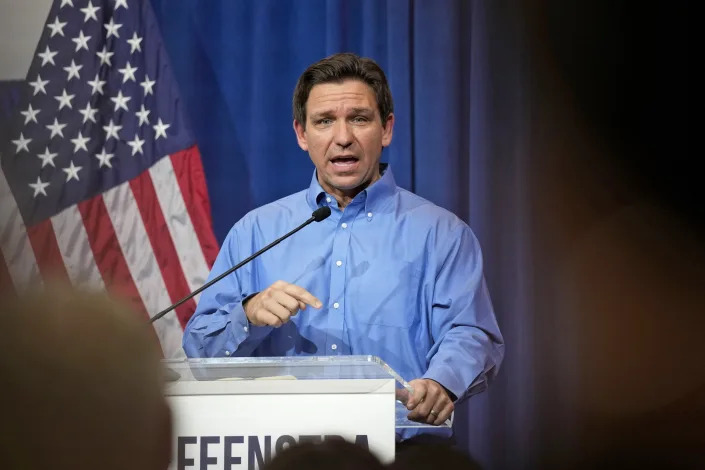
Wherever Gov. Ron DeSantis goes, he brings greetings from “the free state of Florida.” He heralds his “Florida Blueprint.” And he brags about how many people originally from whichever state he happens to be visiting love taking advantage of Florida’s warm weather and low taxes.
But a funny thing has happened as DeSantis travels the country with a “Make America Florida” message that underpins the Republican’s soon-to-launch presidential campaign.
DeSantis has found that not everyone wants to be Florida. And he has encountered spirited pushback from competitive fellow governors and GOP officials who believe that their states have done just as much, if not more, to advance a conservative agenda.
“It’s a lot of fun competing with my colleagues and Republican governors across the country,” Iowa Gov. Kim Reynolds, who has hosted DeSantis in the first-in-the-nation caucus state, said in an interview with NBC News. “But make no mistake, we are competitors.”
Reynolds introduced and interviewed DeSantis at two events in March, making sure to hold up her own record alongside his and frame them as equally accomplished governors. DeSantis, though, emphasized that he enjoys a “special perch” or “unique catbird’s seat” to view how other governors are doing, “because when people visit or move here, they tell me what’s going on in their states.”
After bestowing this authority onto himself, he took some shots at Democratic-led Illinois and proclaimed that Reynolds indeed presides over “one of the best-run states.”
It’s a tricky task — one that has caught attention of DeSantis’ home state reporters at Florida Politics — that in the wrong hands can come off as a magnanimous pander or a condescending pat on the back. And there have been signs in recent weeks that DeSantis recognizes he needs to shift how he talks about Florida, making it seem less aspirational and exceptional and more like an example of Republican leadership that has thrived elsewhere.
Reynolds, who stressed that her rivalry with DeSantis is friendly, brushed aside a question about whether his comments might offend Iowans and then quickly pivoted to her own accomplishments.
“Offend Iowans? Oh no, because I took care of that,” Reynolds said. “Because starting this year, we no longer tax retirement income. I made a deal with Gov. DeSantis. I said, ‘Hey, I’ll let our retirees go down to Florida — maybe a couple of months in January and February when the temperature’s not as good here in Iowa. … He’s gracious when he talks about it.”
DeSantis’ Florida boosterism has also prompted some ribbing in New Hampshire. At a GOP dinner there last month, DeSantis spoke admiringly about that state’s “Live Free or Die” motto before launching into his self-congratulatory story. Before DeSantis left the stage, New Hampshire GOP Chairman Chris Ager playfully jabbed at the governor.
“Instead of people moving to Florida,” Ager said, “maybe you can move up here.”
DeSantis’ spokesperson did not return a request for comment for this piece.
As boastful as DeSantis can be, he also searches for common cause with his audiences. During two stops in Ohio last month he played up his mother’s roots in the Youngstown area and his wife’s childhood in Troy, near Dayton. During that trip, he told a GOP crowd over breakfast in Akron that some parts of Florida are like “Ohio South,” given the number of retirees there.
“And it’s all good, because I’ll tell you, when it came time to get that big victory margin, there were a lot of transplanted people from Ohio who had my back,” DeSantis said, referring to his 19-point re-election margin last year. “So, God bless them for doing that.”
During a speech in South Carolina, DeSantis mentioned how his in-laws now live in the state and how he’s noticed more traffic on the roads there when he and his wife visit.
“Similar to what we’ve seen in Florida over the years with people coming down here,” he said.
But he was unable to resist an attempt at one-upmanship: “Famously — and, as long as I’m around, permanently — we have no state income tax. You guys should try that sometime.”
In Georgia, a compliment quickly gave way to grievance.
“One thing we’re no longer No. 1 in is college football,” DeSantis told an audience during a visit to a gun store in March. “So I just have a little bit of a plea … just stop taking so many of our high school football recruits. Can you give us a little bit of a chance?”
Ager, the New Hampshire GOP chair, said in an interview that he sees nothing wrong with friendly competition — and he wasted little time asserting his own state’s superiority.
“We are clearly No. 1. Gov. DeSantis calls it the free state of Florida. But the Cato Institute … in their whole scoring criteria, New Hampshire came in first last year,” Ager said, referring to a libertarian think tank’s ranking of New Hampshire as the freest state, based on personal and economic freedoms. “So we have some objective criteria from a third party.”
DeSantis himself seems to have softened his pitch a tad. While addressing the Utah GOP’s organizing convention in late April, he called the state, led by Republican Gov. Spencer Cox, “one of the best governed, best performing states.” DeSantis then went on to bestow perhaps the biggest compliment he could, even if it kind of came at the expense of a third state.
“I was recently visiting with some folks in Iowa, and people said, ‘Iowa, they’re really the Florida of the Midwest with all the conservative stuff they’re doing,’” DeSantis said. “Well, let me just tell you, maybe this is a little secret, but it might just be that Florida’s the Utah of the Southeast.”
By the time he returned to Iowa this month, DeSantis sounded ready to reconsider.
“I was here in March, and someone kind of took note and they’re like, ‘Man … Iowa’s like the Florida of the Midwest.’ … But I just want to let you know, after watching all the good stuff you’ve done in Iowa, it may be that Florida is the Iowa of the Southeast. So we’ll see.”
For the competitive Reynolds, there’s no question.
“Absolutely,” said Iowa’s governor, who has not endorsed a candidate for president. “Florida is the Iowa of the Southeast, and we’re doing everything we can to continue that narrative.”
Florida flood insurance costs are about to explode. ZIP codes closest to the coast will pay the most
Ron Hurtibise, South Florida Sun Sentinel – May 22, 2023
Events of the past year have convinced more Florida homeowners of the need to carry flood insurance.
Flooding caused by hurricanes Ian and Nicole caught hundreds, if not thousands, of homeowners across the state by surprise, and without flood insurance.
Similarly, many homeowners affected by last month’s historic rainfall in eastern Broward County had no flood insurance and learned tragically that damage caused by water rising from the ground was not covered by their normal homeowner insurance.
It’s not just flood victims who are experiencing hard lessons about flood insurance.
Just as homeowners are realizing the increased risks of going without flood coverage, the Federal Emergency Management Agency has released data showing that coverage costs are exploding for properties in coastal areas most vulnerable to flooding.
The cost hikes stem from mandates by Congress to require rates charged by the National Flood Insurance Program, which is run by FEMA, to reflect the cost of flood risk to individual covered properties, and to pay down the program’s deficit, which was $20.5 million as of last November, according to FEMA.
The result is a new risk pricing model called Risk Rating 2.0, which took effect on Oct. 1, 2021, for new NFIP policies and on April 1, 2022, for renewing policies. Rather than set rates solely based on a property’s elevation within a zone on a Flood Insurance Rate Map, the new approach considers more risk variables such as flood frequency, types of flooding, and distance to a water source, along with individual property characteristics like elevation and the cost to rebuild, FEMA’s website states.
Improved modeling, however, is of little comfort to homeowners who will have to pay more for flood insurance at the same time costs of regular multiperil property insurance are skyrocketing.
Recently, FEMA released a spreadsheet that compared average premiums currently and how high they’ll climb under the new pricing model.
For example, homeowners in Boca Raton’s 33432 ZIP code can look forward to a whopping 229% flood insurance premium increase, from an average $950 per policy to $3,128.
In Broward County, the 33305 ZIP code that includes Wilton Manors and Fort Lauderdale neighborhoods near the Middle River will pay 209% more, from $1,099 to $3,400.
In the 33315 zip code, which includes Fort Lauderdale’s Edgewood neighborhood that was among the hardest-hit by last month’s flooding, average rates will increase by 64% — from $863 currently to $1,420.
These numbers are averages. Within each ZIP code are less expensive homes with cheaper coverage costs and pricier homes that will cost even more to insure.
Unsurprisingly, homes nearest the coast, particularly in low-lying areas, cost far more to insure than homes on higher ground in western suburban cities.
For example, homeowners in Coral Springs’ 33071 ZIP code are looking at a total premium increase of just 17.6% — from $669 to $787.
FEMA says the new pricing model will also drive down the cost of flood insurance for customers with low-risk characteristics. Yet, none of South Florida’s ZIP codes will see average rates decrease, FEMA’s data shows.
Not everyone facing rate increases will have to pay the higher premiums immediately. While homeowners who previously did not carry NFIP flood insurance will have to pay the new higher prices if they want a new policy, price hikes for existing policyholders are capped at 18% a year for homesteaded properties and 25% annually for second homes or investment properties, until they reach the new rates.
If the total increase is 18% or less, affected homeowners will pay it just once — presumably until FEMA raises rates again, whenever that happens.
Few homes have flood insurance, even in Florida
Although Florida has the largest number of NFIP flood insurance policies of any U.S. state — 597,967 of 2.2 million in the U.S., FEMA data shows, the percentage of covered homes remains low.
Florida has 3.8 million detached single-family homes, according to 2020 census figures. The number of FEMA flood insurance policies are just 15.7% of that total. In South Florida’s tricounty region, the percentage is 20.8%.
The actual percentages of homes with flood insurance are likely to be a little different. The above estimates don’t take into account private flood insurance policies, which are increasing but still a fraction of the number of federally-backed policies. And the estimates exclude attached single-family homes, such as townhomes. The percentage also does not include condominiums, which are typically covered by blanket commercial policies.
Experts advise every Florida homeowner to buy flood insurance because flooding can happen throughout the state, as during last fall’s hurricanes.
But many buy flood insurance only when required, such as home loan borrowers with federally backed mortgages who live in high-risk flood zones.
Flood insurance required for some with Citizens insurance
This year, a new set of homeowners are required to buy flood insurance. Customers of state-owned Citizens Property Insurance Corp. who live in high-risk flood zones are required to also carry flood insurance.
That mandate, enacted by the state Legislature and governor last year, took effect on April 1 for new Citizens policyholders and on July 1 for renewing policyholders.
Under the new law, all Citizens policyholders will have to buy flood insurance by 2027.
According to Citizens data, 228,203 of the company’s 1.2 million customers are now required to buy flood insurance. Of them, 105,763 are in Broward, Palm Beach or Miami-Dade counties.
When enacted last year, the law also required condo owners covered by Citizens to buy flood insurance. They were exempted, however, by a new law that was passed during the just-completed spring Legislative session and now awaits the governor’s signature. The change followed complaints that flood insurance is unnecessary for residents on upper floors of multistory buildings and for those covered by commercial policies that cover all units.
Although the mandate remains in place legally, Citizens has stopped sending notices to condo owners telling them they must buy flood insurance at renewal time, Citizens spokesman Michael Peltier said. Once it is signed, condo owners who bought coverage will be able to drop it.
If they bought FEMA coverage, they can request refunds if their policies have not yet taken effect, the NFIP’s website states.
Because the flood insurance requirement for renewing Citizens customers won’t take effect until July 1, Ryan Papy, president of Palmetto Bay-based Keyes Insurance, says it’s still a bit early to gauge the impact.
“There hasn’t been that much sticker shock,” Papy said in an email. “Many (premiums) in Miami-Dade County have gone down.”
But he added, “We do see issues when some clients are purchasing new property.” The difference between a new owner’s premiums and the capped rates paid by the previous owner can sometimes “be extreme,” he said.
Save money on the private market?
Florida homeowners hit hardest by rising NFIP rate hikes might ask their agents to see if they can save money by checking out the private flood insurance market.
Neptune Flood, the nation’s largest private flood insurer with more than 150,000 clients, can save policyholders up to 25% off the cost of comparable NFIP coverage, Neptune spokeswoman Loren Pomerantz said by email.
Private flood insurance satisfies requirements of both federal mortgage guarantors and Citizens, according to Pomerantz and Peltier.
Pomerantz said Neptune’s sales in Florida have increased in recent months. Sales climbed 20% in areas hard hit by Hurricane Ian prior to the new Citizens mandate taking effect. In high-risk flood zones, sales have increased 25% since April 1 compared to the same period last year, she said.
Private flood insurance also offers coverage that far exceeds the NFIP’s $250,000 cap for structural damage and $100,000 limit for personal property damage. “We can cover homes for up to $4 million in building coverage and $500,000 of personal property,” she said. “Additional coverage options not available through the NFIP include pool repair and refill, replacement cost on contents, temporary living expenses and more. This allows a homeowner to adequately cover their property and protect their families in the event of a flood-related loss.”
A ‘Canadian Armageddon’ Sets Parts of Western Canada on Fire
Dan Bilefsky – May 20, 2023
Flames from a prescribed burn, started by wildland firefighters in an attempt to halt the spread of larger wildfires, in Shining Bank, Alberta, Canada on May 19, 2023. (Jen Osborne/The New York Times)
EDMONTON, Alberta — As acrid smoke filled the air, turning the sky around her sleepy hometown, Fox Creek, Alberta, a garish blood orange, Nicole Clarke said she felt a sense of terror.
With no time to collect family photographs, she grabbed her two young children, hopped into her pickup truck, and sped away, praying she wouldn’t drive into the blaze’s menacing path.
“This feels like a Canadian Armageddon, like a bad horror film,” said Clarke, a 37-year-old hair stylist, standing outside her truck, a large hamper of dirty laundry piled in the back.
In a country revered for placid landscapes and predictability, weeks of out-of-control wildfires raging across western Canada have ushered in a potent sense of fear, threatening a region that is the epicenter of the country’s oil and gas sector.
Climate research suggests that heat and drought associated with global warming are major reasons for the increase in bigger and stronger fires.
Amid frequent fire updates dominating national television news broadcasts, the blazes have also helped unite a vast and sometimes polarized nation, with volunteers, firefighters and army reservists from other provinces rushing in to lend a hand.
Roughly 29,000 people in Alberta have been forced from their homes by the recent bout of wildfires, though that number has been cut in half in recent days as fires subsided.
Clarke said her family had been staying in cheap motels since they were ordered about a week ago to evacuate. But she and her boyfriend were unemployed and money was quickly running out.
“I don’t know if I’ll have a home to return to,” she added Thursday, sobbing.
The fires have produced such thick smoke that during recess, children in some towns have remained in their classrooms rather than risk smoke inhalation outside. Dozens of residents left in such a frantic panic that they left pets behind.
On Highway 43, a long stretch of Alberta highway peppered by small, evacuated towns, the thick layer of smoke blanketing the road on Thursday conjured the feeling of a dystopia.
With helicopters hovering and dropping water, police cars with flashing lights blocked parts of the highway as fires approached the road. Residents trying to return to homes they hoped were still intact commiserated as they were forced to turn back.
Fires have broken out throughout western Canada, including British Columbia, but hardest hit has been neighboring Alberta, a proud oil and gas producing province sometimes referred to as “the Texas of the North,” which has declared a state of emergency. More than 94 active wildfires were burning as of Friday afternoon.
British Columbia was the site in 2021 of one of Canada’s worst wildfires in recent decades, when fires decimated the tiny community of Lytton after temperatures there reached a record 49.6 degrees Celsius, or 121.3 Fahrenheit.
Not since the worst of the COVID-19 pandemic buffeted the region has the area been so overcome by apprehension, accompanied by the all-too familiar need to wear masks outside. Only this time, residents say, a silent killer has been replaced by something more visceral and visible.
So far, no deaths have been reported. But in Alberta, Frankie Payou, a firefighter and 33-year-old father of three from the East Prairie Métis Settlement in Northern Alberta, was in a coma with severe injuries after being hit in the head by a burned tree. His home was also destroyed by a fire.
The bulk of the fires are in the far north of the province, home to many Indigenous communities, dealing a heavy blow to people who depend on the land and natural resources.
At a sprawling evacuation center in Edmonton, Ken Zenner, 61, a father of eight, two of whom are members of the Sturgeon Lake Cree Nation, said he and his family had been evacuated from the town of Valleyview. He worried how they would get by.
Families that have been displaced for a cumulative seven days are eligible for government-provided financial support, according to provincial regulations. But Zenner said he didn’t qualify because he had only been evacuated for six days.
“Indigenous communities have been underfunded for years and now we are seeing the consequences,” he said.
The rest of the country is mobilizing to help. Some 2,500 firefighters are battling the fires, among them 1,000 from other provinces. Joining them are wilderness firefighters from the United States.
The fires have even affected Alberta’s largest city, Calgary, where residents this week said they sat down for breakfast only to see and smell pungent smoke entering from cracks under their front doors.
Environment and Climate Change Canada said the air quality index for the city Wednesday afternoon was at 10+, or “very high risk.” Canadian health authorities have warned the smoke could cause symptoms ranging from sore and watery eyes to coughing, dizziness, chest pains and heart palpitations.
In Alberta, the blazes have brought back bad memories of 2016 when a raging wildfire destroyed 2,400 buildings in Fort McMurray, Alberta, the heart of Canada’s oil sands region with the third-largest reserves of oil in the world.
Alberta is Canada’s main energy-producing province and the United States’ largest source of imported oil and the fires have compelled some companies to curb production.
As flames bore down on wells and pipelines, major drillers such as Chevron and Paramount Resources together shut down the equivalent of at least 240,000 barrels of oil a day, according to energy consulting firm Rystad Energy.
For now, the disruptions affect only a small proportion of the country’s total oil and gas output. Still, they underscore how the production of oil and gas, the main driver of climate change, is also vulnerable to increasingly dire consequences of a warming planet.
Some say the fire may help galvanize Canadians about the perils of climate change. “The smoke from forest fires has an in-your-face impact affecting millions of Canadians that makes it harder to ignore,” the CBC, the national broadcaster, observed this week.
The human toll of the fires will reverberate for weeks to come. Christine Pettie, a business manager for a logging cooperative in Edson, a rural town about two hours west of Edmonton, said residents were still shellshocked after being evacuated.
She and her husband left in such a rush that he forgot his insulin medicine. They were fortunate that their home remained standing.
Still, Pettie said, the experience “definitely shook me to my core.”
Russia confronting unprecedented labor shortage, first time since 1996
May 20, 2023
There is an acute shortage of labor in Russia
“Russia has recorded its worst labor shortage since President Vladimir Putin first came to power amid Moscow’s invasion of Ukraine,” the publication notes.
A poll of about 1,000 industrial enterprises in Russia in April showed that 35% of enterprises lacked workers.
According to the institute, the shortage was partly due to the “partial mobilization” of the Russian population that began in September 2022.
The shortage of personnel in the country is a “deep and long-term problem” that is holding back industrial growth, concluded Sergey Tsukhlo, head of the institute’s business research department.
He said the shortage was most acute in light industry and engineering. And while the departure of Western brands such as McDonald’s and Starbucks has opened up opportunities for local entrepreneurs, the lack of workers now means that “there is simply no one to produce in their place,” Tsukhlo said.