Trump: I have been indicted in classified documents case

Yahoo! News

Trump: I have been indicted in classified documents case

Possible charges could include a violation of the Espionage Act.

David Knowles, Senior Editor – June 8, 2023

Donald Trump
Donald Trump at a campaign event in Waco, Texas, March 25. (Evan Vucci/AP)

Former President Donald Trump announced on Thursday evening that his attorneys had been informed that he had been indicted by the federal government for alleged crimes stemming from his handling of classified documents after leaving the White House in early 2021.

“The corrupt Biden Administration has informed my attorneys that I have been Indicted, seemingly over the Boxes Hoax,” Trump wrote on his social media website, Truth Social, adding, “I have been summoned to appear at the Federal Courthouse in Miami on Tuesday, at 3 PM. I never thought it possible that such a thing could happen to a former President of the United States.”

ReutersABC News and the Associated Press confirmed that Trump had been indicted on seven criminal counts in relation to his handling of the documents, his second indictment in as many months. The National Archives and the FBI sought to retrieve the classified documents before issuing a subpoena last spring for their return.

Possible Espionage Act charge

Among the charges that will be made public Tuesday, Trump will be accused of violating the Espionage Act, according to reporting from the New York Times. The act prohibits the unauthorized possession of national defense-related documents and makes special mention of those that are “willfully retained” despite government efforts to retain them. If convicted on that charge alone, Trump, 76, could face a sentence of 10 years behind bars.

Justice Department stays mum
Attorney General Merrick Garland
Attorney General Merrick Garland. (Nathan Howard/AP)

The Justice Department did not issue a statement about the latest indictment or the specific charges it would contain, the AP reported. Two people familiar with the case but who are not authorized to speak publicly about it, confirmed to the outlet that prosecutors had contacted Trump’s lawyers on Thursday to inform them of the indictment.

Read more from Yahoo News: Who is Jack Smith, the special counsel Garland appointed to investigate

Investigation’s climax

There were plenty of signs over the past few weeks that special counsel Jack Smith’s investigation into Trump’s handling of the documents was reaching its conclusion. In the last few days, Trump received a letter by Smith’s office informing him that he was a target of a criminal investigation, a sign that an indictment was all but guaranteed. On Monday, Trump’s lawyers were spotted in Washington prior to a meeting at the Department of Justice, where they sought to persuade officials not to charge the former president with any crimes stemming from the investigation.

Politically motivated?
Joe Biden
President Biden at the White House on Thursday. (Manuel Balce Ceneta/AP)

While Trump sought to frame the indictments as politically motivated, President Biden was asked Thursday why Americans should have faith that the Justice Department was acting in accordance with the law.

“Because you’ll notice I have never once, not one single time, suggested to the Justice Department what they should do or not do, relative to bringing a charge or not bringing a charge. I’m honest,” Biden responded.

What Trump’s GOP rivals have said about another possible indictment

Prior to the indictment, some of Trump’s Republican rivals for the GOP presidential nomination weighed in on the possibility of a second round of criminal charges against the former president.

Trump’s former vice president, Mike Pence, who announced his own presidential candidacy on Wednesday, said in an interview that he hoped that the DOJ would not indict Trump.

“I would hope the Department of Justice did not move forward. Not because I know the facts, but simply because I think after years where we’ve seen a politicization of the Justice Department is to undermine confidence in equal treatment of the law,” Pence said on the campaign trail in Iowa.

But Pence issued somewhat contradictory statements on a possible Trump indictment, stating that “no one’s above the law.”

Former New Jersey Gov. Chris Christie said he would wait to see what the charges against Trump consisted of, but made clear that Trump had himself to blame if he was charged for his mishandling of the documents.

“The problem with all of this is that it’s self-inflicted. In the end, I don’t know that the government even knew that Joe Biden had those documents or not,” Christie, a former U.S. attorney, told Fox News, drawing a distinction between a Justice Department investigation into classified documents found at Biden’s home. “They did know Donald Trump did and in fact asked voluntarily for them for over a year and a quarter and got them back in dribs and drabs.”

Former Arkansas Gov. Asa Hutchinson was more succinct, saying Trump should “step aside” if indicted in the documents case.

Sen. Tim Scott, R-S.C., said the DOJ was guilty of weaponizing its investigation and that the “the determining factor for the 2024 election should be the voters,” ABC News reported.

Will the indictment hurt Trump?
Donald Trump
Former President Donald Trump at ta campaign event in Des Moines, Iowa, June 1. (Charlie Neibergall/AP)

While an April Yahoo News/YouGov poll taken after Trump’s first indictment in New York on charges stemming form his alleged hush money payment to porn star Stormy Daniels show that Trump had solidified his support among Republican voters, it remains to be seen how a second indictment will play out with his party.

Trump wasted little time in using the news of his latest indictment to try to boost his standing.

“This is indeed a DARK DAY for the United States of America. We are a Country in serious and rapid Decline, but together we will Make America Great Again!” he wrote on Truth Social.

His campaign also jumped into action, seeking to fundraise off the latest news.

One Doctor Used an ‘Elimination Diet’ To Shed Stubborn Pounds and Boost Energy — Here’s How

Woman’s World

One Doctor Used an ‘Elimination Diet’ To Shed Stubborn Pounds and Boost Energy — Here’s How

Allison Nemetz – June 7, 2023

Do your best efforts to get healthier usually end with disappointment, low energy and weight gain? You’re not alone, says popular TikTok doctor Emi Hosoda, MD, who once experienced similar results. “I even went on a 1,200-calorie vegan diet and didn’t take off a single pound,” the Seattle-based internist recalls. At first, she blamed stress and aging. Then a colleague made an offhand comment: “You shouldn’t be so overweight. There must be something wrong with your gut.” Intrigued, Dr. Hosoda turned attention to her belly, eventually going back to school to learn more. She discovered that inflammation in the GI tract can cause hidden thyroid issues, and with the right tests, confirmed this was her problem. Fortunately, she notes that simple steps including adopting an elimination diet (cutting out thyroid-slowing foods) “were life-changing” for weight loss and vitality. Now, she’s sharing her tips and insights on the elimination diet along with her recommended meal plan for best results.

The Factors That Cause Thyroid Issues

You might be wondering what your GI tract has to do with your thyroid, a.k.a. the little gland in your neck that controls metabolism. Turns out, a key reason the thyroid slows down is that the body mistakenly attacks it — and Dr. Hosoda explains these autoimmune attacks “are very often triggered in our gut.”

Here’s the main way it happens: Little by little, things like stress hormones, antibiotics, and irritants in food damage the thin gut lining; if it gets bad enough, tiny tears form and microscopic food particles escape. While scientists don’t fully understand why, this can cause the immune system to malfunction and begin targeting healthy cells and tissue as they would a virus or toxin. And since the thyroid is delicate, Dr. Hosoda notes it’s prone to getting roughed up so much that it becomes sluggish and diseased.

So does your thyroid need help? Symptoms like fatigue, stubborn weight gain, brain fog, and frequent GI issues hint that the answer is yes. Be sure to talk to your doctor; you may need prescription meds to protect your well-being. But most experts agree that Dr. Hosoda’s basic style of eating can benefit virtually everyone. In fact, research shows it can help prevent future issues and even offer significant relief to folks already diagnosed with a slow thyroid.

To be fair, Dr. Hosoda says the perfect gut-soothing diet will be a little different for each of us. If you have access to a functional medicine expert, you can get high-tech tests and a personalized list of foods to avoid. Not an option? No problem! Making changes to your diet is a low-tech approach that gets pretty amazing results too.

The Best Eating Habits To Boost Thyroid Function

The gist of an elimination diet, or autoimmune protocol, is to give your body a break from foods that often cause inflammation and thyroid attacks, “like grains, dairy, sugar, artificial colors and flavors, and any highly processed food,” Dr. Hosoda says. At the same time, you’ll aim to get plenty of nutrients proven to help relieve inflammation and repair damage — especially antioxidants from produce (organic if possible, to avoid pesticide residue), amino acids from high-quality protein, and omega-3s from good fat.

As you narrow down what you eat and pay more attention to your body, you may notice a seemingly healthy food causes bloating or tummy trouble. Remove that item from your diet too. After you give your system time to rejuvenate, you can add things back one at a time and reincorporate any that don’t trigger reactions. “I used to have trouble with coconut, but now that my gut has healed, I can handle it again,” Dr. Hosoda shares. “The key is to find things that are damaging for you and replace them with things that are healing.”

Bonus: “As your gut heals, it becomes better able to absorb nutrients essential for making thyroid hormones, like magnesium and selenium,” Dr. Hosoda notes. A healthy gut also absorbs more minerals like chromium that are key to preventing inflammatory blood-sugar spikes.

For Dr. Hosoda, blood tests showed a significant drop in markers of autoimmune attacks. “I felt energized and better right away. And then the weight started coming off pretty quickly, about 2 to 4 pounds every week or so,” she adds. “If you take steps and don’t get better, a hidden infection or other issues can be at play. Don’t struggle alone. Keep looking until you find a doctor who helps you.”

Dr. Hosoda’s Elimination Diet Meal Plan for Thyroid Health

To try Dr. Hosoda’s way of eating, use a free app like MyFitnessPal to keep portions healthy and enjoy lots of nonstarchy veggies, protein, and good fats. Include a little low-sugar fruit and grain-free starch like sweet potato, beans, and quinoa into your daily diet. Choose organic or grass-fed ingredients if possible. Also, avoid sugar, dairy, grains, and processed food. Below, you can find three easy meal ideas if you’re following the elimination diet plan:

  • Breakfast: Halve and slightly hollow baked sweet potatoes. Brush with olive oil and then add raw eggs. Bake at 375 degrees Fahrenheit until the eggs reach your preferred level of doneness, 10 to 15 minutes.
  • Lunch: Dress up a large bowl of spring greens with grilled chicken, fresh berries, nuts, spring onion, and a drizzle of olive oil vinaigrette.
  • Dinner: On a sheet pan, top salmon and veggies with olive oil and seasoning. Bake at 375 degrees Fahrenheit until the fish flakes, 15 to 20 minutes.

Large body of misinformation is fueling American gun violence

Palm Beach Daily News – Opinion

Large body of misinformation is fueling American gun violence

Tom Gabor and Fred Guttenberg – June 7, 2023

Slogans like  “Guns don’t kill, people do” and “The only thing that stops a bad guy with a gun is a good guy with a gun” reflect the decades-long campaign by the gun lobby and its allies to convince Americans that owning guns makes them safer. This campaign, based on a large body of misinformation, has made America a far more dangerous place. Our book American Carnage identifies and debunks close to 40 core myths that have led many Americans to mistakenly believe that carrying a gun and keeping one in the home will protect them rather than expose them to an elevated risk of harm.

Much of this misinformation stems from the radicalization of the gun lobby, beginning in the 1970s. Since then, the gun industry and gun rights organizations have made it their priority to convince Americans that an armed citizenry is the most effective way to shield ourselves from violence. This campaign has included stoking the public’s fear of crime, funding dubious scholarship by gun-friendly researchers, and shutting down federal funding of research showing that guns in the home put occupants at an elevated risk.

‘I still hate LIV:’ Rory McIlroy tries to find hope in humiliation of PGA Tour-LIV merger

Yahoo! Sports

‘I still hate LIV:’ Rory McIlroy tries to find hope in humiliation of PGA Tour-LIV merger

Rory McIlroy, surprised by the PGA Tour-LIV merger, tried to reconcile frustration and humiliation on Wednesday.

Jay Busbee, Senior writer – June 7, 2023

Rory McIlroy tries to deal with the fallout of Tuesday's seismic news. (Vaughn Ridley/Getty Images)
Rory McIlroy tries to deal with the fallout of Tuesday’s seismic news. (Vaughn Ridley/Getty Images)

Rory McIlroy has known abject humiliation in his golf career. He stood alone in the pines alongside Augusta National’s 10th hole in 2011 as his Masters lead evaporated. He could only watch as Cam Smith blazed past him in 2022 at St. Andrews in an Open Championship that was McIlroy’s for the taking. Never has McIlroy been humiliated like he was Tuesday.

After a year and a half of caping for the PGA Tour and commissioner Jay Monahan, a year and a half of serving as the point of the spear, McIlroy had to just sit and watch as the PGA Tour cut a deal with the opposition. The PGA Tour and the Saudi Public Investment Fund have agreed to join forces in a new, as-yet-unspecified endeavor, and McIlroy was as surprised as the rest of the golf world.

Speaking on Wednesday morning before the RBC Canadian Open, McIlroy walked through both the sequence of events Tuesday and his overall perspective on the seismic, permanent changes that flipped golf on its head.

“It’s hard for me not to sit up here and feel somewhat like a sacrificial lamb,” McIlroy said. He was notified at 6:30 a.m. of the impending merger, just a few hours before it became public news.

McIlroy tried to find some daylight between the PIF, which already bankrolls multiple tournaments, companies and endeavors in which McIlroy is involved, and LIV Golf, the upstart tour that’s spent more time beefing in public with McIlroy and others than actually playing tournaments.

“I’ve come to terms with [the PIF],” McIlroy said. “I see what’s happened in other sports, I see what’s happened in other businesses, and honestly I’ve just resigned myself to the fact that this is what’s going to happen.”

McIlroy also sided with Monahan, at least to the extent that he appreciates the structure of the new endeavor as it was announced. “Whether you like it or not, the PIF were going to keep spending the money in golf. At least the PGA Tour now controls how that money is spent,” he said. “If you’re thinking about one of the biggest sovereign wealth funds in the world, would you rather have them as a partner or an enemy? At the end of the day, money talks and you would rather have them as a partner.”

As for LIV itself, there was no gray area, no equivocation.

“I still hate LIV. I hate them,” McIlroy said. “I hope it goes away.”

McIlroy’s resigned acceptance of the PIF’s incursion didn’t include acceptance of the LIV defectors. He wasn’t quite ready to extend them any courtesies. “There still has to be consequences to actions,” he said. “The people that left the PGA Tour irreparably harmed this Tour, started litigation against it. We can’t just welcome them back in. Like, that’s not going to happen. And I think that was the one thing that Jay was trying to get across yesterday is like, guys, we’re not just going to bring these guys back in and pretend like nothing’s happened. That is not going to happen.”

Still, above and beyond who makes up a given tournament field, there’s an inevitability grinding away here. Sounding like a man watching a tidal wave approach, McIlroy acknowledged the reality of the situation while holding out a faint, perhaps irrational, hope that maybe everything would work out.

“It’s very hard to keep up with people that have more money than anyone else,” McIlroy said. “And if they’re going to put that money into the game of golf, then why don’t we partner with them and make sure that it’s done in the right way?”

McIlroy has spent a lifetime staying loyal to the PGA Tour. But loyalty doesn’t fill bank accounts. McIlroy is, by nature, an optimist. But even the PGA Tour’s strongest, most eloquent defender is struggling to rationalize Tuesday’s events as anything more than a money grab, loyalty be damned.

Before you fight over the word ‘woke,’ learn its history. It will blow you away.

AZ Central – The Arizona Republic – Opinion

Before you fight over the word ‘woke,’ learn its history. It will blow you away.

Phil Boas, Arizona Republic – June 7, 2023

Poster of Leadbelly at the Rusty Nail in Wilmington.

Someday when the cultural moment that many have called “The Great Awokening” is finally, mercifully, over, Americans of all races should fight to give African Americans their word back.

Less than 10 years ago, “woke” was a word so deeply layered with history and meaning it could evoke years of pain suffered by descendants of slaves coming of age in Jim Crow America.

You don’t have to be African American, however, to feel its history. The word woke is seminal to our larger culture in ways most of us have never understood.

It’s one of the great words in American English and it should be preserved in its purest form.

At the moment it is being hijacked by politics – first by white liberals, then by white conservatives.

A battle over ‘woke’ in the Republican Party primary

This week the word “woke” is igniting a family spat within the 2024 Republican primary for president, pitting Donald Trump against his former apprentice, Ron DeSantis.

DeSantis, the Florida governor, uses the word frequently to describe an ideology steeped in identity politics that has taken over our universities, media, large corporations, medicine, arts, entertainment and sports.

Trump argues he doesn’t use the word. “I don’t like the term ‘woke’ because I hear, ‘Woke, woke, woke.’ It’s just a term they use, half the people can’t even define it, they don’t know what it is.”

There’s a good chance none of us would know the word today had the Library of Congress not set out in the 1930s to preserve American folk music in the South.

That project took library archivists to Louisiana where they discovered a little-known African American blues singer named Huddie William Ledbetter or “Lead Belly.”

The archivists recorded on aluminum discs Lead Belly and his 12-string guitar, preserving what would become some of the great Blues standards such as “Cotton Fields,” “Goodnight, Irene” and “Rock Island Line.”

‘Woke’ emerges with a song about race and suffering

In Lead Belly’s song “The Scottsboro Boys,” the nine African-American young men falsely accused of raping two white women in Alabama, he admonishes his listeners to, “Best stay woke!”

It’s believed to be the first recorded instance of the word.

As Huddie Ledbetter used “woke,” it meant that when you’re a Black person travelling through a deeply racist state such as Alabama, you need to know what you’re dealing with – a highly refined form of evil.

Ledbetter would know. He travelled the byways of Louisiana, Alabama and Texas singing his songs and confronting white bigotry and its violence against Black people.

In a way that history has of surprising us, Lead Belly would become essential to white culture in America and Great Britain. All white people reading this and learning the name Huddie Ledbetter for the first time, should know that they have likely felt his influence, far more than they could have imagined.

The driving rhythms of Lead Belly’s version of “Rock Island Line,” would in the 1950s inspire an early British pop singer named Lonnie Donegan, who adopted the song’s musical style called skiffle, a mash of American folk, blues and jazz.

Lead Belly influences Rock ‘n Roll’s greatest band

Donovan became “the king” of the U.K. “skiffle craze” and eventually inspired new skiffle groups across England, such as Liverpool’s The Quarrymen, then led by an aspiring singer-songwriter named John Lennon.

By 1960, the group would evolve into The Beatles, and its lead guitarist, George Harrison, would one day tell an interviewer, “If there was no Lead Belly, there would have been no Lonnie Donegan; no Lonnie Donegan, no Beatles. Therefore, no Lead Belly, no Beatles,” as recounted by Smithsonian Magazine.

Lead Belly was inspiring many musical forms of that day. Those same early recordings that preserved his music and the word “woke,” found their way into the imagination of another young artist of some note. 

“Somebody – somebody I’d never seen before – handed me a Lead Belly record with the song ‘Cottonfields’ on it,” recalled Bob Dylan in his 2017 lecture to the Noble (Prize) Foundation. “That record changed my life right then and there. Transported me into a world I’d never known.

“It was like an explosion went off. Like I’d been walking in darkness and all of the sudden the darkness was illuminated. It was like somebody laid hands on me. I must have played that record a hundred times.”

The biggest names in many genres sing his songs

By the end of the century, Led Belly’s influence on American popular music was its own constellation of stars. Artists covering his songs included Gene Autry, Frank Sinatra, Nat King Cole, Tom Jones, Harry Belafonte, Elvis Presley, Johnny Cash, The Beach Boys, Creedence Clearwater Revival, Aerosmith, Lead Zeppelin, Tom Petty, The Grateful Dead.

When Beat Generation author William S. Burroughs wrote, “These new rock ‘n roll kids should just throw away their guitars and listen to something with real soul, like Lead Belly,” a young musician in Seattle named Kurt Cobain took up his challenge.

Years later, he recalled on an MTV stage: “I’d never heard about Lead Belly before so I bought a couple of records, and now he turns out to be my absolute favorite of all time in music. I absolutely love it more than any rock’n’roll I ever heard.”

After he said it, his band Nirvana began to play Huddie William Ledbetter’s “Where Did You Sleep Last Night.”

Our chattering classes, and I include myself among them, have been poor caretakers of the word “woke.”

When this battle over wokeness is finally over, it would do us well to give the word back.

And while we’re at it, maybe we could make the name Huddie Ledbetter, one of America’s most important songwriters, as easily recognizable as say, Ringo Starr.

Phil Boas is an editorial columnist with The Arizona Republic. Email him at phil.boas@arizonarepublic.com. 

This article originally appeared on Arizona Republic:

Would $10,000 convince you to move to a new city?

MarkerWatch – Best New Ideas in Money

June 1, 2023

To change the world, we may need to change money first. Best New Ideas in Money explores innovations that rethink how we live, work, spend, save and invest. Each week, MarketWatch reporter Charles Passy and economist Stephanie Kelton will talk to leaders in business, tech, finance and government about the next phase of money’s evolution, and meet real people whose lives are being changed as these new ideas are put to the test.

More Ways to Listen

That’s the premise of Tulsa Remote, and the program is far from alone: Cities across the country are competing for workers who can work from anywhere.

Full Transcript

This transcript was prepared by a transcription service. This version may not be in its final form and may be updated.

Raj Choudhury: Given the prevalence of work from anywhere as a work arrangement now it gives policy makers an opportunity to try to leverage this and attract their communities, their region’s workers who can work remotely.

Stephanie Kelton: Welcome to the Best New Ideas in Money, the podcast for Market Watch. I’m Stephanie Kelton. I’m an economist and a professor of economics and public policy at Stony Brook University.

Charles Passy: And I’m Charles Passy, a reporter at Market Watch.

Stephanie Kelton: Each week we explore innovations and economics, finance, technology, and policy that rethink the way we live, work, spend, save, and invest. So Charles, before we get started, I think you have some news that you want to share with our listeners.

Charles Passy: I sure do, Stephanie. So this will be my next to last episode of Best New Ideas in Money. I’ve really loved working on the podcast, but time has come to step aside and let somebody else from the Market Watch team take over. I’ll be doing a little bit more writing for Market Watch, which is my primary duty at the publication.

Stephanie Kelton: Well, I’ve had an absolute blast working with you, Charles. We will miss you and I’m going to continue to read everything you write at Market Watch.

Charles Passy: That’s great. I appreciate that. I’m happy to say that my colleague James Rogers will be taking my place. James is a financial columnist at Market Watch and he has been covering money and technology for decades.

Stephanie Kelton: So you’re saying we’re in good hands?

Charles Passy: Very much. And next week James and I will co-host an episode about why many innovative projects fail and what these failures can teach us about taking meaningful risks. So as always, stay tuned.

Stephanie Kelton: Charles, if you are going to work from anywhere, where would that be?

Charles Passy: I’m going to say a place called Block Island. It’s a island community in Rhode Island. Very remote, very peaceful. I think it’s the kind of place where you could really hunker down and do some really quality work in peace. What about you, Stephanie?

Stephanie Kelton: That sounds pretty nice. Well, I mean, I live on the north shore of Long Island, so it’s pretty peaceful. I’ve got a lot of space. We have the water, but I guess maybe I would go somewhere where there are mountains, maybe a lot of nature, low humidity, nice hiking trails, maybe Colorado.

Charles Passy: So as you might have guessed, working from anywhere is the subject of today’s episode. A few weeks back we talked about the impact of remote and hybrid work on commercial real estate cities and even the economy. Put simply what happens if people stop going to the office.

Stephanie Kelton: Today we’re taking a look at another piece of this puzzle, which is, does remote work present an opportunity for cities and regions across the United States to compete for workers who can, well, work from anywhere?

Charles Passy: But first, when we say remote work, what exactly do we mean?

Johnny C. Taylor Jr.: First of all, it’s really important that we distinguish remote work, which I will say is fully remote from hybrid, from in the office.

Stephanie Kelton: That’s Johnny C. Taylor Jr. President and CEO of the Society for Human Resource Management or SHRM.

Johnny C. Taylor Jr.: Remote work is where your full-time job is working away from an office. Hybrid, which has really become all the rage is where you spend some portion of time in your employer’s physical office space and another portion of time at wherever you’d like to work remotely. And then the obvious is the traditional in-office work environment.

Charles Passy: We’re focusing specifically on fully remote work. So how many jobs does Taylor Jr estimate will be fully remote in the near future?

Johnny C. Taylor Jr.: We believe the number is going to settle in somewhere between 12 and 15% where people will be able to work remotely full time. We believe that’s where we’re going to settle. Obviously none of us know, but that’s our best guess.

Stephanie Kelton: Estimates vary and they’re contested and debated on the higher end the freelance platform, Upwork anticipates that as much as 22% of the United States workforce could become remote by 2025.

Charles Passy: But we’re not there yet. And a more conservative estimate is roughly in line with Taylor Jr’s as of its most recent count. In February, 2023, Stanford University’s monthly study on remote work found that 12% of workers were fully remote.

Stephanie Kelton: But if we stick with Taylor Jr’s range 12 to 15%. That’s between 20 and 25 million workers in the United States.

Charles Passy: That’s a lot of fully remote workers.

Stephanie Kelton: It really is Charles, and it also means that 20 to 25 million workers are potentially up for grabs. To understand more about the race for talent this pool of jobs may create we spoke to three academics who co-authored a study for the Brookings Institution about work from anywhere as policy. They looked at a program called Tulsa Remote, which we’ll hear about later in the episode.

Charles Passy: Before we do, what’s the new idea here? What does work from anywhere say about how the geography of work may be shifting?

Evan Starr: For most of history where workers live has been tied to the jobs that they have.

Charles Passy: That’s Evan Starr, a professor of economics at the University of Maryland, and one of the co-authors of the Brookings Report on work from anywhere as policy.

Evan Starr: So if a locality wants to bring in a bunch of workers and jobs, historically, the main way to do that has been to try to bring in companies.

Stephanie Kelton: Why do companies benefit cities and states? Well, two of the big reasons are they broaden the tax base and they bring jobs.

Charles Passy: And if you remember anything that happened before the COVID-19 pandemic, you might remember the big brouhaha over where Amazon was going to build its HQ two,

Speaker 6: Amazon’s shopping for a second headquarters bringing up to 50,000 jobs to the city the online retail giant selects.

Speaker 7: Amazon will feel right at home here.

Speaker 8: Of the nearly 240 bids from across America. The 20 finalists are mostly in the east and south from big cities like Boston, Dallas, and Atlanta to the mid-size like Columbus, Raleigh, and Nashville.

Stephanie Kelton: Cities and states across America compete with each other to lure corporations typically by offering them valuable tax credits and subsidies or granting them other favorable treatment. And Amazon’s HQ2 was the ultimate big fish pitting cities against cities and states against states.

Charles Passy: Ultimately, Amazon settled on a new build in northern Virginia outside of Washington DC and after a whole lot of controversy leased additional space in New York City where it had originally intended to build a large complex. And notably this year after cutting thousands of jobs, Amazon recently paused construction of its Northern Virginia headquarters.

Stephanie Kelton: The point is with work from anywhere, how cities compete for jobs could be changing. Back to Starr.

Evan Starr: In this day and age where we have these remote workers who can work from anywhere who aren’t tied to location, we can now separate the company from where they live. And so we can have these municipalities competing for the location of the individual while simultaneously having employers competing over their labor. So we’ve split this classic connection of where you work and where you live. And I think that kind of gave all of these programs, these work from anywhere as policy programs a boost.

Stephanie Kelton: What exactly is work from anywhere as policy? Raj Choudhury is another co-author of the Brookings Report, as well as a professor at Harvard Business School. Choudhury studies the future of work, and in particular how the geography of work is changing.

Raj Choudhury: Given the prevalence of work from anywhere as a work arrangement now, it gives policy makers an opportunity to try to leverage this and attract to their communities, their towns, their regions workers who can work remotely. And this is especially salient for towns and cities and regions that have witnessed a lot of talent flight, brain drain, or have had problems retaining their own young workers. So I think if you can incentivize remote workers to relocate to your town, your city, or your region, then you are leveraging work from anywhere as a policy.

Charles Passy: Why is this important? For Choudhury it presents an opportunity.

Raj Choudhury: So in the case of the US, the smaller towns in the middle of the country lose talent with the larger cities on the coasts. And this has been described as a chicken and egg problem. So if you were a mayor or a policymaker in one of these smaller towns, it’s hard for you to try to convince companies to come and set up factories or offices or warehouses in your town because there’s no talent. The talent is leaving. And it’s also hard to convince your residents to stay back because there are no jobs. And so the argument we’ve made in the past is that remote work and work from anywhere breaks this chicken and egg problem because the remote workers come with their own jobs.

Charles Passy: In Choudhury’s view, it’s a win-win. Remote workers bring their jobs and their higher salaries and spend money and pay taxes, which all benefits communities. And if some of these remote workers go on to start companies or open businesses, well, it’s a new way of doing economic development.

Stephanie Kelton: The incentives for cities and states are fairly clear and as a result, the number of work from anywhere as policy programs is growing. Here’s Thomaz Teodorovicz, a professor in the Department of Strategy and Innovation at the Copenhagen Business School. Teodorovicz is the third and final co-author on the Brookings study.

Thomaz Teodorovicz: Right now. We know of more than 17 municipalities who have some type of relocation incentive programs, and they are distributed in several states, West Virginia, Maine, Vermont, Michigan, Iowa, Oklahoma, Alaska, Hawaii. You can see them spread out across all the country. And if you look internationally in 2022, there are over 40 countries that started issuing digital nomad visas.

Charles Passy: Digital nomad visas are pretty much exactly what you’d expect them to be, a type of visa that authorizes the holder to work remotely in another country. And in 2023, there may be more than 50 countries worldwide, which offers some type of digital nomad visa.

Stephanie Kelton: Although the United States doesn’t offer digital nomad visas, Teodorovicz believes that we’ll be seeing more and more of these work from anywhere incentive programs.

Thomaz Teodorovicz: So we are seeing an increase in interest, and that has not diminished even after the COVID pandemic has started, we are have seen a little. So my expectations, this will continue to increase to a certain extent. And right now we’re just starting to explore what is the potential of Working-From-Anywhere as a policy.

Charles Passy: But wait a minute, if one of the inducements for workers is taking their big city salary and moving to a place with a lower cost of living well, aren’t companies going to eventually start to say, “Hey, I’m not going to pay somebody in Tulsa what I pay somebody in New York City? I’m going to adjust for cost of living?”

Stephanie Kelton: Let’s go back to Johnny C. Taylor Jr. President and CEO of SHRM.

Johnny C. Taylor Jr.: It’s actually being hotly debated right now is if in fact you should make cost of living adjustments for people who choose to work remotely. If one currently works in New York City and is going to move to Idaho, perhaps we should decrease your pay. Because if the opposite were occurring, if we were asking someone who lives in the Midwest to move to New York City, we would increase their pay.

Charles Passy: And thinking about these digital nomad visas, couldn’t jobs done anywhere, literally be done anywhere? Meaning if I’m an employer, why would I pay an employee an American salary to work in a country with a much lower cost of living?

Stephanie Kelton: It’s not quite so simple and there are meaningful business labor and tax implications to consider when employers weigh moving jobs abroad. But the point is for employees, be careful what you wish for. Here’s Taylor Jr.

Johnny C. Taylor Jr.: Well, that’s precisely what happened to me as the CEO of SHRM, I had an employee who came in fully prepared, made a very compelling case for why her job could be done remotely, fully, remotely. She wanted to go live in the Caribbean and she could do her work. She didn’t really interact with her fellow colleagues, wasn’t involved in innovation, et cetera. And so she could do it remotely. And I said, “You raise a really important point, but be careful because what you’ve actually done is convinced me that there is no value in me carrying you as a full-time employee, which includes benefits, annual merit increases, et cetera. I could actually get your work done more cost effectively going outside of the country. So while you’re looking to work remotely, I’m looking for remote employees, including elsewhere on the globe.”

Charles Passy: Would $10,000 convince you to move to Tulsa, Oklahoma for one year? Plus we’ll look at another side of the story or what happens when a so-called Zoom town sees too much remote work too fast?

Stephanie Kelton: Welcome back to the Best New Ideas in Money. Before the break we considered how tens of millions of work from anywhere jobs could create a new way in which cities and states consider economic development.

Charles Passy: But what does this actually look like? Our next guest is Justin Harlan, managing director of Tulsa Remote, the program we mentioned earlier. So what exactly is Tulsa Remote?

Justin Harlan: At its core, Tulsa Remote is a one-year program that offers a $10,000 grant and additional benefits to eligible remote workers who move to and work from Tulsa for a year.

Charles Passy: Wait a minute. So if you move to Tulsa for a year and bring your job with you, you get $10,000. How does this work?

Justin Harlan: It’s a fairly quick and easy process is our hope. You jump online, tulsaremote.com, you submit your application. There’s some basic eligibility requirements like having a full-time remote job, living outside of Oklahoma for at least the last year and being eligible to work in United States. And then if you do get invited to move to Tulsa through Tulsa Remote, you have a year to do so. You can move at any time. And when you’re here, you let us know you sign up for an orientation and that’s when we start really trying to help you get integrated into the city and get you connected to the events and connect you with other people.

Stephanie Kelton: And the program is popular. According to Harlan. Tulsa Remote receives about 10,000 applications a year.

Justin Harlan: We started off pretty small. Our cohort in that first year in 2019 was about 70 people. And then in 2020, obviously everything changed. We had about 350 people move to the city, and then that number grew to about 950 people in 2021. And last year we brought in just under 800. So all in all, we’ve brought in over 2300 people to the city thus far. And one of the things that we’re probably most proud of at Tulsa Remote is the fact that about 90% of people that come to Tulsa through the program are staying beyond that year. We have recently surveyed our alumni and know that about 75% of folks that have ever come through the program and have finished that year are still around in Tulsa today, contributing in meaningful ways and choosing to call it home.

Charles Passy: For context, the population of Tulsa is about 400,000. So who are these Tulsa Remoters?

Justin Harlan: 35 is the average age and $100,000 is the average salary. So we see people that are kind of within their career. They’re not entry level folks on average. And the biggest places we see those folks coming from are those big expensive cities like New York and LA and San Francisco and Austin, and really tapping into Tulsa as a place that has high quality of life at a low cost of living.

Stephanie Kelton: It’s not the same measure as average salary, but the real median household income in Tulsa was about $52,000, according to the Census Bureau.

Charles Passy: Stephanie, I’ve been thinking 2300 remote workers at $10,000 each. That’s $23 million. Not to mention staff like Harlan, where’s this money coming from?

Stephanie Kelton: That’s a great question, Charles. Here’s Harlan.

Justin Harlan: Our program is fully funded by the George Kaiser Family Foundation. It’s a large philanthropic organization here in the city of Tulsa, and we also had some legislation passed recently at the state of Oklahoma that essentially incentivizes programs like ours to bring quality remote jobs to the state by reimbursing us up to $10,000 if somebody sticks around for a couple of years. So it’s kind of paying for success that employer tax dollars that are coming with an individual to the state are then coming back to the program that brought that individual.

Stephanie Kelton: According to a November, 2022 story in Oklahoma’s journal record, Tulsa Remote is expected to hit 5,000 jobs and $500 million in new local earnings by 2025. When we spoke, Harlan said they’re on track to exceed those numbers.

Charles Passy: On the other hand, Tulsa has a significant poverty rate, 18% compared to 11.6% nationally. And despite the low cost of living that Tulsa Remote advertises, Tulsa is itself in the grips of a housing crisis. We asked Harlan if some Tulsa’s have questioned why all of this money isn’t being invested into programs that benefit those who need the help and who already live in Tulsa.

Justin Harlan: I believe that both are necessary. In Tulsa we need to continue to attract talented and diverse people to add to the incredibly talented and diverse folks that are already here, which will grow our city and grow the opportunities that exist in our city, which I believe raises the floor for everybody. And one of the beautiful things about working for a program that’s underneath the Georgia Kaiser Family Foundation is I see the annual budget and I know that Tulsa Remote is a very small sliver of the annual budget and the vast majority of the rest of that money is being spent at a local level. So we believe it’s an important both/and we can do both simultaneously and we can do them both really well.

Stephanie Kelton: In Harlan’s view. It’s really a different model of economic development.

Justin Harlan: The traditional economic development approach has been you try to go after a company and you go all in and you invest incentives and you roll out the red carpet in hopes of them bringing hundreds of jobs with them. Our approach has been quite different by going after the individual instead of creating one basket that we’re putting all of our eggs in the form of a company. In our case at Tulsa Remote, we’ve created 2300 different baskets that all primarily have different employers. I think it really creates a less risky, far more differentiated approach to economic development that’s rooted in an individual as opposed to a company.

Charles Passy: Stephanie, you are the economist. What do you think about this?

Stephanie Kelton: Well, it makes a lot of sense and it makes a lot of sense as someone who thinks about finance too, right? I mean, if you were building a portfolio, you wouldn’t just put stocks from a couple of behemoth companies in there. You’d want to diversify your portfolio so it would be less risky. And that’s what this feels like to me. Now, on the other hand, if too many remote workers suddenly descend on a city that isn’t prepared for them, well, that can create a whole lot of problems.

Brian Guyer: Hi everybody. My name is Brian Guyer. I am the housing director for HRDC, the Human Resources Development Council here in Bozeman, Montana.

Stephanie Kelton: The population of Bozeman, Montana is about 50,000 people, but Bozeman is growing fast.

Brian Guyer: Bozeman, during the pandemic was affectionately dubbed a Zoom town by a lot of national publications because quite frankly, it’s a great place to be a remote worker. There’s a lot to love outdoors, a lot of natural amenities that are really attractive to a lot of people, and it’s also a really vibrant community.

Charles Passy: Bozeman is popular and it has been for a while, but during the height of the COVID-19 pandemic, it got even more popular. And unlike a big city, a city of 50,000 people typically has far less capacity to absorb new arrivals who put a strain on often already burdened resources like housing and infrastructure.

Stephanie Kelton: That’s right. Take housing for example. In March of 2020, the median listing price in Bozeman was about $643,000. In January of 2022, it had shot up to $1.8 million.

Charles Passy: That’s higher than Manhattan.

Stephanie Kelton: No kidding. And although that number has since dropped today, it’s still very high, nearly $1.3 million. Meanwhile, according to the Census Bureau, the median household income in Bozeman was about $67,000 in 2021. How did locals respond to this meteoric rise in the cost of housing? Here’s Guyer.

Brian Guyer: We were just in shock at what was going on, and our focus and the focus of a lot of our discussions was on that cost of a single family home and what are we going to do about home ownership opportunities for our workforce? But at the same time, probably the more difficult problem was the rapidly increasing cost of rental units, and that’s something that has really had a profound impact on our local workforce.

Stephanie Kelton: If you’ve watched the show Yellowstone, the fictional drama between longtime residents and new arrivals bear some resemblance to what’s happening in Bozeman today. What does that look like?

Brian Guyer: One of the things that kind of is in my purview is homeless shelters, and we are seeing more and more of our guests who are working multiple jobs. So our staff are waking folks up at 4:00 AM to get off to their early shift. We’re keeping our doors open late because they’re coming home from the late shift. So in a real perverse sort of way, the shelter is workforce housing.

Charles Passy: But the housing affordability issue doesn’t only impact lower income residents.

Brian Guyer: We are seeing more and more people coming to the table to talk about housing solutions who aren’t traditionally at the table. So these employers are losing this sort of middle management talent to other more affordable communities. And when that starts to happen, employers are finding themselves at the table saying, “I have to have a viable business, and if I can’t have housing for my mental management, then my business is not as viable as it may have once been.”

Charles Passy: Despite these issues, the state of Montana has a major initiative called Come Home Montana. It aims to attract remote workers from anywhere and especially to bring home Montanans who have left the state. Why? Well, in a state that was and still is struggling with brain drain, talent flight or the flow of recent college graduates out of the state, the advent of remote work isn’t necessarily a bad thing. Here’s Guyer.

Brian Guyer: So I try to think about it by considering the alternative. If we’re not growing, then effectively our community is dying. And we see a lot of communities who were at one point pretty vibrant, smaller communities who are struggling to retain that vibrancy. So I really pause and I hesitate to say that this is all a bad thing. If it were the alternative of a brain drain to borrow your term, if that was our other option, I’d much rather have the growth and the vibrancy that comes with people arriving in our community excited about being in a new place.

Charles Passy: For Guyer, it’s important that remote workers think of their new home as not only a place that offers some of the best skiing in the world, but a place that needs their talents and expertise.

Brian Guyer: What we aren’t seeing yet is people who are newly arrived to our community rounding themselves out. And I don’t know that we’ve done the best job of outreach and education to our newcomers to say, welcome to our community. We can’t wait to see you on the ski hill. We can’t wait to see you out on the trails. But also, we got issues here. We’re going through some major growing pains, and you’re very smart and you have a lot of resources that maybe haven’t always existed in a place like Montana. Let’s put those resources to good use.

Stephanie Kelton: Thanks for listening to the Best New Ideas in Money. You can subscribe to the show wherever you listen to podcasts. If you like what you heard, please leave us a rating or review. And if you have ideas for future episodes, drop us a line at bestnewideasinmoney@marketwatch.com. Thanks to Johnny C. Taylor, Jr. Evan Starr, Raj Choudhury Thomas, Teodorovicz, Justin Harlan, and Brian Guyer. To learn more about remote work, head to marketwatch.com. I’m Stephanie Kelton.

Charles Passy: And I’m Charles Passy. The Best New Ideas in Money is a podcast for Market Watch. The producers are Michael McDowell, Meta Lutoff and Katie Ferguson. Michael McDowell mixed this episode. Melissa Haggerty is the executive producer. Nathan Vardi was our newsroom editor on this episode. The Best New Ideas in Money theme was composed by Sam Retzer. Stephanie Kelton is an economist and a professor of economics and public policy at Stony Brook University and not part of the Market Watch Newsroom. We’ll be back next week with another new idea.

Top Chinese scientist concedes that coronavirus may have leaked from Wuhan lab

Yahoo! News

Top Chinese scientist concedes that coronavirus may have leaked from Wuhan lab

George Gao told the BBC that the possibility of a lab accident should not be discounted.

Alexander Nazaryan, Senior W. H. Correspondent – June 1, 2023

Eight workers in protective suits disinfect the pavement in front of a school.
Workers disinfect a school following a COVID-19 outbreak in Wuhan, China, in August 2021. (China Daily via Reuters)

The debate over the origins of the coronavirus has largely been conducted in the West, despite the fact that the pathogen originated in the Chinese city of Wuhan.

Chinese authorities have officially maintained a vague stance, meant largely to deflect criticism. Meanwhile, scientists who may hold clues to how the pandemic began — likely sometime in late 2019 — appear to have been silenced.

That changed ever so slightly this week, when George Gao, the former head of the Chinese Center for Disease Control and Prevention, offered his thoughts on the contentious question to a BBC podcast.

Read more from Yahoo News: The endless — and potentially harmful — debate over COVID’s origins

What did Gao say?
The Wuhan Institute of Virology, a large brick building.
The Wuhan Institute of Virology in Wuhan in May 2020. (Stringer/Reuters)

“Don’t rule out anything.”

It may not seem like much, but Gao was clearly acknowledging that the coronavirus could have emerged as a result of a laboratory accident at the Wuhan Institute of Virology.

The remarks came in a new BBC podcast, “Fever: The Hunt for Covid’s Origin.”

Initially, most scientists thought the virus originated at a wildlife market in Wuhan. But gradually, opinion has shifted toward the likelihood of human error.

China has strenuously denied that such a “leak” took place, and Gao did not present any evidence to counter those denials. But he also did not make such a denial himself when presented with the chance to do so.

Lab leak proponent and former National Security Council official Jamie Metzl told Yahoo News that he could not recall another Chinese scientist making a similar concession.

“At least on the surface, he has been pretty honest and straightforward from the beginning,” Metzl said of Gao. “My personal sense is that he is trying to maintain scientific credibility while not overly upsetting the Chinese government.”

In fact, Gao may have even been encouraged by Beijing, speculates Richard Ebright, a Rutgers molecular biologist and an outspoken lab leak proponent. “Gao’s statement may have been authorized by China’s government and thus may augur a change in China’s government’s stance on the subject,” Ebright told Yahoo News.

Read more from our partners: WHO, advisors urge China to release all COVID-related data after new research

An investigation by China?
The Huanan Seafood Market is seen from above.
Wuhan’s Huanan Seafood Market, where the first cluster of COVID cases emerged, in 2021. (Thomas Peter/Reuters)

Gao also told the BBC that the Chinese government investigated the Wuhan laboratory, though he gave no details about the investigation.

“The government organized something,” Gao said. “That lab was double-checked by the experts in the field.”

He did not say which agency employed those experts, or what they found, other than that they discovered no “wrongdoing.”

But the revelation that an investigation had been conducted suggests that Chinese authorities took the possibility of a lab leak more seriously than they had previously indicated.

Read more from our partners: Chinese virologist accuses Beijing of hiding details on coronavirus

A persistent controversy
Members of the World Health Organization team tasked with investigating the origins of COVID pose for pictures.
Peter Ben Embarek, Peter Daszak and Marion Koopmans, members of the WHO team tasked with investigating the origins of COVID, at a hotel in Wuhan in 2021. (Aly Song/Reuters)

Chinese officials and state media have gone so far as to spread conspiracy theories that the coronavirus originated at Fort Detrick, a bioweapons facility in Maryland.

There is no evidence for that outlandish accusation, but it is telling all the same. In some ways, Beijing has treated the coronavirus with some of the same propaganda and obfuscation that the Soviet Union deployed after the Chernobyl partial meltdown in 1986.

In early 2021, China allowed investigators with the World Health Organization to conduct a carefully managed visit to Wuhan. In a subsequent report, the WHO endorsed the view that the virus originated at the Huanan Seafood Market, where it jumped from an “intermediate” animal species to humans.

China has denied the market origin hypothesis as strenuously as the possibility of a lab leak, doing all it can to stymie investigations.

Read more from our partners: COVID-19 likely originated with lab leak, U.S. Energy Department finds in new report

Here comes the raccoon dog
A raccoon dog stands in its enclosure at the Shanghai Zoo.
A raccoon dog in its enclosure at the Shanghai Zoo on May 12. (Staff/Reuters)

In March, a group of researchers made a controversial, highly contested claim. Analyzing genetic data from swabs taken at the Huanan Seafood Market, which had been inadvertently uploaded to an international server, they claimed that the virus had originated in a cage containing raccoon dogs.

Critics quickly noted that the mixture of raccoon dog DNA and viral matter did not necessarily mean that the animals had transmitted the coronavirus to humans. The virus could have been deposited in the raccoon dog cage by a sneezing human already sickened with COVID-19 — or by some other inadvertent means.

And, it turned out, the amount of viral DNA in the raccoon dog sample was minuscule to begin with.

Among the critics of the raccoon dog argument was Gao, who like Chinese political leaders maintained that the virus had been brought to the Huanan market by humans, not animals, in what appeared to be an effort to discount both origin hypotheses without offering a credible alternative.

Gao disparaged the raccoon dog findings as “nothing new.”

Read more from our partners: Expert says origins of pandemic could be known in few years

Preparing for future pandemics
A research team investigating emerging zoonotic diseases lays down some tarps at a bat breeding shed.
A research team investigating emerging zoonotic diseases prepares to collect samples from a bat breeding shed at Accra Zoo in Accra, Ghana, in 2022. (Francis Kokoroko/Reuters)

The attention devoted to Gao’s comments seems to reflect an enduring fascination with the pandemic’s origins, even as coronavirus concerns recede for most people in the United States and elsewhere.

Some have argued that both the wildlife trade and laboratory safety need reform, in China and elsewhere, regardless of how the virus originated.

“As Professor Gao said, science deals in probabilities and not in certainties. In reality, it may never be possible to know with confidence how the covid-19 virus entered the human population,” said James Wood, head of veterinary medicine at the University of Cambridge. “What is important is that lessons are learned and that live wildlife trade, a well recognised route for zoonotic virus transmission, is reduced or banned and that laboratory safety is properly regulated.”

Read more from our partners: The Chinese wild-animal industry and wet markets must go

Five college towns worth staying put in after graduation

MarketWatch – Livability

Five college towns worth staying put in after graduation

Lesley Kennedy – June 1, 2023  

Imagine living in these lively towns without all the classes and homework
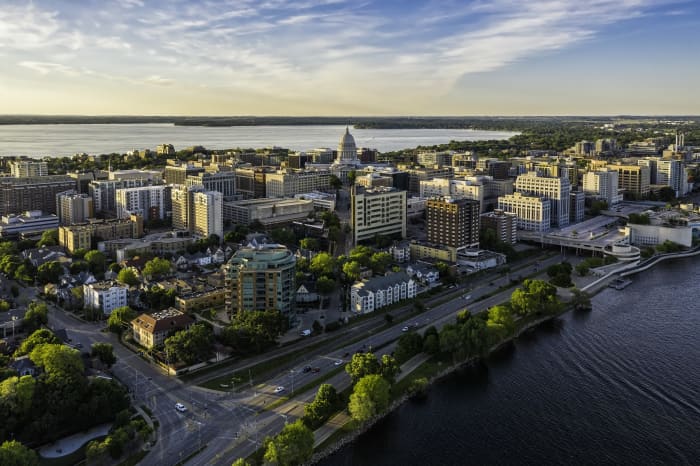
Madison is the capital of Wisconsin and home to the flagship state university. ISTOCK

Your diploma has been framed, the cap and gown are in storage, and you’ve been to more going-away parties than you can count. Now, where to focus that job hunt and narrow down where to live after graduation? If your destination wish list includes lots of culture, a smaller-town feel and football Saturdays (you’re never too old to tailgate), it may be time to head back to school — only without all the classes and homework.

Here are five college towns that are great places to live after graduation. 

1. Madison, Wis.
Lakes Monona and Mendota and the urban core of Madison, Wis. ISTOCK

If the Midwest is calling your name, this authentic college town, home to the University of Wisconsin-Madison, is an easy answer. Frequently recognized on award lists — one of the best cities in the Midwest, best city for biking, happiest city in the world, greenest city, fittest city, etc. — the state capital has the feel of a smaller town (population: 272,159) but offers big-city amenities and culture. With an array of museums, the largest producer-only farmers market in the nation and plenty of food fests — from the world’s biggest Brat Fest to the Isthmus Beer Cheese Festival — it’s also just 77 miles from Milwaukee and 122 miles from Chicago.

Madison is also an excellent place for 20-somethings (more than half the population is younger than 30) and those who seek an active lifestyle (you’ll find five lakes, more than 260 parks and bike paths everywhere you look). 

Ready to move? The average rent for a one-bedroom apartment is $1,567, roughly $400 below the national average, and the median home value in Madison is $339,874. The largest job sectors include healthcare, life sciences, agriculture, advanced manufacturing and IT, and, of course, public employment in education. Is that “On, Wisconsin” we hear you humming?

2. Corvallis, Ore.
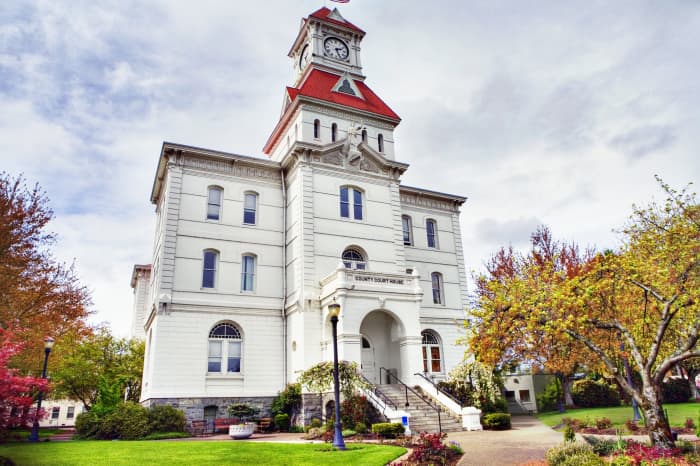
Corvallis is home to Oregon State University. ISTOCK

So your ultimate town wish list includes charming homes, proximity to outdoor adventures, a vibrant college campus and breweries, wineries and independent restaurants? It’s a tall order, but Corvallis, home to Oregon State University, will check all your boxes. 

The pretty, stately campus, situated near downtown, is one of just a few in the country with National Register of Historic Places status and hosts many cultural events (and Pac-12 athletics) open to the public throughout the year. 

With a population of 58,612 and an average Benton County home price of $527,363, it’s also a place where creative jobs are common — nearly half of the workforce is engaged in careers in science and technology, design and architecture, arts, entertainment and media, healthcare, law, management, and education.

Also see: 25 of the best places to live out West

Weekend warriors will love its location in the Willamette Valley (just 90 minutes from Portland), where both skiing and the Oregon coast are within easy drives, but crowd-drawing events, including a festival called da Vinci Days and the Corvallis Fall Festival, make staying put fun, too. 

3. Ames, Iowa
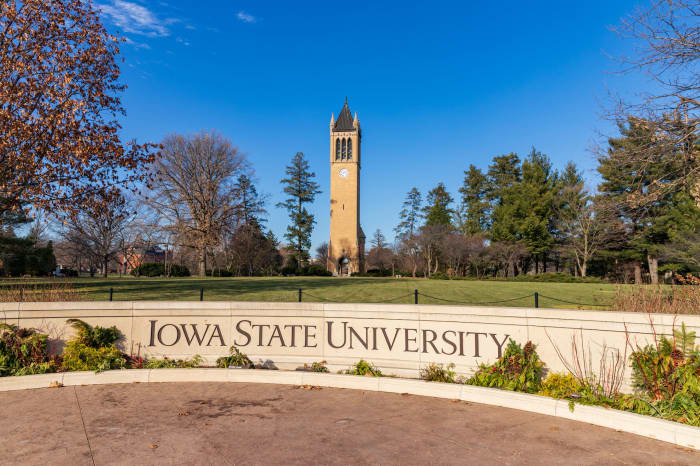
A view of the Iowa State University campanile. ISTOCK

“Is this heaven? No, it’s Iowa.”

Longtime residents of Ames may tire of the famous “Field of Dreams” line, but the movie quote isn’t far off. Boasting Iowa State University, 36 parks, a fun downtown scene, miles and miles of bike trails, four golf courses and more, this college town is a solid place to put down roots.

And it’s not just us saying it: Ames, with a population of 66,361 (including students), has racked up a long list of accolades, including best place for STEM grads, best town for millennials and healthiest city. 

If you plan to have kids, Ames has one of the nation’s top school systems. If you crave culture, the university brings Broadway shows, Pulitzer Prize–winning speakers and famous artists from across the world. If you love collegiate athletics, the Big 12 member ISU Cyclones will have you cheering. 

Don’t miss: This Iowa town will pay you to build a house there

And it’s affordable, too: The median home value is $246,387, and the average rent for a one-bedroom apartment is $725. Top jobs are in education, government and professional, and scientific and technical services.

Heaven? No, it’s Ames. 

Also see: The best affordable places to live in the U.S.

4. Ann Arbor, Mich.
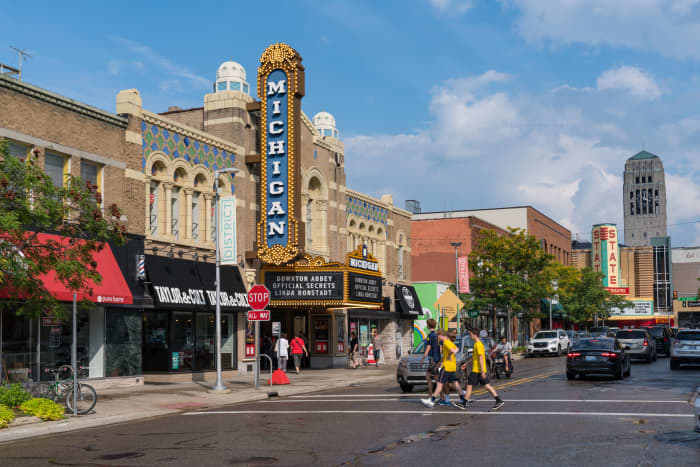
Liberty Street in Ann Arbor. GETTY IMAGES

Thinking of moving to Wolverine territory? Start by learning the lyrics to the University of Michigan fight song (“Hail! to the victors valiant; Hail! to the conqu’ring heroes; Hail! Hail! to Michigan, the champions of the West!”), then get ready to take notes on what makes this city (one of the best in the country) so beloved.

First is the college’s award-winning museums, cultural performances, nationally ranked sports teams (the football stadium seats a whopping 107,601, with epic tailgating on its exterior) and Instagram-worthy campus. Then there’s the food and drink scene: more than 300 restaurants, food trucks, a charming farmers market and a host of breweries.

See: 25 of the best cities and towns to live in the Northeast U.S.

Or the festivals held most weekends, such as July’s Ann Arbor Art Fair, April’s FoolMoon and FestiFools and holiday lights fest. Or the outdoor options — you could golf, hike, mountain bike, snowshoe or cross-country ski or canoe, paddleboard or kayak the Huron River. 

Named a winner on lists celebrating the most educated cities in America, best coffee, best college towns, happiest cities, best cities for entrepreneurs, best city for millennials and so on, Ann Arbor boasts about 122,915 residents (U. of M. students included). The median home value is $377,706, and almost 10% of the workforce is employed by the university (the city’s largest employer); unemployment is low, with the healthcare, automotive, IT and biomedical research fields as local leaders.

Ann Arbor? Hail, yes!

5. Fort Collins, Colo.
On the Poudre River Trail in Fort Collins. ISTOCK

When it comes to Rocky Mountain college towns, Boulder tends to get most of the love. But Fort Collins, home to CU’s intrastate rival, Colorado State, is bursting with potential as a worthy city in which to put down roots.

And if you’re a beer drinker, it’s time to hoist a pint. Fort Collins makes roughly 70% of the craft beer produced in the state of Colorado and has one of the highest numbers of microbreweries per capita. When friends visit, hop on a brew tour (there are plenty to choose from) to sample a Fat Tire from New Belgium, a 90 Shilling from Odell or a Dunkel from Zwei. 

Just an hour’s drive north of Denver, this town (population: 172,676), may center on CSU (which boasts a world-class performing-arts center, historic buildings and a state-of-the-art stadium), but it also supports a ballet troupe, opera company, symphony, art galleries, museums and lots of live music venues. The major employers in the area include Advanced Energy Industries, Anheuser Busch, Banner Health and CSU. 

Also see: I’m looking for a place that has year-round mild, sunny weather and is near or on the water, and my budget is $125,000 — where should I retire?

And the setting ain’t bad. Located along the Cache la Poudre River and along the Front Range, camping, hiking, skiing, fishing, biking and other outdoor adventures are just moments away. It’s a perpetual award winner on top-cities lists, from the best city for cycling to the best place to raise a family to the best place to live.

The average home price in Fort Collins is climbing — currently, it’s at $487,730, with one-bedroom apartments renting for $1,500 on average. But it’s easy to see why folks come here for college and stay forever. 

Climate Shocks Are Making Parts of America Uninsurable. It Just Got Worse.

The New York Times

Climate Shocks Are Making Parts of America Uninsurable. It Just Got Worse.

Christopher Flavelle – May 31, 2023

A firefighter tried to save a home in Meyers, Calif. (NYT)

The climate crisis is becoming a financial crisis.

This month, the largest homeowner insurance company in California, State Farm, announced that it would stop selling coverage to homeowners. That’s not just in wildfire zones, but everywhere in the state.

Insurance companies, tired of losing money, are raising rates, restricting coverage or pulling out of some areas altogether — making it more expensive for people to live in their homes.

“Risk has a price,” said Roy Wright, the former official in charge of insurance at the Federal Emergency Management Agency, and now head of the Insurance Institute for Business and Home Safety, a research group. “We’re just now seeing it.”

In parts of eastern Kentucky ravaged by storms last summer, the price of flood insurance is set to quadruple. In Louisiana, the top insurance official says the market is in crisis, and is offering millions of dollars in subsidies to try to draw insurers to the state.

And in much of Florida, homeowners are increasingly struggling to buy storm coverage. Most big insurers have pulled out of the state already, sending homeowners to smaller private companies that are straining to stay in business — a possible glimpse into California’s future if more big insurers leave.

Growing ‘catastrophe exposure’

State Farm, which insures more homeowners in California than any other company, said it would stop accepting applications for most types of new insurance policies in the state because of “rapidly growing catastrophe exposure.”

The company said that while it recognized the work of California officials to reduce losses from wildfires, it had to stop writing new policies “to improve the company’s financial strength.” A State Farm spokesperson did not respond to a request for comment.

Insurance rates in California jumped after wildfires became more devastating than anyone had anticipated. A series of fires that broke out in 2017, many ignited by sparks from failing utility equipment, exploded in size with the effects of climate change. Some homeowners lost their insurance entirely because insurers refused to cover homes in vulnerable areas.

Michael Soller, a spokesperson for the California Department of Insurance, said the agency was working to address the underlying factors that have caused disruption in the insurance industry across the country and around the world, including the biggest one: climate change.

He highlighted the department’s Safer From Wildfires initiative, a fire resilience program, and noted that state lawmakers are also working to control development in the areas at highest risk of burning.

But Tom Corringham, a research economist with the Scripps Institution of Oceanography at the University of California San Diego who has studied the costs of natural disasters, said that allowing people to live in homes that are becoming uninsurable, or prohibitively expensive to insure, was unsustainable.

He said that policymakers must seriously consider buying properties that are at greatest risk, or otherwise moving residents out of the most dangerous communities.

“If we let the market sort it out, we have insurers refusing to write new policies in certain areas,” Corringham said. “We’re not sure how that’s in anyone’s best interest other than insurers.”

A broken model

California’s woes resemble a slow-motion version of what Florida experienced after Hurricane Andrew devastated Miami in 1992. The losses bankrupted some insurers and caused most national carriers to pull out of the state.

In response, Florida established a complicated system: a market based on small insurance companies, backed up by Citizens Property Insurance Corp., a state-mandated company that would provide windstorm coverage for homeowners who couldn’t find private insurance.

For a while, it mostly worked. Then came Hurricane Irma.

The 2017 hurricane, which made landfall in the Florida Keys as a Category 4 storm before moving up the coast, didn’t cause a particularly great amount of damage. But it was the first in a series of storms, culminating in Hurricane Ian last October, that broke the model insurers had relied on: One bad year of claims, followed by a few quiet years to build back their reserves.

Since Irma, almost every year has been bad.

Private insurers began to struggle to pay their claims; some went out of business. Those that survived increased their rates significantly.

More people have left the private market for Citizens, which recently became the state’s largest insurance provider, according to Michael Peltier, a spokesperson. But Citizens won’t cover homes with a replacement cost of more than $700,000, or $1 million in Miami-Dade County and the Florida Keys.

That leaves those homeowners with no choice but private coverage — and in parts of the state, that coverage is getting harder to find, Peltier said.

‘Just not enough wealth’

Florida, despite its challenges, has an important advantage: A steady of influx of residents who remain, for now, willing and able to pay the rising cost of living there. In Louisiana, the rising cost of insurance has become, for some communities, a threat to their existence.

Like Florida after Andrew, Louisiana’s insurance market started to buckle after insurers began leaving following Hurricane Katrina in 2005. Then, starting with Hurricane Laura in 2020, a series of storms pummeled the state. Nine insurance companies failed; people began rushing into the state’s own version of Florida’s Citizens plan.

The state’s insurance market “is in crisis,” Louisiana’s insurance commissioner, James J. Donelon, said in an interview.

In December, Louisiana had to increase premiums for coverage provided by its Citizens plan by 63%, to an average of $4,700 a year. In March, it borrowed $500 million from the bond market to pay the claims of homeowners who had been abandoned when their private insurers failed, Donelon said. The state recently agreed to new subsidies for private insurers, essentially paying them to do business in the state.

Donelon said he hoped that the subsidies would stabilize the market. But Jesse Keenan, a professor at Tulane University in New Orleans and an expert in climate adaptation and finance, said the state’s insurance market would be hard to turn around. The high cost of insurance has begun to affect home prices, he said.

In the past, it would have been possible for some communities — those where homes are passed down from generation to generation, with no mortgages required and no banks demanding insurance — to go without insurance altogether. But as climate change makes storms more intense, that’s no longer an option.

“There’s just not enough wealth in those low-income communities to continue to rebuild, storm after storm,” Keenan said.

A shift to risk-based pricing

Even as homeowners in coastal states face rising costs for wind coverage, they’re being squeezed from yet another direction: Flood insurance.

In 1968, Congress created the National Flood Insurance Program, which offered taxpayer-backed coverage to homeowners. As with wildfires in California and hurricanes in Florida, the flood program arose from what economists call a market failure: Private insurers wouldn’t provide coverage for flooding, leaving homeowners with no options.

The program achieved its main goal, of making flood insurance widely available at a price that homeowners could afford. But as storms became more severe, the program faced growing losses.

In 2021, FEMA, which runs the program, began setting rates equal to the actual flood risk facing homeowners — an effort to better communicate the true danger facing different properties, and also to stanch the losses for the government.

Those increases, which are being phased in over years, in some cases amount to enormous jumps in price. The current cost of flood insurance for single-family homes nationwide is $888 a year, according to FEMA. Under the new, risk-based pricing, that average cost would be $1,808.

And by the time current policyholders actually have to pay premiums that reflect that full risk, the impacts of climate change could make them much higher.

“Properties located in high-risk areas should plan and expect to pay for that risk,” David Maurstad, head of the flood insurance program, said in a statement.

The best way for policymakers to help keep insurance affordable is to reduce the risk people face, said Carolyn Kousky, associate vice president for economics and policy at the Environmental Defense Fund. For example, officials could impose tougher building standards in vulnerable areas.

Government-mandated programs, like the flood insurance plan, or Citizens in Florida and Louisiana, were meant to be a backstop to the private market. But as climate shocks get worse, she said, “we’re now at the point where that’s starting to crack.”

More Than 1 in 4 American Homeowners Is ‘House Poor’

THe New York Times

More Than 1 in 4 American Homeowners Is ‘House Poor’

Debra Kamin – May 30, 2023

More Than 1 in 4 American Homeowners Is ‘House Poor’

More than one-quarter of homeowners in the United States are “house poor,” spending more than 30% of their income on housing costs, according to a new study.

Chamber of Commerce, a product research company for real estate agents and entrepreneurs, used numbers from the U.S. Census Bureau to analyze monthly housing costs and median household income in the 170 most populated U.S. cities. The company found that 27.4% of all homeowners are “cost-burdened” in its study.

Miami, Los Angeles and New York City have the highest number of “house poor” residents, with more than 4 in 10 homeowners in each city feeling stretched beyond their means by their housing bills. And with the exception of New York City, the top 10 cities in the United States for cost-burdened homeowners are all located in either California or Florida.

Why it matters: Housing costs are on the rise nationwide.

Mortgage interest rates, which dipped to historic lows at the beginning of the pandemic, climbed past 7% in 2022 — the highest numbers seen since 2002. And although rates slightly cooled in the early months of 2023, new homeowners today are still saddled with significantly higher monthly mortgage payments than neighbors who locked in a lower rate.

Add skyrocketing inflation and stagnating wages into the pot, and Americans owe trillions more than they did at the start of the pandemic. Higher housing costs means less set aside for savings, spending and emergencies.

It’s not just homeowners being squeezed, either: Rising housing costs push up rents as well, meaning both renters and homeowners are feeling strapped.

Background: The number of cost-burdened homeowners had been on the decline.

The “30% rule” is a longtime piece of personal finance gospel that advises keeping all housing expenses, including rent or mortgage payments, property taxes and utilities, from cutting into more than 30% of your monthly income.

From 2015 to 2019, the percentage of U.S. homeowners who were considered financially strapped dropped each year, from 29.4% in 2015 to 26.5% in 2019. But the pandemic has now started to erase those gains.

Los Angeles and New York mirror that national trend: In Los Angeles, where nearly half of homeowners are currently house poor, the number of cash-strapped owners dropped 4 percentage points between 2015 and 2019 but is now climbing again. The same goes for New York City, where in 2021, more than 45% of homeowners were house poor, up from 41.3% in 2019.

Miami, however, bucked the trend: The percentage of house-poor homeowners there was 44.6% in 2021, down 2 1/2 points from 2019.

What’s next: Federal interest rates might offer relief.

The Federal Reserve, fighting an uphill battle against inflation, has increased interest rates every month since March 2022. And while the Fed does not set mortgage rates, many home loans are tethered to their actions.

America’s central bank is now signaling that after nearly a year of consecutive rate increases, a break is on the horizon.

“That could signal some relief, at least for new homeowners,” said Collin Czarnecki, a researcher at Chamber of Commerce.