Relentless rain causes floods in Northeast, prompts rescues and swamps Vermont’s capital

Associated Press

Relentless rain causes floods in Northeast, prompts rescues and swamps Vermont’s capital

Lisa Rathke and John Minchillo – July 10, 2023
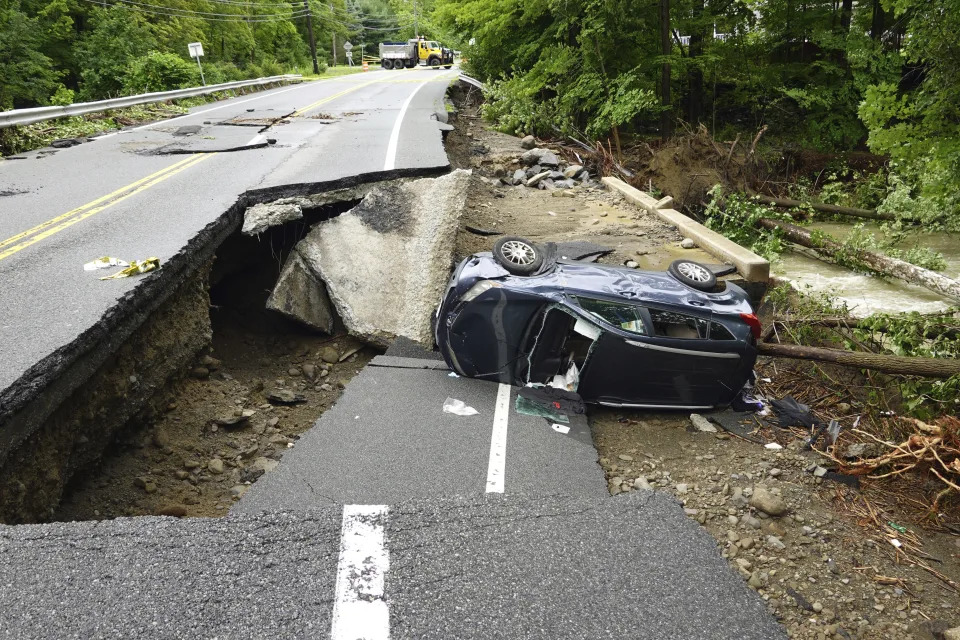
A damaged car lays on a collapsed roadway along Route 32 in the Hudson Valley near Cornwall, N.Y., Monday, July 10, 2023. Heavy rain has washed out roads and forced evacuations in the Northeast as more downpours were forecast throughout the day. (AP Photo/Paul Kazdan)
Residents, journalists, and emergency service workers walk around a flooded Main Street, Monday, July 10, 2023, in Highland Falls, N.Y. Heavy rain has washed out roads and forced evacuations in the Northeast as more downpours were forecast throughout the day. One person in New York's Hudson Valley has drowned as she was trying to leave her home. (AP Photo/John Minchillo)
Residents, journalists, and emergency service workers walk around a flooded Main Street, Monday, July 10, 2023, in Highland Falls, N.Y. Heavy rain has washed out roads and forced evacuations in the Northeast as more downpours were forecast throughout the day. One person in New York’s Hudson Valley has drowned as she was trying to leave her home. (AP Photo/John Minchillo)
Mud, rocks and debris from Sunday's flash flood cover a road on the campus of the United States Military Academy at West Point, Monday, July 10, 2023 in West Point, N.Y. Heavy rain has washed out roads and forced evacuations in the Northeast as more downpours were forecast throughout the day, Monday. (Courtesy of the USMA via AP)
Mud, rocks and debris from Sunday’s flash flood cover a road on the campus of the United States Military Academy at West Point, Monday, July 10, 2023 in West Point, N.Y. Heavy rain has washed out roads and forced evacuations in the Northeast as more downpours were forecast throughout the day, Monday. (Courtesy of the USMA via AP)
Erosion damage is seen after heavy rains washed down Bear Mountain near the Popolopen Bridge along U.S. Route 9W in Highland Falls, N.Y., rendering the bridge unsafe and impassable for vehicles, on Monday, July 10, 2023. (AP Photo/Ted Shaffrey)

ANDOVER, Vt. (AP) — Rescue teams raced into Vermont on Monday after heavy rain drenched parts of the Northeast, washing out roads, forcing evacuations and halting some airline travel. One person was killed in New York’s Hudson Valley as she tried to escape her flooded home.

Mike Cannon of Vermont Urban Search and Rescue said crews from North Carolina, Michigan and Connecticut were among those helping to get to towns that have been unreachable since torrents of rain belted the state. The towns of Londonderry and Weston were inaccessible, Cannon said, and rescuers were heading there to do welfare checks. Water levels at several dams were being closely monitored.

The U.S Army Corps of Engineers said late Monday they expected two dams to release water overnight, causing “severe flooding” downstream likely to affect multiple towns.

Flooding hit Vermont’s state capital, with Montpelier Town Manager Bill Fraser estimating Monday night that knee-high waters had reached much of downtown and were expected to rise a couple more feet during the night. Montpelier had largely been spared during Tropical Storm Irene, which struck the region in 2011.

“For us, this is far worse than Irene. We got water but it went up and down. There were some basements flooded but it didn’t last long,” Fraser said, comparing this flooding to the Montpelier Ice Jams in 1992. “We are completely inundated. The water is way, way higher than it ever got during Irene.”

During Irene, Vermont got 11 inches (28 centimeters) of rain in 24 hours. Irene killed six in the state, washed homes off their foundations and damaged or destroyed more than 200 bridges and 500 miles (805 kilometers) of highway.

There have been no reports of injuries or deaths related to the latest flooding in Vermont, according to state emergency officials. Roads were closed across the state, including many along the spine of the Green Mountains.

Some people canoed their way to the Cavendish Baptist Church in Vermont, which had turned into a shelter. About 30 people waited it out, some of them making cookies for firefighters who were working to evacuate and rescue others.

“People are doing OK. It’s just stressful,” shelter volunteer Amanda Gross said.

Vermont Rep. Kelly Pajala said she and about half dozen others had to evacuate early Monday from a four-unit apartment building on the West River in Londonderry.

“The river was at our doorstep,” said Pajala. “We threw some dry clothes and our cats into the car and drove to higher ground.”

The slow-moving storm reached New England in the morning after hitting parts of New York and Connecticut on Sunday. Additional downpours in the region raised the potential for flash flooding; rainfall in certain parts of Vermont had exceeded 7 inches ( 18 centimeters), the National Weather Service in Burlington said.

One of the worst-hit places was New York’s Hudson Valley, where a woman identified by police as Pamela Nugent, 43, died as she tried to escape her flooded home in the hamlet of Fort Montgomery.

The force of the flash flooding dislodged boulders, which rammed into the woman’s house and damaged part of its wall, Orange County Executive Steven Neuhaus told The Associated Press. Two other people escaped.

“She was trying to get through (the flooding) with her dog,” Neuhaus said, “and she was overwhelmed by tidal wave-type waves.”

Officials say the storm has already wrought tens of millions of dollars in damage. In New York, Gov. Kathy Hochul said at a news conference Monday the storm sent “cars swirling in our streets” and dumped a “historic” amount of rain.

“Nine inches of rain in this community,” Hochul said during a briefing on a muddy street in Highland Falls. “They’re calling this a ‘1,000 year event.’”

As of Monday evening, several washed-out streets in Highland Falls remained impassable, leaving some residents stuck in their homes but otherwise OK, Police Chief Frank Basile said in a telephone interview.

Massachusetts Gov. Maura Healey said there were reports of flooding in central and western Massachusetts and that state emergency management officials were in touch with local authorities.

The U.S. Military Academy at West Point was pounded with more than 8 inches (20.32 centimeters) of rain that sent debris sliding onto some roads and washed others out. Superintendent Lt. Gen. Steven W. Gilland said recently arrived new cadets and others at the historic academy on the Hudson River were safe, but that assessing the damage will take time.

Atmospheric scientists say destructive flooding events across the globe have this in common: Storms are forming in a warmer atmosphere, making extreme rainfall a reality right now. The additional warming that scientists predict is coming will only make it worse.

The storm also interrupted air and rail travel. There were hundreds of flight cancellations at Kennedy, LaGuardia and Newark airports and more than 200 canceled at Boston’s Logan Airport in the last 24 hours, according to the Flightaware website. Amtrak temporarily suspended service between Albany and New York.

Swift water rescue teams in Vermont have done more than 50 rescues, mainly in the southern and central areas of the state, Vermont Emergency Management said Monday night.

Among the buildings flooded Monday was the Weston Playhouse in Weston, Vermont, which had been performing “Buddy — The Buddy Holly Story” to sold-out audiences.

The Weston Theater Company’s executive artistic director Susanna Gellert said the call was made at around 4 a.m. to evacuate 11 people associated with the production to higher ground and another 15 in nearby Ludlow. The three-floor playhouse, which had been damaged during Irene, was also flooded, with the dressing room and props room under water.

“As a theater, we were just starting to get back from the COVID shutdown,” Gellert said. “To have this happen right now is painfully heartbreaking.”

Cara Philbin, 37, of Ludlow, Vermont, was awakened by a neighbor early Monday and told to clear out of her second-floor apartment because the parking lot was already flooded.

“He told me me, ‘You need to get out of here … your car is going to float away, and I suggest you do not stay,’” said Philbin. The neighbor took her car keys and moved her car to a higher spot, while she called her parents and then drove to their home to ride out the storm, she said.

Ross Andrews and his wife were driving back home to Calais, Vermont, on Monday when he saw trucks parked at a 230-year-old dam with crews trying to keep it from failing. There were trees down everywhere.

“The interstate was closed right at our exit. Our road was closed right at our driveway. We managed to thread our way back just in the nick of time,” he said.

Minchillo reported from Highland Falls, New York. Kathy McCormack in Concord, New Hampshire; Michael Hill in Albany, New York; and Mark Pratt and Steve LeBlanc in Boston contributed.


The Future of the “Great Resignation”

The Atlantic Daily

The Future of the “Great Resignation”

The latest jobs data suggest that workers may be losing some of the leverage they gained during the pandemic.

By Lora Kelley – July 10, 2023 

A "Help Wanted" sign
Frederic J. Brown / AFP via Getty

The latest jobs data give a mixed picture of the economy—and raise questions about how America’s workers will fare.


Losing Ground?

In the spring of 2021, I traveled to Pennsylvania to attend a graduation. Driving around the area, I was struck by all the signs in diner and fast-food storefronts seeking workers. As I recall, the signs had a desperate tone, advertising bonuses and high wages to anyone willing to work. I was witnessing in real time a fascinating economic moment: Low-wage workers were in high demand, and that meant they were gaining leverage.

The signs I saw in Pennsylvania were emblematic of what was happening across the economy. Restaurants are a “microcosm” of the Great Resignation, the pattern that took off in 2021 in which workers quit their jobs to seek higher wages and better benefits‚ Nick Bunker, an economist at Indeed’s Hiring Lab, told me. That spring, as freshly vaccinated Americans went out to spend their stimulus checks, they frequented restaurants. Demand for services soared, and so in turn did the demand for service workers. Businesses had to compete for staff. And when workers saw that they could find better wages and conditions elsewhere, many quit their jobs in favor of new ones.

The latest jobs data suggest that workers might be losing some of this power. The economy added about 209,000 jobs in June, according to data from the Bureau of Labor Statistics released last week. It was the 30th consecutive month of job gains, but gains were at their lowest rate since the streak began. “The picture that emerged was a mixed one,” Julia Pollak, the chief economist at ZipRecruiter, told me. “Workers are still in the driver’s seat in many industries, other than tech, but they are losing leverage.” However, she added, the job market is “still more favorable to workers than before the pandemic.”

What’s happening in hospitality, a sector that includes restaurants and bars, tells us a lot about the job market more broadly. That was true in 2021, Bunker told me, and it’s still true now. Looking at the behavior of the hospitality sector in last week’s report, Bunker noted, we can see that “the labor market is moderating but still strong.”

As the job market softens somewhat, workers may be losing some of the leverage they gained when the market was tighter. As Ben Casselman reported in The New York Times last week, “The rate at which workers voluntarily quit their jobs has fallen sharply in recent months—though it edged up in May—and is only modestly above where it was before the pandemic disrupted the U.S. labor market.” When workers quit jobs, it reflects their confidence that they can find another, better job. Casselman reported that hourly earnings for hotel and restaurant workers rose 28 percent from the end of 2020 to the end of 2022, which was faster than the rates of both inflation and overall wage growth. But now, after surging in late 2021 and early 2022, growth for low-wage workers has slowed, and fewer workers in the hospitality industry are separating from their jobs now compared with the same period last year.

This slowing wage growth could be seen as a sign that workers are losing ground. But another possible reason that wage growth has slowed, Bunker explained, is that many workers’ base pay has gone up compared with a couple of years ago. Employers are “giving raises off a wage rate that has risen a lot since the spring of 2021,” Bunker said.

The Fed will be happy to see the job market cooling off, Bunker told me, so we might see fewer interest-rate hikes in the months to come: “Reduced competition for workers is going to reduce wage growth, which is—in the Fed’s view—going to put less pressure on employers to raise prices, so that should bring inflation down.” But after pausing their hikes last month, following 10 consecutive rate hikes, the Fed is still widely expected to raise rates at its meeting at the end of this month.

The monthly job-openings report tells us more about the recent past than it does about our current reality. The patterns we saw in last week’s numbers contain new information about a moment that’s already slightly dated. And they raise fresh questions about whether the Great Resignation is over. Bunker, for his part, riffed on Mark Twain, saying that in his opinion, “rumors of the Great Resignation’s demise are greatly exaggerated.” But, he added, in a few months, we may be able to say more definitively whether the heyday of the Great Resignation really is behind us.

Republican’s hold on nominations leaves Marines without confirmed leader for 1st time in 100 years

Associated Press

Republican’s hold on nominations leaves Marines without confirmed leader for 1st time in 100 years

Lolita C. Baldor – July 10, 2023

Acting Commandant of the U.S. Marine Corps Gen. Eric Smith speaks during a relinquishment of office ceremony for U.S. Marine Corps Gen. David Berger on Monday, July 10, 2023, at the Marine Barracks in Washington. Smith has been nominated to be the next leader, but will serve in an acting capacity because he hasn't been confirmed by the Senate. Berger's term as Commandant of the U.S. Marine Corps expired Monday. (AP Photo/Manuel Balce Ceneta)
Acting Commandant of the U.S. Marine Corps Gen. Eric Smith speaks during a relinquishment of office ceremony for U.S. Marine Corps Gen. David Berger on Monday, July 10, 2023, at the Marine Barracks in Washington. Smith has been nominated to be the next leader, but will serve in an acting capacity because he hasn’t been confirmed by the Senate. Berger’s term as Commandant of the U.S. Marine Corps expired Monday. (AP Photo/Manuel Balce Ceneta)
ASSOCIATED PRESS
U.S. Marine Corps Gen. David Berger, left, whose term as Commandant of the U.S. Marine Corps expires Monday, holds the battle colors during a relinquishment of office ceremony, Monday, July 10, 2023, at the Marine Barracks in Washington. Assistant Commandant Gen. Eric Smith, right, has been nominated to be the next leader, but will serve in an acting capacity because he hasn't been confirmed by the Senate. (AP Photo/Manuel Balce Ceneta)
U.S. Marine Corps Gen. David Berger, left, whose term as Commandant of the U.S. Marine Corps expires Monday, holds the battle colors during a relinquishment of office ceremony, Monday, July 10, 2023, at the Marine Barracks in Washington. Assistant Commandant Gen. Eric Smith, right, has been nominated to be the next leader, but will serve in an acting capacity because he hasn’t been confirmed by the Senate. (AP Photo/Manuel Balce Ceneta)
ASSOCIATED PRESS

WASHINGTON (AP) — The U.S. Marine Corps is without a confirmed leader for the first time in a century as Gen. David Berger stepped down as commandant on Monday and a Republican senator is blocking approval of his successor.

Berger took over as the 38th commandant in July 2019, and is required to leave the job after four years. Gen. Eric Smith, currently the assistant commandant, has been nominated to be the next leader, but will serve in an acting capacity because he hasn’t been confirmed by the Senate.

Under the law, Smith can serve as the acting commandant, but he can do nothing that would presume confirmation. As a result, he can’t move into the main residence or the commandant’s office, or issue any new formal commandant’s planning guidance, which is traditional for a new leader. He has the authority to implement new policies such as budget, training and other personnel decisions.

Smith’s promotion delay is the first of what could be many top level military officers held up by Sen. Tommy Tuberville, R-Ala. Tuberville has stalled all nominations for senior military jobs because he disagrees with Defense Secretary Lloyd Austin’s decision to have the Defense Department pay for travel when a service member has to go out of state to get an abortion or other reproductive care. Abortion is now illegal in Alabama.

Speaking at a ceremony at the Marine Barracks Washington, just down the street from Capitol Hill, Austin and Berger called on the Senate to take action.

“We need the Senate to do their job so that we can have a sitting commandant that’s appointed and confirmed. We need that house to be occupied,” said Berger, with a nod to the commandant’s quarters at the edge of the parade field.

Austin and other Pentagon officials have pressed the Senate to move forward, saying that delays are already impacting more than 200 military officers, and many key leaders.

“You know, it’s been more than a century since the U.S. Marine Corps has operated without a Senate confirmed commandant,” Austin said during the ceremony.

Because of Berger’s requirement to step down in July, the Marine job is the first of the military chiefs to be affected by Tuberville. The Army, Navy and Air Force are all expected to face the same delay later this year, as could the nomination of the next chairman of the Joint Chiefs of Staff.

The current chairman, Army Gen. Mark Milley, leaves his job at the end of September. Gen. CQ Brown, the current chief of the Air Force, has been nominated to replace Milley, and is scheduled to go before the Senate Armed Services Committee for his hearing on Tuesday.

The hold, however, is also impacting scores of one, two and three-star officers who are assigned to new commands but can’t move on. It also affects their families, who usually relocate over the summer to their new military communities so school-age children can settle in before fall.

“Smooth and timely transitions of confirmed leadership are central to the defense of the United States and to the full strength of the most powerful fighting force in history,” said Austin. “Stable and orderly leadership transitions are also vital to maintaining our unmatched network of allies and partners. And they’re crucial for our military readiness.”

Smith hit the thorny issue head on during his remarks at the ceremony Monday — saying he wanted to get one thing out fast.

“If you’re saying, ‘what am I supposed to call you?’ ACMC. That is my title, and one that I’m proud of,” said Smith, using the shorthand for his assistant commandant role. But he quickly added, “to make sure that there is no confusion — all orders, directives and guidance, which were in effect this morning remain in effect, unless I direct otherwise. Further guidance to the force will follow.”

Sabrina Singh, a Pentagon spokeswoman, said Monday that as of last Friday, there were 265 senior officers whose promotions have been held up by Tuberville, and that number could leap to 650 by the end of the year if the issue isn’t corrected. She noted that in more than 100 cases, officers — like Smith — would be forced to do two jobs at the same time because no one can move up.

She said the Pentagon is asking officers to delay planned retirements and stay on, while in other cases officers are doing more senior ranking jobs without getting the pay for that new rank.

Later in the day, Jack Reed, D-R.I., chairman of the Senate committee, spoke on the Senate floor, asking that Smith be confirmed and criticizing Tuberville for what he called an unprecedented hold that is driving the U.S. military “to a potential breaking point.

“In General Smith we have a Purple Heart recipient — this man has literally shed his blood for his country,” said Reed, who attended the Marine ceremony. “He stands ready to continue his service to our nation and the Marines he will lead for four more years. He simply awaits our action.”

Tuberville, however, blocked a vote and in a Senate floor speech said the holds would have “minimal effect” on Smith’s ability to lead.

“There may be a delay in his planning guidance, and yet he cannot move into the commandant’s residence, but there is little doubt about General Smith’s ability to lead effectively,” said Tuberville.

The last time the Corps was led by an acting commandant was in 1910. Then-Maj. Gen. George Elliott, who was the commandant, reached the required retirement age in November 1910 and left the office. Col. William Biddle served as the acting commandant until he was promoted to major general and became commandant in February 1911.

Berger, a native of Woodbine, Maryland, graduated from Tulane University and was commissioned in 1981. He commanded at every level including tours in Iraq and Afghanistan.

During his tenure, he spearheaded a broad campaign to transform the Marine Corps to better be able to fight amphibious wars in the Pacific after years of battling terrorist groups in the Middle East. The plan was lauded by many in the Pentagon and Congress as a critical way for the Marines to prepare for a potential conflict with China.

Smith, a career infantry officer, is a highly decorated Marine who served multiple tours in Afghanistan and Iraq, including time in Fallujah and Ramadi during heavy combat in 2004 and 2005 in Operation Iraq Freedom. He later was the senior military adviser to Defense Secretary Ash Carter.

Associated Press writer Mary Clare Jalonick contributed to this report.

Be on the lookout for invasive, jumping “earthworms on steroids”


CBS News

Be on the lookout for invasive, jumping “earthworms on steroids”

Li Cohen – July 10, 2023

As you tend to your garden this summer, there’s a creepy, crawly creature to be on the lookout for: an invasive worm that moves like a snake, thrashes around, jumps into the air and will even shed its tail in an attempt to escape.

While worms are generally considered to be an excellent addition to help soil and gardening, there are thousands of species — not all of them equally welcome. Invasive jumping worms are one species known to actually worsen soil and make it “inhospitable” to many plants. They have been spotted in recent years, and most recently, may have even been seen in Wisconsin.

Here’s what to know about the invasive species.

What are invasive jumping worms?

Invasive jumping worms, Amynthas agrestis, go by many names, according to the USDA: Alabama jumpers, Jersey wriggles, wood eel, crazy worms, snake worms and crazy snake worms. But all those names stem from one notable feature of the critter.

“Invasive Asian jumping worms got their name because of the way they thrash around,” Forest Service researcher Mac Callaham said in a post by the USDA last year. “They can flip themselves a foot off the ground.”

The worms are thought to have first made it to the U.S. some time in the early to mid 1900s from eastern Asia, and can be transported to new areas in shipments of mulch or potted plants.

The invasive jumping worm has popped up across the U.S. in summer months after they reach maturity. / Credit: DNR

Where are they found?

The critters, which been described as “earthworms on steroids,” had infiltrated Connecticut and more than 30 other states as of last summer. According to the Connecticut Agricultural Experiment Station, the worms are often found in the eastern U.S. and parts of Canada, where the climate is “similar to the area in Japan where jumping worms come from.”

“Jumping worms are well adapted to these humid continental and humid subtropical climates, and so they have a strong potential to invade the entire eastern half of the United States and parts of Canada,” the department says.

And most recently, they may have been found in Wisconsin.

Wisconsin officials said the Door County Invasive Species Team received a report from a local resident that there may be jumping worms in a mulch pile at Sturgeon Bay’s compost site. The city, which issued a statement on July 6, said it is investigating the report and that the site will be treated “as if it is infested” until it is proved otherwise.

The Wisconsin Department of Natural Resources says the worms typically live within the top inch or two of the soil’s surface, often in debris and leaves, and can be found in yards, gardens, mulch, compost and potted plants. They spend the summer months eating and growing and are most noticeable in the late summer and early autumn once they reach maturity and start to reproduce — which they can do without mates.

Why are jumping worms bad?

Wisconsin officials explain that the worms eat the organic matter in soil and leave behind waste that looks like “hard little pellets,” known as castings, that “alter the texture and composition of soil” to make it look like large coffee grounds. That soil lacks the structure and support necessary for many native plants to survive.

The worms are also known to have build-ups of toxic metals within their systems, including mercury, cadmium, copper and lead, according to the Connecticut Agricultural Experiment Station. If those metals, which are found in soil, reach high levels within the worms, it can “negatively impact” the birds that may feed on them, researchers said.

What do invasive jumping worms look like?

The Wisconsin Department of Natural Resources describes invasive jumping worms as having a “smooth, glossy dark gray/brown color” with a cloudy-white to gray-colored band, known as the clitellum. The worms are known to have a “snake-like movement,” are often found in large numbers, and will “thrash, spring into the air and can even shed their tails to escape,” when they are disturbed, the department says.

Invasive jumping worms often have a gray or milky white clitellum band that's flat against the rest of their bodies.  / Credit: Shikha Singh, JLW CISMA/Michigan Invasive Species Program
Invasive jumping worms often have a gray or milky white clitellum band that’s flat against the rest of their bodies. / Credit: Shikha Singh, JLW CISMA/Michigan Invasive Species Program

How can you prevent and get rid of invasive jumping worms?

There are not yet any official methods to help control or prevent jumping worms, but Wisconsin officials say the best thing people can do is to educate themselves about how to recognize the creatures. People are also encouraged to clean soil and debris if moving it between areas, and only sell or purchase plants and gardening materials inspected and believed to be jumping worm-free.

If jumping worms are found, remove and destroy them by sealing them in a bag and throwing that bag in the trash, Wisconsin officials say. They also said research has shown that the worms and their cocoons can’t live through temperatures of 104 degrees Fahrenheit or above for more than three days — a temperature that can be easily hit in compost piles or can be reached by putting clear plastic over garden topsoil exposed to the sun.

Florida is now America’s inflation hotspot

CNN

Florida is now America’s inflation hotspot

Bryan Mena – July 10, 2023

Florida is America’s inflation hotspot, thanks to a persistent problem with sky-high housing costs.

The Miami-Fort Lauderdale-West Palm Beach area has the highest inflation rate of metro areas with more than 2.5 million residents, with a 9% inflation rate for the 12 months ended in April.

That’s more than double the national average of 4%, according to data from the Consumer Price Index. The Tampa-St. Petersburg-Clearwater metro had the third-highest inflation rate in the country, at 7.3% for the year ended in May.

Other metro areas, however, have seen some welcome progress. Minneapolis had an inflation rate of 1.8% in May from a year earlier, the lowest of the 23 metro areas for which the Labor Department publishes inflation data. Urban Hawaii had the second lowest inflation rate at 2% — mirroring the Federal Reserve’s target for its preferred inflation gauge, the Personal Consumption Expenditures index.

Here are some notable inflation trends for the biggest metros in the US and the dynamics behind those shifts.

A vexing inflation problem in the Sunshine State

In Florida, the state’s growing population has been pushing up inflation — particularly via housing costs. It’s a trend that accelerated during the pandemic, when remote work gave some Americans the freedom to relocate, economists say.

“A lot of people are still coming to Florida because the economy is really strong, and many like the fact that we don’t have an income tax like in New York, for example,” said Amanda Phalin, an economist at the University of Florida. “And in places like Miami, we’re seeing a lot of real estate demand from non-Floridians or non-American investors — generally wealthy folks who want to have a nice home here.”

Florida’s population grew the most of any state from July 2021 to July 2022 because of domestic migration, according to the Census Bureau’s latest estimates. During that same period, Florida also had the fastest population growth by percentage, the first time it has notched that top spot since 1957.

Housing costs account for almost a third of the Labor Department’s Consumer Price Index, and population gains heavily influence that component. An influx of residents boosts demand in a local economy across the board — for transportation, services and housing. That has pushed up inflation rates.

Rising interest rates, limited housing stock in cities such as Miami, and more expensive property insurance have also pushed up housing costs, Phalin said.

“Both the rental and purchasing markets are seeing upward pressures on prices from all these factors,” Phalin said. She added that there’s a shortage of available rental units because “a lot of homes are converting themselves into Airbnbs and some homeowner associations prohibit people from renting out their homes.”

That has all resulted in a growing affordability issue for residents who have lived in cities such as Miami and Tampa Bay for decades or their entire lives.

Progress on inflation

Housing costs also loom large in the metro area with the lowest inflation rate: Minneapolis and St. Paul.

“Shelter costs grew faster in Minneapolis and peaked a little bit earlier,” said Tyler Schipper, associate professor of economics at the University of St. Thomas in Minneapolis. “They peaked about six months before they did on average of the rest of the country.”

Also likely playing a role is how the Bureau of Labor Statistics tabulates shelter costs within the CPI and the timing of when readings are collected for various regions.

Shelter carries a lot of weight in the CPI calculations. However, it comes at a significant lag because of how infrequently the data is collected (every six months versus monthly or two months for other CPI prices) and because of how infrequently rents change (many leases are for 12 months, and rents typically are raised when a tenant leaves).

“I think that’s leading to this divergence where inflation peaked at about the same time for [the Twin Cities and the nation], but it just has dropped off faster here than in the rest of the country,” he said.

Helping that along has been a surge of multifamily construction, putting more apartments on the market and bringing down rents in the process.

Last year, multifamily permits made up nearly half of the total housing permits issued in the Federal Reserve Bank of Minneapolis’ district, which spans the Upper Midwest into the Mountain West. The activity — which was the highest share on record for that district, the regional Fed noted — is particularly evident in southeastern Minnesota, where large apartment projects are flourishing throughout the Twin Cities.

Even though the Twin Cities’ inflation rate is currently the lowest among major cities, it might not feel that way to residents, Schipper said.

“Because the CPI is so weighted toward housing, our overall numbers still looked really good, but those food prices went higher and stayed higher relative to other metro areas,” he said. “You’re going to have a hard time convincing people that inflation is getting better if their grocery store prices are still going up.”

Minneapolis resident Latoya Rogers isn’t feeling much price relief when she’s out getting groceries or buying other home goods. Aside from grabbing an item or two if she’s near a Target or a Cub grocery store, most of her shopping is done at Costco or Sam’s Club, she said.

“I budget a lot because things are so expensive these days,” she said during a quick run to Target in south Minneapolis. “Buying in bulk will last you longer.”

Still high, but doing better

At one point, the Atlanta-Sandy Springs-Roswell metro was America’s inflation hotspot.

Inflation soared in Atlanta for the reason it did in other cities in the South: The population grew, driven by Americans fleeing expensive coastal cities.

However, inflation in this metro area has come down steadily in the past year as supply and demand in the region’s housing market has come into better balance as migration into the city has slowed.

Atlanta notched an inflation rate of 5.8% in the 12 months ended in April — about half of the 11.7% peak it saw in August 2022.

“If you look at the data, housing inventory in Atlanta has increased quite a bit from a year ago, so there’s a lot more supply in the market, while the number of sales has been declining,” said Kaiji Chen, an economics professor at Emory University in Atlanta.

A drop in transportation costs also helped slow Atlanta’s inflation rate, he said.

How Is Degenerative Disc Disease Treated?

Verywell Health

How Is Degenerative Disc Disease Treated?

Patty Weasler, RN, BSN – July 10, 2023

<p>laindiapiaroa / Getty Images</p>
laindiapiaroa / Getty Images

Medically reviewed by Cara Beth Lee, MD

Degenerative disc disease treatment aims to minimize symptoms and prevent further disc degeneration. Damage to the disc cannot be reversed. The right treatment option may depend on the extent of deterioration.

Degenerative disc disease is caused by the wear of the shock-absorbing discs (intervertebral discs) between the spinal vertebrae. It can occur in any area of the spine. The symptoms of degenerative disc disease include back pain (especially when sitting), numbness and tingling in the hands or feet, and weakness in the legs.

This article will cover the different treatment options for degenerative disc disease, including conservative treatment and surgery.

Medication

Medication can minimize pain and inflammation in people with degenerative disc disease. It will not stop the progression of the condition, but decrease its symptoms.

Nonsteroidal Anti-Inflammatory Drugs (NSAIDs)

NSAIDs are medications that decrease inflammation and pain. They can relieve the associated back pain and decrease inflammation in the joints in those with degenerative disc disease.

Aspirin and Advil or Motrin (ibuprofen) are common over-the-counter (OTC) NSAIDs. Prescription NSAIDs include Nalfon (fenoprofen), ketoprofen, and sulindac.

Potential side effects of NSAIDs include ringing in the ears, dizziness, gas, bloating, constipation, and nervousness. People who are on blood thinners, have poor kidney function, or are pregnant should talk to their healthcare provider before taking an NSAID.

Nonnarcotic Pain Relievers

Tylenol (acetaminophen) is a common OTC pain reliever. Prescription nonnarcotic pain relievers may also be recommended by a healthcare provider.

Narcotic Medications

Narcotic pain medications may be prescribed by a healthcare provider when pain is moderate to severe.

Narcotics like codeine and morphine work in the central nervous system (CNS) to numb pain. While narcotics are an effective pain medication, they do carry many side effects. These include:

Constipation is a very common narcotic side effect. Talk to a healthcare provider about starting a stool softener or increasing dietary fiber.

Muscle Relaxants

If someone is having muscle spasms in their back then a muscle relaxant may be a good choice to help relieve pain and spasms. Common muscle relaxants include Soma (carisoprodol) and Flexeril (cyclobenzaprine).

Muscle relaxants should not be used long-term, but rather for just three to four days. There are serious side effects like depression and drowsiness.

Antidepressants

Antidepressants may be used to treat pain and poor sleep in people with degenerative disc disease. The chemical reactions in neurons that cause depression seem to be the same nerve pathways as pain.

Using an antidepressant may not be right for everyone, but can be helpful to regain a normal sleep routine due to back pain.

Physical Therapy

People with degenerative disc disease may benefit from physical therapy. The overall goal of physical therapy will be to decrease pain and improve muscle strength and flexibility. This will help the body support the spine and reduce pain and stiffness.

There are many different treatments used under the physical therapy umbrella. They may include:

  • Transcutaneous electrical nerve stimulation (TENS): The electrical stimulation from a TENS unit interferes with or blocks pain signals and can work for back pain.
  • Strength training: Strengthening the core can stabilize the spine and reduce back pain.
  • Improving flexibility: This can improve spine mobility and range of motion. Stretching also decreases back spasms.
  • Posture training: Poor posture contributes to back pain. A physical therapist can teach someone how to sit, stand, and move correctly.
Exercise

Regular exercise is an important component in maintaining spine health. Exercise strengthens back and abdominal muscles, which support the spine. A person with degenerative disc disease should talk to a healthcare provider before beginning an exercise routine. Ask if any motions (such as twisting) should be avoided.

Many types of exercise can be used, like weight training, aerobic exercise, and aquatic therapy, as follows:

  • Weight training combines weights with exercise and helps to prevent bone loss and strengthen muscles.
  • Aerobic exercise like walking, cycling, or running increases the heart rate and blood pressure while also releasing endorphins (the body’s natural pain relievers).
  • Aquatic therapy, or exercise in a pool, is an effective and low-impact aerobic exercise that is beneficial to people with degenerative disc disease. The water decreases pressure on the spine allowing the person to get the benefits of a workout without all the physical stress.
Chiropractic Care

Chiropractic care uses adjustments to the spine to correct improper alignments, reduce pain, and improve the body’s ability to heal itself. There is limited research on the effectiveness and safety of chiropractic care for people with degenerative disc disease, so it should be discussed with a healthcare provider before use.

Acupuncture

Acupuncture is a traditional Chinese medicine practice in which thin needles are inserted into the skin in different areas of the body. An acupuncturist will place the needles along meridians (traditional energy pathways). Acupuncture may improve healing by increasing blood flow or relieve pain by releasing endorphins.

Heat or Cold Therapy

Heat and cold therapy is a common treatment used to alleviate pain in joints.

Cold therapy works by applying an ice pack or cold towel to the painful area for 20 minutes at a time. The cold will interrupt the pain signal, thereby reducing pain. It will also cause the surrounding blood vessels to tighten, which will reduce swelling.

Heat can be used with a warm towel or heating pad. The heat will soothe sore muscles and dilate the surrounding blood vessels, which improves blood flow to the area.

Spine Injections

steroid spine injection can reduce back pain and inflammation caused by degenerative disc disease. The injections use a combination of steroid medication and numbing medicine. Pain relief usually starts soon after the injection and lasts a few weeks to months.

Healthcare providers may limit the number of steroid injections a person can receive in a year. Too many can cause an infection or skin discoloration. Steroid injections are typically used when other conservative treatments are not successful.

Bracing

Another nonsurgical option for degenerative disc disease is a back brace. A back brace is a medical device that is wrapped around the lower back and secured with Velcro. The brace does not completely immobilize the back but does reduce the ability to move. It can stabilize the spine and reduce tension in people with degenerative disc disease.

Surgery

When degenerative disc disease does not respond to conservative treatment, surgery may be necessary. Below are the different surgical options that can be used.

Disc Replacement

Disc replacement is used in place of a spinal fusion in people under 65 years of age who have a herniated disc in the neck. An artificial disc is placed where the damaged disc is removed. One of the greatest benefits is that it allows flexibility and stability in the spine.

People who have a disc replacement can usually go home after one night in the hospital and can walk within 24 hours. They may need to wear a brace for support during the first few weeks after surgery.

Discectomy

discectomy is a common surgery used in the treatment of degenerative disc disease. During the procedure, the injured part of the disc is removed. This alleviates pressure on the surrounding nerves by making room in the spinal canal.

Spinal Fusion

spinal fusion is when a surgeon permanently joins the vertebrae to eliminate movement and stabilize parts of the spine. Spinal fusion may be necessary when there is a severely degenerated disc. It is sometimes done in conjunction with a discectomy and is more often done on the neck than the lower back.

A spinal fusion requires an overnight stay at the hospital. The patient may need to wear a brace after surgery and will need to minimize activity until their surgeon clears them.

How to Prevent Degenerative Disc Disease From Getting Worse

While preventing degenerative disc disease may not be possible, there are several ways to decrease the rate of degeneration. Here are a few steps that can be taken:

  • Stop smoking. Research shows that smoking increases the rate at which the intervertebral disc degenerates.
  • Exercise. Regular exercise will strengthen the back and core muscles that support the spine.
  • Maintain a healthy weight. People with elevated body mass index (BMI) have a higher likelihood of developing degenerative disc disease.
Summary

Degenerative disc disease is a progressive condition that results when the cushions in between the vertebrae wear down. There is no cure for the condition and treatment is aimed at reducing symptoms and preventing further degeneration. Current treatments include exercise, physical therapy, and in severe cases surgery. Talk to a healthcare provider to determine the best treatment route.

Toxic algae that can cause lung infections and neurological disorders is taking over a giant lake in Florida, and ecologists say the bloom will only grow

Business Insider

Toxic algae that can cause lung infections and neurological disorders is taking over a giant lake in Florida, and ecologists say the bloom will only grow

Katie Hawkinson – July 9, 2023

Boats sit at a dock while algae blooms turn the water green around them in Lake Okeechobee.
More than half of Lake Okeechobee is covered in algae blooms.Joe Raedle/Getty Images
  • Florida’s Lake Okeechobee is already half full with toxic algae, and the bloom will only grow.
  • Fumes from the algae can cause several health complications, like lung infections.
  • Climate warming and pollutant run-off from nearby crops help it thrive, experts say.

The largest freshwater lake in Florida, which is a draw for fishing and boating in the summer months, likely won’t see many faces this year.

That’s because Lake Okeechobee is already half-full with a bright green, toxic algae that researchers say will only grow as algae season continues on through the summer. The algae can cause several health complications, including lung infections, organ damage, and neurological disorders, The New York Times reports.

Experts told the Times the severity of this year’s bloom is, in large part, due to the warming climate that has resulted in increased rainfall and rising levels of carbon dioxide, which the algae feeds on. The algae also thrives among the fertilizer and manure that runs into the lake from nearby crops.

This is not a new problem for Florida. In 2018, former Governor Rick Scott declared a state of emergency across seven counties in an effort to combat the same toxic algae in Lake Okeechobee that was also inundating a nearby river.

Finding a solution to this toxic bloom has been a challenge.

Florida plans to build a reservoir to stop the algae from flowing out of the lake and into other bodies of water — though the Times reports that the reservoir would fill to capacity after depleting Okeechobee by only six inches.

Environmentalists are also calling on the state of Florida to implement rules limiting the run-off of pollutants from nearby crops that feed the algae, the Times reports.

This policy would take decades to make a large impact, thanks to the phosphorous-rich sediment already present in the lake.

Las Vegas Valley is making major changes to its landscape to keep up with its fast-growing population

TCD

Las Vegas Valley is making major changes to its landscape to keep up with its fast-growing population — here’s what’s happening

Mary Swansburg – July 9, 2023

The Las Vegas Valley is working with its citizens to help them ditch their grassy yards and embrace Nevada’s natural landscape instead.

The news was shared in an article by ProPublica that was reposted on Reddit.

Las Vegas Valley landscape
Photo Credit: u/WhoIsJolyonWest / Reddit

The effort will conserve water and allow the population in Vegas to continue growing.

Community members have already done their part to conserve water indoors, and Nevada treats and recycles all indoor water. Outdoor water, however, cannot be recycled in the same way because it evaporates or settles into the ground.

Because of this, the state is turning toward grass reduction because growing grass in the desert climate requires a significant amount of water.

A similar plan has been utilized before and helped the conservation effort, but it encountered some pushback from homeowner associations (HOAs.) Also, some citizens want to preserve the aesthetic of green lawns, so the state is making an effort to find a compromise.

The state is targeting “nonfunctional” grass first, like grass that lines roadways and lakes, with the goal to get rid of all of it by 2027. Citizens upset about grass removal can submit an exemption request — many of which are approved — making the pushback from HOAs minimal.

In addition, some companies like Par 3 Landscape and Maintenance are offering ideas for alternative plantlife that is native to the area, such as evergreens and desert-friendly shrubs.

Families that choose to embrace the natural landscape will lower their water bills while leaving resources for the addition of new residents and businesses. On top of that, they’ll be helping to fight rising global temperatures.

Princeton reported that 800 million gallons of gasoline, which releases planet-warming gases, are used by lawn equipment each year, and an additional 17 million gallons are spilled in the process.

Plus, the Natural Resource Defense Council reported that lawns are responsible for consuming almost three trillion gallons of water each year. And when grass is grown outside of its natural habitat, it doesn’t benefit the local wildlife either.

One Redditor echoed this in the comments. “Lawns do NOT belong in the southwest,” they wrote.

Luckily, the Las Vegas Valley is setting a great example for communities looking to conserve water.

“If everyone else takes on similar initiatives, we’ll be able to sustain our community and communities across the Colorado River Basin for future generations,” said Howard Watts, Nevada state representative.

Investigation Uncovers More of Clarence Thomas’ Undisclosed Freebies from Wealthy Pals

Rolling Stone

Investigation Uncovers More of Clarence Thomas’ Undisclosed Freebies from Wealthy Pals

Peter Wade – July 9, 2023

Clarence Thomas’ connections to wealth and expensive vacations run deeper than billionaire businessman and Nazi-enthusiast Harlan CrowThe New York Times reports that Thomas has milked relationships with the rich he made through the Horatio Alger Association of Distinguished Americans, a scholarship association, to benefit himself and his wife.

Because of their Horatio Alger connections, Thomas and his spouse, Virginia, have been invited to join luxurious vacations and parties in addition being granted V.I.P. access to sports events. Thanks to the association, Thomas also rubbed elbows with the likes of Oprah Winfrey and Ed McMahon during a lavish three-day Montana birthday party for billionaire industrialist Dennis Washington.

But the connections Thomas made through Horatio Alger have benefitted him beyond lavish trips. Thomas’ Horatio Alger contacts — including Washington as well as investor David Sokol, formerly of Berkshire Hathaway — helped fund a documentary that painted him in a heroic light after the premiere of an HBO movie that depicted Anita Hill during his confirmation hearings making sexual harassment allegations against Thomas. The Sokol family also hosted Thomas and his wife at their Montana ranch and their waterfront Florida estate. According to the Times, Thomas has not reported many of the benefits and gifts he has received from his rich and well-connected allies. The justice also declined to answer questions from the paper about the matter.

Early in his SCOTUS tenure, Thomas did report a number of personal gifts he received, including flights on private planes, cigars, and clothing. But after 2004, when The Los Angeles Times reported on his disclosures, Thomas ceased reporting to the court certain gifts and benefits he received. A ProPublica investigation in 2023 uncovered the justice’s close relationship with Crow, a GOP megadonor with a large collection of Nazi memorabilia and Hitler paintings, including trips on Crow’s private jet and yacht totaling tens of thousands and Crow’s purchase of the house where Thomas’ mother lived. Crow even paid tuition for Thomas’ nephew, who the Thomases were raising. After his relationship with Crow came to light, Thomas justified his lack of disclosures, claiming that “colleagues and others in the judiciary” advised him he did not need to report trips of “personal hospitality” from friends.

Thomas has not only accepted benefits that granted him access to places he otherwise may not have gone, he also hosts the Horatio Alger Association’s induction ceremony for new members in the Supreme Court’s courtroom, which the Times notes is “unusual access” for an outside group. The association has parlayed the access Thomas gives them to fundraise for scholarships and events, per fundraising records reviewed by the Times.

The court this year updated its disclosure rules to mandate justices report private jet travel and comped stays at hotels and resorts, but there is an exception for “personal hospitality,” meaning food, accommodations, or entertainment that is not related to business.

“The Horatio Alger Association has been a home to Virginia and me,” Thomas said when he received the association’s highest honor in 2010, adding that the association “has allowed me to see my dreams come true.”

If his dreams were of undisclosed fancy vacations and V.I.P. access, then that’s probably the case.

Staying active and healthy – here are some key points to stay fit as you get older

Portsmouth Herald

Staying active and healthy – here are some key points to stay fit as you get older

Brandon Brown, Portsmouth Herald – July 8, 2023

Peter Hubbard, 85, spots his wife, Nona, 61, during a recent weight-lifting workout. Both will compete at the Powerlifting America New Hampshire State Championship at The Lift Free or Die Gym in Dover starting at 9 a.m.

Peter Hubbard, an 85-year-old Candia resident, is a big advocate for physical activity, especially as people age.

“There’s lots of research and data that shows that as you grow older, you’re going to lose muscle density and mass, but you can maintain it better through exercise,” Hubbard said. “It’s been proven that exercise improves your life expectancy, it gives you the ability to do things when you get older that you wouldn’t be able to do. You don’t have to lift all these heavy weights, and I don’t expect everybody to go out and try to be a powerlifter, but if you continue to work out and lift weights, then you can live into you 60s, 70s and 80s, and you’re going to have a better quality of life.

This Sunday, Hubbard will compete in the Powerlifting America New Hampshire State Championship at The Lift Free or Die Gym in Dover starting at 9 a.m.

Though there are three events – the squat, the bench-press and the deadlift, Hubbard is only participating in the bench-press. Hubbard’s goal is to bench more than 200 pounds. Hubbard’s wife, Nona, 61, will participate in all three events.

Although preparation for such a competition takes at least three months, Hubbard is in the gym and keeps up with physical activity year-round.

Hubbard is a role model for how to keep your body strong and fit as you enter your golden years.

Caroline Schepker, doctor at Wentworth-Douglass
It’s never too late to get physically fit

The aging process, realistically, begins in the late 20s and doesn’t become noticeable for most people until their 40s or 50s, said Dr. Caroline A. Schepker, a physiatrist who specializes in physical medicine and rehabilitation and sports medicine at Wentworth-Douglass Hospital in Dover.

“It’s usually around the age where people start to notice that they feel a little bit stiffer, maybe a little bit more easily aching, and look like they’ve lost a little muscle mass,” she said. “The best time to start prevention wise is in your 20s and 30s and kind of maximizing your muscle mass and your mobility.”

Additionally, Schepker said it’s never too late to start with things such as mobility training and strength training.

“And what that could look like is working with either a physical therapist or athletic trainer, or personal trainer to develop a whole body strength and conditioning program that also works on mobility, which is just flexibility and range of motion,” Schepker added.

“The general prescription of physical activity, whether it’s in a sport or just going to the gym or doing your own independent exercise, there’s three categories to it,” Schepker said. “One is aerobic exercise, also known as cardiovascular exercise, the second is resistance training or strength training and the third is flexibility and balance; they kind of put those three together.”

From a fitness standpoint, an ideal week involves two to three days, or 150 total minutes of aerobic exercise, at least two days a week with strength training and at least two days a week with range of motion exercises.

The most common problem Schepker sees is pain, and mostly coming from the spine and lower back, and secondly the hips, knees and shoulders.

“What that usually comes down to is a relative lack of core strength conditioning,” she said. “Even very fit active people can lose touch with their core muscles and how to optimally activate them to stabilize their spine. It can really irritate the little joints and discs in the back. So that’s probably what I see in the older, more active athletic population.”

Stretching or no stretching?

Schepker said stretching is actually one of the topics that can be controversial.

“If you really look into the research to stretching, some people say stretch and some people say don’t,” she said. “I think the reason why it’s complicated is because it’s not just stretching, but also mobility and range of motion exercises; they all have their place.”

Schepker said the research and studies shows that the recommendation is that as people get older, connective tissues, such as tendons and ligaments, naturally start to stiffen.

“Our joints generally get a little stiffer, and we lose range of motion, so it becomes important to do some stretching or range of motion medicine,” she said.

While daily is preferred, the American College of Sports Medicine recommends that adults who are 65 and older stretch at least three times per week.

“And what they recommend for that is really performing stretches of all major muscle groups, meaning the muscle groups that surround the hips, the trunk spine, shoulders and holding stretches for at least 10 to 30 seconds,” Schepker said. “Bigger muscles, like the hamstrings, may require up to 60 seconds. But, holding a stretch is called static stretching and that’s generally done after physical activity or kind of in isolation. Whereas before physical activity, it’s more important to do more kind of active range of motion instead of static holds of stretching.”

Schepker said active range of motion includes things like gently moving joints through their range of motions.

“Things like arm circles, arm swings, hip circles, just kind of getting all the joints through their range,” Schekper said.

How should ages 65 and older approach physical activity

Below is a chart that outlines what the American Heart Association and ACSM recommends for frequency, intensity and types of training for those 65 and older.

Physical Activity Recommendation Chart

“Some older adults who have athletic or fitness backgrounds may feel comfortable looking at those guidelines and kind of being independent with them,” Schepker said. “For those who have questions or concerns about how to incorporate any piece of it, whether it’s the aerobic aspect, or the strength training, or the flexibility or the balance, usually the best place to start is speaking with your doctor and/or working with a physical therapist or athletic trainer.”

Schepker said working with a physical therapist or an athletic trainer is a good way to develop a program for themselves and get comfortable with some of the concepts to where they can branch off to do it independently.