The stinky, disgusting downside of the world’s demand for pork

New York Post

The stinky, disgusting downside of the world’s demand for pork

The Associated Press     March 5, 2018

All the waste from the Everette Murphrey Farm is stored in open-air lagoons and sprayed onto fields as fertilizer. AP

WILLARD, NC — Terry “Pap” Adams says he was out in the backyard, tinkering on one of his car projects, when another cloud of noxious pinkish-brown mist drifted overhead. The droplets hit his wife’s black car, leaving blotches with greasy little dots in the center.

“You can feel it on your clothes,” he said as he stood outside his home in rural Willard, about 70 miles southeast of Fayetteville. “You could feel it, like a misting rain. But it wasn’t misting rain. It was that stuff.”


Orrin Hatch Calls Obamacare Supporters ‘The Stupidest, Dumbass People I’ve Ever Met’

HuffPost

Orrin Hatch Calls Obamacare Supporters ‘The Stupidest, Dumbass People I’ve Ever Met’

David Moye, HuffPost    March 2, 2018

Orrin Hatch Calls Obamacare Supporters;The Stupidest, Dumbass People I’ve Ever Met

Sen. Orrin Hatch (R-Utah) is apparently sick of people who support affordable health care.

On Thursday, the Republican politician called supporters of the Affordable Care Act, otherwise known as Obamacare, “the stupidest, dumbass people I’ve ever met,” according to Salt Lake City station KSTU.

Hatch made the comments during a speech about the recent GOP tax overhaul that repealed the health care law’s individual mandate, according to The Hill.

The insult came after Hatch referred to “that wonderful bill called ‘Obamacare.’”

“Now, if you didn’t catch on, I was being very sarcastic,” he said.

Hatch then called the Affordable Care Act “the stupidest, dumbass bill that I’ve ever seen.”

He added:

“Now, some of you may have loved it. If you do, you are one of the stupidest, dumbass people I’ve ever met. This was one of them — and there are a lot of ’em up on Capitol Hill from time to time.”

Hatch’s comments came the same day the Kaiser Family Foundation released a poll saying the Affordable Care Act was popular with 54 percent of the population.

That’s the highest level of support since the law was enacted in 2010, according to The Hill.

Hatch spokesman Matt Whitlock tried to put a Band-Aid on the senator’s Obamacare insults.

“The comments were obviously made in jest, but what’s not a joke is the harm Obamacare has caused for countless Utahns,” Whitlock told KSTU.

In January, the 83-year-old Hatch announced he would retire from the Senate at the end of 2018. He has served in the office since 1977.

Comments:

Boltarama: “195,000 Utahns signed up for health insurance under Obamacare for 2018 — nearly matching last year’s number, when the enrollment period was twice as long, the Trump administration reported Thursday. About 130,000 people were expected to be covered in 2018 by Intermountain Healthcare SelectHealth, while University of Utah Health Plans signed up 25,000 in the six-week open enrollment period that ended Dec. 15, the insurers told The Salt Lake Tribune.” He’s talking to you folks who voted for him since the beginning of time!!

Colonel: Hatch just insulted over 1/3 of Trump’s base.

Concerned: HATCH + TRUMP= DEPLORABLES

dmacho: TRUMP folks all have STD ” stupid trump disorder ”

Lloyd: Orin Hatch died 10 years ago. He just hasn’t fallen over yet.

Samuel: Says the guy who supports Trump.

trijamma: I agree Obamacare isn’t great. But it’s better than anything Republicans have proposed, which is nothing but trying to tear down an honest attempt to fix health care.

Jason: Yeah, people that want access to affordable healthcare for their families are stupid. Thanks so much Senator.

Gumby: Hillary was crucified for calling racists deplorable, but its okay for Orrin Hatch to call people who want universal healthcare stupid.

Bob P: Let Hatch retire, but for God’s sake don’t let him become an usher taking hold of a collection plate at the Mormon Tabernacle.

If the Supreme Court rules against unions, conservatives won’t like what happens next 

Washington Post

Democracy Dies in Darkness

If the Supreme Court rules against unions, conservatives won’t like what happens next 

Janus vs. AFSCME could mean the end of no-strike clauses.

By Shaun Richman          March 1, 2018

Activists rally in front of the U.S. Supreme Court on Feb. 26. (Alex Wong/Getty Images)
On Monday, the Supreme Court heard the case Janus vs. AFSCME, with the fate of the labor movement seemingly in the balance. At stake are agency fees — public sector unions can collect fees for service from employees who don’t join the union that represents them, which the plaintiff argues is an unconstitutional act of compelled speech.

The deep-pocketed backers of Janus aim to bankrupt unions and strip them of whatever power they still have, but if the court rules that an interaction a union has with the government is political speech, they might not be so happy with the results. Many have noted that such an overreaching and inconsistent decision could have unintended consequences by granting a heretofore denied constitutional right to collective bargaining and transforming thousands of workplace disputes into constitutional controversies.

What the Janus backers (and most commentators) miss is that agency fees are not just compensation for the financial costs of representation, but for the political costs of representing all the members in the bargaining unit and maintaining labor peace. As AFSCME’s attorney pointed out in his oral arguments, the agency fee is routinely traded for a no-strike clause in most union contracts. Should those clauses disappear, employers will have chaos and discord on their hands.

American labor laws, and the employers who benefit from them, prefer that if there’s going to be a union, only one should serve as the exclusive representative of all eligible employees in a workplace. That scheme imposes on unions a legal obligation to fairly represent all members of the bargaining unit, and a political imperative to defend the terms of any deal as “the best we could get” (even if it includes concessions on benefits and work rules). It rewards the unions with a guaranteed right to exist and a reliable base of fee-paying membership. But it rewards employers with the far more valuable guarantee of the right to direct the uninterrupted work of the enterprise while union leadership has to tamp down rank-and-file gripes and discord for the length of the contract.

The combination of exclusive union representation, mandatory agency fees, no-strike clauses and “management’s rights” are the foundation of our peculiar labor relations system. No other country structures its labor relations system quite like this. Knock one part out, as the Janus plaintiffs aim to do with agency fees, and the whole system can fall apart. Employers will not like the chaos that this will bring.

Before this system evolved during the New Deal, multiple unions did compete in individual workplaces for dues-paying members and shop floor leadership. They would compete over who made the boldest wage and hour demands and who led the most disruptive job actions, as well as who could forge a more productive relationship with management or just flat-out take a sweetheart deal. But no deal could bring lasting labor peace, as any union cut out of the deal had a political need to disparage its terms and agitate for a fresh round of protests. In the New York City hotel industry, for example, rival anarchist and Communist unions competed with a number of craft unions. Their one-upmanship resulted in half a dozen industry-wide strikes between 1911 and 1934, until the industry voluntarily recognized one merged union council in 1938.

World War II strained this system. As a show of patriotism, unions pledged not to strike to maintain defense production, but were rewarded with federally enforced wage freezes to combat inflation. Workers who were squeezed by rising consumer prices found themselves unable to file a grievance if they were fired for engaging in wildcat strikes; many chose to quit their unions in protest. With their leadership and revenue under threat, union leaders considered abandoning their no-strike pledge.

To maintain production and labor peace, federal arbitrators began granting unions a “maintenance of membership” clause in contracts, which compelled union members to continue to pay dues during the terms of a collective bargaining agreement. That evolved into today’s union shop and agency fee. Public-sector labor laws, which are immediately at issue in Janus vs. AFSCME, are modeled on private-sector labor law and ruled by the same bargaining dynamics.

If the Supreme Court rules against AFSCME in Janus, many unions will abandon exclusive representation altogether. Their primary motivation will be avoiding the “free rider” problem — being required to expend resources on workers who opt out of paying anything for those services. And new unions will form to compete in that abandoned space.

The first unions to compete will probably be conservative. In non-bargaining Southern states that do not recognize formal union representation, organizations already exist that vie with teachers unions by offering minimal services and the promise to refrain from political activity. And right-wing foundations are paying for “organizers” to go door-to-door to convince union-represented workers to stop paying dues where they no longer have to. Would anybody really be surprised if rich and powerful funders encouraged new anti-union “unions” to more closely align members with the GOP agenda?

Those will eventually be followed by new unions that are more left-wing or militant (or at least crankier). They will not be satisfied with the current work rules and compensation and will have little incentive to settle.

Under the current scheme, those kinds of differences of opinion are aired in winner-take-all leadership elections between competing factions. A post-Janus system of voluntary representation would encourage many opposition caucuses to break away and form alternative, minority unions for their members only.

The solicitor general of Illinois — indirectly a party to the Janus case — warned in Monday’s oral arguments “that when unions are deprived of agency fees, they tend to become more militant, more confrontational.” And AFSCME’s counsel warned about the thousands of contracts that would have to be renegotiated in a climate where an agency fee is no longer a trade for a no-strike pledge, raising “an untold specter of labor unrest throughout the country.”

Although Janus vs. AFSCME applies to public-sector unions, this same logic applies to the majority of states that have passed “right to work” laws prohibiting mandatory union fees in the private sector. And the big-money, right-wing plotters who have been pushing Janus are gunning for the blue states, too.

“No-strike” clauses buy employers a period of guaranteed labor peace. They would be basically unenforceable if workers could quit a voluntary association to engage in a wildcat strike, or join an alternative union that eschews signed agreements to have the freedom to engage in sudden unannounced job actions.

Many union organizers, frustrated by the unequal application of constitutional rights in labor relations and hungry for breakthrough strategies to revive the labor movement, will welcome this kind of chaos. Conservatives who just want to deprive unions of financial resources for short-term partisan gain should think twice about this attack — if the court rules their way, they will not like what comes next.

Worshippers clutching AR-15 rifles hold commitment ceremony

USA Today

Worshippers clutching AR-15 rifles hold commitment ceremony

Michael Rubinkam, The Associated Press     February 28, 2018

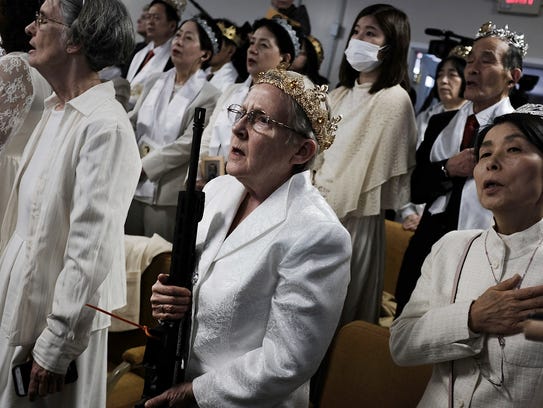
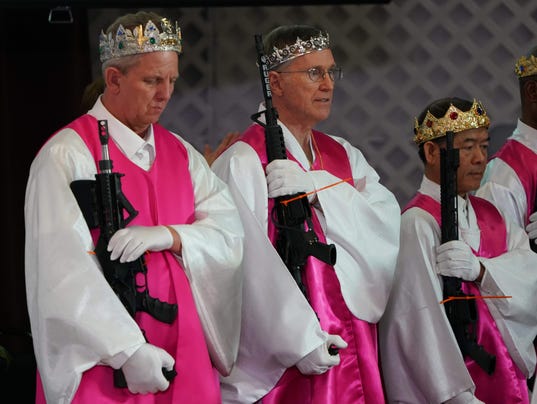
Worshipers clutching AR-15 rifles drank holy wine and exchanged wedding vows in a commitment ceremony at a Pennsylvania church.

   (Photo: DON EMMERT, AFP/Getty Images)

NEWFOUNDLAND, Pa. — Crown-wearing worshippers clutching AR-15 rifles drank holy wine and exchanged or renewed wedding vows in a commitment ceremony at a Pennsylvania church on Wednesday, prompting a nearby school to cancel classes.

With state police and a smattering of protesters standing watch outside the church, brides clad in white and grooms in dark suits brought dozens of unloaded AR-15s into World Peace and Unification Sanctuary for a religious event that doubled as an advertisement for the Second Amendment.

The church, which has a worldwide following, believes the AR-15 symbolizes the “rod of iron” in the book of Revelation, and encouraged couples to bring the weapons. An AR-15 was used in the Florida high school massacre on Feb. 14.

The Rev. Sean Moon, who leads the church, prayed for “a kingdom of peace police and peace militia where the citizens, through the right given to them by almighty God to keep and bear arms, will be able to protect one another and protect human flourishing.”

Moon is the son of the late Rev. Sun Myung Moon, a self-proclaimed messiah who founded the Unification Church, which critics regard as a cult. The younger Moon’s congregation is a breakaway faction of the Unification Church, which had distanced itself from Wednesday’s event.

              A woman holds an AR-15 rifle during a ceremony at the World Peace and Unification Sanctuary on February 28, 2018 in Newfoundland, Pennsylvania (Photo: Spencer Platt, Getty Images)

More: Why the AR-15 keeps appearing at America’s deadliest mass shootings

More: Trump says take guns first and worry about ‘due process second’ in White House gun meeting

More: Walmart bans gun sales to anyone under 21 after Parkland, Florida school shooting

An attendant checked each weapon at the door to make sure it was unloaded and secured with a zip tie, and the elaborate commitment ceremony went off without a hitch. Some worshippers wore crowns made out of bullets.

Tim Elder, Unification Sanctuary’s director of world missions, said the ceremony was meant to be a blessing of couples, not “inanimate objects,” calling the AR-15 a “religious accoutrement.”

But Wednesday’s event, coming on the heels of the high school massacre in Parkland, Florida, which killed 17, rubbed emotions raw.

“It’s scaring people in the community,” one protester told a church member. “Are you aware of that?”

             A man holds an unloaded weapon during services at the World Peace and Unification Sanctuary, Wednesday Feb. 28, 2018 in Newfoundland, Pa. (Photo: Jacqueline Larma, AP)
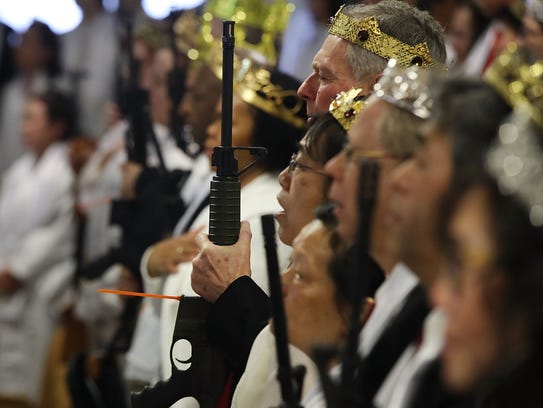
The ceremony prompted Wallenpaupack Area School District to move students at an elementary school down the street to other campuses.

Lisa Desiena, from Scranton, protested outside the church with a sign that called the group an “armed religious cult.”

She said she owns a gun, but “I don’t need a freaking assault weapon to defend myself. Only thing they’re good for is killing. Period. That’s all that weapon is good for, mass killing. And you want to bless it? Shame on you.”

But Sreymom Ouk, 41, who attended the ceremony with her husband, Sort Ouk, and came with their AR-15, said the weapon is useful for defending her family against “sickos and evil psychopaths.”

“People have the right to bear arms, and in God’s kingdom, you have to protect that,” she said. “You have to protect against evil.”

Couples hold AR-15 rifles and other guns during a ceremony at the World Peace and Unification Sanctuary on February 28, 2018 in Newfoundland, Pennsylvania. (Photo: Spencer Platt, Getty Images)
Wisconsin Supreme Court deals blow to union elections

The Seattle Times

Wisconsin Supreme Court deals blow to union elections


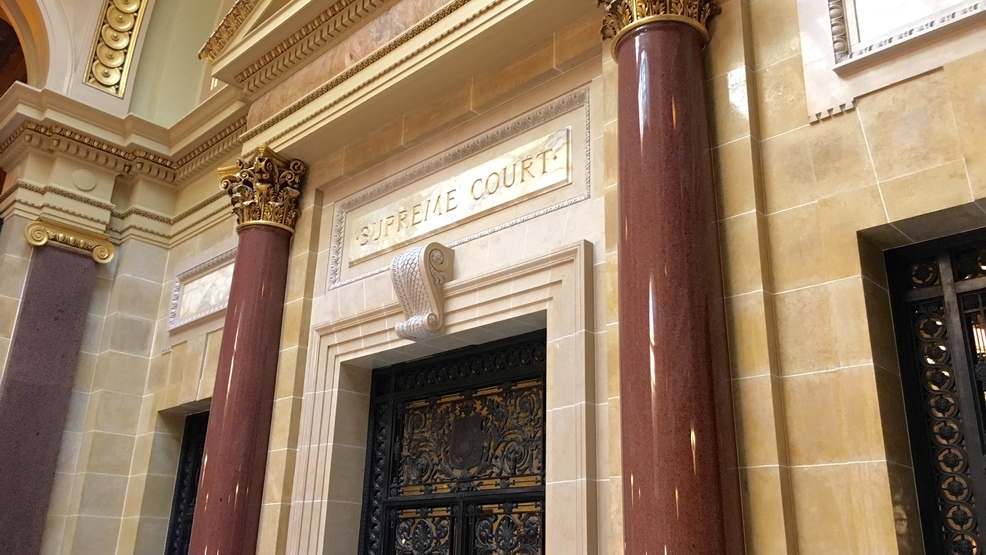
MILWAUKEE (AP) — The administrative agency that oversees employee union elections in Wisconsin can decertify collective bargaining groups if they don’t file election paperwork on time for an election — even if they miss the deadline by an hour, the state’s Supreme Court ruled Wednesday.

The decision Wednesday reverses lower court rulings that sided with the unions’ argument that the Wisconsin Employee Relations Commission overstepped its authority when it proceeded with decertification. The groups missed the deadline by about an hour each in 2014.

The case stems from the Wisconsin’s Act 10, which effectively ended collective bargaining for most public workers, required them to pay more for their pension and health benefits, and weakened their ability to organize. The law enacted shortly after Republican Gov. Scott Walker took office in 2011 also required annual recertification elections for state and municipal employees by Dec. 11.

 The commission’s rules require filing for recertification by the end of business on Sept. 15 to be able to have an election.

In the ruling, the Supreme Court said the commission “has express authority” to “require a demonstration of interest from labor organizations interested in representing collective bargaining units.” The Supreme Court went on to say the commission also has the power to decertify.

An attorney representing the unions in the case said the groups have since had elections to certify.

“The issue is moving forward whether or not the commission is going to be able to erect this sort of artificial barrier that’s not called for in the law in future elections,” said Nathan Eisenberg, adding, “And the Court held that they can.”

The unions involved in the case are: The Wisconsin Association of State Prosecutors, representing assistant district attorneys, and the Service Employees International Union Local 150, representing food service and custodians in Milwaukee Public Schools and the St. Francis School District.

Walker and conservatives have said the law was needed to help balance the state budget and reduce school and local governments’ costs.

Justice Ann Walsh Bradley dissented, saying state law requires the commission to hold elections for collective bargaining units because the statute reads it “shall,” making it clear that elections need to be carried out.

“In other words, each requires that an election be held annually. Full stop. No conditions,” she said.

She went on to say the court’s decision has “drastic consequences for employees.”

“It denies blameless employees the right to vote for union representation if their union narrowly misses a deadline,” she said.

The Town Where Women found Refuge from Domestic Violence,

22 Words Presents‘s video to the group: LIGHTWORKERS of THE WORLD 

The Town Where Men Are Banned

The Town Where Men Are Banned

Today I learned about a self-sufficient women-only village in Kenya. ♀️ ♀️ ♀️It's a safe haven for women fleeing domestic violence or sexual violence.Thanks INSH for sharing!

Posted by 22 Words Presents on Tuesday, February 6, 2018

Dick’s Sporting Goods will no longer sell assault-style rifles:

Good Morning America

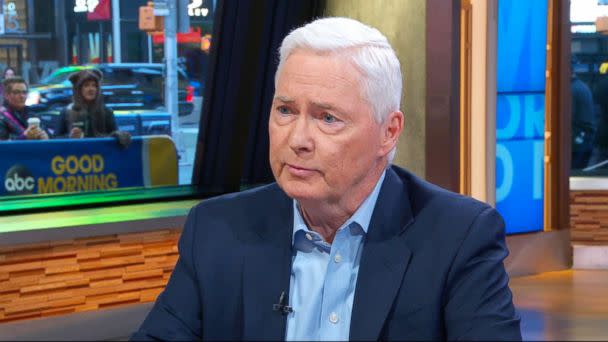
Dick’s Sporting Goods CEO on decision to no longer sell assault-style rifles: ‘We don’t want to be a part of this story’

David Caplan and Katie Kindelan      February 28, 2018

Dicks Sporting Goods Takes a Stand!

CNN
February 28, 2018

“If these kids are brave enough to organize and do what they’re doing, we should be brave enough to take this stand,” says DICK’S Sporting GoodsCEO Edward Stack, after the company announced it would stop selling assault-style weapons in all of its stores http://cnn.it/2t66Njk

Dick's CEO discusses decision to stop selling assault-style weapons

“If these kids are brave enough to organize and do what they’re doing, we should be brave enough to take this stand," says DICK'S Sporting Goods CEO Edward Stack, after the company announced it would stop selling assault-style weapons in all of its stores http://cnn.it/2t66Njk

Posted by CNN on Wednesday, February 28, 2018

The right wing’s 40-year attack on unions is coming to the Supreme Court, and this time it could win

The Los Angeles Times

The right wing’s 40-year attack on unions is coming to the Supreme Court, and this time it could win

By Michael Hiltzik        February 23, 2018

The right wing's 40-year attack on unions is coming to the Supreme Court, and this time it could win
Poised to cut the legs out from public worker unions: Supreme Court Justice Samuel Alito, seen here at the time of his 2006 confirmation hearings. (Charles Dharapak / Associated Press)


For 40 years, right-wing activists and fronts for the 1% have had their knives out for a Supreme Court precedent that protects the ability of public employee unions to represent their members and even nonmembers, and to speak out on matters of public interest.

That precedent faces a mortal threat in a case scheduled for oral argument at the Supreme Court on Monday. Indications are that a conservative majority of justices is poised to overturn it. That would have implications for worker rights, principles of fair compensation and income inequality, none of them good — unless you’re a millionaire.

The case is Janus vs. AFSCME. The issue in the case is the “agency fee,” which public employee unions in 22 states, including California, charge workers who are represented by those unions. The fee is a subset of union dues, which are paid by members. It’s supposed to cover only contract-related union functions such as contract negotiations and enforcement, including grievance procedures.

“The free-rider argument as a justification for compelling nonmembers to pay a portion of union dues represents something of an anomaly.” Supeme Court Justice Samuel Alito. 

Through the agency fee, workers in union-represented jobs pay for those services but are shielded from paying for political activities with which they disagree. In those 22 states, the unions are legally bound to represent all workers in jobs under their jurisdiction, even if they aren’t members. The fee obviously is a key to unions’ performing all their functions, for if it weren’t required, many members would quit the union, taking their dues with them and leaving the union without the resources to do its job. That’s what union opponents would like to see.

As my colleague David G. Savage has reported, the nominal plaintiff in this case is Mark Janus, a child support worker for a state agency in Illinois who objects to the $45 monthly fee he pays to the American Federation of State, County and Municipal Employees, ostensibly because the fee covers political positions he doesn’t support. But the case was initiated by the state’s Republican governor, Bruce Rauner, who had to duck behind Janus when a court ruled he had no standing to sue because he wasn’t paying the fee.

The groups backing the Janus case like to dress up their quest as a campaign to protect the free speech of teachers, healthcare workers or other public employees. We’ve explained before that it’s nothing of the kind. The cases aren’t about free speech or improving education for children. They’re about silencing the political voice and the negotiating strength of teacher and other public employee unions by cutting off their revenues. The campaign is a prime example of pure political cynicism, garbed with faux principle and backed by billions of self-interested dollars.


The main object of the Janus case and others like it has been to overturn a 1977 Supreme Court precedent known as Abood vs. Detroit Board of Education.

Abood established the principle that while public employees represented by unions couldn’t be forced to support union political positions with their dues, they shouldn’t get a free ride on the nonpolitical activities of unions either.

Thus did the “agency” or “fair share” fee receive the Court’s seal of approval. The implicit idea was to address the free-rider problem — people who received the benefit of union representation but didn’t want to pay.

Anti-union forces rapidly geared up to combat Abood. They pressed for state laws to invalidate agency fees. In California, they brought three anti-union initiatives to the ballot between 2000 and 2016, including a 2005 measure sponsored by then-Gov. Arnold Schwarzenegger. All three failed.

And they went to court.

The labor-oriented Economic Policy Institute and Mary Bottari of In These Times have documented that the anti-Abood coalition includes right-wing groups such as the American Legislative Exchange Council, or ALEC, and the State Policy Network. They and other sponsors of these legal cases and related legislative initiatives are affiliated with the Koch brothers, the Sarah Scaife Foundation, the Mercer Family Foundation and the Walton Family Foundation.


Some operate behind the scrim of umbrella groups such as the National Right to Work Legal Defense Foundation and the Center for Individual Rights. But at heart, they’re a network of right-wing billionaire families. The outfit representing Mark Janus, the Liberty Justice Center, is an offshoot of the Illinois Policy Institute; both have received funding from organizations in this network, including the Charles Koch Institute.

Do you really think these people have the interests of ordinary workers at heart? Me neither.

The lawsuits aimed at overturning Abood have been relentless. In 2012, the Supreme Court heard Knox vs. SEIU, a California case that turned on the type of fee notice unions had to give nonmember employees. The court upheld Abood, but Justice Samuel Alito, who wrote the majority opinion, expressed doubts about the precedent. “The free-rider argument as a justification for compelling nonmembers to pay a portion of union dues represents something of an anomaly,” he wrote — “one that we have found to be justified by the interest in furthering ‘labor peace,’ ” but “an anomaly nevertheless.”

Alito implied that he would take a hatchet to Abood if the opportunity arose, giving heart to anti-union forces.


In 2014, Harris vs. Quinn, which had been launched in 2010 on behalf of home healthcare workers in Illinois, reached the Supreme Court. The court didn’t overturn Abood, ruling instead that the home care workers weren’t actually full-fledged state employees so the precedent didn’t apply to them. Alito again wrote the majority opinion and took further potshots at Abood, which he denigrated at length.

That drew pushback from Justice Elena Kagan, who replied that “the Abood rule is deeply entrenched, and is the foundation for not tens or hundreds, but thousands of contracts … across the nation.”

Kagan also pointed out the downside of stripping unions of their financial resources. The agency fee recognizes the special role of unions in public employee bargaining, she observed, because they must represent members and nonmembers equally. “It ensures that a union will receive adequate funding, notwithstanding its legally imposed disability … so that a government wishing to bargain with an exclusive representative will have a viable counterpart.”

Then came Friedrichs vs. California Teachers Assn., a 2016 case, also from California, that took direct aim at Abood. Friedrichs was about to give the court’s conservatives the opportunity they sought to overturn Abood, but an act of God intervened: the death of Justice Antonin Scalia, who was expected to join the anti-Abood majority. That left the court split 4-4, which meant the pro-Abood decision of the 9th Circuit Court of Appeals in San Francisco stood. Now that Scalia’s seat has been filled by the even more conservative Neil Gorsuch, the anti-Abood cabal feels even more confident. At its core, Janus is just an Illinois version of Friedrichs.

The backers of these lawsuits have tried to turn the “free-rider” principle on its head, arguing that mandatory agency fees turn nonmembers into “forced riders.” They say that the resistance of some workers to paying even agency fees shows that those workers don’t believe they get any benefit from union representation.

That notion was challenged in a friend-of-the-court brief filed by 36 moderate and progressive economists. They observed that workers might refuse to pay voluntary fees out of “simple self-interest” — that is, saving the money, even if they appreciated the union’s representation. This, of course, is exactly what union opponents are hoping for.

Catholic faith leaders pressure Congress to protect DREAMers from deportation

NowThis Politics is live now.Follow

February 27, 2018

Catholic faith leaders are gathering to pray, sing, and commit acts of civil disobedience at the Capitol today to put pressure on Congress to protect DREAMers from deportation. #Catholics4DREAMers

Catholic faith leaders are gathering to pray, sing, and commit acts of civil disobedience at the Capitol today to put pressure on Congress to protect DREAMers from deportation. #Catholics4DREAMers

Posted by NowThis Politics on Tuesday, February 27, 2018