Rudy Giuliani Would Be Comic Relief If Any of This Was Funny

Esquire

Rudy Giuliani Would Be Comic Relief If Any of This Was Funny

The president’s lawyer gave another eye-popping interview. This time he mentioned tapes.

By Charles P. Pierce               January 22, 2019

Rudy Giuliani & Joe Montana Visit FOX & FriendsGETTY IMAGESJASON KEMPIN.

One of the most reliable joys of political journalism in this very weird political moment is the series of interviews that Isaac Chotiner is doing for The New Yorker. His latest is a chat with Rudy Giuliani and, yes, there are moments in it that will make you stop so hard that your eyeballs shoot out three feet and then snap back. This is one of them.

Chotiner and Giuliani were talking about the BuzzFeed News story from last week about how the president* allegedly instructed Michael Cohen to lie to Congress regarding the prospective Trump Tower project in Moscow. And this ensued:

RG: I can’t discuss that. President Trump would not have done that. If anybody would have done it, obviously it would have been his lawyers, and I really can’t discuss that. That would be confidential.

IC: Do you—

RG: But I can tell you, from the moment I read the story, I knew the story was false.

IC: Because?

RG: Because I have been through all the tapes, I have been through all the texts, I have been through all the e-mails, and I knew none existed. And then, basically, when the special counsel said that, just in case there are any others I might not know about, they probably went through others and found the same thing.

IC: Wait, what tapes have you gone through?

RG: I shouldn’t have said tapes. They alleged there were texts and e-mails that corroborated that Cohen was saying the President told him to lie. There were no texts, there were no e-mails, and the President never told him to lie.

Mr. Butterfield? History calling on Line One.

IC: So, there were no tapes you listened to, though?

RG: No tapes. Well, I have listened to tapes, but none of them concern this.

Oh, OK. If you follow the link embedded in the interview, you come to a CNN report from last July when a tape emerged on which the president* and Cohen were heard discussing hush-money payments to Stormy Daniels. That may be all this is about but I think Chotiner spoke for all of us with that, “Wait. What tapes have you gone through?” It gets a little nuttier further on:

IC: The quote in the story from you is that the “ ‘discussions were going on from the day I announced to the day I won,’ Mr. Giuliani quoted Mr. Trump as saying during an interview with The New York Times.”

RG: I did not say that.

IC: The Times just made that quote up?

RG: I don’t know if they made it up. What I was talking about was, if he had those conversations, they would not be criminal.

IC: If he had them, but he didn’t have them?

RG: He didn’t have the conversations. Lawyers argue in the alternative. If we went to court, we would say we don’t have to prove whether it’s true or not true, because, even if it’s true, it’s not criminal. And that’s why Mueller will not charge him with it.

IC: Does it matter to the American people if it’s true? We are living in a democracy here. We want to know these things.

RG: That’s an insane question you just asked me. I am not saying that he did it. I just told you he didn’t do it. I am telling you that their investigation is so ridiculous that, even if he did do it, it wouldn’t be a crime. Now, would the American people be interested in it? Of course. There’s a big difference between what the American people would be interested in and what’s a crime. The American people can be interested in a lot of things people conceal that aren’t crimes. I’m a criminal lawyer. I am not an ethicist. And I defend people against unfair criminal charges.

One day, when this is all over, someone is going to have to figure out what exactly Rudy Giuliani’s role in this extended vaudeville was. It’s almost as though he’s comic relief. Or, he would be, if any of this stuff actually were funny.
Respond to this post on the Esquire Politics Facebook page here.

The GOP has become the Soviet party

Democracy Dies in Darkness

The GOP has become the Soviet party


Vice President Pence and President Trump visit the Martin Luther King Jr. Memorial in Washington on Monday. (Mandel Ngan/AFP/Getty Images).

Once upon a time, Ayn Rand-reading, red-baiting Republicans denounced Soviet Russia as an evil superpower intent on destroying the American way of life.

My, how things have changed.

The Grand Old Party has quietly become the pro-Russia party — and not only because the party’s standard-bearer seems peculiarly enamored of Russian President Vladimir Putin. Under Republican leadership, the United States is starting to look an awful lot like the failed Soviet system the party once stood unified against.

Supposedly middle-class workers — people who have government jobs that are supposed to be stable and secure — are waiting in bread lines. Thanks to government dysfunction and mismanagement, those employed in the private sector may also be going hungry, since 2,500 vendors nationwide are unable to participate in the food stamp program while the government is shuttered and unable to renew licenses for the Electronic Benefit Transfer debit card program.

Why? Because of the whims of a would-be autocrat who cares more about erecting an expensive monument to his own campaign rhetoric than about the pain and suffering of the little people he claims to champion.

And for now, at least, most of those little people are too frightened of the government’s wrath to fight back overtly. Instead, desperate to keep jobs that might someday offer them a paycheck again, the proletariat protest in more passive ways: by calling in sick in higher numbers.

The would-be autocrat surrounds himself with toadies who spend more time scheming against one another — sometimes to comic effect — than trying to offer their boss sound guidance or thoughtful policy solutions. In his presence, and perhaps especially when the cameras are on, they praise him relentlessly: his brains, his leadership, his “perfect genes.”

Sometimes they appear afraid to stop clapping, echoing stories of forced standing ovations for Joseph Stalin recounted in video footage and Alexander Solzhenitsyn’s “Gulag Archipelago.”

Apparent corruption among these kowtowing aides — including improper use of public funds or private favors for fancy travel and other pampering — remains rampant. Unlike in true socialist states, it seems, our leaders haven’t run out of other people’s money.

Meanwhile, federal law enforcement is publicly directed to pursue the would-be autocrat’s political enemies, as well as the family members of those enemies, such as former Trump lawyer Michael Cohen’s father-in-law. Purges of law enforcement or other members of the “deep state” are also demanded, and sometimes acted upon. Such actions, when taken by thugs abroad, were once denounced by Republicans.

State-run media, or something closely approximating it, feeds the public a steady diet of pro-leader propaganda and shields viewers from news that might embarrass the head of state. Independent sources of information or accountability, or those who deviate from the party line, are branded “enemies of the people.”

On the macroeconomic front, leadership may be touting “deregulation” but in many ways is moving toward a more centrally planned economy, which includes the shielding of pet industries from the whims of the market or technological change.

That means propping up coal plants, which fracking has made less competitive. And slapping tariffs across thousands of foreign products, to subsidize struggling domestic competitors or sometimes to protect “national security.” And granting more price supports for farmers.

Just as government has inserted itself into more markets, though, it has abruptly stopped functioning, holding up the processing of those farmer subsidies or tariff exemptions. It’s the old Soviet model in a nutshell: promising much, interfering a lot, failing to deliver.

Perhaps providing proof of concept to President Dwight Eisenhower’s domino theory, our government has simultaneously encouraged more central planning by other economies, too.

This includes greater government-directed management of bilateral trade balances by China, the European Union and other countries, regardless of what individual businesses within those countries need or where they’d prefer to source from. While the Trump administration claims it wants China to move in a more market-oriented direction, it also wants it to promise that theoretically private Chinese companies will buy soybeans from the United States, and not Brazil, regardless of quality or price.

Needless to say, “picking winners and losers” was once a thing Republicans abhorred, a practice embraced only by failed socialist states; today the Republican standard-bearer picks winners and losers even within the government itself. The government may be officially shuttered, but President Trump decided to do an end run around the constitutionally mandated, democratic appropriations process. He is picking and choosing which government functions are allowed to function: yes to his offshore drilling plan and tax refunds; no to the Smithsonian museums.

All branches of government may be equal — but some, it seems, are more equal than others.

“Injustice Anywhere is a Threat to Justice Everywhere,” MLK jr

Al Shur shared a post to the group: Our IBEW
January 21, 2019

Dr. Martin Luther King was NOT just a civil rights leader or a religious leader. He was a voice for millions of workers who were made silent in their workplaces and in their lives. Martin Luther King, Jr. was a LABOR LEADER.
Maybe one of the greatest spokespersons, for working Americans, in the Twentieth Century.

Celebrate his day! (MLK was assassinated the very next day, after making this speech to striking workers.) ~AS

Image may contain: text


Lady Gaga: Mike Pence is ‘The Worst Representation’ Of Christianity

Cohen says he paid to rig online polls at Trump’s direction

The Rachel Maddow Show / The MaddowBlog

Cohen says he paid to rig online polls at Trump’s direction

By Steve Benen          Janaury 17, 2019

Image: U.S. President Donald Trump's personal lawyer Michael Cohen arrives at his hotel in New York
U.S. President Donald Trump’s personal lawyer Michael Cohen arrives at his hotel in New York City, U.S., June 20, 2018. REUTERS/Brendan McDermid.


Those who’ve spent a considerable amount of time online have come across websites that invite visitors to vote in unscientific polls. They generally tell us very little about public attitudes, but people often like to register their opinions, and website operators often like to create ways to engage visitors, so they’re fairly common. Those who understand social-science research know to ignore the results.

Donald Trump is not one of those people. In fact, he’s complained more than once about the results of online unscientific polls that failed to make him look good.

With this in mind, the Wall Street Journal published a rather remarkable article this morning on Michael Cohen’s efforts – when he was Trump’s personal lawyer and “fixer” – to “rig online polls in his boss’s favor” before the 2016 elections.

To execute the plan, Cohen reportedly hired John Gauger, the chief information officer at Jerry Falwell’s Liberty University, and the owner of a small tech company called RedFinch Solutions LLC. The Goal was simple; deliver online poll results intended to make Trump happy:

In January 2014, Mr. Cohen asked Mr. Gauger to help Mr. Trump score well in a CNBC online poll to identify the country’s top business leaders by writing a computer script to repeatedly vote for him. Mr. Gauger was unable to get Mr. Trump into the top 100 candidates. In February 2015, as Mr. Trump prepared to enter the presidential race, Mr. Cohen asked him to do the same for a Drudge Report poll of potential Republican candidates, Mr. Gauger said. Mr. Trump ranked fifth, with about 24,000 votes, or 5% of the total.

As is often the case with people who do work for Team Trump, Gauger said he never received the $50,000 he was promised, though he claims Cohen did give him a Walmart bag containing between $12,000 and $13,000 in cash.

Cohen denies that detail – he insists payments were made by check – though he seemed to confirm the gist of the story. In a tweet published this morning, Cohen pointed to the WSJ article and said that when it came to poll rigging, his actions were made “at the direction of and for the sole benefit of” Donald Trump.

The lawyer, who’ll soon be incarcerated for crimes he committed under Trump’s employ, added, “I truly regret my blind loyalty to a man who doesn’t deserve it.”

Why should we care about details like these now? A few reasons.

First, when Trump lashes out at polls he doesn’t like as “rigged,” perhaps he knows of what he speaks.

Second, we’re occasionally reminded that the president has long overseen an operation that can charitably be described as amateurish and incompetent, which offers insights into why his White House is such a mess.

But a Washington Post  analysis published this morning raised a related point, putting the contract to rig polls in a larger context: “Why should we not assume that other surreptitious investments might have been made?”

trump’s flawed pick for Attorney General

Esquire

I Wouldn’t Hire William Barr for Traffic Court

I love my country, but!

Vice News

January 16, 2019

Turkey is now seeking an arrest warrant for New York Knicks center Enes Kanter, accusing him of membership in a terror organization.

In 2017, we spoke to him on why he isn’t backing down from criticizing Erdoğan.

Enes Kanter Isn't Backing Down from Criticizing Erdoğan: VICE …

Turkey is now seeking an arrest warrant for New York Knicks center Enes Kanter, accusing him of membership in a terror organization.In 2017, we spoke to him on why he isn't backing down from criticizing Erdoğan.

Posted by VICE News on Wednesday, January 16, 2019

Food is Helping Flint, Michigan Recover

Civil Eats

Food is Helping Flint Recover and Reimagine Itself

Addressing the water crisis head on, multiple healthy food initiatives are working to improve health, nutrition, and food security while jump-starting the local economy.

By Brian Allnutt, Health, Local Eats, Nutrition   January 16, 2019

Flint Farmers Market


It’s a cold, snowy Thursday in Flint, Michigan, but business is more than steady in the Flint Farmers’ Market where Clinton Peck runs Bushels and Peck’s Produce. Locally grown micro-greens, beets, Brussels sprouts, and cabbage cover the booth, along with tropical fruit and other items he picked up at the produce terminal in Detroit. Elsewhere, the late lunch crowd is enjoying the offerings at the nearby restaurants. Later in the day, a group of kids from the city will participate in a cooking class in one of the market’s industrial kitchens.

It’s probably safe to say that this sort of diverse, foodie environment isn’t the picture most people conjure when they think of Flint—a town that is now synonymous with industrial decline and one of the worst public health crises in the nation’s recent history. Yet this market is booming—more than half a million people visited its 45 year-round and 30 seasonal vendors last year, according to farmers’ market managers.

What’s going on behind the scenes here is just as interesting. Peck’s produce stand operation is supported in part by a primary care pediatric facility called the Hurley Children’s Clinic (HCC), located in the same building. Through an initiative called the Nutrition Prescription Program, sponsored by the Rite-Aid Foundation, caretakers of children visiting the clinic receive a $15 voucher for fresh fruits and vegetables to spend at the market. Peck says he gets about $200 to $250 worth of business from these vouchers every market day.

The prescription program parallels other investments in the Flint food system designed to mitigate some of the worst effects of the water crisis. Programs like Flint Kids Cook—also coordinated by the HCC—as well as Double Up Food BucksFlint Fresh, and investments in community businesses such as the North Flint Food Market are helping Flint residents access fresh fruit and produce, as well as milk products, that are a proven to lessen the effects of lead on the body. For the most part, the produce that Peck sells and Flint Fresh distributes comes from outside the city proper, but Flint Fresh has a specific program of soil-testing and post-harvest handling for growers within the city limit to address lead concerns.

Double Up Food Bucks has grown since 2016, when it was used by 9 percent of SNAP households, to its present reach of over 50 percent. Other promising signs of growth include the facts that Flint Fresh is developing a regional food hub for food processing that could help area growers, and the North Flint Food Market just received a large grant from the Michigan Good Food Fund. In addition to getting healthy foods into the hands of more people, these initiatives are creating openings for the development of sustainable local businesses—and laying the foundation for radical change by giving citizens more control over their health and livelihood.

“Flint is a city like Detroit that is essentially having to re-imagine itself and rebuild itself from the ground up,” says Lisa Pasbjerg, market manager for the nonprofit Flint Fresh. “We want to get fresh produce to our community, but of course we also need to build and have a sustainable local economy.”

Balancing these two efforts hasn’t been easy. Although many nonprofit initiatives have expanded in the city and benefitted small businesses, 42 percent of Flint’s population lives in poverty, according the U.S. Census Bureau, and much of the development is clustered around a gentrifying downtown.

Increasing Access to Nutrition—With a Focus on Children

In 2014, the Flint Farmers’ Market moved to a new location next to the Mass Transportation Authority Transit Center—the source of 80 percent of Clinton Peck’s customers—and also near the YMCA and other amenities. The move preceded the water crisis, as did the co-location of the Hurley’s Children Clinic, but these changes took on a prophetic quality as the fallout from the disaster hit the city.

Since the water crisis, various programs have effectively helped residents—especially young ones—access the fresh food for sale in the market.

When the Nutrition Prescription Program launched in 2016, it gave patients small bags of fresh produce or $5 produce vouchers. As it continued, Amy Saxe-Custack, an assistant professor at Michigan State’s Department of Food Science and Human Nutrition, who runs it along with other researchers, realized their clients weren’t just using these benefits to supplement their diets, but to meet basic food needs. With additional funding from the Rite-Aid Foundation, the HCC was able to increase the amount of the vouchers from $5 to $10 dollars later in 2016 and then from $10 to $15 in 2018.

This effort is groundbreaking for its focus on children and preventative medicine. Saxe-Custack says that most of the food prescription initiatives in other parts of the nation focus on low-income adults with chronic conditions like high blood pressure or diabetes.

“From a dietary perspective, there is tons of evidence to suggest that dietary patterns are established early,” she says, and the attendant research she’s doing for the program may provide some data that could establish it as a model.

A cooking class at Flint Kids Cook. (Photo courtesy of Flint Kids Cook)A cooking class at Flint Kids Cook. (Photo courtesy of Michigan State)

Families using the center also expressed a desire to teach their children how to cook. This inspired Flint Kids Cook, which launched in 2017, sponsored by an anonymous family foundation in New York City that wanted to do something about the water crisis, says Saxe-Custack. Initially the program had trouble attracting enough young people to participate. But now the class at the market has a waiting list and is expanding to other sites in the city.

Saxe-Custack believes the success of the classes stems from the fact that it’s not just a nutrition class or cooking demo: “They’re measuring, they’re mixing, they’re cutting, they’re over a stove … It’s actually hands-on cooking,” she says.

And chefs from the market, such as Ian Diem of Chubby Duck Sushi, help teach the class. “The kids are enamored with the chefs,” as Saxe-Custack puts it. The class could also prepare kids for jobs in a sector that appears to be growing in the city.

Food System Investments Putting Power in Residents’ Hands

The economic benefits of charitable investments in the food sector have grown thanks to programs like Double Up Food Bucks as well. Administered by the Fair Food Network, a national nonprofit that has been using federal, state, and philanthropic funding to match SNAP benefits spent on fruits and vegetables for a decade. At the Flint Farmers’ Market, the effort has translated into more than $110,000 of additional sales annually, according to market manager Karianne Martus.

After the water crisis, the Fair Food Network set out to grow the program by stepping up their outreach to the people of Flint, where they had already established a strong base for the program. They also allowed people to use Double Up Food Bucks on dairy products because calcium has been shown to decrease the absorption of lead in the body.

Since October 2016, the number of residents using the Double Up program has grown from 4,000 to over 13,000. And Holly Parker, senior director of programs at the Fair Food Network, estimates that over 50 percent of SNAP recipients in the city are using the program, which brings more business to people like Peck at the farmers’ market, who says it has boosted his sales by between 8 and 12 percent.

Clinton Peck of Bushels and Pecks at the Flint Farmers' Market.Clinton Peck of Bushels and Pecks at the Flint Farmers’ Market. (Photo courtesy of the Flint Farmers’ Market)

Flint Fresh was also created to respond to the water crisis and is aimed at improving nutrition and food security while supporting local business. Along with mobile farmers’ markets, they deliver around 300 boxes of fresh produce to local families and individuals every month. Both platforms accept Double Up Food Bucks and Nutrition Prescription vouchers, as well as prescriptions from other programs. In the summer, 50 percent of the produce comes from local farms, some of them in Flint itself.

Flint Fresh’s Pasbjerg says that her organization is in the initial phases of building a regional food hub that would help the organization distribute produce. “The idea is that, long term, we would be able to process stuff for local farmers,” she says, “and then use that in the school systems and for local grocery stores.”

In addition to Double Up Food Bucks, the Fair Food Network is partnering with Capital Impact PartnersMSU’s Center for Regional Food Systems, and the W.K. Kellogg Foundation to invest in Flint as part of the Michigan Good Food Fund, which provides financing and counseling to organizations promoting healthy food access, economic development, and other goals. Among this year’s award winners is the North Flint Reinvestment Corporation, which will be receiving $40,000 to help create the city’s first member-owned co-operative grocery store, the North Flint Food Market.

The co-op is another example of the way the water crisis—as well as the disappearance of two large grocery store chains—engendered the desire for radical change. “The conventional food system isn’t going to come back into that neighborhood,” says Rick Sadler, assistant professor of Family Medicine at Michigan State and a member of the store’s steering committee. Starting the co-op was, in Sadler’s words, a way of “putting the power of the investment in the hands of the residents.”

The Challenges of Radical, Food-based Change

Despite all these positive changes, however, the city still faces structural problems caused by overall disinvestment in most of its neighborhoods and the clustering of new investment around Flint’s small downtown.

For these reasons, Flint businesses will still face a lack of a customer base for the immediate future, Sadler says. “It’s just so hollowed-out, and the momentum of getting investment back into the city has been so slow-going,” he added.

There’s also the fact that most grant-based initiatives don’t offer permanent funding. Double Up Food Bucks, according to Emilie Engelhard, senior director of external affairs for the Fair Food Network, seems to be secure after the Senate voted to protect healthy produce incentives in the most recent farm bill. And the Nutrition Prescription Program is funded through 2019 at the farmers’ market and through May 2020 at a second location. But relying on grants for economic stimulus will always be an uncertain proposition.

The exact potential of food businesses as an economic driver in Flint is also unknown. One study based in Detroit, which is 60-some miles away from Flint and dealing with similar structural issues, found that food was the third-largest employment sector in the city and could soon move to second.

Similar research hasn’t been done in Flint, but the city’s master plan projects that “food and hospitality” jobs in the county will be increasing 51.9 percent by 2040, second only to “health care and social assistance.”

Given this projection—and the progress these initiatives have made so far—Flint’s ability to use some of its current nutritional programming to bring investment back to the city could then be a very important for Flint residents. Although Pasbjerg emphasizes that in one of the nation’s poorest cities, “there’s a ton that needs to be done still.”

Has Trump kept his promises to coal workers?

Late Night with Seth Meyers
January 15, 2019

Has Trump actually kept his promises to coal workers? Seth checks in.

The Check In: Trump Country

Has Trump actually kept his promises to coal workers? Seth checks in.

Posted by Late Night with Seth Meyers on Tuesday, January 15, 2019

Florida Ex-Felons Can Finally Register to Vote

“This Is What Democracy Is All About”: Florida Ex-Felons Can Finally Register to Vote

It could lead to the largest expansion of new voters since the Voting Rights Act.

By Ari Berman                January 8, 2019

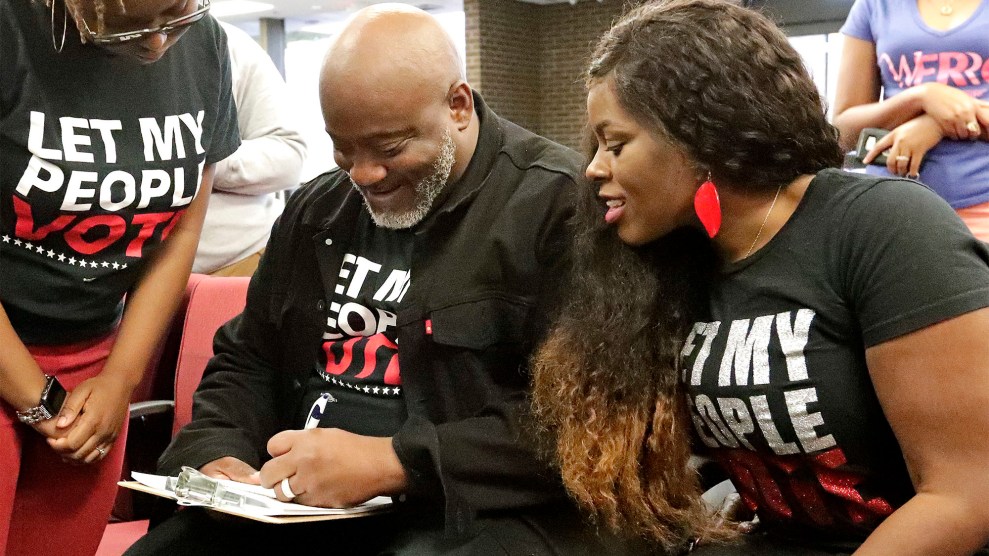
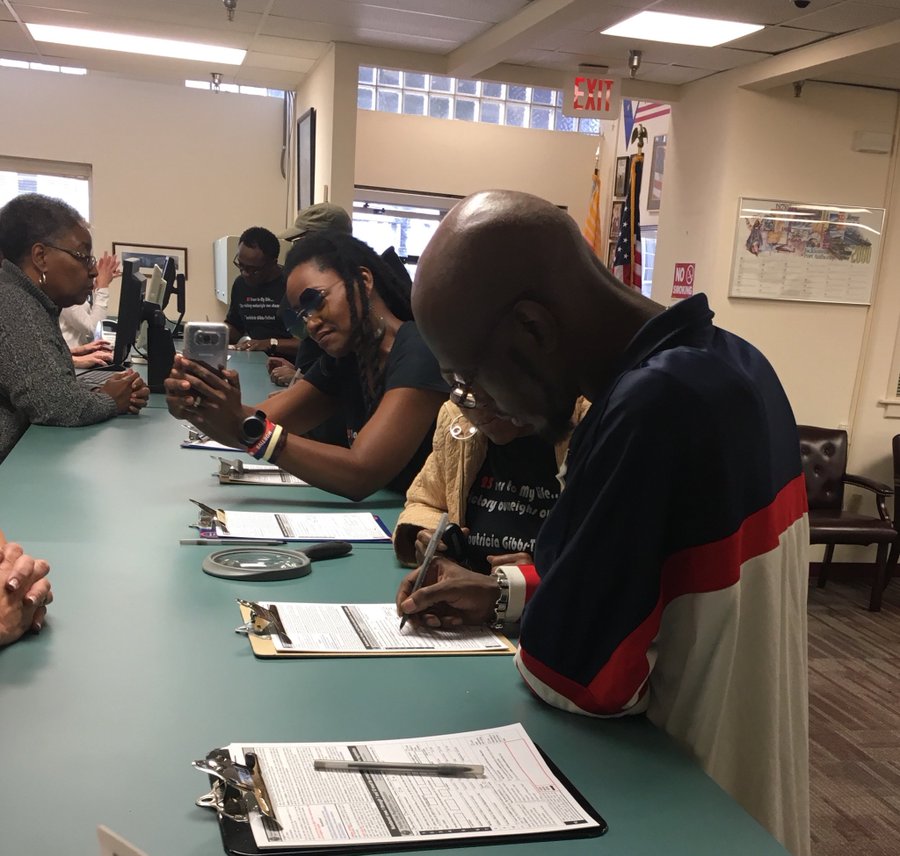
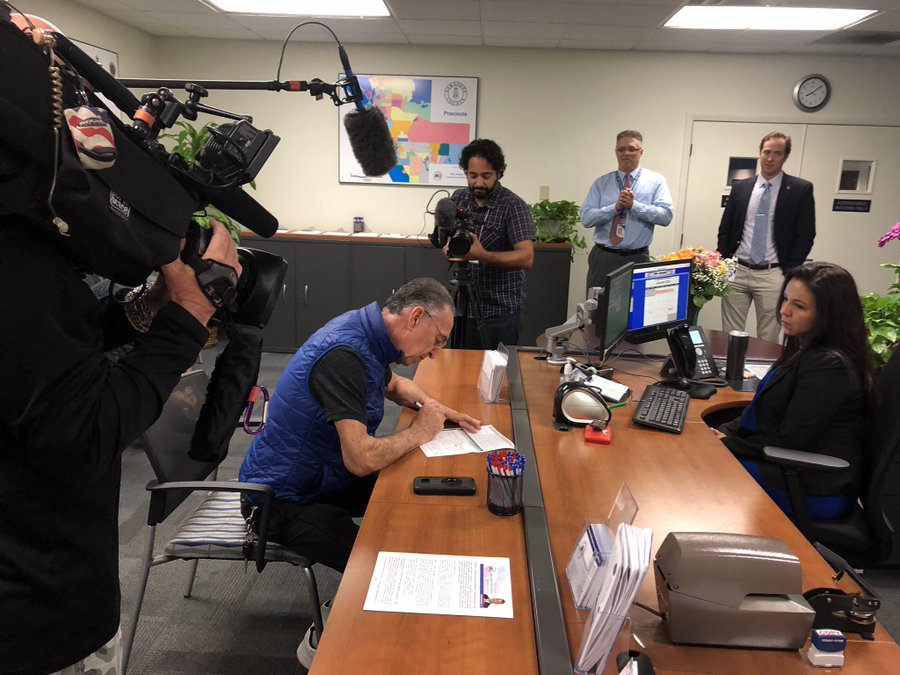
Desmond Meade fills out a voter registration form with his wife, Sheena, at the Supervisor of Elections office on January 8.John Raoux/AP

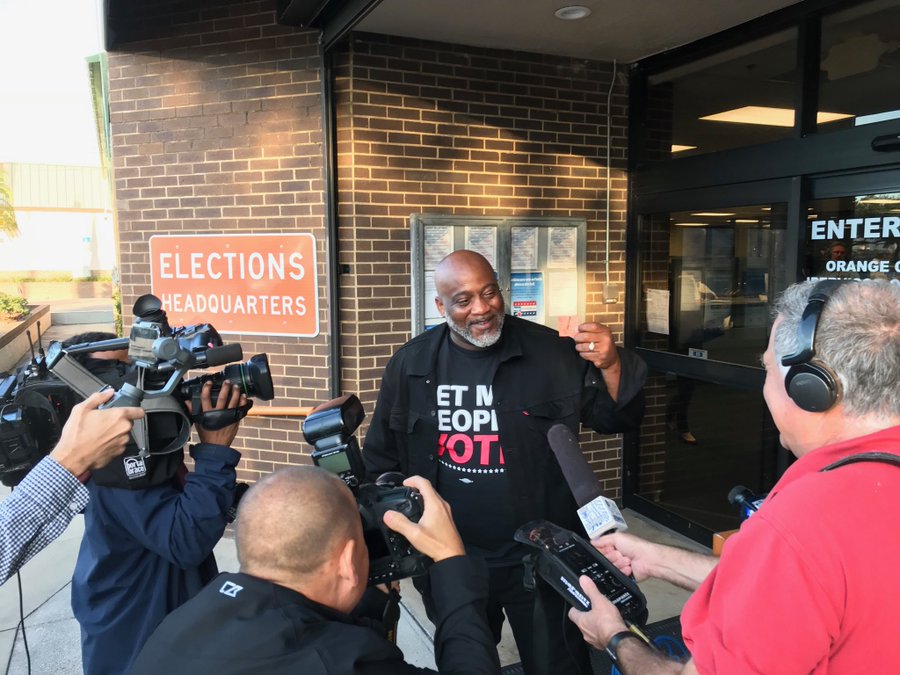
On Tuesday morning, Desmond Meade went down to the the Orange County elections office in Orlando, Florida, and registered to vote for the first time in decades. Since being released from prison, where he was held on a gun possession charge, in 2005, Meade had been unable to vote because of a Florida law preventing ex-felons from casting a ballot even after they’d paid their debt to society.

In 2018, Meade—now president of the Florida Rights Restoration Coalition (FRRC)—led the effort to pass a ballot initiative overturning the felon disenfranchisement law. It passed on November 6 with 64 percent of the vote. The initiative, known as Amendment 4, went into effect Tuesday morning.

“It was a very, very emotional moment,” Meade said on Facebook after he submitted his voter registration form, his eyes welling up with tears. He was surrounded by his wife and kids and wore a “Let My People Vote” t-shirt. “Across the state of Florida, our democracy is being expanded. That’s a great thing.”

View image on Twitter

Steven Lemongello: Desmond Meade, who led the years-long effort to return the right to vote to 1.4 M former felons in Florida, registered this morning at the Orange County elections office

Amendment 4 automatically restores voting rights to people with felony records who have completed their full sentences, except those convicted of murder or a sexual offense. Before it passed, Florida was one of only four states that prevented ex-felons from voting, which blocked 10 percent of Floridians from casting a ballot, including 1 in 5 African Americans. The enactment of Amendment 4 could lead to the largest increase in new voters in the state since the passage of the Voting Rights Act of 1965.

The passage of Amendment 4 was particularly remarkable given that Florida elected a Republican senator and a Republican governor in 2018 who both opposed restoring voting rights to ex-felons. Amendment 4 attracted significant support from Republicans in Florida, even as their party invested heavily in making it harder to vote nationwide. In a huge expansion for voting rights, eight states approved ballot initiatives in 2018 to make it easier to vote and harder to gerrymander.

A huge and improbable coalition supported Amendment 4, ranging from the American Civil Liberties Union to the Christian Coalition to the Koch brothers’ political network. “We are fighting just as hard for that person that wishes he could vote for Donald Trump as that person who wanted to vote for Barack Obama or Hillary Clinton,” Meade told me when I visited Florida in August. “We don’t care about how a person may vote. What we care about is that they have the ability to vote. That is our compass.”

Meade’s own story was equally remarkable, as I reported for Mother Jones:

On a muggy August day in 2005, Desmond Meade stood in front of the railroad tracks north of downtown Miami and prepared to take his life. He’d been released from prison early after a 15-year sentence for gun possession was reduced to three years, but he was addicted to crack, without a job, and homeless. “The only thing going through my mind was how much pain I’d feel when I jumped in front of the oncoming train,” Meade said. “I was a broken man.”

But the train never came, and eventually Meade walked two blocks to a drug treatment center and checked himself in. He got clean, enrolled in school, and received a law degree from Florida International University in 2014. Meade should have been the archetypal recovery success story­—­“[God] took a crackhead and made a lawyer out of him,” as he put it. But he’s not allowed to practice law. And when his wife ran for the Florida House of Representatives in 2016, he couldn’t vote for her. “My story still doesn’t have a happy ending,” he said. “Because despite the fact that I’ve dedicated my life to being an asset to my community, I still can’t vote.”

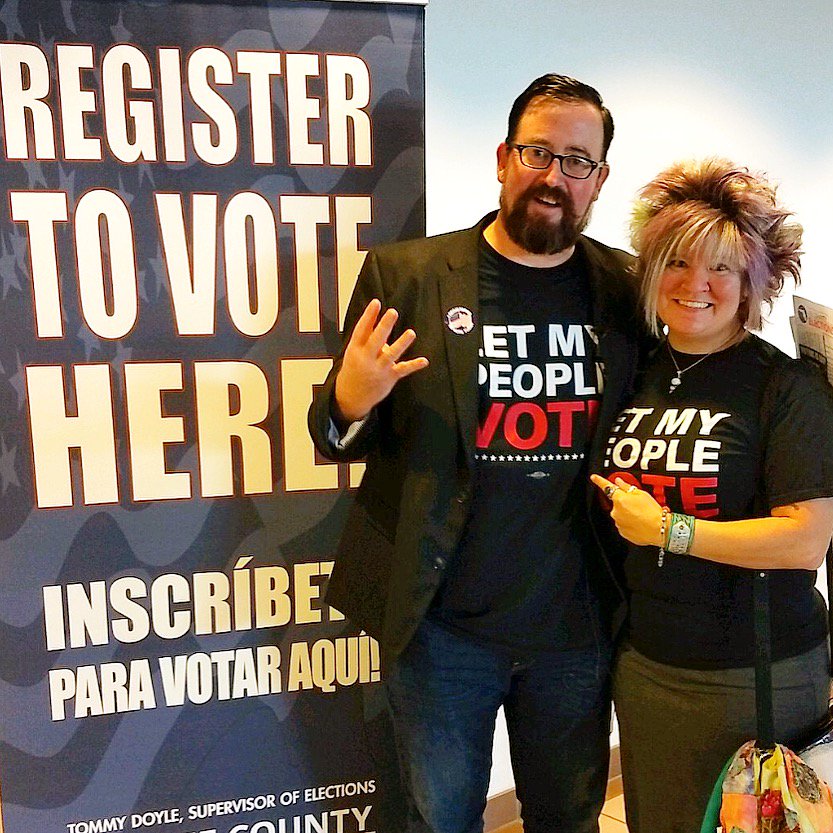
Meade’s unlikely partner in the felon restoration effort was Neil Volz, a former chief of staff for Republican Rep. Bob Ney of Ohio and a top lobbyist for onetime superlobbyist Jack Abramoff. Volz was a GOP power broker in Washington until Abramoff’s pay-for-play lobbying scheme unraveled and Volz pled guilty in 2006 to conspiring to corrupt public officials. He lost the right to vote when he moved to Florida afterward, and registered for the first time in over a decade on Tuesday.

View image on Twitter

Neil Volz: Today…no words. Grateful to God and everyone who has fought to protect our ability to vote!

“Year by year, when you don’t have the vote, you really take on an appreciation for having the ability to vote,” Volz, who’s now the political director for FRRC, told me after he registered at the Lee County elections office in Fort Myers. Similar stories of ex-felons registering across the state circulated widely on social media.

View image on Twitter

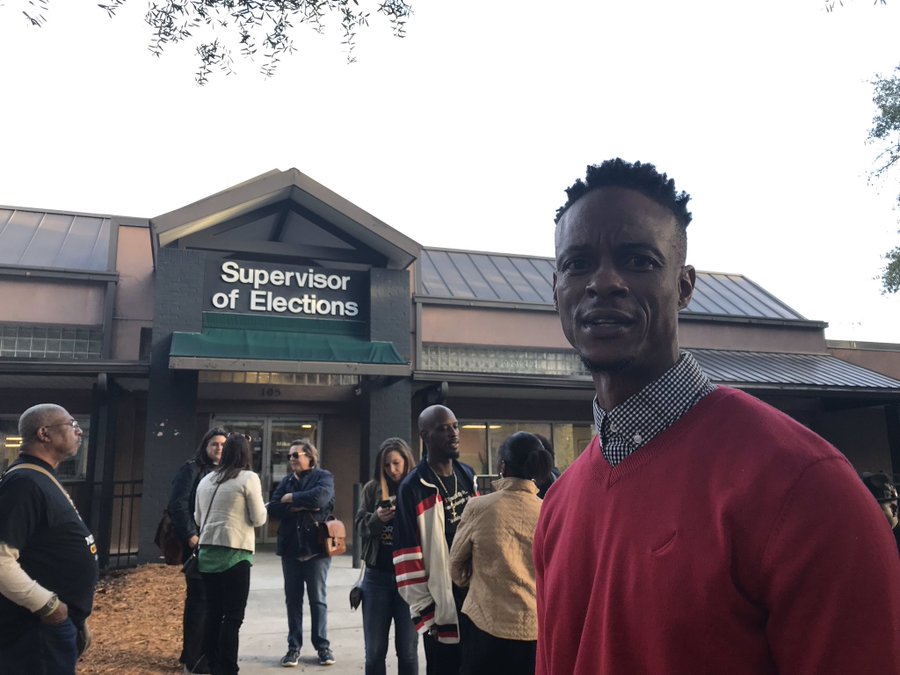
Andrew Pantazi: Corri Moore, 42, was one of the first people downtown to register to vote today. He said he lost his right to vote about 14 years ago for a felony charge of driving with a suspended license. He most regrets not getting to be a part of the historic 2008 election of Barack Obama.

“Thousands of people are registering to vote today,” Volz said. “It’s a real acknowledgement of the sacredness of democracy that’s happening in front of our eyes.”

Some top Republican officials in Florida, however, have sought to delay the implementation of Amendment 4. New GOP Gov. Ron DeSantis, who officially took office on Tuesday, said in December that the Florida Legislature, which does not convene until March, should pass “implementing language” before Amendment 4 took effect. Voting rights groups countered that the amendment was “self-executing” and “the Legislature does not need to pass implementing legislation in order for the amendment to go into effect.” Though new registrants are being processed today, the Legislature could still make the implementation of the law more restrictive when it convenes in the spring.

Paul Lux, president of the Florida State Association of Supervisors of Elections, told me that election officials in Florida had received no guidance from the state on how to comply with Amendment 4. “What we’ve heard is nothing,” he said. He said county supervisors, who oversee voter registration, would register new voters as required by the new law. “I am not aware of any supervisors who have said they won’t take registration forms,” Lux said. Meade and Volz said they were not aware of anyone being turned away from registering. “They were letting people register and celebrating with us,” Meade said of election officials.

View image on Twitter

Steve Bousquet: Craig Aiken, 43, who did time for drug possession, registered to vote in Jacksonville Tuesday. “A second chance to be human,” he said of Amendment 4, which Florida voters approved in November.

Meade invited DeSantis to celebrate with returning citizens (his preferred term for ex-felons) who were registering today, noting that over 1 million DeSantis supporters also voted for Amendment 4. “We have a governor who campaigned on abiding by the rule of law, and this is the law now,” he said.
View image on Twitter

Zac Anderson: North Port resident Alan Rhyelle is the first convicted felon to register to vote under Amendment 4 in Sarasota County. He was waiting in the parking lot by 7:15 a.m.. Busted for growing pot to help his daughter struggling with prescription meds after car accident.