Right to Work Defeated in Montana and Colorado

ucomm Blog

Right to Work Defeated in Montana and Colorado

However, a Right to Work bill continues forward in New Hampshire

By Brian Young                                  March 02, 2021
Photo By: KPAX
Montana and Colorado have both stopped attempts to pass Right to Work laws and will continue to be free bargaining states.


In Montana, Republicans have control over the entire state government, a first in over 16 years. Yet, over the past month, union members and employers have successfully pushed legislators to vote against Right to Work. On Tuesday, with union members filling the gallery and lining the hallways, legislators voted down the bill by a vote of 38 in favor to 62 opposed. In a show of bipartisanship, 29 Republicans joined with 33 Democrats in opposing the bill.

In speaking in opposition to the bill Rep. Derek Harvey, a Democrat from Butte spoke about the role that unions played in his city producing the copper that fueled the industrial revolution, electrified the nation, and supplied ammunition during both World Wars.

“I know my past. I know my town’s past. I also know the history of a man named Frank. Frank (Little) was standing up for his fellow workers when one night he was drug out of his boarding house and beat nearly to death and drug behind a car through the center of my district,” Harvey said before going on to list the Anaconda Road massacre and labor strikes of 1914 that led to martial law in his district. “This is an outrageous bill, and it’s an outrage that it’s made it (this far) through the process.”

Members from around the state came to the Capitol to pressure lawmakers into voting against the bill.

“These are not partisan members,” said Al Eklbad,  Executive Secretary of the AFL-CIO, who was among those in the hallway. “These are people who believe in their collective bargaining rights. They vote for a lot of different issues but the bottom line is our membership will stand for its right to collectively bargain.”

In Colorado, a similar Right to Work bill was rejected. By an 8-5 party-line vote, the House Business Affairs and Labor Committee voted down the bill. “What we didn’t hear today was any examples of people saying that they had bad impacts from a union,” committee chair Dylan Roberts said. “What we did hear a lot of evidence of was the benefit of a union for workers across the state from all different types of professions. We certainly need to take more steps, whether government or non-governmental, to improve our economy but I don’t think that this is one of those things.”

Mark Thompson, a member of the United Brotherhood of Carpenters and Joiners of America testified against the bill saying “This is union-busting legislation — it always has been, always will be. This is strictly to weaken unions.”

With Montana and Colorado blocking Right to Work bills, New Hampshire is the only other state currently considering a Right to Work bill. That bill passed the State Senate by 13-11, with only one Republican voting against the bill. The Right to Work bill now heads to the State House.

A Texas city had a bold new climate plan – until a gas company got involved

A Texas city had a bold new climate plan – until a gas company got involved

Emily Holden for Floodlight, Amal Ahmed for the Texas Observer and Brendan Gibbons for San Antonio Report                    March 1, 2021
<span>Photograph: Montinique Monroe/Getty Images</span>
Photograph: Montinique Monroe/Getty Images


When the city of Austin drafted a plan to shift away from fossil fuels, the local gas company was fast on the scene to try to scale back the ambition of the effort.

Like many cities across the US, the rapidly expanding and gentrifying Texas city is looking to shrink its climate footprint. So its initial plan was to virtually eliminate gas use in new buildings by 2030 and existing ones by 2040. Homes and businesses would have to run on electricity and stop using gas for heat, hot water and stoves.

The proposal, an existential threat to the gas industry, quickly caught the attention of Texas Gas Service. The company drafted line-by-line revisions to weaken the plan, asked customers to oppose it and escalated its concerns to top city officials.

In its suggested edits, the company struck references to “electrification”, and replaced them with “decarbonization”– a policy that wouldn’t rule out gas. It replaced “electric vehicles” with “alternative fuel vehicles”, which could run on compressed natural gas. It offered to help the city to plant more trees to absorb climate pollution and to explore technologies to pull carbon dioxide out of the air – both of which might help it to keep burning gas.

Those proposed revisions were shared with Floodlight, the Texas Observer and San Antonio Report, by the Climate Investigations Center, which obtained them through public records of communications between city officials and the company.

The moves have so far proven a success for Texas Gas. The most recently published draft of the climate plan gives the company much more time to sell gas to existing customers, and it allows it to offset climate emissions instead of eliminating them. The city, however, is revisiting the plan after a backlash to the industry-secured changes.

The lobbying in Austin is not unique. It echoes how an electricity and gas company spent hundreds of thousands of dollars scaling back San Antonio’s climate ambitions by funding the city’s plan-writing process, replacing academics with its preferred consultants and writing its own “Flexible Path” that would let it keep polluting.

The American Gas Association in a statement for this story said it “will absolutely oppose any effort to ban natural gas or sideline our infrastructure anywhere the effort materializes, state house or city steps”. But it argued that position is “not counter to environmental goals we all share”, and said “natural gas is key to achieving the cleaner energy future we all want”.

Texas’s reliance on gas was on display in mid-February when more than 4m households lost power for days after a freak winter storm battered the state. Gas power plants dominate the Texas grid, providing 47% of the state’s electricity. Many of those plants and the natural gas pipelines leading to them failed in the cold conditions.

More than a third of Texas households also rely on gas for heat. Competition for gas-fueled power and heat forced prices to surge as high as 16,000%, one power company said. Utilities now face massive bills from their gas suppliers – and many are passing the costs on to customers in the form of sky-high bills.

The CEO of Comstock Resources, a gas company owned by the billionaire Dallas Cowboys owner, Jerry Jones, described the gas industry windfall as “hitting the jackpot” in an earnings call.

A nationwide fight goes local

The gas industry is battling climate change reforms in cities around the US – with support from Republican politicians.

In Texas, lawmakers have introduced two bills that would prohibit local governments from banning gas connections. “There hasn’t been a city necessarily that has banned natural gas yet, but we have whispers from the Austin city council, the city of Houston, even smaller cities,” said Jeff Carlson, the chief of staff for Representative Cody Harris, who introduced one of the bills.

Four other state legislatures passed similar laws last year, and 12 more have seen proposals for them in 2021. The gas lobby, the American Gas Association, has said it isn’t actively coordinating support or lobbying for state laws to prohibit gas bans, but its internal records indicate a different story.

“We are increasingly active in the States,” the association’s president, Karen Harbert, said in a November letter to members explaining how the organization spent membership dues in 2020. She said the association is participating in several “Pro Natural Gas Coalitions” to bring allies together.

“Over the course of the year, legislation preserving energy choice for customers passed in Arizona, Louisiana, Oklahoma and Tennessee,” Harbert said.

Another internal association email in February 2020 shows the senior director of state affairs, Daniel Lapato, asking a publicly-owned gas utility to back the Tennessee bill that ultimately passed.

The gas burned in buildings causes about 12% of US climate pollution, according to the Environmental Protection Agency. Cities are trying to shrink those heat-trapping emissions with building codes and mandates to switch from gas to electric appliances.

In Texas, they could have a significant impact. Texas burns far more gas than any other state, 14.9% of the US total.

Gas is cheap, and affordability is a major concern in Austin, where families and people of color continue to get priced out of the fast-growing city.

But even so, Austinites don’t necessarily want gas, said Chelsea Gomez, a community ambassador who consulted on the city plan. “When you talk to people, they don’t want natural gas as a middle man to a sustainable future – they want solar panels to be affordable for them,” said Gomez. “People want better [options].”

Burning gas indoors exposes people to dangerous pollutants that are linked with heart attacks, respiratory disease and asthma. One study found that children in homes with gas stoves were 42% more likely to have asthma than children in homes with electric stoves.

The fossil fuel also has clear climate impacts. In Texas, the number of days that are 100F or hotter has more than doubled over the past 40 years and could double again by 2036, according to a study from the Texas state climatologist. Extreme rainfall and urban flooding are increasing, hurricanes are getting more intense and the Gulf of Mexico is rising. Droughts and wildfires are becoming more severe.

Those effects were what Austin was trying to help to limit when Texas Gas Service got involved.

‘Crashing the party’

After one early meeting in June with the city’s climate program manager, Texas Gas’ regulatory affairs manager, Larry Graham, said in an email to Austin’s climate program manager, Zach Baumer, that the proposal for all-electric new construction had “gotten the attention of people at the highest level of our company”. The city released the internal emails, along with the draft versions of the plan, in response to a request for public records.

By July, employees of the company’s parent corporation, One Gas, were weighing in on the proposals from their headquarters in Tulsa, Oklahoma.

It was a level of involvement that raised red flags among city employees.

Baumer later emailed Graham that his company was “kind of crashing a party” when it attended meeting after meeting.

Still, the city officials listened to Texas Gas’ feedback. The climate plan originally called for completely eliminating natural gas use in all buildings by 2040. A few months after the gas company’s lobbying efforts, the city moved the goalposts: Only 25 percent of existing buildings would need to transition off gas by 2030, although all new buildings would have to be off gas by then too.

Texas Gas would be allowed to offset its pollution, by purchasing credits for climate work elsewhere in the country, upgrading leaky pipes and using “renewable” gas from a wastewater treatment plant – efforts which environmental advocates said weren’t enough.

An aerial view of homes, buildings and electrical lines running through an Austin neighborhood on 19 February.
An aerial view of homes, buildings and electrical lines running through an Austin neighborhood on 19 February. Photograph: Joe Raedle/Getty Images


The steering committee was incensed, according to a handful of participants interviewed. The members were selected from the community to focus on equity and write an ambitious plan, but the industry was already thwarting them.

Baumer said he quickly realized his mistake.

“Everybody was pissed at me. I had to call and apologize to people because we sort of gave into what Texas Gas wanted,” Baumer said. “I thought I was making a compromise position. The people who were part of the plan didn’t think that.”

Shane Johnson, the co-chair of the steering committee who works for the Sierra Club, called Texas Gas’ influence “unnerving”.

After environmental advocates balked at the revisions, the city agreed to revert back to the original, more aggressive goals.

Texas Gas, when asked for comment, said it was “invited to participate in the revisions to the Austin Climate Equity Plan and [has] remained an engaged partner ever since”. The company said it has participated in Austin climate initiatives since 2014 and shares the aspiration of reducing carbon emissions.

“We believe that by working together we can improve our community and create effective, long-term strategies that reach the city’s sustainability goals in an equitable and affordable manner for all residents,” Texas Gas said.

In September, when the company seemed to be losing the fight over the proposal, it sent an email to customers claiming it would “severely” drive up costs and “threatens to take away the rights of people to choose their source of energy”.

San Antonio

In San Antonio, local business interests – from the city’s utility company to car dealerships – were even more successful in scrubbing language that called for a full transition away from fossil fuels.

CPS Energy, the city-owned utility that supplies power and gas to San Antonio, spent $650,000 to fund the climate planning process and helped put its preferred consulting firm in charge instead of faculty at the University of Texas at San Antonio.

As committees were meeting in 2018, CPS Energy leaders announced they had already developed their own plan for the coming decades, called the “Flexible Path”. It called for CPS Energy to get half its energy from wind and solar sources by 2040, while also continuing to operate its coal plant into the 2060s.

draft plan in 2019 refused that approach, but the utility kept pushing back. In April 2019, CPS CEO Paula Gold-Williams called for an “in-depth cost analysis”. In a letter to San Antonio’s chief sustainability officer Doug Melnick, she suggested the draft would be too costly for customers and might jeopardize grid reliability. She won. The next draft in August 2019 adopted CPS’s “Flexible Path”. It didn’t attempt to address one serious flaw: the “Flexible Path” wouldn’t get San Antonio to its goal of being carbon neutral by 2050.

CPS did not respond to a request for comment by deadline.

In response to the lobbying, the city’s final plan watered down key emission goals, replacing specific strategies to cut emissions with vague and sometimes misleading platitudes.

The climate activists did have some successes. They got the city to include interim goals – to cut climate pollution 41% by 2030 and 71% by 2040 as checkpoints on the path to carbon neutrality by 2050.

Greg Harman, a clean energy advocate with the Sierra Club who served on one of the climate plan committees, said Texas’s reputation as hostile to climate action is both earned and imposed on the state by the energy industry. Like the rest of the US, surveys show a majority of Texans believe that climate change is real and a cause for concern.

“We’re a complex and interesting state, we just happen to have a lot of energy resources,” Harman said. “But the cynics are right to be cynical.”

From Pollution to the Pandemic, Racial Equity Eludes Louisiana’s Cancer Alley Community

DeSmog

From Pollution to the Pandemic, Racial Equity Eludes Louisiana’s Cancer Alley Community


Louisiana funeral home
Courtney Baloney in full PPE at work in his funeral home, the Treasures of Life Center for Life Funeral Services in St. James Parish. Credit: Julie Dermansky

Mary Hampton, president of the Concerned Citizens of St. John the Baptist Parish, a community group in Louisiana fighting for clean air, opted to do everything in her power to avoid getting the coronavirus after Robert Taylor, the group’s founder, was hospitalized with COVID-19 earlier this year. So she got vaccinated as soon as she could. “Either the vaccine is going to make me sick,” Hampton reasoned, “or the virus is going to kill me.”

Like many African Americans, Hampton’s hesitation around vaccination stems from hearing about the way Black men were left to suffer during the Tuskegee syphilis study, an experiment between 1932 and 1972 which withheld lifesaving treatment, and from her own lifetime of experiences with unequal healthcare access. She told me that she and her family often had to wait hours to see a doctor for medical care while white people would go right in.

Mary Hampton at her home near the Denka plant, in St. John the Baptist Parish on February 9, 2021. Credit: Julie Dermansky.

The Denka Performance Elastomer Plant in St. John the Baptist Parish. Credit: Julie Dermansky

Hampton and Taylor live less than a mile from the Denka Performance Elastomer chemical factory in Louisiana’s St. John the Baptist Parish. This community lies in the middle of Cancer Alley, an 80-mile stretch along the Mississippi River between New Orleans and Baton Rouge that is lined with more than a hundred refineries and petrochemical plants.

Their fenceline community had been exposed to harmful air pollution for 46 years before DuPont sold this petrochemical factory, which produces synthetic rubber, to Denka on November 1, 2015.

Robert Taylor visiting the Zion Travelers Cemetery, next to the Marathon Refinery, in Reserve, Louisiana where some of his relatives are buried on December 3, 2020. Credit: Julie Dermansky.

Then, in late 2016, Taylor started the citizens group when the small, majority Black community learned that for decades this factory had been exposing them to many toxic chemicals, including chloroprene, which the Environmental Protection Agency (EPA) found is a likely human carcinogen.

According to the EPA’s National Air Toxics Assessment published in 2015 — which evaluates air contaminants and estimates health risks — residents near Denka’s plant were determined to have the highest lifetime risk of cancer from air pollution in the country, nearly 50 times the national average.

Covid Hotspot

In mid-March last year as the pandemic spread in the United States, Louisiana was identified as a hotspot for the virus, with the steepest curve of COVID-19 infections in the country.

At an April 5, 2020 press conference, Louisiana Gov. John Bel Edwards identified the African-American community in St. John the Baptist Parish as having an alarming death rate. A few days later, the governor announced the new Louisiana COVID-19 Health Equity Task Force, created to look at how health inequities are affecting communities most impacted by the coronavirus.

Bodies coronavirus victims at the Treasures of Life Funeral home during the second surge of the pandemic. Credit: Julie Dermansky.

Almost a year later, Hampton told me that she doesn’t find anything equitable about how her community has been treated during the pandemic. The Concerned Citizens group believes that equity for their community should start with the government making the Denka plant cut its emissions to meet the maximum level of chloroprene deemed safe by the EPA for humans to inhale over a lifetime.

The Concerned Citizens group isn’t satisfied with Denka’s emission reductions, which were cut by as much as 85 percent after the Louisiana Department of Environmental Quality (DEQ) and the EPA ordered Denka to do so. Emissions, however, are still consistently above the EPA’s recommended level, and the group wants the government to do more.

If the state is serious about creating health equity, Hampton thinks her community should have received access to the vaccines first, given their compromised immune systems and chronic exposure to harmful air pollution. “But that isn’t happening,” Hampton explained.

“I was able to get a vaccine since I’m over 80 years old, but I couldn’t get them for my children who are all in their 50s, and they need them too.”

CF Industries in St. James Parish  at the foot of the Sunshine Bridge. Credit: Julie Dermansky.

Covid and Chronic Pollution

Dr. Chip Riggins with the Louisiana Department of Health told me by phone that the state is doing everything it can to get vaccines to the Mississippi River Parishes including St. John the Baptist and nearby St. James Parish, but admits it isn’t happening as fast as they would like. Riggins explained numerous obstacles, from lack of pharmacies and health centers particularly on the West bank of the river to bad weather and a limited quantity of supply with the vaccine rollout.

Kevin Litten, a communications strategist with the Louisiana Department of Health, said via email, “Statewide, we have seen COVID-19 disproportionately affect communities of color.”

He pointed me to Louisiana’s COVID-19 dashboard and data provided on the department’s website when I asked if the health department could quantify the disparity in cases and deaths in St. John the Baptist and St. James Parish, compared to the rest of the state.

Rock Zion Baptist Church near Baton Rouge next to an industrial site. Credit: Julie Dermansky.

Dow’s St. Charles Chemical plant in Hahnville that recently made a settlement with the government to lower harmful emissions. Credit: Julie Dermansky.

A new study published in the European Journal of Environment and Public Health did just that. It used that exact data to evaluate the relationship between chronic exposure to air pollution and COVID-19 in Cancer Alley. The study found higher rates of COVID-19 infection and death in Cancer Alley’s 11 parishes. Residents of St. John the Baptist were more than five times as likely to die of the disease than people in other parishes, the researchers found.

The findings support other research connecting the impacts of chronic air pollution on the pandemic in China, Europe, and other parts of the United States.

“These effects in the United States are due to inaction on environmental and structural injustices and health inequities in Louisiana,” the authors wrote. (Longtime Cancer Alley advocate and  Louisiana GreenARMY founder, retired Lt. General Russel Honoré contributed to the study.)

The Burden on Black Communities

Courtney Baloney at work at his funeral home in St. James Parish, LA. Credit: Julie Dermansky.

One place where these racial injustices and inequities become magnified is in funeral homes. Courtney Baloney, the owner of the Treasures of Life Center for Life Funeral Services in St. James Parish has been busy since the start of the pandemic. I photographed Baloney at work early in the pandemic and returned to his funeral home when the second surge of infections and deaths started late last year and into this year.

Baloney finds it heartbreaking to watch the pandemic’s impact on the community, and he goes the extra mile to give those who have lost loved ones to the coronavirus all the support he can.

The Louisiana Department of Health acknowledged that it isn’t looking at potential connections between air pollution and COVID-19 hospitalization and death rates in Cancer Alley communities like St. John the Baptist Parish. “With COVID-19 being so new to Louisiana, the U.S., and the world, connecting the effects of the disease to environmental implications is still highly challenging. In Louisiana, we don’t currently have enough information to make these connections,” Litten said by email.

Baloney isn’t surprised that the Louisiana health department isn’t looking for a connection between air pollution and the pandemic’s death count, but he says that he sees the impacts in his own Cancer Alley community and in his work every day.

The Tulane Environmental Law Clinic published an analysis of the connection between COVID-19 and fenceline communities in May 2020. That early study found Black communities are overburdened with both COVID-19 deaths and air pollutants that harm the respiratory and immune systems.

The COVID-19 pandemic reveals the urgent and critical need to reduce the burden of air pollution on Louisiana’s black and economically disadvantaged communities,” Kimberly Terrell, one of the authors of the report, later published in the journal Environmental Justice, said in a news release. “Our study, along with many others, provides evidence that long-term exposure to harmful air pollutants should be considered a pre-existing condition for COVID-19.”

Wilma Subra is a technical advisor to the environmental advocacy group Louisiana Environmental Action Network and has been working with the Concerned Citizens group since 2016. “If you wanted to study the connection between pollution and the impact COVID-19 is having on fenceline communities, more monitoring for volatile organic compounds and particulate matter should be done,” she told me. According to Subra, ideally the state should be monitoring both of these type of pollutants at the fencelines of all polluting plants next to residential areas. “Then you would look at results compared to the hospital records of the people that get the sickness,” Subra said

Taylor, now out of the hospital and regaining his strength, told me over the phone that he is not surprised that the State of Louisiana is not examining the potential connections between the bad air in his community and impacts from the coronavirus.

He and members of his group believe that state environmental regulators and the health department have been working against the group from the start. Taylor pointed out that Dr. Chuck Carr Brown, Secretary of the Louisiana Department of Environmental Quality, labeled the group as fearmongers at December 2016 Parish Council meeting when they asked the parish council to force Denka to cut chloroprene emissions to the level deemed safe by the EPA. Brown later tried to backtrack his comment but never expressed support for Denka to lower emissions more than 85 percent.

A health study done by the University Network for Human Rights (UNHR) that was released in July 2019 provided evidence that Taylor’s community is at pronounced risk of cancer and other negative health effects due to toxic chemicals in the air. A peer-reviewed and updated version of that report, which Taylor and Hampton contributed to, was published this year on February 18 by the journal Environmental Justice.

In November 2019, the Louisiana Department of Health announced plans to conduct a first-ever scientific inquiry into cancer cases around the Denka plant near St. John the Baptist Parish.

“Instead of doing anything to help us after the health study was published, the state decided to do its own study,” Taylor said. While he welcomes the state’s effort, he doesn’t think it should stop state regulators from acting to protect the community from the plant’s emissions in the meantime. “The EPA indicated an elevated risk of cancer for our community. We shouldn’t have to wait till we get cancer and can prove the EPA right.”

The Board of Health tasked the Louisiana State University to send students to homes within a 1.5 mile radius of the Denka plant to collect data on incidences of cancer and then match the data from residents with medical reports. If the data differs from what they find in the Louisiana Tumor Registry, which tracks the state’s cancer incidences, then that data will be updated.

Due to the pandemic, the survey is being done by phone instead of in person. However, Taylor doesn’t see how that approach can succeed in this community. He has yet to receive a call from anyone tied to the study, and the few community members he knows who have received a call told him that the questions they were asked didn’t make much sense to them. Hampton pointed out that community members she knows who did participate didn’t feel comfortable talking about their family’s health status over the phone.

Counting Deaths

A victim of Covid-19 being buried in St. Charles Parish, LA, on January 30, 2021. Credit: Julie Dermansky.

While the Louisiana Tumor Registry’s records don’t show an increase in deaths caused by cancer incidences linked to industrial pollution in Cancer Alley, some environmental advocates say they don’t have much confidence in the accuracy of those records. Neither does  Baloney, the funeral home owner, who says he has no doubt that the oil refineries and petrochemical plants around him impact his community’s health.

The tumor registry bases its cancer count on reports from medical records, Baloney pointed out, but he has tended to many families who lost loved ones who hadn’t sought medical help before they died. With the increased deaths during the pandemic, the tumor registry will likely see a decline in deaths attributed to cancer, he says, because the coronavirus was the main cause of death for so many people, even if they also suffered from cancer.

Courtney Baloney leading pallbearers at a funeral in St. John the Baptist parish on October 10, 2020. Credit: Julie Dermansky.

Woman wearing an K95 mask at a funeral on January 30, 2021 for a loved one who died from Covid-19. Credit: Julie Dermansky.

Funeral in St. John the Baptist Parish in October 10, 2020 while the second surge of the pandemic hit Louisiana. Credit: Julie Dermansky.

On top of that, Baloney suspects that the state of Louisiana has undercounted the number of deaths due to the coronavirus from the start, due to the lack of free testing sites in Cancer Alley. Numerous people whose bodies he embalmed last year were never tested or examined by the coroner, so there is no way to determine whether or not the people he helped lay to rest died of COVID-19.

Some churches in Louisiana still don’t hold funeral services, and many of those in Cancer Alley communities don’t allow open caskets. That reality hits especially hard for Black families, says Baloney, because viewings are a deeply ingrained part of Black culture in America.

People leaving Samuel Gordon’s funeral in St. James Parish on December 5, 2020. Credit: Julie Dermansky.

Family members at Samuel Gordon’s funeral in St. James Parish in a church set up where every other row was in use. Credit: Julie Dermansky.

Samuel Gordon’s burial in St. James Parish on December 5, 2020. Credit: Julie Dermansky.

He considers depriving Black families a viewing following the death of a loved one to be another form of racial injustice. According to the CDC, there are no known risks of attending a service for someone who died of COVID-19. When churches are open for funerals but forbid viewings, Baloney says he holds viewings at his funeral home, and when necessary, the funerals too. He says he makes sure those attending follow safety protocols for social distancing and masking.

With a front-seat to the grief and devastation caused by this pandemic, especially for Black communities in Cancer Alley, Baloney says he is looking forward to a return to normal. But like many, he feels that time can’t come fast enough.

Photos in this report were produced with the support of a grant from the Magnum Foundation.

US House passes historic public lands bill pledging to protect nearly 3m acres

US House passes historic public lands bill pledging to protect nearly 3m acres

Annette McGivney                      

The US House of Representatives has passed a historic public lands preservation bill that pledges to protect nearly 3m acres of federal lands in Colorado, California, Washington and Arizona.

The act combines various bills that languished without Senate approval during the Trump administration. Key provisions include permanently banning new uranium mining on land surrounding the Grand Canyon, giving wilderness designation to 1.5m acres of federal land, and preserving 1,000 river miles by adding them to the Wild and Scenic Rivers System.

“This is one of the largest public lands protection bills to ever go before Congress,” said Kristen Brengel, senior vice-president of government affairs for the National Parks Conservation Association. “Wilderness designation is the strongest protection there is to ensure the lands will never be developed. And it can’t be undone with the stroke of pen.”

Related: Who will clean up the ‘billion-dollar mess’ of abandoned US oilwells?

The bill, called the Protecting America’s Wilderness and Public Lands Act, has strong support from the Biden administration, in part because it will help the president achieve his goal of protecting at least 30% of US land from development by 2030 in order to combat climate change.

Still, the bill must first pass a divided Senate. Given partisan opposition to the measure from some Republican senators, approval could come down to Vice-President Kamala Harris casting a tie-breaking vote.

Sponsored by the Colorado representative Diana DeGette, the bill passed the House in a 227 to 200 vote, generally along party lines. During debate on Thursday, Republican congressional representatives opposing the act argued that it would, among other things, inhibit firefighting abilities in areas close to or surrounded by wilderness in California and Colorado, and create additional burdens for land managers.

“This bill won’t help the environment but will instead kill jobs and imperil our national security and American energy dependence,” said the Arkansas congressman Bruce Westerman, the highest-ranking Republican member on the House natural resources committee.

The package of eight individually sponsored bills incorporated into the Act include:

Arizona

The Grand Canyon Protection Act would provide a victory in the decades-long battle fought by the Havasupai tribe, who live at the bottom of the Grand Canyon, to protect their drinking water from uranium mining contamination. The bill permanently withdraws more than 1m federally owned acres north and south of Grand Canyon from eligibility for new mining claims.

“Grand Canyon is the homeland of indigenous peoples, a primary driver of Arizona’s outdoor recreation and tourism-fueled economy, and a worldwide wonder,” said Amber Reimondo, energy director for the Grand Canyon Trust. “The risks of uranium extraction are not worth it now and never will be. We look forward to the Grand Canyon Protection Act becoming law.”

California

Four different bills significantly enhance public lands recreation opportunities in the Golden state. A new 400-mile trail along the central coast would connect northern and southern wilderness areas in the Los Padres national Forest. In north-west California, a total of 306,500 acres would be protected through wilderness designation. In southern California, popular recreation areas in the Santa Monica mountains and San Gabriel mountains would be significantly expanded and protected from development.

Colorado

Initially introduced by DeGette more than a decade ago, a Colorado measure will add 660,000 acres of public land to the National Wilderness Preservation System. While many of Colorado’s towering mountain peaks are already designated wilderness, the new bill specifically protects lower-elevation areas that are popular for recreation and critical wildlife habitat. Like all lands in the wilderness system, the areas will be off limits to motorized vehicles and resource extraction. An additional measure provides protection to 400,000 acres of federal land through wilderness designation and limiting oil and gas development.

Washington

This bill seeks to expand designated wilderness on Washington’s Olympic Peninsula and adds 460 river miles to the National Wild and Scenic Rivers System.

Trash fills Bosnia river faster than workers can pull it out

Trash fills Bosnia river faster than workers can pull it out

Elmar Emric                          February 24, 2021


This aerial photo shows a dam garbage floating in the Drina river near Visegrad, eastern Bosnia, Wednesday, Feb. 24, 2021. Environmental activists in Bosnia are warning that tons of garbage floating down the Balkan country's rivers are endangering the local ecosystem and people's health. The Drina River has been covered for weeks with trash that has piled up faster than the authorities can clear it out. (AP Photo/Kemal Softic)

VISEGRAD, Bosnia-Herzegovina (AP) — Environmental activists in Bosnia are warning that tons of garbage floating down the Balkan country’s rivers are endangering the local ecosystem and people’s health.

The Drina River, located on the border between Bosnia and Serbia, has been covered for weeks with trash that has piled up faster than the authorities can clear it out.

Weeks of wet winter weather that swelled the Drina and its tributaries pulled plastic bottles, rusty barrels, used tires, old furniture and other rubbish into the water.

Near the eastern Bosnian town of Visegrad, islands of garbage can be seen floating on the emerald-colored water as they advance toward the dam of the local hydroelectric power plant.

Activists say the situation is similar for miles up and downstream from Visegrad.

“This is a problem of huge proportions,” warned Dejan Furtula of the local environmental group Eko Centar Visegrad. “I am appealing on all institutions and everyone who can help to join the (clearing) process.”

Local authorities have been working to remove the garbage, but more trash is constantly arriving from upstream, carried also by the Drina’s tributaries in Serbia and Montenegro. The waste eventually piles up by the Visegrad dam. The 346-kilometer long (215-mile-long) Drina later flows into the Sava River.

Furtula said that micro plastics and toxins from the garbage end up in the food chain, threatening both wildlife and humans.

“The entire ecosystem is in danger,” he said. “We all eat fish here.”

Waste management is a problem in many Balkans nations, where the economies are struggling and environmental issues often come last, after efforts to step up employment and industry production.

Serbia recently faced a similar garbage-clogging emergency at an accumulation lake. Unauthorized waste dumps dot hills and valleys throughout the country, while trash litters roads and plastic bags hang from the trees.

The Drina clearing effort in Bosnia received a boost this week from a startup based in Germany that brought in a garbage-picking vessel dubbed Collectix.

Everwave co-founder Clemens Feigl said “shocking” images of the trash-covered river motivated the company to come over to help.

“We will try in the next days to get as much waste as possible out of the water.,” he said. “We will be in action for the next 14 days and will give it our everything.”

In addition to river pollution, many countries in the Western Balkans have other environmental woes. One of the most pressing is the extremely high air pollution affecting a number of cities in the region.

“We just need to all to work more to boost ecological awareness,” Frutula said.

Wisconsin Wolf Hunt Ends Early as Hunters Exceed Quota

EcoWatch – Wolves

Olivia Rosane                      February 24, 2021


Wisconsin Wolf Hunt Ends Early as Hunters Exceed Quota
A gray wolf is seen howling outside in winter. Wolfgang Kaehler / Contributor / Getty Images


Wisconsin will end its controversial wolf hunt early after hunters and trappers killed almost 70 percent of the state’s quota in the hunt’s first 48 hours.

By the end of Tuesday, the second day of the hunt, 82 wolves had been killed, The Associated Press reported. As of Wednesday morning, 135 had been killed, exceeding the quota, according to the Wisconsin Department of Natural Resources (DNR).

“Wisconsin’s actions offer a tragic glimpse of a future without federal wolf protections,” the Wolf Conservation Center tweeted in response.

President Donald Trump’s delisting of gray wolves under the Endangered Species Act triggered the hunt. The DNR originally set a quota of 200 wolves to be killed between Feb. 22 and Feb. 28. Of the 200, 81 were allocated to the Ojibwe Tribes in accordance with treaty rights, the Wisconsin State Journal reported. Hunters killed about half of the remaining 119 by Tuesday morning and 69 percent by Tuesday afternoon, The Associated Press reported. By Wednesday morning, hunters exceeded the quota by 16 wolves.

Hunters also exceeded the quota set for three of the state’s hunting zones, according to DNR. They killed 33 of an 18-wolf quota in zone 2, located in the northeast; 24 of a 20-wolf quota in zone 3 located in the center; and 30 of a 17-wolf quota in southern zone 6. The hunt ended Wednesday at 10 a.m. CT in the most depleted zones and will end at 3 p.m. CT for the remaining half.

The hunt is the state’s first since 2014, according to the Wisconsin State Journal. After wolves were returned to state management under Trump in January 2021, Wisconsin intended to plan a hunt for November 2021, arguing that it needed the time to study the population and consult with Native American tribes and the general public. However, pro-hunting group Hunter Nation sued the state to start the hunt earlier in the year, with a judge ruling in their favor. This past Friday, an appeals court dismissed the Wisconsin DNR’s appeal, Wisconsin Public Radio reported.

“The reckless slaughter of 135 wolves in just three days is appalling,” said Collette Adkins, carnivore conservation director at the Center for Biological Diversity. “Sound science was ignored here in favor of catering to trophy hunters who were all too eager to kill wolves even at the height of breeding season. It will take years for Wisconsin’s wolf population to recover from the damage done this week. And without federal protections, this bloody spectacle could easily play out in other states.”

The hunt killed about 12 percent of Wisconsin’s wolves, which last numbered between 1,034 and 1,057 according to 2020 DNR data.

Other conservation groups also raised concerns about the rushed hunt. At the same time, Indigenous communities criticized the lack of consultation. The state is required by law to consult with tribes on resources management.

“This hunt is not well-thought-out, well-planned, totally inadequate consultation with the tribes,” Peter David, Great Lakes Indian Fish and Wildlife Commission wildlife biologist, told Wisconsin Public Radio. “And maybe the biggest concern of all is that this season is not so much a hunting season as it is a killing season. No justification, really, was given for what was the legitimate purpose other than killing wolves.”

The Rioters Hate Voting. Here’s the Only Way to Stop Them From Returning.

The Rioters Hate Voting. Here’s the Only Way to Stop Them From Returning.

Jessica Huseman                            February 24, 2021
Samuel Corum/Getty
Samuel Corum/Getty


The Senate hearing on the Jan. 6 Capitol insurrection was the blame game to end all blame games: The failure was within the FBI. Or maybe the Army. Or maybe the Capitol Police.

But the extremists’ deadly siege of Congress didn’t happen only because individual agencies failed to defend the building, and the riot was not just born of rage or blind allegiance to a defiant candidate. It was an attack on voting—the very heart of American democracy.

Just as the pursuit of an impeachment conviction against Donald Trump required members of Congress to regard the former president as “singularly responsible” for inciting the mob, yesterday we asked which agency should be held singularly responsible for the security failures. Those are the wrong targets.

They are wrong not because the impeachment failed to produce a conviction—that result was preordained by Republican fealty— or because we should not suss out the security failures, but because the fixation on Jan. 6 in isolation has led Congress, the media, and much of the nation to lose sight of everything else that sparked the “Stop the Steal” uprising. And now, a fixation on which security oversight to blame threatens to take us further away from realizing that the problem has been decades in the making, while we are doing almost nothing to stop it from happening again.

The roots of this crisis and where it will lead next are clear to me because I’ve had a front-row seat to this drama for four years. As ProPublica’s voting reporter, I took on an unusual beat for the 2016 election, tracking not the stakes of elections but the process of voting itself: seemingly mundane proceedings like poll worker trainings, county purchasing meetings about voting machines, obscure legislative hearings on voting laws. ProPublica’s idea was to pool 1,100 local reporters to document how the vote played out in the first election after the Supreme Court’s landmark revisions to the Voting Rights Act. Then, in October, the story began to change when Trump, then the Republican nominee, alleged widespread voter fraud.

Even after his 2016 victory, Trump continued the charade — sowing the seeds of doubt that would allow him to claim victory in 2020, even if he lost. Today, we connect his motivation with whatever personal demons make Trump unable to admit defeat, but what’s just as important to understand is that Trump had picked up a playbook that was years in the making by his party’s local leaders.

The first place I saw that playbook really clearly was in Texas, where I traveled in 2017 to explain how the implementation of the state’s new voter ID law had gone so disastrously the year before. The assumed goal of voter ID was a policy move to make it more difficult to vote as the state’s rapidly changing demographics threatened power long held by white Republicans. But what really made the party embrace voter ID was its power to ignite the base.

I was especially struck by Doug Smith, the Republican chair of the Texas House elections committee when voter ID legislation passed. He described how claims of voter fraud first levied after the 2000 election by George W. Bush’s attorney general, John Aschroft, ricocheted in Texas, becoming such an obsession of Republicans that by 2009 Smith concluded no legislative activity could proceed until lawmakers tackled voter fraud fears.

After studying Ashcroft’s investigation, which found no evidence of widespread voter fraud, Smith tried to craft moderate legislation. He eventually gave up after Tea Party organizing handed Texas Republicans a supermajority in the House in 2011.

A few years removed from elected office, Smith understood why his party had gone down such a dark hole. “If you persuade people that you are the party trying to make sure elections are controlled by American citizens, and that the Democrats are doing everything they can to make sure that illegal immigrants can vote by the busload,” he said, “that’s a good position to be in.”

And it is.

Fomenting anger based on election fraud claims proved effective in states like Wisconsin, North Carolina and Indiana, where voting laws were debated with increased fury and threats were made toward election officials. And then came Trump. The claims he made in the 2016 campaign aligned him early on with this lineage. Over the course of the 2020 election, Trump took fraud fiction to a new level. I increasingly found myself fielding phone calls from terrified election officials across the country. One Republican election official called me after midnight, a week before November 3, just to talk. She wanted to know what the country would be like after this election. I couldn’t find any words of hope to offer her.

I’ve been reminded again and again over the past four years of the major structural forces that made possible what we saw in January. One is the bigger shifts in voting laws that both opened the door to more restrictive voting laws and centralized voter-roll data, which conspiracy theorists and fraud commissions alike misinterpret to spin scary stories of illegal voting that appeal to the base foundations of the country’s ugliest, most racist roots. The other is changes in my own profession, the media itself.

The local news outlets my ProPublica colleagues and I worked with during the 2016 election were already husks of their former selves, poorly equipped to debunk the claims of vote fraud by local elected officials like Texas Governor Greg Abbott and Kansas Secretary of State Kris Kobach. By 2020, many of those journalists had lost their jobs altogether.

It is no longer acceptable to pretend that we can cover claims about our election system without resourcing local reporters to examine and explain those claims thoughtfully and with nuance to local readers who understandably do not trust national sources. It is no longer acceptable to ignore the tedious and important work of our local election administrators, who are on the front lines of democracy.

As we move forward from the lowest point in modern American democracy, we need to reclaim a common understanding of truth. To do that, we need the journalism that helps voters understand the pivotal events just around the corner, whether bloody or not — from redistricting to legislative election reforms to whether to maintain vote by mail and early voting. That’s why I left ProPublica to join Votebeat, a new pop-up newsroom designed not only to support local reporters in covering voting and elections, as Electionland did, but to create full-time jobs to ensure somebody is doing that reporting.

The local and state level, after all, is not just where voter fraud claims began. It was also the early warning system for the Jan. 6 insurrection, with many reports of harassments of poll workers and death threats against election officials. And it is the stage where state Republicans first made national news for revealing their president’s illegal scheme to overturn Joe Biden’s election victory. Notably, it wasn’t Mitt Romney or a Cabinet member or a White House staffer who recorded and released a call in which Trump abused his power, seeking to falsify an election result. It was a Republican voting official in the state of Georgia.

Mom Recounts Last Moments With Her 3 Kids Who Died in Texas Power Outage

‘This Is Some Crazy Nightmare’: Mom Recounts Last Moments With Her 3 Kids Who Died in Texas Power Outage

Kate Briquelet                            February 22, 2021


Last Monday, Jackie Pham Nguyen was grateful to still have power at her Texas home.

Her kids—Colette, 5, Edison, 8, and Olivia, 11—played in the snow that morning before coming inside for hot chocolate and leftover food from Lunar New Year celebrations. For hours, they played Bananagrams and other board games.

Their grandma, Loan Le, joined them. The 75-year-old, who’d lost heat at her own residence amid the state’s power failures, braved icy roads to take shelter at their Sugar Land house.

These Three Siblings Died Tragically in Texas’ Deep Freeze. It Didn’t Have to Be This Way.

“Honestly it was an awesome day. We had lunch at home, hung out. The kids were excited that they didn’t have school because it was Presidents’ Day, and we just kind of had the news running in the background the whole time,” Jackie said. “The whole day, I felt grateful we were among the 10 to 15 percent of Houston that had power.”

When the lights went out at 5 p.m., the family was undeterred. They huddled together for warmth, Jackie lit the fireplace, and they continued playing games. Around 9:30 or 10 p.m., Jackie tucked the kids in bed upstairs and went to sleep in her room downstairs.

Four hours later, the house was in flames. Jackie said she doesn’t remember much about that night, except that when she woke in a hospital bed, a fire official informed her that the children—and her mother—were gone.

“After that, I couldn’t breathe. Even now, I can’t believe it. This is some crazy nightmare and I’m going to wake up any minute now,” Jackie told The Daily Beast.

“How did we all have this perfectly normal day and how did it end like this?” she said.

Authorities are investigating what caused the blaze, which comes amid extreme weather and a deadly power crisis across the state. Initial reports on social media suggested the inferno may have started from the fire the family lit to keep warm.

Dozens of people in Texas—and across America—have died in last week’s winter storms. The cold snap especially wreaked havoc on the Lone Star State, where millions of people lost electricity, heat and water because of the state’s infrastructure failures.

Among the dead are 11-year-old Cristian Pineda, who died of suspected hypothermia in his freezing cold mobile home in Conroe. The sixth-grader and his family came to the U.S. from Honduras two years ago. Cristian’s mother, Maria, has filed a $100-million wrongful death lawsuit against the state’s grid operator, Electric Reliability Council of Texas (ERCOT) and the utility company, Entergy Corporation.

Houston mom Etenesh Mersha and 7-year-old daughter Rakeb Shalemu died from carbon monoxide poisoning after they desperately sought warmth in their car.

Andy Anderson, a Vietnam veteran in Crosby died of hypothermia while trying to get a generator running; he relied on an oxygen machine, which doesn’t work without electricity.

There are many tragic stories of loss, and likely more to come.

Vanessa Kon, an aunt of the Nguyen children, told the Daily Beast she believed officials should have been prepared for the power grid disaster.

Courtesy of Jackie Nguyen


“We don’t know what happened,” Kon said. “We don’t know why the lights went out like that. The city should have been prepared for it. Why was the power off? If the power wasn’t off, this wouldn’t have happened.”

For her part, Jackie hasn’t even begun to consider accusations of negligence against Texas power operators. “I’m in this triage sort of crisis mode right now,” Jackie told us from an extended-stay hotel. “I’m just waiting for what people have to say.”

Jackie said she spent two days in a hospital burn unit before she left against the advice of doctors. For several days, she still smelled like the smoke from her burning house, until she finally found a hotel with running water.

“I don’t remember a whole lot from that night,” she said. “I suffered from a lot of smoke inhalation. It’s kind of impaired some of my brain cognition. I’m really just hoping a lot of it comes back. Because I want to be able to piece all that together.”

Jackie remembers letting Olivia talk over Zoom with her friends from a New York summer camp that night, despite wanting to conserve energy on their electronic devices in anticipation of outages. “I’m grateful that I did let up a bit on that, so she could have that. So her friends could have that memory,” Jackie said.

She remembers the kids trying to teach Loan to play the card game Speed, but Loan wasn’t catching on. She thinks of little Colette, nicknamed Coco, suggesting they mix chocolate syrup with milk because they ran out of cocoa mix.

Jackie said grandma Loan lived just five miles away and usually never spent the night anywhere but her own house. Even during Hurricane Harvey in 2017, Loan stubbornly chose to stay by herself. “I thought it was so weird that she didn’t even give me a hard time about coming over,” Jackie said of Monday’s sleepover. “I kind of wonder… if things happened that way so that she would be there. She would not have been able to survive knowing what happened to her grandkids.”

The grieving mom—who suffered burns and smoke inhalation from the blaze—said one blip is replaying through her mind. She recalls standing in the foyer of her two-story house and encountering walls of flames. She screamed for the children but didn’t hear them. She only heard the crackling of fire, the noise of the walls disintegrating.

She believes her female friend, a light sleeper who stayed over that night, dragged her from the home. The friend tried calling 911 but her phone wasn’t working, so she ran out and banged on neighbors’ doors.

“Obviously, as a parent, you question yourself, if you could have done something,” Jackie said. “The way it’s been explained to me is just: I’m lucky to be alive. There was nothing else for me to do.”

As Jackie tries to piece together what happened that night, she said she wants people to know who her children were—and how important their grandmother was in their lives, an unsung hero and the glue that kept the family together.

Jackie’s parents moved to the U.S. in 1981 from Vietnam, where Jackie was born. Loan and her husband, Cau Pham, were refugees in Malaysia before coming to California and later moving to Texas. Jackie’s three kids were first-generation Americans.

“If it weren’t for my kids, I don’t think she would have made it as long as she has,” Jackie said of Loan, adding that Cau died several years ago. “They gave her a sense of purpose. She scheduled everything around their 3 o’clock pickup at school. Or she did grocery shopping for us.”

“I can’t say enough about how much my mom was a rock to me and saving grace to my children,” Jackie added.

Jackie’s coworkers at the tech company Topl, and her cohort at Rice University, where she’ll earn an MBA this spring, launched a GoFundMe that has raised more than $278,000. Right now, the fundraiser is a placeholder for a future foundation to honor Colette, Edison and Olivia. (Kon also created a GoFundMe on behalf of her brother, Nathan Nguyen, the children’s father.)

All of her kids, she said, were wildly different “little humans.”

First-born Olivia was witty and sarcastic, and loved skiing and listening to Queen, Journey, and other classic rock music. “She’s very much an old soul—stuck in this middle-schooler’s body,” Jackie said. “She’ll tell me what songs are about. Anything she was curious about she would dive in. Every song, she reads the lyrics, looks up the history, the band members. She could have been on Jeopardy or some sort of trivia.”

The mother and daughter shared a special connection; both were the oldest in their families. “She was such a good big sister,” Jackie said. “It was a love-hate relationship [being the oldest child]. It’s a burden. It’s another way she and I related.”

Edison had just turned 8 in November and was a sweet, gentle boy who enjoyed art and painting and was eerily attuned to other people’s moods. Jackie said Edison was mildly autistic and has struggled with social tact, but he was also incredibly considerate. “He always could sense if I was sad or if I was stressed, or if I was worried. He would just check in on me—my 8-year-old!”

“I’d ask him, ‘Are you happy, son? Are you having a good day?’ The things we say to each other a lot were: ‘If you’re happy, I’m happy,’” Jackie said. “If you spent a minute with him, you just knew he had such a warm heart.”

Colette, at 5 years old, was a girly-girl and unapologetically herself—especially when making videos for TikTok. She even made and presented a PowerPoint show for Jackie’s birthday, with a slide that read: “Top 5 reasons i love mama.”

“She was constantly dancing and talking to herself, as if she’s on a live show,” Jackie said. “She was not going to accept her birth order. There was no way anyone was going to knock her around and bully her in anyway.”

But she was also very loving and affectionate, always hugging her mom or holding her hand. “Even when she looks at you, she looks at you longingly and deep into your eyes, it’s adorable,” Jackie said.

Jackie said she wants the GoFundMe money to go to causes related to performing and visuals arts, autism awareness, and reading and literacy—themes that speak directly to who her children were as people.

“They are amazing little humans and they would have grown up to be awesome, to really contribute and make a difference,” she said.

“This is the legacy I could do for them. This is the goodness they would have potentially done had they been able to live out their lives.”

Democrats’ Top Priority Is To Reform Elections.

HuffPost

Democrats’ Top Priority Is To Reform Elections. Will It Be The Bill To Break The Filibuster?

Paul Blumenthal, Reporter                          

Democrats have control of the House and Senate, and they want to use it to reform elections and make it easier to vote. But first, they’ll have to get past Senate Minority Leader Mitch McConnell (R-Ky.).

Congressional Democrats are pushing a sweeping package of voting rights, gerrymandering, election, campaign finance and ethics reforms, called the For the People Act. It’s listed as H.R. 1 in the House and S. 1 in the Senate, signifying that it is Democrats’ top legislative priority. For the past two decades, every bill labeled both H.R. 1 and S. 1 has become law.

If the For the People Act is to pass, though, Democrats will need to surmount the one obstacle clogging up almost all legislation that doesn’t directly affect the federal budget: the filibuster. Democrats hold only 50 votes ― plus Vice President Kamala Harris’ to break ties ― and Republicans could easily use the filibuster to prevent voting reform. McConnell, who previously called the legislation “socialism” and a “power grab,” blocked it from a Senate vote in 2019.

Debate over the filibuster ― that it is an archaic tool used mostly throughout history to block civil rights laws and is now preventing the government from operating as voters want it to ― is already at a boiling point. If the filibuster winds up killing democracy reform, it may be what finally drives Democrats to turn around and kill the filibuster.

Former President Barack Obama, Democratic lawmakers and activists are already paving the way to make that argument. At the funeral for civil rights hero and Democratic Rep. John Lewis last summer, Obama called the filibuster a “Jim Crow relic” and said that if Republicans dared to filibuster legislation to reauthorize the Voting Rights Act (a bill that is now named for Lewis), Democrats should not hesitate to eliminate the filibuster to pass the bill.

The same could be argued of the For the People Act: Lewis and his staff wrote the entire first section, which greatly expands voting rights and limits voter suppression tactics.

These reforms are all the more vital now, Democrats argue, as Republicans seek to pass new voter restrictions at the state level, spurred on by former President Donald Trump’s voter fraud lies. If Democrats don’t pull off these reforms now, they could be too late.

They intend that the For the People Act become law. Whatever it takes.

“It’s all systems go to try to make that happen,” said Rep. John Sarbanes (D-Md.), the bill’s chief sponsor in the House.

Former President Barack Obama called the filibuster a &amp;ldquo;Jim Crow relic&amp;rdquo; in his eulogy at the funeral service for the late Rep. John Lewis at Ebenezer Baptist Church on July 30, 2020, in Atlanta. (Photo: Alyssa Pointer-Pool/Getty Images)
Former President Barack Obama called the filibuster a “Jim Crow relic” in his eulogy at the funeral service for the late Rep. John Lewis at Ebenezer Baptist Church on July 30, 2020, in Atlanta. (Photo: Alyssa Pointer-Pool/Getty Images)
The Fight To Fix Democracy

Democrats didn’t expect to gain unified control of Congress after the voting ended on Nov. 3. Though Joe Biden had won the White House, they were two seats short of a 50-seat majority in the Senate with two runoff races in Georgia to be decided on Jan. 5. Then they won both runoff races, putting them in control of the White House and both chambers of Congress.

Now, they’re trying to figure out how they’re going to enact their agenda. Just as when Obama came into office in 2009, the main obstacle is McConnell’s use of the filibuster to block any and all legislation that he can.

There was intense discussion around eliminating or reforming the filibuster back then, but that nascent effort could not overcome the hesitancy from old-line Democratic senators who did not understand that the Senate they had served in for decades had changed since the 1970s era of consensus.

A coalition did emerge around filibuster reform in 2010, which ultimately led then-Senate Majority Leader Harry Reid (D-Nev.) to kill the filibuster for lower-court judicial nominees in order to overcome a Republican-led blockage in 2013. After Trump became president in 2017, McConnell ended the filibuster for Supreme Court nominees in order to fill the seat he’d held open for more than a year after Justice Antonin Scalia died.

The groundwork laid down a decade ago gives today’s filibuster reform advocates a running start. The anti-filibuster coalition Fix Our Senate launched in 2019 with backing from some groups involved in the 2010 effort, including the Communications Workers of America, Common Cause and Public Citizen, as well as many new progressive and issue-oriented partners like Sunrise Movement and Data for Progress.

Fix Our Senate and the Declaration for American Democracy, a coalition of good government and progressive groups whose membership overlaps with that of Fix Our Senate, are now pressuring Senate Majority Leader Chuck Schumer (D-N.Y.) and other key Democrats to pass the For the People Act no matter what.

Fix Our Senate has already run a full-page ad in The New York Times calling on Schumer to end the filibuster. More ads are planned in states represented by Democratic senators who are not currently on board with ending the filibuster, like Sens. Joe Manchin (W.Va.) and Kyrsten Sinema (Ariz.).

The Declaration for American Democracy intends to target its messaging in seven states: Alaska, Arizona, Georgia, Maine, Pennsylvania, Virginia and West Virginia. These states fall into four different but sometimes overlapping categories. There are the states with Democratic senators who are currently opposed to ending the filibuster (Arizona and West Virginia), states with potentially swayable Republican senators (Alaska and Maine), states whose election systems were attacked by Trump as part of his campaign to overturn the election (Arizona, Georgia and Pennsylvania), and states with moderate House Democrats who backed the For the People Act (Arizona, Georgia, Maine, Pennsylvania and Virginia).

The For the People Act “is shaping up to be a big flashpoint in the fight to eliminate the filibuster because it is both critically important and also absolutely clear that it will be filibustered,” said Eli Zupnick, spokesman for Fix Our Senate. He added, “If Democrats go two years without taking any steps to fix our democracy and tackle corruption and protect voting rights, this will be a failure. This will be a failure of two years.”

The fight in Congress over the For the People Act will begin in earnest in the coming weeks. The House plans to pass the legislation the week of March 1. After that, the Senate will hold hearings on the bill and likely bring it to the floor for a vote.

And that is where the bill is expected to be blocked by a Republican filibuster and become a flashpoint in the fight to change Senate rules.

Then-Senate Minority Leader Charles Schumer (center) and then-Sen. Tom Udall (D-N.M.) attend a news conference about the For the People Act on March 27, 2019, in the U.S. Capitol. (Photo: Tom Williams/CQ Roll Call/Getty Images)
The Democrats’ Plan For Passage

Sen. Jeff Merkley (D-Ore.) is the lead co-sponsor of the For the People Act in the Senate, alongside Sen. Amy Klobuchar (D-Minn.), and also the leading proponent of eliminating the filibuster. He is insistent that the bill become law. To do so, it must either gain support from 10 Republican senators, an unlikely feat, or overcome the opposition to eliminating the filibuster expressed by Manchin and Sinema.

“It has to pass in some way,” Merkley said, “but it could pass in multiple ways.”

One way to try to gain Republican support, Merkley suggested, is to put the bill on the Senate floor open to all germane amendments. Most bills hit the floor with a rule drafted by the majority party limiting amendments and debate. Showing openness to the other party’s amendments and debate is rare these days and might earn buy-in from the other side.

If that doesn’t work, then Merkley thinks Democrats need to immediately examine any and all ways to change the filibuster rule. This could include lowering the threshold for overcoming the filibuster from 60 to 55 votes, eliminating the 60-vote threshold but providing for a talking filibuster, or entirely ending the filibuster.

A majority party changing the rules to pass its top-priority legislation wouldn’t be out of the ordinary, Merkley noted. In fact, Republicans altered the rules for budget reconciliation in 2015 after winning control of the Senate. This change allowed them to pass their own H.R. 1 and S. 1 in 2017, a package of tax reforms and upper-income and corporate tax cuts.

Failure to pass the For the People Act wouldn’t just mean that Democrats failed to enact the centerpiece of their agenda; it would also clear the way for a new wave of state voter suppression measures driven by Trump’s election fraud lies.

Right now, Republican-controlled state legislatures are pushing bills to limit early and absentee voting, purge voters from the rolls, and toughen voter ID requirements. The For the People Act would ban almost all of these schemes to make it harder for certain communities to vote.

“Here we are with a very, very slim majority, a majority that we’ll probably lose if voter suppression goes on steroids as seems to be the path that so many state legislatures are on right now,” Merkley said. “And so this is the critical moment to pass this bill.”

Furthermore, the bill would ban partisan gerrymandering by requiring states to use independent, nonpartisan redistricting panels to draw House district lines. Given the extent of current Republican control of state legislatures, which exists thanks to district lines gerrymandered back in 2011, the Democratic House majority could theoretically be gerrymandered out of existence ahead of the 2022 midterm elections. Passing the For the People Act quickly could potentially prevent this as well as blocking new voter suppression laws.

What remains to be seen is how many filibusters it will take to create the necessary pressure to tackle the filibuster. The For the People Act may be the first bill to be blocked in this Congress, but as long as there’s a filibuster, it won’t be the last.

House Democrats expect to pass the John Lewis Voting Rights Advancement Act this spring as well. If Republicans block that, too, they’ll be sending a clear symbolic message: that the GOP, fresh off trying to overturn an election by disenfranchising Black voters, is ready to stomp on Lewis’ legacy.

Democrats will have to decide whether to let Republicans block these bills, which will allow further disenfranchisement of Black voters, or to pass the legislation they ran on.

Georgia Republicans File Sweeping Elections Bill To Limit Early And Absentee Voting

NPR – GPB – Politics

Georgia Republicans File Sweeping Elections Bill To Limit Early And Absentee Voting

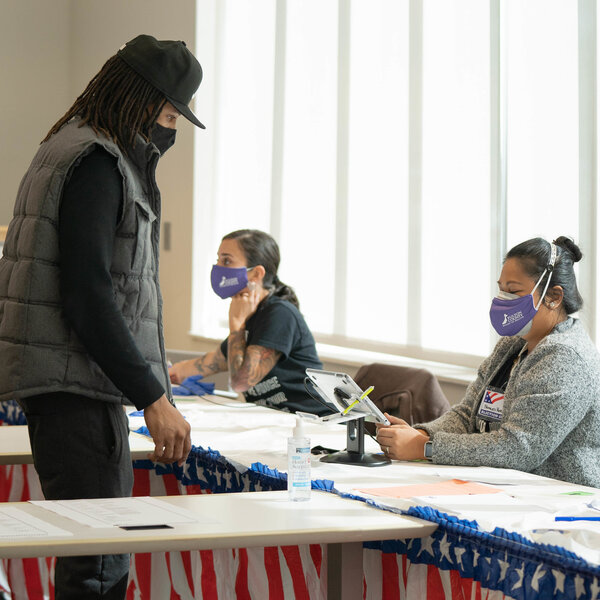
Items at a Gwinnett County, Ga., voting location on Jan. 5, when Democrats flipped two U.S. Senate seats after President Biden won the state in November. Georgia Republicans are proposing a sweeping new state law that would restrict early and absentee voting. Megan Varner/Getty Images
 

version of this story was originally published by Georgia Public Broadcasting.

Republicans in the Georgia legislature have released legislation that proposes tougher restrictions on both absentee and in-person early voting, among other sweeping changes to election laws after an election in which Democrats won the presidential race in the state and flipped two U.S. Senate seats.

The bill, HB 531, filed by GOP state Rep. Barry Fleming was introduced directly into the Georgia House’s Special Committee on Election Integrity on Thursday, and the text of the bill was made available about an hour before a hearing.

Many of the changes in the bill would predominantly affect larger, minority-heavy Democratic strongholds of the state, constituencies that helped President Biden narrowly defeat former President Donald Trump in the state last November, then boosted Democratic Sens. Raphael Warnock and Jon Ossoff in Georgia’s January runoff elections. In recent months, many Republicans at the local, state and federal level have pushed false claims of election fraud, and lawmakers in Georgia have vowed to change laws in response.

Part of the bill would provide “uniformity” to the three-week early voting period, Fleming said, requiring all counties to hold early voting from 9 a.m. to 5 p.m. Monday through Friday for three weeks before the election, plus a mandatory 9-to-5 period of voting the second Saturday before the election. It would allow counties to extend hours to 7 a.m. and 7 p.m., but would prohibit counties from holding early voting any other days — including Sunday voting popular in larger metro counties and a day of traditionally high turnout for Black voters through “souls to the polls” voter mobilization events.

Like other bills making their way through the GOP-controlled legislature, there would be a new photo ID requirement for absentee ballots. The bill would require voters to include their driver’s license number, state ID number or a copy of an acceptable form of photo ID. The driver’s license number or state ID number is already required for a new online request portal for Georgia voters, and photo ID is required to vote in person.

But the proposal would also shrink the window for Georgia voters to request an absentee ballot and limit the timeline for county officials to mail them out. No absentee ballot could be requested earlier than 11 weeks before an election or later than two Fridays before the election, and absentee ballots would not be sent out by mail until four weeks before day of the election.

The bill aims to restrict the location of secure drop boxes in the state to early voting sites and would limit the use of those drop boxes to just the days and times when early voting takes place. Another section would ban county elections offices from directly accepting outside funding for elections, after the Center for Tech and Civic Life and the Schwarzenegger Institute gave tens of millions of dollars to counties across Georgia to run the November and January elections in the midst of the pandemic.

One section appears to target mobile voting buses in Fulton County, which includes part of Atlanta. They were used during early voting to provide several pop-up polling locations in the Atlanta area under a recent Georgia law that allows early voting sites to be held at any location that is an Election Day polling place.

Some changes would give county elections workers more flexibility and greater staffing for polling locations, such as a tweak that would allow poll workers to operate sites in adjoining counties instead of just the county of their residence. Another would allow officials leeway in the requirement of voting equipment for typically lower-turnout primaries and runoffs. However, the deadline for results to be counted and certified would move up four days sooner to the Monday after the election.

Fleming’s bill revives a measure supported by Secretary of State Brad Raffensperger last year that would require precincts with over 2,000 voters and waiting times over one hour to add more workers, more machines or split the precinct.

Democratic state Rep. Rhonda Burnough expressed concern that Democrats did not have any input into the 48-page measure, as well as the quick timing of the bill.

“The public, people of color, they didn’t have opportunity to review or to give an opinion and there’s a lot of information in here that needs to be digested and looked at,” she said. “I think if we’re trying to really work towards restoring confidence that we should be working towards improving everything based on suggestions from the entire state of Georgia, not just us down here in the General Assembly.”

There will be more hearings on the bill in the coming days before it’s potentially sent to the floor of the Georgia House.