Oil pipeline builder agrees to halt eminent domain lawsuits
Adrian Sainz May 4, 2021
In this Jan. 28, 2021, file photo, Clyde Robinson, 80, speaks with a reporter while standing on his acre-sized parcel of land, in Memphis, Tenn. Robinson has been fighting an effort by two companies seeking a piece of his land to build part of an oil pipeline that would run through the Memphis area into north Mississippi. City council members in Memphis, Tenn., delayed a vote Tuesday, May 4, on a law that could make it more difficult for a company to build an oil pipeline over an aquifer that provides clean drinking water to 1 million people. The pipeline company also agreed to halt eminent domain lawsuits against property owners like Robinson (AP Photo/Adrian Sainz, File).
MEMPHIS, Tenn. (AP) — A company seeking to build a disputed oil pipeline over an aquifer that provides drinking water to 1 million people agreed verbally Tuesday to stop pursuing lawsuits against Tennessee property owners who refused to sell access to their land for construction.
Plains All American Pipeline spokesman Brad Leone said the company will put an agreement in writing with the Memphis City Council to set aside lawsuits filed against property owners fighting the Byhalia Connection pipeline. Leone spoke at a council committee meeting in which members discussed a proposed city law making it difficult for the pipeline to be approved and built.
Plains is part of a joint venture with Valero Energy to build the Byhalia Connection, a 49-mile (78-kilometer) underground pipeline linking the east-west Diamond Pipeline through the Valero refinery in Memphis to the north-south Capline Pipeline near Byhalia, Mississippi. The Capline, which has been transporting crude oil from a Louisiana port on the Gulf of Mexico north to the Midwest, is being reversed to deliver oil south through Mississippi to refineries and export terminals on the Gulf Coast.
Plains and Valero say the project will bring needed jobs and tax revenue to the Memphis area. Byhalia Connection has secured permission from Tennessee and the U.S. Army Corps of Engineers to build the pipeline.
The planned route would take the pipeline over the Memphis Sand Aquifer, which provides slightly sweet drinking water to 1 million people the Memphis area. It is part of a large aquifer system that lies beneath eight states and provides water for farms, factories and homes.
Environmentalists, lawyers, activists and politicians who oppose the pipeline are worried an oil spill would cause contaminants to seep into the aquifer and endanger Memphis’ drinking water. In a letter to the Army Corps, the Southern Environmental Law Center said the clay layer above the aquifer “has several known and suspected breaches, holes, and leaks.”
Activists also are upset that the pipeline would run through poor, predominantly Black neighborhoods in south Memphis that for decades have dealt with environmental concerns such as air and ground pollution. Community members have organized weekend rallies attended by pipeline opponents such as former Vice President Al Gore.
Most property owners along the path of the pipeline signed deals granting Byhalia access to their land. Property owners who haven’t agreed to receive payment in return for easements on their land have been sued, with the pipeline company’s lawyers trying to use eminent domain rights to claim property.
A hearing had been set for May 14 for a judge to hear arguments about whether Byhalia has a legal right to take the land.
Leone said the cases would be dismissed and the pipeline company plans to explore alternatives to the current route.
“A major part of that pause is not moving forward with the eminent domain lawsuits as mentioned,” Leone told the committee. “That’s absolutely something that we will agree to do.”
Council members then delayed vote on a proposed ordinance establishing a board to approve or deny construction of underground pipelines that transport oil or other potentially hazardous liquids near wells that pump millions of gallons of water daily from the aquifer.
Leone did not say the company would refrain from seeking easements with other property owners while the ordinance is delayed.
“We want our drinking water and our communities protected and we don’t want the pipeline company to continue misusing eminent domain to take land,” said Justin Pearson, co-founder of Memphis Community Against the Pipeline.
Pipeline opponents are backing the ordinance. But city council attorney Allan Wade said he has concerns about its legality.
Byhalia Connection said the ordinance would hurt local business and it would likely sue if the law is passed. A vote is not expected until at least July.
Byhalia has said the pipeline would be built a safe distance from the aquifer, which sits much deeper than the planned pipeline route. The company said the route was chosen after it reviewed population density, environmental features and historic cultural sites. Byhalia has attempted to build goodwill within Memphis by donating $1 million to local causes.
Byhalia also has said the pipeline route was not driven by factors such as race or class. The company has denied accusations of environmental racism that emerged after a Byhalia land agent said during a community meeting that the developers “took, basically, a point of least resistance” in choosing the pipeline’s path.
Pipeline opponents are fighting the project on several fronts. A federal lawsuit is challenging the Army Corps of Engineers’ approval of the pipeline under a nationwide permit, and the Shelby County Commission has refused to sell to the pipeline builder two parcels of land that sit on the planned route.
U.S. Rep. Steve Cohen, a Memphis Democrat, and about two dozen other members of Congress sent a letter asking the administration of President Joe Biden to reconsider the Army Corps’ permit approval.
Ocean Plastic Pollution Flows From More Rivers Than Previously Thought
Olivia Rosane May 3, 2021
The Pasig River in the Philippines is the kind of small, urban river that contributes more to ocean plastics than larger rivers, a new study has found. Artur Widak / NurPhoto via Getty Images
A new study published in Science Advances Friday found that 80 percent of the plastic that enters the world’s oceans via rivers comes from more than 1,000 waterways. That’s as much as 100 times the number of rivers previously estimated, study leader the Ocean Cleanup explained.
“[T]he problem is actually much more vast than we used to think,” Ocean Cleanup founder Boyan Slat told BBC News. “It’s not 10 rivers, it’s 1,000.”
The Ocean Cleanup is a nonprofit launched by Slat with the goal of using technology to remove 90 percent of the plastic waste floating in the ocean. As part of that goal, the organization funded three years of research into how and how many rivers were significantly contributing to plastic pollution.
Their findings upended some previous assumptions, as National Geographic explained. In 2017, two studies concluded that 90 percent of the plastic that enters the ocean via rivers was contributed by a small fraction of the world’s rivers — 10 in one study and 20 in another. Further, these rivers were large rivers that traveled a long way, such as Egypt’s Nile or China’s Yangtze. However, the new study has found that the biggest culprits are actually smaller rivers in urban areas. The 16-mile Pasig River in the Philippines is now considered a greater contributor to ocean plastics than the Yangtze, which flows 3,915 miles and was formerly ranked the most plastic-polluted river.
The new insights are based on an increased amount of data and new modeling.
“One big difference from a few years ago is we don’t consider rivers mere conveyor belts of plastics,” lead author Lourens J.J. Meijer told National Geographic. “If you put plastic into the river hundreds of kilometers from the mouth, it doesn’t mean that that plastic will end up in the ocean.”
While the results give would-be cleaners more rivers to focus on, Ocean Cleanup is still confident that it can use the data to help remove plastics.
“While this number is much higher than previous estimations (100 times), it is only 1% of rivers worldwide, which means solving the problem is feasible,” Meijer wrote for Ocean Cleanup. “By collectively taking a global approach with various technologies to target these most polluting rivers, we can drastically reduce the influx of plastic into the ocean.”
To that end, the Ocean Cleanup launched the Interceptor, a solar-powered device that gobbles up plastic carried on a river’s current. The devices are already at work on some of the world’s most polluted rivers in Southeast Asia and the Carribean, according to National Geographic. In 2019, the nonprofit announced a plan to install the devices in 1,000 rivers within five years, though the pandemic has slowed down the rollout somewhat.
“We hope to be operational in 10 rivers by the end of the year,” Slat told BBC News. “And what we truly believe is that if we do 10 rivers really well, that forms the foundation to do the next 100. If we do 100, we can also do 1,000.”
People of Color Breathe More Hazardous Air. The Sources Are Everywhere.
Hiroko Tabuchi and Nadja Popovich April 28, 2021
A home near the Marathon Petroleum Company refinery in River Rouge, near Detroit, April 24, 2020. (Emily Rose Bennett/The New York Times)
Over the years, a mountain of evidence has brought to light a stark injustice: Compared with white Americans, people of color in the United States suffer disproportionately from exposure to pollution.
Now a new study on a particularly harmful type of air pollution shows just how broadly those disparities hold true. Black Americans are exposed to more pollution from every type of source, including industry, agriculture, all manner of vehicles, construction, residential sources and even emissions from restaurants. People of color more broadly, including Black and Hispanic people and Asian Americans, are exposed to more pollution from nearly every source.
The findings came as a surprise to the study’s researchers, who had not anticipated that the inequalities spanned so many types of pollution.
“We expected to find that just a couple of different sources were important for the disparate exposure among racial ethnic groups,” said Christopher W. Tessum, an assistant professor in environmental engineering and science at the University of Illinois at Urbana-Champaign, who led the study. “But what we found instead was that almost all of the source types that we looked at contributed to this disparity.”
The study builds on a wealth of research that has shown that people of color in America live with more pollution than their white neighbors. Fine particulate matter air pollution, known as PM 2.5, is harmful to human health and is responsible for 85,000 to 200,000 excess deaths a year in the United States.
Racial and socioeconomic disparities in exposure to PM 2.5 have been well documented and have persisted despite an overall decline in particulate pollution. But the researchers sought to get a better grasp of whether these disparities came from just a handful of sources or whether the inequalities could be seen more widely.
They used an air quality model to analyze data from the Environmental Protection Agency on more than 5,000 emission sources collected as part of a 2014 nationwide emissions survey. Then they identified differences in exposure to each by broad race-ethnicity and income groups, based on U.S. census data.
They found that nearly all emissions sources caused disproportionate exposures for people of color, on average, as well as separately for Black, Hispanic and Asian people. Black people were exposed to higher-than-average concentrations from all major emissions groups, while white people were exposed to lower-than-average concentrations from almost all categories. The disparities were seen nationally as well as at the state level, across income levels and across the urban-rural divide.
These findings were consistent with the experiences of communities on the ground, said Robert D. Bullard, a professor at Texas Southern University who has written for more than 30 years about the need to redress environmental racism, who was not involved in the study.
“If you go to communities of color across this country and ask them, ‘What’s the source of the environmental problems?’ they can point you to every one: the highway, the chemical plants, the refineries, the legacy pollution left over from decades ago, in the houses, in the air, in the water, in the playgrounds,” he said. “Empirical research is now catching up with the reality: that America is segregated and so is pollution.”
On Wednesday, the Environmental Integrity Project, a nonprofit group founded by former officials from the EPA, released a separate report that found that 13 refineries across the United States had released elevated levels of benzene, another harmful pollutant, into mostly minority and lower income neighborhoods in 2020.
These disparities have roots in historical practices, like redlining, under which the federal government marked certain neighborhoods as risky for real estate investments because their residents were Black. For decades, residents of redlined areas were denied access to federally backed mortgages and other credit, fueling a cycle of disinvestment and environmental problems in those neighborhoods.
“Communities of color, especially Black communities, have been concentrated in areas adjacent to industrial facilities and industrial zones, and that goes back decades and decades, to redlining,” said Justin Onwenu, a Detroit-based organizer for the Sierra Club. “And a lot of our current infrastructure, our highways, were built on — built through — Black communities, so we’re breathing in diesel emissions and other pollution just because we’re located right next to these highways,” Onwenu said.
The latest research, published Wednesday in the journal Science Advances, shows how that legacy continues to cast a shadow. Emissions from industry, construction and both light- and heavy-duty vehicles were among the sources that caused the largest absolute disparities for Black, Hispanic and Asian Americans.
Particulate pollution from coal-fired power plants, meanwhile, was one of the only sources that substantially affected white Americans more than average. That was explained, Tessum said, by the predominantly white demographics of many coal towns. Coal power plants also tend to have smoke stacks that are many hundreds of feet high, scattering fine particles more evenly across larger areas.
Likely for the same geographic reason, white Americans were slightly more exposed to particulate pollution from agriculture, including from soil tilling and wind erosion. But in California, which produces more than one-third of the country’s vegetables and two-thirds of its fruits and nuts, Hispanic people were disproportionately exposed.
Newer industries can perpetuate these inequalities. A large Latino population in the Inland Empire region of Southern California, for example, near one of the nation’s largest concentration of Amazon warehouses, has suffered from the heavy diesel traffic that feeds the sprawling e-commerce hub.
“These warehouses are being built within feet of existing homes, within feet of schools,” said Cesunica E. Ivey, an assistant professor in chemical and environmental engineering at the University of California, Riverside, who was not involved in the study. “Local voices in those neighborhoods are often drowned out,” she said. “And they can’t just move. You need resources to relocate.”
The coronavirus pandemic, which has taken a disproportionate toll on Black, Latino and other communities, added to the burdens.
“A lot of families have kids with asthma. There’s high rates of respiratory illness. Many people have died from cancer and other types of diseases,” said Vivian Huang, a director at the Asian Pacific Environmental Network, which works with communities that live at the fence line of refineries and other polluting facilities in California. “The COVID pandemic has just exacerbated these immense inequalities.”
One surprising source of pollution that disproportionately affects communities of color, though a smaller source of emissions overall, were restaurants. A recent study that looked at Oakland, California, and Pittsburgh found that emissions from commercial kitchens — mostly from their use of cooking oils — were a surprisingly large fraction of particulate air pollution in those cities. More people of color tended to live nearby and so were more exposed.
Getting a clearer picture of how different sources of air pollution affect different groups of people is important, because history has shown that simply reducing overall emissions does not address racial and other disparities, said Joshua Apte, an assistant professor at the University of California, Berkeley, and a co-author of both the PM 2.5 and commercial kitchen studies.
“When nearly every major source category in the U.S. disparately impacts people of color, reducing sources alone is really insufficient to solve this problem,” he said. “We have to think about where the sources are as well.”
Judge gives Corps 2nd chance to offer oil pipeline opinion
Dave Kolpack April 27, 2021
FILE – In this October 2016 file photo, construction continues on the Dakota Access pipeline. A hearing was scheduled for Friday, April 9, 2021, to determine whether the Dakota Access oil pipeline should be allowed to continue operating without a key permit while the U.S. Army Corps of Engineers conducts an environmental review on the project. (Tom Stromme/The Bismarck Tribune via AP, File).
FARGO, N.D. (AP) — A federal judge faced with a motion on whether the Dakota Access oil pipeline north of the Standing Rock Indian Reservation should be shut down during an environmental review is giving the Biden administration another chance to weigh in on the issue.
U.S. District Judge James Boasberg held a hearing earlier this month to give the U.S. Army Corps of Engineers an opportunity to explain whether oil should continue to flow during its study, after an appeals panel upheld Boasberg’s ruling that the pipeline was operating without a key federal permit. The Corps instead told the judge it wasn’t sure if it should be shut down.
The decision not to intervene came as a bitter disappointment to Standing Rock, other tribes involved in the lawsuit and environmental groups. Even the judge appeared to be taken aback when the Corps opted to shrug its shoulders.
“I too am a little surprised that this is where things stand 60 days later,” Boasberg said at the hearing, referring to the three months he gave the Biden administration to catch up on proceedings. “I would have thought there would be a decision one way or another at this point.”
Boasberg said in a one sentence order filed late Monday that the Corps has until May 3 to tell him when it expects the environmental review to be completed and give “its position, if it has one,” on whether the pipeline should be shut down. The Corps said earlier it expected the review to be done by March 2022.
Attorneys for the pipeline’s Texas-based owner, Energy Transfer, have argued that shuttering the pipeline now that economic conditions are improving would cause a major financial hit to several entities, including North Dakota, and the Mandan, Hidatsa and Arikara Nation located in the state’s oil patch.
Attorneys for Standing Rock, which straddles the North and South Dakota border, and other tribes said in court documents that Dakota Access is exaggerating the economic losses. And no matter what the true figure is, Standing Rock said, it should not come at the expense of other tribes “especially when the law has not been followed.”
The $3.8 billion, 1,172-mile (1,886-kilometer) pipeline was the subject of months of protests in 2016 and 2017, sometimes violent, during its construction. Standing Rock continued to press legal challenges against the pipeline even after it began carrying oil from North Dakota across South Dakota and Iowa to a shipping point in Illinois in June 2017.
Mark Bittman’s warning: the true costs of our cheap food and the American diet
Oliver Milman in New York April 25, 2021
The global, industrialized food system faces increasing scrutiny for its environmental impact, given its voracious appetite for land is linked to mass deforestation, water pollution and a sizable chunk of the world’s greenhouse gas emissions.
The implied trade-off has been that advances in agriculture have greatly reduced hunger and driven societies out of poverty due to improved productivity and efficiencies. But Mark Bittman, the American food author and journalist, argues in his new book Animal, Vegetable, Junk that these supposed benefits are largely illusionary.
In a sweeping deconstruction of the history of food, spanning the past 10,000 years of organized agriculture, Bittman takes in everything from Mesopotamian irrigation to the Irish famine to the growth of McDonald’s to posit the rise of uniformity and convenience in food has mostly benefited large companies, fueled societal inequities and ravaged human health and the environment. Al Gore, the former US vice president, has called the book a “must-read for policymakers, activists and concerned citizens looking to better understand our food system and how to fix it”.
The Guardian spoke to Bittman about the book – his comments are edited for length and clarity.
Many people will know you for the cookbooks you’ve written. This is quite a departure, isn’t it?
I think it is the most important piece of work I’ve done. I guess the obituary writers decide that or something. I don’t know. But How to Cook Everything was really important to me and my career. And obviously, it’s done very well. But this was the book I wanted to write, I think, for the last 20 or even 30 years. I can’t imagine doing anything bigger or more important.
You say that the advent of organized agriculture could be one of the most disastrous things we ever did. Why is this?
Jared Diamond is, I think, the first guy to say the agricultural revolution is not all peaches and cream. The population 10,000 years ago was a fraction of what it is now. Agriculture has enabled billions of people to have been alive, and be alive, than would be possible without agriculture. So if you think that’s beneficial, that’s really great.
On the other hand, one could argue that the quality of life did not go up, but went down when agriculture became common. And you could certainly argue that agriculture is damaging to the environment, the public health and so on right now. But that is fixable. It’s changeable. So, I don’t think you could say agriculture, which just means growing food or growing stuff, is a bad thing. It’s just what do we make of it?
The book contains quite a harsh critique of how free market capitalism has caused great problems in our food systems.
Yes. We should qualify, so called free market capitalism, since it’s socialism for big corporations and dog-eat-dog for everybody else or whatever. Yeah, there’s a zillion examples in the book and elsewhere of capitalism and its impact on agriculture. You could certainly argue that agriculture, agriculture slavery and capitalism are all tied together. And that’s something that developed from the 15th to the 18th century.
The fallout includes famine, doesn’t it?
The Irish famine was the first well known one and I guess you could say the first politically caused famine as opposed to more environmentally caused famine. They’re all complicated, but the Irish potato famine can definitely be laid at the feet of the English who had converted most of Ireland’s peasant farmland into grazing lands for both animals, the meat of which was destined to be sent over the Irish Sea.
And then followed famines in Bengal and in West Africa. Of course, Stalin and Mao’s famines, it’s not all the UK’s fault. The famines of Stalin and Mao are very much politically induced. They were about a lack of food, but how they were treated was very much political. Stalin wanted to erase the peasants, Mao wanted to erase the landlords. And they were both successful to some extent. They used food as a weapon.
Corn and soybeans grow on a farm near Tipton, Iowa.Photograph: Scott Olson/Getty Images
So where did we go wrong with food?
There was a time that almost everyone farmed and grew food for themselves and their neighbors and or trade, local trade and so on. But at some point, surplus became more important than feeding people. Growing food, or growing crops in order to sell them and make money became more important than growing crops to feed people.
And that process accelerated since 1500, or whenever you want to say capitalism began. To the point where, in the States at least, 95% of crops are basically grown as cash crops. And the question is almost never ‘What is the land telling us we want to grow? What can we grow that will be most beneficial for our community? What can I grow that’s most nutritious that will damage the land as little as possible?’ Those are not questions that are being asked.
Growing food, or growing crops in order to sell them and make money became more important than growing crops to feed people
The questions that are being asked or the question that’s being asked is ‘How can I make the most money possible with this land?’ Sometimes that means just selling the land for development. But often, it means growing one crop at a time. And it’s a crop that’s either directly or indirectly subsidized, like corn or soybeans. And it’s a crop that mostly goes into junk food or animal feed, or even ethanol, which is obviously not food at all.
I really think the enclosure of the commons was a big deal. When the nobility started dictating to peasants what should be grown and how it should be sold and to whom it should be sold. And peasants began to run out of land to grow food for themselves and their families. That was one of the driving factors in the industrial revolution. And we’ve just seen that accelerate.
So if we fast forward to the current situation in the US, how has this history influenced what people eat today?
One of the most damning statistics is that close to 50% of the food that’s available is in the form of ultra processed food. So ultra processed food is what I call junk food. What many of us call junk food. And it means food that contains non-food ingredients; food that your grandmother, great grandmother, maybe at this point wouldn’t have recognized as food.
Food that you can’t cook yourself. Food that you don’t find in your own kitchen in the normal course of cooking and eating. A food that didn’t exist before the 20th century.
The counter-argument to this is often ‘There is so much choice now, why not just choose a healthier option,’ isn’t it?
It’s important to recognize that because ultra processed food is cheap and it’s fast and it’s widely available; people without time and without money, are more likely to buy that kind of food. But everybody eats junk food. And it also poisons the environment for everybody.
The answer is to increase the availability and affordability of real food. It’s not let’s make better personal choices, because they go back to that statistic. And that’s why I think it’s so important that you can only buy, you can only eat what there is. Since actually no one is growing food, we’re all on the market. And if the market is 50% junk food, that’s what people are eating.
This system of food has proved very successful in establishing itself, hasn’t it?
The American diet, which we have to take full responsibility for, is spreading worldwide. It’s spreading worldwide because it’s profitable for big food. It absolutely is engineered to taste good. It hits the pleasure centers in your brain and it stimulates dopamine and so on. If it’s not, strictly speaking, addictive in the way that caffeine or opiates are addictive, it’s very, very close.
The sun rises over chicken houses on a farm in Virginia.Photograph: Steve Helber/AP
What do we need to do differently?
We really have to change agriculture what we’re growing and make a real effort to grow real food. Transport real food, market real food. Have farmers who steward the land. All of those cliches.
But on the other hand, we have to make sure that people have the income or the ability to buy real food. We have a choice. We are subsidizing junk food. It may well be that as societies grow, as populations grow, as societies become more technologically inclined, that it may be that food agriculture just is an expensive enterprise. And needs to be supported by government. It needs to be subsidized.
But we do have a choice between whether we subsidize bad agriculture or subsidize good agriculture. Whether we subsidize the production of junk food or subsidize the production of fruits, vegetables, nuts and seeds.
The world is going to have a population close to 10 billion people by the mid-point of this century and those who support the intensification of monocultural farming say this will be the only way to feed this number of people. What is your response to that?
No one’s asking us to feed them. In many cases, people are just asking us to leave them alone. So that, in a way is a PR ploy for big ag: “We need to increase yield forever, so that we can feed the world.” But the world does not want us to feed them. The world wants us to stop stealing their land and stop poisoning them and so on. At least, that’s my perception of the world.
Cheap food has had a terrible impact on public health. As every country switches from a traditional diet to a more American diet, their rates of chronic disease go up. And yet we cannot get government to consider this a crisis
As for producing cheap food that Americans can afford, yeah, that’s a trade off. That’s an industrial revolution era trade off. Workers were paid, it was assumed that women’s labor was free. So you didn’t have to pay workers enough to worry about child care or cooking or any other domestic chores. And then if you made food cheap, you could pay them even less.
So that was a trade off of the early Industrial Revolution. But there’s a price for cheap food. And the price is not only environmental damage and heavy resource use. There are other prices as well. But the one I want to focus on just this moment is the public health costs.
And if you look at a chart of health care costs versus food costs, it’s perfect like this. As food costs go up, healthcare costs go down. And as food costs go down, health care costs go up. So cheap food, that’s a direct correlation. Cheap food has had a terrible impact on public health. As every country switches from a traditional diet to a more American diet, their rates of chronic disease go up. In every single instance. And yet we cannot get government to consider this a crisis.
So we are paying for the food one way or the other, sometimes with our health.
Yeah, exactly. The society is paying the costs. Just like every aspect of food that you want to examine carefully has hidden costs. Economists call them externalities. Hidden costs that aren’t included in the cost of the product. So, Walmart pays its workers badly, you get cheap stuff at Walmart, including food.
And some huge percentage of those workers are on food stamps. You’re also paying for those. You’re subsidizing Walmart employment costs. It’s not just cash, we’re paying with our own health.
What does an alternative to this look like?
I’m not saying we have to go from industrial farming back to farming the way it was in the 1600s by any means. But I’m saying there are steps we can take to reduce the use of pesticides. To make life better for farmers, to improve the quality of soil. To remove antibiotics from the food supply. To teach our children what real food is and so on down the line.
I think some limits on marketing junk food to children, along with teaching children where food is from and what food is about is really important. Because if you’re going to allow marketers to target kids, they will convince them that Tony the Tiger is their friend and that Coke is the best beverage to drink. And that McDonald’s is the most fun place to eat.
If you’re going to let kids become convinced of that then you’re going to have generation after generation of adults who were saddled with food preferences that are dictated by big food. And we all know how difficult it is to change our food preferences. We all know that. Especially in the last year, everybody saw that: “I’m so scared of Covid. I’m so bored with being locked up. I’m going to order in pizza and have ice cream.” Or whatever their favorite childhood food is, we would all turn to that. I saw this in myself and everybody I talk to sees it in themselves.
So, we have to raise generations of healthy children if we want generations of healthy adults. But that means making good food available, affordable to everybody.
Animal, Vegetable, Junk by Mark Bittman is published by Houghton Mifflin Harcourt
Why so many epidemics originate in Asia and Africa – and why we can expect more
Suresh V. Kuchipudi, Clinical Professor and Associate Director of Animal Diagnostic Laboratory, Penn State April 25, 2021
On Feb. 18, 2020, in Seoul, South Korea, people wearing face masks pass an electric screen warning about COVID-19. AP Photo/Ahn Young-joon
The coronavirus disease, known as COVID-19, is a frightening reminder of the imminent global threat posed by emerging infectious diseases. Although epidemics have arisen during all of human history, they now seem to be on the rise. In just the past 20 years, coronaviruses alone have caused three major outbreaks worldwide. Even more troubling, the duration between these three pandemics has gotten shorter.
I am a virologist and associate director of the Animal Diagnostic Laboratory at Penn State University, and my laboratory studies zoonotic viruses, those that jump from animals and infect people. Most of the pandemics have at least one thing in common: They began their deadly work in Asia or Africa. The reasons why may surprise you.
Shoppers in face masks as they line up at a grocery store in Wuhan, a city of 11 million, in central China’s Hubei Province. The urbanization of once densely forested areas of Asia and Africa have contributed to the spread of these deadly viruses. AP Photo/Arek Rataj
Population explosion and changing urban landscapes
An unprecedented shift in human population is one reason why more diseases originate in Asia and Africa. Rapid urbanization is happening throughout Asia and the Pacific regions, where 60% of the world already lives. According to the World Bank, almost 200 million people moved to urban areas in East Asia during the first decade of the 21st century. To put that into perspective, 200 million people could form the eighth most populous country in the world.
Migration on that scale means forest land is destroyed to create residential areas. Wild animals, forced to move closer to cities and towns, inevitably encounter domestic animals and the human population. Wild animals often harbor viruses; bats, for instance, can carry hundreds of them. And viruses, jumping species to species, can ultimately infect people.
Eventually, extreme urbanization becomes a vicious cycle: More people bring more deforestation, and human expansion and the loss of habitat ultimately kills off predators, including those that feed off rodents. With the predators gone – or at least with their numbers sharply diminished – the rodent population explodes. And as studies in Africa show, so does the risk of zoonotic disease.
The situation is only likely to get worse. A major proportion of East Asia’s population still lives in rural areas. Urbanization is expected to continue for decades.
A family farm in Zambia. Disease in livestock is common, an easy way for pathogens to transfer from animals to people. Getty Images/Guillem Sartorio/AFP
Subsistence agriculture and animal markets
Tropical regions, rich in host biodiversity, already hold a large pool of pathogens, greatly increasing the chance that a novel pathogen will emerge. The farming system throughout Africa and Asia doesn’t help.
On both continents, many families depend on subsistence farming and a minuscule supply of livestock. Disease control, feed supplementation and housing for those animals is extremely limited. Cattle, chickens and pigs, which can carry endemic disease, are often in close contact with each other, a variety of nondomestic animals and humans.
And not just on the farms: Live animal markets, commonplace throughout Asia and Africa, feature crowded conditions and the intimate mixing of multiple species, including humans. This too plays a key role in how a killer pathogen could emerge and spread between species.
Another risk: bushmeat hunting and butchering, which is particularly widespread in sub-Saharan Africa. These activities, as they threaten animal species and irrevocably change ecosystems, also bring people and wild animals together. Bushmeat hunting is a clear and primary path for zoonotic disease transmission.
So is traditional Chinese medicine, which purports to provide remedies for a host of conditions like arthritis, epilepsy and erectile dysfunction. Although no scientific evidence exists to support most of the claims, Asia is an enormous consumer of traditional Chinese medicine products. Tigers, bears, rhinos, pangolins and other animal species are poached so their body parts can be mixed into these questionable medications. This, too, is a major contributor to increasing animal-human interactions. What’s more, demand is likely to go up, as online marketing soars along with Asia’s relentless economic growth.
A matter of time
The viruses, thousands of them, continue to evolve. It’s just a matter of time before another major outbreak occurs in this region of the world. All the coronaviruses that caused recent epidemics, including the COVID-19, jumped from bats to another animal before infecting humans. It’s difficult to predict precisely what chain of events cause a pandemic, but one thing is certain: these risks can be mitigated by developing strategies to minimize human effects which contribute to the ecological disturbances.
As the current outbreak has shown, an infectious disease that starts in one part of the world can spread globally in virtually no time whatsoever. There is an urgent need for constructive conservation strategies to prevent deforestation and reduce animal-human interactions. And a comprehensive global surveillance system to monitor the emergence of these diseases – now missing – would be an indispensable tool in helping us fight these deadly and terrifying epidemics.
Why young people of color are leading the fight to save planet Earth
Beth Greenfield, Senior Editor
Youth activists on the frontlines of climate-change justice include, clockwise from top left: Kevin Patel, Amy Quichiz, Wanjiku “Wawa” Gatheru, Xiye Bastida, Vic Barrett and Nyaruout Nguany. (Illustration by Nathalie Cruz for Yahoo Life)
As we head into Earth Day 2021 — the 51st anniversary of the worldwide environmental movement, on April 22— one of the best ways to find motivation and inspiration in the fight to save our planet might be to look toward those who are leading the charge: a diverse array of youth activists who understand that the only way to see and advocate for climate-justice issues is through an intersectional lens.
That means “taking account the dimensions of gender, socioeconomic class and race that all ultimately influence how one relates to and experiences the effects of climate change,” explains Aalayna Green, 22, co-environmental education director for Black Girl Environmentalist, a “supportive community of Black girls, women and nonbinary environmentalists.” Understanding those dimensions, Green tells Yahoo Life, “ensures that any climate change activism isn’t going to be automatically catered to one type of person in society.”
Historically, the environmental movement has been a very white one — at least on its face, due in part to a “long-running perception that people of color don’t care about the environment, or don’t have the skills and academic backgrounds for these jobs,” environmentalist Dorceta Taylor, a Yale School for the Environment professor, said in a 2014 interview. That perception “has been debunked for just as long,” according to Taylor, whose landmark 2014 report “The State of Diversity in Environmental Institutions: Mainstream NGOs, Foundations, and Government Agencies,” and a more recent update, called for action on the issue. (See just a tiny sampling of pioneering BIPOC environmental activists in the interactive XR, below.)
Just this week, Taylor and a slew of other environmental experts and a diverse array of young activists came together for the fourth annual New Horizons in Conservation Conference, presented by Yale, to discuss the status of equity and inclusion within the field of conservation. “The media tends to focus attention on climate activism on young white activists in the U.S. and Europe,” Taylor tells Yahoo Life vie email, but the conference “demonstrates that young students of color are engaged in climate activism and are interested in being a part of the solution… Many speakers drove the point home that the climate movement, conservation, and the broader environmental movement cannot be successful if white leaders, policymakers, practitioners do not collaborate with communities and activists of color.”
The event has served to highlight the new force of activists, expanding the understanding of who is affected by climate change and who is actively fighting against it.
“I think BIPOC youth, and youth in general, are leading the movement now,” says James Munn, an environmental organizer since 1990 and now the national campaign director for Greenpeace, which just released a new report, “Fossil Fuel Racism,” elucidating how fossil fuels disproportionately harm Black, brown, indigenous and poor communities. “I don’t think that was necessarily true before,” Munn tells Yahoo Life, “although not because there weren’t Black or indigenous POC youth involved in local fights, but because there was a huge separation between mainstream organizations and the local efforts.”
He adds, “We live in a white supremacist society, and organizations mirror the society they’re in. Hopefully, now we’re mirroring the changes that are happening in society.” That would make sense, he says, when taking into account today’s biggest issues and who they most affect.
“When you look at the current existential crises for humanity, you have racial injustice, inequality — with some making billions throughout the pandemic while many are struggling to just have enough food — and climate change,” Munn says. “And we have BIPOC youth often at the intersection of all three…so they can speak to all of it in a way that others couldn’t speak to it in the past.” And just being young, he adds, is an asset for these activists. “They feel invincible, and you need that to go against Trump or Bezos or Chevron, Exxon, and go, ‘OK, they have a lot of power, but we’re going to outlast and outthink them. We can do it.'”
To mark Earth Day this year, Yahoo Life is amplifying those voices by profiling just a handful of the ever-growing force of bright young activists who are approaching climate justice from an intersectional perspective. In our series of profiles, you’ll meet Wanjiku “Wawa” Gatheru, founder of Black Girl Environmentalist; Kevin Patel, founder and executive director of One Up Action; Amy Quichiz, founder of Veggie Mijas; Nyaruout Nguany, co-founder of Maine Environmental Changemakers Network; Vic Barrett, a campaigner with Alliance for Climate Education; and Xiya Bastida, founder of Re-Earth.
“I think the youth movement is the most inclusive and diverse it has been,” Batista, 18, told Yahoo Life about Gen Z’s approach to climate-justice activism. “Re-Earth Initiative, for example, has activists in over 15 times zones, we translate our information to over six different languages. Our board includes people from almost every continent and we operate in a non-hierarchical way that actually listens to the whole body when it comes to what we’re going to do… In our own youth organizations, we’re modeling the world we want to see.”
In Romania, ‘modern slaves’ burn noxious trash for a living
Stephen McGrath April 22, 2021
Vidra, Romania (AP) — In the trash-strewn slums of Sintesti, less than 10 miles from Romania’s capital, Mihai Bratu scrapes a dangerous living for his Roma family amid the foul reek of burning plastic that cloys the air day and night.
Like many in this community, for him illegally setting fire to whatever he can find that contains metal — from computers to tires to electrical cables — seems like his only means of survival.
“We’re selling it to people who buy metal, we are poor people … we have to work hard for a week or two to get one kilogram of metal,” 34-year-old Bratu, perched on an old wooden cart, told The Associated Press. “We are struggling to feed our kids … The rich people have the villas, look at the rich people’s palaces.”
You don’t have to look far.
The main road that runs through Sintesti, a largely Roma village in the Vidra commune, is lined with ornate, semi-constructed villas and dotted with shiny SUVs. Behind lurk the parts where Bravu and his young children live, a social black hole with no sanitation or running water. The two worlds are strongly connected.
For Octavian Berceanu, the new head of Romania’s National Environmental Guard, the government environmental protection agency, the pollution from the illegal fires that burn here almost ceaselessly was so bad that he started regular raids in the community — where he says “mafia structures” lord it over “modern slaves.”
“This is a kind of slavery, because the people living here have no opportunity for school, to get a job in the city, which is very close, they don’t have infrastructure like an official power grid, water, roads — and that is destroying their perspective on life,” Berceanu told The Associated Press during a police-escorted tour in April.
The slums of Sintesti, like Roma communities elsewhere, have long been ignored by authorities. They’re made up of makeshift homes, where unofficially rigged electricity cables hug the ground and run over a sea of trash.
“For too many years, they were allowed in some way to do this dirty job,” Berceanu said. “Nobody came here in the past.. to see what’s happening.”
On one day in April during a patrol of the local area, authorities seized a van loaded with 5,000 kilograms of illegal copper, worth as much as 40,000 euros ($48,000). That’s just a small cog in the local illegal metal recycling industry and highlights the staggering revenue it can bring to the wealthy homeowners.
But on top of the considerable social ills, according to the environment chief, the fires can significantly hike pollution in Bucharest, potentially by as much as 20-30%, at times pushing air quality to dangerous levels.
“The smoke particulates are taken by the wind 10 miles, it’s like rain over Bucharest and it’s destroying the quality of the air in the capital. It’s one hundred times more dangerous than wood-fire particles — there are a lot of toxic components,” Berceanu said.
During a late afternoon patrol of Sintesti, AP journalists joined Berceanu and four police officers as they homed in on an acrid cloud of smoke rising above the hotchpotch dwellings. A raucous scene broke out until a hunched-over elderly lady could be persuaded to douse the fire with water — exposing the valuable metal remnants.
“If the local authorities are not applying the law, of course people — whatever their ethnic origin — are encouraged to continue doing what they are doing,” said Gelu Duminica, a sociologist and executive director of the Impreuna Agency, a Roma-focused non-governmental organization.
Focusing on pollution from the Roma community, Duminica says, instead of on big industry or the more than 1 million cars in the densely populated capital of 2 million, is “scapegoating” and part of a political “branding campaign.”
“Everywhere in the world, the poorest are exploiting the marginal resources in order to survive. We have a chain of causes: low education, low infrastructure, low development … a lot of things are low,” Duminica said
“The rich Roma are controlling the poor Roma, but the rich Roma are controlled by others. If you look at who is leading and who is controlling things, it’s more than likely you’ll have huge surprises. Let’s not treat it as an ethnic issue,” he said.
In the future, the environment chief hopes surveillance drones with pollution sensors and infrared cameras can help paint a clearer picture of how the networks operate.
“We’re working against organized crime and it’s very hard,” he said. “If we solve this problem here, very close to Bucharest, we can solve any kind of problem similar to this all around the country.”
For local resident Floria, who refused to give a surname but said she was 40-something, a lack of official documents, education, and options leave her and her community with no alternatives.
“We don’t want to do this. Why don’t they give us jobs like (communist dictator Nicolae) Ceausescu used to, they would come with buses, with cars, and take us to town to work,” she told The Associated Press. “Gypsies are seen as the worst people no matter where we go or what we do.”
Mihai Bratu blames local authorities for the plight of his community, for the lack of roads, the lack of action.
“The mayor doesn’t help us!” he exclaims, as a small boy shifts building materials from Bratu’s horse cart to the muddy yard next door.
“What do we have? What can we have? Some little house? — whatever God granted us.”
Black neighborhoods in Kansas hard hit by property tax sales
Roxana Hegeman
Karen Pitchford-Knox stands in front of her home Monday, April 19, 2021, in Kansas City, Kan. Pitchford-Knox found out from a state senator that her home was put up for sale by Wyandotte County in January when she fell behind on her property tax payments after loosing her job during the pandemic. (AP Photo/Charlie Riedel)
Racial Injustice Tax Sales
Rozetta Dotson worked two jobs to scrape together the money to pay down a delinquent tax debt on the Kansas City, Kansas, home she owns with her husband, Ricky. Then the pandemic hit, she lost her second job and Ricky got COVID-19.
The Black homeowners kept paying what they could toward the taxes while waiting to talk to a judge about a new payment agreement. Then she found out her house was up for auction online.
“We just felt like it was a scam, like they were trying to take our property and my husband said we felt like we were targeted, you know, because we are living in a predominantly Black neighborhood and they were doing everything they could to cause us to lose our house,” she said.
The Dotsons are among those in historically Black neighborhoods in Kansas City, Kansas, who risk losing their homes amid the pandemic as delinquent property tax sales resume under a practice critics decry as racist and government officials laud for revitalizing communities.
“It is a reverse redlining that is racist. And I don’t use that word a lot, but that is the only thing, I mean, it is classism and racism to socially and economically deprive people of color who live in a particular part or who have acquired a foothold in a particular part of Wyandotte County,” said state Sen. David Haley, a Black Democrat, who has tried to help some residents in his hometown keep their houses.
Officials with the Unified Government of Wyandotte County and Kansas City, Kansas, acknowledge delinquent parcels up for tax sale are predominantly in Black neighborhoods. The county — whose population of 165,000 is about 23% Black, 30% Latino and 40% white — typically has 2,200 properties for sale annually at its three tax auctions, far more than other large Kansas counties.
Wyandotte County says it auctions residential property as soon as the law allows — when taxes are three years behind. It says the goal is to put properties into “responsible hands” to improve the appearance of neighborhoods.
A lot of the properties don’t sell at auction, and the county then gets them through the Wyandotte County Land Bank, a public authority that now has about 3,500 properties — nearly all of them acquired through tax foreclosures.
Katherine Carttar, local director of economic development, said the county decided to be more proactive with delinquent property taxes about three years ago and to use the land bank more as a way to rebuild neighborhoods. At a virtual conference last year touting its successes, she showed slides featuring now-renovated homes and credited the program with raising property values and the county’s tax base.
Critics say Wyandotte County has a disproportionately high number of delinquent tax sales compared with the rest of the state, and that the effort deprives residents of hard-fought gains in communities that for generations have faced discrimination.
Wyandotte County, where 21% of residents live in poverty, has whole city blocks of foreclosed property for future redevelopment. Displaced property owners get no compensation, Haley noted.
Carttar says most properties in the land bank have been long abandoned. The upcoming online delinquent tax sale lists 43% of properties as vacant.
The practice comes against the national backdrop of a wealth gap between white and Black households. The “first rung of the wealth building ladder” is homeownership, said Chuck Collins, director of the Program on Inequality and the Common Good at the Institute for Policy Studies, a progressive research group.
Nearly 72% of white Americans owned their own homes in 2017, compared with just slightly more than 42% of Black families, according to the U.S. Census Bureau.
“Here we are during a pandemic where the racial impact of the pandemic has not been equal. It has been disproportionately borne by Black and brown people and there is a huge risk of evictions and foreclosures coming out of the pandemic once the various moratoriums are lifted,” Collins said. “So it might be a time not to pursue aggressive tax sales.”
The two Black county commissioners who represent neighborhoods hard hit by the sales did not respond to interview requests from The Associated Press.
In the Dotsons’ case, Haley noticed that their house was on the auction list and alerted them. They went to pay the full $2,300 in delinquent taxes the day of the sale, but were told it was too late, Rozetta Dotson said.
They eventually got their home back — by paying back taxes plus legal fees for the attorney for the real estate company that had bought it. The total was $5,200.
Haley successfully warned another Black resident, Karen Pitchford-Knox, that the house where she’d grown up was on the auction block this January. When Pitchford-Knox’s mom died in 2016, she inherited the house as well as more than $5,000 in delinquent property taxes. She got behind on her payment plan after losing her job during the pandemic.
Pitchford-Knox had about two weeks to — as she put it — “beg, borrow and steal from Peter and Paul” the $1,000 for the taxes.
“I most definitely do feel they are targeting Black homes,” she said, noting she knew three other Black women whose homes were on auction lists. “I feel it is like Black female homeowners and Black seniors.”
On May 8, 2017, a drum of radioactive oilfield waste from Australia arrived at a remote West Texas disposal site operated by local oil and gas environmental services company, Lotus LLC. This drum of waste entered the United States aboard a Singapore Airlines cargo jet, appropriately packaged in a steel drum. According to files from the Railroad Commission of Texas, the state’s main oil and gas regulator, it contained the radioactive element radium at concentrations of 2,095 picocuries per gram. Those levels are more than 400 times the protective health limits designated by the U.S. Environmental Protection Agency (EPA) for toxic Superfund sites and uranium mills, where fuel for nuclear bombs was once assembled.
The oil and gas industry produces an extraordinary amount of waste. Much of it is toxic, and it can be highly radioactive too. And since 1997 about one million barrels worth of oilfield waste has been brought to Lotus’s disposal site, situated off a dusty desert road located 19 miles west of Andrews, Texas (and just several miles from a massive solar array financed by Facebook and which provides energy to Shell’s fracking operations).
But according to correspondence with federal and state regulators, documents obtained via a Freedom of Information Act (FOIA) request, and interviews with an industry whistleblower, DeSmog has found that the Lotus disposal site has at times struggled to safely manage the radioactive waste it receives from across the United States.
Despite this challenge, it is importing oil and gas waste from other countries too, and is expanding its reach internationally.
The company has relied heavily on a decades-old industry exemption passed in 1980 — known as the Bentsen and Bevill Amendments to the Resource Conservation and Recovery Act — that classifies oil and gas waste as non-hazardous, thereby affording it little regulatory scrutiny. Meanwhile, Railroad Commission documents obtained via a FOIA request suggest that practices at Lotus’s remote disposal site have put the company’s workers and the environment at risk.
“The oil and gas industry has been really good at painting the picture that they are not a radioactive industry,” said Melissa Troutman, an Earthworks analyst and author of a 2019 report on oil and gas waste, “when in reality it produces a massive amount of radioactive material.”
A growing group of environmentalists, politicians, communities, and even the industry’s own workers have become increasingly critical of the fossil fuel industry, and see room for action under the Biden administration, though most attention has been placed on hot-button topics like climate change and methane emissions. But a small yet ardent band of advocacy groups have been focused on radioactive oilfield waste, long an industry problem but one that has metastasized in the fracking boom and potentially poses an even greater risk to the industry’s bottom line.
“Waste is the Achilles’ heel for these guys,” said Ted Auch, an analyst who has been closely tracking oilfield waste with the watchdog group FracTracker Alliance. “The entire industry operates on the notion that this stuff is relatively cheap and easy to get rid of. If they ever had to pay full price for the waste they produce, the industry’s cost-calculus crumbles.”
According to one calculation in a 2013 analysis co-authored by nuclear physicist and radioactive waste specialist, Marvin Resnikoff, if oil and gas waste were appropriately characterized, disposal costs could increase by more than half a million dollars for every well drilled.
DeSmog’s investigation raises serious concerns as to whether the waste being shipped to Lotus is being disposed of properly.
“If the industry was not exempt from hazardous waste law,” said Troutman, “the characterization of their waste would be far better, the tracking would be far better, and it would be harder for companies to manipulate the system like this.”
Who Is Lotus LLC?
The EPA says the oil and gas industry generates an estimated 5 million cubic feet of radioactive sludge a year, much of it in tanks at the wellhead. That’s enough to fill an Olympic-size swimming pool every week, and this figure only includes sludge generated from conventionally drilled wells.
A radioactive “scale” forms on the inside of wellhead piping, and sludge and radioactive films that are often invisible to the naked eye also accumulate inside natural gas and natural gas liquids pipelines and processing equipment. According to a 1993 paper published by the Society of Petroleum Engineers, much of this material “must be handled as low-level radioactive waste and disposed of accordingly.”
While oil and gas waste may be considered non-hazardous under the Bentsen and Bevill Amendments, it is often too radioactive to be disposed of in a typical landfill. This is where special disposal at sites like Lotus come in, along with a handful of others across the country that are licensed to handle radioactive oilfield waste, including US Ecology in Idaho and Energy Solutions in Utah.
Lotus, a private company with about 75-100 employees, has permits from the Railroad Commission of Texas that enables the waste to be unloaded into pits, and crushed and mixed with water to form a slurry that can be more easily injected down a set of injection wells and into a salt cavern. When properly prepared, these massive domes of salt beneath the earth can be used as a subterranean locker, and the Department of Energy has deemed this an appropriate option for the disposal of radioactive oilfield waste. But Railroad Commission reports, such as one 2003 inspection, indicate that the waste is not always making it into the salt cavern, and rather Lotus “is only using the entire facility plant and decon facility for storage.”
According to an anonymous industry insider, a type of oilfield waste known as “pipe scale” appears to be stored in these tanks at the Lotus facility around 2015-2016. Both tanks are marked with yellow radioactivity placards.
An industry insider with extensive experience in oilfield waste disposal showed concern about observing the apparent “stockpiling,” rather than processing and underground injection, of radioactive oilfield waste at the Lotus facility around 2015-2016.
The whistleblower corroborated this critique of Lotus, and described a situation during an informal visit in the time period of 2015 to 2016 in which the Lotus site had been overrun with stockpiled waste, with barrels piled up around the site. A longtime executive in the oilfield waste industry with firsthand knowledge of disposal facilities across the country, this whistleblower has requested anonymity due to ongoing industry legal obligations. They provided DeSmog with photos of the Lotus site from that period which convey damaged, rusty tanks marked with a yellow radioactivity symbol, a heaped dumpster of additional waste material, and several unmarked black barrels sitting on wooden pallets, without any liners or containment to prevent leaching or runoff. The whistleblower called the Lotus site “alarming and a potential environmental disaster for Texas” and “one of the most shocking facilities I have ever seen in my time in the oil and gas industry.”
DeSmog sent the photos to James Dillingham, the director of global operations with Lotus, who replied with a series of comments. Dillingham stated the photos “are not representative of how Lotus, LLC manages waste. These photos only illustrate a single instance where material was received and was under process for disposal, which was within the parameters of our licenses and permits.” Dillingham added, “Representing Lotus by way of publishing wording or photos in a manner that causes the public to conclude that material sent to our facility is or was handled otherwise will be considered libel. Accordingly, we will seek restitution under the law for personal and financial injury caused by any misrepresentation caused by this.”
Lotus executive James Dillingham told DeSmog that these photos taken around 2015-2016 “are not representative of how Lotus, LLC manages waste. These photos only illustrate a single instance where material was received and was under process for disposal, which was within the parameters of our licenses and permits.”
A number of uncovered containers, open to the elements and sometimes showing damage and rust, appear to hold radioactive oilfield waste at the Lotus LLC facility around 2015-2016.
Additionally, Dillingham supplied a response on behalf of his manager: “The pictures that are proposed to be presented in the article as previously poised are the property of Lotus LLC and are copyrighted and we don’t give permission to display those in any form or fashion and must be returned to us immediately. Additionally the entity or person who has conveyed these pictures to you or has somehow allowed them to become in your possession has violated the confidentiality clause they signed up for and their identity must also be revealed to us so that appropriate legal action may be conducted should these photos be publicly displayed and not returned or destroyed. You are requested to resolve this issue immediately so as to prevent further harm.”
Dillingham also stated that, “according to my manager, the photos you have provided are outdated and not an accurate representation of what is currently at the facility.”
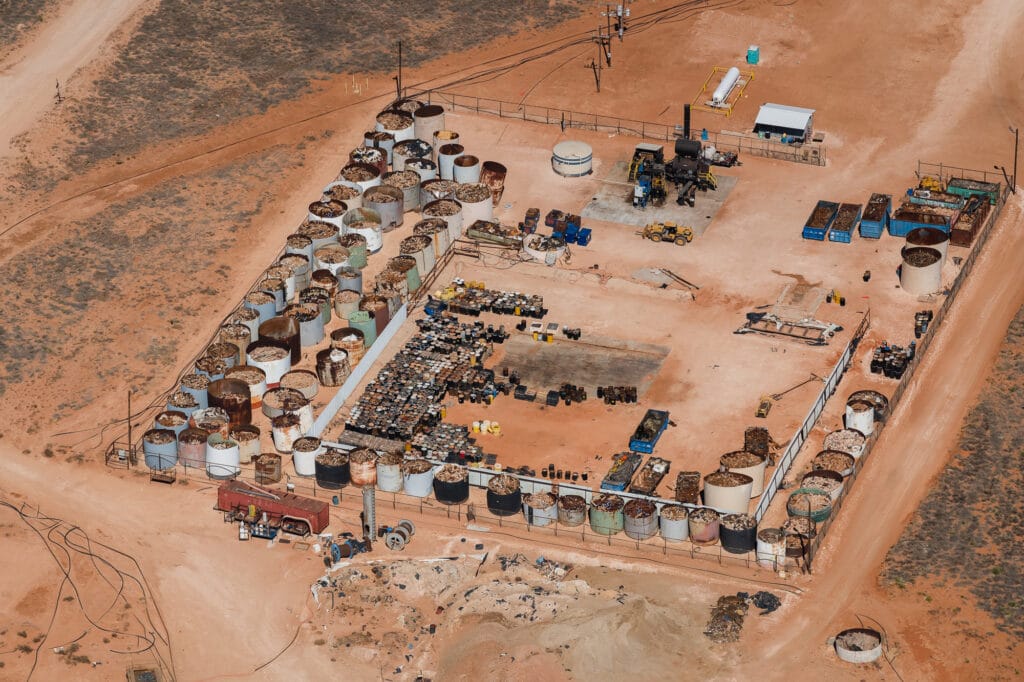
On Sunday, April 4, 2021, DeSmog sent a photographer over the Lotus site in a small plane. The photos reveal the site contains a significant number of stockpiled barrels and containers. When the whistleblower reviewed these recent photos, they said the images suggest that many of the same issues remain — and may have worsened — since their earlier site observation at the Lotus facility during the 2015-2016 timeframe. They pointed to what appeared to be significant amounts of stockpiled TENORM wastes held in numerous damaged, rusted, and degraded tanks or barrels stored directly on an unlined surface without proper containment to prevent leaching, runoff, and other direct risks to groundwater and surface contamination.
The whistleblower also noted that many of the large open tanks in the photos appeared to show high volumes of filter socks and scale from pipes used during oilfield operations — both filter socks and pipe scale are known to have a high radioactive signature. The whistleblower said these were apparent compliance issues, with possible violations including a lack of proper containment around the site, lack of lined protection to the surface, and significant volumes of stockpiled TENORM wastes that have yet to be processed or properly disposed.
“I can’t confirm these pictures,” Lotus operation manager Dan Snow replied via email. In response to questions about the nature of the stockpiled waste and alleged violations, Snow said, “as always, our plant is in full production mode handling all types of RCRA exempt waste as it is shipped to the facility. Waste comes in all types of packaged and unpackaged methods and it can even come in a dump truck so long as the transporter follows the DOT [Department of Transportation] and RRC rules. Waste may even come in the form of abandoned vessels that have to be taken apart to remove the waste.” Snow stated Lotus operations follow all appropriate state and federal rules and permits.
DeSmog sent the recent aerial photos to the RRC for review and asked the agency to comment on the alleged violations and compliance issues. “Our agency conducts inspections to ensure compliance with all rules in place to protect public safety and the environment,” said R.J. DeSilva, the RRC Director of Communications. He directed DeSmog to a web portal that features inspection information for oilfield facilities. It shows that the most recent RRC inspection of the Lotus site in Andrews County occurred on March 29, 2021 and found no compliance issues, stating, “No violations were observed in this inspection.”
Every single day, hundreds of barrels of oilfield waste may arrive via truck at Lotus. The waste comes from oil and gas fields across Texas (including a set of wells operated by Chesapeake and located on the grounds of the Dallas/Fort Worth International Airport) and neighboring states like New Mexico, Oklahoma, and Louisiana. It also comes from offshore wells in the Gulf of Mexico and some of the last remaining oil and gas platforms off the California coast, operated by ExxonMobil. The waste arrives from states as far as Alaska, North Dakota, Michigan, Colorado, West Virginia, and Pennsylvania, and even states like Minnesota, Wisconsin, and Iowa, which have no significant oilfields but are crisscrossed by pipelines that fill up with radioactive sludge. The Railroad Commission files indicate that radioactive sludge also builds up at compressor stations, and this waste may be shipped to Lotus.
The files indicate that virtually every major operator in the oil and gas industry has sent their waste to Lotus, including ExxonMobil, BP, Chevron, Occidental, Anadarko, ConocoPhillips, Chesapeake, as well as midstream companies like Kinder Morgan and ONEOK. DeSmog reached out to these companies who were mostly unresponsive to questions about the site and its operating practices. “At BP we remain committed to safe, reliable, and compliant operations,” stated Cameron Nazminia, Corporate Communications Manager with BP, one of the few companies that replied to questions about Lotus.
“These operators took a lot and got in over their heads.”
A longtime oilfield waste industry insider on Lotus LLC
While the process of grinding radioactive waste into a slurry and injecting it down a hole may seem simple, the whistleblower explained that performing the process safely is technically challenging and operationally expensive. Radioactive oilfield waste is referred to as NORM, or TENORM (Technologically Enhanced Naturally Occurring Radioactive Materials), and a facility licensed to dispose of it can charge waste generators high disposal fees, sometimes as high as $200-250 per barrel, versus an average of around $8 per barrel at a facility simply licensed to dispose of the industry’s non-radioactive waste, according to the whistleblower.
“What happened is they just got overrun with TENORM waste material being delivered from all over the country,” the whistleblower said of Lotus, “they were not technologically or operationally capable, and did not properly manage what was accepted for disposal at the facility. These operators took a lot and got in over their heads.”
James Dillingham, the director of global operations with Lotus, said that, “Any NORM contaminated material present at the site is being processed in accordance with our license and permits.” He said that in recent years, “we have been able to increase daily capacity by having more employees, more offload areas, more efficient pumps, and better process knowledge.” He also pointed out that Lotus was licensed to receive all manners of “nonhazardous oil and gas waste” and that not all of the waste it received was radioactive. “I only say that to illustrate the fact that the items that appear to be accumulating may not necessarily be classified as radioactive waste, nor a waste that has other hazardous elements,” he said.
According to the company’s own quarterly reports to the Railroad Commission, Lotus took in over 10 times more waste in 2013 (83,895 barrels) compared to a decade earlier (6,673 barrels in 2003). When asked how the company has been able to handle the enhanced waste stream brought on by the fracking boom, Dillingham said, “We are currently investing heavily in new technology that will help us process the more difficult types of waste that are plaguing the industry.”
“We believe this technology will allow us to provide a more economical yet equally as secure solution to the industry,” he added. “In the meantime, any difficult or time-consuming materials requiring extended processing are securely temporarily stored in a restricted area adjacent to the processing/disposal facility with constant surveillance, air monitoring, and dosimetry.” (Dosimetry refers to the science of measuring the radiation dose absorbed by the human body.)
Furthermore, he added, the facility is subject to annual audits by the Railroad Commission, the Texas Department of State Health Services, clients, and other groups, and also “more frequent surprise audits.” “These audits would reveal any discrepancy between the Lotus operation and the items that are allowed under the licenses and permits while also obviously revealing any potential weak points that could cause increased risk to human health and safety,” he told DeSmog.
A Risk to Workers
But as the more than 2,000 pages of records and reports reviewed by DeSmog show, Lotus has experienced a number of concerning incidents that began shortly after the site opened in 1997. This history includes radioactive waste leaking into the ground and barrels of waste regularly being piled on site for extended periods of time. Local community members also raised concerns about workers being exposed to radioactivity.
One particularly damning Railroad Commission inspection occurred in May 2003. “There were several metal drums with corroded sides and/or bottoms located at various spots within the fenced process facility,” states the report. “The deteriorated condition of these drums has allowed some NORM contents to escape to the ground.” The inspection suggested that rain received in the days prior to inspection had carried contamination to “low lying, muddy areas near the gate.”
Handwritten notes in the May 2003 report show that drums of waste had been moved around the site “only for the purpose of a cosmetic coverup,” again suggesting the waste was not being appropriately disposed of by injection into the salt cavern, but instead being stored on the site’s grounds. Furthermore, the notes express concern that one of the injection wells has been inappropriately “abandoned” and that the “casing perhaps could be corroded/wear away gradually” and if the well were not properly isolated, the situation could “be harmful to our drinking water.”
In May 2004, Railroad Commission Assistant District Director Mike Houston visited the Lotus facility and noted, “There are still some pollution concerns.” On a walkthrough inspection, Houston noticed “leaking steel drums” whose contents had “either partially spilled or [had] the immediate possibility of leaking onto the storage yard soils.” The letter stated that the conditions observed violated Texas Statewide Rule 8, which regards water pollution and oilfield waste pits.
The report also addressed worker radioactivity risks: One steel drum at the Lotus site measured 5,800 microrems per hour — a measurement used to classify how much radioactivity would be absorbed by a human being — an amount “which can be a health threat to coworkers, given extended exposure time.”
When DeSmog ran that number by Worcester Polytechnic Institute nuclear forensics scientist Marco Kaltofen, he explained that the level was worrisome. “At 5,800 microrems an hour, it would take only about two days to get your typical ANNUAL dose of industrial/medical radiation,” Kaltofen stated in an email, referencing dose limits set by the Nuclear Regulatory Commission for the nuclear and medical industries. These limits, however, do not apply to oil and gas workers.
But perhaps most concerning among the public records DeSmog received from the Railroad Commission was a letter sent to the regulatory agency in October 2000 by the “Concerned Citizens of Andrews County, Texas.”
“We regret having to write you [a] letter anonymously, but because of the nature of the individual involved, we fear not only reprisal from him personally, but also from his battery of attorneys,” the letter states.
The Concerned Citizens explain that they “have made trips to a facility operated by Lotus, L.L.C. in western Andrews County” and found drums of radioactive waste stacked along the fence line of the facility, “a large pile of dirt and rocks on the north fence line that appears to be radioactive contaminant as well,” and a trio of 500-barrel frac tanks that “are completely full of what appears to be radioactive waste.”
According to the letter, Lotus workers told the Concerned Citizens that some of this waste had been stored on site “in excess of two years.” The Railroad Commission was not able to provide a direct response to the question of how long waste is allowed to sit on site before having to be disposed of down the injection well and into the salt cavern.
“These employees have also expressed concerns for their health from long term exposure to this material,” the letter adds.
Attempts to locate the authors of the anonymous letter were not successful. DeSmog presented the letter to Lotus, along with a copy of the June 2003 inspection report that noted leaking waste barrels.
“As it relates to the concerns presented in the letter, the citizens are certainly entitled to bring awareness to potential problems; however, in this particular case, it does not appear that there was anything that was causing any elevated health, safety, or environmental risk,” said Dillingham.
He also defended the company’s efforts to protect its workers from radioactivity contamination. “I can confirm that at the time of the filing, and continuing through today, all employees whose job duties involve potentially making an entry into a restricted area are monitored in the dosimetry program outlined in the Lotus Health Physics Plan,” said Dillingham. “As a company that is licensed for handling this type of waste we have our own health physics plan in place…Lotus workers work around NORM all day, every day, and given that we have never had a person exceed the dose limit, ever, and we have been in business since 1997.”
But Texas regulators do not appear to be addressing the worker safety questions raised in the files received from the Railroad Commission.
DeSmog informed the Texas Department of State Health Services (DSHS) that Lotus records indicate sloppy operating practices that put both workers and the environment of Texas at risk. “DSHS does not regulate the Lotus disposal site,” replied Chris Van Deusen, the agency’s Director of Media Relations.
When asked by DeSmog what tests, inspections, or surveys DSHS has conducted of Lotus workers to ensure they are appropriately protected from radioactivity, Van Deusen again stated, “DSHS does not regulate the Lotus disposal site.” OSHA, in previous correspondence with DeSmog, has conveyed that oilfield workers are not at risk from radioactivity, yet the agency has never formally studied the issue.
The whistleblower expressed concern that Lotus “poses a black eye” to the oil and gas industry and Texas regulators.
“It is exceedingly maddening that nothing is actively being done to properly address these issues,” said the whistleblower. “Myself and others have been pounding the table on this and speaking with the Railroad Commission in Texas for nearly 10 years now. It is there, everyone knows about it, and no one can say they don’t know. Yet, the regulators have not taken any meaningful efforts to correct this dangerous and poor operating practice.”
Importing Radioactive Waste
A lack of oversight when it comes to domestic waste, however, isn’t the only challenge. The 1980s industry exemption also makes it easier to import radioactive oil and gas waste produced outside the United States.
Because this waste is generated in an oilfield, unlike radioactive waste generated by the nuclear or medical industries, the notorious Bentsen and Bevill Amendments enables it to move around the U.S. insufficiently monitored — and into the U.S. from other parts of the world entirely unmonitored.
In DeSmog’s correspondence with EPA, the Nuclear Regulatory Commission, and the Railroad Commission of Texas, it has become apparent that no federal or state agency appears to be tracking or monitoring shipments of radioactive oilfield waste into the United States from foreign countries, and none of these agencies appear to have regulatory authority over such international shipments. U.S. Customs and Borders Protection has not responded to questions on the matter.
According to Jeff Tyson, Head of Environmental Research and Analytics with the Texas-based firm Waste Analytics, oilfield waste generated in Mexico, for example, has been transported across the border for disposal in the United States. At least 534 loads of waste, said Tyson, was transported between October 2005 and March 2006, and disposed of at a treatment facility in Starr County, Texas.
Lotus’s first international shipment was 65.5 barrels of soil and sludge that arrived from Alberta, Canada in November 1999. The files DeSmog obtained from the Railroad Commission records request reveal that more than 450 barrels of waste from Canada arrived between 1999 and 2004.
Information provided to DeSmog by Dillingham shows that Lotus had imported 750 barrels of oilfield waste from Australia between May 2017 and November 2019 — the first barrel arrived by plane, the rest have been transported by ship.
“We reached out to the EPA and the NRC asking if there were any objections to importing Resource Conservation Recovery Act (RCRA) exempt E&P waste containing diffuse amounts of NORM,” said Dillingham. But as DeSmog has learned, no specific permits appear to be necessary in order to import radioactive oilfield waste into the country.
Presently, Lotus is in the process of expanding its overseas operations. The company has already established an office in Watford, England, part of a joint venture tasked with decommissioning, decontamination, and waste management services to the oil and gas and industrial sectors in Europe, UK, and Russia.A map passed alongby Dillingham conveys that Lotus has a presence in oilfields on every continent but Antarctica. “Our international services include NORM training, surveying, consulting, decontamination and a whole gambit of other non-NORM related services relating to decommissioning and well servicing,” said Dillingham. “As it relates to importing NORM waste, it has never been our long-term strategy. The ability to import a stockpiled volume of material can help solve an immediate need, but the long-term objective is to help countries develop local solutions.”
Wording on the website of the company’s England-based joint venture, Lotus ZRG, appears to promote Lotus’s disposal site in Andrews, Texas: “Welcome to Lotus ZRG – from our licensed facility in Texas, we provide NORM decontamination, transportation and disposal internationally to wherever our clients’ facilities require us.”
Current federal laws give the company confidence that these imports are legitimate. “As it relates to transportation, the requirements are based on the same regulations for road or by ship,” said Dillingham. “I certainly didn’t intend on implying or stating that it wasn’t regulated. I said that it is not federally regulated. NORM waste is not defined as a ‘radioactive waste’ by the NRC, therefore not under the Atomic Energy Act. Further, wastes strictly associated with the exploration and production of oil & gas are exempt from EPA hazardous waste definitions under RCRA. Wastes meeting this exemption are regulated on the state level.”
When Lotus asked the EPA in an October 12, 2016 email whether or not the company could import radioactive oilfield waste, the agency replied on November 7, 2016, stating: “Based solely on the information provided by Lotus, the waste…is exempted from federal hazardous waste regulations” and “as such…may be imported to the United States without a hazardous waste notification.” The Railroad Commission, in a December 2016 report, recognizes that “EPA does not regulate the waste” and states that Lotus’s permits with the state agency do not “require or restrict the acceptance of offshore (outside US waters) or foreign oil & gas waste.”
A 2018 letter from the Nuclear Regulatory Commission stated that because the federal agency has no regulatory authority over the oil and gas industry’s radioactive materials, “it would not meet the…definition of radioactive waste.”
“EPA has no records of Lotus importing oilfield waste,” stated an EPA spokesperson, and the agency is not keeping track of how much foreign oilfield waste is entering the U.S., how it enters the country, at which port it enters, or how radioactive it is.
“As we lack jurisdiction over this material,” Nuclear Regulatory Commission spokesperson David McIntyre told DeSmog, “we do not track its movement or disposal.”
More than half a dozen other analysts and policymakers DeSmog spoke to for this story were unaware that oilfield waste was being imported into the United States.
“It never occurred to me that we might be importing toxic and radioactive oil and gas waste from other countries,” said Amy Mall, a senior advocate with the environmental group Natural Resources Defense Council (NRDC). Mall has been tracking oil and gas waste and its impacts for over a decade and is set to release a new report on the topic with NRDC shortly. “Americans are used to the situation where we’re the ones shipping waste overseas to other people who don’t have the ability to stop it, but in this case that has been reversed,” said Mall.
“I do a lot of consulting on import and export of radioactive material and frankly I don’t think there is any database anyone maintains to know what goes in and out of the country,” said Rick Jacobi, the owner and principal consultant at Jacobi Consulting, a former General Manager of the Texas Low-Level Radioactive Waste Disposal Authority and current consultant for domestic and international companies on the management of radioactive material and nuclear facilities. “I don’t think that U.S. Customs maintains any database, and to my knowledge there is no national database.”
None of the regulatory agencies in Texas involved in oil and gas, including the Railroad Commission, the Texas Department of State Health Services, or the Texas Commission on Environmental Quality, have “jurisdiction over the import or export of radioactive waste,” Jacobi added. “Imports and exports are regulated exclusively by the federal government.”
“Commercial facilities have a financial incentive to accept the waste and generate revenue regardless of where the waste was generated,” added Jeff Tyson, with Waste Analytics. “As long as the facility is permitted to accept the waste, there is no legal or economic reason for them to reject it.”
Meanwhile, there may be the need for a much larger investigation. “Companies who are licensed to deal with this waste are trying their best to provide a responsible solution but are often the only ones who get criticized or reviewed,” said Dillingham. “The bigger problem is those who don’t even bother to get licensed and protect their staff.” He said the oilfields of Texas and Oklahoma contain several large facilities of this nature, which accept NORM waste without licenses or proper screening controls in place. Dillingham adds that Lotus’s salt cavern is approaching capacity, and the company is presently in the process of creating another one — using a process called solution mining — out of the bedded salt deposit at the property in Andrews County. Once permitted for waste disposal it could have disposal capacity for up to another million barrels of oilfield waste.
Justin Nobel writes on issues of science and the environment for Rolling Stone and has a book on oil and gas radioactivity forthcoming with Simon & Schuster entitled PETROLEUM-238: Big Oil’s Dangerous Secret and the Grassroots Fight to Stop It.