‘It’s insane’: Proud Boys furor tests limits of Trump’s GOP

‘It’s insane’: Proud Boys furor tests limits of Trump’s GOP

David Siders                              May 26, 2021


It’s been less than two weeks since South Carolina Republicans rejected Lin Wood’s Q-Anon inspired run for state party chair. In Arizona, the GOP is still consumed with infighting over a farcical review of November election results.

Now comes Nevada, where open warfare has broken out in recent days between state and local party officials over a pro-Trump insurgency involving far-right activists with ties to the Proud Boys.

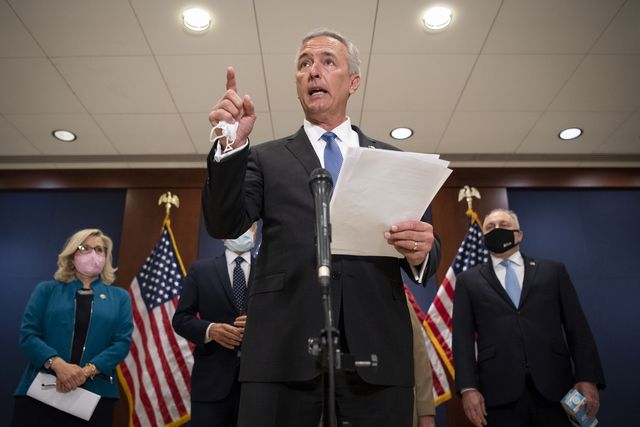
More than six months after the November election, the forces unleashed by former President Donald Trump — election conspiracists, QAnon adherents, MAGA true believers and even the often violent Proud Boys — are attempting to rewire the Grand Old Party’s leadership at the state and local levels, including in some swing states that will be critical in the midterm elections.

It’s a reflection of Trump’s influence on the Republican Party, but also evidence of the breadth of interests seeking to define Trumpism in the vacuum left by his November defeat.

“It’s insane,” said Katie Williams, a Republican school board trustee in Nevada’s Clark County, where party officials canceled a meeting at a church this week, citing security concerns about extremists trying to take over the party. “We can’t have people acting the way they’re acting. That’s the problem. … It’s like an election hangover.”

The uproar in Nevada, which came on suddenly, suggests how far the GOP is from being finished with its post-election reckoning. After the Republican Party’s state central committee voted narrowly last month to censure Nevada’s Republican secretary of state, Barbara Cegavske — for “failing to investigate” Trump’s baseless allegations of widespread voter fraud — Clark County party officials accused the state party chair, Michael McDonald, of tipping the scales against Cegavske by adding extremist members to the county’s roster at the state central committee meeting.

The state party, in turn, accused the Clark County chair, David Sajdak, of spreading “slanderous lies.” But one self-described member of the Proud Boys, Matthew Anthony Yankley, who goes by Matt Anthony, said on a recent episode of the Johnny Bru Show, a Las Vegas-based podcast, that he participated in the censure and that “our votes absolutely made the difference.”

Meanwhile, the Las Vegas Review-Journal published an exhaustive account detailing an effort by Anthony and other far-right activists to gain control of the party in Las Vegas’ Clark County through its elections in July.

For Nevada Republicans, the timing of the feud is fraught. The state Legislature has been tilting Democratic in recent years, but Republicans picked up several seats in November anyway, while Trump lost to President Joe Biden by just more than 2 percentage points — a narrower margin than widely expected.

A well-organized Republican Party could help candidates who have at least an outside chance of upsetting Democratic Sen. Catherine Cortez Masto — or first-term Gov. Steve Sisolak next year. Instead, state and local party officials are at one another’s throats — and the GOP’s connections to the Proud Boys are in the headlines.

“I’m really disheartened by this,” said Carrie Buck, a Nevada state senator and the establishment-backed candidate for chair of the Clark County GOP. “If we don’t get this fixed, we don’t win our state back.”

The conflict in Nevada is about more than just a loyalty test to Trump, which is the motivating concern behind Cegavske’s censure. There’s a more fundamental question about what kind of Republican is welcome in the post-Trump GOP. The Trump era not only mainstreamed conspiracy theories — a large majority of Republicans believing Trump’s baseless claims that the election was rigged — it also gave rise to militant, pro-Trump groups like the Proud Boys, which the Southern Poverty Law Center has labeled a hate group. Nationally, several members of the Proud Boys are facing charges for their involvement in the insurrection at the Capitol on Jan. 6.

Last year, the group was emboldened when Trump declined to explicitly condemn white supremacists and militia groups during the first presidential debate, telling the Proud Boys to “stand back and stand by.” (He later adjusted his tone, saying “they have to stand down.”) And other Republicans have struggled more recently with how accommodating to be to extremists within the party. In Washington, GOP leaders this week criticized Rep. Marjorie Taylor Greene (R-Ga.) for comparing coronavirus vaccine and mask requirements to the Holocaust, but they are not disciplining her, much less excommunicating her from the party.

In Clark County, Republican Party leaders are attempting to draw a rare line in the sand. Officials said they have barred seven people, including Anthony, from membership due to their associations with groups they said have disseminated racist and other hateful messages.

Noting the majority-minority composition of Clark County — the state’s most populous county, and a Democratic stronghold — Sajdak said at a news conference this week that “we welcome everyone that is a reasonable and decent human being” but that “I will never tolerate racist or hateful speech.”

Stephen Silberkraus, the party’s vice chair, said after the press conference, “This isn’t a problem within our party. It’s one at the gates that we have to fend off.”

Nevada Sen. Barbara Cegavske, R-Las Vegas, listens to colleagues pay tribute to her 18-years of public service during a Senate floor session on the final day of the 77th Legislative session at the Legislative Building in Carson City, Nev., on Monday, June 3, 2013. (AP Photo/Cathleen Allison)

Republicans in the state Senate appear to be following that reasoning, calling for a review of the vote to censure Cegavske.

“News reports that state party leaders may have formed a relationship with members of the organization known as the Proud Boys to sway the censure vote of a public official is profoundly concerning,” the caucus said in a prepared statement. “If there is a determination that any member or employee of the Nevada Republican Party conspired with these individuals or had knowledge of any wrongdoing in the party vote, Senate Republicans call for their immediate removal and resignation.”

Amy Tarkanian, a former chair of the state party, said there may be enough frustration with McDonald among Nevada Republicans “to possibly not reelect him finally. So, he very well may just be either so desperate that he’s willing to bring in literally anyone of any background, such as the Proud Boys, to help boost up his numbers, or just let the whole ship burn and sink if he doesn’t get reelected.”

She said, “It makes no sense to be bringing people like that into the fold where they’re not welcome.”

McDonald did not respond to requests for comment. Nor did Anthony.

McDonald told the Review-Journal he does not condone hateful or antisemitic rhetoric. Anthony said on the Johnny Bru Show that the Proud Boys are unfairly maligned and that he is “against hate of all kinds.”

In Clark County, the dispute over who can belong is now playing out in court. Anthony and several other activists filed a lawsuit against the Clark County GOP last week complaining they had “arbitrarily been denied membership” or are having their memberships in the party withdrawn, accusing the county party of “discriminatorily and arbitrarily picking and choosing what applicants to approve for membership in the committee.” County party officials said the lawsuit has no merit.

“What they’re clearly afraid of,” said Ian Bayne, a co-founder of No Mask Nevada, which has been supportive of the effort to challenge the local party, is that new activists will “take the entire party out from under them.”

Bayne said he does not know the local Proud Boys members, but added that denying Republicans membership in the local committee is discriminatory. Bayne’s group, though not part of the lawsuit, was encouraging its members to join the county committee to “replace the failures who now run the Clark County GOP,” promising that an unnamed former Trump staffer would be running for chair, likely announcing his candidacy next week.

Bayne said the intra-party tension in Nevada — as in the GOP elsewhere — is little different than past upheavals within the party, dating back to the days of Barry Goldwater and Ronald Reagan.

In Clark County, he said, “the establishment is running and canceling meetings because they’re scared.”

Climate: World at risk of hitting temperature limit soon

Climate: World at risk of hitting temperature limit soon

David Shukman – Science editor                  May 26, 2021
Nantou in Taiwan during a drought this year


It’s becoming more likely that a key global temperature limit will be reached in one of the next five years.

A major study says by 2025 there’s a 40% chance of at least one year being 1.5C hotter than the pre-industrial level.

That’s the lower of two temperature limits set by the Paris Agreement on climate change.

The conclusion comes in a report published by the World Meteorological Organization (WMO).

The analysis is based on modelling by the UK Met Office and climate researchers in 10 countries including the US and China.

In the last decade, it was estimated that the chance of any one year reaching the 1.5C threshold was only 20%.

This new assessment puts that risk at 40%.

Leon Hermanson, a senior Met Office scientist, told BBC News that comparing projected temperatures with those of 1980-1900 shows a clear rise.

“What it means is that we’re approaching 1.5C – we’re not there yet but we’re getting close,” he said.

“Time is running out for the strong action which we need now.”

The researchers point out that even if one of the next five years is 1.5C above the pre-industrial level, it’ll be a temporary situation.

Temperature curve
Temperature curve


Natural variability will mean the following few years may be slightly cooler and it could be another decade or two or more before the 1.5C limit is crossed permanently.

The Paris Agreement established the goal of keeping the increase in the global average temperature to no more than 2C and to try not to surpass 1.5C – and that’s understood to mean over a long period rather than a single year.

According to Dr Joeri Rogelj, director of research at the Grantham Institute, Imperial College London, “the 1.5C in the Met Office announcement should not be confused with the 1.5C limit in the Paris Agreement”.

“The Paris targets refer to global warming – that is, the temperature increase of our planet once we smooth out year-to-year variations,” he explained.

“A single year hitting 1.5C therefore doesn’t mean the Paris limits are breached, but is nevertheless very bad news.

“It tells us once again that climate action to date is wholly insufficient and emissions need to be reduced urgently to zero to halt global warming.”

Wildfire consumes house in St Helena, California
A house is consumed by flames during the Glass wildfire in California last year


A landmark report by the UN climate panel in 2018 highlighted how the impacts of climate change are far more severe when the increase is greater than 1.5C.

At the moment, projections suggest that even with recent pledges to cut emissions of greenhouse gases, the world is on course to heat up by up to 3C.

The WMO’s secretary-general, Prof Petteri Taalas, said the results of the new research were “more than mere statistics”.

“This study shows – with a high level of scientific skill – that we are getting measurably and inexorably closer to the lower target of the Paris Agreement on Climate Change,” he explained.

“It is yet another wake up call that the world needs to fast-track commitments to slash greenhouse gas emissions and achieve carbon neutrality.”

Prof Ed Hawkins, a climate scientist at the University of Reading, told me that if the new forecast is proved right “it does not mean that we have exceeded the Paris Agreement limit”.

He points out that two individual months in 2016 saw a rise of 1.5C.

“As the climate warms, we’ll get more months above 1.5C, then a sequence of them, then a whole year on average above 1.5 and then two or three years and then virtually every year,” Prof Hawkins said.

He also stresses that 1.5C is “not a magic number that we’ve got to avoid”.

“It’s not a sudden cliff edge, it’s more like a slope that we’re already on and, as the climate warms, the effects get worse and worse.

“We have to set a line in the sand to try to limit the temperature rise but we clearly need to recognize that we’re seeing the effects of climate change already in the UK and around the world and those effects will continue to become more severe.”

The report comes in the approach to the COP26 summit on climate change, due to be held in Glasgow in November.

The summit aims to raise ambition among world leaders on tackling the climate crisis.

U.S. freeways flattened Black neighborhoods nationwide

U.S. freeways flattened Black neighborhoods nationwide

New York state highway plan shows potential pitfalls of Biden’s infrastructure push.


SYRACUSE, N.Y. (Reuters) – Syracuse wasn’t the only city where Black residents were displaced by the U.S. freeway-building boom of the 1950s and 1960s.

Across the country, local officials saw the proposed interstate system as a convenient way to demolish what they regarded as “slum” neighborhoods near their downtown business districts, historians say. With the federal government picking up 90% of the cost, freeway construction made it easier for politicians and business leaders to pursue their own “urban renewal” projects after residents were evicted.

“It was a mistake that many cities were making,” said University of California, Irvine law professor Joseph DiMento, an expert in the policies of the freeway-building era. “The reasons they were built were heavily for removal of Blacks from certain areas.”

Existing long-distance highways, like the New York State Thruway, largely skirted city centers. The new interstates were built right through them.

Road builders at the time were largely free to ignore environmental, historical, social or other factors, allowing them to focus on the most direct route from one point to another.

More often than not, that meant routing those freeways through Black neighborhoods, where land was cheap and political opposition low.

Some black neighborhoods were targeted even when more logical routes were available, research by the late urban historian Raymond Mohl shows. According to his findings:

*In Miami, Interstate 95 was routed through Overtown, a Black neighborhood known as the “Harlem of the South,” rather than a nearby abandoned rail corridor.

*In Nashville, Interstate 40 took a noticeable swerve, bisecting the Black community of North Nashville.

*In Montgomery, Alabama, the state highway director, a high-level officer of the Ku Klux Klan, routed Interstate 85 through a neighborhood where many Black civil rights leaders lived, rather than choosing an alternate route on vacant land.

*In New Orleans and Kansas City, officials re-routed freeways from white neighborhoods to integrated or predominantly Black areas.

Residents in a handful of cities, including Washington, D.C., Philadelphia and Baltimore, successfully mobilized to block freeway construction in Black neighborhoods. But that was not typically the case.

The road-building program ultimately displaced more than 1 million Americans, most of them low-income minorities, according to Anthony Foxx, who served as transportation secretary under Democratic President Barack Obama.

(Reporting by Andy Sullivan; editing by Marla Dickerson)

Trucks of fresh water used to feed Taiwan’s semiconductors as crops left to die in punishing drought

Trucks of fresh water used to feed Taiwan’s semiconductors as crops left to die in punishing drought

Nicola Smith                          May 22, 2021
The dried lakebed of Sun Moon Lake in Nantou county in central Taiwan - AP
The dried lakebed of Sun Moon Lake in Nantou county in central Taiwan – AP


The world’s largest microchip maker is buying tanker trucks full of water to keep its plant going as farmers struggle to make ends meet during the worst drought in the history of Taiwan.

The Taiwanese government this week said it would tighten water rationing from June 1 in the semiconductor making hubs of Hsinchu and Taichung if there is no significant rainfall by then. This would require companies to cut water consumption by 17 per cent.

Chip manufacturing requires a significant amount of water, and the shortfall in Taiwan, the rainswept island that hasn’t seen a typhoon in the last last year, has sounded alarm bells across the world.

The global economy is suffering from a major shortage of semiconductors that are key to almost all consumer appliances and vehicles.

A cut in supply from factories shut by Covid first hit the market last year, but a surge in spending on electrical items during lockdown has savaged the industry.

The automotive sector is by far the hardest hit, with Ford, Volkswagen and Jaguar Land Rover shutting down factories and laying off workers.

Taiwan Semiconductor Manufacturing Co Ltd (TSMC), the world’s largest chipmaker, told the Telegraph it had a contingency plan for the punishing drought compounding global supply issues further.

“We have initiated some measures including cutting back water usage and ordering water by tanker trucks for some of our facilities. So far there’s no impact on production and we are closely monitoring the water supply situation,” said a spokesperson.

People fish at the Sun Moon Lake with low water levels during an island wide drought - ANNABELLE CHIH /REUTERS
People fish at the Sun Moon Lake with low water levels during an island wide drought – ANNABELLE CHIH /REUTERS


But the 18-month drought, which has seen reservoirs in the island’s central and southern region plunge below 5 per cent of capacity, not only threatens Taiwan’s technological dominance, it has damaged farmers’ livelihoods and revived calls for long term action over climate change.

In parts of central Taiwan, taps are now turned off two days a week.

“With climate change accelerating, it is a sign that we have to think about how to transform,” said farmer Liu Cheng-yu, 37, who is facing significant losses from his rice paddy fields due to irrigation restrictions.

“That means our previous investment and effort will go to waste completely, and we won’t be able to earn any income,” he said. “We are desperately looking for other water resources to prevent the irrigation from halting.”

Mr Liu said he saw the crisis as an opportunity, but other farmers believe they have been shortchanged to save the chip industry.

“We had no choice but to stop planting for this season,” said Ho Wan-chin, 57, who was forced to lease his 100 hectares of land in Hsinchu county fallow.

“The government’s policy has always prioritized water supply to industries like the Hsinchu Science Park,” he said. “We are frustrated by the drought, and with climate change, drought will only happen again in the future.”

The island’s Greenpeace chapter agrees, concluding that Taiwan will face a more intense drought by 2030 if nothing is done to reduce carbon emissions.

People visit dried up Sun Moon Lake in Taiwan's Nantou County
People visit dried up Sun Moon Lake in Taiwan’s Nantou County


“Because of semiconductors and the regulation of domestic water use, the public awareness of climate change has indeed increased. However, climate change is never the focus of the discussion,” said June Liu, climate and energy campaigner.

“A long-term and climate-orientated water management policy is lacking and must be built up as soon as possible. Crossing fingers is not how we deal with risks.”

Dr Hsu Huang-hsiung, a climate change expert at Taiwan’s Academia Sinica, said that although this year’s drought was likely more attributable to bad luck rather than proven to be global warming, that it served as a wake-up call for the island.

“This has been a good lesson for the Taiwanese people and government to learn,” he said. “Although this particular event was not necessarily caused by global warming, similar phenomena occurred so that we know that our water resources policy is not well planned.”

The island needed to address leakage in water pipes, hike consumption prices, and explore other water resources like retention pools, he said.

“I think the government will start to come up with better plans for long term policies for water resources for the future.”

Wuhan lab staff sought hospital care before COVID-19 outbreak disclosed – WSJ

Wuhan lab staff sought hospital care before COVID-19 outbreak disclosed – WSJ


FILE PHOTO: WHO team visits Wuhan Institute of Virology


WASHINGTON (Reuters) – Three researchers from China’s Wuhan Institute of Virology (WIV) sought hospital care in November 2019, a month before China reported the first cases of COVID-19, the Wall Street Journal reported on Sunday, citing a U.S. intelligence report.

The newspaper said the previously undisclosed report – which provides fresh details on the number of researchers affected, the timing of their illnesses, and their hospital visits – may add weight to calls for a broader investigation into whether the COVID-19 virus could have escaped from the laboratory.

The Journal said current and former officials familiar with the intelligence expressed a range of views about the strength of the report’s supporting evidence, with one unnamed person saying it needed “further investigation and additional corroboration.”

The first cases of what would eventually be known as COVID-19 were reported at the end of December 2019 in the central Chinese city of Wuhan, where the advanced laboratory specializing in coronavirus research is located.

Chinese scientists and officials have consistently rejected the lab leak hypothesis, saying SARS-CoV-2 could have been circulating in other regions before it hit Wuhan, and might have even entered China from another country via imported frozen food shipments or wildlife trading.

China’s foreign ministry spokesman, Zhao Lijian, said on Monday that it was “completely untrue” that three members of staff at WIV had fallen ill.

“The United States continues to hype up the lab leak theory,” he said. “Does it care about traceability or is it just trying to distract attention?”

The Journal report came on the eve of a meeting of the World Health Organization’s decision-making body, which is expected to discuss the next phase of an investigation into the origins of COVID-19.

Asked about the report, WHO spokesman Tarik Jasarevic said via email that the organization’s technical teams were now deciding on the next steps. He said further study was needed into the role of animal markets as well as the lab leak hypothesis.

A U.S. National Security Council spokeswoman had no comment on the report but said the Biden administration continued to have “serious questions about the earliest days of the COVID-19 pandemic, including its origins within the Peoples Republic of China.”

She said the U.S. government was working with the WHO and other member states to support an expert-driven evaluation of the pandemic’s origins “that is free from interference or politicization.”

“We’re not going to make pronouncements that prejudge an ongoing WHO study into the source of SARS-CoV-2, but we’ve been clear that sound and technically credible theories should be thoroughly evaluated by international experts,” she said.

A joint study into the origins of COVID-19 by the WHO and China published at the end of March said it was “extremely unlikely” that it had escaped from a lab.

But China was accused of failing to disclose raw data on early COVID-19 cases to the WHO team, and the United States, the European Union and other Western countries called on Beijing to grant “full access” to independent experts.

A State Department fact sheet released near the end of the Trump administration said “the U.S. government has reason to believe that several researchers inside the WIV became sick in autumn 2019, before the first identified case of the outbreak, with symptoms consistent with both COVID-19 and common seasonal illnesses.” It did not say how many researchers.

(Reporting by David Shepardson and Andrea Shalal; additional reporting by Gabriel Crossley in Beijing, David Stanway in Shanghai and Stephanie Nebehay in Geneva; Editing by Daniel Wallis and Andrew Heavens)

‘It’s just shocking’: How Missouri Republican politics drove twin crises in Medicaid

‘It’s just shocking’: How Missouri Republican politics drove twin crises in Medicaid

Jonathan Shorman, Jeanne Kuang                          May 23, 2021


Mike Levitt’s nursing homes have experienced a difficult 14 months.

Still recovering after being ravaged by the coronavirus pandemic, Levitt’s Tutera Senior Living & Health Care, which operates five facilities in the Kansas City region, suddenly finds itself at the edge of financial oblivion.

Missouri lawmakers are at fault.

The General Assembly adjourned earlier this month without renewing a tax that funds vast swaths of Medicaid in Missouri. Nursing homes are heavily reliant on Medicaid patients, who have spent down their savings and now depend on the program to pay for their care.

Levitt, Tutera’s vice president, was so frustrated in an interview this week he was reluctant to even discuss what would happen to the homes if the tax is not renewed before it expires this September. Medicaid recipients make up 45% to 95% of residents at Tutera’s facilities.

“It’s unthinkable,” he said. “I hate to think if it doesn’t … We’ve never been here before.”

Missouri’s $12 billion Medicaid program is in the midst of twin crises driven by Republican lawmakers that will play out in the weeks and months ahead. Hundreds of nursing homes, hospitals and pharmacies — and their hundreds of thousands of residents, patients and customers — are caught in the middle.

For the first time in three decades, legislators failed to approve a Medicaid provider tax that generates about $1.6 billion every year. More importantly, the tax allows Missouri to receive an additional $3 billion in federal funds that are then returned to the providers to care for elderly, disabled and low-income residents. Failure to renew the tax would set the program on the course to financial apocalypse.

Hard-right Republicans, led by Sen. Paul Wieland of Imperial, are demanding anti-abortion provisions be included in any renewal.

Gov. Mike Parson is all but certain to call a special session this summer to renew the tax, called the Federal Reimbursement Allowance or FRA. But it remains unclear whether he can focus the session narrowly enough to foreclose an acrimonious birth control debate and how much power Republican leaders really have to end what has become a high-stakes game of chicken.

“It’s just shocking to me and so disheartening to me that we’re using this to leverage any other piece of legislation,” said Nikki Strong, director of the Missouri Health Care Association, which advocates for nursing homes.

The consequences of not renewing the tax are catastrophic, Strong warned. “Without the FRA, every nursing home in the state will be out of business,” she said.

At the same time, Medicaid expansion is in limbo after most Republican lawmakers balked at budgeting the roughly $130 million in state funds needed to expand eligibility for the program on July 1 under the terms voters approved last August. Without funding, Parson officially halted expansion earlier this month.

Advocates for expansion sued Parson’s administration this past week, triggering a legal fight that may lead to a judge ordering the program extended. Months of planning by the health care industry and coverage for an estimated 275,000 residents hinge on the lawsuit’s outcome.

The simultaneous fights over the provider tax and expansion have led to an unparalleled moment of uncertainty for Medicaid. Health care workers and patients are contemplating worst-case scenarios even as they tell themselves Missouri must, eventually, pull back from the edge.

“I think right now people are in shock and feel like we’ve got four months or so to get this thing sorted out,” said Ron Fitzwater, CEO of the Missouri Pharmacy Association.

Michael Levitt, vice president of Tutera Senior Living and Health Care, said he believes nursing homes, such as Northland Rehabilitation & Health Care, are facing a dire financial situation and potentially closure if a key tax that funds Medicaid and pays hospitals and nursing homes is not renewed.
Contraceptives targeted

Wieland, 58, a Catholic who has been in the General Assembly since 2011, is no stranger to showdowns over abortion and contraceptives.

He sued in 2013 to stop his state health insurance plan from covering contraception, saying it violated his religious beliefs. He eventually prevailed in court.

Term-limited and due to leave office in 2023, he is waging one more fight over contraception coverage.

In late March, he inserted provisions into a bill renewing the provider tax that would ban Medicaid coverage of “any drug approved by the federal Food and Drug Administration that may cause the destruction of, or prevent the implantation of, an unborn child.”

That means the abortion pill, RU-486, but it also encompasses common forms of birth control, including IUDs.

Under federal and state law, Medicaid already does not cover abortions, including RU-486, unless the mother’s life is at risk.

“For several years I’ve been figuring out a way to make it so that the state of Missouri taxpayers do not have to fund these drugs that destroy human life,” he said. “I need to do it while I’m still there.”

Wieland’s proposal caused the provider tax to stall and, despite weeks of negotiations, an apparent compromise collapsed in the final hours of session.

With 18 hours left, at the urging of Sen. Bob Onder, a Lake St. Louis Republican, the Senate voted to send the bill to a conference committee where it would be paired with Wieland’s birth control ban. Senate President Pro Tem Dave Schatz cast the deciding vote.

His vote marked an apparent backtracking on a deal with Democrats and some Republicans to pass the provider tax without abortion-related language.

The move effectively killed the bill. Senate Minority Leader John Rizzo, an Independence Democrat, was furious at what he described as a betrayal. He moved with no opposition on the last day of session to adjourn four hours early.

Wieland said this week he, too, was betrayed. The Republican caucus, he said, had agreed to pass yet another version of the tax renewal with his contraceptive ban included.

“It sounds to me like they ignored the will of the Republican caucus and went and tried to make a deal with the Democrats and that blew up in their face,” he said.

Schatz has said he thought the move to send the bill to conference would succeed regardless of his vote, and found it “difficult” to “be in a position of voting against pro-life measures.”

Missouri Senate President Pro Tem Dave Schatz, left, speaks to reporters as Senate Majority Leader Caleb Rowden stands nearby. Schatz cast a deciding vote in whether to send a bill renewing a Medicaid provider tax back to conference committee.


As the fight over contraception was developing, lawmakers were also taking steps to block Medicaid expansion.

Wieland’s first proposal came days before a House committee voted down funding to expand Medicaid, the first in a string of defeats for expansion in the General Assembly. Lawmakers ultimately passed a budget without it.

Unlike the dispute over the provider tax, efforts to block expansion garnered the support of a majority of Republican lawmakers. Some justified their votes against the voter-approved initiative by saying their districts oppose expansion or that constituents didn’t have all the necessary information.

The refusal forced Parson to decide whether to implement expansion without funding or call it off. He chose to call it off and a lawsuit quickly followed.

Parson’s office didn’t respond to questions for this story. Parson has said that without revenue “we are unable to proceed with the expansion at this time” to keep Medicaid financially afloat.

“I think that was the appropriate response on their part,” Rep. Cody Smith, a Carthage Republican who chairs the House Budget Committee, said of Parson’s decision.

As for litigation, Smith said lawmakers “will sit back and watch that process unfold.”

Parson expected to recall lawmakers

The twin developments — the failure to renew the provider tax and the blocking of expansion — have rocked the health profession in Missouri.

The provider tax had been renewed on time so often that its continued existence was almost assumed. And the health care industry had been preparing for expansion for months.

“We’ve been on this wild ride on Medicaid expansion for quite a while now and this latest turn is a bit of a surprise,” said Timothy McBride, a health economist at Washington University in St. Louis.

Health care industry representatives said the tax renewal is nearly always a bargaining chip for conservative Republicans. But Alina Salganicoff, director of Women’s Health Policy at the Kaiser Family Foundation, said she’s never heard of lawmakers trying to ban coverage of specific forms of birth control through the provider tax.

“The particular language that is being used in Missouri is not a language I have seen used in other states,” she said. “These are not medical terms. This is not how medical organizations define and classify drugs.”

Facing the prospect the provider tax will expire, health care advocates remain confident for now legislators will eventually act. They are unanimous in predicting Parson will call a special session.

At the same time, advocates are keeping up pressure. Missouri Foundation for Health President and CEO Dwayne Proctor said Friday that every day “this process is delayed is another day nearly 250,000 Missourians go without the access to health care they need.”

In theory, Parson could voluntarily reverse his stance and implement expansion. But even before advocates filed a lawsuit this week seeking to force him to open up eligibility, he had said he expected the issue to head to the court.

A Cole County Circuit Judge will almost certainly now decide at least the short-term future of expansion. The lawsuit seeks an order requiring Missouri to enroll newly-eligible individuals on July 1.

As for the provider tax, Wieland has vowed to bring up the birth control ban in any special session that allows it. Some political observers have suggested Parson could set strict limits on what lawmakers can consider in a special session.

“I don’t see how you can draft a call and say we’re not going to allow you to amend a bill, and I don’t think the governor will do it anyway,” Wieland said. “He’s not a dictator … I will fight on whatever I need to to get this done, yes.”

Running out of money?

The fights have left Sen. Bill White, a Joplin Republican, frustrated and concerned that Medicaid is likely to run out of money this year, sooner or later.

He voted against paying for the expansion, but acknowledged a court could force the state to enroll new recipients. That would leave the program underfunded regardless of whether the provider tax is renewed.

“It’s a have-to scenario,” White said. “Individual programs we’ve had little fights … they just don’t equal this dollar amount or this impact.”

Jillian Winkler, a nurse at Northland Rehabilitation & Health Care, prepares medication Thursday, May 20, 2021. Nursing homes are facing a dire financial situation and potentially closure if a key tax that funds Medicaid and pays hospitals and nursing homes is not renewed.


Providers like Tutera, the Kansas City-area chain of nursing homes, will be watching.

For Levitt, Tutera’s vice president, imperiling the tax only adds “insult to injury,” as nursing homes across the state struggle to recover financially from revenue losses and high costs fighting the pandemic.

Without the funding, services for 23,000 elderly Missourians, covering everything from changing bedpans to monitoring medications, are on the line.

“We have all these other challenges we dealt with and fought through, and now we’re faced with a 40% cut in Medicaid, just because?” Levitt said. “It’s unconscionable.”

Once More For the People in the Back: You Cannot Negotiate or Compromise With the Republican Party

Once More For the People in the Back: You Cannot Negotiate or Compromise With the Republican Party

Jack Holmes                        May 20, 2021
Photo credit: Drew Angerer - Getty Images
Photo credit: Drew Angerer – Getty Images


Somehow, after everything, there remain creatures in Washington, D.C. obsessed with bipartisan compromise. One of our two major political parties has lined up in opposition to renewing what’s left of the Voting Rights Act, which swept through Congress on a strong bipartisan basis in the Bush years, when it actually still had some teeth. The same party’s Arizona affiliate is engaged in a circus “audit” of that state’s election results because they didn’t like who won. They’ve also responded to the 2020 election, which many Republicans continue to Just Ask Questions about, by passing hundreds of restrictive voter laws in state legislatures across the country. Through this and gerrymandering and court-packing and the undemocratic features of the Senate and the Electoral College, the party has devoted itself, root and branch, to clinging to power without crafting an agenda that actually appeals to a majority of citizens.

But even beyond any of that, they just submarined their own shared Bipartisan Bill to establish a commission to look into an attack on their own place of work earlier this year. If a mob broke into your company’s offices and ransacked the place, chanting that they wanted to hang the vice president of the firm, would the VP’s putative friends—and brother!—shut down an inquiry into what happened? This is not normal behavior, and it’s not the behavior of an organization whose members can be reasoned with. (As David Freedlander pointed out, House Republican Leader Kevin McCarthy used to back a Commission as a desperate escape from impeaching Donald Trump for his crimes against the republic. Now he’s against this, too. It’s almost like he’s not actually interested in any kind of accountability.) There will be no Bipartisan Compromise so long as the Republican Party clings to the increasingly kaleidoscopic fever dreams blasting out of the right-wing infotainment vortex. As my colleague, Charles P. Pierce, wrote, the Democrats will need to go it alone on a January 6 commission. In truth, they’ll have to go it alone on everything.

Photo credit: Drew Angerer - Getty Images
Photo credit: Drew Angerer – Getty Images


This ought to have been obvious before. In the Senate, Mitch McConnell has proven to be the most cynical operator that Washington, D.C. has seen in some time, and that’s saying something. McCarthy, in the House, is as craven as he is dense. And the party has a track record, going back to the Obama years, of demanding bipartisan consultation, extracting concessions and watering down bills, then voting against them anyway. This is what happened with the January 6 commission: Republicans got pretty much everything they wanted, and they still shut it down. They will do the same with the American Jobs Plan. As Catherine Rampell brilliantly laid out in the Washington Post, the initial lowball counterproposal they offered was actually vastly inflated. Their aim is to hack away at the bill, then vote against it. And you can probably forget about even that level of commitment to the American Families Plan. Josh Hawley might have some family-benefits proposals, and so might Mitt Romney on the party’s other wing, but when it gets to crunch time, you can expect at least the former (and very possibly the latter) to vote against the plan and fist-pump at the faithful.

This is an American political ecosystem where shame has ceased to function as a social force and, in fact, shamelessness has become a political superpower. To survive and thrive in the entirely degraded post-Trump Republican Party—the culmination of 40-plus years of self-replicating insanity—you cannot have any compunction about lying your ass off and acting in continual, ceaseless bad faith. There are people in this party who voted against the American Rescue Plan and then went bragging to their constituents about all the relief they’d brought home. Flip-flopping is passé. You now have to be able to juggle multiple contradictory positions at once. John Katko made the mistake Wednesday of thinking any principle—even that an attack on their own workplace should be investigated by Congress—was durable enough to survive the gauntlet of self-serving nonsense. Democrats should do their own commission, and then they should do their own bills. This will require Joe Manchin and Kyrsten Sinema coming back to reality, and seeing all of the above for it is before signing off on filibuster reform. You cannot negotiate with the void.

Republicans Threw Their Own Guy Deep Under the Bus to Avoid a January 6 Commission

Esquire

Republicans Threw Their Own Guy Deep Under the Bus to Avoid a January 6 Commission

Every speaker tried to find a polite way to call John Katko either a rube or a sucker. The end result is that Democrats will need to go on their own.

By Charles P. Pierce                              May 20, 2021

united states april 14 rep john katko, r ny, speaks during a press conference following a house republican caucus meeting in washington on wednesday, april 14, 2021 the house republican members spoke about their recent trip to the southern border and the surge of migrants entering the united states photo by caroline brehmancq roll call, inc via getty imagesCAROLINE BREHMAN/GETTY IMAGES

The It-Didn’t-Start-With-Trump element of the Republican recalcitrance on a proposed bipartisan (Gawd!) commission to investigate the January 6 insurrection is to recall that George W. Bush did all he could to derail the 9/11 commission that everyone now pretends to adore, and that C-Plus Augustus refused to testify under oath to that commission, and wouldn’t even sit for an unrecorded interview except in the White House with Dick Cheney, father of St. Liz of the Holy Soundbite, sitting next to him working the levers. And let’s not even get into the government-wide stonewalling of the Iran-Contra investigations before that, and let’s also remember that there were 33 investigations into Benghazi, BENGHAZI, BENGHAZI!

However, when Mitch McConnell came out on Tuesday as the devious reptile he’s always been, and announced that he was joining House Republican honcho Kevin McCarthy over in Coward’s Corner, the difference was an order of magnitude. These guys were shirking their constitutional obligation and abandoning their moral compasses because a) they lead a party that is very likely complicit in the events, and b) they’re doing so to cover for a crook and a liar who’s in so many crosshairs he looks like Bonnie and Clyde at the end of that movie.

After careful consideration, I’ve made the decision to oppose the House Democrats’ slanted and unbalanced proposal for another commission to study the events of January 6…So, Mr. President, it’s not at all clear what new facts are additional—or additional investigation yet another commission could actually lay on top of existing efforts by law enforcement and Congress. The facts have come out and they’ll continue to come out. What is clear, is that House Democrats have handled this proposal in partisan bad faith going right back to the beginning. From initially offering a laughably partisan starting point to continuing to insist on various other features under the hood that are designed to centralize control over the commission’s process and its conclusions in Democratic hands.

Mitch, my dude, this isn’t a job for grown-ups. And let us all wave farewell to Rep. John Katko, the Republican co-sponsor of the “bipartisan” commission proposal, as he disappears forever under a bus.

Later Wednesday afternoon, debate in the House began on the resolution establishing the commission. The overarching impressions were that, in the debate, the Democrats led with age and the Republicans led with crazy. The first three speakers in defense of the resolution—Nancy Pelosi, Bennie Thompson, and Steny Hoyer—are a combined 235 years old. The Republican side led off with Marjorie Taylor Greene, Louis Gohmert, and some guy from North Carolina named Sam Bishop, who wanted to make sure everybody knew that what happened on January 6.

Let me say this, if it was an insurrection, it was the worst example of an insurrection in the history of mankind. It was a riot. It was a mob. And it was significant. And it was troublesome. But this is not bipartisanship. And I fear that the gentleman from New York may find that he has been played.

Personally, I think the passel of elderly Communist inebriates who tried to overthrow future Pizza Hut spokesman Mikhail Gorbachev back in August of 1991 are still the gold standard for insurrectionist clownery. (They got faced down by Boris Yeltsin, reportedly because, against all possible odds, some of them were drunker than Yeltsin was.) That, however, is beside the point. I would draw your attention to that last sentence in which John Katko returns to his place under the wheels.

washington, ca may 18 senate minority leader mitch mcconnell r ky gets on a elevator after leaving a senate republican policy luncheon news conference on capitol hill on may 18, 2021 in washington, dc kent nishimura los angeles times via getty images

Mitch McConnell joined Kevin McCarthy in the Coward’s Corner. KENT NISHIMURA/GETTY IMAGES

Watching Katko straddle the crazy to get the resolution he co-sponsored passed made you fear for every hamstring the man owns. Speaker after speaker tried to find polite ways to call Katko either a rube or a sucker. Meanwhile, the Democrats, in the person of co-sponsor Thompson, seem convinced that the fact that the resolution is “bipartisan” has some ultimate legislative salience in the Congress, and some ultimate political salience in the country, which is something I doubt profoundly. People don’t give a fck about bipartisanship. It’s neither a dealmaker nor a dealbreaker. It’s a green-room amenity, like sodas and a crudité plate. Thankfully, Rep. Tim Ryan showed up to inveigh against the futility of it all.

To the other 90% of our friends on the other side of the aisle, holy cow. Incoherence. No idea what you’re talking about. Benghazi, you guys chased the former Secretary of State all over the country, spent millions of dollars. We have people scaling the Capitol, hitting the Capitol police with lead pipes across the head and we can’t get bipartisanship. What else has to happen in this country? Cops, this is a slap in the face to cops across America. If we’re going to take on China, reverse climate change, we need two political parties in this country that are both living in reality and you ain’t one of them.

To which Katko responded in his best hall-monitor voice that things were getting impermissibly partisan and emotional. Because, when you come right down to it, John Katko is a Republican, too. At loose moments, he let that slip through. For example, the regular GOP stance on the commission is that it ought to investigate the disturbances last summer following the murder of George Floyd. (Rep. Marjorie Taylor Greene ranted about them in her one minute of debate time.) But Katko tried another tack.

And of course we can’t forget the 2017 terrorist attack against Republican members of Congress during practice for the congressional baseball game. Were it not for the officers involved, there would be scores of dead congressmen. That’s the plain truth.

This is a matter of comparing apples and salamanders. The 2017 episode was the work of one man, James Hodgkinson, and he was killed by the officers at the scene. There was a Secret Service investigation almost immediately after the shooting. As far as I know, there haven’t even been rumors of other people involved in the shooting. Hodgkinson was vocal in his dislike of Republicans and clearly came to the ballfield to attack them that morning, but he did it all on his own. An awful event, certainly, but if Katko thinks a 1/6 commission should examine it, then he’s as invested in delay and deflection as Greene is.

And, unless Mitch McConnell is taken off to glory and replaced by Zombie Paul Douglas, this thing is as dead as Kelsey’s nuts in the Senate anyway. Ten Republicans would have to vote for it and, well, no. It’s time for Democrats simply to put together a select committee of their own, issue subpoenas, and let the chips fall.

County tells Arizona Senate to keep files, threatens lawsuit

County tells Arizona Senate to keep files, threatens lawsuit

Jonathan J. Cooper                          May 21, 2021


PHOENIX (AP) — Maricopa County officials on Friday directed the Arizona Senate and the auditors it hired to review the county’s 2020 election count to preserve documents for a possible lawsuit.

The county made the demand in a letter after the auditors refused to back down from their claim that the county destroyed evidence by deleting an election database. The GOP-controlled Board of Supervisors and Republican Recorder Stephen Richer, one of the top election officials, say the claim is false.

County officials earlier this week said they might consider filing a defamation lawsuit if the Senate President Karen Fann and the auditors don’t retract the allegation files were deleted.

“Because of the wrongful accusations that the County destroyed evidence, the County or its elected officers may now be subject to, or have, legal claims,” the county’s chief litigation attorney, Tom Liddy, wrote in a letter to Senate President Karen Fann, a Republican from Prescott.

Senate Republicans are overseeing an unprecedented partisan audit of the 2020 election in Maricopa County, including a hand recount of 2.1 million ballots and a review of voting machines and other data. Fann claimed the database was deleted, which a twitter account tied to the audit called “spoliation of evidence.” Former President Donald Trump amplified the claim in a statement last weekend.

County officials said Monday that no databases or directories were deleted and laid out a detailed explanation for why they believe the auditors couldn’t find them, accusing the auditors of ineptitude. The next day, a data forensics consultant on the audit team said he was able to “recover” the files, and the audit’s Twitter account later repeated the claim that files were deleted.

The letter directs Fann and anyone working on the audit to preserve any records related to it, including emails and text messages, computer files, cellphones and other devices.

The audit will not change the election result. But Trump and many of his supporters believe it will support their baseless claim that Trump’s loss was marred by fraud.

‘Impending disaster.’ Worsening algae bloom on Lake Okeechobee threatens coasts again

‘Impending disaster.’ Worsening algae bloom on Lake Okeechobee threatens coasts again

Adriana Brasileiro                       May 14, 2021


The scene at Pahokee marina on Lake Okeechobee last week was a warning sign: A thick mat of algae in various shades of green, brown, gray and fluorescent blue covered the area around boat slips. In some spots, the gunk was so dense it stuck out two inches above the water.

Elsewhere on the lake, the algae wasn’t as chunky, but satellite photos were just as shocking: NOAA monitoring images on Wednesday showed nearly two-thirds of the lake, or 500 square miles, were covered with blue-green algae, the potentially toxic stuff that has fouled rivers and canals in the west and east coasts of Florida in past years, killing fish and scaring tourists away. Green streaks of algae are already visible moving down from the Moore Haven lock on the Caloosahatchee River, which has received Lake Okeechobee water releases in recent weeks to lower lake levels.

Is South Florida in for another summer of slime? The answer has a lot to do with how much water will be flushed from the lake to Florida’s west and east coasts. Already, Lake Okeechobee is at 13.6 feet, 2.5 feet higher than what it was at this time last year. Forecasters are predicting a “well above average” hurricane season this year.

“This is an impending disaster,” said John Cassani, of Calusa Waterkeeper. He and other activists are asking Gov. Ron DeSantis to declare a state of emergency to protect the Caloosahatchee from harmful lake discharges as the rainy season approaches and the need to lower water levels will be unavoidable. “Think of the lake as a giant cesspool being flushed into the Caloosahatchee every day with no end in sight. It’s a catastrophic situation.”

Workers from Breen Aquatics vacuum up thick blue-green algae as they try to clean up blooms at the Pahokee Marina on May 3.


The bloom, which expanded quickly over the past few weeks as temperatures rose, is fueling heated debate about how the U.S. Army Corps of Engineers should manage lake waters considering conflicting interests: the need to send water south for Everglades restoration and the guarantee of sufficient supplies for farming while also managing flood protection structures such as its aging Herbert Hoover dike.

The Corps is currently revising its lake management policies to take into account a massive $1.8 billion upgrade of the dike that is scheduled to be completed next year as well as Everglades restoration projects that will come online in the next few years. The projects include a vast reservoir and stormwater treatment area that, once completed in 2023, will allow managers to send more water south when lake levels rise, reducing discharges to estuaries on the east and west. The aim is to produce water clean enough to replenish the Everglades amid efforts to recreate something close to the original flow of the River of Grass, going south through Shark Valley in Everglades National Park, taking much-needed fresh water all the way south to Florida Bay.

The Corps recently presented five conceptual plans for its new Lake Okeechobee System Operating Manual (LOSOM) that will receive public comment before more detailed proposals are presented in July.

But water quality activists want the state to act now under an emergency order to try to avoid a repeat of the devastating 2018 season when massive blooms of cyanobacteria in the lake were discharged to estuaries, killing marine life and making pets and even people sick. The blooms coincided with a widespread red tide that started in the Gulf Coast but spread as far as the Panhandle and St. Lucie County on the Atlantic coast, fouling beaches with dead fish and hundreds of marine animal carcasses.

On Friday the Corps said it will reduce discharges to the Caloosahatchee to 1,500 cubic feet per second from the current 2,000 cfs as a result of the blooms. Col. Andrew Kelly, the Corps commander for Florida, said releases will be made in pulses to try to flush out algae-laden freshwater and allow for water with higher salinity levels to move up the river.

“Some types of algae don’t do as well in higher salinity so we are trying to get some of the higher salinity up into the Caloosahatchee, which will support the degradation of some of that algae, by doing a pulse release of freshwater,” he said during a call with reporters.

Send ‘all that you can’ south

Friends of the Everglades, the Center for Biological Diversity, the Conservancy of South Florida and several water quality advocacy groups sent DeSantis a letter earlier this week saying the state must waive restrictions that stop water managers from moving more water south into conservation areas. Some of those restrictions exist to make sure the water is clean enough to go into conservation areas and beyond, into the Everglades.

DeSantis, who flew over Lake Okeechobee earlier this week to check on the problem, said he asked the District to send “all that you can south,” but didn’t respond to the request for an emergency order. He said he expects the Corps to come up with “a good regulation schedule that balances the equities” and mitigates negative impacts to coastal communities in the summer.

NOAA satellite images showed that cyanobacteria covered about 500 square miles of the lake earlier this week.


Treasure Coast Rep. Brian Mast threatened to sue the Corps to stop the discharges in an interview with CBS 12 on Thursday.

During a board meeting on Thursday, District staff said water conservation areas south of the lake were mostly full or couldn’t receive water because they were in the process of being restored or had projects under construction. Water Conservation Area 3, for instance, is undergoing restoration work after Tropical Storm Eta last year filled marshes to the brim, flooding tree islands and forcing deer to crowd onto levees to survive.

Communities around Lake Okeechobee said their needs must be taken into account. Hendry County Commissioner Ramon Iglesias expressed concern about a schedule that allows too much discretion and flexibility by the Corps every year. He said his fishing and farming community needs certainty so that residents can better plan their lives.

“No schedule should singularly prioritize the loudest people in the room,” Iglesias said during public comments. “We can have a schedule that takes everyone’s concerns into consideration, but not at the expense of my community or any other Floridian that depends on the lake when they need it for drinking, for fishing, for recreating, for farming and even for the environment.”

Sending water south to the Everglades during the dry season is common sense, but it’s important to hold the District accountable for how it manages water in the storm treatment areas, said Eve Samples from Friends of the Everglades. She said most of the water treated in these marsh-like reservoirs is runoff from farms and not water from the lake.

“Why is EAA farm runoff being given priority capacity in taxpayer-funded stormwater treatment areas when STAs could be cleaning water from the lake and sparing people east and west from exposure to these cyanotoxins?” Samples asked.

A decades-old fight for water

Organizations that defend agriculture said everyone is to blame. Nyla Pipes, a sugar industry advocate at One Florida Foundation, said nutrients come from multiple sources and all of them need to be addressed. She said people often blame agriculture because “the public really doesn’t understand that algae is already in our water” and it only gets out of control when there are too many nutrients.

“All this finger pointing … we need to be looking in the mirror because it’s all of us,” she said.

Blue-green algae blooms were observed in nearly two-thirds of the lake earlier this week.


The Everglades Foundation has said it’s about time the state started to manage the lake in a more equitable way and provided its own LOSOM idea to the Corps.

“Currently, we’re not managing Lake Okeechobee in a balanced way. It’s really managed for the needs of agriculture south of the lake, which is primarily sugar. They get the water when they want it. And when it rains, they dump all their stormwater into the Everglades,” said the foundation’s chief science officer, Stephen Davis.

The discussion highlighted the decades-old conflicts in lake water uses and needs. While higher levels benefit farmers that have for decades relied on consistently delivered lake water for their fields, environmentalists and coastal communities say the lake should be kept lower in the dry season and higher in the wet season, to prevent discharges of polluted water to the St. Lucie estuary in the east and the Caloosahatchee to the west.

To prevent a breach on the aging dike when there’s too much water in the lake, the Corps has historically discharged the excess to coastal estuaries. But Lake O is growing increasingly polluted with fertilizer from surrounding farms and communities, and decades of phosphorus and nitrogen that has accumulated on the bottom.

This “legacy pollution” can get stirred up by strong winds over the shallow lake, releasing nutrients that feed blooms. Davis said that’s probably the case now, as blooms are happening early in the season.

“Typically, we don’t see this much algal coverage on the lake until June or July, when we have the longest day lengths,” and sunlight drives the photosynthesis that makes algae grow and reproduce, he said.