
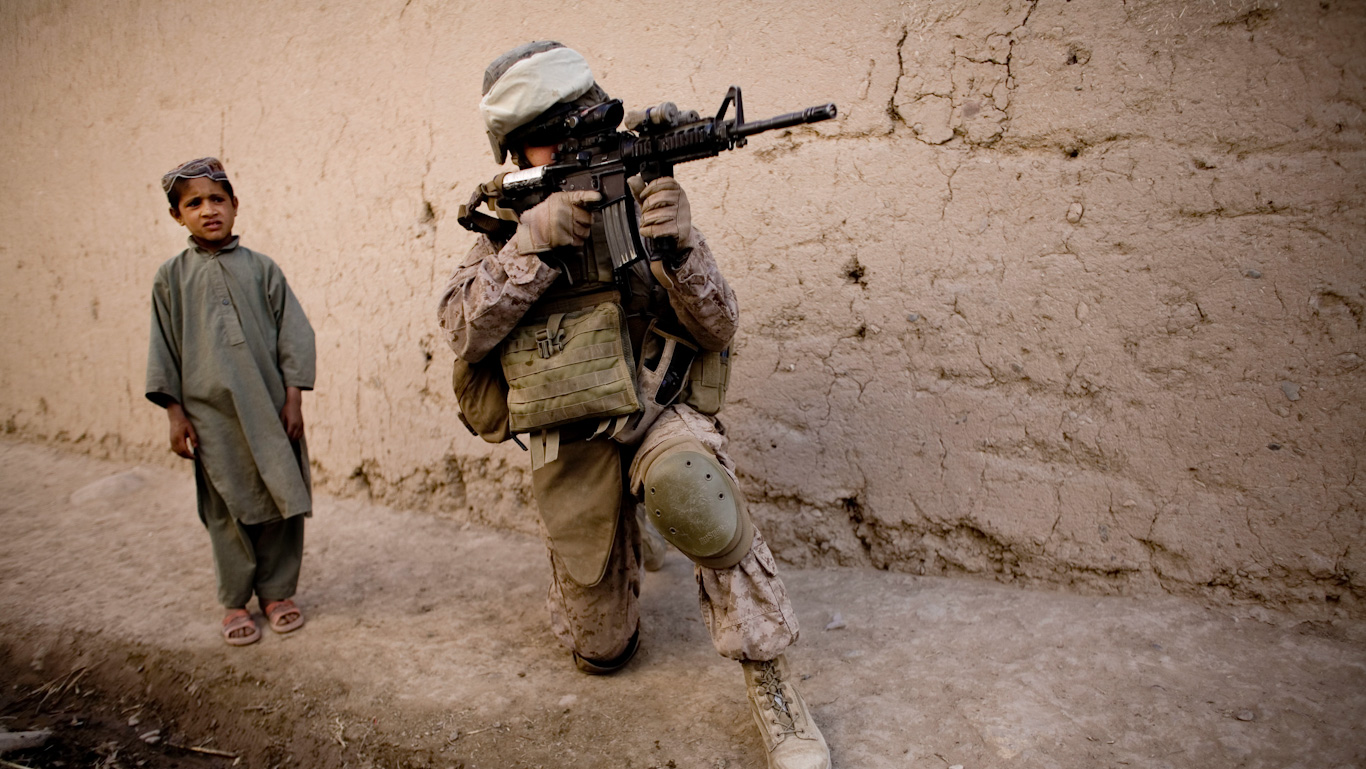
Afghanistan, The Great Game of Smashing Countries

Afghanistan Feature photo
CROCODILE TEARS


In 2010, I was in Washington and arranged to interview the mastermind of Afghanistan’s modern era of suffering, Zbigniew Brzezinski. I quoted to him his autobiography in which he admitted that his grand scheme for drawing the Soviets into Afghanistan had created “a few stirred up Muslims”.

“Do you have any regrets?” I asked. “Regrets! Regrets! What regrets?”

Ed Asner (1929-2021)

Greg Palast – Investigative Journalism

Ed Asner (1929-2021)

A Lion in Underpants – By Greg Palast               

The death squads had just executed Maryknoll nuns, bullets to the back of the head.

It was the Reagan-sponsored war on “communists” in El Salvador, Nicaragua and Afghanistan.

Ed Asner, an actor who wasn’t particularly political, agreed to attend a press conference denouncing the killing of the nuns.

Within short order, his network canceled Lou Grant, the number one show on American TV, in fact, #1 worldwide.

Ed once told me he could’ve kissed the network’s ass, promised to be a good on-stage puppet, an off-stage mute, and save his career which was now on the new Black List.

But he couldn’t. Couldn’t stay silent. Instead, Ed grew louder.

And unstoppable.  At dinner this week, Ed told me he was preparing to open in three new one-act plays.

But my wife didn’t think so. She said, “This is the last time we’ll see Ed, isn’t it?”

I wish she weren’t always right.

I remember when we were about to film Ed in The Best Democracy Money Can Buy. I deliberately hadn’t revealed his lines to him, nor his costume: a ridiculous Santa suit.

Ed was a good sport about it.  And a “one-take” wonder. But, we needed several takes, a bit too long for his 80-something’s bladder. So, rather than halt the production, he said, “The heck with it!”, let go, then simply dropped his soaking pants and continued the shoot in his boxers.

So, that’s how we shot the next scene: Ed Asner in a top hat and underpants. Absolutely brilliant. Take a look.

For inspiration at the shoot, Ed asked our Executive Producer Leni Badpenny if he could think of her naked. Hey, he only said what every guy thinks. Her response was to sit on his somewhat damp lap. (By the way, he was thrilled when he learned we married.)

Ed Asner and Leni Badpenny at The Best Democracy Money Can Buy premiere 2016

And take a listen to learn why Asner was recognized as the best voice actor on the planet. This is his reading of my investigation of Wal-mart, “What Price a Storegasm?”

And here, the Network soliloquy that Ed gamely voiced to a techno dance beat for Armed Madhouse.

Asner was an actor of great talent because he was a man of great feeling.  He would allow nothing to get between his emotions and the words he would express. It was true fearlessness, a courage and inner power that came through even in a sitcom or in a Santa suit.

There’s no guessing where it came from.  A working class Jewish kid from Kansas City, child of the Depression and the incipient Holocaust which most Americans, Left and Right, were happy to ignore, and a fierce union man from early on. Ed only became an actor, he told me, because he lost his job in the steel mills.

Before I got the call that Ed was gone, it was already a lousy morning.

I was deeply upset about the people of Afghanistan whom we’d just abandoned to the Islamists executioners, the very killers Reagan had unleashed alongside the death squads of El Salvador.

And, frankly, I’ve been afraid that I’d be shunned by progressive friends and editors who are breaking out the party hats to celebrate the end of the “forever war.”

But I just can’t join the party.  Should I say something?  Death squads, Nazis, Taliban. Which victims am I allowed to speak for?

I’m an operational atheist.
I can’t turn to the Lord for advice.
But I can ask, What would Lou Grant do?

You’ll have my answer this week.

Alev ha-shalom, my friend.

Producer David Ambrose (left), Ed Asner (center), Greg Palast (right)
at The Best Democracy Money Can Buy premiere 2016

13 U.S. service members killed in Kabul attack: Pentagon

13 U.S. service members killed in Kabul attack: Pentagon


A “complex attack” involving at least two explosions outside the airport in Kabul on Thursday killed 13 U.S. service members and injured at least 15 others, the Pentagon said.

The attack also killed and wounded a number of Afghan civilians. An Afghan official told Associated Press that at least 60 Afghans were killed and 143 others were injured in the attack.

“Let me be clear: While we’re saddened by the loss of life, both U.S. and Afghan [lives], we’re continuing to execute the mission,” Marine Gen. Frank McKenzie, commander of U.S. Central Command, said at a press briefing on Thursday.

McKenzie confirmed earlier reports that a suicide bomb exploded outside one of the main gates at Hamid Karzai International Airport. He said another bomb went off in the vicinity of the Baron Hotel, which is near the airport and is often frequented by Americans in Kabul.

Smoke rises from explosion outside the airport in Kabul, Afghanistan, Thursday, Aug. 26, 2021. The explosion went off outside Kabul's airport, where thousands of people have flocked as they try to flee the Taliban takeover of Afghanistan. (Wali Sabawoon/AP)
Smoke rises from an explosion outside the airport in Kabul on Thursday. (Wali Sabawoon/AP)


McKenzie also confirmed that ISIS-K, an affiliate of the Islamic State terrorist group in Afghanistan, is believed to be responsible for the attacks. He said U.S. officials believe it is the group’s “desire to continue those attacks, and we expect those attacks to continue.” ISIS-K is also an enemy of the Taliban.

Asked whether the U.S. would take military action against those responsible, McKenzie said, “Yes. If we can find who is associated with this, we will go after them.”

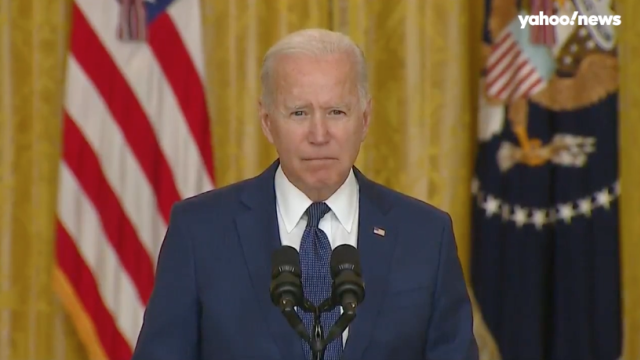
On Thursday evening, President Biden, speaking somberly from the White House, vowed to “hunt down” those who carried out the attack.

“We will not forgive, we will not forget, we will hunt you down and make you pay,” he said.

Biden added that officials “have some reason to believe we know who [the ISIS-K leaders] are, and we will find ways of our choosing, without large military operations, to get them.”

(Yahoo News)
Yahoo News


The Hamid Karzai airport has been the site of a massive airlift operation by the U.S. military to evacuate tens of thousands of Americans, at-risk Afghans and citizens of allied nations out of Afghanistan following the Taliban’s takeover of the country less than two weeks ago.

McKenzie told reporters that the suicide bomber likely made it past Taliban checkpoint outside the airport and was being screened by U.S. Marines for entry at the gate when the attack occurred, highlighting the threats to U.S. troops who are facilitating the airlift.

“We don’t want to let somebody on an airplane with a bomb,” McKenzie said. “Ultimately, Americans have got to be endangered to do these searches, there’s really no other way to do it.”

McKenzie said he doesn’t think there’s any reason to believe the Taliban intentionally let the attack happen.

“Clearly, if they were able to get up to the Marines at the entry point of the base, there’s a failure somewhere,” he said. Still, McKenzie said, U.S. officials have asked Taliban leaders for help providing additional security around the airport, given threats of another possible attack.

“They have a practical reason for wanting us to get out of here by Aug. 31,” McKenzie said of the Taliban, who, he said, want to reclaim control of the Kabul airfield. “As long as we kept our common purpose aligned, they’ve been useful to work with.”

Biden to ISIS-K: ‘We will hunt you down and make you pay’

President Biden addressed the nation Thursday evening following two bombing attacks outside the Kabul airport that killed 12 U.S. service members and dozens of Afghans. Biden blamed Islamic State Khorasan, or ISIS-K, for the attack and vowed to avenge those deaths.

Biden reiterated this point on Thursday, saying that “no one trusts” the Taliban, but that U.S. officials are counting on the group’s “self-interest.”

“It’s not a matter of trust,” Biden said, “it is a matter of mutual self-interest.”

The U.S. has been racing to evacuate as many people from Afghanistan as possible before Aug. 31, when the last American troops are scheduled to withdraw from the country. Earlier this week, Biden confirmed that he intends to stick with that withdrawal deadline, despite calls to extend it. He cited the growing threat that ISIS-K poses to U.S. troops on the ground in Kabul.

“Every day we’re on the ground is another day we know ISIS-K is seeking to target the airport,” Biden said Tuesday. “The sooner we can finish, the better.”

As of Wednesday, Secretary of State Antony Blinken said that more than 4,500 American citizens and their immediate family members had been evacuated from Afghanistan, and that up to 1,500 others were still waiting to leave.

At the Pentagon on Thursday, McKenzie said that before the attack, 104,000 people had been airlifted out of the Kabul airport.

Medical and hospital staff bring an injured man on a stretcher for treatment after two blasts outside the airport in Kabul, Afghanistan, Thursday. (Photo by Wakil Koshar/AFP via Getty Images)
Medical staff bring an injured man on a stretcher for treatment after the explosions on Thursday. (Wakil Koshar/AFP via Getty Images)

The Real Winner of the Afghan War? It’s Not Who You Think.

The Real Winner of the Afghan War? It’s Not Who You Think.

Pakistani police officers stand guard outside the compound where Osama bin Laden was killed in Abbottabad, Pakistan, May 5, 2011. (Warrick Page/The New York Times)

Just days after the Taliban took Kabul, their flag was flying high above a central mosque in Pakistan’s capital. It was an in-your-face gesture intended to spite the defeated Americans. But it was also a sign of the real victors in the 20-year Afghan war.

Pakistan was ostensibly America’s partner in the war against al-Qaida and the Taliban. Its military won tens of billions of dollars in American aid over the last two decades, even as Washington acknowledged that much of the money disappeared into unaccounted sinkholes.

But it was a relationship riven by duplicity and divided interests from its very start after 9/11. Not least, the Afghan Taliban the Americans were fighting are, in large part, a creation of Pakistan’s intelligence service, the ISI, which through the course of the war nurtured and protected Taliban assets inside Pakistan.

In the last three months as the Taliban swept across Afghanistan, the Pakistani military waved a surge of new fighters across the border from sanctuaries inside Pakistan, tribal leaders have said. It was a final coup de grâce to the American-trained Afghan security forces.

“The Pakistanis and the ISI think they have won in Afghanistan,” said Robert Grenier, a former CIA station chief in Pakistan. But, he warned, the Pakistanis should watch what they wish for. “If the Afghan Taliban become leaders of a pariah state, which is likely, Pakistan will find itself tethered to them.”

Pakistan’s already shaky reputation in the West is likely to plummet now, as the Taliban take over Afghanistan. Calls to sanction Pakistan have already circulated on social media. Absent foreign financing, Pakistan faces reliance on a jihadi drug trade encouraged by the new rulers in Kabul. A Taliban-run state on its border will no doubt embolden Taliban and other Islamist militants in Pakistan itself.

Not least, relations with the United States, already on the downslope, will unravel further. Aside from maintaining the stability of Pakistan’s nuclear arsenal, the Americans now have less incentive to deal with Pakistan.

So the question for the Pakistanis is what will they do with the broken country that is their prize? Already Pakistan, along with Russia and China, is helping fill the space the Americans have vacated. The embassies of the three nations have remained open since the Taliban seized Kabul.

A Pakistani protégé, Khalil Haqqani, a Taliban leader who was a regular visitor to Pakistan’s military headquarters in Rawalpindi, is one of the new rulers of Afghanistan.

Known to U.S. intelligence as the Taliban emissary to al-Qaida, Haqqani showed up in Kabul last week as their new chief of security, brazenly armed with an American-made M4 rifle, with a protection squad dressed in American combat gear.

“Governing a war-ravaged country will be the real test and imposing challenge especially as the Taliban have been a warring force, not one adept at governing,” Maleeha Lohdi, a former Pakistani ambassador to the United Nations, wrote in a column in The Dawn newspaper this week.

During the war the Americans tolerated Pakistan’s duplicitous game because they saw little choice, preferring to fight a chaotic war in Afghanistan to warring with nuclear-armed Pakistan. Moreover, Pakistan’s ports and airfields provided the main entry points and supply lines for American military equipment needed in Afghanistan.

Pakistan did that, even as its spy agency provided planning assistance, training expertise and sometimes on the ground advice to the Taliban all through the war, American officials said.

Though Pakistan was supposed to be an American ally, it always worked toward its own interests, as nations do. Those interests did not include a large American military presence on its border, an autonomous Afghanistan with a democratic government it could not control or a strong and centralized military.

Rather, Pakistan’s goal in Afghanistan was to create a sphere of influence to block its archnemesis, India. The Pakistanis insist that India uses separatist groups like the Balochistan Liberation Army, operating from havens in Afghanistan, to stir dissent in Pakistan.

“The Pakistani Army believes Afghanistan provides strategic depth against India, which is their obsession,” said Bruce Riedel, a former South Asia adviser to the Bush and Obama administrations. “The U.S. encouraged India to support the American-backed Afghan government after 2001, fueling the army’s paranoia.”

The Pakistanis were incensed that former President Barack Obama visited India in 2015 but conspicuously boycotted Pakistan, he said.

During a visit to Washington this spring, Moeed Yusuf, the national security adviser to Pakistan’s prime minister, Imran Khan, stressed the need to eliminate the Indian presence in Afghanistan, Americans who met him said.

Yusuf is considered a moderate on the Pakistani political spectrum, and the Americans said they were struck by his vehemence on India’s role in Afghanistan.

When Indian diplomats were among the first foreigners to evacuate from Kabul, their departure was played in the Pakistani press as a singular victory.

The nexus between the Pakistanis and the victorious Haqqani was indisputable and indispensable to the Taliban victory, said Douglas London, a former CIA counterterrorism chief for South and Southwest Asia.

The head of the Pakistani Army, Qamar Javed Bajwa, and the head of the ISI, Hameed Faiz, met with Haqqani on a “recurring basis,” London said. The extended Haqqani family has long been known to live in the largely ungoverned areas of Pakistan along the Afghan border.

“All the time Bajwa was pressed by the U.S. to give up Khalil Haqqani and two other Haqqani leaders, and all the time, Bajwa would say, ‘Tell us where they are,’” said London, who has written an upcoming memoir of his CIA years, “The Recruiter.” “My favorite quote was when Bajwa said: ‘You just have to come to my office and we will go in a helicopter and we will go and pick them up.’”

Pakistan’s help, he said, encompassed a gamut of services. Safe havens in the borderlands of Pakistan, particularly in the city of Quetta, sheltered Afghan Taliban fighters and their families. Medical services treated wounded fighters, sometimes in hospitals in the major cities, Karachi and Peshawar. Free rein for the Haqqanis to run lucrative real estate, smuggling and other businesses in Pakistan kept their war machine churning.

The ISI usually kept its operatives out of the actual conflict, fearful that they might be captured in Afghanistan, delivering a smoking gun to the Americans, London said.

The ISI also provided the Taliban with assets that elevated their international status. The Taliban leader Abdul Ghani Baradar traveled on a Pakistani passport to attend peace talks in Doha, Qatar, and to meet in Tianjin, China, with Wang Yi, the foreign minister.

“The Afghan Taliban would not be where they are without the assistance of the Pakistanis,” London said.

Washington’s relationship with Pakistan cooled after Navy SEALs killed Osama bin Laden in 2011 at a safe house located near a Pakistani military academy. Top American officials stopped visiting Pakistan and assistance was reduced.

But the Obama administration never said publicly what it suspected: that the Pakistani military knew all along that bin Laden was living with his extended family in Abbottabad, one of Pakistan’s best-known garrison towns.

If Washington had declared that Pakistan was harboring bin Laden, then Pakistan would have legally been a state sponsor of terrorism, and subject to mandatory sanctions like Iran, said Riedel, the former South Asia adviser to the Bush and Obama administrations.

That would have forced the Americans to end its support for Pakistan and that in turn, would have led Pakistan to stop American war supplies from transiting Pakistan, increasing the cost of the war.

The bin Laden raid played into long-standing fears within the Pakistani military that the Americans wanted to dismantle Pakistan’s nuclear arsenal, and would violate Pakistani territory to do it.

Despite the strained relations, the U.S. continues to work with Pakistan through the Department of Energy to help provide security for the weapons, and fissile material, said Toby Dalton, co-director of the Nuclear Policy Program at the Carnegie Endowment.

But Pakistan is also agile in its alliances. China, a longtime patron of Pakistan — they call each other as “close as lips and teeth” — is investing heavily in Pakistani infrastructure.

Publicly, China says it is cheered to see the Americans exit Afghanistan, and is ready to step into the void, expanding its Belt and Road initiative into Afghanistan, where it hopes to extract minerals.

But privately, the Chinese are wary. Chinese workers in Pakistan have been killed in terrorist attacks, which could presage a rough ride in Afghanistan. And the Taliban prefer isolation to roads and dams that could serve to loosen their control on the population.

China is counting on Pakistan to serve as its facilitator in Afghanistan, said Sajjan Gohel, International Security Director of the Asia-Pacific Foundation in London.

“The Chinese appear confident that they will be able to secure more security guarantees from the Taliban,” Gohel said, “because of their mutual ties with Pakistan.”

Trump’s former national security advisor John Bolton says it’s ‘impossible’ for Mike Pompeo to ‘rewrite history’ on his negotiations with the Taliban

Trump’s former national security advisor John Bolton says it’s ‘impossible’ for Mike Pompeo to ‘rewrite history’ on his negotiations with the Taliban

Donald Trump Mike Pompeo John Bolton.JPG
John Bolton, right, Mike Pompeo, center, and President Donald Trump, left. REUTERS/Leah Millis 

  • Trump’s national security advisor John Bolton slammed Mike Pompeo over his negotiations with the Taliban.
  • Bolton said it was “impossible” to “rewrite history” about the Trump administration’s role in the Afghanistan pullout.
  • Pompeo and Trump have come under attack over their deal with the Taliban in February 2020.

Donald Trump’s former national security advisor John Bolton criticized former Secretary of State Mike Pompeo, who negotiated a deal with the Taliban in February 2020, for distancing himself from the Afghanistan withdrawal.

“Trying to extricate yourself from this withdrawal is I think difficult if not impossible to do, especially to rewrite history about what actually happened,” Bolton told Politico in a report published Thursday. “I think that’s a prescription for Democratic attack ads that would be fatal to someone’s credibility.”

Pompeo and Trump have come under attack over their agreement with the Taliban, which stipulated that US troops be withdrawn from Afghanistan within 14 months on the condition that the militant group not turn the country into a terrorist base. At the signing ceremony in Qatar, Pompeo posed for photos alongside the Taliban leader Abdul Ghani Baradar, who is anticipated to head the next Taliban government in Afghanistan.

At the time, critics blasted the Trump administration for excluding the Afghan government, saying it undercut its legitimacy. That criticism has been renewed amid the Taliban’s takeover of Afghanistan and the collapse of the US-backed Afghan government on August 15.

Read more: We identified the 125 people and institutions most responsible for Donald Trump’s rise to power and his norm-busting behavior that tested the boundaries of the US government

Bolton, who served as Trump’s national security advisor from 2018 to 2019, has said both the Trump administration and President Joe Biden are responsible for the chaotic, ongoing removal of US troops from Afghanistan.

Other Republicans who have criticized Trump and Biden over the pullout include Reps. Adam Kinzinger of Illinois and Liz Cheney of Wyoming. H.R. McMaster, Trump’s national security advisor from 2017 to 2018, denounced Trump’s Taliban deal as a “surrender agreement.”

Pompeo and Trump have attempted to absolve themselves of the situation in Afghanistan and blamed Biden for the fallout.

“I hope this Administration comes to understand that apologizing, placating, appeasing, being weak, only presents risks to American security,” Pompeo tweeted on Thursday.

‘Was it worth it?’ A fallen Marine and a war’s crushing end

‘Was it worth it?’ A fallen Marine and a war’s crushing end


SPRINGVILLE, Tenn. (AP) — She was folding a red sweater when she heard a car door slam, went to the window and realized that a moment she always imagined would kill her was about to be made real: three Marines and a Navy chaplain were walking toward her door, and that could only mean one thing.

She put her hand on the blue stars she’d stuck next to the front door, a symbol meant to protect her son, Marine Lance Cpl. Alec Catherwood, who had left three weeks before for the battlefields of Afghanistan.

And then, as she recalls it, she lost her mind. She ran wildly through the house. She opened the door and told the men they couldn’t come inside. She picked up a flower basket and hurled it at them. She screamed so loud and for so long the next day she could not speak.

“I just wanted them not to say anything,” said Gretchen Catherwood, “because if they said it, it would be true. And, of course, it was.”

Her 19-year-old son was dead, killed fighting the Taliban on Oct. 14, 2010.

As she watched the news over the last two weeks, it felt like that day happened 10 minutes ago. The American military pulled out of Afghanistan, and all they had fought so hard to build seemed to collapse in an instant. The Afghan military put down its weapons, the president fled and the Taliban took over. As thousands crushed into the Kabul airport desperate to escape, Gretchen Catherwood felt like she could feel in her hands the red sweater she’d been folding the moment she learned her son was dead.

Her phone buzzed with messages from the family she’s assembled since that horrible day: the officer who’d dodged the flowerpot; the parents of others killed in battle or by suicide since; her son’s fellow fighters in the storied 3rd Battalion, 5th Marine Regiment, nicknamed the Darkhorse Battalion, that endured the highest rate of causalities in Afghanistan. Many of them call her “Ma.”

Outside of this circle, she’d seen someone declare “what a waste of life and potential” on Facebook. Friends told her how horrible they’d felt that her son had died in vain. As she exchanged messages with the others who’d paid the price of war, she worried its end was forcing them to question whether all they had seen and all they had suffered had mattered at all.

“There are three things I need you to know,” she said to some. “You did not fight for nothing. Alec did not lose his life for nothing. I will be here for you no matter what, until the day I die. Those are the things I need you to remember.”

In the woods behind her house, the Darkhorse Lodge is under construction. She and her husband are building a retreat for combat veterans, a place where they can gather and grapple together with the horrors of war. There are 25 rooms, each named after one of the men killed from her son’s battalion. The ones who made it home have become their surrogate sons, she said. And she knows of more than a half-dozen who have died from suicide.

“I am fearful of what this might do to them psychologically. They’re so strong and so brave and so courageous. But they also have really, really big hearts. And I feel that they might internalize a lot and blame themselves,” she said. “And oh God, I hope they don’t blame themselves.”

The 3rd Battalion, 5th Marine Regiment deployed in the fall of 2010 from Camp Pendleton, California, sending 1,000 U.S. Marines on what would become one of the bloodiest tours for American service members in Afghanistan.

The Darkhorse Battalion spent six months battling Taliban fighters in the Sangin district of Helmand province. An area of green fields and mud compounds, Sangin remained almost entirely in the Taliban’s control nearly a decade into the U.S.-led war. Fields of lush poppies used in narcotics gave the militants valued income they were determined to hold.

When the Marines arrived, white Taliban flags flew from most buildings. Loudspeakers installed to broadcast prayers were used to taunt U.S. forces. Schools had closed.

The Marines came under fire as soon as a helicopter dropped them outside their patrol base.

“When the bird landed, we were already getting shot at,” recalled former Sgt. George Barba of Menifee, California. “We run, we get inside and I remember our gunnery sergeant telling us: `Welcome to Sangin. You just got your combat action ribbon.’”

Snipers lurked in the trees. Fighters armed with rifles hid behind mud walls. Homemade bombs turned roads and canals into deathtraps.

Sangin was Alec Catherwood’s first combat deployment. He had enlisted in the Marines while still in high school, went to boot camp shortly after graduation, then was assigned to a 13-man squad led by former Sgt. Sean Johnson.

Johnson was impressed by Catherwood’s professionalism — physically fit, mentally tough and always on time.

“He was only 19, so that was extra special,” Johnson said. “Some are still just trying to figure out how to tie their boots and not get yelled at.”

Catherwood also made them laugh. He carried around a small, stuffed animal he used as a prop for jokes.

Barba recalled Catherwood’s first helicopter ride during training, and how he was “smiling ear-to-ear and he’s swinging his feet like he’s a little kid on a highchair.”

Former Cpl. William Sutton of Yorkville, Illinois, swore Catherwood would crack jokes even during a firefight.

“Alec, he was a shining light in that darkness,” said Sutton, who was shot multiple times fighting in Afghanistan. “And then they took it from us.”

On Oct. 14, 2010, after a late night standing watch outside their patrol base, Catherwood’s squad headed out to assist fellow Marines under attack, who were running low on ammunition.

They crossed open fields, using irrigation canals for cover. After sending half his squad safely ahead, Johnson tapped Catherwood on the helmet and said: “Let’s go.”

After running just three steps, he said, gunfire from ambushing Taliban fighters sounded behind them. Johnson looked down and saw a bullet hole in his pants where he had been shot in the leg. Then came a deafening explosion — one of the Marines had stepped on a hidden bomb. Johnson blacked out momentarily, waking up in the water.

Another explosion followed. Looking to his left, Johnson saw Catherwood floating facedown. It was obvious, he said, that the young Marine was dead.

Explosions during the ambush killed another Marine, Lance Cpl. Joseph Lopez of Rosamond, California, and badly wounded another.

Back in the United States, Staff Sergeant Steve Bancroft began an excruciating two-hour drive toward Catherwood’s parents’ house in northern Illinois. He’d served seven months in Iraq before he became a casualty assistance officer, tasked with notifying families of a death on the battlefield.

“I’d never wish that on anybody, I can’t express that enough: I do not wish looking a mom and dad in the face and telling them their only son is gone,” said Bancroft, who is now retired.

He was stoic when he had to be, as he escorted families to Dover, Delaware, to watch coffins be rolled out of a plane. But when he was alone, he cried. And he still weeps when he thinks about the moment he arrived at the home of Gretchen and Kirk Catherwood.

They laugh now about the hurled flowerpot. He still regularly talks to them and other sets of parents he notified. Though he never met Alec, he feels like he knows him.

“Their son was such a hero, it’s hard to explain, but he sacrificed more than 99% of the people in this world would ever think of doing,” he said.

“Was it worth it? We lost so many people. It’s hard to think about how many we’ve lost.” he said.

Gretchen Catherwood keeps the cross her son was wearing on a chain around her bedpost with his dog tags.

Alongside it hangs a glass bead, blown with the ashes of another young Marine: Cpl. Paul Wedgewood, who made it home.

The Darkhorse Battalion returned to California in April 2011. After months of intense fighting, they’d largely seized Sangin from the Taliban’s grip. Leaders of the provincial government could move about safely. Children, including girls, returned to school.

It came at a heavy price. In addition to the 25 who perished, more than 200 returned home wounded, many with lost limbs, others with scars harder to see.

Wedgewood had trouble sleeping when he finished his four-year enlistment and left the Marine Corps in 2013. As he slept less, he drank more.

A tattoo on his upper arm showed a sheet of scroll paper bearing the names of four Marines who died in Sangin. Wedgewood considered reenlisting, but told his mother: “If I stay, I think it’ll kill me.”

Instead, Wedgewood enrolled in college back home in Colorado, but soon lost interest. A welding program at a community college proved a better fit.

Wedgewood had been diagnosed with post-traumatic stress disorder. He was taking medication, participating in therapy.

“He was very engaged in working on his mental health,” said the Marine’s mother, Helen Wedgewood. “He was not a neglected veteran.”

Still, he struggled. On the Fourth of July, Wedgewood would take his dog camping in the woods to avoid fireworks. He quit a job he liked after a backfiring machine caused him to dive to the floor.

Five years after Sangin, things appeared to be looking up. Wedgewood was preparing for a new job that would take him back to Afghanistan as a private security contractor. He seemed to be in a good place.

After a night of drinking with his roommates, Wedgewood didn’t show up for work on Aug. 23, 2016. A roommate later found him dead in his bedroom. He had shot himself. He was 25 years old.

He left a short note.

“He basically said that he loved us, but he was tired,” Helen Wedgewood said.

She considers her son and others who took their own lives to be casualties of war every bit as much as those killed in action.

When the Taliban swept back into control of Afghanistan just before the fifth anniversary of her son’s death, she felt relief that a war that left more than 2,400 Americans dead and more than 20,700 wounded had finally come to an end. But there was also sadness that gains made by the Afghan people — especially women and children — may be temporary.

“As a mom, this kind of stabs you, because would he still be around, would any of these young men still be around if this whole war hadn’t happened?” she said. “But I try to gently correct people when they say this was a waste or this was all for nothing. Because that’s not true. We don’t know what impacts it’s had on the safety of our country, on the safety of the Afghan people.”

Some who served with the Darkhorse Battalion are having a hard time seeing it any way other than that their efforts, their blood and the lives of their fallen friends were all for nothing.

“I’m starting to feel like how the Vietnam vets felt. There was no purpose to it whatsoever,” said Sutton, 32, who now works in the veterans services office of a county outside Chicago, helping military vets get care.

“We were able to hold our head up high and say we went to the last Taliban stronghold and we gave them hell,” Sutton said, “only for it all to be taken away. In the blink of an eye.”

Barba, 34, works as a private security guard near Los Angeles. He and his wife are expecting their first child. He said he’s had trouble sorting his feelings about the bleak news from Afghanistan. His wife recently woke to Barba screaming in his sleep. “I think your nightmares are back,” she told him.

“It really is weird,” Barba said. “I’ve seen my guys get mad. I’ve seen my guys get frustrated. But not like this. This is like somebody spit in their face.”

Johnson, 34, works as a commercial diver in Florida. He said the U.S. should have acknowledged years ago that the Afghan security forces Americans trained and equipped would never be able to defend the country on their own.

“My personal opinion, yeah, we probably should have pulled out years and years ago,” Johnson said. “If you’re not going to win the damn thing, what are you doing there?”

A few months ago, Gretchen Catherwood was painting the cabins that will become the Darkhorse Lodge. It was dark, still without electricity and no cell service, so it was quiet. She felt suddenly like she could feel her son and his 24 fallen comrades. She could almost see their faces.

“It’s a place where I can feel like they’re together,” she said, “and that they are still caring for their brothers.”

The Catherwoods moved out of their home in Illinois. Every time she walked to the front door, Gretchen remembered those four men arriving with the news. She couldn’t bear it anymore.

The gold star pins she wore everyday on her chest kept breaking. She’d always disliked tattoos and hassled her son when he got one as a Marine. But then she found herself at a tattoo parlor. She had his name inked on her arm, and the shape of a gold star pin put permanently on her chest, just above her heart, so she’d never take it off again.

She could no longer care for her son, she said, but she could for those who made it home. She and her husband moved to the woods in Tennessee and got to work on the Darkhorse Lodge.

They fashioned their logo after the battalion’s mascot, a fierce-looking horse, facing left, its mane sharp like a serrated knife and its eyes squinted for battle. The artist who drew theirs softened its edges and turned it to the right, facing toward a future after war.

They raised a million dollars, mostly in small donations. One woman sends a check for $2 every month. Bancroft, the officer who notified her of her son’s death, donates every year. The obituary for one soldier who died by suicide asked for donations to the Darkhorse Lodge in his memory, and checks flooded the Catherwoods’ mailbox.

They hope to open next summer and offer free stays for any combat veteran from any war or branch of the military who might benefit from time in the woods, where the only conflict is among the dozens of hummingbirds fighting over the feeders on her front porch.

She is hopeful that the American withdrawal from Afghanistan means no one else will die on a battlefield there. But she also worries that it might rattle the vets who made it home, and who might already be struggling to make sense of what happened there and why.

“That’s a constant fear, it’s been my fear since they got back but now it’s even worse,” she said. “They experienced things that 99% of the country never will. I’ve never watched a friend die. I’ve never fought to the death. We are losing these people at a frightening, frightening rate to suicides, and we can’t afford to lose one more.”

She and her husband don’t believe that the chaotic end honors their son’s service, and are particularly troubled that some of the Afghan interpreters and others who helped the military for years might not make it out alive. But they also can’t imagine how it might have ended any other way, had the United States stayed in Afghanistan another year or five or 20.

Part of Alec Catherwood remains there, and for a while that bothered his mother.

When he was alive, she loved to touch his face. He had baby soft skin and when she put her hands on his cheeks, this big tough Marine felt like her little boy. The military did an honorable job making him look whole, she said. But when she touched his cheek as he laid in the casket, she touched a part that had been reconstructed – it wasn’t really him.

“That used to be much harder than it is now,” she said. “Now, it’s like, damn straight, he’s still there. He’s always going to have a presence there, flipping off the Taliban.”

Good things will grow where he is, she likes to think.

“He’s part of their dirt, their soil, he’s part of the Earth there, he is forever there.”

Bynum reported from Savannah, Georgia.

‘Times have changed’: some Afghan women defiant as Taliban return

‘Times have changed’: some Afghan women defiant as Taliban return

Afghan women wait to receive free wheat donated by the Afghan government during a quarantine, amid concerns about the coronavirus disease (COVID-19) in Kabul.


(Reuters) – Afghan women and girls who have won freedoms they could not have dreamt of under the last Taliban rule that ended 20 years ago are desperate not to lose them now the Islamist militant movement is back in power.

Taliban leaders have made reassurances in the build-up up to and aftermath of their stunning conquest of Afghanistan that girls and women would have the right to work and education, although they have come with caveats.

Some women have already been ordered from their jobs during the chaos of Taliban advances across the country in recent days. Others are fearful that whatever the militants say, the reality may be different.

“Times have changed,” said Khadija, who runs a religious school for girls in Afghanistan.

“The Taliban are aware they can’t silence us, and if they shut down the internet the world will know in less than 5 minutes. They will have to accept who we are and what we have become.”

That defiance reflects a generation of women, mainly in urban centers, who have grown up being able to attend school and university and to find jobs.

When the Taliban first ruled Afghanistan from 1996 to 2001, their strict interpretation of sharia, or Islamic law – sometimes brutally enforced – dictated that women could not work and girls were not allowed to attend school.

Women had to cover their face and be accompanied by a male relative if they wanted to venture out of their homes. Those who broke the rules sometimes suffered humiliation and public beatings by the Taliban’s religious police.

During the past two years, when it became clear that foreign troops were planning to withdraw from Afghanistan, Taliban leaders made assurances to the West that women would enjoy equal rights in accordance with Islam, including access to employment and education.

On Tuesday, at the Taliban’s first press conference since seizing Kabul on Sunday, spokesperson Zabihullah Mujahid said women would have rights https://www.reuters.com/world/asia-pacific/evacuation-flights-resume-kabul-airport-biden-defends-us-withdrawal-2021-08-17 to education, health and employment and that they would be “happy” within the framework of sharia.

Specifically referring to women working in media, Mujahid said it would depend on what laws were introduced by the new government in Kabul.

On Tuesday, a female anchor for the private Afghan channel Tolo TV interviewed a Taliban spokesman live on air.

WOMEN FORCED FROM WORK

Afghan girls’ education activist Pashtana Durrani, 23, was wary of Taliban promises.

“They have to walk the talk. Right now they’re not doing that,” she told Reuters, referring to assurances that girls would be allowed to attend schools.

“If they limit the curriculum, I am going to upload more books to (an) online library. If they limit the internet … I will send books to homes. If they limit teachers I will start an underground school, so I have an answer for their solutions.”

Some women have said that one test of the Taliban’s commitment to equal rights would be whether they give them political and policy making jobs.

Nobel Peace Prize winner Malala Yousafzai, who survived being shot in the head by a Pakistani gunman in 2012 after she campaigned for girls’ rights to education, said she was deeply concerned https://www.reuters.com/world/asia-pacific/malala-yousafzai-urges-world-leaders-take-urgent-action-afghanistan-2021-08-17 about the situation in Afghanistan.

“I had the opportunity to talk to a few activists in Afghanistan, including women’s rights activists, and they are sharing their concern that they are not sure what their life is going to be like,” Yousafzai told BBC Newsnight.

The United Nations’ children’s agency UNICEF expressed cautious optimism https://www.reuters.com/world/asia-pacific/unicef-says-some-taliban-support-education-afghan-girls-2021-08-17 about working with Taliban officials, citing their early expressions of support for girls’ education.

It is still delivering aid to most parts of the country and has held initial meetings with new Taliban representatives in recently seized cities like Kandahar, Herat and Jalalabad.

“We have ongoing discussions, we are quite optimistic based on those discussions,” UNICEF’s chief of field operations in Afghanistan, Mustapha Ben Messaoud, told a U.N. briefing.

But U.N. chief Antonio Guterres warned on Monday of “chilling” curbs on human rights under the Taliban and mounting violations against women and girls.

Reuters reported https://www.reuters.com/world/asia-pacific/afghan-women-bankers-forced-roles-taliban-takes-control-2021-08-13 last week that in early July, Taliban fighters walked into a commercial bank branch in Kandahar and ordered nine women working there to leave because their jobs were deemed inappropriate. They were allowed to be replaced by male relatives.

(Writing and editing by Mike Collett-White)

The House seat of one of the GOP’s ‘most prominent’ Trump critics is on the chopping block

The House seat of one of the GOP’s ‘most prominent’ Trump critics is on the chopping block

Adam Kinzinger.
Adam Kinzinger. Andrew Harnik-Pool/Getty Images


A new congressional map in Illinois could spell trouble for the House tenure of “one of the GOP’s most prominent” critics of former President Donald Trump, Rep. Adam Kinzinger (R-Ill.), Politico reports.

Democrats, having “total control” over redistricting in Illinois, will almost definitely “attempt to maximize party gains” with the updated map, especially as sure-to-be contentious midterms threaten the party’s razor-thin majority. That said, “thanks to declining population,” Kinzinger’s seat will very likely be cut, writes Politico.

Although no official proposed map has yet emerged, “few party operatives in D.C. or Illinois could envision a final plan that leaves much of Kinzinger’s seat intact,” Politico writes. “If I had to take a bet, I bet that we lose a Republican district,” said Rep. Danny Davis (D-Ill.).

Should Kinzinger lose his seat, he’d be forced to choose between running somewhere new, perhaps against another incumbent, or making a long shot bid for governor or Senate, assuming he could perform in a GOP primary after having repeatedly criticized Trump. Said Rep. Mike Bost (R-Ill.), when asked if Kinzinger could win in a different seat: “It’d be hard.”

But maybe that’s counting him out too early. Some think Kinzinger could mount a successful 2024 presidential run. Others think he could shore up the vote from suburban moderates and democrat-skeptical independents. For his part, Kinzinger, who told Politico he isn’t “losing sleep” over the possibility of losing his seat, hasn’t counted himself out of the political conversation moving forward.

“I certainly wouldn’t rule out Senate or governor and anything else,” he said. “Maybe, who knows?” Read more at Politico.

A Florida teacher who couldn’t get vaccinated because of her cancer treatment died of COVID-19.

A Florida teacher who couldn’t get vaccinated because of her cancer treatment died of COVID-19. Her union says she caught it from her classroom, which had no mask mandate.

Lake Shipp Elementary
Lake Shipp Elementary School in Florida Google Street View
 
  • Florida elementary school teacher Kelly Peterson died of COVID-19 complications on Monday.
  • She was advised not to get a COVID-19 vaccine by her doctor due to her leukemia treatment.
  • Her sister and union believes Peterson got infected in the classroom, where masks were not mandatory.

A 41-year-old Florida teacher whose doctor had advised her against getting vaccinated has died of COVID-19 complications after she was forced to return to in-person teaching where there was no mask mandate, local outlets say.

Kelly Peterson was not vaccinated against the coronavirus because she had leukemia and her doctor advised against getting the shot in her already weakened state, her sister, Christin, told KTVU.

Lake Shipp Elementary School announced Peterson’s death in a Facebook post on Monday, saying she “touched hundreds of students’ lives” and “made a lasting impression on us all.”

Both Peterson’s sister and the Polk County teacher’s union said that she contracted COVID-19 in the classroom, KTVU reported. However, it should be noted that it’s almost impossible to know how someone contracted COVID-19.

Florida Gov. Ron DeSantis has banned mask mandates in the state, but several schools have defied the order.

Peterson’s sister told KTVU of the doctor’s warnings against the COVID-19 vaccination: “Because her leukemia was so bad at this point, their concern was by getting the vaccine that potentially could put too much stress on her body.”

Cancer patients and survivors are encouraged to get the vaccine, but to discuss the decision with their doctor first, according to the American Cancer Society. ACS said the main question about vaccines and cancer is not whether the vaccine is safe, but whether it is as effective in people with already compromised immune systems.

Last year, Peterson worked remotely, but her sister said she was forced to return to in-person learning this school year, even though she’s immunocompromised.

“With all the COVID cases this year and her medical situation, she should have been a virtual teacher this year. The school didn’t offer that,” Peterson’s sister told The Ledger.

Both the Polk County School District superintendent and the Lake Shipp principal did not immediately respond to Insider’s request for comment.

Lorinda Utter, one of Peterson’s coworkers, told The Ledger that Peterson took every precaution in the classroom, wearing a mask at all times and sanitizing surfaces regularly.

“She did everything she could to try to stay away from COVID,” Utter said.

Peterson was terrified of getting COVID-19, her sister said, and knew the effects it would have on her if she contracted it.

“She had voiced concerns many times that if she contracted COVID, she was afraid that it would kill her, and unfortunately that’s what happened,” Christin Peterson told KTVU.

Christin Peterson also said she hopes her sister’s story will encourage more people to get vaccinated.

Stephanie Yocum, president of the Polk County Teachers union, said she hopes parents “set good examples” for their kids by wearing masks.

“If wearing a mask can keep somebody from dying, that should be something that every person should do right now,” Yocum told KTVU.

Afghanistan’s Music School Falls Silent, Its Future Is Uncertain Under The Taliban

NPR – Music

Afghanistan’s Music School Falls Silent, Its Future Is Uncertain Under The Taliban

Students practice the cello during class at the Afghanistan National Institute of Music on Sept. 26, 2010 in Kabul. Paula Bronstein/Getty Images


The doors of the Afghanistan National Institute of Music in Kabul are closed. The music school’s young students, teachers and faculty are staying home — they have reason to fear. According to founder and director Ahmad Sarmast, “armed people entered school property” recently. He says they tried to steal cars the school uses for transportation and destroyed musical instruments. Under the Taliban in the 1990s, music was strictly forbidden. Performing, selling or even listening to music at home could get you in trouble.

Now ANIM’s future is uncertain. With the disorder caused by the Taliban’s takeover of the city, “The situation is very unpredictable,” says Sarmast. “Things are changing very fast in Kabul nowadays.”

Sarmast, who spoke to NPR from Australia where he’s visiting family, is in constant contact with the school’s faculty. He says some students did not bring their instruments home, “because of the fear that if Taliban will be searching door to door, if the instruments will be found in the house, it might cause them some trouble.” When he reported the recent break-in, he says a policeman in the area, “blamed our security people for failure that they opened the gates of the school.”

Eden MacAdam Somer of the New England Conservatory performs at the Afghanistan National Institute of Music in Kabul on Jan. 9, 2013. Musadeq Sadeq/AP

It’s Afghanistan’s leading music school

With help from donors including the World Bank and the National Association of Music Merchants (NAMM), ANIM opened in Kabul in 2010. Boys and girls study music and academics in the same classrooms. Students learn to play instruments from both the Afghanistan and Western classical traditions.

The school has been held up as a great success story in the effort to renew cultural life and the arts in Afghanistan. Ensembles from the school, including the all-female Zohra orchestra, have performed around the world. From Carnegie Hall in New York to the World Economic Forum in Davos, these young musicians, many from impoverished communities, have shown audiences a side of Afghanistan that often gets lost in news accounts.

Making music can have deadly consequences

Making music has long been a risky endeavor in Afghanistan. Over the years, musicians have reportedly been threatened, kidnapped or killed. During one of ANIM’s concerts in 2014, a suicide bomber sitting behind Sarmast exploded. Two people were killed and several others were injured. Sarmast lost his hearing for a time and had an operation to remove shrapnel from his head and body. “Luckily, no students have been injured or killed,” he says, “But of course, the trauma that they received during this bombing probably would have stayed with them all their life.”

Students play the xylophone and drums during class at the Afghanistan National Institute of Music in Kabul on July 30, 2016. Wakil Kohsar/AFP via Getty Images

While the Taliban have presented themselves to the media as less violent than they were in the 1990s, Sarmast is skeptical. “Today the Taliban are promising that they would be respecting human rights and they will be having respect for diversity,” he says, “But … the video footage emerging with the social media is not very encouraging.”

Music entertains, strengthens and heals

Sarmast is concerned about the future of the school’s students. He says 10 of its graduates have received scholarships to study music in the U.S., including pianist Elham Fanoos who attended Hunter College in New York and recently got his master’s from the Manhattan School of Music. Speaking from his home in New York, Fanoos credits ANIM as, “the reason I am here.” He, too, is worried for the safety of everyone involved with the school and hopes Afghans can continue making music.

“I think a culture makes the country and give the country the strength that it needs to have and to represent the country,” says Fanoos. “Without … cultural activities, a country is completely incomplete.”

Young Afghan musicians perform in Kabul on Feb. 2, 2012. Shah Marai/AFP via Getty Images

Sarmast seems determined not to let the Taliban get in the way of the progress ANIM has made. The school had recently expanded to a larger building to accommodate more programs and ensembles. “Music is not just a type of entertainment. It’s not just an art,” he says. It’s a “powerful force” to help Afghans heal “from the years of civil war.”

Sarmast plans to reopen the Afghanistan National Institute of Music because, he says, “the nation needs it.” He hopes the international community will “keep an eye” to make sure the Taliban keep its promises to respect human rights, “to make sure that the musical rights of the Afghan people [are] not toppled again.”