Hurricane Ida Slams Native Communities in Louisiana as New Orleans Loses Electricity & COVID Rages

Democracy Now

Hurricane Ida Slams Native Communities in Louisiana as New Orleans Loses Electricity & COVID Rages

Story – August 30, 2021


Hurricane Ida has completely knocked out power to the city of New Orleans and reversed the flow of the Mississippi River after it hit southern Louisiana and Mississippi, flooding the area with storm surges. The Category 4 storm hit on the same date Hurricane Katrina devastated the area 16 years earlier. “This is a storm like no other,” says Monique Verdin, a citizen of the United Houma Nation and part of the grassroots collaborative Another Gulf Is Possible. “This is a part of South Louisiana that is losing land at one of the fastest rates,” Verdin notes. She also discusses how the storm hit the area as “Delta has been raging in the Mississippi River Delta.”

Thomas James Hand comforts Alzile Marie Hand, whose house in Houma, La., was seriously damaged by Hurricane Ida over the weekend. Go Nakamura/The Washington Post via Getty Images

Transcript
This is a rush transcript. Copy may not be in its final form.


AMY GOODMAN: This is Democracy Now!, democracynow.org, The War and Peace Report. I’m Amy Goodman.

Hurricane Ida, one of the most powerful storms ever to hit the United States, roared ashore Sunday in southern Louisiana in an area dominated by the oil industry that’s also home to many Native communities. The storm brought a seven-foot storm surge, 150-mile-per-hour winds and up to two feet of rain to parts of the Gulf Coast. It was so powerful, it completely knocked out power to a million people, including the entire city of New Orleans, and reversed the flow of the Mississippi River. The Category 4 storm hit on the same day Hurricane Katrina devastated the area 16 years ago. It’s been blamed for at least one death, and more are expected.

A system of dikes and levees that protects the New Orleans region from rising waters is reportedly holding, for now, much of it built since Katrina. But still, it is underfunded, and officials say they could be overwhelmed by a forecasted 20 inches of rain.

Louisiana’s Gulf Coast is a major oil and gas hub, with 17 oil refineries, two liquefied natural gas export terminals, a nuclear power plant and many Superfund sites. Hurricane Ida made landfall near Port Fourchon, the oilfield service hub for almost all of the Gulf of Mexico and not far from the city of Houma.

In a minute, we’ll be joined by Monique Verdin, a citizen of the United Houma Nation, who just evacuated — the Houma Nation, one of the largest Native American tribes in North America. First, this is a trailer, though, for a documentary Verdin co-produced in 2012 called My Louisiana Love.

MONIQUE VERDIN: Our people have survived the natural cycle of floods and storms for centuries.

NARRATOR: In the bayous and swamps of Southeast Louisiana, filmmaker Monique Verdin explores her Native Houma roots.

MONIQUE VERDIN: I want to keep living on our land, but I’m inheriting a dying delta. Our love ties us to this place and makes us feel responsible to care for it.

NARRATOR: As Monique discovers, they’re battling their deadliest storm yet: the explosive growth of the oil and gas companies in the area.

DELTA RESIDENT: You see, the more gas and oil you got underneath your ground, the higher you’re going to sit. The more they’re going to pump, the lower your land is going to go.

CLARICE FRILOUX: We’ve been treated bad throughout the years, but this could destroy our tribe as a whole.

AMY GOODMAN: The trailer for the PBS documentary My Louisiana Love, co-produced by our guest, Monique Verdin, a citizen of the United Houma Nation. She has evacuated for Hurricane Ida. She’s also part of the collaborative Another Gulf Is Possible, which is now organizing mutual aid efforts to provide essential needs, repairs, supplies to the areas hit by Hurricane Ida.

Monique, thanks so much for joining us. I know this is a very difficult time. Can you explain the extent of the devastation that you’re hearing about, not only in Houma, but all over the area — a million people without power, all of New Orleans in the dark, people reporting they’re up to their chest in water?

MONIQUE VERDIN: Well, Amy, we’re really just starting to hear from folks. I know that many have just completely lost their homes. Many of our fishermen rode out the storm on their boats. We haven’t heard from a number of them. And there’s still — you know, everyone was waiting for the sun to come up, and that’s just happening. So, we’re not really sure, but we do know that there’s extreme flooding happening just to the west of the city. And all of those communities, all of the bayou communities, where the United Houma Nation, but also the Atakapa-Ishak of Grand Bayou and Plaquemines Parish, the Pointe-au-Chien Indian Tribe, the Biloxi-Chitimacha Confederation of Muskogee, Bands of Grand Caillou and Dulac, and the Isle de Jean Charles — you know, these are communities that often get left out of the news and have been weathering storms for many years. But this is a storm like no other.

AMY GOODMAN: So, talk about that. And talk about Houma. Talk about your community. And was a complete evacuation done of the Houma Nation?

MONIQUE VERDIN: No. The Houma are not ones to run from a storm. You know, we have boats and lands to take care of. And so, many people usually stay. More people evacuated this time than ever before. And we’ve all been scattered to the wind. Everyone went to whichever direction that they could, if they could. And many just went from the low-lying areas, that are just inside risk reduction levee systems, to higher grounds.

But they, too, you know, have — everyone is exhausted from just riding out the storm and the relentless wind and rains, that I’m hearing has been a very humbling experience. But we know that the disaster is only beginning to unfold. Hurricane Katrina really taught us that. Yes, the storm comes through, but the disaster keeps going for many years to come. And decisions get made in these moments, when people are completely disoriented and just trying to figure out how to get home. And at this moment, and knowing that all of Southeast Louisiana is out of power, when we get home and how we get home is a big question.

AMY GOODMAN: Can you talk about your family members who did not evacuate? Are you able to even be in contact with them? I mean, being in the dark is more than the actual darkness of the night, of course, as, as you said, people cannot communicate. Much of the rescue efforts can’t even start until today in daylight.

MONIQUE VERDIN: Yes. I have not spoken to very many. Social media is spotty, and I’m getting reports that cell service is also very spotty or nonexistent. I did get a text message in the middle of the night from a cousin saying that he didn’t think that he could get out of his home without a chainsaw, and also has — having no communication, so trying to be there for folks. But, you know, this is — everyone’s been kind of in shock. And now no one has power. No one has cell service. So, communication is going to be key.

AMY GOODMAN: Can you talk about the community that your relatives live in, called Big Woods, where there’s a waste pit in the flood areas? What does this mean? And we’re talking about scores of toxic sites that are directly in the hurricane’s path.

MONIQUE VERDIN: Yes. So, in the Yakni Chitto — it’s the “Big Country” between the Atchafalaya and Mississippi Rivers, where the majority of the Houma Nation still reside, at the ends of the bayous — this is a part of South Louisiana that is losing land at one of the fastest rates. And just to say to the audience, Louisiana is losing land at one of the fastest rates on the planet. The statistic is, every 100 minutes, a football field disappears from our shores. Of course, that’s a calculation divided over time, multiplied by disaster. So, you know, this is what we’re up against just in general.

And where these waste pits are, which are taking offshore oil and gas waste and “treating” it in these open-air pits, is just north of some of the fastest-deteriorating land on the planet and just south of what is the Houma Navigation Canal, which is a man-made canal. And this pit — these pits have been there for a very long time. And with every storm, this low-lying area, because of all of the levee infrastructure, too, that has been added since Hurricane Katrina, water goes towards the path of least resistance. And Grand Bois is left out of that levee system in a big way.

So, I haven’t gotten any reports from family in Grand Bois yet. I’m hoping to hear something today. The last photo I saw was a picture of my cousin’s house that was just completely flattened. So, what the water is like there, I’m not sure. Overnight, that’s when, you know, the surge just keeps — it had been pushing up against the levees all day. So —

AMY GOODMAN: And can you talk about climate change crashing into COVID? I mean, the reports on the South — Louisiana, Texas, Arkansas, Florida — you have oxygen running out in hospitals, where the patients who are dying are younger and younger. What does this mean at this time of the hurricane?

MONIQUE VERDIN: Delta has been raging in the Mississippi River Delta. Our hospitals have already been at capacity for weeks now. I read a report that one of the hospitals in Thibodaux actually — their generators, they lost power for a while and were having to manually pump oxygen into people who were in ICU and on ventilators that were not hooked up to the electrical system.

And it’s going to get really hot and humid, so wearing a mask is not ideal, and people are with each other and in each other’s homes at this time of evacuation and in the times of the disaster aftermath. You know, community is what gets you through this. And being in a time when we’re supposed to be social distancing and not being in the same space is really hard, especially when you’re going to start needing to rip out your walls and pull out your floors or, yeah, try to salvage what you have left.

The original content of this program is licensed under a Creative Commons Attribution-Noncommercial-No Derivative Works 3.0 United States License. Please attribute legal copies of this work to democracynow.org. Some of the work(s) that this program incorporates, however, may be separately licensed. For further information or additional permissions, contact us.

U.S. ends 20-year war in Afghanistan with final evacuation flights out of Kabul

CNBC – Politics

U.S. ends 20-year war in Afghanistan with final evacuation flights out of Kabul

Amanda Macias                            August 30, 2021
KEY POINTS
  • The United States has finished its evacuation efforts from Kabul’s airport, the Pentagon said Monday, effectively ending America’s longest war.
  • The last C-17 military cargo aircraft departed Hamid Karzai International Airport on Monday afternoon Eastern time.
  • Marine Corps General Kenneth McKenzie, commander of U.S. Central Command, said there were no Americans on the last five flights out of Kabul.
  • President Joe Biden said he would address the nation Tuesday afternoon.
A US Air Force aircraft takes off from the airport in Kabul on August 30, 2021.
A US Air Force aircraft takes off from the airport in Kabul on August 30, 2021. Aamir Qureshi | AFP | Getty Images


WASHINGTON — America’s longest war is over.

The United States finished its withdrawal efforts from the airport in Kabul, Afghanistan, the Pentagon said Monday, effectively ending a two-decade conflict that began not long after the terrorist attacks of Sept. 11, 2001.

After the Pentagon’s announcement, President Joe Biden, in a statement Monday evening, thanked the American military and said he would address the nation Tuesday afternoon about his decision not to prolong the U.S. mission in Afghanistan beyond Aug. 31.

“The past 17 days have seen our troops execute the largest airlift in U.S. history, evacuating over 120,000 U.S. citizens, citizens of our allies, and Afghan allies of the United States,” the president said in the statement.

“They have done it with unmatched courage, professionalism, and resolve. Now, our 20-year military presence in Afghanistan has ended.”

In the final week of the withdrawal, terrorists from the group ISIS-K killed 13 U.S. service members and dozens of Afghans in an attack outside the airport. U.S. forces retaliated and launched strikes in a bid to thwart other attacks.

The last C-17 military cargo aircraft departed Hamid Karzai International Airport on Monday afternoon Eastern time, according to U.S. Marine Corps General Kenneth McKenzie, commander of U.S. Central Command, completing a massive evacuation effort that flew more than 116,000 people out of Afghanistan over the past two weeks.

McKenzie, who oversees U.S. military operations in the region, said the Taliban did not have direct knowledge of the U.S. military’s time of departure, adding that commanders on the ground “chose to keep that information very restricted.”

“But they were actually very helpful and useful to us as we closed down operations,” McKenzie said of the Taliban.

McKenzie said there were no Americans on the last five flights out of Kabul.

“We were not able to bring any Americans out; that activity probably ended about 12 hours before our exit. Although we continue the outreach and would have been prepared to bring them on until the very last minute, but none of them made it to the airport,” McKenzie said.

The four-star general added that there were no evacuees left at the airfield when the last C-17 took off and confirmed that all U.S. service members and troops from the Afghan military force along with their families were also airlifted out on Monday.

Secretary of State Antony Blinken said later on Monday that fewer than 200 Americans are still seeking evacuation.

“Our commitment to them and to all Americans in Afghanistan and everywhere in the world continues. The protection and welfare of Americans abroad remains the State Department’s most vital and enduring mission,” the nation’s top diplomat said in an evening address.

As of early Monday, U.S. and allied forces evacuated 1,200 people out of the Afghan capital on 26 military cargo aircraft flights in a 24-hour period, according to the latest figures from the White House.

About 122,800 people have been evacuated since the end of July, including about 6,000 U.S. citizens and their families.

“A new chapter of America’s engagement with Afghanistan has begun. It’s one in which we will lead with our diplomacy. The military mission is over. A new diplomatic mission has begun,” Blinken said.

Blinken added that the U.S. had suspended its diplomatic presence in Kabul and will transfer those operations to Doha, Qatar.

“We will remain vigilant in monitoring threats ourselves and will maintain robust counterterrorism capabilities in the region to neutralize those threats if necessary — as we demonstrated in the past few days by striking ISIS facilitators and even threats in Afghanistan, and as we do in places around the world where we do not have military forces on the ground,” Blinken said.

The Taliban return to power
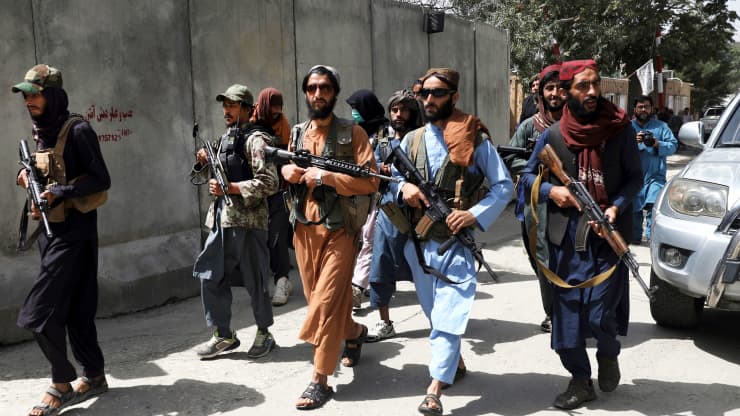
Taliban fighters patrol in Wazir Akbar Khan neighborhood in the city of Kabul, Afghanistan, Wednesday, Aug. 18, 2021.
Rahmat Gul | AP


The U.S. began its war in Afghanistan in October 2001, weeks after the attacks of Sept. 11. The Taliban at the time provided sanctuary to al-Qaeda, the group that planned and carried out the devastating terrorist attacks on the World Trade Center and the Pentagon.

Since then, about 2,500 U.S. service members have died in the conflict, which also claimed the lives of more than 100,000 Afghan troops, police personnel and civilians.

Now the Taliban are yet again in power.

In the final weeks of a planned exodus of foreign forces from Afghanistan, the Taliban carried out a succession of shocking battlefield gains.

The Taliban seized Bagram Air Base, a sprawling and once-stalwart U.S. military installation, less than two months after U.S. commanders transferred it to the Afghan National Security and Defense Force.

In 2012, at its peak, Bagram saw more than 100,000 U.S. troops pass through. It was the largest U.S. military installation in Afghanistan.

As the Taliban moved closer to the capital, Afghan President Ashraf Ghani fled the country, and Western nations rushed to evacuate embassies amid a deteriorating security situation.

Biden ordered the deployment of thousands of U.S. troops to Kabul to help evacuate U.S. Embassy staff and secure the perimeter of the airport.

Meanwhile, thousands of Afghans swarmed the tarmac at the airport desperate to flee Taliban rule.

Despite being vastly outnumbered by the Afghan military, which has long been assisted by U.S. and NATO coalition forces, the Taliban seized the presidential palace in Kabul on Aug. 15.

In April, Biden ordered the full withdrawal of approximately 3,000 U.S. troops from Afghanistan by Sept. 11. He later gave an updated timeline saying the U.S. military mission in Afghanistan will end by Aug. 31.

Following the Taliban takeover, Biden defended his decision that the U.S. would depart the war-torn country.

“I stand squarely behind my decision. After 20 years I’ve learned the hard way that there was never a good time to withdraw U.S. forces,” Biden said a day after Afghanistan collapsed to the Taliban.

“American troops cannot and should not be fighting in a war and dying in a war that Afghan forces are not willing to fight for themselves,” Biden said. “We gave them every chance to determine their own future. We could not provide them with the will to fight for that future,” he added.

Final U.S. casualties of Afghan war
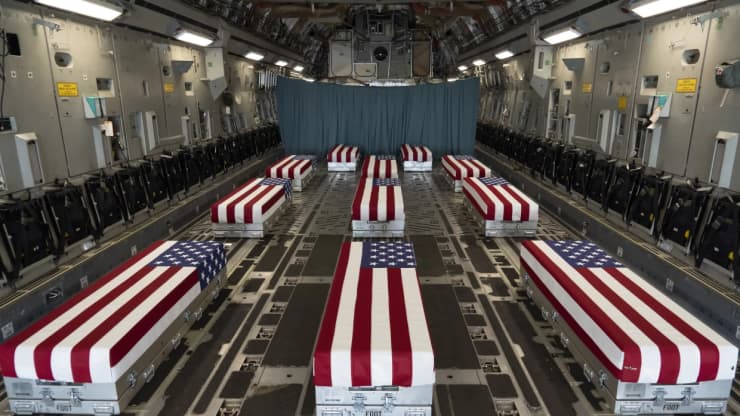
In this image provided by the U.S. Air Force, flag-draped transfer cases line the inside of a transport plane Sunday before a dignified transfer at Dover Air Force Base, Del. The fallen service members were killed while supporting evacuations in Kabul, Afghanistan.
Jason Minto | U.S. Air Force


The Pentagon on Saturday released the names of the 13 U.S. service members killed after a suicide bomber detonated an explosive near the gates of Kabul’s airport.

The Aug. 26 attack, which killed 11 Marines, one Navy sailor and one Army soldier, is under investigation.

On Sunday, the president and first lady Jill Biden traveled to Dover Air Force Base to meet privately with the families of the fallen before observing the dignified transfer of American flag-draped caskets from a C-17 military cargo plane to a vehicle.

A dignified transfer is a solemn process in which the remains of fallen service members are carried from an aircraft to a waiting vehicle. It is conducted for every U.S. service member killed in action.

The remains of the service members were flown from Kabul to Kuwait and then to Germany before arriving at Dover.

Sunday marked the first time Biden has attended a dignified transfer since he became president.

US President Joe Biden attends the dignified transfer of the remains of a fallen service member at Dover Air Force Base in Dover, Delaware, August, 29, 2021.
US President Joe Biden attends the dignified transfer of the remains of a fallen service member at Dover Air Force Base in Dover, Delaware, August, 29, 2021. Saul Loeb | AFP | Getty Images


Secretary of Defense Lloyd Austin and Chairman of the Joint Chiefs of Staff Mark Milley also attended the dignified transfer, along with U.S. Marine Corps Commandant Gen. David Berger, U.S. Army Chief of Staff Gen. James McConville, Chief of Naval Operations Adm. Michael Gilday and U.S. Air Force Col. Chip Hollinger, who oversaw the military logistics of the transfer.

The fallen include:

Marine Corps Staff Sgt. Darin T. Hoover, 31, of Salt Lake City, Utah

Marine Corps Sgt. Johanny Rosariopichardo, 25, of Lawrence, Massachusetts

Marine Corps Sgt. Nicole L. Gee, 23, of Sacramento, California

Marine Corps Cpl. Hunter Lopez, 22, of Indio, California

Marine Corps Cpl. Daegan W. Page, 23, of Omaha, Nebraska

Marine Corps Cpl. Humberto A. Sanchez, 22, of Logansport, Indiana

Marine Corps Lance Cpl. David L. Espinoza, 20, of Rio Bravo, Texas

Marine Corps Lance Cpl. Jared M. Schmitz, 20, of St. Charles, Missouri

Marine Corps Lance Cpl. Rylee J. McCollum, 20, of Jackson, Wyoming

Marine Corps Lance Cpl. Dylan R. Merola, 20, of Rancho Cucamonga, California

Marine Corps Lance Cpl. Kareem M. Nikoui, 20, of Norco, California

Navy Hospitalman Maxton W. Soviak, 22, of Berlin Heights, Ohio

Army Staff Sgt. Ryan C. Knauss, 23, of Corryton, Tennessee.

“It’s Critical That The Rivers Continue to Flow.” Environmental Activist Nicole Horseherder on Reclaiming Water Rights for Native Americans

“It’s Critical That The Rivers Continue to Flow.” Environmental Activist Nicole Horseherder on Reclaiming Water Rights for Native Americans

Nicole Horseherder
Nicole Horseherder

Nicole Horseherder, executive director of Tó Nizhóní Áni Credit – Darcy Padilla.

Nicole Horseherder lives in Hard Rock, Ariz., population 53. Hard Rock sits on the Black Mesa, which takes its name from the numerous coal seams running through the plateau in western Arizona.

Horseherder’s home has no running water, as it is prohibitively expensive to drill down to the nearest aquifer that has potable water. Twice a week, she drives her 20-year-old, three-quarter-ton GMC pickup—towing a 500-gal. tank mounted on a flatbed trailer—to a community well 25 miles away.

Coal and water have dominated Horseherder’s life and work for the past decade.

Horseherder is executive director of Tó Nizhóní Ání, an advocacy group she helped form in 2000, which is dedicated to ending the “industrial use of precious water sources.” Tó Nizhóní Ání means “sacred water speaks” in Horseherder’s native Diné or Navajo. Horseherder and other activists won a tremendous victory with the 2019 decommissioning and subsequent January 2021 demolition of the Navajo Generating Station, one of the largest coal-burning plants in the West. In a related move, two coal mines, the Kayenta and Black Mesa mines, were also closed down in 2019.

Horseherder’s work has now shifted to ensuring that there are adequate funds to reclaim and restore the land. She recently testified at an oversight hearing before a U.S. House subcommittee on unfulfilled coal reclamation obligations and the need to ensure that reclamation efforts are enforced. While the amount has not been finalized, Arizona Public Service, the local power company, has proposed over $100 million to be spent on restoring land impacted by coal.

Horseherder, who grew up on the reservation, got involved in the work when she returned home after college and noticed that the watering holes where she had helped graze the family’s sheep as a young girl had dried up as the local water had been redirected to be used in coal production.

She is on the front lines of an increasingly urgent battle that will have to be played out repeatedly in coming years to ward off the most severe consequences of climate change, according to a recently released study by the U.N., which called for a “sharp reduction in greenhouse gas emissions in coming decades.” There were more than 300 coal-fired power plants in the U.S. in 2019, according to the U.S. Energy Information Administration. Horseherder’s fight is a microcosm and a single example of the grueling effort that goes into closing a single coal mine. “It’s tremendously difficult to fight coal companies and power plants,” she says.

(This interview has been condensed and edited for clarity.)

Earlier this summer, the Bureau of Land Management for the first time declared a water shortage in the Colorado River. That is your neighborhood. What was your reaction?

We knew that this was going to happen. We knew this day was coming. Fifty years have gone by, and industry has had an enormous impact: irreversible in many instances, on both groundwater and surface water. That water in the upper-basin Colorado River belongs to the Navajo people. Whatever is left has to be carefully managed and carefully used. It’s critical that the rivers continue to flow. The Southwest has a “use it or lose it” law for the water of the Colorado River, and it is very destructive. It’s the perfect example of the colonial mindset in the Southwest. That’s what’s going to destroy the population until we have a mindset change. Now more than ever, an Indigenous mindset is needed.

Can you tell me a bit more about the role water plays in your culture?

One of the teachings of water is that it has the ability to give life, and it has the ability to take life. Human beings were born from and conceived in water and grow in a womb that is filled with water. Water nourishes our development and growth. When we are born, it’s the water that breaks, and so we’re actually born through the force of water. Life springs from water. In our teaching, water was given to us, and it has specific prayers and a specific name and water has a song. There are specific songs that are just water songs. There’s a way of speaking to water and greeting water and making a relationship with water, the same way you make a relationship with your mother. Everywhere you go, you always greet water as your mother. If there’s a flowing river, that’s your mother flowing, and her body is long, and her body can wind, and her body is pure, and it glistens in the sunlight. And so, you speak to her because she’s powerful. These are the principles that we try to pass down to our children.

That’s a different mindset.

In America, you know, we are kind of encouraged to make relationships with other things. We are encouraged to have relationships with corporate executives and boardrooms and money and big houses and fast cars. In our teachings, we have to maintain relationships to the earth and to the sky to the four-leggeds and the wings and the plant life and the water and the sunlight and the air. You have to continue to maintain your responsibility to be a life among life, to be considerate of all things, to not take more than you should and to give when you can. You share this earth with every living being.

How did you get started in this work?

I came home in 1998 and noticed that there was no water here and found out that it was due to the mining, and then organized a group and gave it a name and started advocacy to shut down the industrial use of the water by the coal company [Peabody Coal]. We did everything that we could to raise awareness and compel our local leadership to end the pumping for industrial use.

After a decade of work, how did you feel when the decision was made to close the plant and coal mines?

It was a big sense of relief. The land out here and the people have endured and absorbed so much, and they have lost so much. To lose your water source is no little thing.

You are now focused on reclamation and a transition to a sustainable economy. Over $100 million has been proposed by Arizona Public Service, the utility, for a “just energy transition” for the Navajo Nation. How will that be spent?

I hope that the money is used to help all impacted communities recover. It’s not been decided yet because the money hasn’t been given yet. APS has agreed to provide those kinds of transition funds to the Navajo Nation, but the final decision still rests with the Arizona Corporation Commission.

What does sustainable energy look like in Arizona?

We’re pushing for renewable energy to replace coal. The reason I’m pushing so hard for renewable energy—and it’s not a silver bullet, it doesn’t solve all the problems; there’s a lot of problems with solar as well—the material used to make solar panels, and such, but right now it’s the most viable replacement for coal. Anything that continues to be extractive and require combustion requires an enormous amount of water, and water is just something we don’t have in the Southwest. The Indigenous people, especially the Diné people, can’t afford to give up any more water. We cannot afford to negotiate another drop of water for industry.

Based on your experience, how hard will it be to transition off coal nationwide and shut down the hundreds of coal plants still operating in this country?

It’s tremendously difficult to fight coal plants and coal mining. They have good lawyers; they can afford all the best experts in the world, and they can have these experts write their reports for them any way they want. It’s taken a toll on my health, my family. If you’re Indigenous living in America and you’re doing this work, it is tough work, and you are fighting for the lives of every single person in this country because these issues will impact everybody. If not today, it will tomorrow.

The Taliban reportedly have control of US biometric devices – a lesson in life-and-death consequences of data privacy

The Conversation

The Taliban reportedly have control of US biometric devices – a lesson in life-and-death consequences of data privacy

Margaret Hu, Prof. of Law and of International Affairs, Penn State 
<span class="caption">A U.S. Army soldier scans the irises of an Afghan civilian in 2012 as part of an effort by the military to collect biometric information from much of the Afghan population.</span> <span class="attribution"><a class="link rapid-noclick-resp" href="https://www.gettyimages.com/detail/news-photo/an-american-isaf-solider-from-team-apache-of-task-force-news-photo/149781425" rel="nofollow noopener" target="_blank" data-ylk="slk:Jose Cabezas/AFP via GettyImages">Jose Cabezas/AFP via GettyImages</a></span>
A U.S. Army soldier scans the irises of an Afghan civilian in 2012 as part of an effort by the military to collect biometric information from much of the Afghan population. Jose Cabezas/AFP via Getty Images.

In the wake of the Taliban’s takeover of Kabul and the ouster of the Afghan national government, alarming reports indicate that the insurgents could potentially access biometric data collected by the U.S. to track Afghans, including people who worked for U.S. and coalition forces.

Afghans who once supported the U.S. have been attempting to hide or destroy physical and digital evidence of their identities. Many Afghans fear that the identity documents and databases storing personally identifiable data could be transformed into death warrants in the hands of the Taliban.

This potential data breach underscores that data protection in zones of conflict, especially biometric data and databases that connect online activity to physical locations, can be a matter of life and death. My research and the work of journalists and privacy advocates who study biometric cyber-surveillance anticipated these data privacy and security risks.

Biometric-driven warfare

Investigative journalist Annie Jacobson documented the birth of biometric-driven warfare in Afghanistan following the terrorist attacks on Sept. 11, 2001, in her book “First Platoon.” The Department of Defense quickly viewed biometric data and what it called “identity dominance” as the cornerstone of multiple counterterrorism and counterinsurgency strategies. Identity dominance means being able to keep track of people the military considers a potential threat regardless of aliases, and ultimately denying organizations the ability to use anonymity to hide their activities.

By 2004, thousands of U.S. military personnel had been trained to collect biometric data to support the wars in Afghanistan and Iraq. By 2007, U.S. forces were collecting biometric data primarily through mobile devices such as the Biometric Automated Toolset (BAT) and Handheld Interagency Identity Detection Equipment (HIIDE). BAT includes a laptop, fingerprint reader, iris scanner and camera. HIIDE is a single small device that incorporates a fingerprint reader, iris scanner and camera. Users of these devices can collect iris and fingerprint scans and facial photos, and match them to entries in military databases and biometric watchlists.

In addition to biometric data, the system includes biographic and contextual data such as criminal and terrorist watchlist records, enabling users to determine if an individual is flagged in the system as a suspect. Intelligence analysts can also use the system to monitor people’s movements and activities by tracking biometric data recorded by troops in the field.

By 2011, a decade after 9/11, the Department of Defense maintained approximately 4.8 million biometric records of people in Afghanistan and Iraq, with about 630,000 of the records collected using HIIDE devices. Also by that time, the U.S. Army and its military partners in the Afghan government were using biometric-enabled intelligence or biometric cyberintelligence on the battlefield to identify and track insurgents.

In 2013, the U.S. Army and Marine Corps used the Biometric Enrollment and Screening Device, which enrolled the iris scans, fingerprints and digital face photos of “persons of interest” in Afghanistan. That device was replaced by the Identity Dominance System-Marine Corps in 2017, which uses a laptop with biometric data collection sensors, known as the Secure Electronic Enrollment Kit.

Over the years, to support these military objectives, the Department of Defense aimed to create a biometric database on 80% of the Afghan population, approximately 32 million people at today’s population level. It is unclear how close the military came to this goal.

More data equals more people at risk

In addition to the use of biometric data by the U.S. and Afghan military for security purposes, the Department of Defense and the Afghan government eventually adopted the technologies for a range of day-to-day governmental uses. These included evidence for criminal prosecution, clearing Afghan workers for employment and election security.

In addition, the Afghan National ID system and voter registration databases contained sensitive data, including ethnicity data. The Afghan ID, the e-Tazkira, is an electronic identification document that includes biometric data, which increases the privacy risks posed by Taliban access to the National ID system.

A computer screen shows an enlarged image of a pair of eyes as an arm holds a boxlike object in front of the eyes of a woman wearing a headscarf and facemask


It’s too soon after the Taliban’s return to power to know whether and to what extent the Taliban will be able to commandeer the biometric data once held by the U.S. military. One report suggested that the Taliban may not be able to access the biometric data collected through HIIDE because they lack the technical capacity to do so. However, it’s possible the Taliban could turn to longtime ally Inter-Services Intelligence, Pakistan’s intelligence agency, for help getting at the data. Like many national intelligence services, ISI likely has the necessary technology.

Another report indicated that the Taliban have already started to deploy a “biometrics machine” to conduct “house-to-house inspections” to identify former Afghan officials and security forces. This is consistent with prior Afghan news reports that described the Taliban subjecting bus passengers to biometric screening and using biometric data to target Afghan security forces for kidnapping and assassination.

Concerns about collecting biometric data

For years following 9/11, researchers, activists and policymakers raised concerns that the mass collection, storage and analysis of sensitive biometric data posed dangers to privacy rights and human rights. Reports of the Taliban potentially accessing U.S. biometric data stored by the military show that those concerns were not unfounded. They reveal potential cybersecurity vulnerabilities in the U.S. military’s biometric systems. In particular, the situation raises questions about the security of the mobile biometric data collection devices used in Afghanistan.

The data privacy and cyber-security concerns surrounding Taliban access to U.S. and former Afghan government databases are a warning for the future. In building biometric-driven warfare technologies and protocols, it appears that the U.S. Department of Defense assumed the Afghan government would have the minimum level of stability needed to protect the data.

The U.S. military should assume that any sensitive data – biometric and biographical data, wiretap data and communications, geolocation data, government records – could potentially fall into enemy hands. In addition to building robust security to protect against unauthorized access, the Pentagon should use this as an opportunity to question whether it was necessary to collect the biometric data in the first instance.

Understanding the unintended consequences of the U.S. experiment in biometric-driven warfare and biometric cyber-intelligence is critically important for determining whether and how the military should collect biometric information. In the case of Afghanistan, the biometric data that the U.S. military and the Afghan government had been using to track the Taliban could one day soon – if it’s not already – be used by the Taliban to track Afghans who supported the U.S.

Read more:

Margaret Hu is affiliated with the Future of Privacy Forum, a non-profit think tank that provides policy guidance on data privacy. Some of Hu’s research assistants receive funding from Microsoft Research. She received an honorarium for speaking at an event hosted by Microsoft Research.

Don’t Negotiate With Trump’s Disease-Spreading Zombie Army

Don’t Negotiate With Trump’s Disease-Spreading Zombie Army

Photo Illustration by The Daily Beast/Photos Getty


What will it take for the American majority to stop being hijacked by the bad-faith politics of an increasingly radicalized GOP that will stop at nothing to promote death and achieve minority rule?

Most of us in this country, who have chosen life during a pandemic, are asked to coddle the unhinged temper tantrums and violent extremism of a conservative base that continues supporting the Jan. 6 violent insurrection and attacking our voting rights, and is willing to sacrifice our children as canaries in the COVID coalmine to fuel their endless culture war during a pandemic that has killed over 600,000 Americans.

Yet their elected leaders and mouthpieces, like Rep. Steve Scalise, are still treated as credible sources and normalized by being invited on news channels and by papers of record to criticize President Biden’s Afghanistan withdrawal. Rep. Dan Crenshaw, a cartoonishly hardcore Trump loyalist, and ridiculous pseudo-intellectual Ben Shapiro, whom The New York Times once referred to as “the cool kid’s philosopher” and whose Daily Wire is hugely influential in pushing vaccine misinformation on Facebook, still get coveted platforms in Politico.

Welcome to the Upside Down. Democracy might not survive, but the ratings will be great as the GOP base has become so unhinged and radicalized on a feed bag of disinformation to the point that Crenshaw, a slavish MAGA man, got heckled for refusing to say the election was stolen. Even Trump, their god-king, was booed by his adoring cult at a recent rally in Alabama. Did he praise Muslims? Hug an undocumented immigrant? Compliment Obama? Nope. He simply gently recommended that they take a life-saving vaccine, like he did, that will protect them from suffering a tragic, unnecessary death.

The GOP’s New Heroes Are All Killers, Kooks, and Creeps

You can’t “win over” these folks anymore. They are too far over the bend to get brought back around by Hillbilly Elegies, FDA vaccine approvals, sympathetic profiles of voters in rust belt diners, or town halls with undecided voters. Facts, common sense, and good-naturedness will not sway their fragile, terrified hearts.

Enough coddling. It’s time to say enough is enough.

Thankfully, Democrats are flexing their slim congressional majorities—a result of Republican gerrymandering—and trying to push back. The 13-person House panel selected to investigate the Jan. 6 riot announced Wednesday that it’s requesting communications from within the Trump White House and other agencies to determine information about the planning and funding of the Jan. 6 insurrection that left five people dead. This includes asking telecommunication companies to preserve phone records of congressmen to ascertain what, if anything, they knew about the unfolding riots and when.

Republicans like GOP House “leader” Kevin McCarthy have already dismissed the investigation as a political witch hunt. I mean I also would be dismissive of an investigation that would potentially incriminate myself. After all, McCarthy has already admitted he was in touch with Trump from inside the Capitol on the day of the insurrection, and Rep. Jordan has also acknowledged he was in conversation with Trump. Even though a recent report said the FBI found “scant evidence” that the insurrection was a result of an “organized plot,” one of the main organizers of the “Stop the Steal” rally, conservative activist Ali Alexander, has claimed he worked in tandem with three GOP lawmakers. “We four schemed up of putting maximum pressure on Congress while they were voting,” Alexander confessed in a since-deleted video, pointing to Reps. Andy Biggs, Mo Brooks and Paul Gosar.

This Trump Wannabe Just Might Be the Worst of the Rotten Bunch

When he isn’t busy giving keynote speeches at white nationalist rallies and tweeting white supremacist talking points, Gosar is busy accusing Capitol police of “lying in wait’” to “execute” Ashli Babbitt, a radicalized insurrectionist who was transformed after her death into a “martyr” by Trump and the GOP. “I know that day I saved countless lives,” veteran officer Lt. Michael Byrd said in an interview with Lester Holt on NBC Nightly News finally revealing his identity after enduring months of racist hate and death threats. Thankfully, Officer Byrd was just internally cleared by his department for any wrongdoing, but that didn’t stop Tucker Carlson and Russian state TV from weaponizing his Blackness and attacking him and alleging that he “executed” Babbitt.

Meanwhile, Brooks had more to say in support of the failed terrorist and Trump voter who streamed his pathetic attempt to blow up the Library of Congress last week than he did about Officer Brian Sicknick, who died trying to protect the Capitol. Recently, Brooks confirmed he was wearing body armor during his Jan. 6 speech to the Trump supporters who would later overrun the nation’s Capitol.

“Should I wear a striped tie? Cuff links? Bow tie? Body armor?” is a totally normal, daily sartorial debate for elected officials. Meanwhile, his colleagues who didn’t get the memo and were barricaded, protected by Capitol Hill officers, fearing for their lives.

Those include Rep. Andrew Clyde, a hypocrite whose commitment to his extremist base and their attack on our democracy is so great that he tried to gaslight the world by claiming afterward that the riot was a “normal tourist visit.” In reality, new reports reveal that the Secret Service warned Capitol Police about violent threats a day before the insurrection, but due to intelligence lapses did not prepare for a large-scale assault.

Meanwhile, the same 21 GOP officials who’ve attacked the Squad for supporting “defund the police,” voted against awarding congressional medals to the Capitol Police officers who saved their lives. Along with Matt Gaetz and Marjorie Taylor Greene, some of these congressmen are holding rallies in support of the individuals who were arrested for their part in the insurrection.

It’s not surprising any more to hear white supremacist conspiracy theories parroted by GOP elected officials and mainstreamed by Fox News hosts, or domestic terror threats like QAnon embraced by former Trump National Security Adviser Michael Flynn and tolerated by Kevin McCarthy.

But it is still shocking, and should be a big news story, to hear these pols embrace a lunatic conspiracy that just radicalized a young father who speared his two daughters to death because he was convinced his wife “possessed serpent DNA and had passed it onto his children.”

These radicalized Republicans fighting to maintain minority rule do so in no small part thanks to the aid and comfort provided by “moderate” Democrats like Sens. Kyrsten Sinema and Joe Manchin. Even though the House just passed the John Lewis Voting Rights Act to strengthen federal oversight of state election laws, it has no chance of passing thanks to Senate Republicans who will filibuster it to death. And instead of voting to kill the filibuster, an archaic instrument of Jim Crow, these Democrats will instead maintain the fiction of “bipartisanship” with colleagues who are actively supporting a radicalized cult that supported a violent coup that could have killed them.

Why Trump Is Anointing Ashli Babbitt as MAGA’s First Martyr

If there’s a silver lining to these dark clouds, perhaps it’s that death and economic pain are great motivators for the majority to wake up and say “enough” to the right wing’s multi-pronged culture war. With the FDA approval of the Pfizer vaccine, government agencies and private entities are moving forward with vaccine mandates. Meanwhile, these enraged zombies for white supremacy are now assaulting and harassing doctors who are simply providing health guidelines at town halls, bullying our teachers and school boards, fighting mask mandates, resisting vaccine mandates and doing everything to combat the overwhelming majority—nearly 70 percent of us—who have decided to choose life.

Delta Air Lines said it will begin charging unvaccinated workers $200 per month, citing steep hospital bills for their unvaccinated employees who got COVID-19. Tyson is now requiring all of its U.S. employees to be vaccinated by Nov. 1, even as thousands are employed in Arkansas, which just ran out of ICU beds.

It’s too late to convince people determined to believe otherwise that the pandemic is real, deadly, and requires them to wear masks and take vaccines. It’s been nearly two years. We could have reopened safely by now, saved thousands of lives, and protected our front-line workers if we simply followed social distancing and masking.

Instead, a radicalized minority enabled by demagogic governors continues to choose death, which Republicans are trying, insanely, to rebrand as “freedom.”

To quote Batman Begins, “I won’t kill you, but I don’t have to save you.” That minority may have a right to choose death, but they certainly don’t have a right to infect us with their virus by coming to work, to sporting events and into our children’s schools.

Also, it’s encouraging to see U.S. Capitol Police officers fight back against Republicans who are trying to gaslight the Jan. 6 insurrection. Seven officers are now suing Trump and those who organized the Stop the Steal riot that killed five people and injured more than 140 officers.

We are the majority. We have the numbers. However, it’s not enough for the rest of us to be complacent and simply acknowledge the multiple threats to our democracy. It’s time to flex and fight back on all fronts to save lives and our democracy from a conservative hate machine willing to attack truth, science, safety, and democracy in its desperate, violent attempt to preserve white rule.

Biden Deserves Credit, Not Blame, for Afghanistan

The Atlantic – Ideas

Biden Deserves Credit, Not Blame, for Afghanistan

Americans should feel proud of what the U.S. government and military have accomplished in these past two weeks.

By David Rothkopf                           
About the author: David Rothkopf is an author, a commentator, a former senior government official, and the host of the Deep State Radio podcast.
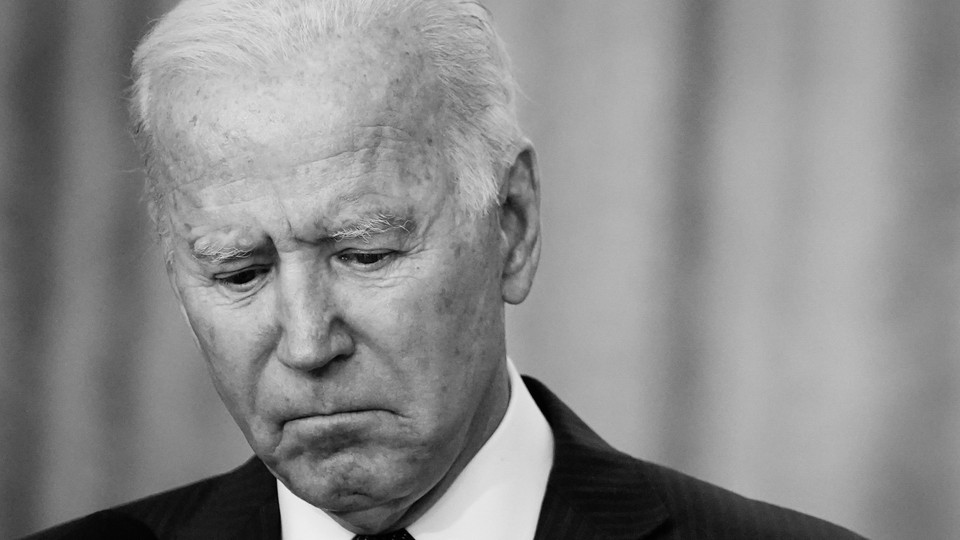
President Joe Biden
Evan Vucci / AP

America’s longest war has been by any measure a costly failure, and the errors in managing the conflict deserve scrutiny in the years to come. But Joe Biden doesn’t “own” the mayhem on the ground right now. What we’re seeing is the culmination of 20 years of bad decisions by U.S. political and military leaders. If anything, Americans should feel proud of what the U.S. government and military have accomplished in these past two weeks. President Biden deserves credit, not blame.

Unlike his three immediate predecessors in the Oval Office, all of whom also came to see the futility of the Afghan operation, Biden alone had the political courage to fully end America’s involvement. Although Donald Trump made a plan to end the war, he set a departure date that fell after the end of his first term and created conditions that made the situation Biden inherited more precarious. And despite significant pressure and obstacles, Biden has overseen a military and government that have managed, since the announcement of America’s withdrawal, one of the most extraordinary logistical feats in their recent history. By the time the last American plane lifts off from Hamid Karzai International Airport on August 31, the total number of Americans and Afghan allies extricated from the country may exceed 120,000.

In the days following the fall of Kabul earlier this month—an event that triggered a period of chaos, fear, and grief—critics castigated the Biden administration for its failure to properly coordinate the departure of the last Americans and allies from the country. The White House was indeed surprised by how quickly the Taliban took control, and those early days could have been handled better. But the critics argued that more planning both would have been able to stop the Taliban victory and might have made America’s departure somehow tidier, more like a win or perhaps even a draw. The chaos, many said, was symptomatic of a bigger error. They argued that the United States should stay in Afghanistan, that the cost of remaining was worth the benefits a small force might bring.

Former military officers and intelligence operatives, as well as commentators who had long been advocates of extending America’s presence in Afghanistan, railed against Biden’s artificial deadline. Some critics were former Bush-administration officials or supporters who had gotten the U.S. into the mess in the first place, setting us on the impossible path toward nation building and, effectively, a mission without a clear exit or metric for success. Some were Obama-administration officials or supporters who had doubled down on the investment of personnel in the country and later, when the futility of the war was clear, lacked the political courage to withdraw. Some were Trump-administration officials or supporters who had negotiated with and helped strengthen the Taliban with their concessions in the peace deal and then had punted the ultimate exit from the country to the next administration.

They all conveniently forgot that they were responsible for some of America’s biggest errors in this war and instead were incandescently self-righteous in their invective against the Biden administration. Never mind the fact that the Taliban had been gaining ground since it resumed its military campaign in 2004 and, according to U.S. estimates even four years ago, controlled or contested about a third of Afghanistan. Never mind that the previous administration’s deal with the Taliban included the release of 5,000 fighters from prison and favored an even earlier departure date than the one that Biden embraced. Never mind that Trump had drawn down U.S. troop levels from about 13,000 to 2,500 during his last year in office and had failed to repatriate America’s equipment on the ground. Never mind the delay caused by Trump and his adviser Stephen Miller’s active obstruction of special visas for Afghans who helped us.

Never mind the facts. Never mind the losses. Never mind the lessons. Biden, they felt, was in the wrong.

Despite the criticism, Biden, who had argued unsuccessfully when he was Barack Obama’s vice president to seriously reduce America’s presence in Afghanistan, remained resolute. Rather than view the heartbreaking scenes in Afghanistan in a political light as his opponents did, Biden effectively said, “Politics be damned—we’re going to do what’s right” and ordered his team to stick with the deadline and find a way to make the best of the difficult situation in Kabul.

The Biden administration nimbly adapted its plans, ramping up the airlift and sending additional troops into the country to aid crisis teams and to enhance security. Around-the-clock flights came into and went out of Afghanistan. Giant cargo planes departed, a number of them packed with as many as 600 occupants. Senior administration officials convened regular meetings with U.S. allies to find destinations for those planes to land and places for the refugees to stay. The State Department tracked down Americans in the country, as well as Afghans who had worked with the U.S., to arrange their passage to the airport. The Special Immigrant Visa program that the Trump administration had slowed down was kicked into high gear. Despite years of fighting, the administration and the military spoke with the Taliban many times to coordinate passage of those seeking to depart to the airport, to mitigate risks as best as possible, to discuss their shared interest in meeting the August 31 deadline.

The process was relentless and imperfect and, as we all have seen in the most horrific way, not without huge risks for those staying behind to help. On August 26, a suicide bomber associated with ISIS-K killed more than 150 Afghans and 13 American service members who were gathered outside the airport. However, even that heinous act didn’t deter the military. In a 24-hour period from Thursday to Friday, 12,500 people were airlifted out of the country and the president recommitted to meeting the August 31 deadline. And he did so even as his critics again sought to capitalize on tragedy for their own political gain: Republicans called for the impeachment of Biden and of Secretary of State Antony Blinken.

Within hours of the attack at the airport, America struck back, killing two terrorists and injuring another with a missile launched from a drone. A separate drone strike targeted a vehicle full of explosives on Sunday. In doing so, Biden countered the argument that America might lack the intelligence or military resources we would need to defend ourselves against violent extremists now that our troops are leaving.

The very last chapter of America’s benighted stay in Afghanistan should be seen as one of accomplishment on the part of the military and its civilian leadership. Once again the courage and unique capabilities of the U.S. armed services have been made clear.  And, in a stark change from recent years, an American leader has done the hard thing, the right thing: set aside politics and put both America’s interests and values first.

RECOMMENDED READING

As US military leaves Kabul, many Americans, Afghans remain

As US military leaves Kabul, many Americans, Afghans remain


WASHINGTON (AP) — As the final five U.S. military transport aircraft lifted off out of Afghanistan Monday, they left behind up to 200 Americans and thousands of desperate Afghans who couldn’t get out and now must rely on the Taliban to allow their departure.

Secretary of State Antony Blinken said the U.S. will continue to try to get Americans and Afghans out of the country, and will work with Afghanistan’s neighbors to secure their departure either over land or by charter flight once the Kabul airport reopens.

“We have no illusion that any of this will be easy, or rapid,” said Blinken, adding that the total number of Americans who are in Afghanistan and still want to leave may be closer to 100.

Speaking shortly after the Pentagon announced the completion of the U.S. military pullout Monday, Blinken said the U.S. Embassy in Kabul will remain shuttered and vacant for the foreseeable future. American diplomats, he said, will be based in Doha, Qatar.

“We will continue our relentless efforts to help Americans, foreign nationals and Afghans leave Afghanistan if they choose,” Blinken said in an address from the State Department. “Our commitment to them holds no deadline.”

Marine Gen. Frank McKenzie, head of U.S. Central Command, told reporters the U.S. military was able to get as many as 1,500 Afghans out in the final hours of the American evacuation mission. But now it will be up to the State Department working with the Taliban to get any more people out.

McKenzie said there were no citizens left stranded at the airport and none were on the final few military flights out. He said the U.S. military maintained the ability to get Americans out right up until just before the end, but “none of them made it to the airport.”

“There’s a lot of heartbreak associated with this departure,” said McKenzie. “We did not get everybody out that we wanted to get out. But I think if we’d stayed another 10 days we wouldn’t have gotten everybody out that we wanted to get out.”

McKenzie and other officials painted a vivid picture of the final hours U.S. troops were on the ground, and the preparations they took to ensure that the Taliban and Islamic State group militants did not get functioning U.S. military weapons systems and other equipment.

The terror threat remains a major problem in Afghanistan, with at least 2,000 “hard core” members of the Islamic State group who remain in the country, including many released from prisons as the Taliban swept to control.

Underscoring the ongoing security threats, the weapon systems used just hours earlier to counter IS rockets launched toward the airport were kept operational until “the very last minute” as the final U.S. military aircraft flew out, officials said. One of the last things U.S. troops did was to make the so-called C-RAMS (Counter Rocket, Artillery and Mortar System) inoperable.

McKenzie said they “demilitarized” the system so it can never be used again. Officials said troops did not blow up equipment in order to ensure they left the airport workable for future flights, once those begin again. In addition, McKenzie said the U.S. also disabled 27 Humvees and 73 aircraft so they can never be used again.

Throughout the day, as the final C-17 transport planes prepared to take off, McKenzie said the U.S. kept “overwhelming U.S. airpower overhead” to deal with potential IS threats.

Back at the Pentagon, Defense Secretary Lloyd Austin and Gen. Mark Milley, chairman of the Joint Chiefs of Staff, watched the final 90 minutes of the military departure in real time from an operations center in the basement.

According to a U.S. official, they sat in hushed silence as they watched troops make last-minute runway checks, make the key defense systems inoperable and climb aboard the C-17s. The official said you could hear a pin drop as the last aircraft lifted off, and leaders around the room breathed sighs of relief. Later, Austin phoned Maj. Gen. Christopher Donahue, commander of the 82nd Airborne Division, who was coordinating the evacuation. Donahue and acting U.S. ambassador to Afghanistan Ross Wilson were the last to board the final plane that left Kabul.

Officials spoke on condition of anonymity to provide details of military operations.

“Simply because we have left, that doesn’t mean the opportunities for both Americans that are in Afghanistan that want to leave and Afghans who want to leave, they will not be denied that opportunity,” said McKenzie.

The military left some equipment for the Taliban in order to run the airport, including two fire trucks, some front-end loaders and aircraft staircases.

Blinken said the U.S. will work with Turkey and Qatar to help them get the Kabul airport up and running again.

“This would enable a small number of daily charter flights, which is a key for anyone who wants to depart from Afghanistan moving forward,” he said.

The US military says it permanently disabled over 150 vehicles and aircraft before leaving Kabul so they can ‘never be used again’

The US military says it permanently disabled over 150 vehicles and aircraft before leaving Kabul so they can ‘never be used again’

The US military says it permanently disabled over 150 vehicles and aircraft before leaving Kabul so they can ‘never be used again’ 

A view of the C-17 Globemaster prepares to take off in the Hamid Karzai International Airport in Kabul, Afghanistan, Sunday, Aug. 29, 2021
A view of the C-17 Globemaster prepares to take off in the Hamid Karzai International Airport in Kabul, Afghanistan, Sunday, Aug. 29, 2021 MARCUS YAM / LOS ANGELES TIMES via Getty Images 
  • The last manned US military aircraft departed the airport in Kabul on Monday.
  • The US permanently disabled over 150 vehicles and aircraft when the military departed, a US general said Monday.
  • The Taliban captured an arsenal of operational US-made weapons when they defeated the Afghan army.

The last manned US military aircraft have departed Hamid Karzai International Airport in Kabul, ending nearly two decades of war in Afghanistan, Gen. Kenneth F. McKenzie, the head of US Central Command, said Monday afternoon.

Asked about military equipment left behind at the airport, McKenzie said that some was brought out. Other systems, he said, were “demilitarized,” meaning US forces purposely broke them to prevent them from being used, CENTCOM clarified for Insider.

The counter rocket, artillery, and mortar (C-RAM) systems, which were used to fend off a rocket attack on the airport on Monday, were kept online until the last minute and then demilitarized.

“We demilitarized those systems so that they’ll never be used again,” McKenzie said. “We felt it more important to protect our forces than to bring those systems back.”

The general further explained that demilitarized equipment included 70 mine-resistant ambush protected (MRAP) vehicles “that will never again be used by anyone,” 27 Humvees “that will never be driven again,” and 73 aircraft that “will never fly again.” Many of the aircraft were not mission capable anyway.

“They’ll never be able to be operated by anyone again,” the CENTCOM commander said.

McKenzie added that some systems, such as fire trucks and front-end loaders, were left operational so that the airport could restart operations as soon as possible.

Even if the Taliban, which rapidly seized control of Afghanistan earlier this month in a sweeping offensive, is unable to use any of the systems the US military did not take with it when it departed the Kabul airport, the group has been able to get its hands on plenty of other working systems.

The Taliban managed to capture a substantial arsenal of American-made weapons, from rifles to military vehicles, when it overran the country and defeated the Afghan armed forces, which the US has spent billions of dollars arming and equipping.

The Biden administration, which has faced criticism for its handling of the withdrawal from Afghanistan, has acknowledged that US-funded combat capabilities fell to the Taliban.

“We don’t have a complete picture, obviously, of where every article of defense materials has gone, but certainly a fair amount of it has fallen into the hands of the Taliban,” White House national security adviser Jake Sullivan said a few days after the fall of the Afghan capital.

A New Breed of Crisis: War and Warming Collide in Afghanistan

A New Breed of Crisis: War and Warming Collide in Afghanistan

Somalian refugees displaced by drought wait for rations in Dadaab, Kenya, July 14, 2011. (Tyler Hicks/The New York Times)


Parts of Afghanistan have warmed twice as much as the global average. Spring rains have declined, most worryingly in some of the country’s most important farmland. Droughts are more frequent in vast swaths of the country, including a punishing dry spell now in the north and west, the second in three years.

Afghanistan embodies a new breed of international crisis, where the hazards of war collide with the hazards of climate change, creating a nightmarish feedback loop that punishes some of the world’s most vulnerable people and destroys their countries’ ability to cope.

And although it would be facile to attribute the conflict in Afghanistan to climate change, the impacts of warming act as what military analysts call threat multipliers, amplifying conflicts over water, putting people out of work in a nation whose people largely live off agriculture, while the conflict itself consumes attention and resources.

“The war has exacerbated climate change impacts. For 10 years, over 50% of the national budget goes to the war,” said Noor Ahmad Akhundzadah, a professor of hydrology at Kabul University, said by phone Thursday. “Now there is no government, and the future is unclear. Our current situation today is completely hopeless.”

A third of all Afghans face what the United Nations calls crisis levels of food insecurity. Because of the fighting, many people haven’t been able to plant their crops in time. Because of the drought, the harvest this year is certain to be poor. The World Food Program says 40% of crops are lost, the price of wheat has gone up by 25%, and the aid agency’s own food stock is due to run out by the end of September.

Afghanistan is not the only country to face such compounding misery. Of the world’s 25 nations most vulnerable to climate change, more than a dozen are impacted by conflict or civil unrest, according to an index developed by the University of Notre Dame.

In Somalia, pummeled by decades of conflict, there has been a threefold increase in extreme weather events since 1990, compared with the previous 20-year period, making it all but impossible for ordinary people to recover after each shock. In 2020, more than 1 million Somalis were displaced from their homes, about a third because of drought, according to the United Nations.

In Syria, a prolonged drought, made more likely by human-made climate change, according to researchers, drove people out of the countryside and fed simmering anti-government grievances that led to an uprising in 2011 and, ultimately, a full-blown civil war. This year again, drought looms over Syria, particularly its breadbasket region, the northeastern Hassakeh province.

In Mali, a violent insurgency has made it harder for farmers and herders to deal with a succession of droughts and flood, according to aid agencies.

Climate change cannot be blamed for any single war, and certainly not the one in Afghanistan. But rising temperatures, and the weather shocks that come with it, act as what Marshall Burke, a Stanford University professor, calls “a finger on the scale that makes underlying conflict worse.” That is particularly true, he argued, in places that have undergone a long conflict and where government institutions have all but dissolved.

“None of this means that climate is the only or the most important factor in conflict,” said Burke, co-author of a 2013 paper looking at the role of climate change in dozens of conflicts across many years. “But based on this evidence, the international community would be foolish to ignore the threat that a warming climate represents.”

The combination of war and warming compounds the risks facing some of the world’s most vulnerable people: According to the U.N. children’s agency, Afghanistan is the 15th-riskiest country in the world for children, because of climate hazards, including heat and drought, and a lack of essential services, including health care. Two million Afghan children are malnourished.

That is in sharp contrast to Afghanistan’s part in global warming. An average Afghan produces 0.2 metric tons of carbon dioxide emissions per year, compared with nearly 16 metric tons of the average American.

The collapse of the government has also made Afghanistan’s participation in the next international climate talks entirely uncertain, said one of its members, Ahmad Samim Hoshmand. “Now I don’t know. I’m not part of any government. What government I should represent?” he said.

Until recently, he had been the government official in charge of enforcing the country’s ban on ozone-depleting substances, including refrigerants used in old air-conditioners and that are banned by the Montreal Protocol, an international agreement that Afghanistan had ratified. Just days before the Taliban seized Kabul, he fled to Tajikistan. The traders of illegal substances whom he helped arrest are now out of prison, keen to exact revenge. He says they will kill him if he returns.

Hoshmand is now scrambling to emigrate elsewhere. His visa in Tajikistan expires in a matter of weeks. “My only hope is the ozone community, the Montreal Protocol community, if they can support me,” he said.

Afghanistan’s geography is a study of extreme hazard, from the glacier-peaked Hindu Kush mountains in the north to its melon farms in the west to the arid south, stung by dust storms.

Climate data is sparse for Afghanistan. But a recent analysis based on what little data exists suggests that a decline in spring rains has already afflicted much of the country, but most acutely in the country’s north, where farmers and herders rely almost entirely on the rains to grow crops and water their flocks.

Over the past 60 years, average temperatures have risen sharply, by 1.8 degrees Celsius since 1950 in the country as a whole and by more than 2 degrees Celsius in the south.

“Climate change will make it extremely challenging to maintain — let alone increase — any economic and development gains achieved so far in Afghanistan,” the United Nations warned in a 2016 report. “Increasingly frequent and severe droughts and floods, accelerated desertification, and decreasing water flows in the country’s glacier-dependent rivers will all directly affect rural livelihoods — and therefore the national economy and the country’s ability to feed itself.”

This is the country’s biggest risk, Akhundzadah argued. Three-fourths of his compatriots work in agriculture, and any unpredictable weather can be calamitous, all the more so in a country where there hasn’t been a stable government and no safety net to speak of.

The Taliban, for their part, appear more exercised by the need to scrub women’s pictures from billboards than addressing climate hazards.

But climate change is a threat multiplier for the Taliban, too. Analysts say water management will be critical to its legitimacy with Afghan citizens, and it is likely to be one of the most important issues in the Taliban’s relations with its neighbors as well.

Already on the Afghan battlefield, as in many battlefields throughout history, water has been an important currency. The Taliban, in their bid for Herat, a strategic city in the west, repeatedly attacked a dam that is critical for drinking water, agriculture and electricity for the people of the region. Likewise, in Kandahar province in the south, one of the Taliban’s most critical victories was to seize control of a dam that holds water for drinking and irrigation.

Climate change also stands to complicate the Taliban’s ability to fulfill a key promise: the elimination of opium poppy cultivation. Poppies require far less water than, say, wheat or melons, and they are far more profitable. Poppy farming employs an estimated 120,000 Afghans and brings in an estimated $300 million to $400 million a year, according to the United Nations, and has, in turn, enriched the Taliban.

Areas under poppy cultivation grew sharply in 2020.

Analysts said the Taliban would seek to use a poppy ban to gain legitimacy from foreign powers, such as Qatar and China. But it is likely to face pushback from growers who have few alternatives as the rains become less reliable.

“It’s going to be a gigantic political flashpoint,” said Vanda Felbab-Brown, who studies the region at the Brookings Institution in Washington, D.C.

The last drought, in 2018, left 4 million Afghans in need of food aid and forced 371,000 people to leave their homes, many of whom haven’t returned.

“The effects of the severe drought are compounded by conflict and the COVID-19 pandemic in a context where half the population were already in need of aid,” U.N. humanitarian coordinator Ramiz Alakbarov said by email from Kabul on Thursday. “With little financial reserves, people are forced to resort to child labor, child marriage, risky irregular migration exposing them to trafficking and other protection risks. Many are taking on catastrophic levels of debt and selling their assets.”

Akhundzadah, a father of four, is hoping to emigrate, too. But like his fellow academics, he said he has not worked for foreign governments and has no way to be evacuated from the country. The university is closed. Banks are closed. He is looking for research jobs abroad. For now, there are no commercial flights out of the country.

“Till now, I’m OK,” he said on the phone. “The future is unclear. It will be difficult to live here.”

California Marine Nicole Gee, 23, who cradled baby at Kabul airport, killed in Afghanistan attack

California Marine Nicole Gee, 23, who cradled baby at Kabul airport, killed in Afghanistan attack


Marine Sgt. Nicole Gee celebrated the joy of service just days before she was one of 13 U.S. service members killed in Thursday’s suicide bombing attack near Hamid Karzai International Airport in Kabul, Afghanistan.

A week ago, Gee, 23, posted a photo on Instagram that showed her holding a baby at that airport. She added a simple, profound comment: “I love my job.” The same photo was posted by the Department of Defense on Aug. 21.

Gee, from Sacramento, California, served as a maintenance technician with the 24th Marine Expeditionary Unit from Camp Lejeune in North Carolina. On her Instagram page, she described herself as a “positive mental attitude advocate.” The locations listed on her page include California, North Carolina and “somewhere overseas.”

Another photo on Gee’s Instagram page shows her earlier in the week, on duty with her rifle next to a line of people waiting to board a transport plane. She described her assignment as “escorting evacuees onto the bird.”

Marine Sgt. Nicole Gee, seen holding a baby at Kabul&#39;s airport, was one of the 13 U.S. service members killed in the Aug. 26 bombing in Afghanistan.
Marine Sgt. Nicole Gee, seen holding a baby at Kabul’s airport, was one of the 13 U.S. service members killed in the Aug. 26 bombing in Afghanistan.


Other recent Instagram photos show Gee with friends in Spain, where they shared a toast, and Greece. Other pictures show the Marine riding a camel in Saudi Arabia and receiving her promotion to sergeant.

“Never would have imagined having my Sergeant promotion meritoriously in Kuwait,” she wrote of the promotion in a post shared three weeks ago.

Facebook post by the city of Roseville, California, which calls Gee “a hometown hero,” says she graduated in 2016 from the city’s Oakmont High School and enlisted in the Marines a year later. It says her husband, Jarod Gee, also is an Oakmont graduate and a Marine.

Gee was remembered by Sgt. Mallory Harrison, a fellow Marine who roomed with her for more than three years, in a Facebook post accompanied by more than a dozen photos.

“Her car is parked in our lot. It’s so mundane. Simple. But it’s there,” she began the post. “My very best friend, my person, my sister forever. My other half. We were boots together, Corporals together, & then Sergeants together. Roommates for over 3 years now, from the barracks at MOS school to our house here. We’ve been attached at the hip from the beginning.

“I can’t quite describe the feeling I get when I force myself to come back to reality & think about how I’m never going to see her again. How her last breath was taken doing what she loved — helping people — at HKIA in Afghanistan. Then there was an explosion. And just like that, she’s gone.”

She said the war stories told by older Iraq and Afghanistan veterans are “not so distant anymore.”

Harrison concluded: “My best friend. 23 years old. Gone. I find peace knowing that she left this world doing what she loved. She was a Marine’s Marine. She cared about people. She loved fiercely. She was a light in this dark world. She was my person. … Til Valhalla, Sergeant Nicole Gee. I can’t wait to see you & your Momma up there. I love you forever & ever.”

Contributing: Associated Press