Sandy Hook families sued Alex Jones. Then he started moving money around.

The Washington Post

Sandy Hook families sued Alex Jones. Then he started moving money around.

Jonathan O’Connell, The Washington Post – November 21, 2022

FILE – Conspiracy theorist Alex Jones takes the witness stand to testify at the Sandy Hook defamation damages trial at Connecticut Superior Court in Waterbury, Conn. Thursday, Sept. 22, 2022. On Friday, Oct. 21, Jones has asked a Connecticut judge to throw out a nearly $1 billion verdict against him and order a new trial in a lawsuit by Sandy Hook families over Jones’ lies that the 2012 Newtown school shooting was a hoax.(Tyler Sizemore/Hearst Connecticut Media via AP, Pool, File) (ASSOCIATED PRESS)

Alex Jones was losing in court.

Parents of children killed at Sandy Hook Elementary School had sued him and his media company for defamation after he repeatedly claimed the 2012 massacre in Connecticut was a hoax. Fans of the Infowars host had harassed and threatened grieving families. By the summer of 2020, two of the lawsuits weren’t going his way.

As the potential for damages mounted, Jones began moving millions of dollars out of his company, Free Speech Systems, and into companies controlled by himself, friends or relatives, according to a Washington Post review of financial statements, depositions and other court records. The transfers potentially put those funds out of reach of the Sandy Hook plaintiffs.

Between August 2020 and November 2021, Free Speech Systems signed promissory notes – essentially IOUs – for $55 million to cover what it said were past debts to a company called PQPR Holdings that Jones owns with his parents, according to financial records filed in court by Jones’s attorneys. PQPR, which is managed by Jones’s father, a dentist, had bought tens of millions of dollars in supplements for Jones that he then sold on his show, the records say. A lawyer for Free Speech systems has said in court that the debt accrued unnoticed due to sloppy bookkeeping.

This year, Jones started paying his personal trainer $100,000 a week to help ship supplements and other merchandise, a Free Speech Systems attorney said in court. A company managed by Jones’s sister and listed as a “supplier or vendor” was paid $240,000, financial records show.

Courts have awarded the Sandy Hook families nearly $1.5 billion in damages against Jones, including $45.2 million in a Texas case in August and $965 million in a Connecticut case two months later. On Nov. 10, the judge in the Connecticut case ordered Jones to pay an additional $473 million in punitive damages, including $323 million for legal fees. Jones has said on his show that he plans to appeal.

The IOUs and other recent transactions helped tip Free Speech Systems into bankruptcy in July, according to Jones’s court filings. An accountant hired by Jones calculated that Free Speech Systems had $79 million in liabilities at the end of May and only $14 million in assets, court records show. As a result, the Sandy Hook families could be left vying with other creditors – including the companies tied to Jones himself – to collect.

The bankruptcy court will ultimately determine which creditors are paid and how much. It is examining whether the promissory notes to PQPR and other transactions are legitimate. Attorneys for PQPR have argued in court that it should be paid before unsecured creditors, a category that would include the Sandy Hook plaintiffs.

Attorneys for the Sandy Hook families contend in a separate suit filed in April in Texas state court that PQPR is “not actually an independent business” and that Jones has engaged in fraudulent transfers to shield his wealth. They have argued in bankruptcy court that Jones began moving money out of Free Speech Systems only after he began to face legal setbacks in the defamation cases.

“In the middle of this lawsuit, they started documenting debts that had no evidence of existing beforehand,” Sandy Hook attorney Avi Berkowitz said in an interview.

A Justice Department trustee whose role in the bankruptcy case is to ensure the integrity of the process also has criticized the agreement to pay PQPR. “We, the U.S. Trustee, we do have concerns with the underlying transaction,” attorney Ha Nguyen told the court, according to a transcript. An agency spokeswoman declined to comment.

Alex Jones, his personal attorney, and attorneys for Free Speech Systems and PQPR did not respond to requests for comment or to detailed lists of questions from The Post. David Jones, Alex Jones’s father, and an attorney representing him also did not respond to requests for comment.

Jones and his father have said in court proceedings that PQPR was created in 2013 for liability protection as Jones got into the supplement business and as his father took on a management role. The accountant hired by Jones told the bankruptcy court that PQPR was a legitimate business that shared responsibility with Jones’s main company for “setting up supply chains, obtaining required governmental certifications, negotiating with vendors, procuring and paying for product, and overhead.”

Raymond Battaglia, a lawyer for Free Speech Systems, has said that as the Infowars brand ballooned, and millions of dollars poured in, the family-run business never adopted “appropriate management and accounting controls,” and so it failed to note the debt that had built up to PQPR.

“This is kind of like the garage band that became the boy band overnight, and had his girlfriend running the books, and the head roadie being the business manager,” Battaglia said in August in the bankruptcy case.

On their own, the corporate structures were not unusual, said bankruptcy experts. Many small-business owners create separate but related entities to organize and protect their wealth. Experts say the fact that the entities do not have any employees, offices or owners other than Jones and his parents does not mean they are not legitimate businesses.

The issue, said Jay L. Westbrook, a University of Texas bankruptcy law professor, is whether the court rules the transfers of wealth were made in the ordinary course of business. “At the end the of the day, the question is whether these are valid payments,” Westbrook said.

The Post examined financial records, depositions and other documents from the court cases to trace the flows of money around Free Speech Systems and establish the ownership of the other companies that were involved. The analysis shows that the transfers echoed financial moves Jones made almost a decade earlier, when divorce proceedings jeopardized his fortune, according to sealed court records from the divorce case obtained by The Post.

Infowars has made Jones a wealthy man, to a degree that has become apparent only because of the Sandy Hook litigation. In August testimony, an expert hired by the Sandy Hook families estimated Jones’s net worth at between $135 million and $270 million. Jones has disputed the plaintiffs’ estimations of his wealth.

“I don’t have all this money they’ve made up,” he said recently.

The supplement business tied to PQPR is the engine of Jones’s fortune, according to financial records Jones submitted in bankruptcy, often generating 2,000 to 3,000 orders a day, according to court testimony. Among the offerings are Survival Shield X-3 iodine spray, DNA Force Plus capsules and Super Male Vitality dietary supplement.

Of the $65 million in income Free Speech Systems had in 2021, the vast majority came from supplement sales, according to those records.

Berkowitz said his clients may be willing to settle with Jones for less money if it meant Jones would end his broadcasting career.

“If he wants to agree to some sort of terms that hold him accountable for all he’s done, we’ll be open to listening,” Berkowitz said. “Whether that means walking away from public life, to paying Sandy Hook families in full, the Sandy Hook families are not going to stop until Jones is held accountable.”

Jones, 48, has said he will keep fighting no matter what.

“They want us off air, that’s their goal,” he said during one show last month. “You’ve got my commitment. I’m not backing down.”

– – –

Jones grew up in Texas, first in Dallas and then in Austin. He has said his early thinking was shaped when, as a high school student, he read the book “None Dare Call it a Conspiracy” by a member of the far-right John Birch Society. Jones was 19 in 1993 when federal agents raided the Branch Davidians’ compound in Waco, north of Austin, leading to a prolonged standoff that ended with 76 dead. He went to Austin Community College for a time but left after growing bored, he told the Austin-American Statesman.

He told the newspaper that his anger toward big government stemmed from problems his father and his grandparents had with the IRS. “That’s where the venom comes from with me,” he said.

Jones started his broadcasting career with a public access TV show in Austin in the early 1990s. Several years later, a local FM radio station gave him a show after his father agreed to sponsor it, according to an accounting expert Jones hired in bankruptcy filings.

By the late 1990s, dozens of stations nationwide carried his show.

On air, Jones called the Branch Davidians victims of “a government coverup of its violation of the First Amendment,” and he asked listeners to send donations to help the sect build a new church and memorial. He wore a pin to the 1999 groundbreaking that said “You burn it, we build it,” according to the Associated Press. He was 25.

Jones railed against the government, the media and what he called the New World Order. He claimed that major world events were not what they seemed – and often that they were manufactured crises, staged to serve as pretexts to accomplish the goals of a secret cabal of globalists and multinational corporations.

In 1999, Jones registered the site infowars.com. As the internet era took off, he launched a subscription-only streaming video service and began selling videos, books and T-shirts, according to bankruptcy records. In 2007 he incorporated Free Speech Systems and created a series of other companies that held intellectual property and film rights, splitting ownership with his then-wife, Kelly, whom he had met at the public access station.

According to records obtained by The Post, in 2009 Free Speech Systems took in $6.2 million in revenue, including $2.6 million in merchandise sales, $1.6 million in advertising and $1.2 million from his streaming video site.

A few years later, Jones’s business was booming, but his marriage was failing.

In the fall of 2013 – two months before Kelly filed for divorce – Jones and his father created a series of companies, including PQPR, which they said in depositions were aimed at protecting Jones from legal liability as he grew his business. PQPR was owned by two other companies, which in turn were owned by Jones or his parents, a representative of Free Speech Systems said in a deposition filed in the bankruptcy case.

PQPR was worth $4.4 million in 2014, according to an accountant Jones hired in the divorce case, records show. Accountants working for Kelly Jones said it was worth as much as $6.2 million.

Alex Jones recounted during a June deposition in one of the defamation cases that they created the companies after he spoke with attorneys familiar with the Food and Drug Administration, the federal agency that regulates dietary supplements. “For liability protection issues, you know, it’s good to have a separate company that then does all of the compliance, buys the products, does all of that,” he said.

Jones’s father said in a deposition filed in the divorce case that Jones recruited him to leave dentistry in order to help professionalize operations and protect the company from liability. “He wanted to be sure that the entities that had been created were up and running properly, that they were legally constituted, that they were doing business as they were supposed to do,” he said, according to a court transcript.

Jones’s ex-wife has alleged that he created the companies as the couple was headed to divorce in order to protect his money, much as the Sandy Hook plaintiffs now accuse him. “Our marriage was absolutely terrible at that time. We were in negotiations for us to break up,” she said in an interview with The Post. “So he did that to hide his assets for when we broke up.”

Records from the divorce case are sealed. It was not clear from the documents obtained by The Post if the court ever directly examined that allegation.

Before the divorce, Kelly was part owner of the main Infowars company and several original affiliates, holding stakes ranging from 49.5 percent to 51 percent, according to records from the divorce case. A 2015 divorce rendition grants her no interest in PQPR or in what were then the newly created companies. Her name does not appear on any of their registration documents.

Those companies all have a stake in Jones’s biggest revenue source: The supplements that he promotes as a way for viewers to improve their health and keep his show running. The supplement sales dramatically boosted his business, according to bankruptcy filings and former employees.

The profit margin on supplements ranges from between three and five times their cost, far more than most of the products he sells, according to the filings. Free Speech Systems often collects $70 million to $80 million annually, according to the accounting expert Jones hired, and it took in more than $500 million in revenue from 2012 to 2022.

Josh Owens, who worked as a video editor at Infowars from 2013 to 2017, said he helped Jones with his first advertisement for an iodine supplement. “Everything changed after that,” he said. “It snowballed after that. It was pretty quickly creating new products, selling new products.”

– – –

In 2018, three years after his divorce was finalized, Sandy Hook families filed a series of lawsuits against Jones. They recounted how he had claimed that the parents were “crisis actors” and that the event was staged to further gun-control efforts.

Jones sought to have the cases thrown out. The day before an appeals court rejected his motion to have one of the cases dismissed, Jones signed a promissory note to PQPR for $29.6 million on Aug. 13, 2020. He also agreed to provide all of his company’s assets and revenue as collateral for the debt to PQPR, according to a contract Jones and his father signed.

On Sept. 27, 2021, a trial court in Texas ruled that Jones had violated the rules of the discovery process by failing to turn records over to the plaintiffs. Four days later, Jones signed an agreement to send PQPR $11,000 per day to cover the alleged debt outlined in the promissory note. On Nov. 10, Jones signed a secondary promissory note saying, in effect, that he had discovered another unpaid debt to PQPR, this time for $25.3 million.

Jones was also taking money out of the company for himself, records from the court cases show. By the end of 2021, he had withdrawn $61.9 million, according to the records. Jones’s attorneys have said in court that the withdrawals occurred over 15 years, and that half that amount was used to pay taxes. The plaintiffs’ attorneys have suggested the withdrawals may have been meant to prevent Sandy Hook families from accessing the money.

In February of this year, Jones transferred ownership of his Austin home – appraised at $2.8 million – into his wife’s name, according to county property records.

His personal trainer, Patrick Riley, in March created a logistics company, Blue Asension Logistics, to pack and ship supplements and other merchandise ordered by Infowars fans. The company hired nearly all of its employees from Infowars and uses the same Infowars warehouse, rent-free, to fulfill the orders, according to Riley’s testimony in the bankruptcy case. Jones agreed to pay him $400,000 upfront and then $105,000 per week, according to bankruptcy records.

Riley did not respond to voice mails seeking comment. He testified that he is the sole owner of the company.

An attorney for the Sandy Hook families, Marty Brimmage, said “this is not an arms-length transaction,” during an Aug. 12 hearing. “It isn’t even close.”

Battaglia argued that, while Riley may be friends with Jones, his business was independent. “Does Mr. Riley have a relationship with Mr. Jones? Absolutely. Is he an insider? No,” Battaglia said in the hearing.

In May and June, Free Speech Systems made six payments totaling $240,000 to a company managed by Jones’s sister, Marleigh Jones Rivera, according to bankruptcy records. The records do not specify who owns the company or the nature of its business.

Marleigh Jones Rivera did not respond to requests for comment.

On Nov. 10, the Connecticut judge temporarily blocked Jones from accessing the company’s money beyond what he needs for “ordinary expenses.”

The bankruptcy judge in Texas, Christopher M. Lopez, is expected to determine whether Jones engaged in fraudulent tactics designed to wall off assets from creditors. If the court finds that he did, the money that has been paid out or committed as debt could be divvied among creditors, said Georgetown University law professor Adam J. Levitin, an expert in corporate bankruptcy.

Levitin said the most likely scenario may be that Free Speech Systems chooses to liquidate, which would likely mean Jones forgoing the rights to all his films, brands and intellectual property, the Infowars name included. “There is nothing beyond a real Hail Mary route for him to avoid liability at this point,” he said.

In one of the defamation courts, Jones apologized to the Sandy Hook families and said he now believes the killings did occur. On his show, he remains defiant.

“I don’t lose sleep at night about giving them a billion dollars,” he said at a news conference he held in Connecticut in October. “They just misrepresent how much money I have. It’s a total fraud.”

Kari Lake Claims Her Voters Were Disenfranchised. Her Voters Tell a Different Story.

The New York Times

Kari Lake Claims Her Voters Were Disenfranchised. Her Voters Tell a Different Story.

Charles Homans, Alexandra Berzon, Jim Rutenberg and Ken Bensinger November 20, 2022

Republican gubernatorial candidate Kari Lake speaks to reporters after voting with her family on Election Day in downtown Phoenix, Ariz. on Tuesday, Nov. 8, 2022. (Alisha Jucevic/The New York Times)

When he stepped inside a Phoenix polling place on the morning of Election Day on the way to work, Kevin Bembry was told that the tabulation machines were not functioning properly and he might want to vote somewhere else.

“I’ve never had that happen before,” Bembry, 57, a security officer, said in a video later posted online.

His testimony was one of many circulated on social media by activist groups, right-wing media outlets and Kari Lake, the Republican candidate for governor, whose campaign posted Bembry’s video along with several others on Thursday.

Lake has vowed to keep fighting the election after her race was called by The Associated Press for her Democratic opponent, Katie Hobbs. Lake has claimed her defeat was the result of the “disenfranchisement” of her supporters in Maricopa County, which includes Phoenix and where technical problems on Election Day introduced delays, confusion and conspiracy theories. On Twitter, Lake’s campaign has claimed that the election was compromised and said that “the appropriate thing to do would be to let Maricopa County cast their votes again.”

But a crucial element has been missing so far in all of these accounts: clear claims that any eligible voters in Maricopa County were actually denied the chance to vote.

The video the campaign circulated of Bembry, for instance, was an edited version of a longer video posted on the site Rumble. In the full video, he states that, despite the inconvenience, he cast his ballot at a nearby polling site. “I was able to vote — no waiting, no misreads of the tabulation machines, nothing,” he says.

The New York Times reviewed 45 accounts offered by voters and 20 additional accounts from poll workers and observers in legal filings, public meeting testimony, submissions to the Arizona secretary of state’s office and on social media posts associated with Lake, her campaign and her allies, in some cases interviewing the voters to clarify details.

In 34 of the 45 accounts, voters acknowledged that, while inconvenienced, they had ultimately been able to cast their ballots.

Three other people described having run into possible issues with their voter registrations. Only one voter, who did not give her full name, claimed to have actually been denied the opportunity to cast a ballot outright, in a brief video that Lake posted to Twitter. That voter noted, however, that she had arrived at the polling place at the time it closed, suggesting that her late arrival, rather than any disenfranchisement, might have been the reason she was unable to vote.

In seven other accounts reviewed by the Times, voters were unclear about whether they had successfully cast ballots or believed their vote had not been counted properly.

The Times also reviewed two reports released Saturday by the Election Integrity Network, a national right-wing election activist group, compiling accounts from Maricopa County observers, poll workers and Republican attorneys that echoed the voter accounts.

In an interview, Bembry, the security officer, repeated the same account of his experience that he had given in the video. He said he believed the poll worker had intentionally given him the wrong information about where to go to vote. Bembry went to a nearby polling site, cast his ballot and arrived at work with “about 10 minutes to spare.”

Maricopa County officials have said that all voters who went to polling places to cast ballots in person on Tuesday were given the opportunity to vote.

Lake’s campaign has hinted on social media that its lawyers are reviewing more damning evidence that they have not made public. “It’s either total incompetence or malice, and that’s what we’re going to try to find out,” Caroline Wren, a spokeswoman for the campaign, told Steve Bannon on his “War Room” podcast on Thursday.

In response to questions from the Times about voters’ accounts, Wren said: “Has The NYT quantified how many disenfranchised voters is too many? Is it 10, 100, 500, 5,000, 25,000?”

That Lake and her supporters would dispute a losing result in the race for governor was in some ways preordained. Lake, a former TV news anchor endorsed by Donald Trump, embraced his false claims of a stolen 2020 election, and during the campaign she refused to say whether she would accept the result if she lost. “I’m going to win the election and accept that result,” Lake told CNN in October.

Hobbs has 17,150 more votes than Lake as of Saturday morning, a margin of 0.6%. The state is scheduled to certify the election on Dec. 5.

The drama in recent days has carried echoes of the post-2020 election period, when Maricopa County was the subject of a raft of conspiracy theories and a partisan audit that became a rallying point for the movement pushing the false claims that the last presidential election had been stolen from Trump. Lake’s public denunciations about the election results have likely made Maricopa County the final battleground this year for 2020 election deniers who were involved in midterm races.

Appearing onstage at Trump’s Mar-a-Lago resort on Thursday evening, Lake declared, “Our elections are a circus, run by clowns.”

But legal experts say the evidence presented publicly thus far by and on behalf of the campaign has fallen far short of what would be necessary to mount a serious legal challenge to the election result. Claims of voting slowdowns and technical difficulties often factor into voting rights litigation, but seeking to invalidate an election based on them — and in this case, throwing out more than 2.5 million actual votes statewide — is all but unheard-of.

“Civil rights attorneys would not ask for a new election,” said Sarah Brannon, a managing attorney with the Voting Rights Project of the American Civil Liberties Union. “What we would ask for are systematic fixes for the future.”

Many of the voters’ accounts and the Lake campaign’s claims have their origins in a widespread malfunction of voting equipment early on the morning of Election Day that caused delays and confusion across the Phoenix area. The voting issues are playing out in the nation’s fourth-most populous county, larger in area than four states, with a population of 4.4 million, more than half of Arizona’s population.

Megan Gilbertson, a spokeswoman for the county elections department, said that by 6:30 a.m. on Election Day, technicians had started reporting technical issues and that by 7 a.m. officials had realized those reports were part of a broader pattern.

Jeff Ellington, the chief executive of Runbeck Election Services, said, “They’re like, ‘Hey, the ballots aren’t tabulating — they’re not going through the precinct scanners.’”

Runbeck has a contract with Maricopa County to service its voting centers, which, because Arizonans can vote at any polling place in their home county, are equipped with laser printers that print ballots on demand. When he saw a photograph of the ballots, Ellington said, he quickly realized the printers were to blame.

Some ballots were printed too lightly, and others had toner flaking off the paper, two conditions that kept them from being read by the optical scanners in the tabulators used at the polling locations. Although some voting centers had been open for early voting, which started Oct. 12, none used tabulators until Election Day. Instead, early votes were deposited in locked drop boxes and kept to be counted later.

Runbeck’s field technicians soon determined that the problem lay in the insufficient temperature of the fuser, the component of a laser printer that heats the toner, causing it to adhere to paper.

Isolated printer malfunctions are common enough, but the scale of what happened in Maricopa County was far from ordinary. At least one printer failed at 70 of the county’s 223 polling places on Tuesday morning, according to Gilbertson.

Both Gilbertson and Ellington said that the mass malfunction of the printers had so far baffled the county’s and the company’s technicians. Gilbertson said that a full investigation would be conducted once the more immediate task of counting the ballots had been completed.

“We are going to look into the root cause,” Gilbertson said.

Technicians had solved the printer problem by late morning on Election Day, and by the afternoon the affected printers’ settings had been updated. In the meantime, poll workers offered voters three options for casting their ballots. The simplest was to place them in a slot marked “3” in the locked box beneath the tabulator, for collection and counting later at the county’s central elections facility in downtown Phoenix.

But within two hours of the first printer problems, wild claims and free-floating suspicions were circulating on social media surrounding Slot 3, or Box 3 as it was often called, including posts by Kelli Ward, the chairwoman of the state Republican Party, and Andy Biggs, a Republican congressman from Arizona. After Maricopa County officials on Twitter had informed voters affected by the glitch of their options, including using Box 3, Ward tweeted in response: “DO NOT PUT YOUR BALLOT IN ‘BOX 3’ TO BE TABULATED DOWNTOWN. Maricopa County is not turning on their tabulators downtown today!” Her post was retweeted almost 400 times.

As the day went on, Lake’s campaign, wary of depressing turnout, began gently pushing back on its political allies’ claims.

Harmeet Dhillon, a lawyer for the campaign, tried to reassure voters on Twitter about the integrity of their ballots that had been set aside for later counting. “They have to have this,” she wrote of Box 3. “It isn’t nefarious per se.” At a news conference, Lake urged her supporters to stay in line to vote, and Dhillon again reassured them about using Box 3.

County election officials have blamed the Box 3 claims and other conspiracy theories for exacerbating the slowdowns and confusion caused by the printer malfunctions. Gilbertson said that 146 provisional ballots out of the near-total of 1.6 million votes counted so far in the county had been set aside for further research, because the voters had checked in at more than one polling place.

Bill Gates, the chairman of the Maricopa board of supervisors and a former election lawyer for the state Republican Party, said some voters “were insisting on putting the ballot through the tabulator 10, 20, even 40 times.”

He added: “Obviously, that slowed things down. Were there lines? Yes. But a certain political party is as responsible for those lines as Maricopa County is.”

One of the earliest efforts by Republicans to compile testimony about Election Day irregularities was led by Floyd G. Brown, the founder of the right-wing website Western Journal.

Brown — a political operative known for his role in producing the race-baiting “Willie Horton” ad in the 1988 presidential campaign — wrote on Twitter that he had held lengthy discussions with a close circle of Lake campaign associates, an account confirmed by a person familiar with the talks.

“Spent hours last night working with the Lake team on a continuing war for Arizona,” he tweeted. “She will not go quietly into the night.”

This Week, Billionaires Made a Strong Case for Abolishing Themselves

Guest Essay By Anand Giridharadas  – November 20, 2022

Mr. Giridharadas is the author of “Winners Take All: The Elite Charade of Changing the World” and other books.

Jeff Bezos, the founder of Amazon.
Jeff Bezos, the founder of Amazon. Credit…Tom Brenner for The New York Times

In recent years, a swelling chorus of Americans has grown critical of the nation’s bajillionaires. But in the extraordinary week gone by, that chorus was drowned out by a far louder and more urgent case against them. It was made by the bajillionaires themselves.

One after another, four of our best-known billionaires laid waste to the image of benevolent saviors carefully cultivated by their class.

It is a commendable sacrifice on their part, because billionaires, remember, exist at our collective pleasure. If enough of us decided to, we could enact labor, tax, antitrust and regulatory policies to make it hard for anyone to amass that much wealth while so many beg for scraps. It is not only the vast political power of billionaires that keeps us keeping them around, it’s also the popular embrace of certain myths — about the generosity, the genius, the renegade spirit, the above-it-ness of billionaires, to name a few.

As of this writing, Elon Musk is running Twitter into the ground, with much of the company’s staff fired or quitting, outages spiking and everyone on my timeline hurrying to tell the app the things they have been meaning to say before it departs for app heaven (or hell?).

In tweeting through one of the most extraordinary corporate meltdowns in history, Mr. Musk has been performing a vital public service: shredding the myth of the billionaire genius.

His particular pretension of benevolence is that his uncontainable genius can solve any challenge. Now he is lavishing his mind and time on electronic money, now on colonizing Mars, now on electric cars and solar panels, now on saving Thai soccer players trapped in a cave, now on liberating speech from its liberal oppressors.

Mr. Musk’s genius pose has long been undermined by his actual record, which is defined by claiming credit for what others have built and is shot through with complaints of discrimination, mismanagement and fraud.

But it wasn’t until Mr. Musk took over Twitter that his claim of infinitely transferable genius truly fell apart. That what Mr. Musk has called the global town square can be eviscerated in a time period somewhere between a Scaramucci and a Truss makes one wonder if we should be more skeptical of all the other billionaire geniuses with ideas for our schools, public health systems and politics.

For example, Jeff Bezos, the founder of Amazon, who this week was doing his part to undermine another pretension of billionaire benevolence: the generosity pose.

On Monday, he made a big splash when CNN released an interview in which he announced that he was giving the great bulk of his more than $120 billion fortune away, with a focus on fighting climate change and promoting unity.

That sure sounds impressive, but his gesture wasn’t about generosity any more than Herschel Walker’s Senate candidacy in Georgia is for the children. After all, the money Mr. Bezos is now so magnanimously distributing was made through his dehumanizing labor practices, his tax avoidance, his influence peddling, his monopolistic power and other tactics that make him a cause of the problems of modern American life rather than a swashbuckling solution.

It’s too soon to tell if Mr. Bezos’s philanthropy will help others, but what’s certain is that it will help Mr. Bezos a lot. Mega-philanthropists of his ilk tend to give through foundations, which they establish in ways that save them an immense amount in taxes, sometimes merely by moving the money from one of their own accounts to another. Giving will also burnish Mr. Bezos’s reputation, in that way preserving and protecting his opportunity to earn yet more money — and to do more social damage.

And it will increase his already gigantic power over public life. For plutocrats like Mr. Bezos, that may be the biggest payoff of all. Their wealth is so vast that by distributing even a small fraction of it, they skew the public agenda toward the kind of social change they can stomach — the kind that doesn’t threaten them or their class. Shortly before his big announcement, Mr. Bezos gave Dolly Parton a $100 million “Courage and Civility Award” to spend on her chosen causes. Ms. Parton is indeed courageous and civil, but so are the workers fighting to unionize Amazon facilities, and I don’t see anyone offering them nine-digit thank-you bonuses.

But once again, instead of the usual critics having to make this case, this week Mr. Bezos took the wheel. Just minutes after his philanthropy announcement on CNN, news broke that Amazon would be laying off thousands of workers, reminding everyone of what was really going on.

At first glance, the two stories might seem like matter and antimatter, or at least two opposite realities. But they are the same story: The system that treats human beings as disposable commodities upholds and reproduces itself by sprinkling some fairy dust and hoping that we will forget the injustice that paid for it.

Then, of course, there was Sam Bankman-Fried, the disgraced crypto kingpin whose spectacular downfall, along with that of FTX, the company he founded, caused $32 billion to disappear, much of it belonging to hundreds of thousands of regular people.

Mr. Bankman-Fried embodies another pretension of plutocratic benevolence: that of the renegade, the people’s billionaire. Like many others, he hawked cryptocurrency as a fight against the establishment, against the big banks, against the powers that be, man. He has said his work was motivated by the ideals of effective altruism, a trendy school of thought that encourages people to go out and make as big a heap of money as they can so that they can use it to heal the world. But, as he admitted in an interview this week with Kelsey Piper of Vox, Mr. Bankman-Fried’s claims about the ethical nature of his pursuit were an example of “this dumb game we woke Westerners play where we say all the right shibboleths and so everyone likes us.”

Finally, of course, this week there was Donald Trump (because let’s face it, there’s always Donald Trump), who has incarnated the most dangerous billionaire pretension of all: that of the hero who in all the world is the only one who can save us. He gamed the system so effectively that only he knows how to un-game it; he manipulated politicians so much that only he knows how to drain the swamp; he amassed so much money that only he is above corruption.

On Tuesday night he addressed a crowded room at Mar-a-Lago and, as expected, announced that he was going to run for president again. He said the usual things that politicians are supposed to say, about how he was doing it for America’s benefit. But this time it was no longer possible to imagine that even he believed it. After all, only a week had passed since America had voted in the midterm elections and rejected most of the high-profile candidates he endorsed — in the process, even Republican commentators agree, rejecting him. He dragged the party down so far that it did not regain the Senate and only barely regained the House.

Fearing even more disastrous outcomes, trusted advisers and allies encouraged him not to run again, or at least to delay his announcement. But they were wasting their time. Standing up there onstage, so low-energy that even Jeb Bush’s son felt compelled to comment, Mr. Trump took in the applause but offered no new ideas or directions. It was a variant of the performance that the others had been putting on, but with one crucial difference: Unlike Mr. Musk and Mr. Bezos and Mr. Bankman-Fried, who strain to show us how public-spirited they are, Mr. Trump could hardly be bothered to care.

It was a particularly unsubtle reminder that billionaires are not our saviors. They are our mistake.

U.S. says Russia’s Ukraine invasion offered preview to potential global tyranny

Reuters

U.S. says Russia’s Ukraine invasion offered preview to potential global tyranny

Phil Stewart – November 19, 2022

(Reuters) -Russia’s invasion of Ukraine has offered a preview of “a possible world of tyranny and turmoil,” U.S. Defense Secretary Lloyd Austin said on Saturday in a speech to a security forum in Canada.

Austin’s remarks were some of his strongest to date on the importance to the international community of helping Kyiv prevail after nearly nine months of war, and they were delivered at what may be an inflection point in the conflict.

After a series of battlefield defeats, Russia is aiming punishing missile strikes at Ukraine’s energy infrastructure that could leave millions of civilians exposed to the winter cold. Moscow hopes to exhaust Ukraine’s missile defenses, and buy time to reset its forces, Pentagon officials say.

Austin said Russia was breaking the laws of war.

“These aren’t just lapses. These aren’t exceptions to the rule. These are atrocities,” Austin said.

“Russian missile barrages have left innocent Ukrainians without heat, water, and electricity. We’ve seen schools attacked. Children killed. Hospitals bombed. Centers of Ukrainian history and culture reduced to rubble.”

Moscow denies that its armed forces deliberately target civilians or civilian infrastructure.

The United States and its allies have helped provide arms, intelligence and training to Ukrainian forces, while stopping short of directly intervening in a war against nuclear-armed Russia.

Austin said the United States wouldn’t get dragged into Russian President Vladimir Putin’s “war of choice,” but warned of the risks of global nuclear proliferation if Moscow were to prevail.

“Putin’s fellow autocrats are watching. And they could well conclude that getting nuclear weapons would give them a hunting license of their own,” Austin said. “And that could drive a dangerous spiral of nuclear proliferation.”

Just days after U.S. President Joe Biden and Chinese President Xi Jinping held talks on Monday, Austin said that Beijing, like Moscow, sought “a world where might makes right.”

Austin said Chinese aircraft were flying near self-ruled Taiwan in record numbers almost daily, while the number of what he called “dangerous intercepts” by China of U.S. or allied forces at sea or in the air were increasing.

Tensions between Taipei and Beijing have risen since China staged war games near the democratically-governed island in August after a visit by U.S. House Speaker Nancy Pelosi.

Beijing, which views Taiwan as a Chinese province, has long said it would bring the self-governed island under its control and has not ruled out the use of force to do so.

The government in Taipei rejects Beijing’s claims and says only Taiwan’s people can decide its future.

Austin said the United States was drawing on the lessons of Ukraine to “bolster the self-defense capabilities of our Indo-Pacific partners.”

“We’re helping them to become more agile and resilient,” Austin said.

(Reporting by Phil Stewart; Editing by Diane Craft and Daniel Wallis)

Russian chess legend says war in Ukraine is a ‘battle between freedom and tyranny’

Yahoo! News

Russian chess legend says war in Ukraine is a ‘battle between freedom and tyranny’

Alexander Nazaryan, Senior W. H. Correspondent – November 19, 2022

NEW YORK — Chess is a cerebral game, but legendary Soviet grand master Garry Kasparov could make it seem like a contact sport. When he was at the height of his powers in the mid-1980s, he approached the chessboard with the buzzing physical intensity of a wrestler consigned to the wrong contest.

Today, his relentless energies are directed entirely against Russian President Vladimir Putin, whom Kasparov approaches with the same singular focus he once reserved for his Soviet nemesis, Anatoly Karpov — who, as it happens, now serves as a pro-Putin parliamentarian. But if the Kremlin autocrat disgusts him, nothing enrages Kasparov like Western hand-wringing over how much to help Ukraine, and for how long.

“Putin is attacking not just Ukraine. He is attacking the entire system of international cooperation,” Kasparov told Yahoo News in a recent interview. “Ukraine is on the frontline of this battle between freedom and tyranny.”

Garry Kasparov, seated, holds a microphone with his right hand and gestures with his left.
Garry Kasparov at the Congress of Free Russia in Vilnius, Lithuania, on Sept. 1. (Oleg Nikishin/Getty Images)

Last week’s congressional elections in the U.S. could complicate Ukrainian aid, especially if Republican skepticism hardens into outright resistance. Speaking at a press conference last week, President Biden expressed hope that aid to Ukraine would continue — but also bristled at charges that he’d given Ukraine too much.

“We’ve not given Ukraine a blank check,” the president told reporters, alluding to a complaint about the extent of Ukraine-focused spending made by Rep. Kevin McCarthy, who will assume the role of House speaker in January. “There’s a lot of things that Ukraine wants that we didn’t do.”

That is precisely the kind of talk that frustrates Kasparov. He praises Biden’s support of the Ukrainian effort, which has been consistently supplemented by European allies, but can’t imagine its scope being scaled back. “It was much less than Ukraine needed and wanted, but much more than Putin expected.”

The war in Ukraine is closer to poker than chess, a contest of stare-downs and bluffs. On the chessboard, an opponent has nowhere to hide his pieces, but poker is by its nature a game of incomplete information, of trying to guess and then being forced to act on those guesses.

Is one of the cards Putin is holding a nuclear strike? How long can an energy-starved Europe last before folding? How long will American aid last?

Kasparov does not ignore those very real considerations, but he also refuses to become paralyzed by the infinite varieties of geopolitical speculation. For him, the war retains an unignorable moral clarity. “I believe Ukraine can and will win,” he says. “I think it’s inevitable. It’s a matter of the cost. And every day of delay, of giving Ukraine what it needs to win, simply is pushing this cost up.”

Vladimir Putin sits at a large desk with many phones and a flat screen.
Russia President Vladimir Putin at a videoconference at the Novo-Ogaryovo residence outside Moscow on Monday. (Gavriil Grigorov, Sputnik, Kremlin Pool Photo via AP)

Utterly unpalatable to Kasparov is the argument that Ukraine should sue for peace, not because the war is going badly for Kyiv but because it is expensive for Washington, London and Berlin.

That was the widely understood subtext of a letter sent on Oct. 24 by House progressives to Biden, urging him to “pursue every diplomatic avenue” while pointing out — not incorrectly — that the war is “fueling inflation and high oil prices for Americans in recent months.” A furor followed, and a day later the letter was recalled, but not without the Russians having noticed growing American reluctance to fund the Ukrainian resistance.

Kasparov finds such talk exceptionally dangerous. He thinks of the conflict in the Manichaean world of chess, where there is only black and white, defeat or victory. Either the West defeats Putin, or Putin defeats the West. “If we capitulate today in light of Putin’s nuclear blackmail, who’s to say that he won’t use the same exact blackmail five years later, six years later?” Kasparov wonders, his tone and expression suggesting this is far from an idle musing.

“And who’s to say,” he continues, “that other dictators around the world won’t look at this and say, ‘Oh, look at that. The West is willing to capitulate to nuclear blackmail? Why don’t we do the same thing?’ And for countries that don’t have nuclear weapons today? Why shouldn’t they have nuclear weapons if nuclear weapons are effective, and helping them get what they want?”

Missile rising from smoke and flames moments after takeoff near a green building and towers in a clearing of trees against a clouded sky.
In a photo released on Oct. 26, a Yars intercontinental ballistic missile is test-fired as part of Russia’s nuclear drills in Plesetsk, northwestern Russia. (Russian Defense Ministry Press Service via AP)

That dark scenario is most likely to be realized in Taiwan, with an emboldened Xi Jinping looking to fully and finally assert China’s control over the island.

Kasparov was especially dismayed — and, characteristically, infuriated — by Elon Musk’s “peace plan,” which would effectively cede vast swaths of Ukraine to Russia. Kremlin propagandists instantly embraced the idea, pointing to condemnation from the American political and media establishment as evidence that Musk (who did not respond to a Yahoo News request for comment sent over Twitter) had spoken some forbidden, consensus-shattering truth.

“He’s buying Russian propaganda points,” Kasparov says of Musk. “It’s very, very damaging.”

Kasparov left Russia in 2013, disgusted by the ever-deepening repressions of the Putin regime. In 2015 he published “Winter Is Coming,” an urgent warning to Western policymakers about Putin, whom he called “clearly the biggest and most dangerous threat facing the world today.”

Never especially shy or circumspect, Kasparov blames President Barack Obama for trying to “reset” relations with Putin shortly after Russia invaded Georgia in 2008, in what was the first incursion by the Kremlin into a sovereign nation since the fall of the Soviet Union. Later, Obama warned that if Russia crossed a “red line” in Syria and used chemical weapons in support of Bashar Assad’s regime, “there would be enormous consequences.”

Putin and Obama moments before they shake hands in front of Russian and American flags.
Putin and President Barack Obama at a bilateral meeting during a G20 summit in Los Cabos, Mexico, in 2012. (Carolyn Kaster/AP)

Then Russia did use chemical weapons. “And Obama blinked,” Kasparov laments, charging the president with “weakness.” It’s not clear, however, what Obama — already managing two costly conflicts, in Afghanistan and Iraq — could have done to stop Putin, short of a military intervention that likely would have been unpalatable to the American public. A representative for the former president did not respond to a request for comment.

No development emboldened Putin to invade Ukraine, Kasparov argues, like the chaotic withdrawal of U.S. forces from Afghanistan. “I wouldn’t call it withdrawal. It was a stampede,” he told Yahoo News. “And it was a disaster. And undoubtedly, it added to Putin’s confidence.”

Today, the 59-year-old New York resident — who is retired from professional chess but still teaches a class on MasterClass — runs the Renew Democracy Initiative, a nonprofit that closely coordinates aid efforts with not-for-profit relief organizations working in Ukraine, which RDI executive director Uriel Epshtein says ensures that supplies and funds get to the right people, in the right places, instead of being squandered or lost.

“It’s our responsibility to give them what they need not merely to survive, not just enough to survive, but enough to actually win the war,” Epshtein, the son of Soviet immigrants who settled in New Jersey, told Yahoo News. He also described efforts in what has come to be known as the “information space,” which the Kremlin has tried to flood with its own propaganda.

Black-and-white image of Garry Kasparov in a dark turtleneck sweater appearing to pose with his left hand slightly pointing up.
Kasparov on MasterClass. (PR Newswire via AP)

RDI works with retired U.S. Gen. Ben Hodges to produce short, polished videos that explain the state of war in digestible terms. It has also solicited and published essays by dissidents from around the world in partnership with CNN, part of a series called Voices of Freedom. Contributors have included, among others, the Egyptian-American dissident Mohamed Soltan and the Iranian journalist Masih Alinejad, who was recently the target of an assassination attempt in New York.

“They have the credibility to break through our partisan shields,” Epshtein says, “to remind us that America is a force for good, and it can remain a force for good.”

That argument has been challenged by Putin’s dark tirades against what he has described as a West whose colonial bloodlust, in his telling, has been married to an anti-Christian progressive agenda. As the war has gone ever more poorly for Russia, these anti-Western screeds have grown ever more sharp.

“Putin’s Russia is on a steep decline,” Kasparov says. “I don’t believe that by next spring Russia will be able to conduct this war.” Recent military advances by Ukraine, including most recently the liberation of Kherson, do give hope of an eventual Ukrainian battlefield victory.

Here Epshtein intercedes: “It’s up to us,” he says.

Election certification avoiding chaos, except in Arizona

Las Cruces Sun – News

Election certification avoiding chaos, except in Arizona

Morgan Lee and Scott Sonner – November 19, 2022

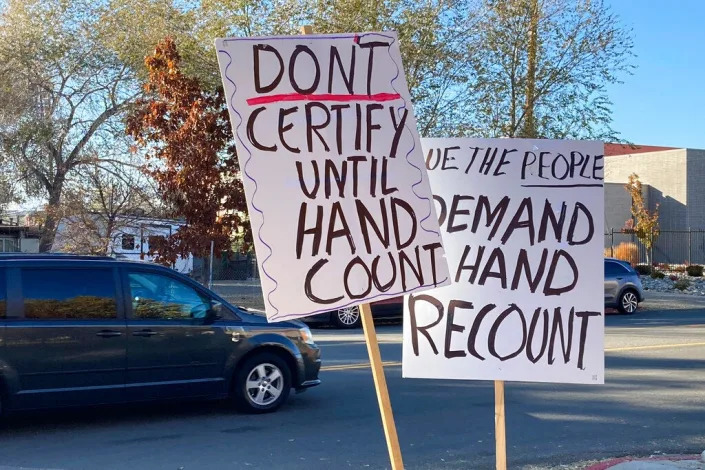
Signs are displayed outside the Washoe County Commission chambers to demand a hand count of ballots before commissioners were scheduled to canvass the vote in Reno, Nev., Friday, Nov. 18, 2022.

SANTA FE — Certification of this year’s midterm election results appears to be proceeding smoothly with little controversy across the country, with a small Arizona county being a rare exception, calming fears that local commissions consumed by talk of election conspiracies would create chaos by refusing to validate the will of the voters.

Action has been orderly even in places where suspicions about election fairness ran deep and led to bitter clashes at local public meetings.

In Nevada, a state that has been a hotbed of election conspiracy accusations and movements to ditch voting machines in favor of hand-counting all ballots, all 17 counties met a Friday-night deadline to certify election results.- ADVERTISEMENT -https://s.yimg.com/rq/darla/4-10-1/html/r-sf-flx.html

In rural Elko County, the county commission unanimously certified the results just weeks after questioning the reliability of voting machines and expressing support for hand-counting all ballots.

Commissioners praised county Clerk Kris Jakeman for a post-election audit that included random hand-counts backing up the results from machine tabulators. Some commissioners had watched the audit and said it helped relieve some of their skepticism.

“I’ve learned a lot this year,” said Commissioner Delmo Andreozzi. “And I appreciate everybody’s willingness to help educate me and help me become more aware about the whole process.”

It was much the same story in New Mexico, where several rural county commissions have been under intense pressure by some residents to reject certification since the state’s primary election in June.

In Otero County, where a crisis occurred this summer when commissioners initially denied certification after the primary, the general election results were certified this week with a drama-free unanimous vote.

“In my heart of hearts, I think Otero County does a good job,” Commission Chairwoman Vickie Marquardt said. “I have no reason not to certify this election.”

More:Doña Ana County Commission votes unanimously to certify 2022 election

In another rural New Mexico county, where a livid crowd in June berated county commissioners as “cowards” and “traitors” as they certified the primary results, the room fell silent this week as the all-Republican board pored over vote tallies and signatures from poll judges. Commissioners peppered Torrance County election officials with questions before voting 3-0 to certify.

The commission had spent months responding to doubts about voting systems with a hand recount of the primary ballots and invitations to attend security testing of ballot-counting machines.

“I’m not seeing any discrepancies, commissioners. Are you?” Republican commission Chairman Ryan Schwebach told colleagues. He won reelection to the local post with roughly two-thirds of the vote, defeating a challenger who said vote-counting machines can’t be trusted. All but one county in New Mexico certified vote tallies this week.

Conspiracy-focused protesters rallied Friday outside an election board meeting in Reno, Nevada, with signs reading “Don’t certify before hand count” and “We the people demand hand count.” Despite the protests, the Washoe County commission voted 4-1 to certify the results.

County Commissioner Jeanne Herman, who represents the most rural part of the county, which stretches north to the border with Oregon, cast the lone dissenting vote. She made a failed attempt earlier this year to push an election reform package that, among other things, would have posted National Guard troops at polling places and relied almost exclusively on paper ballots.

Christiane Brown, a Reno gun control activist, told the commission that the system worked this year, and even most candidates who had embraced the 2020 election falsehoods conceded defeat.

“Denying results does not change them,” she said. “The people rejected lies, disinformation, intimidation and ignorance, as well as hatred. The voters spoke, the system worked, and the rule of law held.”

In Arizona, the state’s 15 counties are just beginning to certify their election results and have until Nov. 28 to do their canvass and send final vote tallies to the secretary of state. Kari Lake, the Republican who lost the race for governor, has refused to concede and in a Thursday video said she has a team of lawyers reviewing whether Election Day issues at the polls disenfranchised some voters.

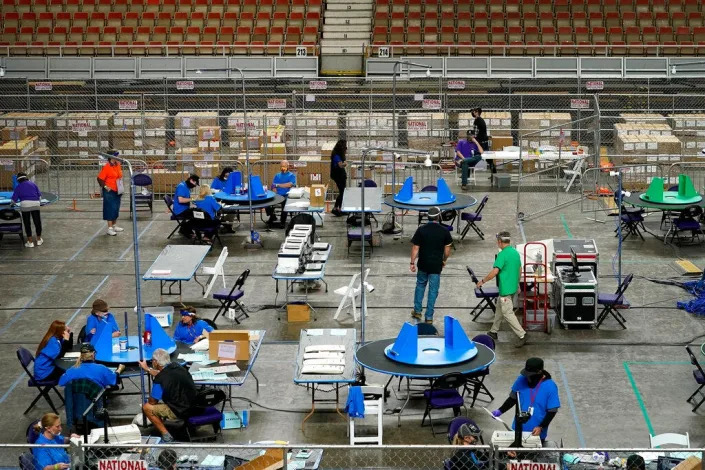
Maricopa County, Ariz., ballots cast in the 2020 general election are examined and recounted by contractors working for Florida-based company, Cyber Ninjas, in Phoenix on May 6, 2021. At least one recount will be on tap in Arizona after the counting from the Nov. 8, 2022, midterm elections ends.

The two Republicans who control the board in southeastern Arizona’s Cochise County delayed their certification Friday night after hearing from a trio of conspiracy theorists who argue vote-counting machines are not certified. The board ignored testimony from the state elections director, who said the contention was false.

The board delayed the vote until the Nov. 28 deadline, saying they wanted to see proof and have the three men evaluate it. State Elections Director Kori Lorick threatened legal action “to compel compliance” and ensure that votes from about 46,000 residents were property reported.

The state is set to certify results from all 15 counties on Dec. 5, a move needed before a recount can proceed in the race for state attorney general, which is too close to call.

Under Arizona law, the only role of the elected county boards is to accept the numbers as they are tallied by their elections departments. If they refuse to do so, either the secretary of state or a candidate would sue.

Election certification emerged as an issue after the 2020 presidential election in Michigan, where Trump and his allies pressured Republicans on both the state certification board and the one for Wayne County, which includes Detroit. The results, showing Democrat Joe Biden winning the state by 154,000 votes, were eventually certified.

Detroit City Clerk Janice Winfrey said her office anticipates having no problems with certification of the Nov. 8 general election. By midday Friday, 71 of the state’s 83 counties had certified results.

“More Michigan citizens cast ballots than ever before in a midterm election, and now bipartisan canvassing boards across the state are certifying the results in accordance with state law,” said Michigan Secretary of State Jocelyn Benson. “We are optimistic that all canvassers will continue to demonstrate this level of professionalism and commitment to upholding the will of the voters.”

Sonner reported from Reno, Nevada. Associated Press writers Christina A. Cassidy in Atlanta, Ken Ritter in Las Vegas, Gabe Stern in Reno; and Corey Williams in Detroit contributed to this report.

Finding safe haven in the climate change future: The Great Plains

Yahoo! News

Finding safe haven in the climate change future: The Great Plains

David Knowles, Senior Editor – November 19, 2022

This Yahoo News series analyzes different regions around the country in terms of climate change risks that they face now and will experience in the years to come.

As the negative consequences of rising global temperatures due to humankind’s relentless burning of fossil fuels become more and more apparent in communities across the United States, anxiety over finding a place to live safe from the ravages of climate change has also been on the rise.

“Millions and likely tens of millions of Americans” will move because of climate through the end of the century, Jesse Keenan, an associate professor of real estate at Tulane University’s School of Architecture, told Yahoo News. “People move because of school districts, affordability, job opportunities. There are a lot of drivers, and I think it’s probably best to think about this as ‘climate is now one of those drivers.’”

The Buffalo Bayou is seen under a highway in Houston.
The Buffalo Bayou in Houston. (Brandon Bell/Getty Images)

In late October, a report by the United Nations concluded that average global temperatures are on track to warm by 2.1°C to 2.9°C by the year 2100. As a result, the world can expect a dramatic rise in chaotic, extreme weather events. In fact, that increase is already happening. In the 1980s, the U.S. was hit with a weather disaster totaling $1 billion in damages once every four months on average. Thanks to steadily rising temperatures, they now occur every three weeks, according to a draft report of the latest National Climate Assessment, and they aren’t limited to any particular geographical region.

To be sure, calculating climate risk depends on a dizzying number of factors, including luck, latitude, elevation, the upkeep of infrastructure, long-term climate patterns, the predictable behavior of the jet stream and how warming ocean waters will impact the frequency of El Niño-La Niña cycles.

“No place is immune from climate change impacts, certainly in the continental United States, and throughout the U.S. those impacts will be quite severe,” Keenan said. “They will be more severe in some places and less severe in other places. Certain places will be more moderate in terms of temperature and some places will be more extreme, but we all share the risk of the increase of extreme events.”

In this installment, we look at the low-lying, expansive, north-south strip of states in the center of the country.

The Great Plains

A vast, predominantly flat stretch in the center of the country that extends from the Canadian border to the Gulf of Mexico, the Great Plains includes Montana, Wyoming, North Dakota, South Dakota, Nebraska, Kansas, Oklahoma and Texas.

While the large overall area of the Great Plains translates into markedly different weather — with North Dakota enduring frigid winters and states like Oklahoma and Texas baking in the summer months — the region has been warming quickly in recent years.

North Dakota, where the average annual temperature is 41.1°F, has warmed by an average of 2.6°F since the turn of the 20th century, according to data provided by the National Oceanic and Atmospheric Administration. Texas, where the average temperature is 65.8°F, has warmed by 1.5°F on average over that same period.

The bulk of that warming, we know, has occurred in recent decades because higher concentrations of greenhouse gases in the atmosphere have further amplified the greenhouse effect, speeding up the rate of temperature rise. Short of a technological breakthrough, unless concerted action is taken to stop burning fossil fuels to slow emissions, scientists say, the world will keep getting hotter.

Tumbleweed rolls across a dried-out landscape in central California’s Kern County as trucks head south on a nearby highway.
Tumbleweed rolls across a dried-out landscape in central California’s Kern County. (Frederic J. Brown/AFP via Getty Images)

“The average annual Texas surface temperature in 2036 is expected to be 3.0°F warmer than the 1950-1999 average and 1.8°F warmer than the 1991-2020 average,” a 2021 report from the Texas state climatologist found. “The number of 100-degree days at typical stations is expected to nearly double by 2036 compared to 2001-2020, with a higher frequency of 100-degree days in urban areas.”

Texas, in fact, is home to all of the Great Plains’ top 10 worst-rated counties — Cameron, Galveston, Willacy, Kleberg, Refugio, Nueces, Pecos, Starr, Webb and Harris — in terms of overall climate change risks, according to information provided by data analytics firm the Rhodium Group and a 2020 analysis of counties in the lower 48 states published by ProPublica and the New York Times. And dozens of other Texas counties aren’t far behind on that list.

In no small part that’s because of two factors, the state’s latitude and its proximity to the Gulf of Mexico. The Rhodium rankings were based on six categories related to climate change: heat stress, the combination of heat and humidity (wet bulb), crop loss, sea level rise, very large fires and overall likely economic damages.

North Dakota’s Ward, Renville, Mountrail and Bottineau counties took the top four spots when it came to safest locations in the Great Plains for climate change risk, with the state also placing two more in the top 10 — Williams and Walsh counties. Montana’s Silver Bow, Glacier and Deer Lodge counties rated No. 5-No. 7 on that list, with Wyoming’s Uinta County ranking eighth-safest in the region.

Extremely low water levels of Jackson Lake in Grand Teton National Park in Moran, Wyo.
Colter Bay Marina in Grand Teton National Park in Wyoming was closed for the summer due to the low water levels of Jackson Lake, seen here in August. (Amber Baesler/AP)

Summertime temperatures this year proved brutal for many states in the southern Great Plains, and drought conditions continued to worsen across the entire region.

On July 19, Oklahoma City set a new temperature record for that day, hitting 110°F during a heat wave that locked in triple-digit heat for more than a week. Yet all-time records, many of which were set in 1936 during the Dust Bowl years, were not surpassed.

Many climate deniers point to record high temperatures during the Dust Bowl years, which were amplified by poor farming practices, to try to show that global warming isn’t happening. If the records were set in the 1930s, the reasoning goes, then, by definition, the world is not warming.

That leaves out the fact that climate anomalies have continued to occur since humankind began pumping greenhouse gases into the atmosphere, that the incidence of heat waves is increasing and that the country on average continues to experience fewer days of extreme cold. In Houston, for example, five of the six hottest Julys on record have occurred since 2009, while the city’s top 10 coolest Julys all happened before 1980, according to data from the National Weather Service.

Skeptics who argue that humankind cannot influence something as large as the Earth’s climate also fail to address the impact that discarding harmful farming practices has had in preventing the return of Dust Bowl conditions. Yet rising temperatures and the continued depletion of the aquifers that help irrigate the Great Plains threaten that progress.

A sprinkler is in use on farmland near Dodge City, Kansas.
A sprinkler near Dodge City, Kan., in 2012. (Kevin Murphy/Reuters)

“Right now we are seeing more dust storms as this drought worsens in what was formerly the Dust Bowl region,” UCLA climate scientist Daniel Swain, who also consults for ClimateCheck, a company that provides climate change risk assessments on real estate nationwide, told Yahoo News. “Certainly nothing on the order of what we saw in the 1930s, but there is a severe, worsening drought there and there are some self-fulfilling feedback mechanisms whereby things start to get warm and dry, they dry out the soil, which begets more warmth and more dryness.”

As in other parts of the country, rising average temperatures in the Great Plains are wreaking havoc on the water cycle, specifically when it comes to sustaining water levels in the High Plains Aquifer. In the years to come, that could pose significant issues in the delivery of water for agriculture.

“In the northern portion of the Great Plains, rain can recharge the aquifer quickly. However, with climate change, precipitation in the winter and spring is projected to increasingly fall in the form of very heavy precipitation events, which can increase flooding and runoff that reduce water quality and cause soil erosion,” the EPA says on its website. “In the southern portion of the region, little recharge occurs, so declines in the aquifer’s water level are much greater. Climate change will worsen this situation by causing drier conditions and increasing the need for irrigation.”

While it is not entirely clear how climate change will impact precipitation trends across all of the Great Plains in the coming decades, there are warning signs in states like Montana, where the melting winter snowpack helps supply the region with water.

An empty dirt road amid the prairie on the Cheyenne River Reservation near Dupree, S.D.
A serious drought has made it difficult to tell the difference between the prairie and the dirt road on the Cheyenne River Reservation near Dupree, S.D. (Jonathan Ernst/Reuters)

“Higher spring temperatures will also result in earlier melting of the snowpack, further decreasing water availability during the summer months,” the EPA says on its website.

More and more often, when it does rain across the Great Plains, it pours. Soil erosion, in turn, can set back the progress made to avert future Dust Bowls, and as evaporation rates rise in tandem with warmer temperatures, the threat of wildfires is also growing. Former Kansas State climatologist Mary Knapp has long warned that while agricultural advances have kept a 1930s disaster from recurring, climate change could yet plunge the Great Plains back into the danger zone.

“I’ve been saying that for years,” Knapp told the Mercury newspaper in Manhattan, Kan., in 2021. “The thought is, with modern agricultural and conservation techniques, that we would preclude the scenario that plagued the Dust Bowl, but there are other factors that can remove vegetation.”

Perhaps the surest climate change bet for the Great Plains is that warmer average temperatures will play out differently across a large region already accustomed to dramatic weather fluctuations. Some parts will have to deal with an uptick in what is known as the “wet bulb” effect, the potentially fatal combination of hot temperatures and high humidity that conspire to prevent the body from being able to cool itself down through the evaporation of sweat. That metric was one of the factors that explains why a place like Galveston County in Texas rated so poorly on the Rhodium analysis.

Utility poles lead to downtown Dallas.
A heat advisory was issued in Dallas in July due to scorching weather. (Shelby Tauber/Reuters)

But climate change has also already disrupted the water cycle in other dangerous ways.

“In late August 2017, Hurricane Harvey ravaged the Houston area with 1 trillion gallons of rain, enough to run Niagara Falls for 15 days. No other big American city has withstood such a natural disaster in modern times,” Houston Mayor Sylvester Turner wrote in the introduction to the city’s 2020 plan on how to use billions in taxpayer funds to harden the city against the changing climate.

Harvey, which racked up $125 billion in damages and killed 107 people, and 2019’s Tropical Storm Imelda, which resulted in another $5 billion in damages and killed six, were both slow-moving systems that unloaded massive amounts of rain from an oversaturated atmosphere. In close succession, they shined a light on Houston’s vulnerability to flooding, but that’s not the only risk the city faces from rising global temperatures.

“Hurricanes, tropical storms, and flooding are not the only threats that we face. Houston is hot — and our heat is increasing due to climate change and the urban heat island effect,” Turner wrote.

Even though studies have shown that climate change is making tropical cyclones wetterwindierslower and able to ramp up quicker than in a pre-climate-change world, persuading residents and elected officials to prepare for those risks is easier after they’ve witnessed the impacts firsthand.

People make their way down flooded Telephone Road in Houston in August 2017.
People make their way down flooded Telephone Road in Houston in August 2017 in the wake of Tropical Storm Harvey. (Thomas Shea/AFP via Getty Images)

“If, for a location, the policy becomes [investing in] sea walls and sewage and drainage and stronger construction, better infrastructure and so forth, then places may be forecast to retain value and people may stay,” Parag Khanna, the founder and CEO of Climate Alpha, a company that helps investors quantify climate change risks to real estate, told Yahoo News.

“You can’t on the one hand continue to have the American dream rest on your property values going up, and on the other hand have people increasingly in survival society, being forced to rebuild time and again after disasters. Those two things are not compatible,” he added.

To be sure, hardening infrastructure from the daunting number of threats posed by climate change is quite expensive, but a reluctance to prepare can prove to be even more so.

In February 2021, a polar vortex descended on Texas, a state that years earlier had moved to deregulate its energy sector. The surging demand for electricity left more than 4.5 million homes and businesses without power. The storm essentially brought North Dakota-like winter conditions to the Lone Star State for days on end, resulting in the deaths of more than 170 people and more than $20 billion in damages, costing the state’s economy between $80 billion and $130 billion, according to the Dallas Federal Reserve.

As counterintuitive as it may sound, studies have since linked the severe winter outbreak to climate change. Thanks to the fact that the Arctic is warming faster than any other region on Earth, those higher temperatures have been shown to disrupt the behavior of polar vortexes, weakening them so that they wander south over the continental U.S.

That’s exactly what happened this week, when another high pressure ridge in Alaska sent another wave of cold arctic air over much of the country.

While the big picture is that the last eight years have been the warmest in recorded history, that warming will usher in an era of what scientists call “climate chaos,” in which a variety of new risks will present themselves. So, while states like Oklahoma and Texas have begun rolling out plans to help them endure hotter temperatures born of climate change, they also face a choice about how much to spend to winterize the electrical grid. Estimates for upgrading it so as to withstand a future polar vortex are anywhere between $5 billion and $20 billion, Texas Monthly reported.

Arizona attorney general race between Kris Mayes and Abe Hamadeh remains virtually tied

AZ Central – The Arizona Republic

Arizona attorney general race between Kris Mayes and Abe Hamadeh remains virtually tied

Tara Kavaler, Arizona Republic – November 19, 2022

Democrat Kris Mayes’ tiny lead continued to increase over Republican Abe Hamadeh Saturday night to 850 votes, up from 570 the night before.

Mayes had a 148-vote lead over Hamadeh at 5 p.m. Thursday, although her lead had dropped at one point to 55 votes.

This race is so close that no matter what the candidates get in the remaining ballot drops, it will go to a recount.

On Wednesday night, Mayes had a lead of 711 votes, after her margin fluctuated throughout the day from a low of 505 votes in the morning to a high of 1,609 votes by the afternoon.

On Tuesday, Mayes concluded the day with a 771 vote lead.

On Monday, Mayes led by 4,195 votes, or 0.2 percentage points.

Races with less than a 0.5 percentage-point difference between candidates automatically go to a recount.

Recount:Key Arizona election races in 2022 likely to go into recount

With a little over 3,300 ballots remaining to count Saturday night in Arizona’s largest county, the race is headed to a photo finish.

The official result likely won’t be known for weeks because of the recount.

On Nov. 13, Mayes led by a little over 11,000 votes, or 0.4 percentage points. On Nov. 12, she led by approximately 20,000 votes, or 1 percentage point.

Election coverage: Arizona election results

Mayes, a former member of the Arizona Corporation Commission, and Hamadeh, a former prosecutor at the Maricopa County Attorney’s Office, hit each other with tough rhetoric on social media and at campaign events during the race, and contempt between the two camps has shaped the race.

Abortion and election integrity were major issues in the campaign.

Another key issue in the race has been experience, namely prosecutorial experience, with each contender making claims about the other’s background.

While this has arisen as an issue on the campaign trail, the day-to-day job of the attorney general does not involve much prosecution. The attorney general oversees prosecutors, acts as counsel to state agencies, protects consumers and represents the state in front of the Supreme Court.

Hamadeh, a political newcomer, was dogged by revelations about his past that emerged after the Aug. 2 primary. Assisted by former President Donald Trump’s endorsement, Hamadeh beat out five other candidates in the crowded Republican primary field.

Abe Hamadeh and Kris Mayes are running for Arizona attorney general.

Hamadeh said Arizona’s pre-state law that bans all abortions is the state law. Mayes said the pre-state law violates the Arizona Constitution, which guarantees a right to privacy.

Hamadeh worked for about three years as a deputy Maricopa County attorney and tried cases in court. The Republic was unable to verify how many in total, but in a one-year period, documents show he took five trials to court as either lead or second prosecutor.

Mayes does not have traditional trial experience but points to her involvement with the Arizona Corporation Commission’s Securities Division.

Mayes spoke about her experience in an Oct. 30 social media post: “I’m proud of the work I did while serving AZ as a Commissioner, including overseeing 2,700 cases that included high level Securities Fraud cases.”

She served for seven years on the commission from 2003-2010.

Mayes also has argued that Hamadeh is a danger to democracy, as he does not acknowledge President Joe Biden’s victory in Arizona in 2020. In the primary, Hamadeh said he disagreed with Gov. Doug Ducey’s certification of that election due to voter fraud, despite no evidence of widespread problems after multiple audits and lawsuits.

Despite taking a hard-line position on immigration, his father, Jamal Hamadah, once faced deportation for overstaying his visa and pointed to his children as justification for remaining. Hamadah was not in the country legally when Abe Hamadeh was born.

Trump has contended that children born in the U.S. to parents without legal status should not receive citizenship. Hamadeh has echoed many of the same immigration stances as Trump, though not specifically on birthright citizenship.

Hamadah, who spells his last name multiple ways in public records, sued Abe and his siblings in a dispute over land after they violated the terms of a written trust agreement.

Election guide: November 2022

And while Hamadeh has made election security a top issue, he also wrote in an online forum as a 17-year-old that he voted his mother’s ballot in the 2008 presidential election. Doing so would violate Arizona election laws.

Hamadeh made an issue of stock purchases Mayes acknowledged she made in 2000 when she was a reporter at The Arizona Republic. She was among the journalists who purchased stock through their 401(k) accounts in the company that owned the paper before its sale to Gannett, the news outlet’s current owner.

The move violated the newspaper’s ethics policy, a newsroom leader said at the time, because those involved acted on knowledge not available to the public. In comments made in 2003, Mayes maintained she did nothing wrong, that discussions about a possible sale of the business were happening inside and outside the newsroom, and said she made about $5,000 off the trade.

Dan Barr, Mayes’ campaign attorney, said in October Mayes was committed not to disparage The Republic over the matter and expected the same of the newspaper.

Hamadeh claimed victory Nov. 9 based on results that put him briefly in the lead. He posted on social media thanking voters and wrote, “I will NEVER forget who I’m fighting for.”

That slim lead evaporated by that evening.

In a statement to The Arizona Republic on Nov. 9, Mayes said, “To claim victory after one small favorable batch is unwise and irresponsible. This race is too close to call. There are at least half a million votes left to be counted, and every single one of those votes is important.”

Tara Kavaler is a politics reporter at The Arizona Republic. 

Kim oversees North Korean ICBM launch with daughter in tow

AFP

Kim oversees North Korean ICBM launch with daughter in tow

Claire Lee and Cat Barton – November 18, 2022

North Korean leader Kim Jong Un oversaw a test of Pyongyang’s newest intercontinental ballistic missile with his daughter in tow for the first time, state media reported Saturday.

Declaring he would meet perceived US nuclear threats with nukes of his own, Kim supervised the launch on Friday of the black-and-white missile, which the official Korean Central News Agency (KCNA) said was the Hwasong-17 — dubbed the “monster missile” by analysts.

The launch of the “new major strategic weapon system” was successful, KCNA said.

KCNA said Kim attended the launch “together with his beloved daughter and wife”, and state media images showed a beaming Kim accompanied by a young girl in a puffer jacket and red shoes as he walked in front of the missile.

North Korean state media has never mentioned Kim’s children, and this was the first official confirmation that he had a daughter, experts said.

KCNA’s report on Saturday did not name the daughter, however.

– ‘The fourth generation’ –

The most significant takeaway from Friday’s ICBM launch is “the permanence of the Kim regime’s weapons programme, because it is so integral to Kim’s own survival and the continuity of his family’s reign,” Soo Kim, a former CIA analyst now with the RAND Corporation, told AFP.

With the state media coverage, “we have seen with our own eyes the fourth generation of the Kim family”, she said.

Kim — the grandson of North Korea’s founding leader Kim Il Sung and the third generation of the Kim family to lead the country — married his wife Ri Sol Ju, in 2009, according to South Korea’s spy agency.

She gave birth to their first child the following year, with their second and third born in 2013 and 2017, the agency has said.

The only previous confirmation of the children’s existence had come from former NBA star Dennis Rodman, who claimed he met a baby daughter of Kim’s called Ju Ae during a 2013 visit to North Korea.

The daughter revealed in the photographs is presumed to be Ju Ae, who is likely Kim’s second child, Cheong Seong-chang of the Center for North Korea Studies at the Sejong Institute in South Korea told AFP.

– Kim’s warning –

KCNA said Saturday that Kim slammed “hysteric aggression war drills”, and said that if the United States continued to make threats, Pyongyang would “resolutely react to nukes with nuclear weapons and to total confrontation with all-out confrontation”.

North Korea has conducted a record-breaking blitz of launches in recent weeks.

Pyongyang — and Moscow — have repeatedly blamed them on Washington’s moves to boost the protection it offers to allies Seoul and Tokyo.

Fears have grown that the launches are building up to a nuclear test.

KCNA said the latest missile hit a maximum altitude of 6,040.9 kilometres (3,750 miles) and flew 999.2 kilometres, matching estimates by Seoul and Tokyo on Friday.

North Korea previously claimed to have launched a Hwasong-17 — its most powerful missile to date — on March 24, releasing a slick promotional video and photos of the event.

But Seoul later cast doubt on that claim.

This time, analysts said it seemed North Korea had succeeded.

“This launch is significant because it is thought to be the first successful full flight test of the Hwasong-17 ICBM,” Joseph Dempsey, a researcher at the International Institute for Strategic Studies (IISS), told AFP.

As with all North Korean ICBM tests, the missile was fired on a lofted trajectory — up not out, to avoid flying over Japan.

That means questions remain about its performance, “particularly in terms of surviving reentry into the atmosphere and… accuracy over greater ranges”, Dempsey said.

The “monster missile” also has disadvantages, he added.

“Its sheer size makes it less practical as a road-mobile system, and production would be likely a significantly greater strain on limited resources.”

Since Kim declared North Korea an “irreversible” nuclear state in September, the United States has ramped up regional security cooperation.

The South Korean military said it staged joint air drills with the United States on Saturday involving the US B-1B long-range heavy bomber.

This was the second B-1B deployment to the Korean peninsula this month — it also participated in “Vigilant Storm”, the largest-ever US-South Korea air exercise.

No Joke America! House GOP Gears up for moving Conspiracy Theories, Election Denialism, Wokeism and white christian grievance, back from the trash heap of political history, to the front burners of House of Representative committee hearings.

USA Today

House GOP heard the American voters: They definitely want Hunter Biden investigations!

Rex Huppke, USA TODAY – November 18, 2022

Hello, fellow Americans. We are the new Republican majority in the U.S. House of Representatives, and it is our honor to share our exciting plans for the weeks and months ahead.

Clearly the midterm elections didn’t go quite as we had hoped, but we are appropriately chastened and have fully heard the message that was sent: You all are tired of conspiracy theories and election denialism and prefer a focus on legislation that will make a difference in your lives.

Point taken. Now that we have a narrow majority in the House, we’re totally going to nail this.

Republicans heard the voters: Time to arrest Hunter Biden!

That’s why we’re proudly introducing the first of 37 investigations into Hunter Biden and his father, President Joe Biden, along with a number of new committees that will address the concerns of regular Americans like Sean Hannity, Donald Trump and Tucker Carlson.

President-elect Joe Biden, right, embraces his son Hunter in Wilmington, Del., on Nov. 7, 2020. Hunter Biden says he learned from federal prosecutors that his tax affairs are under investigation.

Throughout the midterm election campaign, we talked to you about the meat and potato issues we promised to fix: rising inflation, illegal immigration and high gas prices.

What we didn’t tell you is we believe all those problems stem from Hunter Biden and a series of other scandalous things we have read about on the internet.

Why do the libs not seem to care about Hunter Biden being dangerous?

Predictably, the lazy liberals out there say things like, “Who cares about Hunter Biden?” and “If Hunter Biden broke the law, he should be prosecuted and, if convicted, punished appropriately – whatever.”

Little Beau Biden, right, son of Hunter Biden, holds a branch from the official 2021 White House Christmas tree given to him by first lady Jill Biden on Nov. 22, 2021.

Nice try, libs. We know you care as deeply about Hunter Biden as we do, so one of our investigations will focus on why liberals don’t seem to care about Hunter Biden when we’re convinced they actually do.

GOP investigations are already yielding impressive results!

To demonstrate how prepared we are to govern, the House GOP on Thursday tweeted: “Hunter Biden’s laptop is REAL.”

That is one of the things we have already learned! Clearly, the fact the president’s adult son has a REAL laptop is problematic, and quite likely ties in with the exorbitant price of groceries.

A screenshot of a tweet sent by the House Republicans on Nov. 17, 2022.

You may be thinking: How will arresting Hunter Biden and his laptop and impeaching President Biden for a crime to be determined at a later date lower the prices of food or gas?

The answer is simple and, like the legislative plan we didn’t present during the campaign, it’s a secret! You’ll just need to trust us.

The House GOP committees will tackle the most pressing issues of the day

Of course we can’t fix every problem by investigating Hunter Biden, much like we can’t seem to get any made-up scandal to stick to his father.

Rep. Marjorie Taylor Greene, R-Ga., speaks to members of the press on Nov. 15, 2022.

That’s why we are immediately forming the following committees that reflect our newfound understanding of the issues most important to the American people:

►The Committee on the Eradication of Jewish Space Lasers, chaired by Georgia Rep. Marjorie Taylor Greene.

►The Committee to Explain Why Everything We Said Was a Crisis During the Campaign Is No Longer a Crisis Now that We’re in Charge, chaired by Ohio Rep. Jim Jordan.

►The Committee to Investigate Anyone Tweeting Mean Things About Elon Musk, to be led by honorary chair and Twitter CEO Elon Musk.

►The Committee to Apologize to Great and Handsome Russian President Vladimir Putin and Immediately Take All Our Weapons Back from Evil Ukraine #WeLoveVlad, chaired by Florida Rep. Matt Gaetz.

►The Committee to Replace the Washington Monument with a Big, Beautiful Statue of (not-former) President Donald Trump, led by honorary co-chairs Donald Trump and MyPillow CEO Mike Lindell.

We promise to not get bogged down in conspiracies (too much!)

You all made the right decision putting us slightly in control of the House. We Republicans are ready to unify the country, work hard for the average American and prove, once and for all, that Republicans are sane and sensible legislators.

We will also prove that Hunter Biden is in a romantic relationship with “allegedly dead” former Venezuelan President Hugo Chavez, and that together they rigged the 2020 election using … you guessed it … Hunter’s laptop. (Marjorie Taylor Greene had the evidence proving it, but it was vaporized by a Jewish Space Laser.)

More humor columns from Rex Huppke:

After the ‘red wave’ flop, we need new male political experts who are always wrong. I’m in.

With Elon Musk ruining Twitter, it’s time to get back to hollering on street corners.

Americans take a stand for decency as the GOP red wave turns to dust, surprising all of us.