Republicans pushing a plan to remove you (yes, you too) from Arizona’s voter rolls
Laurie Roberts, Arizona Republic – February 24, 2023
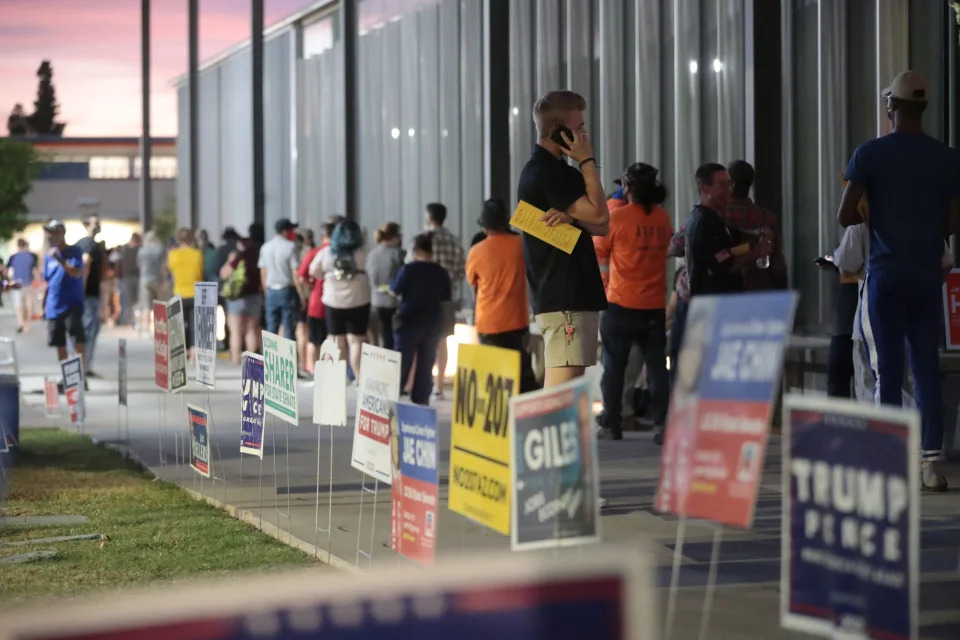
Voters wait in line at a polling station at Mesa Community College in Mesa, Ariz. on Election Day.
In August, the attorney general of Arizona wrapped up his investigation into the Cyber Ninjas’ claim that hundreds of dead voters cast ballots in the 2020 election.
To the surprise of absolutely no one, braindead or alive, Attorney General Mark Brnovich concluded that the Senate’s vaunted auditors didn’t know what they were talking about. There was no vast graveyard full of dead voters determined to deny Donald Trump his due.
Not even so much as a small crypt of conspiracy.
So naturally, there’s a bill in the Arizona Legislature to take care of this nonexistent problem … by cancelling your voter registration.
I am not making this up.
Senate Bill 1566 would wipe Arizona’s voter rolls clean every 10 years, requiring millions of Arizonans to re-register to vote.
It is but one of the dozens of kooky bills born of MAGA zealots and their absolute refusal to consider the fact that maybe they are losing statewide races because their candidates just aren’t acceptable to a statewide electorate.
Both the Senate and House election committees are chaired by election deniers.
The chairwoman of the Senate Elections Committee is Sen. Wendy Rogers of Flagstaff, who wanted to decertify the 2020 election and regularly calls for the arrest of elections officials. After being tapped by Senate President Warren Petersen to run point on election bills this year, Rogers vowed to engineer a do-over of Maricopa County’s 2022 election, though it seems more like a fundraising gimmick than an actual plan.
The chairwoman of the House Municipal Oversight and Elections Committee is Rep. Jacqueline Parker of Mesa, who, like Rogers, was a co-sponsor of then-Rep. Mark Finchem’s 2022 proposal to decertify Arizona’s 2020 presidential election. Her panel is packed with election deniers.
Every week, we are treated to veritable buffet of bad bills designed to fix problems that exist only in their fevered imaginations.
There’s a bill to do away with early ballots, the voting method of choice by 8 in 10 voters.
There’s a bill to ban ballot tabulators, never mind that hand counts are considered less accurate and more expensive. Or that a hand count of up to 70 races on 3 million or more ballots is likely to last until Christmas.
There‘s a bill to ban unmonitored ballot drop boxes out of some undocumented fear that Eeyore is lurking about and another to return to voting in precincts, never mind it leads to more voters being disenfranchised when they show up to the wrong place to vote.
There’s a bill that would require elections officials to post online the name, year of birth and address of every voter and another that would allow representatives of the Republican and Democratic parties to challenge your signature on an early ballot.
Then there is SB 1566, requiring you to reregister every 10 years if you want to continue exercising your constitutional right to vote.
In pushing the bill, Sen. Sonny Borrelli, R-Lake Havasu City, noted that he decided to look into the issue after the Attorney General’s Office spent “thousands of hours” investigating claims of dead voters.
“So I had my audit team go through voter registrations on dead voters and bounced that against the people that voted,” he recently told the Senate Elections Committee. “They looked at 30 ballot envelopes. Within 45 minutes they found 17 people that somehow voted after they died.”
Fifty-six percent? Clearly, our elections are being determined by those whose forwarding address lies somewhere near the Pearly Gates … or perhaps a good ways south of there.
Curiously, Borrelli didn’t mention the findings of the Attorney General’s Office after all those hours of investigation.
The ninjas, as part of their five-month audit of Maricopa County’s election, reported that 282 dead voters cast ballots in the November 2020 election. The AG’s Office then said it spent hundreds of hours investigating those claims.
The conclusion: 281 of those 282 voters were alive and kicking when they cast ballots.
“Our agents investigated all individuals that Cyber Ninas reported as dead, and many were very surprised to learn they were allegedly deceased,” Attorney General Brnovich wrote in an August letter to then-Senate President Karen Fann.
AG investigators also checked out four other reports of up to 6,500 supposedly dead people who either cast ballots or were on the voter registration rolls. They came up with “only a handful of potential cases,” all of them isolated instances.
Yet another conspiracy gone kaput – consigned to the graveyard of crazy to rest in peace alongside Sharpies, green buttons, bamboo ballots, hacked machinery and all the other supposedly nefarious ways in which Arizona’s 2020 election was stolen from Donald Trump.
Only to rise again in the Senate Elections Committee, and to heck with federal law.
The National Voter Registration Act outlines how and when a person’s name can be removed from the voter rolls, for example if he or she requests it or moves or dies.
The act also requires states to make “a reasonable effort to remove ineligible persons by reason of the person’s death, or a change in the residence of the registrant outside of the jurisdiction.”
I’m guessing a wholesale wipeout of every Arizonan’s registration every 10 years might be considered a tad, I don’t know, unreasonable?
“It violates federal law,” Jen Marson, of the Arizona Association of Counties, warned the committee. “It’s totally in conflict with NVRA.”
Even some Republicans were queasy about the proposal. Sen. T.J. Shope, R-Coolidge said he doesn’t view the bill as legitimate. Sens. Ken Bennett, R-Prescott, and John Kavanagh, R-Fountain Hills, agreed.
Then all three voted yes and the bill passed on a party line 5-3 vote.
Voters may not be dead but when it comes to the state Capitol, common sense is a goner.
Support local journalism: Subscribe to azcentral.com today.
Toxic wastewater from Ohio train derailment headed to Texas
February 23, 2023
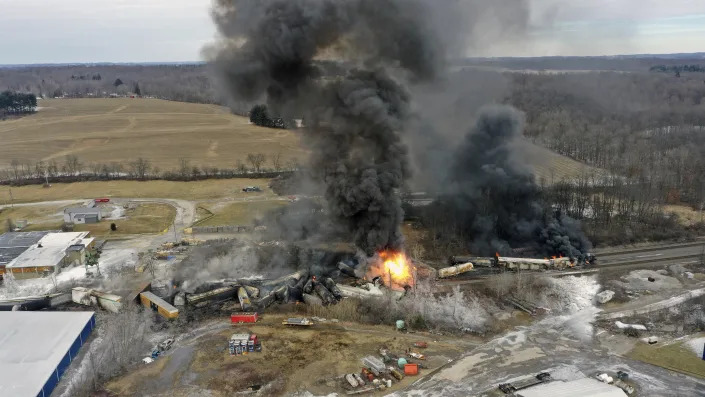
FILE – This photo taken with a drone shows portions of a Norfolk Southern freight train that derailed Friday night in East Palestine, Ohio are still on fire at mid-day Saturday, Feb. 4, 2023. Toxic wastewater used to extinguish a fire following a train derailment in Ohio is headed to a Houston suburb for disposal. Harris County Judge Lina Hidalgo says “firefighting water” from the East Palestine, Ohio train derailment is to be disposed of in the county and she is seeking more information.(AP Photo/Gene J. Puskar) (ASSOCIATED PRESS)
DEER PARK, Texas (AP) — Toxic wastewater used to extinguish a fire following a train derailment in Ohio is headed to a Houston suburb for disposal.
“I and my office heard today that ‘firefighting water’ from the East Palestine, Ohio, train derailment is slated to be disposed of in our county,” Harris County Judge Lina Hidalgo said in a Wednesday statement.
“Our Harris County Pollution Control Department and Harris County Attorney’s have reached out to the company and the Environmental Protection Agency to receive more information,” Hidalgo wrote.
The wastewater is being sent to Texas Molecular, which injects hazardous waste into the ground for disposal.
The Texas Commission on Environmental Quality told KTRK-TV that Texas Molecular “is authorized to accept and manage a variety of waste streams, including vinyl chloride, as part of their … hazardous waste permit and underground injection control permit.”
The company told KHOU-TV it is experienced in managing this type of disposal.
“Our technology safely removes hazardous constituents from the biosphere. We are part of the solution to reduce risk and protect the environment, whether in our local area or other places that need the capabilities we offer to protect the environment,” the company said.
The fiery Feb. 3 derailment in Ohio prompted evacuations when toxic chemicals were burned after being released from five derailed tanker rail cars carrying vinyl choride that were in danger of exploding.
“It’s … very, very toxic,” Dr. George Guillen, the executive director of the Environmental Institute of Houston, said, but the risk to the public is minimal.
“This injection, in some cases, is usually 4,000 or 5,000 feet down below any kind of drinking water aquifer,” said Guillen, who is also a professor of biology and environmental science at the University of Houston-Clear Lake.
Both Guillen and Deer Park resident Tammy Baxter said their greatest concerns are transporting the chemicals more than 1,300 miles (2,090 kilometers) from East Palestine, Ohio; to Deer Park, Texas.
“There has to be a closer deep well injection,” Baxter told KTRK. “It’s foolish to put it on the roadway. We have accidents on a regular basis … It is silly to move it that far.”
Transportation Secretary Pete Buttigieg, who visited the derailment site Thursday, has warned the railroad responsible for the derailment, Norfolk Southern, to fulfill its promises to clean up the mess just outside East Palestine, Ohio, and help the town recover.
Pritzker Will Do What It Takes to Keep Both DeSantis and Trump Out of the White House
Laura Davison and Shruti Date Singh – February 23, 2023
Pritzker Will Do What It Takes to Keep Both DeSantis and Trump Out of the White House
(Bloomberg) — Illinois Governor J.B. Pritzker said he’s willing to spend what it takes in the next election to help President Joe Biden keep his job — and keep Republicans like Ron DeSantis and Donald Trump out of the White House.
“It’s very important to me that we elect a Democratic president and that we make sure to keep DeSantis, Trump and the retrograde views that they carry out of the White House,” Pritzker, a longtime Democratic donor, said in an interview Thursday with Bloomberg News in Chicago. “I’ll continue to support Democrats in the best way I can to help them get elected.”
Pritzker, 58, is a member of one of the world’s wealthiest families, with a net worth of $3.7 billion, according to the Bloomberg Billionaires Index. The Democrat has been in the middle of recent spats with DeSantis, Florida’s Republican governor, and is a long-running nemesis of Citadel founder and GOP mega-donor Ken Griffin, who has said he’d back a DeSantis bid for president in 2024.
DeSantis, who visited Illinois this week, has criticized Chicago’s crime under Pritzker’s watch. Pritzker shot back, saying that DeSantis is trying to lower public education standards by banning the teaching of racial history.
Pritzker also said Griffin moved his financial empire headquarters to Miami from Chicago last year out of “embarrassment” after spending $50 million trying to defeat him in the gubernatorial race by backing Richard Irvin, the mayor of Aurora, Illinois.
“That person lost badly in the Republican primary,” Pritzker said in an interview Thursday with Bloomberg TV.
National Attention
Trading barbs with prominent Republicans sets up Pritzker for national political attention.
Pritzker, who was re-elected as Illinois governor in 2022, said he has been approached about potentially running for president, but declined to give any details about those discussions. He said he’s happy as governor, intends to serve the rest of his term and will back Biden this cycle.
Still, he’s raised his national profile by visiting New Hampshire and Florida, and has taken stances on expanding abortion access and banning assault weapons, stoking speculation that he has lofty ambitions beyond the Illinois statehouse in Springfield.
Regardless, the billionaire’s wealth promises to play a role in the 2024 race.
He poured more than $300 million of his own money into his two successful bids for governor. He spent about $51 million for a failed campaign to change Illinois’s flat income-tax structure to one that increases taxes on the rich.
Outside of Illinois, Pritzker and his wife have donated more than $39 million since 2011, according to campaign finance disclosures. Topping the list of recipients is Priorities USA Action, the super-PAC that’s supported Democratic presidential nominees since it was launched in 2011.
The Pritzkers have also given $2 million to support Hillary Clinton’s 2016 general election campaign and $1.4 million to back Biden in 2020.
Dems consider break with tradition to get Biden more judges
Kevin Freking – February 22, 2023
FILE – Sen. Dick Durbin, D-Ill., chairman of the Senate Judiciary Committee, leads a hearing about the rise in threats toward elected leaders and election workers, at the Capitol in Washington, Aug. 3, 2022. Democrats recently celebrated the 100th judicial confirmation of Joe Biden’s presidency and are clamoring for more. To make it happen, some are flirting with ending a century-long Senate practice that a “blue slip” from a senator could make or break a nomination.(AP Photo/J. Scott Applewhite, File) (ASSOCIATED PRESS)
WASHINGTON (AP) — Even as Democrats celebrated the 100th judicial confirmation of Joe Biden’s presidency, they are clamoring for more — and some are flirting with ending a century-long Senate practice to help make it happen.
The rising friction over what in Washington parlance is known as the “blue slip” is creating tensions on the Senate panel that handles judicial nominations and prompting stern warnings from Republicans about a dangerous escalation in the partisanship that already dominates the judicial confirmation process.
The clash over Senate procedure could have major ramifications for Biden as he seeks to fill as many court vacancies as possible during the final two years of his term. Aghast at the speed with which Republicans approved judges during the Trump era, Democrats have made the confirmation to the courts a top priority, vowing to fill every seat possible. Their focus on the nominations is even greater now that Republicans control the House and can stall much of Biden’s broader legislative agenda.
Since at least 1917, the chairman of the Senate Judiciary Committee has sent a blue-colored form, or “blue slip,” to the senators representing the home state of a judicial nominee. A blue slip returned with a positive response signals the senator’s approval of moving forward with a nomination hearing. But if the blue slip is not returned or comes back with a negative response, that means the home state senator objects, which can doom the nomination.
Republicans during Donald Trump’s presidency determined the lack of a positive blue slip would not stop them from moving forward with considering appellate court nominees — and they did so 17 times. Democrats were livid, pointing out that Republicans blocked several of President Barack Obama’s appellate nominees by declining to return a positive blue slip.
Now, Democrats are being encouraged to follow suit and do away with the blue slip when it comes to the district judges whose courts serve as the starting point for federal civil and criminal cases.
”In many respects, it is an archaic holdover from a different era,” said Sen. Richard Blumenthal, D-Conn. “I think we’re maybe reaching the point of deciding whether it will be continued.”
Advocates for doing away with the blue slip say fast action is critical if Democrats want to have the kind of success Trump had in year three of his presidency, when he secured more than 100 judicial confirmations out of 231. They believe Democrats can’t afford to wait months on Republican senators to give their go-ahead for a nominee.
Besides, they argue, if Democrats don’t do away with the blue slip now, Republicans will abolish it when they return to the majority.
“Democrats would be chumps to say, ‘Oh well, we’re not going to do this because it’s a tradition,'” said Russ Feingold, the former three-term Democratic senator from Wisconsin who now serves as president of the American Constitution Society. The group is a liberal counter to the conservative Federalist Society.
The New York Times editorial board also weighed in recently, saying it was “far past time” for the chairman of the Senate Judiciary Committee to end the blue slip practice.
The chairman, Sen. Dick Durbin, D-Ill., has clearly heard some of the concerns voiced by progressives. He has made it a point recently to emphasize how Democrats submitted 130 positive blue slips for district court nominees during the Trump presidency, but so far, Republicans have only done so about a dozen times.
That’s essentially because Biden has been filling judicial vacancies of predominately Democratic-appointed judges in blue states. Soon, it will get harder. There are about 40 district court vacancies that will require a blue slip from at least one Republican senator. Many of those vacancies don’t have a nominee yet, and Durbin is clearly sending a signal to GOP senators to work expeditiously with the White House on submitting prospective nominees.
Durbin said he wants to continue with the blue slip tradition, but he’s adding a caveat: that they aren’t used for “discriminatory purposes” to block consideration of nominees based on race, gender or sexual orientation.
His comments have alarmed Republican senators. Sen. Lindsey Graham, R-S.C., said the blue slip courtesy is “very much at stake and at risk here.” He also questioned how Durbin is going to discern the motivations of Republicans senators if they object to a nominee.
“The last thing left in this body that makes the Senate the Senate, in my view, and gives a senator a say about a consequential decision in their state that will last a lifetime is the blue slip process,” Graham said. “So I would just hope we could agree, if possible, that no matter how frustrated we get, we’re going to honor this system.”
So far, only one Biden nominee for a district court has had their nomination derailed because a senator withheld a blue slip, William Pocan, nominated to the Eastern District of Wisconsin. Republican Sen. Ron Johnson withheld his blue slip, saying he had heard concerns from the Green Bay legal community that they needed a judge locally based and active in their community.
Sen. John Cornyn, R-Texas, said complaints about the blue slip are “orchestrated and contrived.” He said that he and Sen. Ted Cruz, R-Texas, were asked by the White House to submit names for an appellate court vacancy within three weeks, which they did.
“And eight months later, the administration finally gets around to nominating somebody,” Cornyn said. “We’ve got two district court vacancies where we have not been contacted at all by the White House counsel. So, most of the delay is because the administration has been slow in filling these nominees, these vacancies.”
Cornyn likened the efforts to ending the blue slip to Democratic calls for ending the filibuster so that legislation would only need a simple majority to advance rather than 60 votes.
“They want to fully dismantle the Senate as an institution,” he said.
Proponents of the blue slip say its most important feature is to encourage collaboration and compromise. Durbin said he provided eight positive blue slips after negotiating on nominees with the Trump White House. “I had to give a little. They did, too,” he said.
But Feingold, who served 16 years on the Judiciary panel and 18 years in the Senate, said he believes presidents will continue to consult with senators on judicial openings even without the blue slip, because they need a lawmaker’s votes on other priorities.
“You need to consult them anyway because if you try to jam somebody really bad down their throat, they are going to remember it,” Feingold said.
Blumenthal said he will bring lessons learned from the Obama years to the debate, and he’s determined not to let Republicans block district judges through the blue slip process the way they did appellate court judges.
“The history is undeniable that Republicans succeeded in blocking many of the Obama nominees, and therefore held open judgeships, which they then filled with alacrity,” Blumenthal said. “We’re not going to let that happen again.”
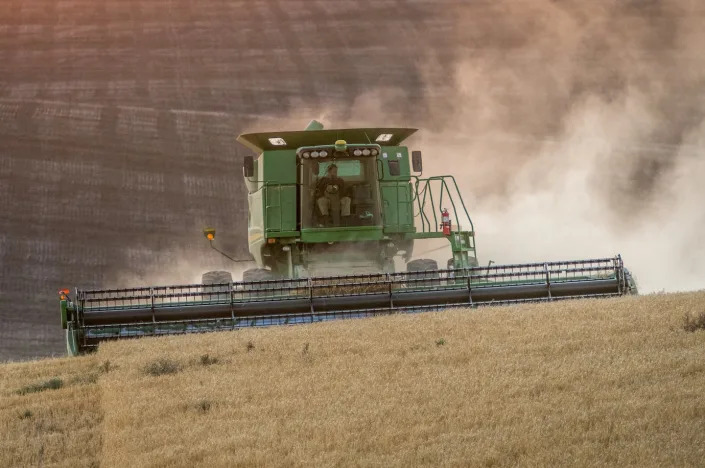
As tractors became more sophisticated over the past two decades, the big manufacturers allowed farmers fewer options for repairs. Rather than hiring independent repair shops, farmers have increasingly had to wait for company-authorized dealers to arrive. Getting repairs could take days, often leading to lost time and high costs.
A new memorandum of understanding between the country’s largest farm equipment maker, John Deere Corp., and the American Farm Bureau Federation is now raising hopes that U.S. farmers will finally regain the right to repair more of their own equipment.
However, supporters of right-to-repair laws suspect a more sinister purpose: to slow the momentum of efforts to secure right-to-repair laws around the country.
Under the agreement, John Deere promises to give farmers and independent repair shops access to manuals, diagnostics and parts. But there’s a catch – the agreement isn’t legally binding, and, as part of the deal, the influential Farm Bureau promised not to support any federal or state right-to-repair legislation.
You can listen to more articles from The Conversation narrated by Noa.
The right-to-repair movement has become the leading edge of a pushback against growing corporate power. Intellectual property protections, whether patents on farm equipment, crops, computers or cellphones, have become more intense in recent decades and cover more territory, giving companies more control over what farmers and other consumers can do with the products they buy.
For farmers, few examples of those corporate constraints are more frustrating than repair restrictions and patent rights that prevent them from saving seeds from their own crops for future planting.
How a few companies became so powerful
The United States’ market economy requires competition to function properly, which is why U.S. antitrust policies were strictly enforced in the post-World War II era.
During the 1970s and 1980s, however, political leaders began following the advice of a group of economists at the University of Chicago and relaxed enforcement of federal antitrust policies. That led to a concentration of economic power in many sectors.
This concentration has become especially pronounced in agriculture, with a few companies consolidating market share in numerous areas, including seeds, pesticides and machinery, as well as commodity processing and meatpacking. One study in 2014 estimated that Monsanto, now owned by Bayer, was responsible for approximately 80% of the corn and 90% of the soybeans grown in the U.S. In farm machinery, John Deere and Kubota account for about a third of the market.
Market power often translates into political power, which means that those large companies can influence regulatory oversight, legal decisions, and legislation that furthers their economic interests – including securing more expansive and stricter intellectual property policies.
Whether the product is an automobile, smartphone or seed, companies can extract more profits if they can force consumers to purchase the company’s replacement parts or use the company’s exclusive dealership to repair the product.
One of the first cases that challenged the right to repair equipment was in 1939, when a company that was reselling refurbished spark plugs was sued by the Champion Spark Plug Co. for violating its patent rights. The Supreme Court agreed that Champion’s trademark had been violated, but it allowed resale of the refurbished spark plugs if “used” or “repaired” was stamped on the product.
Although courts have often sided with the end users in right-to-repair cases, large companies have vast legal and lobbying resources to argue for stricter patent protections. Consumer advocates contend that these protections prevent people from repairing and modifying the products they rightfully purchased.
The ostensible justification for patents, whether for equipment or seeds, is that they provide an incentive for companies to invest time and money in developing products because they know that they will have exclusive rights to sell their inventions once patented.
However, some scholars claim that recent legal and legislative changes to patents are instead limiting innovation and social benefits.
The problem with seed patents
The extension of utility patents to agricultural seeds illustrates how intellectual property policies have expanded and become more restrictive.
Patents have been around since the founding of the U.S., but agricultural crops were initially considered natural processes that couldn’t be patented. That changed in 1980 with the U.S. Supreme Court decision Diamond v. Chakrabarty. The case involved genetically engineered bacteria that could break down crude oil. The court’s ruling allowed inventors to secure patents on living organisms.
Half a decade later, the U.S. Patent Office extended patents to agricultural crops generated through transgenic breeding techniques, which inserts a gene from one species into the genome of another. One prominent example is the insertion of a gene into corn and cotton that enables the plant to produce its own pesticide. In 2001, the Supreme Court included conventionally bred crops in the category eligible for patenting.
Genetically modified seeds, and even conventionally bred crops, can be patented. Sean Gallup/Getty Images
Historically, farmers would save seeds that their crops generated and replant them the following season. They could also sell those seeds to other farmers. They lost the right to sell their seeds in 1970, when Congress passed the Plant Variety Protection Act. Utility patents, which grant an inventor exclusive right to produce a new or improved product, are even more restrictive.
Under a utility patent, farmers can no longer save seed for replanting on their own farms. University scientists even face restrictions on the kind of research they can perform on patented crops.
Because of the clear changes in intellectual property protections on agricultural crops over the years, researchers are able to evaluate whether those changes correlate with crop innovations – the primary justification used for patents. The short answer is that they do not.
One study revealed that companies have used intellectual property to enhance their market power more than to enhance innovations. In fact, some vegetable crops with few patent protections had more varietal innovations than crops with more patent protections.
How much does this cost farmers?
It can be difficult to estimate how much patented crops cost farmers. For example, farmers might pay more for the seeds but save money on pesticides or labor, and they might have higher yields. If market prices for the crop are high one year, the farmer might come out ahead, but if prices are low, the farmer might lose money. Crop breeders, meanwhile, envision substantial profits.
Similarly, it is difficult to calculate the costs farmers face from not having a right to repair their machinery. A machine breakdown that takes weeks to repair during harvest time could be catastrophic.
The nonprofit U.S. Public Interest Research Group calculated that U.S. consumers could save US$40 billion per year if they could repair electronics and appliances – about $330 per family.
The memorandum of understanding between John Deere and the Farm Bureau may be a step in the right direction, but it is not a substitute for right-to-repair legislation or the enforcement of antitrust policies.
Leland Glenna does not work for, consult, own shares in or receive funding from any company or organization that would benefit from this article, and has disclosed no relevant affiliations beyond their academic appointment.
Greater Idaho is a pipe dream, a symptom of a deeper problem: the urban-rural divide | Opinion
Bryan Clark – February 20, 2023
Courtesy Greater Idaho
The Idaho House last week voted to advance a resolution in support of so-called Greater Idaho, which would redraw the border between Oregon and Idaho to somewhere in the vicinity of Bend, chopping off most of the red portions of the Beaver State and tacking them onto the Gem State.
Doing so, proponents say, would free the vast rural areas of eastern Oregon from the oppressive rule of Portland and other urban population centers, and join it to rural, culturally similar Idaho.
The easy thing to say about Greater Idaho is that it’s ridiculous — and that’s true. The interstate compact required would need to get through Congress, as well as both the Oregon and Idaho legislatures.
Getting Congress to do much of anything has been virtually impossible for about a quarter-century or so, absent full one-party control. And Oregon would have to agree to cede more than half of its landmass, an unthinkable proposition.
So it’s a joke. But there is a serious problem contained within this persistent idea.
Greater Idaho is an embodiment of the pipe dream that we can all retire to our corners, where everyone agrees with us and nobody proposes anything we don’t like. It is a kind of political childishness. It’s the idea that you don’t need to build bridges across political divisions; you just need a new map.
It’s dangerous not as a policy, but as a political effect. And it’s spreading.
Rising calls for secession
The interesting question isn’t: Will Greater Idaho happen? It won’t.
The interesting question is: Why has such an effort arisen now?
Each of these proposals is as unserious as Greater Idaho. But there are common threads among them. They’re led by conservatives. They draw their support from rural areas. They promote the notion that they are preserving traditional values and a rural way of life against encroaching urban cosmopolitanism.
In 2020, researchers from the University of Maryland and the University of Washington in St. Louis did a detailed study of how where you live — and specifically how many people you live near — influences your political positions.
As the researchers noted, it was obvious for a long time that there was an urban/rural political division in America, but the general assumption was that this had to do with the differing racial, economic and cultural composition of rural and urban voters. But they found that even after controlling for race, income and a host of other factors, whether you live in a city or the country still has an independent effect on your political views.
And the converse is true, too: Your political views do a lot to determine where you live. The median Democrat lives 12 miles from a city center, the median independent 17 miles and the median Republican 20 miles, according to their findings. The median Republican lives in an area with fewer than 600 people per square mile, while the median Democrat lives in an area with about 1,200 people per square mile.
A 2021 paper by researchers from the London School of Economics and the Arctic University of Norway found that this urban/rural political divide is present in countries throughout the world, though it is much stronger in wealthier countries like the United States than in poorer ones.
In a guest essay last month in the New York Times reviewing a host of recent research, Thomas Edsall warned the cementation of polarized ideological divisions into patterns of living raised serious risks.
“Urban-rural ‘apartheid’ further reinforces ideological and affective polarization,” he wrote. “The geographic separation of Republicans and Democrats makes partisan crosscutting experiences at work, in friendships, in community gatherings, at school or in local government — all key to reducing polarization — increasingly unlikely to occur.
“Geographic barriers between Republicans and Democrats — of those holding traditional values and those choosing to reject or reinterpret those values — reinforce what scholars now call the calcification of difference. As conflict and hostility become embedded in the structure of where people live, the likelihood increases of seeing adversaries as less than fully human.”
We’ve seen plenty of that in Idaho.
From polarization to enmity
One supporter of Greater Idaho said during a committee hearing that he felt liberals in Oregon were taking delight in attacking conservatives and their way of life. He felt there were efforts to make guns impossible to own and to make it impossible to raise livestock.
Liberals in Idaho understand that feeling.
The Idaho Freedom Foundation used to take basically libertarian positions on most issues. It advocated smaller government, for example, but its big fight of 2016 was to make CBD oil, a derivative of hemp, legal. It was a fight against the culturally conservative Republican establishment on behalf of criminalized families.
Now its main enemy seems to be not big government but “wokeness” — not policy but culture. The enemy no longer seems to be state power, but the political minority’s way of life.
Ammon Bundy, known for leading protests outside officials’ homes and leading the armed takeover of the Malheur National Wildlife Refuge — and the Freedom Foundation’s pick for governor — made his biggest splash during campaign season by selling exactly this message. If elected governor, he promised, he’d pay liberals to move out of the state.
The increasing fixation of the Republican supermajority in the Idaho Legislature on the state’s tiny transgender community fits this mold, as well. The raft of yearly policies — trans kids can’t play sports or get gender-affirming medical care, trans people can’t get new birth certificates, books that mention gay people are pornography — comes with the constant rhetorical insistence that there are only two biological sexes, and that they are immutable (a strictly irrelevant point). The aim of the attack seems to be not mainly legal (most of the bills get halted in federal court) but cultural: delegitimizing the very existence of transgender people.
So you could understand why some parts of Idaho might want to be part a majority-Democratic Greater Montana (a proposal jokingly floated by Rep. Colin Nash, D-Boise). But the truth is, these problems can’t be solved by moving borders.
Moving borders solves nothing
The fundamental reason polarization can’t be solved with a new map is that today’s political divisions aren’t like those ahead of the Civil War. You can’t divide people neatly with a line. It isn’t North versus South or East versus West.
The modern American political division is overwhelmingly between urban and rural areas. But there is no conceivable way to collect the rural areas into one set of political divisions and the urban areas into another.
And even if you could, that wouldn’t get rid of the problem.
According to 2018 research by Pew, the average urban county in America had something like a 30-point Democratic lean, while the average rural county had around a 20-point Republican lean. That’s a massive gap. It means no election there will be competitive in a winner-take-all system.
But it still means about one in three urban residents lean Republican, and about two in five rural residents lean Democratic. Polarization extends only so far. More than a quarter of Kootenai and Bonneville counties voted for Joe Biden. One in five people in Custer and Lemhi counties voted for Biden.
No matter where you draw the state’s boundaries, there will remain major divisions within it — which puts you right back where you started. There’s always a very large group of people in the political minority. This isn’t a problem you can solve with a new map.
What the Greater Idaho movement represents is a mix of incredible naïveté and bottomless pessimism. It is the notion that we can all come together to agree that our political differences have become completely irreconcilable.
That is a doomed project, but more than that, it’s a childish urge that needs to be driven out of our political imagination.
Here are the unavoidable facts: We have to live with one another. There’s no way around it. Our coexistence may be peaceful or bitter — that is up to us — but we will coexist. Anyone who tells you something different is lying, either to themselves or to you.
Donna St. George, Katherine Reynolds Lewis and Lindsey Bever, The Washington Post – February 17, 2023
When Sophie Nystuen created a website for teens who had experienced trauma, her idea was to give them space to write about the hurt they couldn’t share. The Brookline, Mass., 16-year-old received posts about drug use and suicide. But a majority wrote about sexual violence.
“Every time I’ve tried, my throat feels like it’s closing, my lungs forget how to breathe,” wrote one anonymous poster. “I was sexually assaulted.”
These expressions of inner crisis are just a glint of the startling data reported by federal researchers this week. Nearly 1 in 3 high school girls said they had considered suicide, a 60 percent rise in the past decade. Nearly 15 percent had been forced to have sex. About 6 in 10 girls were so persistently sad or hopeless they stopped regular activities.
The new report represents nothing short of a crisis in American girlhood. The findings have ramifications for a generation of young women who have endured an extraordinary level of sadness and sexual violence – and present uncharted territory for the health advocates, teachers, counselors and parents who are trying to help them.
The data comes from the Youth Risk Behavior Survey, conducted by the Centers for Disease Control and Prevention from a nationally representative sample of students in public and private high schools. “America’s teen girls are engulfed in a growing wave of sadness, violence and trauma,” the CDC said.
“It’s alarming,” Education Secretary Miguel Cardona said Thursday of the report. “But as a father of a 16-year-old and 19-year-old, I hear about it. It’s real. I think students know what’s going on. I think sometimes the adults are just now realizing how serious it is.”
But high school girls are speaking out, too, about stresses that started before the pandemic – growing up in a social media culture, with impossible beauty standards, online hate, academic pressure, economic difficulties, self doubt and sexual violence. The isolation and upheaval of covid made it tougher still.
When Caroline Zuba started cutting her arms in ninth grade, she felt trapped: by conflict at home, by the school work that felt increasingly meaningless, by the image her friends and teachers had of a bubbly, studious girl. Cutting replaced the emotional pain with a physical pain.
She confided in a trusted teacher, who brought in the school counselors and her mother. But Zuba’s depression worsened and, at age 15, she attempted suicide. That sparked the first of a series of hospitalizations over the summer and subsequent school year.
Now a 17-year-old junior at a public high school in Potomac, Md., Zuba relies on therapy, medication, exercise and coping strategies. She started a mental health club at her high school to support classmates also struggling with depression, anxiety and suicidal thoughts.
At the lowest point of her depression, she said, she kept many secrets from her friends, parents and teachers because she felt stuck in her role: a cheerful high achiever who had it all together.
“My mom’s like my best friend and there’s no way she would have ever expected it,” Zuba said. “Teens are really good at hiding it, which is really sad.”
While the teen mental health crisis was clear before the CDC report, the stark findings have jolted parents and the wider public.
“These are not normal numbers,” said Surgeon General Vivek H. Murthy. “When you grow up with this, I think the risk is thinking, ‘Well, this is just how it is.'”
The reasons girls are in crisis are likely complex, and may vary by race, ethnicity, class and culture. Harvard psychologist Richard Weissbourd points out that “girls are more likely to respond to pain in the world by internalizing conflict and stress and fear, and boys are more likely to translate those feelings into anger and aggression,” masking their depression.
Weissbourd added that girls also are socialized not to be aggressive and that in a male-dominated culture girls can be gaslit into thinking there is something wrong with them when problems or conflicts arise. “They can be prone to blaming themselves,” he said.
Jean Twenge, a psychology professor at San Diego State University and author of the book “iGen,” said that increases in most measures of poor mental health in the past decade were more pronounced for girls than boys.
She said part of the problem is that digital media has displaced the face-to-face time teens once had with friends, and that teens often don’t get enough sleep. Adding to those influences are the hours teens spend scrolling social media. For girls, she said, this often means “comparing your body and your life to others and feeling that you come up wanting.”
That’s not to say everything that people do on smartphones is problematic, Twenge said. “It’s just social media in general and internet use show the strongest correlations with depression,” she said.
Ben Handrich, a school counselor at South Salem High School in Salem, Ore., said teen girls often feel that “people are watching them – that no matter what they do, there’s this invisible audience judging their movements, their actions, the way they smile, the way they eat.”
Lisa Damour, a clinical psychologist and author of “The Emotional Lives of Teenagers,” said it’s important to note that the CDC data was collected in the fall of 2021, a time when many teens were anxious about returning to in-person school and wearing masks.
“Teenagers were miserable,” Damour said. “It absolutely confirms what we were looking at clinically at that time. We don’t know what the next wave of data will tell us.”
Damour noted that the CDC findings are distressing because today’s teens, in many ways, are in better physical health and more risk-averse than most previous generations.
“We’re raising the best-behaved generation of teenagers on record,” said Damour. “They drive with seat belts, they smoke less, they have less sex, they wear helmets. They do all these things that we did not do.”
And yet they are in crisis.
Many girls across the country describe teen cultures of casual slut-shaming, of peers greeting girls with sexist slurs such as “whore” or “ho,” based on what they wear or how they look.
In Los Angeles, Elida Mejia Elias says it’s a no-win situation. “If you’re skinny, they judge you for being skinny and if you’re fat, they judge you for being fat,” explains the 18-year-old, a senior.
In ninth grade, a friend of Mejia Elias’s sent a naked picture of herself to a boy she was dating, at his urging, and he spread it around to his friends. “Everyone was talking bad about her. They were calling her names, like ‘ho,'” said Mejia Elias. “That affected her mental health. She needed to get therapy.”
In Maryland, at her Bethesda public high school, 14-year old Tulip Kaya said that girls in her friend group hear whistles or “gross comments” about their breasts and are texted unsolicited penis pictures by boys at school. “If there’s anything slightly unique about you, you’re not going to have a fun time, and you will be targeted,” she said.
Social media can be overwhelming. “On Snapchat and TikTok, you see all these pretty girls with tiny waists and a big bottom. I know I’m only 14, but it makes me feel like there’s something wrong with myself,” Kaya said. “When I start to feel like that, I will delete the app for a little while.”
Girls interviewed by The Post expressed uncertainty and self-doubt over everything from what to wear, what to post or comment on social media, what it meant if someone wasn’t following them back on a social platform, and even in daily interactions. When in-person school resumed, during the fall of 2021 for many, routine encounters and moments felt weird after a year or more of separation from peers.
“Sometimes I don’t want to wear shorts because I don’t have the body type I had in middle school,” said Leilah Villegas, of Eastvale, Calif., who ran track before the pandemic. Now in 10th grade, she’s started running again but her changed body brings pangs of self-consciousness.
Aanika Arjumand, 16, from Gaithersburg, Md., who sits on her county’s Domestic Violence Coordinating Council, said she was not surprised by the increases in sexual violence.
“We deal with a lot of cases on like teen dating violence and kind of informing schools about teen dating violence because the health curriculum right now basically does not cover abuse or sexual violence as much as it should,” she said.
School itself can sometimes be physically unsafe, as happened with Harker, a 13-year old in Savannah, Ga., who spoke on the condition that her full name not be used because of the sensitivity of the issue.
At school, she received unwanted attention from a boy in sixth grade. He would whisper in her ears and grab her shoulders. Once, he seized her across her chest and did not release her until she screamed. A teacher was nearby, but she said the boy went unpunished and remained in her classes. The teen has resorted to learning at home.
“They didn’t believe me even though there were witnesses,” she said. “A boy in school can get away with something, but if I do one mess-up, I get called out for it.
At the Bronx High School of Science in New York, 17-year-old Najiha Uddin talks about a White beauty standard perpetuated in mainstream and social media, which she says girls of color can’t possibly meet. She and others describe status-oriented peers and media messages about shoes, clothes, styles and experiences that outstrip their families’ means.
For Montanna Norman, 18, a senior at a private high school in Washington during the fall of 2021, the killing of unarmed Black men by police was foremost in her mind after the murder of George Floyd. At the time she was the co-leader of her school’s Black Student Union. “The toll that that took on my mental health was a lot,” she said.
Some of her friends have contemplated, or attempted, suicide, Norman said. “You wish you could do more to help,” she said.
Garvey Mortley, a 14-year old in Bethesda, Md., who is Black, said she has been teased because of her hair and still feels microaggressions. “Racism can be a stressor for depression or a cause of depression because of the bullying that happens, not just Black kids but Asian kids and Hispanic kids who feel they are unwanted,” she said.
Students who are LGBTQ face some of the highest rates of depressive symptoms and sexual violence, including rape. In 2021, nearly 1 in 4 reported an attempt to take their life.
Rivka Vizcardo-Lichter, a student activist in Virginia, pointed out that high school is a time when many LGBTQ students are still figuring out who they are and solidifying their identity. “Even if you have an accepting environment around you, you are aware that there are millions of people who don’t want you to exist,” she said.
Some of the most alarming data collected by the CDC involved the rise in suicidal thoughts among teen girls – 24 percent of teen girls have made a plan for suicide while 13 percent have attempted it, almost twice the rate for boys.
Rich and Trinna Walker, from New Albany, Ind., searched for a therapist for their 13-year-old daughter Ella but struggled to find one in the overloaded mental health-care system during the pandemic. Once Ella finally started treatment, however, her demeanor seemed to improve, they said.
“I really felt like she was doing so much better,” Trinna Walker said. Ella had been asking her dad how she could earn extra money to buy a birthday gift for her sister. She told her mom she wanted doughnuts for breakfast.
“Then we woke up to a nightmare the next morning,” Trinna said.
Ella died by suicide on Jan. 22, 2022. Her parents said they wish someone would have alerted them to the warning signs. Unknown to them, Ella was being bullied, and she was devastated by a breakup, they said.
Now the couple is urging teens to speak up when their peers are in trouble. “It was like a bomb going off,” Rich Walker said. “It’s like it mortally wounded my wife and me and Ella’s two older sisters, and then it reverberated outwardly to her friends.”
Many of the girls interviewed for this story asked that adults listen to and believe girls, and stop dismissing their concerns as drama. “Adults don’t get all the pressure that teenage girls have to deal with, from appearance to the way they act to how smart they are, to the things they do,” said Villegas, the Eastvale 10th-grader. “It can be very overwhelming.”
Asma Tibta, a 10th-grader in Fairfax County, Va., said she is “close friends” with her mother, but doesn’t talk about mental health at home. “I haven’t told her too much. And I don’t plan to.”
In Savannah, Harker took a break from playing Roblox with her friend to be interviewed. Before heading back to the game, she had one request: “I want adults to believe young girls.”
The Washington Post’s Serena Marshall contributed to this report.
If you or someone you know needs help, visit 988lifeline.org or call or text the Suicide & Crisis Lifeline at 988.
Through a year of war in Ukraine, the U.S. and most European nations have worked to help counter Russia, in supporting Ukraine both with armaments and in world energy markets. Russia was Europe’s main energy supplier when it invaded Ukraine, and President Vladimir Putin threatened to leave Europeans to freeze “like a wolf’s tail” – a reference to a famous Russian fairy tale – if they imposed sanctions on his country.
But thanks to a combination of preparation and luck, Europe has avoided blackouts and power cutoffs. Instead, less wealthy nations like Pakistan and India have contended with electricity outages on the back of unaffordably high global natural gas prices. As a global energy policy analyst, I see this as the latest evidence that less wealthy nations often suffer the most from globalized oil and gas crises.
I believe more volatility is possible. Russia has said that it will cut its crude oil production starting on March 1, 2023, by 500,000 barrels per day in response to Western energy sanctions. This amount is about 5% of its current crude oil production, or 0.5% of world oil supply. Many analysts expected the move, but it raises concerns about whether more reductions could come in the future.
How Europe has kept the lights on
As Russia’s intent toward Ukraine became clear in late 2021 and early 2022, many governments and energy experts feared one result would be an energy crisis in Europe. But one factor that Putin couldn’t control was the weather. Mild temperatures in Europe in recent months, along with proactive conservation policies, have reduced natural gas consumption in key European markets such as Germany, the Netherlands and Belgium by 25%.
With less need for electricity and natural gas, European governments were able to delay drawing on natural gas inventories that they built up over the summer and autumn of 2022. At this point, a continental energy crisis is much less likely than many forecasts predicted.
European natural gas stockpiles are around 67% full, and they will probably still be 50% full at the end of this winter. This will help the continent position itself for next winter as well.
The situation is similar for coal. European utilities stockpiled coal and reactivated 26 coal-fired power plants in 2022, anticipating a possible winter energy crisis. But so far, the continent’s coal use has risen only 7%, and the reactivated coal plants are averaging just 18% of their operating capacity
The U.S. role
Record-high U.S. energy exports in the summer and fall of 2022 also buoyed European energy security. The U.S. exported close to 10 million cubic meters per month of liquefied natural gas in 2022, up 137% from 2021, providing roughly half of all of Europe’s imported LNG.
Although domestic U.S. natural gas production surged to record levels, some producers had the opportunity to export into high-priced global markets. As a result, surpluses of summer natural gas didn’t emerge inside the U.S. market, as might otherwise have happened. Combined with unusually hot summer temperatures, which drove up energy demand for cooling, the export surge socked U.S. consumers with the highest natural gas prices they had experienced since 2008.
Prices also soared at U.S. gas pumps, reaching or exceeding US$5 per gallon in the early summer of 2022 – the highest average ever recorded by the American Automobile Association. The U.S. exported close to 1 million barrels per day of gasoline, mainly to Mexico and Central America, plus some to France, and consolidated its position as a net oil exporter – that is, it exports more oil than it imports.
A tugboat helps guide the LNG Endeavor, a French liquefied natural gas tanker, through Calcasieu Lake near Hackberry, La., March 31, 2022. U.S. LNG exports to Europe reached record levels in 2022 as the continent prepared to sever energy ties with Russia. AP Photo/Martha Irvine
Much like Europeans, U.S. consumers had to pay high prices to outbid other global consumers for oil and natural gas amid global supply disruptions and competition for available cargoes. High gasoline prices were a political headache for the Biden administration through the spring and summer of 2022.
However, these high prices belied the fact that U.S. domestic gasoline use has stopped growing. Forecasts suggest that it will decline further in 2023 and beyond as the fuel economy of U.S. cars continues to improve and the number of electric vehicles on the road expands.
While energy prices were a burden, especially to lower-income households, European and American consumers have been able to ride out price surges driven by the war in Ukraine and have so far avoided actual outages and the worst recessionary fears. And their governments are offering big economic incentives to switch to clean energy technologies intended to reduce their nations’ need for fossil fuels.
Developing nations priced out
The same can’t be said for consumers in developing nations like Pakistan, Bangladesh and India, who have experienced the energy cutoffs that were feared but didn’t occur in Europe. Notably, Europe’s intensive energy stockpiling in the summer of 2022 caused a huge jump in global prices for liquefied natural gas. In response, many utilities in less developed nations cut their natural gas purchases, creating price-related electricity outages in some regions.
The energy challenge that the Russia-Ukraine crisis has bred in developing countries has intensified global discussions about climate justice. One less examined impact of giant clean tech stimulus plans enacted in wealthy nations, such as the United States’ Inflation Reduction Act, is that they keep much of the available funding for climate finance at home. As a result, some developing country leaders worry that a clean energy technology knowledge gap will widen, not shrink, as the energy transition gains momentum.
Worsening the problem, members of the G-7 forum of wealthy nations have tightened their monetary policies to control war-driven inflation. This drives up the cost of debt and makes it harder for developing countries to borrow money to invest in clean energy.
The U.S. is supporting a new approach called Just Energy Transition Partnerships, in which wealthy nations provide funding to help developing countries shift away from coal-fired power plants, retrain workers and recruit private-sector investors to help finance decarbonization projects. But these solutions are negotiated bilaterally between individual countries, and the pace is slow.
When nations gather in the United Arab Emirates in late 2023 for the next round of global climate talks, wealthy nations – including Middle East oil producers – will face demands for new ways of financing energy security improvements in less wealthy countries. The world’s rich nations pledged in 2009 to direct $100 billion yearly to less wealthy nations by 2020 to help them adapt to climate change and decarbonize their economies, but are far behind on fulfilling this promise.
U.N. Secretary-General Antonio Guterres has called on developed nations to tax fossil fuel companies, which reported record profits in 2022, and use the money to fund climate adaptation in low-income countries. New solutions are needed, because without some kind of major progress, wealthy nations will continue outbidding developing nations for the energy resources that the world’s most vulnerable people desperately need.
Ron DeSantis requested the medical records of trans students who sought care at Florida’s public universities. Now students are planning a statewide walkout.
Annalise Mabe – February 16, 2023
Students at the University of South Florida gather to protest the request.Justin Blanco
Ron DeSantis told all public universities in Florida to hand over the medical records of trans students who sought care.
Insider has confirmed six of the 12 universities have complied with the request.
Now, college students across the state are planning a walkout to protest the governor’s request.
DeSantis asked to see the records of any student who has experienced gender dysphoria in the past five years. In addition, he wants their ages and the dates they received gender-affirming care. The deadline to submit those records was February 10.
Insider has confirmed that University of Florida, Florida State University, University of Central Florida, Florida A&M University, Florida International University, and the University of North Florida have complied with the request, but has yet to hear back from the rest.
Students at these universities are now planning rallies for next week along with the statewide walkout on February 23. Ben Braver, a junior at the University of South Florida and the outreach officer for the school’s College Democrats chapter, is leading the initiative, known as the Stand for Freedom Florida Walkout.
“Hate is spread when it’s innocuous, when it seems silly, and when it seems like taking a stand is an overreaction,” Braver told Insider. “We, just like any generation, need to stand for the civil rights that have already been fought for, the ones that have been won, and those which are at stake right now.”
Andy Pham, a senior and long-standing member of the University of South Florida’s Trans+ Student Union, said he sees the state’s move as a direct attack on trans rights.
“They want to legislate us out of existence,” Pham said. “That starts with attacking our healthcare, attacking our right to exist in public spaces, attempting surveillance — all of that.”
In January, 20 students at the University of South Florida held a rally protesting DeSantis’ request. They then started an online petition asking the school’s administration not to submit the medical records. The petition received over 2,600 signatures, but officials at the school said they plan to send over the records anyway. Insider hasn’t been able to confirm whether the University of South Florida sent over the data.
“As a state university, USF has an obligation to be responsive to requests from our elected officials,” the university said in a statement, according to WUSF. “However, the university will not provide information that identifies an individual patient or violates patient privacy laws.”
Among those signing on to support the walkout are the Dream Defenders, Florida College Democrats, state lawmaker Anna Eskamani, and 26-year-old Congressman Maxwell Frost.
“The governor’s abusing his power,” Frost told Insider. “He’s targeting folks that disagree with him — people who might not see eye to eye with him, marginalized communities.”
When Insider asked why the state has requested the health data of transgender college students, the state’s deputy press secretary referred to DeSantis’ second inaugural address, in which the governor stated: “We are committed to fully understanding the amount of public funding that is going toward such nonacademic pursuits to best assess how to get our colleges and universities refocused on education and truth.”
The American Civil Liberties Union reports that during this legislative session, Florida lawmakers have introduced 85 bills restricting gender-affirming healthcare, up from 43 bills last year.
Eskamani said DeSantis should prepare for student backlash.
“When students see the visual representation of their peers around them standing up and walking out, they’re going to get plugged in and help us fight back,” she said. “That will happen.”
2nd Amendment sanctuary measure overturned in Oregon
Claire Rush and Lindsay Whitehurst – February 15, 2023
Wednesday, Feb. 15, 2023, that local governments can’t declare themselves Second Amendment sanctuaries and ban police from enforcing certain gun laws within their borders. The opinion was the first court test of the concept, which hundreds of U.S. counties have adopted in recent years. (AP Photo/Andrew Selsky, File)Firearms are displayed at a gun shop in Salem, Ore., on Feb. 19, 2021. An Oregon court decided Wednesday, Feb. 15, 2023, that local governments can’t declare themselves Second Amendment sanctuaries and ban police from enforcing certain gun laws within their borders. The opinion was the first court test of the concept, which hundreds of U.S.
PORTLAND, Ore. (AP) — Local governments in Oregon can’t declare themselves Second Amendment sanctuaries and ban police from enforcing certain gun laws, a state appeals court decided Wednesday, in the first court case filed over a concept that hundreds of U.S. counties have adopted in recent years.
The measure in question, which was approved in Columbia County, forbids local officials from enforcing most federal and state gun laws and would impose thousands of dollars in fines on those who try.
The state Court of Appeals ruled that it violates a law giving the state the power to regulate firearms. The ordinance would effectively, it found, “create a ‘patchwork quilt’ of firearms laws in Oregon, where firearms regulations that applied in some counties would not apply in Columbia County,” something lawmakers specifically wanted to avoid.
Second Amendment sanctuary resolutions have been adopted by some 1,200 local governments around the U.S., including in Virginia, Colorado, New Mexico, Kansas, Illinois and Florida, experts say. Many are symbolic, but some carry legal force like the one in Columbia County, a conservative, rural logging area in deep-blue Oregon.
The sanctuary movement took off around 2018 as states considered stricter gun laws in the wake of mass shootings, but it had not previously faced a major legal challenge.
The Oregon case was filed in 2021 under a provision in state law that allows a judge to examine a measure before it goes into effect. A trial court judge originally declined to rule, a decision that was appealed to the higher court.
The ordinance’s supporters included the Oregon Firearms Federation, which said in a statement Wednesday that the ruling “calls into question the legitimacy of the court and the likelihood of getting fair rulings from it.”
Opponents included the legal arm of the group Everytown for Gun Safety, which had argued that the ordinance violated the U.S. Constitution. Eric Tirschwell, executive director of Everytown Law, called the court’s decision “a win for public safety and the rule of law.”
“Opponents of gun safety laws have every right to advocate for change at the ballot box, statehouse, or Congress, but claiming to nullify them at the local level is both unconstitutional and dangerous,” Tirschwell said.
State Attorney General Ellen Rosenblum, who has also sued two other Second Amendment sanctuary counties, also applauded the ruling.
“Today’s opinion by the Court of Appeals makes it clear that common sense requirements like safe storage and background checks apply throughout Oregon,” Rosenblum said. “Hopefully, other counties with similar measures on the books will see the writing on the wall.”