Trump can be sued for Jan. 6 riot harm, Justice Dept. says

Associated Press

Trump can be sued for Jan. 6 riot harm, Justice Dept. says

Eric Tucker and Alanna Durkin Richer – March 2, 2023

FILE - In this Jan. 6, 2021, file photo, President Donald Trump speaks during a rally protesting the electoral college certification of Joe Biden as President in Washington. Trump can be sued by injured Capitol Police officers and Democratic lawmakers over the Jan. 6, 2021 insurrection at the U.S. Capitol, the Justice Department said Thursday, March 2, 2023, in an ongoing federal court case testing the limits of executive power. (AP Photo/Evan Vucci, File)
 In this Jan. 6, 2021, file photo, President Donald Trump speaks during a rally protesting the electoral college certification of Joe Biden as President in Washington. Trump can be sued by injured Capitol Police officers and Democratic lawmakers over the Jan. 6, 2021 insurrection at the U.S. Capitol, the Justice Department said Thursday, March 2, 2023, in an ongoing federal court case testing the limits of executive power. (AP Photo/Evan Vucci, File)
A federal court filing from the Justice Department is photographed Thursday, March 2, 2023. Former President Donald Trump can be sued by injured U.S. Capitol Police officers and Democratic lawmakers over the Jan. 6, 2021, insurrection at the U.S. Capitol, the Justice Department said in a federal court case testing Trump's legal vulnerability and the limits of executive power. (AP Photo/Jon Elswick)
A federal court filing from the Justice Department is photographed Thursday, March 2, 2023. Former President Donald Trump can be sued by injured U.S. Capitol Police officers and Democratic lawmakers over the Jan. 6, 2021, insurrection at the U.S. Capitol, the Justice Department said in a federal court case testing Trump’s legal vulnerability and the limits of executive power. (AP Photo/Jon Elswick)
FILE - In this Jan. 6, 2021, file photo with the White House in the background, President Donald Trump speaks at a rally in Washington. Trump can be sued by injured Capitol Police officers and Democratic lawmakers over the Jan. 6, 2021 insurrection at the U.S. Capitol, the Justice Department said Thursday, March 2, 2023, in an ongoing federal court case testing the limits of executive power. (AP Photo/Jacquelyn Martin, File)
 In this Jan. 6, 2021, file photo with the White House in the background, President Donald Trump speaks at a rally in Washington. Trump can be sued by injured Capitol Police officers and Democratic lawmakers over the Jan. 6, 2021 insurrection at the U.S. Capitol, the Justice Department said Thursday, March 2, 2023, in an ongoing federal court case testing the limits of executive power. (AP Photo/Jacquelyn Martin, File)
FILE - Attorney General Merrick Garland testifies as the Senate Judiciary Committee examines the Department of Justice, at the Capitol in Washington, Wednesday, March 1, 2023. Former President Donald Trump can be sued by injured Capitol Police officers and Democratic lawmakers over the Jan. 6, 2021 insurrection at the U.S. Capitol, the Justice Department said Thursday in an ongoing federal court case testing the limits of executive power. (AP Photo/J. Scott Applewhite, File)
Attorney General Merrick Garland testifies as the Senate Judiciary Committee examines the Department of Justice, at the Capitol in Washington, Wednesday, March 1, 2023. Former President Donald Trump can be sued by injured Capitol Police officers and Democratic lawmakers over the Jan. 6, 2021 insurrection at the U.S. Capitol, the Justice Department said Thursday in an ongoing federal court case testing the limits of executive power. (AP Photo/J. Scott Applewhite, File)

WASHINGTON (AP) — Former President Donald Trump can be sued by injured Capitol Police officers and Democratic lawmakers over the Jan. 6, 2021, insurrection at the U.S. Capitol, the Justice Department said Thursday in a federal court case testing Trump’s legal vulnerability for his speech before the riot.

The Justice Department told a Washington federal appeals court in a legal filing that it should allow the lawsuits to move forward, rejecting Trump’s argument that he is immune from the claims.

The department said it takes no position on the lawsuits’ claims that the former president’s words incited the attack on the Capitol. Nevertheless, Justice lawyers told the court that a president would not be protected by “absolute immunity” if his words were found to have been an “incitement of imminent private violence.”

“As the Nation’s leader and head of state, the President has ‘an extraordinary power to speak to his fellow citizens and on their behalf,’ they wrote. “But that traditional function is one of public communication and persuasion, not incitement of imminent private violence.”

The brief was filed by lawyers of the Justice Department’s Civil Division and has no bearing on a separate criminal investigation by a department special counsel into whether Trump can be criminally charged over efforts to undo President Joe Biden’s victory in the 2020 presidential election ahead of the Capitol riot. In fact, the lawyers note that they are not taking a position with respect to potential criminal liability for Trump or anyone else.

Trump’s lawyers have argued he was acting within the bounds of his official duties and had no intention to spark violence when he called on thousands of supporters to “march to the Capitol” and “fight like hell” before the riot erupted.

“The actions of rioters do not strip President Trump of immunity,” his lawyers wrote in court papers. “In the run-up to January 6th and on the day itself, President Trump was acting well within the scope of ordinary presidential action when he engaged in open discussion and debate about the integrity of the 2020 election.”

A Trump spokesperson said Thursday that the president “repeatedly called for peace, patriotism, and respect for our men and women of law enforcement” on Jan. 6 and that the courts “should rule in favor of President Trump in short order and dismiss these frivolous lawsuits.”

The case is among many legal woes facing Trump as he mounts another bid for the White House in 2024.

A prosecutor in Georgia has been investigating whether Trump and his allies broke the law as they tried to overturn his election defeat in that state. Trump is also under federal criminal investigation over top secret documents found at his Florida estate.

In the separate investigation into Trump and his allies’ efforts to keep the Republican president in power, special counsel Jack Smith has subpoenaed former Vice President Mike Pence, who has said he will fight the subpoena.

Trump is appealing a decision by a federal judge in Washington, who last year rejected efforts by the former president to toss out the conspiracy civil lawsuits filed by the lawmakers and police officers. U.S. District Judge Amit Mehta ruled that Trump’s words during a rally before the violent storming of the U.S. Capitol were likely “words of incitement not protected by the First Amendment.”

“Only in the most extraordinary circumstances could a court not recognize that the First Amendment protects a President’s speech,” Mehta wrote in his February 2022 ruling. “But the court believes this is that case.”

One of the lawsuits, filed by Rep. Eric Swalwell, D-Calif., alleges that “Trump directly incited the violence at the Capitol that followed and then watched approvingly as the building was overrun.” Two other lawsuits were also filed, one by other House Democrats and another by officers James Blassingame and Sidney Hemby.

The House Democrats’ lawsuit cites a federal civil rights law that was enacted to counter the Ku Klux Klan’s intimidation of officials. The cases describe in detail how Trump and others spread baseless claims of election fraud, both before and after the 2020 presidential election was declared, and charge that they helped to rile up the thousands of rioters before they stormed the Capitol.

The lawsuits seek damages for the physical and emotional injuries the plaintiffs sustained during the insurrection.

Even if the appeals court agrees that Trump can be sued, those who brought the lawsuit still face an uphill battle. They would need to show there was more than fiery rhetoric, but a direct and intentional call for imminent violence, said Laurie Levenson, a Loyola Law School professor and former federal prosecutor.

“We are really far away from knowing that even if the court allows the lawsuit to go forward whether they would be successful,” she said. “Even if the court says hypothetically you can bring an action against a president, I think they’re likely to draw a line that is very generous to the president’s protected conduct.”

In its filing, the Justice Department cautioned that the “court must take care not to adopt rules that would unduly chill legitimate presidential communication” or saddle a president with burdensome and intrusive lawsuits.

“In exercising their traditional communicative functions, Presidents routinely address controversial issues that are the subject of passionate feelings,” the department wrote. “Presidents may at times use strong rhetoric. And some who hear that rhetoric may overreact, or even respond with violence.”

Richer reported from Boston.

New College conservative board votes to abolish DEI office

Associated Press

New College conservative board votes to abolish DEI office

Curt Anderson and Jocelyn Gecker – February 28, 2023

A group of parents of New College of Florida current students and one recent alum protest dressed as handmaids from Margaret Atwood's "The Handmaid's Tale," ahead of a meeting by the college's board of trustees, Tuesday, Feb. 28, 2023, in Sarasota, Fla. A sign in German addressed to Florida Governor Ron DeSantis, reads, "DeSantis, Are you copying the Nazis?" The conservative-dominated board of trustees of Florida's public honors college was meeting Tuesday to take up a measure making wholesale changes in the school's diversity, equity and inclusion programs and offices.(AP Photo/Rebecca Blackwell)
A group of parents of New College of Florida current students and one recent alum protest dressed as handmaids from Margaret Atwood’s “The Handmaid’s Tale,” ahead of a meeting by the college’s board of trustees, Tuesday, Feb. 28, 2023, in Sarasota, Fla. A sign in German addressed to Florida Governor Ron DeSantis, reads, “DeSantis, Are you copying the Nazis?” The conservative-dominated board of trustees of Florida’s public honors college was meeting Tuesday to take up a measure making wholesale changes in the school’s diversity, equity and inclusion programs and offices.(AP Photo/Rebecca Blackwell)
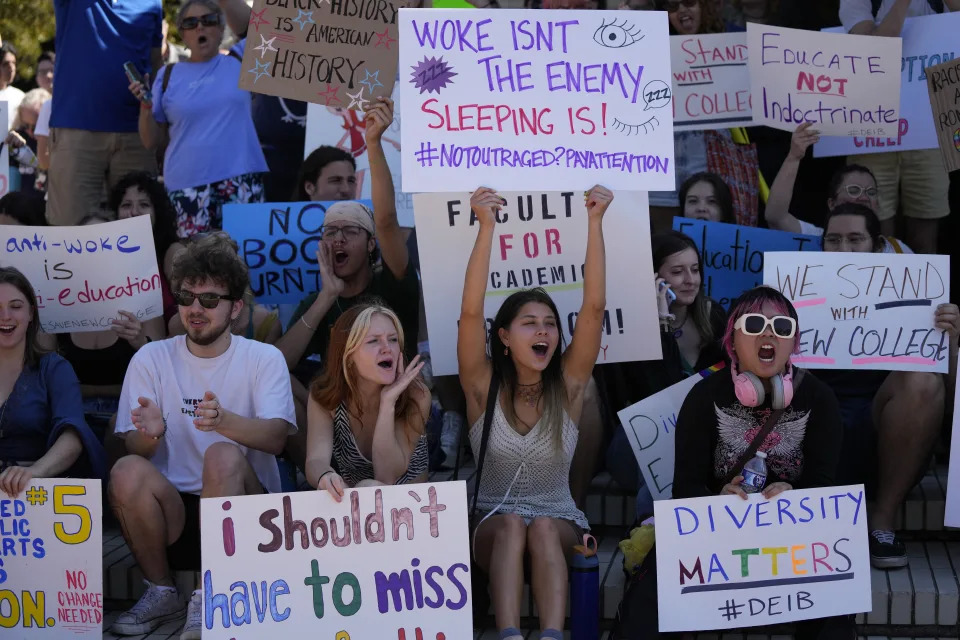
A person cheers as New College of Florida students and supporters protest ahead of a meeting by the college's board of trustees, Tuesday, Feb. 28, 2023, in Sarasota, Fla. The conservative-dominated board of trustees of Florida's public honors college was meeting Tuesday to take up a measure making wholesale changes in the school's diversity, equity and inclusion programs and offices.(AP Photo/Rebecca Blackwell)
A person cheers as New College of Florida students and supporters protest ahead of a meeting by the college’s board of trustees, Tuesday, Feb. 28, 2023, in Sarasota, Fla. The conservative-dominated board of trustees of Florida’s public honors college was meeting Tuesday to take up a measure making wholesale changes in the school’s diversity, equity and inclusion programs and offices.(AP Photo/Rebecca Blackwell)
New College of Florida's Interim President Richard Corcoran, center, listens during a meeting of the college's board of trustees, alongside trustee Matthew Spalding, left, Tuesday, Feb. 28, 2023, in Sarasota, Fla. The conservative-dominated board of trustees of Florida's public honors college was meeting Tuesday to take up measures making changes in the school's diversity, equity and inclusion programs and offices.(AP Photo/Rebecca Blackwell)
New College of Florida’s Interim President Richard Corcoran, center, listens during a meeting of the college’s board of trustees, alongside trustee Matthew Spalding, left, Tuesday, Feb. 28, 2023, in Sarasota, Fla. The conservative-dominated board of trustees of Florida’s public honors college was meeting Tuesday to take up measures making changes
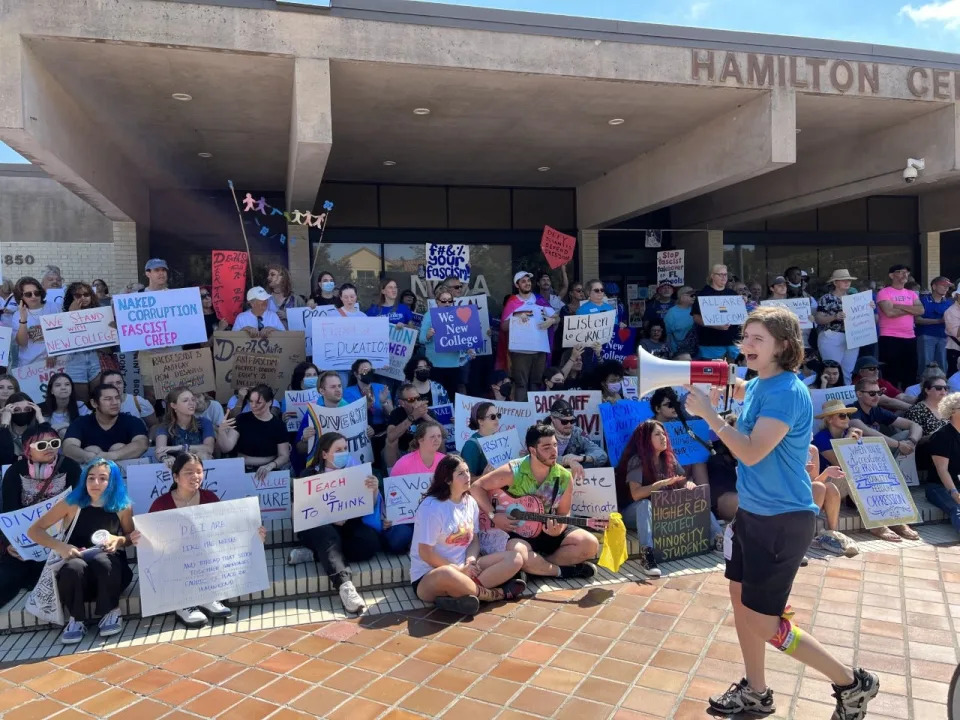
New College of Florida students and supporters protest ahead of a meeting by the college's board of trustees, Tuesday, Feb. 28, 2023, in Sarasota, Fla. The conservative-dominated board of trustees of Florida's public honors college was meeting Tuesday to take up a measure making wholesale changes in the school's diversity, equity and inclusion programs and offices. (AP Photo/Rebecca Blackwell)
New College of Florida students and supporters protest ahead of a meeting by the college’s board of trustees, Tuesday, Feb. 28, 2023, in Sarasota, Fla. The conservative-dominated board of trustees of Florida’s public honors college was meeting Tuesday to take up a measure making wholesale changes in the school’s diversity, equity and inclusion
New College of Florida students and supporters protest ahead of a meeting by the college's board of trustees, Tuesday, Feb. 28, 2023, in Sarasota, Fla. The conservative-dominated board of trustees of Florida's public honors college was meeting Tuesday to take up a measure making wholesale changes in the school's diversity, equity and inclusion programs and offices. (AP Photo/Rebecca Blackwell)
New College of Florida students and supporters protest ahead of a meeting by the college’s board of trustees, Tuesday, Feb. 28, 2023, in Sarasota, Fla. The conservative-dominated board of trustees of Florida’s public honors college was meeting Tuesday to take up a measure making wholesale changes in the school’s diversity, equity and inclusion programs and offices. (AP Photo/Rebecca Blackwell)
New College of Florida students and supporters protest ahead of a meeting by the college's board of trustees, Tuesday, Feb. 28, 2023, in Sarasota, Fla. The conservative-dominated board of trustees of Florida's public honors college was meeting Tuesday to take up a measure making wholesale changes in the school's diversity, equity and inclusion programs and offices. (AP Photo/Rebecca Blackwell)
New College Conservatives Protest
New College of Florida students and supporters protest ahead of a meeting by the college’s board of trustees, Tuesday, Feb. 28, 2023, in Sarasota, Fla. The conservative-dominated board of trustees of Florida’s public honors college was meeting Tuesday to take up a measure making wholesale changes in the school’s diversity, equity and inclusion programs and offices. (AP Photo/Rebecca Blackwell)
Two members of a group of parents of New College of Florida current students and a recent alum who came dressed as handmaids from Margaret Atwood's "The Handmaid's Tale," talk together as they wait to give public comment during a meeting of the college's board of trustees, Tuesday, Feb. 28, 2023, in Sarasota, Fla. The conservative-dominated board of trustees of Florida's public honors college was meeting Tuesday to take up measures making changes in the school's diversity, equity and inclusion programs and offices.(AP Photo/Rebecca Blackwell)
Two members of a group of parents of New College of Florida current students and a recent alum who came dressed as handmaids from Margaret Atwood’s “The Handmaid’s Tale,” talk together as they wait to give public comment during a meeting of the college’s board of trustees, Tuesday, Feb. 28, 2023, in Sarasota, Fla. The conservative-dominated board of trustees of Florida’s public honors college was meeting Tuesday to take up measures making changes in the school’s diversity, equity and inclusion programs and offices.(AP Photo/Rebecca Blackwell)

New College of Florida students and supporters protest ahead of a meeting by the college's board of trustees, Tuesday, Feb. 28, 2023, in Sarasota, Fla. The conservative-dominated board of trustees of Florida's public honors college was meeting Tuesday to take up a measure making wholesale changes in the school's diversity, equity and inclusion programs and offices. (AP Photo/Rebecca Blackwell)

New College of Florida students and supporters protest ahead of a meeting by the college’s board of trustees, Tuesday, Feb. 28, 2023, in Sarasota, Fla. The conservative-dominated board of trustees of Florida’s public honors college was meeting Tuesday to take up a measure making wholesale changes in the school’s diversity, equity and inclusion programs and offices. (AP Photo/Rebecca Blackwell)

SARASOTA, Fla. (AP) — Trustees picked by Republican Gov. Ron DeSantis to oversee New College of Florida voted Tuesday to abolish its small office that handles diversity, equity and inclusion programs targeted by conservatives throughout the state university system.

The trustees voted 9-3 to get rid of the school’s Office of Outreach and Inclusive Excellence, with four full-time staff positions to be transferred elsewhere to vacant jobs. The board also voted to permit interim President Richard Corcoran to consider ending a single online mandatory employee diversity training program that few actually take.

“This is not a very impressive DEI bureaucracy, is what I’m seeing,” said student body president Grace Keenan, who is a trustee and was not appointed by DeSantis. “Any DEI practices we do have here are all about inclusion. We don’t discriminate against anyone here.”

Although they are relatively small programs, some of the seven new trustees at the historically progressive college said it was important to take a stand on issues they believe cause discrimination based on racial, gender, LGBTQ and other group identities rather than focusing on a student, faculty or staff member’s individual merit.

“I think it’s important that we take a position,” said trustee Christopher Rufo, a conservative activist on education issues nationally. “It is essential to say we are taking this mandate seriously.”

The decision comes as DeSantis, widely expected to seek the GOP presidential nomination in 2024, has said a key goal for Florida’s higher education system is to defund DEI programs so they “whither on the vine” on campuses. DeSantis is backing a measure introduced for the upcoming legislative session to prevent colleges and universities from promoting, supporting or maintaining programs related to DEI or critical race theory.

The trustees’ vote to abolish the New College DEI office and transfer staff to other positions will save about $250,000 a year, according to documents provided at Tuesday’s meeting. Although that amount may seem relatively minor, supporters of the change said it will send a message.

“This is a question of what is being imposed and advocated, supported and funded, by the college,” said trustee Matthew Spalding. “If it’s a minor situation, it should be abolished.”

The trustee meeting drew a crowd of about 300 protesters before it began, holding signs that read, “Our Students Are Not Political Pawns” and, “If you’re not outraged, you’re not paying attention,” among others.

Chai Leffler, a third-year student, said he came from a southern, conservative family where being gay was difficult, but New College changed his life.

“I was taught how to love myself again and to stand up for myself like we all are today,” Leffler said. “I understand we are everything DeSantis hates.”

New College, nestled along Sarasota Bay, has fewer than 1,000 students. It was founded in 1960 as a private school in part by funding from the United Church of Christ, said Rev. John Dorhauer, the church’s president and general minister. Dorhauer gave public testimony at the meeting and spoke to the protesters about the “moral outrage” he feels at the changes being made by the conservative trustees chosen by DeSantis.

“The long arc of history will grind you into dust, and they (students) will win this battle and you will be remembered for the sycophants you are,” he told the trustees.

Anderson reported from St. Petersburg, Florida.

Emotional meeting ends with DeSantis’ New College of Florida board abolishing diversity office

USA Today

Emotional meeting ends with DeSantis’ New College of Florida board abolishing diversity office

Zac Anderson, USA TODAY NETWORK – March 1, 2023

Gov. Ron DeSantis proposes a plan to remove and reform diversity-based education programs

Governor Ron DeSantis plans to remove and reform education programs that focus on diversity, equity and inclusion initiatives from state universities.

New College of Florida’s Board of Trustees abolished the office handling diversity, equity and inclusion programs during a contentious and emotional meeting Tuesday that included testimony from students worried that a board reshaped by Gov. Ron DeSantis is making the school unwelcoming to minorities.

DeSantis appointed six members to New College’s board on Jan. 6 in an effort to transform the school, putting the small Sarasota institution at the center of the GOP’s nationwide pushback on education policies aimed at supporting historically marginalized groups, including racial minorities and LGBTQ individuals.

DeSantis has emerged as a key national figure in this debate after he pushed through legislation governing how K-12 schools discuss race and gender identity and recently prohibited an Advanced Placement course in African American studies, which caused an uproar. The governor is now taking aim at university programs.

Eliminating diversity, equity and inclusion (DEI) initiatives − which have become a major flashpoint for conservatives and a target of DeSantis throughout Florida’s public university system − is among the first substantive actions by New College’s revamped board, which also fired the former president last month and hired DeSantis ally Richard Corcoran as interim president. Corcoran’s first board meeting was Tuesday.

How conservatives are reshaping colleges: Board shake-ups, threats to tenure and money

‘Hillsdale of the south’: DeSantis launches conservative overhaul of a Florida college’s board

‘We value academic freedom’: Students walk out in protest of Ron DeSantis’ education policies

A review of DEI programs

Among DeSantis’ New College board appointees is prominent conservative activist Christopher Rufo, who pushed at his first meeting on Jan. 31 to abolish diversity programs.

The board opted to wait until more research could be done. College administrator Brad Thiessen presented the results of his DEI review Tuesday, delving into everything from faculty training to hiring practices and student admissions.

Thiessen said there was little mandatory diversity training and that only recently had prospective faculty been asked to submit a statement in their job application outlining how they would promote diversity.

Richard Corcoran the new interim president of New College of Florida was not welcomed by the majority of students and adult speakers.

Additionally, only one of the employees in the Office of Outreach and Inclusive Excellence was primarily focused on DEI programs. The others managed grants, worked on community outreach and performed other activities that aren’t controversial.

That led Trustees Grace Keenan and Matthew Lepinski to question whether the impacts of the DEI programs had been overstated.

“I’m concerned that we’re solving a problem that isn’t serious, or doesn’t really exist,” Lepinski said.

Keenan wondered if the board was spending a lot of time and energy on something that was relatively limited in scope. She suggested that the effort spent weeding out DEI programs was out of proportion to the amount of DEI that actually exists on campus.

“This is not a very impressive DEI bureaucracy,” Keenan said.

Keenan, Lipinski and Trustee Mary Ruiz voted against eliminating the diversity office.

Conservative appointee Christopher Rufo: DEI efforts discriminatory

Rufo conceded that DEI isn’t as deeply embedded in the college’s practices as he expected, but said it was still important to remove it on “principle.” Rufo and Trustee Matthew Spalding both suggested it is discriminatory to take race into account when setting the college’s priorities.

“It treats people differently on the basis of their skin color,” Rufo said.

“This is discrimination, it should be gone,” Spalding added.

The majority of trustees voted to have Corcoran move forward with eliminating the Office of Outreach and Inclusive Excellence, which handles DEI programs. The Office’s four employees will be offered other jobs.

New College students protest before a board of trustees meeting on campus Tuesday.

Trustees also voted to eliminate the diversity statement when hiring faculty and to direct Corcoran to consider adopting a prohibition on diversity training for employees.

Additionally, the board voted to have Corcoran create a school policy that prohibits spending money on any DEI efforts.

Under the new regulation, DEI will be defined to include “any effort to manipulate or otherwise influence the composition of the faculty or student body with reference to race, sex, color, or ethnicity.”

The definition of DEI also would include: “Any effort to promote as the official position of the administration, the college, or any administrative unit thereof, a particular, widely contested opinion referencing unconscious or implicit bias, cultural appropriation, allyship, transgender ideology, microaggressions, group marginalization, anti-racism, systemic oppression, social justice, intersectionality, neo-pronouns, heteronormativity, disparate impact, gender theory, racial or sexual privilege, or any related formulation of these concepts.”

The rollback of New College’s diversity programs came at the end of a 3-1/2-hour meeting that featured emotional testimony for students, parents and others. About 200 people attended the meeting.

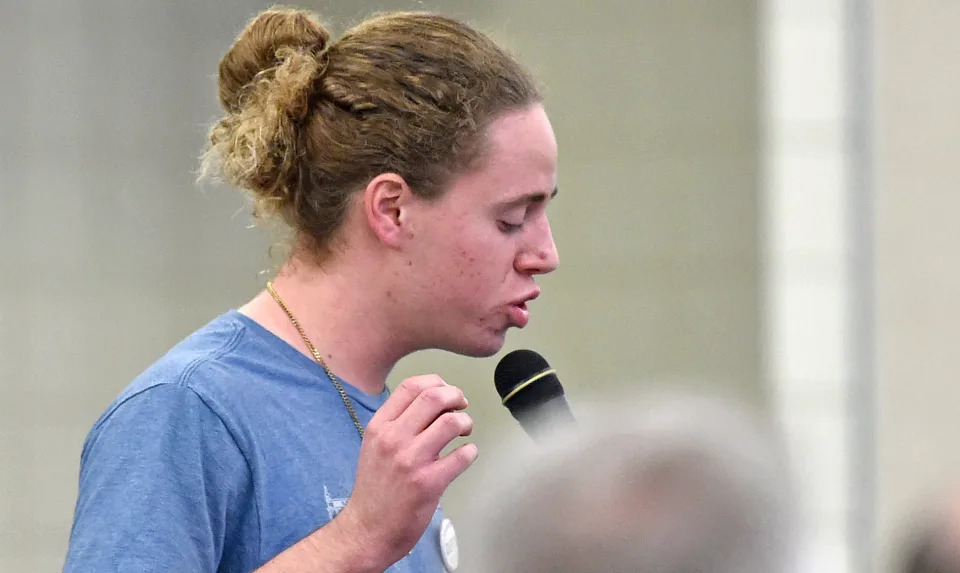
Economics and finance student Joshua Epstein, 17, argued diversity programs are important at a meeting of the board of trustees of New College of Florida Feb. 28, 2023. The board votes to abolish the school's office handling diversity, equity and inclusion programs.
Economics and finance student Joshua Epstein, 17, argued diversity programs are important at a meeting of the board of trustees of New College of Florida Feb. 28, 2023. The board votes to abolish the school’s office handling diversity, equity and inclusion programs.
Where is New College of Florida?

New College of Florida is in Sarasota, in the central part of the state just south of Tampa on the Gulf Coast. The college bills itself as a community of “Free Thinkers, Risk Takers and Trailblazers,” and invites prospective New College students to “discover a public arts and science education driven by your curiosity, career aspirations, and individual learning style.”

Parents, students decry abolishing diversity programs

Economics and finance student Joshua Epstein, 17, said he graduates next year and plans to become a corporate lawyer or banker.

“Folks, I am so far from woke,” Epstein said.

Yet Epstein argued that the school’s diversity programs are important. Epstein said his grandparents on his father’s side survived the Holocaust and his grandfather on his mother’s side was a tank commander in the Israeli Army “where he fought for the survival of a Jewish state to fight to have a place where I’d be safe from persecution if people ever saw Jews as less than human again.”

“Today I fear that other groups of people are being seen as less than human; today I fear that we may eliminate the office that ensures that the composition of our classrooms resemble that of our great nation,” Esptein added.

The concerns raised by the public extended beyond eliminating diversity programs to DeSantis’ broader effort to reshape the school, Corcoran’s $699,000 base salary and other issues.

Corcoran thanked DeSantis during his first public remarks as interim president, saying the governor has “a heartfelt desire to have New College be a leader” in liberal arts education.

Diversity and equity demand: Why are colleges offering up more DEI degrees? Demand for diversity expertise is growing.

Affirmative action: The next legal battle over race and education has already begun

Students vow continued resistance

Earlier in the day students joined religious and political leaders in a large protest before the board meeting.

About 300 people gathered in front of the Hamilton Center on New College’s Sarasota campus to again criticize DeSantis’ conservative takeover of the school and vow continued resistance. Many of the speakers were minority students who criticized the push to eliminate the Office of Outreach and Inclusive Excellence.

DeSantis has targeted DEI programs across all of Florida’s public universities, and New College is first in line.

Lianna Paton, a minority student in her first year at New College, said targeting DEI programs is an attempt to suppress and “erase students of color.”

“You do not get to say diversity is divisive when its very existence is what makes communities like my own feel welcome and safe,” Paton said.

New College supporters protested before a board of trustees meeting on campus Tuesday.

Members of the crowd held up signs saying “Black history is American history” and “Jesus was/is woke.”

Chai Leffler, 21, a gay third year New College student, said he struggled with his sexuality growing up and went through a dark time in high school. He went to a youth center in Sarasota where he met New College students who made him feel welcome.

“There’s one thing they cannot change,” Leffler said. “Us. We the students of New College are the spirit of New College and we will not let that be taken away from us.

Church leader accuses DeSantis’ of prioritizing presidential ambitions

Rev. Dr. John C. Dorhauer leads the church that helped found New College as a private school in 1960 before it became part of the state university system. He said he is outraged by what DeSantis is doing to the school.

“I want to express my moral outrage at Gov. DeSantis willing to compromise and sacrifice the future, the vision, the hopes, the dreams and the safety of the students on this campus for his aspirations to serve as president,” Dorhauer said.

Dorhauer’s United Church of Crist provided funding to create New College and church members were active in the school during its early days.

Dorhauer also spoke at the board meeting, where he told trustees that their actions will be judged harshly by history.

“The long arc of history will grind you into dust and… you will be remembered for the sycophants that you are,” he said. “That’s what history does.”

‘Incomprehensible’: White House slams DeSantis administration for rejecting AP Black studies

AP African American Studies: Here’s what’s actually being taught in the course Florida rejected

Exacting punishment: Florida Gov. Ron DeSantis takes over Disney district on eve of book launch

‘Trans people go to dances and find joy and are whole’: A mom’s viral photos of her daughter send a powerful message

Yahoo! Life

‘Trans people go to dances and find joy and are whole’: A mom’s viral photos of her daughter send a powerful message

Beth Greenfield, Senior Editor – February 28, 2023

Jaime Bruesehoff recently shared side-by-side photos of her daughter Rebekah
Jaime Bruesehoff recently shared side-by-side photos of her daughter Rebekah, one at age 10 and one at 16, to show that trans people “find joy and are whole people.” (Photo: Twitter/Jaime Brusehoff)

Rebekah Bruesehoff may only be 16 years old, but she’s spent almost half her life publicly fighting for her rights as a transgender person.

It’s why her supportive, activist mom Jamie took a moment this week to tweet a joyous photo of Rebekah in a green gown and holding white flowers, primped and ready to attend a high school dance — an update to one that went viral in 2017, of Rebekah at a rally holding a sign that read, cheekily, “I’m the scary transgender person the media warned you about.” That image appears alongside the new one.

“There’s this juxtaposition,” Jamie tells Yahoo Life, referring both to the two photos and her daughter’s life. “The photo from six years ago popped up in my memories, and I was struck: It feels so long ago and like it was just yesterday.” When the photo came up, she says, she was at a nail salon with Rebekah, who was getting a manicure before her sophomore cotillion. Sharing both photos, Jamie explains, felt like an opportunity to show a more well-rounded view of her teen, who plays field hockey and loves musical theater.

Image
Image

“She’s spent six years fighting publicly — but she’s also just a teen going to a fun dance,” she says. “That’s so much of what the Twitter thread was about… that trans people go to dances and find joy and are whole people, and that trans people are more than just their fights for rights and for life.”

The original photo of Rebekah, then 10, holding the sign inspired by a story she had found online, was snapped just before a protest in Jersey City, N.J., over the Trump administration rescinding federal support for transgender students. The tween was asked to speak in front of the crowd of 200, which she agreed to, and then her mom posted the image to Facebook, where it “went crazy viral.”

Looking back now, says Jamie, “It’s certainly not what any of us had planned. But what was really powerful was to see her use her voice and say, ‘I deserve a safe school.’ But even more impactful for her was she heard the voices of the other people… trans kids who were not supported, trans adults… it was the first time, at 10 years old, that she realized how good she had it and how much work we had to do.”

That idea, of work left to do, is especially important now, says Jaime on Twitter: “In ways, things are worse than I could have imagined 6 years ago… and yet she continues to resist with advocacy, speaking and education. She resists with her joy, she resists by growing into this beautiful young woman that so many wish she wouldn’t have the chance to become.”

She’s referring to the unprecedented number of anti-trans and anti-gay bills popping up across the country: Just two months into 2023, LGBTQ-rights organization the Human Rights Campaign (HRC) is tracking 340 anti-LGBTQ bills introduced at state levels, 150 of which would specifically restrict the rights of transgender people, 90 of which would prevent trans youth from being able to access gender-affirming medical care; two have become law, in Utah and South Dakota.

“Things are pretty awful right now,” Jaime tells Yahoo Life. “We live in New Jersey … so there’s some privilege and some level of safety that comes with that — and also, you’re not safe anywhere, we know that. My heart breaks for all transgender young people. Their identities are being used as a political football.”

Because Rebekah is an athlete — and luckily having a “really positive experience” on her hockey team — her family “really jumped into” having public conversations supporting transgender athletes, only to see “attacks on health care getting worse by the day,” she says, adding “it’s become very clear” that the anti-trans fight “is not about protecting children. It never has been. It’s about political power and removing transgender people from public life.

“https://www.instagram.com/p/Cm45juJuVbN/embed/captioned?cr=1&v=12

But even in New Jersey, where there are some protections in place — like state’s LGBTQ-inclusive school curriculum and the Babs Siperstien Law, which allows people to change their gender identity on their birth certificate without “proof of surgery” — there’s no way to fully escape the national rhetoric.

“What people don’t understand is that young people are impacted by these messages … They are seeing what’s happening, watching their identity be banned from public conversations in schools,” she says. “People, even in states like New Jersey and New York, know what’s going on. And for a young person to see their identity being debated on every front? That’s exhausting.”

Luckily, the mom notes of her daughter, “Rebekah is a big joy-as-resistance kind of person. She focuses on the positive, has friends, loves to laugh. It’s how she, I think, sustains herself.” She also recognizes her relative privilege: “She’s white, she exists within the gender expectations people have for girls and she has supportive parents who have been behind her and who have resources.”

Rebekah’s glowing spirit, her mom says, has powerfully influenced the entire family — including her “super-supportive” brothers, ages 8 and 13, and her father, a Lutheran pastor who, Jaime says, “preaches the gospel … that calls for us to work towards justice.” She adds that “he preaches the message of inclusion and of celebration of LGBTQ+ people.

“https://www.instagram.com/p/Cncd4buOitt/embed/captioned?cr=1&v=12

But it’s Jamie, who identifies as “queer” and uses “she/they” pronouns (including on her website and social media profiles), who might be most influenced by her teen’s courage.

“I’m bisexual,” she tells Yahoo Life. “I came out more publicly in 2018. I think there was some part of doing this work, of advocating for my daughter to show up in all her authenticity, that started to feel inauthentic for me not to share.” As for her use of she/they, which is new as of about a year, Jamie adds, it’s one way she is “continuing to break down those boxes of gender, and understand myself in the fullness of who I am. ‘They’ feels really great.

“https://www.instagram.com/p/Cnr4xxlOcRJ/embed/captioned?cr=1&v=12

Jamie, who has written a book due out in September — Raising Kids Beyond the Binary: Celebrating God’s Transgender and Gender-Diverse Children, meant to fill a gap wherein there is no guidance about raising “gender expansive kids in faith, when we know it’s people of faith who are doing the most harm” — adds that coming out has been powerful.

“I think with me sharing my identity as a bisexual person and my identity not as nonbinary, but as someone who feels constrained by the gender binary, and I think watching Rebekah live her life as who she knows herself to be and the positive impact it’s had,” she says, “I know that showing up as ourself changes the world.”

‘Extremely dangerous’: Spike in illegal crossings at Canada-Vermont border has feds sounding alarm

USA Today

‘Extremely dangerous’: Spike in illegal crossings at Canada-Vermont border has feds sounding alarm

April Barton, Burlington Free Press February 27, 2023

President Joe Biden urges migrants to not come to US-Mexico border: ‘Stay where you are’

President Joe Biden unveiled new steps aimed at stemming historic migration as he plans to visit El Paso, Texas.

BURLINGTON, Vt. — Migrants passing into the U.S. by illegal means via Swanton, Vermont have escalated massively in recent months.

Between October and January, apprehensions and encounters at the Canadian border have jumped nearly 850% compared to the same four months a year ago, according to U.S. Customs and Border Protection’s Swanton sector.

During the month of January there were 367 encounters, more than the past 12 years of January totals combined, said Ryan Brissette in a press release for the Swanton border patrol.

The number of border patrol encounters in Swanton started to climb in July 2022. During the seven-month window through January 2023, there have been 2,070 instances of illegal crossings. In that same period, there were 258 the year prior and 225 the year before that.

Northern and Southern borders see uptick in rescues

The uptick is causing problems for officials, especially considering dangerously cold temperatures that have put border crossers’ and border control agents’ lives at risk. Brissette noted -4 degree temperatures and “life-saving aid” that was provided during encounters in Newport, Vermont, and Burke, New York.

More: Arizona will keep sending migrants where ‘they actually need to go’

“It cannot be stressed enough: not only is it unlawful to circumvent legal means of entry into the United States, but it is extremely dangerous, particularly in adverse weather conditions, which our Swanton Sector has in incredible abundance,” Swanton Sector Chief Patrol Agent Robert N. Garcia said in a press release.

The southern border has also seen an increase in rescues, as the U.S. places a renewed emphasis on rescuing migrants and historically high numbers of immigrants seek asylum at U.S. borders.

The numbers at the southern border, the nation’s busiest corridor, show a sharp increase in border rescues, according to data released this month from U.S. Customs and Border Protection, the agency overseeing Border Patrol:

  • 5,336 migrants rescued at southern border in fiscal year 2020.
  • 12,857 migrants rescued at southern border in fiscal year 2021.
  • 22,014 migrants rescued at southern border in fiscal year 2022, which ended in September.

In fiscal 2021, agents at the southern border tallied 568 migrant deaths, the highest ever recorded.

Most of the deaths (219) were attributed to “environmental exposure-heat” as people trek through blazing terrain in Arizona and Texas. Agents also counted 86 deaths as “water-related” as migrants try to cross canals or the swift-moving Rio Grande, which divides the U.S. and Mexico.

Immigration advocates and experts believe the border death toll is much higher, and the federal system for death data long failed to include many border deaths.

The Wall: ‘Mass disaster’ grows at the U.S.-Mexico border, but Washington doesn’t seem to care

Who is crossing the Vermont-Canadian border

There are no clear-cut answers as to why people are crossing as the circumstances differ for each person or group, said Steven Bansbach, a public affairs officer for U.S. Customs and Border Protection. Many are being dropped off near the border by car and then proceeding across land on foot, he said.

https://flo.uri.sh/visualisation/12838349/embed

Among the border crossers are family groups that include infants and children who are particularly vulnerable to the cold. Bansbach said many are crossing at night while cold and sleep deprived, all of which can be disorienting.

Border patrol usually detains, arrests and sends those apprehended back to where they came from, according to Bansbach.

Fact check: False claim that those in country illegally can become police officers in California

More: Rescues of asylum-seekers soar as Border Patrol ramps up efforts and more migrants arrive

Looking at the countries of origin of encounters involving the border patrol in Swanton, a vast majority are from Mexico. Among the 1,513 encounters from October through January, 945 originated from Mexico.

“They may be trying to find a path of least resistance to enter into the U.S.,” Bansbach surmised. “And they may know there’s a conundrum at the southwest border and so they may find that the northern border they may sneak across to have a better advantage.”

The U.S.’s southern border has been a point of contention, from border walls, to the separation of children and parents, to immigrants being caught up in political brinkmanship being shipped from southern states to northern ones, in some cases dropped off on a political opponent’s doorstep.

Contributing: Rick Jervis, USA Today

Rail Industry Pushes Sensors Over Brakes After Ohio Train Crash

Bloomberg

Rail Industry Pushes Sensors Over Brakes After Ohio Train Crash

Thomas Black – February 26, 2023

(Bloomberg) — The train derailment that spilled toxic chemicals into a small Ohio town has revived a long-running debate about railroad safety — and some industry players think they have just the thing to resolve it.

The Feb. 3 crash of the Norfolk Southern Corp. train in East Palestine, Ohio, has renewed a push for railroads to adopt electronic brakes that could help prevent a malfunctioning train from endangering people and property. Electronically controlled pneumatic, or ECP, brakes have been touted for their capacity to bring trains to a halt in shorter distances and prevent dangerous pileups.

The Biden administration has blamed industry stonewalling for blocking regulations that would have mandated use of the systems on some trains — even though it isn’t clear that ECP brakes would’ve done much to mitigate an accident similar to the one in Ohio, and the proposed rules wouldn’t have applied to the train that crashed.

The railroad industry has found itself in a tight spot as the political furor around the accident grows, with former President Donald Trump turning up in East Palestine, and the derailment becoming a talking point on cable news and Capitol Hill. The episode has aggravated fears about the safety of sending chemicals and other hazardous materials over the rails, and raised the specter of new regulation at a time when railroads are coping with restive workers and annoyed customers.

Installing ECP brakes that the Biden administration and safety advocates favor would be expensive and cumbersome for a business beset by complaints about delays and lackluster service. The brakes need to be installed on each car to work properly — a daunting prospect for an industry with some 1.5 million cars on the tracks and little idle capacity.

A coalition that includes railcar makers, shippers and two large railroads say they have a different idea. They want to place sensors on railcars that could flag faulty equipment immediately to a train’s crew and others monitoring remotely. The system is being tested on 400 railcars and could be available commercially by the end of this year, according to the group, which calls itself RailPulse.

Such sensors could potentially catch problems like the overheated wheel bearing that likely caused the East Palestine wreck. Electronically controlled brakes, on the other hand, may not have even done much to mitigate the derailment if they were installed, based on a 2017 study by the National Academy of Sciences.

Notably, a sensor apparatus also would likely be much less expensive for the industry to put into place. RailPulse says its system would cost about $400 to $900 per railcar.

Smart Railcars

The use of remote sensing technology on the railroads isn’t entirely new. Currently, sensors known as wayside heat detectors placed along the tracks screen train cars for defects — and they sniffed out the trouble in Ohio. Wayside detectors were voluntarily adopted by railroads to reduce accidents; Norfolk Southern said it has nearly 1,000 of them.

According to a preliminary report by the National Safety Transportation Board, Norfolk Southern’s wayside detectors in Ohio were working, but caught the overheated wheel too late. The NTSB found that a wayside detector about 20 miles before the crash site measured the wheel bearing at 103 degrees Fahrenheit above ambient temperature — hot, but below a level that calls for the crew to stop and take a look.

However, the next detector, just ahead of the crash site, recorded a wheel temperature at 253 degrees above, a critical level. The sensor sounded an alarm, but it was too late. The wheel failed and caused 38 of the train’s 149 railcars to careen off the rails.

Sensors mounted directly on railcars could diagnose the issue sooner and buy critical time, backers say. Railcars will likely have multiple sensors in the near future that can detect anything from open doors to signs that equipment is in danger of failing, said David Shannon, general manager of RailPulse.

“Our objective is to make railcars smart,” Shannon said.

The group’s pilot program, which is testing five types of sensors, will be on 1,000 railcars by this summer, he said, and should be ready for real-world use by the end of this year. RailPulse plans to provide a subscription service to transmit the data to the cloud, and is counting on manufacturers to design the sensors the industry needs.

ECP Debate

Norfolk Southern was on the forefront of testing ECP brakes before the US Department of Transportation decided to require them on high hazard flammable trains in 2015. The company opposed the mandate because of cost, the brakes’ reliability and the inability to mix locomotives and railcars that didn’t have the system.

One of the biggest drawbacks of ECP brakes is that all the railcars on a train must have them or the system doesn’t work, making it impossible to phase in gradually. The rule followed a spate of derailments by trains shuttling crude oil from fracking hotspots where there were no pipelines to refineries.

As part of an infrastructure bill in 2015, Congress required the transportation department to justify the need for ECP braking. The National Academy of Sciences was ordered to examine computer modeling the department used to support its position that they had a significant safety advantage over conventional brakes.

After tests at a Norfolk Southern rail yard in Conway, Pennsylvania, and the New York Air Brake Facility in Watertown, New York, the academy said in a 2017 report that the department’s efforts to validate its modeling “do not instill sufficient confidence in DOT’s comparison of the estimated emergency performance of ECP braking systems” with other systems. That paved the way for the Trump administration to rescind the mandate.

In a Feb. 19 letter to Norfolk Southern Chief Executive Officer Alan Shaw, Transportation Secretary Pete Buttigieg faulted the industry for opposing ECP brakes. “Rather than support these efforts to improve rail safety, Norfolk Southern and other rail companies spend millions of dollars in the courts and lobbying members of Congress to oppose common-sense safety regulation,” Buttigieg wrote.

However, others in the federal government have pushed back on the idea that the ECP mandate would have prevented the Ohio crash.

“Some are saying the ECP (electronically controlled pneumatic) brake rule, if implemented, would’ve prevented this derailment. FALSE,” NTSB Chairman Jennifer Homendy said in a Feb. 16 tweet. She went on to explain why the Norfolk Southern train wasn’t designated as high hazard flammable. “This means even if the rule had gone into effect, this train wouldn’t have had ECP brakes.”

Uphill Battle

The prospect that regulators would swiftly put the electronic-braking rules in place following the Ohio crash is remote. To reinstate the mandate would be an uphill battle, a senior White House official acknowledged during a Feb. 17 briefing. The rulemaking process takes years and it would be difficult to pull off after Congress weighed in against the technology.

Similarly, persuading the entire railroad industry to go along with RailPulse’s sensors could be a tall order.

Workers are wary of new safety technologies that the industry touts, especially if they are aimed at replacing human inspections, said Mark Wallace, vice president of the Brotherhood of Locomotive Engineers and Trainmen. For the past five years, the railroads’ first priority has been profit, not safety, Wallace said. Operating profit margin for North American railroads increased to 39% last year from 34% in 2017.

“If you’re going to implement the technology, then you have to maintain the technology and you have to have somebody in place to make sure that it’s working properly,” he said.

Additionally, railcars are mostly owned by shippers and by leasing companies. Shippers are pushing to be able to track their freight cars just as they can for trailers on trucks, the railroads’ main competitor for freight. Some large railroads, including CSX Corp. and BNSF Railway, aren’t part of the coalition.

In Town Where Train Derailed, Lawyers Are Signing Up Clients in Droves

The New York Times

In Town Where Train Derailed, Lawyers Are Signing Up Clients in Droves

Campbell Robertson – February 25, 2023

A welcome sign on the outskirts of East Palestine, Ohio on Feb. 23, 2023. (Maddie McGarvey/The New York Times)

EAST PALESTINE, Ohio — In the three weeks since a freight train derailed in East Palestine and released more than 100,000 gallons of toxic chemicals, lawyers have poured into the little town, signing up clients, gathering evidence and already filing more than a dozen lawsuits in federal court on behalf of local residents.

They have held information sessions nearly everywhere a crowd can gather, including at a nearby Best Western, at the American Legion hall and in the packed cafeteria at East Palestine High School. Their message overall has been one of warning: It may be months, years or possibly even decades before the derailment’s ultimate effect on people’s health, property values or the soil and water becomes clear.

Further, the lawyers say, early moves by Norfolk Southern, the operator of the train, suggest that getting comprehensive answers from the company will not be easy.

Among a public that is deeply skeptical of official test results — Gov. Mike DeWine, a Republican, and other state and federal officials say they have not shown anything alarming so far — or camera-friendly efforts at reassurance, these warnings have resonated.

The distrust has been deepened by a sense that politicians are not being diligent enough in their response to the disaster; on Friday, President Joe Biden said that he had no plans to visit, although he pointed out that federal officials had arrived there within hours of the crash, and that he was “keeping very close tabs on” the situation.

“They get what’s happening,” Rene Rocha, a lawyer with supersize personal injury firm Morgan & Morgan, said during a state hearing about the derailment Thursday in Beaver County, Pennsylvania, just across the border from East Palestine.

Referring to residents there who had spoken at the hearing about headaches, coughs and other classic symptoms of chemical exposure, he added: “They see they’re not getting the truth from the politicians and the company. That leaves the lawyers.”

Norfolk Southern declined to comment Friday on matters involving litigation.

The huge scale of the chemical burn-off and the harrowing images of the fire, as well as the intense politicization of it all, have made the derailment in East Palestine among the most high-profile environmental disasters in the country in years.

Television cameras are still routine fixtures on the sidewalks of the town’s central street. On Friday night, Erin Brockovich, the famed environmental activist who years ago exposed corporate wrongdoing that polluted drinking water, spoke to a packed town hall at the East Palestine High School auditorium.

The event, billed as an “educational seminar” and organized by a law firm based out of Akron, Ohio, consisted mostly of a detailed presentation by Mikal Watts, a prominent Texas lawyer, about the potential health effects of the derailment and the legal landscape that plaintiffs would be facing. But it began with a short speech from Brockovich to the hundreds sitting in the auditorium and watching an overflow screen in the gym.

“You’re going to be told it’s safe, you’re going to be told not to worry: Well that’s just rubbish,” she said. Of the derailment in East Palestine, she said, “I’ve never seen anything in 30 years like this.”

To some local attorneys, the army that has descended on the town is exasperating. “Did they even know where East Palestine was prior to this accident?” fumed David Betras, a lawyer who has spent his career just up the road in Youngstown, Ohio, and is planning to file a suit on behalf of hundreds of local residents. “They come in with this star power. Like, ‘Oh, Erin’s gonna solve it.’”

On Thursday night, Steve and Kelly Davis sat down in a yet-to-be-opened wine bar a short walk from where the train cars left the tracks nearly three weeks earlier. Thousands of their bees had been found dead after the burn-off, thousands of dollars’ worth of boxes that had housed the bees were now in questionable condition and the reputation of the family honey business was in jeopardy.

Their son, on the verge of buying a house downtown, was suddenly getting a cold shoulder from the bank. No one had come to test their well water. And to top it all off, Steve Davis had developed a cough.

They had come to meet with Robert Till, a Texas-based investigator for the law firm of Cory Watson who for weeks has been meeting people at a table set up in the empty bar. Till has met with hundreds so far, he said, talking with people about their health conditions, learning how their businesses have been affected and asking whether they have cleaned their homes — and if they have held onto the cleaning materials, which he said would contain critical data about contamination.

“I’m putting you guys on for priority testing,” he told the Davises.

“For the water?” Steve Davis asked.

“For everything,” Till said.

The legal machinations are in their early stages. Cases might ultimately be consolidated as class-action or multidistrict litigation; most of the suits will almost surely end up bundled before one or several federal judges in an Ohio courtroom.

Norfolk Southern may offer some sort of resolution voluntarily, whether by setting up a compensation fund with an independent administrator, as BP did after the 2010 oil spill in the Gulf of Mexico, or establishing a court-supervised medical monitoring program, where people could come for free testing related to possible health effects.

The company has already been paying $1,000 in “inconvenience compensation” to people who had to evacuate. Although Norfolk Southern insists that the payments do not curtail anyone’s right to sue, many are skeptical.

Lawyers point to certain moves made by the company — including a letter sent Thursday notifying plaintiffs’ attorneys that they had two days to inspect the rail cars before the cars were removed or destroyed — as signs that it would be combative.

There is no shortage of experience among the members of the plaintiff’s bar arriving in town: Train derailments are not unusual in the United States, nor are oil spills, chemical leaks or industrial accidents.

“It looks like these dadgum railroads would get it right after that many years and stop falling off the tracks, but they just can’t do it,” said Calvin Fayard Jr., a Louisiana lawyer who took the lead in a suit after a train carrying vinyl chloride — one of the substances that spilled and burned in East Palestine — derailed in a small Louisiana town in 1982.

As part of a $39 million settlement arising from the 1982 derailment, a commission was set up to monitor long-term health effects and oversee the decontamination of soil and water. That commission continued its work for more than 30 years, dissolving less than a decade ago, said Fayard, whose law partner has been in East Palestine talking with potential clients.

But a program of that magnitude is never a sure thing. After a train carrying vinyl chloride derailed in Paulsboro, New Jersey, in 2012, a federal judge ruled against any medical monitoring program and dismissed the suit; settlements were ultimately reached in state court.

No sooner had Till signed up the Davises as clients Thursday evening than another couple walked in, keeping him at work. The Davises stepped outside to talk with Michael McKim, the owner of the wine bar, which so far remains on track to open next month.

McKim had met Till in a hotel lobby during the town’s initial evacuation, and had been letting him use his place as an office ever since. This was all new to both couples.

“I feel like a baby seal in the middle of the ocean surrounded by great white sharks,” McKim said. But with as big a shark as Norfolk Southern as the defendant, he said, joining up with a law firm was his best chance. “It’s kind of nice to at least hang out with a shark that maybe understands.”

Putin’s energy war has flopped (so far)

Yahoo! Finance

Putin’s energy war has flopped (so far)

Rick Newman, Senior Columnist – February 24, 2023

When Russia invaded Ukraine a year ago, President Vladimir Putin had a lot more in his war plan than tanks and missiles. Putin also planned an energy war in parallel with his military war on the ground in Ukraine.

Putin’s military war has gone badly, his army decimated after failing to seize Ukraine, as planned. Putin’s energy war has failed, too. Neither war is over, but the many nations now allied against Russia have done a remarkable job blunting Putin’s most potent economic weapon.

Putin clearly anticipated sanctions against his country in response to the 2022 invasion. He also thought he could counter those sanctions using Russian energy, which Europe in particular was dependent on. Russia is the world’s third-largest oil and natural gas producer, and at the time of the invasion, it was Europe’s top source of gas, needed to produce electricity.

At first, Putin’s energy war worked as planned. Sanctions imposed by the United States and other nations largely exempted Russian energy, to protect consumers from price spikes. But the unpredictable nature of those sanctions, plus instability caused by the war itself, generated a “fear premium” in energy markets that pushed prices up. Oil prices spiked from about $90 before the invasion to nearly $125 four months later.

U.S. gasoline prices hit $5 per gallon last June, damaging President Biden’s popularity and making inflation a bigger everyday concern for Americans than the war in Ukraine. Natural gas prices rose by far more than oil and gasoline. Russia started reducing gas flows to Europe last June, then completely shut the main gas pipeline to Europe in September.

https://flo.uri.sh/story/1836372/embed?auto=1

By late August, European natural gas prices were four times higher than before the war. Wintertime rationing seemed likely, along with a recession caused by sporadic business shutdowns and painful energy inflation. Gas prices surged in the United States as well, though not by as much in Europe, given that gas is not as transportable as oil, generating regional price differences.

Soaring energy prices were exactly the kind of pain Putin planned for nations opposing his war. His hope was that high energy prices among Ukraine’s allies would wreck their economies, undermining public support for sanctions and for aid to Ukraine.

https://flo.uri.sh/visualisation/12840951/embed?auto=1

The full-blown energy crisis Putin tried to create never materialized, however. Prices tell the story. Oil, gasoline and natural gas prices are now lower than they were before Putin invaded, as the chart above shows. Russia is still a crucial source of energy, but the nations it tried to bring to heel have reconfigured their energy supply chains with speed and skill nobody foresaw a year ago.

“The last year may be remembered as the twilight for Russian energy leverage,” Richard Morningstar, founding chairman of the Atlantic Council Global Energy Center, wrote in a January report. “Moscow’s energy strategy is not working, and its ability to wield energy chaos as a geopolitical weapon is waning.”

Several concerted actions by Ukraine’s allies parried Putin’s energy offensive. In the United States, President Biden released an unprecedented amount of oil from the strategic reserve, with other countries releasing smaller amounts. Though not huge relative to total oil supply, those releases seem to have reassured markets and brought price relief at the margins.

TOPSHOT - Workers repair high-voltage power lines cut by recent missile strikes near Odessa on December 7, 2022, amid the Russian invasion of Ukraine. - A new barrage of Russian strikes on December 5, left several Ukrainian cities without power, including the eastern city of Sumy and the southern city of Mykolaiv, according to officials. In Odessa, the water services operator said
TOPSHOT – Workers repair high-voltage power lines cut by recent missile strikes near Odessa on December 7, 2022, amid the Russian invasion of Ukraine. – A new barrage of Russian strikes on December 5, left several Ukrainian cities without power, including the eastern city of Sumy and the southern city of Mykolaiv, according to officials. In Odessa, the water services operator said “there is no water supply anywhere” and officials in the central city of Kryvyi Rig said “parts of the city are cut off from electricity, several boiler and pumping stations are disconnected.” (Photo by OLEKSANDR GIMANOV / AFP) (Photo by OLEKSANDR GIMANOV/AFP via Getty Images)

Putin himself blinked. He could have slowed or stopped Russian oil sales, which would undoubtedly have sent prices soaring, given that Russia produces about 10% of the world’s oil. But he never did. Oil sales are Russia’s biggest source of revenue, and Putin desperately needs that funding to pay for a war that is far costlier than he anticipated. Russian oil production has actually remained stable for most of the past year, which is helping Putin keep the war going but also keeping global prices under control.

Europe also dramatically revamped its natural-gas supply chains, with the portion of gas coming from Russia dropping from 40% to less than 10%. And much of that gas goes to Turkey and Balkan nations not fully participating in sanctions. Gas shipped on tankers from the United States and Qatar backfilled much of the supply lost from Russia. Some European power plants also switched from gas to coal, which boosted carbon emissions, but is also likely temporary.

The United States and other large nations have also developed novel ways to begin sanctioning Russian energy while keeping supplies on the market and prices low. In December, a U.S.-led group of large nations imposed a price cap of $60 per barrel on Russian oil. Barrels from Russia generally sell for less than that, since global prices have been around $80 and the market demands a discount for the risk and complexity of purchasing from Russia. But this “buyers cartel” can lower the price and pinch Russia harder.

On February 5, another set of price caps went into effect for Russian petroleum products such as diesel fuel. Putin has vowed to withhold oil from any buyer participating in the price-cap regime, but so far nothing has changed.

Putin may still have some ammunition in reserve. “Given that Washington has strongly signaled an aversion to higher oil prices, and has gone to quite extraordinary lengths to keep a lid on them, there remains an elevated risk that Putin will seek to exploit this pain point in 2023,” Helima Croft, head of global commodity strategy at RBC Capital Markets, wrote in the January Atlantic Council report. “We may be entering a particularly precarious phase in the conflict. Putin may endeavor to demonstrate that he is not a spent force.”

One concern is Russian sabotage of energy facilities in regions where it has some influence, similar to the mysterious explosions that ruptured two undersea gas pipelines running from Russia to Germany last September. Russia has links to mercenary groups in oil-producing nations such as Iraq, Algeria, and Libya, and direct involvement in some energy facilities operated by former Soviet Republics. Some analysts think a surprise slowdown in production from two fields in Kazakhstan last April may have been a dress rehearsal for future Russian sabotage.

Russia has also announced an oil production cut of 500,000 barrels per day—about 4.5% of its total output—starting in March. Since other tactics haven’t worked, Putin may be testing new ways to gain an edge, similar to Russian troops trying to adapt and survive on Ukraine’s bloody battlefields. What Putin hasn’t accounted for is the ability of his adversaries to adapt, too.

Rick Newman is a senior columnist for Yahoo Finance.

People Boycott Popular Beer After Producer Breaks Promise to Pull Out of Russia

The Street

People Boycott Popular Beer After Producer Breaks Promise to Pull Out of Russia

It’s not a good look.

Colette Bennett – February 24, 2023

People Boycott Popular Beer After Producer Breaks Promise to Pull Out of Russia

More than 10,000 people are spending their Friday morning on Twitter calling for a boycott of Dutch beer company Heineken.

A tweet featuring an incendiary fan-made image first used the hashtag on Feb. 23, which transformed Heineken’s signature green bottle into pointed bullets and stated “proud supporter of Russian genocide.”

Image

The post also stated: “Heineken launched no less than 61 new products on the #Russian market last year after promising to stop investing there because of the war in #Ukraine.”

Heineken in March 2022 had vowed to pull its business from Russia after the country invaded Ukraine. But an investigative report from Netherlands-based website Follow the Money states that the company’s reports showed its Russian arm “launched 61 new products ‘in record time’ and sold 720,000 hectoliters more beer and soft drinks.”

Heineken was quick to respond to the controversy in a formal statement: “We’re working hard to transfer our business to a viable buyer in very challenging circumstances and we expect at a significant financial loss to the company, amounting to around €300M. 

“In the meantime, our local colleagues at Heineken Russia are doing what they can to keep the business going, after fully delisting the Heineken® brand, to avoid nationalisation and ensure their livelihoods are not at risk.”

Ukrainian soldiers with life-changing war injuries posed for portraits saying they are ‘living monuments’ of a brutal war

Insider

Ukrainian soldiers with life-changing war injuries posed for portraits saying they are ‘living monuments’ of a brutal war

Mia Jankowicz – February 24, 2023

A photo by Marta Syrko of Ukrainian soldier Sasha, whose lower legs were amputated. Sasha, lying on his side and propped up by one elbow, is naked except for a strip of cream cloth over his loin, and looks down. He is muscular, has multiple tattoos and is bathed in a pearly, blue-and-cream light.
Oleksandr lost both his lower legs to a Russian missile.Marta Syrko
  • Ukrainian photographer Marta Syrko has asked war-injured soldiers to sit for her.
  • Oleksandr, who lost his lower legs, said he wanted to show that injured bodies can be powerful.
  • The pictures, both stark and tender, are a reminder of the human cost of Putin’s war.

Last summer, 26-year-old Oleksandr was resting in a trench.

Exactly six months earlier, he had been working as a barista while he trained in graphic design. But after Russia invaded, he became a leader in a mortar batallion.

He was exhausted. The safest place to rest would have been under tree cover along with his squad, but there was no more room there. So he drifted off in the trench.

The next thing he knew he was buried in soil, his legs in excruciating pain. After his friends had scrabbled through the earth, they laid him on his front, not wanting him to glimpse his legs.

It was August 24, Ukraine’s independence day, and Ukrainians suspected Russia would seek grim trophies.

Oleksandr’s lower legs were later amputated.

He told Insider he accepted his injuries “from the first moment” the missile hit him. (He spoke to Insider through an interpreter.)

So when photographer Marta Syrko asked Oleksandr to sit for her, he felt he could send a message with his body: among other things, to show the world the carnage Putin is inflicting and the cost of defending his country.

‘We need an artist, not just a photographer’

One of Syrko’s main subjects is bodies. A skim through her Instagram feed shows the human form in all its glory, from an advertising-perfect washboard stomach to the soft millefeuille creases of her grandmother’s skin.

After Russia’s invasion, however, more and more people were returning to her hometown of Lviv with life-changing wounds.

So she approached a rehabilitation clinic near the city to ask if any of the soldiers — whose bodies had been radically transformed by war — would let her take portraits of them.

Four men agreed, three of whom lost limbs and one who received serious burns.

A black-and-white photo by Marta Syrko of Sergiy, Ukrainian soldier who lost his left lower leg. He is sitting up in a chair, mostly unclothed with tattoos on his torso, and his prosthesis visible. He looks down at a baby swaddled in a white cloth that partially covers him. Part of the foreground is blurred.
Serhii agreed to become one of Syrko’s “Heroes.”Marta Syrko

Among the soldiers was Serhii, pictured above cradling his second child, who had his leg torn off in the shockwave of a blast near Izyum, in Kharkhiv Oblast.

Another, Stanislav, also lost a leg last summer, in Bakhmut — one of the most fiercely contested cities in the entirety of Russia’s bloody war.

Syrko said she was inspired by the classical statues she saw in museums like the Louvre.

Foundational for Western art history, they, too, through wear and tear, are often missing limbs.

A photo by Marta Syrko, of Ilya, Ukrainian soldier who was badly burned. A top-down view shows his bare white legs, one bent sideways at the knee, and his lower arms, both partially burned. He wears a red cloth and sits on a grey floor with dark blue paint marks.
Illya Pylypenko received severe burns in a tank.Marta Syrko

Later, Neopalymi, a charity devoted to treating and rehabilitating people with severe burns, approached Syrko with a request. They asked her to photograph Illya Pylypenko, a soldier who had burns on much of his body after his tank caught fire.

Syrko’s unflinching photos of Pylypenko show how his face, in particular, was transformed.

A photo portrait by artist Marta Syrko of Ukrainian soldier Ilya, who was badly burned. Ilya is seen topless in a three-quarter view, chin in hand, looking ahead. Skin on his hand and arm, and much of his face, is badly damaged with red-colored burns on his otherwise white skin.

Neopalymi, a burns rehabilitation center, asked Syrko to photograph Illya Pylypenko.Marta Syrko

Maksym Turkevych, Neopalymi’s CEO, told Insider in an email that the project needed “an artist, not just a photographer.”

‘We don’t know what to say. How to behave.’

Syrko’s work has many fans, but she said she’s had occasional comments from people who say she’s exploiting disabled people through her work.

Asked about this, Syrko — who is able-bodied — said her aim is to make a real and complex discussion happen.

“It’s a hard question for Ukrainians now, because we don’t know how to act near them,” she said. “We don’t know what to say, how to behave. And so that’s why we have to discuss it.”

A photo by Marta Syrko of Stanislav, Ukrainian soldier whose right lower leg was amputated. He is seen bathed in golden light through wet glass, wearing a cloth round his waist, sitting on the floor. One knee is up, while his amputated leg rests on the ground. Stanlislav rests his forehead on his arm, propped on his raised knee.
Stanislav also lost his lower leg.Marta Syrko

For Oleksandr, the decision to become a “monument” for Syrko’s photos, as he put it, was a deliberate choice that he embraced.

He liked Syrko’s thinking about statues, saying in an Instagram post that people like him are “living monuments, who have been close-up witnesses to war.”

A closely-cropped black-and-white-photograph by Ukrainian photographer Marta Syrko, showing soldier Serhii and his son. Serhii is seated and unclothed except for long bands of white cloth, under which his tattoos can be seen. He looks down at his baby son in his arms. In the lower half of the picture, his prosthetic lower leg is visible.
Serhii, pictured here with his son, lost part of his leg near Izyum.Marta Syrko

But public attitudes can be disappointing, even though he was injured defending their homeland, he said. People “look away, and they break into lively talk when ‘monuments’ walk past.”

Society, he said, stops seeing these bodies as beautiful.

“I wanted to become something that would inspire others like me to feel that people are looking at them not with shame, but with exaltation!” he wrote.

This was Neopalymi’s goal, too. “The main reason for us to do it is to show the society that there is a beauty in it, and that they should not be scared or disgusted by this,” said Turkevych, the CEO.

A photo by Marta Syrko of Ilya, Ukrainian soldier who was burned in combat. A closely-cropped overhead view of his hand, red with burn marks, as well as part of his thigh, other hand, and a swathe of red cloth.
Syrko’s unflinching images of Illya show the effects of his burns.Marta Syrko

With a 122,000-strong Instagram following, Syrko said she had conversations with her subjects about the exposure the pictures could bring.

“I told them that they are probably going to be a little bit popular,” she said. And so they turned out to be — her pictures have been shared by the Ukrainian Ministry of Foreign Affairs’ Twitter account, and by newspaper Ukrainska Pravda.

Oleksandr told Insider, laughing, about his surprise when he arrived at the studio and realized that Syrko wanted him to pose nearly nude.

But he quickly got comfortable. “Marta’s the kind of person with whom you can feel comfortable and free,” he said.

Rebuilding an accessible Ukraine

Oleksandr spoke to Insider from the US, where thanks to a partnership with Ukrainian organization Without Restrictions, he has been undergoing intensive rehabilitation.

There, he’s learning to walk and run on high-tech prostheses. But for some weeks before he flew out, he was using a wheelchair.

A photo by Marta Syrko of Stanislav, Ukrainian soldier whose right lower leg was amputated. He appears to have been photographed through gauzy white fabric, seated on the floor with his right knee up, arm resting on it. Mostly unclothed, his waist is wrapped in white fabric.
Syrko photographed Stanislav in her contemplative artistic style.Marta Syrko

While the Ukrainian government has not confirmed exact numbers of casualties, the number of people with life-changing injuries — whether civilian or soldiers — is likely to make accessibility a key concern for the country’s future.

It’s a realization echoed by disability organizations supporting relief efforts in Ukraine, who at a joint conference last year issued the Riga Declaration, a document calling for the country’s rebuilding to employ universal design principles.

“A lot of cities are in a rebuilding phase,” Syrko said, envisioning a new, post-war Ukraine. “We can start to build it from zero — why can’t we do it correctly?”