Texas passes bill stripping authority from cities

The Hill

Texas passes bill stripping authority from cities


Saul Elbein – May 16, 2023

A sweeping Texas bill stripping authority from cities passed the state Senate on Tuesday and is now headed to the governor’s desk.

House Bill 2127 takes large domains of municipal governing — from payday lending laws to regulations on rest breaks for construction workers to laws determining whether women can be discriminated against based on their hair — out of the hands of the state’s largely Democratic-run cities and shifts them to its Republican-controlled legislature.

According to the Austin American Statesman, Gov. Greg Abbott (R) has been a vocal supporter of the bill.

Progressive critics argue the legislation — which one lawyer for Texas cities called “the Death Star” for local control — represents a new phase in the campaign by conservative state legislatures to curtail the power of blue-leaning cities.

Opponents of the bill include civil society groups like the AFL-CIO — and representatives of every major urban area in Texas, along with several minor ones.

They argue the shift in power it would enable would hamstring cities’ abilities to make policies to fit their unique circumstances.

“Where the state is silent, and it is silent on a lot — local governments step into that breach, to act on behalf of our shared constituents,” state Sen. Sarah Eckhardt (D) told the Senate on Tuesday.

“We should be doing our job rather than micromanaging theirs.”

But the bill’s Senate sponsor, state Sen. Brandon Creighton (R), said it was necessary to protect “job creators” from “cities and counties acting as lawmakers outside of their jurisdiction.”

Both the legislation’s sponsors and the principal trade group that backed it — the National Federation of Independent Businesses (NFIB) — have argued local regulation poses an existential threat to Texas businesses.

“As prices escalate, property taxes increase, and workers remain in short supply, small business owners are continuing to struggle in this economic environment,” said Annie Spilman, state director of the NFIB, in a statement earlier this month. “Arduous local ordinances, no matter how well-intended, exacerbate these challenges.”

The NFIB’s solution to that problem: one set of rules governing business across the state, which it says will cut costs by preventing the “patchwork” of local and county regulations that govern Texas’s sprawling cities.

While the NFIB and the legislation are officially nonpartisan, support for the bill has been overwhelmingly Republican.

The bill passed the state Senate 18-13 on a nearly party-line vote after passing the House in April with the votes of just eight out of 65 Democrats.

If enacted, the legislation would have a wide reach, banning — technically “preempting” — broad swaths of the state code.

It would nullify many existing ordinances, like Austin and Dallas’s heat protections for construction workers.

It would also ban new restrictions on payday lending or puppy mills, although — after a long fight — existing city laws will be preserved.

Urban advocates say other specific local laws without state or federal analogs — like an Austin law banning discrimination based on hair texture or style — would also likely be struck down.

The bill failed to pass in the 2019 or 2021 sessions — in part because it was seen as too broad, Austin City Councilor Ryan Alter told The Hill.

But with every failed passage, Alter said, “The bill has only gotten broader.”

Alter listed the state preemption of the Property and Business and Commerce codes as two domains that would lead to unforeseen consequences for cities.

“We do a lot of things as the city as relates to property, land use and issues concerning land, and we make a lot of decisions that impact business and commerce,” Alter added.

The bill also preempts city and county ordinances relating to the Agriculture Code, Finance Code, Insurance Code, Labor Code, Natural Resources Code and Occupations Code.

One worry among the legislation’s opponents is procedural.

The state legislature only meets every two years, making each session a logjam of potential bills, most of which never go anywhere. In 2022, for example, the Legislature passed about 38 percent of the nearly 10,000 bills introduced.

That low frequency of meetings and state-level focus make the Legislature a body opponents argue is ill-suited to managing the day-to-day affairs of cities.

Under the new law, “cities and counties across Texas will have to rely on the state’s part-time Legislature, which meets for only 140 days every two years, to address various issues and problems of local concern,” Adrian Shelley, Texas director for public interest advocacy group Public Citizen, said in a statement.

Spilman of the NFIB has argued the law was necessary to rein in out-of-control municipal governments.

The long campaign for the legislation that became H.B. 2127 began in 2018, when Dallas, Austin and San Antonio passed ordinances requiring employers to offer paid sick leave.

Those laws were later shot down by state and federal courts as a violation of state bans on raising the minimum wage above the federal standard.

But the ordinances would have given city governments subpoena power to investigate potential violations — powers which worried the NFIB, Spilman said in an April statement.

“I just don’t know why a city ordinance would have something in there like that. That’s very frightening to a small business owner, with no compliance officers.”

The need for the legislation was urgent, she added at the time. “You go another two years without this protection — we just don’t know what cities might propose next.”

Opponents, meanwhile, argue the bill would present challenges to businesses because its scope is so broad as to make it impossible to say how far it will reach.

“If there is one thing businesses hate it is uncertainty,” Houston city attorney Collyn Peddie wrote in an April statement.

“Because 2127 barely attempts to define the fields that it purports to preempt, [self-governing] cities will not know what laws to enforce and, more important, businesses will not know what laws to obey,” Peddie continued.

Another source of concern for bill opponents is the method of enforcement, which — as in the case of the state’s “bounty” abortion ban — would occur through lawsuits.

The bill would authorize “any person who has sustained an injury in fact, actual or treated” to sue cities and counties for passing ordinances in areas now officially under the domain of the state.

Winners of such suits would get damages and attorney’s fees covered.

Whenever cities pass big ordinances, “people get clever in their lawsuits to challenge anything they don’t like,” said Alter, the Austin councilor.

“And because the bill is so broad there are a lot of opportunities for people to poke holes in any bills the city passes.”

The NFIB’s position is that the newly preempted powers aren’t being taken away from cities: They’re ones the cities never had to start with, as Spilman explained to The Hill.

The legislation’s GOP sponsors agree. “It’s a ‘stay in your lane’ bill,” Rep. Dustin Burrows (R) said at a February event hosted by the NFIB. “If you’re a city, do your core functions. If you’re a county, do your core functions.”

Burrows has dismissed critics of the bill as “taxpayer-funded lobbyists” who he told the Texas Tribune in March were “out in full force trying to undermine this effort.”

In those remarks, Burrows took a tack familiar from statehouse Republican messaging nationwide.

Groups opposing the bills, he added, “are beholden to special interest groups who cannot get their liberal agenda through at the statehouse, so they go to city halls across the State, creating a patchwork of unnecessary and anti-business ordinances.”

But bill opponents argued that local laws are a patchwork because local conditions are, too.

“Lawmakers who voted for this must explain to their constituents why they gave away local authority to lawmakers hundreds of miles away in Austin who may have never even set foot in their community,” said Adrian Shelley, Texas director of advocacy group Public Citizen.

Eckhardt, the state senator from Bastrop, argued the legislation “obliterates the local balancing of interests that creates the distinct local flavor from Lubbock to Houston, Laredo to Texarkana.”

Bills like House Bill 2127 “excuse the Texas legislature from leading,” she added.

“We are wasting our precious 140 days — when we could be doing statewide health, education, justice and prosperity policies — barging into bedrooms, locker rooms, boardrooms examining rooms and now city council meetings.”

DeSantis just like Putin; they’re both passing laws that force folks to flee their state and country. Concerned about exodus from Russia, Putin orders country to be made “attractive”

Ukrayinska Pravda

Concerned about exodus from Russia, Putin orders country to be made “attractive”

Ukrainska Pravda – May 12, 2023

Russian President Vladimir Putin has ordered that his country should be made “attractive financially and socially” to stem the tide of Russian emigration that occurred in 2022 due to “socio-economic conditions”.

Source: Kremlin-aligned news agency RBCInterfax

Details: Putin has signed a decree amending the migration policy concept for 2019-2025.

The concept now includes a clause stating that the authorities should create “attractive financial, social and other mechanisms for retaining human capital and reducing the outflow of the population” in Russia. The reason is that emigration from Russia increased in 2022 “under the influence of altered social and economic conditions”.

A clause has also been added to the concept that refers to the need to “create conditions for the return” from abroad of residents of the occupied territories of Ukraine who have left since the beginning of the full-scale invasion.

Other clauses added to the concept refer to “creating conditions to ensure that only persons who are in its territory legally may participate in civil and other legal relations on the territory of the Russian Federation”, as well as on “combating the formation of ethnic (multiethnic) enclaves”.

Do you really want to ‘make America Florida’? Under DeSantis, it’s a mean place”

The Miami Herald – Opinion

Do you really want to ‘make America Florida’? Under DeSantis, it’s a mean place” | Opinion

The Miami Herald Editorial Board – May 12, 2023

Alicia Devine/Tallahassee Democrat / USA TODAY NETWORK

Florida, under Gov. Ron DeSantis and Republican Legislature, is increasingly hard to recognize. It’s an intolerant and repressive place that bears scant resemblance to the Sunshine State of just a few years ago.

The 2023 legislative session cemented those appalling setbacks. Florida is now a state where government intrusion into the personal lives of Floridians is commonplace. What will it take for citizens to push back on this unprecedented encroachment on their rights? And, more broadly, what if Desantis supporters get what they want, which is to “make America Florida”?

The latest round of laws makes Florida sound more and more dystopian — something voters in the rest of the nation should note if they are considering what a DeSantis presidency could look like. The state has new rules for who can use which bathroom, what pronouns can be used in schools, which books can be taught and when women can get an abortion (almost never.) There are measures to strip union protections from public employees, keep transgender children and their parents from choosing to seek medical treatment, prevent universities from discussing diversity or inclusion and ban talk of gender identity or sexuality in schools all the way through 12th grade.

The governor, meanwhile, is consolidating power — with a personal militia to do his bidding and the ability, granted by the ever-compliant Legislature, to fly undocumented immigrants around the country on taxpayer dollars. Guns will be easier to carry, and the death penalty will be easier to impose, thanks to DeSantis and the Legislature.

Groups targeted

Forbidden speech, attacks on the rights of vulnerable groups, union-busting, a governor-controlled State Guard? Welcome to the mean state of Florida.

This session, lawmakers seemed to take delight in passing bills designed to push already-marginalized groups into the shadows. One bans children from drag shows (where’s parental freedom now?) Another makes it a misdemeanor to use bathrooms in public schools and other government buildings if the bathroom doesn’t correspond with your sex at birth.

That’s the same bill that led Rep. Webster Barnaby, a Republican from Deltona, to erupt into a thundering, Old Testament-style tirade at a House Commerce Committee meeting in April, calling transgender people “demons,” “imps” and “mutants from another planet.” He apologized later, but the fact that he felt free enough to go on that rant speaks volumes about the way Republicans in Tallahassee are thinking. And though the words were abhorrent even to some Republicans, in the end, that didn’t make a dent. The bill passed.

Lawmakers still had plenty more punishment to dole out: Florida also will start prohibiting teachers from asking for students’ preferred gender pronouns in schools, expanding the “Don’t say gay” law, and criminalizing gender-affirming care.

In addition to making it legal to carry a loaded and concealed gun, without training or a permit — that’s HB 543 — lawmakers made sure under SB 450 to lower the bar for the death penalty to eight votes from a 12-member jury, the lowest in the nation. They did that knowing that Florida has the highest number of exonerations in the country, with 30 people since 1973 wrongfully convicted and sent to Death Row, only to be cleared years later.

What happens if we continue to convict the wrong people? Republicans clearly don’t care. They had one main goal this session: to make DeSantis more right-wing than potential White House rival Donald Trump.

Court challenge

They may have succeeded with the six-week abortion ban, which goes into effect if the state’s current 15-week law weathers an ongoing legal challenge in the state Supreme Court. The six-week ban is especially cruel and punitive because many women don’t know they are pregnant within at that point. That could amount to forced pregnancy, a hellish concept if there ever was one — and one that may make even staunch Republicans blanch.

And don’t forget about immigration. Lawmakers sure didn’t. They passed a bill that will give DeSantis $12 million to continue his inhumane migrant relocation effort — the one that drew national attention last year when he treated a group of migrants like pawns, flying them from Texas to Martha’s Vineyard. The government will also prohibit local governments from providing money to organizations that issue identification cards to people illegally in the country and will require hospitals that accept Medicaid to ask about citizenship — no doubt intended to dissuade undocumented immigrants from seeking medical care.

Banning speech, discouraging medical care for immigrants, making transgender people feel unwelcome while making women less free and loosening up gun laws? This dark and angry place isn’t the Florida we know. It’s not the Florida we want.

Voters across the country should take note. As we head into a presidential election, the Florida that is emerging today under DeSantis’ tight control is a bleak cautionary tale.

Gov. DeSantis is banking on Americans hating immigrants more than high insurance rates

Miami Herald

Gov. DeSantis is banking on Americans hating immigrants more than high insurance rates | Opinion

Fabiola Santiago – May 12, 2023

He’s got your back on the hate, red Floridians.

For starters, millions of your tax dollars have been designated by Gov. Ron DeSantis and the Legislature — no, not to subsidize our skyrocketing home insurance — but to ship planeloads of new immigrants to blue states.

The governor will fish them from the sea, if he has to, for publicity stunts.

His presidential aspirations need shocker headlines — and the oxygen in his $117 billion big government budget only left room for catering to your irrational immigrant-loathing and to fighting Disney World in courts over one opinion contrary to his.

Immigrant-hunting will be as expensive as the well-paid lawyers DeSantis is employing to uphold civil rights violations.

By signing into law a sweeping anti-immigrant bill, DeSantis has built his own wall around the state’s sea and land borders, hoping to outdo Donald Trump’s U.S.-Mexico effort, wimpy and inefficient by comparison.

The Republican governor and his sycophant Legislature figured out that all they had to do was terrorize people with the ruthless contents of SB 1718 — and asylum-seekers wouldn’t confuse the Sunshine State for a sanctuary.

It’s already working so well that immigrant construction workers in South Florida weren’t showing up to work this week for fear that there would be a round-up and they’d be deported, CBS News Miami reported.

READ MORE: Florida can’t run without immigrant labor, so good luck with your crackdown, Gov. DeSantis | Opinion

Red mandates

DeSantis calls his mandates “the strongest anti-illegal immigration law in the country to combat Biden’s border crisis.”

Ironically, he’s promoting the message in an explanatory document set in bold red and black lettering — the colors of Fidel Castro’s 26th of July Movement in Cuba and the Sandinistas’ National Liberation Front in Nicaragua, regimes from which immigrants are fleeing.

The new Florida immigration law, effective July 1, allows random audits of employers suspected of hiring unauthorized immigrant workers — opening the door to ethnic and racial profiling.

All those Hispanic business owners in Miami-Dade and other immigrant-populated communities who voted for DeSantis are being richly rewarded. (There’s a more appropriate verb that starts with an “s,” but I’m not allowed to use it). I don’t feel sorry for these voters. But I do for hard-working undocumented immigrants who aren’t hurting anyone and the families who love them.

The medical field — those providing care and their patients — will also be adversely affected.

If an immigrant without legal status has a medical emergency — a life-threatening illness, is having a baby or had a car accident, makes no difference — the law now requires that hospitals collect data about patients’ immigration status and document the money spent on providing them healthcare.

In addition, no Florida government entity is allowed to issue to immigrants an identification card of any kind, even if they have passports or birth certificates. Can’t get one without proof of legal entry.

People driving without a license is just what we need in Florida. And, nope, relatives can’t drive the undocumented, either, and stay within the law themselves. Drivers can be charged with a third-degree felony for knowingly giving an undocumented migrant a lift to church, school or work.

Do so, and risk being charged as a human smuggler.

In Miami, this means all the Cubans and Venezuelans who love Trump and DeSantis so much — and are housing, hosting, transporting or providing medical care for anyone without the right documentation — now have enforced restrictions to keep in mind.

If they operate as they have until now, on the fly, they become law-breakers.

Then, there’s the tightening of E-Verify, which makes it more difficult than ever for workplaces to hire immigrants.

A federal program for employers to confirm a person’s immigration status, operating since 1996, it became voluntary when President Bill Clinton signed it into law under the Illegal Immigrant Reform and Immigrant Responsibility Act. Later required, the program was expanded and made easier to use under President Barack Obama.

Not good enough for DeSantis, who says his state will strictly enforce E-Verify: Employers with 25 or more workers have to put through the system everyone’s immigration status — or face a $1,000 per day fine if an employee is found to be in the country illegally.

All companies, no matter whether they maintain your lawn, paint the walls or put on a new roof, have to comply. So the able-bodied, quick-learning, eager-to-work rafter who just got off the boat can’t work at your house.

No, Florida is no longer a place where immigrants can rebuild — in peace — lives lost to dictatorship, poverty, and violence, while in the process, contributing desperately needed labor to the United States economy.

Without a care for the state’s history (maybe he is a Midwesterner, as he tries to pass off himself in his political pamphlet-styled memoir) DeSantis — with the help of shameless legislators who are the descendants of exiles and other immigrants — has shut the door.

READ MORE: Lawmakers with no pride in their immigrant heritage help DeSantis crush our communities | Opinion

Why the persecution?

The governor needs your red vote badly to win the Republican presidential primary — and he’s sure that crushing immigrants is the key to voters’ hearts. So much so that he forgot all about the damage those pesky hurricanes and rising seas bring and the ensuing reconstruction.

But no worries about a state dependent on agriculture, tourism and construction, left without immigrant labor.

Write with a smile the big check to the insurance company that, after decades of paying, will tell you when you most need them — as is happening now to the insured in southwest Florida repairing homes destroyed by Hurricane Ian: The fancy door is a decoration and isn’t covered.

Write with a spring in your step the big check to the construction company charging you more because the owner can’t hire cheaper labor.

Your man in Tallahassee has delivered!

Now you can peel your eyes away from the white-world-is-ending Fox News reports from the southern border.

They really are bad for your health. The surge in blood pressure can provoke a stroke — and there won’t be a cheap, undocumented immigrant your family can hire to change your diaper.

This is the new world DeSantis and the Florida GOP have created, one conceived in hatred of The Other who, more often than not, was making our lives better.

A Refugee From Another Time Gets an Eviction Notice

The New York Times

A Refugee From Another Time Gets an Eviction Notice

Dan Barry – May 8, 2023

William Mackiw
William Mackiw

NEW YORK — The travails of many can be lucrative for a few. Take the old Stewart Hotel in Manhattan, which is being used as temporary housing for some of the tens of thousands of migrants who have come north to New York in search of sanctuary.

The city is paying a $200 nightly rate for 611 rooms in the nearly century-old hotel. This comes to roughly $6,000 a month for each room, or about $3.66 million a month for the hotel’s owners.

While they collect favorable rates for their fully booked hotel, the owners are also suing to evict the wisp of a man paying $865 a month for Room 1810: William Mackiw, who has lived there for so long that no one knows when he first appeared. It has been decades.

At some point, he moved in with the rent-stabilized room’s tenant, his aunt Louise. At some point, she died. Again, it has been decades.

And he just kept paying the modest rent with what he earned as a waiter in restaurants of casual fare. Your Howard Johnson’s. Your Beefsteak Charlie’s. Month after month, year after year.

Mackiw, 82 and retired, lives among the relics of a solitary life rooted in the past. Piles of old movies on VHS and DVD. Threadbare shirts hanging above the discolored bathtub. A broken TV. A dust-covered rotary phone. Four pairs of black shoes gathered on the floor like a flock of crows.

Within his confined world, the tight boundaries of which include a church and a market, he lived mostly unseen. Until a few months ago, that is, when someone knocked on his door and handed him a document. Its message:

“Time for you to leave,” Mackiw recalled.

In 10 days.

With that, the economic, societal and geopolitical pressures of the larger world combined to upend his tiny speck of it, and not for the first time. Mackiw was also an immigrant refugee, once. He needed sanctuary then, and may soon need it again.

In November 1949, the General C.C. Ballou, a reconfigured Army transport ship whose amenities included a children’s playroom, departed the German port of Bremerhaven. Aboard were 1,265 of the many millions of Europeans displaced by the upheaval of World War II.

According to records kept by the Center for Migration Studies of New York, the passengers included Celestyn and Sofia Mackiw and their two sons, Zygfryd, 12, and Wilhelm, 9. The Ukrainian family had most recently been living in a displacement camp in Aschaffenburg, Germany, where the uprooted, persecuted and traumatized received food, clothing and medical care.

Asked why his family left Europe, Mackiw said, simply, “Because of the war.” His failing memory recalls only flashes of his disrupted boyhood: being terrified by the bombs; bringing food to Jews harbored by his mother; living in camps.

Once in the United States, the Mackiws settled into a walk-up building in an East Village neighborhood sometimes called Little Ukraine. He remembers his mother as “an incredible woman” and his father as a daring window cleaner who “didn’t bother with the belts.”

The family later moved to Orchard Street on the Lower East Side. Mackiw attended the city’s Machine and Metal Trades High School, became an American citizen in 1959 and held a series of blue-collar jobs before waiting on tables full time.

“I worked in the restaurants,” he said.

Among them was Joe Franklin’s Memory Lane, a Theater District hangout for entertainers either well known or yet to be discovered. They all gravitated toward Franklin, a longtime radio and television host known for his command of entertainment history.

“The King of Nostalgia,” proclaimed his business cards, one of which sits amid the Room 1810 clutter. He died in 2015.

As Franklin held court with the likes of Soupy Sales and “Professor” Irwin Corey — you should look them up — his waiter of choice was Mackiw.

“Joe specifically sat in the section where William would be serving,” recalled Arnold Wachtel, a Joe Franklin’s customer who once ran Times Square gift and novelty shops such as the Fun Emporium and the Funny Store. “They used to reminisce about old movies and swap copies of movies on videos and DVDs.”

At shift’s end, the diminutive waiter would place a hat on his bald head and go back to the Stewart at Seventh Avenue and 31st Street, back to Room 1810.

The 31-story hotel opened in 1929 as the Hotel Governor Clinton — a lesser version of its grand neighbor, the Hotel Pennsylvania — and experienced the typical ups, downs and changes of the hospitality industry. But some aspects seemed permanent, from the art deco touches in the lobby to a few tenants in the rooms above.

Specifics are murky, but a few decades ago, perhaps as early as the 1970s, a retired seamstress named Louise Hirschfeld moved into 1810, a one-room apartment with a bathroom and kitchenette. She was a sister of Mackiw’s mother, Sofia.

The date of Mackiw’s arrival has been lost in the Manhattan blur of time. He slept on the couch while his aunt slept in the bed. Then she left for France, where her son and grandchildren lived and where she died at 81. In 1995.

Mackiw continued to pay the monthly rent with cash or a money order, and to collect receipts bearing the name of his dead aunt. When he wasn’t lingering in the lobby, shopping for food on Ninth Avenue or praying at St. Francis of Assisi Church around the corner, he was in his room, watching movies from the extensive Mackiw collection.

These portals of escape are scattered by the dozens on the floor. “King Kong.” “Broken Arrow.” “It Came From Outer Space.” “To Have and Have Not.” And his favorite: “Gone With the Wind.”

His routine did not change as time passed, as the city evolved, as the hotel came under new ownership. In 2016, the building was bought by a limited liability corporation whose partners declined through their lawyer last week to identify themselves. City records identify two of them as Isaac Chetrit, who with his brother, Eli, owns the AB & Sons investment group, and Ray Yadidi, who with his brother, Jack, owns the Sioni Group real estate firm.

The first threat to Mackiw’s insular world came early last year, when the owners informed the half-dozen permanent residents that they would be providing relocation assistance while the building underwent extensive renovations. The plan was to close the hotel and spend up to three years converting it into a 625-unit apartment building.

This, apparently, was when the owners discovered that Mackiw, not the late Louise Hirschfeld, was occupying Room 1810. Even though he had personally handed over the rent every month for years.

After this revelation, Mackiw said, hotel representatives came to his door more than once to tell him in a forceful and threatening manner that he had to vacate the room. The hotel denies ever harassing him.

At the same time, a humanitarian crisis was unfolding in New York, as thousands of migrants from Central and South America came to escape crime and economic uncertainty. Many arrived by bus, courtesy of the Republican governors of Arizona and Texas, who wanted to give the Northeast a taste of everyday life along the southern border.

The hotel’s owners set aside their conversion plans and, in mid-September, agreed to allow the city to rent half the building, including 300 rooms, for use as an intake center and refuge for asylum-seekers.

It wasn’t enough. In mid-December, the city signed a new contract to take effective control of the entire hotel, including the lobby, the ballroom and 611 rooms (at $200 a night). The agreement, which gave temporary housing to about 2,000 migrants, did not include the several units occupied by permanent residents.

The same week in September that the hotel began renting rooms to the city at market rates, a process server handed a 10-day eviction notice to the man who answered a knock on the door of Room 1810. The server described Mackiw this way:

Height: 5-foot-5.

Weight: 110 pounds.

Approximate age: 83.

Hair: Hat.

By this point, a distressed Mackiw had reached out to Wachtel, his old Joe Franklin’s customer, who had not heard from him in more than a dozen years. But as the son of a Holocaust survivor, Wachtel was moved by the older man’s ordeal — “The man is terrified” — and family memories of harboring Jews during the war.

“He’s a nice guy,” Wachtel said. “He prays for me and my family.”

Wachtel made phone calls, sent emails and arranged to become Mackiw’s power of attorney. He also contacted the Goddard Riverside Law Project, which specializes in the rights of single-room-occupancy (SRO) tenants. It agreed to take the Housing Court case of CYH Manhattan LLC against William Mackiw aka Bill Mackiw.

Daniel Evans, a lawyer with Goddard Riverside, said that under the city’s rent-stabilization codes, Mackiw acquired the rights and protections of a permanent SRO resident once he had spent six months in the apartment. There is no dispute that his stay has been much longer than six months — much, much longer.

“It’s outrageous that they would bring this type of case after 40 years of Mr. Mackiw living there,” Evans said. “Especially when he’s paying the rent himself at the front desk. They know he’s there.”

In a telephone interview, Lisa Faham-Selzer, a lawyer representing the owners, declined to answer a series of questions, including how long Mackiw had lived in the hotel and why the hotel had accepted payment from him for decades.

“This is a strong case with very, very clear allegations,” she said.

A hint of those allegations is contained in a recent court filing, in which the owners contend that Mackiw “has been posing as Louise Hirschfeld for decades.” By doing so, they argue, he “has been perpetrating a fraud.”

The case is pending. Court records do not indicate eviction proceedings brought against any of the hotel’s other permanent tenants, although one moved out after receiving a $10,000 buyout.

For now, Mackiw, a refugee from another time, continues to live among the refugees of today, fretting to the point of tears about his future.

He stays mostly in Room 1810, his longtime home. There, during a recent visit, the only food seemed to be milk, some cheese slices, peanut butter, a box of Cheerios, a pack of vanilla Oreos and a few Hershey chocolate bars.

“You want a Hershey?” asked the old waiter.

Climate change is bad for everyone. But this is where it’s expected to be worst in the US.

USA Today

Climate change is bad for everyone. But this is where it’s expected to be worst in the US.

Dinah Voyles Pulver, USA TODAY – May 7, 2023

If you’re thinking about a long-term real estate investment or shopping for a place to settle down for 20 or 30 years, you might be wondering which cities or states could fare better than others in a changing climate.

“There are no winners in a world where climate change gets worse,” said Alex Kamins, director of regional economics at Moody’s Analytics and author of a recent study on climate risks in the United States.

Climate change is ramping up the long-term risk almost everywhere, said Kamins and others. Temperatures are increasing. Oceans are warming, and rising. And scientists say the heat and higher sea levels help make some natural disasters more extreme.

The impacts vary widely over time and space, so it’s difficult to make a definitive ranking that says “buy here, not there,” but a growing body of evidence helps highlight some general trends.

USA TODAY looked at data from First Street and Moody’s Analytics – two organizations examining future climate risk – to see what areas of the country are most at risk from these climate impacts over the next 30 years.

Insurers and mortgage companies are asking the same kinds of questions, Kamins said. Banks are being asked to “stress test their portfolios in preparation for the impact of climate change.”

While locations with the greatest risks seem obvious – think Florida – others might surprise you.

Here’s your guide to what, when and where you can expect climate change impacts to be the worst in the U.S.

Each region sees risks

Climate change will have uneven impacts on the U.S. in coming decades. Some areas may experience more heat, more flooding, more extreme storms, or more intense wildfires – or all of the above.

The U.S. won’t see any locations underwater or wiped off the map over the next 30 years, Kamins said, but access to fresh water and insurance premiums will become bigger challenges.

“Every year it becomes increasingly crystal clear, just the amount of risk that we face, whether it’s increasingly severe natural disasters or droughts and heat risk,” he said. “In some cases it’s creating renewed momentum or brand new momentum for governments and businesses that hadn’t been thinking seriously about the impact of climate change before.”

Everyone loses out if others are impacted, because we all rely on goods and services from other states and countries,  said climate scientist Michael Mann, director of the Penn Center for Science, Sustainability and the Media at the University of Pennsylvania. “It’s a domino effect.”

East Coast: Wind, flooding and sea level rise stack the deck against many counties and states, especially Florida and the Carolinas, Kamins said. Bustling economies and distance to the beach still attract people in droves, but at some point the tide literally will turn against communities along beaches and coastal rivers.

Southwest: Heat and fire bring increasing risks, particularly in Arizona, he said, even without factoring in the perils of a dwindling water supply.

Interior: Intense heat may affect these states the most in runaway warming scenarios, Mann said. Sudden downpours with unprecedented rain also are occurring more often, even though these states aren’t in hurricane-prone coastal areas. One study he co-authored showed some of the greatest risk of heat stress could be in urban areas in the Pacific Northwest and Great Lakes.

Idaho to Minnesota: A swath of states across the northern U.S. look better than most, with less-pronounced risks, Kamins said. Recent statistics on an influx of newcomers to Idaho and its burgeoning tech hub in Boise show people may be figuring that out. He expects Montana may be the next frontier within 10-20 years.

What are the causes of climate change? How can it be stopped?

What are the effects of climate change? Disasters, weather and agriculture impacts.

States that may face more climate change risk sooner

Texas – Its sheer size and geography means Texas has a lot of risk. First Street’s data shows some of its counties are at great risk of wildfire, some face higher potential losses from tropical cyclone winds and some have greater flood risks. The Lone Star State leads the nation in billion-dollar disasters, according to information from the National Oceanic and Atmospheric Administration. It averages 5.3 such events a year, double the number it experienced in the previous 20, even adjusted for inflation.

Florida – 8,346 miles of shoreline, surrounded on three sides by water. Need we say more? Rising sea levels and extreme rainfall fueled by warming oceans, with the potential for more intense hurricanes while more people crowd into densely populated areas, increase the risks. Florida has the most top spots on First Street’s list of counties that could see the biggest increases in the number of days with the very warmest temperatures they experience today.

New Jersey – The Garden State has counties among the top of First Street’s lists for potential increases in average annual wind losses, extreme fire risk and properties at risk of flooding. New Jersey suffered three hurricanes or their remnants in 2021-22, including Hurricane Ida, Hurricane Henri and the final vestiges of Hurricane Ian. Forecasts for higher winds from more tropical cyclones and hurricanes aren’t good news.

California – Over the past three years, the state has seen its largest wildfire season in history, its worst drought in 1,200 years and a string of record-setting atmospheric rivers. Golden State residents need no reminder of the risks they face, but First Street’s data shows some California counties high on its lists for most extreme fire risk and some cities with the greatest percentage of residential properties at risk of flooding.

Which states did Moody’s Analytics find face the greatest physical risks?

When it comes to weather-related events, hurricanes are literally the heavy hitters when accounting for acute physical risk. Climate change already is cranking up the rain in some tropical storms and hurricanes and could be slowing them down over land but that research is still underway, scientists say. Floods and wildfires also figured into Kamins’ assessment of physical risks. Here’s his list:

  • Florida
  • Louisiana
  • South Carolina
  • North Carolina
  • Delaware
  • Rhode Island
  • New Jersey
  • Virginia
  • Massachusetts
  • Connecticut

Other locations suffer from change happening over time rather than in single headline-grabbing events. Think the creep of rising sea levels or warmer nights and higher average temperatures.

San Francisco faces above average risk across these categories and more, and is the nation’s most exposed large city, Kamins said.

Brown pelicans fly in front of the San Francisco skyline on August 17, 2018 in San Francisco, California.

It’s one of those urban areas where residents aren’t used to temperature extremes and many homes don’t have air conditioning, he said. In a world where temperatures rise 5-10 degrees, unlike Floridians, San Francisco residents are ill-equipped for dealing with heat and it could be economically damaging.

Other cities with more gradually increasing risk on the Moody’s Analytics list are:

Southeastern metropolitan areas are particularly risky because they’re experiencing rising sea levels and higher temperatures, in addition to a parade of cyclones that could be growing more intense, according to Kamins’ study. The top 10:

  • Jacksonville, NC
  • New Bern, NC
  • Myrtle Beach, SC
  • Wilmington, NC
  • Greenville, NC
  • Charleston, SC
  • Punta Gorda, FL
  • Deltona, FL
  • San Juan, PR
  • Palm Bay, FL
  • Goldsboro, NC
Billion dollar disaster data helps point to states already paying the price as the climate changes.

If there’s any doubt about risks from future climate change, look no further than NOAA’s list of the weather and climate disasters that caused at least $1 billion in damages.

At least 37 states suffered twice the number of billion dollar disasters this century than during the previous 20-years.

Tornado activity appears to be expanding in the Mid-South, with more frequent outbreaks, and a USA TODAY investigation showed extreme rainfall events are occurring more often along the Mississippi River Valley. Scientists say both trends may be linked to the warming Gulf of Mexico.

USA TODAY Investigation How a summer of extreme weather reveals a stunning shift in the way rain falls in America.

But it’s not just weather events causing the disaster toll to rise, NOAA said. More extreme weather events take a greater toll when population and development increase in vulnerable areas.

“Where you live is important, but how you live is just as important,” said Stephen Strader, a meteorologist and associate professor at Villanova University. “There are things we can do to better prepare our current developments for climate change.”

Billion dollar disaster events per year since 2001 (More than 3):

  • Texas – 5.3
  • Illinois – 3.9
  • Georgia – 3.7
  • Oklahoma – 3.6
  • Missouri – 3.5
  • North Carolina – 3.4
  • Alabama – 3.3
  • Tennessee – 3.3
  • Virginia – 3.2
  • Kansas – 3.1
  • Mississippi – 3.1

More than 300% increase in billion dollar disaster events per year since 2000:

  • Arizona – 500%
  • Wyoming – 450%
  • Utah – 400%
  • New Mexico – 367%
  • Nevada – 335%
  • Nebraska – 320%
  • Colorado – 300%
  • Wisconsin – 300%

When considering future scenarios, it’s important to note much remains within the world’s control, Mann said.

With substantial action to hold warming below 3 degrees F, “we can limit the worsening of extreme weather events,” although sea level increases would already be locked in, he said. A lack of action would mean “impacts in the interior of our continent could be every bit as bad.”

How taking action could help On Earth Day, scientists tell us what 2050 could be like. Their answers might surprise you.

America is refusing to do the one simple thing that would solve the Great People Shortage

Business Insider

America is refusing to do the one simple thing that would solve the Great People Shortage

Gaby Del Valle – May 4, 2023

A US factory with immigrant employees multiplying
The US needs more workers or it will face serious economic chaos. There’s a clear fix: more immigration.Tyler Le/Insider

Two simple words: more immigrants

America needs more workers.

The United States is already running low on critical positions such as nurses, home-health aides, farmworkers, and truckers. And there are fewer young people on the way to make up the difference: The National Bureau of Economic Research found that birth rates in the US have declined by nearly 20% since 2007, while the fertility rate has been below the replacement level for decades.

That means that unless people start having a lot more kids, the US population could eventually start to shrink — just like China’s population has. The problem, though, isn’t just a smaller population, but an aging one. With fewer people to pay into Social Security to support the growing number of retirees and fewer workers in critical industries, including healthcare and agriculture, a declining population would have devastating consequences for the American economy.

“This is the issue of the future, because this is going to become the first-order issue for all kinds of industries in America,” Lant Pritchett, a development economist and RISE Research director at Oxford University’s Blavatnik School of Government, told me. “They just won’t be able to attract workers.”

Politicians have suggested various ways to encourage people to have more children: “We will support baby bonuses for a new baby boom,” former President Donald Trump said at a conference in March. But even if these policies went into effect, we’d still have to wait for those kids to grow up before they could enter the workforce. The labor imbalance is already here, and the economy needs more workers now. That’s why a growing number of demographers, economists, and business executives support letting more immigrants into the US as a more immediate way to fill in the gaps. President Joe Biden’s economic advisors even said in March that more legal immigration is needed to boost the economy. And while immigration is a politically touchy solution, the quickly aging US economy is running out of options to keep itself afloat.

“The only solution is more workers,” Pritchett said.

America’s People Shortage

The US fertility rate first dipped below the replacement level — the rate needed to sustain the population, which is about 2.1 births per woman — in the 1970s. After rebounding in the 1990s and early 2000s, the rate began a steady decline in 2007 that has not reversed. While the US population has managed to avoid an outright drop, population growth reached an unprecedented low of 0.12% in 2021. Some of this loss can be attributed to the deaths of over 1 million Americans during the pandemic, but the COVID crisis only exacerbated preexisting demographic trends. Americans are getting older: The median age of the US population has increased by roughly 3.5 years since 2000, according to the Census Bureau, and 2021 saw the largest upward shift in the population age ever recorded.

According to estimates, these trends won’t reverse anytime soon. The Congressional Budget Office estimated this year that population growth will slow between 2023 and 2053, and that by 2042, any growth will be from immigration, not births. Kenneth Johnson, a professor of sociology and a senior demographer at the University of New Hampshire, pointed out that the demographic mismatch is even more dire when you look at county-by-county data. Deaths outnumbered births in two-thirds of US counties in 2021, creating a phenomenon that demographers call “natural decrease.” Even before the pandemic, roughly half of all US counties had more deaths than births, he said.

Johnson said that one big debate among demographers is whether people are simply delaying having children or just putting it off altogether. It’s possible that a combination of factors, including the lingering effects of the Great Recession, coupled with crushing student-loan debt, the rising cost of housing, and the pandemic simply pushed back the timeline for many people to have children. After all, birth rates did rise slightly in 2021, likely because of stimulus payments and the flexibility of remote work. But Johnson told me, “Right now, my impression is that a fair number of those babies aren’t going to be born.”

Policymakers and economists have suggested myriad ways to increase the number of babies people are having — ranging from “baby bonds” to a stronger social-safety net. But some ideas to boost fertility come with a sinister undercurrent. The preoccupation with increasing birth rates has particularly taken hold on the political right, which has long had a fascination with the racist conspiracy theory that there is a global plot to “replace” white Americans with immigrants. Trump’s baby-boom plan, for instance, may have been inspired by Hungary’s family-planning program, which is designed to encourage white heterosexual couples to have more children. “Migration for us is surrender,” Hungary’s far-right Prime Minister Viktor Orbán said in 2019.

Kenneth Johnson, University of New Hampshire

The pronatalist movement, which argues that people should be having more babies, has also grabbed hold in Silicon Valley — but some of its adherents don’t believe that just anyone should be having children. Tech billionaires like Elon Musk (who has 10 children) have become convinced that they need to have lots of children to save the human race. And one Silicon Valley couple has started a campaign to encourage more people like themselves to have children, speaking openly about their use of reproduction technology to select embryos based on genetic testing.

But so far, policies designed to induce people into having more kids have been a bust. Japan has struggled with a declining birthrate for decades despite efforts to encourage families to have more children. Earlier this year, Prime Minister Fumio Kishida warned that Japan was “on the brink of not being able to maintain social functions” due to population decline, adding that it was “now or never” to solve the problem. China’s population is both aging and shrinking as well, and after decades of restrictive family-planning policies, the country is trying to change course. In recent years, China has reversed its notorious “one-child policy” and started restricting abortions for “nonmedical reasons.” But the country’s population is still declining.

How immigration can boost the economy

In the face of looming population decline and resulting labor shortages, there is a clear answer staring the US in the face: immigration. Allowing more people to become Americans would not only help immediately alleviate some of the labor shortages plaguing the US economy but would also help to stem some of the country’s long-term population decline. Historically, the median age of immigrants has been younger than the median American age. And people of working age — meaning those between 18 and 64 — comprised 77% of the immigrant population in 2021, compared to just 59% of the US-born population that same year. Immigrants, Johnson said, “bring not only themselves,” but also the potential for more children, further boosting the US population and productivity.

Though current immigration rates — particularly the number of migrants apprehended at the border — are the subject of contentious national debate, recent Census data shows that the total number of immigrants arriving in the country isn’t enough to offset population losses. Between 2021 and 2022, the number of immigrants in the 20 most-populous counties in the country nearly tripled, but most of those counties still saw their overall populations decline. Despite increased immigration, Los Angeles County’s population declined by 90,000 people in 2022 — and by 180,000 people the previous year.

In order to truly prevent a people shortage, the US will need to let more people into the country. And there’s already evidence that immigrants can help boost local economies — and transform entire cities. Immigrants are 80% more likely to start a business than people born in the US, and recent data shows that they’ve started more than 25% of businesses in seven of the eight fastest-growing sectors of the US economy. Because of that, research has found that immigrants actually create more jobs than they take. Plus, across the US, several key industries — including agriculture, meatpacking, manufacturing, and healthcare — depend on immigrant labor. And if we boost immigration rates, the incoming workers could help ease labor shortages in these critical fields.

Mexican farm workers harvest cabbages in a sunny field in California
Critical industries such as agriculture and healthcare rely on immigrant labor.Sandy Huffaker/AFP via Getty Images

From central Indiana to New York City, businesses are struggling because they can’t hire enough workers to fill their open roles. “If we don’t do this and have a positive conversation about immigration today, it will continue to crush Hoosier households and economy,” Patrick Tamm, the president and CEO of the Indiana Restaurant and Lodging Association, told a local publication.

Take Utica, New York. The city’s population declined from 100,410 people in 1960 to just over 60,500 in 2000. But instead of facing extinction, the postindustrial city’s population slowly began rebounding in the 1990s with the arrival of Bosnian immigrants fleeing the Yugoslav Wars, who were followed by refugees from Myanmar in the 2000s and, more recently, Bantu refugees from Somalia. The city’s relatively low cost of living has made it a hub for people fleeing conflicts around the world, who resettle with the help of refugee-aid organizations. Though the city’s population still hovers around 60,000, it would be much lower if not for the resettled refugees and their families who now make up about 25% of Utica’s population.

“The refugee population has helped the city’s economy tremendously,” Brian Thomas, the commissioner of Utica’s Department of Urban and Economic Development, told CNBC.

Political compromise? 

Immigration has, of course, been a political hot potato for decades. One 2022 survey found that one-third of Americans and two-thirds of Republicans believe in tenets of the so-called “Great Replacement” theory. A February Gallup poll found that just 28% of responding Americans are satisfied with our current immigration rates, and most of those who are dissatisfied want immigration to decrease. But even without a huge overhaul of the entire system, there are clear solutions that could help welcome more talented, much-needed workers to America.

One way the US could encourage more immigration is by focusing on temporary visas for specific industries that need workers. Japan took this approach and quietly opened itself to foreign workers in 2019 when it began allowing “specific skilled workers” in 14 key industries. These workers are allowed to stay in the country for up to five years on temporary labor visas — but they aren’t allowed to bring their families. Lawmakers hoped that the policy would attract around 345,000 workers in a five-year period, or an average of 5,750 people each month. Pritchett said this model could also work in the United States.

“A lot of people in the world would love to come work in a high-productivity place and would be more than willing to do so not in an exploitative way, but on a term-limited basis,” he told me.

There are already two guest-worker programs in the United States: the H-2A program for temporary agricultural laborers and the H-2B program for temporary non-agricultural workers. Both programs give temporary work visas to people tied to specific employers. The current programs are not perfect, however, and workers on H-2A and H-2B visas have sounded the alarm over squalid living conditions, wage theft, and exploitation. And the treatment of workers in the country on temporary visas has been a problem for decades. For these programs to be expanded, there would need to be significant safeguards in place to ensure workers aren’t exploited.

And there are other approaches that could work. Tara Watson, an economist and the director of the Center on Children and Families at the Brookings Institution, said that solutions focused on bringing people here on a long-term basis are more in line with what the US needs. “I’d rather see more expansion on the permanent side than the temporary side, because I think the challenges that we’re facing are long-run challenges and they really require long-run solutions,” Watson said.

She said that a good place to start would be expanding both family- and employment-based migration by simply allocating more visas in each category. Scaling up both programs would make an immediate difference, she said. Other simple solutions include lifting the cap on the number of skill-based green cards issued to immigrants from each country and letting people on nonimmigrant visas renew their status in the United States, rather than having to leave the country to do so.

Regardless of the approach, the biggest hurdle is a matter of political will. “I think there will be some resistance to this as a solution,” said Watson. “But I also think it’s essentially an imperative.” After all, the US is running out of options, and soon its growing people shortage is going to spell economic disaster.

Watson said that the economic forces will eventually overwhelm the “white-nationalist far right” that has “played an outsize influence” on the immigration debate. “If we don’t solve this problem in the next couple of years, it’s going to come to a head,” she said.

Gaby Del Valle is a writer and reporter living in Brooklyn. She coauthors the immigration newsletter BORDER/LINES.

Flood insurance costs will soar in Florida. See the expected increases in your ZIP code

Miami Herald

Flood insurance costs will soar in Florida. See the expected increases in your ZIP code

Nicolas Rivero – May 4, 2023

Brace for a few years of flood insurance rate hikes, South Florida. And they’re going to be steep — doubling, even tripling for thousands of homeowners.

FEMA has changed the way it calculates flood insurance prices. Instead of relying on old flood zone maps covering broad areas, it’s now basing premium prices on a wider range of factors, like an individual property’s distance from the ocean, rainfall levels and the cost to rebuild a home.

Last month, for the first time, FEMA shared estimates for what that will mean for the average flood insurance premium by ZIP code. For the worst-hit ZIP code in South Florida — 33469, a stretch of coastal Palm Beach County that covers parts of Jupiter and Tequesta — that will mean a 342% premium increase, on average.

In the most expensive ZIP code for flood insurance in South Florida — 33149, which covers Key Biscayne — average premiums will rise north of $7,000 a year.

How your costs compare

Type in your ZIP code to see what is happening to flood insurance costs in your community.

Some important qualifiers: The premium hikes won’t hit all at once for existing policyholders, and not everyone will see an increase. FEMA estimates that about 20% of Florida policyholders will actually see their premiums drop under the new pricing regime, known as Risk Rating 2.0.

For those with current federal flood policies, the good news is that the rate won’t immediately skyrocket. Congress has capped price hikes at 18% per year. The bad news is, you might see that flood insurance premium go up 18% every year for several years until it reaches the new Risk Rating 2.0 calculation for your home.

If you’re buying a new flood insurance policy, however, you’ll get hit with the new premium all at once. Since April 2022, new policyholders have had to enroll at the full Risk Rating 2.0 price.

FEMA says the new premiums reflect the reality of Florida’s increasing flood risk, as people continue to build homes in flood-prone areas and climate change raises sea levels and makes “rain bomb” events, like the 1,000-year floods that recently inundated Fort Lauderdale, more common.

The agency also argues that the new premium regime is more fair. “The new methodology allows FEMA to equitably distribute premiums across all policyholders based on the value of their home and the unique flood risk of their property. Currently, many policyholders with lower-value homes are paying more than they should and policyholders with higher-value homes are paying less than they should,” FEMA wrote in an April 2021 press release announcing the change.

Mortgage lenders and banks often require that home and property owners get federal flood insurance. Although Florida has the highest number of policies in the country, roughly 4 out of 5 Florida homes aren’t covered. Emergency management experts warn that just about anyone in a state vulnerable to hurricanes and heavy rains should get it.

The number of Florida flood insurance policies is likely to rise. This year, Florida lawmakers passed a bill requiring anyone with hurricane and wind policies from Citizens Insurance to also get flood insurance. That affects 1.2 million Citizens policyholders in the state.

Across South Florida, the biggest premium hikes will go to policyholders in the Keys, South Miami-Dade and coastal Broward and Palm Beach counties. Rates will remain relatively stable in North Dade and inland Broward and Palm Beach.

The 10 biggest premium hikes in South Florida affect ZIP codes up and down the coastline from Summerland Key to Jupiter — and three ZIP codes in inland Miami-Dade County.

Those hikes will eventually lead to average increases in annual insurance bills as high as $4,056 in ZIP code 33036, which covers Islamorada. But the increases will phase in gradually. In ZIP code 33469, which covers parts of Jupiter and Tequesta, the average policyholder will see eight straight years of 18% insurance hikes before their premiums stabilize at the new Risk Rating 2.0 level.

Under the new risk rating regime, the highest average premiums in South Florida will all be in ZIP codes in Miami-Dade and Monroe counties. Key Biscayne, Islamorada, Marathon, Miami Beach, North Bay Village, Bal Harbor, Surfside, and Sunny Isles will be among the most expensive areas to insure against flooding in South Florida.

Key Biscayne will have the sixth highest insurance premiums of any ZIP code in the state.

In Miami-Dade, the biggest premium increases are coming in the southern part of the county, in ZIP codes where home prices are particularly high (33146, i.e. Coral Gables) or where premiums have been historically low (33033, i.e. Leisure City and 33170, which runs west from Goulds to the Everglades).

In Broward, the biggest premium increases are concentrated on the coast, especially in ZIP codes surrounding Fort Lauderdale. ZIP code 33315, which covers Edgewood, one of the worst-hit neighborhoods in the Fort Lauderdale floods, will see a relatively modest 64% premium hike. But a few miles north in ZIP code 33305, premiums are expected to double on average.

This climate report is funded by Florida International University, the Knight Foundation and the David and Christina Martin Family Foundation in partnership with Journalism Funding Partners. The Miami Herald retains editorial control of all content.

Large portion of Florida under red flag warning. What’s that mean?

The Florida Times – Union

Large portion of Florida under red flag warning. What’s that mean?

Cheryl McCloud, Florida Times-Union – May 3, 2023

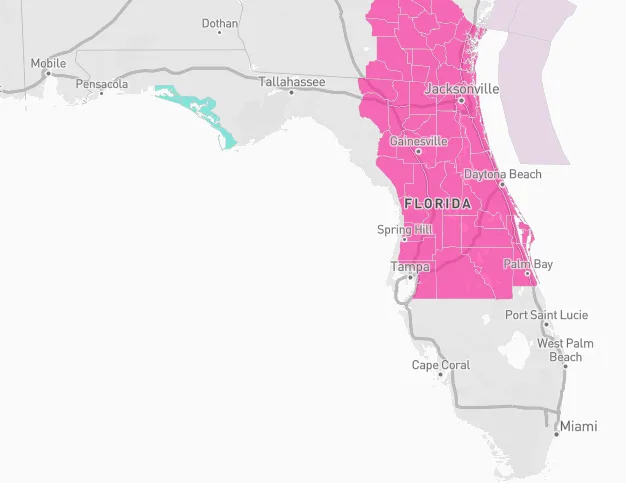
red flag warning is in effect for much of Florida today.

The warning is in effect for Northeast and Central Florida from noon to 7 p.m. In some locations, the warning is in effect until 8 p.m., according to the National Weather Service.

Low humidity, breezy winds and critically dry conditions prompted the warning.

Winds of 15 mph are expected to be out of the west today, with gusts up to 25 mph. Relative humidity is forecast to be 20 percent to 30 percent.

Giant mats lurk off Florida: Giant mats of sargassum are off Florida coast and have beached in spurts but will peak soon

What to know about sargassum: Sargassum seaweed being seen in Florida. Here’s where it’s going and when it will be worst

What is a red flag warning?
Much of Florida is under a red flag warning May 3, 2023.

A red flag warning means warm temperatures, very low humidity, and stronger winds are expected to combine to produce an increased risk of fire danger, according to the National Weather Service.

Conditions also can cause reignition of any smoldering fires started by recent lightning strikes.

What are the dangers with a red flag warning?

Wildfires can grow quickly under these conditions.

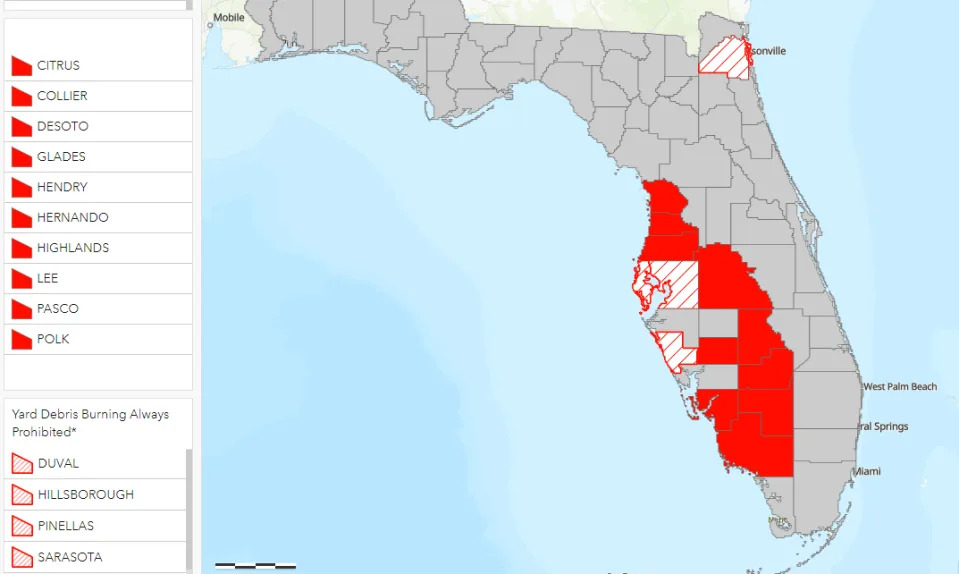
What Florida counties are under a burn ban?
Conditions in Florida prompted a red flag warning for much of the state May 3, 2023. Burn bans in effect.

The Florida Forest Service reports the following counties are under a burn ban as of May 1:

  • Citrus
  • Collier
  • Desoto
  • Glades
  • Hendry
  • Hernando
  • Highlands
  • Lee
  • Pasco
  • Polk

Burning of yard debris is prohibited year-round under county ordinance in these locations:

  • Duval
  • Hillsborough
  • Pinellas
  • Sarasota
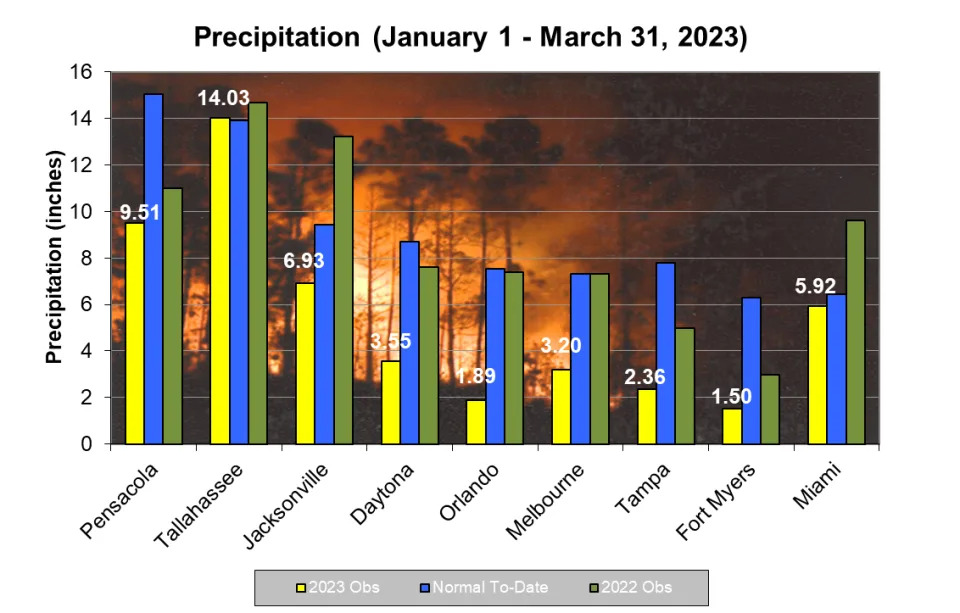
How dry is it in Florida?
Florida rainfall around the state from Jan. 1 through March 31, 2023.

As La Niña  continues to make itself felt, for the southeastern U.S., that includes a dry and warm winter and a potentially active wildfire season for Florida, according to the Florida Forest Service.

A combination of above-average temperatures and below-average precipitation was in the forecast throughout all North Florida through March.

There may be good news on the horizon: The drought coverage and intensity may have peaked across Florida in recent past weeks, according to the Climate Prediction Center. 

What should you do when under a red flag warning?
  • If you are allowed to burn in your area, all burn barrels must be covered with a weighted metal cover, with holes no larger than 3/4 of an inch.
  • Do not throw cigarettes or matches out of a moving vehicle. They may ignite dry grass on the side of the road and become a wildfire.
  • Extinguish all outdoor fires properly. Drown fires with plenty of water and stir to make sure everything is cold to the touch. Dunk charcoal in water until cold. Do not throw live charcoal on the ground and leave it.
  • Never leave a fire unattended. Sparks or embers can blow into leaves or grass, ignite a fire, and quickly spread.
Where are active wildfires in Florida?

There are 42 active fires covering more than 5,000 acres currently across the state. The Florida Forest Service maintains a map showing the location, size and percentage contained of current wildfires.

‘Poor people are not stupid’: I grew up in poverty, earned $14 an hour, and inherited $150,000. Here’s what I have learned from my windfall.

MarketWatch – The Moneyist

‘Poor people are not stupid’: I grew up in poverty, earned $14 an hour, and inherited $150,000. Here’s what I have learned from my windfall.

Quentin Fottrell – May 3, 2023

‘When I open my accounts and see how they are growing it really fills me with a sense of pride and determination.’
‘My tiny house has been one of the greatest decisions I’ve ever made, and has truly changed my whole mindset on what makes me happy.’ MARKETWATCH

In September 2018, this woman from Texas, then 36, wrote to the Moneyist to ask how she should invest her windfall — over $150,000. It was small by some people’s standards, but it was life-changing to her. She didn’t have a college degree, said she would never earn more than $30,000 a year, and worked full-time for $15 an hour, in addition to a part-time job at $10 an hour. She paid $1,050 a month in rent. 

She paid off her car, and bought a “tiny home,” which she owns free and clear, she wrote in an update a year later. She deposited $70,000 in a high-yield online savings account. She topped up her retirement portfolio and invested $30,000 into emerging markets. She maxed out her IRA and invested $10,000 between very safe dividend stocks and ETFs. She also spent $7,000 on dental work in Mexico.

And today? Five years after her first letter, she has updated MarketWatch readers on her progress, and what she learned from this experience:

Dear Moneyist,

There are a lot more Americans making less than $50,000 a year than there are those who make more. I feel like we aren’t really represented in the financial-advice world. I’d love to see more columns helping people to invest $25-$100 when they can. It’s empowering to invest. I might never be a Warren Buffet, but when I open my accounts and see how they are growing it really fills me with a sense of pride and determination. 

As to how I’m doing? Beautifully. I hate to say it but the pandemic was a blessing to me personally. I feel terrible saying that because of the loss and devastation so many others suffered and are still suffering because of it, but for me, the pandemic opened up a world of possibilities. A job opportunity landed in my lap because of the shutdown, and I’m making almost $4,000 a month now after taxes. 

Yes, me! I’ve never made so much money before (outside of the inheritance I received). I am still frugal and live off of about $1,800 a month, and that includes health insurance, long-term disability insurance, full-coverage car insurance, and pet insurance! Everything else goes to savings and investments. I won’t say what it is I’m doing because it might identify me, but I will say it is a job that allows me to be happy every second I’m “working.”

My tiny house has been one of the greatest decisions I’ve ever made, and has truly changed my whole mindset on what makes me happy. As I’ve lived in it I’ve altered certain parts of the design to be more efficient, and I can honestly say I intend to live tiny until some mobility issue — hopefully age-related and not an accident of some kind! — forces me back into a more conventional dwelling. Tiny living forces you to be mindful. Not only of your space, but also of yourself, and how you live in your space. It might sound strange to hear, but living tiny has truly made me a better person and improved my quality of life in ways other than financial. 

I would like to address some of the comments I read in response to your previous article on my letter. While most were truly supportive others were coming from a place of judgment and condescension. I’d like to thank everyone who wished me well, and for them to know that their words meant a lot to me. That people took time out of their day to read about me and wish me well was uplifting. I send them all virtual hugs and hope each and everyone is happy and healthy. 

However, I’d also like to address some of the comments that were less encouraging. Several people insisted that my letter was obviously fake because of how well I wrote, and that someone with my education level could not possibly be in the financial situation I’m in. I was less hurt by this attitude as I was utterly astounded by it. That people genuinely believe the educated cannot struggle financially just floored me. 

‘There are more ‘poor’ Americans than there are ‘rich’ Americans, and we are not stupid or lazy. We’re trying to make it work.’

Poor people are not stupid. We’re not illiterate country bumpkins struggling to figure out how to work a computer. We’re the nurse that lives down the street with two roommates to be able to afford rent. We’re the teachers still living with their parents because they can’t find enough roommates to qualify for an apartment. We’re the cops working at Home Depot on the side trying to save up for a baby. We’re the lawyers doing Uber just to afford student-loan payments. There are more “poor” Americans than there are “rich” Americans, and we are not stupid or lazy. We’re trying to make it work — usually by having 2-3 jobs. 

There is a financial crisis in this country. I believe it comes from unchecked capitalism. When corporations are allowed to buy up single-dwelling homes and drastically raise rents, and banks/lending institutions are allowed to prey on people with obscenely high interest rates, you foster an environment of exploitation. Our society allows for the targeting of young people before they even graduate high school. Credit-card companies and college-loan institutions begin preying on people as soon as they hit 18. If their parents are financially illiterate, and considering most public schools rarely teach financial literacy, too many young people start out life with insane amounts of debt. Additionally, wages have not kept pace with the cost of living in this country, and you have a lot of educated “poor” people. 

I just could not believe those comments that insisted this story was fake because I was too educated to be poor. Then I was mad. Mad because that stereotype is what prevents a lot of change from taking place. Nothing is ever going to get better if we keep thinking the worst of each other. 

Anyway, I again want to thank you for thinking of me and sharing my story. Hopefully it helped more people. As I said before, investing is truly empowering. I didn’t know that before, but I know it now, and I wish it for many more Americans. 

Sincerely, 

Not Quite As Low Income, But I’m Still A Couponing Lady

Dear Not Quite As Low Income,

Thank you for your insightful and eloquent letter. Your words and story continue to inspire me, and I hope will inspire many others out there in America who never had a head start in life and/or continue to face financial struggles. I wish you the best of everything in your life, and I hope more good things continue to happen to you.