Solar Power…Even When There’s No Sunshine

DeSmog                                                            (via Years of Living Dangerously)

November 27, 2017. As amazing as solar power is, it’s not much use when the sun isn’t shining. Right? Wrong. #WeCanSolveThis #YEARSproject

We Can Solve This: Concentrated Solar

As amazing as solar power is, it's not much use when the sun isn't shining. Right? Wrong. #WeCanSolveThis #YEARSproject (via Years of Living Dangerously)

Posted by DeSmogBlog on Monday, November 27, 2017

The big short: Why the Senate doesn’t have the votes it needs to pass GOP tax plan

ThinkProgress

The big short: Why the Senate doesn’t have the votes it needs to pass GOP tax plan

The upper chamber can only afford to lose two votes, yet has at least seven maybes.

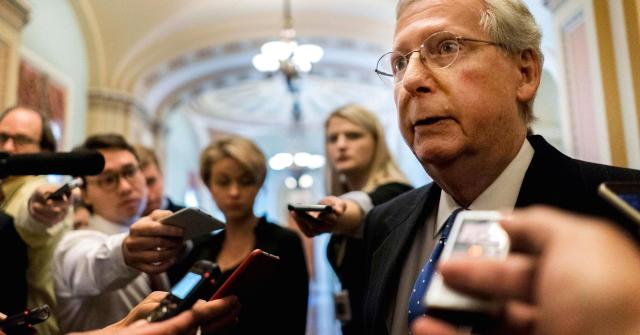
Chairman Sen. Bob Corker, R-Tenn., confers with Sen. Ron Johnson, R-Wisc., Right, as Sen. Jeff Flake, R-Ariz., Left, reads nearby during Senate Foreign Relations Committee hearing on North Korea on capitol hill in Washington, Tuesday, Nov. 14, 2017. (AP photo/ Pablo Martinez Monsivais)

Rebekah Entralgo       November 27, 2017

As the Senate prepares to vote on their version of the tax bill as early as this week, all eyes are on six Senators.

Three Senators, Jeff Flake (R-AZ), Bob Corker (R-TN), and John McCain (R-AZ) are virtually immune from outside pressure as they are unlikely to face voters again. Flake and Corker are retiring and McCain is 80, just won reelection and is battling a serious illness. All three have expressed serious concerns about how much the tax proposal will increase the federal deficit.

Meanwhile Senators Susan Collins (R-ME), Steve Daines (R-MT), and Ron Johnson (R-WI) have all outwardly expressed hesitancy over voting for the Senate tax bill citing other policy concerns. Daines and Johnson don’t think the legislation does enough for “pass-through business,” small businesses that also include larger corporations like hedge funds and law firms. Collins, who was a key vote in stopping multiple GOP attempts at repealing the Affordable Care Act, has stated the Senate’s decision to include a repeal of the individual mandate to help pay for a massive corporate tax cut is the reason why she is hesitant to vote for the bill as written.

The Senate Finance Committee is considering some last minute alterations to the legislation in an effort to get some support, this includes an expansion of the pass-through deduction to win over Johnson and Daines and a change allowing taxpayers to deduct $10,000 in local property taxes from their taxable income, a provision included in the House bill but not yet in the Senate, to get Collins’ vote.

These minor alterations, however, won’t lower the deficit, and that will be a tougher nut to crack. Corker and Flake have cited the deficit, which is expected to increase by $1.5 trillion if the proposal were to become law, as a major concern. This may understate the true deficit impact. The individual tax cuts will expire in 2025 while the corporate tax cut is permanent. Temporary individual tax cuts would help pay for the long-term costs of the bill, and Republicans argue there is no way a future Congress would allow the tax cuts to completely expire. If that’s true, the real impact on the deficit would be substantially higher.

Then there are the claims that the tax proposal would raise wages across-the-board and boost the economy. The Congressional Budget Office (CBO) estimated Monday that the Tax Cuts and Jobs Act would hurt more low-income Americans than previously reported, while the conservative-leaning Tax Foundation’s dynamic scoring found the legislation wouldn’t yield sustainable 3 percent economic growth like the White House previously promised.

The bill’s inability to deliver results on economic growth could cause Republicans to lose another vote in the Senate.

Republicans can only afford to lose two votes in the Senate or the tax proposal will go down. Right now there are at least seven Republican Senators with serious concerns about the bill.

New polling has found the bill is incredibly unpopular in Corker’s home state of Tennessee (30% approve), McCain’s home state of Arizona (26% approve) and Collins’ home state of Maine (22% approve).

This puts Senate passage of the bill later this week in jeopardy.

Congressional Budget Office Says GOP Senate Tax Bill Hits Poor, Including Many Veterans, Harder

CNBC

Lowest-income Americans would take bigger hit than first thought under Senate GOP tax bill, CBO says

Jacob Pramuk, CNBC    November 27, 2017 

Melina Mara | The Washington Post | Getty Images. The CBO report estimates that lower-income groups would foot a bigger bill from tax cuts than previously expected.

The lowest-income American households would take a hit while higher-earning taxpayers would see their burden reduced under the Senate Republican tax plan, according to the latest analysis from the nonpartisan Congressional Budget Office.

The Senate proposal permanently chops the corporate tax rate and temporarily reduces individual income taxes, while changing numerous deductions . GOP senators hope to pass that plan this week and approve a final bill agreed upon with the House before the end of the year.

The CBO report, released Sunday, estimates that lower-income groups would foot a bigger bill from tax cuts than previously expected. In 2019, all income groups under $30,000 would have a bigger burden under the bill, the CBO projected.

In 2027, that would extend to all income groups under $75,000, as individual tax reductions expire.

The change largely stems from the bill effectively getting rid of the Obamacare provision requiring most Americans to have health insurance or pay a penalty.

Low-income Americans would receive fewer premium tax credits if more of them choose not to have insurance. The CBO estimate also includes the effects of changes to spending for programs like Medicaid and Medicare.

A previous Joint Committee on Taxation analysis that showed more modest effects on low-income Americans did not include the changes in those programs.

In a statement, Senate Finance Committee spokeswoman Julia Lawless criticized the CBO report, calling its logic related to the individual mandate “confusing and erroneous.”

“Unfortunately, this is not the first time CBO has vastly overestimated the impact of the deeply flawed individual mandate,” the statement said. “And, for members concerned about the sunset date for individual tax cuts, Democrats will have a chance to make these strong middle-class tax cuts permanent on the floor.”

Democrats, who oppose the GOP tax bill, have repeatedly cast it as a plan helping corporations and the wealthy at the expense of poorer Americans.
More From CNBC:

Wavering GOP senators must face three hard truths on tax reform

Rand Paul: ‘I plan to vote for the Senate tax bill’ despite problems

Ken Griffin: We ‘probably’ don’t need to cut taxes as much as proposed

The Red-State Revolt Spreads to Oklahoma

The Atlantic

The Red-State Revolt Spreads to Oklahoma

Republican voters soured on tax cuts in Kansas. Now a similar budget crisis is playing out in Oklahoma, and in a string of special-election wins, Democrats are taking advantage.
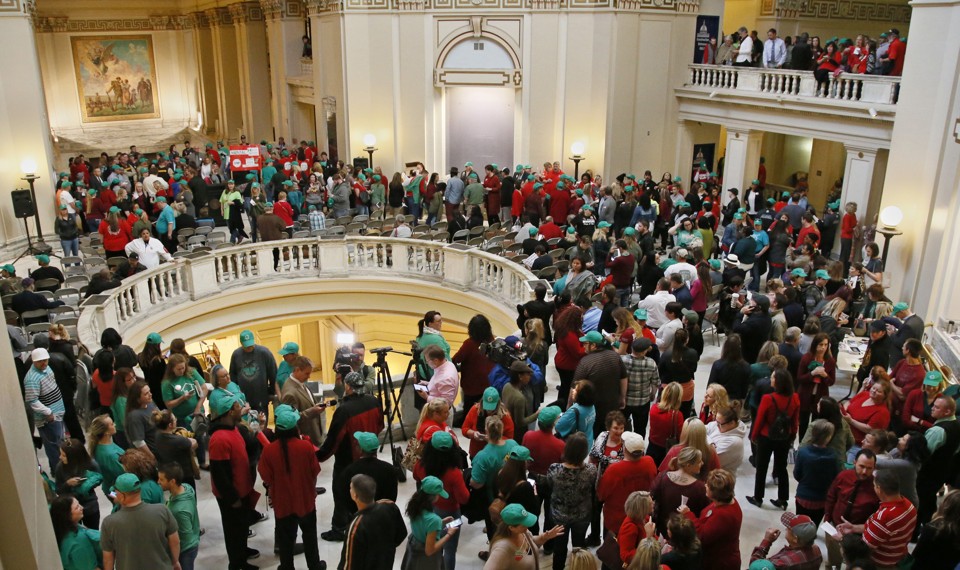
Ogrocki / AP

Russell Berman     November 27, 2017

Republicans have a vise grip on power in Oklahoma, and they are in no imminent danger of losing it.

In a state that gave 65 percent of its vote to Donald Trump a year ago, the GOP controls pretty much everything: the governorship and every statewide office, both U.S. Senate seats, all five House seats. The state legislature is almost laughably one-sided; Republicans have super-majorities of more than 70 percent of the seats in each chamber.

But in the last four months, voters have repudiated those Republicans running in Oklahoma at the polls. Democrats have captured four state legislative seats held by the GOP, two in special elections for the House and two for the Senate.  The most recent—and perhaps the most surprising—win occurred last week, when a 26-year-old lesbian Democrat named Allison Ikley-Freeman edged out the Republican candidate by 31 votes in a conservative state House district near Tulsa that went heavily for Trump in 2016. Democrats may have a chance to make an even bigger statement in a few months, when a vacancy caused by the likely Senate confirmation of Representative Jim Bridenstine to be NASA administrator could trigger a special congressional election in the district that includes Tulsa.

Officials in both parties attribute the Democrats’ run in part to the party’s motivation to fight back in the Trump era, scandals that have forced Republican legislators to resign, and the low-turnout quirkiness of special elections. But the overriding factor is likely a budget crisis that has starved funding for Oklahoma’s schools, resulting in a teacher shortage and prompting more than one-quarter of the state’s districts to hold classes only four days a week.

“The people are just not happy,” former Oklahoma Governor Frank Keating, a Republican, told me in a phone interview. “Government appears dysfunctional, and government officials appear unwilling to solve the problems of the state and the nation. And there will be hell to pay.”

The political backlash in Oklahoma has parallels to the recent reckoning in Kansas, its neighbor to the north and another Republican-led state where deep tax cuts led to significant, ongoing budget shortfalls. Both states are heavily reliant on the oil-and-gas industries, and the drop in prices in recent years hit their economies hard and contributed to a falloff in state revenues. In Kansas, voters rebelled by ousting conservatives in favor of moderate Republicans and some Democrats in 2016. Earlier this year, the reconfigured legislature voted to roll back the signature tax cuts of conservative Governor Sam Brownback.

Lawmakers in Oklahoma City are now debating similar measures, and the Democrats’ special-election victories could help tip the balance in a state where a third-quarter super-majority is needed to raise taxes. “It really feels like the dam has broken, and the conversation has shifted in Oklahoma,” said David Blatt, executive director of the Oklahoma Policy Institute, a left-leaning advocacy group and think tank.

“The hostility from the general public is palpable, and it will be directed at incumbents. They will held to task.”

The budget crisis in Oklahoma has been longer in the making than the one that erupted in Kansas soon after Brownback signed his tax cuts in 2011 and 2012, Blatt said. And it implicates both parties, since it was a Democratic governor, Brad Henry, who first agreed to cut the state’s income tax in exchange for future increases in teacher pay and spending.

Those policies accelerated after Mary Fallin’s election as governor in 2010 gave Republicans full control of the government in Oklahoma, which Democrats had dominated at the state level for nearly the entire century after it joined the Union in 1907. A state that was once near the national average in the percentage of income taxes it collected from residents fell to 48th in the nation by 2014. In addition to about $1 billion in annual income tax cuts, Oklahoma have legislators voted to give between $300 million and $500 million in yearly tax breaks to the oil-and-gas industry, according to Blatt. “It’s been a serious erosion of our tax base,” he said.

In Kansas, Brownback resisted any reversal in his tax cuts on income, forcing Republican majorities to override his veto earlier in the year. But Fallin has taken the opposite approach, demanding that conservatives in the state legislature pass a budget that has substantial and recurring new revenues. A 1992 state law requiring super-majority support for tax increases has made that a challenge, however. Fallin earlier this month vetoed parts of a “cuts-and-cash” bill that closed the budget gap with a combination of one-time money transfers and spending reductions, which will likely force the legislature into a second special session to consider tax increases.

Oklahoma Democrats view the situation as evidence of a fundamental failure on the part of Republicans who spent years railing against government spending and blaming the state’s fiscal woes on a federal government led by Barack Obama, whose unpopularity in the state made his administration an effective foil. “They can’t blame it on Obama anymore, so they have no choice but to take responsibility for the failures across the board in Oklahoma,” said State Senator John Sparks, the Democratic leader.

It’s a message the party is sounding on the national level as well, where Republicans won control of both the White House and Congress but have struggled to enact their agenda and are now debating tax cuts that are similar in scope to the ones that busted the budgets in Oklahoma and Kansas. “When you have a bunch of government haters getting control of the government, it’s no surprise they don’t know how to make things operate effectively,” Sparks said.

Where the Democrats in Oklahoma see the beginnings of a wave, the state Republican Party sees little more than a ripple. Two of the seats Democrats flipped in special election came in districts where Republicans had resigned over sex-related scandals. Pam Pollard, the state GOP chairwoman, downplayed the results in an interview, pointing out that despite the Republican dominance of the state legislature, Democrats had actually won two-thirds of the special elections held in recent years. And she suggested that given the GOP’s lopsided numerical advantage, it had nowhere to go but down. Even after the special elections this year, Republicans control 40 of 48 Senate seats and 71 out of 101 in the House. “We fully anticipated that some of these would revert back to more representative of the districts,” Pollard told me.

Pollard pushed back hard against the Democratic argument that Republicans had mismanaged the state’s government. She accused local officials of playing politics  “to tug at the heart strings” by cutting down the school week rather than reducing bloated administrative expenses. And Pollard said Republicans were willing to spend more money on government where needs were demonstrated, noting that the state Department of Corrections got a 10 percent boost after an outside study recommended higher spending.

Yet the topic of tax increases remains delicate for the GOP. When Pollard broached the possibility, she stopped herself. “Let me say it better: What Republicans are looking at is not necessarily a tax increase but a change in the way revenue is collected in Oklahoma,” Pollard said. It sounds like a euphemism, and it is. But she tried to explain that the state was seeking a better balance between income taxes and sales taxes, since the rise in online shopping has led to a drop off in revenue from retail stores.

“All seats are in play, and they will be until Republicans can figure out how to keep our schools open five days a week.”

Keating, the former two-term governor who left office in 2003, saw more of a warning sign in the election results for Republicans, if only because as the party in power, they had more to lose. He told me of a conversation he recently had with a GOP state legislative candidate who had been knocking on doors in his district. The first threshold question potential voters asked was not whether he was a Republican or a Democrat, but whether he was an incumbent. “The hostility from the general public is palpable, and it will be directed at incumbents,” Keating said. “They will be held to task.”

What remains to be seen is whether the voter anger will carry over into a possible special election to replace Bridenstine in Congress. The 1st district is strongly Republican, so much so that Bridenstine first won the seat by knocking off a veteran Republican incumbent in a primary in 2012 before facing little opposition in the general election. Democrats haven’t seriously contested the seat in years.

RELATED STORY
The Death of Kansas’s Conservative Experiment

Battle For The Consumer Protection Agency

Fact; Not Fake Trump News! After the financial collapse in 2008, President Obama and the Democrats passed legislation creating the CFPB, as one of the remedies protecting America from the evil doers ever again destroying the economy. The Consumer Financial Protection Bureau has returned more than $12 billion back to consumers who were cheated or deceived by banks, lenders and other tricksters. Some of the biggest recipients of these consumer protections are our Veterans and their families, who often struggle during deployments and are frequent victims of financial shenanigans; and of course the poorest of the poor, many who inexplicably voted for Trump. Does the recent Wells Fargo scandal ring a bell? The GOP’s rich and powerful political donors have given the Republi-cons their marching orders; destroy the CFPB! Tell your representatives to stand up for America’s consumers and the CFPB.    John Hanno

UPI: Acting consumer bureau chief sues Trump admin in power struggle

By Ed Adamczyk     November 27, 2017

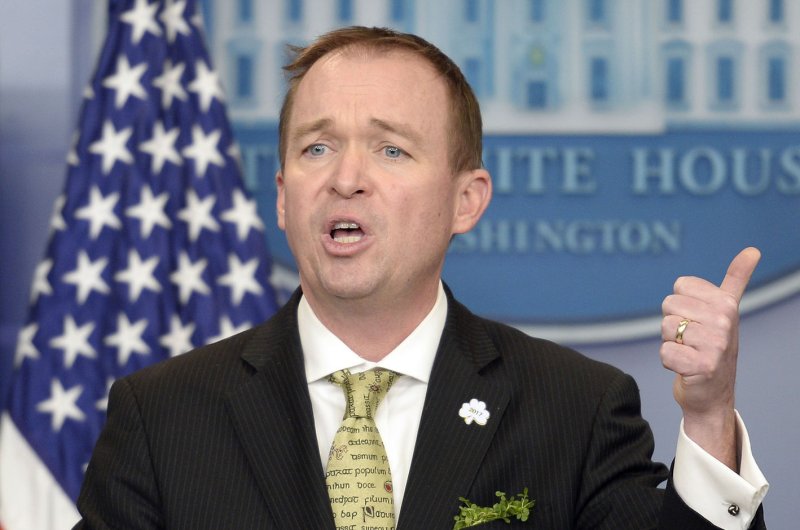
Federal Consumer Protection Bureau acting director Leandra English filed a lawsuit Sunday to keep her position, after President Donald Trump named budget director Mick Mulvaney, pictured, to the post. File Photo by Olivier Douliery/UPI/Pool

Nov. 27 (UPI) — The acting head of the U.S. Consumer Financial Protection Bureau has filed a federal lawsuit that says President Donald Trump overstepped his authority by trying to replace her with budget director Mike Mulvaney.

The resignation Friday of CFPB chief Richard Cordray came after he appointed Leandra English, his former chief of staff, as acting director.

Trump, however, announced that Mulvaney, his Office of Management and Budget director, will take over the leadership post instead.

English argues in her lawsuit, filed late Sunday, that the court should deny the Trump administration’s claim that the Federal Vacancies Reform Act permits him to appoint a new director.

“The president’s purported or intended appointment of defendant Mulvaney as acting director of the CFPB is unlawful,” the legal challenge states. “The president’s use of the Federal Vacancies Reform Act to appoint an acting director of the CFPB would be an obvious contravention of Congress’s statutory scheme.”

The CFPB was established in 2011 to protect consumers in dealings with banks regarding debt collection, credit card and loan companies. Republicans have said the agency has too much power and unnecessarily burdens banks and credit card companies. Mulvaney, while a member of Congress, co-sponsored a bill to eliminate the agency.

A permanent director of the agency must be nominated by the president and confirmed by the Senate.

Sen. Lindsay Graham, R-S.C., told CNN Sunday that Trump is on “good ground” to appoint Mulvaney and called the CFPB “the most out of control, unaccountable federal agency in Washington.”

Mary McLeod, CFPB general counsel, said in a memo this weekend that Trump has the power to appoint Mulvaney.

“Statutory language, legislative history, precedent from the Office of Legal Counsel at the Department of Justice, and case law all point to the conclusion that the President may use the Vacancies Reform Act to designate an acting official, even when there is a succession statute under which another official may serve as acting,” she wrote.

“It’s a watchdog agency. Wall Street hates it like the devil hates holy water, and they’re trying to put an end to it with Mr. Mulvaney stepping into Cordray’s spot,” Sen. Dick Durbin, D-Ill., countered.

The Hill:  Succession battle at consumer agency intensifies

Reuters       November 27, 2017

The two officials both claiming to be the rightful acting director of the Consumer Financial Protection Bureau are battling for control of the agency on Monday morning.

Office of Management and Budget Director Mike Mulvaney, who President Trump says is now in charge of the consumer bureau, showed up for work with donuts and ordered CFPB employees to ignore all directives from Deputy Director Leandra English and report them to the agency’s legal department, according to Reuters.

Mulvaney was seen entering the CFPB’s headquarters in downtown Washington carrying a Dunkin Donuts bag.

English, whom former CFPB Director Richard Cordray named as his successor, sent the director’s weekly email to CFPB employees this morning, addressing herself as the “acting director.”

She also briefed lawmakers at the Capitol Monday on her transitions plan, a source familiar with the plans told The Hill.

The White House told CNBC that Mulvaney was given access to the director’s office with full support from the bureau’s staff, despite the lawsuit filed against him and Trump by English.

English sued Trump and Mulvaney in federal court on Sunday night to block Mulvaney from taking acting directorship of the CFPB. She cited the CFPB’s line of succession as enacted in the Dodd-Frank Act, which calls on the deputy director to serve as acting chief when between permanent directors.

English claimed that Trump violated Congress’s will by claiming he had the power under the Federal Vacancies Act to supersede Dodd-Frank. However, the CFPB’s chief counsel issued memo to employees supporting the White House’s nomination of Mulvaney.

The Justice Department released memo on Saturday arguing that it is within Trump’s authority to appoint Mulvaney as the interim director of the CFPB.

Prominent Democrats, who have fiercely defended the CFPB under Cordray, called Trump’s appointment of Mulvaney an illegal attempt to destroy the agency from within.

While serving as a congressman before joining Trump’s administration, Mulvaney sponsored bills to eliminate the CFPB and backed other legislation to put it under closer legislative oversight.

Mulvaney has in the past called the bureau “a sick, sad joke” that shouldn’t exist.

Offshore Wind Farms

350.org

These offshore wind turbines are powering 3,000 homes in Europe and helping create a diverse and robust marine ecosystem.

Offshore Wind Farms

These offshore wind turbines are powering 3,000 homes in Europe and helping create a diverse and robust marine ecosystem.

Posted by 350.org on Sunday, November 26, 2017

India driven by the sun! 

EcoWatch

India driven by the sun!  Read why we must act now:                  ecowatch.com/india-air-pollution

India driven by the sun!Read why we must act now: ecowatch.com/india-air-pollution

Posted by EcoWatch on Sunday, November 26, 2017

Healthy Air Campaign

EcoWatch

November 23, 2017      Happy Thanksgiving. Hoping our children will benefit from climate action instead of suffering from climate destruction.

via Healthy Air Campaign

Happy Thanksgiving. Hoping our children will benefit from climate action instead of suffering from climate destruction. via Healthy Air Campaign

Posted by EcoWatch on Thursday, November 23, 2017

New dynamic score shows the Senate tax bill raises debt by more than advertised

Vox

New dynamic score shows the Senate tax bill raises debt by more than advertised

The math just doesn’t work

By Matthew Yglesias, Vox          November 24, 2017

Drew Angerer/Getty Images

Kent Smetters was in the trenches in the Newt Gingrich-era Congressional Budget Office and he’s a veteran of George W. Bush’s Treasury Department. His well-regarded new analysis just concluded the Republican tax plan won’t raise nearly as much revenue as its proponents say, or provide a meaningful boost to economic growth.

The problem, according to a pair of new analyses by the Penn-Wharton Budget Project, is that the Senate Republicans’ tax bill would increase federal debt by more than advertised, and increased debt accumulation would counteract much — or potentially all — of the positive growth impact of tax cuts. The result will likely be lower incomes for the bottom half of the income distribution even before considering the negative impact of inevitable spending cuts to offset the surprisingly low federal tax intake.

This is technical, in-the-weeds stuff, but that’s where tax policy happens. And you can bet that business lobbyists and the donor class aren’t afraid of delving into it.

To comply with the terms of the Byrd Rule that allows Senate Republicans to bypass a Democratic filibuster, the tax plan must meet two conditions. On the one hand, it needs to comply with the budget resolution’s mandate to raise the deficit by no more than $1.5 trillion over 10 years. According to Penn-Wharton, it does that. But on the other hand, it needs to not increase the long-term deficit in the years following.

And here’s where Penn-Wharton says that there’s a problem: “We estimate that the Senate TCJA continues to reduce revenue in years beyond the 10-year budget window.”

Critically, this conclusion does not change when they attempt a “dynamic” score that considers the potential growth-boosting effects of tax cuts. Instead, they find that “the Senate Tax Cuts and Jobs Act reduces federal tax revenue in both the short- and long-run relative to current policy. In the near term, there is a small boost to GDP, but that increase diminishes over time.”

Senate Republicans would like you to look past ugly distributive numbers and thing about broad growth effects. But the bottom line here is not even Republicans can make that math work out when they need to plug it into a rigorous model.

Penn-Wharton thinks gimmicks will reduce revenue

The tax bill has a three-part structure:

  • There’s a permanent tax cut for business owners.
  • That’s offset by a permanent tax increase for individuals.
  • In the short-term, the tax increase for individuals is offset by a temporary middle-class tax cut.

The goal, then, is to deliver a big business tax cut without increasing the long-term deficit. Penn-Wharton’s model suggests that this won’t work as well as the bill’s authors believe it will work, since individuals — especially rich ones who pay a lot of taxes and have good accountants — will engage in deliberate income shifting to take advantage of the temporary tax cuts, as well as “reclassification of income to exploit differences in marginal tax rates, potentially permanent or due to sunsets.”

In short, the Senate GOP leadership wrote a bill that’s designed to game the system with phase-ins and phase-outs, and Penn-Wharton thinks taxpayers will respond in kind — gaming the gamed system, reducing federal revenue, and increasing the long-term deficit.

Penn-Wharton Budget Model

The result is a plan that raises long-term deficits by significantly more than the bill is supposed to, even before you consider the impact of higher debt service costs.

Dynamic scoring doesn’t save the plan

For years, Republicans have hinted that they would ultimately enact a tax plan by engaging in dynamic scoring — i.e., a form of economic analysis that tries to argue tax cuts will boost economic growth and therefore tax collection and therefore be more affordable than they appear in a static context.

Yet curiously, the Trump Treasury Department has not yet produced a dynamic analysis of the president’s pet legislative project. The most likely reason for this is that the last time we had a Republican administration and its Treasury Department tried to do a rigorous dynamic analysis they found that they couldn’t make it work. The growth-boosting impact of lower marginal tax rates was largely offset by the growth-slowing impact of more government borrowing. To generate a scenario in which tax cutting boosted growth, the George W. Bush Treasury had to invoke the idea of a tax plan that was offset by large, unspecified spending cuts.

There’s no reason to believe an honest Treasury analysis of the Trump tax plan would show anything different.

And, indeed, that’s what the Penn-Wharton dynamic analysis shows: Growth is faster in the short-term because of Keynesian effects but it slows down in the longer-term because of more debt accumulation. Under optimistic assumptions, the economic pie gets slightly bigger but under pessimistic assumptions the economic pie gets slightly smaller.

Penn-Wharton Budget Model

These small-or-maybe-nonexistent growth impacts aren’t nearly enough to let the tax cuts pay for themselves. And the economic gains involved are very unequally distributed across the population.

The rich get richer

Penn Wharton finds that in the long-term, labor income will rise by somewhere between 1.2 percent and 0.2 percent as a result of the Senate’s tax plans.Penn-Wharton Budget Model

But recall that in the long-term, the tax plan actually raises taxes on most middle-class Americans.

This chart from the Center on Budget and Policy Priorities, based on Joint Committee on Taxation data, shows that households earning less than $50,000 will lose more from tax increases than they would gain from these dynamic boosts to labor income.

Center on Budget and Policy Priorities

In other words, the overall economic pie gets very slightly bigger. But the maldistribution is so bad that households in the bottom half of the income distribution end up with less money anyway — more than 100 percent of the aggregate gains go to the affluent.

Then, of course, you get to the matter of the increased debt. If that ends up being paid for by cuts to Medicaid, Medicare, and Social Security (and honestly where else are Republicans going to get the money) then poor and middle-class households will end up even worse off.

Here’s what would happen if the supervolcano under America erupted, experts say

Yahoo News UK Science

Here’s what would happen if the supervolcano under America erupted, experts say

Rob Waugh, Yahoo News UK          November 24, 2017

The Yellowstone supervolcano under America could erupt with terrifying power – expel up to 250 cubic miles of volcanic rock and ash at once.

The eruption could blanket large areas of America in ash – and possibly plunge Earth into a ‘volcanic winter’.

NASA has said that supervolcano eruptions are a bigger threat to life than any asteroid – but what would actually happen?

Yellowstone Volcano Observatory’s Scientist-In-Charge, Dr Michael Poland, told IFLScience that the eruption would shoot a column of burning ash and lava up to 16 miles into the air.

Rumors are circulating that the super volcano in Yellowstone National Park will erupt sooner than expected. Scientists say the eruption would blanket most of the U.S. in ash, sending the earth into a volcanic ice age.

Poland said ‘If people were present in the vicinity of the eruption, say, within a few tens to perhaps a few hundred kilometers – they would be in peril.

But the real damage woould come from ‘volcanic fallout’, which would clog roads, short out electrical grids and make millions of homes uninhabitable, Poland says.

Nearby cities such as Salt Lake City would be buried in three feet of ash, and other cities such as Los Angeles would see an inch of ash rain from the sky.

Flights would be grounded across America and the knock-on effects would be felt across the world as a ‘volcanic winter’ began to bite, with years and possibly decades of cooling.

Yellowstone’s last super-eruption happened 631,000 years ago, and Poland says it’s highly unlikely to erupt now.

He says, ’Right now, much of Yellowstone’s magma body is partially solidified, and you need a lot of magma to feed a large eruption.’