White House seeks 72 percent cut to clean energy research

Washington Post – Economy

Democracy Dies in Darkness

White House seeks 72 percent cut to clean energy research, underscoring administration’s preference for fossil fuels

By Chris Mooney, Steven Mufson       January 31, 2018  

Filipinos ride energy efficient electric tricycles during a test drive in Taguig city, south of Manila, Philippines, 12 January 2018. The Department of Energy (DOE) donated 200 units of energy efficient electric tricycles to the affected residents of war-torn Marawi as part of its efforts to help rebuild the city. Photo by FRANCIS R. MALASIG/EPA-EFE/REX/Shutterstock (Malasig/Epa-Efe/Rex/Shutterstock/Malasig/Epa-Efe/Rex/Shutterstock)

The Trump administration is poised to ask Congress for deep budget cuts to the Energy Department’s renewable energy and energy efficiency programs, slashing them by 72 percent overall in fiscal 2019, according to draft budget documents obtained by The Washington Post.

Many of the sharp cuts would likely be restored by Congress, but President Trump’s budget due out in February will mark a starting point for negotiations and offer a statement of intent and policy priorities.

The document underscores the administration’s continued focus on the exploitation of fossil fuel resources — or as Trump put it in his State of the Union address, “beautiful clean coal” — over newer renewable technologies seen as a central solution to the problem of climate change.

The Energy Department had asked the White House for more modest spending reductions for the renewable and efficiency programs, but people familiar with the process, who asked for anonymity to share unfinished budget information, said that the Office of Management and Budget insisted on the deeper cuts.

The cuts would also be deeper than those the Trump administration sought for the current fiscal year, but was unable to implement because of the budget impasse in Congress. The federal government has been operating on a series of continuing resolutions that have maintained existing spending. The current continuing resolution expires Feb. 8.

President Trump applauded his administration’s energy policy at a rally in Pensacola, Fla. on Dec. 8. (The Washington Post)

Spending for the Energy Department’s Office of Energy Efficiency and Renewable Energy is set at a $2.04 billion level for the current fiscal year, which ends Oct. 1. Last year the administration asked for just $636.1 million, a decline of over two-thirds, though Congress did not implement the request. For 2019, the administration’s draft proposal would lower that request even further to $575.5 million.

The document also suggests substantial staff cuts, down from 680 in the enacted 2017 budget to 450 in 2019.

“It shows that we’ve made no inroads in terms of convincing the administration of our value, and if anything, our value based on these numbers has dropped,” said one EERE employee, who spoke on the condition of anonymity to discuss the internal budget information.

The Energy Department did not respond to requests for comment on Wednesday. The White House said in a statement: “We don’t comment on any leaked or pre-decisional documents prior to the release of the official budget.”

It is unclear whether the document represents a final budget proposal or will be subject to last-minute negotiation and revision. The federal budget is due out in February.

One source familiar with the negotiating process, who spoke on the condition of anonymity to freely describe what the person had learnedsaid that the budget request had been lowered after negotiations with the Office of Management and Budget, and may have been lowered further because of a desire to channel more funding toward nuclear energy, a favored subject for Energy Secretary Rick Perry.

The funding requests represent a double whammy for renewable energy after the administration last week imposed tariffs on imported solar panels.

The tariff action e is likely to decrease the installation volumes of solar energy in coming years, according to industry analysts.

The Office of Energy Efficiency and Renewable Energy is perhaps best known for the solar “SunShot” program, which strives to drive down the price of solar energy.

The large bulk of its funding is deployed on research, most frequently at the National Renewable Energy Laboratory in Golden, Co. The vast majority of the laboratory’s $293 million budget in 2017 came from EERE.

But it’s far from clear the cuts would become a reality.

“”The president suggests a budget, but, under the Constitution, Congress passes appropriations bills,” Sen. Lamar Alexander (R — Tenn.), an influential appropriator on energy issues, said in a statement.

The draft document says the administration will once again ask Congress to abolish the weatherization program, which has trained thousands of workers and helped reduce utility bills for thousands of homeowners. The budget proposal would also eliminate state energy grants.

The budget would ax research in fuel efficient vehicles by 82 percent, bio-energy technologies by 82 percent, advanced manufacturing by 75 percent and solar energy technology by 78 percent.

The proposal would cut funds for electric car technologies and fuel efficient vehicles — at $307 million currently the biggest of the program areas — to $ 56 million in 2019.

Money for bio-energy technologies have gone to research renewable fuels from nonfood sources.

The plan would also chop spending on more efficient building technologies and research into geothermal, hydro and wind power.

The renewable and efficiency programs represent about seven percent of the Energy Department’s overall budget. The majority of the department’s budget goes to maintaining the nation’s nuclear weapons stockpile and cleaning up sites contaminated by federal nuclear programs.

Chris Mooney reports on science and the environment.

Steven Mufson covers energy and other financial matters. Since joining The Post, he has covered the White House, China, economic policy and diplomacy.

EPA delays Obama water rule

The Hill

EPA delays Obama water rule

By Timothy Cama     January 31, 2018

EPA delays Obama water rule© Greg Nash

The Environmental Protection Agency (EPA) is pushing back by two years an Obama administration rule redefining the federal government’s power over small waterways.

The Trump administration is working to repeal the rule, dubbed the Clean Water Rule or Waters of the United States (WOTUS), and formally proposed to do so last year.

But earlier this month, the Supreme Court overturned a federal appeals court’s action halting the rule, so it could take effect soon.

EPA head Scott Pruitt said the Wednesday action is meant to stop the Clean Water Rule from taking effect due to the Supreme Court’s action.

“Today, EPA is taking action to reduce confusion and provide certainty to America’s farmers and ranchers,” Pruitt said in a statement.

“The 2015 WOTUS rule developed by the Obama administration will not be applicable for the next two years, while we work through the process of providing long-term regulatory certainty across all 50 states about what waters are subject to federal regulation.”

The EPA is taking the action alongside the Army Corps of Engineers, which also has responsibility for enforcing the Clean Water Act.

The Natural Resources Defense Council said the delay puts significant water supplies at risk, and said it would sue to stop the delay.

“EPA Administrator Scott Pruitt is racing the clock to deny protections for our public health and safety. It’s grossly irresponsible, and illegal — and we’ll challenge it in court,” said Jon Devine, the group’s senior attorney.

The original 2015 rule was designed to clarify federal agencies’ authority and give them the power to regulate small waterways such as ponds, headwaters and wetlands for pollution prevention. It should have taken effect in 2015, but various courts halted it.

Republicans and many business groups fought the rule tooth and nail, saying it gave the federal government power over wide swaths of land.

Its repeal has been a top priority for President Trump, and he signed an order to repeal it shortly after taking office.

Pruitt is also working to develop a new rule to replace the Obama rule’s definitions once it is fully repealed. The replacement rule would likely give the federal government power over a significantly smaller area.

Toxic waste from coal ash pits leaching into Illinois’ only National Scenic River

Chicago Tribune

Toxic waste from coal ash pits leaching into Illinois’ only National Scenic River

Toxic coal ash waste can be seen leaking into the Middle Fork of the Vermilion River. (Prairie Rivers Network)

Michael Hawthorne, Contract Reporter      January 31, 2018

Seven years after Dynegy Inc. scrapped one of the last coal plants in downstate Illinois, environmental groups are accusing the company of failing to prevent toxic waste stored nearby from seeping into the state’s only National Scenic River.

Citing problems documented in the Houston-based company’s own internal reports, the nonprofit Prairie Rivers Network announced Wednesday that it plans to file suit, accusing Dynegy of repeatedly violating the federal Clean Water Act. The group said it decided to take more aggressive action because federal and state regulators have failed to address longstanding problems at the shuttered plant near Oakwood, about 25 miles east of Urbana.

Vermilion River pollution

Vermilion River pollution

Pictures taken by the group show orange- and purple-hued muck leaching from the banks of the Middle Fork of the Vermilion River as it meanders past the former Vermilion Power Station, a coal-fired facility built in the mid-1950s by Illinois Power and later purchased by Dynegy.

“These illegal discharges could not be more obvious,” said Jenny Cassel, an attorney for Earthjustice, a nonprofit environmental law organization representing the Prairie Rivers Network.

Before Dynegy closed the plant in 2011, the two companies deposited more than 3.3 million cubic yards of coal ash into pits next to the river — enough to fill the Empire State Building nearly 2½ times. Testing by Dynegy and the Prairie Rivers Network shows the multicolored waste oozing into the water contains dangerous levels of heavy metals found in coal ash, including arsenic, chromium, iron, lead and manganese.

“This toxic waste needs to be cleaned up,” said Andrew Rehn, water resources engineer for the network, based in Champaign. “We want to make sure that Dynegy can’t just walk away from its responsibility. We all have a right to a clean Vermilion River.”

Chicago Tribune Graphics

What’s left of the old power plant rises above the river about a mile downstream from a launch that draws thousands of paddlers, kayakers and tubers to the area every year. It also is along a 17-mile stretch of the river protected in 1989 under the federal National Wild and Scenic Rivers Act, a designation based in part on the dozens of endangered and threatened species in the river and surrounding woods.

In 2012, Dynegy was cited by the Illinois Environmental Protection Agency for water pollution violations at the site. The case is still open.

“We remain focused on working with state and federal regulatory agencies to provide long-term protection of the storage areas at Vermilion, the Middle Fork of the Vermilion River and groundwater resources,” the company said in a statement.

The company has suggested it could solve the problem in Vermilion County by capping the waste pits to prevent rain and snowmelt from washing coal ash into the water. But in November, Dynegy sent state regulators a report that estimated the normal flow of the Middle Fork is eroding the river banks by up to 3 feet a year, making it more likely the toxic slurry will be exposed below the proposed caps.

Because the power plant has been closed for so long, the ash pits are exempt from federal regulations enacted by the Obama administration in 2015. Opposition from Dynegy and other energy companies prompted the Trump administration last year to reconsider the safeguards; a separate proposal in Illinois also has been sidetracked.

Vermilion River pollutionThe environmental groups plan to sue Dynegy under a provision of the Clean Water Act that allows citizens to challenge companies about water pollution violations but requires a 60-day notice.

mhawthorne@chicagotribune.com     Twitter @scribeguy

Despite Trump’s Remark, There Is No War On Coal and It’s Definitely Not Clean

EcoWatch

Despite Trump’s Remark, There Is No War On Coal and It’s Definitely Not Clean

Lorraine Chow      January 31, 2018

President Donald Trump’s line, “We have ended the war on beautiful, clean coal” drew some of the biggest claps and cheers from Republican lawmakers at last night’s State of the Union address.

Energy Sec. Rick Perry, who wants to bail out uncompetitive coal plants, quickly bopped up with a standing ovation. Interior Sec. Ryan Zinke, who wants to open federal lands to mining, stood up shortly after.

You can watch their enthusiastic reaction here:

But there are a few problems with their boss’ remark. First, there is no war on coal. Market forces, the country’s glut of cheap natural gas, increased energy efficiency and renewable energy have all contributed to the coal industry’s decline.

While the Trump administration has aggressively pushed for fossil fuels and has rolled back a number of regulations, including the Clean Power Plan, to prop up domestic energy, the policies haven’t revived the coal sector. Vox noted that “mining jobs have crashed from a high of 800,000 workers in the 1920s to about 76,000 today.” Additionally, U.S. coal consumption fell by 2.4 percent in 2017—the lowest level in nearly four decades.

Secondly, there’s no such thing as clean coal. Coal is one of the world’s most polluting fossil fuels and its combustion is a major contributor to air pollution and climate change.

The Associated Press fact-checked Trump’s statement, and wrote:

“According to the Energy Department, more than 83 percent of all major air pollutants—sulfur dioxide, carbon dioxide, toxic mercury and dangerous soot particles—from power plants are from coal, even though coal makes up only 43 percent of the power generation. Power plants are the No. 1 source of those pollutants.’

Vox pointed out that Trump may simply be confusing “clean coal” with mines that wash or pretreat coal. Or perhaps the president is referring to carbon capture and storage, which collects and stores carbon from coal-powered plants’ emissions.

But the process is not only costly and more expensive than installing natural gas, wind or solar systems—many governments are also abandoning the trials that are needed to make it work. Meanwhile, Energy Sec. Perry’s most recent budget proposal slashed the clean-coal budget from more than $200 million to only $35 million.

Trump’s head-scratching comment was succinctly summarized by the New York Times’ columnist Nicolas Kristof:

“Trump says he has ended ‘the war on clean coal.’ I’d make three points: 1. Coal employment is in long-term secular decline. 2. Newspaper industry has lost more jobs in recent years than coal has. 3. Solar power employs 5 times as many people as coal—and it’s the future.”

RELATED ARTICLES AROUND THE WEB

Oklahoma, America’s No. 2 wind producer, sours on the industry

Christian Science Monitor – Environment

Oklahoma, America’s No. 2 wind producer, sours on the industry

A massive state budget crisis, along with powerful oil and gas interests, has led the state to phase out key tax incentives for wind.

Christa Case Bryant/The Christian Science Monitor

Christa Case Bryant, Staff writer     January 30, 2018

Garber, Oklahoma. First the wind came sweeping down the plain, then the dollars, and now the controversy.

With ever more spiky wind turbines cropping up across its open lands, Oklahoma has just become the No. 2 state in the country for wind energy production, the American Wind Energy Association announced Tuesday. That has been a boon for local communities, but it has also come at a price for the state, which pays tens of millions of dollars a year in subsidies for wind companies. As the industry grows, so does the price tag for wind incentives.

Now a new project – Wind Catcher, which is slated to be one of the largest wind farms in America – is facing stiff resistance and could be scrapped altogether.

The Wind Catcher case comes amid a pushback on wind incentives, galvanized by a state budget crisis and influential oil and gas interests. In the past year, Oklahoma has ended two key incentives that even wind proponents admitted were in some ways “too generous.”

“I’m hopeful that the current balance that we’ve struck between local taxation and making sure that we’re not penalizing a new technology – I’m hopeful that that balance stays in place,” says state Sen. AJ Griffin (R) of Guthrie, who says she encourages investment in wind “without giving away the farm.”

But some are pushing not only to remove all subsidies, but to levy a new tax on wind.

 Think you know the odd effects of global climate change? Take our quiz.

One of America’s largest wind farms

Under the whirring of turbines in Oklahoma’s Garfield County, Craig Schlichting hauls rock, agricultural lime, and grain for a living.

He’s not particularly keen on wind, but with the agricultural economy flagging, he sees the industry’s positive effect on his community of Garber, Okla. There’s a new blacktop road being laid down, and a smart new school building a mile away. Then there’s the wind companies’ payments to those with turbines on their land.

“It’s scuttlebutt, but the guys who have them say [the wind companies] pay $10,000 per year,” says Mr. Schlichting, standing in well-worn striped overalls. “In a poor state, it’s good money.”

The money coming into the county through such landowner payments is equivalent of the paying 194 employees at the county average wage – which would put it among the top-10 companies in the area, says Brent Kisling, executive director of the Enid Regional Development Alliance in Garfield County.

Now Enid stands to benefit from the $4.5 billion Wind Catcher project, which includes plans to build a 350-mile transmission line that would pass through the area, bringing supply-chain jobs, says Mr. Kisling.

Public Service Company of Oklahoma (PSO), which is investing $1.3 billion in the project, says Wind Catcher will save Oklahoma electric customers an estimated $2 billion over 25 years. That would be a relief for many in a state where summer electric bills often run $400 or more a month.

But there’s a problem.

$2 billion in savings? AG doesn’t think so.

PSO skipped a required competitive bidding process for building the transmission line. That was intentional: It wanted to finish the project before a federal tax credit expires at the end of 2020, says spokesman Stan Whiteford. Now it needs an exemption from the Oklahoma Corporation Commission (OCC), which regulates public utilities.

PSO is asking the state to approve a rate hike to help finance its investment, and says that the added cost to consumers will be quickly canceled out by the savings of wind power. The OCC held hearings this month over whether to approve the exemption and the rate hike. A decision is expected in early spring.

One of the strongest opponents to the project is Attorney General Mike Hunter, whose job is to protect Oklahoma consumers.

However, Mr. Hunter disputes PSO’s savings estimate. He has experience with public utility cases, having previously worked for OCC, and says the Wind Catcher project is likely to cost consumers around $320 million.

He also underscores that PSO did not follow state rules, plain and simple, and must be opposed on that basis.

“My responsibility is to the ratepayers of the state of Oklahoma and that responsibility is a statutory responsibility, it’s consistent with my oath of office, and the case that we’re putting on is based on careful investigation, thoughtful review of evidence, and the law,” Hunter tells the Monitor. “And that is my sole motivation in this matter.”

What makes a level playing field?

Pro-wind critics argue that the opposition to Wind Catcher – and the wind industry in general – is being driven by influential oil and gas magnates like Harold Hamm, an ally of President Trump and former Oklahoma attorney general Scott Pruitt.

“Certainly everybody in Oklahoma knows there’s been a Harold Hamm vs. wind fight for several years,” says Jeff Clark, head of the Texas-based Wind Coalition. “He’s not intervening so Wind Catcher gets built more competitively. He’s intervening because he wants to kill Wind Catcher.”

Mr. Hamm’s office did not respond to multiple requests for comment. But he has argued that wind subsidies are no longer necessary in light of a federal tax credit extension for wind, and says the subsidies primarily benefit out-of-state companies whose power often goes to out-of-state customers.

Jonathan Small, president of the Oklahoma Council for Public Affairs in Oklahoma City and an early member of The Windfall Coalition spearheaded by Hamm, says it’s more about free-market economics than favoritism.

“I think the vast majority of lawmakers and citizens would say it has more to do with lack of a level playing field than not liking wind,” says Mr. Small, a former budget analyst for the Oklahoma Office of State Finance. He says the budget crunch focused scrutiny on wind incentives, and cites a statistic that each turbine costs taxpayers more than a teacher’s starting pay – a figure calculated by Wind Waste on an Apex wind installment in Oklahoma’s Kingfisher County. (Teachers are in such short supply that some Oklahoma school districts have gone to four-day weeks.)

But proponents of wind argue that oil and gas subsidies cost the state significantly more than wind subsidies, despite wind’s growth in recent years. A 2017 Oklahoma Policy Institute paper calculated that in fiscal year 2018 the state would forgo more than $500 million in revenue due to tax breaks for oil and gas.

“I think a lot of it is that [oil and gas entities] want to have their incentives, but they don’t think the wind should have the same incentives,” says Jan Kuehn of Kingfisher County, who has Apex wind turbines on her land as well as oil wells that still pay her royalties. “I think the wind people left the land and the roads in better shape than before they came – which is a great help because as most states, Oklahoma is strapped for money.”

In May 2016, Oklahoma’s secretary of finance announced that the state had needed to borrow $5 million from other funds that month to pay refunds due corporations, including $3.3 million in zero-emission credits to wind companies. The following year, the legislature ended that incentive for new wind farms, as well as a five-year property tax exemption.

Gov. Mary Fallin also proposed a production tax on wind to help close a nearly $1 billion budget gap for fiscal year 2018. Legislators are still pursuing that idea.

Kisling of the Enid Economic Development Alliance says what’s needed is a shift away from zero-sum thinking.

“We’ve spent too much time as a state [debating] who gets which slice of the pie,” he says. “We ought to spend more time figuring out how to increase the size of the pie.”

 Did this story deliver on patterns of thought?   Give us your feedback, please.

Will Shell Turn From Big Oil Into Big Energy?

EcoWatch

From Oil Change International

Will Shell Turn From Big Oil Into Big Energy?

By Andy Rowell       January 30, 2018

Shutterstock

On the surface, the good times are back for Big Oil. Later this week, Shell is expected to unveil its biggest profits in a decade since the oil price crash.

As the oil price recovers to over $65 a barrel last year, so do Shell’s fortunes, with reported earnings of nearly $16 billion.

The days of Shell being on the rocks—pummeled by a low oil price—seem over. So much so that the company even has Big Oil’s number one, Exxon, in its sights. Exxon’s reported earnings are expected to be slightly lower than Shell’s at a still significant $15.7 billion.

As Shell’s CEO Ben van Beurden recently said, “At the moment we are number two and we are closing in on number one. We almost have the tiger by the tail.”

As the two Big Oil companies battle it out for the number one spot, it is worth taking a step back and worth asking who will win the energy war not just in the next year, but in the decades ahead, which will be dominated by the upcoming renewable revolution, stranded assets and climate change. Many would argue that short term profits hide Big Oil’s longer term problems.

In the medium term, Shell is betting big on gas, despite the fact that environmentalists argue is it no solution to climate change. For example, you can read OCI’s report on gas here.

There are signs that the company is also taking some small steps into carbon disinvestment: As Reuters reported this week, “Royal Dutch Shell has spent over $400 million on a range of acquisitions in recent weeks, from solar power to electric car charging points, cranking up its drive to expand beyond its oil and gas business and reduce its carbon footprint.”

Before we all get too excited by this, there are two fundamental problems. One is that the investments are small change, as Reuters pointed out: “The scale of the buying spree pales in comparison to the Anglo-Dutch company’s $25 billion annual spending budget. But its first forays into the solar and retail power sectors for many years shows a growing urgency to develop cleaner energy businesses.”

In total, according to analysts, Big Oil has invested just over $3 billion on renewables acquisitions over the past five years, predominantly on solar. Again it is peanuts compared to the tens of billions the companies spend looking for oil.

And the other problem is the one we have just mentioned, gas. As Reuters noted, “The investments are not limited to renewables such as biofuels, solar and wind. Shell, as well as rivals such as BP, Exxon Mobil and Chevron, are betting on rising demand for gas, the least polluting fossil fuel, to power the expected surge in electric vehicles in the coming decades.”

Indeed, Shell may be betting on gas just at a time when the future of gas is in trouble. “The end of natural gas is near” is the title of an article this month on GreenBiz by Danny Kennedy from the California Clean Energy Fund. It states:

“Natural gas is no longer a contender or pretender, just a relic of the past, likely to fall as far and as fast as Old King Coal, and maybe faster … But I think it’s important to reflect that in 2017, for all its other problems in the clean-energy industry and our nation more broadly, the gas industry became, if not dead, at least a dead man walking.”

It is questions like these—is the market for gas in trouble?—that are supposed to be predicted by Shell’s long term planning unit. A really interesting article by Fortune looks at how this Big Oil dinosaur is desperate not to die out in the coming decades.

All the oil majors have scenario planning and Shell has been doing some serious head scratching. As Jeremy Bentham, Shell’s scenarios leader, said, “I am tasked with making sure that Shell isn’t a dodo.” So will Shell become extinct in the upcoming energy transition or dominate the new energy landscape?

The article argues that when Shell disinvested from most of its stakes in the tar sands last year, it was over long term fears over the oil price, rather than climate, that was the real concern.

The Shell scenarios team, Fortune noted, concluded that “global demand for oil might peak in as little as a decade—essentially tomorrow in an industry that plans in quarter-century increments.”

Hastened by the quickening uptake of renewables, Shell executives were alarmed by the dropping oil price:

“When the oil-demand peak came, Shell believed, petroleum prices might begin a slow slide, dipping too low to cover the costs of oil-sands production. This wouldn’t be just another oil-price cycle, a familiar roller coaster in which every down is followed by an up. It would be the start of a decades-long decline of the Oil Age itself—an uncharted world in which, in a phrase gaining currency at Shell, oil prices might be ‘lower forever.'”

As Fortune noted, “If Shell failed to prepare for this new energy landscape, it could wind up saddled with massive stranded assets: buried oil and gas that its shareholders paid billions to find, but that, because of softening demand, the company found itself unable to profitably drill and sell.”

Ben van Beurden, Shell’s CEO, told Fortune, “We won’t be sitting ducks. We are going to adapt.”

But adapt to what? “What is a challenge at the moment,” Beurden said, “is that we don’t know anymore where the future will go.” Beurden, Fortune said, is making strategic bets to transform “Big Oil into Big Energy.”

Finally it seems Big Oil has got the message. In response, many will argue it it too little, too late. Environmental groups have been telling the oil companies for decades of the need to disinvest from fossil fuels due to climate change, not just deny the problem of climate change.

But only now, when their very own corporate future is threatened by companies such as Tesla, have the oil companies finally decided to act. Will it be too late for them and us? Will Shell become a Dodo? Only time will tell.

100% Renewable Energy Worldwide Isn’t Just Possible—It’s Also More Cost-Effective http://100isnow.com/2BRerim  via @EcoWatch

Thriving Communities and Thriving Ecosystems through the Bee

Resilience

Building a world of resilient communities

Thriving Communities and Thriving Ecosystems through the Bee

 By Wangui Kamonji, orig. pub. in Transition Network – January 26, 2018


Wanjiku Mwangi pours out the golden liquid onto her finger checking the flow and the colour. She puts some on her tongue, tastes and smacks her lips. “Yes, this is good honey,” she says.

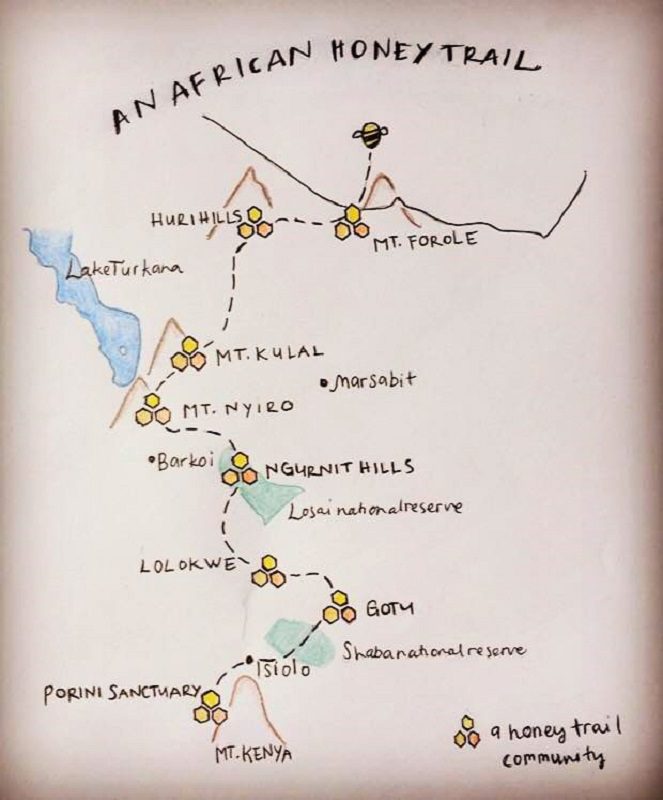
Wanjiku is a co-founder and director of Porini Association. She has been integrating her spiritual path with reviving traditional nature wisdom in Kenya ever since she was introduced to the spirituality of nature through an immersion program in Botswana in 2004. Over the years Porini has hosted dialogues on indigenous environmental knowledge and laws with communities in Kenya, mapped cultural landscapes, and is now connecting bee custodians along a honey trail that runs from central Kenya to southern Ethiopia.

I sat down with Wanjiku to talk about her path and how this latest project both ensures thriving communities and a thriving environment through bees and honey.

How did you come to this work?

I had worked for government, private sector, and consultancies in Kenya, Tanzania and the UK when I was invited to the Botswana Process. That’s where the story of trying to connect with nature and questing for what African spirituality and what the spirituality in nature is really started. That brought me back to looking at my ancestral lineage and connecting with that. After the process, I and other Kenyans co-founded Porini Association and began to look for communities in Kenya that were still steeped in their indigenous knowledge and connected to nature to continue the dialogues we had begun in Botswana.

How did these dialogues go?

We had numerous dialogues with communities. But we faced a lot of resistance because what communities wanted was money in their pockets. They said “You people are always coming to talk, talk, talk but we want to see where we can do something and get money.” So that niggled me for a long time. And I could see that yes, money is important. That’s how we live today. But how is it that we could get the money and still respect nature?

How did you deal with this challenge?

My answer came rather fortuitously as I held a ritual to bless a piece of land I had bought and one of the elders present gifted me hives.

When we had our first harvest I was really touched to see how much honey the bees had been making while I was just mucking about. That really hit me. So I started the quest to understand bees. And it’s at that point that I saw the question that the communities had been asking about money or prosperity come into play. Honey can give you money. But what I really wanted to stress is that the bees actually point towards nature more than we imagine. Once you start watching the bees and you connect with your bees, you see and learn the different plants they’re going to and which water they’re drinking. So I started connecting with the bees and with time designed the current flag-bearing project for Porini which is An African Honey Trail.

Tell me about An African Honey Trail

I wanted to connect as many ‘honey peoples’ as possible because I felt that they had been forgotten. The ‘bee custodians’, as I like to call them as opposed to beekeepers, had held the space for bees throughout our previous generations. And yet the hunter-gatherer is pitched at the bottom of the strata of livelihoods. Actually they need to be at the top, because without bees the farmer will not have any pollination, the pastoralists will not have wild herbs growing, and even for the fisher-folk, the trees next to the river give flowers that the fish use to rear their young. It dawned on me that there was much need to bring them out of the woodwork and at the same time invite more people to become keepers of the bee.

At the same time I knew that the bees would drive people to be more careful about their ecosystems and their immediate environments because they have to think about what the bees are eating, so they would start to safeguard their environments. So hopefully the project will bring the two together. If somebody raises the question of money it’s there. If you raise the question of the ecosystem it’s there.

You distinguish between bee custodians and beekeepers. Could you tell me about the difference?

An elder, Ole Sikoi, told me, “Don’t go bragging that you have bees, because you don’t own the bees. The bees own you, they choose you. So if they’ve chosen you, you’re very fortunate. And the bees will make you prosperous because they will guide you and show you, and they will make your environment much richer.”

I realised that in all the material I was reading the emphasis tended to be really skewed: have beehives so you can get money, so you can pay your kids’ school-fees, buy a cow, or pay your medical bills. I relegate the word beekeeper to people who only think about the bee for commercial purposes.

You can’t just look at it as the bees making the honey for you to make money because we’re actually robbing the bee of its honey. You’ve got to respect that so that when you harvest, you don’t harvest all the honey. Or in the drought you help the bees with some clean water.

I use bee custodians to distinguish that it’s not all about the money. And the reward from the bee is to allow you to take some of the honey and cash it so that hopefully you can grow the bee some more flowers. So bee custodians is what I’m for. I champion that very much.

African Honey Trail sketch map. Map by Hanna Söderström.

How does the trail function?

We go into communities and find the bee custodians, engage with them, build trust and begin dialogues.

We’ve devised a system to track the ecological calendar. Most of the custodians actually have the calendars in their minds. They know at this time, this acacia is going to bloom. If there’s an impending drought they know so they store their honey. We thought we should start to record these ecological calendars so that new people wanting to get into bee custodianship would begin to see it. To be able to relate to your bees, you need to be in touch with the cycles of nature. You must follow the ecological calendar.

We’ve given out digital cameras for people to photograph flowers so that we can align the naming. We can figure out the botanical names and get to understand names cross-culturally.

We also encourage the custodians to keep diaries. And we say it’s for them really to get back into the pattern of reading the ecology, it’s not to report back.

Then we have quarterly gatherings and people trade their stories. And as we do this, we are collecting indigenous knowledge stories that have been around for years. We want to uplift this because indigenous knowledge has a deeper connection to the bee and to the ecosystem yet the modern bee keeper thinks that modern science is more important and traditional knowledge is not important.

I am also planning to have a beehive stop at the beginning of the trail where we can have an exhibition running, a museum, and then a shop that will sell the honey and other bee products. Honey is such a sacred thing that you don’t want to imagine that it’s going to be adulterated as some middlemen do.

This is also thinking about sustainability because grants are not sustainable. Once you don’t have the grant there’s nothing going on so one has to think about how to get money in a decent way that ploughs back in to the work and especially into the ecosystems which is where it begins.

At this beehive stop we hope to also have a place where we can start to engage children because children are very open and they will always remember. They keep the knowledge and it influences the way they think in the future.

You’ve mentioned as challenges funding coming into Porini; money for communities; people not seeing indigenous knowledge as important; ignorance about the bee and prejudice of people preferring modern technology over indigenous hives. What are some of the ways you confront these challenges?

Well, ultimately I think we are on the path regardless. Because when you look at the indigenous people they never received any funding but they keep at it because that’s their livelihood, that’s their path. So we continue.

What are some triumphs along the way?

Along the honey trail we’ve had rituals in each one of the stops, and the bees have come and occupied the hives so that’s been really good.

The enthusiasm of the younger generation has been overwhelming because I didn’t think they would find it cool enough to get into bees. Hopefully in that coolness and in that engagement they will start to safeguard the environment.

The hives we’ve installed have been well received and appreciated and some communities have gone ahead and installed more of their own. The realization that they had forgotten about the bee for me was quite a bit of an achievement. For example, when a chief in Mount Forole at the end of our dialogues said that they would now start including the bee in their traditional prayers in which they pray about the rain, the children, the livestock, etc.

smoking hives for installation. Image thanks to Porini Association
How do you take care of yourself while doing this work?

There’s always turmoil because I’m trying to hold my path on deepening my spirituality, running an organisation, being the family member that I am, and trying to balance my friendships and other relationships.

The sanctuary I built on this land is where I come and reflect, heal and recharge.

It’s amazing how quick we are to charge our phones, we carry power banks and the minute you walk into a restaurant you’re looking for Wi-Fi and battery outlets but we’re not as quick to recharge our own batteries. It’s a really important thing, and sometimes I have to stop and say – just like the phone goes off and you have to stop and charge it so you also have to stop and recharge your batteries, otherwise you could just fizzle out.

For me nature is where I go for the battery outlet, it’s where I go for the Wi-Fi. It’s where I connect and recharge and then I can pick up another day and start.

What’s your vision for the future of this work, and for Africa’s environment?

In Kenya I want to see a million hives go up. And if each country would adopt a philosophy or a policy to have more hives, the better. Give the bees more homes because at the moment there’s not enough old trees for them to hive in in the forests and our forests are dwindling.

The more people who have hives the more people will say “Oh no, don’t cut that tree. We must plant these flowers for the bees.” So catalysing more hives catalyses more safeguarding of the ecosystem. If more people got on board I think the world would certainly become a better place.

To really get the respect of the bee back and people in the frame of mind where when they see a bee they say “oh wow, wonderful, the crops are going to be pollinated”, or “wonderful, there’s going to be more honey”, not “oh wow I’m going to get bitten”. That’s really my big dream.

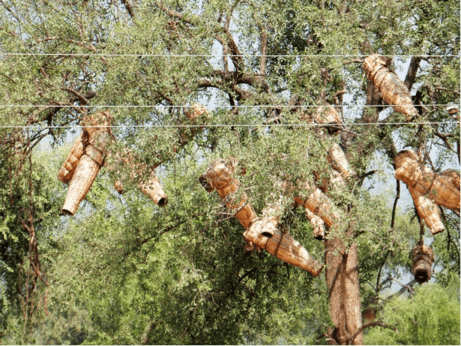
                              Ethiopian hives in tree. Image thanks to Porini Association
The Koch Effect

John Hanno    January 30, 2018     

                       The Koch Effect

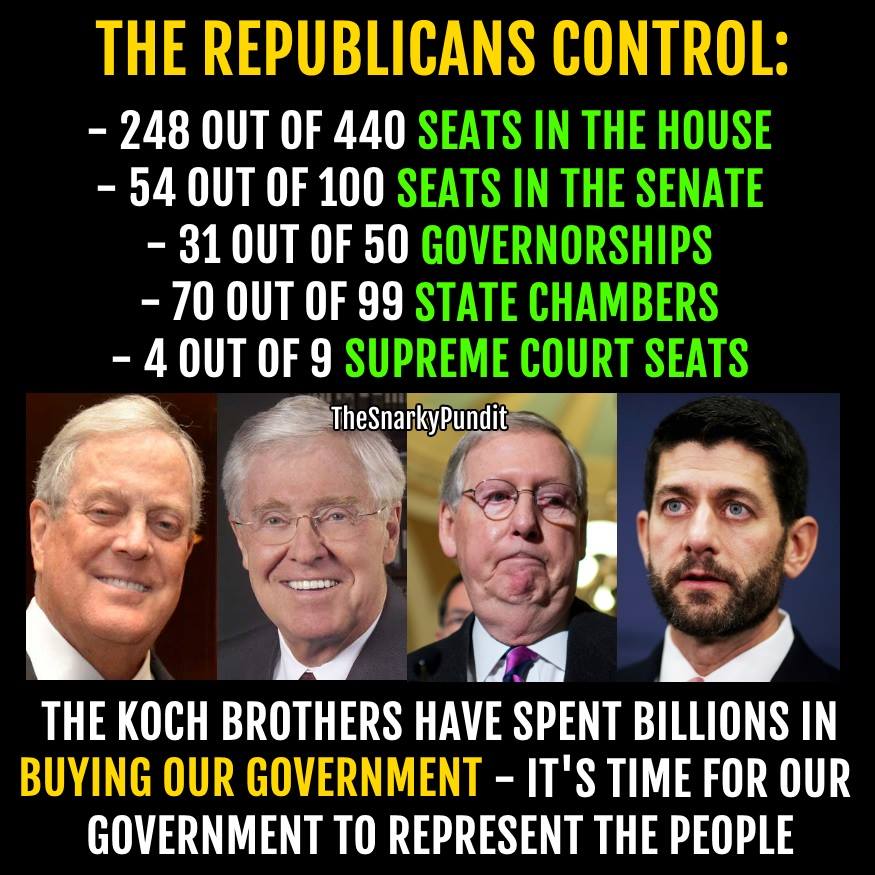
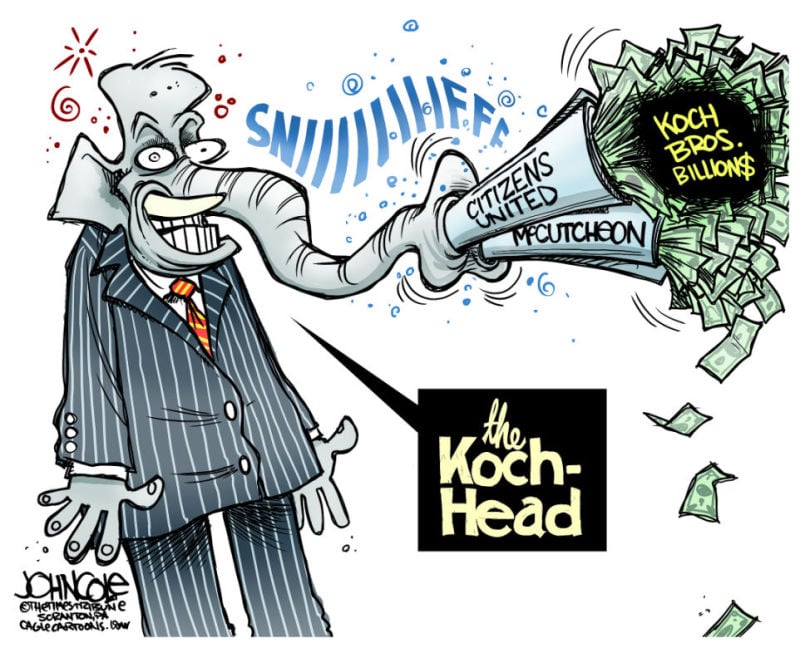
Yes, our political system is broke, thanks to the U.S. Supreme Court decision in Citizens United, to Republi-cons who respect no ethical or legal boundaries (including congressional and legislative district borders) – who will do anything to “Win” and prop up their dying party, and to a cabal of obscenely rich autocratic and predatory old white men, who believe they alone should rule the world.

But all the benefits they’ve received from our erstwhile prosperous and expanding middle-class based economy is in serious jeopardy. Unfortunately they’re too stupid or obsessed with greed to realize, that if America’s middle-class crumbles, their gravy train will eventually derail.

These toxic crony capitalists somehow believe they’re solely responsible for their wealth and good fortune. They’re quick to criticize folks who just “need to pull themselves up by their boot-straps.” “If they can do it, anyone can.” Thankfully, everyone’s not so obsessed with greed, that they follow in their “mo money” footsteps.

If it were up to these greedy bastards, they would pay absolutely no taxes to support the commons, would refuse to fairly share their wealth with faithful employees or their communities and would engage in any scheme, legal or otherwise, that would make them even richer.

Fortunately these old farts will soon be spreading their toxic brand of capitalism and far right ideology in the Here-After. America and the world will be better for it.

I read a study where once you reach an annual income of $75,000, you’re no happier if you earn more. I think the authors were on to something because every time I see trump, the Koch brothers, Sheldon Adelson, the Mercers or any of the other GOP mega donors, they all look incredibly miserable. They must store up their regrets, the imagined slights and persecution and just can’t seem to appreciate their good fortune.

Charles and David Koch have a combined net worth of almost $100 billion, the second richest family in America. I’m sure they’ve always worked hard but they didn’t accumulate that enormous wealth on their own. They were left a fortune by their father and I’m sure their vast assortment of businesses have benefited greatly from taxpayers who support our government and the public commons and infrastructure.

I don’t know if the Koch’s are as averse to paying taxes as trump or as reluctant to show their tax returns, but they spent $20 million supporting the just passed Republican tax legislation for the betterment of corporations, the rich and the politically connected, and a conservative group led by the brothers are now funding a $20 million public relations campaign to tout the benefits of that tax bill con. They also pledged almost $900 million from their political action committee to Republican candidates during the 2016 campaigns. And will spend $400 million more during the 2018 mid-term elections.

As rabid Libertarians, they’ve never been fans of America’s particular form of democratic socialism. Corporations hate social welfare, unless that socialism benefits their bottom line. So worried that America would sink to the depths of say, a socialist European country, or God forbid even worse, a Scandinavian country, that the Koch’s have spent their entire adult lives supporting libertarian causes and fighting against socialist tendencies of any sort.

They’re particularly fond of supporting ALEC anti-labor and right-to-work legislation across the country. And in Wisconsin, they’ve showed a particularly venomous bent by supporting an anti public employee, anti-teacher union,  anti-environmental and pro corporate  agenda. Wisconsin, a birthplace of the Progressive movement, now represents the worst of corporate controlled state government.

Some recent polls show Millennials and younger Americans harbor an increasing distaste for the predatory form of capitalism practiced by trump, the Koch’s and others. When these old buzzards have all died off, hopefully a more democratic form of social community will emerge and begin to reverse America’s enormous wealth and income disparity.

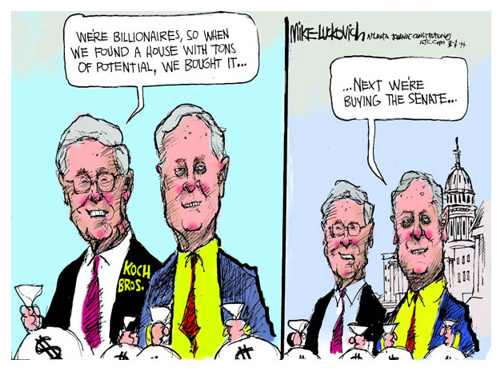
Image result for Koch Brothers Pictures

I don’t wish to leave the impression that all rich folks are like these turkey vultures. A large group of wealthy Americans signed petitions and supported efforts to defeat the Republi-con tax cut fraud. They actually believed their taxes should be raised instead of cut. And there are many thousands who obey the law, pay their fair share of taxes, or even more, aren’t afraid to show their tax returns, play by the rules, share their wealth and good fortune with their governments, their communities and their employees and partners. They support the commons, don’t cheat, tell the truth and from all appearances, are well respected happy human beings.

The Koch’s typically re-invest more that 90% of their profits back into their companies. They’re the number one supporter of conservative, Republican, libertarian, anti-labor and anti-social welfare and anti-socialist programs. I guess that doesn’t leave much for charitable donations.

Compare that to Warren Buffet and the Gate’s family (including Bill’s wife Melinda and his father). In July of 2017, Mr. Buffet donated another $3.17 billion of Berkshire Hathaway stock to the Bill & Melinda Gates Foundation and four family charities. That brings his total contributions since 2006 to $30 billion or more. Buffet has pledged more than 99% of his wealth to charity during his lifetime or within 10 years of the settlement of his estate. The Gates have also donated more than $30 billion of their wealth to their foundation. In 2010, Buffet and Gates created the Giving Pledge program, which encourages billionaires throughout the world to donate at least half their fortunes to charity. As of 2017, there have been 173 pledgers. Mr. Buffet still owns 17 percent of Berkshire, despite donating more than 40 percent of his stock. I think one can be sure that trump, the Koch’s and others of their ilk are not Giving Pledgers.

I believe an overwhelming number of humans, if blessed with the Koch’s wealth and power, would be thankful to keep just a few hundred million or half a billion dollars for themselves and their families and then donate the rest to those in need; and would also spend their time making this world a better place. I’m sure most of us would not spend so much money and effort fighting attempts to increase the minimum wage and living wages for public employees, teachers and organized laborers.

Or  would not spend millions to defeat and overturn the lifesaving Patient Protection and Affordable Care Act (Obamacare) and would not support efforts to stop the inevitable march to single payer health care for all Americans. We would not stay up nights scheming ways to cripple Social Security, Medicare, Medicaid and other social welfare programs for the poor and middle-class. We would not be obsessed with turning a vibrant and prosperous middle-class into a horde of desperate workers willing to work for peanuts.

What drives these folks to deny others just a little bit of the good fortune they’ve been blessed with? I remember the July 2007 Senator Ted Kennedy speech in the U.S. Senate, advocating for an increase in the $5.15 minimum wage to $7.25 over a 2 year period, which hadn’t been increased in 10 years because Republicans filibustered any vote on the bills. After 5 whole days of debate, Kennedy asked: “$240 billion in tax cuts for corporations, $36 billion in tax breaks for small businesses, a 42% increase in productivity, but no increase in the minimum wage. What is the price you want from these working men and women? What cost? How much more do they have to give? and “When does the greed stop?”

And what drives people like the Koch’s to plunder the earth by destructive  mining and fossil fuel extraction, including the dirtiest of all toxic tar sand mining and pipelines, no matter the harm to our environment? Why do they risk destroying America’s air and precious water just so they can become even richer? “When does the greed stop?

These predatory capitalists will try their damnedest to accumulate as much money as they can – any way they can. Buying political fealty is their primary modus operandi. This current crop of elected Republi-con enablers have forsaken all integrity and sense of duty to the American people. No deviancy from the normal is too low to stoop for this corrupt white house and republi-con congress. Even conspiring with the Russians is not a bridge too. And attacking and tearing down the free press and our Democratic institutions, including the Justice Department, is part of their tyrannical grand plan.

Unless the corporate and toxic dark money is wrenched from our political system, nothing much will change; the enormous infusion of mega donor payoffs are too tempting for low character republi-con supplicants to pass up. Public financing of campaigns is the only real answer.

The Koch’s are worried that their paid political sycophants in the U.S. Congress and in state legislatures across the country, even in red states, are heading for a 2018 mid-term ass-whoopin. Its patriotic American’s job to make their premonition come true. Vote for folks who will stand up for women, for workers, for immigrants and dreamers, for our environment, for our National Parks and public lands, for common sense and science, for public education, for American Democracy, for a free and fair media and most importantly, for the truth.

Related:   

The GOP has a major millennial issue, new poll shows

Mic

The GOP has a major millennial issue, new poll shows

By Stacey Leasca       January 30, 2018

The Republican Party could be in serious trouble when it comes to attracting younger voters, according to a new in-depth NBC News/GenForward survey.
The survey of “racially and ethnically diverse young adults” found that not only do 63% of millennials think the country under the Trump administration is on the wrong track, but they also believe Republicans don’t care about them or issues they see as relevant.

The majority of the those polled — 63% — said they disapprove of the job President Donald Trump is doing, and 61% disapprove of Congress.

Evan Siegfried tweet: Worrisome numbers for GOP in NBC News millennial poll:

•63% disapprove of Trump
•72% say GOP “doesn’t care about people like me”
•Only 17% identify as GOP & 57% of them as “not very strong” Republicans
•63% say country headed in wrong direction

These numbers indicate how young people feel about the Republican Party in general — according to the poll, 62% of the polled age demographic holds unfavorable views of the party. This is likely to affect the 2018 midterm elections, as nearly half of those surveyed said they were either planning to or leaning toward voting for whoever the Democratic congressional candidate is in their locality. Just 25% said they were leaning toward or planning to vote for the Republican candidate.

Perhaps even more concerning for the GOP and Democrats: a quarter of the millennials surveyed said they were neither planning to vote for, nor leaning toward voting for, either major party’s candidate. This could mean they plan to vote third party, or not at all. The GOP’s millennial problem, according to some insiders, could be a result of the over-the-top rhetoric displayed by Republicans in the media.

“The GOP brand is severely tarnished among this entire generation of Americans, as a paltry one in five millennials identify with the GOP or conservative values,” Evan Siegfried, a Republican strategist and commentator, wrote in an op-ed for NBC News. “We are perceived as waging a ‘War on Women’ because of our policies regarding the right to life and outlandish figures like former Rep. Todd Akin who make ridiculous statements that a woman’s body can’t get pregnant in a case of ‘legitimate rape.’”

Evan Siegfried tweet: The GOP’s millennial problem existed long before Trump. However, he has only cemented the divide, as Trump is the prism through which the GOP is viewed.

Siegfried argued that millennials have “bought into the idea” that Republicans only care about the super wealthy. The NBC News/GenForward poll showed to be true — 85% of respondents said they agree with the statement that the government is run by a few big interests “looking out for themselves and their friends.”

But Siegfried believes the GOP can fix its image by engaging with issues millennials care about, including fixing the student loan crisis, rethinking health care and criminal justice reform.

Evan Siegfried tweet: The notion that millennials don’t have jobs, are lazy, want free stuff, etc. is part of why the GOP has a millennial problem. Reality is they’re the largest part of the workforce, most fiscally conservative gen since Great Depression & don’t want to associate with us in the GOP

“The question is not if, but when the Republican Party’s leaders will remove their heads from the sand and finally address the problem the party has with millennial voters,” he wrote. “The longer they take, the bigger the electoral calamity, and the Republican Party will only have itself to blame.”

Siegfried does miss a few key points highlighted by the poll, including noting that Republicans may need to get on board with continuing the Deferred Action for Childhood Arrivals program, which grants roughly 800,000 undocumented immigrants who were brought to the U.S. as children the ability to live and work in the country legally. This is an issue millennials appear to care deeply about.

In a statement to Ebony, NBC News/Gen Forward explained, “millennials across race and ethnicity groups overwhelmingly agree that undocumented individuals who currently meet DACA eligibility should be granted citizenship. Over 75% of millennials share this view.”

Millennials are the most racially diverse generation in U.S. history, with 44% of those within the age demographic identifying as a minority, according to the Brookings Institute. Just 33% of millennials identify as Republican or Republican-leading, according to Pew Research Center.

Stacey Leasca is a news writer with Mic. Her byline has appeared in Travel+Leisure, the Los Angeles Times, GOOD Magazine and more. When not writing you can find her surfing in Southern California.

Related:

Joe Kennedy III carries the Kennedy legacy into the fight against Trump

Yahoo News

Joe Kennedy III carries the Kennedy legacy into the fight against Trump

Jon Ward           January 30, 2018

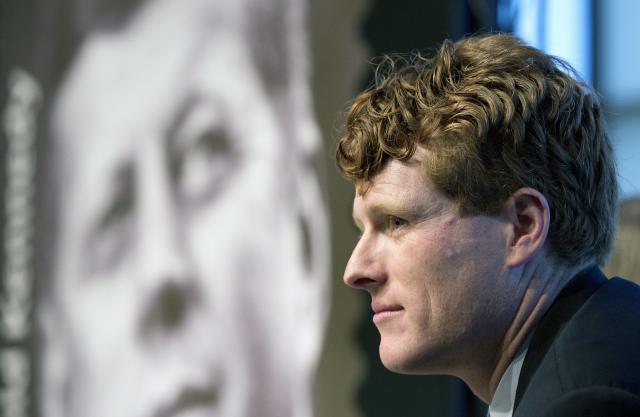
Rep. Joseph P. Kennedy IIIRep. Joseph P. Kennedy III, D-Mass. (Photo: Michael Dwyer/AP)
When Republicans called Joe Kennedy III “rich” and “boring” the day before he was to deliver the Democratic response to President Trump’s first State of the Union address, they were really saying something else.

“There’s no there there,” they were saying. “He’s an empty suit. He is coasting on his family name and money.”

If you’re a Kennedy, it’s a familiar charge. Joe’s great-uncle Ted Kennedy, the former U.S. senator who died in 2009, was treated as “a joke” when he first ran for the Senate as a 30-year old assistant district attorney.

Sure enough, when Joe III first ran for Congress in 2012 — also on the basis of a résumé that mostly amounted to three years as an assistant DA — someone at a debate leveled the same epithet at him. “If your name were Joseph Patrick … and not Joseph Patrick Kennedy, based on your life experiences, would not your campaign be a joke?” a debate audience member asked.

As late as 1980, after 18 years in the Senate, Ted Kennedy had to confront the accusation that he was presuming to inherit the presidency from his late brother John, and his quest for the Democratic nomination fell short.

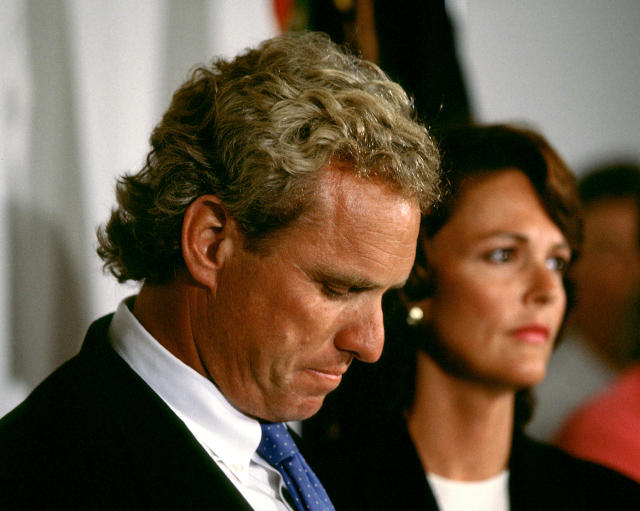
Joe III’s own father, Joe Kennedy II, abandoned a 1997 gubernatorial bid in Massachusetts because of a personal scandal, another recurring theme in Ted’s life and in the Kennedy family as a whole. But Joe II was also bedeviled by an over-reliance on his last name and the lack of a compelling vision for his candidacy.

In August 1997, Joe Kennedy II, joined by his wife Beth, announced he would not be running for governor. (Photo: Brooks Kraft LLC/Sygma via Getty Images)

That background, and the Kennedy penchant for bad behavior, may explain why Joe III was such a straight arrow in college — Stanford, not Harvard, although he went to Harvard Law School — abstaining from alcohol and gaining a reputation as a highly conscientious student. It sheds some light on why he spent two years with the Peace Corps in the Dominican Republic.

On his office wall, there is a quote from his grandfather Robert F. Kennedy, the former attorney general who was assassinated in 1968 while running for president. “You can use your enormous privilege and opportunity to seek purely private pleasure and gain, but history will judge you,” the RFK quote reads.

Unlike his great-uncle Ted, Joe III seems to wear the weight of expectations well. He understands the power of the Kennedy name, springing from John F. Kennedy’s charismatic presidency and his martyrdom in 1963.

But he has been in no rush to become a political star. Kennedy, 37, has been a member of Congress for five years now and has remained relatively unknown beyond his district. He missed the December House vote on the Republican tax bill to be with his wife — whom he met at Harvard Law in Sen. Elizabeth Warren’s class — for the birth of the couple’s second child.

“I don’t think he gets out ahead of himself,” said Paul Watanabe, a professor of political science at the University of Massachusetts Boston. “He has been somebody who focuses on being what young congress-people do, which is focus on their district, focus on constituent services.”

Joe Kennedy III officially launches his campaign for Congress on Thursday in Newton, Mass. (Photo: Suzanne Kreiter/Boston Globe via Getty Images)
Chosen by House Minority Leader Nancy Pelosi to speak Tuesday night after Trump, Kennedy will now have much more visibility — and scrutiny. Already he has faced questions about his wealth, which was estimated at around $18 million in 2015. The Boston Globe reported in 2016 that Kennedy owned as much as half a million dollars’ worth of stock in a drug company called Gilead Sciences, which makes a hepatitis C drug that costs patients $1,000 a pill.

Even if many younger voters don’t know much about the Kennedy history, this new phase for Kennedy will bring more intense pressures on him.

“For people who may have loathed the Kennedys and saw them as representative of all that’s bad in the country — and there’s many of them — they may shift that to Joe,” Watanabe said. “On the other hand, many loved the Kennedys and thought everything they did was gold. On both sides it’s a little unfair and too much responsibility to bear.”

“The important thing is whether he comes out of this as his own person, and as a politician of the future and not of the past,” Watanabe said.

Kennedy family allies like Robert Shrum, a former adviser to Ted Kennedy, seem most anxious for Joe III to create some separation from the family heritage conveyed by his last name.

“I think he should be judged on his own, not as part of the family, or not as some kind of heir to Kennedy politics,” Shrum said.

Kennedy has gained some attention this past year. His remarks in a committee hearing challenging House Speaker Paul Ryan’s characterization of efforts to repeal Obamacare as an “act of mercy” went viral. A few other speeches have also drawn attention on social media.

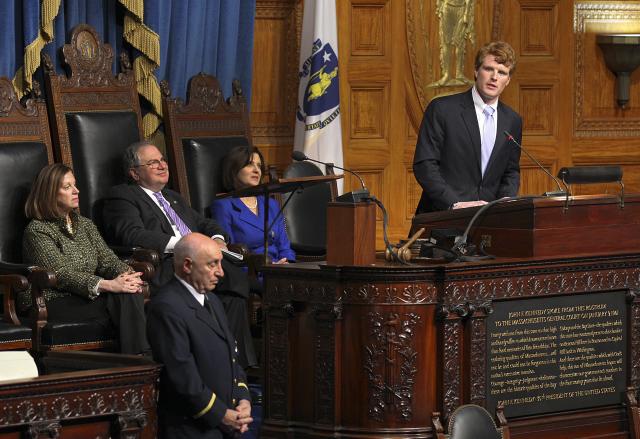
But one of Kennedy’s more notable speeches came a year before he ran for Congress, when he addressed the Massachusetts legislature during a 2011 ceremony to commemorate the 50th anniversary of JFK’s inauguration.

Joseph Kennedy IIIJoseph Kennedy III at the 50th anniversary of JFK’s inauguration at the State House in Boston. (Photo: David L Ryan/Boston Globe via Getty Images)
Kennedy stood at the lectern with Ted’s widow, Vickie, seated on the dais behind him and began his remarks with a joke about JFK and former House Speaker Tip O’Neill, who also was a Massachusetts Democrat and a close Kennedy family ally.

Near the end of his 10-minute speech, Kennedy turned emotional as he spoke about the death of his grandfather, and connected it to the most recent violence in American politics. Rep. Gabby Giffords, an Arizona Democrat, had been shot in the head just a few days before.

Kennedy traced the roots of political violence back to extreme language, and he blamed both Republicans and Democrats for creating “an atmosphere of hate.”

“For too long the rhetoric in Washington has been toxic: antiwar protesters holding up signs saying ‘Death to terrorist pig Bush’; tea party protesters shouting out racist and antigay slurs to members of Congress; protesters shouting out ‘Death to Cheney’; radio talk show hosts calling President Obama and Democrats communists and traitors; images of both political parties showing opponents in the crosshairs of a rifle scope,” Kennedy said.

“This isn’t what President Kennedy stood for. It isn’t what [Martin Luther] King or Robert Kennedy stood for. They took on the big problems of our world. They looked to those common threads that unite us rather than diving into the identity politics to find those that divide us,” he said.

Kennedy’s willingness to call out both political parties could position him to speak to the whole nation Tuesday night. His speeches, Shrum said, include “the kind of thing that Democrats need to be saying if we’re going to reconnect with some of the people we lost in 2016, while keeping the people we had.”

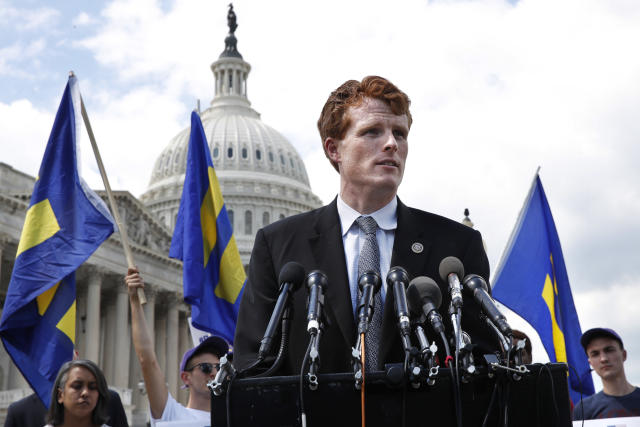
Rep. Joe Kennedy, D-Mass.Kennedy speaks in support of transgender members of the military, July 26, 2017. (Photo: Jacquelyn Martin/AP)

And Kennedy’s condemnation of “identity politics” presaged a debate among Democrats now in the wake of Hillary Clinton’s loss to Trump. Liberals like Mark Lilla and others have blamed Clinton’s loss on a “fixation on diversity” that “has produced a generation of liberals and progressives narcissistically unaware of conditions outside their self-defined groups, and indifferent to the task of reaching out to Americans in every walk of life.”

Kennedy is certainly no cultural conservative. His guest at the State of the Union speech will be a transgender member of the U.S. Army, Staff Sgt. Patricia King. And he has been an outspoken advocate for gay rights.

But as he speaks to the entire country following Trump, whose first year as president has been defined by divisiveness, Kennedy may sound notes like the ones he closed with in 2011, which called on themes made into mantras by JFK and generations of Democrats after him.

“In times such as these, our commitment to each other and to our country cannot dip but is more critical than ever, drawing once again to something greater than ourselves, to lives of service and sacrifice, courage and judgment, integrity and dedication,” Kennedy said. “These are the ideals that ought to endure, rather than partisan rancor, naked self-interest, and other corrosive effects of promoting social divisions, a kind of moral gerrymandering that saps our spirit and degrades our collective will.”