Can Vegetable Crops and Canola Coexist in the Seed Capitol of America?

Civil Eats

Oregon’s Seed War: Can Vegetable Crops and Canola Coexist in the Seed Capitol of America?

With a state law restricting canola cultivation set to expire, a 20-year fight over the future of growing seeds on the Willamette Valley’s 1.7 million acres is at stake.

By Lynne Curry, Farming, GMO’s, Pesticides        June 20, 2019

(Update: The Oregon state legislature voted on June 30 to pass SB 885, which extends for five years the moratorium on growing more than 500 acres of canola in the Willamette Valley.)

On July 1, a state law that restricts canola cultivation in Oregon’s Willamette Valley will expire. Around the state capitol, two groups of farmers and their advocates are locked in battle over the potential expansion of canola production. It’s the latest flare-up in a 20-plus-year fight over the future of these prime farmlands stretching 125 miles due south from Portland.

Cradled between two mountain ranges, the populous Willamette Valley is one of the most productive and protected agricultural regions in the country. While renowned for its diversity of farm crops and wine grapes that feed a thriving farm-to-table movement, it’s also the epicenter of a lucrative seed industry. Lands for growing grass seed, cover crop seed, and flower and vegetable seeds dominate the corridor’s 1.7 million arable acres.

Within the world of vegetable seed production, brassicas such as kale, broccoli, cabbage, and rutabaga contribute significantly to the valley’s specialty seed market, ranked fifth in the world. The canola plant is in the same Brassicaceae family (commonly known as mustard or cabbage). Also called rapeseed, the yellow flowering Brassica napus is a useful rotational crop for grass seed farmers in the valley, and the oilseed is crushed for oil and animal feed.

While canola has been raised in the Willamette Valley since before World War II, the state has taken a precautionary approach to the crop because it is a notorious cross-pollinator with rampant pest, disease, and weed issues. In 2013, the legislature implemented a 500-acre limit for canola cultivation in the Willamette Valley Protected District and tagged on a mandate for Oregon State University (OSU) to study the fields.

Now, with the July sunset date looming, a fierce debate has reignited between specialty vegetable seed stakeholders and pro-canola supporters.

canola field in oregon's willamette valleyAn Oregon canola field. (Photo CC-licensed by the Oregon Department of Agriculture)

Organic and vegetable seed producers fear that the potential for contamination from cross-pollination from canola, which also has the potential to carry genetically engineered (GE) materials, is so high it threatens the viability of Oregon’s specialty seed industry. Led by the Willamette Valley Specialty Seed Association (WVSSA), they’re seeking the protections of a renewed state law, SB 885, which would extend the 500-acre limit on canola for four more years.

Oilseed growers have long bristled at strict regulations that single out the canola crop from other brassicas and limit the development of an oilseed industry. They are pushing for expansion under a new set of rules from the Oregon Department of Agriculture (ODA) that would go into effect if the legislature allows the cap on canola to expire.

The central question in play is: Is there a way for vegetable seed and oilseed production to coexist? The matter is far from settled, and the pro- and anti-canola groups have found little, if any, common ground.

What’s at Stake for Oregon Farmers

Oregon’s Willamette Valley, with its mild, moist winters, long summers, and fertile soils, is one of few places, along with Chile, Australia, the Mediterranean, and western Canada, ideal for cultivating high-quality vegetable seeds. There is no official data collected on the number of seed companies located in the valley nor how many acres they farm. But industry sources reported to Civil Eats that there are at least 40 and as many as 100 seed companies operating on 10,000 to 12,000 acres. This includes valuable brassica seeds, including most of the world’s supply of European cabbage, Brussels sprouts, rutabaga, and turnip seed, and a quarter of the radish, Chinese cabbage, and other Chinese Brassica vegetable seed, according to a 2010 OSU report.

It’s well-established that when any variety of brassica blossoms, there is the potential for pollen to be transferred by insects or wind to other brassicas. If turnip pollen drifts to Chinese cabbage, for instance, it can produce undesirable traits in the resulting seed. However, the WVSSA has maintained a voluntary system of safeguards for decades that include field spacing (“isolation distances”) and crop mapping (“pinning”).

This same system is in use for GE sugar beet seed production, which was introduced in the valley in 2010. So far, it has worked to prevent sugar beets from contaminating fields of chard (a close relative) as well as non-GE table beets. But growers remain vigilant for transgenic contamination and test every seed lot.

While only non-GE canola is currently planted in Oregon, there is widespread concern that, because 90 percent of global canola seed is GE, it could make the canola seed supply vulnerable. Contamination from cross-pollination or seed mixing would make vegetable seed unsalable to the U.S. organic market or to countries that ban genetically modified materials, including Japan, Europe, and New Zealand. And there is no recourse or compensation for farmers.

Even without the GE issue, anti-canola advocates say low-value canola is a direct threat to the high-value specialty seed market. They point to places such as the U.K., Denmark, and France, where vegetable seed production declined or disappeared in the wake of commercial canola production as a result of disease and pest problems.

Nonetheless, the state-mandated OSU study on those 500 acres of canola has cleared a pathway for expanded canola production. Researchers collected data on the disease and pest impacts—but not cross-pollination—of canola on other brassica crops. It concluded, “The results of this research provide no reasons, agronomic or biological, that canola production should be prohibited in the Willamette Valley when there are no restrictions on the production of other [brassica] crops.” It also recommended an expansion of canola acreage to the state legislature as “reasonable and feasible.”

The Willamette Valley Oilseed Producers Association (WVOPA) touted the findings as a green light for canola production. Over the past two years, farmers have requested permits to plant twice the number of allowable acres. Canola is one of several crops that farmers can grow in rotation with grass seeds to break pest and disease cycles and doesn’t need irrigation. It’s desirable for farmers like Anna Scharf, WVOPA board president, who raises 11 different crops, including grass seed, turnip, clover, and wine grapes on close to 3,000 acres. “Because [canola] is a commodity, as a farmer I can grow the crop and play the market,” she told Civil Eats. “At the end of the day this fight comes down to economics.”

Currently, all canola seed grown in the valley is processed at Willamette Biomass Processors, located about 20 miles west of Salem. If canola production increased, its advocates say the certified organic facility could be used to produce more valuable food-grade canola oil. Growers like Scharf see alarmist fears over canola blocking its market potential She said, “I can grow marijuana easily in this state, but I can’t grow canola.”

The grass seed industry in the Willamette Valley is immense, representing most of the seed crops grown, or about 250,000 acres valued at over $228 million per year. In contrast, the acreage devoted to vegetable seed production is small, but the value is high, reportedly worth $50 million per year. And despite the study’s results, the anti-canola camp remains unconvinced that both an oilseed industry and specialty seed industry can coexist and thrive in the valley.

OSU vegetable breeder Jim Myers was one of the research advisors on the canola report. In his opinion, while the latest research provides more knowledge, the results have limitations. “I think it’s a problem of scale,” he said in a phone conversation with Civil Eats. “When you mix commercial acreage with seed production, then we get into problems.”

Specialty vegetable seeds are bred and selected to meet high quality standards for varietal and genetic purity—requirements that oilseed does not have. Myers detailed how increased acreages of canola with three-mile isolation distances between fields would fragment production areas. What’s more, just a few seeds blown off farm equipment and transport trucks could spread feral weeds, and because canola seed stays dormant in the soil for at least two years, weed problems could persist.

“I think the crux is, ‘What do we do best in western Oregon?’” he said. And that’s not growing commodity crops, in Myers’s view. He added, “It’s hard to know where the [vegetable seed] production would go if it couldn’t be done in the Valley.”

“Is Oregon willing to sacrifice this region to the interests of canola?” said Kiki Hubbard, advocacy and communications director at the Organic Seed Alliance (OSA). “What’s at stake is the diversity of our seed supply and the diverse seed economy currently thriving in the Willamette Valley.”

Countdown to Sunset

Underlying the controversy over canola, there is widespread agreement that the specialty seed industry is unique and valued. But there is no agreement over how to move forward. The oilseed growers insist on their right to farm, while the vegetable seed growers, along with plant breeders and seed companies, fight for self-preservation.

“Coexistence requires compromises,” the OSU report stated. But it also acknowledged the uneven playing field: “Coexistence does not mean that risks, if any, are equally distributed among the sectors.” The report noted that the data could not predict that “unlimited Brassicaceae crop production within the Willamette Valley would not result in production problems.” This is the heart of issue for the specialty seed industry: in the current paradigm of coexistence, they are the ones with everything to lose.

Beehives in an Oregon canola fieldPhoto CC-licensed by Ian Sane.

After years of meetings with all stakeholders, the ODA’s draft regulations for canola include an isolation area banning 937,000 acres of the Willamette Valley from canola production. The zone outside of this area, about 1.5 million acres, could be planted with canola by permit from ODA, as reported by The Capital Press.

“Nobody likes it,” said Jonathan Sandau, government affairs director for the Oregon Farm Bureau (OFB), which participated in the rule making. Members of OFB include farmers growing specialty crops as well as farmers who would like the opportunity to grow canola.

“I don’t think you can ban one industry,” Sandau said. “I think the department really strived to find within their existing authority an ability to protect the specialty seed industry.”

In their current form, seed growers say the regulations leave a lot of unanswered questions, including permitting requirements and pinning system details. “There’s a lot of gaps in what they’ve proposed,” says Smith of WVSSA. “I’m worried.” And three organic seed companies, Adaptive Seeds, Moondog’s Farm, and Wild Garden Seed, are located outside of the proposed isolation area.

But Sandau wonders, “If you’re asking for greater protection, how much protection is enough?” At the same time, he acknowledges that no one knows the market capacity for canola or the long-term impacts it could have on agriculture in the Willamette Valley. As a representative from the U.K. seed company Limagrain put it during 2009 discussions about permitting canola in Willamette Valley, “Once the genie of canola production is out of the bottle, you will never put it back.”

With the deadline on the canola law closing in, oilseed opponents may get their wish from the legislature. According to several sources in the Oregon capitol, SB 885—the continuation of the existing 500-acre limit—appears to be moving to a vote and may pass before the end of June. If approved, it would go into effect immediately, with a new expiration date in 2023. If it doesn’t pass, the ODA is mobilizing to present new rules in time for fall canola planting.

But even a four-year reprieve will not resolve the canola war in Oregon. “Either the legislature’s going to act or ODA is going to have a rule,” said Scharf of WVOPA. “No matter what happens, it is very consequential for the state of Oregon.”

Stewardship is one of the hallmarks of the diverse Willamette Valley farm community. So, as the canola schism draws out, many have argued for being “good neighbors.” Even the OSU report urged “the entire agricultural industry to maintain good stewardship practices to protect the status of the Willamette Valley as a premier seed production region.”

But some growers, including veteran plant breeder Frank Morton of Wild Garden Seed, question the presumption that peaceful coexistence between producing oilseed and specialty vegetable seeds is reasonable and feasible. “This is a road paved with good intentions, perhaps,” he said in a testimony to ODA, “but it will lead to a world of conflict without end.”

(Correction: This article was updated to reflect the fact that Willamette Valley canola is not currently sold for biofuels. Craig Parker, CEO of Willamette Biomass Processors, told Civil Eats that the plant used to sell to the biofuels industry, but the economics were not sustainable.)

Even Ronald Reagan knew a demagogue when he saw one???

Occupy Democrats
July 2, 2019

Or in this case, cynically hugging the flag. Yes Republicans, the immortal Ronald Reagan said this. There is no excusing your support for the “amoral” Donald Trump.

Follow Occupy Democrats for more.

Image may contain: 2 people, people smiling, text

Parts of America are trapped in a ‘catch-22’ economic situation

Yahoo – Finance

‘It’s really troubling’:Parts of America are trapped in a ‘catch-22’ economic situation 
Aarthi Swaminathan, Yahoo Finance Writer           July 1, 2019.
Parts of America are stuck in an economic ‘catch-22’

While the economy and the job market have boomed in the post-Financial Crisis period, Americans living in “distressed” zip codes — which are increasingly rural — are struggling to find stability.

And their path to progress poses a “catch-22” situation, according to a researcher from the Economic Innovation Group (EIG).

“Young people are kind of trapped in debt in distressed communities,” EIG Research Director Kenan Fikri told Yahoo Finance. “And they don’t really have a pathway to get out of their situation and be able to afford moving to a prosperous metropolitan area to try to turn the situation around. So it’s really in a catch-22 that individuals who are trying to advance themselves from these communities end up landing.”

An EIG report, originally published in October 2018, looked at around 25,800 zip codes — 99% of the U.S. population — and compared two periods: 2007 to 2011, and 2012 to 2016. One of the primary reasons for the distressed communities being left behind, researchers found, was a lack educational attainment.

Yet when residents from these distressed communities tried to bridge that gap by attending college, they ended up burdened by student debt, creating a worse situation financially.

(Data: EIG, Graphic: David Foster)(Data: EIG, Graphic: David Foster)

Distress was defined through seven metrics: educational attainment, housing vacancy, unemployment levels, poverty rate, median income, the change in number of jobs, and in business establishments.

“It’s really troubling, we did a casual overlay of the [Distressed Communities Index] map with that of where student debt is most burdensome and found that delinquency rates are higher in places where economic opportunity is worse,” Fikri said

(Source: WalletHub, Graphic: David Foster)(Source: WalletHub, Graphic: David Foster)

Keith Orejel, an assistant professor at Wilmington College who studies rural communities, told Yahoo Finance that the “plight of rural America as much more structural. When one gets down to brass tacks, at the end of the day, rural areas never recovered from the Great Recession.”

Orejel added: “If you actually look at the data, it is quite shocking. Urban and metropolitan employment today is well above what it was prior to the Great Recession, whereas total employment in non-metropolitan areas is still below what it was prior to the Great Recession. And there is clearly just an absence of job opportunities in the countryside that is making these sort of economically unappealing places to live.”

Parts of rural America are ‘projected to never fully recover’

While 97% of America’s land mass is rural, only around 20% of the population resides in those areas, according to the U.S. Census. The data also showed that around 65% of the total rural population lives east of the Mississippi River, and nearly half of the people living in rural areas are in the South.

These rural areas “are increasingly in distress, and we find that rural economic well-being is more volatile generally,” said Fikri. “As the recovery progressed, metropolitan areas really benefited disproportionately. The Great Recession didn’t impact rural zip codes that severely as a group, but the recovery didn’t really reach them either.”

The most distressed zip codes are concentrated “in the southeast, rural west, and urban centers in the northeast and Midwest that have the country’s most persistent pockets of really entrenched poverty,” Fikri explained. “And we see that poverty coincides with all sorts of other socioeconomic problems: low levels of education, low levels of employment, low levels of job growth, and low levels of new business openings.”

WAYNESBURG, PA - MARCH 01: A Donald Trump sign hangs in the window in the town of Waynesburg near the West Virginia border on March 1, 2018 in Waynesburg, Pennsylvania. Waynesburg, once a thriving coal industry center, has struggled to find its footing in the new energy era. The average household income in the city is $38,255, more than $15,000 a year below the state average and another area coal mine is set to start closing down on March 2nd. Despite President Donald Trump's pledge to bring back the coal industry, some 370 coal miners are expected to lose their jobs at the 4 West Mine in southwestern Pennsylvania when it closes. Following the first wave of layoffs the remaining 175 miners will be let go by June 1 after the company removes underground equipment and seals the mine. (Photo by Spencer Platt/Getty Images)A Donald Trump sign hangs in the window in the town of Waynesburg near the West Virginia border on March 1, 2018 in Waynesburg, Pennsylvania. Waynesburg. (Photo by Spencer Platt/Getty Images)

The South in particular saw a big decline in overall rankings.

“Louisiana, New Mexico, and West Virginia saw even more of their zip codes fall into the distressed category between the two periods and the distressed share of their populations rise accordingly,” the report stated. “They joined Alabama, Arkansas, and Mississippi to bring the number of states with approximately one-third or more of residents living in distressed communities to six.”

The problem with many of the distressed areas within these states was that a large number of jobs were overwhelmingly blue-collar work which was “physically demanding” and low-paying, according to the report: “3 out of 10 employed adults in these communities worked in such classically blue-collar jobs as production, construction, transportation, and maintenance occupations.”

But the big boom that followed the Great Recession period has disproportionately affected areas with white-collar workers, with the number of jobs surging in “prosperous” areas, as seen in the chart below:

(Source: EIG)(Source: EIG)

And the post-recession recovery didn’t just miss distressed zip codes entirely, the report added. They’re also “projected to never fully recover from the Great Recession on current trendlines.”

Education as the ‘fault-line’

EIG found that the great divide between distressed communities and thriving, stable ones ultimately came down to one big fault-line: education.

Most of the major metro areas listed as distressed share the lowest ranks on college attainment nationally.

“The population differential between prosperous and distressed communities was almost entirely accounted for by the clustering of college-educated Americans in well-off zip codes,” the report stated. “Prosperous zip codes contained… 27.7 million adults with a bachelor’s degree or higher, almost six times the 4.8 million that lived in distressed zip codes.”

In Bakersfield, California for example, where nearly 50% of the population live in distressed zip codes, the area’s residents “had the lowest college attainment rate of its peers, with only 15.7% of the population holding a bachelor’s degree or higher — half the national rate,” the report stated.

A worker prunes almond trees in an orchard near Bakersfield in the Central Valley, California, United States January 17, 2015. Almonds, a major component of farming in California, use up some 10 percent of the state's water reserves according to some estimates. California ranks as the top farm state by annual value of agricultural products, most of which are produced in the Central Valley, the vast, fertile region stretching 450 miles (720 km) north-sound from Redding to Bakersfield. California water regulators on Tuesday adopted the state's first rules for mandatory cutbacks in urban water use as the region's catastrophic drought enters its fourth year. Urban users will be hardest hit, even though they account for only 20 percent of state water consumption, while the state's massive agricultural sector, which the Public Policy Institute of California says uses 80 percent of human-related consumption, has been exempted. REUTERS/Lucy NicholsonA worker prunes almond trees in an orchard near Bakersfield in the Central Valley, California, United States January 17, 2015. (Photo: REUTERS/Lucy Nicholson).

And while educational attainment is seen as a crucial step for those trying to come out of struggling communities, that same college degree pushes many others into debt.

Having taken on relatively high levels of student debt because they’re unable to afford the high tuition costs, borrowers struggle to repay loans upon graduation.

In Bakersfield, the median debt held by a graduate was $15,150, while the median income was $60,862 according to an analysis by WalletHub. That means that upon graduation, student debt represented nearly a quarter of the college graduate’s income.

‘Young people fleeing the countryside’

And since education was a big driver of economic well-being, many rural communities have struggled because of trailing rates of educational attainment.

The 2017 USDA chart below details that a considerable proportion of people living in the South lacked a high school diploma.

And while some do choose to go to college, it hasn’t been an economically rewarding experience, USDA stats also reveal. In 2015, while nearly 48% of young adults aged 18 to 24 living in a city enrolled in college, only 29% of their rural counterparts did the same according to the National Center for Education Statistics.

And those who finished college then saw their earnings lag substantially behind those in urban areas, according to the USDA.

In 2017, rural workers' incomes lagged behind urban workers as they pursued further education. (Source: USDA)                                    In 2017, rural workers’ incomes lagged behind urban workers as they pursued further education. (Source: USDA).

Orejel, the professor who studies rural communities, brought up another problem facing rural communities: The decline of the manufacturing industry. Manufacturing jobs that were available in rural areas — and created jobs that retained young people — served as a “staple of middle class jobs in the countryside have just been utterly devastated.”

That trend is well-observed. Yahoo Finance previously reported that since 1989, while there has been a surge in service jobs by 53.4%, goods-producing industries have fell by 15.5%.

But the transition to a more modern economy hasn’t been easy. Most of the big industries like finance and real estate don’t find these places attractive, “because rural areas don’t have the infrastructure to support a lot of these more sophisticated enterprises,” Orejel explained. “And the population lacks the educational attainment to staff such positions.”

Hence the gap widens further, Orejel said: “In the bifurcated economy that has developed since 2008, where you have a lot of high tech, professional, high-education, jobs, that are fueling economic growth, those are more and more gravitating towards metropolitan areas.”

He concluded that “what’s left for the rural economy is the low wage, lower end of the service sector — which are notoriously low paying with little to no benefits. And then almost complete lack of job security.”

A City Of 10 Million Is Running Out Of Water

NPR

No Drips, No Drops: A City Of 10 Million Is Running Out Of Water

By Sushmita Pathak        June 25, 2019

These satellite images from June 15, 2018, (left) and June 15, 2019, show the diminishing size of the Puzhal Lake reservoir in Chennai, India. Copernicus Sentinel-2 Satellite Image/Maxar Technologies via AP.
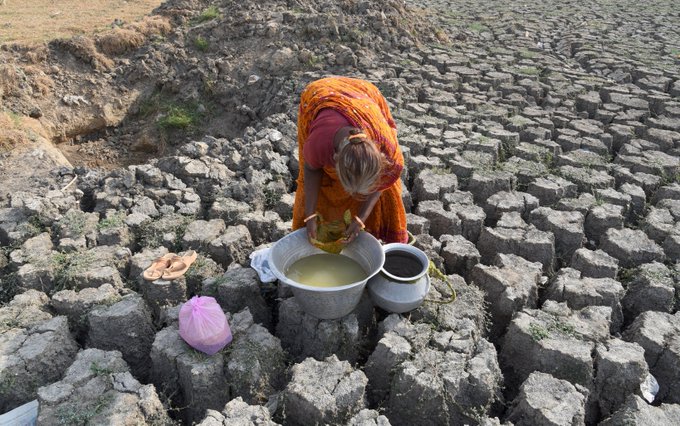
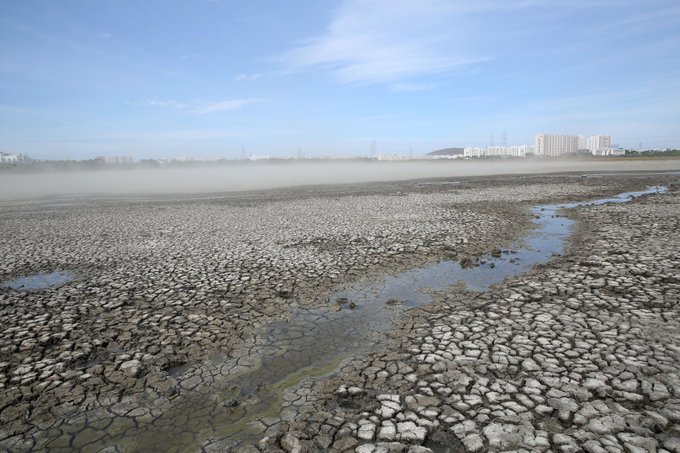
In India’s sixth-largest city, lines for water snake around city blocks, restaurants are turning away customers and a man was killed in a brawl over water. Chennai, with a population of almost 10 million, is nearly out of water.

In much of India, municipal water, drawn from reservoirs or groundwater, typically runs for only a couple of hours each day. That’s the norm year-round. The affluent fill tanks on their roofs; the poor fill jerrycans and buckets.

But in Chennai this summer, the water is barely flowing at all. The government has dispatched water tankers to residential areas to fill the void. Still, some people in especially hard-hit areas have vacated their homes and moved in with relatives or friends.

Satellite images of the city’s largest reservoir, Puzhal Lake, taken one year apart, reveal a chilling picture. Since June 2018, the lake has shrunk significantly. Puzhal is one of the four rain-fed reservoirs that supply water to most parts of Chennai.

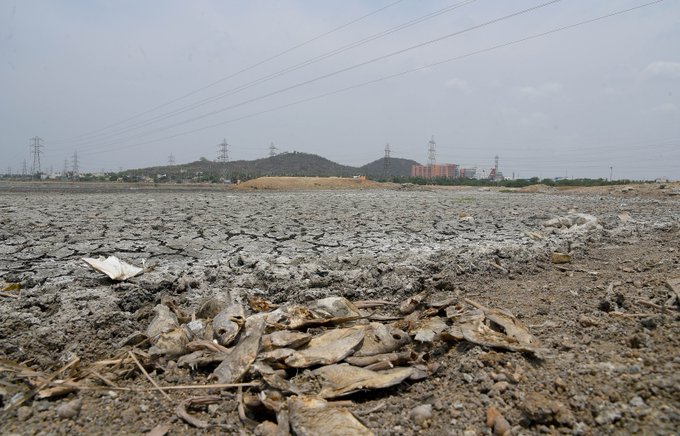
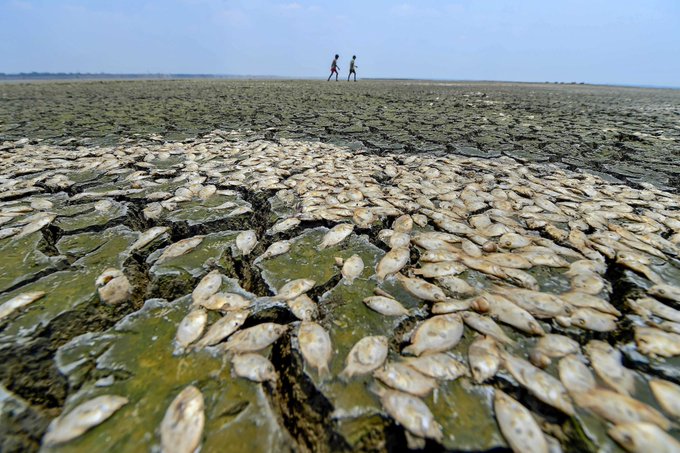
Another picture shows the parched bed of Chembarambakkam Lake, another major reservoir. Its cracked surface is covered with dead fish.

“It’s shocking but not surprising,” says Tarun Gopalakrishnan, a climate change expert at the New Delhi-based Centre for Science and Environment. He says the crisis in Chennai is the result of “a toxic mix of bad governance and climate change.”

Rains have become more erratic because of climate change. That, coupled with a delayed arrival of the seasonal monsoon, which usually comes in June, has all but dried up the city’s water supply. Government data show that the storage level in the four lakes combined is less than one-hundredth of what it was at this time last year. A severe heat wave gripping most of India, including Chennai, has aggravated conditions.

What’s happening in Chennai could easily happen anywhere across India, Gopalakrishnan says.

A 2018 government think tank report projected that 21 major Indian cities, including the capital, New Delhi, and India’s IT hub, Bengaluru, will “run out of groundwater as soon as 2020.” Approximately 100 million people would be affected, the report predicts.

In Chennai, residents are scrambling to conserve water.

“We stopped using showers for bathing. We use buckets so that we can ration the amount of water,” says 33-year-old university professor Nivash Shanmugkam. His family also avoids using a washing machine for its laundry and washes clothes by hand as much as possible.

Public institutions are suffering. Hospitals and nursing homes are charging more for services to cover the increased cost of water, according to the local press. There are also reports that toilets at schools are dirty due to a lack of water.

Indian workers carry the last bit of water from a small pond in the dried-out Puzhal reservoir on the outskirts of Chennai. Arun Sankar/AFP/Getty Images

A scuffle over water turned deadly for a 33-year-old man when he tried to stop another man and his sons from siphoning large amounts of water from a public tank this month.

Businesses and offices have been affected too. Amit Agarwal, a 28-year-old IT professional in Chennai, has been working from home for the past few days because there is no water in the bathrooms in his office. Many tech companies have been advising employees to do the same.

In Chennai’s shopping malls, restrooms are operational only on some floors.

The rich can buy additional deliveries of water from private tankers, sometimes at exorbitant rates. Poor people living in slums simply can’t afford to pay.

The response of the government of Tamil Nadu, the state whose capital is Chennai, has ranged from downplaying the extent of the crisis to praying to the rain gods.

“There has been a water shortage in several areas due to monsoon deficit. The government is taking several steps,” Tamil Nadu Chief Minister Edappadi Palaniswami told reporters on Friday.

Those steps include a special train that will soon begin transporting 10 million liters of water per day – that’s about 2.6 million gallons — to Chennai from another part of the state. After initially turning down donations, Tamil Nadu has accepted an offer of aid of 2 million liters of drinking water from a neighboring state, Kerala.

Opposition politicians in Tamil Nadu are staging protests. Dozens of women carrying colorful plastic water pots with slogans written on them gathered in Chennai this week to criticize the government for its handling of the water crisis.

One thing that could have possibly averted this acute water shortage? Rainwater harvesting.

In 2002, the government of Tamil Nadu passed legislation that mandated rainwater-harvesting structures on all buildings, including private homes, in the city. The goal: to capture rainwater and store it for later use. It was a revolutionary idea. When the city got hit with heavy monsoon rains a few years later, rainwater harvesting raised the water table enough to last the city until 2016, says Sekhar Raghavan, director of the Chennai-based nonprofit The Rain Centre.

But the government failed to monitor the rainwater-harvesting structures, which meant a lot of them didn’t work properly.

“This is a wake-up call for the government and citizens,” he says.

Raghavan says he’s now getting calls from people asking about how they can properly harvest every drop of rainwater.

Anticipating inadequate rainfall and planning for acute water shortages are further complicated by climate change.

“The fear associated with climate change is not the fear of knowing that everything is going to be worse,” says Gopalakrishnan. “It’s the fear of not knowing.”

While they may not necessarily light ceremonial fires for rain like their elected leaders, Chennai residents will nevertheless be praying for a downpour soon.

NPR correspondent Lauren Frayer contributed to this report from New Delhi.

Welcome to the Swedish shopping mall where every single item is second hand

BBC

June 26, 2019

Welcome to the Swedish shopping mall where every single item is second hand 🙌

via People Fixing The World

The shopping mall where everything is recycled

Welcome to the Swedish shopping mall where every single item is second hand 🙌via People Fixing The World

Posted by BBC on Tuesday, June 25, 2019

Shocking photo of drowned father and daughter highlights migrants’ border peril

The Guardian

Shocking photo of drowned father and daughter highlights migrants’ border peril

The toddler’s arm was still draped around her father’s neck after bodies were found in the Rio Grande as they sought asylum Warning: graphic images

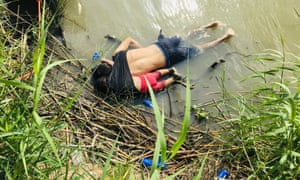
The grim reality of the migration crisis unfolding on America’s southern border has been captured in photographs showing the lifeless bodies of a Salvadoran father and his daughter who drowned as they attempted to cross the Rio Grande into Texas.

The images, taken on Monday, show Óscar Alberto Martínez Ramírez, 26, and his daughter Valeria, lying face down in shallow water. The 23-month-old toddler’s arm is draped around her father’s neck, suggesting that she was clinging to him in her final moments.

The UN refugee agency compared the photograph to the 2015 image of the three-year-old Syrian boy Alan Kurdi who drowned off the Greek island of Kos – although it remains to be seen if it will have the same impact on America’s fierce immigration debate.

Their bodies were discovered on the bank of the river near Matamoros, Mexico, across from Brownsville, Texas, just half a mile (1km) from an international bridge.

According to Julia Le Duc, a reporter for La Jornada, Martínez Ramírez had arrived in Matamoros on Sunday, hoping to request asylum from US authorities with his wife, Vanessa Ávalos, and their daughter.

But when he realized that it could be weeks before they were even able to start the asylum process, Martínez decided they should swim across, said Le Duc, who witnessed Ávalos give her account to the police.

“He crossed first with the little girl and he left her on the American side. Then he turned back to get his wife, but the girl went into the water after him. When he went to save her, the current took them both,” Le Duc told the Guardian.

Tania Vanessa Ávalos of El Salvador, center left, is assisted by Mexican authorities after her husband and nearly two-year-old daughter were swept away by the current while trying to cross the Rio Grande to Brownsville, Texas, in Matamoros, Mexico.
FacebookTwitterPinterest. Tania Vanessa Ávalos of El Salvador, center left, is assisted by Mexican authorities after her husband and nearly two-year-old daughter were swept away by the current while trying to cross the Rio Grande to Brownsville, Texas, in Matamoros, Mexico. Photograph: Julia Le Duc/AP


The image underlines the dangers which mostly Central American migrants face in their attempts to escape violence, corruption and poverty at home and find asylum in the United States.

As part of a broader crack down on migration, the Trump administration tightened the country’s asylum system, creating a growing backlog of cases. Migrants are routinely forced to wait for months to start the asylum process; those who despair of waiting turn to more remote and dangerous routes across the southern frontier.

On Sunday, two babies, a toddler and a woman were found dead after succumbing to heat exhaustion in Anzalduas Park, which borders the river in the city of Mission.


Elsewhere three children and a woman from Honduras died in April after their raft capsized on the Rio Grande, and a six-year-old from India was found dead earlier this month in Arizona, where temperatures routinely soar well above 100F.

So far this year, dozens of people have died attempting to cross the Rio Grande, where water levels are at their highest levels in 20 years and record levels of snow-melt run-off have transformed the river into a raging torrent.

Claudia Hernández, a Mexican police officer in the border town of Piedras Negras, told the Guardian: “The river is treacherous and the people who aren’t from here don’t know that. I grew up here along the Río Bravo river [Río Grande]. I wouldn’t even go into that water to bathe or swim. There are springs and whirlpools and when the current takes you it can pull you under.”

Authorities stand behind yellow warning tape along the Rio Grande where the bodies of Óscar Alberto Martínez Ramírez and his daughter Valeria were found, in Matamoros, Mexico, on Monday.
FacebookTwitterPinterest. Authorities stand behind yellow warning tape along the Rio Grande where the bodies of Óscar Alberto Martínez Ramírez and his daughter Valeria were found, in Matamoros, Mexico, on Monday. Photograph: Julia Le Duc/AP


Isabel Turcios, a Franciscan nun, the director of the Casa del Migrante shelter in Piedras Negras said that local activists warn migrants not to try their luck on the river, but the US has drastically reduced the number of migrants who are allowed to request asylum each day.

“People get desperate and cannot keep waiting. They just want to cross. So they go to the river and without any form of protection – no life jacket, nothing to save them – they go into the river. They always tell me that if God wants them to make it then somehow they will make it.”

She added: “It’s not how things should be. They should be able to cross at the bridges. Every human being has the right to migrate. It’s a human right.”

Meanwhile Mexico has launched its own crackdown on migrants as the government scrambles to ward off Trump’s threat of trade tariffs.

“Very regrettable that this would happen,” said President Andrés Manuel López Obrador on Tuesday in response to a question about the latest deaths on the border. “As there is more rejection in the United States, there are people who lose their lives in the desert or crossing” the river.

According to reports in the local press, Martínez, Ávalos and their daughter left their home in the municipality of San Martín in April. But after two months waiting in the southern city of Tapachula – and fearful of the Mexican authorities – the family decided to push on.

A U.S. Border Patrol boat navigates the Rio Grande near where the bodies of Salvadoran migrant Oscar Alberto Martínez Ramírez and his nearly 2-year-old daughter Valeria were found.
FacebookTwitterPinterest. A U.S. Border Patrol boat navigates the Rio Grande near where the bodies of Salvadoran migrant Oscar Alberto Martínez Ramírez and his nearly 2-year-old daughter Valeria were found. Photograph: Julia Le Duc/AP


“They said they were scared because of the way things were going for migrants, what with the pressure from Trump. That’s why they decided to cross the river. Their plan was to hand themselves into US migration,” Martínez’s sister Wendy told El Diario de Hoy.

One of Martínez’s cousins, Enrique Gómez, tweeted an appeal to the Salvadoran president, Nayib Bukele, pleading for help in repatriating the bodies. Gómez said the family sought assistance from the Salvadoran government but were being charged between $7,000 and $8,000 to repatriate the bodies. Bukele’s office responded by asking Gómez to send a private message and promised to start the repatriations.

On Wednesday, Pope Francis expressed “immense sadness” over the fate of Martínez and his daughter. “The pope is profoundly saddened by their death, and is praying for them and for all migrants who have lost their lives while seeking to flee war and misery,” a spokesman said in a statement.

The UN high commissioner for refugees, Filippo Grandi, said the deaths represent “a failure to address the violence and desperation pushing people to take journeys of danger for the prospect of a life in safety and dignity.”

In the US, several Democratic presidential candidates, including Kamala Harris, Beto O’Rourke and Cory Booker, also expressed their dismay on Tuesday evening. “Trump is responsible for these deaths,” wrote O’Rourke in a tweet, while Harris called it “a stain on our moral conscience”.

The photograph of Martínez and his daughter provoked soul-searching among some Mexicans, but recent polls revealed that attitudes towards migrants have hardened in recent months.

“The image… is a painful symptom of our systematic failure,” tweeted author Alma Delia Murillo. “And on top of that you have idiots who blame the migrants.”

Polling firm Parametría showed 58% of Mexicans oppose migrants entering the country from Central America. 32% of respondents expressed the same opinion on November, when migrant caravans were welcomed with outpourings of generosity.

This report includes material from the Associated Press

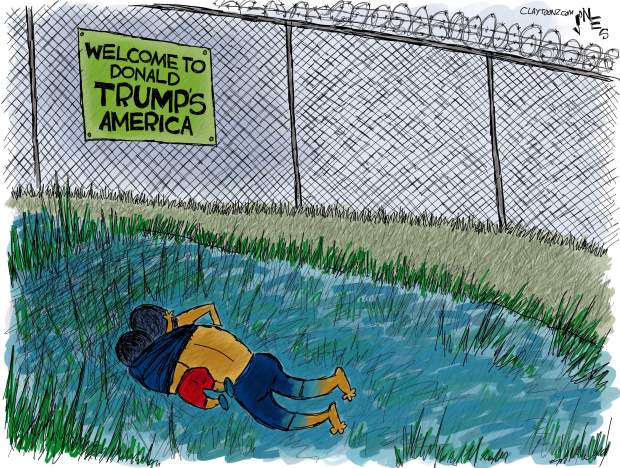
Welcome to donald trump’s America!

From Clay Jones

June 26, 2019

cjones06302019

I’ve been a cartoonist since 1990 and this might be the hardest cartoon I’ve ever had to draw.

Shame on Donald Trump. Shame on Republicans. Shame on each and every single one of you who supports this.

This cartoon was hard to draw but right now, it’s even harder to be a proud American.

Claytoonz.com

Supreme Court’s Ruling on Making SNAP Retail Data Public Has Broad Public Health Implications

Civil Eats

Supreme Court’s Ruling on Making SNAP Retail Data Public Has Broad Public Health Implications

At issue is USDA’s longstanding practice of shielding how much money retailers, including big box stores like Walmart, make from SNAP.

By Cassie M. Chew, Food Policy, Nutrition          June 24, 2019

(Update, on June 24, the Supreme Court ruled 6-3 against the Argus-Leader, limiting public and media access to government records such as store-level SNAP sales data.)

Open for business every Sunday between the hours of 10 a.m. and 2 p.m., the Takoma Park farmers’ market makes it easy for recipients of food-assistance benefits—including Maryland’s Independence Card, and Washington, D.C.’s DC EBT card—to shop for healthy food.

At the center of market, surrounded by farmers’ stands, a high school student runs table where shoppers can swipe their cards to convert Supplemental Nutrition Assistance Program (SNAP) dollars into tokens that they can use to buy locally grown produce and pasture-raised meats from the market’s dozen or more vendors.

Although the market will match SNAP users’ first $5, less than 1 percent of its 2,000 or more Sunday visitors are SNAP shoppers. Even at larger markets that match more SNAP funds, in Maryland and around the country, farmers’ markets are distant competitors to the roughly 250,000 big food retailers authorized by the U.S. Department of Agriculture’s (USDA) to accept SNAP funds for purchases. While the 3,600 authorized farmers’ markets nationwide redeemed nearly $16 million in SNAP benefits in 2017, the nearly 51,000 authorized grocery stores, supermarkets, and superstores redeemed nearly $52.7 billion in SNAP benefits through the program.

SNAP farmers' market tokens photo CC-licensed by Seacoast Eat Local

Photo CC-licensed by Seacoast Eat Local.

The USDA has refused to share with the public the individual SNAP sales data from those food retailers, although the outcome of arguments before the U.S. Supreme Court this session could raise the curtain on that information. Some advocates hope to shine a light on just how much companies like Kroger and Walmart are benefiting financially from the SNAP program, while also employing many SNAP users. If made public, this data might offer a clearer picture of the challenges associated with food access across the country.

The case, Food Marketing Institute v. Argus Leader Media, pits the trade association for chain and independent food retailers against the Sioux Falls, S.D.-based Argus Leader newspaper. The case has been brewing since 2011, and in its oral arguments the Food Marketing Institute (FMI) asked the Supreme Court to reverse a November 2016 district court decision that, under the Freedom of Information Act (FOIA), required the USDA to disclose individual store sales data on its retailers authorized to accept SNAP funds for purchases.

In the wake of two decisions in favor of the Argus Leader, the USDA in January 2017 announced that it would comply with the court ruling and promptly begin releasing the data to the public. The FMI then intervened, first taking the case to the U.S. Court of Appeals, then appealing its loss there to the Supreme Court. In its opening statement, the FMI asked the Court to reverse the decision and keep its members’ SNAP food sales confidential.

“Our injury in fact is the disclosure of our members’ store-level sales information that they keep secret,” argued Evan Young, an attorney for the FMI, which represents 33,000 retail food stores and 12,000 pharmacies. Young, along with an attorney for the Department of Justice, told the nation’s highest court that retail sales from taxpayer-funded SNAP should be considered trade secrets and confidential financial data that the USDA, in their more than four-decade long partnership with retailers, has to date agreed not to disclose.

“We are exercising our discretion in a matter of good government,” Anthony Yang, Department of Justice (DOJ) assistant to the solicitor general, told the court. “The government is trying to keep its word, given over 40 years, in the most official form possible, that we’re going to keep this information confidential.”

Meanwhile, the Argus Leader argued that SNAP sales data are agency records under FOIA and presumptively open records.

“How the government spends its own money is critical information that the press and the public need to know,” Richard Loeb, attorney for the newspaper told the Court. “It’s the type of information that FOIA has been used for decades to reveal.”

The USDA has said that FOIA exemptions prohibit it from disclosing data that retailers have shared with the agency in confidence. But since the information the newspaper has requested is automatically stored in USDA’s Store Tracking and Redemption database, the Argus Leader says USDA’s argument is misleading.

“USDA’s imprecise use of the term ‘redemption data’ … creates the mis-impression that USDA must depend on retailers to furnish SNAP payment information,” the Argus Leader wrote in court filings. Further, the newspaper’s lawyers say the agency’s claims are “disingenuous” since it already has the data.

SNAP Fights Hunger, but Should it Also Support Healthy Eating?

The difference between using SNAP for purchases at farmers’ markets and using them at a Walmart Supercenter are significant—farmers’ markets rarely offer much in the way of processed, packaged foods. And while the overarching goal of SNAP is to reduce food insecurity, there’s a growing interest in simultaneously improving people’s health. Governments and health advocates at all levels are increasingly advocating the design of food assistance programs that will boost nutrition, improve health, and maybe even reduce the cost of healthcare associated with the chronic illnesses that arise from an unhealthy diet.

To food access advocates, keeping secret the data about where SNAP dollars are being spent doesn’t make sense.

Takoma Park and other Maryland farmers’ markets receive funding through statewide grants, partnerships with private business and fundraisers at individual markets like Takoma Park’s annual pie contest. Despite the fact that Maryland has among the highest per capita household income in the country, as many as one out of eight residents experience food insecurity. Food access advocates have been active in developing programming that promotes greater consumption of healthier foods by creating incentives for SNAP shoppers at individual farmers’ markets and say they don’t keep their work a secret.

“It’s very unfortunate when we have a program that’s fairly transparent [while] large food retailers don’t have to share the same amount of information,” said Amy Crone, founder and executive director of the Maryland Farmers Market Association(MDFMA).

At the Takoma Park farmers' market. (Photo by Cassie Chew)

At the Takoma Park farmers’ market. (Photo by Cassie Chew)

Since 2014, Crone and the MDFMA have raised more than $700,000 in funding, which they’ve used to increase food access and farmer sales through its statewide farmers’ market matching program for SNAP shoppers.

“We found that 90 percent of SNAP shopper purchases go toward fruits and vegetables,” Crone said. “We know our incentive program is making a difference.”

With a $65 billion budget supporting food purchases of 40 million people in 2018, roughly one out of every seven Americans, food access advocates and scholars at the intersection of agriculture, economics, and policy have long wanted to use SNAP to improve health status among individuals at the lower end of the economy.

Getting more data on nationwide SNAP purchases could help achieve that goal. In its 2011 FOIA request, the Argus Leader asked for five years of store-level data; two years prior, the USDA’s own research suggested more data on consumers’ connection to stores would improve analysis of the availability of nutritious food.

“The data would definitely help, so that we can incentivize healthy eating,” said Crone.

Experts at the intersection of food access and health say there needs to be greater innovation in food assistance policy.

“SNAP is an effective program for reducing hunger in the United States … Yet, compared with both income-eligible nonparticipants and higher-income individuals, SNAP beneficiaries have significant disparities in diet quality and diet-related health outcomes,” wrote cardiologist Dariush Mozaffarian and two of his colleagues at Tufts University Friedman School of Nutrition Science & Policy in a March 2019 paper published in JAMA.

Expressing disappointment with what he says is a lack of SNAP policy innovation in the 2018 Farm Bill, Mozaffarian wrote that the current $1 per person per year food insecurity nutrition incentive (FINI) grant program that subsidizes low-income Americans’ produce purchases is too low.

“Expanding FINI to allow a 30 percent subsidy for all SNAP fruit and vegetable purchases would have cost $11.5 billion over five years—a far larger expenditure, but one that is estimated, based on a modeling study, to be cost-effective over a lifetime for reducing cardiometabolic diseases.”

Agricultural economist Parke Wilde, also at Tufts’ Friedman School, says that SNAP sales data might be useful to help identify food desserts, understand how SNAP contributes to healthy food environments and determine whether policy innovations in retail could increase the beneficial impact of SNAP.

“It seems to me it is useful to understand all of the retailers in the vicinity of where people live. We spend a lot of time thinking about how far it is to the closest supermarket, but I often find myself curious about how far do people travel to the supermarket that’s actually getting a lot of their business. So you can see how knowing the SNAP sales is potentially helpful,” said Wilde, who focuses on U.S. food and nutrition policy, consumer economics, and federal food assistance programs.

What We Learned from the Supreme Court

With the disclosure of SNAP retailer sales data hinging on how the court interprets FOIA exemptions, it is unclear how the Court, with its conservative majority, might rule on the case.

Conservative justices on the Court were less active in their questioning. Justice Neil Gorsuch asked the attorney for the Argus Leader for greater insight into how the word “confidential” has been interpreted in the prior cases and Justice Brett Kavanaugh asked the DOJ attorney about the legal threshold for keeping the sales data from disclosure.

“Can it be deemed confidential even in cases without government assurance?” Kavanaugh asked, exploring the potentially broader implications of the Court’s decision.

In one of her questions to Young, Justice Ruth Bader Ginsburg discussed whether the USDA can avoid sharing the data just because of its agreement with retailers. “To say the government can control this by making a promise that it won’t disclose, that seems to run counter to the whole idea of FOIA,” she said.

Justice Sonia Sotomayor, the most active in questioning the attorneys, reminded the attorney for FMI and DOJ that the USDA has lost two prior cases for keeping retail data confidential, and asked whether FMI had standing in the case—the requirement to bring a lawsuit in court based upon a stake in the outcome—especially after the USDA announced that it would comply with the district court’s November 2016 decision.

When Yang told the Court that USDA would not release the data as a matter of good governance, Sotomayor responded, “Mr. Yang, you are going to tell me that you were going to be in contempt on the order?”

More questions came when the attorneys discussed whether the FOIA exemption required retailers to show releasing the data would have a “competitive harm”—or negative impact—on their business.

Loeb argued that courts in the past have ruled that companies must demonstrate harm in order to request an exemption from disclosing information under FOIA. “We know trade secrets required under the common law a showing of competitive harm,” Loeb said, adding, “confidential business information also required a showing of competitive harm.”

But unlike the attorneys from the two prior court proceedings, who argued on behalf of the USDA that revealing store sales information would lead to “substantial competitive harm,” the FMI asserted that that food retailers didn’t have to demonstrate competitive harm to prevail in this case.

The line of questioning from the justices hinted at the case’s larger implications: Should the Court decide that businesses can withhold data without showing competitive harm, it could set a precedent for companies across industries to withhold any and all data.

While the Court is expected to announce its decision at the end of June, food policy analysts reiterate that, in keeping with the spirit of the goals of the SNAP program, the information should become available.

“This is really a public investment,” Wilde said. “The public has made an investment in preventing hunger through the SNAP program. I think of this as being not so much the government sharing [companies’] trade secrets but really about sharing the government’s own investment in food retail by location.”

Lizzo’s Performance at the 2019 BET Awards Was So Good Even Rihanna Gave It a Standing Ovation

Glamour – Entertainment

Abby Gardner,  Glamour         June 24, 2019

Three terrifying facts that show how much we’re damaging the earth

Video – World Economic Forum

May, 2019

Wildlife: ⬇️
Biodiversity: ⬇️
Human population: ⬆️

📕 Read more: https://wef.ch/2U32fU6

Here are 3 terrifying facts that show how much we’re damaging the earth

Wildlife: ⬇️ Biodiversity: ⬇️ Human population: ⬆️ 📕 Read more: https://wef.ch/2U32fU6

Posted by Video – World Economic Forum on Thursday, April 25, 2019