When Einstein gave lectures at U.S. universities, the recurring question that students asked him most was: Do you believe in God?
And he always answered: I believe in the God of Spinoza.
Baruch de Spinoza was a Dutch philosopher considered one of the great rationalists of 17th century philosophy, along with Descartes.
(Spinoza) : God would say: Stop praying.
What I want you to do is go out into the world and enjoy your life. I want you to sing, have fun and enjoy everything I’ve made for you.
Stop going into those dark, cold temples that you built yourself and saying they are my house. My house is in the mountains, in the woods, rivers, lakes, beaches. That’s where I live and there I express my love for you.
Stop blaming me for your miserable life; I never told you there was anything wrong with you or that you were a sinner, or that your sexuality was a bad thing. Sex is a gift I have given you and with which you can express your love, your ecstasy, your joy. So don’t blame me for everything they made you believe.
Stop reading alleged sacred scriptures that have nothing to do with me. If you can’t read me in a sunrise, in a landscape, in the look of your friends, in your son’s eyes… you will find me in no book!
Stop asking me “will you tell me how to do my job?” Stop being so scared of me. I do not judge you or criticize you, nor get angry, or bothered. I am pure love.
Stop asking for forgiveness, there’s nothing to forgive. If I made you… I filled you with passions, limitations, pleasures, feelings, needs, inconsistencies… free will.
How can I blame you if you respond to something I put in you? How can I punish you for being the way you are, if I’m the one who made you? Do you think I could create a place to burn all my children who behave badly for the rest of eternity? What kind of god would do that?
Respect your peers and don’t do what you don’t want for yourself. All I ask is that you pay attention in your life, that alertness is your guide.
My beloved, this life is not a test, not a step on the way, not a rehearsal, nor a prelude to paradise. This life is the only thing here and now and it is all you need.
I have set you absolutely free, no prizes or punishments, no sins or virtues, no one carries a marker, no one keeps a record.
You are absolutely free to create in your life. Heaven or hell.
I can’t tell you if there’s anything after this life but I can give you a tip. Live as if there is not. As if this is your only chance to enjoy, to love, to exist.
So, if there’s nothing after, then you will have enjoyed the opportunity I gave you. And if there is, rest assured that I won’t ask if you behaved right or wrong, I’ll ask. Did you like it? Did you have fun? What did you enjoy the most? What did you learn?…
Stop believing in me; believing is assuming, guessing, imagining. I don’t want you to believe in me, I want you to believe in you. I want you to feel me in you when you kiss your beloved, when you tuck in your little girl, when you caress your dog, when you bathe in the sea.
Stop praising me, what kind of egomaniac God do you think I am?
I’m bored being praised. I’m tired of being thanked. Feeling grateful? Prove it by taking care of yourself, your health, your relationships, the world. Express your joy! That’s the way to praise me.
Stop complicating things and repeating as a parakeet what you’ve been taught about me.
What do you need more miracles for? So many explanations?
The only thing for sure is that you are here, that you are alive, that this world is full of wonders.
Wells dry up, crops imperiled, farm workers in limbo as California drought grips San Joaquin Valley
Louis Sahagún April 26, 2021
A worker sets up irrigation lines to water almond tree rootstocks along Road 36 in Tulare, Calif. (Gary Coronado / Los Angeles Times)
As yet another season of drought returns to California, the mood has grown increasingly grim across the vast and fertile San Joaquin Valley.
Renowned for its bounty of dairies, row crops, grapes, almonds, pistachios and fruit trees, this agricultural heartland is still reeling from the effects of the last punishing drought, which left the region geologically depressed and mentally traumatized.
Now, as the valley braces for another dry spell of undetermined duration, some are openly questioning the future of farming here, even as legislative representatives call on Gov. Gavin Newsom to declare a drought emergency. Many small, predominantly Latino communities also face the risk of having their wells run dry.
Drought is nothing new to California or the West, and generations of San Joaquin Valley farmers have endured many dry years over the last century. Often, they have done so by drilling more wells.
However, some growers say they are now facing a convergence of forces that is all but insurmountable — a seemingly endless loop of hot, dry weather, new environmental protections and cutbacks in water allotments.
John Guthrie pumps water from a 3,000-gallon cistern into a water trailer to haul back to his ranch’s headquarters in Porterville, Calif. Guthrie will use the water for dust control at the corals. (Gary Coronado/Los Angeles Times)
“I’m proud of our family’s history in this part of the state,” said John Guthrie, president of the Tulare County Farm Bureau. “If not for that, I would seriously consider bowing out of this business.”
The cattle rancher and farm owner said his family has been working the land here for more than 150 years. However, he wonders how much longer that will continue.
Most recently, state and federal allocations of surface water were slashed to a trickle due to less snowpack in the Sierra Nevada — a move expected to force some growers to search underground for additional sources of water to keep their farms from ruin.
Even more frustrating, growers say, is a complex law passed in 2014 — during the last drought — that requires all groundwater taken from wells to match the amount of water returned to aquifers by 2040. Experts say meeting its requirements will mean taking about 1 million acres of farmland out of production statewide.
John Guthrie at his cattle ranch and farm, which has been in his family for 150 years. (Gary Coronado/Los Angeles Times)
“Things were tough enough without having to deal with regulations that are becoming more onerous by the day,” Guthrie said.
In recent weeks Central Valley Republicans in particular have urged Newsom to declare a statewide drought emergency, which would allow state regulators to relax water quality and environmental standards that limit deliveries from the Sacramento-San Joaquin River Delta, California’s water hub. They were enraged recently when Newsom declared drought emergencies in Sonoma and Mendocino counties only.
Much of Tulare County sits atop groundwater basins that have helped farmers compensate when there was little or no available surface water. But unlimited pumping during the historic drought of 2012-16, and the 2007-09 drought before that, has set off a cascade of events that has proved disastrous.
Large farms drilled to depths of more than 1,000 feet to sustain thirsty citrus orchards and almond and pistachio groves that had drawn hedge funds and big corporations into the business.
Wheat fields along 2nd Avenue in Hanford, Calif. (Gary Coronado/Los Angeles Times)
“I’m proud of our family’s history in this part of the state. If not for that, I would seriously consider bowing out of this business.”
John Guthrie, cattle rancher and president of the Tulare County Farm Bureau
A reservoir with no water in April due to the lack of rain on the ranch of John Guthrie in Porterville, Calif. In a normal year, the reservoir would have water all year long. (Gary Coronado/Los Angeles Times)
As farmers punched more wells into the earth, the groundwater table plummeted, drying up old wells and causing the land to sink up to 2 feet a year in some places, damaging infrastructure. Also, as groundwater levels fell, pesticides and nitrates from fertilizer and animal waste leached into the private groundwater supplies of impoverished farmworker communities in such locations as Tooleville, East Orosi and East Porterville in Tulare County and Tombstone Territory in Fresno County.
These and other rural burgs got international attention after wells that had served them for more than half a century went dry or became polluted. Unincorporated areas of Tulare County were hit particularly hard.
As a result, families were forced to forgo showers and dump a bucket of water into toilets to flush.
Cheers and chants of “Si se puede!” — yes, we can — rang out when Newsom visited Tombstone Territory to sign into law Senate Bill 200, the Safe and Affordable Drinking Water Fund. The bill set aside up to $130 million a year for safe drinking water projects.
Jovita Torres, left, with her friend and neighbor, Rodolfo Romero, in the impoverished farmworkers enclave of the Tombstone Territory in Sanger. Torres had to replace a 60-foot-deep well with a 200-foot one to access water. (Gary Coronado/Los Angeles Times)
“The governor did his part by coming out here to listen to our problems before signing the bill. But our problems didn’t end that day,” said Jovita Torres, a resident and community activist.
“I’ve still got dirty water coming out of my tap,” she said, “and bottled water is still being delivered to our community every Friday.”
Her neighbor, Rodolfo Romero, 95, was not surprised.
“What’s happening right now,” he said with a wry smile, “involves climate changes and political forces that are too big to stop.
“The people making important decisions are elected officials and big farmers who have money and power,” he added. “We have no power. So, the way I see it, there is no way to live off our wells anymore. Those days are over.”
Rodolfo Romero near his 60-foot deep water well and pressure tank that provides water to the home. (Gary Coronado/Los Angeles Times)
Leslie Martinez of the advocacy group Leadership Counsel would not go that far.
“State and county agencies are to blame,” she said, “and must be held accountable for overlooking contaminant plumes due to heavy groundwater pumping and failing to address a basic human right in disadvantaged communities to have reliable sources of clean water.
“They have treated these people like disposable labor,” she added, “which is heartbreaking and wrong, because they helped build this region’s agricultural industry.”
Seasonal droughts are typical to California’s Mediterranean climate, but the effects of global warming, due to the burning of fossil fuels, have now made it easier for the state to slip into periods of dryness, and harder for it to get out, experts say.
This trend toward more frequent and more severe droughts comes at a time of immense change in agriculture.
Irrigation sprinklers blast water along Bethel Avenue in Kingsburg, Calif. A deepening drought and new regulations are causing some California growers to consider an end to farming. (Gary Coronado/Los Angeles Times)
Tulare County, one of Central California’s top agricultural producers, was named after Tulare Lake, once the largest body of fresh water west of the Mississippi. Farmers drained the lake dry in the 1930s to transform desert scrub into croplands.
The 4,839-square-mile county just west of Sequoia National Park is the domain of the Tulare County Farm Bureau, which in the 1960s boasted 5,000 members.
Since then, membership has dwindled to a record low of 1,200, the result of smaller growers selling out and consolidation as agricultural production shifts toward larger farms.
This year, with half the county enshrouded in severe drought conditions, ranchers are culling cattle herds for sale months earlier than usual, and farmers are making tough decisions about idling row crops such as lettuce and onions in order to devote precious water supplies to higher-value permanent plantings like almonds and pistachios.
This latest drought has also raised the once-unthinkable specter of croplands yielding to a new future of subdivisions, industrial parks and habitat development.
“If things continue in the direction they’re headed right now, there’s going to be lots of new open space around here and that ground will have to be used for something,” said Denise England, Tulare County Water Commission’s water resources program director.
“In the long term, I’m hopeful our economy might be replaced with something else, perhaps factories or business parks,” she said.
“American people have an important decision to make. Do they want their agricultural food grown locally, or in Mexico and China?”
Dino Giacomazzi, almond grower
Dino Giacomazzi, a fourth-generation farmer with more than a century of family history in the Central Valley, stands in an 8-year-old almond tree field in Goshen. (Gary Coronado/Los Angeles Times)
That’s not the future that grower Dino Giacomazzi wants to see, but he concedes that change is inevitable.
In 2014, midway through the worst drought in state history, Giacomazzi closed his family’s 126-year-old dairy farm — the state’s oldest — and took up almond farming instead.
“We just didn’t see a path forward in ‘cowdom,’” he said. “We had a very old 400-acre facility in an increasingly regulated world when it comes to air, food and water, and we were facing years of low milk prices.”
Eight-year-old trees grow almonds in a field owned by Dino Giacomazzi in Goshen, Calif. (Gary Coronado/Los Angeles Times)
It wasn’t a smooth transition, however.
“As it turned out … California farmers planted too many almonds and oversupplied the market,” the 52-year-old said. “Then came the coronavirus pandemic, which raised the price of getting almonds to market out of the country.”
Whiplashing weather patterns due to climate change and state groundwater regulations that are just beginning to take effect are making the future even more uncertain.
“American people have an important decision to make,” Giacomazzi said. “Do they want their agricultural food grown locally, or in Mexico and China?”
Mark Bittman’s warning: the true costs of our cheap food and the American diet
Oliver Milman in New York April 25, 2021
The global, industrialized food system faces increasing scrutiny for its environmental impact, given its voracious appetite for land is linked to mass deforestation, water pollution and a sizable chunk of the world’s greenhouse gas emissions.
The implied trade-off has been that advances in agriculture have greatly reduced hunger and driven societies out of poverty due to improved productivity and efficiencies. But Mark Bittman, the American food author and journalist, argues in his new book Animal, Vegetable, Junk that these supposed benefits are largely illusionary.
In a sweeping deconstruction of the history of food, spanning the past 10,000 years of organized agriculture, Bittman takes in everything from Mesopotamian irrigation to the Irish famine to the growth of McDonald’s to posit the rise of uniformity and convenience in food has mostly benefited large companies, fueled societal inequities and ravaged human health and the environment. Al Gore, the former US vice president, has called the book a “must-read for policymakers, activists and concerned citizens looking to better understand our food system and how to fix it”.
The Guardian spoke to Bittman about the book – his comments are edited for length and clarity.
Many people will know you for the cookbooks you’ve written. This is quite a departure, isn’t it?
I think it is the most important piece of work I’ve done. I guess the obituary writers decide that or something. I don’t know. But How to Cook Everything was really important to me and my career. And obviously, it’s done very well. But this was the book I wanted to write, I think, for the last 20 or even 30 years. I can’t imagine doing anything bigger or more important.
You say that the advent of organized agriculture could be one of the most disastrous things we ever did. Why is this?
Jared Diamond is, I think, the first guy to say the agricultural revolution is not all peaches and cream. The population 10,000 years ago was a fraction of what it is now. Agriculture has enabled billions of people to have been alive, and be alive, than would be possible without agriculture. So if you think that’s beneficial, that’s really great.
On the other hand, one could argue that the quality of life did not go up, but went down when agriculture became common. And you could certainly argue that agriculture is damaging to the environment, the public health and so on right now. But that is fixable. It’s changeable. So, I don’t think you could say agriculture, which just means growing food or growing stuff, is a bad thing. It’s just what do we make of it?
The book contains quite a harsh critique of how free market capitalism has caused great problems in our food systems.
Yes. We should qualify, so called free market capitalism, since it’s socialism for big corporations and dog-eat-dog for everybody else or whatever. Yeah, there’s a zillion examples in the book and elsewhere of capitalism and its impact on agriculture. You could certainly argue that agriculture, agriculture slavery and capitalism are all tied together. And that’s something that developed from the 15th to the 18th century.
The fallout includes famine, doesn’t it?
The Irish famine was the first well known one and I guess you could say the first politically caused famine as opposed to more environmentally caused famine. They’re all complicated, but the Irish potato famine can definitely be laid at the feet of the English who had converted most of Ireland’s peasant farmland into grazing lands for both animals, the meat of which was destined to be sent over the Irish Sea.
And then followed famines in Bengal and in West Africa. Of course, Stalin and Mao’s famines, it’s not all the UK’s fault. The famines of Stalin and Mao are very much politically induced. They were about a lack of food, but how they were treated was very much political. Stalin wanted to erase the peasants, Mao wanted to erase the landlords. And they were both successful to some extent. They used food as a weapon.
Corn and soybeans grow on a farm near Tipton, Iowa.Photograph: Scott Olson/Getty Images
So where did we go wrong with food?
There was a time that almost everyone farmed and grew food for themselves and their neighbors and or trade, local trade and so on. But at some point, surplus became more important than feeding people. Growing food, or growing crops in order to sell them and make money became more important than growing crops to feed people.
And that process accelerated since 1500, or whenever you want to say capitalism began. To the point where, in the States at least, 95% of crops are basically grown as cash crops. And the question is almost never ‘What is the land telling us we want to grow? What can we grow that will be most beneficial for our community? What can I grow that’s most nutritious that will damage the land as little as possible?’ Those are not questions that are being asked.
Growing food, or growing crops in order to sell them and make money became more important than growing crops to feed people
The questions that are being asked or the question that’s being asked is ‘How can I make the most money possible with this land?’ Sometimes that means just selling the land for development. But often, it means growing one crop at a time. And it’s a crop that’s either directly or indirectly subsidized, like corn or soybeans. And it’s a crop that mostly goes into junk food or animal feed, or even ethanol, which is obviously not food at all.
I really think the enclosure of the commons was a big deal. When the nobility started dictating to peasants what should be grown and how it should be sold and to whom it should be sold. And peasants began to run out of land to grow food for themselves and their families. That was one of the driving factors in the industrial revolution. And we’ve just seen that accelerate.
So if we fast forward to the current situation in the US, how has this history influenced what people eat today?
One of the most damning statistics is that close to 50% of the food that’s available is in the form of ultra processed food. So ultra processed food is what I call junk food. What many of us call junk food. And it means food that contains non-food ingredients; food that your grandmother, great grandmother, maybe at this point wouldn’t have recognized as food.
Food that you can’t cook yourself. Food that you don’t find in your own kitchen in the normal course of cooking and eating. A food that didn’t exist before the 20th century.
The counter-argument to this is often ‘There is so much choice now, why not just choose a healthier option,’ isn’t it?
It’s important to recognize that because ultra processed food is cheap and it’s fast and it’s widely available; people without time and without money, are more likely to buy that kind of food. But everybody eats junk food. And it also poisons the environment for everybody.
The answer is to increase the availability and affordability of real food. It’s not let’s make better personal choices, because they go back to that statistic. And that’s why I think it’s so important that you can only buy, you can only eat what there is. Since actually no one is growing food, we’re all on the market. And if the market is 50% junk food, that’s what people are eating.
This system of food has proved very successful in establishing itself, hasn’t it?
The American diet, which we have to take full responsibility for, is spreading worldwide. It’s spreading worldwide because it’s profitable for big food. It absolutely is engineered to taste good. It hits the pleasure centers in your brain and it stimulates dopamine and so on. If it’s not, strictly speaking, addictive in the way that caffeine or opiates are addictive, it’s very, very close.
The sun rises over chicken houses on a farm in Virginia.Photograph: Steve Helber/AP
What do we need to do differently?
We really have to change agriculture what we’re growing and make a real effort to grow real food. Transport real food, market real food. Have farmers who steward the land. All of those cliches.
But on the other hand, we have to make sure that people have the income or the ability to buy real food. We have a choice. We are subsidizing junk food. It may well be that as societies grow, as populations grow, as societies become more technologically inclined, that it may be that food agriculture just is an expensive enterprise. And needs to be supported by government. It needs to be subsidized.
But we do have a choice between whether we subsidize bad agriculture or subsidize good agriculture. Whether we subsidize the production of junk food or subsidize the production of fruits, vegetables, nuts and seeds.
The world is going to have a population close to 10 billion people by the mid-point of this century and those who support the intensification of monocultural farming say this will be the only way to feed this number of people. What is your response to that?
No one’s asking us to feed them. In many cases, people are just asking us to leave them alone. So that, in a way is a PR ploy for big ag: “We need to increase yield forever, so that we can feed the world.” But the world does not want us to feed them. The world wants us to stop stealing their land and stop poisoning them and so on. At least, that’s my perception of the world.
Cheap food has had a terrible impact on public health. As every country switches from a traditional diet to a more American diet, their rates of chronic disease go up. And yet we cannot get government to consider this a crisis
As for producing cheap food that Americans can afford, yeah, that’s a trade off. That’s an industrial revolution era trade off. Workers were paid, it was assumed that women’s labor was free. So you didn’t have to pay workers enough to worry about child care or cooking or any other domestic chores. And then if you made food cheap, you could pay them even less.
So that was a trade off of the early Industrial Revolution. But there’s a price for cheap food. And the price is not only environmental damage and heavy resource use. There are other prices as well. But the one I want to focus on just this moment is the public health costs.
And if you look at a chart of health care costs versus food costs, it’s perfect like this. As food costs go up, healthcare costs go down. And as food costs go down, health care costs go up. So cheap food, that’s a direct correlation. Cheap food has had a terrible impact on public health. As every country switches from a traditional diet to a more American diet, their rates of chronic disease go up. In every single instance. And yet we cannot get government to consider this a crisis.
So we are paying for the food one way or the other, sometimes with our health.
Yeah, exactly. The society is paying the costs. Just like every aspect of food that you want to examine carefully has hidden costs. Economists call them externalities. Hidden costs that aren’t included in the cost of the product. So, Walmart pays its workers badly, you get cheap stuff at Walmart, including food.
And some huge percentage of those workers are on food stamps. You’re also paying for those. You’re subsidizing Walmart employment costs. It’s not just cash, we’re paying with our own health.
What does an alternative to this look like?
I’m not saying we have to go from industrial farming back to farming the way it was in the 1600s by any means. But I’m saying there are steps we can take to reduce the use of pesticides. To make life better for farmers, to improve the quality of soil. To remove antibiotics from the food supply. To teach our children what real food is and so on down the line.
I think some limits on marketing junk food to children, along with teaching children where food is from and what food is about is really important. Because if you’re going to allow marketers to target kids, they will convince them that Tony the Tiger is their friend and that Coke is the best beverage to drink. And that McDonald’s is the most fun place to eat.
If you’re going to let kids become convinced of that then you’re going to have generation after generation of adults who were saddled with food preferences that are dictated by big food. And we all know how difficult it is to change our food preferences. We all know that. Especially in the last year, everybody saw that: “I’m so scared of Covid. I’m so bored with being locked up. I’m going to order in pizza and have ice cream.” Or whatever their favorite childhood food is, we would all turn to that. I saw this in myself and everybody I talk to sees it in themselves.
So, we have to raise generations of healthy children if we want generations of healthy adults. But that means making good food available, affordable to everybody.
Animal, Vegetable, Junk by Mark Bittman is published by Houghton Mifflin Harcourt
Why so many epidemics originate in Asia and Africa – and why we can expect more
Suresh V. Kuchipudi, Clinical Professor and Associate Director of Animal Diagnostic Laboratory, Penn State April 25, 2021
On Feb. 18, 2020, in Seoul, South Korea, people wearing face masks pass an electric screen warning about COVID-19. AP Photo/Ahn Young-joon
The coronavirus disease, known as COVID-19, is a frightening reminder of the imminent global threat posed by emerging infectious diseases. Although epidemics have arisen during all of human history, they now seem to be on the rise. In just the past 20 years, coronaviruses alone have caused three major outbreaks worldwide. Even more troubling, the duration between these three pandemics has gotten shorter.
I am a virologist and associate director of the Animal Diagnostic Laboratory at Penn State University, and my laboratory studies zoonotic viruses, those that jump from animals and infect people. Most of the pandemics have at least one thing in common: They began their deadly work in Asia or Africa. The reasons why may surprise you.
Shoppers in face masks as they line up at a grocery store in Wuhan, a city of 11 million, in central China’s Hubei Province. The urbanization of once densely forested areas of Asia and Africa have contributed to the spread of these deadly viruses. AP Photo/Arek Rataj
Population explosion and changing urban landscapes
An unprecedented shift in human population is one reason why more diseases originate in Asia and Africa. Rapid urbanization is happening throughout Asia and the Pacific regions, where 60% of the world already lives. According to the World Bank, almost 200 million people moved to urban areas in East Asia during the first decade of the 21st century. To put that into perspective, 200 million people could form the eighth most populous country in the world.
Migration on that scale means forest land is destroyed to create residential areas. Wild animals, forced to move closer to cities and towns, inevitably encounter domestic animals and the human population. Wild animals often harbor viruses; bats, for instance, can carry hundreds of them. And viruses, jumping species to species, can ultimately infect people.
Eventually, extreme urbanization becomes a vicious cycle: More people bring more deforestation, and human expansion and the loss of habitat ultimately kills off predators, including those that feed off rodents. With the predators gone – or at least with their numbers sharply diminished – the rodent population explodes. And as studies in Africa show, so does the risk of zoonotic disease.
The situation is only likely to get worse. A major proportion of East Asia’s population still lives in rural areas. Urbanization is expected to continue for decades.
A family farm in Zambia. Disease in livestock is common, an easy way for pathogens to transfer from animals to people. Getty Images/Guillem Sartorio/AFP
Subsistence agriculture and animal markets
Tropical regions, rich in host biodiversity, already hold a large pool of pathogens, greatly increasing the chance that a novel pathogen will emerge. The farming system throughout Africa and Asia doesn’t help.
On both continents, many families depend on subsistence farming and a minuscule supply of livestock. Disease control, feed supplementation and housing for those animals is extremely limited. Cattle, chickens and pigs, which can carry endemic disease, are often in close contact with each other, a variety of nondomestic animals and humans.
And not just on the farms: Live animal markets, commonplace throughout Asia and Africa, feature crowded conditions and the intimate mixing of multiple species, including humans. This too plays a key role in how a killer pathogen could emerge and spread between species.
Another risk: bushmeat hunting and butchering, which is particularly widespread in sub-Saharan Africa. These activities, as they threaten animal species and irrevocably change ecosystems, also bring people and wild animals together. Bushmeat hunting is a clear and primary path for zoonotic disease transmission.
So is traditional Chinese medicine, which purports to provide remedies for a host of conditions like arthritis, epilepsy and erectile dysfunction. Although no scientific evidence exists to support most of the claims, Asia is an enormous consumer of traditional Chinese medicine products. Tigers, bears, rhinos, pangolins and other animal species are poached so their body parts can be mixed into these questionable medications. This, too, is a major contributor to increasing animal-human interactions. What’s more, demand is likely to go up, as online marketing soars along with Asia’s relentless economic growth.
A matter of time
The viruses, thousands of them, continue to evolve. It’s just a matter of time before another major outbreak occurs in this region of the world. All the coronaviruses that caused recent epidemics, including the COVID-19, jumped from bats to another animal before infecting humans. It’s difficult to predict precisely what chain of events cause a pandemic, but one thing is certain: these risks can be mitigated by developing strategies to minimize human effects which contribute to the ecological disturbances.
As the current outbreak has shown, an infectious disease that starts in one part of the world can spread globally in virtually no time whatsoever. There is an urgent need for constructive conservation strategies to prevent deforestation and reduce animal-human interactions. And a comprehensive global surveillance system to monitor the emergence of these diseases – now missing – would be an indispensable tool in helping us fight these deadly and terrifying epidemics.
In Romania, ‘modern slaves’ burn noxious trash for a living
Stephen McGrath April 22, 2021
Vidra, Romania (AP) — In the trash-strewn slums of Sintesti, less than 10 miles from Romania’s capital, Mihai Bratu scrapes a dangerous living for his Roma family amid the foul reek of burning plastic that cloys the air day and night.
Like many in this community, for him illegally setting fire to whatever he can find that contains metal — from computers to tires to electrical cables — seems like his only means of survival.
“We’re selling it to people who buy metal, we are poor people … we have to work hard for a week or two to get one kilogram of metal,” 34-year-old Bratu, perched on an old wooden cart, told The Associated Press. “We are struggling to feed our kids … The rich people have the villas, look at the rich people’s palaces.”
You don’t have to look far.
The main road that runs through Sintesti, a largely Roma village in the Vidra commune, is lined with ornate, semi-constructed villas and dotted with shiny SUVs. Behind lurk the parts where Bravu and his young children live, a social black hole with no sanitation or running water. The two worlds are strongly connected.
For Octavian Berceanu, the new head of Romania’s National Environmental Guard, the government environmental protection agency, the pollution from the illegal fires that burn here almost ceaselessly was so bad that he started regular raids in the community — where he says “mafia structures” lord it over “modern slaves.”
“This is a kind of slavery, because the people living here have no opportunity for school, to get a job in the city, which is very close, they don’t have infrastructure like an official power grid, water, roads — and that is destroying their perspective on life,” Berceanu told The Associated Press during a police-escorted tour in April.
The slums of Sintesti, like Roma communities elsewhere, have long been ignored by authorities. They’re made up of makeshift homes, where unofficially rigged electricity cables hug the ground and run over a sea of trash.
“For too many years, they were allowed in some way to do this dirty job,” Berceanu said. “Nobody came here in the past.. to see what’s happening.”
On one day in April during a patrol of the local area, authorities seized a van loaded with 5,000 kilograms of illegal copper, worth as much as 40,000 euros ($48,000). That’s just a small cog in the local illegal metal recycling industry and highlights the staggering revenue it can bring to the wealthy homeowners.
But on top of the considerable social ills, according to the environment chief, the fires can significantly hike pollution in Bucharest, potentially by as much as 20-30%, at times pushing air quality to dangerous levels.
“The smoke particulates are taken by the wind 10 miles, it’s like rain over Bucharest and it’s destroying the quality of the air in the capital. It’s one hundred times more dangerous than wood-fire particles — there are a lot of toxic components,” Berceanu said.
During a late afternoon patrol of Sintesti, AP journalists joined Berceanu and four police officers as they homed in on an acrid cloud of smoke rising above the hotchpotch dwellings. A raucous scene broke out until a hunched-over elderly lady could be persuaded to douse the fire with water — exposing the valuable metal remnants.
“If the local authorities are not applying the law, of course people — whatever their ethnic origin — are encouraged to continue doing what they are doing,” said Gelu Duminica, a sociologist and executive director of the Impreuna Agency, a Roma-focused non-governmental organization.
Focusing on pollution from the Roma community, Duminica says, instead of on big industry or the more than 1 million cars in the densely populated capital of 2 million, is “scapegoating” and part of a political “branding campaign.”
“Everywhere in the world, the poorest are exploiting the marginal resources in order to survive. We have a chain of causes: low education, low infrastructure, low development … a lot of things are low,” Duminica said
“The rich Roma are controlling the poor Roma, but the rich Roma are controlled by others. If you look at who is leading and who is controlling things, it’s more than likely you’ll have huge surprises. Let’s not treat it as an ethnic issue,” he said.
In the future, the environment chief hopes surveillance drones with pollution sensors and infrared cameras can help paint a clearer picture of how the networks operate.
“We’re working against organized crime and it’s very hard,” he said. “If we solve this problem here, very close to Bucharest, we can solve any kind of problem similar to this all around the country.”
For local resident Floria, who refused to give a surname but said she was 40-something, a lack of official documents, education, and options leave her and her community with no alternatives.
“We don’t want to do this. Why don’t they give us jobs like (communist dictator Nicolae) Ceausescu used to, they would come with buses, with cars, and take us to town to work,” she told The Associated Press. “Gypsies are seen as the worst people no matter where we go or what we do.”
Mihai Bratu blames local authorities for the plight of his community, for the lack of roads, the lack of action.
“The mayor doesn’t help us!” he exclaims, as a small boy shifts building materials from Bratu’s horse cart to the muddy yard next door.
“What do we have? What can we have? Some little house? — whatever God granted us.”
Black neighborhoods in Kansas hard hit by property tax sales
Roxana Hegeman
Karen Pitchford-Knox stands in front of her home Monday, April 19, 2021, in Kansas City, Kan. Pitchford-Knox found out from a state senator that her home was put up for sale by Wyandotte County in January when she fell behind on her property tax payments after loosing her job during the pandemic. (AP Photo/Charlie Riedel)
Racial Injustice Tax Sales
Rozetta Dotson worked two jobs to scrape together the money to pay down a delinquent tax debt on the Kansas City, Kansas, home she owns with her husband, Ricky. Then the pandemic hit, she lost her second job and Ricky got COVID-19.
The Black homeowners kept paying what they could toward the taxes while waiting to talk to a judge about a new payment agreement. Then she found out her house was up for auction online.
“We just felt like it was a scam, like they were trying to take our property and my husband said we felt like we were targeted, you know, because we are living in a predominantly Black neighborhood and they were doing everything they could to cause us to lose our house,” she said.
The Dotsons are among those in historically Black neighborhoods in Kansas City, Kansas, who risk losing their homes amid the pandemic as delinquent property tax sales resume under a practice critics decry as racist and government officials laud for revitalizing communities.
“It is a reverse redlining that is racist. And I don’t use that word a lot, but that is the only thing, I mean, it is classism and racism to socially and economically deprive people of color who live in a particular part or who have acquired a foothold in a particular part of Wyandotte County,” said state Sen. David Haley, a Black Democrat, who has tried to help some residents in his hometown keep their houses.
Officials with the Unified Government of Wyandotte County and Kansas City, Kansas, acknowledge delinquent parcels up for tax sale are predominantly in Black neighborhoods. The county — whose population of 165,000 is about 23% Black, 30% Latino and 40% white — typically has 2,200 properties for sale annually at its three tax auctions, far more than other large Kansas counties.
Wyandotte County says it auctions residential property as soon as the law allows — when taxes are three years behind. It says the goal is to put properties into “responsible hands” to improve the appearance of neighborhoods.
A lot of the properties don’t sell at auction, and the county then gets them through the Wyandotte County Land Bank, a public authority that now has about 3,500 properties — nearly all of them acquired through tax foreclosures.
Katherine Carttar, local director of economic development, said the county decided to be more proactive with delinquent property taxes about three years ago and to use the land bank more as a way to rebuild neighborhoods. At a virtual conference last year touting its successes, she showed slides featuring now-renovated homes and credited the program with raising property values and the county’s tax base.
Critics say Wyandotte County has a disproportionately high number of delinquent tax sales compared with the rest of the state, and that the effort deprives residents of hard-fought gains in communities that for generations have faced discrimination.
Wyandotte County, where 21% of residents live in poverty, has whole city blocks of foreclosed property for future redevelopment. Displaced property owners get no compensation, Haley noted.
Carttar says most properties in the land bank have been long abandoned. The upcoming online delinquent tax sale lists 43% of properties as vacant.
The practice comes against the national backdrop of a wealth gap between white and Black households. The “first rung of the wealth building ladder” is homeownership, said Chuck Collins, director of the Program on Inequality and the Common Good at the Institute for Policy Studies, a progressive research group.
Nearly 72% of white Americans owned their own homes in 2017, compared with just slightly more than 42% of Black families, according to the U.S. Census Bureau.
“Here we are during a pandemic where the racial impact of the pandemic has not been equal. It has been disproportionately borne by Black and brown people and there is a huge risk of evictions and foreclosures coming out of the pandemic once the various moratoriums are lifted,” Collins said. “So it might be a time not to pursue aggressive tax sales.”
The two Black county commissioners who represent neighborhoods hard hit by the sales did not respond to interview requests from The Associated Press.
In the Dotsons’ case, Haley noticed that their house was on the auction list and alerted them. They went to pay the full $2,300 in delinquent taxes the day of the sale, but were told it was too late, Rozetta Dotson said.
They eventually got their home back — by paying back taxes plus legal fees for the attorney for the real estate company that had bought it. The total was $5,200.
Haley successfully warned another Black resident, Karen Pitchford-Knox, that the house where she’d grown up was on the auction block this January. When Pitchford-Knox’s mom died in 2016, she inherited the house as well as more than $5,000 in delinquent property taxes. She got behind on her payment plan after losing her job during the pandemic.
Pitchford-Knox had about two weeks to — as she put it — “beg, borrow and steal from Peter and Paul” the $1,000 for the taxes.
“I most definitely do feel they are targeting Black homes,” she said, noting she knew three other Black women whose homes were on auction lists. “I feel it is like Black female homeowners and Black seniors.”
On May 8, 2017, a drum of radioactive oilfield waste from Australia arrived at a remote West Texas disposal site operated by local oil and gas environmental services company, Lotus LLC. This drum of waste entered the United States aboard a Singapore Airlines cargo jet, appropriately packaged in a steel drum. According to files from the Railroad Commission of Texas, the state’s main oil and gas regulator, it contained the radioactive element radium at concentrations of 2,095 picocuries per gram. Those levels are more than 400 times the protective health limits designated by the U.S. Environmental Protection Agency (EPA) for toxic Superfund sites and uranium mills, where fuel for nuclear bombs was once assembled.
The oil and gas industry produces an extraordinary amount of waste. Much of it is toxic, and it can be highly radioactive too. And since 1997 about one million barrels worth of oilfield waste has been brought to Lotus’s disposal site, situated off a dusty desert road located 19 miles west of Andrews, Texas (and just several miles from a massive solar array financed by Facebook and which provides energy to Shell’s fracking operations).
But according to correspondence with federal and state regulators, documents obtained via a Freedom of Information Act (FOIA) request, and interviews with an industry whistleblower, DeSmog has found that the Lotus disposal site has at times struggled to safely manage the radioactive waste it receives from across the United States.
Despite this challenge, it is importing oil and gas waste from other countries too, and is expanding its reach internationally.
The company has relied heavily on a decades-old industry exemption passed in 1980 — known as the Bentsen and Bevill Amendments to the Resource Conservation and Recovery Act — that classifies oil and gas waste as non-hazardous, thereby affording it little regulatory scrutiny. Meanwhile, Railroad Commission documents obtained via a FOIA request suggest that practices at Lotus’s remote disposal site have put the company’s workers and the environment at risk.
“The oil and gas industry has been really good at painting the picture that they are not a radioactive industry,” said Melissa Troutman, an Earthworks analyst and author of a 2019 report on oil and gas waste, “when in reality it produces a massive amount of radioactive material.”
A growing group of environmentalists, politicians, communities, and even the industry’s own workers have become increasingly critical of the fossil fuel industry, and see room for action under the Biden administration, though most attention has been placed on hot-button topics like climate change and methane emissions. But a small yet ardent band of advocacy groups have been focused on radioactive oilfield waste, long an industry problem but one that has metastasized in the fracking boom and potentially poses an even greater risk to the industry’s bottom line.
“Waste is the Achilles’ heel for these guys,” said Ted Auch, an analyst who has been closely tracking oilfield waste with the watchdog group FracTracker Alliance. “The entire industry operates on the notion that this stuff is relatively cheap and easy to get rid of. If they ever had to pay full price for the waste they produce, the industry’s cost-calculus crumbles.”
According to one calculation in a 2013 analysis co-authored by nuclear physicist and radioactive waste specialist, Marvin Resnikoff, if oil and gas waste were appropriately characterized, disposal costs could increase by more than half a million dollars for every well drilled.
DeSmog’s investigation raises serious concerns as to whether the waste being shipped to Lotus is being disposed of properly.
“If the industry was not exempt from hazardous waste law,” said Troutman, “the characterization of their waste would be far better, the tracking would be far better, and it would be harder for companies to manipulate the system like this.”
Who Is Lotus LLC?
The EPA says the oil and gas industry generates an estimated 5 million cubic feet of radioactive sludge a year, much of it in tanks at the wellhead. That’s enough to fill an Olympic-size swimming pool every week, and this figure only includes sludge generated from conventionally drilled wells.
A radioactive “scale” forms on the inside of wellhead piping, and sludge and radioactive films that are often invisible to the naked eye also accumulate inside natural gas and natural gas liquids pipelines and processing equipment. According to a 1993 paper published by the Society of Petroleum Engineers, much of this material “must be handled as low-level radioactive waste and disposed of accordingly.”
While oil and gas waste may be considered non-hazardous under the Bentsen and Bevill Amendments, it is often too radioactive to be disposed of in a typical landfill. This is where special disposal at sites like Lotus come in, along with a handful of others across the country that are licensed to handle radioactive oilfield waste, including US Ecology in Idaho and Energy Solutions in Utah.
Lotus, a private company with about 75-100 employees, has permits from the Railroad Commission of Texas that enables the waste to be unloaded into pits, and crushed and mixed with water to form a slurry that can be more easily injected down a set of injection wells and into a salt cavern. When properly prepared, these massive domes of salt beneath the earth can be used as a subterranean locker, and the Department of Energy has deemed this an appropriate option for the disposal of radioactive oilfield waste. But Railroad Commission reports, such as one 2003 inspection, indicate that the waste is not always making it into the salt cavern, and rather Lotus “is only using the entire facility plant and decon facility for storage.”
According to an anonymous industry insider, a type of oilfield waste known as “pipe scale” appears to be stored in these tanks at the Lotus facility around 2015-2016. Both tanks are marked with yellow radioactivity placards.
An industry insider with extensive experience in oilfield waste disposal showed concern about observing the apparent “stockpiling,” rather than processing and underground injection, of radioactive oilfield waste at the Lotus facility around 2015-2016.
The whistleblower corroborated this critique of Lotus, and described a situation during an informal visit in the time period of 2015 to 2016 in which the Lotus site had been overrun with stockpiled waste, with barrels piled up around the site. A longtime executive in the oilfield waste industry with firsthand knowledge of disposal facilities across the country, this whistleblower has requested anonymity due to ongoing industry legal obligations. They provided DeSmog with photos of the Lotus site from that period which convey damaged, rusty tanks marked with a yellow radioactivity symbol, a heaped dumpster of additional waste material, and several unmarked black barrels sitting on wooden pallets, without any liners or containment to prevent leaching or runoff. The whistleblower called the Lotus site “alarming and a potential environmental disaster for Texas” and “one of the most shocking facilities I have ever seen in my time in the oil and gas industry.”
DeSmog sent the photos to James Dillingham, the director of global operations with Lotus, who replied with a series of comments. Dillingham stated the photos “are not representative of how Lotus, LLC manages waste. These photos only illustrate a single instance where material was received and was under process for disposal, which was within the parameters of our licenses and permits.” Dillingham added, “Representing Lotus by way of publishing wording or photos in a manner that causes the public to conclude that material sent to our facility is or was handled otherwise will be considered libel. Accordingly, we will seek restitution under the law for personal and financial injury caused by any misrepresentation caused by this.”
Lotus executive James Dillingham told DeSmog that these photos taken around 2015-2016 “are not representative of how Lotus, LLC manages waste. These photos only illustrate a single instance where material was received and was under process for disposal, which was within the parameters of our licenses and permits.”
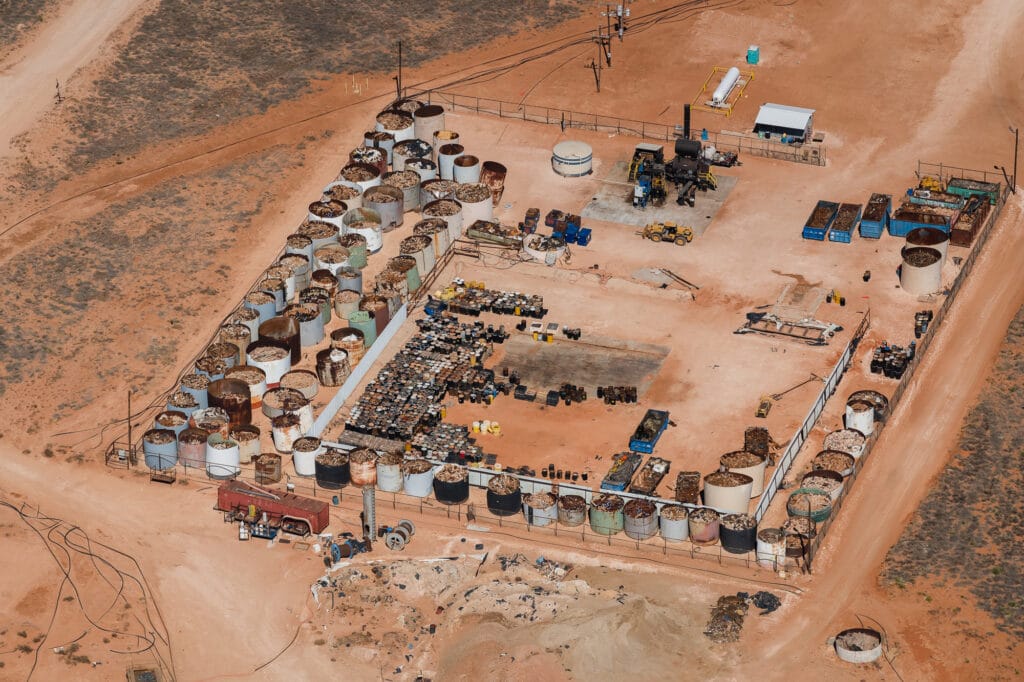
A number of uncovered containers, open to the elements and sometimes showing damage and rust, appear to hold radioactive oilfield waste at the Lotus LLC facility around 2015-2016.
Additionally, Dillingham supplied a response on behalf of his manager: “The pictures that are proposed to be presented in the article as previously poised are the property of Lotus LLC and are copyrighted and we don’t give permission to display those in any form or fashion and must be returned to us immediately. Additionally the entity or person who has conveyed these pictures to you or has somehow allowed them to become in your possession has violated the confidentiality clause they signed up for and their identity must also be revealed to us so that appropriate legal action may be conducted should these photos be publicly displayed and not returned or destroyed. You are requested to resolve this issue immediately so as to prevent further harm.”
Dillingham also stated that, “according to my manager, the photos you have provided are outdated and not an accurate representation of what is currently at the facility.”
On Sunday, April 4, 2021, DeSmog sent a photographer over the Lotus site in a small plane. The photos reveal the site contains a significant number of stockpiled barrels and containers. When the whistleblower reviewed these recent photos, they said the images suggest that many of the same issues remain — and may have worsened — since their earlier site observation at the Lotus facility during the 2015-2016 timeframe. They pointed to what appeared to be significant amounts of stockpiled TENORM wastes held in numerous damaged, rusted, and degraded tanks or barrels stored directly on an unlined surface without proper containment to prevent leaching, runoff, and other direct risks to groundwater and surface contamination.
The whistleblower also noted that many of the large open tanks in the photos appeared to show high volumes of filter socks and scale from pipes used during oilfield operations — both filter socks and pipe scale are known to have a high radioactive signature. The whistleblower said these were apparent compliance issues, with possible violations including a lack of proper containment around the site, lack of lined protection to the surface, and significant volumes of stockpiled TENORM wastes that have yet to be processed or properly disposed.
“I can’t confirm these pictures,” Lotus operation manager Dan Snow replied via email. In response to questions about the nature of the stockpiled waste and alleged violations, Snow said, “as always, our plant is in full production mode handling all types of RCRA exempt waste as it is shipped to the facility. Waste comes in all types of packaged and unpackaged methods and it can even come in a dump truck so long as the transporter follows the DOT [Department of Transportation] and RRC rules. Waste may even come in the form of abandoned vessels that have to be taken apart to remove the waste.” Snow stated Lotus operations follow all appropriate state and federal rules and permits.
DeSmog sent the recent aerial photos to the RRC for review and asked the agency to comment on the alleged violations and compliance issues. “Our agency conducts inspections to ensure compliance with all rules in place to protect public safety and the environment,” said R.J. DeSilva, the RRC Director of Communications. He directed DeSmog to a web portal that features inspection information for oilfield facilities. It shows that the most recent RRC inspection of the Lotus site in Andrews County occurred on March 29, 2021 and found no compliance issues, stating, “No violations were observed in this inspection.”
Every single day, hundreds of barrels of oilfield waste may arrive via truck at Lotus. The waste comes from oil and gas fields across Texas (including a set of wells operated by Chesapeake and located on the grounds of the Dallas/Fort Worth International Airport) and neighboring states like New Mexico, Oklahoma, and Louisiana. It also comes from offshore wells in the Gulf of Mexico and some of the last remaining oil and gas platforms off the California coast, operated by ExxonMobil. The waste arrives from states as far as Alaska, North Dakota, Michigan, Colorado, West Virginia, and Pennsylvania, and even states like Minnesota, Wisconsin, and Iowa, which have no significant oilfields but are crisscrossed by pipelines that fill up with radioactive sludge. The Railroad Commission files indicate that radioactive sludge also builds up at compressor stations, and this waste may be shipped to Lotus.
The files indicate that virtually every major operator in the oil and gas industry has sent their waste to Lotus, including ExxonMobil, BP, Chevron, Occidental, Anadarko, ConocoPhillips, Chesapeake, as well as midstream companies like Kinder Morgan and ONEOK. DeSmog reached out to these companies who were mostly unresponsive to questions about the site and its operating practices. “At BP we remain committed to safe, reliable, and compliant operations,” stated Cameron Nazminia, Corporate Communications Manager with BP, one of the few companies that replied to questions about Lotus.
“These operators took a lot and got in over their heads.”
A longtime oilfield waste industry insider on Lotus LLC
While the process of grinding radioactive waste into a slurry and injecting it down a hole may seem simple, the whistleblower explained that performing the process safely is technically challenging and operationally expensive. Radioactive oilfield waste is referred to as NORM, or TENORM (Technologically Enhanced Naturally Occurring Radioactive Materials), and a facility licensed to dispose of it can charge waste generators high disposal fees, sometimes as high as $200-250 per barrel, versus an average of around $8 per barrel at a facility simply licensed to dispose of the industry’s non-radioactive waste, according to the whistleblower.
“What happened is they just got overrun with TENORM waste material being delivered from all over the country,” the whistleblower said of Lotus, “they were not technologically or operationally capable, and did not properly manage what was accepted for disposal at the facility. These operators took a lot and got in over their heads.”
James Dillingham, the director of global operations with Lotus, said that, “Any NORM contaminated material present at the site is being processed in accordance with our license and permits.” He said that in recent years, “we have been able to increase daily capacity by having more employees, more offload areas, more efficient pumps, and better process knowledge.” He also pointed out that Lotus was licensed to receive all manners of “nonhazardous oil and gas waste” and that not all of the waste it received was radioactive. “I only say that to illustrate the fact that the items that appear to be accumulating may not necessarily be classified as radioactive waste, nor a waste that has other hazardous elements,” he said.
According to the company’s own quarterly reports to the Railroad Commission, Lotus took in over 10 times more waste in 2013 (83,895 barrels) compared to a decade earlier (6,673 barrels in 2003). When asked how the company has been able to handle the enhanced waste stream brought on by the fracking boom, Dillingham said, “We are currently investing heavily in new technology that will help us process the more difficult types of waste that are plaguing the industry.”
“We believe this technology will allow us to provide a more economical yet equally as secure solution to the industry,” he added. “In the meantime, any difficult or time-consuming materials requiring extended processing are securely temporarily stored in a restricted area adjacent to the processing/disposal facility with constant surveillance, air monitoring, and dosimetry.” (Dosimetry refers to the science of measuring the radiation dose absorbed by the human body.)
Furthermore, he added, the facility is subject to annual audits by the Railroad Commission, the Texas Department of State Health Services, clients, and other groups, and also “more frequent surprise audits.” “These audits would reveal any discrepancy between the Lotus operation and the items that are allowed under the licenses and permits while also obviously revealing any potential weak points that could cause increased risk to human health and safety,” he told DeSmog.
A Risk to Workers
But as the more than 2,000 pages of records and reports reviewed by DeSmog show, Lotus has experienced a number of concerning incidents that began shortly after the site opened in 1997. This history includes radioactive waste leaking into the ground and barrels of waste regularly being piled on site for extended periods of time. Local community members also raised concerns about workers being exposed to radioactivity.
One particularly damning Railroad Commission inspection occurred in May 2003. “There were several metal drums with corroded sides and/or bottoms located at various spots within the fenced process facility,” states the report. “The deteriorated condition of these drums has allowed some NORM contents to escape to the ground.” The inspection suggested that rain received in the days prior to inspection had carried contamination to “low lying, muddy areas near the gate.”
Handwritten notes in the May 2003 report show that drums of waste had been moved around the site “only for the purpose of a cosmetic coverup,” again suggesting the waste was not being appropriately disposed of by injection into the salt cavern, but instead being stored on the site’s grounds. Furthermore, the notes express concern that one of the injection wells has been inappropriately “abandoned” and that the “casing perhaps could be corroded/wear away gradually” and if the well were not properly isolated, the situation could “be harmful to our drinking water.”
In May 2004, Railroad Commission Assistant District Director Mike Houston visited the Lotus facility and noted, “There are still some pollution concerns.” On a walkthrough inspection, Houston noticed “leaking steel drums” whose contents had “either partially spilled or [had] the immediate possibility of leaking onto the storage yard soils.” The letter stated that the conditions observed violated Texas Statewide Rule 8, which regards water pollution and oilfield waste pits.
The report also addressed worker radioactivity risks: One steel drum at the Lotus site measured 5,800 microrems per hour — a measurement used to classify how much radioactivity would be absorbed by a human being — an amount “which can be a health threat to coworkers, given extended exposure time.”
When DeSmog ran that number by Worcester Polytechnic Institute nuclear forensics scientist Marco Kaltofen, he explained that the level was worrisome. “At 5,800 microrems an hour, it would take only about two days to get your typical ANNUAL dose of industrial/medical radiation,” Kaltofen stated in an email, referencing dose limits set by the Nuclear Regulatory Commission for the nuclear and medical industries. These limits, however, do not apply to oil and gas workers.
But perhaps most concerning among the public records DeSmog received from the Railroad Commission was a letter sent to the regulatory agency in October 2000 by the “Concerned Citizens of Andrews County, Texas.”
“We regret having to write you [a] letter anonymously, but because of the nature of the individual involved, we fear not only reprisal from him personally, but also from his battery of attorneys,” the letter states.
The Concerned Citizens explain that they “have made trips to a facility operated by Lotus, L.L.C. in western Andrews County” and found drums of radioactive waste stacked along the fence line of the facility, “a large pile of dirt and rocks on the north fence line that appears to be radioactive contaminant as well,” and a trio of 500-barrel frac tanks that “are completely full of what appears to be radioactive waste.”
According to the letter, Lotus workers told the Concerned Citizens that some of this waste had been stored on site “in excess of two years.” The Railroad Commission was not able to provide a direct response to the question of how long waste is allowed to sit on site before having to be disposed of down the injection well and into the salt cavern.
“These employees have also expressed concerns for their health from long term exposure to this material,” the letter adds.
Attempts to locate the authors of the anonymous letter were not successful. DeSmog presented the letter to Lotus, along with a copy of the June 2003 inspection report that noted leaking waste barrels.
“As it relates to the concerns presented in the letter, the citizens are certainly entitled to bring awareness to potential problems; however, in this particular case, it does not appear that there was anything that was causing any elevated health, safety, or environmental risk,” said Dillingham.
He also defended the company’s efforts to protect its workers from radioactivity contamination. “I can confirm that at the time of the filing, and continuing through today, all employees whose job duties involve potentially making an entry into a restricted area are monitored in the dosimetry program outlined in the Lotus Health Physics Plan,” said Dillingham. “As a company that is licensed for handling this type of waste we have our own health physics plan in place…Lotus workers work around NORM all day, every day, and given that we have never had a person exceed the dose limit, ever, and we have been in business since 1997.”
But Texas regulators do not appear to be addressing the worker safety questions raised in the files received from the Railroad Commission.
DeSmog informed the Texas Department of State Health Services (DSHS) that Lotus records indicate sloppy operating practices that put both workers and the environment of Texas at risk. “DSHS does not regulate the Lotus disposal site,” replied Chris Van Deusen, the agency’s Director of Media Relations.
When asked by DeSmog what tests, inspections, or surveys DSHS has conducted of Lotus workers to ensure they are appropriately protected from radioactivity, Van Deusen again stated, “DSHS does not regulate the Lotus disposal site.” OSHA, in previous correspondence with DeSmog, has conveyed that oilfield workers are not at risk from radioactivity, yet the agency has never formally studied the issue.
The whistleblower expressed concern that Lotus “poses a black eye” to the oil and gas industry and Texas regulators.
“It is exceedingly maddening that nothing is actively being done to properly address these issues,” said the whistleblower. “Myself and others have been pounding the table on this and speaking with the Railroad Commission in Texas for nearly 10 years now. It is there, everyone knows about it, and no one can say they don’t know. Yet, the regulators have not taken any meaningful efforts to correct this dangerous and poor operating practice.”
Importing Radioactive Waste
A lack of oversight when it comes to domestic waste, however, isn’t the only challenge. The 1980s industry exemption also makes it easier to import radioactive oil and gas waste produced outside the United States.
Because this waste is generated in an oilfield, unlike radioactive waste generated by the nuclear or medical industries, the notorious Bentsen and Bevill Amendments enables it to move around the U.S. insufficiently monitored — and into the U.S. from other parts of the world entirely unmonitored.
In DeSmog’s correspondence with EPA, the Nuclear Regulatory Commission, and the Railroad Commission of Texas, it has become apparent that no federal or state agency appears to be tracking or monitoring shipments of radioactive oilfield waste into the United States from foreign countries, and none of these agencies appear to have regulatory authority over such international shipments. U.S. Customs and Borders Protection has not responded to questions on the matter.
According to Jeff Tyson, Head of Environmental Research and Analytics with the Texas-based firm Waste Analytics, oilfield waste generated in Mexico, for example, has been transported across the border for disposal in the United States. At least 534 loads of waste, said Tyson, was transported between October 2005 and March 2006, and disposed of at a treatment facility in Starr County, Texas.
Lotus’s first international shipment was 65.5 barrels of soil and sludge that arrived from Alberta, Canada in November 1999. The files DeSmog obtained from the Railroad Commission records request reveal that more than 450 barrels of waste from Canada arrived between 1999 and 2004.
Information provided to DeSmog by Dillingham shows that Lotus had imported 750 barrels of oilfield waste from Australia between May 2017 and November 2019 — the first barrel arrived by plane, the rest have been transported by ship.
“We reached out to the EPA and the NRC asking if there were any objections to importing Resource Conservation Recovery Act (RCRA) exempt E&P waste containing diffuse amounts of NORM,” said Dillingham. But as DeSmog has learned, no specific permits appear to be necessary in order to import radioactive oilfield waste into the country.
Presently, Lotus is in the process of expanding its overseas operations. The company has already established an office in Watford, England, part of a joint venture tasked with decommissioning, decontamination, and waste management services to the oil and gas and industrial sectors in Europe, UK, and Russia.A map passed alongby Dillingham conveys that Lotus has a presence in oilfields on every continent but Antarctica. “Our international services include NORM training, surveying, consulting, decontamination and a whole gambit of other non-NORM related services relating to decommissioning and well servicing,” said Dillingham. “As it relates to importing NORM waste, it has never been our long-term strategy. The ability to import a stockpiled volume of material can help solve an immediate need, but the long-term objective is to help countries develop local solutions.”
Wording on the website of the company’s England-based joint venture, Lotus ZRG, appears to promote Lotus’s disposal site in Andrews, Texas: “Welcome to Lotus ZRG – from our licensed facility in Texas, we provide NORM decontamination, transportation and disposal internationally to wherever our clients’ facilities require us.”
Current federal laws give the company confidence that these imports are legitimate. “As it relates to transportation, the requirements are based on the same regulations for road or by ship,” said Dillingham. “I certainly didn’t intend on implying or stating that it wasn’t regulated. I said that it is not federally regulated. NORM waste is not defined as a ‘radioactive waste’ by the NRC, therefore not under the Atomic Energy Act. Further, wastes strictly associated with the exploration and production of oil & gas are exempt from EPA hazardous waste definitions under RCRA. Wastes meeting this exemption are regulated on the state level.”
When Lotus asked the EPA in an October 12, 2016 email whether or not the company could import radioactive oilfield waste, the agency replied on November 7, 2016, stating: “Based solely on the information provided by Lotus, the waste…is exempted from federal hazardous waste regulations” and “as such…may be imported to the United States without a hazardous waste notification.” The Railroad Commission, in a December 2016 report, recognizes that “EPA does not regulate the waste” and states that Lotus’s permits with the state agency do not “require or restrict the acceptance of offshore (outside US waters) or foreign oil & gas waste.”
A 2018 letter from the Nuclear Regulatory Commission stated that because the federal agency has no regulatory authority over the oil and gas industry’s radioactive materials, “it would not meet the…definition of radioactive waste.”
“EPA has no records of Lotus importing oilfield waste,” stated an EPA spokesperson, and the agency is not keeping track of how much foreign oilfield waste is entering the U.S., how it enters the country, at which port it enters, or how radioactive it is.
“As we lack jurisdiction over this material,” Nuclear Regulatory Commission spokesperson David McIntyre told DeSmog, “we do not track its movement or disposal.”
More than half a dozen other analysts and policymakers DeSmog spoke to for this story were unaware that oilfield waste was being imported into the United States.
“It never occurred to me that we might be importing toxic and radioactive oil and gas waste from other countries,” said Amy Mall, a senior advocate with the environmental group Natural Resources Defense Council (NRDC). Mall has been tracking oil and gas waste and its impacts for over a decade and is set to release a new report on the topic with NRDC shortly. “Americans are used to the situation where we’re the ones shipping waste overseas to other people who don’t have the ability to stop it, but in this case that has been reversed,” said Mall.
“I do a lot of consulting on import and export of radioactive material and frankly I don’t think there is any database anyone maintains to know what goes in and out of the country,” said Rick Jacobi, the owner and principal consultant at Jacobi Consulting, a former General Manager of the Texas Low-Level Radioactive Waste Disposal Authority and current consultant for domestic and international companies on the management of radioactive material and nuclear facilities. “I don’t think that U.S. Customs maintains any database, and to my knowledge there is no national database.”
None of the regulatory agencies in Texas involved in oil and gas, including the Railroad Commission, the Texas Department of State Health Services, or the Texas Commission on Environmental Quality, have “jurisdiction over the import or export of radioactive waste,” Jacobi added. “Imports and exports are regulated exclusively by the federal government.”
“Commercial facilities have a financial incentive to accept the waste and generate revenue regardless of where the waste was generated,” added Jeff Tyson, with Waste Analytics. “As long as the facility is permitted to accept the waste, there is no legal or economic reason for them to reject it.”
Meanwhile, there may be the need for a much larger investigation. “Companies who are licensed to deal with this waste are trying their best to provide a responsible solution but are often the only ones who get criticized or reviewed,” said Dillingham. “The bigger problem is those who don’t even bother to get licensed and protect their staff.” He said the oilfields of Texas and Oklahoma contain several large facilities of this nature, which accept NORM waste without licenses or proper screening controls in place. Dillingham adds that Lotus’s salt cavern is approaching capacity, and the company is presently in the process of creating another one — using a process called solution mining — out of the bedded salt deposit at the property in Andrews County. Once permitted for waste disposal it could have disposal capacity for up to another million barrels of oilfield waste.
Justin Nobel writes on issues of science and the environment for Rolling Stone and has a book on oil and gas radioactivity forthcoming with Simon & Schuster entitled PETROLEUM-238: Big Oil’s Dangerous Secret and the Grassroots Fight to Stop It.
‘All kinds of damage’: Blood samples show effects of wildfire smoke on human health
Denise Chow, Steve Patterson and Bita Ryan
When the San Francisco Bay Area experienced a record 30 consecutive days of worrisome air quality alerts in August and September, Mary Prunicki began taking blood samples from firefighters.
And the damage isn’t likely to have stopped there. Prunicki, director of air pollution and health research at Stanford University’s Sean N. Parker Center for Allergy and Asthma Research, is studying the blood samples to understand what wildfire smoke does to human health. It’s part of a growing body of work that illustrates how wildfire seasons made worse by climate change threaten not just immediate destruction but also long-term health.
Mary Prunicki labels a sample collected from a firefighter. (NBC News).
She and other scientists are particularly concerned about a type of particulate matter in wildfire smoke known as PM2.5. These tiny airborne particles, about one-twentieth the width of a human hair, are especially dangerous because they can be breathed deeply into the lungs.
“The size of that particulate can, when you inhale it, go all the way to the base of your lungs and then cross over into your bloodstream,” Prunicki said. “Once it’s in the bloodstream, it can go to various organs and do all kinds of damage.”
Experts have said that in a warming world, devastating wildfires like the ones that tore across California, Oregon and Washington last year will be more common. Around the world, wildfire seasons have been starting earlier and lasting longer, becoming in some regions an almost year-round threat.
The results of Prunicki’s study are forthcoming, but a clearer picture is emerging of just how damaging wildfire smoke can be to humans, and scientists are sounding the alarm over a problem they say is only going to get worse with climate change.
“In the climate science community, we’ve been predicting these types of impacts for decades now,” said Tom Corringham, an environmental economist at the Scripps Institution of Oceanography at the University of California, San Diego.
Corringham co-authored a study published last month in the journal Nature Communications that found that airborne particles in wildfire smoke can be several times more harmful to human respiratory health than other forms of air pollution, including car exhaust.
It’s not yet well understood why wildfire smoke is more harmful than other forms of ambient air pollution, although it is likely to have something to do with the chemical composition of what’s being burned, Prunicki said. Wildfires that engulf homes and other buildings, for instance, can be particularly dangerous because the chemicals in furniture, clothing and other everyday items are released. In some cases, the materials in firefighters’ protective gear can also release harmful particulate matter.
Tony Stefani, a retired San Francisco fire captain, knows the risks well. Stefani, who in 2006 founded the San Francisco Firefighters Cancer Prevention Foundation, was diagnosed with a rare form of kidney cancer. He recalled wondering whether his illness was somehow linked to his line of work.
Tony Stefani. (NBC News)
“I knew there was definitely something wrong,” Stefani said. “And I thought there was a direct correlation between what I had and my exposures on the job.”
Many of his colleagues, Stefani said, accept that developing cancer is not a matter of if but when. Studies by the National Institute for Occupational Safety and Health have shown that firefighters are at higher risk of cancer and cancer-related deaths compared to the general population, but researchers want to know why — and how best to protect them.
Through his foundation, Stefani works to spread the word about early detection and prevention, but he’s also involved with scientific efforts such as Prunicki’s research to better understand how exactly wildfire smoke affects immune functioning and human health.
While firefighters are among the most vulnerable when it comes to smoke exposure, it’s not just those on the front lines battling blazes who are feeling the impacts of more frequent and intense wildfires.
Studies have observed increases in hospitalizations, particularly for respiratory conditions, during wildfire events. In their study, Corringham and his colleagues combed through 14 years of hospital admissions records in Southern California, analyzing them together with satellite data on wildfire smoke and wind.
The researchers discovered that an increase of PM2.5 pollution from wildfire smoke caused respiratory-related hospital admissions to increase by 1.3 percent to 10 percent. An increase in PM2.5 from other sources of air pollution, on the other hand, contributed to only a 1 percent rise in hospital admissions.
Their findings suggest air quality standards may need to take into account differences in toxicity between different forms of air pollution, said a co-author of the study, Rosana Aguilera, a postdoctoral researcher at the Scripps Institution of Oceanography.
“If there are different impacts of PM2.5 on health, depending on where this PM2.5 is coming from, then we should study that further and reflect that in standards and policies for air pollution,” she said.
A study published Wednesday in the journal JAMA Dermatology also found that wildfire smoke can exacerbate more than just respiratory conditions. Researchers at the University of California, San Francisco observed a rise in the number of patients visiting health clinics for eczema and other general skin concerns in November 2018, when the catastrophic Camp Fire raged in Northern California.
The scientists found that even short-term exposure to hazardous particulate matter in wildfire smoke can have consequences for skin health.
Mary Prunicki takes a skin sample from a firefighter to test for toxins. (NBC News).
The studies of the health effects of wildfire smoke paint a concerning picture of a future in which climate change is expected to supercharge wildfire seasons.
That realization, Stefani said, makes his foundation’s collaboration with scientists all the more important, because science can help advocates push for safer working conditions and better public health measures.
“They’re the impetus for change,” Stefani said of the studies. “That is the reason that we know there’s a problem. When we have the scientific proof that something’s wrong and we have the numbers to show it, change can occur. And that’s really, really important.”
Pesticides disrupt our hormones for generations – even women whose grandmothers were exposed to the chemical have higher risks of obesity and breast cancer, scientists say
Julia Naftulin April 19, 2021
An aerosol can, loaded with DDT, Dichloro-diphenyl-trichloroethane, is used here against flies. (AP Photo) AP
A new study found women whose grandmothers had DDT exposure are more likely to be obese and have early periods.
DDT was a widely used insecticide that’s been banned in the US since 1972.
Early onset periods are a risk factor for breast cancer and heart conditions.
There’s evidence that DDT, a pesticide previously used to kill insects like mosquitoes, is still wreaking havoc on human health four decades since the government banned it.
In 1972, Congress banned DDT, or dichlorodiphenyltrichloroethane. Since then, evidence has emerged – first in wildlife and then in humans – that the pesticide left an enduring mark on health.
According to a study published April 14 in the journal Cancer Epidemiology, Biomarkers & Prevention, the granddaughters of people who were exposed to DDT while pregnant are more likely to be obese, have early-onset periods, breast cancer, high blood pressure, and diabetes.
To study the effects of DDT, researchers at UC Davis and the Public Health Institute in Oakland used archived blood samples from 15,000 women who were pregnant when DDT was still used. The researchers then worked with these women’s daughters and granddaughters, collecting their blood samples to see how DDT impacted them before they were born.
Researchers found that women in their 20s and 30s with grandmothers who were exposed to DDT are between two and three times more likely to be obese and two times more likely to have their periods start earlier than usual – around the age of 11.
Early-onset menstruation can lead to other health conditions later in life, like breast cancer, high blood pressure, and diabetes, according to the study authors.
“Even though we banned that stuff more than 40 years ago, people now walking the Earth – the granddaughters of those who were pregnant – were exposed,” Barbara Cohn told the LA Times. Cohn is director of the Public Health Institute’s Child Health and Development Studies, the institution that researched the 15,000 women who gave blood samples decades ago.
‘Forever chemicals’ are ruining reproductive abilities and overall health
This isn’t the first study to find chemicals’ lasting impact on human health.
An October 2007 study in the journal Environmental Health Perspectives found the daughters of pregnant women exposed to DDT were more likely to develop breast cancer. The researchers of the study also found children who had DDT exposure were five times more likely to develop breast cancer.
In addition to DDT, chemicals in plastics like water bottles are altering human reproductive abilities, Insider previously reported.
“It’s the full meaning of what a ‘forever chemical’ is – in some ways, that makes every chemical potentially ‘forever’ if it has the potential to do this,” Cohn told the LA Times.
‘If you want a scary story:’ Agriculture, human health and ecosystems at risk as Illinois’ climate is quickly changing, report shows
Morgan Greene, Chicago Tribune April 21, 2021
1 / 2
Illinois’ climate is swiftly changing,
In an extensive new report released Tuesday, the Nature Conservancy details how Illinois’ climate has transformed and looks forward to what more change might mean for the state’s agriculture, human health and already-stressed ecosystems.
“There’s a big message there that we need to be doing everything we can to prevent future climate change by mitigating our use of fossil fuels, particularly,” said Donald Wuebbles, a professor of atmospheric sciences at the University of Illinois, and one of the lead authors of the assessment. “For those things we can’t prevent, because there’s still going to be some change, we have to adapt to be resilient.”
Even after curbing carbon emissions to meet certain bench marks, the changes in Illinois by 2100 could be stark: average annual temperatures warming 4 to 9 degrees, a month of 95-degree or higher temperatures, 3 more inches of spring rain, more flooding, and compounding health risks from heat, waterborne pathogens and diseases carried by mosquitoes and ticks. Not to mention the mental strain of living through it all.
What’s happening in Illinois is part of the larger story of human activity driving a changing global climate. Last year tied for the warmest on record, according to NASA scientists. Since preindustrial times, concentrations of heat-trapping greenhouse gases such as carbon dioxide have shot up, and the global average temperature has increased. The Paris Agreement aims to limit warming, preferably to 2.7 degrees Fahrenheit, a limit fast approaching.
Carbon emissions dropped during the pandemic, but carbon dioxide levels continued to climb.
“The climate of Illinois, like the rest of the country and the rest of the world, is changing and is changing rapidly,” Wuebbles said. “And that has serious repercussions on the people of Illinois.”
“If you want a scary story, that’s the story,” Wuebbles added. “And we need to be taking it seriously. We need to be doing something about it.”
Vulnerable communities
The health effects of climate change will depend on where you live; communities already disproportionately facing inequities, including low-income communities and communities of color, are likely to be harder hit, according to the report released Tuesday by more than 40 scientists and experts.
“The thing about climate change is that it really doesn’t leave anything untouched,” said Karen Petersen, climate change project manager at the Nature Conservancy. “It’s not just about temperature, or feeling hotter on a summer day, or having a rainier day. It’s about how those climate impacts, which we perceive as our daily weather, are going to impact how a farmer farms, or how someone deals with heat stress.”
In Illinois, increasing overall precipitation and heavier events are expected to intensify flooding. Greater flooding risk may bring greater emotional stress, along with mold and waterborne disease. Additionally, dozens of Illinois health care facilities are located in flood plains, which may hinder access to care during floods.
According to a study referenced in the assessment that looked at flooding claims by county over a seven-year period, nearly all private insurance claims were in urban areas.
In Chicago, flooding has forced sludge into basements and unleashed swarms of sewer flies in nightmare scenarios. The burden is disproportionate, said Marcella Bondie Keenan, climate program director at the Center for Neighborhood Technology.
“You can see it on the ground in terms of neighborhoods that are being hit over and over again, places like Chatham for example,” Keenan said. “But also places like the Far Southeast Side.”
On the Southeast Side, it’s not just the basement backups, Keenan said, but also what’s being picked up along the way from industrial areas. And pollution concerns also connect to climate resiliency, Keenan said.
“Every time we make a decision around what to permit and how to develop, you’re either moving toward a climate safe future, or you’re moving further away from it,” Keenan said.
Climate change is likely to increase the total days with a dangerous heat index in Illinois and warmer weather can mean an increased risk of heat stroke. Cities including Chicago, blanketed in concrete and asphalt, also exhibit the “urban heat island effect” — warming more and staying warmer at night. If emissions rise, heat waves like the 1995 Chicago disaster that led to more than 700 deaths are expected to become more common.
Heat may also welcome some species north, including the yellow fever mosquito, which transmits dengue, and allow pests to bite for longer periods. Warmer winters may assist tick survival and mosquito population growth, leading to earlier and more circulation of West Nile virus.
Respiratory allergies and asthma attacks could be more frequently spurred by mold, pollution and pollen — which is likely to see an extended season. In Illinois, the assessment notes asthma is already high among African Americans, women and low-income communities.
“The normal that we understand now is going and is already shifting,” Petersen said. “It’s already happening.
‘A very resilient breed’
Jeff Kirwan, who serves on the board of directors for the Illinois Farm Bureau, farms corn and soybeans south of the Quad Cities in Mercer County.
Over the years, Kirwan said variability seems to have increased a bit, but it’s hard to assess. “We do seem to get more severe weather, more dynamic rainfalls, dryer spells,” Kirwan said. “The future, when you look into that crystal ball, it’s a whole bunch of uncertainty. … We don’t know. And so you just kind of adapt. And I think that’s what we’re good at, adapting to changes.”
The climate that Illinois farmers depend upon is changing, the assessment says, and farmers will be up against higher temperatures, increased soil evaporation, flash droughts — and stressed crops.
Illinois is among the top producers of soybeans and corn, which in part contribute to a more than $19 billion a year industry, according to the Illinois Department of Agriculture. The industry employs close to a million people, but farm operators have decreased to about 75,000 from 164,000 in 1959, while average farm sizes have more than doubled with technology developments, according to the Department of Agriculture.
It’s tough to predict how Illinois crops will react to a warming climate with much uncertainty ahead, the assessment notes, but even with a longer growing season, there are some challenges farmers might face.
Increased carbon dioxide levels may benefit soybean crops in the short term, but as drought and heat intensify, elevated levels may make things worse. Corn yields are likely to be reduced by 2050 and may be particularly vulnerable to warming nighttime temperatures. Some planting zones may shift north.
With increasing precipitation, a wet spring could delay planting. In 2019, among the wettest years on record , about 1.2 million acres of corn and soybeans went unplanted, the assessment notes. Wetter weather can also cause erosion, which can make soil less resilient to extreme weather.
Nuisances — weeds, pests and disease — may also become greater problems, requiring more applications of control measures, including pesticides.
These competing forces mean adapting will be necessary, but the assessment says farmers may be able to make up for some losses through technology advances and management tweaks.
Kirwan’s farm uses cover crops — which can assist in soil erosion — and other conservation measures. Adopting those practices was part of thinking about sustainability, water quality and nutrient management, Kirwan said.
“But also because it helps us preserve our asset and our legacy,” Kirwan said. “It’s not for everybody, and you’ll get differing opinions, but I think overall we try and do the things that are best for our operations and for our families.”
There have been discussions about climate in Illinois for years in the agricultural world, Kirwan said, and he’s still optimistic, especially as technology has developed.
“Farming, we are always dealing with challenges — weather challenges, insect challenges, governmental challenges,” Kirwan said. “Nothing’s ever going to stay the same, we know that.”
Weather disasters, and the existential threats climate change poses, can affect mental health, and the assessment notes farmers may be at an especially high risk as they face increasingly unpredictable and extreme weather.
To watch weather diminish a crop can take a mental toll, Kirwan said. “We don’t like to have to watch something that we put our hard-earned work into wither away.”
Still, Kirwan said, “Farmers are a very resilient breed — if we’ve made it this far.”
‘Things can warm up very quickly’
In Illinois, the average daily temperature has increased throughout most of the state in the last century by 1 to 2 degrees.
Nighttime minimum temperatures in some parts of the state have increased at three times the rate of daytime temperatures, leading to hot summer nights without relief, and also fewer freezing evenings in winter — the season that has seen the most warming. In some parts of the state, minimum winter temperatures have warmed by more than 3 degrees.
Daytime high temperatures have been kept at bay in part by increased precipitation, which increases soil moisture. Average annual precipitation has increased by 5% to as much as 20% in pockets of the state, and there are 40% more days with 2 inches of rain or more, while in recent decades extreme droughts have become more rare.
A warmer atmosphere holds more moisture, and heavier rains are likely to continue, especially in the north. But that balance may shift in coming decades, as temperatures increase and summer precipitation decreases.
“Once you dry out those soils, things can warm up very quickly,” said Jim Angel, a lead author of the report and a former state climatologist for more than three decades.
An exceptionally hot 1936 summer, with temperatures 4.5 degrees above a 30-year average, could become the norm.
And more extreme weather may become more likely — more exceptionally warm days, more intense rains and longer dry spells.
The assessment’s lower scenario model predicting the effects of climate change depends on a rapid retreat from fossil fuels and lower emissions overall, while in a higher scenario model, emissions continue to steeply rise.
Wuebbles, a former White House expert on climate science, said he thinks people can adapt to the lower end. “It’s the high scenario, or anything approaching the high scenario, that by the end of this century I think would be disastrous for humanity.”
The higher estimates for the state by the end of the century are difficult to imagine. In northern Illinois, for example, at the extreme end, the annual average temperature could increase from 49 degrees to as much as 63 degrees — a 14-degree jump.
“It’s not in the abstract,” Angel said. “We’re actually observing these changes taking place now and the projections are that not only are they going to continue, but in many cases become much more problematic moving on into the future.”
At a Tuesday morning news conference, Wuebbles said, “My big worry is getting to 2050 and having our grandchildren saying, what were they thinking back in 2020?”

 When Einstein gave lectures at U.S. universities, the recurring question that students asked him most was: Do you believe in God?
 Baruch de Spinoza was a Dutch philosopher considered one of the great rationalists of 17th century philosophy, along with Descartes.