
‘It’s like a place of healing’: the growth of America’s food forests

The Guardian – Our Unequal Earth Food

‘It’s like a place of healing’: the growth of America’s food forests

Mike Jordan in Atlanta and Salomé Gómez-Upegui in Miami 

May 8, 2021
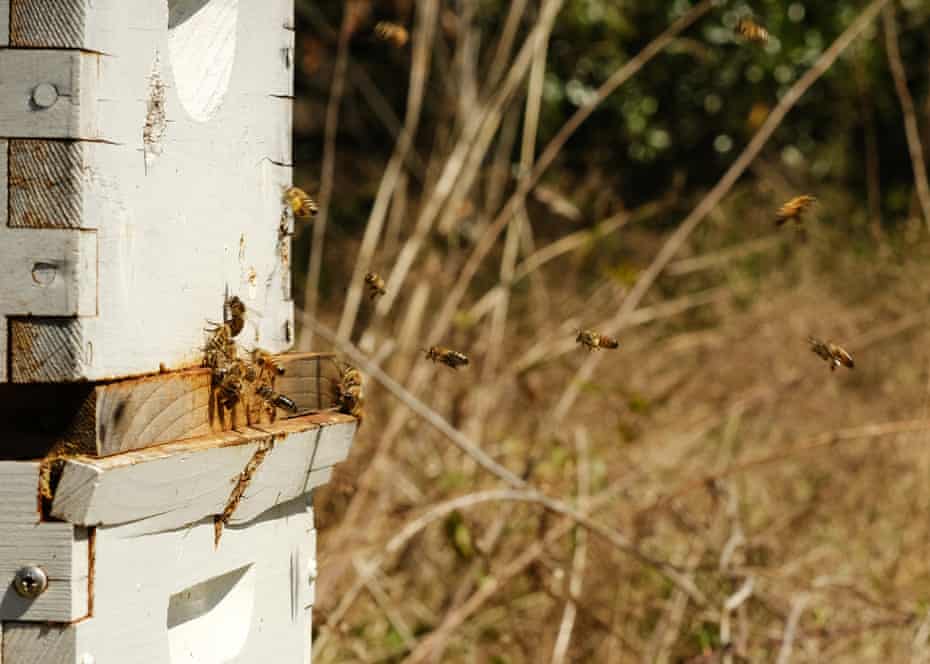
 

Atlanta is home to America’s biggest food forest which also offers composting, beekeeping and bat boxes.Atlanta is home to America’s biggest food forest which also offers composting, beekeeping and bat boxes. Photograph: Peyton Fulford/The Guardian

There are more than 70 ‘food forests’ in the US as part of a growing movement to tackle food insecurity and promote urban agriculture

America’s biggest “food forest” is just a short drive from the world’s busiest airport, Atlanta’s Hartsfield-Jackson, but there is a relative calm as you wander through the gravel paths that weave through its fertile 7.1 acres (2.8 hectares).


When the Guardian visits the Urban Food Forest at Browns Mill there are around a dozen volunteers working on a warm morning. Among them are a mother and son clearing weeds from a secluded area soon to become a yoga and meditation space. “I wanted to help,” Rina Saborio said. “I thought it was a really cool opportunity for the community.”

Hundreds of volunteers have come before them in Atlanta, and thousands at similar schemes across the US.

Food forests are part of the broader food justice and urban agriculture movement and are distinct from community gardens in various ways. They are typically backed by grants rather than renting plots, usually rely on volunteers and incorporate a land management approach that has a focus on growing perennials. The schemes vary in how they operate in allocating food and policies on harvesting, but they are all aimed at boosting food access.

Organizers in Atlanta stress that they properly distribute the food to the neighborhoods that the food forest is intended to support and it’s not open to the public beyond volunteer workers. Other schemes have areas where the public is free to take what they want.

Atlanta’s Urban Food Forest opened in 2019 with a plan to be a model for urban agriculture and to increase food access, a challenge that long predates the pandemic but which has been terribly exacerbated by the economic crisis caused by Covid-19.

This scheme is located in Atlanta’s southside Lakewood community, less than five miles from downtown. Lakewood is a food desert, as defined by the USDA, and the nearest grocery store with healthy food options takes 20 minutes via public transportation. Most nearby “food marts” offer far more sweets, processed foods, and canned goods than fresh fruits, vegetables and produce.

Celeste Lomax, who manages community engagement at the Brown Mills forest and lives in the neighborhood, believes education is key to the forest’s success and beams like sunlight when sharing her vision for the fertile soil she tends. “We’re using this space for more than just growing food. We have composting, beehives, bat boxes, and this beautiful herb garden where we’re teaching people how to heal themselves with the foods we eat. We’ll be doing walkthrough retreats and outside yoga. This is a health and wellness place. It’s so much more than just free food.”

Celeste Lomax, top left, manages community engagement at the Urban Food Forest at Browns Mill in Atlanta. Rosemary Griffin, bottom left, waters the garden. The food forest gives the community access to fresh, nutritious food with garden beds, herb gardens and fruit trees. Photographs by Peyton Fulford/The Guardian


The land, once owned by a pecan farming family, sat vacant for years and almost became a multi-family housing unit after being purchased by developers in 2000. It was acquired by the city in 2016, through a partnership with Trees Atlanta and The Conservation Fund, and a grant from the USDA Forest Service’s Community Forest and Open Space Conservation Program.

Food access has been a long-term challenge in the city. According to a June 2017 report in the Atlanta Studies journal, food insecurity rates were above 25% in downtown Atlanta and nearby in southern Fulton and DeKalb counties, where residents are mainly people of color with lower incomes. In Atlanta Regional Commission’s annual Metro Atlanta Speaks survey, 18% stated they received food bank assistance since March 2020.

Before the pandemic, Lomax had enough herbs of all types, to give volunteers tea packs for homebrewing after a day’s work. Today, the volunteer maximum is set at fifteen people, but back then as many as fifty volunteers worked the forest on scheduled days. She is hopeful that there’ll be enough catnip, lemon balm, chocolate mint, and other herbs to keep up with demand as members of the community near and far come back to help. “Once this stuff grows, and I can start giving things away again, I’ll be blessing the volunteers. They call it sweat equity; I call it blessing those who bless us.”

‘A living system’

Some 35.2m people lived in food-insecure households throughout the US according to a report by the US Department of Agriculture in 2019. Last month a Guardian/Northwestern University investigation showed the scale of the crisis in the past year with one in four facing food insecurity before Christmas, amounting to some 81 million people. It also highlighted the racial divide in the food system with Black families reported to be facing hunger four times more often than white families.

The Dr George Washington Carver edible park in Asheville, North Carolina, was the first public food forest to open in the US, back in 1997. Since then, many more have emerged around the country, and though there is no official data, according to the non-profit Sustainable America, as of 2018 there were more than 70 public food forests in the United States.

As Mark Bittman writes in his book, Animal, Vegetable, Junk, urban gardens, farms and food forests “can’t compare in scale, appearance, or yield to large rural farms but by supplying populations with real food, and bringing power and understanding of food systems to urban eaters, they become important pieces of the puzzle.”

As defined by expert Michael Muehlbauer, Orchard Director at the Philadelphia Orchard Project who is currently working to bring a food forest to public land in Philadelphia, food forests “are a gardening technique or land management system, which mirrors and works with woodland ecosystems by incorporating trees, shrubs, perennials and annuals that produce human food. This creates a living system with numerous benefits including wildlife habitat, resilient biodiversity, an abundance of food and medicinal yields, carbon sequestration, increased urban tree canopy, local food security, and an opportunity for community gathering and education.”

Muehlbauer was one of the very first volunteers at the Beacon Food Forest in Seattle. It began back in 2009 when four friends from the neighborhood of Beacon Hill came together to transform a seven-acre plot of public land into an ecosystem that could provide local food to neighbors.

The role of community and volunteers is crucial to places like the Urban Food Forest. Volunteer Rina Saborio, bottom left, pulls weeds in the learning area. “We do something unique where we empower people to show up,” said Elise Evans, a long-time volunteer and former board president of Food Forest Collective. Photographs by Peyton Fulford/The Guardian.

Elise Evans, a long-time volunteer and former board president of Food Forest Collective, the nonprofit that manages the Beacon Food Forest, shared that the forest has helped in many ways with food insecurity.

“We’re not a food bank,” she clarified, “but we do something unique where we empower people to show up. We accept all volunteers who are kind and want to have a sense of purpose in growing food together. It’s sort of a large-scale demonstration site. Anyone can do this in their ecosystem and we’re showing them how that can be done.”

The Beacon Food Forest in Seattle is mostly an open harvest site. Except for areas designated as food bank plots and City of Seattle P-Patches, they allow free foraging on-site. Over the past eleven years, they’ve seen successful results and haven’t observed anyone “wiping out” a harvest. Evans said: “In the golden hour of the evening, we see many people on site harvesting food for their dinner or food for a neighbor. They get to harvest something and walk two blocks away to go home and have dinner.”

The role of community and volunteers is crucial to keep these initiatives going. And Evans knows this from personal experience. She first became involved in the Beacon Food Forest after attending the first “ground making party”, a monthly community gathering that pre-Covid that would attract more than 100 people of all backgrounds to work on the forest while enjoying pots of soup and salads picked from the site.

“It was a glorious communal experience,” she recalled. “At first I thought I would learn about permaculture, but in the end, it was a vivid experience with energy from people of all backgrounds. So I ended up making friends and stayed for the people, which is a story of many people at the Beacon Food Forest.”

J Olu Baiyewu, Urban Agriculture Director of the City of Atlanta, says that as urban agriculture installations continue to come into communities, digging more deeply into community engagement and outreach is essential: “I think what has become clearer for everyone involved is the need for a continuous community engagement beyond the visioning plan, continuous kind of check-ins,” he said.

Yet, consistent community engagement comes with challenges of its own. There are issues of governance, organizing and commitment to be sorted out, and as projects grow, these matters become increasingly complex.

Muelhbaur, who has worked for the past five years to bring a food forest to public land in Philadelphia, emphasized that “challenges for public food forest projects include volunteer burnout, as it can be quite a bit of work to organize these projects, which often fall on the shoulders of passionate volunteers Finding the right structure is important to keep the project organized.”

Citing his experience with the upcoming food forest, he added, “it’s taken five years of community organizing, talking to the city, making sure we have the right insurance policy in place, and negotiating a lease”.

As Evans put it, many volunteers are driven by wanting a change from large mono-crop agriculture. And aside from knowing where their food comes from, they want to know their neighbors. “In a world that’s increasingly digital and stressful, it’s consistent that we need community and this provides that. It’s nourishing both for our bodies and our hearts to show up to this space.”

Celeste Lomax shares her knowledge of the food found in the forest with other volunteers.
Celeste Lomax shares her knowledge of the food found in the forest with other volunteers. Photograph: Peyton Fulford/The Guardian
‘This is so much bigger than us’

“This is good for stomach ailments,” Lomax recommended, speaking to one of the Atlanta volunteers about anise growing near lavender. “It’s good for insomnia, so I would use this in a tincture and also in a tea.”

As she continues explaining the potential of the forest, including her excitement about meeting a volunteer earlier in the day who offered to lead a cooking class on the property using herbs and produce grown in its dirt, Rina Saborio walks over to say goodbye after finishing her day of volunteering. In her hand is a bunch of chives she’s carefully uprooted from the area she and her son were clearing. She offers them to Lomax, who says she can keep them in exchange for her service.

“This is so much bigger than us,” Lomax said. “We thought we were just gardening but it’s grown to be so much more. It’s like a place of healing. I’ve had a lady cry because she was able to release stress in this place. That’s when I said, “Wow, this place is really magical. It takes a village to raise a child but it takes a community to change the world.”

… we have a small favor to ask. Perhaps you’re familiar with the Guardian’s reputation for hard-hitting, urgent reporting on the environment, which tens of millions of people read every year. We need your support to continue providing high-quality coverage from across a rapidly changing world.

The Guardian views the climate crisis as the defining issue of our time. It is already here. Mega-droughts, wildfires, flooding and extreme heat are making growing parts of our planet uninhabitable. As parts of the world emerge from the pandemic, carbon emissions are again on the rise, risking a rare opportunity to transition to a more sustainable future.

The Guardian has renounced fossil fuel advertising, becoming the first major global news organization to do so. We have committed to achieving net zero emissions by 2030. And we are consistently increasing our investment in environmental reporting, recognizing that an informed public is crucial to keeping the worst of the crisis at bay.

More than 1.5 million readers, in 180 countries, have recently taken the step to support us financially – keeping us open to all and fiercely independent. With no shareholders or billionaire owner, we can set our own agenda and provide trustworthy journalism that’s free from commercial and political influence, offering a counterweight to the spread of misinformation. When it’s never mattered more, we can investigate and challenge without fear or favor.

Unlike many others, Guardian journalism is available for everyone to read, regardless of what they can afford to pay. We do this because we believe in information equality. Greater numbers of people can keep track of global events, understand their impact on people and communities, and become inspired to take meaningful action.

If there were ever a time to join us, it is now. Every contribution, however big or small, powers our journalism and sustains our future. Support the Guardian from as little as $1 – it only takes a minute. Thank you.

The Recycling Industry in America Is Broken

The Recycling Industry in America Is Broken

By Tiffany Duong          April 20, 2021 – Repost

The Recycling Industry in America Is Broken
Recycling and general waste plastic wheelie bins awaiting collection for disposal in Newport, Rhode Island. Tim Graham / Getty Images


Reduce. Reuse. Recycle. According to The National Museum of American History, this popular slogan, with its iconic three arrows forming a triangle, embodied a national call to action to save the environment in the 1970s. In that same decade, the first Earth Day happened, the EPA was formed and Congress passed the Resource Conservation and Recovery Act, encouraging recycling and conservation of resources, Enviro Inc. reported.

According to Forbes, the Three R’s sustainability catch-phrase, and the recycling cause it bolstered, remain synonymous with the U.S. environmental movement itself. There’s only one problem: despite being touted as one of the most important personal actions that individuals can take to help the planet, “recycling” – as currently carried out in the U.S. – doesn’t work and doesn’t help.

Turns out, there is a vast divide between the misleading, popular notion of recycling as a “solution” to the American overconsumption problem and the darker reality of recycling as a failing business model.

The Myth: Recycling Began as a Plastics’ Industry Marketing Tactic

When it was first introduced, recycling likely had altruistic motivations, Forbes reported. However, the system that emerged was never equipped to handle high volumes. Unfortunately, as consumption increased, so too did promotion of recycling as a solution. The system “[gave] manufacturers of disposable items a way to essentially market overconsumption as environmentalism,” Forbes reported. Then and now, “American consumers assuage any guilt they might feel about consuming mass quantities of unnecessary, disposable goods by dutifully tossing those items into their recycling bins and hauling them out to the curb each week.”

Little has changed since that Forbes article, titled “Can Recycling Be Bad For The Environment?,” was published almost a decade ago; increases in recycling have been eclipsed by much higher consumption rates. In fact, consumerism was at an all-time high in January 2020 before the pandemic hit, Trading Economics reported.

But, if the system doesn’t work, why does it continue? Turns out, consumers were misled – by the oil and gas industry. News reports from September 2020 revealed how the plastic industry-funded ads in the 1980s that heralded recycling as a panacea to our growing waste problem. These makers of virgin plastics were the biggest proponents and financial sponsors of plastic recycling programs because they created the illusion of a sustainable, closed-cycle while actually promoting the continued use of raw materials for new single-use plastics.

To the masses, these programs justified overconsumption and eased concerns over trash that could be thrown into recycling bins, Forbes reported. Generations of well-meaning Americans since the 1970’s and ’80’s – believing these communications masterminds – have dutifully used-then-recycled plastics and other materials. They trusted that their discards would be reborn as new goods instead of ending up in oceans and landfills.

The plastics industry went even further, lobbying 40 states to put the recycling triangle symbol on all plastic – even if it wasn’t recyclable, Houston Public Media reported. This bolstered the public image of plastic as a renewable resource, but the cost was clarity about what actually can be recycled. As recent as 2020, a Greenpeace report found that many U.S. products labeled as recyclable could not actually be processed by most domestic material recovery facilities.

The Reality: Most Recyclables Aren’t Being Recycled

The U.S. relies on single-stream recycling systems, in which recyclables of all sorts are placed into the same bin to be sorted and cleaned at recycling facilities. Well-meaning consumers are often over-inclusive, hoping to divert trash from landfills. Unfortunately, the trash often ends up there anyways – with the additional cost of someone at a recycling plant sorting through it.

The single-stream system is easier on consumers, but results in a mixed stream of materials that is easy to contaminate, hard to sort and more expensive to process. There are a variety of items – including dirty pizza boxes, old clothing, hangers, plastic bags, aerosols, batteries and electronics – that, if added to a residential recycling bin, will contaminate the entire batch of recyclables, a Miami recycling center representative told EcoWatch. At that point, it can be too costly and too dangerous for employees to hand-pick out erroneous items. Because these items cannot be processed in the same way as recyclable materials, their inclusion often means the whole batch will fetch a lower price from buyers or must be thrown away.

“Most people have the attitude that if they just put it in the blue bin, it will get taken away and somebody will figure out what to do with it, but putting something in the blue bin and actually recycling it are two very different things,” said David Biderman, CEO and executive director of the Solid Waste Association of North America.

Misunderstandings, misinformation and mislabeling aside, the harsh reality was and remains that most plastic can’t and won’t be recycled, reported NPR. For example, the EPA reported that plastic generation in 2018 was 35.7 million tons, accounting for 12.2 percent of municipal solid waste (MSW) that year. Of this total, only three million tons were recycled (an 8.7 percent recycling rate). The vast majority – 27 million tons – ended up in landfills, and the rest was combusted. The environmental agency also estimated that less than 10 percent of plastic thrown in bins in the last 40 years has actually been recycled.

The situation is slightly better for other recyclables, though they make up a smaller percentage of MSW. For example, glass products totaled 12.3 million tons in 2018, or 4.2 percent of the annual MSW generation. Almost 25 percent of glass was recycled, 61.6 percent ended up in landfills and 13.4 percent was combusted.

Post-consumer paper and cardboard for 2018 totaled 67.4 million tons, or 23.1 percent of total MSW generation for the year. The material also had the highest recycling rate of any other material in MSW – 68.2 percent. 25.6 percent of paper ended up in landfills and 6.23 percent was combusted.

According to this EPA data, recyclable plastics, glass and paper accounted for 18.5 percent, 5.2 percent and 11.8 percent of MSW landfilled in 2018, respectively. Those three materials alone comprised 35.5 percent of the total landfilled trash in the U.S. for the year; had they been properly collected, processed and purchased, they theoretically could have been diverted and recycled.

The Reason: Recycling Is Bad Business Around the World

Unfortunately, the EPA data also shows that 2018 was not an anomaly but rather another data point showing how the single-stream system in the U.S. has never been economically viable or feasible on a large scale. To further understand why recycling in America is failing, we need to think of recycled goods as commodities – because that’s what they are.

According to the recycling center representative, municipalities and counties pay for residential and commercial recyclables to be trucked to local and regional recycling plants for processing. Clean batches are sorted and/or compressed into bales of similar plastics, paper, aluminum or glass. The centers sell the cleaned recyclables on the open market to buyers who will process them into recycled materials like plastic pellets or post-consumer paper; these can be turned into new products.

This entire process – the processing and creation of saleable recycled goods – costs money. As with any good, profitability requires selling for a higher price than it costs to make. Contaminated batches are harder to process into new products and therefore fetch a lower price on the market, if they can be sold at all. Currently, U.S. recyclables are no longer profitable, and no one wants to buy them.

China used to buy the majority of the world’s plastics and paper for recycling, The New York Times reported. The U.S. has been the #1 generator of plastic waste in the world for years and used to ship more than half of its total plastic production to China, a November 2020 study found. The research also noted that up to one-fourth of American plastics sent abroad were contaminated or of poor quality, which would make it extremely difficult to recycle anyways.

Starting Jan. 1, 2018, China banned imports of most scrap materials because shipments were too contaminated, The Times reported; the country no longer wanted to be the “world’s garbage dump.”

As a result, the U.S. and other Western nations who had relied on China to offload their recyclables saw a “mounting crisis” of paper and plastic waste building up in ports and recycling facilities, The Times reported.

The Western nations began sending recyclable waste to other Southeast Asian countries like Vietnam, Indonesia, India and Malaysia. These countries often lacked the infrastructure to handle recyclables, so a lot of the waste ended up incinerated or landfilled

In response, in 2019, the United Nations passed an amendment to the Basel Convention hoping to protect the poor and developing countries who’d taken up China’s vacated role in the global recycling trade. The amendment ambitiously aimed to clean up the global trade in plastic waste, making it more transparent and better regulated and allowing developing countries to reject contaminated shipments. The U.S. did not ratify the amendment, and new evidence suggests it continues to send illegal and/or contaminated shipments to developing countries.

Domestically, the closing of the Chinese market to U.S. recyclables bankrupted many domestic recycling programs because there was too much supply and no real demand. The smaller Asian countries could not accept nearly as much as China had. Prices of recyclables dropped, and bales of scrap materials were sent to landfills and incinerators when they couldn’t be sold, another Times article reported.

This left waste-management companies around the country with no market for recyclabes, The Atlantic reported. They’ve been forced to go back to cities and municipalities with two choices: pay a lot more to get rid of their recycling or throw it away. The news report noted that most are choosing the latter.

“The economics are challenging,” agreed Nilda Mesa, director of the Urban Sustainability and Equity Planning Program at the Earth Institute’s Center for Sustainable Urban Development. “If there is not a market for the recycled material, then the numbers do not work for these facilities as well as cities, as they need to sell the materials to recoup their costs of collection and transportation, and even then it’s typically only a portion of the costs,” Columbia’s State of the Planet reported.

Tiffany Duong is an avid ocean advocate. She holds degrees from UCLA and the University of Pennsylvania Carey Law School and is an Al Gore Climate Reality Leader and student member of The Explorer’s Club.

She spent years as a renewable energy lawyer in L.A. before moving to the Amazon to conduct conservation fieldwork (and revamp her life). She eventually landed in the Florida Keys as a scientific scuba diver and field reporter and writes about the oceans, climate, and the environment from her slice of paradise.

Report: China emissions exceed all developed nations combined

Report: China emissions exceed all developed nations combined

A security guard stands outside the cooling towers for a coal-powered power plant
China emitted 27% of the world’s greenhouse gases in 2019

China emits more greenhouse gas than the entire developed world combined, a new report has claimed.

The research by Rhodium Group says China emitted 27% of the world’s greenhouse gases in 2019.

The US was the second-largest emitter at 11% while India was third with 6.6% of emissions, the think tank said.

Scientists warn that without an agreement between the US and China it will be hard to avert dangerous climate change.

China’s emissions more than tripled over the previous three decades, the report from the US-based Rhodium Group added.

The Asian giant has the world’s largest population, so its per person emissions are still far behind the US, but the research said those emissions have increased too, tripling over the course of two decades.

Greenhouse gas emissions (%). .  .
Greenhouse gas emissions (%). . .

China has vowed to reach net-zero emissions by 2060 with a peak no later than 2030.

President Xi Jinping reiterated his pledge at a climate summit organised by US President Joe Biden last month.

“This major strategic decision is made based on our sense of responsibility to build a community with a shared future for mankind and our own need to secure sustainable development,” President Xi said at the time.

However, China is heavily reliant on coal power.

The country is currently running 1,058 coal plants – more than half the world’s capacity.

Under the Paris accord, agreed in 2015, 197 nations pledged to limit global warming to below 2C. However, the world is far from meeting that commitment.

Central to the Paris Agreement are Nationally Determined Contributions (NDCs). These are targets intended to cut emissions.

NDCs represent the commitments by each country – under the Paris pact – to reduce their own national emissions and adapt to the impacts of climate change.

According to the Climate Action Tracker, an independent scientific analysis that tracks government climate action, China’s NDC rating is “highly insufficient” and “are not at all consistent with holding warming to below 2C”.

President Biden’s climate envoy, John Kerry travelled to China last month to meet counterparts and discuss how to work together to combat climate change, despite diplomatic tensions between the two countries on a range of other issues.

In a joint statement, the two sides committed to working together and with other countries on tackling climate change including specific action on emissions.

Leaders will come together for COP26 – a crucial climate change summit – in November in Glasgow, UK to accelerate action towards the goals of the Paris Agreement.

A sweeping U.N. report says methane is far worse for the climate, human health than previously thought

A sweeping U.N. report says methane is far worse for the climate, human health than previously thought

Andrew Freedman                            May 6, 2021

Methane emissions from oil and gas, agriculture and other sources are contributing to thousands more deaths per year from air pollution than previously thought, while simultaneously leading to a rapid increase in global average temperatures, according to a comprehensive new U.N. report.

Why it matters: The report, which is the most thorough study of methane’s contribution to global warming, public health ailments, and solutions to date.

  • It shows both the perils involved with continuing to drill and transport oil and natural gas and the range of available low-cost solutions to bring down emissions.

The details: The world would need to cut 40 to 45% of human-caused global methane emissions by 2030 in order to avoid 0.3°C of warming.

  • About 30% of the cuts in methane emissions by 2030 would come from targeted measures, such as containing leaks in natural gas pipelines.
  • Another 15% of the emissions cuts would come from broader efforts to decarbonize the economy, such as turning away from fossil fuels and toward renewable energy sources, the report finds.
  • Inge Andersen, executive director of the U.N. Environment Program which co-produced the report, told reporters on a call Thursday morning that it’s no longer optional to tackle methane emissions.
  • “Without tackling this we cannot hit 1.5°C and we will certainly overshoot the [2°C target]. So, I think… that this is on the must have list.”

The big picture: Methane is a greenhouse gas that, while it is far more ephemeral in the atmosphere compared to carbon dioxide (it only lasts in the air about 10 years, compared to hundreds to a thousand years for a molecule of CO2), is about ten times more potent as a global warming contributor.

  • Methane concentrations have risen rapidly during the past few decades, to record highs that are incompatible with the Paris Agreement’s 2°C temperature target relative to the preindustrial era, the report notes.
  • According to the report, there is “strong evidence” that the increases in methane amounts detected since the 2010s were “primarily attributable” to increased emissions from fossil fuel-related activities.
  • This period coincides with the fracking boom and growth in oil and gas production in the U.S. Methane is the main component of natural gas, and the report focuses on leak prevention, detection, and sealing abandoned wells as cost-saving measures that industry could implement.

Of note: The study also finds that there are considerable low cost to money-saving measures that oil and gas companies can take to cut their methane emissions from pipelines, drilling sites, and other facilities.

  • However, it finds that expanding natural gas infrastructure and usage without relying on currently unproven technologies to remove carbon from the atmosphere is “incompatible” with limiting global warming to keeping global warming to 1.5°C relative to the preindustrial era.
  • “One thing the report calls for very strongly is not building any more of this fossil fuel infrastructure if we are phasing this out over the next couple of decades,” said Drew Shindell, an Earth scientist at Duke University and lead author of the new report.
  • In other words, the report calls into question the popular view in Washington that natural gas is a growing, so-called “bridge fuel” for use until renewables can more reliable supply power to the grid.
  • Other solutions would be employed to cut methane emissions from agriculture and coal sectors.

Context: The study also shows that methane emissions have much more significant health impacts than previously thought.

  • For every million metric tons of methane emissions that’s reduced, about 1,430 annual premature deaths would be avoided, researchers found.
  • Methane emissions are a contributor to ground-level ozone pollution, which is a deadly form of air pollution that can aggravate respiratory and cardiovascular disease.

What they’re saying: “Of all the short lived climate pollutants, methane has by far the largest current warming impact, accounting for nearly one-fifth of global greenhouse gas emissions, and it is therefore now by far the top priority, short-lived climate pollutant that we need to tackle,” said Rick Duke, senior advisor to John Kerry, President Biden’s special envoy on climate.

Pesticides Threaten the ‘Foundations of the Web of Life,’ New Soil Study Warns

Pesticides Threaten the ‘Foundations of the Web of Life,’ New Soil Study Warns

By Jessica Corbett, Common Dreams                 May 04, 2021

Pesticides Threaten the 'Foundations of the Web of Life,' New Soil Study Warns
“Beetles and springtails have enormous impacts on the porosity of soil and are really getting hammered, and earthworms are definitely getting hit as well,” said study co-author Nathan Donley, a scientist at the Center for Biological Diversity. smaragd8 / iStock / Getty Images Plus


A study published Tuesday in the journal Frontiers in Environmental Science bolsters alarm about the role that agricultural pesticides play in what scientists have dubbed the “bugpocalypse” and led authors to call for stricter regulations across the U.S.

Researchers at the University of Maryland as well as the advocacy groups Friends of the Earth U.S. and the Center for Biological Diversity were behind what they say is “the largest, most comprehensive review of the impacts of agricultural pesticides on soil organisms ever conducted.”

The study’s authors warn the analyzed pesticides pose a grave danger to invertebrates that are essential for biodiversity, healthy soil, and carbon sequestration to fight the climate emergency — and U.S. regulators aren’t focused on these threats.

“Below the surface of fields covered with monoculture crops of corn and soybeans, pesticides are destroying the very foundations of the web of life,” said study co-author Nathan Donley, a scientist at the Center for Biological Diversity, in a statement.

“Study after study indicates the unchecked use of pesticides across hundreds of millions of acres each year is poisoning the organisms critical to maintaining healthy soils,” Donley added. “Yet our regulators have been ignoring the harm to these important ecosystems for decades.”

As the paper details, the researchers reviewed nearly 400 studies “on the effects of pesticides on non-target invertebrates that have egg, larval, or immature development in the soil,” including ants, beetles, ground-nesting bees, and earthworms. They looked at 275 unique species, taxa, or combined taxa of soil organisms and 284 different pesticide active ingredients or unique mixtures.

“We found that 70.5% of tested parameters showed negative effects,” the paper says, “whereas 1.4% and 28.1% of tested parameters showed positive or no significant effects from pesticide exposure, respectively.”

Donley told The Guardian that “the level of harm we’re seeing is much greater than I thought it would be. Soils are incredibly important. But how pesticides can harm soil invertebrates gets a lot less coverage than pollinators, mammals, and birds — it’s incredibly important that changes.”

“Beetles and springtails have enormous impacts on the porosity of soil and are really getting hammered, and earthworms are definitely getting hit as well,” he said. “A lot of people don’t know that most bees nest in the soil, so that’s a major pathway of exposure for them.”

Underscoring the need for sweeping changes, Donley noted that “it’s not just one or two pesticides that are causing harm, the results are really very consistent across the whole class of chemical poisons.”

Buglife on Twitter

Co-author Tara Cornelisse, an entomologist at the Center for Biological Diversity, concurred that “it’s extremely concerning that over 70% of cases show that pesticides significantly harm soil invertebrates.”

“Our results add to the evidence that pesticides are contributing to widespread declines of insects, like beneficial predaceous beetles, and pollinating solitary bees,” she said in a statement. “These troubling findings add to the urgency of reining in pesticide use to save biodiversity.”

In December, Food and Agriculture Organization (FAO) of the United Nations released a report emphasizing how vital soil organisms are to food production and battling the climate crisis — and highlighting that such creatures and the threats they face are not being paid adequate attention on a global scale.

“Soils are not only the foundation of agri-food systems and where 95% of the foods we eat is produced, but their health and biodiversity are also central to our efforts to end hunger and achieve sustainable agri-food systems,” FAO Director-General Qu Dongyu said at the time, pushing for increased efforts to protect the “silent, dedicated heroes” that are soil organisms.

A growing body of research has also revealed the extent of insect loss in recent decades, with a major assessment last year showing that there has been a nearly 25% decrease of land-dwelling bugs like ants, butterflies, and grasshoppers over the past 30 years. The experts behind that analysis pointed to not only pesticides but also habitat loss and light pollution.

In January, a collection of scientific papers warned that “insects are suffering from ‘death by a thousand cuts,'” and called on policymakers around the world to urgently address the issue. That call followed a roadmap released the previous January by 73 scientists outlining what steps are needed to tackle the “insect apocalypse.”

The roadmap’s key recommendations included curbing planet-heating emissions; limiting light, water, and noise pollution; preventing the introduction of invasive and alien species; and cutting back on the use of synthetic pesticides and fertilizers.

“We know that farming practices such as cover cropping and composting build healthy soil ecosystems and reduce the need for pesticides in the first place,” Aditi Dubey of University of Maryland, who co-authored the new study, said Tuesday. “However, our farm policies continue to prop up a pesticide-intensive food system.”

“Our results highlight the need for policies that support farmers to adopt ecological farming methods that help biodiversity flourish both in the soil and above ground,” Dubey declared.

While the solutions are clear, according to the researchers, the chemical industry is standing in the way.

“Pesticide companies are continually trying to greenwash their products, arguing for the use of pesticides in ‘regenerative’ or ‘climate-smart’ agriculture,” said co-author Kendra Klein, a senior scientist at Friends of the Earth. “This research shatters that notion and demonstrates that pesticide reduction must be a key part of combating climate change in agriculture.”

Reposted with permission from Common Dreams. 

Ocean Plastic Pollution Flows From More Rivers Than Previously Thought

Ocean Plastic Pollution Flows From More Rivers Than Previously Thought

Olivia Rosane           May 3, 2021

Ocean Plastic Pollution Flows From More Rivers Than Previously Thought
The Pasig River in the Philippines is the kind of small, urban river that contributes more to ocean plastics than larger rivers, a new study has found. Artur Widak / NurPhoto via Getty Images


Plastic pollution is entering the ocean from more sources than previously thought.

A new study published in Science Advances Friday found that 80 percent of the plastic that enters the world’s oceans via rivers comes from more than 1,000 waterways. That’s as much as 100 times the number of rivers previously estimated, study leader the Ocean Cleanup explained.

“[T]he problem is actually much more vast than we used to think,” Ocean Cleanup founder Boyan Slat told BBC News. “It’s not 10 rivers, it’s 1,000.”

The Ocean Cleanup is a nonprofit launched by Slat with the goal of using technology to remove 90 percent of the plastic waste floating in the ocean. As part of that goal, the organization funded three years of research into how and how many rivers were significantly contributing to plastic pollution.

Their findings upended some previous assumptions, as National Geographic explained. In 2017, two studies concluded that 90 percent of the plastic that enters the ocean via rivers was contributed by a small fraction of the world’s rivers — 10 in one study and 20 in another. Further, these rivers were large rivers that traveled a long way, such as Egypt’s Nile or China’s Yangtze. However, the new study has found that the biggest culprits are actually smaller rivers in urban areas. The 16-mile Pasig River in the Philippines is now considered a greater contributor to ocean plastics than the Yangtze, which flows 3,915 miles and was formerly ranked the most plastic-polluted river.

The new insights are based on an increased amount of data and new modeling.

“One big difference from a few years ago is we don’t consider rivers mere conveyor belts of plastics,” lead author Lourens J.J. Meijer told National Geographic. “If you put plastic into the river hundreds of kilometers from the mouth, it doesn’t mean that that plastic will end up in the ocean.”

While the results give would-be cleaners more rivers to focus on, Ocean Cleanup is still confident that it can use the data to help remove plastics.

“While this number is much higher than previous estimations (100 times), it is only 1% of rivers worldwide, which means solving the problem is feasible,” Meijer wrote for Ocean Cleanup. “By collectively taking a global approach with various technologies to target these most polluting rivers, we can drastically reduce the influx of plastic into the ocean.”

To that end, the Ocean Cleanup launched the Interceptor, a solar-powered device that gobbles up plastic carried on a river’s current. The devices are already at work on some of the world’s most polluted rivers in Southeast Asia and the Carribean, according to National Geographic. In 2019, the nonprofit announced a plan to install the devices in 1,000 rivers within five years, though the pandemic has slowed down the rollout somewhat.

“We hope to be operational in 10 rivers by the end of the year,” Slat told BBC News. “And what we truly believe is that if we do 10 rivers really well, that forms the foundation to do the next 100. If we do 100, we can also do 1,000.”

Air pollution makes older men think and speak less clearly

Air pollution makes older men think and speak less clearly

Max Stephens                       May 3, 2021
The findings ‘stress the impact that air pollution is having on human health’, researchers said - Nick Ansell/PA
The findings ‘stress the impact that air pollution is having on human health’, researchers said – Nick Ansell/PA


Air pollution causes older men to think and speak less clearly, according to researchers at Columbia University, and even short-term spikes in airborne particles can damage brain health.

In a study of nearly 1,000 white men with an average age of 69, scientists found mental performance fell after rises in air pollution a month before testing. This occurred even when peak levels of air pollution were below safety thresholds set by the World Health Organisation.

Test scores from 954 men living in Boston were compared to local levels of PM2.5s, airborne particles measuring smaller than 2.5 micrometres in diameter. The tests included tasks assessing word memory, number recall and verbal fluency.

The findings, published in Nature Aging, showed the fall in test scores was linked to higher levels of PM2.5s in the four weeks before the participants were assessed even when concentrations of PM2.5s stayed below 10 micrograms per cubic metre, the WHO guideline level routinely breached in London and many other cities.

However, the test scores were shown to be less adversely affected if the men were taking aspirin or other non-steroidal anti-inflammatory drugs, known as NSAIDs.

Xu Gao, from the Mailman School of Public Health at Columbia University and the author of the paper, said: “Our study indicates that short-term air pollution exposure may be related to short-term alterations in cognitive function and that NSAIDs may modify this relationship.”

Earlier studies suggested the painkillers may help by reducing the inflammation triggered by air pollution particles getting into the brain.

“The findings really stress the impact that air pollution is having on human health,” Dr Joanne Ryan, the head of biological neuropsychiatry and dementia research at Monash University in Melbourne, told The Guardian.

“The importance of this study is that the findings align with a potential causal link of air pollution on brain function and they suggest that it is not just the very high levels of prolonged pollution that are concerning. The study found that even relatively low levels of air pollution can negatively impact cognitive function, and over possibly short periods of time.”

From dust bowl to California drought: a climate scientist on the lessons we still haven’t learned

From dust bowl to California drought: a climate scientist on the lessons we still haven’t learned

Maanvi Singh in San Francisco                        April 29, 2021
<span>Photograph: Justin Sullivan/Getty Images</span>
Photograph: Justin Sullivan/Getty Images


California is once again in a drought, just four years after the last dry spell decimated ecosystems, fueled megafires and left many rural communities without well water.

Droughts are a natural part of the landscape in the American west, and the region has in many ways been shaped by its history of drought. But the climate scientist Peter Gleick argues that the droughts California is facing now are different than the ones that have historically cycled through the Golden State.

Related: California is on the brink of drought – again. Is it ready?

“These are not accidental, strange dry periods,” said Gleick, the co-founder of the Pacific Institute, a global thinktank that has become a leading voice on water issues in California and around the world. “They’re increasingly the norm.”

Gleick this week spoke with the Guardian about the history of drought in the west, and the urgency of reshaping our relationship to water. The interview has been edited for length and clarity.

The California governor has declared a drought emergency in two counties, a few years after the state faced its last major drought from 2011-2017. Are more frequent dry periods part of a new normal?

The last drought was a wake up call to the effects of climate change. For the first time, the public began to make the connection that humans were impacting the climate and the water cycle – affecting the intensity and severity of our droughts.

Since that drought, we have learned some lessons about improving water efficiency, and reducing waste. We had serious conversations about things like getting rid of grass lawns for example. But we still haven’t learned the fundamental message: that these are not accidental, strange dry periods. They’re increasingly the norm.

We better start to assume that the sooner we put in place policies to save water, the better off we are. We don’t seem to have learned that there still is enormous untapped potential for conservation and efficiency despite our past improvements.

If the last drought helped people wake up to a worsening climate crisishow did other defining droughts reshape our understanding of water in the region?

There were the dust bowl years of the 1930s, when thousands and thousands of people were dislocated from their homes in the western US because of severe drought that decimated agriculture and triggered deadly dust storms.

After drought in the 50s, we started building big water infrastructure like dams and aqueducts in California, in part because we knew that populations were growing in the coastal areas very rapidly and that we had to expand access to water supply. That infrastructure brought enormous benefits, but it came with massive costs that we didn’t appreciate at the time. In particular, it really started to disrupt our ecology.

Following the dust bowl, probably the worst drought we experienced in California was the 1976-1977 drought, which is considered the state’s worst two-year drought on record. That drought really, really showed us, OK, we’re vulnerable to extreme dry weather, despite having built these dams and the aqueducts to help store, conserve and distribute water. It showed us that massive population and economic growth has put new pressures on our water resources. I’d say that was our first real wake up call.

Of course, climate change wasn’t a contributor to the dust bowl in the 1930s. But it seems there are some major lessons we could learn from that period about how badly designed policies can really intensify natural disaster. Back then, it was farmers’ decision to plow up millions of acres of native grassland, and plant water-intensive crops that caused the soil to erode and stirred up the deadly, devastating dust storms that we associate with that drought.

The way we’ve decided to use water in the west has a long, complicated history. Going back to the dust bowl era, until now – at least on paper – agriculture and other industries have far greater rights than anyone else. And that has put an enormous stress on our system, economically.

Sure, during the dust bowl, settlers didn’t really understand some crucial things about soil management that we now understand. And we have learned how to make more food with less water. But we never had a rethink of our system of water rights, and how much of our limited water we should be spending on agriculture versus leaving in the natural ecosystem.

Those were lessons we should have learned during the dust bowl, and, frankly we are still having to learn.

Going back to the dust bowl era, until now – at least on paper – agriculture and other industries have far greater rights than anyone else

During the last drought, we saw the death of about 163m trees, and that dead vegetation helped fuel some of the worst fires in the state’s history. Even though research has found that conditions during the last drought were actually worse than the dust bowl – a lot of people in the west who lived through it wouldn’t describe it as being so bad.

Good infrastructure has insulated a lot of Californians from really feeling the impacts of drought. In the US, most of us don’t directly experience the consequences of drought the way people in other parts of the world do.

How do you measure 100m dead trees and the risk to forest fires that could be attributed to that drought? How do you measure the death of 95% of the Chinook salmon? How do you measure the impact on poor communities who were left without water? We don’t put dollar values on these things, and so we don’t directly see or feel the impact.

I don’t want to minimize the impact of the last drought on particular farmers. But the systems that we’ve built mean that even if some fields have to fallow, we can still keep growing during drought years. Even during a severe drought I can turn the water on my tap and, you know, incredibly cheap, pure water comes out.

But that’s not the case for many disadvantaged communities in the Central Valley, who couldn’t turn on the tap and get water. They’re the ones suffering most directly from the impacts of extreme drought, but they’re largely invisible to many other Californians. And that’s not the case for our ecosystems and fisheries and forests, which are dying out.

Fierce hail storms batter Texas, Oklahoma: ‘Billion-dollar’ damage likely from ‘gargantuan’ hail

USA Today

Fierce hail storms batter Texas, Oklahoma: ‘Billion-dollar’ damage likely from ‘gargantuan’ hail

Doyle Rice, USA TODAY                   April 29, 2021


Residents in Texas and Oklahoma were recovering Thursday after hail as large as softballs battered portions of the states a day earlier, leaving behind shattered windows on cars and in homes.

In Oklahoma, at least one injury was reported when large hail hit Norman and surrounding areas Wednesday evening, officials said. A National Weather Service spotter reported hail in excess of 3 inches in diameter around 9 p.m. in the Norman area.

A wind gust of 69 mph was measured in the area at 9 p.m. as the storm pushed through.

In all there were 38 reports of severe hail across the two states, according to the Storm Prediction Center.

“Yesterday was certainly a billion-dollar hail loss day across the U.S.,” Northern Illinois University meteorologist Victor Gensini said. “San Antonio and Fort Worth, Texas – along with Norman – were all impacted with large to significant hail. In addition, there was one gargantuan (4 inch) hail report near Hondo, Texas.”

Storm damage to cars in Norman, Okla., on April 29, 2021, after a hail storm hit the area the day before.


CNN senior meteorologist Dave Hennen said that it would be the second billion-dollar disaster this year in Texas, following the extreme Arctic outbreak back in February.

Hail makes up the highest number of insurance claims each year and can exceed $10 billion in losses annually, according to the Weather Channel.

Hail photos: Norman sees hail damage after Wednesday storm. View the photos

The storms were part of a sprawling system that brought severe weather and heavy rain to much of the southern and central Plains. In addition to large hail, storms also produced damaging winds and a few possible tornadoes, CNN said.

Contributing: The Oklahoman

People of Color Breathe More Hazardous Air. The Sources Are Everywhere.

People of Color Breathe More Hazardous Air. The Sources Are Everywhere.

Hiroko Tabuchi and Nadja Popovich              April 28, 2021
A home near the Marathon Petroleum Company refinery in River Rouge, near Detroit, April 24, 2020. (Emily Rose Bennett/The New York Times)


Over the years, a mountain of evidence has brought to light a stark injustice: Compared with white Americans, people of color in the United States suffer disproportionately from exposure to pollution.

Now a new study on a particularly harmful type of air pollution shows just how broadly those disparities hold true. Black Americans are exposed to more pollution from every type of source, including industry, agriculture, all manner of vehicles, construction, residential sources and even emissions from restaurants. People of color more broadly, including Black and Hispanic people and Asian Americans, are exposed to more pollution from nearly every source.

The findings came as a surprise to the study’s researchers, who had not anticipated that the inequalities spanned so many types of pollution.

“We expected to find that just a couple of different sources were important for the disparate exposure among racial ethnic groups,” said Christopher W. Tessum, an assistant professor in environmental engineering and science at the University of Illinois at Urbana-Champaign, who led the study. “But what we found instead was that almost all of the source types that we looked at contributed to this disparity.”

The study builds on a wealth of research that has shown that people of color in America live with more pollution than their white neighbors. Fine particulate matter air pollution, known as PM 2.5, is harmful to human health and is responsible for 85,000 to 200,000 excess deaths a year in the United States.

Racial and socioeconomic disparities in exposure to PM 2.5 have been well documented and have persisted despite an overall decline in particulate pollution. But the researchers sought to get a better grasp of whether these disparities came from just a handful of sources or whether the inequalities could be seen more widely.

They used an air quality model to analyze data from the Environmental Protection Agency on more than 5,000 emission sources collected as part of a 2014 nationwide emissions survey. Then they identified differences in exposure to each by broad race-ethnicity and income groups, based on U.S. census data.

They found that nearly all emissions sources caused disproportionate exposures for people of color, on average, as well as separately for Black, Hispanic and Asian people. Black people were exposed to higher-than-average concentrations from all major emissions groups, while white people were exposed to lower-than-average concentrations from almost all categories. The disparities were seen nationally as well as at the state level, across income levels and across the urban-rural divide.

These findings were consistent with the experiences of communities on the ground, said Robert D. Bullard, a professor at Texas Southern University who has written for more than 30 years about the need to redress environmental racism, who was not involved in the study.

“If you go to communities of color across this country and ask them, ‘What’s the source of the environmental problems?’ they can point you to every one: the highway, the chemical plants, the refineries, the legacy pollution left over from decades ago, in the houses, in the air, in the water, in the playgrounds,” he said. “Empirical research is now catching up with the reality: that America is segregated and so is pollution.”

On Wednesday, the Environmental Integrity Project, a nonprofit group founded by former officials from the EPA, released a separate report that found that 13 refineries across the United States had released elevated levels of benzene, another harmful pollutant, into mostly minority and lower income neighborhoods in 2020.

These disparities have roots in historical practices, like redlining, under which the federal government marked certain neighborhoods as risky for real estate investments because their residents were Black. For decades, residents of redlined areas were denied access to federally backed mortgages and other credit, fueling a cycle of disinvestment and environmental problems in those neighborhoods.

“Communities of color, especially Black communities, have been concentrated in areas adjacent to industrial facilities and industrial zones, and that goes back decades and decades, to redlining,” said Justin Onwenu, a Detroit-based organizer for the Sierra Club. “And a lot of our current infrastructure, our highways, were built on — built through — Black communities, so we’re breathing in diesel emissions and other pollution just because we’re located right next to these highways,” Onwenu said.

The latest research, published Wednesday in the journal Science Advances, shows how that legacy continues to cast a shadow. Emissions from industry, construction and both light- and heavy-duty vehicles were among the sources that caused the largest absolute disparities for Black, Hispanic and Asian Americans.

Particulate pollution from coal-fired power plants, meanwhile, was one of the only sources that substantially affected white Americans more than average. That was explained, Tessum said, by the predominantly white demographics of many coal towns. Coal power plants also tend to have smoke stacks that are many hundreds of feet high, scattering fine particles more evenly across larger areas.

Likely for the same geographic reason, white Americans were slightly more exposed to particulate pollution from agriculture, including from soil tilling and wind erosion. But in California, which produces more than one-third of the country’s vegetables and two-thirds of its fruits and nuts, Hispanic people were disproportionately exposed.

Newer industries can perpetuate these inequalities. A large Latino population in the Inland Empire region of Southern California, for example, near one of the nation’s largest concentration of Amazon warehouses, has suffered from the heavy diesel traffic that feeds the sprawling e-commerce hub.

“These warehouses are being built within feet of existing homes, within feet of schools,” said Cesunica E. Ivey, an assistant professor in chemical and environmental engineering at the University of California, Riverside, who was not involved in the study. “Local voices in those neighborhoods are often drowned out,” she said. “And they can’t just move. You need resources to relocate.”

The coronavirus pandemic, which has taken a disproportionate toll on Black, Latino and other communities, added to the burdens.

“A lot of families have kids with asthma. There’s high rates of respiratory illness. Many people have died from cancer and other types of diseases,” said Vivian Huang, a director at the Asian Pacific Environmental Network, which works with communities that live at the fence line of refineries and other polluting facilities in California. “The COVID pandemic has just exacerbated these immense inequalities.”

One surprising source of pollution that disproportionately affects communities of color, though a smaller source of emissions overall, were restaurants. A recent study that looked at Oakland, California, and Pittsburgh found that emissions from commercial kitchens — mostly from their use of cooking oils — were a surprisingly large fraction of particulate air pollution in those cities. More people of color tended to live nearby and so were more exposed.

Getting a clearer picture of how different sources of air pollution affect different groups of people is important, because history has shown that simply reducing overall emissions does not address racial and other disparities, said Joshua Apte, an assistant professor at the University of California, Berkeley, and a co-author of both the PM 2.5 and commercial kitchen studies.

“When nearly every major source category in the U.S. disparately impacts people of color, reducing sources alone is really insufficient to solve this problem,” he said. “We have to think about where the sources are as well.”