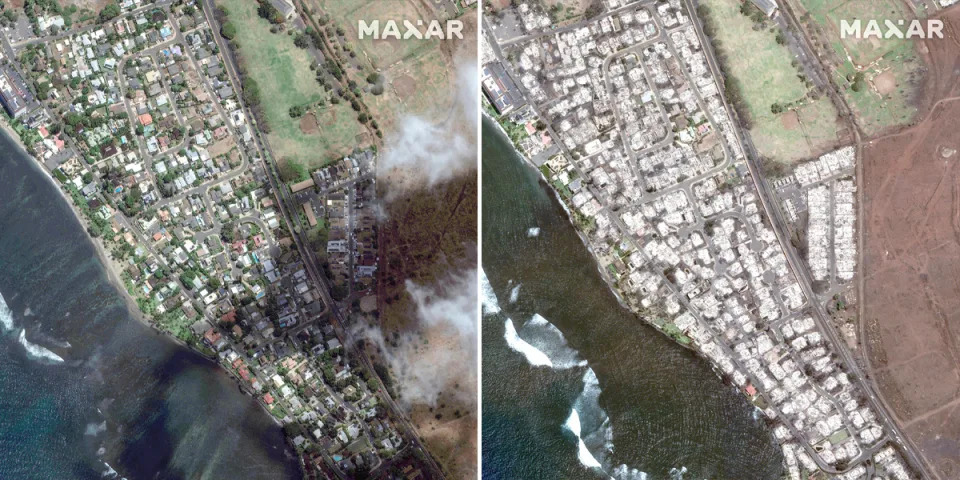
In one image from the company Maxar Technologies, the historic area of Banyan Court — home to the island’s oldest living banyan tree, at 150 years old — appears to have mostly been reduced to ash.
Other images showed similar devastation in and around Lahaina Square, a shopping area, and a neighborhood on the southern end of the town of roughly 12,700.
“I still don’t know where my little brother is,” she said. “I don’t know where my stepdad is.”
The fires, which have also hit the island of Hawaii, have been fueled by strong, erratic winds from a Category 4 hurricane.
“This is not going to be a short journey,” said Lt. Gov. Sylvia Luke, who is acting governor until the governor returns early from a trip. “It’s going to take weeks and maybe months to assess the full damage.”
Scientists warn that extreme ‘wet bulb temperature’ events are becoming more common with human-caused climate change (Frederic J. BROWN)
Scientists have identified the maximum mix of heat and humidity a human body can survive.
Even a healthy young person will die after enduring six hours of 35-degree Celsius (95 Fahrenheit) warmth when coupled with 100 percent humidity, but new research shows that threshold could be significantly lower.
At this point sweat — the body’s main tool for bringing down its core temperature — no longer evaporates off the skin, eventually leading to heatstroke, organ failure and death.
This critical limit, which occurs at 35 degrees of what is known “wet bulb temperature”, has only been breached around a dozen times, mostly in South Asia and the Persian Gulf, Colin Raymond of NASA’s Jet Propulsion Laboratory told AFP.
None of those instances lasted more than two hours, meaning there have never been any “mass mortality events” linked to this limit of human survival, said Raymond, who led a major study on the subject.
But extreme heat does not need to be anywhere near that level to kill people, and everyone has a different threshold depending on their age, health and other social and economic factors, experts say.
For example, more than 61,000 people are estimated to have died due to the heat last summer in Europe, where there is rarely enough humidity to create dangerous wet bulb temperatures.
But as global temperatures rise — last month was confirmed on Tuesday as the hottest in recorded history — scientists warn that dangerous wet bulb events will also become more common.
The frequency of such events has at least doubled over the last 40 years, Raymond said, calling the increase a serious hazard of human-caused climate change.
Raymond’s research projected that wet bulb temperatures will “regularly exceed” 35C at several points around the world in the coming decades if the world warms 2.5C degrees above preindustrial levels.
– ‘Really, really dangerous’ –
Though now mostly calculated using heat and humidity readings, wet bulb temperature was originally measured by putting a wet cloth over a thermometer and exposing it to the air.
This allowed it to measure how quickly the water evaporated off the cloth, representing sweat off of skin.
The theorised human survival limit of 35C wet bulb temperature represents 35C of dry heat as well as 100 percent humidity — or 46C at 50 percent humidity.
To test this limit, researchers at Pennsylvania State University in the United States measured the core temperatures of young, healthy people inside a heat chamber.
They found that participants reached their “critical environmental limit” — when their body could not stop their core temperature from continuing to rise — at 30.6C wet bulb temperature, well below the previously theorised 35C.
The team estimated that it would take between five to seven hours before such conditions would reach “really, really dangerous core temperatures,” Daniel Vecellio, who worked on the research, told AFP.
– The most vulnerable –
Joy Monteiro, a researcher in India who last month published a study in Nature looking at wet bulb temperatures in South Asia, said that most deadly heatwaves in the region were well below the 35C wet bulb threshold.
Any such limits on human endurance are “wildly different for different people,” he told AFP.
“We don’t live in a vacuum — especially children,” said Ayesha Kadir, a paediatrician in the UK and health advisor at Save the Children.
Small children are less able to regulate their body temperature, putting them at greater risk, she said.
Older people, who have fewer sweat glands, are the most vulnerable. Nearly 90 percent of the heat-related deaths in Europe last summer were among people aged over 65.
People who have to work outside in soaring temperatures are also more at risk.
Whether or not people can occasionally cool their bodies down — for example in air conditioned spaces — is also a major factor.
Monteiro pointed out that people without access to toilets often drink less water, leading to dehydration.
“Like a lot of impacts of climate change, it is the people who are least able to insulate themselves from these extremes who will be suffering the most,” Raymond said.
His research has shown that El Nino weather phenomena have pushed up wet bulb temperatures in the past. The first El Nino event in four years is expected to peak towards the end of this year.
Wet bulb temperatures are also closely linked to ocean surface temperatures, Raymond said.
The world’s oceans hit an all-time high temperature last month, beating the previous 2016 record, according to the European Union’s climate observatory.
People in Hawaii flee into ocean to escape wildfires that are burning a popular Maui tourist town
Jennifer Sinco Kelleher – August 9, 2023
HONOLULU (AP) — Wildfires in Hawaii fanned by strong winds burned multiple structures in areas including historic Lahaina town, forcing evacuations and closing schools in several communities Wednesday, and rescuers pulled a dozen people escaping smoke and flames from the ocean.
The U.S. Coast Guard responded to areas where people went into the ocean to escape the fire and smoky conditions, the County of Maui said in a statement. The Coast Guard tweeted that a crew rescued 12 people from the water off Lahaina.
The county tweeted that multiple roads in Lahaina were closed with a warning: “Do NOT go to Lahaina town.”
Fire was widespread in Lahaina, including Front Street, an area of the town popular with tourists, County of Maui spokesperson Mahina Martin said in a phone interview early Wednesday. Traffic has been very heavy as people try to evacuate and officials asked people who weren’t in an evacuation area to shelter in place to avoid adding to the traffic, she said.
The National Weather Service said Hurricane Dora, which was passing to the south of the island chain at a safe distance of 500 miles (805 kilometers), was partly to blame for gusts above 60 mph (97 kph) that knocked out power as night fell, rattled homes and grounded firefighting helicopters. Dangerous fire conditions created by strong winds and low humidity were expected to last through Wednesday afternoon, the weather service said.
Acting Gov. Sylvia Luke issued an emergency proclamation on behalf of Gov. Josh Green, who is traveling, and activated the Hawaii National Guard.
Officials were not aware of any deaths and knew of only one injury, a firefighter who was in stable condition at a hospital after experiencing smoke inhalation, Martin said There’s no count available for the number of structures affected by the fires or the number of people affected by evacuations, but Martin said there are four shelters open, with more than 1,000 people at the largest.
“This is so unprecedented,” Martin said, noting that multiple districts were affected. An emergency in the night is terrifying, she said, and the darkness makes it hard to gauge the extent of the damage.
“Right now it is all-hands-on-deck and we are anxious for daybreak,” she said.
The Federal Emergency Management Agency approved a disaster declaration to provide assistance with a fire that threatened about 200 homes in and around Kohala Ranch, a rural community with a population of more than 500 on the Big Island, according to the Hawaii Emergency Management Agency. When the request was made, the fire had burned more than 600 acres (243 hectares) and was uncontained. Much of Hawaii was under a red flag warning that continued Wednesday, and two other uncontrolled fires were burning on the Big Island and Maui, officials said.
Fire crews on Maui were battling multiple blazes concentrated in two areas: the popular tourist destination of West Maui and an inland, mountainous region. In west Maui 911 service was not available and residents were directed to call the police department.
Because of the wind gusts, helicopters weren’t able to dump water on the fires from the sky — or gauge more precise fire sizes — and firefighters were encountering roads blocked by downed trees and power lines as they worked the inland fires, Martin said.
About 14,500 customers in Maui were without power early Wednesday, according to poweroutage.us.
“It’s definitely one of the more challenging days for our island given that it’s multiple fires, multiple evacuations in the different district areas,” Martin said.
Winds were recorded at 80 mph (129 kph) in inland Maui and one fire that was believed to be contained earlier Tuesday flared up hours later with the big winds, she added.
“The fire can be a mile or more from your house, but in a minute or two, it can be at your house,” Fire Assistant Chief Jeff Giesea said.
In the Kula area of Maui, at least two homes were destroyed in a fire that engulfed about 1.7 square miles (4.5 square kilometers), Maui Mayor Richard Bissen said. About 80 people were evacuated from 40 homes, he said.
“We’re trying to protect homes in the community,” Big Island Mayor Mitch Roth said of evacuating about 400 homes in four communities in the northern part of the island. As of Tuesday, the roof of one house caught on fire, he said.
Fires in Hawaii are unlike many of those burning in the U.S. West. They tend to break out in large grasslands on the dry sides of the islands and are generally much smaller than mainland fires.
Fires were rare in Hawaii and on other tropical islands before humans arrived, and native ecosystems evolved without them. This means great environmental damage can occur when fires erupt. For example, fires remove vegetation. When a fire is followed by heavy rainfall, the rain can carry loose soil into the ocean, where it can smother coral reefs.
The island of Oahu, where Honolulu is located, also was dealing with power outages, downed power lines and traffic problems, said Adam Weintraub, communication director for Hawaii Emergency Management Agency.
Associated Press writer Audrey McAvoy contributed to this report.
There’s a very distinct possibility we could trigger our own extinction or, at the very least, greatly reduce our population while completely altering the way we currently live. Little things like going outside during daylight hours or growing food in the dirt could become relics of the past, along with birds, insects, whales and many other species. War, famine, pestilence and death — that dreaded equine quartet — threaten to topple our dominance on this planet. We are destroying our own home, sawing off the very branch we rest on.
Those who refute this reality, or climate change deniers, misinterpret the same sets of data showing a clear anthropological cause as being part of the “natural” cycle of the planet. Things are warming, they argue, and that is normal. Only, it really isn’t normal.
Climatologists and scientists have been sounding the alarm for decades: Global temperatures and planetary homeostasis are spiraling out of control, and we’re to blame. The climate crisis is no longer a hypothetical future. It’s the tangible present, and the evidence is clear in every grueling heatwave, not-so-uncommon “freak” storm and raging wildfire.
On the opposite extreme is a vocal minority, the accelerationists and nihilists who accept that humanity is overwhelmingly destructive to nature, but argue our extinction would be a welcome relief. I received many such comments on social media after interviewing Peter Ward, a paleontologist and professor at the University of Washington, about his “Medea hypothesis,” a theory that life is not a benevolent force and often causes its own extermination. Many species in Earth’s history became so successful that they wiped themselves out — and we could do the same.
In response to that article, many readers said something such as, “Humans are a virus and should be eradicated.” Obviously, inducing human extinction is an outcome for which only a very cynical personality would advocate. But what about the first part of that statement? Are humans really like a virus, a pathogen, a cancer?
Dr. Warren Hern, a Colorado-based physician and author of the new book “Homo Ecophagus: A Deep Diagnosis to Save the Earth,” argues that human civilization indeed has many similarities with cancer. This isn’t a metaphor, but rather a literal diagnosis — and it can be addressed in the same way that an actual cancer diagnosis can be the first step to treatment.
Salon recently spoke with Hern about his new book, which acts partially as a memoir, textbook, dire diagnosis and poetic ode to a disintegrating planet, discussing the implications for such an urgent prognosis, a new name for the human species that reflects our true nature and how we can still fix this crisis.
This interview has been condensed and lightly edited for clarity.
My opinion is that humans are part of nature — we are not separate from it. After I came across your book, I began asking myself, “Are humans really a cancer on the planet?” I thought, “Aren’t we part of this whole ecosystem?” I initially set out to disprove what you’re saying, but the argument you make is so extremely convincing. I know from your writing that when you were first conceptualizing the notion that humans are a cancer on the planet, it was very unpopular. But now it seems like this idea has earned some mainstream acceptance. Is that true?
This is a fundamental scientific and philosophical question. And, first of all, I agree with you that we are part of nature. We evolved in a natural ecosystem, and we have obviously very intimate close ties with other species, other animals. Humans are unique in that they have culture, although we’re learning that other animals have certain levels of culture also, like whales. So, we are really not unique in that sense, but we have a different and higher level of culture that allows us to dominate other species and ecosystems.
These are cultural adaptations that allow us to survive, but they have become malignant maladaptations because they are now threatening our survival and millions of other species. We have essentially made a decision at this point as a species to go extinct. That’s what we’re doing — we’re eliminating our biosphere and our planetary support system. Consciously or not, and I think mostly unconsciously.
When I first came onto this in the late ’60s, I was horrified. It’s not an analogy; nobody ever died from an analogy. It’s a diagnosis, and that’s different. The diagnosis is the same as the hypothesis. The guy comes into the emergency room with a sore belly, and he has right lower quadrant pain. Your diagnosis is appendicitis until proven otherwise. But that’s a hypothesis because he might have some other disease, or if it’s a woman, they might have an ovarian cyst.
I work with the idea from Karl Popper that science is not advanced by proving anything, but by disproving false hypotheses. The purpose of a hypothesis is to explain reality and predict events. This hypothesis [humans as a cancer] explains what we see going on in reality around us — and has for a long time — and it predicts what is going to happen. And that means the prognosis, in medical terms, for cancer is death. The cancer continues until the host organism dies.
The difference between us and a cancer — the only difference — is we can think, and we can decide not to be a cancer. If the diagnosis is correct, things will continue until we are extinct. The biosphere can’t go extinct; it can’t die, but we can alter it to the point that we can no longer survive. And that will take out millions of other organisms. Clearly, plenty of organisms are going to survive that process. They might even be more intelligent than us. I don’t know.
That’s sort of the general picture. And whether people accept this or want to even listen to it is another thing. For example, in the book, I talk about the guy who took over the anthropology section at AAAS [American Association for the Advancement of Science] back in the early ’90s. He didn’t like this idea, and he wanted them to drop it from the schedule because his wife had cancer and he was very offended by it. I told him, “Well, I’m really sorry that your wife has cancer, and I certainly hope she recovers. This doesn’t have anything to do with your wife’s cancer.”
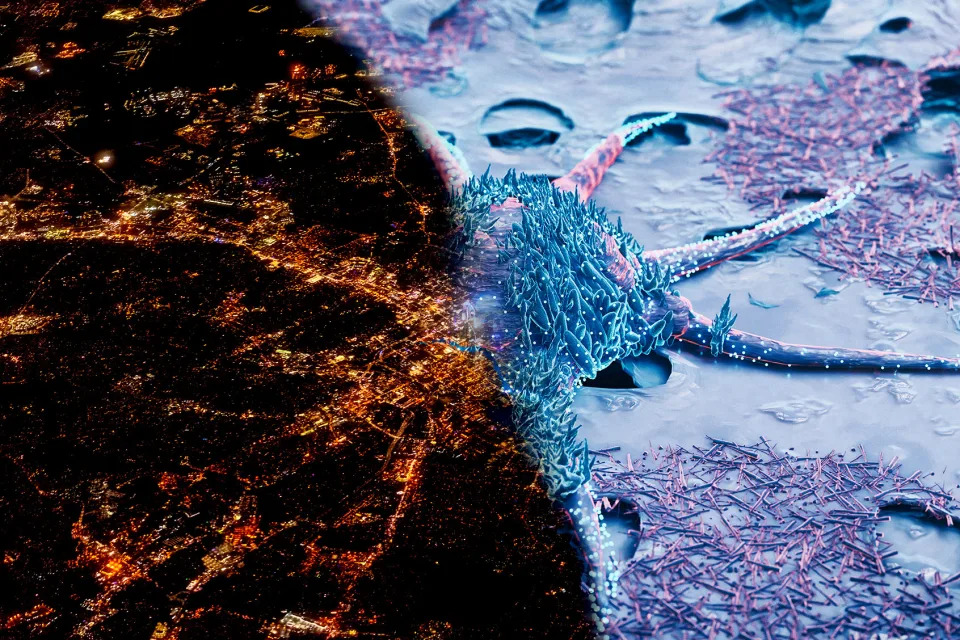
I hope people can see that because it’s such a good diagnosis. I mean, it really does fit the bill. You look at maps of cities and tumors, and you can see how they kind of grow similarly. But the similarities don’t end there.
The basic premise is that humans have the capacity of developing culture, and that has millions of manifestations, everything from language and speech and mathematics to constructing shelters, building weapons and having medical care to keep us alive. These adaptations have allowed us to go from a few separate species of skinny primates wandering around in Africa a couple of million years ago to being the dominant ecological force on the planet to the point we’re changing the entire global ecosystem.
These cultural adaptations have now become maladaptive. They do not have survival value. And they are, in fact, malignant maladaptations because they’re increasing in a way that cancer increases. So, this means that the human species now has all of the major characteristics of a malignant process. When I was in medical school, we had four of them that were identified: rapid, uncontrolled growth; invasion and destruction of adjacent normal tissues — in this case, ecosystems; metastasis, which means distant colonization; and dedifferentiation, which you see very well in the patterns of cities.
That’s only one example. We now have 10 or 15 other new characteristics of cancer, and the human species fits all of them. And so the disturbing thing about this? If you have any two of the first four characteristics of cancer, it’s cancer until proven otherwise. And cancer does not stop until the host organism has ceased to function, which for our purposes is the biosphere.
Now, I have given the book the name “Homo Ecophagus.” That is my new name for the human species, which currently has the scientific name of Homo sapiens sapiens, or wise, wise man, which makes us the most misnamed species on the planet. Homo ecophagus means the man who devours the ecosystem — and that’s what we are doing.
We are in the process of converting all plant, animal, organic and inorganic material on the planet into human biomass and its adaptive adjuncts or support systems. The evidence for that is all around us.
So, that’s the basic idea in a nutshell, and then the rest of the book is simply manifestations of this malignancy and an explanation of the analysis. And so, the next question is: Can we do anything about this? Should we do something about this? It’s very hard under the circumstances, for example, to think about Vladimir Putin sitting down with Zelensky if they can fix the ecosystem in Ukraine.
Right, it’s a very, very difficult problem. It’s the biggest problem our society faces right now. Literally, nothing else matters if we don’t address this problem.
That’s the point: It’s an existential crisis. Yes.
I have to say that it seems like we’re not going to solve this problem. I don’t want to be negative and despair that we’re all simply going to die from climate change. I recently made a move across the country from California to Illinois. Everywhere you go, you get that dedifferentiation that you speak of, where everything looks the same. Every freeway has the same strip malls. You see all these people in these giant pickup and semi trucks and all this overconsumption. I just don’t see people giving it up. I just don’t see it happening. Not fast enough, at least.
This is what I call the “ecophasic imperative.” Robert Ardrey, a brilliant anthropologist, about 40 or 50 years ago wrote a number of outstanding books. One is called “The Territorial Imperative,” which is about how humans have an imperative need to have and expand their territories.
One of the most lurid manifestations of what we have right now is Donald Trump. Another one is Putin and the war on Ukraine, but humans have been doing this forever. And now our malignant melanoma patients have been put in a position where we are devouring the Earth. We are devouring the ecosystem. We have an imperative to do that. Look at the open pit mines that we have of various kinds. The whole alternative energy programs depend on destroying certain ecosystems to get the rare metals that we need to do that stuff.
I do not want to be negative, either. I’m basically an optimistic and positive person. I’ve been my whole life. The Intergovernmental Panel on Climate Change gives us a list of horribles, and it gets more horrible every year. But what’s the underlying dynamic? I say this is a malignant process going on for hundreds of thousands of years.
This is not new. When the Australian Aborigines arrived on the continent of Australia, they started changing the ecosystem in very dramatic ways, and a lot of species went extinct. My colleague here at the University of Colorado, Giff Miller, has been one of the people showing that it happened in North America. It happened in the Pacific Islands. It happens every place. Humans have made other species extinct wherever they show up.
Of course, it takes individual actions. The obvious side to that is people can make changes in their lives. I’m in Boulder, Colo, for example, where they have a lot of recycling going on, and people are very conscious of that. But, at the same time, you have China putting in a coal-fired power generation plant every week. So, it’s very hard to see how all these individual actions can really have that effect that we want.
Do you have hope for the future, or maybe feel despair about everything? I often get a little bit paralyzed and feel like there’s no point to anything, like we’re all just going to go off the cliff. I’m hoping something will change, that something will shift on a major level, that we’ll all kind of come together on this issue. But I feel like I’ve been waiting for that moment for years.
It’s hard to know how to answer your question when you ask me, “Is there hope?” One of my main answers — which is true — is that young people like you give me hope, people who are looking at this stuff and thinking about it and figuring out what to do. When I look at the current political scene in the United States, it’s very hard to be optimistic because we have a violent fascist movement that occupies the attention of at least a third, if not more, of the population, supporting a man who is a sociopathic criminal.
I think that we make the decisions about these situations — the environment and our survival — through our political process. I want to be optimistic. Let me just share a little example of something with you. A week ago, I went to New Mexico to attend a special memorial service for Dave Foreman.
The meeting was held in a campground outside of Los Alamos, and we were a scruffy-looking bunch of backpackers and tree huggers. I felt right at home with these wonderful people, who were some of the hardcore environmentalists of this country, and people who really, really were dedicated, spent their lives working on protecting the environment. We’ve been talking about people with advanced degrees, with PhDs in ecology and biology, wolf conservation, I don’t know what else.
They were an impressive bunch of people. I enjoyed meeting them, and I participated in this meeting. I admire Dave, who was a friend of mine. And I have his books, and they’re worth reading. OK, this is a highly energetic, wonderful, dedicated, altruistic group in this country. What’s been happening since they started Earth First!? Things are a lot worse than they were.
And it’s very hard to see how that has really influenced the broad scale of things, even though they’ve had a lot of very specific local victories. More people need to understand that we are in an impending extinction crisis for ourselves and for the rest of the ecosystem and other species. We are destroying the planet as we speak — as rapidly as possible — and that must stop. We must find ways to do things differently, and that’s going to make big changes in our lives.
Ahead of Ohio abortion vote, Republicans try to change the rules
Holly Honderich – in Washington – August 5, 2023
An upcoming referendum in Ohio has become a proxy fight for abortion
A pro-abortion referendum looked poised to win in the conservative state of Ohio this November. Now, Republican state legislators are accused of moving the goalposts.
Last summer, just like every summer for the past 22 years, Michael Curtin spent his days on the assorted baseball fields of central Ohio, acting as umpire for high school and college games.
Mr Curtin, retired after a 38-year career in journalism and another four in state politics, loves the game. But this summer, Mr Curtin’s umpire equipment has been neglected, shoved somewhere in the basement of his Columbus home so he could focus on the rules of Ohio politics instead.
“I’m not doing one game,” he said. “And I miss it. But this fight’s too important to lose.”
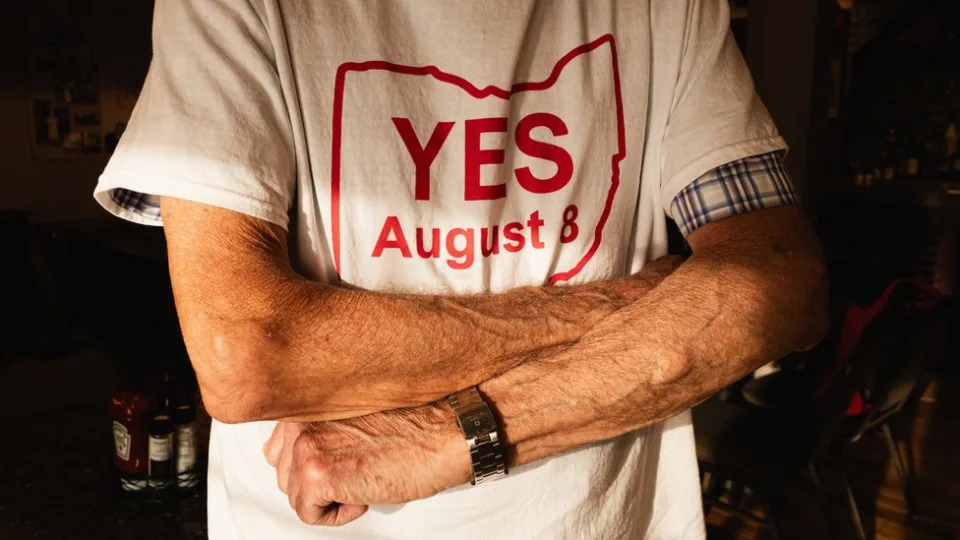
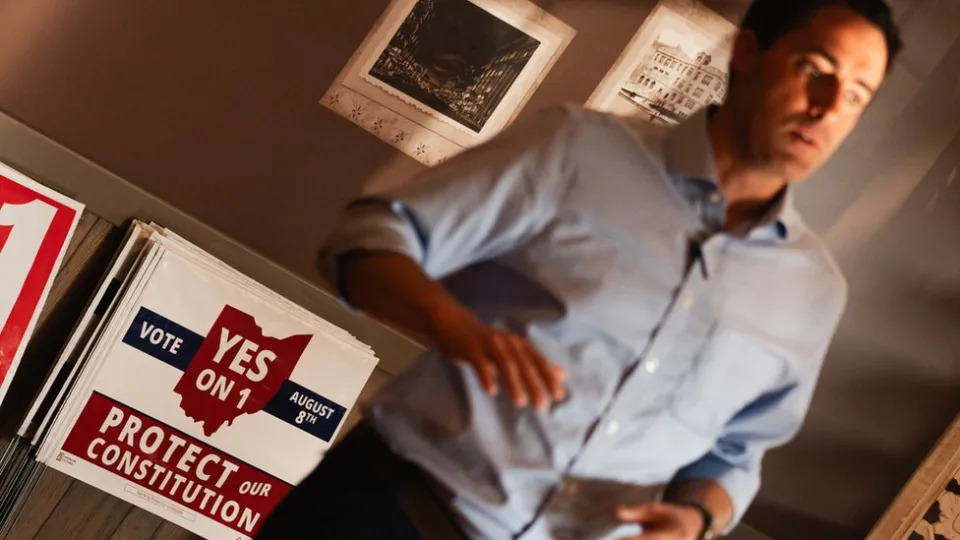
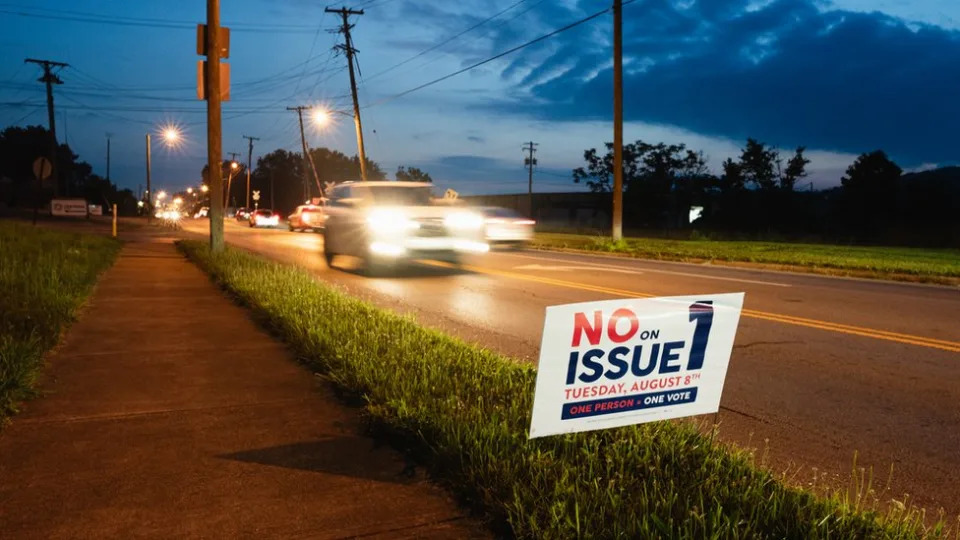
The fight in question is over Issue 1, a deceivingly dull and procedural-sounding referendum on the minimum threshold required to pass constitutional amendments.
The premise is simple: voters will decide on 8 August whether that threshold should remain at 50% plus one, or be raised to 60%.
But Ohio’s vote has become a proxy war over abortion, one of the many state-wide battles that have broken out since the US Supreme Court rescinded the nationwide right to abortion last June.
That’s because Issue 1 is not the only referendum looming. In November, Ohioans will vote on another constitutional amendment, one that would protect abortion access up until foetal viability, around 24 weeks of pregnancy.
The proponents of issue 1 claim that Tuesday’s vote is simply to protect the state’s constitution from outside influence.
But its opponents – a diverse coalition featuring political wonks like Mr Curtin, a retired Supreme Court judge and all of Ohio’s past living governors – have called foul. They claim Issue 1 is a backhanded attempt to change the rules mid-game, raising the voter threshold just in time to thwart the abortion vote.
“Look, everybody knows what’s going on here. Everybody knows,” Mr Curtin said. “This was just bad faith.”
Issue 1 has been championed by Ohio’s secretary of state Frank LaRose
Since Roe v Wade was overturned last June, the country’s abortion fight has increasingly played out in state ballot initiatives. There have been six so far, each one a win for abortion rights.
If Ohio’s vote is passed, it will be the most sweeping affirmation of reproductive rights in a state controlled by a firm Republican majority, said Mary Ziegler, a law professor at the University of California, Davis and a leading authority on the US abortion debate. “It will confirm that there’s some sort of consensus around abortion rights, even in conservative states.”
But if Issue 1 is passed first, and the threshold is raised to 60%, the abortion rights amendment may be finished.
“They [anti-abortion campaigners] very clearly looked at this and said: we cannot win if we don’t change the rules,” said Kellie Copeland, executive director of Pro-Choice Ohio.
Issue 1 has had the full-throated support of Ohio’s chief election official, secretary of state Frank LaRose.
“To allow a bare majority of 50% plus one to change the very ground rules that the state operates on is just not good public policy,” he told the BBC.
Issue 1’s opponents include all four of the state’s living former governors
Mr LaRose, 44, is a veteran of the US Special Forces and now an enthusiastic envoy for the Republican Party, crisscrossing the state for more than 65 pro-Issue 1 events. He is charming, conservative and politically ambitious. In November – at the same time the abortion referendum is held – Mr LaRose will be on the ballot for the US Senate.
In public, Mr LaRose has kept the focus squarely on the constitution. But at a fundraising dinner in May, Mr LaRose made explicit the importance of Issue 1 for the anti-abortion movement.
“I’m pro-life. I think many of you are as well,” Mr LaRose said, in a video recorded by Scanner Media. “This is 100% about keeping a radical pro-abortion amendment out of our constitution. The left wants to jam it in there this coming November.”
In an interview with the BBC, Mr LaRose acknowledged that the “looming abortion amendment” helped bring the Issue 1 vote forward. “But that’s not the only reason,” he said.
To his opponents, Mr LaRose had been caught saying the quiet part out loud.
“There’s an old standard that our grandparents taught us that bears repeating: if you want any credibility in life… never deny the obvious,” Mr Curtin said. “Here is Mr LaRose denying the obvious.”
There have been other accusations of hypocrisy. Earlier this year, Republicans passed a law eliminating nearly all August elections, citing their high cost and low turnout. Then, in an apparent u-turn, they put Issue 1 on the calendar for 8 August.
Even some of Mr LaRose’s fellow Republicans have spoken out against Issue 1.
“You’re talking about changing a part of the Ohio constitution that has been in effect for well over 100 years,” said former Ohio Governor Bob Taft, a Republican. “And it’s worked, it’s worked well, the system is not broken.”
In the 111 years since Ohio first granted voters the power to introduce citizen-led amendments, just 19 of 71 proposed measures have passed. Ohio’s current policy requiring a simple majority is in line with most of the 17 US states that allow citizen-initiated amendments. And in 2015, Ohioans added a new restriction, passing an amendment that prohibited anyone from changing the constitution for their own financial benefit.
“This is an elaborate scheme to suppress the vote of Ohioans… It’s unconscionable,” said former Ohio Supreme Court Chief Justice Maureen O’Connor, also a Republican.
Whatever Mr LaRose’s motivations, Issue 1 has been embraced by Ohio’s anti-abortion lobby. Mike Gonidakis, president of Ohio Right to Life, said he “led efforts” to get signatures from state politicians to put the measure on the ballot.
“In speaking with Frank LaRose I said ‘now’s our time to do this’,” he told the BBC.
Mr Gonidakis, like Mr LaRose, rejected criticism that Issue 1 was underhanded. “It’s not changing the goalposts if Ohioans weigh in and vote on it,” he said.
Experts said they see Ohio’s Issue 1 as part of a broader tactic employed by anti-abortion advocates to circumvent public opinion in service of their ultimate goal, outlawing abortion entirely – a goal that is unsupported by most Americans.
“They think if voters had a straight up and down decision on abortion it wouldn’t go their way, so they’re trying to do what they can to prevent that from happening,” said the University of California’s Ms Ziegler.
As a result, anti-abortion leaders and their Republican allies have found paths around popular support – either relying on the court system or on politicians willing to promote abortion policy regardless of voters’ wishes.
These manoeuvres are possible, Ms Ziegler said, because in so many cases Republican politicians fear the anti-abortion lobby more than their own constituents.
And the strategy suits the movement’s internal logic, in which banning abortion is seen as the worthiest cause.
“There’s a sense in which winning is more important than democracy,” she said.
And as concerning as these developments are, scientists have long worried about even more dramatic, looming and irreversible changes to the planet that could happen quickly. Even in the past year, there’s evidence some of these scenarios are becoming more likely.
A paper in the journal Science in 2022 looked at several climate “tipping points” – conditions beyond which changes become self-perpetuating and difficult or impossible to undo. While the concept raised the hackles of some scientists, who suggested it was overly simplistic, the paper suggested even the possibility of such no-going-back points provided compelling reasons to limit warming as much as possible.
But the news isn’t all bad: There’s some good news in the Amazon. And scientists continue to say that if humanity takes climate threats seriously and quickly moves to end carbon emissions, the scenarios below become less likely or at least less extreme.
Here are five tipping points scientists say could start to teeter sooner rather than later:
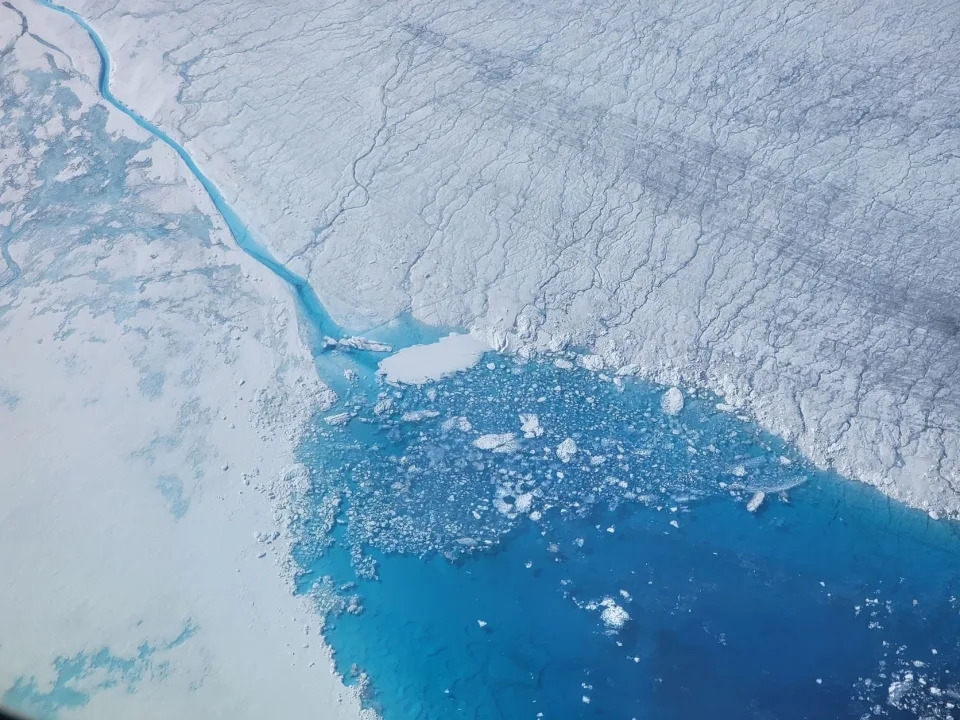
A July 2022 photo of melting summer sea ice in the Arctic Ocean near Greenland.
As of July 18, Antarctic sea ice was more than 1 million square miles below the 1981-2010 average. That’s an area larger than the seven southwestern states, including Utah and Texas, according to the National Snow and Ice Data Center. It is also more than half a million square miles lower than last year, which had also been the previous record low.
In Greenland, temperatures over the country’s central-north ice sheet between 2001 and 2011 were the warmest in the past 1,000 years, said Maria Hörhold, a glaciologist at the Alfred Wegener Institute for Polar and Marine Research in Germany and author of a study published this year.
Critical Atlantic ocean currents could stall, reshape climate in US and Europe
What could happen: Massive ocean currents that move hot and cold water around could grind to a halt. Some studies have called it an “irreversible transition.”
When could it happen: New research suggests it could occur this century.
What would the effect on Earth be: Scientists aren’t sure, but some say a stoppage could trigger rapid weather and climate changes in the U.S., Europe and elsewhere. It could bring about an ice age in Europe and sea-level rise in cities such as Boston and New York, as well as more potent storms and hurricanes along the East Coast.
What changed since last year? Recent analysis shows the current appears to be weakening or slowing down.
It’s far from certain and many scientists say there’s not enough data yet to tell if there’s a trend that could mean a sudden collapse is in the offing.
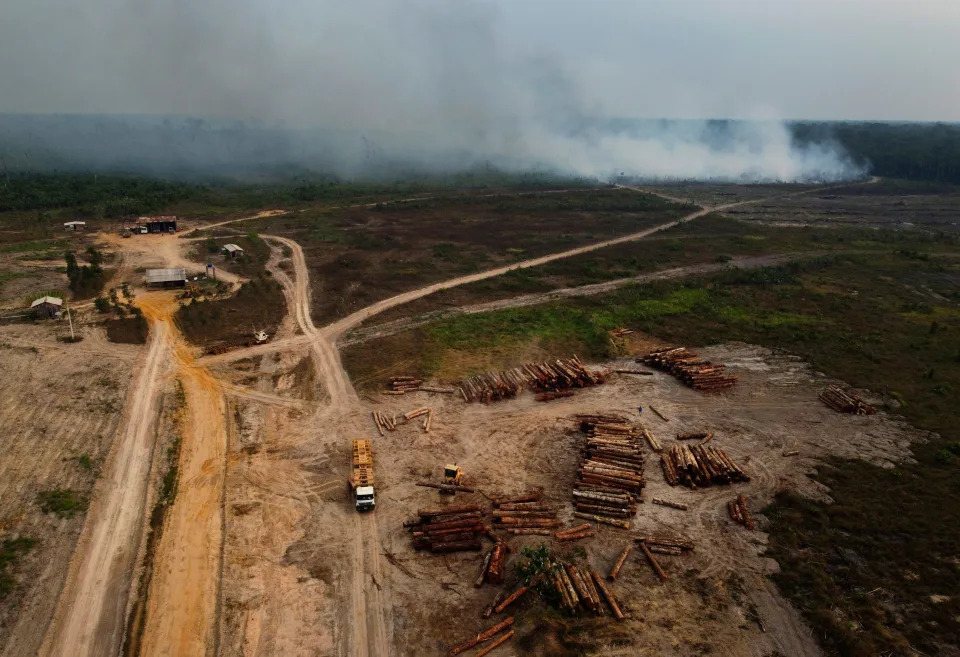
FILE – Smoke rises from a fire near a logging area in the Transamazonica highway region, in the municipality of Humaita, Amazonas state, Brazil, Sept. 17, 2022. Brazil has a major role to play in addressing climate change as home to the world’s largest rainforest, but after the Sunday, Oct. 2, election, the subject is less likely to come up than ever. (AP Photo/Edmar Barros, File) ORG XMIT: CLI301More
What could the effect on Earth be? The Amazon’s 2.5 million square mile rainforest, sometimes called “the lungs of the plant,” is so vast it creates half of its own rainfall and is home to 10% of the world’s species. It also stores a substantial amount of the world’s carbon.
As temperatures rise and droughts become more common, the ability of the forest to grow back after fires or logging is of concern. That’s especially a problem in the Amazon where the trees themselves capture water through their roots and then release moisture back through their leaves. It’s estimated a single tree can emit 265 gallons of water a day.
If drought or logging kills trees there may not be enough left to bring water to the area, meaning what grows back in their place would instead be grassland.
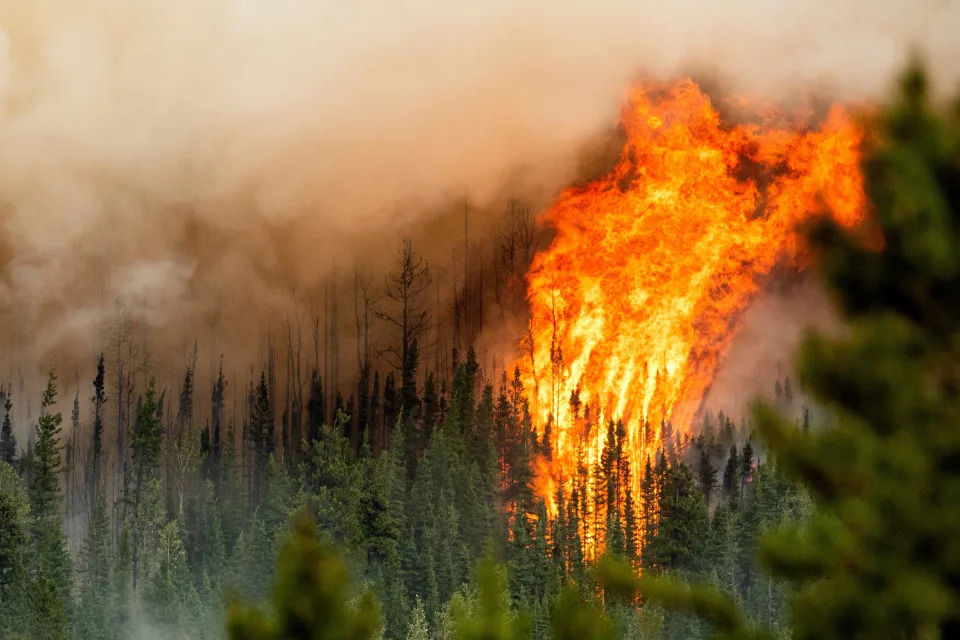
July 2, 2023 : Flames from the Donnie Creek wildfire burn along a ridge top north of Fort St. John, British Columbia.
Wildfires could reshape Alaska and Canada, turning forests into grassland
What could happen: Massive wildfires could mean North America’s vast northern forests – sometimes called “snow forests” – could face a future as mostly treeless grasslands.
What would the effect on Earth be: These cold-weather forests run across Alaska and Canada and are estimated to store more than 30% of all forest carbon on the planet. Without them, huge amounts of greenhouse gases would be released into the atmosphere, worsening global warming.
Forests have always burned but what’s happening now is on a different scale, in every part of the country, said Marc-André Parisien, a research scientist with the Canadian Forest Service.
This summer has been a historically bad fire season in Canada. As of August 4, a remarkable 1,054 active fires were burning, according to the Canadian Interagency Forest Fire Centre.
While boreal forests are highly adapted to wildfires, the climate in the forested areas is now hotter and windier than before, making it harder for the seedlings to reestablish themselves. The concern is that in some areas what grows back after these megafires might not be today’s endless forests but instead grassland and shrubland, interspersed with smaller areas of trees.
“The climate in the northern forests has always been changing since the end of the Ice Age,” Parisien said. “But just the sheer speed at which things are happening now is surprising.”
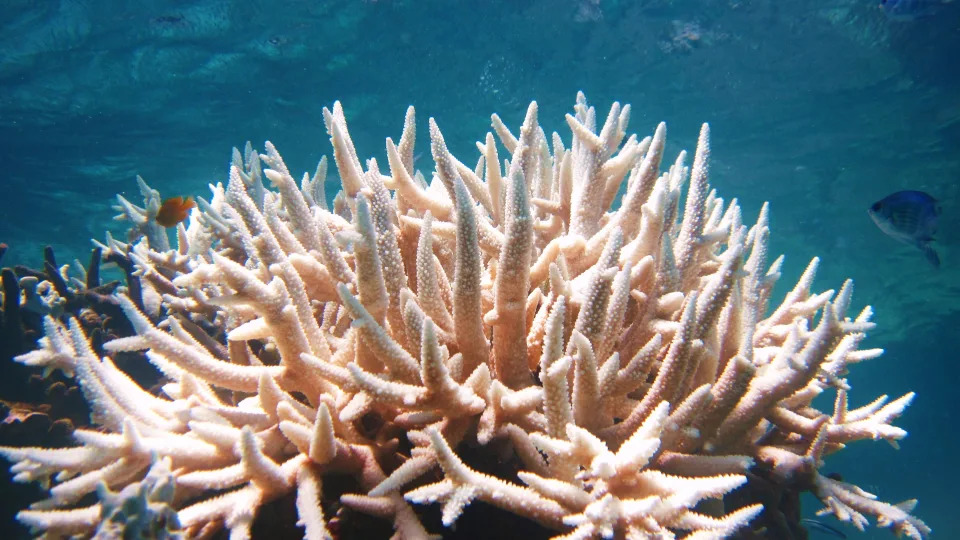
Underwater photo of coral bleaching and hard coral Acropora sp turns white due to high sea surface temperature and climate change
World’s coral reefs could be cooked by the ocean
What could happen: Rising ocean temperatures are literally cooking coral to death. If localized die-offs happened across the world’s oceans, it would fundamentally change and diminish undersea life.
When could it happen: The Intergovernmental Panel on Climate Change has predicted that 1.5°C of global warming would result in between 70 and 90% of the world’s coral reefs disappearing – which could happen in the early 2030s.
What would the effect on Earth be: Corals are vital to the health of the oceans. Although they cover only 0.2% of the ocean floor, they are home to at least a quarter of all marine species. They provide safety for juvenile fish and are home to small organisms and fish that provide food for larger fish. A report released last year showed that almost 15% of the planet’s reefs have vanished since 2009.
Coral reefs can survive within only a relatively narrow temperature band. The coral that build the reefs get much of their food from algae living in their tissues. When the seawater is too warm, the coral’s stress response is to expel algae, causing the coral to turn white. The process is called coral bleaching, and if it lasts too long, the coral can starve – turning a thriving ecosystem into a cemetery of dead, white shells.
The Coral Restoration Foundation, a group centered around restoring and protecting Florida’s coral reefs, said it visited the Sombrero Reef off the Florida Keys on July 20 and found “100% coral mortality.” The discovery means all corals on the Sombrero Reef, a popular snorkeling area, have died and the reef will not recover on its own without active restoration, the foundation said.
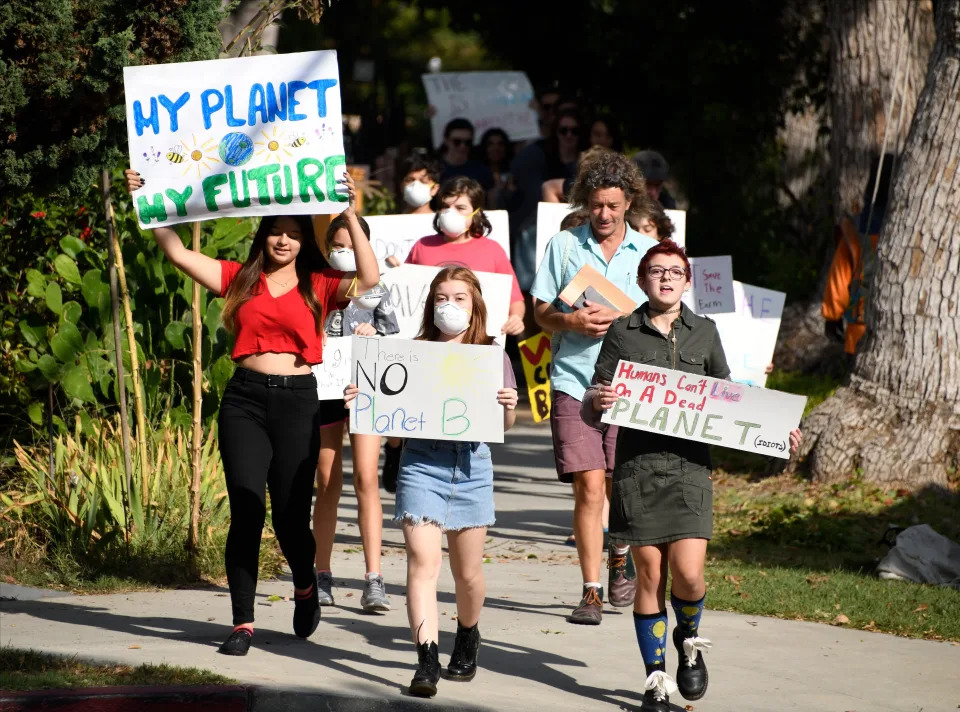
Students from the Urban Homeschoolers in Atwater Village march through the neighborhood chanting and carrying signs on their way to the Los Angeles River and then an overpass on Interstate-5. Photo by Robert Hanashiro, USA TODAY staff
Action, not despair
Even though it appears humanity is on track to miss the United Nations’ hoped-for limit of a temperature rise of no more than 1.5 degrees Celsius, giving up is not the answer, said Anthony Leiserowitz, director of the Yale Program on Climate Change Communication.
No specific number signifies that all hope is lost. Instead, it’s a call for action.
“It’s not like we fall off the edge of the world,” he said. “We can still make a big difference and every single tenth of a degree is enormously important.”
With interest rates climbing, a new form of one-upmanship is making the rounds: the mortgage-rate humble brag. (Getty Images)
At a rooftop party on a steamy July night in Philadelphia, the margarita machine was churning, the seafood boil was hearty, and the conversation turned to the default of the upwardly mobile: real estate.
Almost anyone shopping for a home in the 2020s knows the script by now: Someone mentions their recent home purchase, a tale undoubtedly rich with drama, stress and suspense. Guests, well schooled in the volatility of the housing market, lean in for the follow-up: When did you buy?
The response to that key question “is normally followed by an ‘Oooh,’” said Evan Barker, 36, a lawyer who attended the party and has participated in enough of these exchanges to know that the “Oooh” means one of two things: You either got the interest rate of a lifetime, or you squarely did not.
Fortunately for Barker, he falls into the former category. He and his wife, Laura Gallagher, 36, bought their first house in Bryn Mawr, Pennsylvania, in the early spring of 2020, weeks before home prices began their fastest ascent in U.S. history, as mortgage rates plummeted to historic lows. In January 2021, the 30-year mortgage rate bottomed out at 2.65%, a few months before Barker and Gallagher refinanced, besting the national average with a rate of 2.375%.
So it’s no wonder that Barker spent the evening enjoying the banter almost as much as the stunning City Center rooftop views. He knew his lines for this dialogue. He had spent months fine-tuning his delivery, usually waiting for someone else to toss out an enviable interest rate before he topped it.
“I throw the humblebrag in,” he said. “Hey! Best financial decision of my life was pure luck. It’s just that simple.”
While most of the guests spent the conversation one-upping each other, the person who stood out to Barker was the one who had bought recently, at a substantially higher interest rate than everyone else. “They shocked us with some of their payment info,” he said.
American homeowners now stand on two sides of a divide. On one side are those who had the good fortune to buy or refinance between 2020 and early 2022, and now enjoy notably low monthly interest payments on their principal. On the other side: everyone else.
These prospective and recent homebuyers are watching their purchasing power diminish as home prices hold steady amid rising rates. In mid July, the 30-year mortgage rate hovered just under 7%, after reaching a high of 7.08% in October. The last time rates exceeded 7% was in 2002 — more than 20 years ago.
The contrast creates ideal conditions for ribbing from the winners and resentment from the losers. Homeowners and buyers say the sparring has been happening among friends at parties, with colleagues at the office, and on social media, where it plays out as memes that are smug, shocked or hopeless, depending on where you fall on the spectrum.
“There is almost a cross-generational envy,” said Övül Sezer, an assistant professor of management and organizations at Cornell University, who studies humblebragging.
Flaunting wealth and good fortune is nothing new. But Americans, for the most part, avoid sharing specifics about money. Sure, you’ll plaster news about your promotion on Facebook and on the platform formerly known as Twitter, but you’ll probably keep mum about the salary package that comes with it. When it comes to real estate, the attitude is no different. A gleeful homeowner may gloat about vanquishing the competition in a bidding war, but they won’t mention the sale price, or their monthly payments.
In comes the interest rate, serving as the ideal proxy. Share your mortgage rate and you can showcase your financial prowess without revealing how much money you spent (or how much you have). It almost feels humble. Almost.
“When we brag, we signal our competence,” Sezer said — telling the world, in this case, that we’re savvy consumers. “Yet we also know that bragging is kind of bad, so humblebragging is this seemingly sweet spot. It allows us to both brag, but also look humble.”
Few people are fooled.
“It’s like a talking point. We get it, we know, yes, yes — everybody has 2.6%, you’re all so smart, thanks for informing me,” said Ike Wachuku, 34, a software engineer in Baltimore, who will not be getting a 2.6% interest rate if he and his wife ever manage to find a new house. “People are rubbing your face in it.”
Consumers have little control over what mortgage rate they get, aside from maintaining a solid credit rating. Mortgage rates have been rising in response to the Federal Reserve’s continued efforts to wrestle inflation under control. So timing, not skill, dictates the rate — and timing is a byproduct of luck.
As it happens, luck isn’t entirely random. The pandemic exacerbated inequalities that existed before 2020. For many wealthier Americans, the pandemic was a financial boon. They kept their jobs, were able to work remotely, enjoyed bonuses and raises, and had cash on hand when interest rates plummeted to keep the economy afloat. They were the ones best positioned to pluck up homes, driving up prices. The people who spent 2020 and 2021 struggling through job losses, illnesses or other financial hardships likely missed out on the moment, and are now the ones enduring the hard consequences of rampant inflation.
The interest rate cut “was this free handout to people who didn’t really need it,” said Daryl Fairweather, the chief economist at Redfin. For everyone else, “that door closed as soon as people started to get back on their feet.”
Or as Sharon Reshef, who last month bought a $400,000 one-bedroom apartment in Washington D.C., put it: “It’s really hard to plan your life around macroeconomics.”
That hasn’t stopped some of her slightly older colleagues in Sen. Kirsten Gillibrand’s office from teasing her about her 6.625% interest rate.
“It’s just a gentle ribbing,” said Reshef, 30, the research director for the senator from New York, who now spends half of her take-home pay on her mortgage. “But as long as we’re here, I will say that not a lot of people in my cohort own property, especially as a single person. Regardless of the interest rate, I have that one up on them. I can definitely brag.”
In hindsight, Scott Decker, 35, wishes he had been ready to leave Brooklyn for the suburbs in 2021, when many of his friends were leaving. Instead, he and his wife, Maureen Decker, bought a home in Montclair, New Jersey, the following year. Now, when he drives his son to preschool, passing the stately homes on picturesque, tree-lined streets, he plays a tortured game.
“I’m like, ‘I wonder what this house sold for?’ And, ‘We could have gotten this house two years ago if we had wanted it,’” he said. “I’m definitely always thinking about that and always a little jealous.”
Decker, who leads strategic media planning for a tech company, “definitely overpaid” for the four-bedroom house that he and Decker bought for $1.1 million, 40% over the list price. They also took out an adjustable-rate mortgage, with a rate that is fixed at 4.15% until 2030, when it adjusts based on the current rates. “I’m terrified at what I may be forced to change to in the future,” he said.
The Deckers are friendly with another Montclair couple who own a bigger house, but because their interest rate is lower, their monthly payments are about the same. “Every time we go to their house, I’m like, ‘Man, this is unfair,’” Decker said.
Talk to anyone who managed to buy a home in 2020 or 2021, and they will probably tell you the competition was fierce and the experience miserable. But buyers today face similar, if not tougher, conditions. Inventory is anemic, partly because homeowners do not want to part with their low interest rates. So far, a scant 1% of American homes have traded hands this year, the lowest rate in a decade, according to a July report from Redfin.
Of course, things could be worse. In 1981, mortgage rates peaked at a jaw-dropping 18.53%. Still, the average home price in the second quarter of 1981 was $84,300 — even adjusted for inflation, that’s about $287,020, which is far less than the average price of $495,100 in the second quarter of 2023.
But people who remember the days of double-digit interest rates are often quick to remind younger generations that they, too, walked to school uphill both ways in the snow.
“The fate, the gods, determine when you enter that phase of your life and what is happening in the market,” said Allen J. Palmer, 85, who is retired from IBM and bought his house in what is now Silicon Valley, in California, in 1977 for $95,000 (or $480,686 in today’s dollars), with an 8.5% mortgage interest rate. The first year he and his wife spent in that house, they couldn’t afford to fly home to Milwaukee for the holidays.
Young buyers “don’t understand that this is the way it is,” he said. “They probably don’t remember that their parents struggled to pay” the mortgage, too.
On a recent TikTok video, Barbara Corcoran, the 74-year-old real estate mogul, arranged fresh flowers as she chided hesitant buyers for their reluctance to get back into the market — a common refrain among real estate agents, who insist that there is no time like the present to buy a house.
“Pick your poison: high interest rates now, which aren’t so high, or super-high prices once they come down,” Corcoran said, her hand grazing a fern frond. “Your choice.”
Decker, in Montclair, knows which choice he thinks buyers should make. Recently, he was standing at the bar of a local barbecue restaurant and overheard another patron who seemed overconfident about a recent lowball offer he had made on a house in town. Decker had lost enough bidding wars to know how this story would end, and considered schooling him on his grim prospects. Maybe he would lean across the bar, he thought, and say, “Don’t even bother, man, cool your heels somewhere else.” But he hesitated.
“It did make me feel a little good,” he said, “and certainly thankful that I have a place to live and I’m not dealing with that right now.”
Instead of offering unsolicited advice, he ordered a Pabst Blue Ribbon and a shot of Jameson, and walked back to the patio to sit down and enjoy the evening with his family in their new town.
DeSantis says he’d slash federal bureaucratic jobs on his first day as president: ‘We are going to start slitting throats’
Madison Hall – August 3, 2023
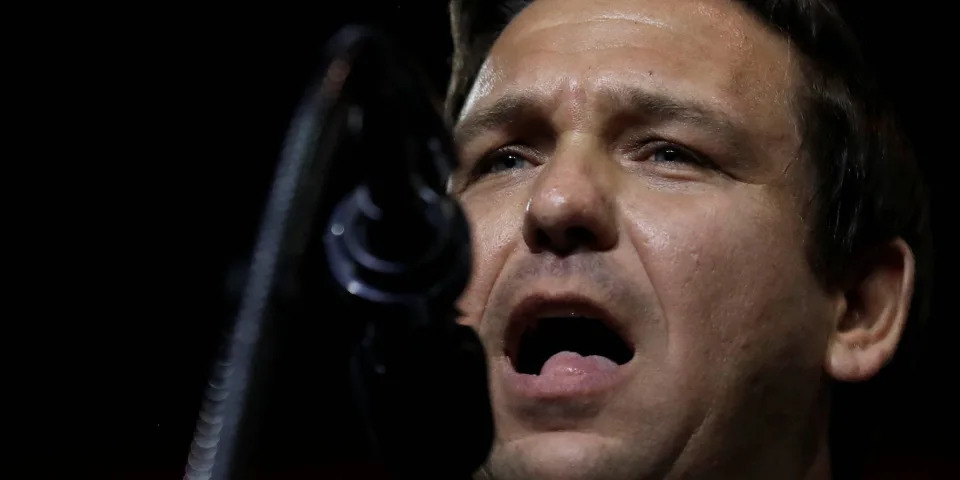
Republican Florida governor candidate Ron DeSantis speaks during a Make America Great Again Rally at the Florida State Fairgrounds in Tampa, Florida, U.S., July 31, 2018.Carlos Barria/Reuters
Ron DeSantis railed against the US for having too many federal bureaucrats at a recent campaign stop.
“We are going to start slitting throats on day one,” he said.
DeSantis has previously said he’d eliminate the IRS and other agencies if elected.
GOP Florida Gov. Ron DeSantis continued on his tirade against federal bureaucrats while speaking on the campaign trail Wednesday.
“We are going to start slitting throats on day one,” DeSantis said about federal bureaucrats, leading to some dissatisfaction among the crowd at the campaign stop in New Hampshire, according to New Hampshire Public Radio.
Wednesday wasn’t the first time DeSantis said he’d slash government agencies if elected to the White House. In June, he said he wanted to get rid of the Internal Revenue Service, the Department of Commerce, the Department of Energy, and the Department of Education.
“You also have to bring this administrative state to heel, the bureaucracy in Washington is totally out of control,” DeSantis said. “It is exerting power that is not therefore under the Constitution, and we need a President to come in and really, really clean house and I will do that on day one.
The president of the American Federation of Government Employees, a labor union that represents more than 650,000 federal workers, said in a statement that DeSantis’ comments were “disgusting, disgraceful, and disqualifying.”
“These public servants deserve respect and commendation from our nation’s leaders,” said Everett Kelley. “No federal employee should face death threats from anyone, least of all from someone seeking to lead the U.S. government. Governor DeSantis must retract his irresponsible statement.”
In a recent New York Times survey, DeSantis finished second among currently declared Republican presidential candidates, trailing behind former President Donald Trump by 37 percentage points. The same survey found that likely Republican voters much prefer a presidential candidate who thinks the “government should stay out of deciding what corporations can support” rather than one who promises “to fight corporations that promote ‘woke’ left ideology,” as DeSantis has pledged to do time and time again.
DeSantis does have time to claw back supporters in the GOP primary race: he qualified for and has said he’ll attend the first Republican presidential debate on August 23.. And in an effort to get more eyes on his campaign, DeSantis just accepted an offer to debate California Gov. Gavin Newsom (who’s not running for president).
Moderna’s COVID-19 vaccine proves safest, most effective for older adults, study says
Clyde Hughes – August 2, 2023
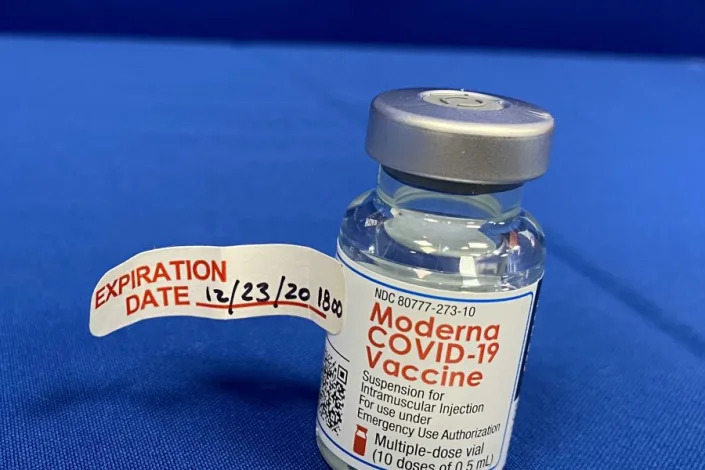
A new study has found that the Moderna COVID-19 vaccine was safest for older patients. File Photo by Gary I. Rothstein/UPI
Aug. 2 (UPI) — In examining real-world data on the long-term health of elderly patients who received the COVID-19 vaccine, researchers at Brown University and Boston-based Hebrew SeniorLife determined that the Moderna variety was the safest and most effective for older adults.
The study, in which scientists examined data from some 6 million patients who were administered coronavirus vaccines, was published Wednesday in the peer-reviewed online journal JAMA Network Open.
The study’s investigators conducted the research as part of the IMPACT Collaboratory project that allowed massive monitoring of the long-term safety and effectiveness of the vaccines for Medicare beneficiaries in collaboration with CVS and Walgreens.
The researchers probed data from millions of adults with an average age of 76, who were vaccinated using either the Moderna or Pfizer-BioNTech vaccines.
The researchers found that while the risk of serious adverse events with both vaccines was “very low,” the Moderna vaccine saw a 4% lower risk for pulmonary embolism or a sudden blockage of blood vessels.
The Moderna vaccine was also tied to a 15% lower risk of being diagnosed with COVID-19 compared to the Pfizer-BioNTech vaccine.
“Immunization with either mRNA vaccine is substantially better and safer than not being vaccinated at all,” study lead author Daniel Harris said.
“But in an ideal world where we can have a choice between which vaccine product is used, we wanted to see whether one vaccine was associated with better performance for older adults and those with increased frailty,” added Harris, an epidemiologist and research scientist in the Center for Gerontology and Healthcare Research at the Brown University School of Public Health.
Harris said that up to this point, little in-depth evidence existed about the safety and effectiveness of the COVID-19 vaccines on older adults and individuals with chronic health conditions.
“The results of this study can help public health experts weigh which mRNA vaccine might be preferred for older adults and older subgroups, such as those with increased frailty,” Harris said.
Older adults, many of whom chronic health conditions, tend to be excluded from clinical trials or represented in small numbers, which is one of the reasons this study was so critical, he said.
This was important considering that older adults, especially those in nursing homes, had a higher risk of developing severe COVID-19.
He added that older adults with frailty can also have differences in their immune responses to vaccines, making it important to understand how these vaccines work for frail older adults compared to their stronger counterparts.
The study, though, only looked at the first dose of the mRNA vaccines, so further research could include similar comparisons for subsequent vaccinations.
“You can imagine regularly updating these types of analyses as new vaccines are developed,” Harris said. “Depending on which one comes out on top, even on a very small scale, that may have big implications at the population level and render a preference for that particular vaccine.”
Why is leprosy spreading in Florida? What to know about recent rise in US cases
Caroline Kee – August 2, 2023
Cases of leprosy, also known as Hansen’s disease, are on the rise in Florida, and the infectious disease may be endemic in the Southeastern United States, a new report suggests.
Despite its biblical-sounding name, leprosy not a disease of the past. Leprosy still occurs in more than 120 countries, and there are over 200,000 new cases reported every year, according to the World Health Organization.
Leprosy is a chronic infectious disease caused by the bacteria Mycobacterium leprae, which affects the skin and nervous system.
“Leprosy is a pretty unusual infection in the United States, and cases had been dropping very steadily over a long period of time, but then recently, there’s been a bit of a slow uptick,” Dr. William Schaffner, professor of infectious diseases at Vanderbilt University Medical Center, tells TODAY.com.
Are there cases of leprosy in Florida?
Yes, there are cases of leprosy in Florida. So far this year, there have been 15 cases of leprosy in Florida, NBC affiliate WESH reported.
In 2020, 159 new leprosy cases were reported in the U.S., and Florida was among the top states reporting cases, according to a research letter in the journal Emerging Infectious Diseases, published by the U.S. Centers for Disease Control and Prevention.
There has been a drastic reduction in cases in the U.S. since the 1980s, per the CDC, but the number of cases of leprosy has more than doubled in Southeastern states over the last decade.
Why is leprosy spreading in Florida?
The short answer it’s still not known why leprosy is spreading in Florida or why it’s happening now. “Frankly, these cases are still are a bit of a mystery,” says Schaffner, adding that further public health investigation is needed.
Previously, leprosy in the U.S. affected people who had immigrated from leprosy-endemic countries, per the CDC. “Most of the cases we’ve seen in the past have been in people who came from their homeland where there was much more leprosy,” says Schaffner.
But more recently, the rate of new diagnoses in people born outside of the U.S. has been declining, even though the incidence of leprosy in the U.S. has been increasing overall, the CDC said in its report.
About 34% of new cases between 2015 and 2020 appear to have been acquired locally, per the CDC report. In other words, more and more people are being infected with leprosy in the U.S., Schaffner adds — and Florida may be a hotspot.
Additionally, the CDC said several of the recent cases in Florida showed no evidence of traditional risk factors. The report highlights a case of leprosy in a 54-year-old Florida man who reported that he had no known contact with an infected person, no exposure to armadillos (a known animal reservoir for the bacteria that causes leprosy), and no travel history to leprosy-endemic countries.
The CDC report noted that many Florida residents, like the 54-year-old, spend time a lot of time outdoors, so “environmental reservoirs” should be investigated “as a potential source of transmission.”
Where is leprosy in Florida?
Central Florida seems to be where most of the cases of leprosy in the state are located, based on recent data. Of the 15 cases reported so far this year, most were in Brevard County, in East Central Florida.
Of the 2020 data analyzed in the CDC report, Central Florida accounted for about 81% of the cases reported in the state in 2020 and nearly one-fifth of cases reported nationwide, according to the CDC report. The agency did not specify where in Central Florida had the most leprosy cases.
By most definitions, Central Florida includes the Greater Orlando area and sometimes the Tampa Bay area. Other major cities in Central Florida, according to VisitFlorida.com, include St. Petersburg, Clearwater, Palm Bay, Lakeland and Deltona.
How common is leprosy in Florida?
The rate of leprosy in Florida overall is low, as is the case in all of the U.S. So far this year, only 15 cases have been reported in the state. With a population of 22 million across the whole state, that’s a very low risk of coming in contact with someone with leprosy.
That said, the recent trends and cases add to a growing body of evidence that leprosy is endemic in the Southeastern U.S., namely in Florida. Endemic means a virus is consistently present in a population within a geographic area, according to Medline Plus.
“I keep my fingers on the pulse of communicable diseases in this country, and that number (159 cases in the U.S.) surprised me. It was higher than I thought,” says Schaffner.
There are no Leprosy-related travel warnings for Florida, but the CDC said in its report that travel to Florida should be considered during contact tracing for leprosy in any state.
It’s also important to keep in mind that leprosy is “usually difficult to acquire and requires close, persistent, prolonged contact with a person who has leprosy,” says Schaffner. You cannot get leprosy from casual contact like hugging, shaking hands, or sitting next to someone who has leprosy, per the CDC.
“Leprosy is not communicable in the classic sense the way influenza or COVID-19 is,” says Schaffner. According to the CDC, the risk of getting Leprosy is very low because more than 95% of people have natural immunity.
It’s not fully understood how leprosy is spread, per the CDC, but it is thought to be spread through respiratory droplets produced when an infected person coughs or sneezes. There is also evidence humans can contract leprosy from armadillos, a known animal reservoir for the bacteria, says Schaffner. In this case, transmission would also require prolonged contact with the animal — fortunately most people aren’t getting that close to armadillos, he adds.
Is there a cure for leprosy?
“We used to think it was untreatable, but we can treat and cure this disease now,” says Schaffner. Leprosy is typically treated with a combination of antibiotics and treatment usually lasts one to two years, per the CDC.
“It is a very slowly multiplying bacteria in the body, so you have to take the appropriate antibiotics for a long period of time,” says Schaffner.
If left untreated, leprosy can cause permanent damage to the nerves, skin, hands, feet and eyes, which may result in paralysis or blindness, per the CDC. Early diagnosis is important to avoid long-term disfigurement and disability from the disease.
Previously, leprosy was thought of to be highly contagious and patients were isolated in remote areas, Schaffner explains, but today the disease can be safely managed at home.
Pictures of leprosy
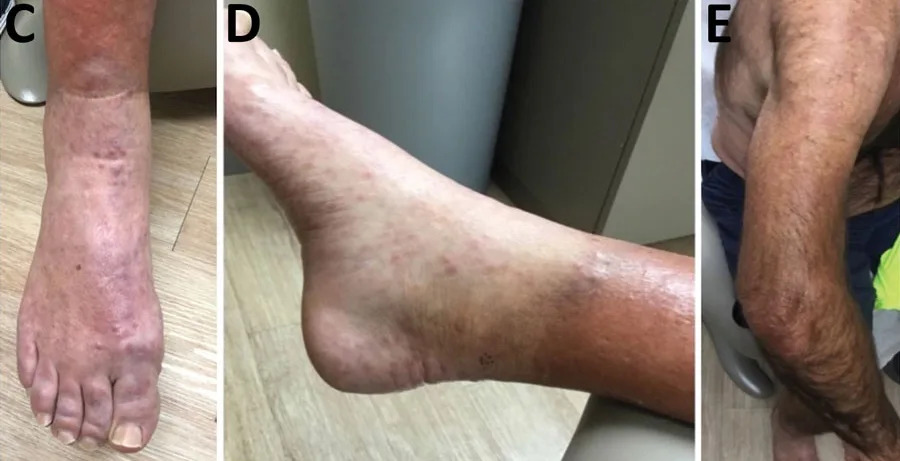
Lepromatous leprosy in a 54-year-old man in central Florida in 2022. (CDC)
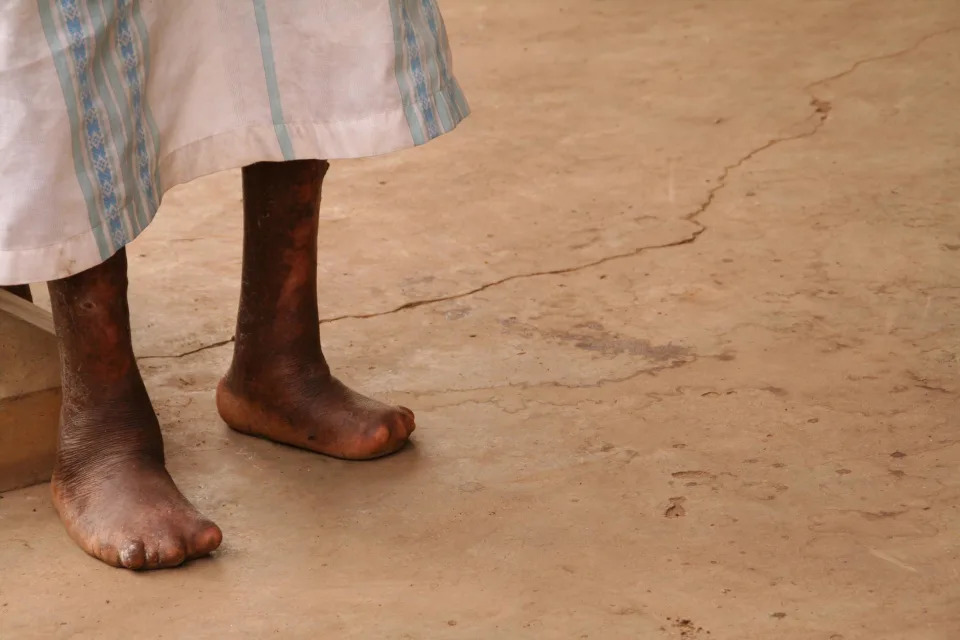
Leprosy can cause skin symptoms, including lesions, discolored or flat rashes, thick or stiff patches of skin, growths and painless ulcers (often on the feet) that do not heal over time, according to the CDC.
Disfigured feet on someone with leprosy. (Shutterstitch / Getty Images/ iStockphoto)
Symptoms affecting the nerves include numbness in the affected areas of the skin, muscle weakness, nerve pain, paralysis and eye issues. Leprosy can also affect the mucous membranes lining the nose, mouth, and inside of the eyes and cause bleeding, tissue damage, impaired speech and vision loss, per Medline Plus.