The whales tidbit is just the latest in a long list of complaints he’s had about the renewable energy generators, including false claims that they cause cancer and kill “all the birds.”
As absurd as it sounds, Trump’s not the first person to make some version of the whales claim, despite a lack of evidence.
Some environmental groups have also raised concerns about how the development and construction of wind farms could impact whales. However, the environmental community has pointed to the absence of any evidence suggesting there’s a link between the projects and whale deaths, and stressed the importance of renewable energy to combat climate change ― the greatest threat to marine life.
On its website, the National Oceanic and Atmospheric Administration says there are no known links between large whale mortalities and offshore wind surveys.
“At this point, there is no scientific evidence that noise resulting from offshore wind site characterization surveys could cause mortality of whales,” the agency said.
The Bureau of Ocean Energy Management also said it had found no evidence, noting: “Past and current research show that vessel strikes and entanglements in fishing gear continue to pose a dangerous, life-threatening risk to whales.”
Users of X, formerly Twitter, were swimming in scorn over Trump’s fishy claim:
Arne Duncan @arneduncan· Follow You literally could never make this stuff up if you tried, but the SNL skits will write themselves. “The windmills are driving the whales a little batty” tells you all you need to know about his fitness for duty… Deranged and impossibly stupid are descriptors that come to mind
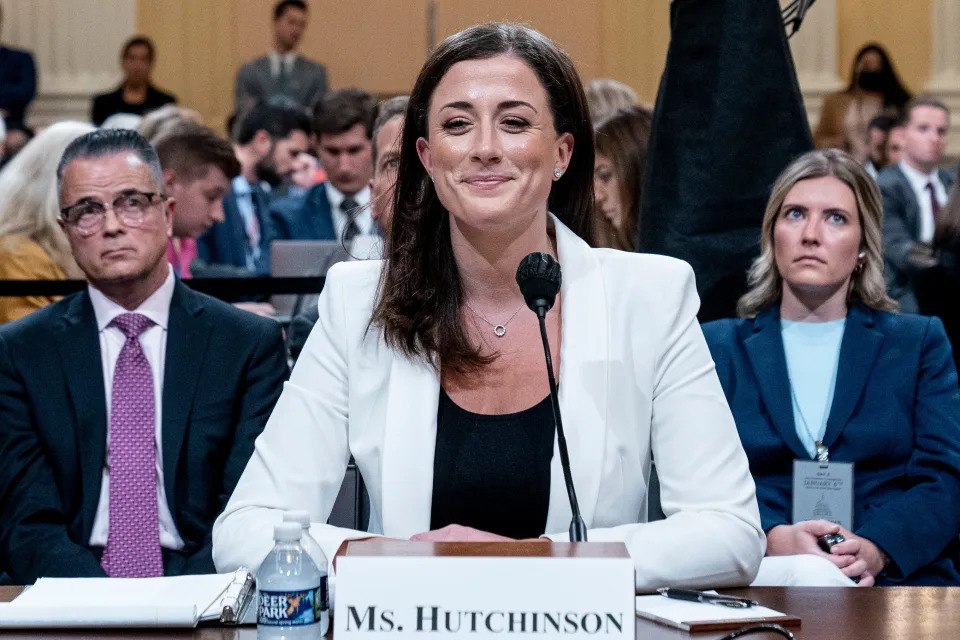
Hutchinson was a top aide to Mark Meadows, then Trump’s chief of staff. She planned to continue working for Trump at Mar-a-Lago after his term ended, she wrote in her book “Enough.”
But despite her loyalty, Meadows told Hutchinson two days before leaving the White House that Trump suspected her of leaking to the press the names of people joining him in Florida, which she denied.
“My frustration turned to rage. ‘Mark, you can go to hell if you think that,’” Hutchinson wrote. “That night I went home and unpacked, trying to let the news sink in that I wasn’t moving to Florida.”
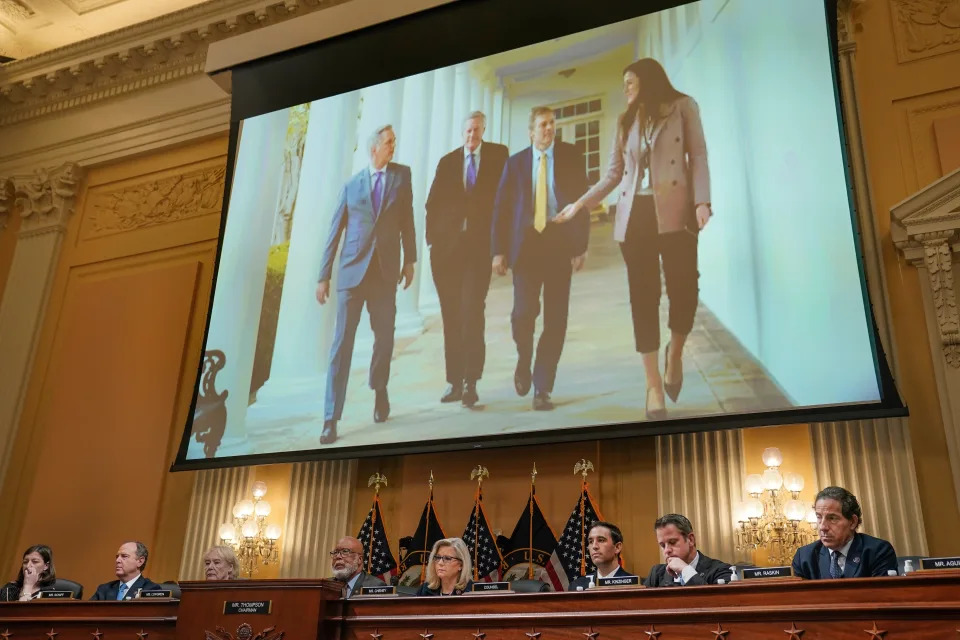
Instead, Hutchinson became the most revelatory witness during the House’s investigation of Jan. 6 hearings and her book provides an explanation for the actions behind Trump’s criminal charges.
Anecdotes include how Meadows’ wife complained to her about the campfire smell of his burning papers. Rudy Giuliani allegedly groped her at Trump’s Jan. 6 rally. And her observations foreshadowed criminal charges Trump would face over the handling of classified documents and trying to overturn the 2020 election.
Here are five takeaways from the book:
Giuliani approached ‘like a wolf closing in on its prey,” Hutchinson wrote
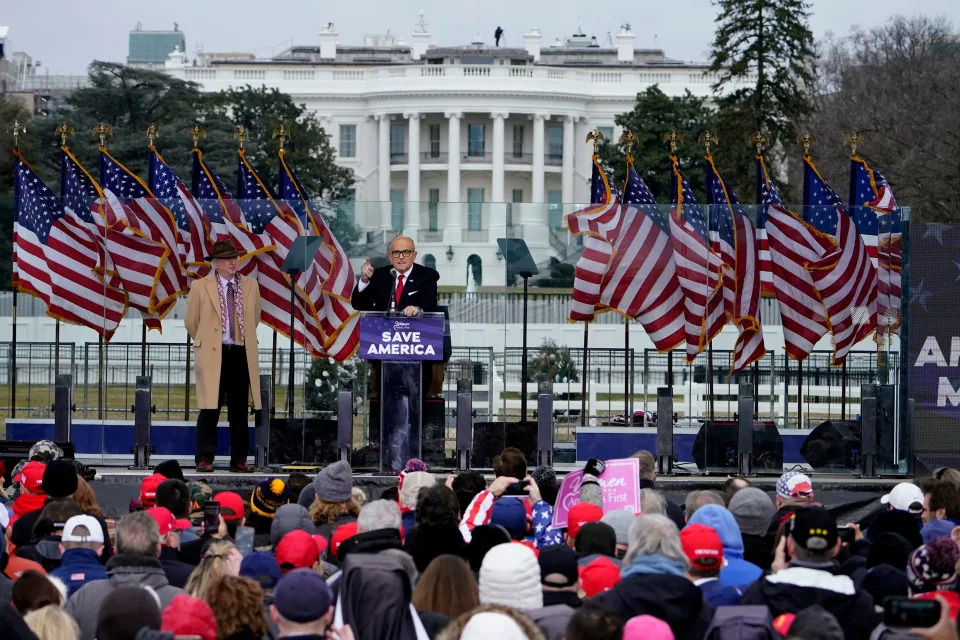
The book largely tracks the testimony Hutchinson delivered before the House committee that investigated Jan. 6. But one revelation was her accusation that Giuliani, Trump’s chief campaign lawyer, groped her at the president’s Jan. 6 rally near the White House. Giuliani has denied the allegation.
Hutchinson wrote that she was in a tent with Giuliani and another campaign lawyer who spoke at the rally, John Eastman, who had a “Cheshire cat smile.” Giuliani approached her “like a wolf closing in on its prey,” Hutchinson wrote.
Giuliani complimented her leather jacket, which she told him was faux leather, and he wrapped his arm around her body, Hutchinson wrote.
“His hand slips under my blazer, then my skirt,” Hutchinson wrote. “I feel his frozen fingertips trail up my thigh. He tilts his chin up. The whites of his eyes looked jaundiced. My eyes dart to John Eastman, who flashes a leering grin.”
Hutchinson wrote that she recoiled and stormed away in a rage.
“The claims are absolutely false, totally absurd,” Giuliani said.
Meadows’ wife said his suits ‘smell like a bonfire’ from burning documents, Hutchinson wrote
Meadows was burning so much paperwork in his office fireplace during the final weeks of the administration that Hutchinson wrote she was worried he would set off the smoke detectors.
Hutchinson propped open the door to a patio despite the chill on Dec. 19, 2020, she wrote.
The Presidential Records Act requires White House staffers to preserve their documents and send them to the National Archives. Copies and personal documents were supposed to be destroyed in burn bags, she wrote.
“I do not know precisely what papers Mark was burning, but his actions raised alarms,” she wrote. “Even if he was burning copies, he was still toeing a fine line of what should be preserved, under the law.”
Meadows’ wife Debbie, who helped pack his belongings when leaving the White House, asked Hutchinson and another staffer not to light the fireplace any more.
“All of his suits smell like a bonfire and I can’t keep up with his dry cleaning,” Hutchinson quoted Debbie Meadows as saying.
Hutchinson compares White House on Jan. 6 to Titanic
Hutchinson breaks little new ground in the book from her testimony before the committee. But her eye for detail is often amusing, such as when she notices when arriving at the rally Jan. 6 the loudspeakers are playing “My Heart Will Go On,” from the movie “Titanic.”
“The ship is the White House,” Hutchinson tells a friend, who replies: “And we’re in steerage.”
The book echoed her testimony from her House testimony:
Hutchinson couldn’t hear what the fight was about Dec. 18, 2020, but the raised voices erupting from the Oval Office were “highly unusual.” According to the House Committee that investigated the Jan. 6 Capitol riot, Michael Flynn, the former national security adviser, and lawyer Sidney Powell, among others, were urging Trump to seize voting machines, which White House lawyers opposed. “The screaming was much louder than I anticipated,” Hutchinson wrote.
Hutchinson also recited an exchange Jan. 6, 2021, with Tony Ornato, then-deputy of staff and a Secret Service official. Ornato described an “irate” Trump demanding to be taken to the Capitol in his vehicle nicknamed “the Beast,” before Secret Service agent Bobby Engel rebuffed him, Hutchinson wrote. Ornato described Trump “grabbing for the steering wheel, and then for Bobby’s neck,” Hutchinson wrote.
Hutchinson’s observations about classified documents, Jan. 6 foreshadow criminal charges against Trump
Hutchinson foreshadows the criminal charges against Trump.
At one point, Meadows scolds her for storing classified binders about Crossfire Hurricane, an FBI investigation of Russian interference in the 2016 election, in a safe rather than in her desk drawer as he instructed, Hutchinson wrote.
Meadows asked her to coordinate declassification of documents during the final month of the administration, she wrote. She described carrying armloads of classified documents around White House offices, despite not holding a security clearance to deal with them.
“When I got to Florida, I reminded myself, I would have a fresh opportunity to restore order so the president would be better served,” Hutchinson wrote.
Meadows arranged the call Jan. 2, 2021, when Trump asked Georgia Secretary of State Brad Raffensperger to “find” enough votes for him to the win the state. After the call, White House counsel Pat Cipollone appeared at Meadows’ office and said: “That call was not good,” Hutchinson wrote.
Meadows has pleaded not guilty to the charges of conspiracy and to asking Raffensperger to violate his oath of office. His lawyers contend the “kerfuffle” about his trip to Georgia was based on discharging his official duties.
Hutchinson dedicates book to lawyers who represented her for free
The book is dedicated to Hutchinson’s pro bono lawyers rather than to her parents or others.
She was initially represented in the congressional investigation of Jan. 6 by a lawyer arranged by former White House aides: Stefan Passantino. But she worried about misleading the committee with incomplete answers about what she saw, as she eventually testified to the committee.
Passantino never told her to lie, as she testified and writes in the book. He sought to keep her testimony brief and uneventful. But Hutchinson feared what would happen if she left out important information as the committee called her back for a third deposition, such as about Trump wanting to visit the Capitol.
“Liz Cheney zeroed in on how I knew what had been said in the Beast: ‘So who relayed to you the conversation that happened in the Beast?’” Hutchinson wrote. “I froze. I thought for certain she had heard that something eventful had happened, and she suspected I knew what it was.”
Hutchinson worried she had lied to the committee by not explaining more fully. As she cast about for a new lawyer, Bill Jordan and Jody Hunt of Alston & Bird volunteered to represent her for free.
“Well, Cassidy, it looks like you’ve had quite the adventure the last few years,” Jordan told her, according to her book.
The elusive Fed ‘soft landing’ nears. Why are Americans so mad about the economy?
Howard Schneider – September 26, 2023
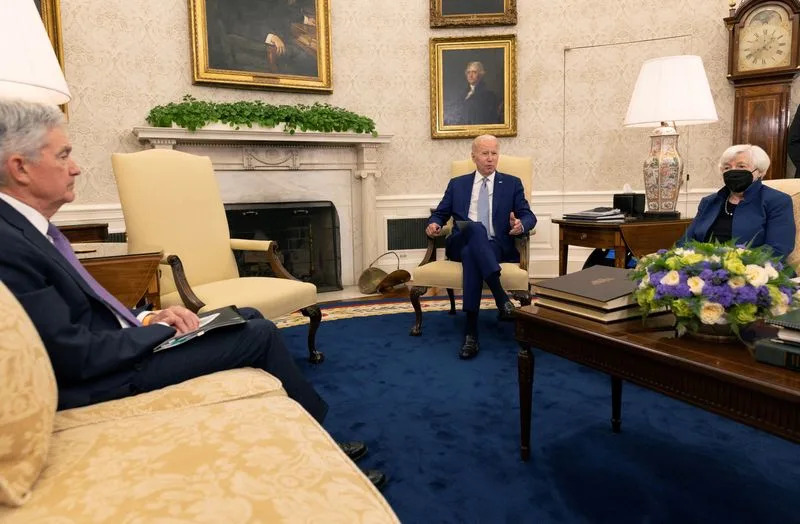
Grocery store in WashingtonU.S. President Biden meets with Fed Chair Powell and Treasury Secretary YellenThe U.S. Federal Reserve building in Washington, D.C.
WASHINGTON (Reuters) – U.S. Federal Reserve Chair Jerome Powell said emphatically last week that people “hate inflation, hate it,” but he left another fact unspoken – they also punish the politicians in charge when prices rise.
The central bank’s quest for a “soft landing” of more slowly rising prices and continued economic growth looks increasingly probable. In fact, the U.S. may hit a sweet spot just as the 2024 presidential election campaign crescendos next year.
It’s the sort of benign outcome that academic studies and high-ranking economists had called virtually impossible after inflation hit 40-year highs in June of 2022. Some warned that millions of workers might need to be rendered jobless to reduce the pace of price increases in a flashback to the central banking experience of the 1970s.
Rather than cheering, though, after years of economic turbulence since the coronavirus pandemic erupted in 2020, Americans grumble, at least if you ask them about the economy.
More than 40% of U.S. voters who backed Joe Biden in the 2020 presidential election say they think the economy is worse off than it was then, a Reuters/Ipsos poll published last month found.
The front-runner for the Republican presidential nomination, former President Donald Trump, faces a string of criminal indictments related to his attempts to overturn the 2020 election. Still, several recent polls show him tied with Biden in a hypothetical 2024 matchup.
That’s because things on the ground don’t feel as good as the positive inflation trend would indicate. With fast rising prices and the end of an array of pandemic-era government benefit programs, inflation-adjusted household income fell last year, and the poverty rate increased.
Borrowing costs also have risen sharply in the past 18 months as the Fed ratcheted up interest rates to tame the surge in inflation, adding to consumers’ sour mood.
Past presidential elections have often seemed to turn on pocketbook issues. High inflation and a Fed-induced recession hampered President Jimmy Carter’s 1980 reelection campaign against Republican candidate Ronald Reagan; President George H. W. Bush was hobbled by rising unemployment, a spike in prices, and a recession in his 1992 bid for a second term against Democrat Bill Clinton, the race in which a Clinton adviser famously framed campaign strategy around “the economy, stupid.”
The Biden administration has worked to lower costs by releasing stores of the country’s strategic petroleum stockpile, pushing down health insurance premiums, negotiating the cost of common prescription drugs, and trying to end monopolies in meat processing and battling “junk” fees paid by consumers.
They’ve also touted hundreds of billions of dollars in infrastructure investments during Biden’s term as increasing the capacity of the U.S. economy going forward by easing supply chain constraints. Critics say that spending and the associated deficits may actually be fueling higher prices.
A Biden adviser said the White House understands that the economy and inflation are a critical issue, and the campaign has a big media push planned on “Bidenomics.” The adviser added that many voters see threats to democracy and their rights as vital, too, and the strong performance of Democrats in the midterm elections last year shows that.
‘MORAL INDIGNATION’
Analysts, economists and the media closely track the main inflation gauge, the U.S. Consumer Price Index, for its monthly window on how much prices have risen from a month or a year ago.
In the 12 months through August, the CPI accelerated 3.7%, a sharp drop from its peak of 9.1% in June of 2022.
But that’s not what voters care about. Even as the pace of price hikes recedes, the sticker shock from previous increases remains. Just because inflation falls, in other words, it doesn’t mean prices fall back to where they were – only that they are growing less quickly.
Anyone in a grocery store is less likely to appreciate that meat, poultry, fish and eggs are slightly less expensive now than they were at the start of the year – inflation among those goods was negative for several months – than to grimace at the fact that those core sources of protein still cost about 24% more than they did on the eve of the pandemic in early 2020.
In a mid-1990s survey, Yale University economics professor and Nobel Prize winner Robert Shiller found that inflation associated with no less than “a tone of moral indignation.”
“People tell of businesses trying too hard to pursue profits, the Fed behaving stupidly, people trying to live above their means, or politicians trying too hard to get reelected,” Shiller wrote.
In another telling survey in the summer of 2022, management consulting firm McKinsey & Company found that the onset of inflation had promptly doubled the percentage of respondents seen in previous polls who felt pessimistic about the economy – dwarfing the numbers seen even at the depths of a pandemic that would go on to kill 1.1 million people in the U.S. and throw the economy into chaos.
“Now that inflation has accelerated to its highest rate in four decades, the mood has turned darker,” the McKinsey study said.
The headline to the American Psychological Association’s “Stress in America 2022” report from October of last year was headlined “Concerned for the future, beset by inflation.”
How could paying more at the grocery store or the gas station compare with a mass catastrophe like the pandemic?
In the latter case, a multi-trillion-dollar government safety net had given people a bridge through the initial spike in unemployment and provided a buffer for them to stay away from jobs until they regarded the workplace as safe.
There is no similar buffer from higher prices, a stretched family budget, or an eroding retirement. Inflation is universal and efforts to combat it with things like price controls or subsidies typically don’t work.
Biden promised this month to get gasoline prices down again, a rash vow for any president given the limited impact an administration has on prices at the pump.
The question is how long the inflation scar will last from here, whether the pace of price increases continues to moderate, and whether, as the Fed seems to anticipate, the rest of the economy remains on track.
STILL SPENDING
If it goes according to the central bank’s current expectations, there may even be interest rate cuts thrown into the mix next year, letting Biden test the premise of whether running on a strong economy in an environment of easing credit works as well as running against an economic downturn, financial tightening, and rising prices.
There’s some indication a turn in public sentiment could be in the making even before that happens. The U.S. Census Bureau’s most recent Household Pulse survey, for the two weeks ending Sept. 4, showed that while 80% of respondents were still “somewhat” or “very” concerned about future inflation, the number had fallen from earlier peaks in every state.
As Powell noted last week, there is a schism between what people say in surveys and how they behave.
When asked a question, they are sour.
When left alone, they go shopping.
“It’s a very hot labor market … You’re starting to see real wages are now positive by most metrics … Overall, households are in good shape,” Powell said in his Sept. 20 press conference after the end of the latest Fed policy meeting. “Surveys are a different thing. Surveys are showing dissatisfaction. I think a lot of it is people hate inflation. Hate it. And that causes people to say the economy’s terrible. At the same time they’re spending money. Their behavior is not exactly what you’d expect from the survey.”
(Reporting by Howard Schneider; additional reporting by Trevor Hunnicutt; Editing by Heather Timmons and Paul Simao)
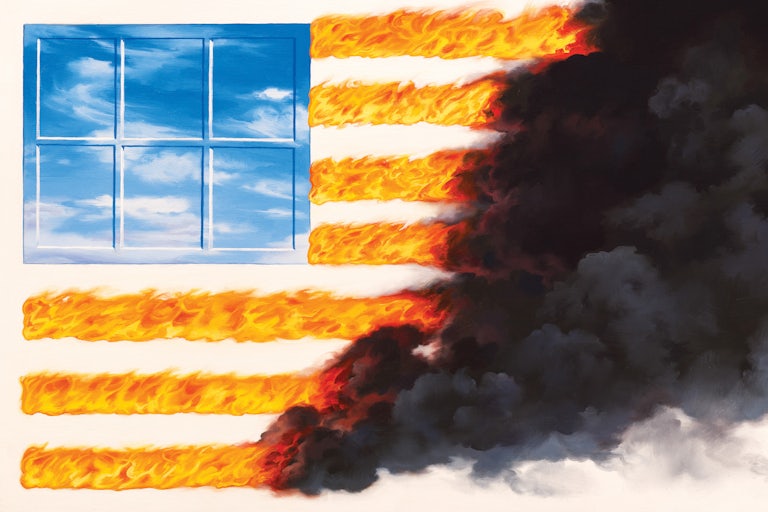
There have always been two Americas. One based in religious zeal, mythology, and inequality; and one grounded in rule of the people and the pursuit of equality. This next election may determine which one prevails.
I.
The Crisis Upon Us
America is at a crossroads.
A country that once stood as the global symbol of democracy has been teetering on the brink of authoritarianism.
How did this happen? Is the fall of democracy in the United States inevitable? And if not, how can we reclaim our democratic principles?
This crisis in American democracy crept up on many of us. For generations of Americans, grainy news footage from World War II showing row upon row of Nazi soldiers goose-stepping in military parades tricked us into thinking that the Adolf Hitlers of the world arrive at the head of giant armies. So long as we didn’t see tanks in our streets, we imagined that democracy was secure. But in fact, Hitler’s rise to absolute power began with his consolidation of political influence to win 36.8 percent of the vote in 1932, which he parlayed into a deal to become German chancellor. The absolute dictatorship came afterward.
Democracies die more often through the ballot box than at gunpoint.
But why would voters give away their power to autocrats who inevitably destroy their livelihoods and sometimes execute their neighbors?
In the aftermath of World War II, scholars invested a great deal of energy in trying to explain how, in the 1930s, ordinary Germans whose constitution was one of the most democratic in the world had been persuaded to stand behind a fascist government whose policies led to the destruction of cities, made millions homeless, and created such a shortage of food that Germans were eking by on less than 1,500 calories a day. That government also ultimately murdered six million Jews and millions more Slavs, Roma, sexual minorities, disabled individuals, and dissenters.
Social scientists noted that the economic and political instability in Germany after World War I was crucial for Hitler’s rise. But it took writers, philosophers, and historians to explain how authoritarians like Hitler harnessed societal instability into their own service.
The key to the rise of authoritarians, they explained, is their use of language and false history.
Authoritarians rise when economic, social, political, or religious change makes members of a formerly powerful group feel as if they have been left behind. Their frustration makes them vulnerable to leaders who promise to make them dominant again. A strongman downplays the real conditions that have created their problems and tells them that the only reason they have been dispossessed is that enemies have cheated them of power.
Such leaders undermine existing power structures, and as they collapse, people previously apathetic about politics turn into activists, not necessarily expecting a better life, but seeing themselves as heroes reclaiming the country. Leaders don’t try to persuade people to support real solutions, but instead reinforce their followers’ fantasy self-image and organize them into a mass movement. Once people internalize their leader’s propaganda, it doesn’t matter when pieces of it are proven to be lies, because it has become central to their identity.
As a strongman becomes more and more destructive, followers’ loyalty only increases. Having begun to treat their perceived enemies badly, they need to believe their victims deserve it. Turning against the leader who inspired such behavior would mean admitting they had been wrong and that they, not their enemies, are evil. This, they cannot do.
Having forged a dedicated following, a strongman warps history to galvanize his base into an authoritarian movement. He insists that his policies—which opponents loathe—simply follow established natural or religious rules his enemies have abandoned. Those rules portray society as based in hierarchies, rather than equality, and make the strongman’s followers better than their opponents. Following those “traditional” rules creates a clear path for a nation and can only lead to a good outcome. Failing to follow them will lead to terrible consequences.
Those studying the rise of authoritarianism after World War II believed these patterns were universal. Yet scholars in the United States noted that while countries around the world were falling to authoritarianism in the 1930s, the United States, sailing between the siren songs of fascism on the one side and communism on the other, had somehow avoided destruction.
This was no small thing. The United States was as rocked as any country by economic trouble and the collapse of authority it revealed and, in the 1930s, it had its own strong fascist movement with prominent spokespeople. Things had gone so far that in February 1939, in honor of President George Washington’s birthday, Nazis held a rally at New York City’s Madison Square Garden. More than twenty thousand people showed up for the “true Americanism” event, held on a stage that featured a huge portrait of Washington in his Continental Army uniform flanked by swastikas.
And yet, just two years later, Americans went to war against fascism. Within six years the United States was leading the defense of democracy around the world, never perfectly—indeed, often quite badly—but it had rejected authoritarianism in favor of the idea that all people are created equal.
Scholars studying the U.S. suggested that Americans were somehow different from those who had fallen to authoritarianism. They were too practical, too moderate, to embrace political extremes. They liked life in the middle.
II.
The Two Warring Visions of Society
It was a lovely thought, but it wasn’t true.
America took a different course in the 1930s not because Americans were immune to authoritarianism, but because they rallied around the language of human self-determination embodied in the Declaration of Independence.
They chose to root the United States not in an imagined heroic past, but in the country’s real history: the constant struggle of all Americans, from all races, ethnicities, genders, and abilities, to make the belief that we are all created equal and that we have a right to have a say in our democracy come true. People in the United States had never lost sight of the promise of democracy because marginalized people had kept it in the forefront of the national experience. From the very first days of the new nation, minorities and women had consistently, persistently, and bravely insisted on their right to equality before the law and to a say in their government.
In the 1930s their insistence translated into a defense of democracy around the world. President Franklin Delano Roosevelt clearly and repeatedly spelled out the difference between a society based on the idea that all people are equal and a society based on the idea that some people are better than others and have a right to rule.
Americans chose a free future by choosing a principled past. But they could have chosen differently.
In the 1930s the struggle between equality and inequality took shape as a fight between democracy and fascism. But while fascism was a newly articulated ideology in that era, the thinking on which it was based—that some people are better than others—had deep roots in the United States. From the nation’s beginning, the Founders’ embrace of equality depended on keeping women, Black Americans, and other people of color unequal.
That paradox had in it the potential for the rhetoric that authoritarians use, and in the past, those determined to undermine democracy have indeed gone down that road. Whenever it looked as if marginalized people might get an equal voice, designing political leaders told white men that their own rights were under attack. Soon, they warned, minorities and women would take over and push them aside.
Elite enslavers had done this in the 1850s and had come close to taking over the country. “We do not agree with the authors of the Declaration of Independence, that governments ‘derive their just powers from the consent of the governed,’” enslaver George Fitzhugh of Virginia wrote in 1857. “All governments must originate in force, and be continued by force.” There were 18,000 people in his county and only 1,200 could vote, he said, “but we twelve hundred … never asked and never intend to ask the consent of the sixteen thousand eight hundred whom we govern.”
During the Civil War, the majority of Americans worked to defeat the enslavers’ new definition of the United States. But the thinking behind the Confederacy—that people are inherently unequal and some should rule the rest—persisted.
During the Civil War, the majority of Americans worked to defeat the enslavers’ new definition of the United States. Their victory on the battlefields made them think they had made sure that “government of the people, by the people, for the people, shall not perish from the earth.”
But the thinking behind the Confederacy—that people are inherently unequal and some should rule the rest—persisted.
That thinking has once again brought us to a crisis. In the years after 1980, a political minority took over Congress, the state legislatures, the courts, and the Electoral College, and by 2016 the Economist Intelligence Unit had downgraded the U.S. from a “full democracy” to a “flawed democracy.” By 2021, warnings had become more dire. Freedom House, a nonprofit that charts the health of democracies internationally, “urgently” called for reforms after a decade in which “US democracy has declined significantly.”
The election and then the presidency of Donald Trump hastened that decline. When the nation’s rising oligarchy met a budding authoritarian, the Republican Party embraced the opportunity to abandon democracy with surprising ease. In the four years of Trump’s presidency, his base began to look much like the one post–World War II scholars had identified: previously apathetic citizens turned into a movement based in heroic personal identity. Trump discarded the idea of equality before the law and scoffed at the notion that Americans had the right to choose their government. He and his followers embraced the false past of the Confederates and insisted they were simply trying to follow the nation’s traditional principles. Eventually, they tried to overturn the results of the 2020 presidential election to stay in power. And even after Trump had tried to undermine the principle of self-government on which the United States was founded, his followers stayed loyal.
Those justifying their embrace of authoritarianism as the future of government in the twenty-first century say that democracy is obsolete. Some argue that popular government responds too slowly to the rapid pace of the modern world and that strong countries need a leader who can make fast decisions without trying to create a consensus among the people.
Critics of liberal democracy say that its focus on individual rights undermines the traditional values that hold societies together, values like religion and ethnic or racial similarities. Religious extremists have tried to tie their destruction of democracy into our history by insisting that the Founders believed that citizens must be virtuous, and that religion alone can create virtue. By this line of thought, imposing religious values on our country is exactly what the Founders intended.
I don’t buy it.
The concept that humans have the right to determine their own fate remains as true today as it was when the Founders put that statement into the Declaration of Independence, a statement so radical that even they did not understand its full implications. It is as true today as it was when FDR and the United States stood firm on it. With today’s increasingly connected global world, that concept is even more important now than it was when our Founders declared that no one had an inherent right to rule over anyone else, that we are all created equal, and that we have a right to consent to our government.
III.
Reclaiming Our Country
When Americans elected Democratic President Joe Biden in 2020, he made it clear that he intended to defend American democracy from rising authoritarianism. Throughout his campaign, he focused on bringing people in the center-right and center-left together, just as scholars of authoritarianism have called for. Biden ignored Trump and pledged to work with Republicans who believe in “the rule of law and not the rule of a single man.”
On January 6, 2022, the one-year anniversary of the attack on the U.S. Capitol and on the right of Americans to choose their leaders, Biden explicitly defended traditional American values.
“Those who stormed this Capitol and those who instigated and incited and those who called on them to do so” acted “not in service of America, but rather in service of one man” who “has created and spread a web of lies about the 2020 election … because he values power over principle, because he sees his own interests as more important than his country’s interests and America’s interests, and because his bruised ego matters more to him than our democracy or our Constitution,” Biden told the American people. He urged Americans not to succumb to autocracy, but to come together to defend our democracy, “to keep the promise of America alive,” and to protect what we stand for: “the right to vote, the right to govern ourselves, the right to determine our own destiny.”
Once sworn into office, Biden set out to demonstrate that the government could work for ordinary people. In his first two years in office, with a slender majority in the House of Representatives and a Senate split 50–50, the Democrats managed to pass historic legislation that echoed that of FDR and LBJ, shoring up the economy, rebuilding the country’s infrastructure, and investing in the future, trying to bring the disaffected Americans who had given up on democracy back into the fold. Biden’s domestic program expanded liberalism to meet the civil rights demands of our time just as Abraham Lincoln, Theodore Roosevelt, FDR, and LBJ had each expanded liberalism to meet the challenges of westward expansion, industrialization, globalization, and anti-colonialism.
Biden knew that defending democracy at home meant strengthening it internationally. In his first speech to the State Department, on February 4, 2021, he emphasized that once again, “America’s most cherished democratic values” would be at the center of American diplomacy: “defending freedom, championing opportunity, upholding universal rights, respecting the rule of law, and treating every person with dignity.”
The power of that defense became clear in February 2022, when Vladimir Putin launched a new invasion of Ukraine. Putin was stymied by Ukraine’s soldiers, who had trained hard in the eight years since the first Russian invasion, and by an international community that refused to recognize Russia’s land grab, imposed strict and coordinated sanctions, and provided Ukraine with money, intelligence, and weapons. This community stood together in no small part thanks to Biden and Secretary of State Antony J. Blinken, and the strength in that cooperation discredited the argument that autocracy was more efficient and powerful than democracy.
But despite the emerging defense of democracy, Trumpism did not die. Trump and his loyalists continued to insist he had won the 2020 election, while extremists like newly elected Georgia Representative Marjorie Taylor Greene, who has endorsed the idea that some Democratic politicians should be executed, told a right-wing newspaper that there was no difference between establishment Republicans and Democrats. She said she was eager to bring more action-oriented people like her to Congress to help Trump with his plan, “whenever he comes out with [it].”
Establishment leaders swung behind the Trump faction, especially after June 2022, when the Supreme Court, packed by then–Senate Majority Leader Mitch McConnell with three extremist judges, ignored the precedent they had promised to respect and overturned the 1973 Roe v. Wade decision legalizing abortion.
Republican leaders went on to challenge many of the court decisions protecting the liberal consensus government in place since the 1930s. If the Fourteenth Amendment did not protect abortion, the other civil rights it protected were on the table, including gay marriage, the right to contraception, and perhaps even desegregation. Also on the table was the government regulation of business.
Meanwhile, Trump’s political star had begun to fall as his legal and financial troubles mounted in the years after the election. But he had radicalized the Republican Party, and Republican governors competed to pick up his voters. Unlike Trump in 2016, though, they made no pretense of embracing the Reagan Republican ideology of free markets: Florida Governor Ron DeSantis, for instance, openly used the power of his office to reward political friends and punish those he perceived as his enemies and to manufacture anti-immigrant and anti-LGBTQ sentiment, much as Putin and Viktor Orbán had done before him. Right-wing thinkers began to argue openly that democracy and its values—equality before the law, separation of church and state, an independent press, academic freedom, and free markets—have undermined the human virtue of the past and must be stamped out.
Crucially, those efforts depended on maintaining the right-wing myth that American history was rooted in a pure past that their opponents were destroying. Early in Biden’s term, Republican operatives manufactured outrage over the alleged teaching of critical race theory in public schools. That legal theory, designed to explain why the laws of the 1960s hadn’t created the equality they promised, was an upper-level law school elective that had never actually been taught in public schools. Republican-dominated legislatures passed laws forbidding teachers from teaching “CRT” or any lesson suggesting that the American system might ever have had systemic inequalities, or even lessons that might make some people—by which they meant white people—uncomfortable. Hand in hand with that censorship went a surge in book banning from the public schools and from some public libraries, with most of the banned books written by or about Black or LGBTQ people.
A history that looks back to a mythologized past as the country’s perfect time is a key tool of authoritarians. It allows them to characterize anyone who opposes them as an enemy of the country’s great destiny.
But the true history of American democracy is that it is never finished. It is the story of people who have honored the idea that a nation can be based not in land or religion or race or hierarchies, but rather in the concept of human equality.
But the true history of American democracy is that it is never finished. It is the story of people who have honored the idea that a nation can be based not in land or religion or race or hierarchies, but rather in the concept of human equality. That commitment, along with its corollary—that we have a right to consent to our government, which in turn should act in our interest—has brought us our powerful history of people working and sacrificing to bring those principles to life. Reclaiming our history of noble struggle reworks the polarizing language that has done us such disservice while it undermines the ideology of authoritarianism.
In 1776, with all their limitations, the Founders proposed that it was possible to create a nation based not in religion or race or hierarchies of wealth or tradition, but in the rule of law. It was possible, at least in principle, they thought, to bring widely different peoples together in a system in which every person was equal before the law and entitled to a voice in government. They set out to show that it could be done.
That theory was never unchallenged. In the 1850s, a reactionary and wealthy minority tried to get rid of it altogether, insisting that true “democracy” centered power in the state governments that they controlled.
But that story didn’t end as the elite enslavers wished.
Men like Abraham Lincoln recognized that such a struggle was not just about who got elected to the White House. It was the story of humanity, “the eternal struggle between these two principles—right and wrong—throughout the world.” Lincoln made it clear that those who wanted the right to self-determination had always had to struggle—and would always have to struggle—against those who wanted power. “The one is the common right of humanity and the other the divine right of kings. It is the same principle in whatever shape it develops itself,” he said. “No matter in what shape it comes, whether from the mouth of a king who seeks to bestride the people of his own nation and live by the fruit of their labor, or from one race of men as an apology for enslaving another race, it is the same tyrannical principle.”
When Lincoln said those words in 1858, it was not at all clear his vision would prevail. But he had hope because, after decades in which they had not noticed what the powerful were doing to destroy democracy, Americans had woken up. They realized that the very nature of America was under attack. They were divided among themselves, and at first they didn’t really know how to fight back, but ordinary people quickly came to pitch in however they could, using the tools they had. “We rose each fighting, grasping whatever he could first reach—a scythe—a pitchfork—a chopping axe, or a butcher’s cleaver,” Lincoln recalled. Once awake, they found the strength of their majority.
In Lincoln’s era, democracy appeared to have won. But the Americans of Lincoln’s time did not root out the hierarchical strand of our history, leaving it there for other rising autocrats in the future to exploit with their rhetoric and the fears of their followers.
So far, the hopes of our Founders have never been proven fully right. And yet they have not been proven entirely wrong.
Once again, we are at a time of testing.
How it comes out rests, as it always has, in our own hands.
This excerpt has been edited for length and clarity.
Heather Cox Richardson is professor of history at Boston College and an expert on American political and economic history. The author of seven books, she also writes “Letters From an American,” a daily chronicle of American politics.
Toxic red tide algae, last seen in 2018, returns to Texas coast
Alejandra Martinez – September 25, 2023
Red tide visible in the water near South Padre Island in October 2009. The state has detected red tide in Texas coastal waters for the first time since 2018. Credit: Courtesy of TPWD
Toxic algae blooms known as red tide have been detected in multiple sections of the Texas Gulf Coast including the upper coast around Galveston Bay and the lower Laguna Madre in the Rio Grande Valley, the Texas Parks and Wildlife Department said.
It’s the first time Texas has seen a red tide since 2018, when it affected the upper and middle parts of the state’s coast.
Red tide typically starts in late summer or early fall. Parks and Wildlife officials first noticed it in Freeport, south of Houston, on Sept. 3.
The state agency estimates that at least two fish kills have been associated with red tide, one on Surfside-Quintana beaches near Freeport and another between Sargent Beach and Matagorda Beach last week.
Red tide is caused when colonies of microalgae rapidly grow and produce toxins that can make people, fish and other sea creatures sick. When red tide algae, which occur naturally in the Gulf’s waters, reproduce in mass quantities in one location, they form “blooms,” which are visible as discolored patches of water often reddish in color.
People who swim in water with a high concentration of red tide can experience eye, nose and throat irritation, as well as coughing, wheezing, and shortness of breath. The toxins can become airborne and people can breathe them in. Red tide also releases a toxin that can affect the central nervous system of fish, paralyzing them so they cannot breathe. This often leads to dead fish washing up on Gulf beaches — especially in Florida, where it happens nearly every summer.
Red tides in Texas happen less often and don’t last very long, according to the National Oceanic and Atmospheric Administration.
TPWD said their staff is keeping an eye on the situation and working with other groups including NOAA to monitor beach conditions.
Lerrin Johnson, a TPWD spokesperson, said it’s difficult to predict how long the red tide will last in Texas, adding that long periods without rainfall, like most of Texas has experienced this year, can drive algal blooms and, specifically, red tide.
The agency suspects the red tide near Freeport and Galveston Bay might have caused fish to die in places like San Luis Pass and Surfside Beach and Quintana Beach.
The Brazoria County parks department said staff checking beach conditions reported respiratory symptoms caused by discolored water and scattered dead fish at Quintana Beach and Follet’s Island Beach. County officials are asking people to stay off beaches for safety.
Red tide has also been detected in the lower Laguna Madre area at Good Hope Circle Beach and the Gulf Beach in Cameron County.
Disclosure: Texas Parks And Wildlife Department has been a financial supporter of The Texas Tribune, a nonprofit, nonpartisan news organization that is funded in part by donations from members, foundations and corporate sponsors. Financial supporters play no role in the Tribune’s journalism. Find a complete list of them here.
Leanne Hainsby Commemorates a Year Since Chemo Started: ‘I Was So Frightened’
Cara Lynn Shultz – September 25, 2023
The Peloton instructor looks back one year after beginning chemotherapy for breast cancer
Leanne Hainsby/InstagramLeanne Hainsby.
Leanne Hainsby celebrates the one-year anniversary of when she started chemotherapy
The Peloton instructor was “trying my best to be brave” during breast cancer struggle
She’s turning her attention to charity work, and says she wants to ”make a difference”
A year after starting the chemotherapy treatments that saved her life, Leanne Hainsby is looking back and feeling “lucky.”
“On this day last year, I started chemotherapy,” the popular British Peloton instructor wrote on Instagram. She had been diagnosed with breast cancer when she was just 35 years old last August.
“I was so frightened, unsure of it all, totally overwhelmed and trying my best to be brave, and accepting,” Hainsby, now 36, wrote.
Hainsby — who continued to teach continued to teach 3-4 Peloton classes a week to unknowing members while undergoing 12 weeks of chemo — announced that she’s teamed up with a charity initiative aimed at early diagnosis of breast cancer.
Never miss a story — sign up for PEOPLE’s free daily newsletter to stay up-to-date on the best of what PEOPLE has to offer, from juicy celebrity news to compelling human interest stories.
“Today, I had the privilege of announcing an event I am hosting (that sold out within minutes 🥹), which is aimed at raising awareness and money for @coppafeelpeople – a charity that [will] educate, encourage and empower people (especially young people) to ensure breast cancer is diagnosed early and correctly.”
“I feel SO lucky to be well, and proud for this moment. It’s taken a lot to get here, and I’m really ready to hopefully make a difference x.”
Hainsby’s health struggle began during an emotional time in her life, as “two days before my best friend’s funeral, I found a lump in my breast,” she captioned a series of Instagram photos of herself in a hospital bed last year.
“That really is a sentence I NEVER imagined writing.”
After first being dismissed by a doctor who said she was fine, she went on to consult another physician and was diagnosed with breast cancer in August 2022.
“I trusted my gut and got a second opinion,” she wrote. “That saved my life. Check, and check again.”
She said she was inspired to give up alcohol after her cancer diagnosis.
“At first, it was to ensure that I was as healthy as possible “ during treatment, she wrote on Instagram. “Then it quickly turned into the best decision I made for myself, because everything everyone says about stopping drinking, for me, continues to be true.”
While she said that her mental clarity and productivity improved, “I think my initial reason for stopping drinking was definitely more intense than it would be for most. Deep in the VERY early stages of traumatic grief, and shock, drinking too much to try and numb an ounce of the pain in any way possible, and then diagnosed with cancer a few weeks later, it could have been a recipe for disaster.”
But instead, Hainsby said, “I chose to sit with the feelings, as brutal and relentless as they have been.”
And while “we all have our own definition of fun,” Hainsby wrote, “I’m just redefining mine.”
Florida’s coastal homes may lose value as climate-fueled storms intensify insurance risk
Kate Cimini, USA TODAY- Florida – September 25, 2023
Climate-fueled disasters like Hurricane Ian are wreaking havoc on home values across the nation, but Florida’s messy insurance market makes it one of the most stressed, new research out of a nonprofit climate modeling group indicates.
High insurance premiums and a state-backed requirement that homeowners covered by the state-backed insurer of last resort enroll in the National Flood Insurance Program over the next three years could drop home values up to 40% in Florida in the next 30 years, data provided by First Street Foundation shows. And climate and insurance experts say that may further gentrify Florida’s coastal regions and barrier islands.
Using what First Street representatives described as a typical institutional-investing calculation, First Street Foundation found some homes, adjusting for 2023 insurance costs, have already lost up to 19% of their value.
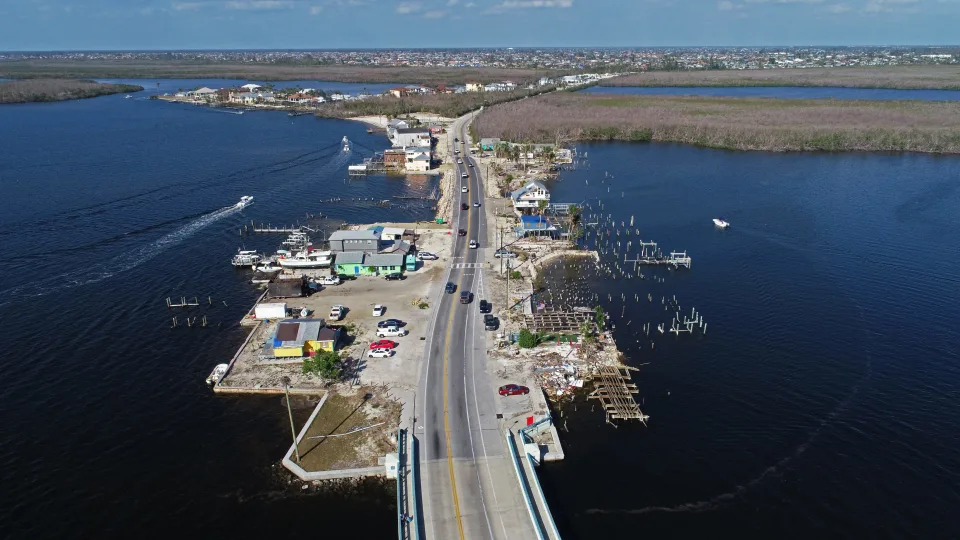
The News-Press reported earlier this month on middle-class families being forced off Fort Myers Beach due to the rising costs associated with living on a barrier island in a time of stronger storms, including more stringent, expensive building requirements and a high demand for Beach property.
Experts say this trend will likely continue in coastal communities as high-income buyers who can afford to go without insurance rebuild and repair out of pocket. They say it will take a concerted effort among state and federal officials, as well as insurance and reinsurance companies to avoid climate-spurred migration and subsequent gentrification of Florida’s coast.
Do property values go down after a hurricane in Florida?
Geographer Zac Taylor, a professor with the Delft University of Technology in Norway, studies the connection between climate change and the insurance industry in Florida. Taylor uses they/them pronouns.
They urged caution in reassessing home values but agreed that this was a possible outcome based on current climate models.
Some of Florida’s more vulnerable coastline may even see corporations purchasing homes with the intent to rent them out, Taylor said, though real estate investor purchases of single-family homes dropped 45% in the second quarter of 2023, compared to a year ago, per realty company Redfin.
Soon, “only wealthy people will be able to afford to remain in coastal areas,” said Taylor.
What areas are being gentrified in Florida?
Gentrification of Florida’s coastline may have already begun in areas hardest-hit by Ian.
This is likely to continue as a number of factors drive up the costs associated with living along the Sunshine State’s coast thanks to sea level rise, a 2022 study out of Florida State University predicted.
“Eventually, people are likely to start moving inland from coastal areas as the costs of staying become too great,” the report reads. “Those that are further inland are more likely to be displaced by higher income residents who eventually move inland in the process of relocating to higher ground.”
On Pine Island, a community whose year-round residents are largely working-class, people are cutting back their monthly budgets and searching desperately for cheaper insurance after rates rose in response to Hurricane Ian’s devastation of the barrier island. Some are leaving the island after too many problems with insurance, said nonprofit civic group Matlacha Hookers president Joanne Correia.
Guylinda DeMyers and her husband have lived in Pine Island’s St. James City for 20 years, she estimates, but after this most recent hurricane, she said they plan to sell their home and leave for safer climes − once their insurance company pays their claim.
They’ve yet to see a penny of their claim from People’s Trust, she said, even though it’s been almost a year. In fact, it’s been so long, their policy has expired. They haven’t pursued a new one because “there’s nothing to insure,” DeMeyers said. “It’s broken.”
She doesn’t think they’ll get what the home was worth before the storm, but says her realtor has told her the property itself – an ocean-front lot ‒ is valuable enough by itself.
But DeMeyers is determined to see her claim through – if not for her, then for her husband, who has Alzheimer’s. She’s lived through three major hurricanes and subsequent rising insurance costs.
“It’s not safe here anymore,” DeMeyers said. “We need a stable place.”
On Fort Myers Beach, another one of Florida’s vulnerable barrier islands, coastal gentrification is already underway. Renters and low-income homeowners are finding there’s nothing in their budget on the island anymore. The island is home to just 5,700 residents year-round, and the loss of even a few is significant.
“I feel like I’ve lost my community,” former Fort Myers Beach resident Cheri Warren told Chad Gillis of The News-Press in early September. Warren’s one-story home was destroyed during Hurricane Ian; now, she and her husband found it was too costly to repair it and have left the barrier island for the mainland. They plan to sell their lot at a later date, when the market has stabilized.
Has home insurance gone up in Florida?
For its new study, released in September, First Street Foundation founder and CEO Matthew Eby said the nonprofit, like institutional investors, calculated home values by dividing the amount of what a property would rent for over the course of a year, minus operating costs (which includes insurance costs), by 5%, an average risk amount.
While most homeowners look at the prices their neighbors homes are selling for in order to figure out how much theirs could be worth, this approach can take a while to show fluctuations in real home value, said First Street Foundation’s head of climate implications Jeremy Porter. Institutional investors use a standard calculation that First Street Foundation employed to “take the uncertainty out of the equation,” he said.
But with the cost of insurance rising due to both inflation and natural disasters like hurricanes and fires, risks increase as well. That means that operating costs have increased, particularly for Floridians who have no option for insurance other than state-created nonprofit Citizens Property Insurance Corporation. Citizens was created to insure homes that all other carriers refused to insure − the riskiest properties.
Not only is Citizens often more expensive than other carriers, as state law allows them to charge an actuarially-sound amount, but Florida legislators recently passed a law requiring homeowners who get their insurance through Citizens also enroll their homes in the National Flood Insurance Program, a federal insurance program.
That increases a homeowner’s operating costs even further.
“When … you don’t have anywhere else to go and you are beholden to whatever increase in prices that they just decide to put on you, there’s no way out,” Eby said.
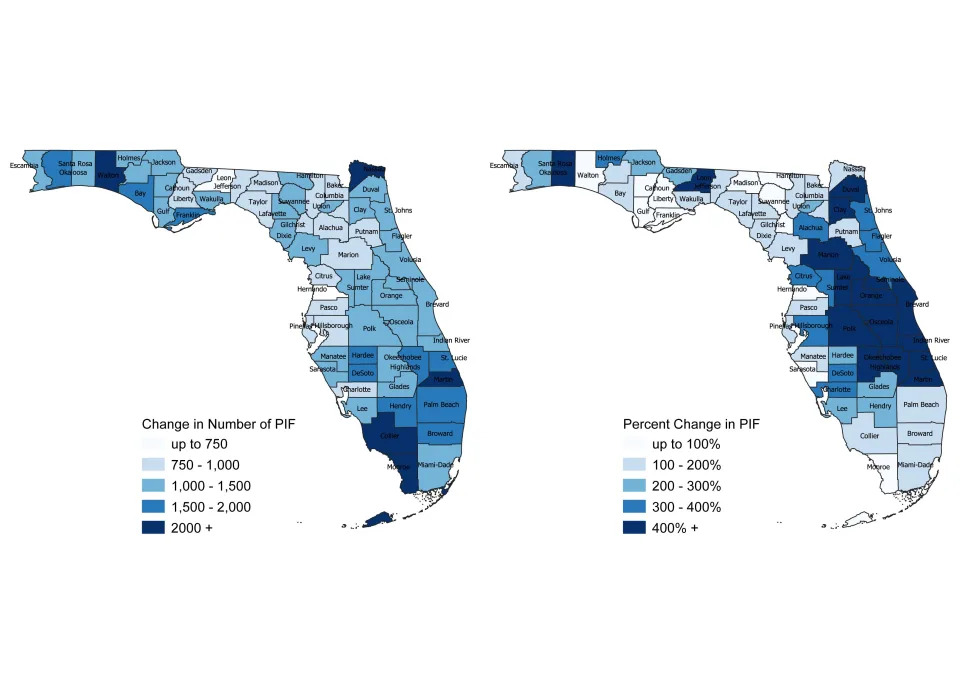
Since 2017, Citizens’ number of policies have increased 168%, while the average premium has also increased from roughly $2,000 to more than $3,000 annually.
Citizens spokesman Michael Peltier said Citizens is held to a policy premium increase of 12% annually, and increases are subject to state approval.
Although California and Louisiana are facing rocketing insurance costs as well, according to First Street Foundation’s data, Eby said, “Florida has the biggest problem.”
The nonprofit examined the number of policies Citizens holds in Florida going back to 2017, when Citizens held roughly 500,000 policies. Eby noted that increased over time, and dramatically grew in 2021 as private insurance companies began to pull out of the state. After Ian, it shot up once again.
Citizens currently holds 1.5 million policies in force, and, Peltier said, expects that to increase to 1.7 million by the end of 2023.
“The major insurance companies have all been pulling out of Florida, leaving Citizens the largest insurer in the state,” said Eby. “The insurance company of last resort, the very last one that you want to go to for your insurance, is now the insurer for the entire state.”
Rising homeowners’ insurance bill have yet to translate that to loss of equity, Porter said.
“When you go to sell it, that’s when the property devaluation becomes realized – at the closing table,” Porter said. But even those who hang on to their homes may feel it the next time Florida gets hit by another major weather event like Ian, he cautioned.
Then, he said, taxpayers will be the ones hurting.
“At some point, the amount of exposure on Citizens is too much, relative to its premiums,” said Porter. “If it’s not accounted for properly there has to be some kind of a subsidy from Florida taxpayers one way or another.”
Eventually, Porter predicted, “the state of Florida is going to have to ask the federal government for a bailout if they if they end up getting hit by a disaster that empties the coffers.”
According to Peltier, Citizens has a number of backstops to keep itself solvent. First, he said, if the state-created nonprofit goes through its premium-driven surplus, like all other insurers in the state it has access to the Florida hurricane catastrophe fund. It also purchases reinsurance to cover the possibility that the catastrophe fund is exhausted. Finally, Peltier said, Citizens is required by law to levy assessments on policyholders to make up any deficits.
Not your grandfather’s black lung: Federal rule seeks to save coal miners from silica dust
Eduardo Cuevas, USA TODAY – September 25, 2023
Workers may get respite from breathing the toxic dust that remains omnipresent in U.S. mining operations, despite decades of evidence of its deadly consequences.
The federal Mine Safety and Health Administration has proposed cutting by half the level at which miners may be exposed to silica dust stirred up during drilling for coal and other ores. The new regulations align with exposure limits already in place in other job sectors. The fine dust, crystalline silica, is a primary driver for harmful respiratory illnesses known as pneumoconioses, with symptoms that include scarring in the lungs and restricted lung capacity. There is no cure for these diseases.
Growing evidence indicates that silica dust contributes to black lung disease, or coal workers’ pneumoconiosis, as well as its more deadly form, progressive massive fibrosis.
“Silica is actually quite toxic dust,” said Dr. Leonard Go, an assistant professor at the University of Illinois Chicago’s School of Public Health, who has studied silica’s effects on miners. Despite silica being common in the earth’s crust, he said, “This is bad stuff, and it can cause quite severe disease. It’s clear that, in the case of coal mining, the current regulation is not effective in preventing disease.”
What the rule does
The federal rule would drastically limit silica dust permissible in mining to just 50 micrograms per cubic meter, with an action level at 25 micrograms, for an eight-hour workday. That’s the equivalent of a tiny, short strand of hair appearing once a day, in fine dust form, within the space of a cardboard box, Go estimated.
Notably, the rule would also require, for the first time, that workers mining metal, nonmetal, stone, sand and gravel receive early and ongoing health screenings at no cost. Coal miners have had mandatory on-site screenings, check ups and X-rays since Congress passed the Federal Coal Mine Health and Safety Act of 1969, which established the Coal Workers’ Health Surveillance Program. The public comment period for the new rule ended in mid-September, and a final rule is expected to be issued later this fall.
For years, regulators and labor groups have kept an eye on breathing hazards for coal miners. The new rule will likely benefit coal miners in Central Appalachia, where more than a fifth of long-tenured workers are estimated to have pneumoconiosis. But coal workers now make up a declining share of the workforce, about 55,000 people nationwide, compared with nearly 200,0000 metal, nonmetal, stone, sand and gravel workers, who operate in what has been until now a far less regulated sector.
The harms of silica have been known since at least the 1930s, when the Department of Labor led a campaign to “Stop Silicosis,” a pneumoconiosis associated with inhaling silica dust.
Decades later, in the late ’60s, the federal government began regulating coal dust, prompted by concerns about the prevalence of black lung disease among coal miners. From that period through the 1990s, doctors saw a steep decline in the disease. Now a growing body of evidence shows an increase in silica dust across U.S. mining operations, which has contributed to miners becoming more ill and even exacerbating cases of black lung in recent decades.
Academic experts and regulators attribute the increase in severe black lung in younger workers to thinner coal seams as workers drill through more layers of rock containing silica. At the same time, advances in technology mean workers handle heavier machinery that kicks up more dust than older miners, who often relied on hand tools.
‘Just about all of them did’ get black lung
Former coal miner Leonard Fleming, 81, of Whitesburg, Kentucky, has a severe form of black lung disease. He relies on a myriad of medical devices to help his breathing, including various portable oxygen tanks, a nebulizer that mists liquid and a vest to dislodge mucus. He no longer takes warm showers. He estimates he can take about 20 steps before he has to stop to huff for air.
Fleming’s grandfather and father had black lung. After serving in the Army, Fleming saw its effects as a 24-year-old lab assistant in a coal miners’ hospital, wearing a white lab coat and dress pants, conducting pulmonary function tests. Eventually, he turned to the mines like his family members had before him, for the wages, which supported his late wife, Norma, and their two children, who never worked in the mines.
“Anybody that goes in the mines just assumes they’re not going to get it,” Fleming said, wheezing as he talked. “Just about all of them did.”
Now that he’s retired, Fleming said, he longs to watch the dirt track car racing or baseball games, but his body can’t handle the exertion.
What he’s lived through is now better understood.
Silica’s effects on the body
In a 2022 study in Annals of the American Thoracic, Go and other researchers viewed tissue samples from 85 deceased coal miners born before and after 1930, in many cases from people who lived through the implementation of federal regulations on coal dust levels. The samples indicated that people who’d mined in recent years had higher concentrations of silica in their lungs and endured severe lung disease, often at earlier ages than the previous generations of miners who showed severe disease that tended to be derived from coal dust.
These findings square with the 2020 review of the Coal Workers Health Surveillance Program by the National Institute for Occupational Safety and Health, which showed a resurgence in pneumoconiosis and progressive massive fibrosis, especially in Appalachia.
Dr. Noemi Hall, a research epidemiologist at NIOSH’s Respiratory Health Division in Morgantown, West Virginia, said miners are contracting more severe forms of disease in their 30s and 40s.
Silica dust, she explained, can break down into even smaller pieces and lodge itself permanently in the lungs.
“These miners can’t get rid of it,” she said. “Once it goes in there, it stays in there.”
Inside the lungs, it causes inflammation and scarring that results in a limited capacity to take in oxygen. Symptoms include coughing, fatigue, shortness of breath and chest pain. Workers who develop pneumoconiosis are also at greater risk of issues such as tuberculosis, lung cancer and chronic obstructive pulmonary disease, or COPD.
Decades of inaction
Concerns about silica dust arose long before the 21st century. In fact, in 1974, NIOSH recommended cutting silica dust levels, just five years after the federal law regulating coal and its effects on miners. Labor advocates attribute the delay in addressing the danger to the aggressive lobbying by coal companies and other industries, which centered on denying silica’s harm on the body.
The official consensus seems to have shifted across the industry. Christopher Williamson, assistant secretary for the Mine Safety and Health Administration, said the consensus is that miners should have the same protection as other workers with silica dust. Other occupations, such as construction, where workers are exposed to greater quantities of silica, are already covered under Occupational Safety and Health Administration standards implemented in 2016.
“The timing is right to move forward on it,” Williamson, whose West Virginia family members worked in coal mines and developed black lung, told USA TODAY. “We know that miners need greater levels of protection from exposure to this toxic dust, and that’s why we’ve proposed it.”
What does industry, labor say?
The National Mining Association, which represents mining companies, supports lower silica exposure levels, but it took issue with proposals that called for respirators, or personal protective equipment. The rule under consideration uses respirators as a temporary supplemental measure when silica levels are high.
Paul Krivokuca, vice president for health and safety at the National Mining Association, wrote in final comments there were some “times and places where use of PPE is the best way to protect miners when other measures have proven unable to reduce personal exposure.”
Go, of the University of Illinois Chicago, said he thinks masking against dust is the least effective means of protection, and it can cause communication problems in the workplace. Preventing dust from being in the atmosphere, whether by watering it down or through better ventilation, is safer, he said.
Officials from the United Mine Workers of America told federal regulators they were concerned about enforcement of the rule by mine operators, who are currently expected to conduct sampling of exposure levels but don’t always do so. The union told federal officials in final comment the rule is “vulnerable to being gamed.”
“This would be like each driver on a highway being responsible for reporting their own violations of law,” union President Cecil Roberts said.
“We know that would never work,” he said. “You need a number of things in order to protect miners. You need good laws. You need those laws to be obeyed and, if they’re not obeyed, you need good enforcement.”
At Temple University Medical Center, in Philadelphia, Dr. Jamie Garfield, a professor of thoracic medicine and surgery, sees miners who travel into the city for lung transplant evaluations, at late stages in the disease.
The new rule could reduce that risk, she said.
“Anytime that we can identify a condition that is completely avoidable with better surveillance, oversight and protection,” she said, “that is an opportunity for a major public health triumph.”
Eduardo Cuevas covers health and breaking news for USA TODAY.
This Is the #1 Bad Habit Contributing to Low Energy, According to Primary Care Docs
Beth Ann Mayer – September 25, 2023
You likely recharge your phone’s battery every night. If you have a hybrid, you probably charge your car regularly (and if you don’t, you hit a gas station before your tank hits E).
But if you feel like you’realways running on empty and feel like you could use a charger yourself, you may have what some doctors call “low energy.”
“Low energy is a feeling a patient has when he or she feels tired and fatigued throughout the day,” Dr. Jared Braunstein, DO, board-certified internist with Medical Offices of Manhattan and contributor to LabFinder.com, says.
We all have low-energy days, of course, but experts say chronic bouts are problematic.
“Everyone experiences low energy at some point, but if it starts to impact your life negatively or at inconvenient times, you may need to take a closer look at what’s causing your symptoms,” says Dr. Karla Robinson, MD, a medical editor at GoodRx.
However, primary care physician says that people with low energy often experience it chronically.
“Usually, by the time a person realizes they have low energy, things have not been going well for a while,” says Dr. Howard Pratt, DO, the board-certified Medical Director at Community Health of South Florida, Inc. (CHI) and a psychiatrist.
Sometimes, low energy is a result of health issues like sleep apnea. Other times, Dr. Pratt and other primary care doctors say that habits may also be to blame for low energy, including one in particular.
There are no diagnostic criteria in the DSM-5 for low energy, but doctors say people with low energy often experience hallmark symptoms.
“If you have low energy, you may have trouble feeling refreshed, even when you first wake up,” Dr. Robinson says. “You may find yourself dozing off easily during the day or finding it difficult to concentrate on tasks.”
Low energy is often chronic and persistent.”Typically, this drop in energy is something that has been bothering them for some time,” Dr. Pratt says. “One common indicator is that things that they would have normally been able to do without difficulty in the past have become much more difficult to accomplish.”
What’s the Biggest Habit Contributing to Low Energy?
Dr. Braunstein says poor sleep hygiene, or getting up and going to bed at different times, is the worst energy-zapping habit. Dr. Pratt agrees that poor sleep hygiene is problematic and involves more than unpredictable wake and bedtimes. “[Good sleep hygiene is] about using your bed for sleep only,” Dr. Pratt says.
But Dr. Pratt says people often use screens before bedtime, like TV or phones, which can make falling asleep and staying asleep harder.
But why is poor sleep hygiene so bad for energy levels? Because it can trigger poor sleep. Naturally, you’ll likely feel fatigued if you don’t sleep well—particularly if it’s happening chronically.
“When you don’t get enough restorative sleep, your body and mind don’t have the opportunity to recharge, leading to fatigue,” explains Dr. David Cutler, MD, a board-certified family medicine physician at Providence Saint John’s Health Center in Santa Monica, California.
“Continued poor sleep hygiene is easy to fall into as we are often prone to take our cell phones to bed with us, but it means we never develop a set sleep schedule and can find ourselves trying to make up for lost sleep on weekends, oversleeping or drowsing throughout the day,” Dr. Pratt says.
Lean into your circadian rhythm, or the body’s natural sleep-wake cycle, by having a consistent bedtime including on weekends, Dr. Pratt says.
“If we don’t go to bed at a certain time and wake up at a certain time daily, we are disrupting our sleep cycle,” he says, referring to the body’s circadian rhythm, or natural sleep-wake cycle.
Ditto for technology, especially phones. A 2020 study suggested that people who spent less time on their phones before bed for a month were likelier to experience better quality and longer sleep. Research from 2019 found that people who used their phones before hitting the sack were at a higher risk for poor sleep.
“Scrolling on your phone long after you’ve turned your lights off can make it much more difficult to fall asleep,” Dr. Robinson explains. “Blue light signals your brain to be on, plus you might find it hard to wind down if you’ve been consuming particularly exciting or engaging content.”
Cue the low energy and an unpleasant ripple effect. “Over the long term, this can complicate our performance at work and other activities and can diminish our overall health,” Dr. Pratt says.
In other words, power down your phone before bedtime or recharge it out of arm’s reach so you can also recharge.
Of course, poor sleep hygiene isn’t the only reason why people experience low energy. Here are some other possible reasons:
1. You’re dehydrated
Dr. Braunstein says poor fluid intake can lower blood pressure and flow to the brain. Dr. Pratt agrees drinking up is critical, but avoid trying to get your daily fluid intake in right before bedtime.
“Be sure to drink enough water throughout the day while being mindful that most of this liquid intake isn’t happening right before going to bed, which will likely mean waking up mid-sleep to go to the bathroom,” Dr. Pratt says.
2. Your diet needs work
Dr. Braunstein says skipping meals can lead to low blood sugar, zapping energy in the process. But what you eat matters. “Not consuming enough nutrients can leave you feeling sluggish,” Dr. Cutler says. “Nutrient-rich foods provide the energy your body needs to function optimally. Carbohydrate-rich diets can cause fluctuations in blood sugar, which may result in feeling low energy.”
Dr. Robinson recommends sticking to fruits, vegetables and whole grains high in fiber as often as possible to keep energy flowing and avoid blood sugar spikes and crashes.
3. You’re stressed out
Can’t stop ruminating or staring at the ceiling, thinking about everything that went wrong today and could go awry tomorrow? Not surprisingly, this is probably affecting your energy.
“High levels of stress or chronic anxiety can be mentally and physically draining even when they don’t interfere with sleep,” Dr. Cutler says. “Constant worry and tension can sap your energy over time.”
Another dust advisory starts tonight for Coachella Valley. What to know
City News Service – September 25, 2023
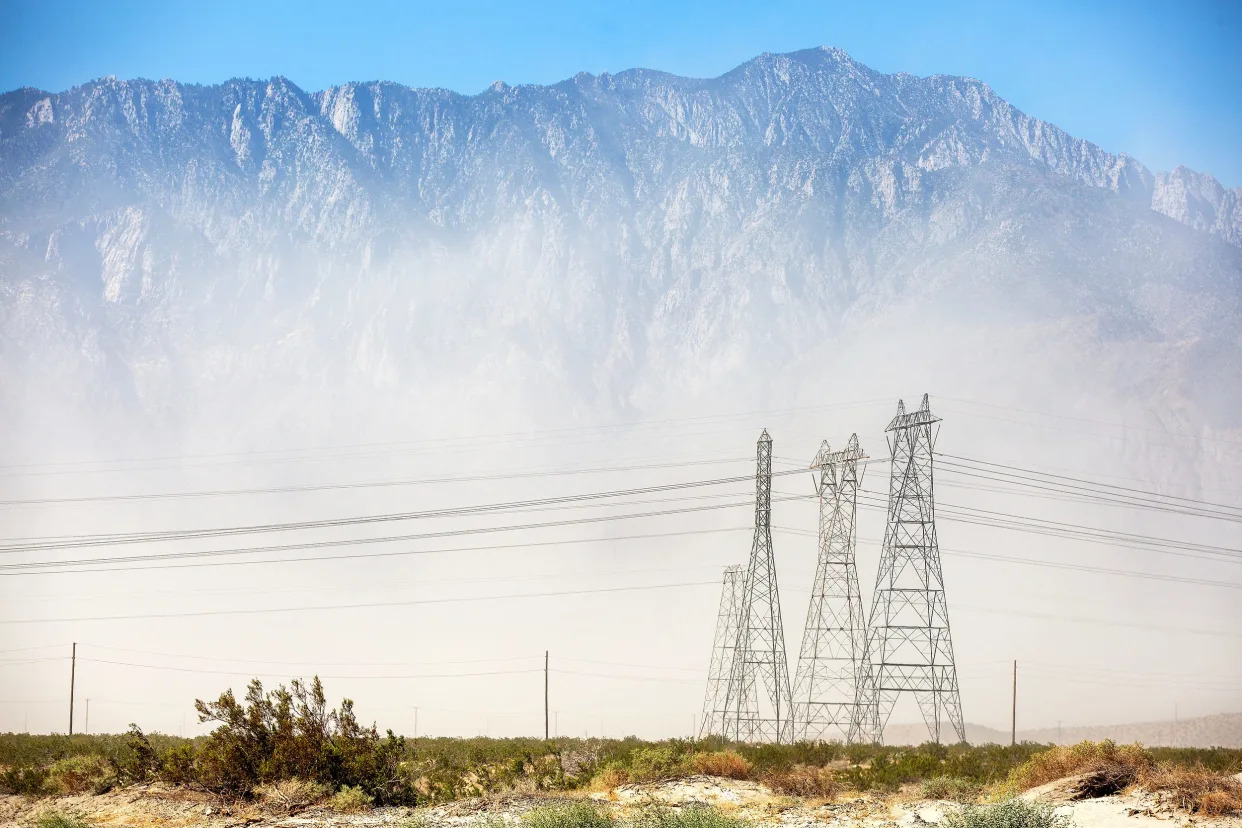
A dust advisory will go into effect Monday and is expected to last until Wednesday for parts of Riverside County, mostly in the Coachella Valley.
The advisory will begin at 6 p.m. Monday and is expected to be in place until 8 a.m. Wednesday, according to the South Coast Air Quality Management District.
Forecasted gusty winds in the Coachella Valley, which can lift dust and soil, can result in air quality index levels that are unhealthy or worse, SCAQMD officials said. The highest levels are expected overnight when winds are expected to be the strongest.
“Elevated levels are resulting from much lower windspeeds than in the past,” SCAQMD officials wrote. “The public is encouraged to pay close attention to the current conditions reported.”
In areas directly impacted by high levels of windblown dust, people were advised to limit their exposure by remaining indoors with windows and doors closed, avoid vigorous physical activity, run their air conditioner or air purifier, and avoid using whole house fans or swamp coolers that bring in outside air.
Officials added that serious health problems can occur as a result of exposure to high-particle pollution levels.
The desert has been plagued with unusually dusty conditions since August when Tropical Storm Hilary caused major flooding that left residual dirt and dust cross the valley.
More information about air quality in the area can be found at aqmd.gov.