FDA tells consumers to stop using eye drops from major brands due to infection risk
Gabe Hauari, USA TODAY – October 30, 2023
The U.S. Food and Drug Administration is advising consumers to stop using some over-the-counter eye drops due to a potential risk of infection that may lead to partial vision loss or blindness.
The agency issued an alert Friday flagging 26 eye care products from CVS Health, Leader (Cardinal Health), Rugby (Cardinal Health), Rite Aid, Target Up&Up and Velocity Pharma.
The FDA recommended the manufacturer of these products to recall all lots on Oct. 25 after investigators found unsanitary conditions in the manufacturing facility and positive bacterial test results from environmental sampling of “critical drug production areas” in the facility, the agency said.
CVS, Rite Aid and Target are removing the products from their store shelves and websites, according to the FDA, while products branded as Leader, Rugby and Velocity may still be available to purchase in stores and online. These products should not be purchased, the agency warned.
The FDA is recalling certain eye drop products due to a risk of infection to consumers.
What should you do if you have used these products?
People who have signs or symptoms of an eye infection after using these products should talk to their health care provider or seek medical care immediately, the FDA says.
The FDA also recommends consumers properly discard these products.
There have been no reports of eye infection associated with these products as of Friday, but the FDA encourages health care professionals and patients to report adverse events or quality problems with any medicine to the agency’s MedWatch Adverse Event Reporting Program.
For a full list of the 26 eye care products the FDA flagged, click here.
Here’s every eye drop and gel being recalled from stores including Target, CVS, and Rite Aid after the FDA warned they could cause blindness
Kim Schewitz – October 30, 2023
The FDA has warned consumers to avoid 26 eye drops and gels that could potentially cause blindness.
Retailers including CVS, Rite Aid, and Target are pulling the products from shelves.
The FDA said to seek medical care if you experience symptoms after using the products.
The FDA has warned consumers to immediately stop using and not buy 26 over-the-counter eye drops and gels that could potentially cause partial vision loss or blindness. Below is a list of all the products the FDA has told their manufacturer to recall.
Agency investigators found unsanitary conditions and bacteria where the products were made, according to a safety alert from the FDA published on Friday, and said they had the potential to cause infections that could result in blindness.
The FDA said on Friday that no adverse reactions had been flagged, but the products could pose “a potential heightened risk of harm” because drugs applied to the eyes bypass some of the body’s natural defenses.
The products were marketed under the brands: Target Up&Up, CVS Health, Rite Aid, Leader (Cardinal Health), Rugby (Cardinal Health), and Velocity Pharma.
Those who have signs or symptoms of an eye infection after using these products should speak to a healthcare provider or seek medical care immediately, the alert said.
Eye drops and gels recalled by the FDA
CVS Health:
Lubricant Eye Drops 15 ml (single pack)
Lubricant Eye Drops 15 ml (twin pack)
Lubricant Gel Drops 15 ml (single pack)
Lubricant Gel Drops 15 ml (twin pack)
Multi-Action Relief Drops 15 ml
Lubricating Gel drops 10 ml
Lubricant Eye Drops 10 ml (single pack)
Lubricant Eye Drops 10 ml (twin pack)
Mild Moderate Lubricating Eye Drops 15 ml (single pack)
Rugby (Cardinal Health):
Lubricating Tears Eye Drops 15 ml
Polyvinyl Alcohol 1.4% Lubricating Eye Drops 15 ml
Leader (Cardinal Health):
Dry Eye Relief 10 ml
Lubricant Eye Drops 15 ml (single pack)
Lubricant Eye Drops 15 ml (twin pack)
Dry Eye Relief 15 ml
Eye Irritation Relief 15 ml
Rite Aid:
Lubricant Eye Drops 15 ml (twin pack)
Lubricant Eye Drops 10 ml (twin pack)
Gentle Lubricant Gel Eye Drops 15 ml
Lubricant Gel Drops 15 ml
Lubricating Gel Drops 10 ml
Multi-Action Relief Drops 15 ml
Target:
Up&Up Dry Eye Relief Lubricant Eye Drops 30 ml
Up&Up Extreme Relief Dry Eye 15 ml (single pack)
Up&Up Extreme Relief Dry Eye 30 ml (twin pack)
Velocity Pharma:
Lubricant Eye Drop 10 ml (triple pack)
CVS, Rite Aid, and Target are pulling the drugs from shelves
CVS, Rite Aid, and Target are removing the products from their shelves and websites after the FDA recommended all batches be recalled on October 25, the alert said.
Products branded as Leader, Rugby, and Velocity may still be available in stores and online, the alert said, but they should not be purchased.
A spokeswoman for Rite Aid said that “due to safety concerns identified by the FDA, we are removing the applicable Rite Aid branded products from our store shelves.”
ACVS spokeswoman told Insider in an email: “We’ve immediately stopped the sale in-store and online of all products supplied by Velocity Pharma within the CVS Health Brand Eye Products portfolio,” and customers can return those products for a full refund.
In a statement, Cardinal Health said: “Immediately upon being notified, we placed all identified impacted eye drop products in our inventory on hold and contacted Velocity Pharma, the supplier of the impacted eye drop products.
“We are in the process of working with Velocity Pharma and FDA to initiate a recall of all impacted Rugby Laboratories and Cardinal Health Leader branded eye drop products to further safeguard public health and safety.”
Target and Velocity Pharma did not immediately respond to Insider’s request for comment.
In February, the Centers for Disease Control and Prevention and FDA warned against two other eye drop products, EzriCare Artificial Tears eye drops and Delsam Pharma’s Artificial Tears. The drugs were recalled over bacteria contamination, which was linked to four deaths and 14 cases of vision loss or eye removal.
Hamas built a massive tunnel network in Gaza. Here’s how Israeli ‘weasel’ forces will fight it
Rick Jervis, USA TODAY – October 30, 2023
As Israeli troops push deeper into Gaza in retaliation for the Oct. 7 Hamas attacks, the ground attack won’t look quite like the door-to-door skirmishes seen in Fallujah, Mosul and other past urban clashes.
Instead, it will happen largely out of sight and underground, deep in a warren of connecting tunnels that Hamas has been digging and lining with concrete for more than a decade. The battle to control and destroy this subterranean labyrinth, estimated at more than 300 miles, will be a key strategy for the Israeli military, according to military analysts and experts – and will make the incursion into Gaza unlike any past urban conflict.
For these “de-tunneling” operations, specialized units code-named Samur – Hebrew for “weasel” – expect to squeeze through the narrow passages and find rocket assembly lines, stores of small arms and mortars and, deeper still, Hamas’ leaders’ lodging and headquarters – much of it probably booby-trapped with homemade bombs. They may also be searching for some of the more than 200 hostages taken from Israel who may be hidden in those same tunnels.
“It’s going to be an undertaking like nothing the (Israeli military) has ever done,” said retired U.S. Army Lt. Gen. Mark Schwartz, who ran U.S. security coordination with both Israel and the Palestinian Authority from 2019 to 2021. “And frankly unlike anything we’ve ever done.”
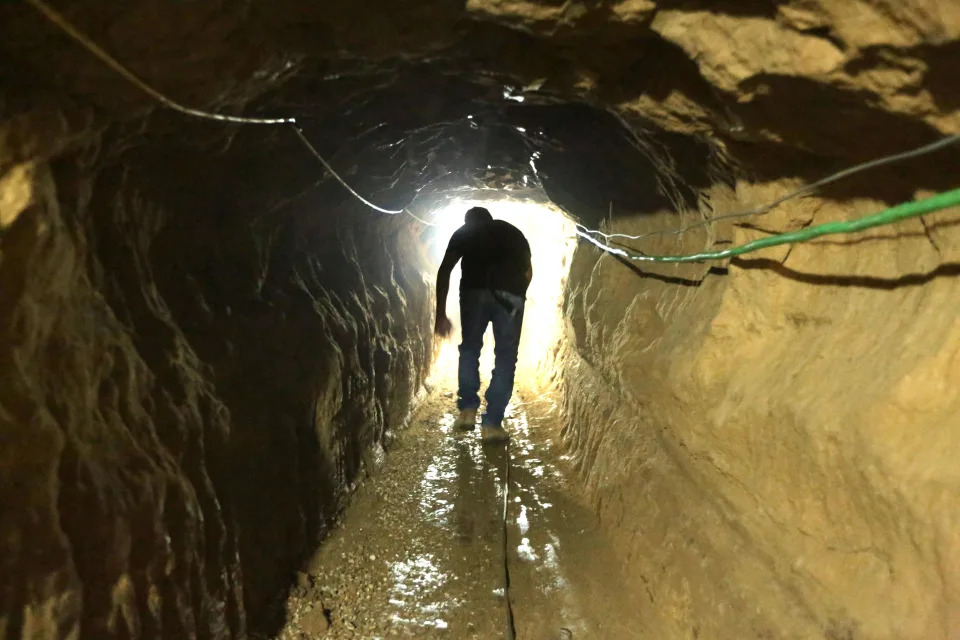
A Palestinian man walks from the Egyptian side of the border in a repaired bombed smuggling tunnel linking the Gaza Strip to Egypt, in Rafah, in this file photo from 2012.
After the Hamas attacks, which killed 1,400 people, Israel unleashed a bombing campaign that has killed more than 8,000 people, most of them civilians, according to the Hamas-run health ministry. Israeli officials have said they are targeting Hamas operatives and infrastructure. The response by Israeli ground troops, now underway by degrees, will bring the next phase of the fight – including the fight for the tunnels.
The Biden administration has sent some of its most seasoned insurgency experts from the war in Iraq and against the Islamic state to advise the Israelis, including three-star Marine Corps Gen. James Glynn, who commanded troops in Fallujah during the Iraq War. In the second battle for Fallujah in November 2004, more than 10,000 U.S. troops went house-to-house clearing the city of 3,000 insurgents in what became the bloodiest battle of the war. Nearly 100 U.S. troops and 2,000 insurgents were killed.
The fight in Gaza may bear some similarities to operations in Fallujah, or in Mosul, where U.S.-backed Iraqi forces flushed Islamic state fighters out of a tunnel network in 2014.
But in Gaza, Israeli forces face more formidable infrastructure and more challenging geography.
Hamas’ tunnel system is more advanced, and its fighters are better trained, more disciplined and better equipped than the Islamic state fighters, said Eitan Shamir, director of the Begin-Sadat Center for Strategic Studies at Bar-Ilan University in Tel Aviv, Israel.
“It’s a major challenge,” Shamir said. “This is a very messy affair.”
And in Gaza – hemmed in by Israel, Egypt and the Mediterranean Sea, which gives civilians nowhere to flee – a ground war is uniquely challenging, said Seth Jones, a military analyst at the Washington-based Center for Strategic and International Studies.
“The intricate nature of the tunnel complex in a densely packed urban environment that is entirely fenced in makes this a fundamentally different – and in many ways more difficult – environment than what U.S. forces had to face in cities like Fallujah or Mosul,” he said. “The possibility of civilian casualties is much greater in Gaza.”
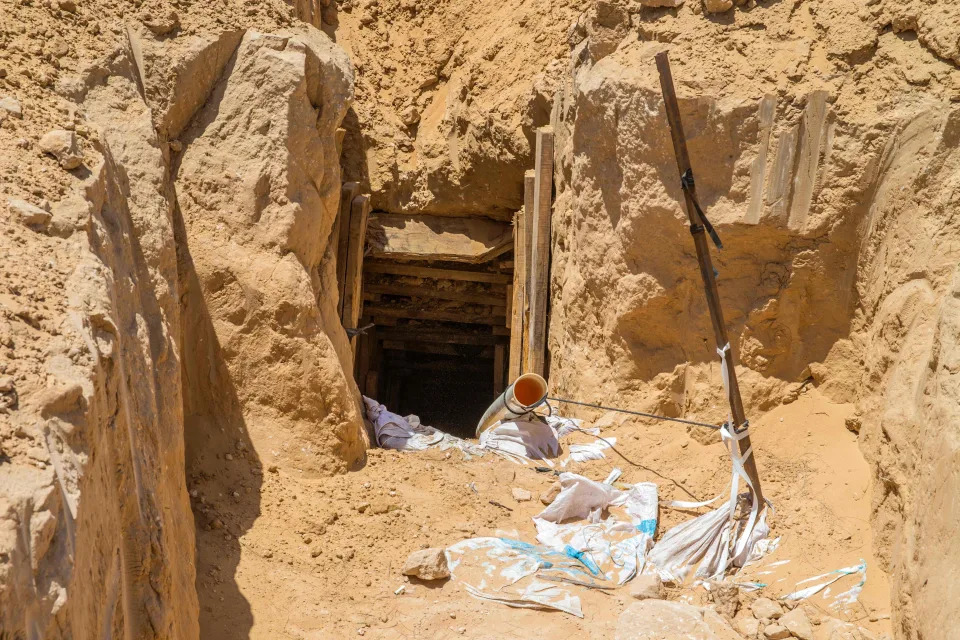
A picture taken on May 6, 2016, from the Israeli side along the border between Israel and the Gaza Strip shows the exit of an alleged offensive tunnel leading into Israel.
Palestinians have excavated tunnels under Gaza for decades, initially mostly to smuggle people and goods between Gaza and Egypt, according to testimony to the United Nations by Israeli researcher Eado Hecht. Israel and Egypt have tightly controlled their borders to Gaza, creating a virtual blockade on the territory.
In time, three types of tunnels emerged, according to Hecht: In addition to tunnels into Egypt in the south, there are tunnels that cross the border of Gaza into Israel and tunnels that crisscross under Gaza and can be used as command posts, storage facilities and positions to launch mortars or rockets.
The tunnels have become so elaborate and extensive – Hamas leaders claimed in 2021 they stretched for 311 miles, or nearly half the length of the New York City subway system – that the Israeli military dubbed it the “Gaza Metro,” according to a report this month by the Congressional Research Service. Experts believe some tunnels drop as far as 200 feet – roughly the equivalent of a 20-story building, or a typical airport control tower, underground.
Over the years, the U.S. has lent its expertise – and money – to help Israel locate and destroy the tunnels and develop technologies to combat them. Since 2016, Congress has appropriated $320 million in Defense Department funding for U.S.-Israel collaboration on “detecting, mapping and neutralizing underground tunnels” in response to the cross-border tunnels built by Hamas, according to the CRS report. In 2021, crews completed an underground concrete barrier with anti-tunnel sensors along the entire 40-mile Israel-Gaza border.
The tunnels have fueled Israeli-Hamas violence before. In 2006, Hamas operatives used a tunnel to launch a surprise attack on Israeli forces and kidnap one of its soldiers, Gilad Shalit, who was held captive for five years before being traded for more than 1,000 prisoners in Israeli jails.
The 2014 conflict between Israel and Hamas led to the discovery of 36 cross-border tunnels, most of which were destroyed, Hecht said.
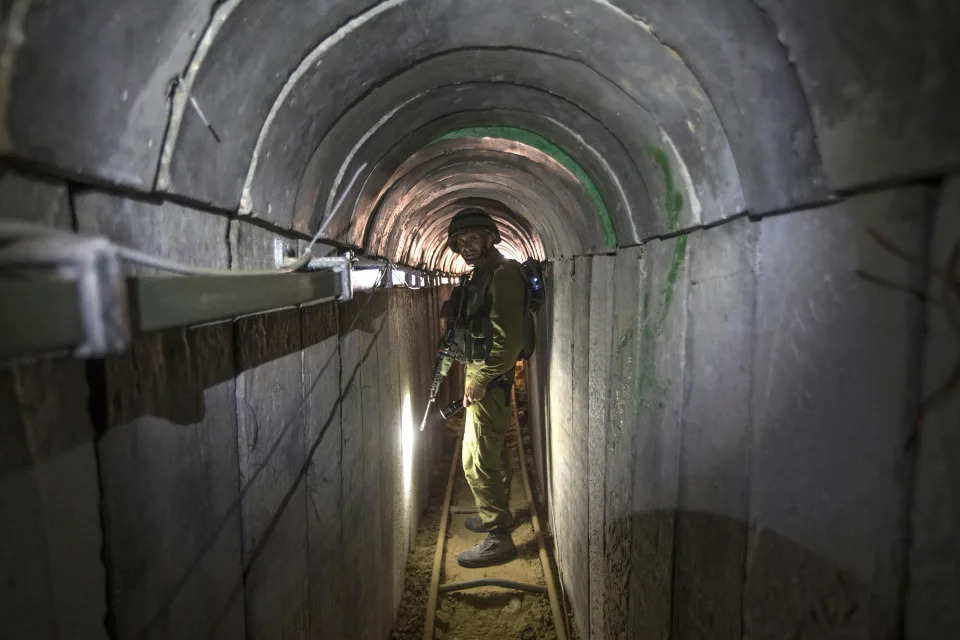
An Israeli army officer gives journalists a tour of a tunnel allegedly used by Palestinian militants for cross-border attacks at the Israel-Gaza border, in this file photo from 2014.
This time, a key challenge will be finding and rescuing the more than 200 hostages held by Hamas, including 12 Americans.
Yocheved Lifshitz, 85, a hostage taken in the Oct. 7 raid and released by Hamas last week, described to reporters how she was taken through a “huge network” of underground tunnels that looked like a “spiderweb.”
She said hostages were made to walk for two to three hours in the tunnels, gathered and ate in a large hall and slept on mattresses in different rooms. “They told us they believe in the Quran and would not harm us,” she said. “They would give us the same conditions as they have in the tunnels.”
Israeli Prime Minister Benjamin Netanyahu said Saturday that the military has opened a “second stage” in the war against Hamas by sending ground forces into Gaza and expanding attacks from the ground, air and sea.
Among the ground troops in the next phase of the war, experts told USA TODAY, will be specialized units trained to enter, clear and destroy the tunnels.
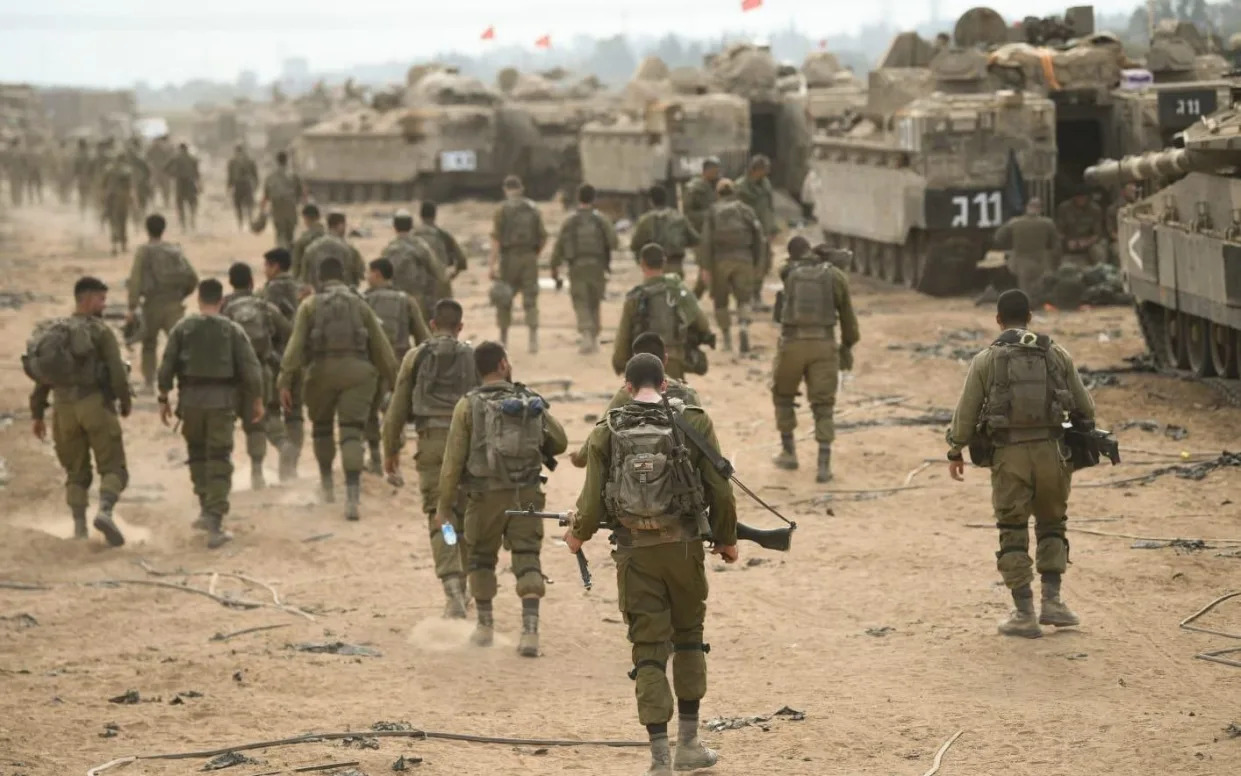
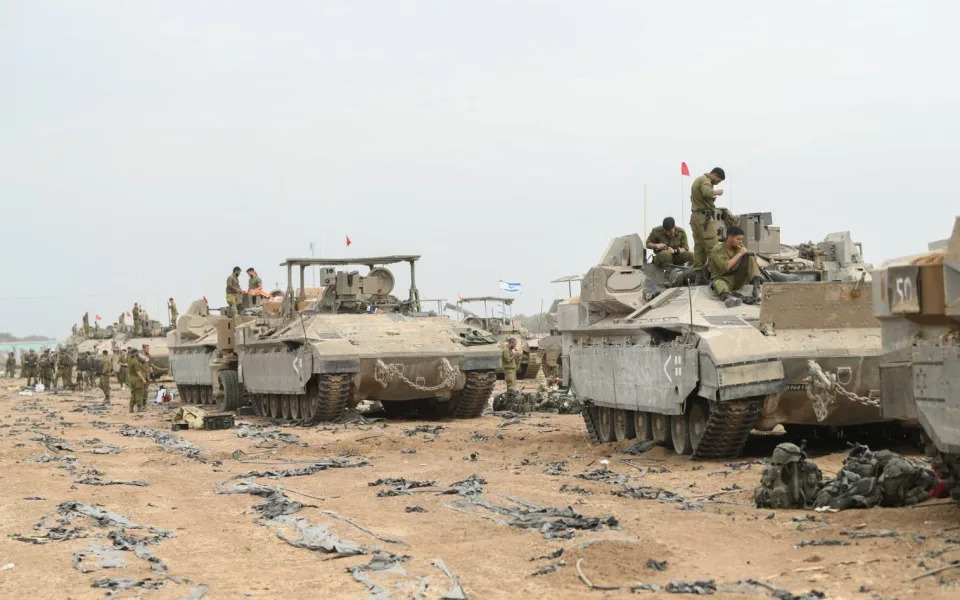
Israeli troops gather near the border with Gaza before entering on Oct. 29, 2023.
Since the 2014 Israeli-Hamas conflict, Israel has been gathering intelligence and training troops on how to find and destroy the passageways, said Shamir of Bar-Ilan University. At the center of the effort is a highly secretive laboratory – known simply as “the lab” – where scientists from different fields meet to try to learn tunnel locations and dream up technologies that could penetrate them.
Remote-controlled robots have been developed to enter and search the tunnels. Israeli engineers also have developed technology that uses acoustic or seismic sensors and software to detect digging, similar to the science used by oil and gas companies to detect oil reserves, according to the Congressional Research Service.
Because some tunnels are so deep and are concrete-lined, they can survive heavy bombing, Shamir said. Hamas fighters are thought to have enough provisions to live several months in the subterranean labyrinth, he said.
As Israeli forces rumble into the dense urban quarters of Gaza City, Hamas fighters will use the tunnels to launch surprise attacks on Israeli troops, then melt away underground again and pop up in another location, Shamir said. They’ll also use snipers, improvised explosive devices – or IEDs – and bomb-dropping drones.
Shamir said he believed Israel’s initial incursion into Gaza is more of a tactic to try to pressure Hamas into a negotiated release of the prisoners. As the military moves into denser urban areas and begins destroying tunnels, it becomes exponentially harder to rescue them, he said.
“Everyone understands the chances then are small,” Shamir said.
A black cloud of smoke rises from the Gaza Strip amid the ongoing battles between Israel and the Palestinian group Hamas, seen from the Israeli border with Gaza on Oct. 29, 2023.
The task of neutralizing the tunnel advantage will fall to the Yahalom, the special forces unit of the Combat Engineering Corps, who have been training in tunnel combat. A subunit of the Yahalom, the Samur, or “weasel” operators, will enter the tunnels and try to disarm or destroy the passages and look for hostages.
In recent years, the Israeli military has doubled the number of soldiers in Yahalom, expanding its focus to include subterranean fighting, according to the Israel Defense Forces website.
“The main challenge of underground warfare is that the enemy has no above-ground signature,” the website quotes a Yahalom commander as saying. “The fact that the enemy is hidden and collecting intelligence is complicated and difficult.”
Though Israeli forces may not know the precise entrance of every tunnel, they’ve been monitoring for years where cement-mixing trucks in Gaza have been deployed to give them an idea, Edward Luttwak, an Israeli strategist and historian, wrote in an essay this month.
Israeli tunnel specialists will be ferried by 70-ton Namer infantry combat vehicles, considered some of the most heavily armored vehicles in the world, he wrote. As they reach suspected tunnel sites, several Namers will form a perimeter – “an improvised fortress” – protecting the combat engineers.
“In 2014, the last time Israeli troops fought in Gaza, most were riding thinly armored M.113s, which were easily penetrated by RPG anti-tank rockets, with some 60 soldiers killed and hundreds wounded,” Luttwak wrote. “Not this time.”
Schwartz, who coordinated training with Israeli and Palestinian Authority security forces, witnessed some of the tunnel training in Israel. The Israeli military re-created what they believe the Gazan tunnels look like and sent soldiers through the maze to test weaponry and tactics, as well as unmanned vehicles and robotics.
“They know what they’re going to experience,” Schwartz said. “But the magnitude of what they’re going to deal with compared with what they’ve done in the past is very different.”
They went hunting for fossil fuels. What they found could help save the world
Laura Paddison, CNN – October 29, 2023
When tw o scientists went looking for fossil fuels beneath the ground of northeastern France, they did not expect to discover something which could supercharge the effort to tackle the climate crisis.
Jacques Pironon and Phillipe De Donato, both directors of research at France’s National Centre of Scientific Research, were assessing the amount of methane in the subsoils of the Lorraine mining basin using a “world first” specialized probe, able to analyze gases dissolved in the water of rock formations deep underground.
A couple of hundred meters down, the probe found low concentrations of hydrogen. “This was not a real surprise for us,” Pironon told CNN; it’s common to find small amounts near the surface of a borehole. But as the probe went deeper, the concentration ticked up. At 1,100 meters down it was 14%, at 1,250 meters it was 20%.
This was surprising, Pironon said. It indicated the presence of a large reservoir of hydrogen beneath. They ran calculations and estimated the deposit could contain between 6 million and 250 million metric tons of hydrogen.
That could make it one of the largest deposits of “white hydrogen” ever discovered, Pironon said. The find has helped fuel an already feverish interest in the gas.
White hydrogen – also referred to as “natural,” “gold” or “geologic” hydrogen – is naturally produced or present in the Earth’s crust and has become something of a climate holy grail.
Hydrogen produces only water when burned, making it very attractive as a potential clean energy source for industries like aviation, shipping and steel-making that need so much energy it’s almost impossible to meet through renewables such as solar and wind.
But while hydrogen is the most abundant element in the universe, it generally exists combined with other molecules. Currently, commercial hydrogen is produced in an energy-intensive process almost entirely powered by fossil fuels.
A rainbow of colors is used as a shorthand for the different types of hydrogen. “Gray” is made from methane gas and “brown” from coal. “Blue” hydrogen is the same as gray, but the planet-heating pollution produced is captured before it goes into the atmosphere.
The most promising from a climate perspective is “green” hydrogen, made using renewable energy to split water. Yet production remains small scale and expensive.
That’s why interest in white hydrogen, a potentially abundant, untapped source of clean-burning energy, has ratcheted up over the last few years.
‘We haven’t been looking in the right places’
“If you had asked me four years ago what I thought about natural hydrogen, I would have told you ‘oh, it doesn’t exist,’” said Geoffrey Ellis, a geochemist with the US Geological Survey. “Hydrogen’s out there, we know it’s around,” he said, but scientists thought big accumulations weren’t possible.
Then he found out about Mali. Arguably, the catalyst for the current interest in white hydrogen can be traced to this West African country.
In 1987, in the village of Bourakébougou, a driller was left with burns after a water well unexpectedly exploded as he leaned over the edge of it while smoking a cigarette.
The well was swiftly plugged and abandoned until 2011, when it was unplugged by an oil and gas company and reportedly found to be producing a gas that was 98% hydrogen. The hydrogen was used to power the village, and more than a decade later, it is still producing.
When a study came out about the well in 2018, it caught the attention of the science community, including Ellis. His initial reaction was that there had to be something wrong with the research, “because we just know that this can’t happen.”
Then the pandemic hit and he had time on his hands to start digging. The more he read, the more he realized “we just haven’t been looking for it, we haven’t been looking in the right places.”
The recent discoveries are exciting for Ellis, who has been working as a petroleum geochemist since the 1980s. He witnessed the rapid growth of the shale gas industry in the US, which revolutionized the energy market. “Now,” he said, “here we are in what I think is probably a second revolution.”
White hydrogen is “very promising,” agreed Isabelle Moretti, a scientific researcher at the University of Pau et des Pays de l’Adour and the University of Sorbonne and a white hydrogen expert.
“Now the question is no longer about the resource… but where to find large economic reserves,” she told CNN.
A slew of startups
Dozens of processes generate white hydrogen but there is still some uncertainty about how large natural deposits form.
Geologists have tended to focus on “serpentinization,” where water reacts with iron-rich rocks to produce hydrogen, and “radiolysis,” a radiation-driven breakdown of water molecules.
White hydrogen deposits have been found throughout the world, including in the US, eastern Europe, Russia, Australia, Oman, as well as France and Mali.
Some have been discovered by accident, others by hunting for clues like features in the landscapes sometimes referred to as “fairy circles” – shallow, elliptical depressions that can leak hydrogen.
Ellis estimates globally there could be tens of billions of tons of white hydrogen. This would be vastly more than the 100 million tons a year of hydrogen that is currently produced and the 500 million tons predicted to be produced annually by 2050, he said.
“Most of this is almost certainly going to be in very small accumulations or very far offshore, or just too deep to actually be economic to produce,” he said. But if just 1% can be found and produced, it would provide 500 million tons of hydrogen for 200 years, he added.
It’s a tantalizing prospect for a slew of startups.
Australia-based Gold Hydrogen is currently drilling in the Yorke Peninsula in South Australia. It targeted that spot after scouring the state’s archives and discovering that back in the 1920s, a number of boreholes had been drilled there which had very high concentrations of hydrogen. The prospectors, only interested in fossil fuels, abandoned them.
“We’re very excited by what we’re seeing,” said managing director Neil McDonald. There is more testing and drilling to do but the company could get into early production possibly in late 2024, he told CNN.
Some startups are seeing eye-popping investments. Koloma, a Denver-based white hydrogen start-up, has secured $91 million from investors, including the Bill Gates-founded investment firm Breakthrough Energy Ventures – although the company remains tight-lipped about exactly where in the US it is drilling and when it is aiming for commercialization.
Another Denver-based company, Natural Hydrogen Energy, founded by geochemist Viacheslav Zgonnik, has completed an exploratory hydrogen borehole in Nebraska in 2019 and has plans for new wells. The world is “very close to the first commercial projects,” Zgonnik told CNN.
“Natural hydrogen is a solution which will allow us to get get to speed” on climate action, he said.
Aerial view of drilling operations by Natural Hydrogen Energy in Kansas. – Natural Hydrogen Energy LLC
From hype to reality
The challenge for these businesses and for scientists will be translating hypothetical promise into a commercial reality.
“There could be a period of decades where there’s a lot of trial and error and false starts,” Ellis said. But speed is vital. “If it’s going to take us 200 years to develop the resource, that’s not really going to be of much use.”
But many of the startups are bullish. Some predict years, not decades, to commercialization. “We have all necessary technology we need, with some slight modifications,” Zgonnik said.
Challenges remain. In some countries, regulations are an obstacle. Costs also need to be worked out. According to calculations based on the Mali well, white hydrogen could cost around $1 a kilogram to produce – compared to around $6 a kilogram for green hydrogen. But white hydrogen could quickly become more expensive if large deposits require deeper drilling.
Back in the Lorraine basin, Pironon and De Donato’s next steps are to drill down to 3,000 meters to get a clearer idea of exactly how much white hydrogen there is.
There’s a long way to go, but it would be ironic if this region – once one of western Europe’s key coal producers – became an epicenter of a new white hydrogen industry.
Shopper left furious after purchase on dad’s recent grocery store trip: ‘Totally wipes out the benefit’
Kendall Burke – October 29, 2023
A Redditor who found a baffling instance of excessive plastic took to the r/anticonsumption subreddit to voice their frustrations.
The poster said their dad bought the offending cucumber — which was covered in not one, but two layers of single-use plastic — during a recent grocery run, seemingly at U.K. chain Morrison’s, given the branding The Greengrocer’s on Market Street.
“All this plastic for HALF A F******* CUCUMBER,” the frustrated Redditor wrote.
Photo Credit: u/DyeTheSheep / Reddit
The image reveals that the package actually contains just half a cucumber, which could be the reason for wrapping it in so much plastic, as cut vegetables and fruit spoil faster than uncut ones. However, that raises the question, why would anyone sell just half a cucumber.
Commenters agreed with the original poster’s sentiment.
One shared, “The other day I saw organic cilantro on a plastic tray, wrapped with plastic. Totally wipes out the benefit of organic.”
Another joked, “Nice I need a plastic bag to transport it too please.”
While plastic wrap can reduce how quickly food spoils, a main cause of consumer-level food waste, it can take anywhere between 20 and 500 years (or more by some estimates) to break down in our landfills and oceans.
Innovative solutions to this issue are being perfected every day. Multiple companies have debuted versions of plastic-free “plastic” wrap, with one particularly cool option that sprays on like a Spiderman web. There are also myriad groups at work on an international and local level to clean up our existing ocean plastic problem.
Hamas ambushes Israel from tunnels near Gaza border
Danielle Sheridan – October 29, 2023
IDF ground activity in the Gaza Strip
Israeli troops clashed with Hamas for the first time since the ground offensive began in an ambush from its network of tunnels in northern Gaza.
The Israel Defense Forces (IDF) killed several terrorists after spotting them “exiting the shaft of a tunnel in the Gaza Strip” near the Erez Crossing that was stormed on Oct 7.
Israel later said it believed the militants were attempting to cross the border into Israel for another surprise attack.
Hamas said its militants clashed with Israeli troops as they entered the northwest Gaza Strip, using small arms and anti-tank missiles against the armoured convoy.
Tanks have moved across the border
Guided by troops on the ground Israeli aircraft also struck two Hamas staging posts, killing several Hamas members, the IDF claimed.
Israel intensified its war with Gaza over the weekend, sending in troops and tanks on Friday night as part of a ground operation aimed at destroying Hamas.
But it stopped short of a full invasion of its forces massing on the Gaza border.https://cf-particle-html.eip.telegraph.co.uk/63d27584-172c-4312-bbc6-2e6a01c01203.html?direct=true&id=63d27584-172c-4312-bbc6-2e6a01c01203&truncated=false&expandable=false
Rear Admiral Daniel Hagari, the Israeli military spokesman, said on Sunday that movement into Gaza would be a “gradual expansion”.
He said: “We will do everything we can from the air, sea and land to ensure the safety of our forces and achieve the goals of the war.”
Analysts have speculated that Israel’s preference for a low-intensity ground offensive betrays concerns about hostages held in Gaza and threats from Arab proxies linked to Hamas.
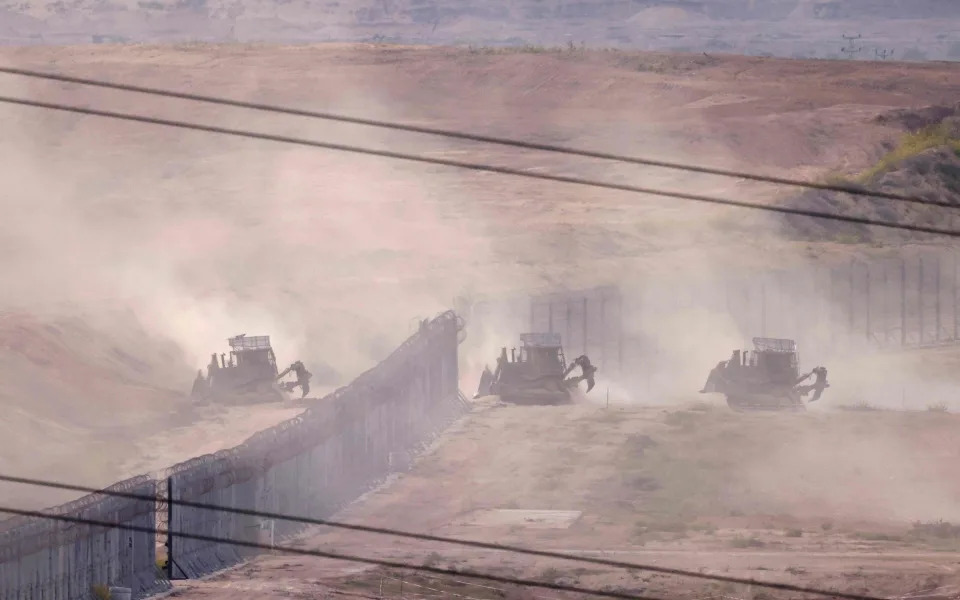
Israeli army buldozers crossing the border into Gaza, on October 29, 2023 – MENAHEM KAHANA
As pressure has mounted on Israel to slow the offensive in order to negotiate the release of hostages, its defence minister Yoav Gallant spoke to families of captives on Sunday.
In an attempt to reassure them, he said: “The ground move is intertwined with the effort to return the kidnapped and is intended, among other things, to increase the chance of returning our people. If there is no military pressure on Hamas, nothing will progress.”
He added: “I have two goals: to return the abductees and win the war, the return of the abductees and locating the missing is a task of utmost importance.”
The ground assault resulted in an almost total communications blackout in the coastal enclave.
An Israeli tank manoeuvres inside the Gaza Strip, as seen from the Israel border – EVELYN HOCKSTEIN
Meanwhile, as clashes on the Lebanese border escalate, Rear Admiral Hagari said the IDF responded to the fire from Lebanon toward the northern border by striking military targets, infrastructure and posts belonging to Hezbollah overnight.
Hezbollah added that the drone was hit near Khiam, about three miles from the border, and was seen falling into Israeli territory.
Capability to shoot down a drone
Two security sources in Lebanon said it was the first time Hezbollah had announced downing an Israeli drone.
Mohanad Hage Ali, of the Carnegie Middle East Center, said: “They have insinuated they have this capability but it is the first time they declare they have this kind of capability to shoot down a drone.”
The United Nations’ Lebanon peacekeeping force Unifil said one of its members was injured after shells hit its base near the village of Houla on the Lebanese-Israeli border on Saturday.
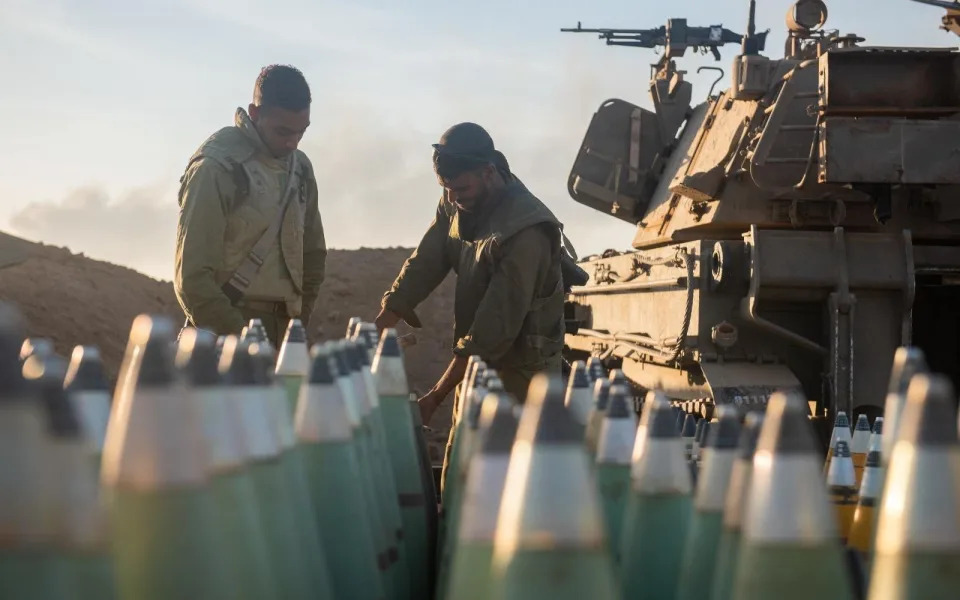
IDF soldiers with munitions
The clashes with Hamas in northern Gaza are thought to be the first in which militants have emerged from tunnels, but is likely to become a theme of the ground assault.
The Erez Crossing, which was built in 2005 when Israel withdrew its settlers and soldiers from Gaza, was at the time considered a symbol of passage between Israel and Gaza.
The IDF accused Hamas of having deliberately built tunnels next to the crossing, which was formerly used by Gazans to enter Israel for work or medical treatment, in order to “attack the humanitarian crossing and harm everyone in the area”.
Hamas spent two decades building a labyrinthine network of underground tunnels which makes a central part of its defences.https://cf-particle-html.eip.telegraph.co.uk/5bf20ca6-3f78-4b5f-97ec-f32a757dcfed.html?direct=true&id=5bf20ca6-3f78-4b5f-97ec-f32a757dcfed&truncated=false&expandable=falsehttps://cf-particle-html.eip.telegraph.co.uk/7a13177e-311d-4b5a-bc79-7786c96a919a.html?direct=true&id=7a13177e-311d-4b5a-bc79-7786c96a919a&truncated=false&expandable=false
Israel says the tunnels have entrances hidden beneath schools, mosques and houses and are said to be 300 miles long with lighting, electricity and rail tracks for transport.
Accused of psychological games
After Sunday’s clashes, Rear Adm Hagari said: “We killed the terrorists that were on the security fence, who were trying to infiltrate and were trying to attack Israel.”
Mr Gallant accused Hamas on Sunday of playing “psychological games” over hostages after it offered to free all captives in exchange for Palestinian prisoners in Israeli jails.
“The stories published by Hamas are part of their psychological games. Hamas is cynically using those who are dear to us – they understand the pain and the pressure,” he told relatives of some of the 230 hostages.https://cf-particle-html.eip.telegraph.co.uk/f0dff9cd-562a-4bcf-a740-6bd2c38091d9.html?direct=true&id=f0dff9cd-562a-4bcf-a740-6bd2c38091d9&truncated=false&expandable=false
On Saturday, Hamas’s leader in Gaza, Yahya Sinwar, said the group was ready for an “immediate” prisoner swap with Israel.
Mr Gallant said: “They seek the collapse of Israeli society from within and are using the hostages in a brutal manner.
“The military operation is intended, among other things, to increase the chance of returning our people.”
Ezzedine al-Qassam Brigades, the armed wing of Hamas, has said that about 50 hostages have been killed in Israeli strikes, a claim that could not be independently verify.
So far the group has released four hostages.
Those confirmed to be held captive rose to 239 on Sunday.
‘A remarkable role model’: Warren Buffett and Bill Gates call this fellow billionaire their hero — here are 3 big lessons to learn from Charles Feeney
Serah Louis – October 29, 2023
‘A remarkable role model’: Warren Buffett and Bill Gates call this fellow billionaire their hero — here are 3 big lessons to learn from Charles Feeney
He was known as the billionaire who gave it all away.
Charles “Chuck” Feeney made his much of his riches selling booze, cigarettes and perfume. The co-founder of the Duty Free Shoppers Group died on Oct. 9 at the age of 92, but fulfilled his pledge to donate the bulk of his $8 billion fortune long before his death.
“Chuck Feeney is a remarkable role model, and the ultimate example of giving while living,” Bill Gates told Forbes back in 2012.
Here’s what you can learn from how Feeney managed his money.
Diversification
While building his massive fortune, Feeney didn’t just focus on his global network of duty-free airport stores — he was a prolific investor as well.
By the early 1980s, he was profiting from hotels, property and retail, and he later invested in some tech start-ups. It wasn’t until 1996 that he sold his stake in Duty Free Shoppers for a tidy $1.63 billion that went to his foundation, Atlantic Philanthropies, a deal that multiplied in value by investment returns later, according to the Wall Street Journal.
Feeney followed the golden rule — don’t put all your eggs in one basket — and grew his wealth by diversifying his investments.
Similarly, while you’re buying stocks, make sure you’re not sticking to one company or sector. This will provide some shelter from any unexpected dips in the market. Do your research and build a balanced portfolio of companies or ETFs.
Frugality
Feeney went from purchasing luxurious multimillion-dollar homes — including in London and the French Riviera — to renting a two-bedroom San Francisco apartment with his wife.
Like many folk of his ilk, he once spent his time cruising on yachts and private jets — but decided in his later years to cut back and focus on his philanthropic efforts.
For Feeney, value was more important than showing off his wealth. He flew coach because he wasn’t getting anywhere any faster by opting for a first-class ticket. He wore a $15 watch and used plastic bags in place of a briefcase.
“I just reached the conclusion with myself that money, buying boats and all the trimmings didn’t appeal to me,” he was quoted saying in a 2007 biography about his life, “The Billionaire Who Wasn’t.”
Most importantly, Feeney was intentional with his spending, leaving enough funds behind for his investments and donations.
This is a crucial tenet for managing your money (even if you don’t have billions in your bank account). Consider creating a budget and monitoring your monthly expenses so that you’re leaving some of your income behind for your financial goals, too, such as your emergency savings or nest egg.
Charitable giving
Once dubbed “the James Bond of philanthropy” by Forbes, Feeney is perhaps best known for his charitable giving — despite his attempts to hide it for many years.
Feeney donated to a range of causes, including AIDS relief in South Africa, Operation Smile’s free surgeries for children with cleft lips and palates and earthquake relief in Haiti.
“People used to ask me how I got my jollies, and I guess I’m happy when what I’m doing is helping people and unhappy when what I’m doing isn’t helping people,” Feeney told Forbes.
There are potential financial benefits to charitable giving as well come tax time, as you may qualify for a tidy deduction on your next return.
The city landed that title through multiple metrics including its inflation rate and the cost of gas. The report also considered living costs from annual housing costs, median gross rent and high fees associated with homeownership.
The report said home prices exceed the national median sale price and added that many in San Diego’s downtown area must pay homeowners association fees to maintain living in housing complexes.
“Living in San Diego is not particularly affordable,” the report reads. “San Diegans are willing to pay these elevated prices, though, often referring to the cost-of-living differences as the ‘sunshine tax,’ or the price of enjoying a year-round temperate climate.”
Los Angeles was ranked the second most expensive city, followed by Honolulu and Miami. California actually made up seven of the top ten spots in the report and around half of the top 25. New York City, the most populated U.S. town, earned the 11th spot.
According to the report, the cities at the top of the list require the most amount of wealth in order to live comfortably.
What are the most expensive cities in the US?
These are the 25 most expensive American cities according to the U.S. News & World Report. For information on each city’s various qualities like value and quality of life, click here.
Sen. Kyrsten Sinema voted to limit background check reporting hours before Maine shootings
Laura Gersony, Arizona Republic – October 28, 2023
An Army reservist, who has reportedly shown symptoms of mental health issues in recent months, allegedly shot and killed 18 people Wednesday in Lewiston, Maine.
Earlier that day, the U.S. Senate voted to approve a Republican-led amendment that would limit the Department of Veterans Affairs’ ability to relay information about some veterans, including those with certain mental health issues, to an FBI database used for gun background checks.
Sen. Kyrsten Sinema, I-Ariz., was one of only five non-Republican senators to vote in favor of the measure.
According to the bill’s sponsor, the VA is required to report people to the FBI’s criminal background check system whenever a fiduciary is appointed to help the person manage their VA benefits.
The Senate-approved amendment would prohibit the VA from relaying that information to the database, unless a judge rules that the person poses a danger to themselves or others.
A spokesperson for Sinema defended her vote, noting that the amendment would not change federal requirements for background checks, and is geared toward limiting the VA’s role in determining whether a person is mentally fit to own a gun.
“Kyrsten voted to ensure a judge — not a bureaucrat at the VA — was responsible to determine whether a veteran was a danger to themselves or others, just as judges make that determination for civilians,” the spokesperson wrote.
Research suggests that most mass murders are not committed by severely mentally ill people, and that people with mental illness are more likely to be victims of violent crime than perpetrators of it.
The suspect in the mass shooting, Robert Card, was committed to a mental health facility for two weeks over the summer because he was “hearing voices” and threatening to shoot up a military base in Saco, Maine, severalnews outlets have reported.
It is not immediately clear whether the amendment would have applied directly to Card. Jaclyn Schildkraut, a gun policy expert with the Rockefeller Institute of Government, noted that only certain specific criteria in federal law limit people’s right to have a gun, such as a person being deemed, as the law puts it, a “mental defective” or being committed to a mental institution, rather than going to one voluntarily.
A VA spokesperson said they could not say for sure whether Card fell into those categories and said that Card used VA education benefits in 2004, but he has not used or applied for any VA benefits since.
“Effectively it is too early to determine whether this bill would have any relevance to the Maine shooting as there are just a lot of unknowns,” wrote Schildkraut, the gun policy expert, in an email to the Arizona Republic.
Asked on Friday about Sinema’s vote, Rep. Ruben Gallego, D-Ariz., who is running for the Senate seat she currently holds, said that he would have voted against the measure.
“Our criminal background system is very important. It’s one of the few things that does work to stop people that shouldn’t be owning weapons (from) buying weapons. And anything that diminishes that, I think, is not going to keep Americans safe,” Gallego said Friday at a news conference on another topic.
‘We were living our best lives’: This 32-year-old says he had more financial freedom working at Chili’s in 2012 than he does now with a much higher income — here’s why
Sabina Wex – October 28, 2023
‘We were living our best lives’: This 32-year-old says he had more financial freedom working at Chili’s in 2012 than he does now with a much higher income — here’s why
While it’s not hard to get a millennial to indulge in some nostalgia for the 2010s — the decade many of their cohort entered adulthood and the workforce — what’s got them reminiscing about their younger years lately may come as a surprise.
Although many were fresh out of college, still figuring things out and living on minimum wage, they’d likely hesitate to characterize their past selves as “young, dumb and broke.” But not necessarily because they remember themselves as wise and mature.
As Mordecai Nuccio explains in a recent TikTok, he feels like he had more disposable income back in 2012 compared to now — an assertion that’s been making the rounds on TikTok.
“We were making minimum wage, but we were living our best lives,” Nuccio, a 32-year-old photographer, says about his time living on minimum wage working as a food runner at Chili’s.
He adds that a big part of his current financial stress is thanks to his increased credit card and student loan debts. Even though he makes more money and lives in a double-income household with his fiancé, he feels more squeezed.
Here’s how do you get back to living your best life now that you should have more cash flow.
Tackle debt
Back in 2012, Nuccio says he had “minimal” credit card debt. But that’s changed as his expenses have increased — and he’s got his student loans to think of too.
While expenses tend to increase as you age and take on more responsibilities, making more often translates into spending more. Millennials love splurging on experiences, but that can quickly wander into risky spending habit territory.
Living on borrowed money can get expensive once you start to factor in interest but it can be overwhelming to get out of that vicious cycle. If you’ve racked up a couple of balances, one way to start picking away at your debt in a manageable way is to use the “debt avalanche method,”. Here’s how it works: you pay off your highest interest loan debt first, and only make minimum payments on all your other debts.
Once you’ve paid off the highest interest loan, you move on to the next highest interest debt, and so on — until, voila, all your debt has disappeared.
Up until fairly recently, student loan payments were suspended. But their return means that borrowers like Nuccio need to figure out how to fit these payments back into their monthly expenses.
Unfortunately, 28% of student loan borrowers say they’ll need to take on additional debt to maintain their household payments and repay their student debt, according to a recent Achieve survey.
When you’re robbing Paul to pay Peter, things can get messy. But consolidating your debts can make this a little easier. If you have private student loans and credit card debt, you might consider refinancing your loan.
Even though it means taking on another loan, if you’re able to find an offer at a lower rate than your current accounts, you’ll save yourself plenty in interest over the life of the loan. Plus, by pooling your debts, you’ll only have to worry about making a single monthly payment, which will hopefully make your life a little easier.
Lower your cost of living
Nuccio mentions that he lived in Tampa, Florida in 2012 when he worked at Chili’s, but has since moved to New York City to pursue photography. Though this may have been a good move for his career, it’s bad news for his debt.
Though Nuccio doesn’t explicitly say which borough he lives in, New York’s Manhattan is the most expensive city in the U.S., according to the Council for Community and Economic Research’s (CCER) most recent data. Though several Florida media outlets report Tampa is the Sunshine State’s most expensive city, it still doesn’t rank on the CCER’s list of priciest cities across the country.
So part of your plan to pay back your debt may need to include your locale. If you live in an expensive city like New York, it’ll likely take you longer to pay off your debt than a cheaper city like Tampa.