74 percent of Republicans say it’s fine for Trump to be dictator for a day
Lauren Irwin – February 7, 2024
A new survey found that a majority of Republicans say it is fine for former President Trump to be a dictator for the day if he wins the presidential election.
The survey from the University of Massachusetts Amherst and YouGov found that 74 percent of Republican voters said it would be a good idea if Trump follows through on his remarks in which he said he would be a dictator only on the first day of his second term. Twenty-six percent of Republicans say it would be a bad thing.
Thirty-six percent of independent voters said it would be good, while 65 percent said it would be a bad idea.
Democrats were much more opposed. Only 13 percent of Democratic respondents said it would be a good idea for the country if Trump fulfilled his vow to be dictator for a day, while 87 percent said it would be a bad idea.
Trump has said in the past that he would not be a dictator if he were reelected, “except for day one.” On the campaign trail in Iowa in December, Trump doubled down on his claims that he would close the border and be “drilling, drilling, drilling” on his first day back in office.
“After that, I’m not a dictator,” he told Sean Hannity of Fox News.
The remarks have fueled concern for Democrats and even some Republicans that a second Trump term could threaten democracy, as he has threatened to abuse power and target people who have disagreed with him.
The former president is currently defending himself against 91 criminal charges among four state and federal criminal indictments. He is the front-runner to become the GOP’s nominee for the 2024 presidential election.
According to the survey, voters are split on whether they believe Trump is guilty of charges that he tried to overturn the results of the 2020 presidential election.
Fifty-eight percent of respondents said Trump is likely guilty, while 42 percent said they believe he is innocent. Seventy-two percent of Republican voters said they think the former president is innocent.
The survey was conducted Jan. 25-30 among 1,064 respondents. It has a margin of error of 3.7 percent.
The ‘Nuclear’ Election Conspiracy Doc Trump Cited In Court Is A Sign Of Things To Come
Hunter Walker – February 7, 2024
The true believers were buzzing.
It was Jan. 2 and former President Trump had just used his “Truth Social” platform to release a 32-page “Summary of Election Fraud in the 2020 Presidential Election in the Swing States.” The document rehashed thoroughly debunked claims, promoted blatantly false information, and repeatedly cited other reports that do not actually appear to exist to make the patently absurd assertion there is “no evidence Joe Biden won.” In other words, it was everything many hardcore Trump supporters who refuse to accept his defeat had been waiting for.
On the site formerly known as Twitter where election dead-enders have taken advantage of Elon Musk’s permissive attitude towards right-wing conspiracy theories, a few thousand pro-Trump activists spent nearly 13 hours in an audio chat discussing the document, which they dubbed “The Nucleus File.” But the report was more than an object of fascination for the pro-Trump fringe.
Along with becoming a hot topic in delirious Twitter Spaces, the report was cited in a Jan. 2 federal court filing by Trump’s attorneys, part of a wild strategy to argue he was immune from prosecution in the election interference case brought by special counsel Jack Smith.
The use of a questionable anonymous document to incorporate election conspiracies into his defense raised eyebrows from legal observers, even those who had grown familiar with the former president’s everything-at-the-wall approach to his defense. One lawyer who previously worked for Trump described the move to TPM as not just unlikely to help his case, but akin to bringing up an “alien abduction” before a judge.
“That’ll never get off the ground,” said the lawyer, Ty Cobb, a veteran defense attorney who was special counsel on Trump’s White House legal team during the Mueller investigation and who has since become an outspoken Trump critic.
The D.C. Circuit Court of Appeals ruled against Trump’s team on Tuesday and allowed the prosecution to move forward at the district court level. In their decision, the circuit court panel stuck to the question at hand and completely ignored the assertion from Trump’s legal team that the 2020 outcome was up for debate. Instead, the court flatly declared Trump both an election loser and a danger to the democracy.
“Former President Trump’s alleged efforts to remain in power despite losing the 2020 election were, if proven, an unprecedented assault on the structure of our government,” the judges wrote.
The document may not have had any impact in court, but there are many indications it is part of a larger — and ongoing — project for Trump’s presidential campaign that his activist allies describe as a “nuclear” assault. The promotion of the document by the former president and its use in his legal defense ultimately served as proof that Trump is making the fever dream that he won the last election a part of the current one. Trump is dragging all elements of his political universe with him down the conspiracy theory rabbit hole, including his campaign team, an army of attorneys, Republican Party leaders, and the activists who have driven the false narrative online and are increasingly targeting election infrastructure in the real world.
Former President Donald Trump — flanked by attorney John Lauro, left, and D. John Sauer, right — speaks to reporters and members of the media at the Waldorf Astoria hotel after attending a hearing of the D.C. Circuit Court of Appeals at the federal courthouse on Tuesday, Jan. 09, 2024, in Washington, DC. (Photo by Jabin Botsford/The Washington Post via Getty Images)More
Early on in the marathon Twitter discussion about the file, a right-wing streamer who has amassed a six-figure following using the handle “Behizy” took the virtual stage.
“What’s up my fellow conspiracy theorist election deniers?” Behizy declared, with evident sarcasm oozing over any potential hint of self awareness.
“I saw the report,” he said. “Who wrote it? Does anyone know?”
“We’re trying to figure that out,” replied Pablo Martinez, the chairman of the Republican Party in McKinley County, New Mexico, who was one of the hosts of the conversation.
“Behizy” actually seemed pleased not to get an answer to his question.
“I like that the author is anonymous because we know the mainstream media will attack the messenger before actually addressing the message,” he said. “So, I think it’s just smart that they intentionally omitted their name from the report.”
The report, however, wasn’t entirely anonymous. One person whose name was all over the document — David Cross — spoke to the crowd a few minutes later. Cross, who is a financial adviser in Georgia, has emerged in recent years as one of several self-styled experts and sleuths who have taken it upon themselves to question the 2020 presidential election results and the integrity of the country’s election systems. Corporate records show Cross is one of three executives at an outfit called the Election Oversight Group, a supposed watchdog organization, along with a man named Kevin Moncla. The EOG has helped file complaints with elections officials in Georgia and created research documents and videos based on debunked allegations. Cross, Moncla, and their organization were cited seven different times in the document shared by Trump and, on the Twitter broadcast, Cross hinted it was just the beginning.
“One of the things that everybody needs to realize about this report is that this is a summary. There’s a bigger report that’s going to be coming later and it’s going to be like dropping a nuclear bomb on all of these states and with all of the ways that elections are manipulated,” Cross declared. “So, that’ll be the next thing that’s coming. So, you’re kind of getting a taste of the big picture in looking at this report. There’s more to come.”
Cross, who did not elaborate on his apparent inside knowledge, then went on to encourage other activists to obtain positions working within election infrastructure. However, he cautioned them to erase their “pro-Trump” digital footprint beforehand.
“You need to be involved as an election worker on Election Day and, if you are going to do that, then go on to your Facebook account and eliminate as much conservative stuff as you possibly can because you will be profiled,” he said. “They will not hire you.”
“Put stuff about, like, you know, your cats, and your flower garden, or your dogs, or fishing. I don’t care, just not political stuff,” Cross said, adding, “Get your ass hired so that you can be part of this and be part of the solution.”
The strategy was an example of how election conspiracy-theory activists are taking their message offline and into the polling places and offices where America’s votes are counted. After outlining his idea for a stealth mission, Cross returned to the report and seemed to indicate he had a hand in writing it.
“We have to close all possible loops for cheating and malfeasance, and I think we’ve done a really good job of exposing that in the report that everybody’s reading or the summary that you’re reading,” Cross said.
Despite seeming to take credit on the Twitter broadcast, Cross denied playing any role writing the report shared by Trump during a phone conversation with TPM on Feb. 2.
“My involvement in that report is just that my work was cited in it, so I didn’t actually write the bullet points that are in there, because what you’re looking at is a summary,” Cross said. “But I am aware that there’s going to be more, because, like I said, you’re looking at a summary, you’re not looking at all the details.”
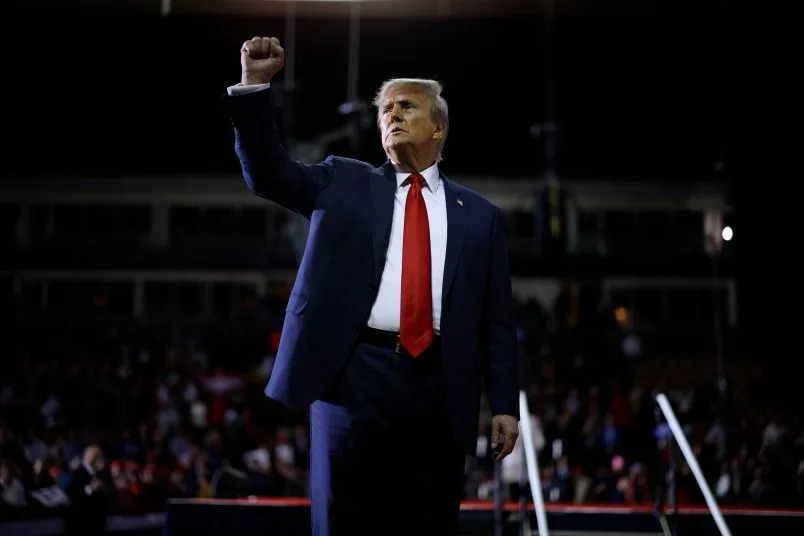
Former President Donald Trump acknowledges supporters as he leaves the stage at the conclusion of a campaign rally at the SNHU Arena on January 20, 2024 in Manchester, New Hampshire. (Photo by Chip Somodevilla/Getty Images)
The Trump campaign clearly played a role in publishing the report. On Jan. 6, four days after Trump shared the “election fraud” summary and his legal team cited it in the reply brief, the Washington Post published a story about the document that claimed “Trump campaign spokesperson Liz Harrington wrote the report.” The Post cited people “familiar with the matter.” Along with reportedly being produced by a Trump staffer, the document was hosted on a URL associated with Campaign Nucleus, a platform used by the campaign. That official web address is what led the excited activists to dub the document “The Nucleus File.”
Harrington did not respond to requests for comment on record. Cross also initially denied being in contact with anyone on Trump’s campaign team, but later admitted the pair had been in contact.
“Liz is really private, and so, I’m not really comfortable talking about what she’s doing or anything like that,” Cross said. “I mean, I can tell you that I’ve had a couple of conversations with her, but it’s all fairly general.”
The Post described Harrington as a “polarizing figure in Trump’s orbit” due to her interest in 2020 election denial. Overall, the reporters framed the publication of the report as evidence of “divisions” on Trump’s team, where some of the staff have tried to tamp down on the election conspiracy theories. A senior former Trump campaign official echoed that notion in a conversation with TPM where they described Harrington as a source of “craziness” and a “challenging” figure for those trying to steer Trump away from the false voter fraud narratives.
Of course, while Harrington or other individual staffers might be interested in election conspiracy theories, at the end of the day, it is Trump himself who shared the report and his lawyers who cited it in a court filing. Still, Harrington seems to be a central figure connecting fringe election activists with the Trump campaign.
Last August, Trump announced a grand plan to unveil a separate report on “the Presidential Election Fraud which took place in Georgia” during a press conference at his New Jersey golf club. According to the New York Times, that report was a more than 100-page document “compiled at least in part by Liz Harrington, a Trump communications aide who is often described as among the true believers in his false claims that the 2020 election was stolen from him.”
Despite Trump’s announcement, the press conference never took place and that Georgia-specific document has, thus far, never seen the light of day.
The Georgia report that Harrington supposedly worked on seems like it may have been referenced in the “Nucleus File,” which contained multiple citations referencing a “Report on Widespread Fraud in the Georgia 2020 Presidential Election” that does not appear to exist anywhere else online. In a conversation last week, Kevin Moncla, David Cross’ partner in the Election Oversight Group, told TPM he is aware of a report on Georgia that is based, in part, on the pair’s research.
“The Georgia portion of that report I know includes some of our work,” Moncla said.
Like Cross, Moncla was somewhat coy when asked about his ties to Harrington.
“I’ve contributed my work,” Moncla said. “I’ll just leave it at that.”
Georgia’s 2020 election result, which has been the focus of much of Cross’ and Moncla’s work and skepticism, has been affirmed in three separate counts overseen by officials from Trump’s own party. The factual issues and logical leaps that plague their work aren’t the only things that make the pair potentially problematic associates for a presidential campaign. Last year, Georgia election officials asked the FBI to investigate a series of aggressive emails they received from Moncla in conjunction with complaints he filed related to the administration of the vote. At least one of those complaints is still being reviewed by the State Election Board. Moncla has also had personal legal troubles. In 2004, Moncla pleaded guilty to a misdemeanor voyeurism charge related to secretly videotaping his former wife and other guests in the bathroom of their home.
When asked about the call for an FBI investigation, Moncla said, “I’m not going to get into the status of it.” And he dismissed the voyeurism charges as an issue that came up in a “personal divorce case.”
“My work stands for itself, I don’t care what people think of me,” Moncla said.
Along with showing links between fringe activists and the Trump campaign, the “Nucleus File” connects the conspiratorial politics to the former president’s legal team. The filing that cited the document used it as an example of evidence that prosecutors are ignoring “the vigorous disputes and questions about the actual outcome of the 2020 Presidential election — disputes that date back to November 2020, continue to this day in our nation’s political discourse, and are based on extensive information about widespread fraud and irregularities in the 2020 election.” Trump’s attorneys, who have argued he has immunity for his conduct on Jan. 6, brought that point up to argue prosecutors had made “legally and factually incorrect” statements in the case. The lawyers who filed the brief citing the report did not respond to requests for comment.
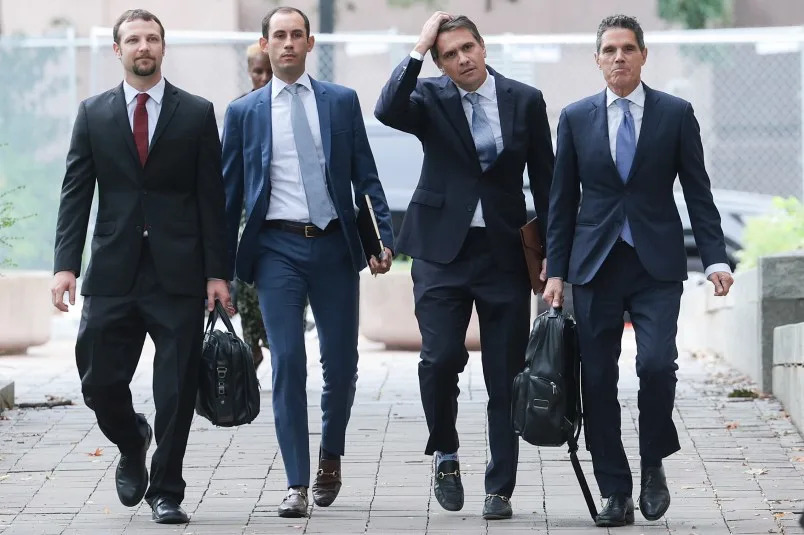
Attorneys for former U.S. President Donald Trump Todd Blanche (2nd R), John Lauro (R) and Gregory Singer (L) arrive at the E. Barrett Prettyman U.S. Court House August 28, 2023 in Washington, DC. (Photo by Win McNamee/Getty Images)
Cobb, the veteran defense attorney and former federal prosecutor who once worked for Trump, theorized to TPM that the inclusion of election conspiracy theories is likely an effort directed by the former president to “relitigate that and complicate the criminal case.” Cobb predicted that strategy would be an utter failure since it is “irrelevant” to the question of whether Trump tried to obstruct an official proceeding.
“As a criminal defendant, you’re basically allowed to say it was an alien abduction,” Cobb said.
While Trump and his attorneys might be able to bring up election conspiracy theories in pre-trial hearings, Cobb predicted the judge would not allow them to take these issues to trial.
“You can get away with a lot argumentatively pretrial, but that’s why this would be a pretrial exercise. … He needs to get through her to be able to raise this at trial,” Cobb said, referencing U.S. District Judge Tanya Chutkan, “and he won’t be able to do that.”
Though Cobb does not expect “The Nucleus File” will make it further into Trump’s case, its inclusion in the filings so far does seem to shed light on the figures surrounding the president. On both his campaign and in his defense Trump has found people who are willing to indulge in the 2020 election fantasies promoted by the former president.
For his part, Cobb said he would refuse to file this type of information for a client and would “withdraw” if they insisted on it.
“There’s right and wrong, and the importance of ethics, and having a duty of candor with the court,” Cobb said, adding, “You don’t perpetrate a fraud upon the court and you try to stop shy of letting your client do it. So this is the kind of thing I would just say no to.”
Trump’s current legal and political operations clearly have no such qualms.
Biden blames Trump for sinking bipartisan immigration bill
By Steve Holland – February 6, 2024
WASHINGTON (Reuters) -U.S. President Joe Biden said on Tuesday that the bipartisan immigration bill is falling apart under political pressure from Republican rival Donald Trump and vowed to hit the road to remind voters who was to blame if it fails.
“All indications are this bill won’t even move forward to the Senate floor. Why? The simple reason: Donald Trump,” Biden said. “Because Donald Trump thinks it’s bad for him politically.”
Concerns over immigration have become a top issue in this year’s election campaign, with Trump preparing for a likely November rematch with Biden. Trump has been pushing congressional Republicans to reject the bipartisan border security deal unveiled on Sunday.
A spokesperson for Trump did not immediately respond to a request for comment.
Biden’s vow to make the Republican ex-president’s efforts to kill the bill a major theme of his reelection campaign is a risky bet given polls showing that Americans give Biden low grades for his handling of border security and immigration.
The Democratic president’s approval rating sank to 38% in January as concerns over immigration flared, the latest Reuters/Ipsos poll showed.
Biden has grappled with record numbers of migrants caught illegally crossing the U.S.-Mexico border during his presidency. Republicans contend that Biden should have kept the restrictive policies of Trump.
In December, encounters averaged more than 9,500 per day, according to U.S. government statistics, but have dropped steeply in about the last month.
Biden will test whether blaming Trump for thwarting a bipartisan compromise can help change American minds.
“I’ll be taking this issue to the country and the voters are gonna know that…just at the moment we’re going to secure the border and fund these other programs Trump and the MAGA Republicans said no because they’re afraid of Donald Trump,” Biden said at the White House.
The $118 billion bill, which also includes aid for Israel and Ukraine as it fights a Russian invasion, is quickly losing support on Capitol Hill. House of Representatives Republicans have declared it dead on arrival, and more than 20 Republican senators have said the measure is not strict enough.
Several Democrats have also opposed the bill because they say some of its measures treat migrants too harshly.
Biden didn’t mention the Democratic opposition, but blamed Republicans for buckling under the pressure from Trump, who he said was reaching out to Republican lawmakers to “intimidate them to vote against this proposal.”
“Frankly, they owe it to the American people to show some spine and do what they know to be right,” Biden said.
Senate Majority Leader Chuck Schumer on Tuesday also took aim at Trump over the mounting opposition to the border security deal.
“Donald Trump would rather keep the chaos at the border so he can exploit it on the campaign trail instead of letting the Senate do the right thing and fix it,” Schumer said.
(Reporting by Steve Holland and Jarrett Renshaw; Writing by Jarrett Renshaw; Editing by Trevor Hunnicut and Leslie Adler)
Negotiators in the Senate have produced a draft agreement on immigration and asylum. The deal delivers on Republican priorities. It includes changes to federal law to discourage asylum seeking. It shuts down asylum processing altogether if too many people arrive at once. Those and other changes send a clear message to would-be immigrants: You’re going to find it a lot harder to enter the United States without authorization. Rethink your plans.
The draft agreement offers little to nothing on major Democratic immigration priorities: no pathway to citizenship for long-term undocumented immigrants, only the slightest increase in legal immigration. The Democrats traded away most of their own policy wish list. In return, they want an end to the mood of crisis at the border, plus emergency defense aid for Ukraine and Israel.
Yet Republicans in the House seem determined to reject the draft agreement. They appear poised to leave in place a status quo that one senior GOP House leader has described as an “invasion” and an “existential and national security threat.”
So if no deal results, what truths will we learn from this process?
The first is that Republicans don’t really care all that much about the situation at the border. A real “existential threat” cannot wait for some later date. People who perceive an existential threat don’t delay. In fact, a good many Republican legislators are very happy to allow a continuing flow of laborers across the border.
Consider that Florida’s Republican-controlled House of Representatives has voted to allow 16- and 17-year-olds to work eight-hour days during the school year. Or that the Republican governor of Arkansas has signed a bill that relieves the state of having to certify that teenage workers aged 14 and 15 may work. Or that Ohio’s Republican-controlled legislature may soon pass a law allowing 14- and 15-year-olds to work as late as 9 p.m. on school nights. Or that Republican legislators in Wisconsin are pushing to allow 14-to-17-year-olds to serve alcohol in bars and restaurants. Consider also that all of these changes are written with teenage migrants very much in mind: Almost 40 percent of recent border-crossers have been under 18, a fivefold increase since the late aughts.
Those teenagers are traveling both alone and in family groups. They are coming to the U.S. to work. When state legislatures relax the rules on employing under-18s and under-16s, they’re flashing a giant we’re hiring sign to job-seeking teenagers around the world. The legislators know that. The teenagers know it. American voters should know it too.
A second truth concerns what Republican priorities really are. When Mike Johnson was elevated to the House speakership, he claimed that he genuinely wanted to help Ukraine but that aid had to wait until Congress passed new laws to harden the U.S. southern border. He wrote to President Joe Biden as recently as December 5 that further aid to Ukraine was “dependent upon enactment of transformative change to our nation’s border security laws.” When Senate negotiators produced exactly what Johnson said he wanted—a transformative bill that Congress could enact—he responded by reversing his demands. Johnson no longer wants any law at all. But one thing is constant: no aid to Ukraine—which suggests that “no aid to Ukraine,” not “defend the border,” is the true priority here.
A third truth is suggested by the angry reaction of House Republicans to the work of Senate Republicans: The very act of negotiation is mistrusted. Along with their speaker, House Republicans radically altered their position from “there must be a new law” to “there must be no new law,” and from “the president must sign our bill exactly as we wrote it” to “the president must act unilaterally by executive authority only.” How does anyone negotiate with a House majority that can so abruptly and totally pivot? The true goal revealed is failure and chaos.
And this points to a fourth truth, maybe the most important one of all. Donald Trump has sold his supporters the dangerous fantasy that democratic politics can be replaced by one man’s will. No need for distasteful compromises. No need to reckon with the concerns and interests of people who disagree with House Republicans. Just somehow return Trump to the presidency: He’ll bark; the system will obey.
Of course, such fantasies have no basis in reality. As the Cato Institute reported last November:
The Biden Department of Homeland Security (DHS) has removed a higher percentage of arrested border crossers in its first two years than the Trump DHS did over its last two years. Moreover, migrants were more likely to be released after a border arrest under President Trump than under President Biden. In absolute terms, the Biden DHS is removing 3.5 times as many people per month as the Trump DHS did.
Altogether, about 1.1 million unauthorized border-crossers were released into the United States during the Trump presidency and not removed by the end of his term. Glowering and yelling do not in fact accomplish much. But to many Trump supporters, glowering and yelling are the whole of it. They don’t care how little gets accomplished, so long as that little is done in the most offensive manner possible.
In their 1981 study of negotiation, Getting to Yes, Roger Fisher and William Ury stress the importance of understanding the opposite party’s point of view. Among the benefits of doing so is helping a negotiator recognize when he’s received the best offer he’s likely to get—and then say yes rather than press for more and arrive at no.
Arriving at no is what’s happening now among the House Republicans. Because they refuse to understand the other side, they cannot appreciate a good offer and recognize when to accept it. They’re going to arrive only at no—no for America, and no for Ukraine. But no is what they want.
Until a few days ago, I was feeling fairly sanguine about America’s prospects. Economically, we’ve had a year of strong growth and plunging inflation — and aside from committed Republicans, who see no good, hear no good and speak no good when a Democrat is president, Americans appear to be recognizing this progress. It has seemed increasingly likely that the nation’s good sense would prevail and democracy would survive.
But watching the frenzy over President Biden’s age, I am, for the first time, profoundly concerned about the nation’s future. It now seems entirely possible that within the next year, American democracy could be irretrievably altered.
And the final blow won’t be the rise of political extremism — that rise certainly created the preconditions for disaster, but it has been part of the landscape for some time now. No, what may turn this menace into catastrophe is the way the hand-wringing over Biden’s age has overshadowed the real stakes in the 2024 election. It reminds me, as it reminds everyone I know, of the 2016 furor over Hillary Clinton’s email server, which was a minor issue that may well have wound up swinging the election to Donald Trump.
As most people know by now, Robert Hur, a special counsel appointed to look into allegations of wrongdoing on Biden’s part, concluded that the president shouldn’t be charged. But his report included an uncalled-for and completely unprofessional swipe at Biden’s mental acuity, apparently based on the president’s difficulty in remembering specific dates — difficulty that, as I wrote on Friday, everyone confronts at whatever age. Hur’s gratuitous treatment of Biden echoed James Comey’s gratuitous treatment of Clinton — Hur and Comey both seemed to want to take political stands when that was not their duty.
Yes, it’s true that Biden is old, and will be even older if he wins re-election and serves out a second term. I wish that Democrats had been able to settle on a consensus successor a year or two ago and that Biden had been able to step aside in that successor’s favor without setting off an intraparty free-for-all. But speculating about whether that could have happened is beside the point now. It didn’t happen, and Biden is going to be the Democratic nominee.
It’s also true that many voters think the president’s age is an issue. But there’s perception and there’s reality: As anyone who has recently spent time with Biden (and I have) can tell you, he is in full possession of his faculties — completely lucid and with excellent grasp of detail. Of course, most voters don’t get to see him up close, and it’s on Biden’s team to address that. And yes, he speaks quietly and a bit slowly, although this is in part because of his lifetime struggle with stuttering. He also, by the way, has a sense of humor, which I think is important.
Most important is that Biden has been a remarkably effective president. Trump spent four years claiming that a major infrastructure initiative was just around the corner, to the point that “It’s infrastructure week!” became a running joke; Biden actually got legislation passed. Trump promised to revive American manufacturing, but didn’t. Biden’s technology and climate policies — the latter passed against heavy odds — have produced a surge in manufacturing investment. His enhancement of Obamacare has brought health insurance coverage to millions.
If you ask me, these achievements say a lot more about Biden’s capacity than his occasional verbal slips.
And what about his opponent, who is only four years younger? Maybe some people are impressed by the fact that Trump talks loud and mean. But what about what he’s actually saying in his speeches? They’re frequently rambling word salads, full of bizarre claims like his assertion on Friday that if he loses in November, “they’re going to change the name of Pennsylvania.”
Not to mention confusing Nikki Haley with Nancy Pelosi and mistaking E. Jean Carroll for one of his ex-wives.
As I also wrote last week, Trump’s speeches make me remember my father’s awful last year, when he suffered from sundowning — bouts of incoherence and belligerence after dark. And we’re supposed to be worried about Biden’s mental state?
Over the past few days, while the national discussion has been dominated by talk about Biden’s age, Trump declared that he wouldn’t intervene to help “delinquent” NATO members if Russia were to attack them, even suggesting that he might encourage such an attack. He seems to regard NATO as nothing more than a protection racket and after all this time still has no idea how the alliance works. By the way, Lithuania, the NATO member that Trump singled out, has spent a larger percentage of its G.D.P. on aid to Ukraine than any other nation.
Again, I wish this election weren’t a contest between two elderly men and worry in general about American gerontocracy. But like it or not, this is going to be a race between Biden and Trump — and somehow the lucid, well-informed candidate is getting more heat over his age than his ranting, factually challenged opponent.
As I said, until just the other day I was feeling somewhat optimistic. But now I’m deeply troubled about our nation’s future.
Paul Krugman has been an Opinion columnist since 2000 and is also a distinguished professor at the City University of New York Graduate Center. He won the 2008 Nobel Memorial Prize in Economic Sciences for his work on international trade and economic geography.
How two sentences in the Constitution rose from obscurity to ensnare Donald Trump
Nicholas Riccardi – February 4, 2024
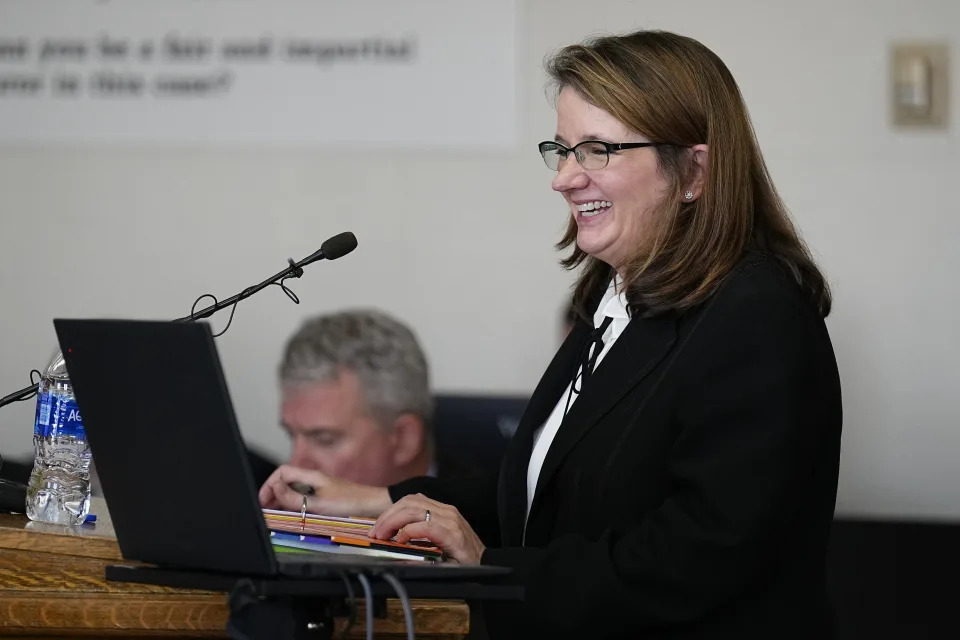
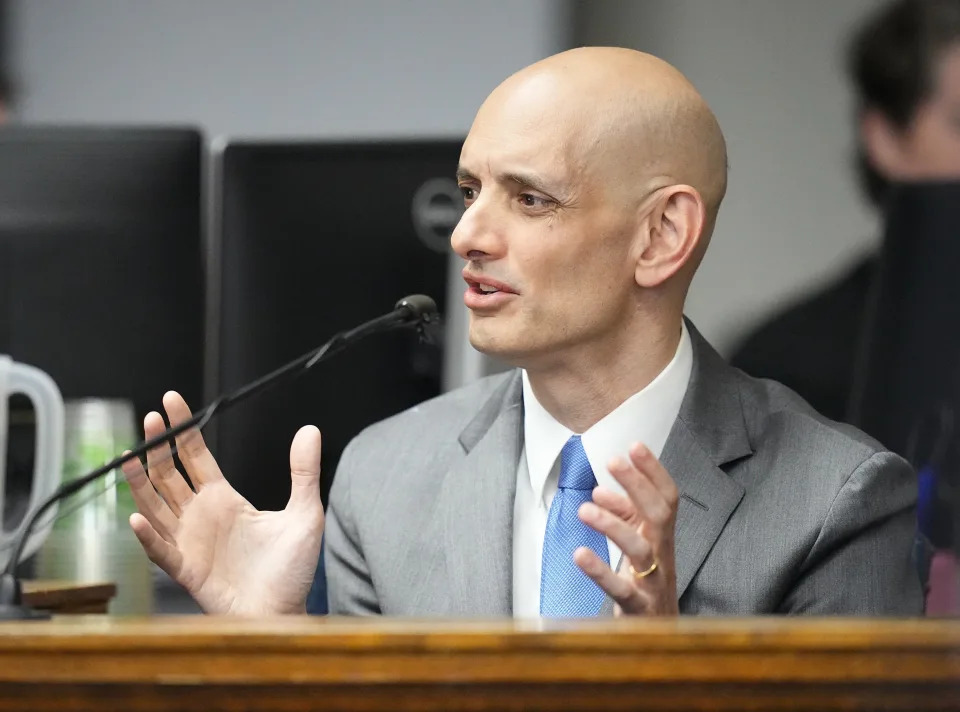
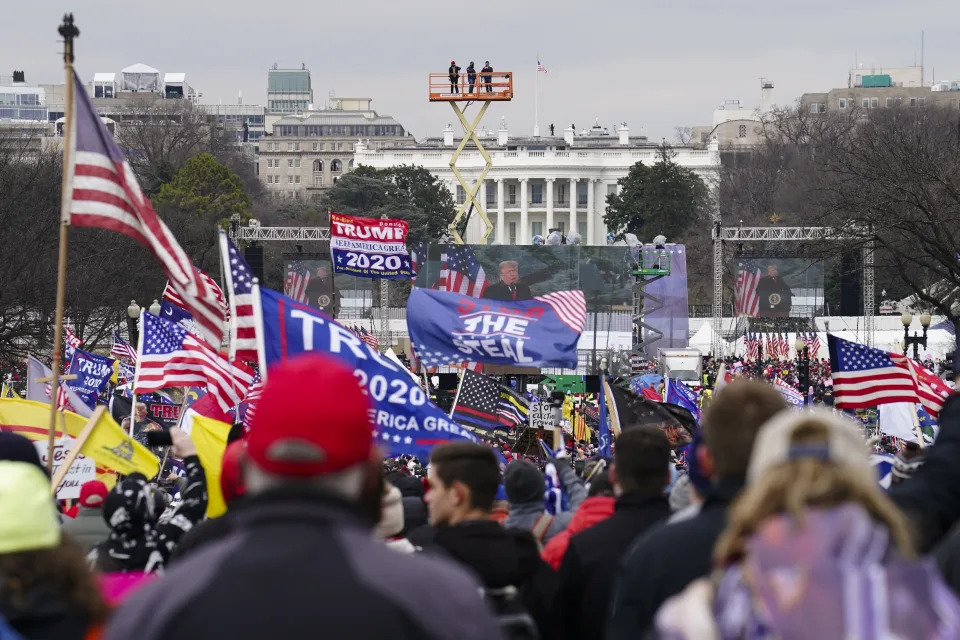
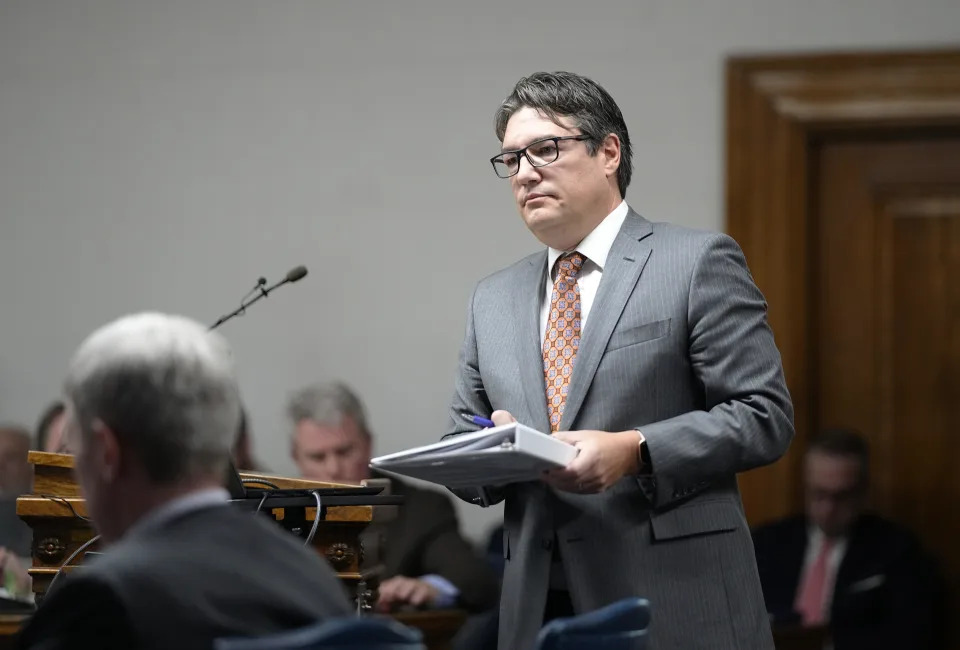
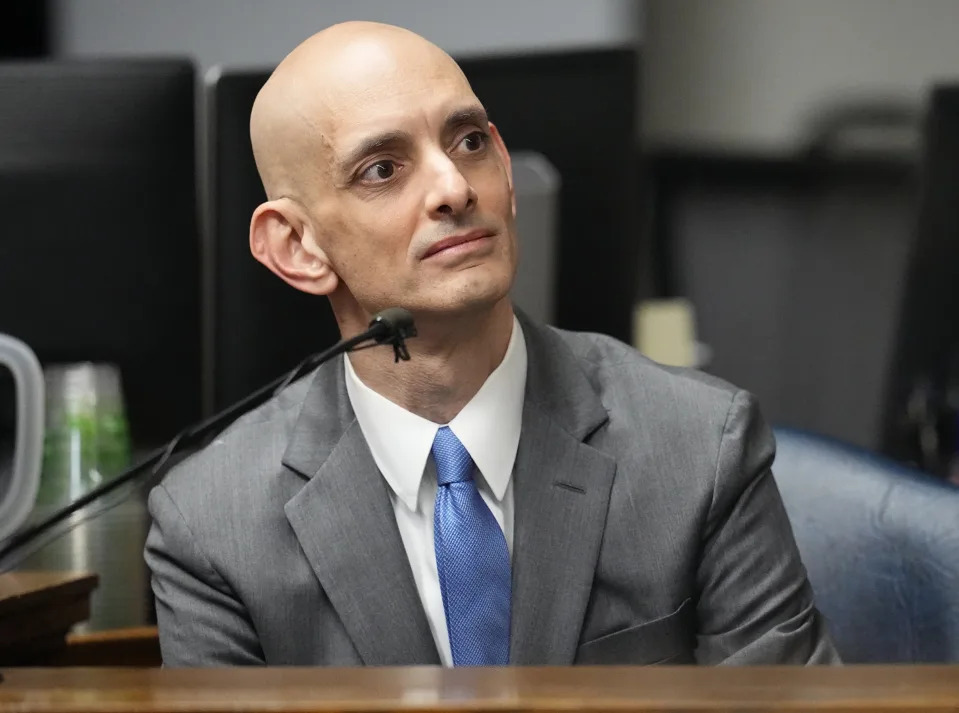
Trump supporters participate in a rally in Washington, Jan. 6, 2021, that some blame for fueling the attack on the U.S. Capitol. On Thursday, Feb. 8, the nation’s highest court is scheduled to hear arguments in a case involving Section 3 of the 14th Amendment, which prohibits those who “engaged in insurrection or rebellion” from holding office. The case arises from a decision in Colorado, where that state’s Supreme Court ruled that Trump violated Section 3 of the 14th Amendment and should be banned from ballot. (AP Photo/John Minchillo, File)Then-President Donald Trump speaks during a rally protesting the Elector College certification of Joe Biden’s win in the 2020 presidential race, in Washington on Jan. 6, 2021. On Thursday, Feb. 8, 2024, the nation’s highest court is scheduled to hear arguments for a case involving Section 3 of the 14th Amendment, prohibiting those who “engaged in insurrection or rebellion” from holding office. The case arises from a decision in Colorado, where that state’s Supreme Court ruled that Trump violated Section 3 and should be banned from ballot. (AP Photo/Evan Vucci, File) Attorney Scott Gessler speaks during a hearing before the Colorado Supreme Court for a lawsuit to keep former President Donald Trump off the state ballot, on Dec. 6, 2023, in Denver. On Thursday, Feb. 8, 2024, the nation’s highest court is scheduled to hear arguments in a case that arises from the state Supreme Court’s decision that Trump violated Section 3 of the 14th Amendment and should be banned from ballot.(AP Photo/David Zalubowski, Pool, File)Trump supporters participate in a rally in Washington, Jan. 6, 2021, that some blame for fueling the attack on the U.S. Capitol. On Thursday, Feb. 8, the nation’s highest court is scheduled to hear arguments in a case involving Section 3 of the 14th Amendment, which prohibits those who “engaged in insurrection or rebellion” from holding office. The case arises from a decision in Colorado, where that state’s Supreme Court ruled that Trump violated Section 3 of the 14th Amendment and should be banned from ballot. (AP Photo/John Minchillo, File)Attorney Eric Olson, far right, argues before the Colorado Supreme Court for a lawsuit to keep former President Donald Trump off the state ballot on Dec. 6, 2023, in Denver. On Thursday, Feb. 8, 2024, the nation’s highest court is scheduled to hear arguments in a case that arises from the state Supreme Court’s decision that Trump violated Section 3 of the 14th Amendment and should be banned from ballot. (AP Photo/David Zalubowski, Pool, File)Attorney Martha Tierney smiles during a hearing for a lawsuit to keep former President Donald Trump off the Colorado ballot in court Oct. 30, 2023, in Denver. On Thursday, Feb. 8, 2024, the nation’s highest court is scheduled to hear arguments in a case that arises from the state Supreme Court’s decision that Trump violated Section 3 and should be banned from ballot. (AP Photo/Jack Dempsey, Pool, File) Gerard Magliocca, a professor at Indiana University’s Robert H. McKinney School of Law, testifies during a hearing for a lawsuit to keep former President Donald Trump off the Colorado ballot, Nov. 1, 2023, in Denver. During the coronavirus pandemic, Magliocca began to research the history of two rarely noticed sentences tucked in the middle of the 14th Amendment. (AP Photo/Jack Dempsey, Pool, File)Trump supporters participate in a rally in Washington, Jan. 6, 2021, that some blame for fueling the attack on the U.S. Capitol. On Thursday, Feb. 8, the nation’s highest court is scheduled to hear arguments in a case involving Section 3 of the 14th Amendment, which prohibits those who “engaged in insurrection or rebellion” from holding office. The case arises from a decision in Colorado, where that state’s Supreme Court ruled that Trump violated Section 3 of the 14th Amendment and should be banned from ballot. (AP Photo/John Minchillo, File)Sean Grimsley, attorney for the petitioners, delivers closing arguments during a hearing for a lawsuit to keep former President Donald Trump off the Colorado ballot in district court, Nov. 15, 2023, in Denver. On Thursday, Feb. 8, 2024, the nation’s highest court is scheduled to hear arguments in a case that arises from the state Supreme Court’s decision that Trump violated Section 3 of the 14th Amendment and should be banned from ballot. (AP Photo/Jack Dempsey, Pool, File)Gerard Magliocca, a professor at Indiana University’s Robert H. McKinney School of Law, testifies during a hearing for a lawsuit to keep former President Donald Trump off the Colorado ballot, Nov. 1, 2023, in Denver. During the coronavirus pandemic, Magliocca began to research the history of two rarely noticed sentences tucked in the middle of the 14th Amendment. (AP Photo/Jack Dempsey, Pool, File)
DENVER (AP) — In the summer of 2020, Gerard Magliocca, like many during the coronavirus pandemic, found himself stuck inside with time on his hands.
A law professor at Indiana University, Magliocca figured he would research the history of two long-neglected sentences in the Constitution’s 14th Amendment. Dating to the period just after the Civil War, they prohibit those who “engaged in insurrection or rebellion” from holding office.
On Jan. 6, 2021, after then-President Donald Trump‘s supporters stormed the U.S. Capitol to try to block certification of his loss to Joe Biden, Magliocca watched as Republicans such as Sens. Mitch McConnell and Mitt Romney described the attack as an “insurrection.”
That night, Magliocca composed a quick post on a legal blog: “Section Three of the Fourteenth Amendment,” he wrote, “might apply to President Trump.”
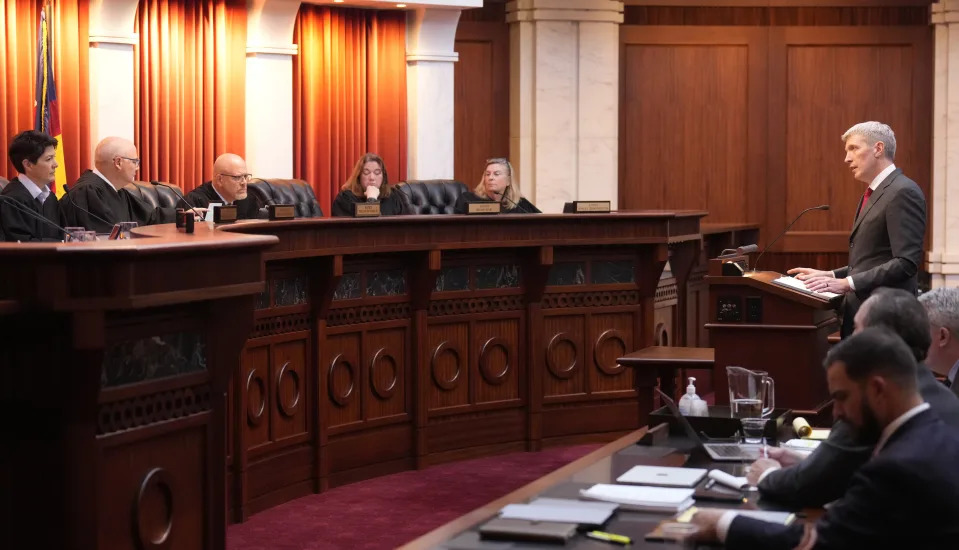
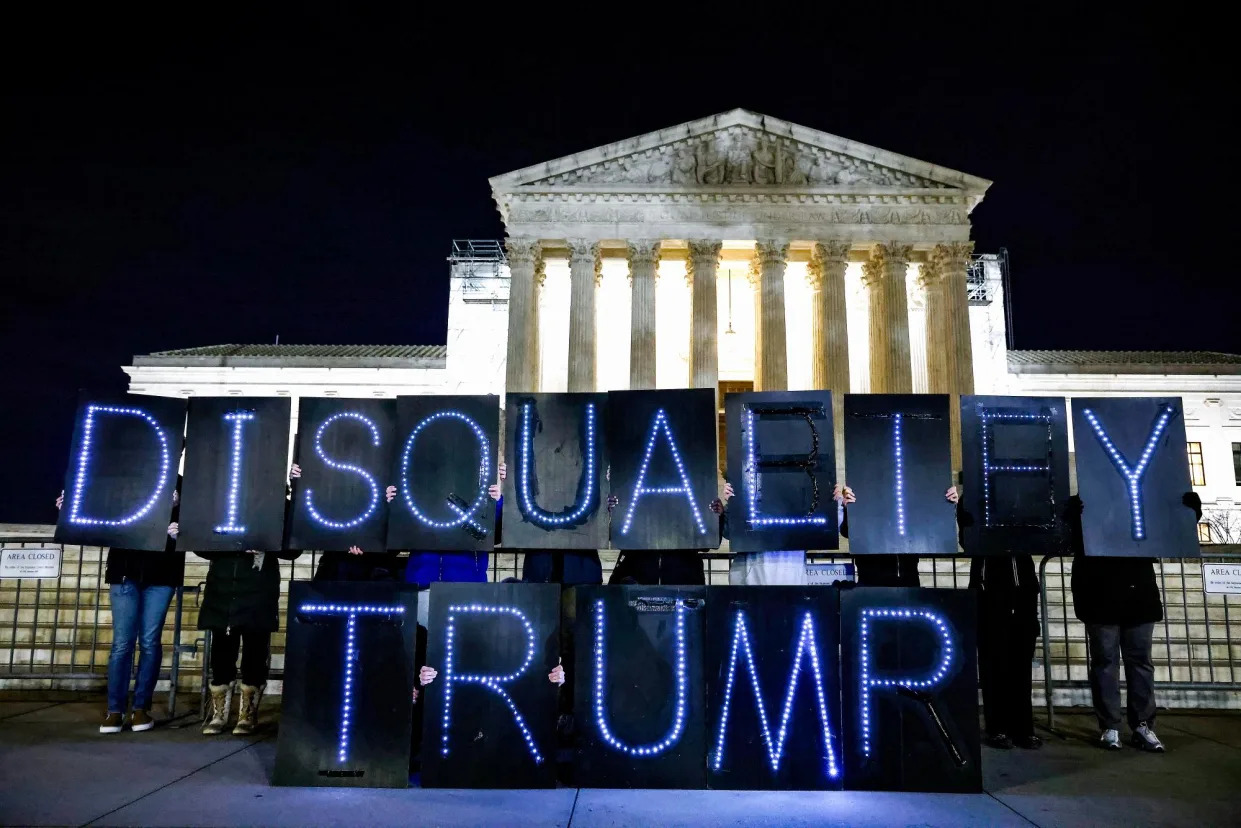
Just over four years later, the U.S. Supreme Court will have to determine whether it does. On Thursday, the nation’s highest court is scheduled to hear arguments over whether Trump can remain on the ballot in Colorado, where the state’s Supreme Court ruled that he violated Section 3.
It’s the first time the Supreme Court has heard a case on Section 3, which was used to keep former Confederates from holding government offices after the amendment’s 1868 adoption. It fell into disuse after Congress granted an amnesty to most ex-rebels in 1872.
Before the attack on the Capitol, even many constitutional lawyers rarely thought about Section 3. It hadn’t been used in court for more than 100 years. Its revival is due to an unlikely combination of Democrats and Republicans, liberals and conservatives, all rediscovering 111 words in the nation’s foundational legal document that have now become a threat to the former president’s attempt to return to office.
In the days after Jan. 6, thanks to scholars such as Magliocca, Section 3 started its slow emergence from obscurity.
Free Speech For People, a Massachusetts-based liberal nonprofit, sent letters to top election officials in all 50 states in June 2021, warning them not to place Trump on the ballot should he run again in 2024.
The group didn’t hear back from any of them.
“People were just treating it as something that was not serious,” recalled John Bonifaz, the group’s co-founder.
In January 2022, Free Speech For People filed a complaint in North Carolina to disqualify Republican Rep. Madison Cawthorn under Section 3. Cawthorn lost his primary, mooting the case.
That same month, the group Citizens for Responsibility and Ethics, also known as CREW, decided to test Section 3 in court.
“It wasn’t just Trump we were focused on,” chief counsel Donald Sherman said in an interview. “One thing we’ve been very careful about is we don’t think it’s appropriate to pursue outside or longshot cases.”
On Sept. 6, 2022, a New Mexico judge ordered Couy Griffin, a rural New Mexico county commissioner convicted of illegally entering the Capitol on Jan. 6, removed from his position after CREW filed against him. It was the first time in more than 100 years an official had been removed under Section 3. Griffin has appealed to the Supreme Court.
Trump announced his campaign for president two months later.
Both Free Speech For People and CREW began scouring state ballot laws, looking for places that allowed the rapid contesting of a candidacy. CREW settled on Colorado.
Sherman and another CREW attorney, Nikhel Sus, contacted Martha Tierney, a veteran election lawyer who also served as general counsel of the state Democratic Party.
Tierney wasn’t acting as the Democratic Party’s lawyer, but CREW wanted to balance its team. Sherman contacted Mario Nicolais, a former Republican election lawyer who had left the party over Trump.
Nicolais’ first interaction with Sherman was a direct message about the case on X, the social media platform previously known as Twitter. Nicolais thought it could be from a crank.
“Is this for real or is this from somebody just angry at the president?” Nicolais recalled wondering.
On Sept. 6, 2023 — one year from the disqualification of Griffin — their 105-page complaint was filed in district court in Denver.
Trump hired former Colorado Secretary of State Scott Gessler to represent him. The Denver judge who got CREW’s complaint, Sarah Block Wallace, said she was obligated to hold a hearing under state election law.
During the five-day hearing, two officers who defended the Capitol testified, along with a University of California professor who was an expert in right-wing extremism, two Trump aides and several other witnesses. One was Magliocca, who laid out the history of Section 3.
Trump’s attorneys were pessimistic, expecting Wallace, who had a history of donating to Democrats, to rule against them. Trump spokesman Jason Miller addressed reporters outside court, complaining that the plaintiffs had intentionally filed in a liberal jurisdiction in a blue state.
Wallace issued her decision on Nov. 17. She found that Trump had “engaged in insurrection” but ruled that — contrary to Magliocca’s testimony — it wasn’t certain that the authors of the 14th Amendment meant it to apply to the president. Section 3 refers to “elector of President and Vice President,” but not the office itself.
Wallace was hesitant to become the first judge in history to bar a top presidential contender unless the law was crystal clear.
“It was a loss that only a lawyer could love,” Sus recalled.
CREW was just a legal sliver away from victory. It just needed the Colorado Supreme Court to uphold all of Wallace’s ruling besides the technicality of whether the president was covered.
The seven justices of the state’s high court — all appointed by Democrats from a pool chosen by a nonpartisan panel — peppered both sides with pointed questions at oral argument three weeks later.
Neither side left feeling certain of victory.
On Dec. 19, the court announced it would issue its decision that afternoon — ruling 4-3 that Trump was disqualified. The decision was put on hold, pending the outcome of the case that will be argued Thursday.
A progressive political action committee that typically supports veterans’ issues and Democratic-leaning veterans running for office plans to pump $45 million into the effort to reelect President Biden this fall and bolster other Democrats on the ballot.
A spokesperson for VoteVets confirmed the plans to The Hill after The New York Times first reported the effort.
A $15 million push aimed at courting veterans and active-duty military families in the presidential battleground states will be the centerpiece, according to the group.
VoteVets also identified these races among the group’s priorities: Incumbent Democratic senators in Montana, Nevada, Pennsylvania and Ohio; Democratic Reps. Ruben Gallego (Ariz.) and Elissa Slotkin (Mich.), who are running for Senate; and Rep. Andy Kim (N.J.), who is challenging embattled Sen. Bob Menendez (D-N.J.).
Former President Trump, seen as the front-runner for the GOP presidential nomination, has enjoyed robust support among military members in the past, but his edge slipped from the 2016 election to the 2020 cycle.
VoteVets co-founder and chairman Jon Soltz told The Times in an interview that Trump’s vocal support for people who carried out the Jan. 6, 2021 attack on the Capitol and past remarks against military officials and soldiers will be highlighted in the ads.
“There’s political ramifications to all this,” he said. “There’s no other way to explain the disrespect to Gold Star families and the erratic behavior and the attacks on our law enforcement at the Capitol — these are values things.”
The group unveiled part of its plan with a 60-second spot in Pennsylvania last month that highlights remarks attributed to Trump referring to veterans as “losers” and “suckers” and features Gold Star families responding.
VoteVets has in the past shown that it’s messaging beyond military families with its efforts.
In Georgia’s 2022 Senate race, the group released an ad accusing Republican candidate and former football star Herschel Walker of defrauding the government at the expense of veterans. Walker ultimately lost to Democratic Sen. Raphael Warnock.
‘The threat isn’t over’: the expert arguing to the supreme court Trump is an insurrectionist
David Smith in Washington – February 5, 2024
MoveOn members rally outside the supreme court in Washington DC on 1 February.Photograph: Paul Morigi/Getty Images for MoveOn
When Jill Habig had an office down the hall from Kamala Harris in California, Barack Obama was US president, abortion was a constitutional right and January 6 was just another date on the calendar. A lot has happened since then.
On Thursday Habig, now president of the non-profit Public Rights Project (PRP), hopes her arguments will persuade the supreme court that Donald Trump is an insurrectionist who should be disqualified from the 2024 presidential election.
Habig has filed an amicus brief on behalf of historians contending that section 3 of the 14th amendment to the constitution, which bars people who “engaged in insurrection” from holding public office, applies to Trump’s role in the 6 January 2021 attack on the US Capitol.
The brief gives the supreme court’s originalists, who believe the constitution should be interpreted as it would have been in the era it was written, a taste of their own medicine. Conservative justices Clarence Thomas, Neil Gorsuch, Brett Kavanaugh and Amy Coney Barrett are self-declared originalists while Samuel Alito has described himself as a “practical originalist”.
“Our goal was to bring an originalist historical perspective to the supreme court as it considered the meaning of section 3 of the 14th amendment,” Habig, a former special counsel to then California attorney general Harris, says by phone from Oakland. “The point we make with our historian colleagues is that the history of section 3 is actually very clear. It demonstrates that section 3 was intended to automatically disqualify insurrectionists.”
The amicus brief, led by historians Jill Lepore of Harvard and David Blight of Yale, cites debates from the time in which senators made clear that their view that the provision that would not only apply for former Confederates but to the leaders of rebellions yet to come.
Habig adds: “It was intended to apply not only to the civil war but also to future insurrections and it bars anyone who has betrayed an oath to uphold the constitution from becoming president of the United States.”
The supreme court will hear arguments on a Colorado case in which Trump was stricken from the ballot; a decision in Maine is on hold. Other states have ruled in favor of keeping Trump on the ballot. The flurry of decisions have prompted debate over whether Trump can be fairly considered to have committed insurrection even though he has not been found guilty in a court of law – at least not yet.
Habig, who founded the PRP in 2017, says yes. “It’s clear historically that there was no requirement of a conviction or even of charges, that the framers intended section 3 to be self-executing. The brief goes through a number of examples of people who had taken part in the secession and been on the Confederate side actually petitioning Congress for exceptions. There’s a lot of evidence that it was self-executing. There was no need for a particular conviction.”
She adds: “The evidence that we have seen and heard and watched with our own eyes over the last few years has made it quite clear that President Trump lost an election in 2020 and has spent the months and years since then trying to overturn the results of that election in a variety of ways, including people marching to the Capitol and invading the Capitol.”
It’s difficult to argue with a straight face that these activities don’t qualify for section 3
Jill Habig
Indeed, Blight has pointed out that the US Capitol was never breached during the civil war but was on January 6. Habig comments: “It’s difficult to argue with a straight face that these activities don’t qualify for section 3.”
Still, there are plenty of Republicans, Democrats and neutrals who warn that the 14th amendment drive is politically counterproductive, fueling a Trumpian narrative that state institutions are out to stop him and that Joe Biden is the true threat to democracy. Let the people decide at the ballot box in November, they say.
Habig counters: “It’s important to note that the American people did decide in 2020. We had a political process and then we had a president of the United States who attempted to overturn that political process. ”
Spectacular as it was, the January 6 riot did not occur in a vacuum. Habig and her work at the PRP place it in a wider context of a growing movement to harass and threaten election officials and to interfere with the administration of elections. She perceives a direct line between Trump’s “big lie” and threats to democracy across the country today.
“Regardless of this particular case, the threat isn’t over. It’s actually intensifying. We’re just seeing an array of efforts to rig the rules of the game against our democracy and it’s part of why we’re investing a lot of resources into protecting election officials this cycle, and to litigating and advancing voting rights and free and fair elections this year.”
How did America get here? A turning point was the supreme court’s 5-4 decision in 2013 to strike down a formula at the heart of the Voting Rights Act, so that voters who are discriminated against now bear the burden of proving they are disenfranchised. Since then states have engaged in a barrage of gerrymandering – manipulating district boundaries so as to favor one party – and voter suppression.
Habig reflects: “The gutting of the Voting Rights Act by the supreme court left states to themselves to rewrite the rules of the game in a variety of ways that disenfranchised voters and continued to rig maps against their systems and fair representation.
“We’ve seen the supreme court take itself out of the game of protecting other fundamental rights like abortion and throw that back into the states. What that’s creating is a lot of volatility at the state and local level as officials try to rewrite the rules or pick up the pieces and protect their constituents’ rights. What we’re trying to do is help state and local officials across the country use the power that they have to fight back and advance civil rights in all the ways that they can.”
The PRP is building a rapid response hub to provide legal support for 200 election officials to combat harassment and intimidation and targeting election deniers. It is pursuing litigation against gerrymandering, the disqualification of legitimate ballots and state officials who try to prevent voters weighing in on ballot measures to advance abortion rights.
“This is an all-out effort to make sure that we don’t have death by a thousand cuts for our democracy this year,” Habig says. “We are potentially less likely to see one central threat like we did on January 6 or even in the 2020 election. We’ve seen some of the larger counties like Maricopa county, Arizona, Philadelphia, Detroit et cetera, who have been targets in the past, have more resources to fight back.
“What we’re most concerned about is the soft underbelly of our democracy, which is the smaller, less-resourced jurisdictions that just don’t have all of the capacity they need to push back against this harassment and intimidation. Because of our decentralised system, election deniers who are intent on disrupting our elections and disrupting the outcome of our election don’t have to mount a huge effort in one place.
“They can pick apart jurisdiction by jurisdiction, invalidate 250 ballots here, and a thousand ballots there and 500 there, challenge absentee ballots, disrupt targeted polling places and that in the aggregate can actually change election results, sow disillusionment and distrust in our system and have the same or even worse aggregate outcome in terms of undermining the integrity of our election. That’s what we’re mobilising to prevent.”
There was no greater measure of America’s ailing democracy than the 2022 decision to overturn Roe v Wade, the ruling that in effect made abortion legal nationwide, by supreme court justices appointed by presidents who lost the national popular vote. But since then, in a series of ballot measures in individual states, abortion rights have prevailed.
Habig reflects: “Every single time that has been put to voters, abortion rights have won. As a result, we’re actually starting to see a lot of overlap between the reproductive rights fight and the democracy fight because this battle over abortion is fuelling additional efforts to break the rules and prevent voters from having a meaningful say in their rights. We’re mobilising on both fronts because the future of both is interconnected.”
PRP says it has worked with local elected officials to provide legal guidance and filed dozens of amicus briefs in key reproductive rights cases, secured legal access to abortion for 6.5 million people. Habig explains: “We’re working with state and local officials to overturn criminal abortion bans at the state level.
“We’re working to poke holes in existing criminal bans when there’s not a path to overturn them right away. Then we’re working to hold crisis pregnancy centers accountable for deception of women and patients; these are anti-abortion centers that masquerade as health clinics that provide comprehensive healthcare. We’re looking at this multi-pronged approach state by state and across the country.”
Habig, a political strategist who was deputy campaign manager for Harris’s first Senate election campaign in 2016, has no doubt that democracy and abortion rights will play a big part in the November election.
“I appreciate President Biden’s clarity on democracy and the constitution and his leadership on the issue. I do think it’s important for people to understand what democracy means and for their real lives. It can sound abstract sometimes and like an academic debate but bringing it down to the level of, do you have autonomy over your future and your community, do you have autonomy over your own body, is important for people.”
She adds: “That’s why we’ve seen in cases when we’re talking about the fundamental right to vote, people get that. When we’re talking about their autonomy, they get it. When they’re talking about their dignity in the workplace, people get that and feel that on a visceral level. It’s important that we work to build a democracy that actually delivers so that people can feel the value of it in their daily lives.”
Ex-GOP Lawmaker Has Urgent 2024 Message For Former Trump Loyalists
Josephine Harvey – February 5, 2024
Former Rep. Denver Riggleman (R-Va.) says it’s time for more of Donald Trump’s former allies to throw their weight behind President Joe Biden.
On MSNBC Sunday, Riggleman said it’s “absolutely” important for those who no longer support Trump to publicly back Biden. As examples, he pointed to former Trump aide Anthony Scaramucci and former Rep. Adam Kinzinger (R-Ill.), both of whom have said they would vote for Biden in his likely rematch with Trump this year.
“This is a person that you don’t want anywhere near … the Oval Office again,” Riggleman told MSNBC’s Alex Witt of the quadruply-indicted former president. “This is an individual that is out of touch with reality, or pretends that he’s out of touch with reality, to actually ignite the base, or to try to make the base violent, or to do things outside of what normal behavior would be.”
Riggleman said that when he considers what Trump has done and what kind of people he has surrounded himself with, “there’s nobody else who I’d vote for but Joe Biden.”
The ex-congressman announced in 2022 that he had left the Republican Party over its devotion to Trump.
Numerous former Trump associates and officials have in recent months spoken out about the former president and warned about the dangers of a potential White House return, but some have stopped short of saying they’d vote for Biden.
Riggleman later shared a RawStory editor’s tweet about his comments, writing: “Yes. I said this.”
“I am done identifying with a party,” he wrote on X (formerly Twitter). “I am an American— and right now that means supporting Democratic institutions and our way of life no matter what.”
Russia’s New Threats to Exiles: Seized Assets and Forced Returns
Anton Troianovski – February 1, 2024
Fans watch as Bi-2, one of Russia’s most popular rock bands, performs at Chalet Berezka, a Russian restaurant and nightclub in Dubai, United Arab Emirates on March 1, 2023. (Andrea DiCenzo/The New York Times)
In Bangkok this week, members of an anti-war Russian-language rock group were fighting deportation to Russia, detained in what supporters described as a cramped, hot, 80-person immigration holding cell.
On Wednesday in Moscow, the lower house of Parliament passed a law that will allow the Russian government to seize the property of Russians living abroad who, in the words of the legislature’s chair, “besmirch our country.”
The two developments, though thousands of miles apart, reflected the same grim calculus by the Kremlin: Using new legislation and apparent diplomatic pressure on other countries, it is turning the screws on Russia’s sprawling anti-war diaspora.
“Historic Russia has risen up,” President Vladimir Putin said at a meeting with backers of his presidential campaign on Wednesday, reprising his contention that the time has come to cleanse Russian society of pro-Western elements. “All this scum that’s always present in any society is being slowly, slowly washed away.”
Under the law, any Russian, even those in exile, found to be engaged in “crimes against national security” — including criticizing the invasion of Ukraine — could have their assets confiscated. Putin is expected to sign the law, though it is not yet clear how widely or aggressively the Kremlin plans to use it.
But the law’s quick passage — it sailed through the rubber-stamp State Duma unanimously — is another signal that the Kremlin, having stamped out dissent at home, is increasingly turning its attention to criticism from abroad. Hundreds of thousands of Russians fled after the war began, including many celebrities who can still reach their fans through platforms like YouTube, which remains accessible inside Russia.
Among the first to feel this increasing pressure are popular performers who have drawn large audiences in places popular with Russian émigrés like Dubai, United Arab Emirates, and Southeast Asia. In recent weeks, Russian anti-war celebrities have accused Thailand and Indonesia of bending to Russian pressure to cancel their shows, while an anti-war rapper found himself banned from reentering the United Arab Emirates, his adopted home.
The most dramatic case unfolded after members of the rock group Bi-2, originally from Belarus and one of Russia’s most popular bands, were arrested in Thailand last week for an immigration violation. Their supporters said Russian officials spent days pushing Thailand to deport some of them to Russia, where the musicians could have faced prosecution for criticizing the war.
By Wednesday, the rockers had escaped that fate thanks to the intervention of Israeli and Australian diplomats, who arranged for all seven band members to be deported to Israel, according to the group’s lawyer, who requested anonymity for security reasons. (Four are citizens of Israel, and one of Australia.)
The extent of the Kremlin’s efforts to get the rockers sent to Russia was not clear, but on Tuesday, the group said in a statement that Thai authorities had canceled an earlier plan to deport some of them to Israel after Russian diplomats visited the immigration center where they were being held.
Analysts and human rights advocates consider the case a stark demonstration of the Kremlin’s increasingly aggressive efforts to punish Russians speaking out against Putin abroad — especially when they do so in non-Western countries that are interested in maintaining good relations with Moscow.
“This is a special operation,” said Dmitry Gudkov, an exiled Russian opposition politician who is close to Bi-2, referring to what he described as Russia’s efforts to get the band members sent to Russia. “Their task is to grab someone big outside the country to show that they can grab anyone, anywhere.”
The rock group’s brooding hits are part of the soundtrack of the early Putin era, and in later years the group was rubbing shoulders with the Russian elite at marquee events — performing, for example, at Putin’s annual economic conference in St. Petersburg in 2019. But by last year, Bi-2’s lead singer, Igor Bortnik, was writing that Putin’s Russia evoked “only disgust and squeamishness.”
Russia’s Foreign Ministry denied interfering in the Bi-2 case in Thailand, but it referred to the band members soon after their detention as “sponsors of terrorism.” A Russian lawmaker, Andrei Lugovoi, said the country was awaiting Bi-2’s deportation “with open arms” and predicted: “Soon they’ll be playing and singing on spoons and metal plates, tap dancing in front of their cellmates.”
(Lugovoi is no stranger to Russian intervention abroad, having been charged by Britain in 2007 with poisoning a Putin critic in London.)
Thailand, which has stuck to a largely neutral stance on the war in Ukraine and is a prime destination for Russian tourists, said it was following established procedure. Asked by a reporter on Wednesday about the potential deportation to Russia of Bi-2 band members, the country’s foreign minister, Parnpree Bahiddha-Nukara, said that if they are found to have “committed illegal acts,” then Thailand “has to follow the process.”
The band released a statement from its concert organizer, VPI Event, acknowledging that it had failed to obtain the right visas for the band’s Jan. 24 show on the Thai island of Phuket. But VPI asserted that Thai authorities’ decision to arrest the performers — rather than sanction the concert organizers — was unusually harsh.
“We are making every effort to free the performers, but we are facing unprecedented pressure at every stage,” the company’s statement said while the musicians were still behind bars, adding that shows in Thailand by two other Russian anti-war performers had been canceled in recent weeks. “The campaign to cancel concerts under pressure from the Russian Consulate began in December.”
Some pro-Kremlin figures have started praising Russia’s Ministry of Foreign Affairs for getting more aggressive in putting pressure on anti-war Russians abroad.
“The MFA has really gotten to work in this regard,” Sergei Markov, a pro-Kremlin political analyst who appears frequently on Russian state television, said in a phone interview. Russian diplomats, he added, have been “actively informing” foreign governments in recent months about Russians who have “gone over to the enemy’s side.”
Alisher Morgenshtern, a rapper who had criticized the war and moved to Dubai, said last Friday that the United Arab Emirates had banned him from reentering the country. Ruslan Bely, an anti-war comedian, had two shows in Thailand canceled in January.
Another Russian comedian who opposes the war, Maksim Galkin, last week announced a show in Bali, Indonesia, days after Russian state media reported that his two planned shows in Thailand had been canceled.
But last weekend, Galkin told his 9 million Instagram followers that the Bali show, too, was canceled. Indonesian authorities, he wrote, had turned him away at the border and told him they were doing so at the request of the Russian government.
“It’s funny,” Galkin wrote, that the Russian state was expending so much effort on “the maniacal persecution of dissenting artists abroad.”
The head of the Bali regional office of Indonesia’s Ministry of Law and Human Rights, Romi Yudianto, said he was not familiar with Galkin’s case but that Indonesia “has its own sovereignty” and the right to reject unwanted visitors.
But Markov described the pressure on anti-war performers, as well as the new law allowing the confiscation of the property of Russians criticizing the war, as part and parcel of the same government effort.
“This is a message to those who are against Putin,” but aren’t sure how loudly to voice their disapproval, Markov said. It is a reminder to them, he said, that if they do speak up, even outside Russia, “don’t think that you’ll be fine.”