Why I Am Now Deeply Worried for America

Paul Krugman – February 12, 2024

An American flag in murky water.
Credit…Damon Winter/The New York Times

Until a few days ago, I was feeling fairly sanguine about America’s prospects. Economically, we’ve had a year of strong growth and plunging inflation — and aside from committed Republicans, who see no good, hear no good and speak no good when a Democrat is president, Americans appear to be recognizing this progress. It has seemed increasingly likely that the nation’s good sense would prevail and democracy would survive.

But watching the frenzy over President Biden’s age, I am, for the first time, profoundly concerned about the nation’s future. It now seems entirely possible that within the next year, American democracy could be irretrievably altered.

And the final blow won’t be the rise of political extremism — that rise certainly created the preconditions for disaster, but it has been part of the landscape for some time now. No, what may turn this menace into catastrophe is the way the hand-wringing over Biden’s age has overshadowed the real stakes in the 2024 election. It reminds me, as it reminds everyone I know, of the 2016 furor over Hillary Clinton’s email server, which was a minor issue that may well have wound up swinging the election to Donald Trump.

As most people know by now, Robert Hur, a special counsel appointed to look into allegations of wrongdoing on Biden’s part, concluded that the president shouldn’t be charged. But his report included an uncalled-for and completely unprofessional swipe at Biden’s mental acuity, apparently based on the president’s difficulty in remembering specific dates — difficulty that, as I wrote on Friday, everyone confronts at whatever age. Hur’s gratuitous treatment of Biden echoed James Comey’s gratuitous treatment of Clinton — Hur and Comey both seemed to want to take political stands when that was not their duty.

It’s a case of bureaucrats overstepping their bounds in a way that’s at best careless and at worst malicious.

Yes, it’s true that Biden is old, and will be even older if he wins re-election and serves out a second term. I wish that Democrats had been able to settle on a consensus successor a year or two ago and that Biden had been able to step aside in that successor’s favor without setting off an intraparty free-for-all. But speculating about whether that could have happened is beside the point now. It didn’t happen, and Biden is going to be the Democratic nominee.

It’s also true that many voters think the president’s age is an issue. But there’s perception and there’s reality: As anyone who has recently spent time with Biden (and I have) can tell you, he is in full possession of his faculties — completely lucid and with excellent grasp of detail. Of course, most voters don’t get to see him up close, and it’s on Biden’s team to address that. And yes, he speaks quietly and a bit slowly, although this is in part because of his lifetime struggle with stuttering. He also, by the way, has a sense of humor, which I think is important.

Most important is that Biden has been a remarkably effective president. Trump spent four years claiming that a major infrastructure initiative was just around the corner, to the point that “It’s infrastructure week!” became a running joke; Biden actually got legislation passed. Trump promised to revive American manufacturing, but didn’t. Biden’s technology and climate policies — the latter passed against heavy odds — have produced a surge in manufacturing investment. His enhancement of Obamacare has brought health insurance coverage to millions.

If you ask me, these achievements say a lot more about Biden’s capacity than his occasional verbal slips.

And what about his opponent, who is only four years younger? Maybe some people are impressed by the fact that Trump talks loud and mean. But what about what he’s actually saying in his speeches? They’re frequently rambling word salads, full of bizarre claims like his assertion on Friday that if he loses in November, “they’re going to change the name of Pennsylvania.”

Not to mention confusing Nikki Haley with Nancy Pelosi and mistaking E. Jean Carroll for one of his ex-wives.

As I also wrote last week, Trump’s speeches make me remember my father’s awful last year, when he suffered from sundowning — bouts of incoherence and belligerence after dark. And we’re supposed to be worried about Biden’s mental state?

Over the past few days, while the national discussion has been dominated by talk about Biden’s age, Trump declared that he wouldn’t intervene to help “delinquent” NATO members if Russia were to attack them, even suggesting that he might encourage such an attack. He seems to regard NATO as nothing more than a protection racket and after all this time still has no idea how the alliance works. By the way, Lithuania, the NATO member that Trump singled out, has spent a larger percentage of its G.D.P. on aid to Ukraine than any other nation.

Again, I wish this election weren’t a contest between two elderly men and worry in general about American gerontocracy. But like it or not, this is going to be a race between Biden and Trump — and somehow the lucid, well-informed candidate is getting more heat over his age than his ranting, factually challenged opponent.

As I said, until just the other day I was feeling somewhat optimistic. But now I’m deeply troubled about our nation’s future.
EXPLAINER-What did Trump say about NATO funding and what is Article 5?

Reuters

EXPLAINER-What did Trump say about NATO funding and what is Article 5?

Andrew Gray and Sabine Siebold – February 12, 2024

BRUSSELS, Feb 12 (Reuters) – Former U.S. President Donald Trump raised a storm of criticism from the White House and top Western officials for suggesting he would not defend NATO allies who failed to spend enough on defence and would even encourage Russia to attack them.

Here are the answers to some key questions about NATO, the comments by Trump – who is running for another term in the White House in November and leading President Joe Biden in some polls – and their implications.

WHAT IS NATO? Founded in 1949 to counter the Soviet Union with Cold War tensions rising, the North Atlantic Treaty Organization is a political and military alliance of countries from North America and Europe.

Enshrined in Article 5 of its founding treaty is the principle of collective defence – the idea that an attack on one member is considered an attack on all of them.

NATO takes decisions by consensus but the political and military strength of the United States means that it is by far the most powerful country in the alliance, with its nuclear arsenal seen as the ultimate security guarantee.

WHICH COUNTRIES ARE IN NATO?

NATO currently has 31 members – most of them European nations, plus the United States and Canada. The newest member is Finland, which joined last April in reaction to Russia’s 2022 invasion of Ukraine. Sweden applied to join along with Finland but is waiting for Hungary to ratify its application as the final major step before membership.

During the Cold War, NATO’s main focus was protecting Western Europe from the Soviet Union. After the 1989 fall of the Berlin Wall, NATO expanded to take in former communist bloc countries from Central and Eastern Europe.

NATO’s members range from large countries such as Britain, France, Germany and Turkey to small nations such as Iceland and Montenegro.

WHAT DID TRUMP SAY ABOUT NATO?

As U.S. president from 2017-21, Trump often lambasted NATO and members such as Germany, accusing them of not paying enough for their own defence and relying on Washington to protect them. He openly questioned the collective defence principle.

Other U.S. administrations have also accused Europeans of not spending enough on defence, but in less strident terms.

Trump took his criticism to a new level at a campaign rally on Saturday in Conway, South Carolina, when he recounted what he said was a conversation with the “president of a big country”.

“Well sir, if we don’t pay, and we’re attacked by Russia – will you protect us?” Trump quoted the unnamed leader as saying.

“I said: ‘You didn’t pay? You’re delinquent?’ He said: ‘Yes, let’s say that happened.’ No, I would not protect you. In fact, I would encourage them (Russia) to do whatever the hell they want. You gotta pay,” Trump said.

HOW IS NATO FUNDED?

Trump has often accused other NATO members of not paying their dues, giving the impression that the alliance is like a club with membership fees.

But NATO operates differently. It has some common funds, to which all members contribute. But the vast bulk of its strength comes from members’ own national defence spending – to maintain forces and buy arms that can also be used by NATO. However, NATO members have committed to spending at least 2% of their Gross Domestic Product (GDP) every year on defence – and most of them did not meet that goal last year.

HOW MANY NATO MEMBERS MEET THE DEFENCE SPENDING TARGET? According to NATO estimates from July last year, 11 members were expected to meet the 2% target in 2023. Those members were Poland, the United States, Greece, Estonia, Lithuania, Finland, Romania, Hungary, Latvia, Britain and Slovakia.

Germany, Europe’s economic heavyweight, was estimated at 1.57%. But German officials have said they expect to meet the 2% target this year, partly thanks to a special 1-billion-euro fund established in response to Russia’s war in Ukraine.

The lowest spenders as a share of national GDP were Spain, Belgium and Luxembourg, according to the NATO figures.

NATO is expected to release updated figures in the coming days that will show more allies meeting the 2% target, according to people familiar with the data.

WHAT IS NATO’S ARTICLE 5?

In Article 5 of the founding treaty, NATO members declared that an armed attack against one or more of them in Europe or North America “shall be considered an attack against them all”.

They agreed they would “assist the Party or Parties so attacked by taking forthwith, individually and in concert with the other Parties, such action as it deems necessary, including the use of armed force”.

However, Article 5 stops short of a commitment to an automatic military response to help an ally under attack. That means the strength of Article 5 depends on clear statements from political leaders that it will be backed up by action. This is one reason Trump’s comments caused such a furore, particularly as they came at a time of heightened alarm in NATO about Russia’s intentions, following its invasion of Ukraine.

By suggesting he would not take military action to defend an ally, Trump undermined the assumptions that give Article 5 its power.

“Any suggestion that allies will not defend each other undermines all of our security, including that of the U.S., and puts American and European soldiers at increased risk,” NATO Secretary General Jens Stoltenberg said on Sunday. (Reporting by Andrew Gray and Sabine Siebold; editing by Mark Heinrich)

Carlson interview solidified one thing about Putin — he’s off the rails

Business Insider

Russia historians say the Tucker Carlson interview solidified one thing about Putin — he’s off the rails

Erin Snodgrass and Kelsey Vlamis – February 12, 2024

  • Vladimir Putin’s interview with Tucker Carlson showcased his delusions, two Russia experts said.
  • Putin attempted to negate Ukraine’s sovereignty through his version of Russian history.
  • US senators are working to provide aid to Ukraine and Israel, but it may not survive the House.

Russian President Vladimir Putin delivered a strange performance fueled by Russian propaganda and imperialist posturing in his interview with right-wing media host Tucker Carlson last week.

The two-hour interview revealed little new information about the war in Ukraine — beyond that it is likely to continue — but did manage to highlight Putin’s increasing delusion, according to two Russia historians.

“Putin’s performance was strange,” said Robert English, a professor at the University of Southern California who studies Russia, the Soviet Union, and Eastern Europe.

For nearly 30 uninterrupted minutes, Putin rattled off his version of Russian history in an apparent attempt to prove that Ukraine is not a sovereign country. Countless historians and analysts have refuted Putin’s sovereignty claims since the war began in February 2022.

The Russian president parroted in great, slogging detail many of the erroneous talking points he’s used over the years to bolster his belief that Ukraine ought to be under Russian control.

“Putin seems like a delusional man who has lost touch with reality, yammering on about Rurik and the Polish-Lithuanian Commonwealth,” said Simon Miles, an assistant professor at Duke University’s Sanford School of Public Policy and a historian of the Soviet Union and US-Soviet relations.

“The first question where Carlson asks about outbreak of hostilities in Ukraine — as if they just spontaneously combusted and Putin didn’t invade, starting the war — really set the tone,” Miles wrote in an email to BI.

The interview, which streamed Thursday on Carlson’s website and X, comes at a key moment in Ukraine’s fight for ongoing US assistance.

Putin could have easily blamed the invasion on Russia’s fear of an expanding NATO presence in the region, English said. If Putin had acquiesced even a bit — hinting at the possibility of eventual reconciliation — he may have been able to turn the tide even further against continued US assistance to Ukraine.

“Instead, he showed that it wasn’t Russian insecurity, but Putin’s personal imperialism, that motivated the war,” English said. “And so those watching in the West may well conclude that he still wants to conquer all of Ukraine, that he will never respect its sovereignty, and so the West must keep the weapons flowing to Kyiv.”

“He could have shown that he is reasonable and open to a fair compromise,” English added. “Instead, he showed that he is both imperious as well as imperialistic, and so compromise with him may be impossible.”

In their read of the interview, the New Yorker’s Masha Gessen noted the danger of Putin’s delusion.

“But the way Putin described the beginning of the Second World War in his interview with Carlson suggests that, although he keeps accusing Ukraine of fostering Nazism, in his mind, he might see himself as Hitler, but perhaps a wilier one, one who can make inroads into the United States and create an alliance with its presumed future President,” Gessen wrote.

Former President Donald Trump made comments over the weekend that added to the potential dangers of Putin’s view. The GOP frontrunner said the US should allow Russia to attack non-paying NATO countries and even “encourage them to do whatever the hell they want.”

Meanwhile, US senators are working to advance a bill that would provide aid to Ukraine and Israel, but its prospects in the House remain uncertain.

Donald Trump and Tucker Carlson gave Putin exactly want he wants

Salon – Opinion

Donald Trump and Tucker Carlson gave Putin exactly want he wants

Heather Digby Parton – February 12, 2024

 Brendan Smialowski / AFP via Getty Images
Brendan Smialowski / AFP via Getty Images

As we all know, the biggest story in the world is the breaking news that President Joe Biden is old. Sure 9/11 was something of a big deal and the war in Iraq and the global pandemic required all of our attention for a time, but this is the most important news of our lifetime, maybe anyone’s lifetime and there’s no telling when, or if, the nation will ever recover. Still, it’s probably important to at least pay a tiny bit of attention to other things happening in the world just in case they might also be affected by Biden’s age in some way.

In fact, we probably should be just a little bit curious about what former Fox News celebrity Tucker Carlson was doing in Moscow last week interviewing Russian president Vladimir Putin. Carlson has demonstrated his affinity for Putin for years now and is commonly extolled on the Russian state television channels as a model American with all the right ideas. Back in March of 2022, Mother Jones obtained a copy of a Kremlin memo with talking points for the media:

“It is essential to use as much as possible fragments of broadcasts of the popular Fox News host Tucker Carlson, who sharply criticizes the actions of the United States [and] NATO, their negative role in unleashing the conflict in Ukraine, [and] the defiantly provocative behavior from the leadership of the Western countries and NATO towards the Russian Federation and towards President Putin, personally,” advises the 12-page document written in Russian. It sums up Carlson’s position: “Russia is only protecting its interests and security.” The memo includes a quote from Carlson: “And how would the US behave if such a situation developed in neighboring Mexico or Canada?”

(People like Carlson used to be called “useful idiots.”) Russian state media has followed those instructions and for the past two years has featured Carlson’s commentary regularly. It’s therefore not all that surprising that he would be granted the coveted interview with Putin.

As it turns out the interview ended up mostly being a twisted history lesson from Putin with Carlson sitting there like a potted plant with a feigned fascinated expression on his face. The point of Putin’s tutorial was to explain why Russia has every right to invade Ukraine and anywhere else he might fancy. Putin went to great pains to explain why it was the victims of WWII who made Hitler do what he did, specifically the people of Poland, whom Putin blamed for balking at Hitler’s invasion of its country. The entire thrust of the conversation was a very thinly veiled threat to invade Poland. The Polish government certainly heard it that way. The foreign minister posted this on Friday:

He’s right. It isn’t the first time. Putin been saying it for years now and it’s one reason why the NATO alliance has not only been more unified than ever, but they’ve also welcomed Finland — another country that shares a border with Russia and is definitely on Putin’s wish list. Sweden has also applied for membership but is still being held up by Russia-friendly Hungary under the leadership of authoritarian dreamboat, Viktor Orban. (There is some hope that this last impediment will be lifted in the near future.) These are countries that had long resisted joining the alliance but moved quickly to do it when Putin expanded his invasion of Ukraine in 2022. They see the writing on the wall.

There’s been a ton written about the right’s attraction to Putin for reasons that range from affinity with his macho whiteness and adherence to “traditional values” (homophobia and misogyny) to an appreciation of his willingness to crack down on dissent. He’s their kind of guy. And we know that the man who leads their party, Donald Trump, admires him greatly because he says so all the time. When Putin invaded Ukraine in 2022, Trump was very impressed:

Here’s a guy who’s very savvy … I know him very well. Very, very well. By the way, this never would have happened with us. Had I been in office, not even thinkable. This would never have happened. But here’s a guy that says, you know, ‘I’m gonna declare a big portion of Ukraine independent’ – he used the word ‘independent’ – ‘and we’re gonna go out and we’re gonna go in and we’re gonna help keep peace.’ You gotta say that’s pretty savvy.”

He pays lip service to the idea that Putin is so afraid of Trump that he would never make a move without his permission but the truth is that Trump not only doesn’t care that Putin invaded a sovereign country, he is actively hostile to Ukraine, which he has been persuaded to hate for a variety of reasons many of which were likely put in his head by Putin himself.  And he’s been opposed to the NATO alliance for years, mainly because he never understood what it does and why the U.S. should be a part of it. He even admitted it on the trail once back in 2016, saying “I said here’s the problem with NATO: it’s obsolete. Big statement to make when you don’t know that much about it, but I learn quickly.”

Whatever Trump may have learned came up against his unwillingness to ever admit he was wrong so he transformed his critique to the only thing he understands: money. He has repeatedly threatened to pull out of NATO because the other countries aren’t “making their payments” as if they’re members of Trump’s Mar-a-Lago beach club in arrears on their membership dues rather than a mutual defense alliance in which each country has agreed to spend a certain amount on its national defense.

Over the weekend he went further, however, and said something truly dangerous and unhinged:

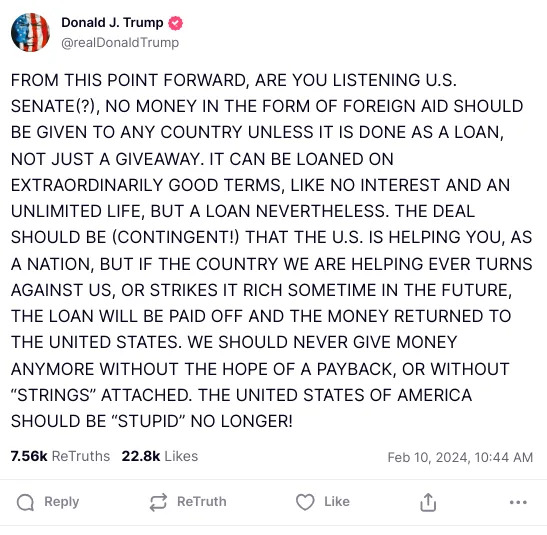
This kind of loose talk is dangerous and stupid coming from a man who was once president of the United States and is running again. People believe him when he says something like that, not because they can’t take a joke or don’t know that he’s full of hot air, but because it’s entirely believable that he would do exactly that. Everyone knows he doesn’t care about America’s allies and he has made it clear over and over again that he sees no real benefit to them beyond a possible payout. He posted this on Sunday:

That’s a meaningless demand indicating that even after four years as president, Trump is still as shallow and vacuous as he was the day he was inaugurated. It’s no doubt a coincidence that he made these comments within days of the Carlson interview with Putin. I find it hard to believe that Trump slogged through that tedious conversation or understood what Putin was talking about. But you can bet that Putin heard Trump and rubbed his hands together with glee. If only the American people heard him just as clearly.

Tucker Carlson Defends Putin, Says ‘Leadership Requires Killing’ | Video

The Wrap

Tucker Carlson Defends Putin, Says ‘Leadership Requires Killing’ | Video

Sharon Knolle – February 12, 2024

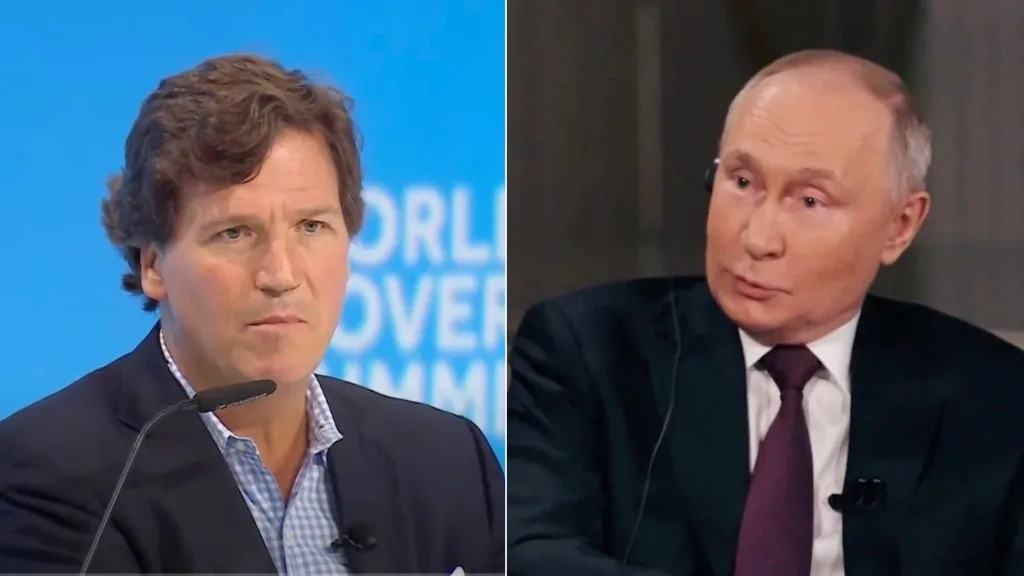
Tucker Carlson had a curious defense of Vladimir Putin in his first interview since interviewing the Russian autocrat, saying “Every leader kills people, leadership requires killing.”

Carlson’s remarks were made at the 2024 World Government Summit in Dubai, where he was interviewed by Egyptian journalist Emad Eldin Adeeb.

Adeeb asked Carlson why he neglected to ask Putin about such pressing topics as the poisoning of Russian opposition leader Alexei Navalny. “I’m not going to lecture you, but you should challenge some ideas,” said Adeeb. “You did not talk about freedom of speech, you did not talk about Navlny…”

Carlson replied that other journalists had already posed such questions to Putin, adding, essentially, that it’s not news that Putin has ordered hits on his enemies. “Every leader kills people, leadership requires killing,” said the former Fox News anchor. (Carlson’s comments that “leadership requires killing” appear about 17 minutes into the 26-minute segment.)

Although Carlson did ask Putin about the potential release of detained Wall Street Journal reporter Evan Gershkovich during the interview that took place in Moscow, he told Adeeb that his primary goal was to “let Putin talk” and “hear his thoughts.” Carlson said that positioning himself as the “good guy” to Putin’s “bad guy” would “not be fruitful.”

When Adeeb asked about Carlson’s response to the criticism leveled at him over his Putin interview, Carlson responded,”I don’t like the internet and I haven’t seen any of the reactions.” Adeeb asked specifically if Carlson had heard Hillary Clinton’s summation that he had proved “a useful idiot” to the Russian dictator and he claimed not to have heard about it.https://www.youtube.com/embed/mMXikZM_O80?feature=oembed

“She’s a child, I don’t listen to her,” he said of the former Secretary of State.

While Carlson insisted several times that he is “not flakking for Putin,” he did praise Moscow for being better than any current U.S. city. “Moscow is so much nicer than any city in my country, cleaner and safer and prettier. I grew up in a country that had cities like Moscow and Abu Dhabi, and Singapore and Tokyo, and we no longer have them.”

Decrying the “filth and graffiti” found in American cities and people “begging for drugs” in London, Carlson seemed to be saying that if he were in charge, those kinds of things would not happen: “My children don’t smoke marijuana at the breakfast table because I don’t allow them.”

Carlson also has a long history of supporting pro-Putin and pro-Russia talking points on issues like the unprovoked invasion of Ukraine or U.S.-Russia relations, and criticizing Putin’s enemies and people arrested and imprisoned by Russia.

Reagan’s daughter says he wouldn’t want to be in GOP today

The Hill

Reagan’s daughter says he wouldn’t want to be in GOP today

Elizabeth Crisp – February 12, 2024

Patti Davis, the daughter of former President Reagan, says her late father would be “appalled” by the state of politics today, and she doubts he would want to be associated with the Republican Party.

“I don’t see how he would want to be in it,” Davis told CNN’s Jim Acosta in an interview Sunday. “It’s so diametrically opposed to what he believed and to the dignity that he felt that people in government should have.”

It’s not the first time Davis, an actress and author who was estranged from her father for several years but reconciled before his death in 2004, has spoken unfavorably about the modern GOP.

She penned an open letter to Republicans in 2019, arguing they had disparaged her father to pump up former President Trump.

“You have claimed [my father’s] legacy, exalted him as an icon of conservatism and used the quotes of his that serve your purpose at any given moment,” Davis wrote. “Yet at this moment in America’s history when the democracy to which my father pledged himself and the Constitution that he swore to uphold, and did faithfully uphold, are being degraded and chipped away at by a sneering, irreverent man who traffics in bullying and dishonesty, you stay silent.”

During the CNN interview over the weekend, she said she believes her father would be saddened by the state of the nation.

“I think that he would be heartbroken and horrified about where America is and how mired we are in anger, in violence, in disrespect for one another,” she said. “I think he would heartbroken, and I think he would be scared.”

Feeling betrayed, Trump wants a second administration stocked with loyalists

NBC News

Feeling betrayed, Trump wants a second administration stocked with loyalists

Katherine Doyle, Jonathan Allen and Peter Nicholas – February 12, 2024

WASHINGTON — Sitting in the Oval Office in the infancy of his presidency in 2017, Donald Trump found himself surrounded by new aides who had worked for other prominent Republicans, including Sen. Ted Cruz of Texas, his most bitter rival from the previous year’s primaries.

The “America First” president evidently worried that they wouldn’t now put the American president first.

Trump went around the room, inquisition-style, asking each aide to declare allegiance, according to a person who was present.

“He was quizzing people in the Oval if they were loyal to him or previous bosses,” the source recalled seven years later.

But no matter how much emphasis Trump put on loyalty in his first term, he found himself disappointed and frustrated when people he had hired chose other considerations over his instructions — their own reputations, future ambitions and even the Constitution.

During one meeting three years into his term, the president sat with his third defense secretary, Mark Esper, a top aide who had been tasked with installing loyalists in the administration and other senior advisers. The aides wondered aloud how they had kept missing the mark and choosing people who weren’t loyal enough.

“Trump said, ‘We can’t let that happen again,’” according to a source familiar with the conversation.

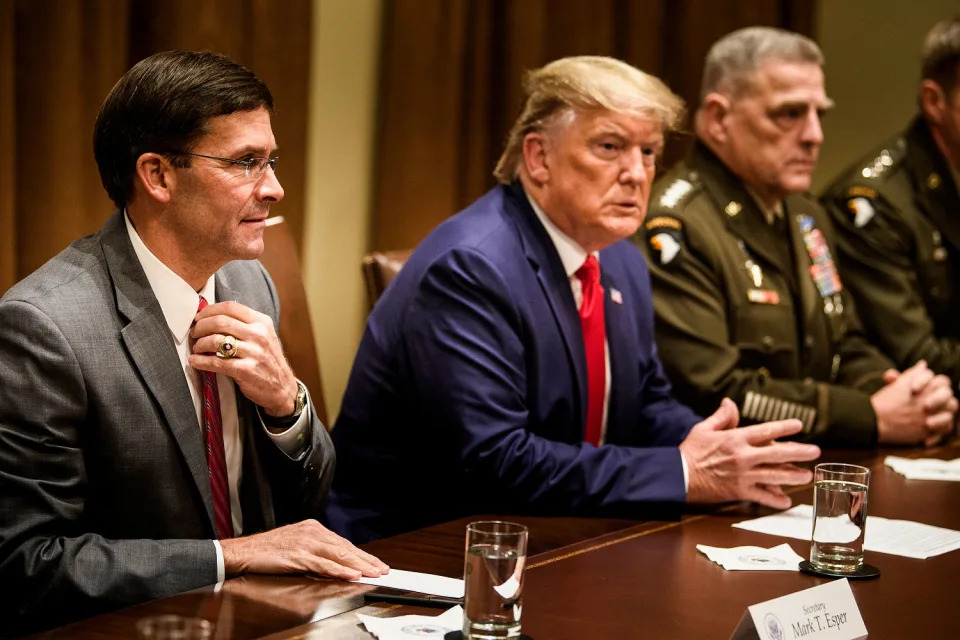
Secretary of Defense Mark Esper, left, President Donald Trump, and Chairman of the Joint Chiefs of Staff Army Gen. Mark A. Milley, right, wait for a meeting with senior military leaders in the Cabinet Room of the White House on Oct. 7, 2019. (Brendan Smialowski / AFP via Getty Images file)

From Attorney General Jeff Sessions’ allowing for the appointment of the Russia probe special counsel Robert Mueller to Attorney General William Barr’s refusing to declare the 2020 election invalid and Vice President Mike Pence’s declining to reject electors, Trump felt he had been betrayed by the very officials who owed him the most.

Esper, too, would later be unceremoniously cast out after being at odds with Trump on a number of issues.

Now, as he contemplates a second stint in the Oval Office, his fixation on fealty appears to be growing, and some people who have spent time close to the former president say they believe it will be the singular criterion for potential appointees if voters give him what he wants.

Trump has repeatedly brought up the issue of loyalty in his public remarks, as well. On the eve of the Iowa caucuses, he emphasized that point at a rally. He went after Florida Gov. Ron DeSantis and former U.N. Ambassador Nikki Haley, his competitors who were once his allies. And as a contrast, he stood with his onetime rival Doug Burgum as the governor of North Dakota offered him an endorsement.

“There’s something about the lack of loyalty in politics,” Trump said.

Trump’s success in a second term will hinge on bringing in people committed to his agenda, top appointees from his first term say. Trump and his allies have big plans for a second term — and still-fresh memories of a drawn-out four-year battle against a hostile administrative state. But without committed allies in key roles, ambitions to gut the federal bureaucracy, overhaul rulemaking and slash budgets could wither and die.

“They have to be resolute with their commitment to the president’s vision,” a top Trump official said of those who could find themselves tapped for plum roles. “You weren’t elected; you’re a Cabinet person as part of the executive branch, and your job is to understand and execute.”

“The headwinds will be significant,” he added.

Finding the ‘shock troops’

Allies of Trump, who is term-limited if re-elected, are aware of the need for a slate of officials willing to execute his vision and prepared to quickly kick into gear.

“You have four years. You have three or four major things you can accomplish — major things — and you have to have the full support of a team that’s loyal,” an outside adviser to Trump said. “I think the president is going to have that.”

A former White House official, speaking about the plans to send in loyalists who are better prepared to execute Trump’s agenda, said: “We’re not going to sit around and wait for the Senate, which is very, very divided and not even in the hands of conservatives, to get things done. Things will be happening, even before Inauguration Day.”

Already, conservatives are laying the groundwork for “shock troops” to take administration posts in a second Trump term, with one group, the Association of Republican Presidential Appointees, hosting a two-day “presidential appointee boot camp” Feb. 19 and 20 in the Washington suburbs.

The boot camp promises to give would-be appointees insight into “the operating context in which appointees work to implement the president’s agenda” and “tactics appointees can use to help the president gain control over the levers of power and thwart a hostile bureaucracy.”

And yet, Trump’s campaign team has tried to put a lid on a constellation of outside groups that are dreaming up wish lists of appointees and an agenda for a prospective next term.

“The efforts by various non-profit groups are certainly appreciated and can be enormously helpful,” Trump campaign senior advisers Susie Wiles and Chris LaCivita said in a statement in November. “However, none of these groups or individuals speak for President Trump or his campaign. We will have an official transition effort to be announced at a later date.”

Wiles and LaCivita declined requests to comment for this article.

Refusing to take any chances in the vetting process, allies are promising to help “weed out those that would employ subterfuge” in a bid to thwart Trump from inside, the former official said.

“This is a sharp-elbowed sport, and we know that there will be people that want to undermine the president,” the person added.

A political strategist with ties to a Republican who has been floated in the media as a potential running mate for Trump said, “If you’re Trump, you value loyalty above all else, particularly because he sees Mike Pence as having made a fatal sin.”

It’s exactly that thinking that has given rise to concerns about who might be prepared to staff a future Trump administration, with those at odds with him fearing a worst-case scenario that imperils the sanctity of the republic.

“The starting point for a second Trump term will be the last year of his first term. … Loyalty will be the attribute Trump will be seeking above all else,” said Esper, whose tenure as defense secretary was cut short as Trump struggled to come to terms with the 2020 election results. “He won’t pick people like Jim Mattis or me who will push back on him. So the question becomes: What harm might occur over four years?”

‘It reminds me of “Game of Thrones”‘

As Trump’s lead in the Republican primary campaign becomes more solid, ritual demonstrations of loyalty, particularly from Republicans with stronger ties to a political establishment that was once foreign to him, show his tightening grip.

After Sen. Tim Scott of South Carolina — who challenged Trump for the Republican nomination before he dropped out in November — said he would support Trump over Haley, Trump gave little pause before he dug the knife in as the two appeared together in New Hampshire last month.

“You must really hate her,” Trump said of Haley, the former governor of South Carolina, who appointed Scott to his seat in the Senate.

Scott could only manage to utter words that are music to Trump’s ears: “I just love you,” Scott said.

Yet, it’s not just Trump demanding fealty as he mounts his comeback campaign. Voters, too, feel a sense of allegiance, with Republicans today less likely than they were two years ago to believe Joe Biden was the legitimate winner of the 2020 election, according to a recent University of Maryland-Washington Post poll.

Sen. JD Vance of Ohio, a onetime Trump critic, defended those concerns in an interview with ABC News this month, echoing other allies for whom Trump’s election loss in 2020 still looms over his comeback campaign.

Vance, who has been floated as a possible vice presidential pick, said the results of the 2020 presidential race should have been handled differently for a “legitimate” outcome, with Congress considering multiple slates of electors.

It isn’t only potential running mates or political appointees who are taking stock of the price of disloyalty; so are operatives at every juncture of the Republican machine.

“It reminds me of ‘Game of Thrones,’” a former adviser said. “They want you to bend the knee. And if you don’t bend the knee, they take your property. They take your title. They take your reputation, and they throw you into the gulag.”

The demand has settled like a fog over the Republican Party, seeping into its crevices and stifling dissent, an outcome that gives credence to Trump’s fiercest critics, this person argued.

“What I fear is this idea of loyalty means ‘stop questioning,’” the former adviser said. “There will be consequences if you do, and that’s why I think there’s some credence to the idea that he’s a so-called authoritarian. I don’t think he is authoritarian, but he’s opening himself up to this criticism.”

This person added, “His idea of loyalty is one-way.”

Others said that while Trump is susceptible to displays of fealty, he is looking to nab top talent.

“He wants the ‘best available,’” another former White House official said. “Loyalty is important to him, but I don’t know that it’s as much of a litmus test as that.”

History shows that even a promise of excommunication from Trump can run its course. Those who have climbed back in from the cold include Steve Bannon, Trump’s ousted former chief strategist, and conservative media figure Tucker Carlson, who endorsed Trump in November but earlier wrote that he hated him “passionately” in a text message revealed in a lawsuit.

“There are plenty of people that he once viewed as, in his mind, disloyal, who he then relishes bringing back on board,” said Marc Short, Pence’s chief of staff. “Trump loves nothing more than a public reconciliation.”

In Tucker Carlson interview, Putin’s plans for Ukraine appear to echo Trump’s

USA Today

In Tucker Carlson interview, Putin’s plans for Ukraine appear to echo Trump’s

Kim Hjelmgaard and Rachel Barber – February 9, 2024

Former Fox News host and divisive conservative political commentator Tucker Carlson on Thursday released a lengthy and carefully stage-managed interview with President Vladimir Putin − the first Western media figure to do so since Russia invaded Ukraine nearly two years ago.

Carlson published the video interview on his personal website. It was also posted on his X social account. The interview took place in a gilded hall at the Kremlin palace in Moscow.

It covered a variety topics from the war in Ukraine to President Joe Biden, from the fate of detained Wall Street Journal reporter Evan Gershkovich to Elon Musk. The interview did not break meaningful new ground. Carlson has consistently spread misinformation and conspiracy theories. He’s also been a strident critic of Ukraine.

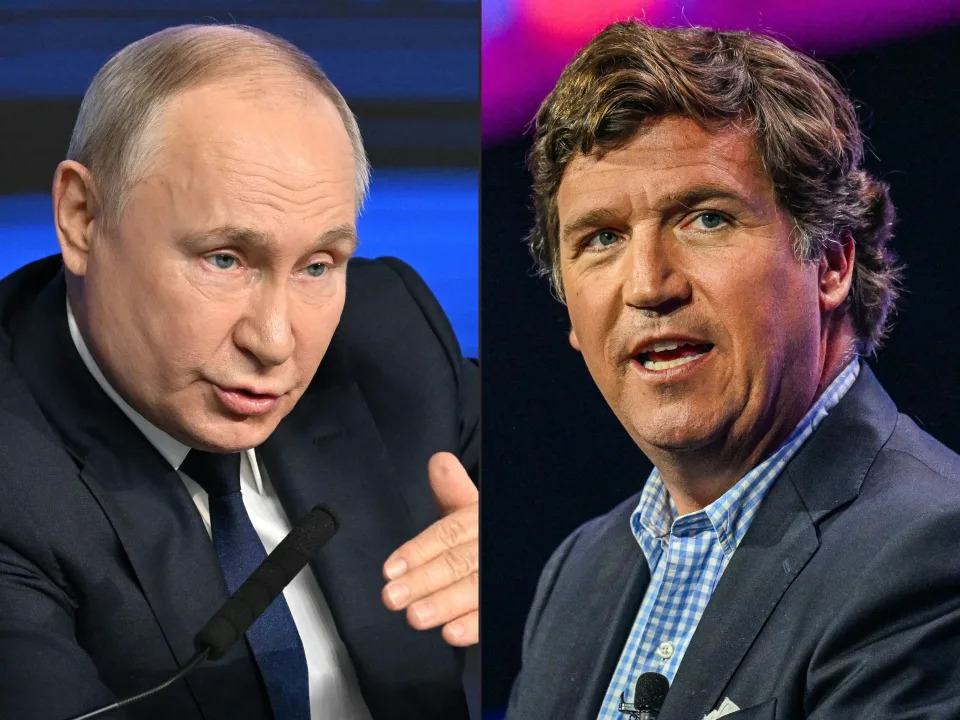
Russian President Vladimir Putin, left, and U.S. conservative political commentator Tucker Carlson.

“If you really want to stop fighting, you need to stop supplying weapons,” Putin said when asked by Carlson about the prospect for peace in Ukraine, referring to Western aid. “It will be over within a few weeks. That’s it.”

Putin said he didn’t see a point in calling Biden, whom he had not spoken to since before the invasion. Biden has refused to speak to the Russian leader unless genuine conditions for negotiating a peace deal are put forward.

Instead, Putin’s answers about the fighting in Ukraine seemed to echo with the U.S. president he said he had a positive relationship with: Donald Trump.

Putin called on the U.S. to “make an agreement” to end the war, likely involving Ukraine ceding territory to Russia.

“Before I even arrive at the Oval Office, shortly after I win the presidency, I will have the horrible war between Russia and Ukraine settled,” Trump said at a Manchester, New Hampshire, rally last month.

Trump has not explained how he would achieve this.

The interview comes as momentum on the battlefield appears to have swung in Russia’s favor while fresh U.S. aid for Ukraine remains uncertain in Congress. Polls show the majority of Americans believe the U.S. should be supporting Ukraine, but many are concerned it may be doing too much at the expense of domestic priorities. Republicans are far more skeptical than Democrats over the utility of sending Ukraine more wartime aid.

Ukraine is running out of weapons: Is it also running low on the time-tested coping mechanism of humor?

At times, the interview, which lasted more than two hours, became somewhat confrontational. However, Carslon did not explicitly challenge Putin’s many false assertions, nor did he push Russia’s leader on his military’s alleged war crimes in Ukraine or political repressions at home.

When Putin said he believed Russia and the U.S. could potentially reach a deal to free Gershkovich, an American journalist Russia detained last year, Carlson pressed him: “This guy’s obviously not a spy. He’s a kid, and maybe he was breaking your law in some way, but he’s not a super spy, and everybody knows that.”

Putin’s government has been holding Gershkovich for more than a year for reporting on the invasion. Gershkovich has been charged with espionage, an allegation he and the U.S. State Department deny. The U.S. government has determined that Gershkovich is being wrongfully detained.

The U.S. made an offer late last year to secure Gershkovich’s release but said Moscow rejected it. Putin appeared to indicate Thursday that he would consider swapping Gershkovich for Vadim Krasikov, a Russian assassin who killed a Georgian-born dissident in a park in Berlin in 2019. Krasikov followed his victim to the park on a bicycle. He’s serving a jail sentence in Germany.

Putin dominated the conversation. He also appeared to occasionally joke and snarl at Carlson’s expense.

“Are we having a talk show or a serious conversation?” Putin said in response to a question about why he had previously said he believed the U.S. could, via NATO, launch a “surprise attack” on Russia.

“Your basic education is in history, as far as I understand,” Putin added. “So if you don’t mind, I will take only 30 seconds or one minute to give you a short reference to history to give you a little historical background.”

Putin then went on to speak for more than 20 minutes about the history of Eastern Europe, including references to Catherine the Great, the 18th century empress of Russia.

Carlson struggled to interrupt Putin during his personal overview of Russian history.

At one point, the conversation took a turn to discussing the U.S. reputation in the international community. Putin claimed the U.S. is more afraid of a “strong China” than it is of a “strong Russia.”

Putin repeated false claims Russia did not attack Ukraine. He addressed his relationships with past U.S. presidents, saying he had a “very good” one with George W. Bush.

And he lavished praise on Tesla’s founder, who also owns X.

“I think there’s no stopping Elon Musk,” he said.

In a social media monologue prior to releasing the interview, Carlson said he wanted to sit down with Putin because “most Americans are not informed” on how the war in Ukraine is “reshaping the world.” He blamed U.S. mainstream media for this, alleging that “no one has told them the truth.” He has previously claimed, without providing evidence, that the U.S. government has thwarted his attempts to sit down with Putin.

Carlson said Western journalists have, by contrast, interviewed Ukraine’s President Volodymyr Zelenskyy many times. He described these interviews as “fawning pep sessions” aimed at amplifying Ukraine’s need for more U.S. weapons and ultimately directed at getting the U.S. more involved in the war.

There was no immediate official reaction to Carslon’s interview with Putin from Ukraine’s government.

Ukraine shake-up: Volodymyr Zelenskyy removes his top general Valery Zaluzhny

International media outlets have sat down with Zelenskyy dozens of times since the war’s start. However, there is little merit to Carlson’s other claims. Journalists in Russia face extreme reporting restrictions. They can be arrested for labeling Russia’s invasion a “war”; instead, they have to call it a “special military operation.”

Russia’s crackdown on free speech extends to regular citizens as well as journalists. They can be arrested or fined for criticizing the war in Ukraine. Carlson promotes his show on social media platform X as a defender of free speech.  The International Criminal Court in The Hague, Netherlands, has issued an arrest warrant for Putin. It accused him of war crimes in Ukraine including deporting children from Ukraine to Russia.

War crimes allegations in Ukraine: They may be unprecedented. So is the country’s push for swift justice

Russians escape Putin’s war on Ukraine: They find a new home – and a moral dilemma

Since news of the interview broke, many Western journalists have been posting on social media how they have repeatedly attempted to secure interviews with Putin over the last two years. The last time Putin was interviewed by an American journalist was in June 2021 with NBC’s Keir Simmons.

“Does Tucker really think we journalists haven’t been trying to interview President Putin every day since his full scale invasion of Ukraine?” CNN’s Christiane Amanpour wrote on X. She called his claim “absurd.”

Putin himself has made many speeches and public appearances during which he’s commented at length on the war in Ukraine and his “objectives.” At various times, he’s described these as “denazification, demilitarization and its neutral status.” There is no evidence to indicate that Ukraine has a systemic problem with neo-Nazis. Putin has long been vehemently opposed to Ukraine and other neighboring nations joining NATO.

Putin has said that Western countries have been “stupefied” by anti-Russian propaganda.

Before the interview ran, White House National Security Council spokesman John Kirby told reporters that Americans shouldn’t believe anything Putin said in the interview.

“Anybody (who) watches that interview you need to make sure to remember that you are listening to Vladimir Putin. You shouldn’t take at face value anything he has to say.”

As the host of “Tucker Carlson Tonight” on Fox News, Carlson was one of the network’s biggest stars. The show was canceled last year following a series of controversies. Carlson drove ratings at the network but, his critics say he pushed extreme right-wing views and trafficked in racist and misogynistic themes and conspiracy theories.

“Tucker Carlson isn’t a journalist, he’s a propagandist,” wrote Ian Bremmer of the Eurasia Group, a global political risk consultancy, on X.

A timeline: Tucker Carlson and his Russia obsession

Carlson has been a longtime defender of Putin and he has consistently questioned U.S. support for Ukraine.

“It may be worth asking yourself, since it is getting pretty serious, what is this really about? Why do I hate Putin so much?” he said as Russia’s leader amassed troops on Ukraine’s border, ready to invade, in February 2022.

“Has Putin ever called me a racist? Has he threatened to get me fired for disagreeing with him? These are fair questions, and the answer to all of them is: ‘No.’ Vladimir Putin didn’t do any of that.” Carlson described Ukraine as a “a pure client state of the United States State Department” and the then looming war as a “border issue.”

Prior to his interview with Putin, one of the topics Carlson addressed on his X account, which posts material from his subscription streaming service, was about male-pattern baldness.

Contributing: Francesca Chambers

Republicans are sticking to Trump — they’re about to reap the whirlwind

Salon – Opinion

Republicans are sticking to Trump — they’re about to reap the whirlwind

Brian Karem – February 8, 2024

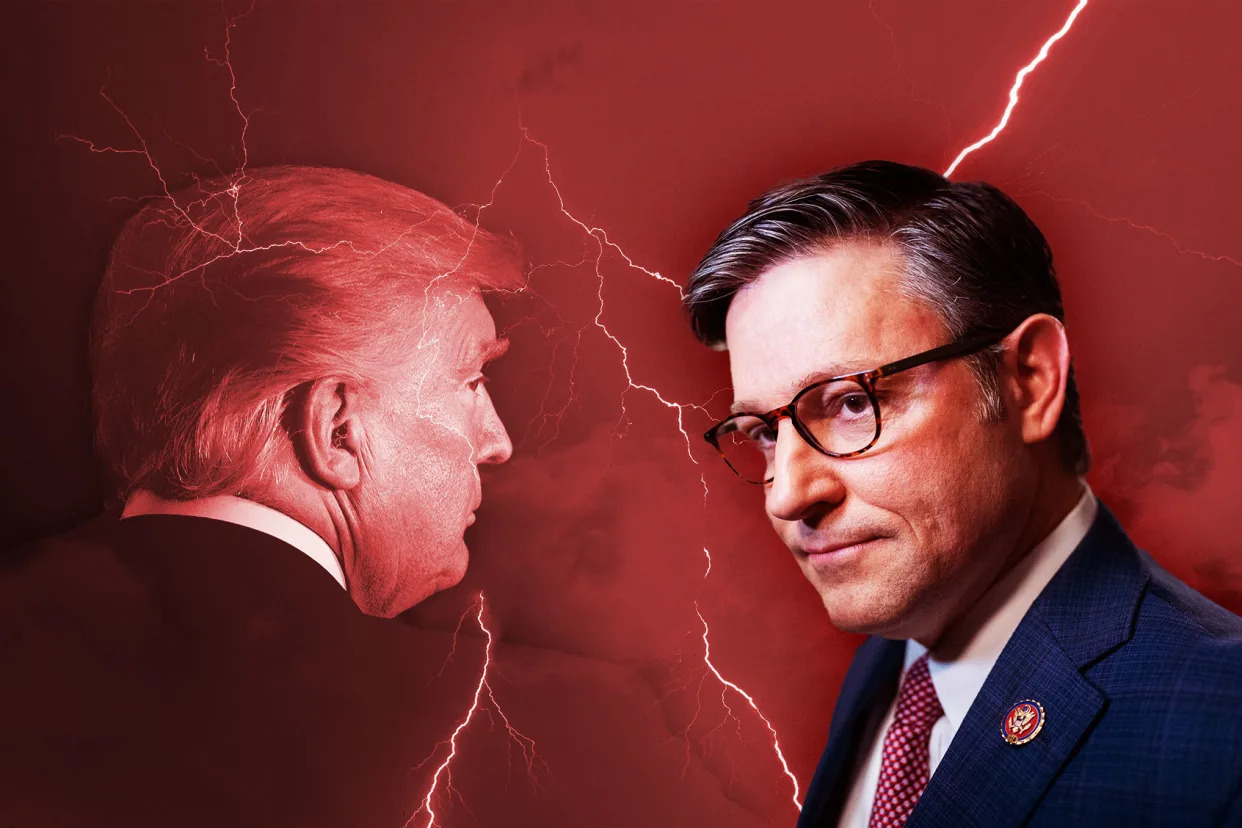
Donald Trump; Mike Johnson Photo illustration by Salon/Getty Images

Welcome to the whirlwind.

Rep. Jamie Raskin, a Maryland Democrat and constitutional lawyer, says he doesn’t believe the Republicans can win this fall. “They are floundering to find something to run on,” he said. “They’re losing all over the place. They don’t want solutions, they want problems. With them it’s rule or ruin. Either they want to rule everything or ruin our chances of progressing. That’s a fascistic strategy.”

According to Raskin, the Republicans won’t accept the result of elections unless they win, and are using immigration as a campaign issue for Donald Trump — who may well be ineligible to run for office. “I don’t think he’s legally qualified to be on the ballot,” Raskin said. “It’s clear to me that section 3 of the 14th amendment disqualifies Donald Trump because he participated in an insurrection or rebellion. He violated his oath.” Raskin hopes the Supreme Court will come to the “unavoidable” conclusion that Trump is ineligible for the presidency.

Like I said, the whirlwind.

In 1984, in a place called Rio Bravo just south of Laredo, Texas, a double-wide trailer burst into flames.

As the flames grew in intensity they became a whirlwind of fire that consumed the trailer and another structure nearby.

That serves as an apt metaphor for today’s Republican politics, and not just on the southern border.

The trailer owners were unable to do anything about the fire because the subdivision they lived in had no running water, or even electricity. At the time of the fire they were also busy fishing a friend’s trailer out of the Rio Grande, where it had been swept after a sudden deluge of rain.

Rio Bravo was, at the time, a subdivision situated next to the Rio Grande, carved out of rented land by a greedy Texas land developer who sold parcels in “open contracts” to undocumented immigrants. Business was so good, he opened a second illegal subdivision (later called “colonias” — a common term in Mexico — as they became popular throughout the Southwest). He named the second one “El Cenizo.”

That’s right. He called the second one “The Ash.” You can’t make that up.

Covering the border between Texas and Mexico was one of my earliest assignments as a reporter. One of my first run-ins with the Trump administration occurred because of Trump’s incredibly obtuse policies regarding the border. At the time I confronted White House press secretary Sarah Sanders — now the governor of Arkansas — about the practice of caging young immigrant children.

She, of course, claimed to be a Christian and also claimed to be more credible than most reporters. She lied then. She lies now. And Don the Con did not understand, either then or now, the root cause of illegal immigration or how to solve that problem. Trump is not alone. It is an emotional issue, one that nearly every politician has fumbled and few of us understand. It isn’t about criminals marauding through the countryside. It is about hope, despair and disinformation. The U.S. government and the businesses that want a constant supply of cheap labor are responsible for continuing the problem.

There has been no meaningful legislation concerning illegal immigration since the Simpson-Mazzoli Act in 1985, which, for the first time, made it illegal to hire undocumented immigrants. In the 40 years since that became law, few if any large companies have ever been prosecuted for hiring any of the millions of immigrants who work in agriculture, construction, thoroughbred racing and numerous other industries. It’s the promise of jobs and a chance to live out the American Dream that drives the “crisis” on the border that has been with us for at least 40 years.

America needs cheap labor. Immigrants from Mexico and Latin America (and other places much farther away) need jobs. In response, there has been a steady deluge of political garbage out of every White House since the Reagan administration, aimed at criminalizing a story of hope in search of votes.

As the rain continued to fall in Los Angeles this week, causing catastrophic mudslides and flooding, the political rain in Washington also continued, and with similar results.

It engulfed the GOP shortly after sunset on Tuesday, when the House failed by four votes to impeach Secretary of Homeland Security Alejandro Mayorkas — for reasons that even some Republicans could not fathom. Rep. Tom McClintock of California, for instance, voted against impeachment for the simple reason that House Republicans failed “to identify an impeachable crime that Mayorkas has committed.” To proceed, he said, would “stretch and distort the Constitution.”

The world is in disarray right now. But nothing is in more disarray than the Republican Party, as it suffers both the whirlwind of fire brought about by its own need to generate issues for Donald Trump’s presidential campaign and the deluge of stupidity unleashed by those who do his bidding in Congress. Rep. Marjorie Taylor Greene led the charge in that latter deluge, one of the few things she does with aplomb. She even claimed that Democrats had hidden members on the House floor to confuse the GOP majority as they voted to impeach Mayorkas. Apparently she can’t count to four even if she uses all of her toes. House Speaker Mike Johnson is so inept that he appointed Greene as a spokesperson. He also can’t count votes. Majority Whip Tom Emmer couldn’t find a way to get four more votes from his own caucus. Republicans have vowed to go after Mayorkas again once they figure out how to count. Is there a better definition of incompetent?

None of this has anything to do with “high crimes and misdemeanors,” the constitutional necessity for impeaching officeholders. There is nothing more grimly amusing than watching the GOP’s three-ring circus — which is both led by Donald Trump and staged exclusively for his benefit.

Trump lost twice on Tuesday. He couldn’t get the votes he wanted to impeach Mayorkas and he lost his bid for “total immunity” in his Jan. 6 criminal case, when three judges on the D.C. Circuit Court delivered circuit judges offered a unanimous and airtight opinion against him.

To understand the depth of Trump’s despair, you may be tempted to count the ketchup bottles at Mar-a-Lago. Or you could read at least part of the 57-page court decision which found that Trump can be criminally charged. Meanwhile,  the GOP couldn’t muster anyone brighter than  Greene to speak up about it. “When they came to Washington to protest, you called that an insurrection,” she said. “But when Biden was inaugurated and this Capitol was surrounded with National Guard troops, none of you stood there and called that an insurrection.”

The congresswoman from Georgia proves, once again, that you can be a whirlwind of fiery rhetoric while deluging the populace with extreme ignorance. Oh, and she wants the House to pass a resolution stating that Trump was no insurrectionist. So there is that.

At the same time the House GOP was trying to impeach Mayorkas, it was also just saying no to a Senate compromise bill that would provide more money and infrastructure on the border along with more support for both Ukraine and Israel. A standalone bill to fund aid to Israel, backed by the GOP, also failed on Tuesday. The border bill failed in the Senate Wednesday, and now that robust body, dominated by aging white men who suffer from incontinence, will have to take up separate funding bills for Ukraine and Israel.

“All of this is just to give Trump something to run on,” Raskin told me. “My colleagues in the Republican Party are subverting the process for a man who embraces fascism.”

The failures keep mounting, but don’t expect Mike Johnson to take any responsibility for his part in the fiasco on the House side. He told reporters, “I don’t think that this is a reflection on the leader, I think this is a reflection on the body itself.” Well, here’s a reminder: He’s the head of that body.

Johnson has promised that any bipartisan legislation sent to the House from the Senate regarding immigration will be “dead on arrival.” Of course Johnson says the border is “an overwhelming emergency” and should be dealt with promptly — but apparently not so much of an emergency that the GOP is willing to accept a compromise solution to a problem that has been ongoing since the last century. The Senate plan — negotiated by James Lankford, an Oklahoma Republican; Chris Murphy, a Connecticut Democrat; and Kyrsten Sinema, an Arizona independent — would strengthen border security and reduce illegal immigration. The Border Patrol union even supports it – and those folks are not liberal Democrats.

Don’t expect a solution anytime soon. We will get nothing but empty words as Trump’s tempest in a very nasty teapot continues. He wants to delay border legislation indefinitely, so he can run on the issue and take credit for any solution — but only after he wins, which is looking increasingly uncertain the closer we get to Election Day. The decision to deny him immunity seems ironclad, and relies on one of the oldest landmark Supreme Court cases — Marbury v. Madison — to do so. That decision gives courts the ability to strike down laws deemed unconstitutional. So it could be argued that if the Supreme Court takes up Trump’s immunity case and rules in his favor, it will overturn more than 200 years of judicial decisions and eliminate the Supreme Court as an equal partner in government.

To quote the D.C. Circuit decision: “As the Supreme Court has unequivocally explained: No man in this country is so high that he is above the law. No officer of the law may set that law at defiance with impunity. All the officers of the government, from the highest to the lowest, are creatures of the law and are bound to obey it. It is the only supreme power in our system of government, and every man who by accepting office participates in its functions is only the more strongly bound to submit to that supremacy, and to observe the limitations which it imposes upon the exercise of the authority which it gives. … That principle applies, of course, to a President.”

The court also found that the president is “amenable to the laws for his conduct,” and “cannot at his discretion” violate them.

Finally, the court found that Trump was a “citizen,” not a king: He “lacked any lawful discretionary authority to defy federal criminal law and he is answerable in court for his conduct.”

Harry Litman of the Los Angeles Times offered an explanation on X of what took the D.C. circuit so long: “They opted, probably from the start, to make it per curiam — basically one voice. That gives it even added force. And that might have required extensive compromising negotiation to get it just right.”

That means the Supreme Court might actually refuse to hear Trump’s appeal on the immunity case — something he fears and that many court watchers say is possible now that the D.C. Circuit has done the heavy lifting and penned an exquisite opinion. At any rate, even if the Supreme Court takes up the case, many experts believe Trump will still face a criminal trial, at the latest, by fall.

In the short term, do not expect any legislation regarding immigration to pass the Senate or House. Expect Donald Trump to use the time to raise money while he continues to fight his battles in court and keeps his political party running interference for him.

Trump’s last wild ride in the public domain is in its death throes. His whirlwind is consuming him. His supporters are holding on, and those who need him the most, like Marjorie Taylor Greene, are  defending him so they can stay as relevant as possible (and perhaps evade criminal charges) in a world that increasingly sees Trump and his minions for what they are; soulless hacks with a need and desire for great personal power at the expense of humanity.

What this means for the GOP is obvious: After Kevin McCarthy and Mike Johnson; after Senate Minority Leader Mitch McConnell; after its inability to pass any legislation, the party is undeniably broken, unable to lead and woefully lacking in common sense. It is dedicated to the edification and protection of one of the worst politicians ever to rise to prominence in our republic.

Trump’s former chief of staff, John Kelly, described him as “a person that has no idea what America stands for and has no idea what America is all about.”

Lead? The GOP is incapable of that. Follow? It won’t follow anyone except Trump, and it will never get out of the way — unless we collectively kick it to the curb. Or right into that whirlwind.

Behind the border mess: Open GOP rebellion against McConnell

Politico

Behind the border mess: Open GOP rebellion against McConnell

Burgess Everett – February 7, 2024

Senate Minority Leader Mitch McConnell, R-Ky., speaks during a news conference on border security, following the Senate policy luncheon at the Capitol in Washington, Tuesday, Feb. 6, 2024. (AP Photo/Jose Luis Magana)

Conservative hardliners once celebrated Mitch McConnell for wrestling the federal judiciary to the right and thwarting progressive hopes.

Now he is under open attack from the right for even trying to work with Democrats on the border.

The Senate GOP leader is facing internal resistance not seen in more than a year as Republicans descend into discord over two issues they once demanded be linked: border security and the war in Ukraine.

McConnell, now nearing his 82nd birthday, is determined to fund the Ukrainian war effort, a push his allies have depicted as legacy-defining. But now that his party is set on Wednesday to reject a bipartisan trade of tougher border policies for war funding, his far-right critics are speaking out more loudly: Several held a press conference Tuesday where they denounced his handling of the border talks, with Sen. Ted Cruz (R-Texas) calling on McConnell to step down.

In an interview, McConnell rejected the criticism and said his antagonists fail to recognize the reality of divided government.

“I’ve had a small group of persistent critics the whole time I’ve been in this job. They had their shot,” McConnell said, referring to Sen. Rick Scott’s (R-Fla.) challenge to his leadership in 2022.

“The reason we’ve been talking about the border is because they wanted to, the persistent critics,” he added. “You can’t pass a bill without dealing with a Democratic president and a Democratic Senate.”

Despite that pragmatism, McConnell’s job is only getting harder. If he runs for another term in leadership next year, a tougher fight than Scott gave him seems almost inevitable.

That is in part because of Donald Trump, whom McConnell barely acknowledges after criticizing his role in the Capitol riot of Jan. 6, 2021. The former president played a leading role in killing the border deal and has called consistently for McConnell’s ouster. And at this time next year, Trump could well be back in the White House.

More and more of Senate Republicans’ internal strife is seeping out into public view, exposing years-old beefs that are still simmering. Sen. Mike Lee (R-Utah) posted a fundraising link asking donors to “kill this border bill” in the middle of a closed-door GOP meeting on Monday and demanded “new leadership,” while Sen. Ron Johnson (R-Wis.) memed McConnell as Charlie Brown whiffing on an attempt to kick a football held by Sen. Kyrsten Sinema (I-Ariz.).

“I’ve been super unhappy since this started,” Johnson said in an interview. “Leader McConnell completely blew this.”

Trump and Speaker Mike Johnson helped squash the border bill’s prospects in the House while Ron Johnson, Lee, Cruz, Scott and Sen. J.D. Vance (R-Ohio) pummeled it on TV and social media. The intensity of that assault turned many GOP senators sour on a border security deal that would have amounted to the most conservative immigration bill backed by a Democratic president in a generation — a bill they once said was the key to unlocking Ukraine aid.

Though McConnell touted the work of Sen. James Lankford (R-Okla.) and the bill’s endorsement by the Border Patrol union, he conceded what was obvious by Monday night: This legislation is dead.

“The reason we ended up where we are is the members decided, since it was never going to become law, they didn’t want to deal with it,” McConnell said in the interview. “I don’t know who is at fault here, in terms of trying to cast public blame.”

At Tuesday’s party meeting, Cruz told McConnell that the border deal was indefensible, while Sen. Lisa Murkowski (R-Alaska) questioned why the GOP would walk away from it, according to two people familiar with the meeting. That followed a Monday evening private meeting where Johnson got into a near-shouting match with Sen. Todd Young (R-Ind.), one of several senators who has tried to rebut Trump’s influence on the party.

Young played down the spat afterward: “Ron and I have a very good relationship. We can be very candid with one another.”

McConnell’s loud critics are among those most responsible for raising opposition to the border deal, attacking its provisions while the text was being finalized. They raised such a ruckus that none of McConnell’s potential successors as leader — Sens. John Barrasso (R-Wyo.), John Cornyn (R-Texas) and John Thune (R-S.D.) — offered to support it.

McConnell can’t be ejected spontaneously like a House speaker, meaning his job is safe until the end of the year. He also has major sway over the Senate Leadership Fund, a super PAC that may have to help Cruz, Scott and other Republicans win reelection.

And McConnell is not without defenders. Sen. Lindsey Graham (R-S.C.) said any attempt to blame McConnell for the border crackup is “a bit misplaced.”

Indeed, McConnell was OK with just approving foreign aid back in the fall, but agreed to link it to border security after rank-and-file Republicans grew eager to extract concessions from Democrats in order to get Ukraine money.

“It’s not James’ fault, he did the best he could under the circumstances. It’s not Mitch’s fault,” said Sen. John Kennedy (R-La.).

The historical record holds plenty of quotes from McConnell’s current critics asking for stronger border policy during the Trump administration. Many of them now have since changed their tune to say Biden doesn’t need new laws at all to enforce border security.

“We all wanted to see border security. And I think a lot of our members were demanding that in exchange for the rest of the funding. That’s an issue our conference needs to be aware of,” said Sen. Joni Ernst (R-Iowa), the No. 4 leader. “The conference wanted border security.”

The animosity McConnell now faces from Ron Johnson, Lee and others isn’t new either: They’ve questioned Senate GOP leadership’s decisions for years.

Ron Johnson’s been a thorn in McConnell’s side for years, particularly after many Republicans abandoned his reelection bid in 2016. Cruz has sparred with McConnell since getting to the Senate in 2013, Lee frequently breaks with leadership and a number of newer GOP senators voted for Scott over McConnell in 2022.

One GOP senator, granted anonymity to assess the situation candidly, said that the new wave of attacks could be happening because McConnell’s opponents sense weakness — or just out of “personal pique” over years-old disagreements.

“For three months it’s been nothing but border and Ukraine, border and Ukraine, border and Ukraine. I don’t know how many speeches I’ve heard … and now all of a sudden, it’s: ‘We’re not going to do that,’” said Sen. Josh Hawley (R-Mo.), another of the McConnell critics. “It just seems like total chaos to me.”

Either way, the 180 among many Republicans is evidence of a major drift away from McConnell’s style of Republicanism and toward Trump’s. McConnell hasn’t talked to Trump since the Jan. 6 riot and tried to turn the party in a surprisingly deal-centric direction during the first two years of President Joe Biden’s presidency.

Just two years ago, debt ceiling increases, gun safety and infrastructure laws passed with McConnell’s blessing — all a reflection of his view that protecting the filibuster requires working with Democrats on bipartisan bills.

Now the reality is that Trump, the likely nominee, doesn’t want a deal that Republicans set out to secure four months ago. Deal-making without Trump’s blessing appears impossible, and that’s a challenging dynamic for the longtime GOP leader.

“This wasn’t good for him. This wasn’t good for any of us,” said Sen. Tommy Tuberville (R-Ala.) of McConnell, whom he backed in 2022. “And I’m not gonna say he’s the total cause of it, but we got to have a better plan. This didn’t work out for us.”

Ursula Perano contributed to this report.