PCOS symptoms are still difficult for doctors to diagnose and treat. Here’s why

NBC News

PCOS symptoms are still difficult for doctors to diagnose and treat. Here’s why

Caroline Hopkins – March 31, 2024

Every morning, Jeni Gutke swallows 12 pills. In the evening, she takes 15 more, then another before bed. She also takes an injectable medication once weekly, and two other medications as needed.

Gutke, of Joliet, Illinois, has polycystic ovary syndrome, or PCOS, and the medications and supplements help the 45-year-old cope with migraines, high blood pressure, diabetes, high cholesterol, anxiety and depression that come with the complex hormonal condition.

Not one of  Gutke’s medications are technically “PCOS drugs.”

portrait (Courtesy Jeni Gutke)

The Food and Drug Administration has not approved a medication specifically for PCOS, which is often linked to infertility, irregular or missed periods, weight problems, and other debilitating symptoms. Gutke’s array of medications is typical of how many of the estimated 5 million women in the U.S. diagnosed with PCOS deal with it.

“It’s such a vast syndrome that affects everything from your head to your toes,” she said. She was diagnosed with endometrial cancer — another risk linked to PCOS — at age 37.

After nearly a century of disagreements over what, exactly, defines the condition, as well as a lack of research, PCOS is still poorly understood. The symptoms vary so widely that any single drug would be unlikely to help all patients, said Dr. Heather Huddleston, a reproductive endocrinologist at the University of California, San Francisco and director of UCSF’s PCOS Clinic.

Women with PCOS and the doctors who care for them say they want better options — treatments for the condition’s root causes rather than bandages for individual symptoms. Even as calls for better treatments grow, the lack of investment in PCOS research has limited doctors’ ability to help their patients.

“It gets very messy to try to identify one treatment that’s going to work for everybody,” Huddleston said.

Many women with the condition end up taking off-label prescriptions — meaning drugs technically approved for other conditions, like diabetes or obesity — to help PCOS-related symptoms. Navigating insurance coverage for off-label prescriptions can be challenging.

“There’s no magic pill,” said Tallene Hacatoryan, 31, a registered dietician from Orange County, California. “There are too many components for there to be a one-size-fits-all treatment.”

portrait weights exercise happy smile (Courtesy Tallene Hacatoryan)

Hacatoryan was diagnosed with PCOS at age 18 and now works as a diet and lifestyle coach for women with PCOS.

Although research is murky when it comes to the best diet for women with PCOS, the most up-to-date international guidelines recommend exercise and a healthy diet. There’s no evidence that any particular diet improves symptoms, although some women have found lifestyle coaching helpful.

Insufficient funding for research

Among the reported 315 medical conditions that receive federal support from the National Institutes of Health, PCOS ranks near the bottom, with an estimated $10 million earmarked for research in 2024. Until 2022, PCOS was so underfunded that it wasn’t included as a line item in the NIH list.  And the condition is not explicitly included in the $100 million the Department of Health and Human Services announced recently to research neglected areas of women’s health. Neither is PCOS mentioned in President Joe Biden’s recent executive order to advance women’s health, which includes $200 million for NIH research grants, or the White House’s calls for Congress to allocate $12 billion to fund women’s health research.

A spokesperson at the NIH said that it’s too early to know which women’s health conditions will receive funding under the new initiative.

“Given how common PCOS is, the amount of funding it’s gotten is proportionately extremely small,” Huddleston said.

Government funding is just one part of the total research budget for a given disease. While it’s tough to pin down a dollar figure for private industry spending, experts say the lack of FDA-approved PCOS treatments reflects a lack of investment from drugmakers, too.

Developing PCOS treatments requires a better understanding of the condition. This, in turn, requires far more research tracking thousands of women over many years, which can be extremely expensive, experts say.

However, there are some promising signs.

Although research is early and only in a few dozen women, there are a handful of small drug companies studying possible PCOS treatments. A Menlo Park, California-based company called May Health, for instance, is developing a one-time surgical procedure it thinks could help with PCOS. Spruce Bio, a San Francisco biotech firm, is running a small clinical trial with a drug called tildacerfont for PCOS. It is not clear yet if the oral drug works. President and CFO Samir Gharib said larger clinical trials will depend on the company’s ability to “secure additional financing” or partner with another drug company.

The FDA recently attended a meeting with advocacy group PCOS Challenge where women shared their experiences with the agency’s scientists and drug companies. No PCOS drug trials were announced after the meeting, but the FDA’s interest shows a growing push for improved treatment, said William Patterson, a spokesperson for PCOS Challenge.

No known cure for PCOS

Doctors recommend hormonal contraceptives — most commonly the birth control pill — to regulate heavy, irregular periods;, acne;, and unwanted hair growth. Others say taking the pill just masks, rather than treats, their PCOS symptoms and the symptoms return as soon as they stop taking it.

“PCOS is unfortunately not curable, so treatment is about managing its symptoms,” said Dr. Jessica Chan, a reproductive endocrinologist at Cedars-Sinai. Chan said birth control can be a good option for some, but not all, of her PCOS patients.

For women with PCOS whose main concerns are insulin resistance or stubborn weight gain, Chan often prescribes off-label diabetes medications like metformin.

Some doctors who treat PCOS, including OB-GYNs or endocrinologists, have also begun prescribing GLP-1 agonists like Ozempic and Wegovy, which have shown promise for some women with PCOS,  although studies have been small and early -stage.

Novo Nordisk, the company that makes Ozempic and Wegovy, said it has no plans as of now to seek FDA approval for PCOS. Still, the company mentions PCOS on its Truth About Weight website, part of its marketing campaign for Wegovy

Causes and symptoms of PCOS

“We don’t know the initial spark leading to PCOS or where it arises from,” Chan said.

PCOS affects an estimated 6% to 12% of reproductive-age women in the U.S. The real prevalence is likely higher since an estimated 70% of cases go undetected.

Experts generally agree that PCOS, at its core, is a hormone-related condition. Women with PCOS have higher levels of androgen hormones, which can cause a range of symptoms, including:

  • Missing, irregular, or heavy periods
  • Acne
  • Excess hair growth on the face or body
  • Thinning or balding scalp hair

According to endocrinologist Dr. Andrea Dunaif, some doctors have been pushing to separate PCOS into two different diagnoses: one having more to do with the reproductive cycle and fertility issues and another having more to do with metabolism, high body weight, and diabetes.

“PCOS looks to be at least two or three different conditions we’re lumping together, but they’re genetically distinct,” said Dunaif, the chief of the endocrinology, diabetes and bone disease division of Mount Sinai Health System and the Icahn School of Medicine.

The confusion surrounding PCOS diagnosis is partly why it’s been hard to get large pharmaceutical companies to invest in PCOS treatment, she said.

In Dunaif’s view, it’s not accurate to call the condition “PCOS” at all, because it has more to do with excess hormones than it does with actual cysts on the ovaries. PCOS got its name from the bumps on the ovaries appearing like cysts on an ultrasound image. These are not cysts, but instead egg follicles that are, as Dunaif described them, “arrested in development.”

As it is, many doctors diagnose the condition based on two of three factors:

  • Irregular periods
  • High androgen levels
  • Multiple follicles on the patient’s ovaries

But these three factors don’t account for some of the most challenging symptoms of PCOS: insulin resistance and stubborn weight gain. Excess androgen hormones can spike insulin levels, which interferes with how the body processes sugar. Doctors aren’t sure whether the hormonal dysregulation causes insulin resistance, or whether insulin resistance causes excess androgen hormones.

Either way, women with PCOS have a higher risk of diabetes, excess weight gain, high cholesterol, and high blood pressure. Yet these metabolic conditions aren’t included in the criteria many doctors use to diagnose PCOS. The result? A missed diagnosis.

This was initially the case for Candice Bolden, 35, who started noticing acne and excess facial and body hair several years before she was diagnosed with PCOS in 2021. Bolden, a lifelong dancer, also had unusually low energy.

portrait (Courtesy Candice Bolden)

“The final straw was excess weight gain that I could not take off no matter what I did,” said Bolden, who lives in Los Angeles. “All the other things I had kind of just stuffed under the rug. I’d just chalked it up to being a hairy, Haitian woman.”

After gaining 35 pounds, the 5-foot-2-inch Bolden, who exercised twice a day and followed strict diets, saw multiple doctors who she said ignored her symptoms.

“Doctors kept telling me I was fine, and to go home, work out, and eat clean,” she said. “It was the most frustrating thing ever.”

‘We don’t have to live underneath this dark cloud’

Women living with PCOS say the rise of online communities, including on social media apps like TikTok and Instagram, has given them a place to speak out, share the treatment approaches working for them, and meet other women with PCOS.

When Bolden finally got a diagnosis, she wasn’t sure what to do next. Gutke and Hacatoryan had similar experiences.

“I was like, ‘Wait, I have so many questions,’ and the doctor just told me, ‘It is what it is,’” Hacatoryan said.

Hacatoryan calls women in her online community her “cysters.”

Bolden said she’s noticed more women turning to social media to learn how others manage their PCOS and share their own stories.

On her own social media accounts, she’s been trying to change the narrative about PCOS being primarily a fertility problem, which she sees as an outdated perception.

“When I was diagnosed, my doctor mentioned PCOS being the No. 1 reason for infertility, and that shattered me,” said Bolden, who was newly engaged at the time and eager to start a family. “I was happy I was diagnosed, because it showed me something was actually happening and I wasn’t just crazy. But I was heartbroken.”

Things changed after Bolden moved; found a new doctor; and worked closely with her husband and the  online PCOS community to find a system that worked to manage her PCOS symptoms.

Bolden is now pregnant and expecting a baby girl.

“I want people diagnosed with PCOS to know there’s hope, and we don’t have to live underneath this dark cloud all the time,” she said.

What is “pink cocaine” or “tuci,” the drug Diddy allegedly had smuggled on a jet?

Salon

What is “pink cocaine” or “tuci,” the drug Diddy allegedly had smuggled on a jet?

Manisha Krishnan – March 30, 2024

Sean Diddy Combs Paras Griffin/Getty Images

Among the many drugs Sean “Diddy” Combs allegedly consumed — and had his staff procure for him — was tuci, an obscure street drug concoction nicknamed “pink cocaine,” according to a lawsuit filed by his former producer Rodney Jones.

Jones, who alleged Combs sexually assaulted him while he was producing Comb’s “The Love Album,” filed the $30 million lawsuit in Federal District Court in Manhattan in February, amending it with additional allegations earlier this week.

Jones saId Combs’ chief of staff Kristina Khorram “required all employees, from the butler to the chef to the housekeepers, to walk around with a black Prada pouch or fanny pack filled with cocaine, GHB [a depressant drug], ecstasy [sometimes sold as MDMA], marijuana gummies (100 – 250 mg’s each), and tuci (a pink drug that is a combination of ecstasy and cocaine).”

“Khorram wanted Mr. Combs’ drug of choice immediately ready when he asked for it,” the lawsuit alleges.

Last April, Combs and Jones were rehearsing for the Something in the Water music festival in Virginia, when Jones alleged Combs did some cocaine in his dressing room and wanted tuci. However, Brendan Paul, Combs’ alleged drug mule who is facing felony drug possession charges, forgot to bring tuci, so Khorram had rapper Yung Miami fly the drug from Miami on Combs’ jet, according to the lawsuit.

Through his lawyer Shawn Holley, Combs denied the claims outlined in the initial lawsuit, describing them as “pure fiction.”

Tussi; Pink Cocaine
Tussi; Pink Cocaine

But what is tuci in the first place – and why is it popping off as a party drug in some circles?

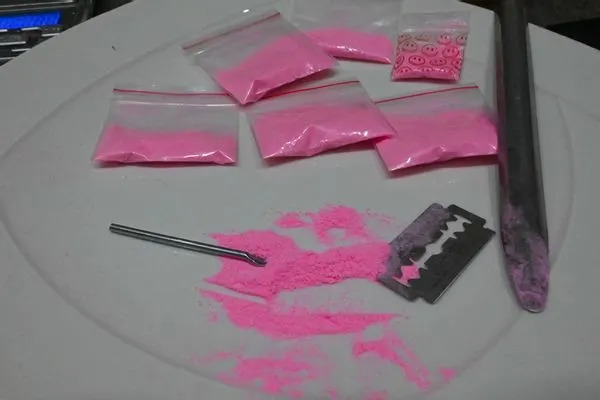
The little-known drug has cropped up in the Latin American street drug supply over the last few years, typically sold as a neon pink powder, according to a 2022 report from the United Nations Office on Drugs and Crime. While the name, also spelled tusi and tucci may be a shortened version of 2C-B — a stimulant and psychedelic first synthesized in the 1970s — tested samples of tuci typically don’t contain 2C-B, but rather a mix of ketamine, MDMA and caffeine. Despite being nicknamed “pink cocaine,” it rarely contains cocaine, though it is typically snorted.

While it’s hard to quantify how much tuci is entering the North American drug supply, it has been detected in Vancouver, New York, Miami and in several European countries. Services in Europe and Canada that test street drugs have issued alerts about tuci, warning people that it’s very difficult to predict its true contents.

“It can contain any drug. Every batch is different,” said U.K-based drug checking service the Loop, in a tuci warning to drug users in August 2022. “Be extra cautious if mixing drugs because you might not know how you will react to that mixture.”

In a text blast viewed by Salon, a New York-based dealer recently advised customers he was selling “something new” called “ducey,” which he described as “pink euphoric snow.” (Snow is a nickname for cocaine.)

Get Your Drugs Tested, a Vancouver-based harm reduction service, said a sample of tuci they tested last weekend came back positive for MDMA, ketamine and multiple benzodiazepines (sedative drugs like Xanax.)

A Toronto-based journalist, who requested anonymity, told Salon she frequently encountered people using tuci while backpacking in Medellin, Colombia in December.

“It was like a combination of stuff that dealers had leftover that wasn’t enough to make up a gram but they would combine it and dye it pink and make it marketable and then sell it,” she said.

At a party one night in late December, she said several people were on tuci and seemed “really happy.”

“It looked like an intense MDMA high, they were super sweaty, dancing,” she said.

However, one man in the group had a bad reaction to the drug, and was unable to stand or sit up straight for hours.

“His eyes were rolling to the back of his head,” she said. “He kept trying to throw up but he couldn’t throw up, couldn’t really get words out … That’s what kind of scared me.”

A 2023 VICE documentary on tuci in Medellin found sales of the drug was so lucrative there, it has spawned a new wave of traffickers dubbed neo-narcos, selling grams for $10 to $16 each. Matt Shea, the host of the documentary, uncovered how dyeing this random mixture of drugs pink is little more than marketing strategy concocted by cartels and described the substance as a “frankenstein drug.”

Jones’ lawsuit didn’t detail how often Combs consumed tuci, but said Khorram ordered her assistants to keep Combs “high” off gummies and pills. Jones also accused Combs and his associates, described by the lawsuit as “the Combs Rico Enterprise,” of procuring, transporting and distributing ecstasy, cocaine, GHB, ketamine, marijuana, mushrooms and tuci in and around the U.S.

While Paul has been arrested, and federal agents have raided two of Combs’ homes, Combs has not yet been charged with any crimes.

Nicole Wallace Gets Fed Up, Tosses Script While Covering Latest Trump Attack: ‘What Are We Going to Do Different?’ | Video

The Wrap

Nicole Wallace Gets Fed Up, Tosses Script While Covering Latest Trump Attack: ‘What Are We Going to Do Different?’ | Video

Stephanie Kaloi – March 30, 2024

MSNBC’s Nicole Wallace quite literally threw out her prepared script on Friday on-air while covering breaking news about a new public attack from former president Donald Trump. The visibly angry anchor told a panel of guests that “it’s time to do something different” when speaking about Trump’s outrageous and sometimes dangerous actions on and offline.

Wallace picked up her news script and tossed it to her right as she explained, “I have come on the air with breaking news about requests for gag orders because of threats for judges and their kids more times than I can count today before I got ready.”

After she apologized to the person who “has to write the banner at the bottom of my show,” Wallace added, “Donald Trump broke the rule of law. We should cover a broken judiciary in this country. Donald Trump managed to delay every federal, criminal trial based on facts that he barely denies.”

“Donald Trump managed to enlist the Supreme Court in a delayed process — the highest court in the land. Donald Trump brazenly and repeatedly attacks not just judges … judges don’t have Secret Service protecting them.”

Wallace spoke in response to a Truth Social post that Trump published on Thursday about the daughter of Judge Juan Merchan, who had previously placed Trump on a gag order before his April 15 court date in his hush money trial.

Trump wrote, “Judge Juan Merchan is totally compromised, and should be removed from this TRUMP Non-Case immediately. His Daughter, Loren, is a Rabid Trump Hater, who has admitted to having conversations with her father about me, and yet he gagged me.”

“She works for Crooked Joe Biden, Kamala Harris, Adam ‘Shifty’ Schiff, and other Radical Leftists who Campaign on ‘Getting Trump,’ and fundraise off the ‘Biden Indictments’ – including this Witch Hunt, which her father ‘presides’over, a TOTAL Conflict – and attacking Biden’s Political Opponent through the Courts. Former D.A. Cy Vance refused to bring this case, as did all Federal Agencies, including ‘Elections.’

The claim about Merchan’s daughter has not been prove true.

Trump’s repeated use of social media to fire unsubstantiated and unwarranted accusations at his political opponents (perceived and real) is unprecedented in American politics, and has posed a real danger to his targets.

The gag order in Trump’s hush money case is meant to prohibit both Trump and surrogates from making public statements about jurors and witnesses in the trial. He is also banned from making statements about the court’s staff, prosecutors, and family members. The gag order does not prohibit Trump from commenting on Judge Merchan or his family members.

The hush money case is the first of Trump’s four federal cases that will go to trial. He is accused of logging payments to his former lawyer Michael Cohen as legal fees when they were actually for his work during Trump’s 2016 presidential campaign. Those payments included $130,000 to adult entertainment star Stormy Daniels to ensure she would not speak about a sexual encounter she had with Trump.

Trump has pled not guilty to 34 counts of falsifying business records and has denied Daniels’ claims.

Watch the segment with Wallace in the video above.

OK, I’ll be the No Labels presidential candidate. My platform is: ‘Vote for Joe Biden.’

USA Today – Opinion

OK, I’ll be the No Labels presidential candidate. My platform is: ‘Vote for Joe Biden.’

Rex Huppke, USA TODAY – March 29, 2024

Now that former New Jersey Gov. Chris Christie has turned down the chance to be the No Labels presidential candidate, I am issuing the following statement: “OK, fine. I, Rex Huppke, will be the No Labels presidential candidate. Happy now?”

At this point, I kind of feel bad for No Labels. They’re like the kid at recess who nobody picks for a kickball team.

The allegedly centrist third-party group holds the increasingly inaccurate belief that Americans don’t want to choose between Democratic President Joe Biden and Republican former president and current criminal defendant Donald Trump. Since both candidates have resoundingly locked up presidential nominations, there’s little wind in the sails of the “nobody wants them” argument, but No Labels has persisted.

Even Chris Christie wants nothing to do with No Labels
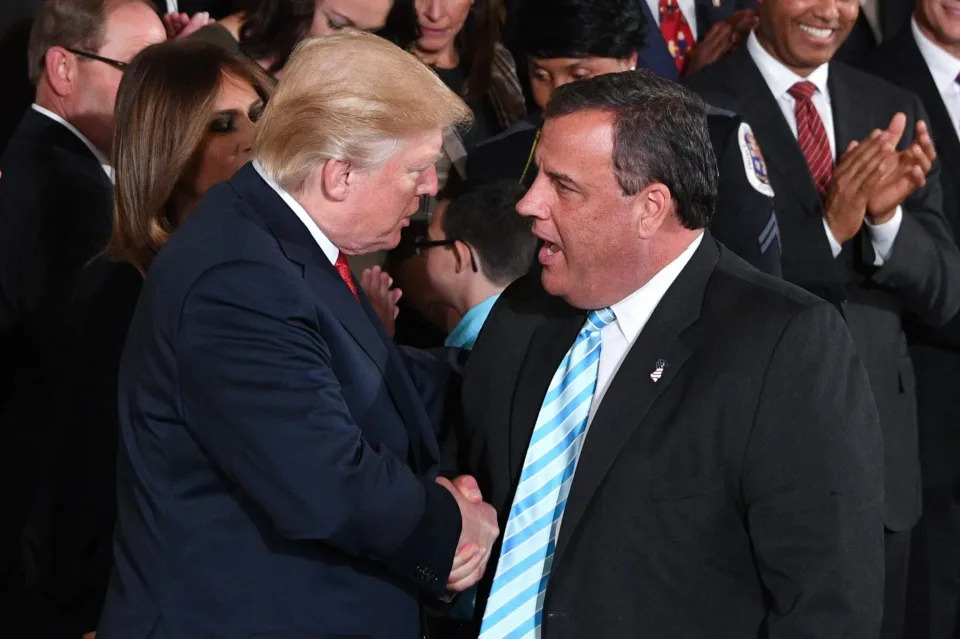
President Donald Trump shakes hands with New Jersey governor Chris Christie after he delivered remarks on combatting drug demand and the opioid crisis on October 26, 2017, in the East Room of the White House in Washington, D.C.

The party has reportedly amassed big bucks from dark-money donors, but it is missing the one thing most necessary for a presidential run: a human person willing to say, “I am the No Labels presidential candidate!” out loud without feeling profoundly embarrassed and ashamed.

This week, Christie became the latest big-name politician to pass on the opportunity.

The former GOP presidential candidate told The Washington Post in a statement: “While I believe this is a conversation that needs to be had with the American people, I also believe that if there is not a pathway to win and if my candidacy in any way, shape or form would help Donald Trump become president again, then it is not the way forward.”

How serious is No Labels? Is No Labels an elaborate grift with no candidate? Their secrecy is telling.

That puts him very much at odds with No Labels, whose organizers surely recognize their candidate’s presence on the ballot might help Trump by pulling votes away from Biden.

I know the group doesn’t like labels, but it is clearly a threat to the incumbent and an asset to the guy who tried to overturn the last election.

My name is Rex Huppke, and I am the No Labels presidential candidate

Others who have said “Yeah, no” to No Labels included: former Maryland Gov. Larry Hogan, a Republican; Sen. Joe Manchin of West Virginia, a Democrat; and former Georgia Lt. Gov. Geoff Duncan, a Republican.

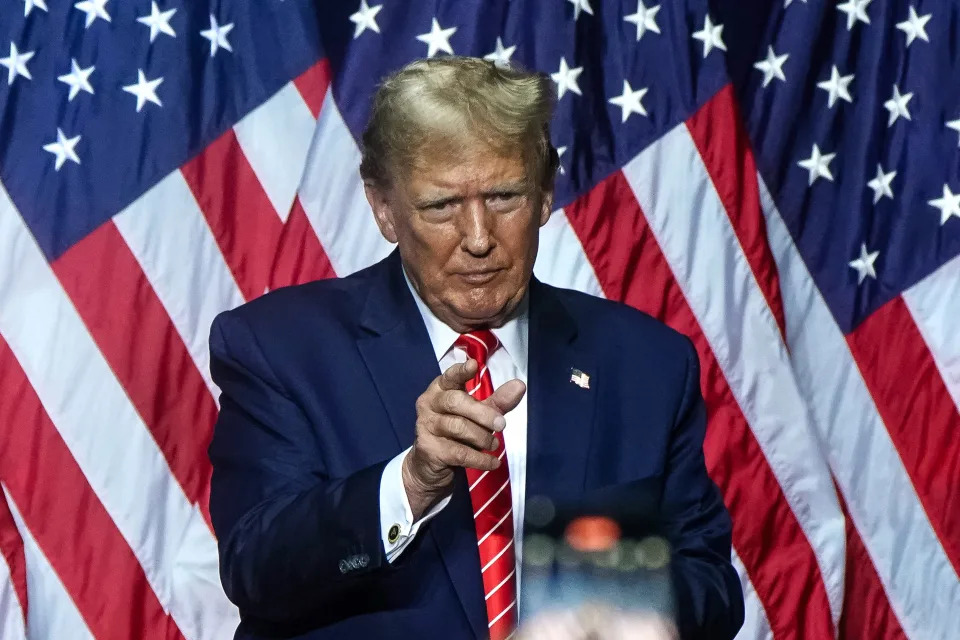
(FILES) Former President Donald Trump gestures to the crowd after speaking at a campaign event in Rome, Georgia, on March 9, 2024.

Since No Labels officials seem both unwilling to go away and unable to find anyone willing to play in their sandbox, I’ll take one for the team and be the group’s presidential candidate.

My platform will be: “For the love of God, please vote for Joe Biden. The other guy is, at best, dictator-curious, and he’s now selling $60 Bibles like some traveling huckster in a bad community theater musical.”

Getting to know the self-declared No Labels presidential candidate

Here is a candidate questionnaire so you can get to know me – Rex Huppke, the 2024 No Labels presidential candidate – a bit better.

Q: Why did you decide to join the No Labels ticket?

A: Well, for starters, I admire the party’s strong opposition to labels. I dislike labels, particularly the ones they put on apples at the grocery store. Those are hard to get off and sometimes I accidentally eat them.

Q: What should voters know about your key policy positions?

A: I don’t have any of those. I’m lucky if I can decide what I want for lunch, so asking me to decide how best to run the economy or deal with Russia is a fool’s errand. Absolutely nobody should vote for me. Ever. They should vote for President Joe Biden, who is by far the least likely of the two major party candidates to lock up journalists, forcibly silence dissenters and sell an entire U.S. state to a foreign power to help pay off his legal debts.

Who is Nicole Shanahan? RFK Jr.’s VP pick shows his presidential bid for what it is

Q: How would you describe a No Labels voter?

A: I guess I’d go with “incredibly selfish” and then perhaps “unconcerned about democracy” and “righteous to the point of arrogance and dismissive of all vulnerable groups that would be profoundly harmed by a second Trump presidency.”

Q: That sounds a little harsh.

A: Yeah, I guess I’m kind of labeling people a bit. The truth hurts sometimes. But when you think about it, even “No Labels” is a label, right? Like if someone called themselves a “centrist,” that’s a label. The only true “no label” would be … you know … not saying anything. Just kind of shutting up.

Q: Did you get high before this interview?

A: Yes. Yes I did. Nobody should vote for me. I am deeply unqualified. Please vote for Joe Biden.

USA TODAY columnist Rex Huppke has bravely stepped up and offered to be the No Labels presidential candidate. His platform is simple: "Please vote for Joe Biden."
USA TODAY columnist Rex Huppke has bravely stepped up and offered to be the No Labels presidential candidate. His platform is simple: “Please vote for Joe Biden.”

Q: Will you be picking a running mate?

A: Hah! No. If I’m the best No Labels could find for a presidential candidate, do you honestly think there’s a person alive who would stoop to being my vice president? No, the ticket is just me. And our slogan will be: “Huppke/Nobody 2024! A vote for us is dumb!”

The Unhinged Arguments the Supreme Court Is Fielding on Trump Immunity

Daily Beast

The Unhinged Arguments the Supreme Court Is Fielding on Trump Immunity

Jose Pagliery – March 30, 2024

Photo Illustration by Elizabeth Brockway/The Daily Beast/Getty

Retired American generals vehemently say that no, Donald Trump cannot deploy SEAL Team 6 to kill a political rival. Gun groups howl that the United States is turning into Communist China. And a convicted Jan. 6 rioter warns that President Joe Biden could someday get sued over the death of a jogger in Georgia.

These are among the 18 various groups that shared their wisdom with the Supreme Court earlier this month, filing amicus briefs on the same day that Trump told the high court why he should be able to dodge a federal prosecution for trying to overturn the 2020 election on false pretenses.

Department of Justice Special Counsel Jack Smith’s election interference case against Trump has finally reached the nation’s highest judicial authority, which will determine whether the business tycoon can be put on trial. The timing of the nine justices’ eventual decision will determine if the presumptive 2024 Republican presidential nominee is to face trial in court before Election Day in November.

Trump Demands Supreme Court Gift Him ‘Absolute Immunity’

But ahead of oral arguments next month, the Supreme Court is already getting inundated with all kinds of opinions about the main question in the case: whether a former president enjoys immunity for actions made while at the White House.

The Daily Beast reviewed the litany of uninvited legal arguments spanning 599 pages, ranging from breathless reiterations of Trump’s claims to head-turning warnings. Yet all bear the signs of a historic case that could determine the fate of the election, if not American democracy.

The most unusual and unexpected amicus brief comes from three former high-ranking military leaders: Retired Lt. Gen. Keith Kellogg, who served as Trump’s own acting national security adviser; Robert Wilkie, who served as Trump’s Veterans Affairs Department secretary; and retired Lt. Gen. William “Jerry” Boykin, who once led the Army’s elite commandos in Delta Force and Green Berets.

The three former military men felt it necessary to join together and address—in public and at the national level—one of the crazier Trump legal arguments: that Trump’s immunity from criminal prosecution is so beyond question that it would allow him to order the assassination of his political enemies.

“No—the president cannot order SEAL Team Six to assassinate his political rival and have the military carry out such an order,” they clarified, marking the first time former military leadership has ever had to utter such a phrase in court.

The trio went further, pointing out that a Reagan-era executive order already prohibits anyone acting on behalf of the United States government from taking part in an assassination. They dedicated a significant portion of their 18-page court filing to making clear that military officers would be legally justified in refusing to even carry out an official order from their commander-in-chief, an assertion rarely made by military brass—and one that underlies just how stark their concerns are at this point.

“That a person is a political rival of the president is neither a justification nor an excuse for an unlawful killing. And deliberately carrying out an order to murder such a person would be acting upon a premeditated design to kill or an intent to kill. Therefore, any officer engaged in murder on the orders of a president would be subject to the death penalty or life in prison—and the officer would know it,” they wrote.

Meanwhile, the vast majority of the other amici curiae—the so-called “friends of the court” who weighed in to give the Supreme Court their two cents—largely sided with Trump.

Trump Seeks Hush-Money Trial Delay While Supreme Court Weighs Immunity Claim

The right-wing nonprofit America’s Future—which screened a bonkers QAnon Hollywood conspiracy “documentary” at Mar-a-Lago earlier this week—joined forces with Gun Owners of America and similar firearms associations to warn the high court that Smith’s prosecution was making the United States look more like China, Russia, or Zimbabwe.

“The prosecution of President Trump by the Biden Administration has a parallel to a recent event in Communist China,” they wrote, recalling the way former Chinese President Hu Jintao has vanished from public view ever since he was mysteriously escorted out of a public ceremony where he had been sitting next to his successor, Xi Jinping.

The United States is heading down that same route, they warned, lamenting “the explosion of lawfare” aimed at Trump for doing what they deemed totally sensible political speech—an argument that rests, in part, on the gun-toting petitioners’ continued rejection of the 2020 election results. They referenced Trump’s “supposed” defeat in Arizona and Georgia.

The real danger here, though, is that while Trump is currently polling strong, the gun groups concede that “the effect of a conviction may be very different and could determine the outcome of the election.”

But it wasn’t the conglomeration of Second Amendment enthusiasts that made a veiled threat over the high court decision. That came from an Alabama electrical engineer who’s become a political financier.

In his court filing, Shaun McCutcheon describes himself as “a successful, self-made American businessman and constitutional patriot.” And he warned Supreme Court justices that the country’s MAGA loyalists aren’t going to suddenly start trusting the U.S. court system to select fair-minded jurors.

“The former President’s tens of millions of supporters cannot reasonably be expected to accept the typical legal fictions of voir dire under such extreme circumstances,” his lawyer wrote.

McCutcheon assigns malicious intent to the Special Counsel’s decision to indict Trump in the largely liberal District of Columbia—never mind that the U.S. Constitution’s Sixth Amendment ensures that a person will be subjected to a speedy and public trial by an impartial jury drawn from the district where his alleged crime was committed, which in this case was the White House.

“A prosecutor appointed by a partisan presidential appointee of the opposing political party may prosecute a former president in a hand-picked venue deeply hostile to that former president, his beliefs, political expression, and legacy,” his lawyer wrote.

While the Supreme Court received various interpretations of presidential immunity that cast the Special Counsel’s investigations as a severe threat to the functions of the commander-in-chief’s job, the sharpest example came from someone who knows a thing or two about Trump’s insurrection.

Trump Vows to Free Jan. 6 ‘Hostages’ as One of His ‘First Acts’ as President

In his brief, Treniss Evans argued that if Trump can be put on trial for allegedly masterminding a months-long and multi-pronged attack on U.S. democracy, then President Biden could be held personally responsible for the death in February of Georgia nursing student Laken Riley, given that an allegedly undocumented Venezuelan man was arrested for her killing.

“If a President doesn’t have immunity from prosecution for his actions, what prevents Georgia murder victim Laken Riley’s family from suing Joe Biden for allowing her illegal migrant murderer into the USA? Or what if hundreds of families all sued, seriatim?” his lawyer wrote, using the Latin phrase that means “one-by-one.”

Evans made the filing through his “legal advocacy group,” which bears the emotionally charged name Condemned USA. He trivialized Trump’s 2020 election fraud claims, but then went on to assert that Trump and his followers can’t possibly be accused of trying to stop certification of the election with a violent riot because technically Jan. 6, 2021, was just the official counting of the already certified votes before Congress.

The Supreme Court justices will get the sense that this topic is deeply personal for Evans. After all, his brief says right up top that “Mr. Evans has been investigating and reporting events of January 6th since January 6th, 2021. He was present at the Capitol on that day.”

In reality, he was in the violent crowd, held a bullhorn, and entered the Capitol—only to be identified by a Facebook tipster, arrested in Texas two months after the insurrection, and eventually sentenced to three years’ probation. To convince the federal judge to go easy on him, his other lawyer wrote that “Mr. Evans is quite self-reproving, sincerely remorseful, and duly contrite. He is embarrassed of this criminal conduct and the shame he has brought upon himself and his family. He has entered his plea of guilty voluntarily.”

But his March 19 brief before the Supreme Court doesn’t exactly hint at that remorse, nor does it morph into any critique of the man who called on him and others to show up that day and march on the Capitol Building.

Yet another legal advocacy firm asked the Supreme Court to give even more deference to Trump for the actions that led up to the disaster at the tail end of his presidency. The Christian Family Coalition Florida, a conservative Miami group that recently lent its support to Gov. Ron DeSantis’ crackdown on transgender kids in girls’ sports teams, reduced Trump’s election interference efforts to merely “core political speech.” And it would give future politicians carte blanche to lie—and follow through with those lies—regardless of their claim’s merit.

“For the sake of the presidency and the nation, criminal liability cannot turn on a mere factual dispute over whether an ex-president’s communications in challenging an election were ‘knowingly false,’” a lawyer for the group wrote.

In this Trump case, justices also heard from a favorite villain of the American progressive movement: Citizens United, the nonprofit behind the Supreme Court’s 2010 landmark decision that opened the door to having corporations spend unlimited funds on elections.

The group joined with two former U.S. Attorneys General: the Reagan administration’s Edwin Meese III, and the George W. Bush administration’s Michael B. Mukasey. Together, they tried to strip the current team of federal prosecutors going after Trump from any legitimacy.

Trump Briefly Named Election Denier to Acting AG, Lawyer Claims

They argued that Smith “wields tremendous power, effectively answerable to no one, by design.” And they contend that’s something he can’t do without the Senate’s confirmation. Instead, they say, AG Merrick Garland should have taken the same approach he did with the separate Hunter Biden investigation and tap an existing, Senate-confirmed federal prosecutor in charge of a regional office, like Delaware U.S. Attorney David Weiss.

The two conservative former AGs and the nonprofit also claim that most cabinet officials have the authority to appoint officers—minus the Justice Department, a proposition that would give the heads of Agriculture, Education and Homeland Security departments more leeway than the nation’s attorney general. And they warn that Garland’s actions could “create by regulation an entire shadow Department of Justice.”

But leave it to a consortium of 18 state attorneys general—all pro-Trump Republicans led by Alabama AG Steve Marshall—to make the one point everyone can probably agree on.

“If he had not been president, none of this would be happening,” they wrote.

Donald Trump faces backlash after sharing video featuring a hogtied Joe Biden

USA Today

Donald Trump faces backlash after sharing video featuring a hogtied Joe Biden

Phillip M. Bailey, USA TODAY – March 30, 2024

Former President Donald Trump is facing intense criticism for what Democrats say is a new low this weekend after sharing a video on his social media website that has an image of President Joe Biden hogtied.

In a 20-second video posted on the presumptive Republican nominee’s Truth Social page, a pickup truck featuring pro-Trump flags can be seen with a large decal on its rear end showing Biden bound by his legs and hands, lying horizontally.

Trump indicated the clip was filmed in Long Island on Thursday while he was there attending the wake of Officer Jonathan Diller, a New York City police officer gunned down in the line of duty.

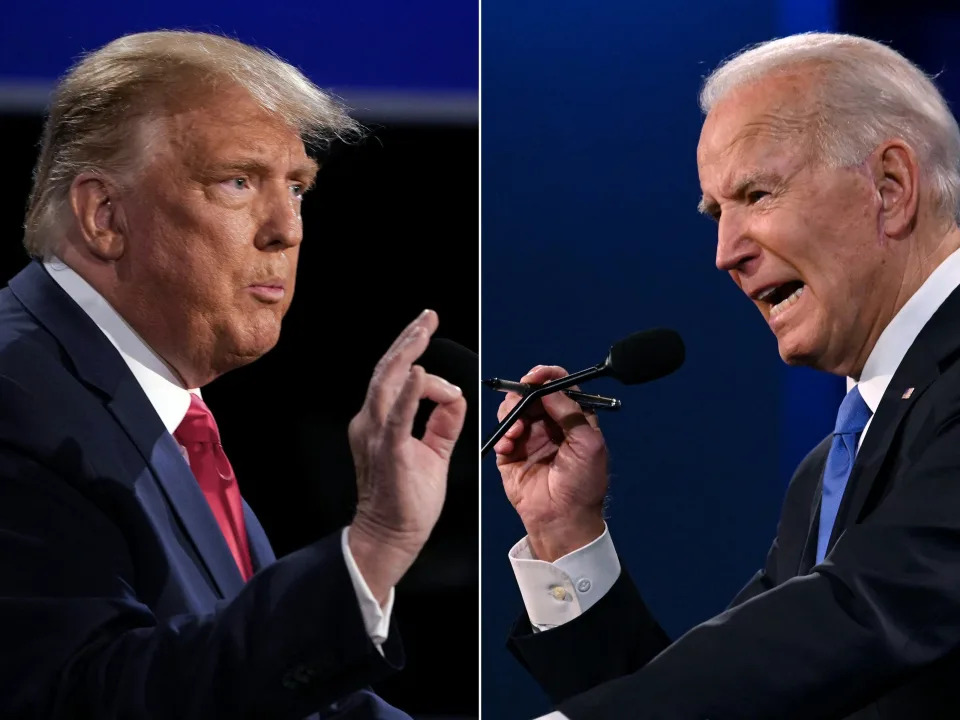
Donald Trump (L) and Joe Biden (R) during the final presidential debate at Belmont University in Nashville, Tennessee, on October 22, 2020. (Photo by Brendan Smialowski and JIM WATSON / AFP) (Photo by BRENDAN SMIALOWSKIJIM WATSON/AFP via Getty Images)

Promoting the video ignited a new round of condemnation from Trump’s critics, who pointed to how the GOP contender has repeatedly used grisly images in the past and who asserted it crosses a serious line in U.S. politics.

“A realistic picture of President Biden tied up helpless in the back of a van with Trump’s gloating mug in front of the scene. He’s threatening the president’s life,” Laurence Tribe, a Harvard Law professor emeritus said in a March 29 post on X, formerly known as Twitter.

“That’s a felony. If anyone else did it, the feds would arrest him. What now?”

Asked about sharing the clip, Trump campaign spokesperson Steven Cheung pivoted to several comments by Democrats in years past that he alluded to as going too far.

Among the examples Cheung spotlighted was a 2018 comment made by Biden referring to Trump’s infamous “Access Hollywood” tape, which surfaced during the 2016 campaign.

“If we were in high school, I’d take him behind the gym and beat the hell out of him,” Biden said at the time.

“Democrats and crazed lunatics have not only called for despicable violence against President Trump and his family, they are actually weaponizing the justice system against him,” Cheung said.

The Biden campaign did immediately responded to a request for comment.

Trump shares video with image depicting Biden tied up in the back of a pickup truck

NBC News

Trump shares video with image depicting Biden tied up in the back of a pickup truck

Megan Lebowitz – March 30, 2024

Matt Rourke

Former President Donald Trump shared a video on social media Friday that included an image of President Joe Biden bound and restrained in the back of a pickup truck.

The 20-second video, which Trump indicated was taken Thursday in Long Island, New York, shows a truck emblazoned with “Trump 2024” and a large picture depicting Biden tied up and lying on his side.

Trump was in Long Island Thursday for the wake of fallen NYPD officer Jonathan Diller.

When reached for comment on the image in the video, Trump campaign spokesperson Steven Cheung said, “That picture was on the back of a pick up truck that was traveling down the highway.” Cheung also accused “Democrats and crazed lunatics” of calling for violence against Trump and his family, arguing that “they are actually weaponizing the justice system against him.”

Cheung pointed to comments by Biden in 2018, before he declared his candidacy, when he said that if he and Trump were in high school he’d “take him behind the gym and beat the hell out of him” if he heard him demeaning women.

Biden campaign spokesman Michael Tyler slammed Trump for posting the video.

“This image from Donald Trump is the type of crap you post when you’re calling for a bloodbath or when you tell the Proud Boys to ‘stand back and stand by,'” Tyler said in a statement. “Trump is regularly inciting political violence and it’s time people take him seriously — just ask the Capitol Police officers who were attacked protecting our democracy on January 6.”

The White House referred questions about the video to the campaign.

Trump has previously used violent imagery and rhetoric, both in his 2024 presidential campaign and before.

On March 16, he vowed that there would be a “bloodbath” if he was not re-elected, while speaking about the economy. Last year, before his numerous indictments, Trump warned about “potential death and destruction” if he were to be charged in the Manhattan district attorney’s hush money case against him.

He also shared an article on Truth Social that had an image of him with a baseball bat near Manhattan District Attorney Alvin Bragg’s head. The post was deleted.

More recently, Trump used his Truth Social platform to go after Judge Juan Merchan, who is overseeing the hush money case, as well as the judge’s daughter after being hit with a partial gag order.

Trump faces four criminal indictments for charges related to allegations of election interference, mishandling classified documents and falsifying business records related to hush money payments. He has pleaded not guilty to all charges.

The ‘Broken Clock’ Problem

The Dispatch – Opinion

The ‘Broken Clock’ Problem

Nick Catoggio – March 29, 2024

Here’s something you don’t see every day.

It’s rare for a federal judge to appear on a news program for any reason. But to appear on one for the purpose of criticizing a party in an active case was so extraordinary it rendered my colleague, Sarah Isgur, nearly speechless.

“This is a sitting federal judge commenting on a criminal defendant in a pending trial in his district,” she tweeted in reaction to the news. Not a word of that sentence is overtly critical, but it didn’t need to be. Merely describing what had happened conveyed the depth of her astonishment.

Res ipsa loquitur, to borrow a phrase from the law.

If it matters to you, Reggie Walton is a senior judge rather than an active judge, which means he hears cases on a reduced and irregular schedule for the U.S. District Court for the District of Columbia. He isn’t presiding over Donald Trump’s criminal trial in Washington for trying to overturn the 2020 election; Judge Tanya Chutkan is in charge of that. And if you watch the interview he did with Kaitlan Collins, you’ll find that he spoke mainly in generalities about threats to judges instead of focusing on Trump.

But so what?

The context for the CNN segment was Trump’s attempt to intimidate the judge overseeing his upcoming criminal trial over the Stormy Daniels hush-money payoff. Collins made that explicit on social media:

Judge Walton understood that context. He knew, of course, that Trump is a criminal defendant right now not only in his home district but in Florida, Georgia, and New York. He must have recognized that prospective jurors in each of those venues might see the interview and have their views of Trump’s guilt colored by a notable judge’s dim regard for his behavior.

As you may have heard, Trump is also the Republican nominee for president. Even if no jurors end up being influenced by Judge Walton’s interview, some voters very well might be. Federal judges aren’t supposed to be campaigning against candidates for office. So what was he doing on CNN?

Canon 2 of the Code of Conduct for United States Judges urges jurists to “act at all times in a manner that promotes public confidence in the integrity and impartiality of the judiciary.” Canon 5 warns them against engaging in “political activity.” Whether or not Judge Walton’s conduct ran afoul of either is above my pay grade, but the appearance of impropriety was glaring enough for numerous Trump boosters to complain loudly about it online.

How seriously should we take them?


One of my editors described Judge Walton’s appearance as the latest in a series of “broken clock” moments for Trump’s critics. A broken clock is right twice a day, the saying goes; insofar as Trump reflexively whines about corruption and unfairness after every setback he faces, most famously following the 2020 election, he’s a broken clock.

But sometimes, Trump’s antagonists overreach by making special exceptions to institutional norms just for him. When they do, the broken clock appears correct, leading many Americans to wonder whether it’s actually as broken as his critics say.

The reasons for that overreach vary.

Sometimes, the missteps are a matter of earnest gullibility driven by understandable suspicion, as happened when some media outlets published the Steele dossier without affirming the truth of its contents. A special exception from standard journalistic practices was made for Trump because his apologetics for Vladimir Putin are genuinely weird and because he appears amoral by nature to a degree that no U.S. president, Richard Nixon included, has ever been. If any commander-in-chief might plausibly be jungled up with the Kremlin, it’s him.

So a special exception was made. And when it didn’t pan out, the broken clock that’s forever complaining about the media being out to get him seemed correct.

Suppression of the Hunter Biden laptop story by Twitter and Facebook in October 2020 falls into the same bucket. A special exception to platform rules was made because it seemed only too likely that Russia was once again trying to lend Trump a hand in the home stretch of an election. Liberals weren’t about to let that happen with victory within reach; the laptop story was suppressed on the assumption that it was enemy disinformation or, at the very least, the product of hacking.

It wasn’t. The broken clock was right.

Sometimes, it’s personal ambition that causes overreach. Prosecutors keen to make a political name for themselves have always eyed high-profile suspects hungrily, but Trump is a historically juicy target due to the animosity Democrats feel for him and the freakishly high political stakes of a conviction before November. Some of his antagonists have gotten sucked into that and dropped the pretense that they’re dispassionately applying the law, instead playing to the cheap seats. Witness Fulton County District Attorney Fani Willis warning Trump that “the train is coming” for him, the sort of thing you might hear at a pro wrestling event. Or consider New York State Attorney General Letitia James doing the legal equivalent of end zone dancing by posting daily updates online of how much interest Trump owes in the civil judgment against him.

The broken clock says he’s being persecuted by corrupt, hyperpartisan Democratic lawyers for political gain. Sometimes he seems correct. The fact that Willis has gotten sidetracked by a garish ethical scandal of her own making only seems to drive the point home: Why should Donald Trump pay a legal price for his misconduct when those who sit in judgment of him are compromised themselves?

No wonder that Americans’ views of his criminal culpability have changed.

Insofar as Judge Walton’s CNN interview was another “broken clock” moment, though, neither ambition nor gullibility explains it. I think it’s a matter of sincere exasperation. And while that doesn’t excuse it, it does make it relatable.

On some level, this newsletter is a product of the same sentiment. The reality that half the country is comfortable enough with how Trump behaves that they’re willing to entrust the presidency to him again is so shattering and disillusioning that I often retreat into the belief that they simply mustn’t know how bad he is. I’d better tell them! (And tell them, and tell them, and tell them.) Those of us opposed to a second Trump term can rationalize the current polling by speculating that Americans haven’t paid any attention to what Trump has been up to since 2021 and that they’ll snap out of their stupor soon enough. Ignorance, not indifference, is to blame.

Maybe. But it may also be that they do have some sense of what he’s been up to yet have chosen to remain willfully ignorant about the particulars so as not to create any pangs of guilt before they go out and vote for him again. They know the clock is broken, but they don’t care—and don’t care to be reminded of it.

In their heart of hearts, some might even admit that it’s the brokenness that attracts them.

I can’t read Judge Walton’s mind, but I imagine him finding Trump’s intimidation tactics in the New York case—which now include mentioning the judge’s daughter by name—so far beyond the pale that he concluded some extraordinary measure needed to be taken to alert the public. Threats against judges and prosecutors have been commonplace during Trump’s legal travails, yet Republican voters handed him their party’s presidential nomination anyway almost by acclamation. How is that possible? Can it be that they hadn’t heard anything about them when they cast their ballots for him?

They simply mustn’t know how bad he is, Judge Walton might have figured. I’d better tell them—even if telling them, in this case, meant committing a breach of judicial ethics, proving the broken clock correct once again about American institutions ditching their usual rules to go after Trump.

This is all very conflicting for a Never Trumper.


J. Michael Luttig, a conservative and a former judge himself, commended Walton on Friday for speaking up to try to protect the judiciary from Trump’s goonish tactics “because no one whose responsibility it is to do so has had the courage and the will.”

Luttig went on to say that the United States Supreme Court and its counterparts at the state level should be taking the lead on this, but ultimately, he laid the blame where it belongs: “It is the responsibility of the entire nation to protect its courts and judges, its Constitution, its Rule of Law, and America’s Democracy from vicious attack, threat, undermine, and deliberate delegitimization at the hands of anyone so determined.”

That’s correct, but the nation—or half of it, anyway—has chosen to abdicate that responsibility. How far should institutional actors go in bending their own rules to try to pick up the slack and/or spur that wayward half into caring again?

Forced to choose, I prefer Sarah Isgur’s attitude to Luttig’s. If we must defeat Donald Trump in November to prevent him from smashing American norms, but the only way to defeat him is to smash those norms ourselves, then … what is the point, exactly?

What is classically liberal conservatism conserving in that case?

Underlying Luttig’s argument is the sense that democracy no longer works as well as it used to. American institutions could safely follow the ethical guidelines by which they’ve traditionally abided so long as the people themselves were virtuous enough not to reward a comically vulgar demagogue with power. That virtue has now been lost. And so some institutional actors—like courts, prosecutors, and Judge Walton—may feel an earnest duty to try to fill the vacuum by confronting the demagogue themselves, even if that means carving out ethical exceptions to do so.

I understand the impulse. Trust me, I do. But putting a thumb on the scale by ignoring traditional norms amounts to institutions admitting that they no longer trust the people whom they allegedly serve to defend the constitutional order themselves. The “pro-democracy” movement that opposes Trump is actually pretty anti-democratic in that respect.

If all of that doesn’t move you, consider how swing voters might be processing all of these examples of ethical rules being broken by Trump’s critics in law enforcement. The more correct the broken clock appears to be, the more tempted some of those voters will be to conclude that it isn’t really broken at all. In an election that may turn on Americans’ judgments of whether Trump or his political enemies are more incompetent and corrupt, every “broken clock” moment gets him a little closer to victory.

So, no, Judge Walton shouldn’t have done the interview.

But I can scold him only so much.


The vacuum of condemnation described by Luttig is real, after all, and predictably most pronounced on the American right. It’s an ineffable disgrace that Trump continues to try to intimidate law enforcement in the light of day, up to and including digs at their children, and endures scarcely a word of meaningful protest from anyone to the right of Liz Cheney.

That’s partly because many have been physically intimidated themselves. When former Trump White House communications director Anthony Scaramucci was asked recently why more Republicans weren’t speaking out against the former president, he answered bluntly: “They probably don’t like death threats.” Being threatened with harm by Trump’s rabid fans is now a fact of American political life and no one with a modicum of influence in the GOP has the nerve to object to it. So Judge Walton opted to fill the void.

It’s also hard to get indignant about his CNN appearance in light of the cynicism with which Trump apologists routinely yet falsely spin every bit of institutional resistance he encounters as a “broken clock” moment. Jonathan Chait had their number in a piece published Wednesday by New York magazine in which he identified disingenuous abuse of the term “lawfare” by figures across the American right:

The advantage of this catchall term is that it allows Trump’s defenders to ignore the specifics of Trump’s misconduct, or at least to analyze it in a highly selective way. There are indeed a couple instances in which Trump has faced legal challenges that are questionable (the attempt to disqualify him from the ballot based on the 14th Amendment) or downright weak (Alvin Bragg’s indictment over hush-money payments to Stormy Daniels). Conservatives tend to focus obsessively on these cases, and “lawfare” is a permission structure that allows them to use these cases to ignore or discredit the others, where Trump’s behavior is impossible to defend.

It is a similar rhetorical strategy to the way Republicans dismissed the entire Russia scandal as “Russiagate” (or, in Trump’s preferred phrasing, “Russia, Russia, Russia”). The Russia scandal consisted of innumerable strands and accusations, some of which (most famously the Steele dossier) did not pan out. But the sweeping frame allowed Trump’s defenders to ignore the voluminous evidence of guilt. No need to defend Trump pardoning the campaign manager who had a Russian intelligence agent as a partner when you can just denounce Russiagate as a hoax.

That’s correct, and it’s as true of anti-anti-Trump conservative partisans as it is of diehard MAGA populists. Devoting oneself to running political interference for the Republican Party, as both groups do, requires relentlessly muddying the waters between genuine examples of Trump’s enemies behaving irresponsibly and examples of them simply holding him to account for his own irresponsible behavior. It’s the same impulse that motivates bad-faith right-wing analogies between Trump’s 2020 coup attempt and the fact that certain random Democrats questioned the results when he won in 2016.

Ask yourself: How often do Trump apologists in right-wing media attempt to draw ethical distinctions between Fani Willis on the one hand and Special Counsel Jack Smith on the other? How commonly do they distinguish the dubious Stormy Daniels prosecution in Manhattan from the formidable case against him in Florida for concealing classified documents? Their goal in refusing to do so is to convince Republican voters to lump together all accusations of misconduct against Trump, no matter how well substantiated, and dismiss them out of hand en masse as part of the same meritless “witch hunt.” That goal has largely been achieved

Go figure that Judge Walton thought desperate measures were needed to try to puncture the information bubble by using CNN to reach more conciliatory Republican viewers about threats being made to judges and their families.


I understand his decision to appear on the network for another reason, though.

Trump gets to threaten people, to preemptively cast doubt on the legitimacy of the election, to tease violent unrest if he’s convicted of a crime, and to promise “retribution” for his enemies if he’s elected, all with political impunity. As a matter of moral and civic duty, Joe Biden and the leaders of his party must be better.

It’s the right thing to do. But emotionally, it is maddening to have to engage in asymmetrical political warfare with Trump and his most goonish, dishonest enablers.

Judges aren’t supposed to indulge their emotions in public discourse, which is why I’m Team Isgur more so than Team Luttig. But as a matter of common humanity, one can’t help but sympathize with Judge Walton emotionally for not remaining similarly passive as Trump stoops to thuggery toward the law that even a mafia don would eschew. When someone makes a habit of physically intimidating others, a rule-of-law stickler might understandably feel compelled to raise a very mild objection to it publicly rather than take it lying down.

That’s what Walton did. Consider it a matter of self-defense, a principle Republicans normally cherish and exalt. If the American right won’t defend the courts from Trump’s intimidation racket, shouldn’t the courts defend themselves?

They’ve been moved to defend their integrity from Trump’s attacks before, remember, although admittedly not in the thick of an election campaign when he was facing dozens of federal criminal charges.

The “broken clock” problem exemplified by Judge Walton’s interview recurs eternally in liberal societies confronted by illiberal threats because it feels foolish and self-defeating to follow norms designed to protect the rights of authoritarian cretins who wouldn’t extend the same courtesy if the roles were reversed. And when said cretins start crying crocodile tears about ethical rigor amid their usual hosannas to a man who doesn’t understand ethics as a concept except as something suckers believe in to justify their own weakness, it’s downright infuriating.

The illiberal faction will always cynically exploit ethical lapses by the liberal establishment they resent and hope to replace to draw a moral equivalence between that system and their own brand of “might makes right” politics. Having to indulge them while they play that game is, as I say, sincerely maddening—even for a federal judge.

But what’s the alternative? If the only way to stop Trump from becoming president and appointing partisan judges is to have judges quasi-campaign against him on CNN, the great war over normalizing Trumpism is already over. We lost.

I think we lost regardless, even if we resolve to slap Reggie Walton on the wrist. And I think he thinks so too: He wouldn’t have agreed to appear on CNN, I assume, if he didn’t think the hour was late in getting American voters to care about politicians using threats as a pressure tactic. The battle against Trump might be won in November, but Trump has never been the problem in all this. The real problem will remain.

Conservative Judges Sound Alarm: Trump Will Shred Our Justice System

The New Republic – Opinion

Conservative Judges Sound Alarm: Trump Will Shred Our Justice System

Ellie Quinlan Houghtaling – March 29, 2024

Donald Trump’s attacks on the judges and court staff overseeing his criminal trials have much deeper legal implications than petty fines. Instead, the attacks—and the responding “passivity, acquiescence, and submissiveness by the nation”—are actively undermining the entire judicial system, prominent conservative judges are warning.

In a CNN interview Thursday evening, Republican-appointed federal District Judge Reggie B. Walton felt compelled to announce that Trump’s continued attacks could result in “tyranny.” Just hours later, former Appeals Court Judge J. Michael Luttig, also a conservative, issued his own warning cry, declaring that Trump is responsible for the “dismantling” of the nation’s “system of justice.”

“The Nation is witnessing the determined delegitimization of both its Federal and State judiciaries and the systematic dismantling of its system of justice and Rule of Law by a single man—the former President of the United States,” started Luttig in a multipart thread on X.

“In the months ahead, the former president can only be expected to ramp up his unprecedented efforts to delegitimize the courts of the United States, the nation’s state courts, and America’s system of justice, through his vicious, disgraceful, and unforgivable attacks and threats on the Federal and State Judiciaries and the individual Judges of these courts.”

“Never in American history has any person, let alone a President of the United States, leveled such threatening attacks against the federal and state courts and federal and state judicial officers of the kind the former president has leveled continually now for years.”

Luttig also warned that Trump isn’t accomplishing the task alone. It’s the complicit Supreme Court—and the American people—that are letting Trump get away with it.

“It is the responsibility of the Supreme Court of the United States in the first instance to protect the federal courts, the federal judges, and all participants in the justice system from the reprehensible spectacle of the former president’s inexcusable, threatening attacks, just as it is the responsibility of the respective State Supreme Courts in the first instance to protect their courts and their state judges from the same,” he added. “Ultimately, however, it is the responsibility of the entire nation to protect its courts and judges, its Constitution, its Rule of Law, and America’s Democracy from vicious attack, threat, undermine, and deliberate delegitimization at the hands of anyone so determined.”

Here was Walton’s own dire warning:

Georgia Republican official and outspoken election denier caught voting illegally 9 times

USA Today

Georgia Republican official and outspoken election denier caught voting illegally 9 times

Josh Meyer, USA TODAY – March 28, 2024

A judge has found Georgia Republican Party official Brian Pritchard guilty of illegally voting nine times over several years. Pritchard has falsely asserted Democrats had stolen the 2020 election through fraud.

Administrative Law Judge Lisa Boggs wrote in her Wednesday decision that Pritchard, the Georgia GOP’s first vice chairman, violated state election laws by voting while on probation for forgery and other felonies, and that his explanations were neither “credible or convincing.”

Pritchard must pay a $5,000 fine and $375.14 in investigative costs incurred by the court. Boggs also ordered that Pritchard “be publicly reprimanded for his conduct” by the State Election Board, which sought the sanctions against him.

On Thursday, Georgia Republican Rep. Marjorie Taylor Greene called on Pritchard to “resign immediately or be removed” from his Georgia GOP position because he “voted ILLEGALLY nine times while serving out his probation for FELONY check forgery.”

“The Republican Party is the party of election integrity,” Greene said on X, formerly Twitter, and “our state party should be the leading voice on securing our elections.”

Forged checks, and claims of a stolen election

Pritchard, a conservative talk show host, has claimed on his FetchYourNews.com show that the 2020 presidential election was fraudulent, echoing claims by former President Donald Trump, who lost in the Peach State and nationwide to Democrat Joe Biden. Trump and 14 co-defendants are currently facing charges of illegally conspiring to overturn the result in Georgia, while four co-defendants have pleaded guilty.

Republican presidential candidate, former U.S. President Donald Trump, gestures while speaking during the 2024 NRB International Christian Media Convention Presidential Forum on February 22, 2024 in Nashville, Tennessee.

Investigations consistently have found no evidence of mass fraud in 2020. But in her 25-page ruling, Boggs found that Pritchard committed voter fraud himself.

Boggs cited certified records from an Allegheny County, Pennsylvania court, which showed Pritchard pleaded guilty in 1996 to felony fraud and theft involving $38,000 in forged checks relating to a construction project and that he was ordered to pay that same amount in restitution. Felons in Georgia lose their right to vote until they complete probation or parole.

Evidence presented in court by two senior officials of the state attorney general’s office indicated Pritchard’s probation had been extended until 2011, but he registered to vote in 2008 and voted in nine elections between then and 2010.

Pritchard testified at an evidentiary hearing in February that he didn’t knowingly commit fraud and that he believed his status as a felon who is ineligible to vote had ended more than two decades ago. He also said he believed his criminal sentence had been converted to a civil judgment, according to a copy of Boggs’ decision.

In an earlier proceeding before the State Election Board, which referred Pritchard’s case to the Georgia attorney general’s office for investigation, his attorney said Pritchard was unaware he was considered a felon when he registered and voted in Georgia.

‘He should have known’

The judge found Pritchard’s explanations to be lacking in credibility, noting that “to accept that the Respondent’s grasp of legal proceedings was so unsophisticated that he did not understand the basic terms of his probation in 1996 … this Court would need to disregard (Pritchard’s) self-described experience as a businessman handling complex projects as well as million-dollar contracts and budgets.”

“Based on the above, and upon careful consideration of the evidence in its totality the Court does not find the explanations credible or convincing,” Boggs wrote. “At the very least, even if the Court accepts he did not know about his felony sentences, the record before this Court demonstrates that he should have known.”

Pritchard’s fine includes $500 for each of the nine times he voted illegally and another $500 for illegally registering to vote in 2008. He can appeal the decision.

Neither Pritchard nor his lawyer, George Weaver Jr. could be reached for immediate comment.

‘I’ve not done anything wrong here’

Pritchard was defiant about his voting record back in December 2022 when he qualified to run in a special election for the state House seat previously held by Speaker David Ralston, who had died the previous month.

“I’ve not done anything wrong here,” Pritchard said at the time, asserting that his sentence had ended long ago and his rights had been restored, the Atlanta Journal Constitution reported. “I guess if you’re apprehending public enemy No. 1, here I am.”

Pritchard has said on his show that the 2020 presidential election was “stolen,” the Atlanta newspaper wrote. It said he also had criticized Republican Gov. Brian Kemp and Republican Attorney General Chris Carr for being “complicit” in Biden’s victory in Georgia.

“I do not believe that 81 million people voted for this guy,” Pritchard said on his show.

Jason Shepherd, a former vice chairman of the Georgia Republican Party, told USA TODAY that the judge’s decision is ironic given Pritchard’s constant claims of election fraud.

Pritchard, he said, “has rapidly risen in the ranks of the Georgia Republican Party and has built a media empire of literally tens of dozens of followers by spouting conspiracy theories about stolen elections and rampant voter fraud from thousands of illegal voters, despite being investigated himself for illegally voting.”

Shephard, who writes the Peach Pundit political column, said the accusations of Pritchard’s voter fraud “have been well known long before he became the second highest officer in the Georgia Republican Party.”

“He should have never been elected and he has now needs to go…and sooner rather than later,” Shephard said. “If (Georgia GOP) Chairman Josh McKoon doesn’t have a resignation by the end of the day, I don’t see how anyone can take the Georgia Republican Party seriously.”