The Arizona Supreme Court has revived an 1864 criminal ban on abortion.
The Civil War-era law, which predated Arizona statehood by almost a half a century, prohibits abortion at any stage of pregnancy, for any reason other than when “necessary” to save the pregnant person’s life. The ban carries a penalty of up to five years in prison for abortion providers.
“[P]hysicians are now on notice that all abortions, except those necessary to save a woman’s life, are illegal,” the court’s opinion read.
The ban — which is set to take effect 14 days after Tuesday’s ruling, on April 23 — will replace Arizona’s 2022 law which banned most abortions after 15 weeks gestation. (That law contained a single exception, for “medical emergencies”; providers who violated it could be charged with a felony and lose their medical licenses.)
The legal case, originally brought in the wake of the U.S. Supreme Court’s 2022 Dobbs decision, sought to determine which ban — 1864 or 2022 — would take precedence after the court struck down federal protections for abortion.
In December 2022, the Arizona Court of Appeals upheld the 15-week ban. But by that time, Arizona voters had replaced Mark Brnovich, the Republican attorney general who argued for restoring the 1864 ban, with a Democrat, Kris Mayes, who declined to appeal the court’s decision. In a statement Tuesday, Mayes called the court’s decision “unconscionable and an affront to freedom,” and said her office would not enforce the ban.
The case could have ended there, but Dr. Eric Hazelrigg, an anti-abortion OB-GYN from Gilbert, Arizona, who petitioned the court to be appointed as a “guardian ad litem” for the state’s “unborn” children, intervened to appeal the lower court decision. Alliance Defending Freedom, the conservative christian litigation shop known for its willingness to take on culture war cases, represented Hazelrigg.
The decision was four to two; all six of the Supreme Court’s justices — four men and two women — were appointed by Republican governors.
The decision could have major electoral consequences: advocates for reproductive rights are working to place a popular referendum on the November ballot that would protect the right to abortion in Arizona. The state is also seen as a critical battleground, one that could decide both the presidential contest and control of the Senate this November.
The Arizona Supreme Court’s decision comes as debate has raged over whether abortion laws should be determined at the state or federal level. Republicans, Including Donald Trump, have had a difficult time addressing the issue this election season, feeling the need to placate the party’s far-right base while not alienating the vast majority of Americans who believe in protecting reproductive rights.
Trump on Monday released a video statement insisting he believes that the issue should be up to the states — but the claim is dubious, to say the least. The former president has repeatedly taken credit for killing Roe v. Wade, and has on several recent occasions spoken about implementing a federal ban.
The real price tag for Trump’s billionaires’ banquet
Opinion by Dean Obeidallah – April 7, 2024
Editor’s Note: Dean Obeidallah, a former attorney, is the host of SiriusXM radio’s daily program “The Dean Obeidallah Show.”
This weekend, some 100 wealthy people were on the guest list for an exclusive fundraising event at the ritzy Palm Beach, Florida, home of billionaire investor John Paulson.
Dean Obeidallah – CNN
The soirée reportedly raised more than $50 million for former President Donald Trump’s 2024 White House campaign. Trump’s well-heeled backers paid $250,000 per person for those serving on the “host committee” to $824,600 per person to serve as a “chairman.” Those contributing at the top level were allowed to be seated at Trump’s table during dinner.
In more normal times, there would be nothing particularly remarkable about this kind of high-priced fundraiser. Trump, however, is anything but a conventional Republican candidate. After all, he attempted a coup to remain in power despite losing the 2020 election for which he now faces numerous felony charges.
Trump’s deep-pocketed and highly credentialed donors, including Paulson, doubtless are fully aware of his record, but nevertheless see fit to donate massive sums of money to a man who attempted to destroy the peaceful transfer of power that stands at the heart of our democracy.
Paulson and the other wealthy donors who attended Saturday night’s event must surely be aware that Trump sat idly by, watching on television as the January 6 attacks unfolded — ignoring requests that he call off his supporters for more than three hours and even turning a deaf ear to his aides and one of his family members.
They may also know that since leaving the White House, Trump has celebrated the January 6 attackers, even starting many of his campaign rallies by playing a recording sung by the “J6 Prison Choir.” They might have heard that he has vowed to pardon those convicted of crimes related to the siege of the Capitol, which in some cases included assaulting police officers.
The effort to upend our democracy also involved violent groups like the right-wing, extremist Proud Boys, the leader of which has been convicted of seditious conspiracy in connection with his role in seeking to interfere with the peaceful handover of power on January 6.
None of that seems to have troubled these rich people — at least not enough to get them to forgo making massive donations to Trump’s presidential campaign. Their fundraiser came a little over a week after Democrats, including former Presidents Barack Obama and Bill Clinton, held a star-studded fundraising event for incumbent President Joe Biden that raked in some $25 million.
If they’ve been paying attention, the wealthy donors at Saturday night’s fundraiser for Trump — who included hedge fund billionaire Robert Mercer and his daughter Rebekah, oil tycoon Harold Hamm and casino mogul Steve Wynn — might also be aware that in December, the Colorado Supreme Court ruled that Trump had been “engaged in an insurrection.” And even though the US Supreme Court ultimately determined that Trump could remain on the 2024 ballot in Colorado, it did not overrule the state’s high court on the issue of Trump having taken part in an “insurrection.”
Trump’s donors might even have heard reports about the former president channeling Adolf Hitler by declaring that immigrants are “poisoning the blood” of our nation, his vow to be a “dictator” on the first day of his presidency and his repeated praise of autocrats. Presumably, if they found any of this alarming, they would not have donated at least a quarter of a million dollars per person to help Trump take back the White House.
To put it bluntly, I don’t put the sophisticated, ultra-wealthy people who attended this weekend’s campaign fundraiser in the same category as average Americans who have been conned time and again by Trump’s repeated lies that the 2020 election was “rigged.” I suspect that this elite group of backers knows exactly what is going on with the former president.
It seems more than plausible that Paulson had at least some second thoughts about Trump in 2024. In fact, earlier in the 2024 campaign, Paulson raised funds for Trump’s GOP primary opponent Ron DeSantis despite having made big donations to Trump in 2016 and 2020.
But all of that changed once it became clear that Trump would become the GOP’s presidential nominee. A few weeks ago, Paulson told CNN, during a discussion ahead of Saturday’s fundraiser, that he was “pleased to support President Trump in his re-election efforts.” He added, “His policies on the economy, energy, immigration and foreign policy will be very beneficial for the country.”
Paulson left out any mention of the Trump tax cut enacted in 2017, which greatly helped the very wealthy set, which Paulson and the others at Saturday’s dinner are privileged to be part of.
Is that why these very rich people are now turning a blind eye to the threat that Trump poses to the rule of law in our country? Are they hoping he’ll enact more policies that could fatten their wallets? Perhaps they have fully grasped the danger Trump poses to our republic, but have decided they are on board with him all the same.
Or perhaps they believe they can benefit as wealthy friends of an autocratic leader. After all, in Hungary led by Trump’s ally Viktor Orban, his inner circle has profited under his leadership with the funneling of contracts. Of course, the same can be said of Russia under Vladimir Putin, where the oligarchs who gave him their support became even wealthier — until running afoul of him, when some were “forced into exile or died in suspicious circumstances.”
A short time after the January 6 attack, Chuck Collins, director of the Project on Inequality and the Common Good at the Institute for Policy Studies, was unstinting in his criticism of Trump’s uber-wealthy backers. “They enabled Donald Trump. They bankrolled his campaigns,” he told the progressive news site Common Dreams. “And they cheered as Trump cut their taxes, swept away regulations that pinched their profits, and packed the courts with judges eager to wink at their transgressions.”
Liz Cheney — the conservative former US Representative from Wyoming and onetime Republican member of the House GOP leadership — warned Americans recently that with Trump’s second rise to power we are “sleepwalking into dictatorship.” If he in fact regains power, we can blame, among others, these short-sighted, wealthy enablers who helped underwrite Trump’s campaign. They undoubtedly know better, but appear to care more about helping their bottom line than protecting our democracy.
Abortion Might Be a Winning Issue — Even in Florida
Ryan Lizza – April 6, 2024
Chasity Maynard/Tallahassee Democrat via AP
Abortion rights supporters have been on a hot winning streak in state ballot initiatives since the Supreme Court struck down Roe v. Wade. Now here comes Florida.
The Florida Supreme Court issued a pair of decisions earlier this week that upheld a strict abortion ban in the state and also cleared the way for Amendment 4, a November referendum on whether to enshrine the right to abortion in the Florida Constitution.
Anna Hochkammer did much of the heavy lifting to get Amendment 4 on the ballot as executive director of the Florida Women’s Freedom Coalition, but the job is getting only trickier amid the swirl of 2024 politics. Changing the Florida Constitution via referendum requires a 60 percent majority, which means Amendment 4 will need support from a lot of Floridians who would never back Joe Biden.
Still, Hochkammer is optimistic about winning a bipartisan coalition of support after studying the 11 post-Dobbs elections that have centered on abortion rights; she found that a message promoting freedom succeeds.
“Floridians are interested in freedom — personal freedom — and that became one of the North Stars of the entire petition,” she said in this week’s episode of Playbook Deep Dive.
I sat down with Hochkammer for POLITICO Magazine to discuss the delicate relationship between abortion rights activists and the Biden campaign, why she thinks politicians need to use the “a” word when talking about abortion and whether she would want Donald Trump to endorse Amendment 4 and be an ally for her cause.
This transcript has been condensed and edited for length and clarity.
Florida’s law on constitutional amendments is that they require 60 percent support. If I’m not mistaken, the abortion issue hasn’t hit 60 percent in any red state so far. How do you get to 60 percent in Florida?
You get to 60 percent in Florida by being really focused about who you’re talking to, how you’re talking about abortion access and getting people to understand that it’s an issue that transcends politics.
You basically have to give people who are independents and Republicans permission to agree with you on this thing, to disagree with their individual candidate or their party, and to split that ticket if that’s what they feel they need to do. Yes, 60 percent can be an intimidating threshold. Florida has passed referenda at the 60 percent threshold over and over again over the last decade.
The Biden campaign this week argued after the Supreme Court’s decisions that Florida was suddenly “winnable.” You just said that voters need to split the ticket. Julie Chávez Rodríguez, Biden’s campaign manager, doesn’t want people to split the ticket. She wants people to support your amendment and vote for Joe Biden. How does that complicate things?
My election is to pass Amendment 4.
I do not live in a hole in the ground. We’re going to be on the November 2024 ballot in Florida, and all sorts of people and candidates in all kinds of races are looking at this as an opportunity for synergy. But I’m not trying to be naive when I say that more people support abortion access than probably support Santa Claus. It would be a crazy thing in 2024 in Florida to not support Amendment 4.
I don’t look at it as threatening. I look at it as smart people who are reading the room and realizing that 75 percent of Floridians reject the six-week abortion ban. I would never look at any candidate who agrees with me on this issue and say, “Please don’t talk about Amendment 4 because you’re running in a partisan race.” I say: “The more the merrier.” Just make the tent as big as possible on this particular issue, and let individual candidates and campaigns find their own way.
Would it help your campaign if Donald Trump came out and supported your amendment?
I hope everyone who supports our amendment comes out and says so on the record, no matter who they are.
We’re in this situation because the Florida Legislature passed a 15-week ban, and then went back a year later and passed a six-week ban. We are just closing up another session of the Florida Legislature. If they had wanted to take this off the table, they could have simply undone it during the legislative session. In fact, Gov. Ron DeSantis could call a special session tomorrow on this issue, repeal the six-week ban, announce they got it wrong and take it off the table if they wanted to. That’s in their power to do.
It seems to me that it would be good for your campaign if Trump came out in favor of Amendment 4.
I want everybody who supports Amendment 4 to come out and say so — whoever you are, whatever your name, whatever your party affiliation, whatever your religious background, if you support Amendment 4, I would hope that people would have the courage to say so and say so on the record.
I’m trying to tease this out of you because the politics are so tricky. This isn’t an easy one for you, right?
I think the politics are really straightforward on this because I’m lucky enough that I’m working on an issue. I’m not working on a campaign, per se. I’m not working for a political party. It’s one of the reasons why the Florida Women’s Freedom Coalition has been doing such good work as part of the coalition to get Amendment 4 on the ballot and to get it to pass is that we are a single-issue PAC. We are a bipartisan PAC. We have advisers on board like our former [state] House Rep. Carlos Lacasa, who’s come out very strongly in favor of Amendment 4. He can make very persuasive political arguments from his perspective as a conservative, Cuban, Catholic Republican, former elected official in Florida about why he thinks Amendment 4 is the right thing to do and why he’s going to be voting for it. And keeping my arms wide open has done nothing except help this initiative.
What is the relationship between voters who are enthusiastic about going to the polls and supporting Amendment 4, but who may not like Joe Biden? What does your polling say about this? Is the Biden campaign’s enthusiasm warranted?
It’s really complicated. I would say that there are some elements of the moment here that are unique to November 2024. So it’s hard to draw conclusions about what Florida voters will do and what the voter universe will do inside the ballot box, because this is the first time that we’ve had the confluence of a statewide referendum on an issue in Florida that has coincided with a statewide or nationwide campaign that has chosen to focus on that exact issue. And I think that is probably the thing that makes this situation so hard to get a handle on.
I think abortion access is the most compelling domestic political issue in America right now. Everyone in America is talking about it. I think that through a bunch of different actions at the local, state and national level, the presidential election has become a proxy election about abortion. That is really the thing that makes it different.
I think you’re going to have candidates, whatever their position on abortion, telling their voters, whether they’re in California, New York state, Texas or Florida, “A vote for your presidential candidate is a vote on access to abortion.” It’s either banning abortion at the state level or wanting abortion access protected at a national level. And that’s a pretty stark political choice to give people at the top of the ticket while simultaneously asking them to vote about an abortion amendment at the bottom.
I don’t know whether the bottom is going to push the top, or the top is going to push the bottom, but I certainly think that more people feel positively about access to abortion than they do about any particular political candidate.
Let’s talk about the amendment language. There’s an art to writing these things.
Here’s the language: “No law shall prohibit, penalize, delay, or restrict abortion before viability or when necessary to protect the patient’s health, as determined by the patient’s healthcare provider. This amendment does not change the Legislature’s constitutional authority to require notification to a parent or guardian before a minor has an abortion.” How did you come up with those two sentences?
The first thing I have to acknowledge is that a lot of the heavy lifting was done on writing that language by working groups. Most of them were people that were associated with Planned Parenthood and the ACLU or had worked on other statewide referenda at other times in Florida.
Every state is its own universe when it comes to this sort of thing — what’s the law in the state where we are? What’s the process for getting something on the ballot? What’s the process for getting something to amend the constitution? What’s the legal history of the issue in our state?
Then you have to figure out what you want to say, what you want to do. And then you have to poll it. When you have a disagreement between one noun and another noun, one verb and another verb, you really do have to spend the time and money polling these things to see whether moving a comma or changing an adverb changes what voters perceive of this language. And so you really do have a data-informed process.
We didn’t officially launch this petition drive until June 1. And the first half of 2023 was really spent circling the horses, organizing and figuring out what we wanted to do so that we could avoid some of the problems that other referenda have had across the country. We had the great advantage in Florida of being able to learn from other states.
Tell us about that. What did you learn from the other post-Dobbs referenda?
I looked at that Wisconsin Supreme Court race that got a ton of national attention and a huge amount of money was put into it. That was basically a proxy election about abortion access in Wisconsin. I think anybody who reads that election differently is choosing not to see what’s right in front of them.
So, I went through these 11 different elections that I considered either direct or proxy elections about abortion, and I tried to look for some common themes. I looked at the data — not only in what their polling told them about their messaging and about the voter universe that they expected, but we were lucky enough to be able to do an autopsy afterward.
My hypothesis about Florida is that as much as we like to underscore, you know, #FloridaMan, all the crazy stories out of Florida, Floridians do tend to follow some national trends. We’re not so far off the median American voter’s point of view that that data isn’t useful to us. One thing that became clear from the get-go was Floridians are interested in freedom — personal freedom — and that became one of the North Stars of the entire petition.
The top takeaway from those 11 campaigns is that abortion access is really popular with Americans. A lot of us had been trained in the political world, even in the reproductive rights and human rights world, to kind of dance around the word “abortion.”
Joe Biden recently did that.
Yeah. For a long time in politics, “reproductive health care” and “women’s health care” and “women’s rights” sort of became synonymous with access to abortion. I think the evidence shows, at least in the way that voters behave across America, that “abortion” is not a dirty word. And that holds true everywhere — whether it’s Kentucky, Ohio or California. And that holds true in Florida as well.
The other thing we learned is that people find abortion somewhat ethically fraught. The idea that if you support abortion access, you are hardened to the human stories — to the complicated feelings that people have about abortion — does not bear out. And in fact, I would say most Americans acknowledge that abortion is complicated. Not just medical abortion, but elective abortion. The circumstances around each and every one of these abortions can be something that gives people pause. And interestingly, it seems to me that what we need to do in politics around abortion is lean into that by saying, “It is complicated. It is fraught.”
We’re not having a referendum about pap smears. We’re not having a referendum about breast examinations. Nobody goes to a women’s clinic and says, “I need ‘care.’” You walk in, and you ask for something very specific because you need it — and that’s an abortion. And so we need to be able to say the word, and have conversations with voters assuming that they are functional grown-ups. Because when we do that on this issue, we find that time and time again across America, they vote “yes.”
Did it bother you that Joe Biden didn’t use the word “abortion” in the State of the Union?
One part of me says, “Yes, I wish he’d used the word ‘abortion’ in the State of the Union.” And the other part of me, the grown-up, who’s not selfish and is able to see the bigger picture, is amazed that about a minute-and-a-half of the State of the Union was about abortion access. Whatever euphemisms he chose to use, he talked about my issue in ways that I have not heard a president talk about abortion, ever.
You know, the president of the United States is saying the issue that’s my No. 1 priority is a No. 1 priority for him. I can’t complain too much about that, frankly, even if it wasn’t exactly the way I would want it to happen.
Let’s go back to the language. Help us understand the two sentences. Why this language?
It’s 49 words. It’s two sentences. It’s plain language. You know, “viability” has been defined under Florida statute since 1979. It’s the Roe standard. So it is the most straightforward way, at least from a Floridian perspective, to talk about abortion access.
And interestingly, it’s also the way that polls the best. People who find themselves in these circumstances with their doctors talk about the issue of viability, which is a very straightforward thing. It’s the point at which you understand that the fetus will survive outside the womb without extraordinary medical intervention. And that is a fungible place. It depends on what’s wrong with the fetus, what’s wrong with a woman, and what sort of medical care is available.
The opponents like to underscore that is a weakness in the issue. I actually think it’s a strength. I think it’s all the more reason why it’s a decision that should be made by a doctor, made by a medical team, made by a patient and her family with their health care provider and not arbitrarily defined somewhere far, far away by people who don’t understand the context of any particular situation or case.
So the first part of the sentence is about viability. And then the second part of the sentence is to protect the patient’s health as determined by a health care provider.
Correct. And the second sentence is a very straightforward sentence. Under the Florida standard, a constitutional amendment has to be single-subject. There is language in the Florida Constitution that grants the authority to the Legislature to require parental notification before a minor receives abortion services. And so we included that second line to make sure that it was clear to the Florida Supreme Court and to voters that this was a single issue, and it didn’t affect that authority.
Ironically, it also makes it poll better, because it makes it very clear to people that we’re not asking them to throw up their hands and give up any sort of parental oversight over the lives of their children, and people in their families. And it’s a fabulous thing to be able to tell people so clearly what we want for them in such a succinct language.
I want to ask you about the opponents and what they are seizing on in the language. The Florida Conference of Catholic Bishops is making two arguments. First, that abortions would be allowed at a point when a fetus can feel pain. And second, that it would legalize full-term abortions. How do you respond to that?
There’s a lot of misinformation that we’re going to have to make sure that people understand. And once people understand the biology and the sociology behind pregnancy and childbirth, most people end up supporting our amendment. I don’t want to go too far down the gynecological-obstetric route here. But I can say that those are not concerns that we have. We don’t think that there’s science to support those positions.
And then the abortion “up to birth” thing is really just a misrepresentation of exactly what happens during pregnancy and childbirth. Third trimester abortions are just exceedingly rare. They’re well under 1 percent of abortions that are conducted in this country. They are always the result of truly tragic circumstances. So the only response I can have to anybody faced with the issue of a possible third trimester termination is that we all need to mind our businesses and have tremendous compassion for those people because they are dealing with an outrageous human tragedy, and they should have the privacy to do so with their medical team and their family and their faith leader. And I hope it never happens to me or anyone that I love.
Explain the other decision that the Florida Supreme Court issued on Monday, and what that means on a practical level for people in Florida.
So, interestingly, the same day that they published the ruling on our abortion access referendum, the Florida Supreme Court published its ruling on the constitutionality of the 15-week abortion ban that was passed by the Florida Legislature about 18 months ago. It does not include any exceptions for rape or incest. It was challenged immediately on the grounds that it violates the state of Florida’s right to privacy.
Not content with the 15-week abortion ban, the Florida Legislature reconvened for the following session, and passed a six-week abortion ban. Now, a six-week abortion ban is, for all intents and purposes, a total abortion ban. The vast majority of women have no idea that they’re even pregnant at six weeks. And so in the middle of this statewide referendum, we are given the opportunity to paint a pretty clear political picture about what the choice is. The choice is either total abortion ban or access to abortion before viability and when necessary to protect the patient’s health. And I think it’s a winner for us.
It’s a human tragedy. I would imagine over the next eight to 10 months, we’re going to start hearing horror stories like those we’ve been hearing out of Tennessee and out of Texas, where they have similarly banned abortion at these very, very early stages. And you’re going to hear stories of people bleeding out on the bathroom floors. You’re going to hear stories of women having to flee the state in order to get medical care.
I have no particular desire to see the women of Florida suffer from these barbaric circumstances. But I do have to acknowledge that it does help my movement show people in no uncertain terms exactly what the options are in front of them. It is a tremendous political opportunity on top of a horrifying human crisis.
When the six-week ban kicks in, what will the availability of medical abortions be in Florida?
That’s still very to-be-determined. Of course, we have this entire group out there now that wants to revive the Comstock Act back from 1873 and make the mailing of anything it considers “pornographic” — which, traditionally, includes birth control — illegal. The six-week abortion ban contains language in it that is somewhat vague, but does make anybody who facilitates an abortion an accessory to a crime.
So the question then becomes, who’s facilitating? How are they facilitating? What counts as facilitating? One of the consistent strategies that I’m seeing come out of this very extreme Florida branch of politics is writing these laws in ways that are quite broad and quite vague in order to intimidate people into not acting. Of course health care providers don’t want to be arrested for serving their patients; husbands don’t want to be arrested for driving their wives to a clinic or to a doctor’s appointment; and anybody who really cares about not ending up inside a courtroom and being accused of a terrible crime while providing healthcare to somebody is, I think, necessarily going to be stumped here. They want to make it as confusing, as frightening and as intimidating as possible.
I think it’s entirely likely that we’re going to see people arrested, we’re going to see people accused of and defending themselves for simply helping their family members.
An earthquake. An eclipse. A bridge collapse. A freak blizzard. A biblical flood. Donald Trump leading in battleground states.
Apocalyptic vibes are stirred by Trump’s violent rhetoric and talk of blood baths.
If he’s not elected, he bellowed in Ohio, there will be a blood bath in the auto industry. At his Michigan rally on Tuesday, he said there would be a blood bath at the border, speaking from a podium with a banner reading, “Stop Biden’s border blood bath.” He has warned that, without him in the Oval, there will be an “Oppenheimer”-like doomsday; we will lose World War III and America will be devastated by “weapons, the likes of which nobody has ever seen before.”
“And the only thing standing between you and its obliteration is me,” Trump has said.
An unspoken Trump threat is that there will be a blood bath again in Washington, like Jan. 6, if he doesn’t win.
That is why he calls the criminals who stormed the Capitol “hostages” and “unbelievable patriots.” He starts some rallies with a dystopian remix of the national anthem, sung by the “J6 Prison Choir,” and his own reciting of the Pledge of Allegiance.
In “Macbeth,” Shakespeare uses blood imagery to chart the creation of a tyrant. Those words echo in Washington as Ralph Fiennes stars in a thrilling Simon Godwin production of “MacBeth” for the Shakespeare Theater Company, opening Tuesday.
“The raw power grab that excites Lady Macbeth and incites her husband to regicide feels especially pertinent now, when the dangers of autocracy loom over political discussions,” Peter Marks wrote in The Washington Post about the production with Fiennes and Indira Varma (the lead sand snake in “Game of Thrones.”)
Trump’s raw power grab after his 2020 loss may have failed, but he’s inflaming his base with language straight out of Macbeth’s trip to hell.
“Blood will have blood,” as Macbeth says. One of the witches, the weird sisters, urges him, “Be bloody, bold and resolute.”
Another weird sister, Marjorie Taylor Greene, is predicting end times. “God is sending America strong signs to tell us to repent,” she tweeted on Friday. “Earthquakes and eclipses and many more things to come. I pray that our country listens.”
Like Macbeth, Trump crossed a line and won’t turn back. The Irish say, “You may as well be hanged for a sheep as a lamb.” Macbeth killed his king, then said: “I am in blood. Stepped in so far that, should I wade no more, Returning were as tedious as go o’er.”
The Washington Post’s Josh Dawsey reported that since Trump put his daughter-in-law in charge of the Republican National Committee, prospective employees are asked if they think the election was stolen. Republicans once burbled on about patriotism and defending America. Now denying democracy is a litmus test for employment in the Formerly Grand Old Party.
My Irish immigrant father lived through the cruel “No Irish Need Apply” era. I’m distraught that our mosaic may shatter.
But Trump embraces Hitleresque phrases to stir racial hatred. He has talked about immigrants “poisoning the blood of our country.” Last month, he called migrants “animals,” saying, “I don’t know if you call them ‘people,’ in some cases. They’re not people, in my opinion.”
Trump’s obsession with bloodlines was instilled by his father, the son of a German immigrant. He thinks there is good blood and bad blood, superior blood and inferior blood. Fred Trump taught his son that their family’s success was genetic, reminiscent of Hitler’s creepy faith in eugenics.
“The family subscribes to a racehorse theory of human development,” the Trump biographer Michael D’Antonio told PBS. “They believe that there are superior people and that if you put together the genes of a superior woman and a superior man, you get a superior offspring.”
Trump has been talking about this as far back as an “Oprah” show in 1988. The “gene believer” brought it up in a 2020 speech in Minnesota denouncing refugees.
“A lot of it is about the genes, isn’t it, don’t you believe?” he told the crowd about their pioneer lineage, adding: “The racehorse theory, you think we’re so different? You have good genes in Minnesota.”
As Stephen Greenblatt writes in “Tyrant: Shakespeare on Politics,” usurpers don’t ascend to the throne without complicity. Republican enablers do all they can to cozy up to their would-be dictator, even introducing a bill to rename Dulles airport for Trump. Democrats responded by introducing a bill to name a prison in Florida for Trump.
“Why, in some circumstances, does evidence of mendacity, crudeness or cruelty serve not as a fatal disadvantage but as an allure, attracting ardent followers?” Greenblatt asked. “Why do otherwise proud and self-respecting people submit to the sheer effrontery of the tyrant, his sense that he can get away with saying and doing anything he likes, his spectacular indecency?”
Like Macbeth’s castle, the Trump campaign has, as Lady Macbeth put it, “the smell of blood,” and “all the perfumes of Arabia will not sweeten” it.
Trump’s bizarre, vindictive incoherence has to be heard in full to be believed
Rachel Leingang – April 6, 2024
Donald Trump speaks during a rally in Vandalia, Ohio, on 16 March, at which he predicted there would be a ‘bloodbath’ if he loses the election. Photograph: Kamil Krzaczyński/AFP/Getty Images
Donald Trump’s speeches on the 2024 campaign trail so far have been focused on a laundry list of complaints, largely personal, and an increasingly menacing tone.
He’s on the campaign trail less these days than he was in previous cycles – and less than you’d expect from a guy with dedicated superfans who brags about the size of his crowds every chance he gets. But when he has held rallies, he speaks in dark, dehumanizing terms about migrants, promising to vanquish people crossing the border. He rails about the legal battles he faces and how they’re a sign he’s winning, actually. He tells lies and invents fictions. He calls his opponent a threat to democracy and claims this election could be the last one.
Trump’s tone, as many have noted, is decidedly more vengeful this time around, as he seeks to reclaim the White House after a bruising loss that he insists was a steal. This alone is a cause for concern, foreshadowing what the Trump presidency redux could look like. But he’s also, quite frequently, rambling and incoherent, running off on tangents that would grab headlines for their oddness should any other candidate say them.
Journalists rightly chose not to broadcast Trump’s entire speeches after 2016, believing that the free coverage helped boost the former president and spread lies unchecked. But now there’s the possibility that stories about his speeches often make his ideas appear more cogent than they are – making the case that, this time around, people should hear the full speeches to understand how Trump would govern again.
Watching a Trump speech in full better shows what it’s like inside his head: a smorgasbord of falsehoods, personal and professional vendettas, frequent comparisons to other famous people, a couple of handfuls of simple policy ideas, and a lot of non sequiturs that veer into barely intelligible stories.
Curiously, Trump tucks the most tangible policy implications in at the end. His speeches often finish with a rundown of what his second term in office could bring, in a meditation-like recitation the New York Times recently compared to a sermon. Since these policies could become reality, here’s a few of those ideas:
Instituting the death penalty for drug dealers.
Creating the “Trump Reciprocal Trade Act”: “If China or any other country makes us pay 100% or 200% tariff, which they do, we will make them pay a reciprocal tariff of 100% or 200%. In other words, you screw us and we’ll screw you.”
Indemnifying all police officers and law enforcement officials.
Rebuilding cities and taking over Washington DC, where, he said in a recent speech, there are “beautiful columns” put together “through force of will” because there were no “Caterpillar tractors” and now those columns have graffiti on them.
Issuing an executive order to cut federal funding for any school pushing critical race theory, transgender and other inappropriate racial, sexual or political content.
Moving to one-day voting with paper ballots and voter ID.
This conclusion is the most straightforward part of a Trump speech and is typically the extent of what a candidate for office would say on the campaign trail, perhaps with some personal storytelling or mild joking added in.
But it’s also often the shortest part.
Trump’s tangents aren’t new, nor is Trump’s penchant for elevating baseless ideas that most other presidential candidates wouldn’t, like his promotion of injecting bleach during the pandemic.
But in a presidential race among two old men that’s often focused on the age of the one who’s slightly older, these campaign trail antics shed light on Trump’s mental acuity, even if people tend to characterize them differently than Joe Biden’s. While Biden’s gaffes elicit serious scrutiny, as writers in the New Yorker and the New York Times recently noted, we’ve seemingly become inured to Trump’s brand of speaking, either skimming over it or giving him leeway because this has always been his shtick.
Trump, like Biden, has confused names of world leaders (but then claims it’s on purpose). He has also stumbled and slurred his words. But beyond that, Trump’s can take a different turn. Trump has described using an “iron dome” missile defense system as “ding, ding, ding, ding, ding, ding. They’ve only got 17 seconds to figure this whole thing out. Boom. OK. Missile launch. Whoosh. Boom.”
These tangents can be part of a tirade, or they can be what one can only describe as complete nonsense.
During this week’s Wisconsin speech, which was more coherent than usual, Trump pulled out a few frequent refrains: comparing himself, incorrectly, to Al Capone, saying he was indicted more than the notorious gangster; making fun of the Georgia prosecutor Fani Willis’s first name (“It’s spelled fanny like your ass, right? Fanny. But when she became DA, she decided to add a little French, a little fancy”).
He made fun of Biden’s golfing game, miming how Biden golfs, perhaps a ding back at Biden for poking Trump about his golf game. Later, he called Biden a “lost soul” and lamented that he gets to sit at the president’s desk. “Can you imagine him sitting at the Resolute Desk? What a great desk,” Trump said.
One muddled addition in Wisconsin involved squatters’ rights, a hot topic related to immigration now: “If you have illegal aliens invading your home, we will deport you,” presumably meaning the migrant would be deported instead of the homeowner. He wanted to create a federal taskforce to end squatting, he said.
“Sounds like a little bit of a weird topic but it’s not, it’s a very bad thing,” he said.
These half-cocked remarks aren’t new; they are a feature of who Trump is and how he communicates that to the public, and that’s key to understanding how he is as a leader.
The New York Times opinion writer Jamelle Bouie described it as “something akin to the soft bigotry of low expectations”, whereby no one expected him to behave in an orderly fashion or communicate well.
Some of these bizarre asides are best seen in full, like this one about Biden at the beach in Trump’s Georgia response to the State of the Union:
“Somebody said he looks great in a bathing suit, right? And you know, when he was in the sand and he was having a hard time lifting his feet through the sand, because you know sand is heavy, they figured three solid ounces per foot, but sand is a little heavy, and he’s sitting in a bathing suit. Look, at 81, do you remember Cary Grant? How good was Cary Grant, right? I don’t think Cary Grant, he was good. I don’t know what happened to movie stars today. We used to have Cary Grant and Clark Gable and all these people. Today we have, I won’t say names, because I don’t need enemies. I don’t need enemies. I got enough enemies. But Cary Grant was, like – Michael Jackson once told me, ‘The most handsome man, Trump, in the world.’ ‘Who?’ ‘Cary Grant.’ Well, we don’t have that any more, but Cary Grant at 81 or 82, going on 100. This guy, he’s 81, going on 100. Cary Grant wouldn’t look too good in a bathing suit, either. And he was pretty good-looking, right?”
Or another Hollywood-related bop, inspired by a rant about Willis and special prosecutor Nathan Wade’s romantic relationship:
“It’s a magnificent love story, like Gone With the Wind. You know Gone With the Wind, you’re not allowed to watch it any more. You know that, right? It’s politically incorrect to watch Gone With the Wind. They have a list. What were the greatest movies ever made? Well, Gone With the Wind is usually number one or two or three. And then they have another list you’re not allowed to watch any more, Gone With the Wind. You tell me, is our country screwed up?”
He still claims to have “done more for Black people than any president other than Abraham Lincoln” and also now says he’s being persecuted more than Lincoln and Andrew Jackson:
“All my life you’ve heard of Andrew Jackson, he was actually a great general and a very good president. They say that he was persecuted as president more than anybody else, second was Abraham Lincoln. This is just what they said. This is in the history books. They were brutal, Andrew Jackson’s wife actually died over it.”
You not only see the truly bizarre nature of his speeches when viewing them in full, but you see the sheer breadth of his menace and animus toward those who disagree with him.
His comments especially toward migrants have grown more dehumanizing. He has said they are “poisoning the blood” of the US – a nod at Great Replacement Theory, the far-right conspiracy that the left is orchestrating migration to replace white people. Trump claimed the people coming in were “prisoners, murderers, drug dealers, mental patients and terrorists, the worst they have”. He has repeatedly called migrants “animals”.
“Democrats said please don’t call them ‘animals’. I said, no, they’re not humans, they’re animals,” he said during a speech in Michigan this week.
“In some cases they’re not people, in my opinion,” he said during his March appearance in Ohio. “But I’m not allowed to say that because the radical left says that’s a terrible thing to say. “These are animals, OK, and we have to stop it,” he said.
And he has turned more authoritarian in his language, saying he would be a “dictator on day one” but then later said it would only be for a day. He’s called his political enemies “vermin”: “We pledge to you that we will root out the communists, Marxists, fascists and the radical left thugs that live like vermin within the confines of our country,” he said in New Hampshire in late 2023.
At a speech in March in Ohio about the US auto industry he claimed there would be a “bloodbath” if he lost, which some interpreted as him claiming there would be violence if he loses the election.
Trump’s campaign said later that he meant the comment to be specific to the auto industry, but now the former president has started saying Biden created a “border bloodbath” and the Republican National Committee created a website to that effect as well.
It’s tempting to find a coherent line of attack in Trump speeches to try to distill the meaning of a rambling story. And it’s sometimes hard to even figure out the full context of what he’s saying, either in text or subtext and perhaps by design, like the “bloodbath” comment or him saying there wouldn’t be another election if he doesn’t win this one.
But it’s only in seeing the full breadth of the 2024 Trump speech that one can truly understand what kind of president he could become if he won the election.
“It’s easiest to understand the threat that Trump poses to American democracy most clearly when you see it for yourself,” Susan B Glasser wrote in the New Yorker. “Small clips of his craziness can be too easily dismissed as the background noise of our times.”
But if you ask Trump himself, these are just examples that Trump is smart, he says.
“The fake news will say, ‘Oh, he goes from subject to subject.’ No, you have to be very smart to do that. You got to be very smart. You know what it is? It’s called spot-checking. You’re thinking about something when you’re talking about something else, and then you get back to the original. And they go, ‘Holy shit. Did you see what he did?’ It’s called intelligence.”
I Listened to Trump’s Rambling, Unhinged, Vituperative Georgia Rally—and So Should You
The ex-President is building a whole new edifice of lies for 2024.
By Susan B. Glasser – March 14, 2024
I’m sure you had better things to do on Saturday evening than watch Donald Trump rant for nearly two hours to an audience of cheering fans in Rome, Georgia. His speech was rambling, unhinged, vituperative, and oh-so-revealing. In his first rally since effectively clinching the Republican Presidential nomination, Trump made what amounted to his response to Joe Biden’s State of the Union address. It’s hard to imagine a better or more pointed contrast with the vision that, two days earlier, the President had laid out for America.
And yet, like so much about Trump’s 2024 campaign, this insane oration was largely overlooked and under-covered, the flood of lies and B.S. seen as old news from a candidate whose greatest political success has been to acclimate a large swath of the population to his ever more dangerous alternate reality. No wonder Biden, trapped in a real world of real problems that defy easy solutions, is struggling to defeat him.
This is partly a category error. Though we persist in treating the 2024 election as a race between an incumbent and a challenger, it is not that so much as a contest between two incumbents: Biden, the actual President, and Trump, the forever-President of Red America’s fever dreams. But Trump, while he presents himself as the country’s rightful leader, gets nothing like the intense scrutiny for his speeches that is now focussed on the current occupant of the Oval Office. The norms and traditions that Trump is intent on smashing are, once again, benefitting him.
Consider the enormous buildup before, and wall-to-wall coverage of, Biden’s annual address to Congress. It was big news when the President called out his opponent in unusually scathing terms, referring thirteen times in his prepared text to “my predecessor” in what was, understandably, seen as a break with tradition. Republican commentators grumbled about the sharply partisan tone of the President’s remarks and the loud decibel in which he delivered them; Democrats essentially celebrated those same qualities.
Imagine if, instead, the two speeches had been covered side by side. Biden’s barbed references to Trump were all about the former President’s offenses to American democracy. He called out Trump’s 2024 campaign of “resentment, revenge, and retribution” and the “chaos” unleashed by the Trump-majority Supreme Court when it threw out the decades-old precedent of Roe v. Wade. In reference to a recent quote from the former President, in which Trump suggested that Americans should just “get over it” when it comes to gun violence, Biden retorted, “I say: Stop it, stop it, stop it!” His sharpest words for Trump came in response to the ex-President’s public invitation to Russia to do “whatever the hell they want” to nato countries that don’t spend what Trump wants them to on defense—a line that Biden condemned as “outrageous,” “dangerous,” and “unacceptable.”
Trump’s speech made little effort to draw substantive contrasts with Biden. Instead, the Washington Post counted nearly five dozen references to Biden in the course of the Georgia rally, almost all of them epithets drawn from the Trump marketing playbook for how to rip down an opponent—words like “angry,” “corrupt,” “crooked,” “flailing,” “incompetent,” “stupid,” and “weak.” Trump is, always and forever, a puerile bully, stuck perpetually on the fifth-grade playground. But the politics of personal insult has worked so well for Trump that he is, naturally, doubling down on it in 2024. In fact, one of the clips from Trump’s speech on Saturday which got the most coverage was his mockery of Biden’s stutter: a churlish—and, no doubt, premeditated—slur.
And yet there was the G.O.P. strategist Karl Rove, writing this week in the Wall Street Journal that it was Biden who had “lowered himself with shortsighted and counterproductive blows” in his State of the Union speech. Trump’s entire campaign is a study in grotesque slander, but Rove did not even mention Trump’s Georgia rally while sanctimoniously tut-tutting about Biden. And I don’t mean to single out Rove; it was hard to find any right-leaning commentators who did otherwise. This many years into the Trump phenomenon, they’ve figured out that the best way to deal with Trump’s excesses is simply to pretend they do not exist.
Hanging over both speeches was the increasingly burning question of performance, as the country is now forced to choose between two aging leaders aspiring to remain in the White House well into their eighties. Trump has arguably lowered the bar for Biden, with his constant insults aimed at the President’s age and capacity, and Biden managed to clear it, turning his State of the Union into an affirmation—for fretting Democratic partisans, at least—that he has the vigor and fight to keep going in the job.
Trump’s appearance in Georgia, by contrast, reflected a man not rooted in any kind of reality, one who struggled to remember his words and who was, by any definition, incoherent, disconnected, and frequently malicious. (This video compilation, circulating on social media, nails it.) In one lengthy detour, he complained about Biden once being photographed on a beach in his bathing suit. Which led him to Cary Grant, which led him to Michael Jackson, which led him back to the point that even Cary Grant wouldn’t have looked good in a bathing suit at age eighty-one. In another aside, he bragged about how much “women love me,” citing as proof the “suburban housewives from North Carolina” who travel to his rallies around the country. He concluded that portion of his speech by saying:
But it was an amazing phenomenon and I do protect women. Look, they talk about suburban housewives. I believe I’m doing well—you know, the polls are all rigged. Of course lately they haven’t been rigged because I’m winning by so much, so I don’t want to say it. Disregard that statement. I love the polls very much.
Makes perfect sense, right?
It was no surprise, of course, that Trump began his speech by panning Biden’s: “the worst President in history, making the worst State of the Union speech in history,” an “angry, dark, hate-filled rant” that was “the most divisive, partisan, radical, and extreme” such address ever given. As always, what really stuns is Trump’s lack of self-awareness. Remember his “American carnage” address? Well, never mind. Get past the unintended irony, though, and what’s striking is how much of Trump’s 2024 campaign platform is being built on an edifice of lies, and not just the old, familiar lies about the “rigged election” which have figured prominently in every speech Trump has made since his defeat four years ago.
Trump’s over-the-top distortions of his record as President—“the greatest economy in history”; “the biggest tax cut in history”; “I did more for Black people than any President other than Abraham Lincoln”—are now joined by an equally flamboyant new set of untruths about Biden’s Presidency, which Trump portrayed in Saturday’s speech as a hellish time of almost fifty-per-cent inflation and an economy “collapsing into a cesspool of ruin,” with rampaging migrants being let loose from prisons around the world and allowed into the United States, on Biden’s orders, to murder and pillage and steal jobs from “native-born Americans.” Biden, in Trump’s current telling, is both a drooling incompetent being controlled by “fascists” and a corrupt criminal mastermind, “weaponizing” the U.S. government and its criminal-justice system to come after his opponent. His campaign slogan for 2024 might be summed up by one of the rally’s pithier lines: “Everything Joe Biden touches turns to shit. Everything.”
Indeed, Trump’s efforts this year to blame Biden for literally everything have taken on a baroque quality even by the modern-day standards of the party that introduced Willie Horton and Swift-boating into the political lexicon. Consider their latest cause célèbre, the tragic recent death of a young woman, Laken Riley, in which the accused is an undocumented migrant. Trump explicitly blamed Biden and his “crime-against-humanity” border policies for her death. “Laken Riley would be alive today,” he said, “if Joe Biden had not willfully and maliciously eviscerated the borders of the United States and set loose thousands and thousands of dangerous criminals into our country.” Against such treachery, Trump offers a simple, apocalyptic choice: doomsday if Biden is reëlected, or liberation from “these tyrants and villains once and for all.” Wars will be ended at the mere thought of Trump retaking power; crime will cease; arrests will be made; dissenters will be silenced.
I recognize that a speech such as the one that Trump delivered the other night is hard to distill into the essence required of a news story. His detours on Saturday included complaints about Jeff Zucker, Arnold Schwarzenegger, Martha Stewart, Megyn Kelly, “the big plagiarizer from Harvard,” Ron “DeSanctimonious,” the Washington Post, “Trump-deranged judge” Lewis Kaplan, “the fascist and racist attorney general of New York State,” “corrupt Fani Willis,” Merrick Garland, and the F.B.I., which, Trump claimed, “offers one million dollars to a writer of fiction about Donald Trump to lie and say it was fact where Hunter Biden’s laptop from hell was Russian disinformation.” What was he talking about? I don’t know. The man has so many grievances and so many enemies that it is, understandably, hard to keep them straight.
But whether or not it’s news in the conventional sense, it’s easiest to understand the threat that Trump poses to American democracy most clearly when you see it for yourself. Small clips of his craziness can be too easily dismissed as the background noise of our times. The condemnation of his critics, up to and including the current President, can sound shrill or simply partisan. The fact checks, while appalling, never stop the demagogue for whom the “bottomless Pinocchio” was invented.
On Tuesday, days after this performance, Trump and Biden each locked up their respective parties’ nominations. The general election has now begun, and Trump, as of this writing, is the favorite. In the next few months, the Biden campaign and its allies plan to spend close to a billion dollars attempting to persuade Americans not to make the historic mistake of electing Trump twice. My thought is a simpler and definitely cheaper one: watch his speeches. Share them widely. Don’t look away. ♦
By Jamelle Bouie, Opinion Columnist – February 13, 2024
Credit…Patrick T. Fallon/Agence France-Presse — Getty Images
It is unclear whether Donald Trump has forgotten the precise nature of NATO or whether he ever fully grasped it in the first place.
What is clear, however, is that Trump — who ostensibly spent four years as president of the United States — has little clue about what NATO is or what NATO does. And when he spoke on the subject at a rally in South Carolina over the weekend, what he said was less a cogent discussion of foreign policy than it was gibberish — the kind of outrageous nonsense that flows without interruption from an empty and unreflective mind.
“One of the presidents of a big country stood up and said, ‘Well, sir, if we don’t pay, and we’re attacked by Russia, will you protect us?’” Trump said, recalling an implausible conversation with an unnamed, presumably European head of state. “‘You didn’t pay? You’re delinquent?’” Trump recounted responding. “‘No, I would not protect you. In fact, I would encourage them to do whatever the hell they want. You gotta pay. You gotta pay your bills.’”
The former president’s message was clear: If NATO members do not pay up, then he will leave them to the mercy of a continental aggressor who has already plunged one European country into death, destruction and devastation.
Except NATO isn’t a mafia protection racket. NATO, in case anyone needs to be reminded, is a mutual defense organization, formed by treaty in 1949 as tensions between the United States and the Soviet Union hardened into conflict. “The parties agree that an armed attack against one or more of them in Europe or North America shall be considered an attack against them all,” states Article 5 of the North Atlantic Treaty.Sign up for the Opinion Today newsletter Get expert analysis of the news and a guide to the big ideas shaping the world every weekday morning. Get it sent to your inbox.
According to the terms of an agreement reached last year, member states will work to spend at least 2 percent of national G.D.P. on military investment.
But let’s set this bit of fact-checking aside for a moment and look at the big picture.
It is not just that Trump is ignorant on this and other vital questions; it is that he is incoherent.
Consider his remarks at a recent gathering of the National Rifle Association in Harrisburg, Pa. “We have to win in November, or we’re not going to have Pennsylvania. They’ll change the name. They’re going to change the name of Pennsylvania,” Trump said.
Who, exactly, is going to change the name of Pennsylvania? And to what? I don’t know. I doubt Trump does either.
Or consider the time, last November, when Trump confused China and North Korea, telling an audience of supporters in Florida that “Kim Jong Un leads 1.4 billion people, and there is no doubt about who the boss is. And they want me to say he’s not an intelligent man.”
There was also the time that Trump mistook Nikki Haley, his former ambassador to the United Nations, for Nancy Pelosi, the former speaker of the House.
“Nikki Haley, you know they, do you know they destroyed all of the information, all of the evidence, everything, deleted and destroyed all of it. All of it, because of lots of things like Nikki Haley is in charge of security. We offered her 10,000 people, soldiers, National Guard, whatever they want. They turned it down. They don’t want to talk about that. These are very dishonest people,” Trump said, repeating his false claim that Pelosi was responsible for the failure of Capitol security on Jan. 6.
If you would like, you can also try to make sense of the former president’s recent attempt to describe a missile defense system:
“I will build an Iron Dome over our country, a state-of-the-art missile defense shield made in the U.S.A.,” Trump said, before taking an unusual detour. “These are not muscle guys here, they’re muscle guys up here, right,” he continued, gesturing to his arms and his head to emphasize, I guess, that the people responsible for building such systems are capable and intelligent.
“And they calmly walk to us, and ding, ding, ding, ding, ding, ding. They’ve only got 17 seconds to figure this whole thing out. Boom. OK. Missile launch. Whoosh. Boom,” he added.
I assume Trump is describing the pressure of actually manning a missile defense system. Even so, one would think that a former president — currently vying to be the next president — would at least try to be a little more articulate.
But this gets to one of the oddest things about this election cycle so far. There is no shortage of coverage of President Biden’s age, even if there’s no evidence that his age has been an obstacle to his ability to perform his duties. Indeed, it is plainly true that Biden has been an unusually successful president in areas, like legislative negotiations, that require skill and mental acuity.
Coverage of Biden’s age, in other words, has more to do with the vibes of an “elderly” president — he isn’t as outwardly vigorous and robust as we would like — than it does with any particular issue with his performance.
In contrast to the obsessive coverage of Biden’s age, there is comparatively little coverage of Trump’s obvious deficiencies in that department. If we are going to use public comments as the measure of mental fitness, then the former president is clearly at a disadvantage.
Unfortunately for Biden, Trump benefits from something akin to the soft bigotry of low expectations. Because no one expected Trump, in the 2016 election, to speak and behave like a normal candidate, he was held to a lower effective standard than his rivals in both parties. Because no one expected him, during his presidency, to be orderly and responsible, his endless scandals were framed as business as usual. And because no one now expects him to be a responsible political figure with a coherent vision for the country, it’s as if no one blinks an eye when he rants and raves on the campaign trail.
It’s not that there aren’t legitimate reasons to be concerned about Biden’s age. He is already the oldest person to serve in the Oval Office. The issue here is one of proportion and consequence. Biden may be unable to do the job at some point in the future; Trump, it seems to me, already is.
One of those is a lot more concerning than the other.
Supreme Court slow to resolve potentially election-altering cases as justices inch toward final arguments
John Fritze, CNN – April 6, 2024
As the Supreme Court turns toward a series of politically charged disputes in its final arguments later this month, it is wrestling with a backlog of controversies on guns, elections and transgender rights that will thrust its conservative majority into the middle of another turbulent presidential contest.
But as the high court moves toward a busy and fraught final sitting this term, it is also once again slipping behind its past pace, issuing fewer opinions than it did at this same point in its nine-month work period just a few years ago. The court has handed down 11 opinions so far this term – most in relatively obscure matters that were decided unanimously.
The Supreme Court has issued opinions in just 22% of its argued cases this year, compared with 34% through mid-April two years ago and 46% in 2021, according to data compiled by Adam Feldman, founder of Empirical SCOTUS. The share of resolved cases is up slightly over last year – a historic low.
The comparison would improve if new rulings land next week.
Taken together, the numbers point to a term in which the court’s decisions could be scrunched into a shorter time fame – potentially giving the court’s 6-3 conservative supermajority an opportunity to reshape the political debate around culture war issues just as Americans begin tuning into the Biden-Trump rematch for president.
Erwin Chemerinsky, dean of the University of California Berkeley School of Law, said it had become a “clear trend” in recent years that the court is “very slow” releasing decisions. Though there are many theories about why that may be, the court’s opaque-by-design practice of negotiation and opinion crafting makes it difficult to say with certainty.
A large share of the court’s docket touches on “enormously significant and difficult issues,” Chemerinsky told CNN. “It also is a court that has deep divisions. I assume that all of this leads to delays in releasing decisions.”
Writing a majority opinion is only part of the behind-the-scenes process: Sometimes delays are caused by the concurrences and dissents other justices write. More fractured decisions, in other words, can generate separate opinions and take longer.
The slower pace could prove particularly meaningful this year because of Trump’s assertion of immunity from special counsel Jack Smith’s election subversion charges. Trump asked the justices to block a lower court ruling that flatly rejected those immunity claims. The high court agreed to hear the case in late February, but did not set arguments until the end of this month.
The case has put the Supreme Court on the clock and opened it up to criticism that delay will play into Trump’s broader legal strategy of pushing off his pending criminal trials until after the November election. Unless the court speeds up its work, it’s difficult to see how the Trump immunity decision would arrive before the end of June.
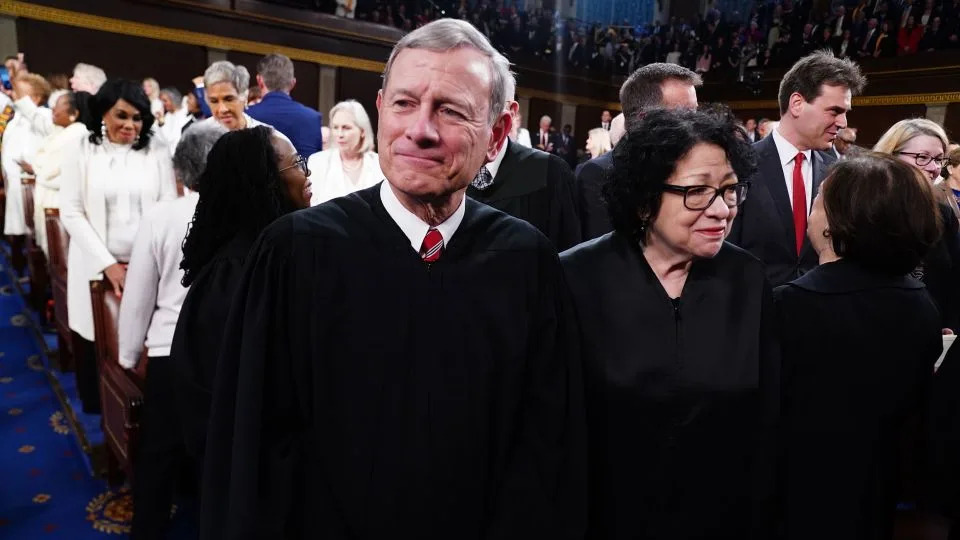
U.S. Supreme Court Chief Justice John Roberts and Associate Justice Sonia Sotomayor stand on the House floor ahead of the annual State of the Union address by U.S. President Joe Biden. – Shawn Thew/Pool/Getty Images
Trump redefines Supreme Court’s docket
The court heard oral arguments in mid-October over South Carolina’s new congressional map, which a lower court found was a racial gerrymander that violated the Constitution. Both the GOP state lawmakers defending the map and the parties challenging it had asked the Supreme Court to rule by January.
Noting that deadlines for this year’s election were nearing, the state lawmakers filed an emergency appeal last month, asking for permission to use the disputed map while the justices continued their deliberations. Ultimately, a lower court stepped in to allow the state to use the map for now, lamenting that “the ideal must bend to the practical.”
On the court’s emergency docket, meanwhile, where cases are decided more quickly and without oral argument, the justices have been sitting for weeks on a request from Idaho officials to enforce a strict statewide ban on gender-affirming care for minors. Initially filed in mid-February, the request has been fully briefed since early March.
The go-slow approach is not a new phenomena this year. The pace of opinions fell sharply last year, according to Feldman’s data, which led to speculation that the shocking leak of the court’s draft opinion overturning Roe v. Wade months earlier gummed up the court’s internal works.
Several justices indicated the leak damaged trust, including Justice Clarence Thomas, who described the unprecedented breach as “kind of an infidelity.”
Last year, Justice Brett Kavanaugh downplayed the slower pace by noting many of the court’s biggest cases – which usually are not settled until June – were heard at the start of the term. For instance, the court heard arguments early on that year in a major challenge to the consideration of race in admissions at Harvard and the University of North Carolina. The Supreme Court ultimately barred consideration of race in June.
This year, some of the biggest cases have been more spread out. On the other hand, the court has been pummeled by a series of divisive emergency appeals. It also has agreed to take on several high-profile matters involving Trump.
In one, the court ruled that Trump would remain on Colorado’s presidential ballot despite claims he violated the 14th Amendment’s “insurrectionist ban” because of his actions leading up to the January 6, 2021, attack on the US Capitol. The court was unanimous on the bottom line conclusion but splintered over its reasoning.
In another, the justices agreed to hear arguments April 25 about Trump’s immunity claims.
Republican presidential candidate former President Donald Trump speaks at a campaign event in Grand Rapids, Michigan, on Tuesday, April 2. – Paul Sancya/AP
The Supreme Court will also hear arguments later this month over a federal law the Biden administration says requires hospitals to provide an abortion if the health of the mother is in danger, even in states such as Idaho that have approved strict abortion bans. The rise of state abortion restrictions following the court’s overturning of Roe has become an election-year cudgel for Biden and congressional Democrats.
Also this month, the court will take up the question of whether a federal obstruction law can be used to prosecute some of the rioters involved in the Capitol attack. The decision could also affect Trump, who has also been charged with that crime.
‘Something has to give’ on Supreme Court docket
The court also dealt with a divisive and ongoing dispute over a Texas immigration law that allowed law enforcement in the state to arrest and detain people it suspects entered the country illegally. Over a public dissent from the three liberal justices, the court cleared the way for Texas to enforce that law last month.
The 5th US Circuit Court of Appeals temporarily blocked the enforcement hours later and the appeals court heard arguments over the law Wednesday.
The emergency cases, which have drawn increased criticism in recent years, take time away from consideration of the court’s regular docket.
“The court only has so many resources,” said Steve Vladeck, CNN Supreme Court analyst and professor at the University of Texas School of Law. “Something has to give, and the court really ought to be thinking through ways to avoid putting itself in this position every year.”
In an aerial view, Texas National Guard soldiers load excess concertina wire onto a trailer at Shelby Park on January 26, 2024 in Eagle Pass, Texas. – Michael Gonzalez/Getty Images
At the same time, the Supreme Court has always moved at its own pace and the justices have little incentive to worry about timing. By its own standards, the court moved unusually quickly to resolve the Trump ballot dispute this year – handing down a decision two months after the former president filed his appeal.
That kind of speed is the exception.
“If you look systematically over time, they’re becoming slower and they’re taking fewer cases,” Feldman said.
But other than stirring speculation among court watchers, he said, the pace of opinions doesn’t have much practical impact. Taking an extra few weeks to finish an opinion, Feldman said, simply means the justices get more time to write.
“It makes sense to me from their perspective that they might want to be slower,” Feldman said. “For efficiency, it probably makes sense to hold off as much as they can until the end of the term.”
Many Democrats Are Worried Trump Will Beat Biden. This One Isn’t.
Simon Rosenberg has spent the past two years telling Democrats they need to calm down. His Biden-will-win prediction is his next big test.
By Adam Nagourney – April 3, 2024
Adam has been covering presidential campaigns since Michael Dukakis ran for president in 1988 — the same campaign in which Simon Rosenberg, the subject of this interview, began his long career in presidential politics.
Simon Rosenberg, a Democratic strategist and consultant, is pushing back against the Democratic doom and gloom.Credit…Jason Andrew for The New York Times
Simon Rosenberg was right about the congressional elections of 2022. All the conventional wisdom — the polls, the punditry, the fretting by fellow Democrats — revolved around the expectation of a big red wave and a Democratic wipeout.
He disagreed. Democrats would surprise everyone, he said again and again: There would be no red wave. He was correct, of course, as he is quick to remind anyone listening.
These days, Mr. Rosenberg, 60, a Democratic strategist and consultant who dates his first involvement in presidential campaigns to Michael Dukakis, the Democratic presidential candidate in 1988, is again pushing back against the polls and punditry and the Democratic doom and gloom. This time, he is predicting that President Biden will defeat Donald J. Trump in November.
In a world of Democratic bed-wetters, to reprise the phrase used by David Plouffe, a senior political adviser to Barack Obama, to describe Democratic fretters, Mr. Rosenberg is the voice of — well, whatever the opposite of bed-wetter is these days. He even has a Substack newsletter offering insights and daily reassurance to his worried readers — “Hopium Chronicles,” the name taken from what the pollster Nate Silver suggested he was ingesting back in 2022.
I talked to Mr. Rosenberg about what it feels like to be an outlier in his own party, and why he sleeps so well at night while so many of his fellow Democrats are plotting their moves to Paris after November. This conversation has been edited for clarity and length, and because Mr. Rosenberg — God love him — likes to talk about this subject. A lot.
Good morning, Simon. And, first things first, thank you for doing this.
Any opportunity I have to talk about the good works of Joe Biden and the Democrats — how could I turn that down?
The idea of this interview is that, at a time when there is so much fretting in the Democratic world, you are not — and have never been — a bed-wetter. Can you explain why? This goes back to the midterm congressional elections in 2022, as I recall?
Yes. The argument I made then was threefold. One was that the Republicans did something unusual in 2022. Usually when a party loses elections, they run away from the politics that caused them to lose. And Republicans were running toward it. They were becoming ever more MAGA, even though MAGA had lost in 2018 and 2020.
Second, that Biden was actually a good president, and we’d have a strong case to make. And third, there’s been this huge increase in citizen engagement in the Democratic Party. We’ve been raising crazy amounts of money and have an unprecedented number of volunteers because of the fear of MAGA.
We were stronger and better than was the conventional wisdom. The constant mistake everyone’s been making since the spring of 2022 has been the overestimating of their strength and the underestimating of ours. We went into Election Day with there being this huge belief that the Democrats were going to get killed. I believed those three things were going to allow us to do better than people expected in 2022. And I have that basic view now about 2024.
Mr. Rosenberg said the only thing that worries him about whether President Biden will win re-election is the issue of time. “I think the campaign got a late start, and we have a lot of work to do to win this thing,” he said. Credit…Doug Mills/The New York Times
But this seems like a different time for Democrats, or certainly for Biden.
Here we are almost two years later, and a lot of the same kinds of things are still happening — and Trump is a far weaker candidate in this election than he was in 2016. He’s more dangerous. He’s more extreme. His performance on the stump is far more erratic and disturbing. I’m just giving you my rap here.
How critical to your case — to your rap — is the Supreme Court decision on abortion rights?
I think the election changed a lot with Dobbs, and it hasn’t really changed very much since. There’s one party that just keeps winning all over the country, and every type of election going back now two years — the same basic dynamic, which is, we keep winning, they keep struggling. Why would it be different in November? My view is that it won’t be, because there’s a structural thing happening underneath all of this, which is that Dobbs broke the Republican Party and that a big chunk of the Republican Party has become loosened from MAGA. It’s costing them in elections and costing them a lot of donors — and money.
But poll after poll shows Americans have unfavorable views of Biden and are distressed about the direction of the country. A Wall Street Journal poll released this week found Mr. Biden trailing Mr. Trump in six of seven swing states. That seems like rocket fuel for the worrying class.
I’m not really surprised by anything we’re seeing. But I will tell you that we were told in 2022 that Biden’s low approval rating meant that Democrats were going to get crushed in the elections. And that’s why I think that centering your understanding of this election around Biden’s approval rating or around the public polling is risky business.
Polling can only tell us where things are today. Those of us who’ve been in the business understand how these things evolve and that polling is very soft this far out. We’re asking polling, in my view, to do too much when we have all this other information and data that’s available to us to augment our understanding. And to me, that additional data suggests that we’re going to have a good election. But we’ve got a long way to go.
Now, on the issue of the nervousness? Yeah, I mean, look, I mean, the media tells us, The New York Times tells us, MSNBC tells us, that we should be looking at this election largely through the prism of current polling. That’s the polling industrial complex asserting itself in a very aggressive way in the daily understanding of our elections. I think those of us who have a more holistic understanding of the health of candidates and parties, we have to keep making our case that there’s a lot of other things we should be looking at.
Is there evidence already that polls that suggest Biden is in trouble are misleading?
Well, the evidence is that Trump has underperformed in these early primary states and underperformed in public polling in every one of these states, except for North Carolina. Second is that we know from polling in these early states that somewhere between 20 and 30 percent of the Republican coalition is open to not supporting Trump.
OK, but is there anything that keeps you up at night, that worries you in terms of Biden winning re-election?
I wish we had more time. I think the campaign got a late start, and we have a lot of work to do to win this thing. But we are where we are now, and just have to put our heads down and go to work.
Would you list the backlash against Mr. Biden for Gaza as a problem?
Building and maintaining a winning coalition in a presidential election is always hard, and will be for Biden-Harris in 2024. We are going to have challenges along the way — debates, discussions, even disagreements. But the Democratic Party is very unified right now. There is no one holding back endorsements, or saying they won’t support Biden, as Trump is now facing on the Republican side. Gaza is today a challenge to be managed by Biden, not a threat.
What about third party candidates? What if Robert F. Kennedy Jr., to name the most famous, grabs ballot lines in super-close swing states?
We know from history that we have to take all that very seriously. Democrats understand that we are not just running against Donald Trump this cycle, but we’re running against three other candidates as well, and that we’re going to have to engage them. We’re going to have to treat them like they are serious candidates in this election. And we have to do what we do in politics, which is we have to make them unacceptable to voters.
Is anyone on your side of the house listening to you on all of this? Do you feel like an outlier in your own party — or rather, why are you such an outlier in your own party?
Because polling.
Mr. Rosenberg works at his home in Washington, D.C., with his colleague, Lincoln Cooper. Mr. Rosenberg’s Substack newsletter offers insights and daily reassurance to his worried Democratic readers. Credit…Jason Andrew for The New York Times
But also, Democrats tend to gravitate to the negative right?
Yes. There is that. And also because there’s a sense that, in the Democratic Party, if we stumble in an election, our democracy could go away. The worry that people have is warranted.
But I’m looking at a lot more than just polling.
The other factor, I would argue, is that Democrats still remember what happened in 2016, when Trump beat Hillary Clinton after polls told them to expect an easy Clinton victory.
Yeah. There’s trauma from 2016 about the election. The most important thing I can say, however you put this in, is that it isn’t like Democrats are sitting around in their houses twiddling their thumbs and throwing things at the television.
Does this mean you are not worried about Biden’s age as a factor in this election?
I am. I know Biden’s age is an issue. But I think Biden assuaged a lot of the concerns that people had with a strong performance at the State of the Union. But also you have to write, in my view, you have to be honest and fair-minded: there’s a strong argument that Biden’s age is also an asset for him, that, in a time of an enormous challenge for the country, having the guy who’s the most experienced person to ever be in the Oval Office may have been a blessing for us. I think we can make that case without sounding like, you know, we’re pushing the envelope on truth.
Are there any other Democrats who would be — would have been — stronger against Trump in this election?
I don’t think that’s even worthy of — no, no, I mean, Joe Biden’s the nominee. I mean, it’s not worthy of speculation, right? Look, we just had a primary. People could have challenged him. They didn’t because they didn’t think they could beat him. And the two candidates who did challenge him got crushed.
We are quietly confident. In the grand scope of things, we can handle this; we can win the election. The big thing that people got wrong in 2022 was that they thought the Democratic Party wasn’t going to bring it, that we weren’t hungry and we weren’t energized. And it turned out that we were.
Adam Nagourney is a national political reporter for The Times, covering the 2024 campaign.
Terrified Parents, New Age Health Nuts, MAGA Exiles. Meet the R.F.K. Jr. Faithful.
By Michelle Goldberg, Opinion Columnist – April 4, 2024
Photographs by Michael Schmelling
Chris Inclan, an alcohol and drug counselor from Sonoma, Calif., voted for the Green Party candidate Jill Stein in 2016. In 2020 he backed Andrew Yang in the Democratic primary and cast a ballot for Donald Trump in the general election. Joe Biden, he said, was “so ingrained in the establishment and politics as usual,” while Trump “went against the grain on a lot of issues,” including wars and government regulation. But Inclan, a big bearded 39-year-old with tattoos on his hands, doesn’t want to have to make that choice again, which is why he’s now enthusiastically supporting Robert F. Kennedy Jr.
I met Inclan at the Oakland rally where Kennedy introduced his new running mate, the 38-year-old political donor Nicole Shanahan. Held in the auditorium of the Henry J. Kaiser Center for the Arts, it was the first political rally Inclan had ever attended.
“The system is corrupt,” he said of what he called the two-party “duopoly.” “We keep playing the same game. But I think Americans are fed up.” He’d joined Kennedy’s We the People Party, formed to help Kennedy get on the ballot in several states, and has aspirations to run for office himself someday.
Setting up banners at Kennedy’s campaign event in Oakland, Calif., to announce his pick for a running mate.
Inclan’s politics are hard to understand in purely left or right terms. The more relevant dichotomy, for him as for many Kennedy voters, is insider versus outsider, which is why Kennedy’s following sometimes overlaps, in unexpected ways, with the MAGA movement.
Matt Castro, a San Francisco bus driver at the rally, described himself as “extremely left-leaning,” but didn’t vote in the last election and said that, if Kennedy isn’t on the ballot, he’d probably vote for Trump in the next one, because of his opposition to military support for Ukraine. Alex Klett, a 33-year-old Kennedy volunteer from Wisconsin who was handing out American flags, described himself as a right-leaning independent who voted for Trump in 2016 and then, in 2020, wrote in Kanye West.
Another Kennedy volunteer, Jaclyn Aldrich, a striking 43-year-old Black woman who sometimes works as a model, has never cast a presidential ballot, because she hadn’t trusted any of the candidates. “I didn’t even vote for Obama,” she said. Among her fellow volunteers, she said, are some former Bernie Sanders voters, but “it’s mostly Trump people.”
This is a paradox of the Kennedy campaign. Many Democratic and Republican insiders view Kennedy as a danger to Biden’s re-election. Timothy Mellon, the top donor to the Trump super PAC Make America Great Again Inc., is also the top donor to the Kennedy super PAC American Values 2024, suggesting he thinks Kennedy will help Trump. The Democratic National Committee, meanwhile, has recently formed a unit, including veteran Democratic operative Lis Smith, devoted to battling third-party candidates, and Kennedy is getting most of its attention.
But on the ground, I haven’t met many Kennedy-curious voters for whom Biden is a second choice. Instead, Kennedy attracts many of the same sort of alienated political eccentrics who in the past have gravitated to Trump. “They keep saying that he’s pulling from Biden, but most of our people are actually coming from the right,” said Leigh Merinoff, volunteer chair of the finance committee of American Values.
Anecdotes aren’t the same thing as data, and people who go to rallies and volunteer for campaigns aren’t necessarily representative of the electorate, which is full of people who are much more disengaged. Nevertheless, there’s a gap between both Democratic and Republican assumptions about Kennedy’s appeal and the character of his real-life movement. He’s much more of a wild card than left-wing third-party candidates like Stein and Cornel West. There’s something distinctly Trumpy in his campaign’s mix of New Age individualism, social media-fueled paranoia and intense, aching nostalgia for the optimistic America of the early 1960s, when Kennedy’s uncle John F. Kennedy was president and his father, Robert F. Kennedy, served as attorney general. It’s not surprising that some otherwise Trump-leaning voters are picking up on it.
Faces at recent Kennedy campaign events in California.
On the surface, Kennedy’s choice of Shanahan, a patent lawyer and former Democrat who has donated to candidates like Pete Buttigieg and Marianne Williamson, might seem as if it would draw more left-leaning voters into the campaign. In introducing Shanahan, an avid surfer who met her ex-husband, the Google founder Sergey Brin, at a yoga festival, Kennedy said, “I wanted a vice president who shared my passion for wholesome, healthy foods, chemical-free, for regenerative agriculture, for good soils,” as well as an athlete who “would help me inspire Americans to heal, to get them back in shape.”
One can imagine voters who frequent farmers markets and follow wellness influencers seeing an idealized version of themselves in her. And while large parts of the New Age and alternative health community moved right during the pandemic in response to lockdowns and vaccine mandates, it’s still a world with plenty of people who think of themselves as progressives.
Indeed, the most interesting thing about Shanahan is the way she dramatizes how Kennedy wins over voters like her. In the week after her debut as a candidate, Shanahan hasn’t made any mainstream media appearances, but she did speak at length on the podcast of Rick Rubin, the music producer and, recently, self-help author, telling the story of her conversion from lifelong Democrat to Kennedy acolyte.
Their conversation is fascinating, demonstrating how frustrations with conventional medicine and the desire for a transcendent order — for a big holistic framework that makes sense of the world’s destabilizing chaos — lead away from technocratic liberalism and toward, well, the unstable political formation that’s coalescing around Kennedy. Listening to it, you can hear a smart and sensitive woman narrating her own journey down the rabbit hole, a portal that took her to a place where she could help swing the 2024 election and thus the course of American history.
Shanahan came to Kennedy the way many desperate parents have. During the pandemic, her 18-month-old daughter was diagnosed, over Zoom, with autism, and she described how none of the interventions offered by experts helped. Another Silicon Valley mom with an autistic child urged her to listen to Kennedy, who has long asserted a false link between vaccines and autism. Though Shanahan was resistant at first — she knew about Kennedy’s reputation as a conspiracy theorist — she tuned into his podcast.
Around the same time, she got deep into the work of Jack Kruse, a neurosurgeon and self-described “biohacker” who emphasizes the importance of sunlight for good health. (Kennedy and Kruse appeared together on Rubin’s podcast last year.) Kruse, said Shanahan, awakened her to the idea that autism could be “related to the way that the brain was responding to some kind of outside influence” — like vaccines — “and how to heal the brain.”
She started her daughter, Echo, on a regimen that included lots of early morning light, swimming in a saltwater pool and music frequencies that send “a signal to brain cells that they can repair.” (“Morning sunlight in particular is like chicken soup for metabolic health,” she told Rubin.) At the same time, she worked to reduce Echo’s exposure to “nonnative light sources,” and cellular and Wi-Fi signals. These interventions, she said, have all helped her daughter. “When it works, maybe we need science to catch up,” she said.
When she met Kennedy last summer, she was impressed by his record of “looking at the environmental exposures and the things that impact human health that are man-created,” she said. Shanahan lamented what she sees as widespread closed-mindedness in the face of the questions she wants to explore. “My daughter has lifted the veil for me,” she said, in an allusion to Aldous Huxley’s work on psychedelics. “If we’re talking about my support for Bobby Kennedy, that is what has brought me to this movement.”
A Kennedy supporter in Oakland.Nicole Shanahan, Kennedy’s running mate.
Shanahan was never all that left-wing; she helped fund the recall campaign against San Francisco’s progressive district attorney, Chesa Boudin. Still, her presence on the ticket has alienated some right-leaning Kennedy fans. Shortly after she was announced, one erstwhile Kennedy supporter posted a link to an online “Save R.F.K. Jr. Rally” on Kennedy’s campaign website, demanding the firing of Kennedy’s campaign manager for promoting a “C.I.A., feminist agenda” by bringing Shanahan on board. (It was quickly taken down.) “I think the pick was meant to be more about covering his left flank, and I found that an odd calculation,” Chamath Palihapitiya, a venture capitalist who has co-hosted a fund-raiser for Kennedy, said on the podcast “All-In.”
In fact, the calculation makes perfect sense: Kennedy needs Shanahan’s money. Her divorce settlement from Brin isn’t public, but she reportedly asked for more than $1 billion, about 1 percent of his net worth at the time, and she’s clearly extremely wealthy. Campaign finance law allows both presidential and vice-presidential candidates to pour unlimited funds into their own races, and the process of getting Kennedy on state ballots as a third-party candidate is going to be expensive. Shanahan has shown she’s willing to spend; she gave $4 million to American Values 2024 to fund a Kennedy ad that ran during the Super Bowl.
Introducing Shanahan in Oakland, Kennedy said, with a straight face, that there is “no American more qualified” than she to serve as vice president. But his speech also gestured at the heart of those qualifications. Shanahan, he said, would help him liberate America from the “predatory cabal” that controls the campaign finance system.
It’s doubtful, however, that Shanahan will be able to help Kennedy in ways that go beyond finances, and not just because the influence of vice-presidential candidates tends to be limited, especially with third-party aspirants. (My guess is that few readers remember either Ralph Nader’s or Jill Stein’s running mates.) Shanahan appears to find negative publicity debilitating, an unusual quality in an aspiring politician and one that may limit her visibility.
Before joining the Kennedy ticket, she was probably best known for her divorce from Brin, which, according to The Wall Street Journal, was precipitated by an affair with Elon Musk. (Both she and Musk deny this.) In an essay in People magazine, she described the scrutiny that followed the Journal article as unbearable. “I was thrust into the public eye; the online images and commentary felt more like a zeitgeist than depictions of my lived experiences,” she wrote. Insisting that she’s “not a public person,” she called the Journal article and its aftermath “a disaster for my work life, my reputation and my ability to communicate the things I care most deeply about.”
This week, “Fox & Friends” promoted an appearance by Kennedy and Shanahan, but Kennedy ended up going on alone. In a post on the social media platform X, Shanahan wrote, “While Bobby’s out there spreading our message on TV right now, I’m working behind the scenes to make sure we’re on the ballot in all 50 states.” So rather than add a new note to Kennedy’s message, Shanahan is mostly just using her fortune to amplify what he’s already been saying. And what he’s been saying is often quite reactionary. (The campaign didn’t respond to my requests to interview Kennedy or Shanahan.)
At a Kennedy campaign event in Los Angeles.
The last time I saw Kennedy speak, in June in New Hampshire, he was still a Democrat, running a doomed primary challenge to Biden in a campaign managed by the quirky former Democratic congressman Dennis Kucinich. Seeking to echo the famous 1963 “Peace” speech in which his presidential uncle called for a halt to the Cold War arms race, Kennedy warned against antagonizing Russia over Ukraine, presenting himself as an antiwar candidate.
Some of his followers still see him that way, but now they must either rationalize or overlook his zealous support for Israel’s war in Gaza. In March, weeks after the Biden administration called for a six-week cease-fire, Kennedy was skeptical of the idea, telling Reuters that previous truces have “been used by Hamas to rearm, to rebuild and then launch another surprise attack.” Though he often rails against censorship, he cheered on the hedge fund billionaire Bill Ackman’s demand that Harvard do more to crack down on antisemitism, writing, “It’s time to hold college administrations responsible for the epidemic of campus antisemitism by insisting on zero-tolerance policies.”
Kucinich left the campaign in mid-October in ambiguous circumstances, though he’s hinted that disagreements with Kennedy about Gaza had something to do with his departure. (The campaign is now run by Kennedy’s daughter-in-law Amaryllis Fox Kennedy, a former C.I.A. officer.) In November, Sayer Ji, an alternative medicine promoter and key anti-vaccine influencer, withdrew his endorsement of Kennedy over Gaza. Charles Eisenstein, a major intellectual figure in New Age circles, is still advising Kennedy but has been openly critical of his stance on Israel.
While there are still some progressive figures in Kennedy’s orbit, his campaign has an increasingly right-wing vibe. Border security has become a central part of his pitch. Since January, his communications director has been Del Bigtree, a leading anti-vaccine activist who doubts that climate change is caused by human activity and who spoke at the MAGA Freedom Rally near the Capitol on Jan. 6. “I wish I could tell you that this pandemic really is dangerous,” Bigtree said then. “I wish I could believe that voting machines work and that people care. You’ve been sold a lie!”
The conservative talk radio host Randy Economy, one of the leaders of the campaign to recall Gov. Gavin Newsom of California, is Kennedy’s senior adviser for ballot access. An opening speaker at the Oakland event was Angela Stanton-King, a Black conservative QAnon promoter who served time for her role in a car-theft ring and was pardoned by Donald Trump.
An attendee at a Kennedy event carried a book of L. Ron Hubbard essays.Yvette Corkrean, the Republican nominee for a California Senate seat, attended the Oakland event.
Some strains of New Age wellness culture — with its distrust of mainstream expertise, moralistic view of health and weakness for quackery — have long intersected with right-wing politics. (Alex Jones, after all, made much of his fortune shilling health supplements.) The connection between alternative medicine and conservatism grew significantly stronger during the pandemic, as the center of gravity in the anti-vaccine movement moved rightward and longtime right-wingers grew increasingly mistrustful of Big Pharma and, with it, Big Food.
“The globalists want you to be fat, sick, depressed and isolated — the better to control you and to milk you for as much economic value as they can before they kill you,” a pseudonymous far-right figure who goes by Raw Egg Nationalist said on the 2022 Tucker Carlson special “The End of Men.”
Kennedy’s conservationism can sound a lot like that of Raw Egg Nationalist. His commitment to the environment is tempered by paranoia about federal government power that makes him suspicious of regulation. Climate change “is being used as a pretext for clamping down totalitarian controls, the same way the Covid crisis was, and it’s the same people,” he said in a campaign video featuring Jordan Peterson, the anti-woke psychologist and author. Dismissing the efficacy of a “war on carbon,” Kennedy said he’d approach energy issues using “free markets and not top-down control.”
Because of his hostility to the state, Kennedy’s environmentalism often manifests as a belief in the redemptive power of healthy living and closeness to nature, which Shanahan shares. This ethos helps explain Shanahan’s much-publicized criticism of I.V.F. “I believe I.V.F. is sold irresponsibly, and my own experience with natural childbirth has led me to understand that the fertility industry is deeply flawed,” she wrote in People. She’s interested in low-cost, organic alternatives. “I’m not sure that there has been a really thorough mitochondrial respiration study on the effects of two hours of morning sunlight on reproductive health,” she said on a panel last year. “I would love to fund something like that.” Hearing this, I couldn’t help thinking of Carlson’s promotion, on his “End of Men” special, of testicle tanning to raise testosterone levels.
Of course, even though the Kennedy camp has a lot in common with the esoteric new right, Kennedy could still siphon Democratic votes from Biden. A lot of undecided voters don’t follow politics closely, and some who are unhappy about their major-party choices may find themselves drawn to Kennedy’s mythic last name and green-seeming, anti-establishment pitch.
“Anything that splits up the anti-Trump coalition hurts Biden,” said Sarah Longwell, an anti-Trump conservative pollster who regularly asks about Kennedy in focus groups. As she sees it, the largest group of persuadable voters in 2024 are the so-called double haters, those who disapprove of both Trump and Biden. “My experience over the years in the focus groups is that when Trump is top of mind for people, people who dislike both him and Biden end up disliking Trump more,” said Longwell. Kennedy, she fears, could give people who might otherwise reluctantly vote for Biden an off-ramp from making a dispiriting decision.
No one knows how the race will ultimately shake out.
Some polls back up this analysis. A recent Quinnipiac survey shows Kennedy getting 13 percent of the vote; he has support from 9 percent of Democrats, 8 percent of Republicans and 20 percent of independents. The poll shows Biden leading Trump by three points in a head-to-head matchup but Trump ahead by one point when third-party candidates are included. Though both numbers are within the poll’s margin of error, they suggest that Trump could benefit if the election isn’t seen as a binary choice.
Other polls, however, show Kennedy pulling more voters from Trump, and the truth is no one knows how the election will ultimately shake out. “The public polling, if you dig into it, can be really head-swiveling,” said Smith. “It’s very hard to gauge the impact, but it does seem like he pulls from both, and right now — emphasis on ‘right now’ — slightly more from Biden.”
Kennedy certainly has no qualms about spoiling the election for Trump. On CNN on Monday, he argued that Biden poses a “much worse” threat to democracy than Trump because of the Biden administration’s attempts to get social media companies to remove vaccine misinformation, much of it spread by Kennedy.
“President Biden is the first candidate in history that has used the federal agencies to censor political speech, to censor his opponent,” he said. The primary threat to democracy, he added, “is not somebody who questions election returns,” noting that he believed the 2004 election was stolen from John Kerry. “So I don’t think people who say that the election is stolen — we shouldn’t make pariahs of those people,” he said.
This interview was clarifying about Kennedy’s intentions. But precisely because he evidently views Trump, not Biden, as the lesser of two evils, he may prove most attractive to voters who also view the election that way. That, however, would depend on people grasping what he stands for. So it might not be a disaster for Democrats if Shanahan can help Kennedy be more widely heard.
“If anyone is listening who never considered an independent ticket, I want to extend the same invitation to you that my friend did to me last year,” said Shanahan in her Oakland speech. “Please, listen to Bobby Kennedy in his own words.” It’s sage advice.
Michelle Goldberg has been an Opinion columnist since 2017. She is the author of several books about politics, religion and women’s rights, and was part of a team that won a Pulitzer Prize for public service in 2018 for reporting on workplace sexual harassment.