Biden’s first 2024 ad focuses on ‘extremist’ threat to democracy
AFP – January 4, 2024
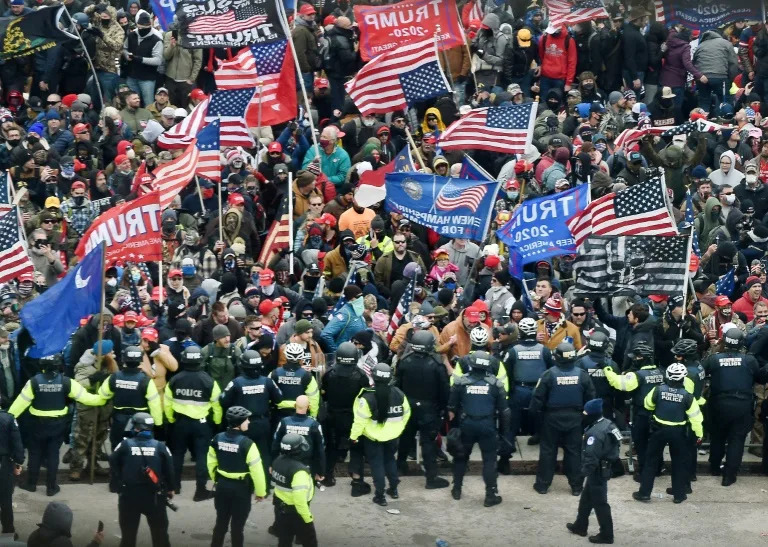
Trump supporters clash with police and security forces as they storm the US Capitol in Washington, DC on January 6, 2021 (Olivier DOULIERY)
President Joe Biden‘s campaign released its first television ad for the 2024 election on Thursday, warning of an “extremist” threat to democracy over images of the January 6, 2021 attack on the US Capitol.
The advertisement, entitled “Cause,” will get its first network showing on Saturday, the third anniversary of the historic assault by Donald Trump supporters which left five people dead.
“All of us are being asked right now, what will we do to maintain our democracy?” the 81-year-old Democrat says in a passage lifted from a speech he gave in Arizona last year.
“There’s something dangerous happening in America. There’s an extremist movement that does not share the basic beliefs in our democracy,” says the ad, released early on social media.
During the one-minute ad, Biden does not mention by name former president Trump — the clear frontrunner for the Republican nomination and the man he beat in 2020.
But over swelling, dramatic music, the ad features repeated images of pro-Trump signs held by the January 6 rioters, as well as a hangman’s noose brought by the protesters to the Capitol.
It also includes pictures of torch-bearing white supremacists at a rally in Charlottesville in 2017.
The Biden campaign is increasingly painting the election as a fight for American democracy against Trump, with the president set to give a speech on similar lines in Pennsylvania on Friday.
Polls show Biden and Trump neck and neck despite the populist Republican tycoon, 77, facing multiple criminal trials, including one linked to the January 6 riot.
Biden campaign manager Julie Chavez Rodriguez said Republicans had “doubled down” on threats to undermine elections.
“This ad serves as a very real reminder that this election could very well determine the very fate of American democracy,” she said in a statement.
Letters to the Editor: I immigrated to the U.S. in 1971. I’ll leave if Trump is reelected
Los Angeles Times Opinion – January 4, 2024
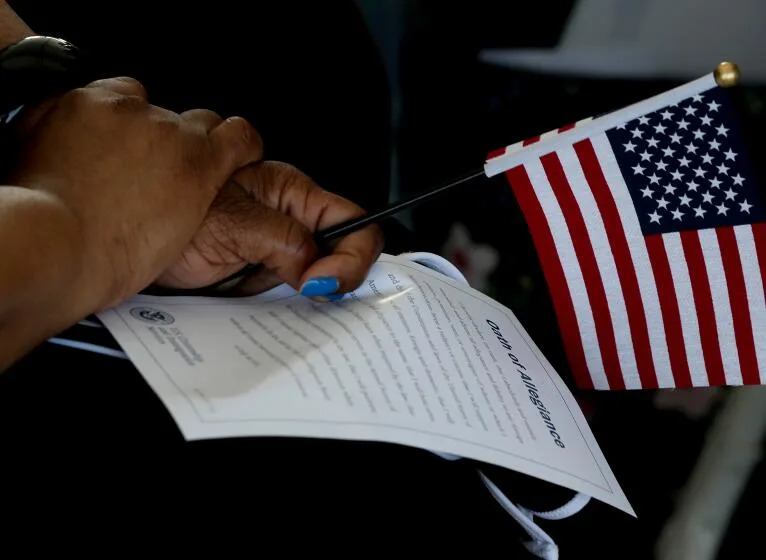
An immigrant holds a flag and the Oath of Allegiance during a naturalization ceremony in Los Angeles in 2021. (Luis Sinco / Los Angeles Times)
To the editor: After I immigrated to the U.S. in 1971, my introduction to national politics was the Watergate hearings, which I followed closely on TV. The role that prominent members of the Republican Party played in the downfall of President Nixon was expected and commendable. (“Is 2024 the year you’ll become an American expat?” Opinion, Jan. 1)
Forty-five years later, I watched Trump get elected and left the country in horror. Unfortunately, my American family was unable to join me in Switzerland due to job obligations, so after three months I returned to suffer for four years watching the principles of my beloved adopted country being systematically dismantled.
If former President Trump gets reelected, I will once again move to Europe, unwilling to spend another four years experiencing the deterioration of our country at home, and being a laughingstock abroad.
The complicity of Republicans in Trump’s ego-driven schemes reminds me too much of the developments leading to World War II, and I abhor the mindless adherence of Trump supporters to his amoral behavior. They will still be around long after Trump is a nightmarish memory.
Isabelle H. Meyer, Glendale
..
To the editor: In “The Dawn of Everything,” the book Virginia Heffernan mentions in her op-ed article, authors David Graeber and David Wengrow mention three freedoms. Heffernan focuses only on one — the right to move.
Why does she not discuss options for people who are rich enough to leave the United States? What about exhorting her readers to disobey and change society, the two other freedoms, before abandoning the country?
Abcarian: Really, young voters? You want to teach Democrats a lesson by letting Trump back into the White House?
Robin Abcarian – January 3, 2024
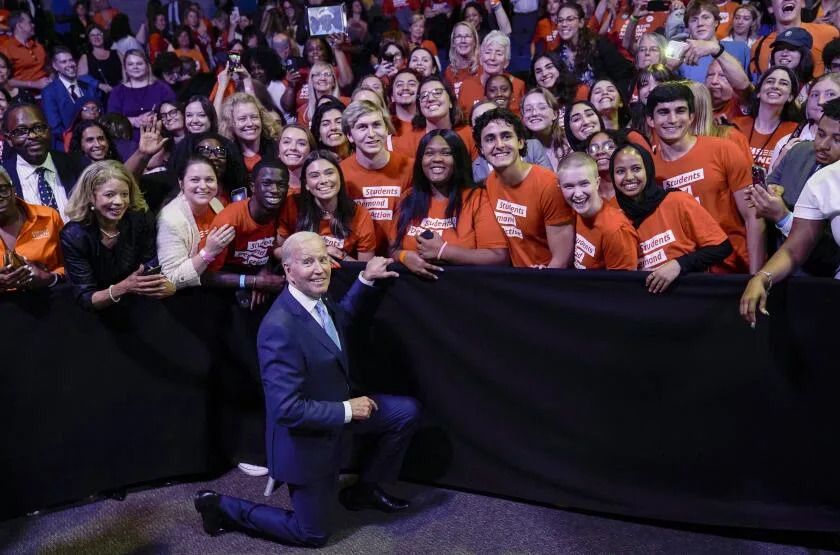
President Biden poses with Students Demand Action in Connecticut in June. In 2020, the youngest American voters were squarely in his corner. Not now, according to polls. (Susan Walsh / Associated Press)
I almost spit out my Geritol the other day when I read what one young voter in Philadelphia told NBC News about why she is disillusioned about the upcoming presidential election.
“I don’t think the presidency has too much of an effect on what happens in my day-to-day life,” said Pru Carmichael, who supported Biden in 2020 but says she will not vote for president at all this year if she has to choose between the disappointing incumbent and former President Trump.
Seriously?
Maybe she believes she will never have an unintended, unwanted pregnancy. (However, if she does, she is lucky enough to live in Pennsylvania, where abortion is still legal.)
But how can she not appreciate the profound changes the Trump presidency inflicted on this country? Had there been no President Trump, there would be no ultraconservative majority on the Supreme Court, no Dobbs decision overturning nearly half a century of reproductive rights, no outright abortion bans in 13 states and no suffering by people like Kate Cox of Texas, who was forced to seek abortion care in another state after the Texas Supreme Court said she could not abort her severely compromised fetus, who suffered a condition that was incompatible with life.
In 2020, the youngest American voters were squarely in Biden’s corner. According to exit polls, 65% of those 18 to 24 years old chose him, the largest percentage of any age group. And yet, if recent national polls are to be believed, voters up to age 34 have grown disenchanted with the president. Perhaps this is a reflection on the impatience of youth, or, worse, a fundamentally weak grasp on how government operates.
Listen to what younger voters told NBC News they’re upset about: the country’s slow pace on reversing climate change, Biden’s failure to fully cancel student loan debt, his inability to federally codify the right to abortion and, perhaps most starkly, his handling of Israel’s war against Hamas and the humanitarian crisis in Gaza.
“I mean, he made a lot of really big promises in his campaign and virtually none of them were followed through on,” one poll respondent, Austin Kapp, 25, of Colorado, told NBC News.
He did try to codify Roe, but was unable to marshal the 60 votes needed to overcome a filibuster by Senate Republicans.
And what has Trump been doing about abortion, besides taking credit for the overturning of Roe vs. Wade? He’s urging Republicans to mislead voters: “In order to win in 2024, Republicans must learn how to properly talk about abortion,” he told a group of Iowa supporters in September. “This issue cost us unnecessarily but dearly in the midterms.”
We now know, thanks to the horrific experience of Cox and other women who have brought suit in Texas, that the idea of an “exception” to abortion bans for cases of rape, incest, fetal anomalies or the health of the pregnant person is nothing more than a shimmering lie, a mirage to make abortion bans slightly more palatable to the majority of Americans who support a woman’s right to choose.
As for the Middle East crisis, even if you agree that Biden’s handling of the situation has been uneven, why would anyone think Trump, an outspoken supporter of Israeli Prime Minister Benjamin Netanyahu, would handle it better, particularly if your sympathies lie more with the Palestinians caught in the violence than the Israeli government’s response to the Oct. 7 Hamas attack?
On the campaign trail, Trump has signaled a lack of engagement in the conflict, suggesting that he would “let this play out.” His one concrete suggestion? In an interview with Univision in November, he said that Israel needed to “do a better job of public relations, frankly, because the other side is beating them at the public relations front.”
He has also pledged to “revoke the student visas of radical anti-American and antisemitic foreigners at our colleges and universities, and we will send them straight back home.” (Muslim ban, anyone?) Does that sound like an appealing counter-message for the 70% of voters under 35 who told NBC News pollsters they disapprove of the way Biden has handled the war?
With 2024 upon us, and the first contests of the Republican presidential primaries set to take place on Jan. 15 in Iowa and on Jan. 23 in New Hampshire, barring some unforeseen development it could become clear very quickly that the much-indicted Trump is bound for the November ballot as the Republican presidential nominee.
A Suffolk University/USA Today poll released on New Year’s Day showed that Trump is out-polling Biden among groups the pollsters described as “stalwarts of the Democratic base,” that is, Hispanics and younger voters. Biden’s support among Black Americans has also slipped significantly, though he still leads Trump.
This is alarming, not catastrophic. Biden, and Democrats, have time to make their case. I remain skeptical that the Democratic base will not come home by November, particularly as Trump continues to embrace his inner dictator on the campaign trail.
“A Republican getting elected isn’t the end. It is the beginning of a much larger fight,” a 23-year-old Wisconsin Starbucks worker and union organizer who is considering withholding his vote from Biden told NBC News. “I want to show the Democratic Party as a young person that you still need to earn our vote and if you don’t, the consequences will be your career.”
Teach Democrats a lesson by electing a democracy-destroying authoritarian?
My mother used to call that cutting off your nose to spite your face.
This surprise argument could derail Trump’s effort to delay the Jan. 6 trial
Harry Litman – January 3, 2024
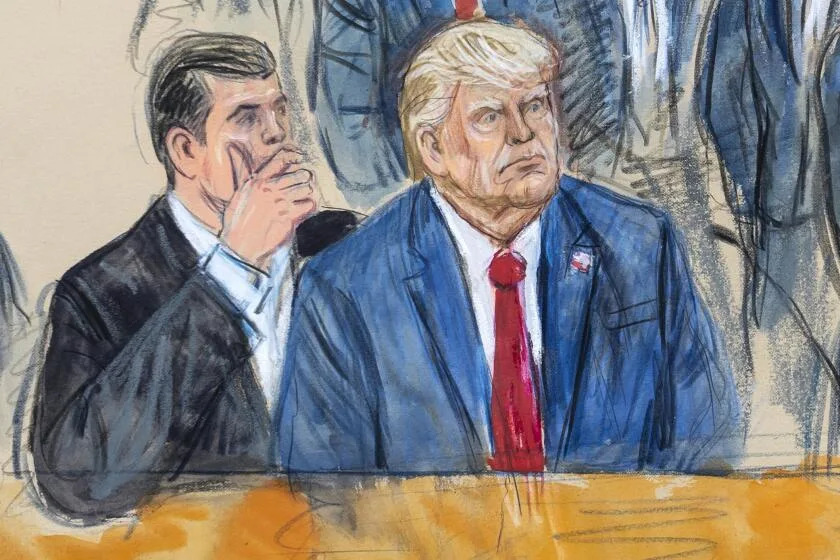
A sketch of former President Trump conferring with one of his lawyers at the federal courthouse in Washington last summer. (Dana Verkouteren / Associated Press)
As all eyes watched every word filed by Donald Trump and federal prosecutors ahead of next week’s crucial arguments on immunity, a third party slipped in the side door with a brief that may dramatically foil the former president’s efforts to leverage the issue for maximum delay.
The watchdog organization American Oversight, which is not a party to the case, successfully petitioned the U.S. Court of Appeals for the D.C. Circuit to accept its friend-of-the-court brief on the ground that it provides a “unique perspective.”
Indeed it does. The brief makes the apparently compelling argument that the court shouldn’t be hearing this appeal at all because it lacks jurisdiction — that is, the power to consider it in the first place. If the court agrees, it would mean dismissing the appeal and returning the case to U.S. District Judge Tanya Chutkan, abruptly aborting Trump’s best opportunity to delay the federal Jan. 6 trial.
Trump’s argument is that he is entitled to avoid trial because the Constitution prohibits indicting him for conduct he undertook as president, at least if it was within the “outer perimeter” of his official duties. Most observers, including me, think Trump will lose the claim on the merits, but it’s likely that the U.S. Supreme Court will have to make that pivotal determination. The question is when — before trial, putting the case on ice, or afterward.
Chutkan has decided that she can’t go forward with the trial until that’s settled, reasoning that immunity is a right not to go to trial in the first place. That suggests that even if Trump is bound to lose his claim, he will be able to string out the process for at least a couple of months, bumping back the start of probably the most important of the four criminal trials he faces. Originally scheduled for March, the trial is thereby being delayed deeper into Trump’s campaign to return to the White House.
Enter the American Oversight brief, written by lawyers with the Washington-based firm Arnold & Porter. The brief relies on a unanimous 1989 Supreme Court opinion, Midland Asphalt Corp. vs. United States, written by the late Justice Antonin Scalia. The defendant in the criminal case, Midland Asphalt, had moved unsuccessfully for a dismissal of the charges based on the prosecution’s alleged violation of grand jury rules.
The Supreme Court held that neither it nor the circuit court had the power to hear the case on “interlocutory appeal,” or before trial. As with the vast majority of issues that may arise at trial, the court ruled, this one could be considered only after a conviction.
The court emphasized that in criminal cases, the compelling interest in prompt trials demands that courts apply the interlocutory appeal doctrine “with utmost strictness.” Federal courts have jurisdiction over such appeals, the justices found, only if they are brought under a constitutional or statutory provision that expressly gives the defendant a right not to go to trial.
Since the Midland Asphalt opinion, the court has identified only three categories of motions that may be considered before trial in criminal cases: motions to reduce bail and those concerning the double jeopardy clause in the Constitution’s 5th Amendment, and the speech or debate clause, which protects legislators from being “questioned” — that is, tried — at all.
Trump’s immunity argument therefore doesn’t seem to fit within Midland Asphalt’s exceptions. It doesn’t rest on any explicit constitutional guarantee. And the D.C. Circuit Court previously held that a right based on constitutional principles such as the separation of powers doesn’t cut it.
The Justice Department and Trump had been assuming the D.C. Circuit Court has jurisdiction based on Nixon vs. Fitzgerald, which established broad but not endless immunity from lawsuits over a president’s conduct while in office. But that civil case was not subject to the “utmost strictness” standard the Supreme Court has applied to criminal trials. It also predated the Midland Asphalt opinion, which the Justice Department somewhat bafflingly failed to mention.
There may be a reason the Midland Asphalt doctrine doesn’t apply here, but I can’t think of one.
Jurisdiction is an issue that courts take extremely seriously, and I think the D.C. Circuit Court should and probably will consider the argument that it lacks jurisdiction very carefully. It’s already ordered the parties to address American Oversight’s position at oral argument Tuesday, when it’s likely to be a subject of intense questioning.
If the argument succeeds, it will be an appellate version of the sort of Perry Mason moment that rarely happens in a real courtroom. With a wave of a jurisdictional wand, Trump would be back in the district court preparing for an only slightly delayed trial.
Here’s why MAGA politicians are deflecting hard & getting VERY NERVOUS about that Epstein list
Ariel Messman-Rucker – January 3, 2024
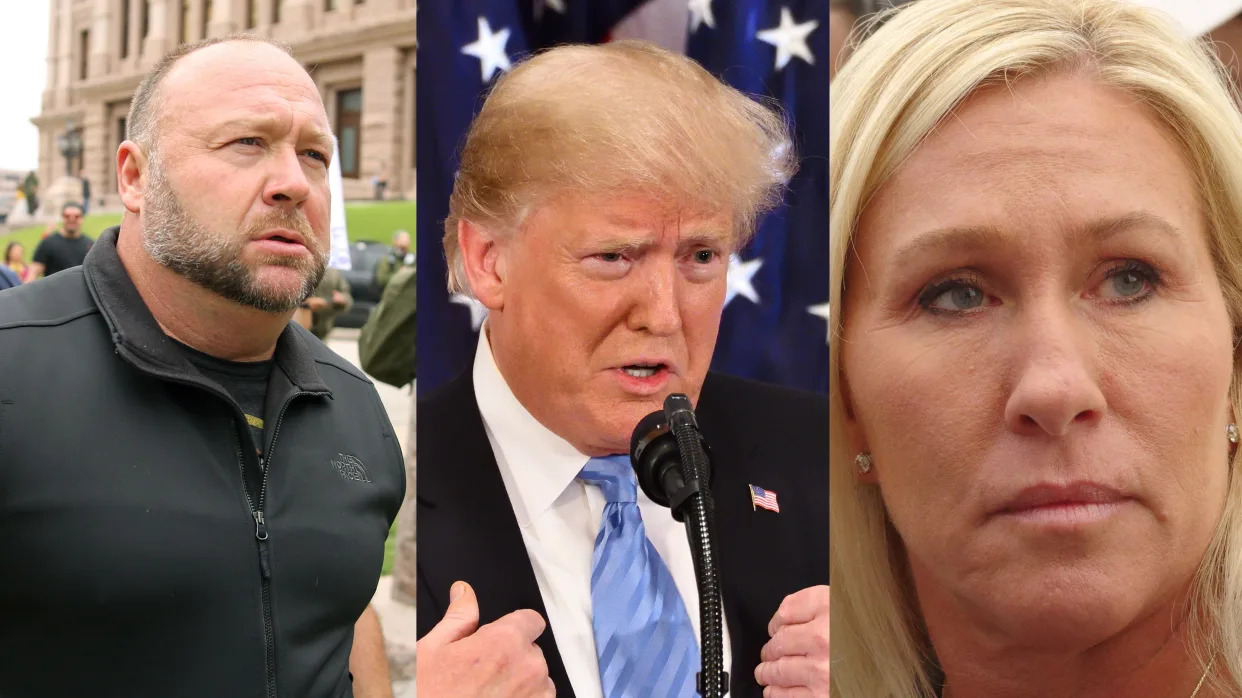
Alex Jones, Donald Trump, and Marjorie Taylor Greene
After spending decades calling queer people child predators and groomers, we can’t help but notice that Republicans are getting REAL NERVOUS about who is going to be named in the Jeffrey Epstein court documents that are about to be released.
U.S. District Judge Loretta Preska recently ordered that the names of 200 associates of Epstein be released on Wednesday, January 3, causing some members of the GOP to push wild conspiracy theories to explain why Donald Trump is going to appear on documents connected to a child sex trafficker.
It’s almost as if right-wing zealots will say literally anything to stay in power.
The list of names will include victims, associates, and employees and could potentially contain the names of high-profile figures. Trump, former President Bill Clinton, and the U.K.’s Prince Andrew are all believed to be among the names on the list, reports Forbes.
While the names of the two former presidents are expected to appear on Epstein’s flight logs, there is no evidence that either of them spent time on Epstein’s island, where underage girls were taken. But that hasn’t stopped admitted liar Alex Jones and MAGA-die hard Rep. Marjorie Taylor Greene from floating the theory that the former president’s name only appears on the list because “deep state” federal operatives are trying to destroy his name.
They need a new story because this one is getting tired. Honestly, we’ve known these documents were coming out for a while now; you’d think they would have used that time to come up with something a little more creative—though, that might be impossible because they clearly suffer from MAGA brain rot.
Recently, on his show InfoWars, Jones claimed that the CIA has previously faked lists like this in connection with Israeli and British intelligence agencies. “If they put out a client list, and that’s possible that it could be fake, because Epstein’s dead. And that’s something very possible.” Jones said, according to LGBT Nation.
The ease at which Jones tries to blow off Trump being associated with a known child sex trafficker is especially rich considering he and his guests have repeatedly called LGBTQ+ people pedophiles.
“[Trump] gets devoted to one woman at a time, gets totally obsessed with them, totally nice to them,” Jones continued.
Right, because a man who has been married three times, has been accused of sexual misconduct by 26 women, and allegedly had multiple extra-marital affairs is loyal to one woman. The math ain’t mathing.
Greene, on the other hand, took a different tack and focused her vitriol on Clinton to draw attention away from Trump. “For some us, it’s no surprise at all that Bill Clinton will be named in the Jeffrey Epstein files,” she wrote in a January 3 post on X, formerly Twitter. “We said it a long time ago, but they labeled us conspiracy theorists. There will be lots of names you’ve never heard of, and the IC collected info on them. Pedophiles belong in jail, not on secret government lists.”
Did she forget that Trump’s name will appear on that same list? Are these people capable of not being GIANT hypocrites?
We guess it would be too much to ask for Greene, a woman who has spent years spewing hate at the LGBTQ+ community and calling all queer people pedophiles, to hold members of her party accountable for the heinous acts she accuses us of. It’s better to play a game of ‘Hey, look over there!”
Republicans may close their eyes and pretend there are no right-wingers on the list, but we’ll be here to remind them.
Trump Will Lose 2024 Because Americans Worry ‘He’s Going to Start a World War,’ Biden’s Deputy Campaign Manager Says | Video
Dessi Gomez – January 3, 2024
Joe Biden’s deputy campaign manager Quentin Fulks thinks Donald Trump won’t be reelected in 2024 because American voters fear, among other things, a world war.
Fulks appeared on “CNN News Central” with anchor John Berman Wednesday to discuss why Trump shouldn’t be reelected considering the lessons learned in the first term of his presidency.
“American voters know what it feels like to wake up every day and be afraid of what their president is going to tweet, if he’s going to start a world war because he can’t control his temper, right? These are the things that are at stake. And voters know that now,” Fulks said. “They’ve seen Donald Trump, which is exactly why the most people turned out than ever before to send Joe Biden and Kamala Harris to the White House in 2020.”
Fulks added that voters today should look to Hillary Clinton, who largely predicted Trump’s behavior as president while running against him in 2016 simply by taking the embattled politician at his word.
“Sec. Clinton was right: We should have taken Donald Trump at his word. But the difference here is that Donald Trump has now had four years to prove exactly what he would do,” Fulks said.
He added: “So, maybe you’re right, maybe we should take him at his words and his actions because when he was president, he did all the things that he said he would do. And so that’s the major difference that we have now heading into 2024 is that American voters have seen what Donald Trump would do.”
Watch the full clip from the “CNN News Central” segment in the video above.
Opinion Columnist, reporting from Dubai, United Arab Emirates.
Credit…Amir Cohen/Reuters
I’ve been The Times’s foreign affairs columnist since 1995, and one of the most enduring lessons I’ve learned is that there are good seasons and bad seasons in this business, which are defined by the big choices made by the biggest players.
My first decade or so saw its share of bad choices — mainly around America’s response to Sept. 11 — but they were accompanied by a lot of more hopeful ones: the birth of democracy in Russia and Eastern Europe, thanks to the choices of Mikhail Gorbachev. The Oslo peace process, thanks to the choices of Yitzhak Rabin and Yasir Arafat. China’s accelerating opening to the world, thanks to the choices of Deng Xiaoping. India’s embrace of globalization, thanks to choices initiated by Manmohan Singh. The expansion of the European Union, the election of America’s first Black president and the evolution of South Africa into a multiracial democracy focused on reconciliation rather than retribution — all the result of good choices from both leaders and led. There were even signs of a world finally beginning to take climate change seriously.
On balance, these choices nudged world politics toward a more positive trajectory — a feeling of more people being connected and able to realize their full potential peacefully. It was exciting to wake up each day and think about which one of these trends to get behind as a columnist.
For the last few years, though, I’ve felt the opposite — that so much of my work was decrying bad choices made by big players: Vladimir Putin’s tightening dictatorship and aggression, culminating in his brutal invasion of Ukraine; Xi Jinping’s reversal of China’s opening; Israel’s election of the most right-wing government in its history; the cascading effects of climate change; the loss of control over America’s southern border; and, maybe most ominously, an authoritarian drift, not only in European countries like Turkey, Poland and Hungary but in America’s own Republican Party as well.
To put it another way: If I think about the three pillars that have stabilized the world since I became a journalist in 1978 — a strong America committed to protecting a liberal global order with the help of healthy multilateral institutions like NATO, a steadily growing China always there to buoy the world economy, and mostly stable borders in Europe and the developing world — all three are being shaken by big choices by big players over the last decade. This is triggering a U.S.-China cold war, mass migrations from south to north and an America that has become more unreliable than indispensable.
But that’s not the half of it. Because now that advanced military technologies like drones are readily available, smaller players can wield much more power and project it more widely than ever before, enabling even their bad choices to shake the world. Just look at how shipping companies across the globe are having to reroute their traffic and pay higher insurance rates today because the Houthis, Yemeni tribesmen you never heard about until recently, have acquired drones and rockets and started disrupting sea traffic around the Red Sea and through the Suez Canal.
This is why I referred to Russia’s invasion of Ukraine as our first true world war, and why I feel that Hamas’s war with Israel is in some ways our second true world war.
They are being fought on both physical battlefields and digital ones, with huge global reach and implications. Like farmers in Argentina who were stymied when they suddenly lost their fertilizer supplies from Ukraine and Russia. Like young TikTok users around the world observing, opining, protesting and boycotting global chains, such as Zara and McDonald’s, after being enraged by something they saw on a 15-second feed from Gaza. Like a pro-Israel hacker group claiming credit for shutting down some 70 percent of Iran’s gas stations the other day, presumably in retaliation for Iran’s support for Hamas. And so many more.
Indeed, in today’s tightly wired world, it is possible that the war over the Gaza Strip — which is roughly twice the size of Washington, D.C. — could decide the next president in Washington, D.C., as some young Democrats abandon President Biden because of his support for Israel.
But before we become too pessimistic, let us remember that these choices are just that: choices. There was nothing inevitable or foreordained about them. People and leaders always have agency — and as observers we must never fall prey to the cowardly and dishonest “well, they had no choice” crowd.
Gorbachev, Deng, Anwar el-Sadat, Menachem Begin, George H.W. Bush and Volodymyr Zelensky, to name but a few, faced excruciating choices, but they chose forks in the road that led to a safer and more prosperous world, at least for a time. Others, alas, have done the opposite.
To close out the year, it’s through this prism of choices that I want to re-examine the story that has consumed me, and I dare say much of the world, since Oct. 7: the Israel-Hamas war. It was not as inevitable as some want you to think.
Credit…Samar Abu Elouf for The New York Times
I began thinking about this a few weeks ago, when I flew to Dubai to attend the United Nations climate summit. If you’ve never been there, the Dubai airport has some of the longest concourses in the world. And when my Emirates flight landed, we parked close to one end of the B concourse — so when I looked out the window I saw lined up in a perfectly symmetrical row some 15 Emirates long-haul passenger jets, stretching far into the distance. And the thought occurred to me: What is the essential ingredient that Dubai has and Gaza lacks? Because both began, in one sense, as the convergence of sand and seawater at crucial intersections of the world.
It’s not oil — oil plays only a small role in Dubai’s diversified economy today. And it’s not democracy. Dubai is not a democracy and does not aspire to be one. But people are now flocking to live here from all over the world — its population of more than 3.5 million has surged since the outbreak of Covid. Why? The short answer is visionary leadership.
Dubai has benefited from two generations of monarchs in the United Arab Emirates who had a powerful vision of how the U.A.E. in general and the emirate of Dubai in particular could choose to be Arab, modern, pluralistic, globalized and embracing of a moderate interpretation of Islam. Their formula incorporates a radical openness to the world, an emphasis on free markets and education, a ban on extremist political Islam, relatively little corruption, a strong rule of law promulgated from the top down and a relentless commitment to economic diversification, talent recruitment and development.
There are a million things one could criticize about Dubai, from labor rights for the many foreign workers who run the place to real estate booms and busts, overbuilding and the lack of a truly free press or freedom of assembly, to name but a few. But the fact that Arabs and others keep wanting to live, work, play and start businesses here indicates that the leadership has converted its intensely hot promontory on the Persian Gulf into one of the world’s most prosperous crossroads for trade, tourism, transport, innovation, shipping and golf — with a skyline of skyscrapers, one over 2,700 feet high, that would be the envy of Hong Kong or Manhattan.
And it has all been done in the shadow (and with the envy) of a dangerous Islamic Republic of Iran. When I first visited Dubai in 1980, there were still traditional wooden fishing dhows in the harbor. Today, DP World, the Emirati logistics company, manages cargo logistics and port terminals all over the world. Any of Dubai’s neighbors — Kuwait, Qatar, Oman, Bahrain, Iran and Saudi Arabia — could have done the same with their similar coastlines, but it was the U.A.E. that pulled it off by making the choices it made.
I toured the site of the U.N.’s global climate conference with the U.A.E.’s minister of state for international cooperation, Reem al-Hashimy, who oversaw the building of Dubai’s massive 2020 Expo City, which was repurposed to hold the event. In three hours spent walking around, we were stopped at least six or seven times by young Emirati women in black robes in groups of two or three, who asked if I could just step aside for a second while they took selfies with Reem or whether I would be their photographer. She was their rock-star role model — this Harvard- and Tufts-educated, nonroyal woman in a leadership role as a government contractor.
Compare that with Gaza, where the role models today are Hamas martyrs in its endless war with Israel.
Among the most ignorant and vile things that have been said about this Gaza war is that Hamas had no choice — that its wars with Israel, culminating on Oct. 7 with a murderous rampage, the kidnappings of Israelis as young as 10 months and as old as 86 and the rape of Israeli women, could somehow be excused as a justifiable jailbreak by pent-up males.
No.
Let’s go to the videotape: In September 2005, Ariel Sharon completed a unilateral withdrawal of all Israeli forces and settlements from Gaza, which Israel occupied in the 1967 war. In short order, Hamas began attacking the crossing points between Gaza and Israel to show that even if Israel was gone, the resistance movement wasn’t over; these crossing points were a lifeline for commerce and jobs, and Israel eventually reduced the number of crossings from six to two.
In January 2006, the Palestinians held elections hoping to give the Palestinian Authority legitimacy to run Gaza and the West Bank. There was a debate among Israeli, Palestinian and Bush administration officials over whether Hamas should be allowed to run in the elections — because it had rejected the Oslo peace accords with Israel.
Yossi Beilin, one of the Israeli architects of Oslo, told me that he and others argued that Hamas should not be allowed to run, as did many members of Fatah, Arafat’s group, who had embraced Oslo and recognized Israel. But the Bush team insisted that Hamas be permitted to run without embracing Oslo, hoping that it would lose and this would be its ultimate refutation. Unfortunately, for complex reasons, Fatah ran unrealistically high numbers of candidates in many districts, dividing the vote, while the more disciplined Hamas ran carefully targeted slates and managed to win the parliamentary majority.
Hamas then faced a critical choice: Now that it controlled the Palestinian parliament, it could work within the Oslo Accords and the Paris protocol that governed economic ties between Israel, Gaza and the West Bank — or not.
Hamas chose not to — making a clash between Hamas and Fatah, which supported Oslo, inevitable. In the end, Hamas violently ousted Fatah from Gaza in 2007, killing some of its officials and making clear that it would not abide by the Oslo Accords or the Paris protocol. That led to the first Israeli economic blockade of Gaza — and what would be 22 years of on-and-off Hamas rocket attacks, Israeli checkpoint openings and closings, wars and cease-fires, all culminating on Oct. 7.
These were fateful choices. Once Sharon pulled Israel out of Gaza, Palestinians were left, for the first time ever, with total control over a piece of land. Yes, it was an impoverished slice of sand and coastal seawater, with some agricultural areas. And it was not the ancestral home of most of its residents. But it was theirs to build anything they wanted.
Had Hamas embraced Oslo and chosen to build its own Dubai, not only would the world have lined up to aid and invest in it; it would have been the most powerful springboard conceivable for a Palestinian state in the West Bank, in the heart of the Palestinian ancestral homeland. Palestinians would have proved to themselves, to Israelis and to the world what they could do when they had their own territory.
But Hamas decided instead to make Gaza a springboard for destroying Israel. To put it another way, Hamas had a choice: to replicate Dubai in 2023 or replicate Hanoi in 1968. It chose to replicate Hanoi, whose Củ Chi tunnel network served as the launchpad for the ’68 Tet offensive.
Hamas is not simply engaged in some pure-as-the-driven-snow anticolonial struggle against Israel. Only Hamas’s useful idiots on U.S. college campuses would believe that. Hamas is engaged in a raw power struggle with Fatah over who will control Gaza and the West Bank, and it’s engaged in a power struggle in the region — alongside other pro-Muslim Brotherhood parties and regimes (like Turkey and Qatar) — against pro-Western monarchies like Saudi Arabia, Jordan, Kuwait and the U.A.E. and military-led regimes like Egypt’s.
In that struggle, Hamas wanted Gaza isolated and in conflict with Israel because that allowed Hamas to maintain its iron-fisted political and Islamist grip over the strip, forgoing elections and controlling all the smuggling routes in and out, which funded its tunnels and war machine and the lifestyle of its leaders and loyalists — every bit as much as Iran’s Islamic regime today needs its hostility with America to justify its iron grip over Iranian society and the Revolutionary Guard’s control of all of its smuggling. Every bit as much as Hezbollah needs its conflict with Israel to justify building its own army inside Lebanon, controlling its drug smuggling and not permitting any Lebanese government hostile to its interests to govern, no matter who is elected. And every bit as much as Vladimir Putin needs his conflict with NATO to justify his grip on power, the militarization of Russian society and his and his cronies’ looting of the state coffers.
This is now a common strategy for consolidating and holding power forever by a single political faction and disguising it with an ideology of resistance. It’s no wonder they all support one another.
There is so much to criticize about Israel’s occupation of the West Bank, which I have consistently opposed. But please, spare me the Harvard Yard nonsense that this war is all about the innocent, colonized oppressed and the evil, colonizing oppressors; that Israel alone was responsible for the isolation of Gaza; and that the only choice Hamas had for years was to create an underground “skyline” of tunnels up to 230 feet deep (contra Dubai) and that its only choice on Oct. 7 was martyrdom.
Credit…Pool photo by Menahem Kahana
Hamas has never wavered from being more interested in destroying the Jewish state than in building a Palestinian state — because that goal of annihilating Israel is what has enabled Hamas to justify its hold on power indefinitely, even though Gaza has known only economic misery since Hamas seized control.
We do those Palestinians who truly want and deserve a state of their own no favors by pretending otherwise.
Gazans know the truth. Fresh polling data reported by AFP indicates that on the eve of Oct. 7, “many Gazans were hostile to Hamas ahead of the group’s brutal Oct. 7 attack on Israel, with some describing its rule as a second occupation.”
As Hamas’s grip over Gaza is loosened, I predict we will hear a lot more of these Gazan voices on what they really think of Hamas, and it will be embarrassing to Hamas’s apologists on U.S. campuses.
But our story about agency and choices does not stop there. Benjamin Netanyahu, Israel’s longest-serving prime minister — 16 years — also made choices. And even before this war, he made terrible ones — for Israel and for Jews all over the world.
The list is long: Before this war, Netanyahu actively worked to keep the Palestinians divided and weak by strengthening Hamas in Gaza with billions of dollars from Qatar, while simultaneously working to discredit and delegitimize the more moderate Palestinian Authority in Ramallah, committed to Oslo and nonviolence in the West Bank. That way Netanyahu could tell every U.S. president, in effect: I’d love to make peace with the Palestinians, but they are divided, and moreover, the best of them can’t control the West Bank and the worst of them control Gaza. So what do you want from me?
Netanyahu’s goal has always been to destroy the Oslo option once and for all. In that, Bibi and Hamas have always needed each other: Bibi to tell the United States and Israelis that he had no choice, and Hamas to tell Gazans and its new and naïve supporters around the world that the Palestinians’ only choice was armed struggle led by Hamas.
The only exit from this mutually assured destruction is to bring in some transformed version of the Palestinian Authority in the West Bank — or a whole new P.L.O.-appointed government of Palestinian technocrats — in partnership with moderate Arab states like Egypt, Jordan and Saudi Arabia. But when I raise that with many Israelis right now, they tell me, “Tom, it’s not the time. No one wants to hear it.”
That makes me want to scream: No, it is exactly the time. Don’t they get it? Netanyahu’s greatest political achievement has been to persuade Israelis and the world that it’s never the right time to talk about the morally corrosive occupation and how to help build a credible Palestinian partner to take it off Israel’s hands.
He and the settlers wore everyone down. When I covered the State Department in the early 1990s, West Bank settlements were routinely described by U.S. officials as “obstacles to peace.” But that phrase was gradually dropped. The Trump administration even decided to stop calling the West Bank “occupied” territory.
The reason I insist on talking about these choices now is because Israel is being surrounded by what I call Iran’s landcraft carriers (as opposed to our aircraft carriers): Hamas, Hezbollah, the Houthis and Shiite militias in Iraq. Iran is squeezing Israel into a multifront war with its proxies. I truly worry for Israel.
But Israel will have neither the sympathy of the world that it needs nor the multiple allies it needs to confront this Iranian octopus, nor the Palestinian partners it needs to govern any post-Hamas Gaza, nor the lasting support of its best friend in the world, Joe Biden, unless it is ready to choose a long-term pathway for separating from the Palestinians with an improved, legitimate Palestinian partner.
Biden has been shouting that in Netanyahu’s ears in their private calls.
For all these reasons, if Netanyahu keeps refusing because, once again, politically, the time is not right for him, Biden will have to choose, too — between America’s interests and Netanyahu’s.
Netanyahu has been out to undermine the cornerstone of U.S. Middle East policy for the last three decades — the Oslo framework of two states for two people that guarantees Palestinian statehood and Israeli security, which neither side ever gave its best shot. Destroying the Oslo framework is not in America’s interest.
In sum, this war is so ugly, deadly and painful, it is no wonder that so many Palestinians and Israelis want to just focus on survival and not on any of the choices that got them here. The Haaretz writer Dahlia Scheindlin put it beautifully in a recent essay:
The situation today is so terrible that people run from reality as they run from rockets — and hide in the shelter of their blind spots. It’s pointless to wag fingers. The only thing left to do is try and change that reality.
For me, choosing that path will always be in season.
“Extreme sabotage”: Trump rants about new “10,000 soldiers” conspiracy theory on Truth Social
Gabriella Ferrigine – January 2, 2024
Donald Trump Chip Somodevilla/Getty Images
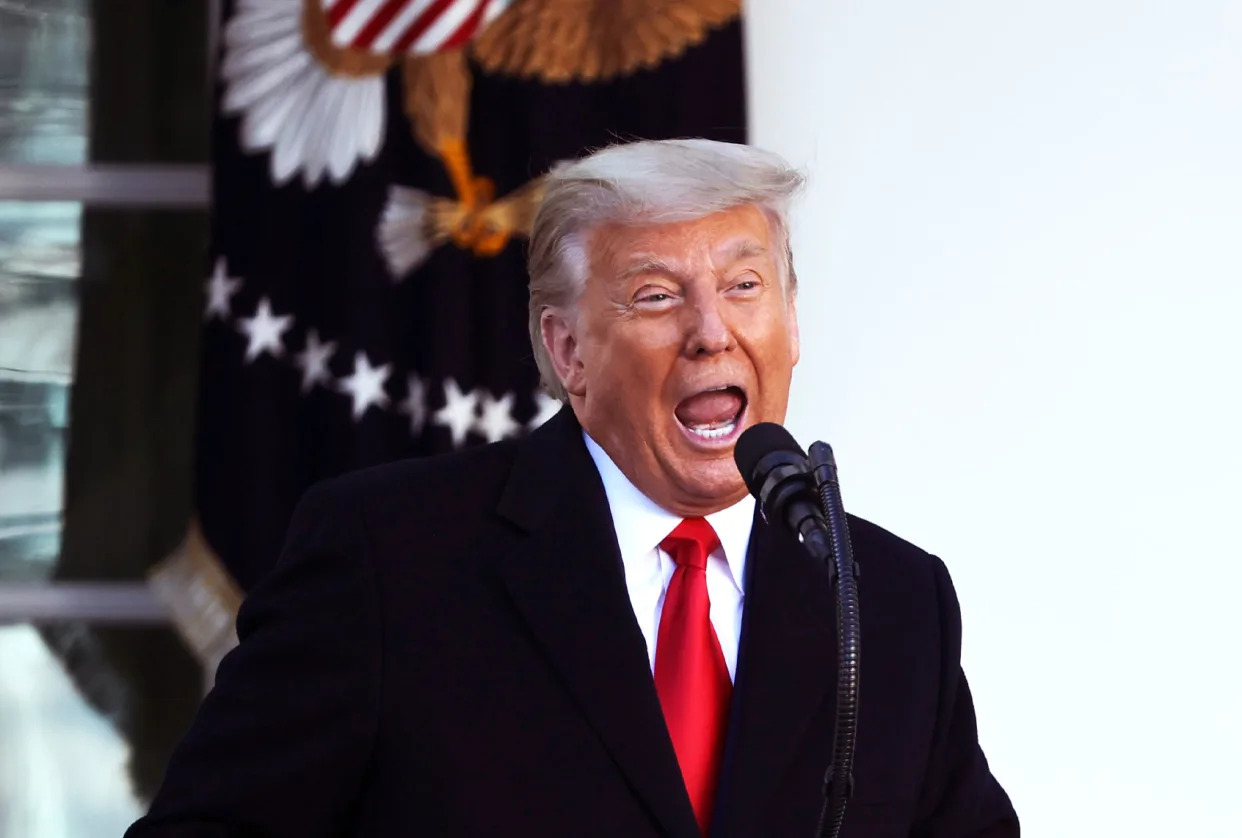
Former President Donald Trump spent a portion of his New Year’s holiday blasting perceived political adversaries on his Truth Social platform, on the heels of his Christmas rant in which he told special counsel Jack Smith, President Joe Biden, and others to “ROT IN HELL.” On Monday evening, Trump unleashed an invective targeting former Rep. Liz Cheney, R-Wyo., Rep. Nancy Pelosi, D-Calif., and once again at Smith.
“Why did American Disaster Liz Cheney, who suffers from TDS (Trump Derangement Syndrome), and was defeated for Congress by the largest margin for a sitting Congressman or Congresswoman in the history of our Country, ILLEGALLY DELETE & DESTROY most of the evidence, and related items, from the January 6th Committee of Political Thugs and Misfits,” Trump wrote. “THIS ACT OF EXTREME SABOTAGE MAKES IT IMPOSSIBLE FOR MY LAWYERS TO PROPERLY PREPARE FOR, AND PRESENT, A PROPER DEFENSE OF THEIR CLIENT, ME. All of the information on Crazy Nancy Pelosi turning down 10,000 soldiers that I offered to to guard the Capitol Building, and beyond, is gone. The ridiculous Deranged Jack Smith case on Immunity, which the most respected legal minds in the Country say I am fully entitled to, is now completely compromised and should be thrown out and terminated, JUST LIKE THE RADICAL LEFT LUNATICS DID TO THE EVIDENCE!”
While Trump’s public and online bashing of political rivals is hardly a new phenomenon, this most recent post contains traces of conspiracy theory rhetoric — that any exonerating evidence is mysteriously “gone” — is something that his followers could latch onto,” Mediaite noted. Conspiracy theories such as this work because they cannot be proven false,” wrote Mediaite’s Colby Hall, referencing Trump’s claims of a stolen election in 2020. “But this is where we are at the moment,” Hall added, “and it appears that Trump has resorted to the ‘they lost my homework’ legal strategy, which may reveal just how desperate he actually is.”
‘A formulaic game’: former officials say Trump’s attacks threaten rule of law
Peter Stone in Washington DC – January 1, 2024
Photograph: Charlie Neibergall/AP
As Donald Trump faces 91 felony counts with four trials slated for 2024, including two tied to his drives to overturn his 2020 election loss, his attacks on prosecutors are increasingly conspiratorial and authoritarian in style and threaten the rule of law, say former justice department officials.
The former US president’s vitriolic attacks on a special counsel and two state prosecutors as well as some judges claim in part that the charges against Trump amount to “election interference” since he’s seeking the presidency again, and that “presidential immunity” protects Trump for his multiple actions to subvert Joe Biden’s 2020 victory.
But ex-officials and other experts say Trump’s campaign and social media bashing of the four sets of criminal charges – echoed in ways by his lawyers’ court briefs – are actually a hodgepodge of conspiracy theories and very tenuous legal claims, laced with Trump’s narcissism and authoritarian impulses aimed at delaying his trials or quashing the charges.
Much of Trump’s animus is aimed at the special counsel Jack Smith, who has charged him with four felony counts for election subversion, and 40 felony counts for mishandling classified documents when his presidency ended.
Trump’s chief goal in attacking Smith, whom he’s labelled a “deranged lunatic”, and other prosecutors and judges is to delay his trials well into 2024, or until after the election, when Trump could pardon himself if he wins, experts say.
Similarly, Trump has targeted the Fulton county district attorney, Fani Willis, who has brought a racketeering case in Georgia against Trump and 18 others for trying to overturn Biden’s win there, branding her a “rabid partisan”.
Right before Christmas, Trump’s lawyers asked an appeals court in Washington to throw out Smith’s four-count subversion indictment, arguing that his actions occurred while he was in office and merited presidential immunity, and Trump in a Truth Social post on Christmas Eve blasted Smith for “election interference”.
In an 82-page brief rebutting Trump’s lawyers on December 30, Smith and his legal team wrote that Trump’s efforts to overturn the election results in 2020 “threaten to undermine democracy,” and stressed Trump’s sweeping immunity claims for all his actions while in office “threatens to license Presidents to commit crimes to remain in office.”
Former justice department officials say Trump’s rhetoric and tactics to tar prosecutors and judges are diversionary moves to distract from the serious charges he faces – especially for trying to subvert the 2020 election.
Delay is his major strategic objective in all these cases … Trump’s constitutional objections to the trial-related issues are all frivolous
Former Trump lawyer Ty Cobb
“Claiming the federal criminal cases or the Georgia Rico action are election interference, and railing constantly about the character of the prosecutors, judges and others, is just a formulaic game to Trump,” Ty Cobb, a White House counsel during the Trump years and a former DoJ official, said.
“Delay is his major strategic objective in all these cases. These criminal cases were started because of Trump’s criminal acts and his refusal to allow the peaceful transfer of government for the first time in US history. Trump’s constitutional objections to the trial-related issues are all frivolous including his claim of presidential immunity and double jeopardy.”
Cobb added that Trump’s “everyone is bad but me and I am the victim” rants, lies and frivolous imperious motions and appeals are just his “authoritarianism in service of his narcissism”.
Other ex-officials offer equally harsh assessments of Trump’s defenses.
“The reality is that Trump has clearly done a series of illegal things and the system is holding him to account for things that he’s done,” said the former deputy attorney general Donald Ayer, who served during the George HW Bush administration. “He’s telling more lies to mischaracterize prosecutions that we should be thankful for.”
Yet Trump keeps escalating his high-voltage rhetoric and revealing his authoritarian tendencies. Trump even bragged that Russian president Vladimir Putin in December echoed Trump’s charges of political persecution and election interference to bolster his claims.
“Even Vladimir Putin … says that Biden’s – and this is a quote – ‘politically motivated persecution of his political rival is very good for Russia because it shows the rottenness of the American political system, which cannot pretend to teach others about democracy’,” Trump told a campaign rally in Durham, New Hampshire.
For good measure, Trump complimented two other foreign authoritarian leaders, calling Hungary’s prime minister, Viktor Orbán, “highly respected” and North Korean dictator Kim Jong-un “very nice”.
In November Trump sparked fire for slamming his opponents on the left as “vermin”, a term that echoed Adolf Hitler’s language, and the ex-president has more than once pledged in authoritarian style to appoint a special prosecutor to “go after” Biden and his family.
Likewise, critics have voiced alarm at Trump’s vow of “retribution” against some powerful foes in both parties if he’s re-elected, including ex-attorney general Bill Barr. That pledge fits with Trump painting himself a victim of a vendetta by “deep state” forces at the justice department, the FBI and other agencies Trump and his allies want to rein in while expanding his executive authority, if he’s the Republican nominee and wins the presidency again.
Critics say Trump’s attacks on the prosecutions are increasingly conspiratorial.
“Of course, it’s true that Trump is the undisputed master of election interference, so he certainly knows the field,” Democratic congressman Jamie Raskin, a leading Trump critic in the House, said.
“It’s hard to think of a greater case of election interference than what Trump did in 2020 and 2021. His claim of election interference is meant to give him a kind of political immunity from the consequences of his criminal actions.
“He’s basically inviting the public to believe that the legal system’s response to his stealing government documents or trying to overthrow an election are illegal attempts to interfere with his political career.”
Raskin noted there was some Trump-style logic to citing Putin in his defense.
“We know Putin is Trump’s hero and effective cult master,” the congressman said. “So it makes sense that Trump would try to elevate him as a kind of moral arbiter. Trump would love a world where Vladimir Putin would decide the integrity of elections and prosecutions. Wouldn’t that be nice for the autocrats?”
Trump’s modus operandi to stave off his trials is emblematic of how he has operated in the past, say some ex-prosecutors.
“Trump has a habit of picking up allegations made against him and, like a kid in the playground, accusing the critics of doing the same thing”, such as crying “electoral interference”, said the Columbia law professor and former federal prosecutor Daniel Richman.
Richman stressed that “I wouldn’t assume Trump is trying to mimic other authoritarians. He just shares their values, or the lack of them.”
Other scholars see Trump’s desperate defenses and incendiary attacks on the legal system as part of his DNA.
Trump feels entirely emboldened by his supporters. He’s been given license by the Republican party to go as far as he wants
Congressman Jamie Raskin
“The Trump team is looking to cobble together a defense for the indefensible,” said Timothy Naftali, a senior research scholar at Columbia’s School of International and Public Affairs. “Trump has long been looking for and finding ways to protect himself whenever he crosses legal lines. This is who he is.”
Naftali suggested: “Trump announced his second re-election bid much earlier than is traditional for major candidates. A likely reason why he announced so early – and then hardly campaigned for a long time – was to pre-empt any indictments so that he could later denounce them as ‘election interference’ and perhaps undermine any future trials. This is a man who lies and creates a reality most favorable to him.”
More broadly, Raskin views Trump’s attacks on the legal system as hallmarks of fascist rulers.
“Fascism is all about the destruction of the rule of law in the service of a dictator. It’s important for Trump to continue to attack our essential legal institutions. He’s also gotten to the point of dehumanizing his opponents by using words like ‘vermin’. Violence permeates his rhetoric,” he said.
“Trump feels entirely emboldened by his supporters. He’s been given license by the Republican party to go as far as he wants.”
Will the Economy Help or Hurt Biden ’24? Krugman and Coy Dig Into Data.
Paul Krugman and Peter Coy – December 31, 2023
Credit…Photo illustration by Sam Whitney/The New York Times
Mr. Krugman is an Opinion columnist. Mr. Coy is an Opinion newsletter writer.Sign up for the Opinion Today newsletter Get expert analysis of the news and a guide to the big ideas shaping the world every weekday morning. Get it sent to your inbox.
Peter Coy: Paul, I think the economy is going to be a huge problem for President Biden in 2024. Voters are unhappy about the state of the economy, even though, by most measures, it’s doing great. Imagine how much unhappier they’ll be if things get worse heading into the election — which I, for one, think is quite likely to be the case.
Paul Krugman: I’m not sure about the politics. We can get into that later. But first, can we acknowledge just how good the current state of the economy is?
Peter: Absolutely. Unemployment is close to its lowest point since the 1960s, and inflation has come way down. That’s the big story of 2023. But 2024 is a whole ’nother thing. I think there will be two big stories in 2024. One, whether the good news continues and, two, how voters will react to whatever the economy looks like around election time.
Paul: Right now many analysts, including some who were very pessimistic about inflation last year, are declaring that the soft landing has arrived. Over the past six months, the core personal consumption expenditures deflator — a mouthful, but that’s what the Federal Reserve targets — rose at an annual rate of 1.9 percent, slightly below the Fed’s 2 percent target. Unemployment is 3.7 percent. The eagle has landed.
Peter: I question whether we’ve stuck the soft landing. I do agree that right at this moment, things look really good. While everyone talks about the cost of living going up, pay is up lately, too. Lael Brainard, Biden’s national economic adviser, points out that inflation-adjusted wages for production and nonsupervisory workers are higher now than they were before the Covid pandemic.
So let’s talk about why voters aren’t feeling it. Is it just because Biden is a bad salesman?
Paul: Lots of us have been worrying about the disconnect between good numbers and bad vibes. I may have been one of the first people to more or less sound the alarm that something strange was happening — in January 2022! But we’re all more or less making this up as we go along.
The most informative stuff I’ve seen recently is from Briefing Book, a blog run by former White House staff members. They’ve tried to put numbers to two effects that may be dragging consumer sentiment down.
One effect is partisanship. People in both parties tend to be more negative when the other party controls the presidency, but the Briefing Book folks find that the effect is much stronger for Republicans. So part of the reason consumer sentiment is poor is that Republicans talk as if we’re in a depression when a Democrat is president, never mind reality.
Peter: That is so true. And I think the effect is even stronger now than it used to be because we’re more polarized.
Paul: The other effect affecting consumer sentiment is that while economists tend to focus on relatively recent inflation, people tend to compare prices with what they were some time in the past. The Briefing Book estimates suggest that it takes something like two years or more for lower inflation to show up in improved consumer sentiment.
This is one reason the economy may be better for Democrats than many think. If inflation really has been defeated, many people haven’t noticed it yet — but they may think differently a little over 10 months from now, even if the fundamentals are no better than they are currently.
I might add that the latest numbers on consumer sentiment from several surveys have shown surprising improvement. Not enough to eliminate the gap between the sentiment and what you might have expected from the macroeconomic numbers, but some movement in a positive direction.
Peter: That makes sense. Ten months from now, people may finally be getting over the trauma of high inflation. On the other hand, and I admit I’m not an economist, I’m still worried we could have a recession in 2024. Manufacturing is soft. The big interest rate increases by the Fed since March 2022 are hitting the economy with a lag. The extra savings from the pandemic have been depleted. The day after Christmas, the Federal Reserve Bank of St. Louis said the share of Americans in financial distress over credit cards and auto loans is back to where it was in the depths of the recession of 2007-9.
Plus, I’d say the labor market is weaker than it looked from the November jobs report. (For example, temp-agency employment shrank, which is an early warning of weak demand for labor.)
Paul: Glad you brought up small business confidence — I wrote about that the other week. Hard indicators like hiring plans are pretty strong. Soft indicators like what businesses say about future conditions are terrible. So small businesses are, in effect, saying, “I’m doing OK and expanding, but the economy is terrible” — just like consumers.
I’m not at all sure when the Fed will start cutting, although it’s almost certain that it eventually will, but markets are already effectively pricing in substantial cuts — and that’s what matters for the real economy. As I write this, the 10-year real interest rate is 1.69 percent, down from 2.46 percent around six weeks prior. Still high compared with prepandemic levels, but financial conditions have loosened a lot.
Could there be a recession already baked in? Sure. But I’m less convinced than I was even a month ago.
Peter: The big drop in interest rates can be read two ways. The positive spin is that it’ll be good for economic growth, eventually. That’s how the stock market is interpreting it. The negative spin is that the bond market is expecting a slowdown next year that will pull rates down. Also, what if the economy slows down a lot but the Fed doesn’t want to cut rates sharply because Fed officials are afraid of being accused by Donald Trump of trying to help Biden?
Paul: I guess I think better of the Fed than that. And always worth remembering that the interest rates that matter for the economy tend to be driven by expectations of future Fed policy: The Fed hasn’t cut yet, but mortgage rates are already down substantially.
Peter: Yes.
Paul: OK, about the election. The big mystery is why people are so down on the economy despite what look like very good numbers. At least part of that is that people look not at short-term inflation but at prices compared with what they used to be some time ago — but people’s memories don’t stretch back indefinitely. As I said, the guys at Briefing Book estimate that the most recent year’s inflation rate is only about half of what consumers look at, with a lot of weight on earlier inflation. But here’s the thing: Inflation has come way down, and this will gradually filter into long-term averages. Right now the average inflation rate over the past 2 years was 5 percent, still very high; but if future inflation runs at the 2.4 percent the Fed is now projecting, which I think is a bit high, by next November the two-year average will be down to 2.7 percent. So if the economy stays where it is now, consumers will probably start to feel better about inflation.
Peter: Except that perceptions of inflation are filtered through politics. Food and gasoline are more expensive for Trump supporters than Biden supporters, if you believe what people tell pollsters. That’s not going to change between now and November.
The Obama-Biden ticket beat the McCain-Palin ticket in 2008 because voters blamed Republicans for the 2007-9 recession. Obama-Biden had a narrower win in 2012 against Romney-Ryan, and I think one factor was the so-called jobless recovery from that recession. That’s why Biden is supersensitive about who gets credit and blame for turns in the economy.
For the record, Trump might be president right now if it hadn’t been for the Covid pandemic, which sent the unemployment rate to 14.7 percent in April 2020. The economy was doing quite well before that happened. A lot of Republicans are nostalgic for Trumponomics, although I think the economy prospered more in spite of him than because of him. Thoughts?
Paul: Most of the time, presidents have far less effect on the economy than people imagine. Big stimulus packages like Barack Obama’s in 2009 and Biden’s in 2021 can matter. But aside from pandemic relief, which was bipartisan, nothing Trump did had more than marginal effects. His 2017 tax cut didn’t have much visible effect on investment; his tariffs probably on net cost a few hundred thousand jobs, but in an economy as big as America’s, nobody noticed.
Peter: Just speculating, but I wonder if when people say they trust Trump more than Biden on the economy, they’re feeling vibes more than parsing statistics. You know, “We need a tough guy in the White House!”
Paul: People definitely aren’t parsing statistics. Only pathetic nerds like us do that. And while Trump wasn’t actually a tough economic leader, he literally did play one on TV.
But we don’t really know if that matters or whether people are still reacting to the shock of inflation and high interest rates, which they hadn’t seen in a long time. Again, the best case for Biden pulling this out is that voters get over that shock, with both inflation and interest rates rapidly declining.
Oh, and falling interest rates mean higher bond prices and often translate into higher stock prices, too — which has also been happening lately.
Peter: True, Paul. But cold comfort for people who don’t own stocks and bonds. Or who do own stocks and bonds in their retirement plans but don’t think of themselves as part of the capitalist class. To win in November, Biden and his team are going to need to be perceived as doing something for the working class and the middle class. That’s why you see the White House talking about eliminating junk fees and capping insulin prices.
Paul: For what it’s worth, I think a lot of people judge the economy in part by the stock market, even if they don’t have a personal stake. That’s why Trump boasted about it so much and has lately been trying to say that Biden’s strong stock market is somehow a bad thing.
Finally, there are some indications that Democrats in particular are feeling better about the Biden economy. The Michigan survey tracks sentiment by partisanship. The numbers are noisy, but over the past few months Democratic sentiment has been slightly more positive than in the months just before the pandemic struck.
Peter: Paul, how important do you think the economy will be to voters compared with other issues, such as Trump’s fitness for office, Biden’s age, abortion access, et cetera? I mean, if it’s not important, why are we even having this conversation?
Paul: The economy surely matters less than it did when Republicans and Democrats lived in more or less the same intellectual universe — everyone agreed that the economy was bad in 1980 or 2008; now, Dems are fairly positive, while Republicans claim to believe that we’re in a severe downturn. But there are still voters on the margin and weak Democratic supporters who will turn out if they have a sense that things are improving.
Peter: Democratic strategists think the election might come down to Pennsylvania and Wisconsin, assuming that Biden holds Michigan and New Hampshire and loses Arizona and Georgia. Any thoughts about the economic outlook for Pennsylvania and Wisconsin?
Paul: No strong sense about either state. But one little-noticed fact about the current economy is how uniform conditions are. In 2008, so-called sand states that had big housing bubbles were doing much worse than states that didn’t; now unemployment is low almost everywhere.
Of course, all political bets are off if we have a recession. But there’s a reasonable case that the economy will be much less of a drag on Democrats by November, as the reality of a soft landing sinks in.
Oh, and my subjective sense is that for whatever reason, media coverage of the economy has turned much more positive lately. I have to think this matters, otherwise, what are we even doing? And until recently, media reports tended to emphasize the downsides; “Great jobs numbers, and here’s why that’s bad for Biden” has become a sort of running joke among people I follow. These days, however, we’re starting to see reports acknowledging that we’ve had an almost miraculous combination of strong employment and falling inflation.
Peter: Paul, what economic indicators will you be paying the most attention to in the next few months with regard to the election? I’ll nominate inflation and unemployment, although those are kind of obvious.
Paul: Unemployment, for sure. On inflation, I’ll be watching longer-term measures: Will inflation be low enough to bring down two- or three-year averages? And especially highly visible stuff, like groceries. Thanksgiving dinner was actually cheaper in 2023 than in 2022. Will grocery prices be subdued enough to reduce the amount of complaining?
Oh, and I’ll be looking at consumer sentiment, which as we’ve seen can be pretty disconnected from the economy but will matter for the election.