“FBI arrests Jan. 6 fugitives early this morning in Lake County, FL,” the agency wrote on X on Saturday, 6 January, adding that the trio are expected to appear in federal court on 8 January in Ocala, Florida.
Two men and one woman were arrested: Joseph Daniel Hutchinson III, Jonathan Daniel Pollock, and Olivia Michele Pollock.
Mr Hutchinson, 27, and Ms Pollock, 33, were wanted for assaulting, resisting, or impeding certain officers, aiding and abetting, knowingly entering restricted building or grounds without lawful authority, violent entry and disorderly conduct on Capitol grounds.
Mr Pollock, 24, was wanted for the same offenses, as well as theft of government property.
The FBI warned that all three “should be considered armed and dangerous.”
FBI announces capture of three Jan 6 fugitives on third anniversary of riot (FBI)
Federal arrest warrants were issued for the trio — along with two others — on 25 June, 2021.
According to the criminal complaint, Mr Pollock came dressed to the Capitol riot wearing an all-camouflage outfit, including “ballistic plate-carrier vest” and kneepads. The complaint accuses him of stealing an officer’s riot shield and being physical with police, including “holding the officer’s neck, in a choking action.”
He had taken several weeks off work to travel to Washington DC, and when he returned, he apparently showed photos of himself to “brag to his coworkers about having been on the news.”
After returning to the office for a day, he told his superiors that “he had a ‘family emergency,’ left the worksite, and did not return again,” the complaint states.
Olivia Pollock, the sister of Jonathan Pollack, was wearing a white flag insignia, a green headband, and the same type of vest, according to the filing. Footage captured Ms Pollock carrying a flagpole with the American flag and allegedly stripping a baton from an officer.
The Pollock family owns a Lakeland, Florida gun shop, where Mr Hutchinson works. Footage captured Mr Hutchinson punching an officer, the filing states.
More than 1,200 people have been charged in connection to the Capitol riot, the Justice Department said. Like this trio, more than 450 have been charged with assaulting, resisting, or impeding officers and over 1800 have been charged with entering or remaining in a restricted federal building.
Supreme Court to decide if emergency room doctors can perform medically necessary abortions in states that prohibit them
Devan Cole, CNN – January 5, 2024
The Supreme Court said Friday that it will decide whether emergency room doctors can perform medically necessary abortions in states that prohibit them, bypassing the court of appeals to resolve on an expedited basis a lawsuit brought by the United States against Idaho.
It’s the second major abortion case the court will consider this year amid the fallout from the reversal of Roe v. Wade in 2022. The justices are already set to hear a case about access to the abortion drug mifepristone – even in states where the procedure is legal.
Idaho’s Defense of Life Act is a near total ban on abortion, but there is an exception to prevent the mother’s death. The law imposes penalties on doctors who perform prohibited abortions unless the “physician determined in good faith medical judgement and based on the facts known to the physician at the time, that the abortion was necessary to prevent the death of the pregnant woman.” Physicians who violate the law could face criminal penalties and risk the suspension of their licenses.
The Biden administration sued, claiming that a provision of a federal Medicare statue – the Emergency Medical Treatment and Labor Act (EMTALA) – preempts Idaho’s law in emergency rooms.
The federal law requires hospitals to provide stabilizing care to emergency room patients regardless of their ability to pay. It was enacted to ensure that the poor and uninsured receive emergency medical care at hospitals receiving Medicare reimbursement.
A district court in Idaho blocked the law in hospital emergency rooms that receive Medicare funding, holding that the state law interferes with a federal Medicare statute.
In 2022, US District Judge B. Lynn Winmill said that the “broad scope” of Idaho’s near-total ban on abortion meant that he was not convinced that it would be possible for emergency health care workers to “simultaneously comply with obligations” under both state and federal law. “The state law must therefore yield to federal law to the extent of that conflict,” he wrote.
A federal appeals court later agreed to put the district court ruling on hold pending appeal, but a larger panel of judges on the 9th US Circuit Court of Appeals lifted the pause on November 13. The Idaho law will now be in effect pending the Supreme Court’s decision.
The state, represented by a conservative legal group that opposes abortion, then turned to the Supreme Court, asking the justices to step in on an emergency basis to put the district court ruling on hold while appeals play out.
“After Dobbs,” Erin Hawley a lawyer for the Alliance Defending Freedom told the justices in court papers, “the United States adopted the novel view that EMTALA creates a federal right to abortion in emergency rooms, even though EMTALA is silent on abortion and actually requires stabilizing for the unborn children of pregnant women.”
The Justice Department warned the justices that the law’s provision could have “devastating harms” for women in the state and urged the court to keep that part of it on pause.
“As the district court recognized, when state law criminalizes essential care required by federal law, ordinary principles of preemption require state law to give way,” Solicitor General Elizabeth Prelogar said in court papers.
“The narrow preliminary injunction is preserving the status quo and protecting women and doctors in Idaho from the devastating harms that would result if doctors could be subjected to criminal prosecution for providing essential emergency care,” Prelogar wrote.
The ruling will have national implications.
“While the mifepristone case is especially relevant for the availability of abortions in states in which they are still largely legal, this case has enormous ramifications for the availability of abortions in emergency circumstances in states in which they are not,” said Steve Vladeck, CNN Supreme Court analyst and professor at the University of Texas School of Law.
This story has been updated with additional details.
Abortion initiative hits milestone for getting in front of Florida voters
Mike Schneider – January 5, 2024
FILE – Florida Attorney General Ashley Moody speaks at a news conference, Jan. 26, 2023, in Miami. A petition initiative that would enshrine abortion rights in the Florida constitution on Friday, Jan. 5, 2024, reached the necessary number of verified signatures to qualify for the 2024 ballot. (AP Photo/Marta Lavandier, File)
ORLANDO, Fla. (AP) — A petition initiative that would enshrine abortion rights in the Florida constitution on Friday reached the necessary number of verified signatures to qualify for the 2024 ballot, officials said.
More than 911,000 signatures have been verified, according to the Florida Division of Elections, surpassing the more than 891,500 petition signatures required by the state to put a ballot initiative before voters.
If the measure ultimately makes it on the fall ballot, voters in the third-most populous U.S. state could join citizens of other states in deciding what, if any, abortion protections or restrictions there should be following the U.S. Supreme Court’s decision to overturn Roe v. Wade in 2022.
Since that landmark 1973 case giving constitutional protections for abortion across the United States was overturned in the Dobbs decision, voters in at least seven states have supported ballot measures protecting abortion rights or rejected measures aimed at limiting access. Constitutional amendments to protect access are already on the ballots for 2024 in Maryland and New York.
“We know what will happen if reproductive rights make it onto the ballot in 2024 — just like in every other state since Dobbs, Florida voters will choose to keep the government out of their health care decisions,” said Nikki Fried, chair of the Florida Democratic Party.
The proposed amendment would allow abortions in Florida to remain legal until the fetus is viable, as determined by the patient’s health care provider. If the amendment makes the ballot, it will need at least 60% voter approval to take effect.
Florida Attorney General Ashley Moody says that abortion rights proponents and opponents have differing interpretations as to what viability means. Those differences along with the failure to define “health” and “health-care provider,” she said, are enough to deceive voters and potentially open a box of legal questions in the future.
Because of that, the Republican attorney general has asked the state Supreme Court to keep the proposed measure off the ballot, saying proponents are waging “a war” to protect the procedure and ultimately will seek to expand those rights in future years.
The court will hear arguments Feb. 7 on whether the ballot language should be approved.
A law Florida Gov. Ron DeSantis approved last year banning abortion after 15 weeks is being challenged in court.
If the courts uphold the law — DeSantis appointed five of the Supreme Court’s seven justices — a bill DeSantis signed this year will ban abortion after six weeks, which is before many women know they are pregnant. DeSantis, who is running for president, has said he would support a federal abortion ban after 15 weeks.
Any change in abortion access in Florida will be felt out of state as well because the Sunshine State traditionally has been a haven for women in the southeastern U.S. seeking abortions. There are bans on abortion at all stages of pregnancy in nearby Alabama, Louisiana and Mississippi and a ban on terminating pregnancies in Georgia after cardiac activity can be detected.
Kavanaugh will ‘step up’ to keep Trump on ballots, ex-president’s lawyer says
Martin Pengelly in Washington – January 5, 2024
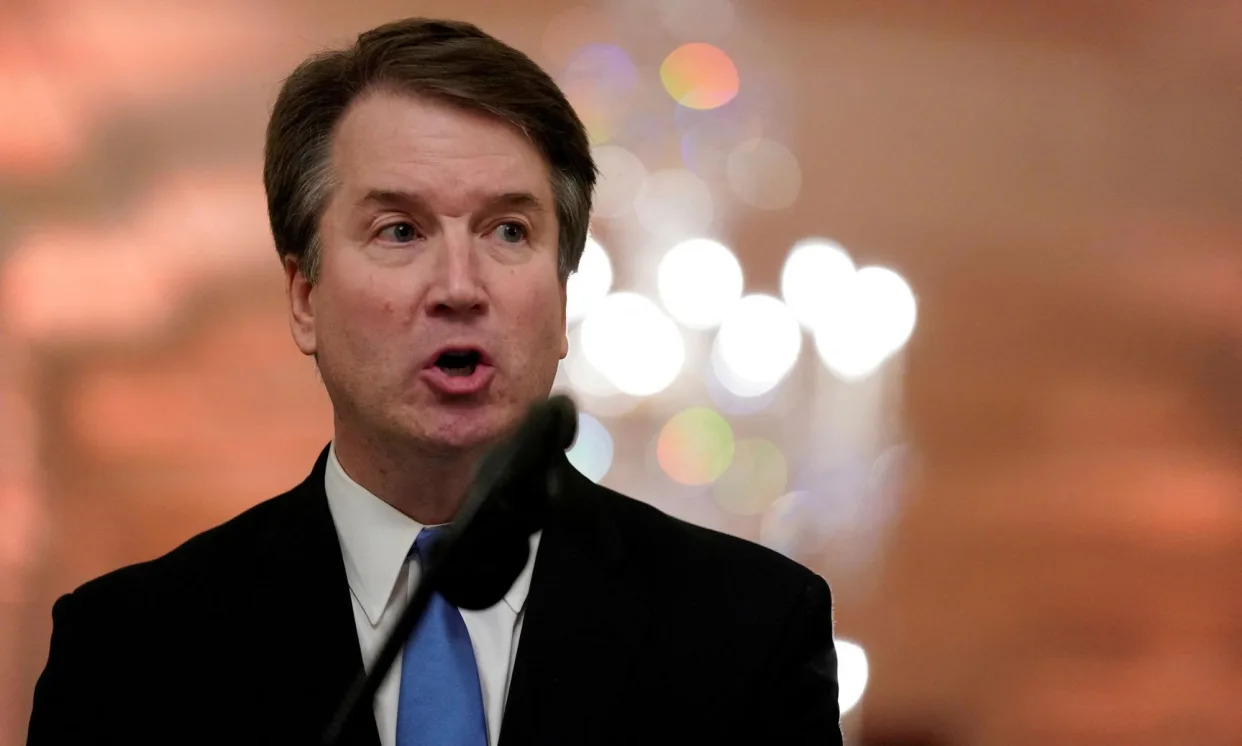
Photograph: Jonathan Ernst/Reuters
Brett Kavanaugh, the US supreme court justice, will “step up” for Donald Trump and help defeat attempts to remove the former president from the ballot in Colorado and Maine for inciting an insurrection, a Trump lawyer said.
“I think it should be a slam dunk in the supreme court,” Alina Habba told Fox News on Thursday night. “I have faith in them.
“You know, people like Kavanaugh, who the president fought for, who the president went through hell to get into place, he’ll step up. Those people will step up. Not because they’re pro-Trump but because they’re pro-law, because they’re pro-fairness. And the law on this is very clear.”
Kavanaugh was the second of three justices appointed by Trump, creating a 6-3 rightwing majority that has delivered major Republican victories including removing the federal right to abortion and loosening gun control laws.
Habba’s reference to Trump “going through hell” was to a stormy confirmation during which Kavanaugh was accused of sexual assault, which he angrily denied. Trump reportedly wavered on Kavanaugh, only for senior Republicans to persuade him to stay strong.
Observers were quick to notice Habba’s apparent invitation to corruption.
Michael Kagan, a law professor at the University of Nevada, Las Vegas, said: “Legal ethics alert. If … Kavanaugh feels in any way that he owes Trump and will ‘step up’, then [Habba] should be sanctioned by the bar for saying this on TV and thus trying to prejudice a proceeding.”
Last month, the Colorado supreme court and the Maine secretary of state ruled that Trump should be removed from the ballot under the 14th amendment to the US constitution, passed after the civil war to stop insurrectionists holding office.
Trump incited the deadly January 6 attack on Congress in 2021, an attempt to stop certification of his defeat by Joe Biden. Impeached but acquitted, he is now the frontrunner for the Republican presidential nomination this year.
Trump has appealed both state rulings. In a supreme court filing in the Colorado case, lawyers argued that only Congress could resolve such a dispute and that the presidency was not an office of state as defined in the 14th amendment.
The relevant text does not mention the presidency or vice-presidency. ABC News has reported exchanges in debate in 1866 in which those positions are covered.
The supreme court has not yet said if it will consider the matter.
Norm Eisen, a White House ethics tsar turned CNN legal analyst, said: “It’s likely … the supreme court will move to resolve this. They may do it quickly. They may not do it quickly because by filing this petition … Trump has stayed the Colorado proceedings. So at the moment he remains on the ballot. The supreme court does have to speak to it.”
Habba said:
“[Trump] has not been charged with insurrection. He has not been prosecuted for it. He has not been found guilty of it.”
She then made her prediction about Kavanaugh and other justices “stepping up”.
Trump ‘dictator’ comments raise questions about democracy. Here are 5 guardrails – if they hold
Riley Beggin and Angele Latham – January 5, 2024
As he seeks a second term in office, former President Donald Trump has indicated he plans to dramatically expand the power of the presidency and upturn democratic precedents.
Multiple American presidents of both parties have tested the bounds of executive power. But these pledges – and Trump’s unwillingness to acknowledge the valid results of the 2020 election, including saying the “termination” of the Constitution would be appropriate to overturn it − have experts in authoritarianism particularly on edge for what a second term would bring.
The United States government was built to withstand attempts to concentrate power in the hands of a single leader by vesting authority in Congress and the courts to check the president. There are also several agencies that operate independently of the president and decades of precedent that can create additional guardrails for democracy.
Experts who spoke with USA TODAY had varied opinions on the strength of those guardrails to stand up to potential abuses of power. Some said a widespread abandonment of democratic principles is unlikely; others suggested Trump has already proven they can be worn down.
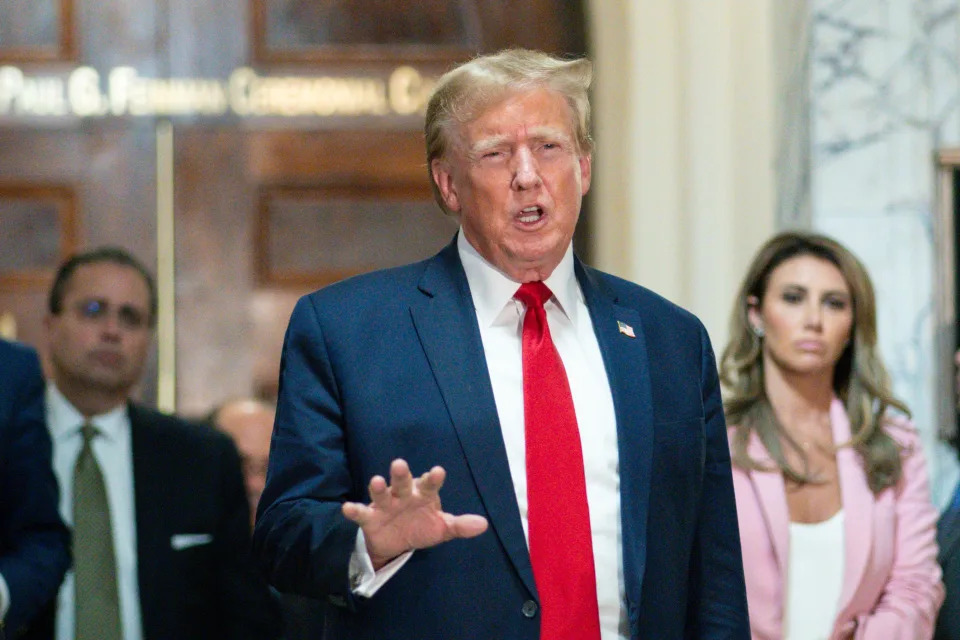
Former President Donald Trump speaks after exiting the courtroom for a break at New York Supreme Court, Dec. 7, 2023, in New York.
In either case, they said, the strength of American democracy depends on how willing people are within the system to defend it in the face of retaliation.
“There is a possibility that the Constitution’s limits are exposed,” said Daniel Kiel, a professor of constitutional law at the University of Memphis. The Constitution sets rules to protect democracy, but it works only if people follow them, he said.
“If we don’t have voluntary adherence to the rules of the game, then it reveals that the Constitution on its own isn’t enough.”
Here’s more on five key guardrails at play in curbing potential abuses of executive power.
The courts
The judicial system, a co-equal branch of government, is a major arbiter of whether policies spearheaded by Congress or the president are legal.
“One of the guardrails against presidential dictatorship is the expectation that the other institutions will push back,” said Joel Goldstein, a law professor and constitutional expert at St. Louis University School of Law. “The Constitution requires every member of Congress, every member of the court, to take an oath to support the Constitution. And the premise behind that is that if you have a president who steps out of his or her lane, exceeds his or her power, as preventions to dictatorship the other institutions will push back.”
Trump has had a particularly significant influence on the court system: He appointed more than 200 federal judges in four years in office, only about 30% fewer than Presidents Barack Obama and George W. Bush, who each served two terms.
A relatively high proportion of those were in the higher ranks. For instance, he appointed 54 judges to the nation’s 13 powerful appeals courts (compared with 55 appointed by Obama and 62 by Bush). He also appointed three U.S. Supreme Court justices, more than any president since Ronald Reagan. That created the conservative supermajority now serving on the nation’s highest court.
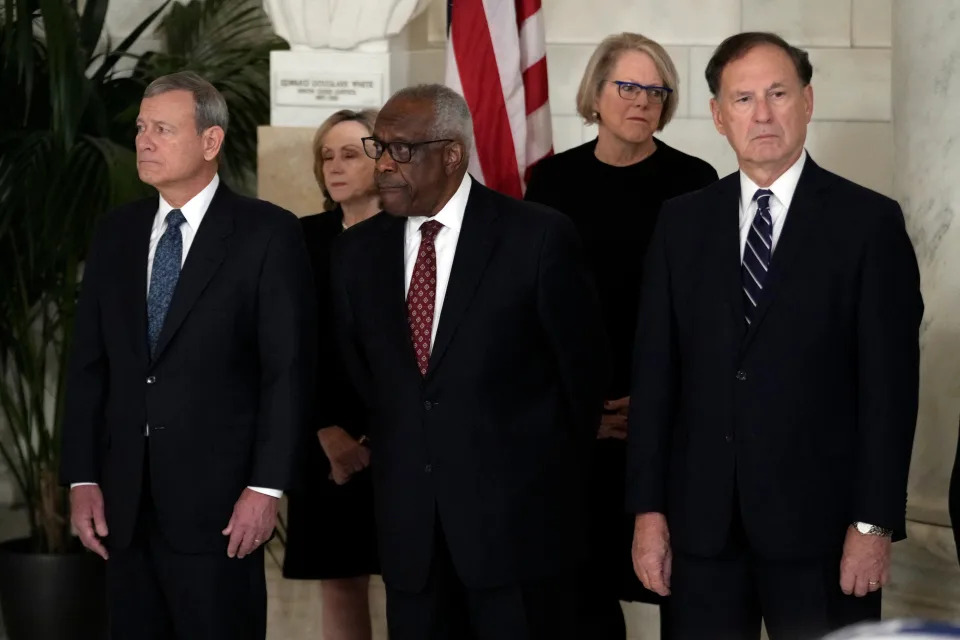
Chief Justice of the United States John Roberts, Justice Clarence Thomas and Justice Samuel Alito attend a private ceremony for retired Supreme Court Justice Sandra Day O’Connor before public repose in the Great Hall at the Supreme Court in Washington, DC, on Dec. 18, 2023.
But that doesn’t mean the justices would allow a significant power grab. In fact, the Supreme Court has ruled against Trump in more cases than any president in modern history.
Trump and the Supreme Court would likely be on the same page about some disputes, said Philip Gorski, a political sociologist at Yale University, such as his plan to purge the civil service.
But “the real acid test would be around elections and presidential immunity,” he said.
The high court has already made one key decision in Trump’s favor: In late December, it declined special counsel Jack Smith’s request to take up Trump’s claim that he is immune from prosecution in the federal election interference case. The move is a boon for Trump in that it may delay the start of his March 4 trial, which is schedule a day before 16 states hold primary elections.
Congress
“One of the most important checks on executive power – the most obvious and the most powerful – is Congress,” said Sheri Berman, a political science professor at Barnard College.
Congress was built to be a co-equal branch of government with the president. But as the United States became a larger global player and the number of federal agencies expanded, presidents gained much more power to shape policy without the help of Congress.
Goldstein said that apart from a citizen’s initial vote, the role of Congress to uphold an equal separation of powers is one of the most vital to prevent extreme presidential overreach.
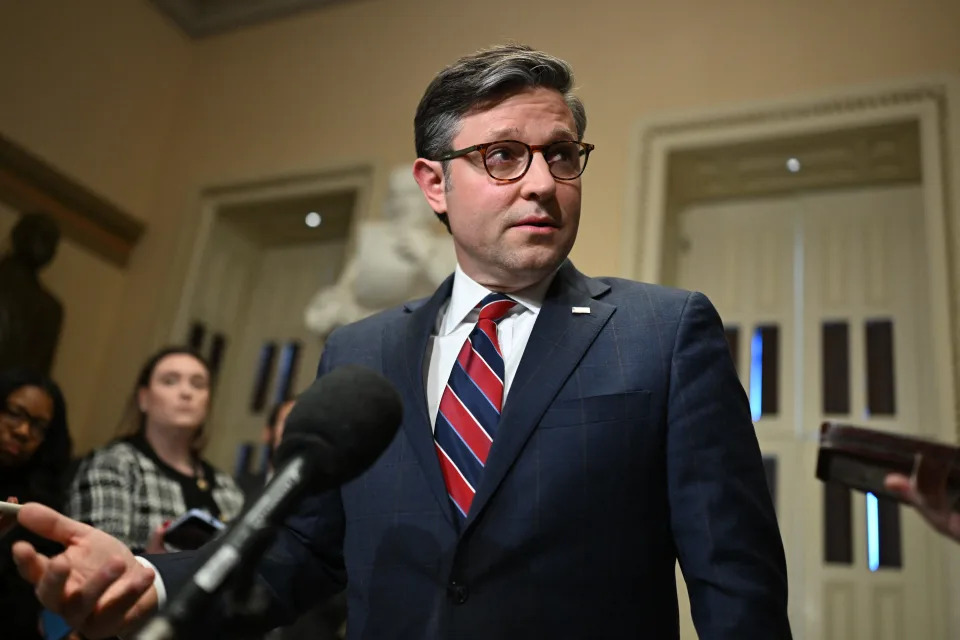
US House Speaker Mike Johnson, R-La., speaks to the press after meeting with Ukrainian President Volodymyr Zelensky on Capitol Hill in Washington, DC, on December 12, 2023.
The legislative branch has the power to rein in a president. They are the only branch with constitutional power to tax and spend, can pass laws limiting executive branch regulatory powers (especially with a president set on slashing regulation), and remain able to impeach, convict and remove a president from office – but only with enough support in the House and Senate.
But “one of the things that I think has made Trump so dangerous is that the Republican Party has pretty much fallen in behind him,” Berman said. Trump remains extraordinarily popular among the GOP base – and he doesn’t hesitate to go after members of his own party who publicly defy him – which can make it challenging for a Republican-controlled Congress to be a significant check on his power, she said.
The ‘power ministries’
Trump has claimed he is being targeted for political reasons by Smith, the nonpartisan special prosecutor, and pledged to use the Justice Department to “go after” President Joe Biden and other political adversaries if elected.
He also has said he would send the National Guard into cities with high crime rates “until law and order is restored” and to the southern border “to stop the invasion” of record numbers of migrants seeking asylum in the U.S. Trump and his top military leaders clashed over Trump’s suggestion of using military might to quell protests in the wake of George Floyd’s murder in Minneapolis in summer 2020.
“The real threat is if he is able to purge and co-opt the power ministries: law enforcement, defense, intelligence,” said Yale’s Gorski. “Failing that, he can’t really go beyond being a norm-defying president.”
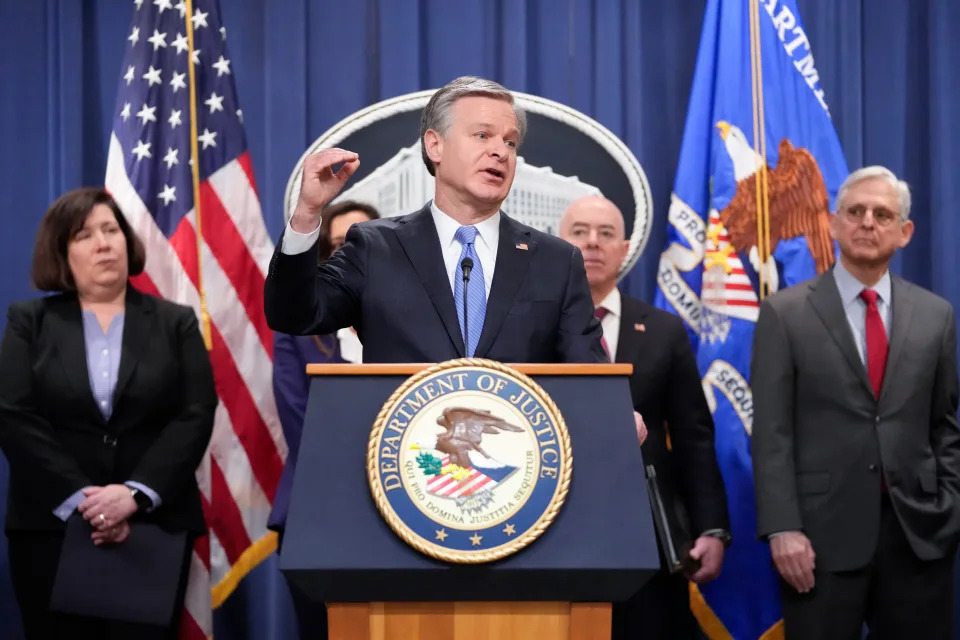
FBI Director Christopher Wray, speaks with reporters during a news conference at the Department of Justice on Dec. 6, 2023, in Washington, as from left, Senior Official Performing the Duties of the Deputy Director Staci Barrera, of U.S. Immigration and Customs Enforcement, Assistant Attorney General Nicole M. Argentieri of the Criminal Division, Secretary of Homeland Security Alejandro Mayorkas and Attorney General Merrick Garland, look on.More
There are multiple reasons to believe those “power ministries” would stand firm, he said. The militaries of successful strongmen are often drawn from the region or ethnic group that has strong ties to the leader. “The fact that we have a really cross-class, multiracial, inclusive military is certainly a buttress,” he said.
Gorski and Berman said the defense communities are staffed with people who are largely nonpartisan, professional and committed to defending the Constitution.
“Because of the strong ethos within each of those agencies or branches of the government – I would still expect considerable pushback,” Gorski said.
Elections
Multiple experts noted there is an often-overlooked guardrail to protect democracy that can prevent concerns of overreach from the very beginning: voting.
“The first act of rejection of these anti-democratic proposals should be at the ballot,” said Frederico Finchelstein, a history professor at the New School for Social Research in New York.
“If that is not effective, the situation will be very problematic because then you will have a person who is supported by votes” to deliver on anti-democratic promises – a voter mandate that could bolster arguments for more authoritarian policies, he said.
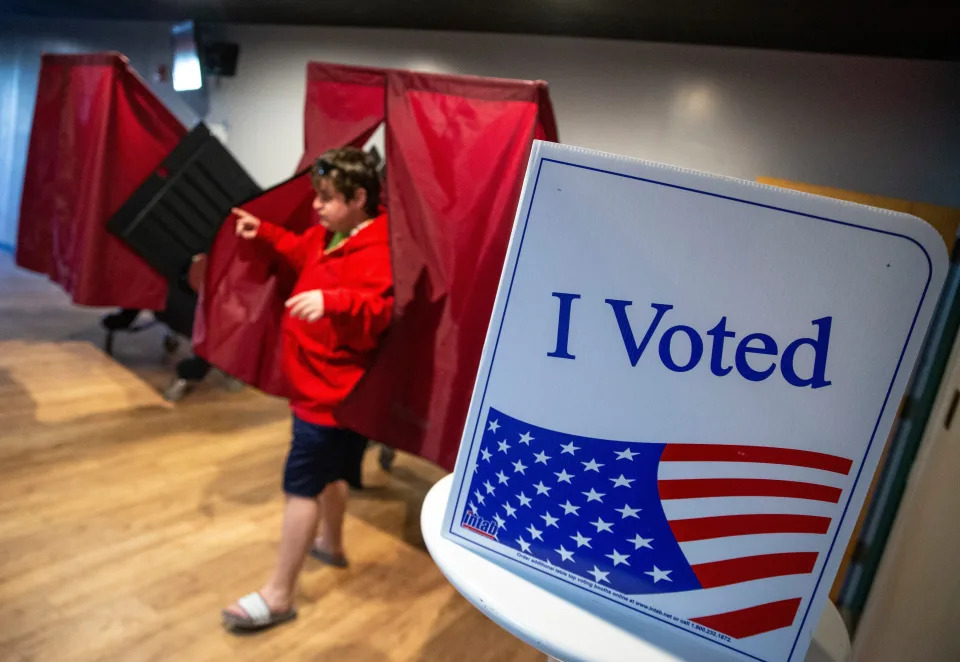
Lee Curran of Cherry Hill emerges from the voting booth after casting his vote at the Erlton Fire Company, district 25 in Cherry Hill, N.J. Tuesday, Nov. 8, 2022.
Goldstein expressed a similar sentiment.
“A democratic government is the antithesis of a dictatorship – and so the first guardrail against presidential dictatorship is not to elect somebody who has tendencies toward authoritarianism or dictatorial tendencies,” he said.
Though the right to vote is the first step in checking presidential power, Kiel warns that should Trump be duly elected in 2024, that electoral support might embolden him to push the limits of his presidential power.
“There was already a second reelection effort (by Trump) that failed, and so the voters have limited his power by voting him out of office,” Kiel said. Trump has been impeached twice − and acquitted twice in the Senate − and lost election once, he added: “If he were to be returned to office … I do think it’s a unique scenario in that one might feel more emboldened to test those limits of presidential power because those limits have proven already inadequate.”
The press
A primary guardrail of democracy, multiple experts noted, is also often the loudest one in the room: the press.
“The freedom of the press, the freedom of speech − our system depends upon a belief that the press and dissidents can speak against the government,” Goldstein said. “And that you as a citizen are not being unpatriotic by criticizing the government − it’s our patriotic duty to criticize the government when it acts improperly.”
But the attitude of a presidential administration toward the press can drastically affect the public’s trust in America’s oldest institution.
Trump has been a vocal critic, repeatedly claiming the press is intentionally peddling false information about him and his former administration. Kash Patel, a close ally who is likely to have a national security role in a second Trump administration, said that a new administration would “go out and find the conspirators” in the media.
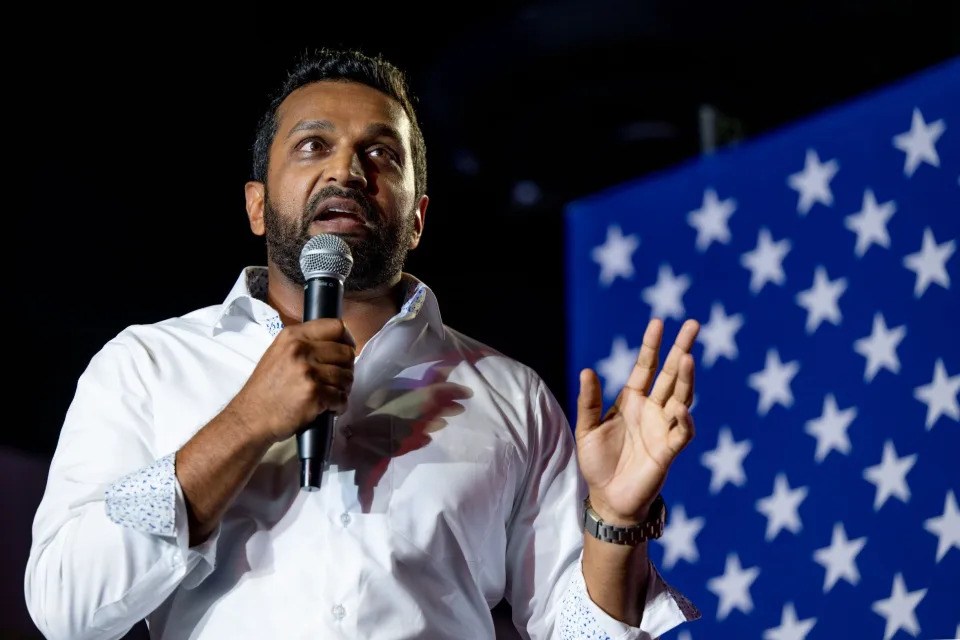
TUCSON, ARIZONA – JULY 31: Kash Patel, a former chief of staff to then-acting Secretary of Defense Christopher Miller, speaks during a campaign event for Republican election candidates at the Whiskey Roads Restaurant & Bar on July 31, 2022 in Tucson, Arizona. With less than two days to go before the Arizona primary election, candidates continue campaigning across the state. (Photo by Brandon Bell/Getty Images)More
Patel’s statements reflect a growing gap among Americans regarding the trustworthiness and efficacy of reputable news organizations to provide that constitutional guardrail.
In 2020, the Pew Research Center found that the gap between Americans who view a number of notable news sources as “trustworthy” versus “untrustworthy” has widened significantly since 2014 – and almost entirely along political lines.
Indeed, another study found that the number of citizens who believed that news organizations’ criticism of elected leaders “(kept) them from doing things they shouldn’t” split dramatically after the first year of Trump’s presidency.
In January 2016, 75% of respondents believed news organizations protected from governmental overreach, and the gap between Republican-leaning respondents and Democrat-leaning respondents spanned 3 points. One year into Trump’s term, that gap widened to 47 points.
Looking forward
These five factors each have a role to play in protecting democracy in the United States, the experts who spoke with USA TODAY said. But their success hinges on the people inside each institution acting in the country’s best interest.
“Ultimately, any guardrail on presidential authoritarianism or dictatorship depends upon government officials and citizens valuing constitutional principle above short-term partisan advantage,” said Goldstein, of St. Louis University.
When people are more interested in “protecting their own team” than following the Constitution, he said, “then the system can unwind.”
“Unprofessional”: Experts blast Trump lawyer for saying Brett Kavanaugh “quid pro quo part out loud”
Igor Derysh – January 5, 2024
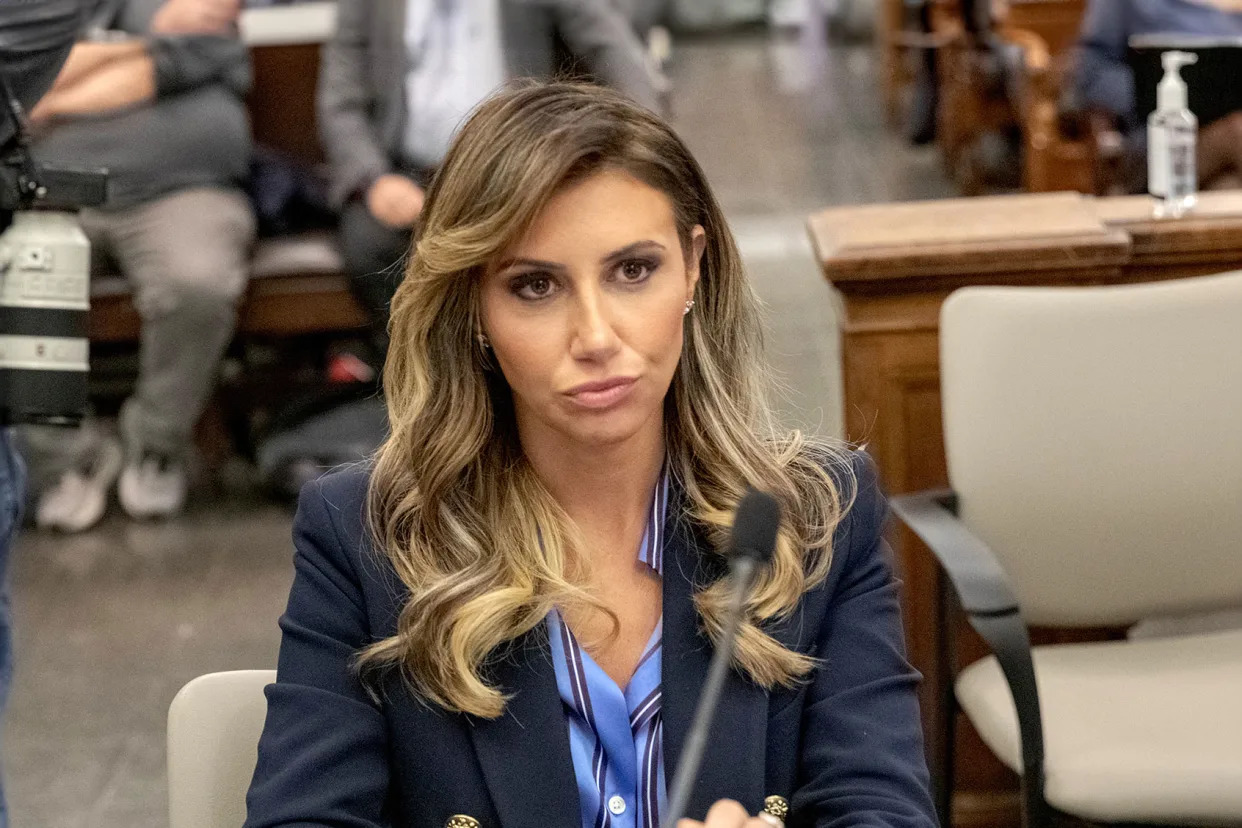
Alina Habba ANNA WATTS/POOL/AFP via Getty Images
Trump attorney Alina Habba on Thursday suggested that Supreme Court Justice Brett Kavanaugh would “step up” and rule in favor of the former president because he “fought for” him.
Trump on Wednesday asked the U.S. Supreme Court to overturn a Colorado Supreme Court ruling barring him from the presidential primary ballot under the Constitution’s “insurrectionist” clause. Trump has privately told people that he thinks the Supreme Court will “overwhelmingly” overturn the ruling but has also expressed concern that the conservative justices he appointed “will worry about being perceived as ‘political’ and may rule against him,” according to The New York Times.
Habba echoed Trump’s worries in an interview with Fox News.
“That’s a concern that he’s voiced to me, he’s voiced to everybody publicly, not privately. And I can tell you that his concern is a valid one,” she said. “They’re trying so hard to look neutral that sometimes they make the wrong call.”
But in a later appearance on the network with host Sean Hannity, Habba said the case should be a “slam dunk in the Supreme Court.”
“You know people like Kavanaugh ― who the president fought for, who the president went through hell to get into place ― he’ll step up,” she said. “Those people will step up. Not because they’re pro-Trump but because they’re pro-law. Because they’re pro-fairness, and the law on this is very clear.”
CNN host Phil Mattingly was taken aback as he played the clip on Friday.
“If a Democrat said that about the Justice Department or Merrick Garland or fill-in-the-blank here, there would be an absolute implosion. That’s bonkers,” he said.
“She’s saying the quiet part out loud,” replied panelist Jon Avlon. “She’s saying that Brett Kavanaugh will step up and side with the president because he appointed him. That goes against every basic idea of law and independence of the judiciary. And frankly, it puts Kavanaugh in a bit of a box.”
Legal experts skewered the lawyers’ Fox News remarks.
“That’s not how this works,” tweeted national security attorney Bradley Moss. “Imagine for a second if a lawyer for Clinton, Obama or Biden said this. It’d be a massive scandal at Fox,” he added.
“Alina Habba saying the quid pro quo part out loud here,” wrote MSNBC legal analyst Katie Phang.
“Yet another example of Habba demonstrating how unprofessional she is as an attorney,” national security lawyer Mark Zaid added.
US Supreme Court to hear Trump appeal of Colorado ballot disqualification
Andrew Chung and John Kruzel – January 5, 2024
FILE PHOTO: Republican presidential candidate and former U.S. President Trump campaigns in Reno
WASHINGTON (Reuters) -The U.S. Supreme Court on Friday agreed to hear Donald Trump‘s appeal of a judicial decision barring the former president from Colorado’s Republican primary ballot, taking up a politically explosive case with major implications for the 2024 presidential election.
At issue is the Colorado Supreme Court’s Dec. 19 ruling disqualifying Trump from the state’s primary ballot based on language in the U.S. Constitution’s 14th Amendment for engaging in insurrection, involving the Jan. 6, 2021, attack by his supporters on the U.S. Capitol.
The justices took up the case with unusual speed. Trump, the frontrunner for his party’s nomination to challenge Democratic President Joe Biden in the Nov. 5 U.S. election, filed his appeal on Wednesday. The justices indicated they would fast-track a decision, scheduling oral arguments for Feb. 8. The Colorado Republican primary is scheduled for March 5.
The state court, acting in a challenge to Trump by Republican and unaffiliated voters in Colorado, found him ineligible for the presidency under a constitutional provision that bars anyone who “engaged in insurrection or rebellion” from holding public office, barring him from the primary ballot.
The U.S. Supreme Court did not act on a separate appeal of the state court’s decision by the Colorado Republican Party.
The Colorado case thrusts the Supreme Court – whose 6-3 conservative majority includes three justices appointed by Trump – into the unprecedented and politically fraught effort by his detractors to invalidate his campaign to reclaim the White House.
Trump’s spokesperson Steven Cheung praised the court’s decision to hear the case, characterizing the disqualification efforts as “part of a well-funded effort by left-wing political activists hell-bent on stopping the lawful re-election of President Trump this November, even if it means disenfranchising voters.”
Colorado Secretary of State Jena Griswold said people in her state and around the United States “deserve clarity on whether someone who engaged in insurrection may run for the country’s highest office.”
Noah Bookbinder, president of Citizens for Responsibility and Ethics in Washington, a watchdog group representing the challengers to Trump, added, “We’re glad that the Supreme Court will definitively decide whether Donald Trump can be on the ballot. We look forward to presenting our case and ensuring the Constitution is upheld.”
Many Republicans have decried the disqualification drive as election interference, while proponents of disqualification have said holding Trump constitutionally accountable for an insurrection supports democratic values. Trump faces criminal charges in two cases related to his efforts to overturn his 2020 loss to Biden.
Trump also has appealed to a Maine state court a decision by that state’s top election official barring him from the primary ballot under the same constitutional provision at issue in Colorado.
HIGH STAKES FOR SUPREME COURT
While the Colorado case could hamper Trump’s bid to win back the presidency, it also has major implications for the justices. Given the political nature of the dispute, they run the risk of appearing partisan whichever way they lean.
Their action will shape a wider effort to disqualify Trump from other state ballots. Colorado and Maine are Democratic-leaning states. Nonpartisan political analysts forecast that both are unlikely to back a Republican presidential candidate in the general election. But there are efforts underway in other states – including highly competitive Michigan – that could shape the election’s outcome.
The Colorado ruling marked the first time that Section 3 of the 14th Amendment – the so-called disqualification clause – was used to deem a presidential candidate ineligible. Section 3 bars from holding office any “officer of the United States” who took an oath “to support the Constitution of the United States” and then “engaged in insurrection or rebellion against the same, or given aid or comfort to the enemies thereof.”
The amendment was ratified in the aftermath of the American Civil War of 1861-1865 in which Southern states that allowed the practice of slavery rebelled in a bid for secession.
Among other arguments, Trump’s lawyers have said that Section 3 does not apply to U.S. presidents, that the question of presidential eligibility is reserved to Congress, and that he did not participate in an insurrection.
The Colorado court’s decision marked “the first time in the history of the United States that the judiciary has prevented voters from casting ballots for the leading major-party presidential candidate,” Trump’s appeal stated.
The Republican and unaffiliated voters who sued to disqualify Trump from the ballot disagreed. In a filing on Thursday, they emphasized the lower court’s findings that Trump’s intentional “mobilizing, inciting, and encouraging” of an armed mob to attack the Capitol meets the legal definition in Section 3.
“This attack was an ‘insurrection’ against the Constitution by any standard,” they said in the filing.
Trump’s supporters attacked the Capitol in a bid to prevent Congress from certifying Biden’s election victory. Trump gave an incendiary speech before the attack, repeating his false claims of widespread voting fraud.
Biden in a speech in Pennsylvania on Friday cast Trump as a threat to American democracy, one of the themes of his re-election campaign. Biden specifically made reference to Trump’s speech before the Capitol riot, whose three-year anniversary is on Saturday.
(Reporting by John Kruzel in Washington and Andrew Chung in New York; Editing by Will Dunham)
“No shame. No decency”: Experts shocked at “weakness” of Trump’s bizarre Supreme Court ballot appeal
Igor Derysh – January 4, 2024
Donald Trump Scott Olson/Getty Images
Former President Donald Trump on Wednesday appealed the Colorado ruling barring him from the state’s primary ballot to the Supreme Court.
The Colorado Supreme Court last month found that Trump engaged in an insurrection on Jan. 6 and was barred from appearing on the ballot under Section 3 of the 14th Amendment — a post-Civil War provision barring insurrectionists from office.
Trump’s lawyers in a filing asked the U.S. Supreme Court to put his name back on the ballot, arguing it would “mark the first time in the history of the United States that the judiciary has prevented voters from casting ballots for the leading major-party presidential candidate.”
Trump’s team called on the court to “return the right to vote for their candidate of choice to the voters,” arguing that only Congress has the authority to determine who is eligible for the presidency.
Trump’s team also disputed that he engaged in insurrection, citing a “long history of political protests that have turned violent.”
Legal experts criticized Trump’s filing starting with the very first line, which noted that it is a “fundamental principle” of the Constitution that “the people should choose whom they please to govern them.”
“No shame. No decency,” tweeted former U.S. Attorney Joyce Vance, alluding to Trump’s own efforts to disenfranchise voters after his 2020 loss.
“The sort of gall that the brief represents, it’s really, I think, shocking,” former federal prosecutor Andrew Weissmann, who served on special counsel Bob Mueller’s team, told MSNBC. “It’s really sort of beyond the pale and legally wrong.”
“Donald Trump is charged with, essentially, disenfranchising, trying to disenfranchise 80 million people,” Weissmann said.
Conservative attorney George Conway went through the indictment on MSNBC’s “Morning Joe” on Thursday.
“This is a bizarre document, and I think it reflects the weakness of Trump’s position,” he said.
“He is throwing stuff up at the wall, or throwing stuff up in a zoo cage, and seeing what would stick,” Conway said, noting that Trump lacks “real appellate advocates” on his legal team and that the filing is effectively “channeling Trump’s narcissism.”
“The third reason, I think, is the fundamental weakness of his position. The fifth point in this brief, point five, Roman numeral five, is he didn’t engage in insurrection. It is not number one. The reason is, it’s because his arguments are very, very weak. If you look at the question in terms of President Trump should be removed from the ballot, it’s kind of a shocking notion to those of us who haven’t lived, until now, in an era where public officials engage in insurrection. But it was familiar to the people who enacted the 14th amendment,” he said.
“When you go through the issues one by one by one, the way lawyers are supposed to, his case looks terrible,” he added.
CNN legal analyst Elie Honig, a former federal prosecutor, noted that Trump’s argument that he did not engage in insurrection is a “weak argument.”
“First on the facts but second, the Supreme Court’s not going to touch that,” he said. “They’re not a fact-finder, they don’t do trials. They generally won’t make that kind of finding.”
Honig said it is unclear how the court might look at Trump’s arguments that the matter should be left to Congress or that he was not given due process in the Colorado case.
“And then the fourth argument is this claim that the term ‘officers,’ as it’s used in the insurrection clause, doesn’t include the president. I tend to side with Colorado and [the plaintiffs] on that one. You can carve that up linguistically either way but just [on] common sense, how could it not apply to the president?” Honig questioned. “All of this is new… whatever happens here, we’re all going to learn together.”
How Rep. Andy Biggs proves House Speaker Mike Johnson’s Texas border bonanza was bogus
EJ Montini, Arizona Republic – January 4, 2024
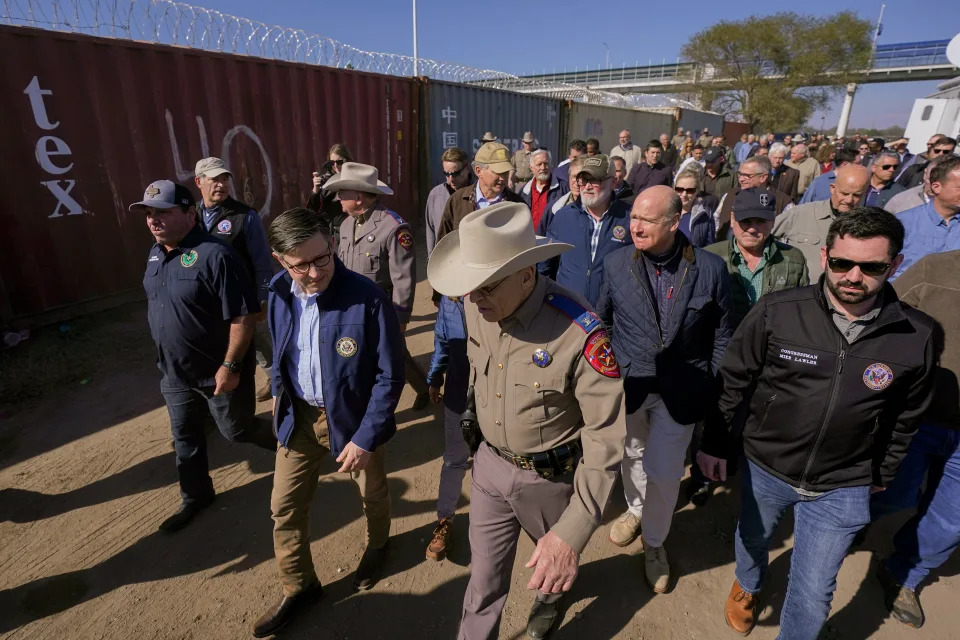
Arizona Rep. Andy Biggs was at the border community of Eagle Pass, Texas, on Wednesday, part of a group of 60-plus Republicans led by House Speaker Mike Johnson, all of whom made the trip to make speeches, make the news, make (perhaps) some campaign cash, and accomplish … nothing.
Accomplishing nothing is something Biggs has proven to be very good (?) at.
“No more money for this bureaucracy of his (President Joe Biden’s) government until you’ve brought this border under control,” Biggs is quoted as saying in The New York Times. “Shut the border down or shut the government down.”
The congressman made the same threat on X, formerly Twitter.
”Shut the border down, or we’ll shut the government down,” he posted, standing with three other Republicans, including Arizona Rep. Eli Crane, who appears to have spent his time in Congress being tutored by Biggs on how to get zero done.
Some make progress. Biggs make noise
U.S. House Speaker Mike Johnson, center left, and Texas Department of Public Safety chief Steve McCraw, center right, lead a group of Republican members of Congress during a tour of the Texas-Mexico border, Wednesday, Jan. 3, 2024, in Eagle Pass, Texas.
There are two groups of elected officials operating in Washington, D.C.
There is a very small collective who want to make progress. And there is an overwhelming majority who want to make noise. You can guess which group Biggs, Speaker Johnson and the other Texas tinhorns belong to.
Meantime, back at the Capitol, there is a small working group of senators, including Arizona’s independent Sen. Kyrsten Sinema, Oklahoma Republican Sen. James Lankford and Democratic Sen. Chris Murphy of Connecticut, who are trying to hammer out a bipartisan agreement on border measures.
Sinema told The Arizona Republic, “We’re dealing with very, very difficult, complex issues. Drafting is very technical. It must be done incredibly precise and to avoid unintended consequences and decades of litigation. And so this is really hard. But everyone is working in good faith to solve this crisis.”
Not everyone.
Border isn’t a crisis, it’s a GOP gold mine
Republicans already are using the border crisis as their primary campaign argument for the 2024 election. It’s how they hope to help Donald Trump get back to the White House.
The worst thing that could happen to them, politically, would be for Republicans and Democrats of good faith to reach a bipartisan deal on the border.
Speaker Johnson, like Biggs and Arizona Republican Rep. Paul Gosar, was among those who tried to stage a nonviolent coup to keep Trump in office after he lost the election in 2020.
The bogus bonanza in Texas on Wednesday wasn’t about the border. It was about Trump.
Congress can solve this, but will it?
It wasn’t even the first time Biggs threatened a government shutdown.
He did that last year when he and some Republican cronies were trying to strongarm then Speaker Kevin McCarthy.
On Wednesday, Democratic Sen. Chuck Schumer in Washington said of the Republicans and their Texas two-step, “It’s very nice that they have a trip to the border, but the only way to solve this is here, working in a bipartisan way with Senate Republicans, Senate Democrats and House Democrats to get it done, period.
“I hope the speaker will realize that if he wants to solve the problem on the border.”
Trump’s businesses received millions from foreign entities during his presidency, House report says
Will Steakin – January 4, 2024
Former President Donald Trump’s businesses received millions of dollars from foreign entities located in 20 different countries during his presidency, according to a new report released Thursday by Democrats on the House Oversight committee.
The top Democrat on the Oversight Committee, Rep. Jamie Raskin, released the report and provided documents from Trump’s former accounting firm that show that 20 governments, including China and Saudi Arabia, paid at least $7.8 million during Trump’s presidency to business entities that included Trump International Hotels in Washington, D.C., and Las Vegas, and Trump Towers in New York.
The 156-page report by House Democrats is entitled “White House For Sale.”
In the forward to the report, Raskin wrote, “By elevating his personal financial interests and the policy priorities of corrupt foreign powers over the American public interest, former President Trump violated both the clear commands of the Constitution and the careful precedent set and observed by every previous commander in chief.”
The reports says that, according to “limited records” obtained by the committee, Saudi Arabia likely paid Trump-owned business at least $615,422 during Trump’s first term in office.
“While the Kingdom of Saudi Arabia was making these payments, President Trump chose Saudi Arabia as the destination of his first overseas trip — a choice that was unprecedented among U.S. presidents,” the report says.
PHOTO: Republican presidential candidate and former President Donald Trump attends a campaign event in Waterloo, Iowa, Dec. 19, 2023. (Scott Morgan/Reuters, FILE)
The report claims that the payments violated the Constitution’s foreign emoluments clause, a rule that bars the president and other federal officials from accepting money or gifts from foreign governments without Congressional approval.
In 2021, the U.S. Supreme Court dismissed lawsuits accusing Trump of profiting from his presidency, on the grounds that he is no longer in office.
“Through entities he owned and controlled, President Trump accepted, at a minimum, millions of dollars in foreign emoluments in violation of the United States Constitution,” Democrats write in the report. “The documents obtained from former President Trump’s accounting firm demonstrate that four Trump-owned properties together collected, at the least, millions of dollars in payments from foreign governments and officials that violated the Constitution’s prohibition on emoluments ‘of any kind whatever’ from foreign governments.”
ABC News has reached out to Trump’s representatives for comment on the report.
Related:
AFP
Foreign govts paid Trump firms millions while president: report
AFP – January 4, 2024
A Chinese embassy delegation spent $19,391 at the Trump International Hotel in Washington, DC (CHIP SOMODEVILLA)
Former US president Donald Trump‘s businesses received at least $7.8 million from foreign governments including China during his time in the White House, a congressional report claimed Thursday.
Officials from Saudi Arabia, India, Turkey and Democratic Republic of Congo were among some 20 countries’ representatives who paid money to Trump’s hotel and real estate businesses during his presidency, Democrats on the House Oversight Committee wrote in their report.
The authors claim that such revenues from overseas governments violated a constitutional ban on “foreign emoluments.”
“As President, Donald Trump accepted more than $7.8 million in payments from foreign states and their leaders, including some of the world’s most unsavory regimes,” said the report titled “White House for Sale.”
“We know about only some of the payments that passed into former President Trump’s hands during just two years of his presidency from just 20 of the more than 190 nations in the world through just four of his more than 500 businesses.”
– ‘Prohibited emoluments’ –
In the case of China, the report alleged that Beijing as well as businesses including ICBC bank and Hainan Airlines spent $5.5 million at Trump-owned properties.
“Former President Trump violated the Constitution when the businesses he owned accepted these emoluments paid by (Beijing) without the consent of Congress,” the report said.
The authors say that the full amount could be higher as the $5.5 million figure is based only on limited disclosures from Trump’s accountants Mazars and filings with the American financial regulator, the SEC.
In one expenditure dated August 27, 2017, a Chinese embassy delegation spent $19,391 at the Trump International Hotel in Washington.
The report also claims that “Saudi Arabia paid at least $615,422 in prohibited emoluments to former President Trump’s businesses over the course of his term in office from just (the Trump World Tower) and the March 2018 stay at the Trump International Hotel in Washington, DC.”
“Former President Trump has also boasted about the continued willingness of the Saudis to do business on terms highly favorable to him,” the report stated.
Trump’s Washington hotel was sold in 2022 to a private investor group and rebranded under the luxury Waldorf Astoria line.
The frontrunner for the 2024 Republican presidential nomination, Trump separately faces a civil fraud trial in New York over claims that his real estate businesses fraudulently inflated the value of their assets.
He is to go on trial in Washington in March for conspiring to overturn the results of the 2020 election, and in Florida in May on charges of mishandling top secret government documents.
The twice-impeached former president also faces racketeering charges in Georgia for allegedly conspiring to upend the election results in the southern state after his 2020 defeat by Democrat Joe Biden.
Related:
CNN
China spent over $5.5 million at Trump properties while he was in office, documents show
Zachary Cohen and Kara Scannell, CNN – January 4, 2024
Gabriella Demczuk/Getty Images
The Chinese government and its state-controlled entities spent over $5.5 million at properties owned by Donald Trump while he was in office, the largest total of payments made by any single foreign country known to date, according to financial documents cited in a report from House Democrats released Thursday.
Those payments collectively included millions of dollars from China’s Embassy in the United States, a state-owned Chinese bank accused by the US Justice Department of helping North Korea evade sanctions and a state-owned Chinese air transit company. Accounting records from Trump’s former accounting firm, Mazars USA, were obtained by Democrats on the House Oversight Committee.
China is one of 20 countries that made at least $7.8 million in total payments to Trump-owned businesses and properties during the former president’s stint in the White House, including his hotels in Washington DC, New York and Las Vegas, the report states.
The documents offer additional evidence of the rare practice of foreign governments spending money directly with businesses owned by a sitting president but are not a complete record of all foreign payments made to Trump’s businesses during his time in the White House.
At the time, Trump’s lawyer said the former president planned to donate foreign profits from his hotels to the US Treasury Department. However, the amount reportedly donated by the Trump Organization in 2017 and 2018 falls well short of estimated foreign payments that were made to its properties.
Trump refused to divest himself of corporate assets and properties prior to taking office, meaning he could still profit from his various businesses with little transparency.
Democrats say the additional accounting records raise new questions about possible efforts to influence Trump through his companies while he was in the White House.
As an example, committee Democrats point to the fact that Trump declined to impose sanctions on the Industrial and Commercial Bank of China (ICBC), a state-owned entity that leased property at Trump Tower in New York.
A Securities and Exchange Commission filing from 2012 shows that the Chinese bank’s base rent paid was $1.9 million and documents produced by Mazars confirm the bank stayed in Trump Tower through 2019 at least.
In 2016, the Justice Department accused the bank of conspiring with a North Korean bank to evade US sanctions.
But upon taking office, Trump did not sanction ICBC despite calls from Republican members of Congress to “apply maximum financial and diplomatic pressure” by “targeting more Chinese banks that do business with North Korea,” House Oversight Committee Democrats wrote in a report summarizing the contents of the Mazars USA records.
Asked about China’s payments to Trump-owned properties, Chinese Embassy spokesperson Liu Pengyu told CNN, “China adheres to the principle of non-interference in internal affairs and does not comment on issues related to US domestic politics.”
“At the same time, I want to stress that the Chinese government always requires Chinese companies to operate overseas in accordance with local laws and regulations. China-US economic and trade cooperation is mutually beneficial. China opposes the US politicizing China-US economic and trade issues,” Pengyu added.
The Trump Organization says it donated over $450,000 in estimated profits from foreign government patronage to the US Treasury over the time of Trump’s term. The company also worked to track all foreign government business across its entire portfolio and did not make new business investments overseas while Trump was in office.
In a statement, Eric Trump said that the former president was tough on China regardless of any business interests.
“There is no President in United States history who was tougher on China than Donald Trump … a President who introduced billions and billions of dollars worth of tariffs on their goods and services,” Eric Trump said.
Democrats also argue that the Mazar documents show Trump repeatedly violated the US Constitution’s Emoluments Clause, which prohibits a president from receiving an “emolument,” or profit, from any “King, Prince, or foreign State” unless Congress consents. Yet despite ethical concerns that have been raised about Trump’s lack of adherence to constitutional norms that were embraced by his predecessors, legislation to enforce the Emoluments Clause has gone nowhere in Congress.
The committee, which has investigated Trump’s businesses and his lease of the Old Post Office in Washington from the US government that housed his hotel, was provided the records following a years-long court battle that ended in a settlement in 2022.
Many of the documents in the subset released Thursday have not been previously made public.
“These countries spent – often lavishly – on apartments and hotel stays at Donald Trump’s properties – personally enriching President Trump while he made foreign policy decisions connected to their policy agendas with far-reaching ramifications for the United States,” Democrats wrote in their report.
Saudi Arabia, for example, spent roughly $600,000 at Trump-owned properties during his time in office and was making significant payments in May 2017 when it signed a massive arms deal with the Trump administration.
The Trump administration agreed to the controversial arms deal, worth over $100 billion, despite bipartisan concerns about civilian casualties resulting from Saudi Arabia’s military intervention in Yemen.
The report produced by House Democrats also highlighted comments made by Trump during a 2015 campaign rally regarding his view of Saudi Arabia.
“Saudi Arabia, I get along great with all of them. They buy apartments from me. They spend $40 million, $50 million.” He continued, “Am I supposed to dislike them? I like them very much!” Trump said at the time.
Committee Democrats have previously released some of the accounting records, but those documents only accounted for a fraction of the foreign payments to Trump-owned businesses during the years he occupied the White House.
Foreign spending at Trump World Tower
A sizable percentage of foreign spending disclosed in the latest report comes from leases or common charge payments countries made for apartments their diplomatic missions rent or own at Trump World Tower, an apartment building across the street from the United Nations.
Many of the countries bought properties years before Trump ran for office, but they continued to make payments to the Trump Organization during the presidency.
Saudi Arabia, India, Qatar, Kuwait, Afghanistan, and a Chinese-government linked petroleum company each owned or rented apartments at Trump World Tower and combined paid the Trump Organization an estimated $1.7 million in charges and fees, according to House Democrats.
The figure is based on records the Democrats received from Mazars for the year 2018 – the only year Mazars gave to the committee – and then an extrapolation based on the assumptions the charges remain the same during the course of Trump’s presidency.
The biggest payment to the UN property came from Saudi Arabia, which owns the 45th floor of the apartment tower. Democrats estimate the Saudi government paid $537,080 during Trump’s presidency – out of a total $615,422 in emoluments. The remainder came from payments to Trump’s hotel in Washington DC.
Qatar paid an estimated $465,744 for the properties it owned during Trump’s presidency; India paid at least $264,184; Afghanistan spent an estimated $153,208 for its unit; and Kuwait paid Trump’s company $152,664 for the Trump World Tower.
Kuwait also spent roughly $150,000 to the Washington hotel for National Day events held by its embassy in 2017 and 2018, according to Mazars records.
The national day event was also held at the hotel in 2019, but the Democrats said they did not receive records from Mazars related to the cost. The events were attended by Trump administration officials, the Democrats said citing press releases from the Kuwaiti embassy.
This story has been updated with additional details.
Related:
BBC News
Trump companies got millions from foreign governments, Democrats say
Natalie Sherman – BBC News – January 4, 2024
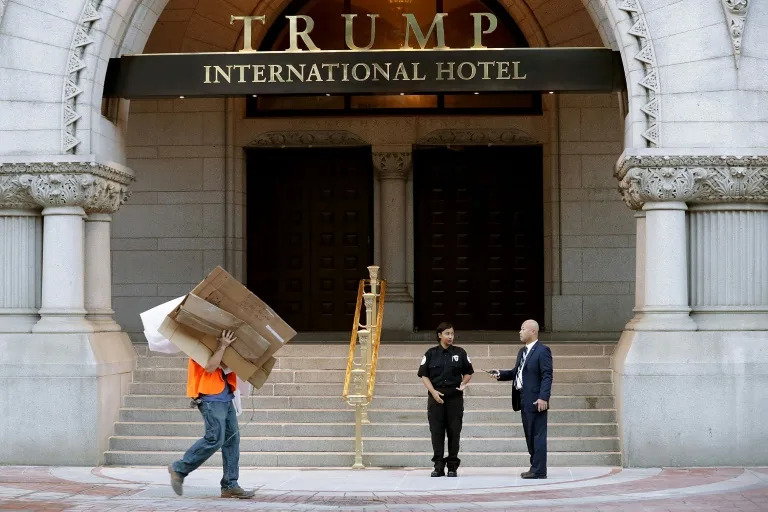
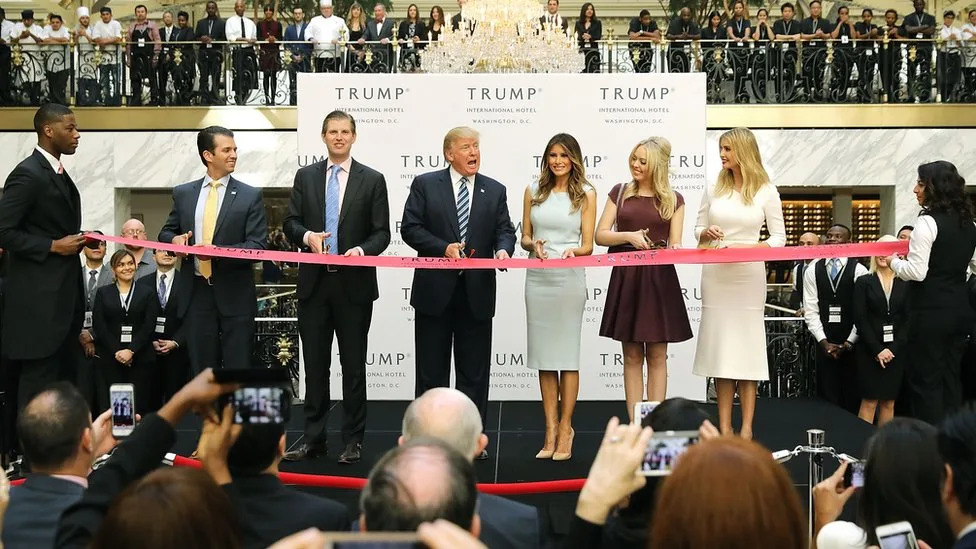
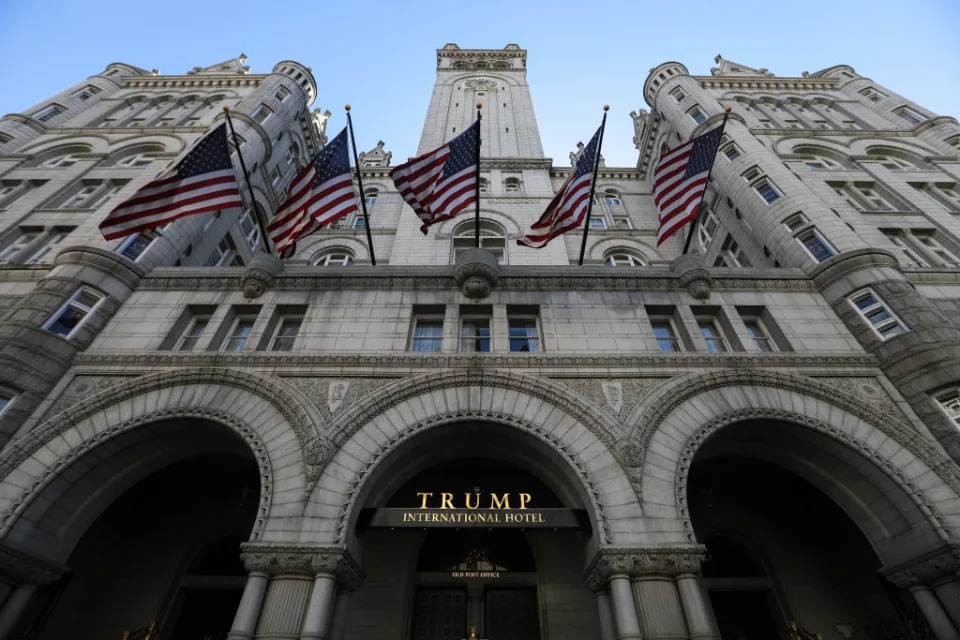
Trump International Hotel opened in 2016 in Washington
Donald Trump‘s hotels and other businesses accepted more than $7.8m (£6.1m) from foreign governments during his presidency, according to a new report from Democrats in Congress.
They found that China was responsible for more than $5.5m of those payments, which Mr Trump is accused of accepting in violation of the US constitution.
The report is based on documents released by Mr Trump’s former accounting firm after a court battle.
Mr Trump did not immediately comment.
The US constitution bars presidents from accepting gifts or other benefits derived from their position without express permission from Congress.
The former businessman, who made his name as a hotel and property developer, has been dogged by questions about his firms’ dealings since he entered the White House in January 2017.
At the time, he placed his sons in charge of the companies’ day-to-day operations but maintained ownership of the businesses, which included the Trump International Hotel in Washington, which became a known haunt for lobbyists, foreign delegations and others.
Mr Trump, who is currently campaigning for a second term, faced numerous lawsuits alleging conflicts-of-interest.
In 2021, America’s highest court threw out the cases, saying they were moot after he lost the 2020 election.
Representative Jamie Raskin, the top Democrat on the House Oversight Committee, said the investigation showed Mr Trump “put lining his pockets with cash from foreign governments seeking policy favors over the interests of the American people”.
“The report’s detailed findings make clear that we don’t have the laws in place to deal with a president who is willing to brazenly convert the presidency into a business for self-enrichment and wealth maximization with the collusive participation of foreign state,” he wrote in the introduction to the report.
Democrats said their investigation showed that Mr Trump’s loyalties were split by the payments, which came from at least 20 governments many of which had sensitive or politically charged matters before the US.
They cite as an example that Mr Trump supported arms sales to Saudi Arabia that were opposed by Congress due to fears the weapons would be used against civilians.
The report also notes he cast doubt on US intelligence assessments that the Crown Prince Mohammad bin Salman had ordered the murder of Washington Post journalist Jamal Khashoggi.
After China, Saudi Arabia and its royal family was the second biggest patron of the Trump businesses, spending more than $600,000 at his properties, according to the report.
Qatar, Kuwait and India rounded out the top five list.
Democrats said that the findings reflect just the first two years of his presidency and only four of his properties, claiming it likely represented just a fraction of the money Mr Trump’s businesses made from foreign governments during his time as president.
In 2022, Democrats lost control of Congress and could no longer compel release of documents, cutting short the investigation.
Republican James Comer, who is leading an inquiry into the business dealings of President Joe Biden’s son, Hunter, during his father’s vice presidency, dismissed the findings.
“It is beyond parody that Democrats continue their obsession with former President Trump,” he said in a statement. “Former President Trump has legitimate businesses but the Bidens do not.”
Mr Trump’s tax records, released in 2022, revealed significant business losses during his presidency and he has scaled back his business.
The Trump Organization sold the Washington hotel to an investment group for $375m in 2022.
Related:
CBS News
Trump businesses got millions in foreign payments while he was president, Dems say
Kathryn Watson, Stefan Becket – January 4, 2024
Washington — Donald Trump‘s businesses received at least $7.8 million in payments from foreign governments and government-backed entities from 20 countries while he was in the White House, according to a new report by House Democrats.
Drawing upon 451 pages of documents received from Trump’s longtime accounting firm Mazars and a federal agency, Democratic staffers on the House Oversight Committee on Thursday issued their 156-page report entitled “White House for Sale: How Princes, Prime Ministers, and Premiers Paid Off President Trump.”
The records, the report said, “demonstrate that four Trump-owned properties together collected, at the least, millions of dollars in payments from foreign governments and officials.” The Democrats alleged these payments violated what’s known as the Constitution’s Foreign Emoluments Clause, which prohibits federal officials from accepting gifts or other benefits from foreign countries without congressional approval.
“This report sets forth the records showing foreign government money — and all the spoils from royals we can find — pouring into hotels and buildings that the President continued to own during his presidency, all in direct violation of the Constitutional prohibition,” said Rep. Jamie Raskin of Maryland, the top Democrat on the committee.
The Democrats noted that they had access to a limited number of financial documents and that “the foreign payments to President Trump identified in this report are likely only a small fraction of the total amount of such payments he received during his presidency.”
Where the payments came from
The Democratic report focuses on payments to four Trump-controlled businesses: the Trump hotels in Washington, Las Vegas and New York, and Trump Tower in Manhattan.
While Trump turned over day-to-day operations of his businesses to his sons when he entered the White House in 2017, he declined to divest his assets and retained “personal ownership and control of all his businesses, as well as the ability to draw funds from them without any outside disclosure,” the report alleged. This arrangement, Democrats said, “reinforced (rather than severed) his ties to his businesses and enabled him to prioritize his personal interests over those of the nation.”
During his presidency, the Trump International Hotel in Washington attracted many foreign diplomats and dignitaries hoping to mingle with Trump allies and administration officials. According to Trump’s financial disclosure reports from when he was president, he earned more than $40 million from the D.C. hotel in 2017, and $40.8 million the following year.
A view of the Trump International Hotel in Washington, D.C., on Oct. 18, 2021. / Credit: Yasin Ozturk/Anadolu Agency via Getty Images
Despite Trump’s frequent criticism of China and insistence that the country was taking advantage of the U.S., the majority of foreign payments included in Thursday’s report came from the Chinese government and two state-owned entities.
The payments totaled nearly $5.6 million at properties including Trump Tower, and the Trump International Hotels in Washington and Las Vegas, the report found. The bulk of the payments came from the state-owned Industrial and Commercial Bank of China, which paid $5.35 million in rent for space in Trump Tower from February 2017 to October 2019.
The nation that spent the second-most at the Trump properties, according to the report, was Saudi Arabia. The Saudi government spent more than $615,000 at Trump World Tower in New York and the Trump hotel in Washington from 2017 to 2020.
The report noted that Trump praised Saudi Arabia and mentioned “his transactional relationships” with the kingdom before taking office. During an August 21, 2015, rally in Alabama, Trump said Saudi nationals had spent millions of dollars on his apartments.
“Saudi Arabia, I get along great with all of them. They buy apartments from me. They spend $40 million, $50 million,” he said. “Am I supposed to dislike them? I like them very much!”
The report said that Trump “oversaw several highly consequential decisions on a range of issues involving U.S. policy towards Saudi Arabia” while his businesses were receiving payments from the Saudi government. The Democrats noted Trump’s response to the 2018 death of Washington Post columnist and Saudi dissident Jamaal Khashoggi, in which he publicly doubted the conclusion of the intelligence community that the Saudi crown prince had ordered his killing.
Qatar follows Saudi Arabia’s spending, with $465,744 spent at Trump World Tower. Nearly all of the remaining payments, from countries including Kuwait, India, Malaysia, Afghanistan, the Philippines and the United Arab Emirates, occurred at the Trump International Hotel in Washington.
The fight over emoluments
Trump’s business dealings as president were the subject of three major court cases while he was in office, the first of which was filed in 2017. The cases, brought by Democratic lawmakers, several states and an oversight group, were the first legal battles over the Emoluments Clause, but failed to resolve questions about the definition of an “emolument” or the scope of constitutional provision. The Supreme Court dismissed two of them once Trump left office and declined to review the third.
The Trump campaign didn’t immediately respond to a request for comment on the new report. Trump dismissed the “phony Emoluments Clause” and concerns about his business dealings in 2019.
The Trump Organization has said it voluntarily donated proceeds from foreign governments to the U.S. Treasury every year from 2018 to 2021. In 2017, the Trump Organization said it would rely on foreign representatives to self-report if they were paying a Trump company for something in their official capacity.
The company said it donated $191,538 in foreign payments in 2019, $105,465 in 2020 and $10,577 in 2021.