Ron DeSantis ends his struggling presidential bid before New Hampshire and endorses Donald Trump

Associated Press

Ron DeSantis ends his struggling presidential bid before New Hampshire and endorses Donald Trump

Steve Peoples, Thomas Beaumont, Holly Ramer – January 21, 2024
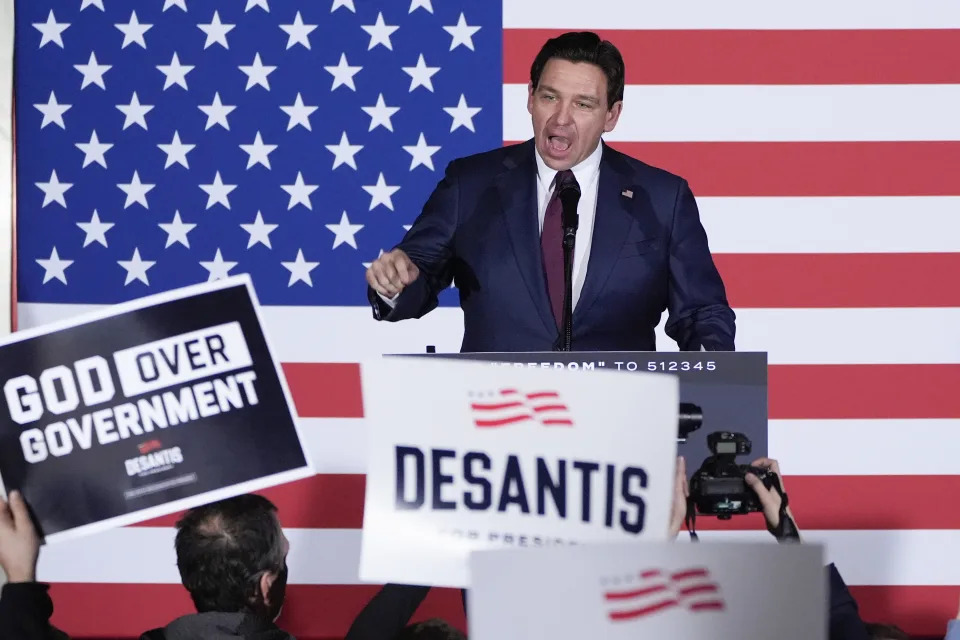
FILE - Republican presidential candidate Florida Gov. Ron DeSantis speaks to supporters during a caucus night party, Jan. 15, 2024, in West Des Moines, Iowa. DeSantis has suspended his Republican presidential campaign after a disappointing showing in Iowa's leadoff caucuses. He ended his White House bid Sunday, Jan. 21, after failing to meet lofty expectations that he would seriously challenge former President Donald Trump. (AP Photo/Charlie Neibergall, File)
Republican presidential candidate Florida Gov. Ron DeSantis speaks to supporters during a caucus night party, Jan. 15, 2024, in West Des Moines, Iowa. DeSantis has suspended his Republican presidential campaign after a disappointing showing in Iowa’s leadoff caucuses. He ended his White House bid Sunday, Jan. 21, after failing to meet lofty expectations that he would seriously challenge former President Donald Trump. (AP Photo/Charlie Neibergall, File)

MANCHESTER, N.H. (AP) — Florida Gov. Ron DeSantis suspended his Republican presidential campaign on Sunday, ending his 2024 White House bid just before the New Hampshire primary while endorsing his bitter rival Donald Trump.

The decision leaves Trump and former U.N. Ambassador Nikki Haley as the last major candidates remaining in the race ahead of Tuesday’s New Hampshire primary. This is the scenario Trump’s foes in the GOP have long sought, raising the stakes for this week’s contest as the party’s last chance to stop the former president who has so far dominated the race.

But as some Trump critics cheered, DeSantis nodded toward Trump’s primary dominance — and attacked Haley — in an exit video he posted on social media.

“It’s clear to me that a majority of Republican primary voters want to give Donald Trump another chance,” DeSantis said in the straight-to-camera video, delivered in a cheerful tone.

He continued: “I signed a pledge to support the Republican nominee and I will honor that pledge. He has my endorsement because we can’t go back to the old Republican guard of yesteryear, a repackaged form of warmed-over corporatism that Nikki Haley represents.”

Haley spoke at a campaigning stop in Seabrook, New Hampshire, just as DeSantis announced his decision.

“He ran a great race, he’s been a good governor, and we wish him well,” she told a room packed with supporters and media. “Having said that, it’s now one fella and one lady left.“

DeSantis’ decision, while perhaps not surprising given his 30-point blowout loss last week in Iowa, marks the end of an extraordinary decline for a high-profile governor once thought to be a legitimate threat to Trump’s supremacy in the Republican Party. After months of contentious exchanges, Trump struck a more conciliatory tone late Sunday during a rally in Rochester, New Hampshire, calling DeSantis a “really terrific person.”

“I also look forward to working with Ron” to win the general election, Trump said.

His record wasn’t enough to overcome Trump

DeSantis entered the 2024 presidential contest with major advantages in his quest to take on Trump, and early primary polls suggested DeSantis was in a strong position to do just that. He and his allies amassed a political fortune well in excess of $130 million, and he boasted a significant legislative record on issues important to many conservatives, like abortion and the teaching of race and gender issues in schools.

Such advantages did not survive the reality of presidential politics in 2024. From a high-profile announcement that was plagued by technical glitches to constant upheavals to his staff and campaign strategy, DeSantis struggled to find his footing in the primary. He lost the Iowa caucuses — which he had vowed to win — by 30 percentage points to Trump.

His departure was days in the making

DeSantis’ allies said that private discussions began shortly after Iowa to decide how to bow out of the race gracefully.

The Florida governor notified top donors and supporters of his decision through a series of phone conversations and text messages between senior campaign officials to top donors and supporters on Sunday afternoon, according to two people who received such communications. They spoke on the condition of anonymity to disclose the private conversations.

DeSantis had returned to Florida by then after a roller-coaster weekend that included stops in South Carolina ahead of an event in New Hampshire Sunday evening that was ultimately canceled. The campaign also canceled a series of national television appearances earlier in the day, blaming the cancelation on a miscommunication with DeSantis’ super PAC.

DeSantis was physically worn after spending weeks on the campaign with little, if any, time off, even as he stormed across frigid Iowa and New Hampshire, often without a winter coat.

A bitter rivalry comes to a meek end

He ultimately decided that he needed to endorse Trump given his popularity in the party despite the deeply personal feud between them.

“While I’ve had disagreements with Donald Trump, such as on the coronavirus pandemic and his elevation of Anthony Fauci, Trump is superior to the current incumbent, Joe Biden. That is clear,” said DeSantis, who is in his second and final term as Florida’s governor, which ends in January 2027.

The endorsement was a stunning tail-between-his-legs moment for DeSantis, whom Trump has mercilessly and relentlessly taunted in deeply personal terms for the better part of a year now.

For Trump, whose team includes many former DeSantis staffers, the attacks have often felt more like sport than political strategy. Trump and his aides have blasted the governor as disloyal for running in the first place, mocked his eating habits and his personality, and accused him of wearing high heels to boost his height.

DeSantis’ team joined Trump in attacking Haley as news of his departure rippled across the political landscape. Some doubt Haley, who was seen as splitting Republican votes and preventing a head-to-head matchup between Trump, would benefit from DeSantis’ decision.

“She will not be the nominee,” key DeSantis supporter Rep. Chip Roy, R-Texas, told AP. “She will not be the president of the United States.”

Trump had already shifted his focus to Haley in recent weeks, but minutes after DeSantis’ announcement, the former president’s campaign released a new memo highlighting the pressure on Haley to win New Hampshire.

“Now that we are a mere 48 hours from the primary, the tone has shifted mightily. We see it, you see it, but make no mistake, if Nikki Haley loses in New Hampshire — there are only two options,” wrote senior advisers Chris LaCivita and Susie Wiles.

“Option A: Nikki Haley drops out, unites behind President Trump, and commits to defeating Joe Biden,” they wrote. “Option B: Nikki Haley prepares to be absolutely DEMOLISHED and EMBARRASSED in her home state of South Carolina,” which votes on Feb. 24.

“Now, for some important advice,” they continued. “Choose wisely.”

Trump himself addressed DeSantis’ departure shortly after it was announced during a stop at Manchester campaign headquarters, according to a video shared by his staff.

“We just got some word that one of our opponents, very capable person, is dropping out of the race — Ron DeSantis. And Ron is dropping out and, in doing so, he endorsed us,” Trump said to cheers, before a “Trump!” chant broke out in the room of volunteers.

Asked if he would be using the nickname “Ron DeSanctimonious”: “I said that name is officially retired,” he said to loud cheers.

At roughly the same time not far away, DeSantis’ dejected supporters gathered privately in the Manchester restaurant where he had been scheduled to speak.

Rep. James Spillane, of Deerfield, said he had initially backed Trump, switched to DeSantis and will now vote for Trump.

“I had a suspicion this morning, and I had talked to some friends of mine saying the way I was hearing things shake out, I thought this was going to happen, and I was right,” he said. “Unfortunately, DeSantis is not going to be able to make it forward. However, in the future, hopefully we can have a viable way forward in 2028.”

Associated Press writers Lisa Mascaro in Washington; Jill Colvin and Michelle L. Price in Manchester, New Hampshire; and Meg Kinnard in Columbia, South Carolina, contributed to this report.


The Trials Won’t Stop Donald Trump From Becoming President Again. Here’s What Might.

Slate

The Trials Won’t Stop Donald Trump From Becoming President Again. Here’s What Might.

Dahlia Lithwick – January 19, 2024

Any conversation currently happening around legal accountability for Donald Trump is quickly caught up in the riptide of a very different sort of conversation about electoral strategy: Should states be allowed to remove Donald Trump from the ballot, as the plain meaning of the 14th Amendment suggests that it was designed to do? Or will that drive his supporters to commit further acts of vigilante justice in response to being disenfranchised? Should we run our democracy based on such potential threats, and more abstractly: Should judges presiding over the myriad Trump trials that the former president uses to incite stochastic terror and demean the judicial system allow him to speak freely? Or should they make every effort to limit his use of their courtrooms as campaign stops and hate rallies? Should prosecutors in these cases make every effort to have them done and dusted before the presidential election? Or is there something unseemly in the haste to bring about accountability timed to some external political event? Should the judicial system proceed at its own pace, or should it find a way to move faster, with the recognition that it might (only might) be able to do what the other branches of government have chosen not to do, in glacial legal units of time?

The biggest brains in both the legal and political spheres are currently engaged in a near-daily exploration of questions that posit law and the rule of law not so much as ends in themselves, but as tactics—often Hail Mary, last-ditch, desperate-times-call-for-desperate-measures tactics in a presidential contest. We are in an existential battle to save democracy from the single most profound threat it has faced since at least the Civil War. And Americans who have become all too familiar with opening arguments and jury selection and civil fraud and conspiracy law have somehow convinced themselves that the justice system alone can somehow be deployed—or, in the parlance of the insurrectionists, “weaponized”—into becoming the shiny entity that could preserve democracy as we know it. Principally, because nothing else seems positioned to do the trick.

The asymmetry here is that of course the American legal system is not a tactic, or a strategy, or a party trick, although, sure, any one trial is built on tactical decisions. The American legal system, indeed any legal system, is a search for truth, facticity, conclusion, and resolution. When legal systems are working, they are largely backward-looking excavations of what happened and why. One of the reasons Donald J. Trump has managed to evade legal accountability throughout his lifetime is that this is not his objective: He doesn’t allow the legal system to look backward at facts—indeed, he disputes facts literally as they are happening, and even adjudicated facts, including his sexual abuse of E. Jean Carroll, are perpetually reopened for public appeal. His objective is to use the mechanisms of the legal process as tactics toward a larger end—to make himself richer or more famous, or to vanquish his opponents. And we all know that should he get himself elected as president in 10 months, he will use the law to prosecute Joe Biden, stay in office indefinitely, strip non-Americans of their rights, and do almost anything he wishes to remain in power. For Trump, law isn’t the endgame—it’s just the ladder that gets him somewhere better.

Here is the problem: When we engage in tactical intramural debates about about how best to deploy the American legal system to stop Trump, we are in a sense engaging in a mirror image of that same Trumpist project. We say we want accountability and findings of fact and conclusions of law and injunctions and gag orders and, ultimately, convictions. But above all, what we want is for him to go away, to stop, to unravel all the harm he has done to the myriad institutions and principles upon which the rule of law once relied. The purists among us argue that in so doing, we will at least have given it a shot. The worriers fret that in so doing, we further rip the country asunder because, uh, what if it doesn’t work out the way the purists had hoped?

For my part, I worry that we have imported far too much force into the idea that the law itself and law alone will curb Trump’s lawlessness, because no amount of gag orders and conclusions of law and even criminal convictions can stop someone hellbent on using those things as tactics on a tear toward fascism. As Jeff Sharlet put it on last week’s Amicus podcast, “The one thing Trump has made clear is we don’t know yet how to stop Trumpism.” The rule of law may be a component in the war against Trumpism, but if it isn’t plain by now, I will say it here: The rule of law exists not to stop Trumpism. It exists to promote the rule of law.

For those who note that Trump has the ability to delay, drag out, undermine, and even capitalize on his legal troubles but can’t escape the voting booth, the very existence of the Colorado 14th Amendment appeal at the Supreme Court shows the extent to which the law and the voting both are bound up together, and the degree to which both may be profoundly incapacitated when we expect either to create Cold, Hard Facts in a world that has fundamentally put truth out with the recyclables. Trump’s supporters in the conservative legal movement have been using the law to suppress and subvert elections for years, and they have already amassed literally billions of dollars to do so again. Subverting the vote is a tactic. It is also the single most effective way to subvert the rule of law.

This is by no means a call to abandon the pursuit of legal accountability for Trump and his supporters in every single forum possible. Of course the law should attempt to impose every last consequence this man deserves, and of course the fact that this makes his cultists angry is never a reason to stop. It is simply a caution to those who have convinced themselves that the law exists to keep Trump from winning the 2024 election. Because the law alone may not suffice.

Paradoxically, to the extent the law can be usefully deployed as a tactic, the 14th Amendment itself is a tactical enterprise that exists to protect us from tyranny. But we tie ourselves in knots deploring how slow and technical and mincing legal accountability can be. (Consider emoluments! It took eight years to get those numbers reported out! But there is still no accountability!) The challenge isn’t exclusively that law takes too long. The challenge is that, unfortunately for all current citizens of America and quite frankly the world, the law can’t be boiled down to a distillate, reconstituted as a vitamin, then chugged down with a Gatorade to save us from an authoritarian strongman.

Donald Trump is nothing but an amalgam of tactics with hair. Purposive lying is a tactic, distraction is a tactic, bullying is a tactic, threats of violence is a tactic, running out the clock is a tactic, all with the incredibly simple objective of amassing power. And Trump’s promise to use the law to terrorize and jail political adversaries, to further immiserate those he dislikes, to suppress speech and protest? All of this is about using the law to further an authoritarian agenda.

Ensuring that Trump is driven from public life requires tactical thinking and execution that involves so much more than the tactical use of legal remedies. It involves structural election reform, expanded voting rights, democracy building, rethinking the way the media covers elections, and a thousand other tactics that protect constitutional democracy and free and fair elections. Law can be weaponized to do all of these things, by the way. But this would require the work of millions of people for thousands of days, pushing every lever. It cannot be readily swapped out for a single victory in a civil fraud trial, as important as such victories may be toward the greater end.

If the rise of authoritarian strongmen around the planet in recent years proves anything, it’s that the law alone was not designed to restrain authoritarian strongmen. What we grouse about as the slowness of the law is in fact the absence of the fast fix to fascism.

The relevant legal question in the coming months cannot be limited to How do we best use the law to hold Donald Trump to account? Even holding Donald Trump to account will not necessarily save us from electing Donald Trump the dictator—it could be too slow, or too unpersuasive, or totally steamrolled by his own destruction tactics. The relevant question is: Whether we realize in time that the law alone cannot save us, are we directing all our efforts, right now, to doing everything and anything else that will?

The Supreme Court looks set to make Steve Bannon’s dream come true

Salon – Opinion

The Supreme Court looks set to make Steve Bannon’s dream come true

Conor Lynch – January 20, 2024

Steve Bannon; Donald Trump; Clarence Thomas Photo illustration by Salon/Getty Images

Not long after Donald Trump was sworn in as president back in 2017, his chief strategist, Steve Bannon, made an incendiary statement vowing that the new administration would fight an unending battle for the “deconstruction of the administrative state,” raising fears that the new president would carry out a blitzkrieg assault on the federal bureaucracy. While the former TV host likely had no inkling of what his more ideological strategist meant by the “administrative state,” it would not be long before Trump himself would embrace similar rhetoric aimed at what he derisively coined the “deep state.” Unlike his advisor (and many libertarian-leaning Republicans), Trump’s hostility towards the federal government stems less from any ideological opposition to “big government” than from his own personal resentment and paranoia. With his agenda stalled early on his term, the president came to blame all of his woes on this supposedly omnipotent deep state, which denoted a quasi-invisible and demonic cabal of entrenched bureaucrats allegedly sabotaging his presidency. 

Fortunately for those who believe in a strong and independent federal bureaucracy, the Trump administration largely failed to follow through on these early threats. Within six months of his inflammatory remark, Bannon was out of a job in the White House, while the embattled president had more pressing concerns than attempting to dismantle the federal bureaucracy. By the time he left office, Trump had done irreparable damage to American democracy and its institutions, but the so-called “administrative state” — an ideological shorthand for the numerous departments and independent agencies inside the federal government, from the Environmental Protection Agency (EPA) to the Securities and Exchange Commission (SEC) to the National Labor Relations Board (NLRB) — remained standing, if not mostly unscathed.

Still, more than three years after Trump left the White House, the so-called administrative state is under assault like never before — in large part due to the enduring legacy of the Trump administration. This was evident this week, when the Supreme Court heard oral arguments that challenged a forty-year-old case that had established judicial deference to federal agencies like the EPA in their implementation of “ambiguous statutes.” In other words, the philosophy that it is best for judges who know little about environmental standards or the derivatives market or drug development to defer to the “reasonable interpretation” of statutes by experts in their respective agencies. If this challenge to what is known as the Chevron Doctrine is successful, it would open up a floodgate of potential legal challenges to regulations across the federal government, crippling the ability of agencies like the SEC or the EPA to carry out their missions. Not surprisingly, it currently looks like at least two of the three Supreme Court justices nominated by Trump will help to repeal this doctrine and open up the anti-regulatory floodgates. It’s Steve Bannon’s dream come true.

Trump’s toxic legacy is not only felt in the judiciary. Indeed, it is clear from the Republican primaries that the entire GOP is now fully devoted to the once-fringe cause of dismantling the administrative state. Recall Florida Gov. Ron DeSantis’ vow to “start slitting throats on day one.” 

While Trump largely failed to carry out his own threats against the “deep state” as president, his final year in office offered a dress rehearsal for what to expect if he — or any Republican — returns to the White House next year. Over the course of his term, Trump’s obsession with the “deep state” intensified, as did his Nixonian quest to root out his enemies. Shortly after his first impeachment trial, the president tapped loyalists to carry out a purge of any officials who displayed even the slightest hint of dissent. Spearheading the effort was Trump’s former body man, 29-year old Johnny McEntee, who the president appointed to run the Presidential Personnel Office (PPO). Overseeing the hiring and vetting of the roughly 4,000 political appointments in the executive branch, McEntee quickly pushed out officials deemed disloyal and earned the moniker of Trump’s “loyalty cop.” 

This purge was only a preview of what the administration had planned for his second term. Weeks before the 2020 election, the president signed an executive order known as “Schedule F,” which would have stripped civil service protections from tens or even hundreds of thousands of employees had it been implemented. Though promoted as a measure to enforce accountability, Schedule F was an overt attempt to politicize the bureaucracy. It would have empowered the president to easily purge the civil service of any senior or mid-level officials deemed politically suspect or insufficiently loyal. 

Today Schedule F has more or less become doctrine on the right. Donald Trump’s rise thus ushered in a more radical and dangerous phase in the conservative movement’s decades-long struggle against the federal government. All the major Republican presidential candidates have promised to reinstate some version of the executive order, which President Biden rescinded upon entering office. Indeed, most candidates have even tried to outdo Trump in both their policies and rhetoric. \ The supposed “moderate” in the race, former South Carolina governor and UN ambassador under Trump, Nikki Haley, has put forward an even more radical plan than Schedule F that would not just strip civil service protections but introduce five-year term limits for all positions in the federal workforce — from air traffic controllers and public health inspectors to park rangers and Social Security administrators. As Washington Post columnist Catherine Rampell notes, this would effectively “destroy the basic machinery of government” — which might just be the point.

Across the board, then, Republicans have embraced the Trumpian vow to “destroy the deep state.” They have also adopted the former president’s conspiratorial rhetoric about the federal bureaucracy and civil service, which is now depicted as a national fifth column. The traditional Reaganite critiques of big government waste, inefficiency and onerous regulations have been increasingly supplanted by radical fulminations against the “deep state” that sound more like The Turner Diaries than The Road to Serfdom

This is evident throughout Mandate for Leadership, the 920-page manifesto published earlier this year by the Heritage Foundation-led 2025 Presidential Transition Project (or Project 2025), which aims to recruit and vet up to 20,000 potential staffers for a future Republican administration after the anticipated purge. Writing in the book’s introduction, project director Paul Dans, who served in Trump’s Office of Personnel Management during his final year, breathlessly proclaims that the “long march of cultural Marxism through our institutions has come to pass,” giving credence to a notorious conspiracy theory that has long floated around white supremacist circles. With the federal government ostensibly captured by “cultural Marxists” and “globalists,” Dans frantically proclaims that it has been “weaponized against American citizens and conservative values, with freedom and liberty under siege as never before.”

This kind of siege mentality has become the official posture of the right since the rise of Trump. “Either the deep state destroys America or we destroy the deep state,” proclaimed the Republican frontrunner last March at his first campaign rally, which he symbolically held in the city of Waco, Texas, just seventeen miles from where the FBI got into a deadly standoff with the apocalyptic Branch Davidians cult almost three decades before. Besides inspiring the far-right terrorist Timothy McVeigh in his bombing of a federal building in Oklahoma City in 1995, the “Waco siege” also galvanized various anti-government militia movements that would ultimately contribute to the storming of the capital more than a quarter century later. The symbolism of holding his opening rally in Waco was not lost on Trump’s allies. “We’re the Trump Davidians,” Bannon quipped to ABC News journalist Jonathan Karl when asked why the Trump campaign would choose Waco for its opening act. The rhetoric of both Trump and his “Davidians” leaves little room for doubt about their intentions if he wins in November. 

For the millions of MAGA zealots, Trump’s election is less about achieving specific ideological aims than about satisfying their thirst for revenge. On the other hand, the authors of Project 2025’s manifesto have more concrete ideological goals that happen to align with Trump’s revenge fantasy. In his forward to Mandate for Leadership, Heritage Foundation president Kevin Roberts alludes to the unifying goal when he states that the “top priority” for the next Republican president must be to “dismantle” the “administrative state.” Or as Dans puts it, the goal is to “assemble an army of aligned, vetted, trained, and prepared conservatives to go to work on Day One to deconstruct the Administrative State.” 

Republicans have been harboring fantasies about gutting the federal government since the Reagan era. But what distinguishes today’s right from the past is its greater willingness to employ explicitly authoritarian means to achieve their ends. Indeed, a growing number of conservatives now appear convinced that the next Republican president must be granted something close to dictatorial power if their movement is to stand a chance against the “cultural Marxists” who allegedly control the state. 

To legitimize an autocratic power grab by Trump or any other Republican president, many conservatives will no doubt employ the dubious legal theory of the “unitary executive,” which was first popularized during the George W. Bush administration to justify the president’s illegal policies in the war on terror. The unitary executive theory asserts that the president is effectively above the law and has absolute control over all departments and agencies in the federal government (including independent and quasi-legislative agencies like the EPA or the NLRB). This controversial interpretation of Article II grants the president something close to dictatorial power, giving him or her total control over the hiring and firing of two million federal employees and “complete authority to start or stop a law enforcement proceeding,” as one of the theories leading proponents, Bill Barr, wrote in a memo shortly before Trump appointed him attorney general.

While most conservatives continue to cloak their vision of a strongman executive in contentious legal theories, a growing contingent on the right has more or less abandoned such pretenses. Since Trump’s defeat, the idea of a so-called “Red Caesar” coming to rescue the beleaguered republic has caught on in more reactionary milieus. “Red Caesar” was first coined by conservative author and former national security official in the Trump administration, Michael Anton, who in a 2020 book predicted that a “red America that feels sufficiently imperiled by the leftist coalition might well look to unify behind one man with authority.” For Anton, the coming of Caesarism — defined as “authoritarian one-man rule partially legitimized by necessity” — appears almost historically determined. “Just as tyrannies give way to aristocracies and republics on the upswing, so do democracies collapse into decadence, anarchy, and back to tyranny on the downswing,” he writes. In Anton’s telling, the cyclical historical forces at work in America today are no different than those in ancient Rome, where Caesar and his successors restored order and — for a time — greatness to a decadent republic. “When and where Caesarism comes, it arises only because liberty is already gone,” writes Anton, offering a preemptive justification of a Trumpian assault on the country’s exhausted democratic institutions. 

With the now widespread acceptance among conservatives that the federal government and other major institutions have been captured by “cultural Marxists,” “globalists,” and “wokeists,” Republicans are now pre-programmed to accept more authoritarian leadership. This is especially the case among a younger coterie of Republicans who have come to prominence in the post-Trump era. Unlike some of their older Republican colleagues, these young Trumpians are more open to employing post-Constitutional or “extra-Constitutional” means to achieve their reactionary goals. 

Consider Ohio Senator J.D. Vance, a Trump supporter who echoed Anton’s analysis of contemporary America on a far-right podcast in late 2021, noting that “we don’t have a real constitutional republic anymore” but rather an unaccountable “administrative state.” With America currently in its “late republican period,” Vance suggested that resisting woke tyranny will require Republicans to get “pretty wild” and go in “directions that a lot of conservatives right now are uncomfortable with.” While sympathetic to the cause of “deconstructing” the administrative state, Vance offered a more Caesarist alternative: “I tend to think that we should seize the institutions of the left…and turn them against the left. We need like a de-Baathification program, a de-woke-ification program.” If Trump is wins this fall Vance suggested that he immediately fire “every single mid-level bureaucrat” and “civil servant in the administrative state” and replace them with “our people.” 

Ultimately, the point of the planned purge is not to replace every civil servant who is forced out but to derail the federal government before stripping it down and selling it for parts, like private equity vultures fresh after a hostile takeover. In the words of the authors at Project 2025, the “only real solution is for the national government to do less: to decentralize and privatize as much as possible…” The Trumpian innovation comes in the effort to weaponize the agencies and departments that remain after the right-wing assault on regulatory agencies like the EPA and the Consumer Financial Protection Bureau (CFPB). The Republican frontrunner has already promised to weaponize the justice department and is reportedly mulling over deploying troops against domestic protests on day one. Trump would return to Washington with more experience and an entire team of “loyalty cops” working to enforce fealty across the executive branch. And as recent hearings at the Supreme Court have shown, he would also return with increasingly politicized courts that are sympathetic to both his assault on the “administrative state” as well as his quest for more “unitary power” over the executive branch. 

The growing belief in the necessity of “authoritarian one-man rule” on the right stems from the fact that their ideological project is broadly unpopular with the American people. The majority of Americans do not support dismantling environmental protections or criminalizing abortion or eliminating child labor laws or registering teachers and librarians as sex offenders for espousing so-called “transgender ideology.” Neither do they support the modern right’s crusade to “dismantle” or “deconstruct” the “administrative state.” 

While it is true that public trust in the government is currently close to an all-time low, conservative critics tend to greatly exaggerate how much of this stems from disapproval for career civil servants and government agencies. In reality, low ratings for the “federal government” tend to reflect the population’s disdain for Congress and national politicians from both parties. Conversely, most individual departments and federal agencies receive favorable ratings from Americans, whether it’s the National Park Service (+74%), the U.S. Postal Service (+57%), NASA (+65%), the Social Security Administration (+33%), the EPA (+24%), or the Department of Health and Human Services (HHS, +25%). The same is generally true for federal employees. A 2022 survey by the Partnership for Public Service found that while only 30 percent of people view members of Congress favorably, more than 6-in-10 have a favorable view of civil servants. 

Dismantling the “administrative state,” then, is not a goal that most Americans or even most Republican voters would knowingly support. For Trump, destroying the nebulous “deep state” is part of a personal crusade. In all likelihood, he would be satisfied if he could simply weaponize the justice and defense departments to go after his enemies. But for the ideologues who have hitched themselves to his star, the mission is far more ambitious. In the event of a Trump victory in 2024, one can expect the worst of both worlds: an assault on essential agencies that would recall the worst neoliberal policies of the Reagan years, and the weaponization of those “deep state” agencies that would recall the worst abuses of the Nixon and Bush years.

Thousands without heating as Russian infrastructure buckles amid winter freeze

The Telegraph

Thousands without heating as Russian infrastructure buckles amid winter freeze

James Kilner – January 20, 2024

People gather round a mobile kitchen after dozens of residential buildings were left without central heating due to a housing service accident caused by a cold snap in the town of Klimovsk near Moscow
People gather round a mobile kitchen after dozens of residential buildings were left without central heating due to a housing service accident caused by a cold snap in the town of Klimovsk near Moscow – Reuters/EVGENIA NOVOZHENINA

Thousands of Russians are living without heating through a freezing winter that is breaking the country’s fragile Soviet-era infrastructure.

Hot water pipes are bursting, electricity is failing and radiators are freezing across Russia, triggering complaints from angry locals who have accused officials of incompetence two months before a presidential election.

In videos posted this week from Nizhny Novgorod, 265 miles east of Moscow, residents were evacuating apartments flooded with steaming boiling water.

“The apartment is completely destroyed. The apartment is uninhabitable,” said one man as he filmed water pouring through the ceiling.

In Novosibirsk, Siberia, a major pipe burst on Wednesday, projecting a spout of boiling water high into the air which burnt 13 people and left entire apartment blocks without heating during one of Russia’s coldest winters for decades.

A resident of Novosibirsk said she was upset but was not surprised.

“Of course people are upset. They have been in the cold, with children, since January 11,” she said, declining to give her name. “I wasn’t surprised at all. It would have happened at some point because the pipes that burst were laid back in 1973 and 1963.”

Municipal officials have admitted that the burst pipe in Novosibirsk was laid in 1963 and was last repaired in 1990, a year before the Soviet Union collapsed.

In Khimki, a suburb of Moscow, freezing residents have taken to huddling around a fire on the street to keep warm in temperatures of -25C.

“We haven’t had any heating since January 2. The authorities are aware of the problem,” said a woman in a video of several people holding up ‘SOS’ signs. “Please help us, we are desperate.”

A municipal worker removes snow during snowfall and cold weather in Moscow
A municipal worker removes snow during snowfall and cold weather in Moscow – YURI KOCHETKOV/EPA

Campaigners have said that chronic underfunding has undermined civilian infrastructure in Russia.

Russia’s centrally controlled hot water systems were built in the Soviet Union and struggle under extreme temperature changes which have been harsh this year.

Analysts said that with an election in mid-March, these failures undermine the Kremlin’s message that Vladimir Putin is the tough and competent leader that ordinary Russians need, although he is still guaranteed to win.

“The heating emergencies around Russia, the result of long-term underinvestment in public utilities infrastructure, complicate that narrative,” said Ben Noble, assistant professor of Russian Politics at UCL.

And civilians’ gripes are unlikely to be smoothed out any time soon.

A couple stands on the Komendantskaya pier of the Peter and Paul Fortress and looks at the frozen Neva River during abnormal frosts in St. Petersburg
A couple stands on the Komendantskaya pier of the Peter and Paul Fortress and looks at the frozen Neva River during abnormal frosts in St. Petersburg – Zuma Press / eyevine/Artem Priakhin

Putin has prioritised his army over civilian demands, approving a massive boost in military funding and co-opting everything from shopping malls to bakeries to produce weapons for the war effort in Ukraine.

But fracturing infrastructure is not the only internal problem facing Putin. Although protests are effectively banned, demonstrations in Bashkortostan, a region with a large Muslim population that lies south of the Ural Mountains, against mobilisation have been growing.

People in Dagestan, in southern Russia on the Caspian Sea, have also been protesting since the summer about failing infrastructure and the wives and mothers of mobilized men have been campaigning for the return of their men from frontlines in Ukraine.

Trump pushes back on claims of mental missteps

The Hill

Trump pushes back on claims of mental missteps

Filip Timotija – January 20, 2024

Former President Trump, the current GOP frontrunner, pushed back on claims of mental missteps during his Saturday rally in New Hampshire, after his main rival in the state, former U.N. Ambassador Nikki Haley, raised concerns about his mental fitness.

Trump deflected the criticism that arose after he appeared to mix up Haley and former House Speaker Nancy Pelosi (D-Calif.) on Friday while talking about Jan. 6, 2021, stating his reliance on sarcasm during speeches and emphasizing that he aced a cognitive test that he claimed he took “a few months ago.”

“A lot of times I’ll say that President Obama is doing a lousy job, meaning that Obama is running the show,” Trump said during his rally. “They’ll say, Donald Trump doesn’t know who our president is. No, no. A few months ago I took a cognitive test my doctor gave me, I said give me a cognitive test just we can, you know, and I aced it. I also took one when I was in the White House.”

The 45th president has often raised concerns over President Biden’s age, claiming he is “cognitively impaired” and “in no condition to lead” the country.

During his rally on Friday, Trump appeared to have mixed up Haley and Pelosi while talking about the insurrection on the Capitol, to which the former U.N. Ambassador responded by saying that she was concerned to have somebody whose “mental fitness” is questioned while serving in the Oval Office.

“The concern I have is, I’m not saying anything derogatory, but when you’re dealing with the pressures of a presidency, we can’t have someone else that we question whether they’re mentally fit to do this,” Haley said.

During the Saturday rally, Trump continued the defense of his mental acuity, stating that he will let people know when he “goes bad.”

“I’ll let you know when I go bad,” Trump said. “I really [don’t] think I will be able to tell you because someday we go bad.”

He also refuted Haley’s claims, saying he does not mind being his age, possibly referencing when the former South Carolina governor called for “mandatory competency” tests for politicians over 75.

“They always say, like Haley, she talks about, ‘yeah, we don’t need 80-year-old,” Trump said. “Well, I don’t mind being 80, but I am 77, that’s a big difference.”

Rep. Elise Stefanik (R-N.Y.), who has endorsed the former president and is rumored to be in circulation for a potential vice president pick, pushed back on Haley’s claims, stating that “the reality is Nikki Haley is relying on Democrats, just like Nancy Pelosi, to try to have a desperate showing.”

In November, Forbes noted that Trump mixed up Biden and Obama at least seven times in recent months.

Send Channel migrant boats to Ukraine to help war effort, Government urged

The Telegraph

Send Channel migrant boats to Ukraine to help war effort, Government urged

Danielle Sheridan – January 19, 2024

Since October, British and Ukrainian volunteers have delivered 15 inflatable dinghies and rigid inflatable boats to soldiers fighting along the Dnipro River
Since October, British and Ukrainian volunteers have delivered 15 inflatable dinghies and rigid inflatable boats to soldiers fighting along the Dnipro River – Alex Kruglyak/MissionUkraine UK

Boats used by migrants to cross the Channel to the UK should be sent to Ukraine to help the war effort, a volunteer organisation has told the Government.

Since October, British and Ukrainian volunteers have delivered 15 inflatable dinghies and rigid inflatable boats to soldiers fighting along the Dnipro River.

The small boats, which were in relatively poor condition, were driven from the UK to the south of Ukraine, where they were refurbished. This included the installation of new engines and painting the vessels khaki.

They have provided a lifeline to the Ukrainian soldiers holding three established bridgeheads on the occupied eastern side of the river, by carrying vital supplies and evacuating wounded soldiers.

When MissionUkraine, the organisation leading the small boats initiative, initially appealed to the Government for boats used by migrants to cross the Channel to be sent to Ukraine, it was informed by Border Force that this would not be possible.

Officials said: “The majority of boats are not fit for re-sale or to ever go to sea again, because they arrive in very poor condition. These boats also deteriorate and perish over the period, and are therefore often destined for recycling.

“The boat engines might also be sold at auction, but again, over time, they are no longer operational, or require additional funds to bring their condition back to normal.”

A small boat that was taken from the UK to Ukraine, repaired and then delivered to the front line
A small boat that was taken from the UK to Ukraine, repaired and then delivered to the front line – Alex Kruglyak/MissionUkraine UK

A government spokesman told The Telegraph that while it was “committed to supporting Ukraine” it “cannot donate unsafe and dangerous small boats which will put more lives at risk”.

However, Alex Kruglyak, one of the leaders of MissionUkraine, said poor quality boats were still useful to troops because marine engineers in Ukraine were able to refurbish them to a decent operating standard, meaning they were seaworthy again.

“All of the boats we deliver go through a boat maintenance procedure which is done by marine experts and all the engines go through an engine testing and maintenance procedure done by guys with decades of experience,” he told The Telegraph. “We will pay for all transport and maintenance costs – we are not asking for a penny.”

In June last year, the Kakhovka Dam in Ukraine was breached, causing widespread flooding that stopped Ukrainian troops advancing via the Dnipro River.

By October, troops had started to cross the Dnipro, but were using rowing boats in order not to attract attention from the Russians.

There are now three established bridgeheads on the occupied eastern side of the river, with the Ukrainian troops at those secured areas dependent on small boats.https://www.youtube.com/embed/viYOh8tkwJY?enablejsapi=1&modestbranding=1&origin=http://www.telegraph.co.uk&rel=0

To date, MissionUkraine has delivered second hand boats to Kharkiv, Zaporizha, and Dnipro, which have then been transported to soldiers on the frontlines.

Mr Kruglyak, 35, originally from Odesa but living in London, added that it “made sense” for the Government to donate the boats confiscated from migrants, which are currently in a pound in Dover.

His calls were echoed by Paul Watson, 69, from Bridgend, Wales, who has driven to Ukraine’s front line numerous times with his friend Martin Blackwell, 70, to deliver both 4x4s and small boats.

Mr Watson said that the rigid inflatable boats they had transported so far were purchased from private owners for prices ranging between £1,500 and £4,000, with money raised through their local church.

Some of them were “in a very bad state when we first took them out,” he said, adding: “In any time of crisis, people can be very versatile and alter things to become usable. If one boat saved one life it was worth it.”

The US is struggling to handle an immigration surge – here’s how Europe is dealing with its own influx

The Conversation

The US is struggling to handle an immigration surge – here’s how Europe is dealing with its own influx

Tara Sonenshine, Tufts University – January 19, 2024

Workers from the Spanish nonprofit Open Waters rescue 178 migrants from different countries, off the coast of Italy in September 2023. <a href=
Workers from the Spanish nonprofit Open Waters rescue 178 migrants from different countries, off the coast of Italy in September 2023. Jose Colon/Anadolu Agency via Getty Images

As record-high numbers of undocumented migrants cross the United States-Mexico border illegally, one key question is how the U.S. got into this situation, and what lessons can be learned from how other countries respond to border security and immigration problems.

Having worked both inside the U.S. government and in the private sector, I have observed the growing importance of welcoming foreign citizens to one’s country for improving economic growth, scientific advancement, labor supply and cultural awareness.

But migrants entering and staying in the U.S. without visas or proper documentation can create problems – for the migrants themselves, and for overtaxed governments that lack the ability to quickly process asylum cases in immigration courts, for example, or to provide temporary shelter and other basic services for large numbers of arriving migrants. These strains are happening now in many places in the U.S.

Immigrants arrive at Ellis Island in 1923, one year before Congress reformed immigration laws in the U.S., making it harder to enter the country. <a href=
Immigrants arrive at Ellis Island in 1923, one year before Congress reformed immigration laws in the U.S., making it harder to enter the country. Underwood & Underwood/Underwood Archives/Getty Images
U.S. immigration trends

In 1924, after decades of the U.S. welcoming foreign-born citizens to its shores, Congress passed the Immigration Act, restricting the numbers and types of people who could legally enter and stay in the U.S.

That legislation ushered in even more xenophobia and division in the U.S. over the ethnic origins of immigrants – cutting off large-scale immigration, especially from Europe and Asia, until jobs needed to be filled – and there weren’t enough people in the U.S. to fill them.

In the 1960s, immigration laws were reformed again, ushering in waves of immigration from Asia because the U.S. needed people to work at unfilled jobs.

Today, once again, some U.S. politicians are pushing for new ways to restrict immigration. Much of their work focuses on making it harder for migrants to get asylum – meaning legal permission to remain in the U.S. if they have a legitimate fear of persecution in their home countries.

Overall, U.S. border officials encountered more than 1.1 million people illegally crossing the U.S. border from April 2022 through March 2023 – a sharp rise from previous years, when the number of people illegally crossing each year hovered at less than 300,000.

U.S. authorities are now stepping up deportations, quickly sending more undocumented people back to their home countries.

A shifting response to immigration

Globally, international migration to rich countries reached an all-time high in 2022.

So, how do other countries, including Canada and Germany, respond to migrants crossing their borders without a visa or proper documentation?

One answer has been to reform their immigration systems to make deportation easier.

Germany, for example, has been wrestling with increases in undocumented immigration.

Germany Chancellor Olaf Scholz announced at the end of 2023 that he supports large-scale deportations for migrants who are rejected for asylum.

Germany deported close to 8,000 people, many of them fleeing the war in Ukraine, in the first part of 2023. In total, an estimated 92,119 immigrants entered Germany illegally from January through September 2023.

New German government reforms will increase that figure and no longer require officials to announce deportations in advance.

Italy, which is also battling a huge influx of undocumented migrants from North Africa, recently doubled the amount of time that it can detain undocumented migrants, rising from three months to at least six months. This decision is seen as an effort to deter more migrants from illegally entering Italy.

In November 2023, Italy signed an agreement to build two new immigration detention centers across the Adriatic Sea in Albania.

This allows Italy to skirt a European Union policy that requires its member countries to consider and process all asylum applicants’ requests within a year of their arrival. Since Albania is not part of the European Union, it could quickly deport the migrants that Italy sends there.

In December 2023, the European Union’s 27 countries also voted on a major overhaul of asylum laws. These changes will make it easier for countries to deport migrants who fail to get asylum. They also direct the European Union to give money to countries that allow more asylum seekers to stay in those countries.

Other approaches

Right now, Italy and Greece bear much of the brunt of migration in the EU.

More than 31,000 undocumented migrants, mainly from Syria, crossed into Greece in 2023, up from 18,000 undocumented people who entered the country in 2022.

The parliament in Greece is considering new laws that would enable the country to issue tens of thousands of undocumented migrants residence and work permits to address labor shortages.

Greece is also pushing the European Union to slap economic sanctions on countries, like Pakistan, that refuse to take back the undocumented migrants that Greece deports to their home countries.

Closer to home, Canada is also experiencing a surge of undocumented migration into Quebec and other places, prompting some Canadians to feel growing anxiety, in part because of perceptions that the sudden population growth is also raising the country’s already-high housing costs. Canada deported 7,232 undocumented people in the first six months of 2023 – a rise compared to the 7,635 deportations Canada carried out in the entire year of 2021.

Canada also announced in December 2023 that it is planning to allow people who entered the country with valid, short-term visas, and who continue living in Canada after these visas expire, to apply for permanent residency. This would mainly affect foreign students and temporary workers.

A Canadian officer speaks to migrants as they arrive in Quebec in March 2023. <a href=
A Canadian officer speaks to migrants as they arrive in Quebec in March 2023. Sebastien St-Jean/AFP via Getty Images

An uncertain way ahead

Back in the U.S., the fight over immigration continues, with Republicans eager to crack down and Democrats who generally want to avoid harsh new standards that could lead to more deportations and mass roundups of undocumented immigrants.

Traditionally, Democrats have been supportive of immigration and the rights of undocumented immigrants in the U.S.

But the wave of migrants who arrive in cities like New York and Chicago without any money, jobs or places to live is severely straining city governments’ capacity and budgets. Local leaders like New York Mayor Eric Adams are pleading with the federal government to help with a crisis that, as Adams said in September 2023, has no clear end in sight.

This article is republished from The Conversation, a nonprofit, independent news organization bringing you facts and analysis to help you make sense of our complex world.

It was written by: Tara SonenshineTufts University.

Read more:

Tara Sonenshine does not work for, consult, own shares in or receive funding from any company or organization that would benefit from this article, and has disclosed no relevant affiliations beyond their academic appointment.

Pastor Mock: In 2024, democracy is on the ballot, choose the democracy candidate – Biden

Erie Times News – Opinion

Pastor Mock: In 2024, democracy is on the ballot, choose the democracy candidate – Biden

Charles Mock – January 17, 2024

According to The Washington Post, and I quote, “A Post-University of Maryland poll published this week shows a sizable share of Americans accept lies about the 2020 election and the insurrection that followed on Jan. 6, 2021. Only 62 percent say Joe Biden‘s victory was legitimate, down from 69 percent two years ago, and far lower than after the contested 2000 election. One-third of U.S. adults say they believe there’s ‘solid evidence’ of ‘widespread voter fraud’ in the 2020 election. Regarding Jan. 6 itself, 28 percent say former president Donald Trump bears no responsibility, 21 percent say the people who stormed the Capitol were ‘mostly peaceful’ and 25 percent say the FBI probably or definitely instigated the attack.”

With each presidential election, comes opportunities to vote for the person whose policies best represent the best values, principles, processes and practices of a constitutional democracy. If we are not careful as citizens, we will be voting for a person’s policies rather than voting for democracy.

Democracy is far more important than the policies that constitute it. It is not policies that sustain democracy. It is democracy that sustain policies.

If we do not like a president whose personal policies are pro-abortion, pro-same-sex marriage, pro-transgender, etc., we can always use our vote to vote him or her out of office because the power of democracy rests on the freedom to vote and freedom of choice.

It has become obvious there is no pure democracy. Democracy is always an experimental work in progress. Some decades require much more work than others. For example, we read of present egregious challenges such as growing disparities of wealth and autocratic tendencies within our democracy. These autocratic tendencies are driven by multinational corporations that continue placing democracy at risk.

Insurrections loyal to President Donald Trump try to break through a police barrier, Wednesday, Jan. 6, 2021, at the Capitol in Washington. The Department of Justice is prosecuting those who violently stormed the Capitol.

If we want to kill the democracy that makes autocratic, financially oppressive mega-corporations normalize greed, all we have to do is change our form of government from a democracy to pure dictatorship or a king-centered monarchy. In dictatorships the dictator determines the means of corporate capitalism. I pray we choose otherwise.

In a real sense, democracy is being voted for or against in 2024. We cannot afford to vote for candidates based on three or four particular policies we might find immoral. We must vote for candidates who will be governed by a constitution that upholds and sustains democracy as the chosen form of governance. For better or for worse, democracy is still the best form of governance. I have heard it said and believe it true that democracy is the worst form of government except for all the rest.

Without democracy there’s no genuine freedom to vote or freedom to choose.

Choose today which government you will serve. As for me and my house, I choose democracy.  The Rev. Dr. Charles Mock is the interim pastor at Second Baptist Church in Erie.

These voters will pick the next president. They’re frightened about American democracy.

Politico

These voters will pick the next president. They’re frightened about American democracy.

Zach Montellaro – January 17, 2024

WASHINGTON, DC – JANUARY 12: Members of the U.S. National Guard arrive at the U.S. Capitol on January 12, 2021 in Washington, DC. The Pentagon is deploying as many as 15,000 National Guard troops to protect President-elect Joe Biden’s inauguration on January 20, amid fears of new violence. (Photo by Tasos Katopodis/Getty Images) 

NAZARETH, Pennsylvania — Earlier this month, 15 voters in this closely contested area of Pennsylvania convened to discuss the state of American democracy.

To say they were discouraged as the 2024 election gets underway would be an understatement.

Three years after the attack on the U.S. Capitol, half of the voters in the focus group immediately started nodding when asked about the possibility of violence around the election.

Sitting around folding tables in an arts center just off of the small town’s Rockwell-esque Main Street, the voters painted a bleak picture over the next hour: A largely negative view on everything from trusting that their votes and their neighbors’ votes will be fairly counted, the speed it takes to get results and that those results will be accepted by the losers.

“I almost feel numb to it,” Jackie, a younger voter in the focus group, said of the violence on Jan. 6. “We’re going to have another election, could that happen again? I probably won’t even react the same, because I’m like ‘this is what happens.’ … Something’s probably going to happen.”

The focus group was brought together by Keep Our Republic, a nonprofit and nonpartisan organization that seeks to educate the public about strengthening the democratic system. It was convened in Northampton County, Pennsylvania, a swing county in one of the most important swing states in the nation.

The participants’ pessimism encapsulates one of the most pressing challenges in American politics right now — the loss of public trust in democracy itself and the electoral infrastructure that supports it. It is a problem that stretches far beyond just Nazareth; a Gallup poll released the day after the focus group found that a record low 28 percent of American adults are satisfied with the way democracy is working in this country.

Their distrust comes at a moment of intense polarization in America — and after former President Donald Trump has spread constant lies about the security of American elections in the three years since the Capitol riot.

“Everybody agreed on one thing: That there’s a very good chance there’s gonna be violence in the next election,” said former Rep. Charlie Dent (R-Pa.), who sits on the state advisory board of Keep Our Republic. “There’s a heightened sense of, or concern about, civil disorder in the next election.”

The voters in the focus group are, in a literal sense, the mythological “Main Street” swing voters that politicians talk about in their stump speeches. Christopher Borick, a pollster and professor at nearby Muhlenberg College, selected them from his neighbors who lived on or near the town’s Main Street.

The group was overwhelmingly white, like both the town of Nazareth and Northampton County more broadly, but was otherwise emblematic of the voters who will decide 2024. They were all registered voters — and those who said how they voted in 2020 during the focus group seemed evenly divided between Trump and President Joe Biden.

Borick asked them to participate because he never saw a political sign pop up on their front lawns. POLITICO observed the focus group under the condition that voters would be identified by their first names only.

The focus group came just a day before Biden gave a speech near Valley Forge, about an hour’s drive away, on the state of the country’s democracy. There, the president cast the 2024 election as a referendum that will decide “whether democracy is still America’s sacred cause.”

But the focus group made clear that much of the distrust in the democratic system is rooted in the broader political polarization of the moment.

Borick often tried to steer the conversation away from the politics of the 2024 election to the mechanics of it, but participants consistently returned to their displeasure in another Biden-Trump rematch.

Almost to a person there was a wariness — and in some cases an outright distrust— of the democratic process in the county. Two voters, distinctly in the minority, repeated conspiracy theories popularized by Trump about mail ballots being used to steal the election from him. And roughly a third of participants said they believed unregistered people were casting ballots.

But more broadly, the participants were confused by the process, with complaints especially about the time it takes to know the winner. Pennsylvania did not allow for election officials to pre-process mail ballots in 2020 — a significant cause of the state’s elongated vote count — and is now an outlier state that hasn’t updated its laws to allow for it in 2024.

“America’s Got Talent can tally 50 million votes in 15 minutes,” Mike, a middle-aged engineer, joked during the focus group. “How can we not elect officials effectively, and not feel confident? Across the board, I don’t feel a lot of confidence here that all of our votes are getting counted properly.”

Northampton voters’ suspicions are fueled by a string of recent election administration failures. In recent municipal elections, election machines have faltered twice: In 2019, initial vote totals showed a candidate who would go on to narrowly win their contest only initially get less than 200 votes across some 55,000 ballots. And just last year, the printout of a person’s ballot would in some cases display the wrong selection on judicial retention elections.

In both cases, election officials stressed that the final outcomes were correct. A paper trail backup was used to count the votes in 2019, and election officials said last year’s erroneous printouts were due to human error when programming the machines and that they were able to correctly tally the final count as voters intended.

“If they tell me they’re working, I am hoping they’re working,” Jimmy, another participant in the group, said of the voting machines. “I try to be optimistic.”

But election officials and groups like Keep Our Republic face a tough climb ahead, even in counties that did not have demonstrable problems like Northampton did.

Keep Our Republic’s theory is that the group can reverse — or at least slow — the declining trust in the democratic process by working with local leaders in key battleground states like Pennsylvania, Michigan and Wisconsin.

The group has hosted legal education classes for attorneys in Pennsylvania about the state’s election laws, and meetings with local election officials and their community in Wisconsin. The goal of the group, in the words of the group’s executive director Ari Mittleman, is to educate the local “chattering class” — local attorneys, community leaders and regular voters.

“If you look at the climate, I think we should assume that it’s going to be incredibly, incredibly tumultuous,” Mittleman said in an interview over a plate of pierogi and beer at a local brewery. “All we can do is put up speed bumps. And our hypothesis is … who is turned to in these communities in purple America, in these three states? It’s not the president. It’s not the politicians.”

The hope, he said, is that instead of turning to national pundits or politicians, voters turn inward to their community with questions. The theory is that another parent on a child’s Little League team or a church elder would be a more effective messenger about the democratic process than a prominent politician or expert parachuting into the community. And when there are questions over things like election litigation, or problems that do occur, community leaders would be inherently more trustworthy.

“I’ll be the first to say, it’s a total hypothesis that might be proven wrong. People might tune into national news, talking heads and experts who’ve never been to Northampton County or Kent County, Michigan, or whatever,” Mittleman said. “But I have a feeling they’re going to go and say to people in their community, ‘What’s this all about?’”

George Washington’s Farewell Address provides stark warning for Americans Today

Portsmouth Hereld – Opinion

Opinion: George Washington’s Farewell Address provides stark warning for Americans Today

Jeff Frenkiewich – January 17, 2024

On September 19, 1796, George Washington published his Farewell Address. In it, America’s “founding father” announced his retirement and explained his reasons for not seeking a third term as president. Nervous about the upcoming election that threatened to tear apart the country he loved, Washington also offered his fellow citizens, “some sentiments which are the result of much reflection.” With New Hampshire’s first-in-the-nation primary less than a week away, and a divisive general election later this year, we would be wise to consider George Washington’s advice, as it is just as relevant today as it was 228 years ago.

Washington’s America, much like today, was a nation divided by regional differences and sectional interests. Our first president could have predicted a time when politicians openly call for a “national divorce” based on regional differences, and state legislatures would feel empowered to debate the idea of secession.

Rebutting those who look to divide America, Washington argues that a unified country brings us, “greater strength, greater resource, proportionably greater security from external danger, a less frequent interruption of their peace by foreign nations; and, what is of inestimable value!” He states, “your Union ought to be considered as a main prop of your liberty, and that the love of the one ought to endear to you the preservation of the other.”

Washington acknowledges that regional differences exist between the North and South, East and West, but he is urging us to consider that the whole is greater than the sum of our parts; a break up of our union will only damage the liberty and prosperity that we have worked so hard to secure.

Washington is not shy in identifying the cause of animosity between regions of the United States – political parties. Washington states, “One of the expedients of party to acquire influence within particular districts is to misrepresent the opinions and aims of other districts.” Foreshadowing a media saturated with disinformation, Washington says, “You cannot shield yourselves too much against the jealousies and heart burnings which spring from these misrepresentations. They tend to render alien to each other those who ought to be bound together by fraternal affection.” Again, our unity provides us strength, and only those who wish to weaken the United States look to exploit the perceived differences amongst our people.

For Washington, the end result of political parties stoking regional divisions is despotism – a dictatorship. He states, “The disorders and miseries which result gradually incline the minds of men to seek security and repose in the absolute power of an individual; and sooner or later the chief of some prevailing faction, more able or more fortunate than his competitors, turns this disposition to the purposes of his own elevation on the ruins of public liberty… It agitates the community with ill founded jealousies and false alarms, kindles the animosity of one part against another, foments occasionally riot and insurrection.” In this election cycle, we have one candidate who actively created jealousies and false alarms when he tried to overturn the last presidential election with lies. He kindled animosity urging his followers to march on the Capitol as lawmakers were certifying that election, and he fomented an insurrection, watching idle as his followers attempted to overthrow our democracy. That same candidate, when asked if he would be a dictator if elected president, replied, “No, no, no, other than day one.” Most recently, this candidate endorsed the claim that a president, “could sell pardons, could sell military secrets, could order SEAL Team 6 to assassinate a political rival.” We must take these threats to our democracy seriously.

In his Farewell Address, a letter that runs just over 6,000 words, George Washington uses the pronouns “you” or “your” 75 times (he used “yourselves” twice). Washington is speaking directly to us, the American people, making clear that despite the cult of personality that surrounded him, he was only one of many responsible for the nation’s welfare; it is “We the People” who are the stewards of our republic.

Washington knew that we would be challenged in preserving our Union; he knew that sectional divisions would promote a spirit of party and that these factions would produce a want-to-be despot surrounded by his own cult of personality. We the people are the only guards against such a dictatorship; we must heed Washington’s warning and do everything we can to preserve our union. We must protect our democracy from those who wish to put their own self-interests above the interests of our Union. Please vote in this upcoming election.

Jeff Frenkiewich teaches social studies at Milford Middle School and he is an adjunct professor of education at the University of New Hampshire. (The views expressed here represent those of the author, not Milford School District or UNH.)