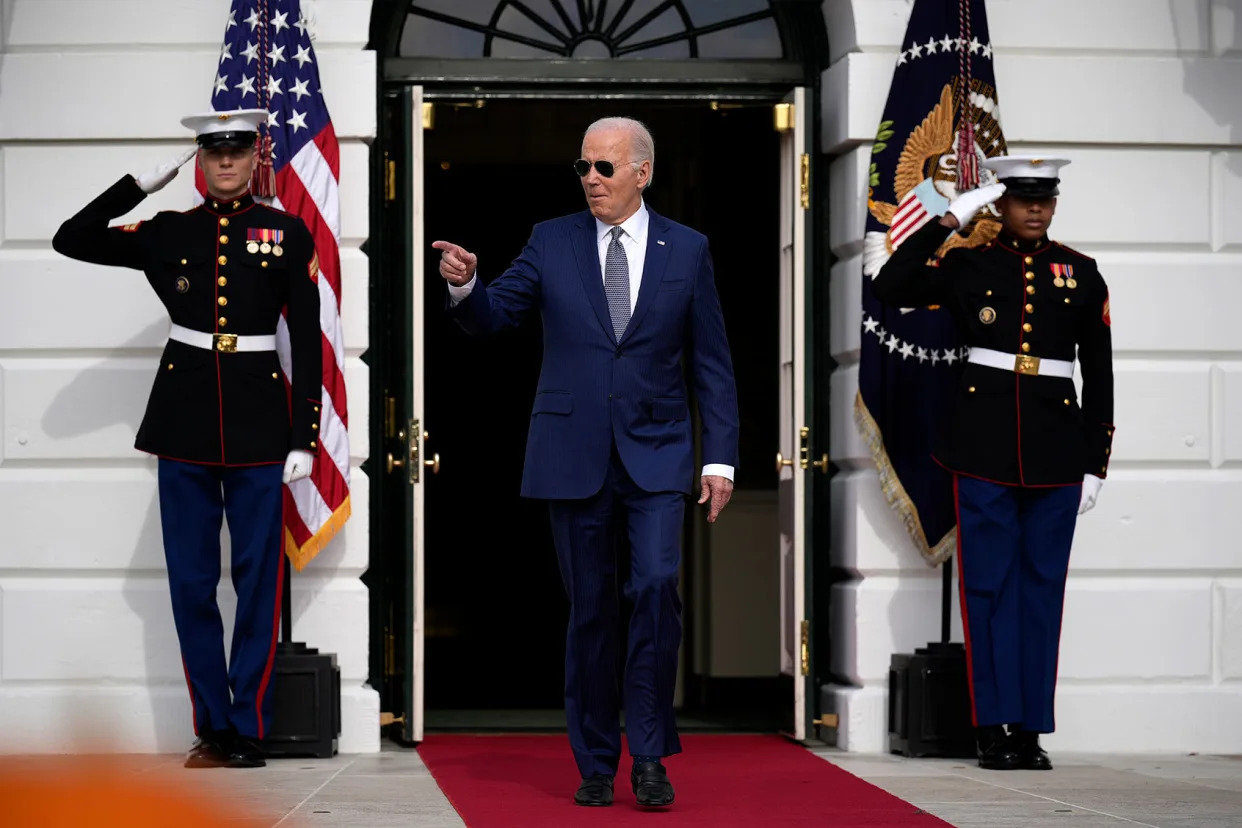
Sure, Joe Biden is pretty old: Listen, could you do what he’s doing?
Kirk Swearingen – November 27, 2023
Joe Biden Drew Angerer/Getty Images
For months, since Joe Biden’s age became the pet topic of the corporate media — you know, rather than the openly authoritarian maneuverings of the former occupant of the White House — I have said to anyone who will listen (OK, mostly to my wife, who nods agreeably) that I couldn’t do a quarter of the things that Joe Biden is doing. Honestly, not many of us could.
Not long ago on MSNBC’s “Morning Joe,” journalist Mike Barnicle defended Biden on the “age issue” in the same way. His comments came after host Joe Scarborough noted that Biden, beyond his normal duties as president, currently has multiple other full-time jobs:working to try to limit the conflict in the Middle East, supporting Ukraine’s war against Russian aggression, trying to stabilize relations with China. (His recent meeting with Xi Jinping reportedly went quite well.)
Here’s what Barnicle had to say about the media’s focus on Biden’s age:
Very few of us, very few in the media, really pay enough attention to the weight that this president carries each and every day. … Right now, he’s carrying two twin towers of tyranny: one in Donald Trump here domestically and the other Bibi Netanyahu in Israel, who is perhaps the biggest obstacle to a two-state solution that exists today. So, the president has that on his plate. … He has, every hour of every day, something that comes across his desk. None of us can comprehend the weight of the presidency, every hour of every day.
And as he would tell you if he were here today, it’s amazing how every country in the world looks to the United States for help, for solutions, for just almost anything you can think of. Every single day.
Read every newspaper in the country about President Biden, within the first two paragraphs they’ll point out he’s in his 80s. No kidding. He knows how old he is. You couldn’t do it. I couldn’t do it. Someone 45 years of age couldn’t do what he does every day. But he does it.
Scarborough pointed out that leaders and diplomats around the world admire and trust Biden and say that he fully understands the issues facing their own countries. Scarborough also commented that Biden works hard as president, while Trump notoriously spent most of his days in the White House watching cable TV until noon and often continued viewing even when he bothered to show up in the Oval Office.
Trump entered the presidency with no experience in public service and left it with next to none. He did, however, leave office with two impeachments and box after box of classified documents. One recalls that Rex Tillerson, his first secretary of state, said that getting Trump to pay attention to important issues around the world was always a challenge, partly because he was likely to listen to others and “form a view that had no basis in fact.” (We all know what Tillerson really thought of Trump.)
I understand the hand-wringing about Biden’s age. Didn’t he say he would be a one-term bridge to a better, Trumpless future? (Well, Republicans haven’t given up on their angry cult leader.) Haven’t I considered Ruth Bader Ginsburg’s decision to remain on the Supreme Court? Don’t I hear Bill Maher and David Axelrod unhelpfully quailing at the polls and saying that Biden can’t win because people think he’s too old? I have, and it makes me feel deeply anxious (so I stop thinking about it and go for a walk or do some push-ups).
Still, Biden is doing a lot more than I could do, and I suspect (as Barnicle said indignantly) that he’s doing a lot more than most of us could do, physically and emotionally, and he’s doing it with something we lack: a deep understanding of the deftness needed in maintaining personal relationships and the give-and-take critical to governing and diplomacy.
Biden has the experience we need in political leadership in general, especially with the Republican Party dead and gone and reduced to playacting “toughness” by elbowing House colleagues and challenging witnesses to fistfights in the Senate. Too many Republicans don’t take their oath of office seriously, and now even have to be reminded they are members of Congress. These seriously unserious people know their ideas are unpopular with the American public and thus have seriously unhinged plans for instituting minority rule permanently in any way they can.
Less than a year from now, Americans face a choice between remaining a democratic republic or morphing into a chaotic, vengefultheocracy, where millions of immigrants will be sent to holding camps before being deported (that’s the stated plan) and where women and people of color and LGBTQ folks and political “enemies” and journalists and authors and critics are targeted by those in power. For all their endless talk about the First Amendment, the MAGA insurrectionist party wants to turn it on its head, by instituting a national “religion” (Christian in name only) and silencing dissent.
Would it be ideal to have someone younger than 80? Sure it would. But that’s not reality this time around. And that imaginary 45-year-old wouldn’t have the extensive institutional and foreign policy experience that Joe Biden has. The Democratic Party has quite a few truly worthy (and perhaps even charismatic) future candidates for the highest office waiting in the wings, gaining more experience in governing and serving all the citizens in their districts or states, not just the ones who voted for them.
But those candidates will need a liberal democracy in place (i.e., basic rule of law, support for voting rights, willingness to compromise on policies and acceptance of the peaceful transfer of power) for us to find out what they can do to move us forward.
If you think 80 is really old — well, in some cases it is. People sometimes die much younger than that. In the two months since I retired, I’ve lost two close friends. But let’s list just a few older people who are still out there killing it: Paul McCartney is touring again and puts on vigorous three-hour concerts (without breaks). He turned 81 in June. Mick Jagger is still doing that chicken-strut thing he learned from Tina Turner, and celebrated his 80th birthday in July. At 97, Mel Brooks is sharper (and a lot funnier) than you or me. So is the amazing Norman Lear, at 101. Many notable scientists, philosophers, poets, artists and people in other demanding fields function at a high level, mentally and physically, deep into their lives.
Moreover, emotional well-being tends to increase in old age, as personal ambitions drop away and we allow ourselves the time to just be. (These findings do not apply to people who never grow up, by the way.) Biden stays active, eats a good diet, has social intelligence and awareness of others’ needs, has varied interests and solves complex problems daily — those, it seems, are the habits and characteristics of “super agers.” He is buoyed by a loving wife and family, because he’s earned that love. (The Beatles would approve.)
No matter how any of us may feel about Biden going for a second term at his age, it is beyond my comprehension that anyone could consider Trump, who is only a few years younger, as being more mentally or physically competent. According to his niece Mary Trump and others who know him well, has not been mentally fit for most of his life.
Physically, as a young man Trump claimed he was not fit enough to serve his country, and, by all accounts, his diet continues to be a disaster zone of highly processed food and well-done steaks served with ketchup, sometimes tossed against the wall (speaking once again to his mental state, which seems to be characterized by endless, irrational resentment).
Does Trump have any interest in or curiosity about anything beyond himself (except for a few of his favorite authoritarian leaders)? Has he ever solved a complex problem for the benefit of anyone but himself? He’s teased them endlessly but has never delivered — think those multiple, embarrassing “Infrastructure Weeks”; think “I will get it all done” to bring peace to the Middle East, fobbed off on his embarrassing son-in-law.
Trump has made it crystal clear over many years that he is vengeful and only out for himself. He now threatens those he wants to “root out” like “vermin,” jutting out his chin like his favorite historical Italian dictator and talking like his favorite German one. He also likes to fantasize that he’s a superhero.
I suspect that if it weren’t that guy the Republicans seemed determined to put up again, Biden would have determined it was safe to step aside. But it is that guy, who now has two impeachments, 91 felony indictments in four different jurisdictions, findings of liability for sexual assault and business fraud, and a history of telling lies every time he opens his mouth, including persistent whoppers about the 2020 election and about being good at business.
Liberals and progressives, broadly speaking, tend to be people who believe in reality, in facts. Whether we’re delighted about this or not, Joe Biden is running for president again. His leadership, whether you agree with every decision or not, can help us extend the American experiment and bolster democracy, as well as fight for more ways to share our nation’s prosperity and protect its cultural heritage.
The other choice will be a man who is chronologically almost as old and who seems to live in an entirely imaginary version of America in a previous era. He is mentally and emotionally unstable, to say the least, and has no interest and no ability to help anyone other than himself. Oh, and he intends to be a dictator and get revenge on his perceived enemies.
If we lose our democracy because voters tie themselves in knots about Joe Biden’s age. that will go down as ageism for the ages.
A Troubling Trump Pardon and a Link to the Kushners
A commutation for a drug smuggler named Jonathan Braun had broader implications than previously known. It puts new focus on how Donald Trump would use his clemency powers in a second term.
By Michael S. Schmidt, Maggie Haberman and Alan Feuer – November 27, 2023
In April 2022, Jonathan Braun, left, and his wife, Miriam, visited a Trump resort in Florida. Mr. Braun said they ran into the former president by coincidence.
Jonathan Braun of New York had served just two and a half years of a decade-long sentence for running a massive marijuana ring, when Mr. Trump, at 12:51 a.m. on his last day in office, announced he would be freed.
A Staten Islander with a history of violent threats, Mr. Braun had told a rabbi who owed him money: “I am going to make you bleed.” Mr. Braun’s family had told confidants they were willing to spend millions of dollars to get him out of prison.
At the time, Mr. Trump’s own Justice Department and federal regulators, as well as New York state authorities, were still after him for his role in an entirely separate matter: his work as a predatory lender, making what judges later found were fraudulent and usurious loans to cash-strapped small businesses.
Nearly three years later, the consequences of Mr. Braun’s commutation are becoming clearer, raising new questions about how Mr. Trump intervened in criminal justice decisions and what he could do in a second term, when he would have the power to make good on his suggestions that he would free supporters convicted of storming the Capitol and possibly even to pardon himself if convicted of the federal charges he faces.
Just months after Mr. Trump freed him, Mr. Braun returned to working as a predatory lender, according to New York State’s attorney general. Two months ago, a New York state judge barred him from working in the industry. Weeks later, a federal judge, acting on a complaint from the Federal Trade Commission, imposed a nationwide ban on him.
A New York Times investigation, drawing on documents and interviews with current and former officials, and others familiar with Mr. Braun’s case, found there were even greater ramifications stemming from the commutation than previously known and revealed new details about Mr. Braun’s history and how the commutation came about.
The commutation dealt a substantial blow to an ambitious criminal investigation being led by the Justice Department’s U.S. attorney’s office in Manhattan aimed at punishing members of the predatory lending industry who hurt small businesses. Mr. Braun and prosecutors were in negotiations over a cooperation deal in which he would be let out of prison in exchange for flipping on industry insiders and potentially even wearing a wire. But the commutation instantly destroyed the government’s leverage on Mr. Braun.The investigation into the industry, and Mr. Braun’s conduct, remains open but hampered by the lack of an insider.
At multiple levels, up to the president, the justice system appeared to fail more than once to take full account of Mr. Braun’s activities. After pleading guilty to drug charges in 2011, Mr. Braun agreed to cooperate in a continuing investigation, allowing him to stay out of prison but under supervision for nine years — a period he used to establish himself as a predatory lender, making violent threats to those who owed him money, court filings show.Since returning to predatory lending after being freed, Mr. Braun is still engaging in deceptive business tactics, regulators and customers say.
In working to secure his release, Mr. Braun’s family used a connection to Charles Kushner, the father of Jared Kushner, Mr. Trump’s son-in-law and senior White House adviser, to try to get the matter before Mr. Trump. Jared Kushner’s White House office drafted the language used in the news release to announce commutations for Mr. Braun and others.
In a telephone interview, Mr. Braun said he did not know how his commutation came about.
“I believe God made it happen for me because I’m a good person and I was treated unfairly,” he said, adding that his supporters tried “multiple paths” to get him out of prison but he had no idea which one succeeded.
He said the 10-year sentence he received for marijuana trafficking was excessive and made him a victim of the criminal justice system. He denied any wrongdoing as a lender, and insisted that he had never talked to prosecutors about cooperating in the criminal predatory lending investigation.
He said he had never met Jared Kushner. And he said a picture from April 2022, showing him and his wife on a golf course with the former president, had nothing to do with the commutation but was a chance three-minute encounter during a visit to a Trump property in Florida for a Passover event.
“I didn’t meet him because of what happened, I just happened to be there the same time,” Mr. Braun said.
Mr. Braun’s commutation highlights what former administration officials say were major problems at the Trump White House as it considered clemency applications: the lack of rigorous vetting of applications and the sidelining of the Justice Department, which has traditionally screened candidates.
Mr. Kushner took a major role in the less structured vetting process that resulted in Mr. Braun’s commutation. The Justice Department investigators from Manhattan involved in the cooperation negotiations with Mr. Braun were never consulted.
As other convicts seeking clemency did, Mr. Braun’s family retained Alan Dershowitz, the prominent lawyer and Trump ally who worked with Jewish organizations pushing for pardons, at least one of which had received financial support from the Kushner family.
Mr. Dershowitz, who represented Mr. Trump in his first impeachment, had a direct line into Mr. Kushner’s office, and succeeded in helping win clemency from Mr. Trump for a number of other people. Mr. Dershowitz said he did not remember what steps he took to help Mr. Braun but said they were minimal.
Jared Kushner declined to comment, and Charles Kushner hung up when called by a reporter, as did Jacob Braun, Mr. Braun’s father. The U.S. attorney’s office in Manhattan did not respond to messages seeking comment.
A spokesman for Mr. Trump said all pardon applications “went through a vigorous vetting and review process,” but he did not address specific questions about Mr. Braun’s commutation.
William P. Barr, a Trump attorney general who had left by the time of the Braun commutation, said when he took over the Justice Department he discovered that “there were pardons being given without any vetting by the department.”
Mr. Barr added that he told Trump aides they should at least send over names of those being considered so the department could thoroughly examine their records. While the White House Counsel’s Office tried to do so, the effort fell apart under the crush of pardon requests that poured in during the final weeks before Mr. Trump left office, according to people with direct knowledge of the process.
Mr. Trump boarding Air Force One for the last time on Jan. 20, 2021. He pardoned Mr. Braun in the final hours of his presidency. Credit…Pete Marovich for The New York Times
Marc Short, the chief of staff to Mr. Trump’s vice president, Mike Pence, said when the vice president’s office was approached by Mr. Trump’s aides about clemency applications, it opted not to participate.
“The pardon process at the end of the administration was so unseemly it would make the Clintons blush,” Mr. Short said, referring to the final-days pardons issued by President Bill Clinton — including one to the fugitive financier Marc Rich, whose ex-wife donated $450,000 to Mr. Clinton’s presidential library.
Threats and a 10-Year Sentence
Mr. Braun’s path to receiving a last-minute commutation began in 2009, when the U.S. attorney’s office in Brooklyn, working with the Drug Enforcement Administration, raided what prosecutors said was a stash house for a marijuana smuggling ring run by Mr. Braun.
When Mr. Braun found out about the raid, he rented a car and drove 25 hours straight from Florida to an Indian reservation in upstate New York where, dressed in all black, he was smuggled into Canada, according to court filings. He then fled to Israel.
The Justice Department placed him on a special Interpol list that asked Israel to apprehend him. By 2010, he was back in New York, the Justice Department had charged him and he was behind bars.
In the days after his arrest, prosecutors asked a federal judge to keep him in jail until he went on trial. The prosecutors said Mr. Braun could not be deterred and was violent or willing to use the specter of violence against those who owed him money or might turn on him. Mr. Braun, the prosecutors said, had access to millions of dollars in untraceable cash, and was willing to do anything to stay out of prison.
The judge ordered that Mr. Braun be held pending trial. After nearly a year and a half in custody, Mr. Braun agreed to plead guilty. As part of the plea deal, he began cooperating secretly with the government’s investigations into other drug smugglers, particularly higher profile ones abroad, according to a former law enforcement official, who spoke on the condition of anonymity to discuss the internal workings of an investigation.
In exchange, the prosecutors agreed to release Mr. Braun from jail, putting him on house arrest and delaying his sentencing on the drug charges while they pursued new cases with his help. It is unclear what information Mr. Braun provided the authorities or whether it led to convictions.
Often, a cooperator can remain free for a few months by providing investigators with useful information. Sometimes, a court will hold off sentencing for a year or two as the cooperation continues. Throughout the process, federal authorities are supposed to monitor cooperators to ensure they do not break the law.
For reasons that remain unexplained, Mr. Braun was permitted by the U.S. attorney’s office in Brooklyn to live relatively freely for nearly the next decade, and he was able to turn his focus to an enterprise rife with cash and threats: providing loans to struggling small businesses that often had nowhere else to turn.
Former prosecutors and defense lawyers said they had never heard of a defendant being allowed to delay sentencing for such a long period or using his freedom to engage in the conduct he did. A spokesman for the Brooklyn federal prosecutor’s office declined to comment on Mr. Braun’s case.
The business Mr. Braun entered is known by many names: the merchant cash advance industry, predatory lending or, in the view of some law enforcement officials, loan sharking.
Small businesses — like restaurants and contractors — have long faced a problem: They need cash on a daily basis to buy ingredients and supplies, and pay employees so they can operate while awaiting customer payments.
How Times reporters cover politics. Times journalists may vote, but they are not allowed to endorse or campaign for candidates or political causes. That includes participating in rallies and donating money to a candidate or cause.
Banks often won’t lend to them, especially small firms with troubled credit histories, providing an opening for the merchant cash advance business to offer them financing on strict, sometimes usurious, terms that include high-interest rates and exorbitant fees. (Technically, they provide cash in exchange for a percentage of future revenues, an arrangement that typically gives them access to the borrower’s books and sometimes the borrower’s bank accounts.)
An examination of court records by The Times found that between when the U.S. attorney’s office in Brooklyn first let him out of prison in 2011 and when he reported to prison in 2020, Mr. Braun was accused of violently threatening eight people who owed him money. Another man accused Mr. Braun in a lawsuit of shoving him from the deck of a house in Staten Island in 2018.
Mr. Braun eventually reported to the federal prison in Otisville, N.Y., in 2020.Credit…Mike Segar/Reuters
Among those threatened was a real estate developer, who said Mr. Braun told him: “I will take your daughters from you,” according to court documents.
Another borrower said in an affidavit Mr. Braun told him, “Be thankful you’re not in New York, because your family would find you floating in the Hudson.”
Over that time, companies connected to Mr. Braun made 1,900 fraudulent and illegal loans, some with interest rates greater than 1,000 percent, according to the New York State attorney general.
Even as Mr. Braun was starting to become a threatening presence, the U.S. attorney’s office in Brooklyn actually gave him more freedom. In May 2017, prosecutors and probation officers approved Mr. Braun being removed from house arrest.
Five months later, Mr. Braun threatened the rabbi of a synagogue that had borrowed money from him, according to New York’s attorney general. Mr. Braun told the rabbi he would beat and “publicly embarrass him,” adding: “I am going to make you bleed” and “I will make you suffer for every penny.”
Nearly a decade after he was first charged in the drug case, prosecutors scheduled his sentencing. Anonymous letters accusing him of violent threats were then filed on the docket of the judge overseeing his case.
Despite his cooperation with the ongoing drug investigations, the judge sentenced him to 10 years in prison. Mr. Braun tried to appeal, but weeks before the pandemic hit in early 2020, he reported to the federal penitentiary in Otisville, N.Y.
In prison, Mr. Braun’s legal troubles actually worsened. In June 2020, New York’s attorney general and the Federal Trade Commission, which was run by a Trump appointee at the time, sued him for his role as a predatory lender. The New York attorney general credited reporting by Bloomberg News — which in 2018 first documented Mr. Braun’s business practices and revealed last year that he had returned to predatory lending — as the impetus for the suit.
At the same time, a dogged New York Police Department detective named Joseph Nicolosi, who was assigned to work as an investigator for the U.S. attorney’s office in Manhattan, was trying to build a wide-ranging criminal case focused on predatory lenders.
The inquiry faced a big challenge. Unlike many financial fraud cases, where the government relies on documents to prove charges, federal prosecutors concluded they needed something more in this case: a turncoat to flip on higher-ups, explain the intricacies of lending agreements, say they knew what they were doing was wrong and serve as a narrator on the witness stand.
Finding that witness was proving difficult, but investigators believed they had a strong candidate sitting behind bars.
So in the fall of 2020, Mr. Nicolosi drove to Otisville to meet with Mr. Braun. Mr. Nicolosi had previously tried to flip Mr. Braun when he was free, but now Mr. Nicolosi — armed with a possible get-out-of-jail card in exchange for cooperation — had leverage over him as he sat marinating in the misery of federal prison.
At the meeting, which Mr. Braun’s lawyer attended, both sides discussed what a deal could look like.
Mr. Braun made clear he would do anything the government asked of him — including wearing a wire to record calls with his former business partners — if the government would agree not to prosecute him for his role in the lending business, according to a person familiar with the matter.
Ties to the Kushners
Negotiations between Mr. Braun and prosecutors stretched into the final days of Mr. Trump’s presidency. But what the prosecutors did not know was that Mr. Braun, his family and allies were pursuing an entirely different effort to help him regain his freedom through the White House’s clemency process. And among the channels they were exploiting was a tie to the Kushner family.
Mr. Braun had ties to the family of Jared Kushner, Mr. Trump’s son-in-law and a former White House senior adviser. Credit…Doug Mills/The New York Times
Mr. Braun, The Times found, was in the inaugural class of the Kushner Yeshiva High School in Livingston, N.J., which was heavily funded by Jared Kushner’s family. Mr. Braun enrolled in its first freshman class, alongside Jared Kushner’s youngest sister, Nicole.
In an interview, a merchant cash advance dealer recounted how a cousin of Mr. Braun — whom Mr. Braun put in charge of his business when he went to prison and who took on a major role in trying to get him out — had told him in the wake of the commutation that Mr. Braun’s father, Jacob Braun, had sought help from Jared Kushner’s father, Charles Kushner, about getting their pleas for a commutation before Mr. Trump.
The cousin, Isaac Wolf, was said to have recounted that Charles Kushner and Jacob Braun had known each other for many years. Mr. Wolf credited the Kushner family with coming through for Mr. Braun, the merchant cash advance dealer said, speaking on the condition of anonymity because he did not want to be publicly associated with Mr. Braun.
Others who dealt with Mr. Braun also later relayed to investigators that they had been told that the Braun family helped secure the commutation by relying on their connections to the Kushner family.
The Brauns also retained Mr. Dershowitz, a Trump ally who developed such a strong relationship with Jared Kushner that he nominated Mr. Kushner for the Nobel Peace Prize for his work on Middle East peace 10 days after Mr. Trump left office.
Mr. Dershowitz said Jacob Braun would call him regularly.
“Every single Friday by 3 o’clock in the afternoon: ‘Hi this is Jacob Braun, I’m so upset my son is still in prison, what can you do? It’s unfair, he’s a good boy,’” Mr. Dershowitz recounted.
Mr. Dershowitz said he handled so many clemency requests that he could not recall what he did for Mr. Braun, whom he might have talked to at the White House about his case or how much he was paid. But he said his involvement was minimal, perhaps just a phone call.
In the chaotic final weeks of the Trump presidency, the volume of clemency requests overwhelmed the White House Counsel’s Office. Requests were being fielded by numerous White House officials — and many came in through Mr. Kushner’s office.
It is unclear what type of due diligence, if any, the White House did on Mr. Braun. The New York attorney general and the F.T.C. had put out news releases about their civil actions against him in June 2020, and the suits they filed were a matter of public record. An inquiry to the Justice Department could have revealed the plea deal discussions.
Jacob Braun, Mr. Braun’s father, made contact with and retained Alan Dershowitz, seen in a 2015 photo, the prominent lawyer and Trump ally who was active in seeking clemency for convicts. Credit…Todd Heisler/The New York Times
Just hours before Mr. Trump left office on Jan. 20, 2021, the White House sent out the news release, written by Mr. Kushner’s office, announcing Mr. Braun’s commutation, along with similar summaries for the 143 convicts who received pardons and commutations in the final batch, according to a person familiar with the matter. Mr. Kushner thought it was important to honor each person granted clemency with a personalized write-up, the person said.
The release misspelled Mr. Braun’s first name. And it overstated the time he had served in prison.
“Upon his release, Mr. Braun will seek employment to support his wife and children,” the release said.
The federal investigators in Manhattan learned of the commutation early that morning, immediately calling Mr. Braun’s lawyer to express their fury over how the president had undercut his own department’s investigation by removing all the leverage prosecutors had over Mr. Braun.
In the weeks that followed, investigators made another attempt to reach a cooperation deal with Mr. Braun, meeting with him in person. But no longer needing help getting out of prison, Mr. Braun essentially called their bluff, signaling that if they thought they had a case against him they should indict him. Since then, the prosecutors have brought no charges against Mr. Braun or anyone else with ties to him in the industry.
Back in Business
Just a few months after his release, Mr. Braun returned to working in the merchant cash advance business.
Amid the ongoing suits against him by state and federal regulators, he remained in a relatively behind-the-scenes role. While he would make major decisions, he would use an email account that did not include his name, his name was left off business documents and his interactions with customers were limited, according to court documents and a former merchant cash advance dealer.
But in the experience of at least one borrower who dealt with him, his business practices remained unchanged.
Dr. Robert Clinton is a North Carolina physician who during the pandemic turned his urgent care facility into a Covid testing center. He turned to merchant cash advance dealers because it took months for insurance companies and the federal government to reimburse him.
Mr. Braun’s companies made arrangements with Dr. Robert Clinton for loans and eventually pushed him to the brink of financial ruin. Credit…Kate Medley for The New York Times
Relying on similar tactics to what he was accused of employing before he went to prison, the companies affiliated with Mr. Braun withheld some of the financing they had agreed to provide Dr. Clinton but charged him interest on the full amount, imposed heavy fees with little or no warning and unilaterally withdrew money from Dr. Clinton’s bank accounts, according to court documents.
At one point, another merchant cash advance dealer who had lent money to Dr. Clinton called him in a panic to warn about Mr. Braun.
“You gotta get away from him and pay him off — we are all afraid of him — anytime Jon Braun is involved he could seize your assets, block your bank accounts,” the other merchant cash advance dealer told Dr. Clinton, in the doctor’s recounting of the conversation.
As Dr. Clinton’s finances deteriorated, he got a call from a man who claimed his name was Mike Wilson and that he was working for one of the Braun-affiliated lenders. The man told Dr. Clinton that he would send a private jet down to pick him up so he could bring expensive watches he had to New York to use as collateral for the money he owed, Dr. Clinton said.
In an apparent slip-up during conversations with Dr. Clinton at the time, the man said: Refer to me as Jon.
Dr. Clinton rejected the idea and, with help from a lawyer, Shane Heskin, sued the Braun-affiliated companies, saying they had fleeced him for over a million dollars.
A major portion of the suit was dismissed because North Carolina usury laws provided no protection for Dr. Clinton. Now, Dr. Clinton — who still owes other merchant cash advance dealers several million dollars — spends his days doing some telemedicine and the rest of his time trying to get money back from insurance companies and the federal government.
In a filing this summer, the New York attorney general said Mr. Braun, through his companies, “continues to commit usury.”
Mr. Braun continues to portray himself as a victim of an unfair criminal justice system.
“What is so bad about me?” he said in the interview with The Times. “I never hurt anybody, never did anything wrong to anybody.”
Mr. Braun and his companies put liens on Dr. Clinton’s business, leading to cascading financial problems that Dr. Clinton said cost him $1.6 million.Credit…Kate Medley for The New York Times
Matthew Cullen, Kirsten Noyes, Kitty Bennett, Alain Delaquérière and Sheelagh McNeill contributed research.
Michael S. Schmidt is an investigative reporter for The Times covering Washington. His work focuses on tracking and explaining high-profile federal investigations. More about Michael S. Schmidt
Maggie Haberman is a senior political correspondent and the author of “Confidence Man: The Making of Donald Trump and the Breaking of America.” She was part of a team that won a Pulitzer Prize in 2018 for reporting on President Trump’s advisers and their connections to Russia. More about Maggie Haberman
Jonathan Swan is a political reporter who focuses on campaigns and Congress. As a reporter for Axios, he won an Emmy Award for his 2020 interview of then-President Donald J. Trump, and the White House Correspondents’ Association’s Aldo Beckman Award for “overall excellence in White House coverage” in 2022. More about Jonathan Swan
Alan Feuer covers extremism and political violence for The Times, focusing on the criminal cases involving the Jan. 6 attack on the Capitol and against former President Donald J. Trump. More about Alan Feuer
Trump’s pardoning of a Kushner-linked drug smuggler undercut a larger DOJ investigation
Lloyd Lee – November 27, 2023
Former President Donald Trump.AP Photo/Phelan M. Ebenhack
Donald Trump pardoned Jonathan Braun, a convicted drug smuggler, on his last day in office.
Meanwhile, the DOJ hoped to use Braun in a separate probe into the predatory-lending business.
Braun’s commutation meant the DOJ lost the leverage it needed to get him to cooperate, the NYT reported.
Donald Trump’s pardoning of a convicted marijuana smuggler with ties to the Kushner family threw a wrench in the Justice Department’s larger probe into the predatory-lending industry, The New York Times reported.
On his last day in office, Trump pardoned Jonathan Braun, a Staten Island resident who at the time was serving a 10-year prison sentence for money laundering and running an international marijuana smuggling ring.
Braun’s pardon came while Trump’s Justice Department was working out its own deal with Braun to fast-track his sentence in exchange for his cooperation with a separate DOJ probe into the predatory-lending or merchant-cash-advance industry.
In the merchant-cash-advance business, lenders offer cash-strapped borrowers, such as small businesses, financing with high interest rates and fees. These terms can often leave borrowers in a vicious cycle of debt.
Braun was convicted of drug smuggling in 2011, but a law-enforcement official told the Times under the condition of anonymity that Braun was released from jail after a year and a half in custody as part of a plea deal to cooperate with investigations into other high-profile drug smugglers.
Although he was placed under house arrest, Braun was largely able to live as a free man for reasons still unknown, the Times reported. He spent nearly the next decade leading a predatory-lending operation as a “principal” of Richmond Capital group, prosecutors said in court documents seen by Business Insider.
Prosecutors accused Braun of harassing and sending threats to his clients. Braun, for example, told one merchant not to “fuck with him” and threatened, “I know where you live. I know where mother lives,” prosecutors said.
In eight years, Braun advanced about $80 million, targeting desperate small-business owners and setting interest rates often higher than 1,000% yearly, Bloomberg reported.
In a telephone interview with the Times, Braun denied any wrongdoing as a lender.
Years after his 2011 drug-smuggling conviction, Braun was sentenced to 10 years in a New York prison despite cooperating with investigators. He began his sentence in 2020, according to the NY attorney general.
But Braun’s hand in the lending industry made him a valuable asset to the Justice Department since the US attorney’s office in Manhattan was investigating the wider predatory-lending business, the Times reported.
With Braun’s experience, the DOJ hoped to cut out a deal with the convicted smuggler by commuting his sentence in exchange for providing information on other predatory lenders and possibly wearing a wire, the Times reported.
Key to gaining his clemency, The Times reported, was Braun’s connection to the family of Jared Kushner, Ivanka Trump‘s husband and a senior White House advisor during the Trump Administration.
Braun was a member of the inaugural class of the Kushner Yeshiva High School in Livingston, New Jersey, which the Kushner family funded, the report said.
As a member of the first freshman class, Braun was classmates with Jared Kushner’s youngest sister, Nicole, the Times reported.
One merchant-cash-advance dealer told the Times that Braun’s cousin, Isaac Wolf, told him Braun’s father sought help from Kushner’s father, Charles, to secure a pardon.
On his last day in office, Trump pardoned Braun, releasing a statement that misspelled Braun’s first name, despite calling for drug dealers to receive the death penalty a year later at a Pennsylvania rally.
“Every pardon application went through a vigorous vetting and review process overseen by the Office of the Pardon Attorney and various White House departments, including the counsel’s office,” a Trump spokesperson said in an email to Insider. “President Trump acted upon their recommendations that were based off each individuals’ circumstances.”
The Braun family also retained Alan Dershowitz, a member of Trump’s legal counsel, during the impeachment proceedings in 2020.
Dershowitz told the Times that Braun’s father regularly called him, saying he was “so upset my son is still in prison” and asked what the attorney could do to help.
The lawyer told the publication he could not recall what he did for Braun but that his involvement could have just been a phone call.
“I believe God made it happen for me because I’m a good person, and I was treated unfairly,” Braun told the Times, adding that his supporters sought several avenues to get him out of prison.
A spokesperson for the US Attorney’s Office in Manhattan could not be reached for comment during the weekend.
Trump hints at expanded role for the military within the US. A legacy law gives him few guardrails
Gary Fields – November 27, 2023
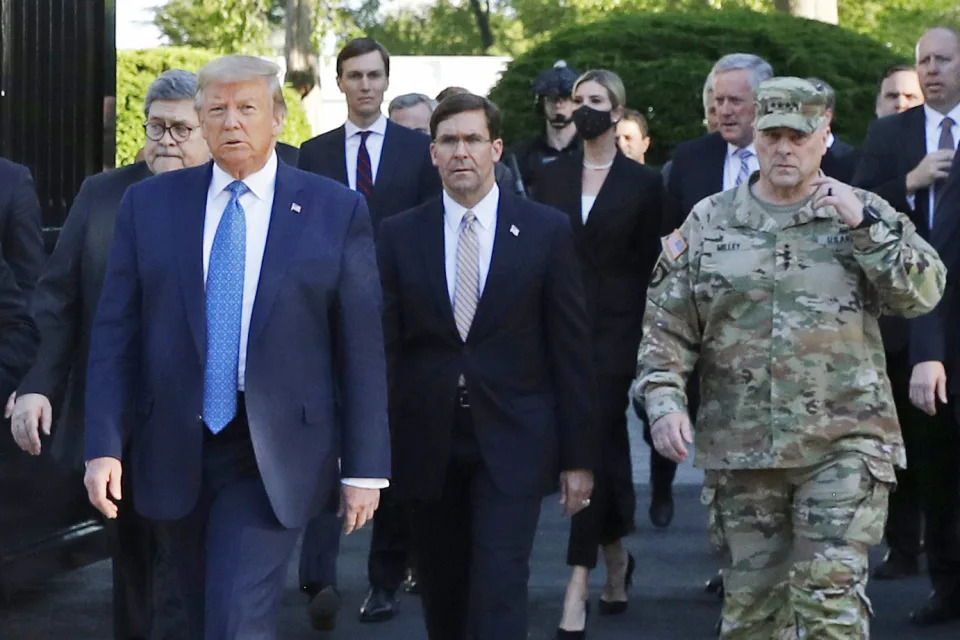
Surrounded by Army cadets, President Donald Trump watches the first half of the 121st Army-Navy Football Game in Michie Stadium at the United States Military Academy, Saturday, Dec. 12, 2020, in West Point, N.Y. Experts in constitutional law and the military say the Insurrection Act gives presidents tremendous power with few restraints. Recent statements by former President Donald Trump raise questions about how he might use it if he wins another term. (AP Photo/Andrew Harnik, File) In this Sept. 26, 1957, file photo, members of the 101st Airborne Division take up positions outside Central High School in Little Rock, Ark. The troops were on duty to enforce integration at the school. During the Civil Rights era, Presidents Johnson, John F. Kennedy and Dwight Eisenhower used the law to protect activists and students desegregating schools. Eisenhower sent the 101st Airborne to Little Rock, Arkansas, to protect Black students integrating Central High School after that state’s governor activated the National Guard to keep the students out. (AP Photo/File)President George H.W. Bush addresses the nation on May 1, 1992, from the Oval Office in Washington. George H.W. Bush was the last president to use the Insurrection Act, a response to riots in Los Angeles in 1992 after the acquittal of the white police officers who beat Black motorist Rodney King in an incident that was videotaped. (AP Photo/Dennis Cook, File)A fire burns out of control at the corner of 67th Street and West Boulevard in South Central Los Angeles, on April 30, 1992. On April 29, 1992, four white police officers were declared innocent in the beating of black motorist Rodney King, and Los Angeles erupted in deadly riots. George H.W. Bush was the last president to use the Insurrection Act, a response to riots in Los Angeles in 1992 after the acquittal of the white police officers who beat Black motorist Rodney King in an incident that was videotaped. (AP Photo/Paul Sakuma, File)In this June 1, 2020 file photo, President Donald Trump departs the White House to visit outside St. John’s Church, in Washington. Walking behind Trump from left are, Attorney General William Barr, Secretary of Defense Mark Esper and Gen. Mark Milley, chairman of the Joint Chiefs of Staff. Experts in constitutional law and the military say the Insurrection Act gives presidents tremendous power with few restraints. Recent statements by former President Donald Trump raise questions about how he might use it if he wins another term. (AP Photo/Patrick Semansky, File)
WASHINGTON (AP) — Campaigning in Iowa this year, Donald Trump said he was prevented during his presidency from using the military to quell violence in primarily Democratic cities and states.
Calling New York City and Chicago “crime dens,” the front-runner for the 2024 Republican presidential nomination told his audience, “The next time, I’m not waiting. One of the things I did was let them run it and we’re going to show how bad a job they do,” he said. “Well, we did that. We don’t have to wait any longer.”
Trump has not spelled out precisely how he might use the military during a second term, although he and his advisers have suggested they would have wide latitude to call up units. While deploying the military regularly within the country’s borders would be a departure from tradition, the former president already has signaled an aggressive agenda if he wins, from mass deportations to travel bans imposed on certain Muslim-majority countries.
A law first crafted in the nation’s infancy would give Trump as commander in chief almost unfettered power to do so, military and legal experts said in a series of interviews.
The Insurrection Act allows presidents to call on reserve or active-duty military units to respond to unrest in the states, an authority that is not reviewable by the courts. One of its few guardrails merely requires the president to request that the participants disperse.
“The principal constraint on the president’s use of the Insurrection Act is basically political, that presidents don’t want to be the guy who sent tanks rolling down Main Street,” said Joseph Nunn, a national security expert with the Brennan Center for Justice. “There’s not much really in the law to stay the president’s hand.”
A spokesman for Trump’s campaign did not respond to multiple requests for comment about what authority Trump might use to pursue his plans.
Congress passed the act in 1792, just four years after the Constitution was ratified. Nunn said it’s an amalgamation of different statutes enacted between then and the 1870s, a time when there was little in the way of local law enforcement.
“It is a law that in many ways was created for a country that doesn’t exist anymore,” he said.
It also is one of the most substantial exceptions to the Posse Comitatus Act, which generally prohibits using the military for law enforcement purposes.
Trump has spoken openly about his plans should he win the presidency, including using the military at the border and in cities struggling with violent crime. His plans also have included using the military against foreign drug cartels, a view echoed by other Republican primary candidates such as Florida Gov. Ron DeSantis and Nikki Haley, the former U.N. ambassador and South Carolina governor.
The threats have raised questions about the meaning of military oaths, presidential power and who Trump could appoint to support his approach.
Trump already has suggested he might bring back retired Army Lt. Gen. Michael Flynn, who served briefly as Trump’s national security adviser and twice pleaded guilty to lying to the FBI during its Russian influence probe before being pardoned by Trump. Flynn suggested in the aftermath of the 2020 election that Trump could seize voting machines and order the military in some states to help rerun the election.
Attempts to invoke the Insurrection Act and use the military for domestic policing would likely elicit pushback from the Pentagon, where the new chairman of the Joint Chiefs of Staff is Gen. Charles Q. Brown. He was one of the eight members of the Joint Chiefs who signed a memo to military personnel in the aftermath of the Jan. 6, 2021, attack on the U.S. Capitol. The memo emphasized the oaths they took and called the events of that day, which were intended to stop certification of Democrat Joe Biden’s victory over Trump, “sedition and insurrection.”
Trump and his party nevertheless retain wide support among those who have served in the military. AP VoteCast, an in-depth survey of more than 94,000 voters nationwide, showed that 59% of U.S. military veterans voted for Trump in the 2020 presidential election. In the 2022 midterms, 57% of military veterans supported Republican candidates.
Presidents have issued a total of 40 proclamations invoking the law, some of those done multiple times for the same crisis, Nunn said. Lyndon Johnson invoked it three times — in Baltimore, Chicago and Washington — in response to the unrest in cities after the assassination of Dr. Martin Luther King Jr. in 1968.
During the Civil Rights era, Presidents Johnson, John F. Kennedy and Dwight Eisenhower used the law to protect activists and students desegregating schools. Eisenhower sent the 101st Airborne to Little Rock, Arkansas, to protect Black students integrating Central High School after that state’s governor activated the National Guard to keep the students out.
George H.W. Bush was the last president to use the Insurrection Act, a response to riots in Los Angeles in 1992 after the acquittal of the white police officers who beat Black motorist Rodney King in an incident that was videotaped.
Repeated attempts to invoke the act in a new Trump presidency could put pressure on military leaders, who could face consequences for their actions even if done at the direction of the president.
Michael O’Hanlon, director of research in foreign policy at the Brookings Institution think tank, said the question is whether the military is being imaginative enough with the scenarios it has been presenting to future officers. Ambiguity, especially when force is involved, is not something military personnel are comfortable with, he said.
“There are a lot of institutional checks and balances in our country that are pretty well-developed legally, and it’ll make it hard for a president to just do something randomly out of the blue,” said O’Hanlon, who specializes in U.S. defense strategy and the use of military force. “But Trump is good at developing a semi-logical train of thought that might lead to a place where there’s enough mayhem, there’s enough violence and legal murkiness” to call in the military.
Democratic Rep. Pat Ryan of New York, the first graduate of the U.S. Military Academy to represent the congressional district that includes West Point, said he took the oath three times while he was at the school and additional times during his military career. He said there was extensive classroom focus on an officer’s responsibilities to the Constitution and the people under his or her command.
“They really hammer into us the seriousness of the oath and who it was to, and who it wasn’t to,” he said.
Ryan said he thought it was universally understood, but Jan. 6 “was deeply disturbing and a wakeup call for me.” Several veterans and active-duty military personnel were charged with crimes in connection with the assault.
While those connections were troubling, he said he thinks those who harbor similar sentiments make up a very small percentage of the military.
William Banks, a Syracuse University law professor and expert in national security law, said a military officer is not forced to follow “unlawful orders.” That could create a difficult situation for leaders whose units are called on for domestic policing, since they can face charges for taking unlawful actions.
“But there is a big thumb on the scale in favor of the president’s interpretation of whether the order is lawful,” Banks said. “You’d have a really big row to hoe and you would have a big fuss inside the military if you chose not to follow a presidential order.”
Nunn, who has suggested steps to restrict the invocation of the law, said military personnel cannot be ordered to break the law.
“Members of the military are legally obliged to disobey an unlawful order. At the same time, that is a lot to ask of the military because they are also obliged to obey orders,” he said. “And the punishment for disobeying an order that turns out to be lawful is your career is over, and you may well be going to jail for a very long time. The stakes for them are extraordinarily high.”
Associated Press writers Jill Colvin and Michelle L. Price in New York, and Linley Sanders in Washington contributed to this report.
Trump’s Pardoning of a Loan Shark Derailed a Federal Investigation: Report
Peter Wade – November 26, 2023
Very early in the morning on Donald Trump’s last day in office, the president announced he was pardoning Jonathan Braun, a loan shark who had been convicted of running a vast marijuana ring. Braun, who at the time was serving a 10-year sentence, was pardoned along with 142 others, including rappers Lil Wayne and Kodak Black.
Trump’s move undermined a years-long federal investigation, The New York Times reported Sunday. The paper also uncovered ties between Braun and the family of Trump’s son-in-law, Jared Kushner.
Federal prosecutors were in the midst of negotiations hoping to secure Braun’s cooperation in a Justice Department investigation into predatory lenders in the merchant cash advance industry when Trump announced his clemency. Investigators felt that an industry insider like Braun could reveal information about predatory lending agreements, but after he was released from incarceration, prosecutors no longer had leverage they could use to compel Braun to talk.
Between 2011 and 2020, while awaiting sentencing in the marijuana case, Braun offered predatory loans to small businesses. Borrowers who took out loans from Braun say in court documents that he threatened them and their families for non-payment. During the nine years he was waiting to be sentenced, Braun was accused of making violent threats to eight people who had borrowed money from him, and a lawsuit claimed Braun had pushed a man off a deck at a Staten Island home in 2018.
A real estate developer who borrowed from Braun said in a court document that Braun threatened him, saying, “I will take your daughters from you.”
According to an affidavit, Braun allegedly told another borrower, “Be thankful you’re not in New York, because your family would find you floating in the Hudson.”
Only months following his release from prison, Braun was banned from making or collecting business loans by the state of New York. In a statement following the ban, New York Attorney General Letitia James claimed that Braun and others had been “harming small businesses through high-interest loans and undisclosed fees.” In a lawsuit, James alleged that “merchant cash advances, which are a form of short-term, high-interest funding for small businesses” offered by Braun and others “were in fact illegal, high-interest loans with astronomical and illegal rates.”
The court ordered Braun’s company — Richmond Capital Group, LLC — as well as two other companies — Ram Capital Funding, LLC, and Viceroy Capital Funding Inc. — to cancel debt owed by thousands of small businesses across the country as well as repay interest and overage charges, amounting to tens of millions of dollars.
The Times also raised questions about Braun’s connections to the Kushners. An investigation by the paper found that Braun was a member of the inaugural class of the Kushner Yeshiva High School in Livingston, N.J., which received a large amount of funding from the Kushner family.
A merchant cash advance dealer who wished to remain anonymous told The Times that a cousin who was running Braun’s business while he was in jail told him that Braun’s father, Jacob Braun, had reached out to Kushner’s father, Charles Kushner, regarding the family’s hopes that Trump would pardon Braun. The cousin, Isaac Wolf, later claimed that the Kushners had helped secure Braun’s release, the merchant cash advance dealer said.
Jacob Braun also regularly called Trump ally Alan Dershowitz to plead for Braun’s release. “Every single Friday by 3 o’clock in the afternoon: ‘Hi this is Jacob Braun, I’m so upset my son is still in prison, what can you do? It’s unfair, he’s a good boy,’” Dershowitz told the paper.
Federal investigators were not made aware of the pardon until the morning it was announced and, according to The Times, they were furious that Trump had sabotaged a possible deal with Braun over predatory lending practices.
Braun, however, maintains his innocence and claims he is a victim of the justice system’s unfair practices. “What is so bad about me?” he told the paper. “I never hurt anybody, never did anything wrong to anybody.”
Russian authorities are restricting abortion access amid population and military recruiting concerns
Katie Balevic – November 25, 2023
Russian President Vladimir Putin speaks to Russian Orthodox Church Patriarch Kirill at Red Square in Moscow in November 2023.Gavriil Grigorov/AP
Top Russian authorities are restricting abortion access to combat population stagnation.
The head of the Russian Church said it would boost the population like “waving a magic wand.”
Russian women’s groups say the policies are forcing women to birth unwanted children, per the BBC.
Top Russian authorities are restricting abortion access, calling the procedure a “disaster.”
It comes amid the state’s concerns over population growth, particularly where it impacts military recruiting, according to the BBC. Some one in three women claim to have gotten the procedure, and more than 500,000 pregnancies were terminated in 2022, the outlet reported.
Patriarch Kirill, the head of the highly influential Russian Orthodox Church, is leading the charge.
“As a member of the clergy, I testify that an abortion is a disaster and a tragedy for the woman [and] those close to her,” Kirill said in January, per the BBC.
The church has close ties to the Kremlin, and Kirill has been a key supporter of President Vladimir Putin.
While Russia’s population leans male for births up to 14 years old, females outpace males ages 15 and up. Over 65% of the population is aged 15 to 64, and there are 3 million more women than men in that age bracket, according to the 2023 data from the Central Intelligence Agency.
The total population of 144 million stands at 2 million less than it did in 2001 when Putin came to power, the BBC reported. In 2022, over 500,000 Russian pregnancies were terminated compared to 1.3 million live births, the outlet reported.
Putin sees it as “an acute problem,” per the BBC. Kirill says anti-abortion policies are the solution.
“The population can be increased as if by waving a magic wand: if we solve this problem and learn how to dissuade women from having abortions, statistics will go up immediately,” Kirill said, per the BBC.
The patriarch’s policies of dissuasion include doctors telling pregnant teenagers to keep their child “because they are practically from the same generation,” the BBC reported. If a woman is single, doctors are to tell the pregnant patient that “having a child is no obstacle to finding a life partner.”
Authorities are also restricting the sale of medication used in medical abortions – over the protests of women’s groups who say such moves will cause the number of illegal and botched abortions to surge.
“Officials, ultra-right politicians and the church are actively forcing women and girls to give birth to unwanted children,” the Urals Feminist Movement group said, according to the BBC.
George Santos says he’ll treat expulsion as a ‘badge of honor’ as he claims his colleagues are drunkenly having sex with lobbyists ‘every night’
Bryan Metzger – November 25, 2023
Rep. George Santos of New York on Capitol Hill. Justin Sullivan/Getty Images
Rep. George Santos went on an extended tirade against his colleagues on Friday evening.
Santos says he expects to be expelled this week and will wear it “like a badge of honor.”
He also called the Ethics Committee chairman a “pussy” and made wild claims about his colleagues.
Days before his likely expulsion from the House of Representatives, Rep. George Santos of New York went on his most unhinged tirade yet.
In an X Space hosted by conservative media personality Monica Matthews on Friday evening, the scandal-plagued Republican said he expects to be expelled when the House votes on the matter, which is likely to happen this coming week.
But he said he’s not sweating it.
“I don’t care. You want to expel me? I’ll wear it like a badge of honor,” Santos said. “I’ll be the sixth expelled member of Congress in the history of Congress. And guess what? I’ll be the only one expelled without a conviction.”
That was just one part of Santos’s lengthy and angry diatribe against his colleagues, during which the indicted congressman made a series of statements and claims that are unlikely to endear him to any colleagues who may still remain on the fence about expelling him.
At one point, he mocked the Republican chairman of the House Ethics Committee — Rep. Michael Guest of Mississippi — in the wake of that committee’s damning report about his conduct.
“It ain’t gonna be the dude from Mississippi that’s gonna kick me, a New Yorker, out of Congress,” Santos said. “No offense to people from Mississippi, but making that very, very clear, it’s going to take a lot more than that.”
He also said Guest needs to “stop being a pussy” and call up the expulsion resolution when Congress returns this week.
Spokespeople for Rep. Guest did not immediately respond to Business Insider’s request for comment sent outside of regular business hours.
And in a moment reminiscent of former Republican Rep. Madison Cawthorn — whose wild claims of cocaine-laden orgies among his colleagues spurred GOP leaders to plot his ouster last year — Santos claimed his colleagues were “hypocrites” who were regularly cheating on their spouses and barely doing their job.
“I have colleagues who are more worried about getting drunk every night with the next lobbyist that they’re gonna screw and pretend like none of us know what’s going on, and sell off the American people, not show up to vote because they’re too hungover or whatever the reason is, or not show up to vote at all and just give their card out like fucking candy for someone else to vote for them,” Santos claimed.
“This shit happens every single week,” he said. “Where are the ethics investigations?”
Santos is no longer seeking re-election and is set to go to trial next September following a federal indictment on charges that include money laundering, identity theft, and wire fraud.
According to the House Ethics Committee’s report on Santos’s conduct, the congressman was largely uncooperative during the investigation.
The report also found that Santos swindled campaign donors, using their money for luxury purchases at Hermes, Ferragamo, Sephora, OnlyFans, and Botox.
‘The poison continues to spread’: legal losses fail to quell election denial hotbed
Rachel Leingang – November 25, 2023
Photograph: Alberto Mariani/AP
In the year since two elected officials in rural Arizona tried to hand-count ballots then refused to certify an election, the consequences have started to trickle in.
Peggy Judd and Tom Crosby, the two Republican supervisors in Cochise county who led these efforts, were recently subpoenaed as part of an investigation by the state’s attorney general.
The Republican-led county on the US-Mexico border has had to pay hundreds of thousands of dollars in legal fees and settlements for the lawsuits it faced in the wake of Crosby and Judd’s decisions. They have lost in court multiple times in their quest to prevent machine counting – part of an ongoing rightwing effort to switch to hand counts – and stall election results.
The elections department has had four different leaders in the past year. A longtime elections director left because of a hostile work environment, followed by the county’s recorder taking over her duties. The county then hired a director who had questioned election results in the past, only to see that director leave quickly to return to the previous county he worked in, which he called a “welcoming home”. The current director, Tim Mattix, has been on the job since October.
To settle a lawsuit from the former director Lisa Marra, who left because of a toxic work environment caused by the two supervisors, the county’s insurance paid out $130,000. Other legal fees, primarily in the form of paying the costs of the other side’s attorneys in losses, have totaled nearly $170,000.
Still, the costs and consequences so far haven’t quelled election denialism in the county. An effort to recall Crosby fell short of its signature goal in May, and the former supervisor is now crowdfunding for legal help to continue his crusade. (Crosby and Judd did not respond to requests for interviews.)
The rural, red county has became a microcosm of far-right election fervor that’s featured a host of conspiracies and attempts to curtail voting access. Proponents have pushed the county to hand-count all ballots, get rid of any machines involved in the voting process, end voting by mail and vote solely on one day. They have rarely pointed to any specific claims of fraud in Cochise’s elections, but instead called out problems in other places or cited potential issues.
Cochise itself is not a swing county – it is reliably Republican. Arizona overall, though, has grown more purple in recent years, resulting in a backlash from the right over the state’s direction.
The topic has gripped the county’s meetings, with regular appearances from people speaking in favor of hand counts and against voting by mail or machine counting. Even during meetings where election considerations aren’t on the agenda, several speakers will focus on the topic during public comment periods. In response, a group of people who support the way elections have run there and opposed the hand count and certification delay have routinely spoken up at supervisors’ meetings.
Tricia Gerrodette, an unaffiliated voter who lives in Crosby’s district, started speaking up at meetings again after a decade or so off from the practice. She helped the effort that sought to recall Crosby. She doesn’t think her comments will sway the two supervisors at this point, but she has a broader mission.
“It’s more letting the general public, the population, know that there are other voices that do trust the elections, so we’re not drowned out by the deniers,” she said.
Despite the recall’s failure, its proponents say they found a broad array of voters from all political backgrounds who were sick of the election denial sideshow. They also informed many voters who weren’t aware of what supervisors do or what had happened with the election. Crosby now faces a Republican primary challenger in his re-election bid.
Tom Crosby: ‘I have been an elections integrity proponent since before it became popular.’ Photograph: Alberto Mariani/AP
Some in the county wanted the state’s attorney general, Democrat Kris Mayes, to launch an investigation into the supervisors’ actions. It appears Mayes is doing just that. Crosby and Judd were summoned to a grand jury proceeding this month, and the Democratic supervisor, Ann English, told Votebeat that investigators asked her about the hand count and certification issues. (Mayes’s office would only confirm an active investigation into open meetings law violations.)
In a post on the rightwing crowdfunding site GiveSendGo, Crosby sought donations to defend himself. He has raised nearly $3,000 with a goal of $100,000.
“I have been an elections integrity proponent since before it became popular,” he wrote. “I have heard that a grand jury subpeona [sic] is almost a guaranteed indictment. If that is the case, I would expect to go to trial, and be stuck with tens of thousands or hundreds of thousands of dollars of court costs and legal fees. If my legal adversary is successful in defeating me, it will intimidate other AZ County Supervisors into falling in line with the globalist plans of compromised elections, and forced use of voting machines.”
In a board meeting this month, after hearing from people commenting on elections issues, Crosby foreshadowed that “election integrity issues are not going to go away heading into a presidential election year.”
As for Judd, who once said she was prepared to go to jail for her vote in favor of a full hand count, she told Votebeat that she felt “used” by outside attorneys who advised her on the issue and that she wouldn’t vote similarly this election.
Cochise’s troubles have so far deterred other Arizona counties from following suit. Mohave county, a Republican-led county, has twice rejected attempts to hand-count ballots, despite heavy lobbying efforts from state lawmakers and some local residents. The costs and potential legal consequences, highlighted by the county’s attorney and elections director, have kept Mohave from moving ahead with a hand count for 2024’s elections there. In advance of a second vote on a hand count earlier this week, Mayes’s office sent a letter to Mohave’s supervisors reminding them that undertaking a hand count would be illegal, and they would be sued for it.
While the hand count and certification issues already worked their way through the courts, an investigation into the issue takes time. In the meantime, the local Democratic party chair, Elisabeth Tyndall, said, “the poison continues to spread.”
All elections now are under intense scrutiny. A local all-mail election to fund jails snagged a lawsuit that sought to nullify the results and claimed the votes were all illegal. It was dismissed. When the board met to accept the results of the jail district election, Crosby abstained from the vote.
“It’s this cascading effect of creating distrust and creating chaos around basic maintenance elections, things that shouldn’t be controversial. It’s a yes or no vote,” Tyndall said. “It shouldn’t be a knockdown, dragout about whether mail-in elections are valid.”
The Mayes investigation came as welcome news to those who have been sounding the alarm about democracy issues in Cochise county, though there is also a concern that any criminal charges stemming from the hand count and certification issues could backfire, especially during a high-profile presidential election year in a swing state.
“I’m concerned that a felony charge … would really galvanize the opposition,” Gerrodette said. “And I’m just not sure what direction that might go. There’s some really angry people out there who really believe that their votes aren’t being counted, I guess.”
Column: Pedophile panic and coming political violence. What the Paul Pelosi case revealed
Anita Chabria – November 24, 2023
This image from police body-worn camera video shows Paul Pelosi, right, fighting for control of a hammer with his assailant, David DePape. (San Francisco Police Department via AP)
A unicorn costume, a hammer and a belief that pedophiles are using public schools to destroy democracy: The trial of David DePape for attacking Paul Pelosi was strange and disturbing.
But take away the costume and the hammer, and the reasoning for DePape’s vicious attack is alarmingly mainstream — pedophile panic.
By that, I mean the outrageous effort not just by hate-mongering conspiracy theorists to frame LGBTQ+ individuals as deviant and dangerous, lumping them in with criminals who sexually abuse children. But also a cynical bid by some politicians, clergy and grifters to do the same.
Anti-LGBTQ+ attacks are everywhere, both physical and political. Hysteria about pedophiles, driven by conspiracy theories, has trampled truth.
As DePape explained it on the stand, he is concerned about “groomer schools,” where teachers are “queering the students, pushing transgenderism to confuse children about their identities to make them more vulnerable to abuse and Marxist indoctrination.”
Sound familiar? It could have been a quote from a Huntington Beach City Council meeting, a Republican presidential rally or a debate on the floor of the Florida Legislature, where the controversial “don’t say gay” bill last year was described by an aide to Gov. Ron DeSantis as an “anti-grooming” law.
The quote is, in fact, DePape’s summary of what he learned from right-wing podcaster James Lindsay about one of DePape’s top targets, a professor of feminist theory and queer studies whose house seemed, to DePape, too difficult to break into. So he went to Pelosi’s brick mansion instead.
When a San Francisco jury came back with a guilty verdict against DePape, it was hardly a bombshell. It is fact that DePape smashed a hammer into Pelosi’s skull, a brutal act caught on camera and uncontested even by his own lawyers.
What was lost with the quickness of the in-an-out, no-surprises trial — and what should be chilling to any supporter of civil rights — was the defense team’s argument about why DePape created his elaborate plot, which was going to involve donning the unicorn costume while interrogating the victim’s wife, Rep. Nancy Pelosi, about government corruption, and, you guessed it, pedophiles.
It wasn’t conventional politics. It wasn’t even aimed at Nancy Pelosi. The powerful San Francisco Democrat was somewhere down a list that included the mother of DePape’s two sons, Tom Hanks, George Soros, Hunter Biden and performance artist Marina Abramovic.
DePape was propelled by the hyper-drive conspiracies that have bled out from internet chat rooms onto streets and into school boards — amped-up paranoia about threats not just to the white Christian values that some perceive as intrinsic to our country’s identity, but to the safety of our children.
“It’s not just that she’s a pedo-activist. It’s that she wants to turn all the schools into pedophile molestation factories,” DePape said of the queer studies professor he was targeting.
“She wants to destroy children’s sense of identity because it’s her opinion that this will lead them to grow up dysfunctional and unhappy. And if they’re dysfunctional and unhappy, they will be maladjusted to society, hate society, and want to become communist activists,” he said.
Those kind of beliefs, ugly and untrue, can no longer be considered extreme, or extremism.
“For parents, rejecting radical gender theory is a matter of protecting their children. The rest of us, though, should reject queer theory’s attempt to gain control of the next generation,” he wrote.
Or Trump’s recent sit-down interview with conservative activists Moms for America, in which he lamented that the “indoctrination programs” at public schools are “out of control” and promised quickly to end them if elected.
Jared Dmello, an expert on extremism and an incoming senior lecturer at University of Adelaide in Australia, told me that mainstream politics is “driving an anti-LGBTQ ideology.”
Where once conspiracy was relegated to dark corners, it now has a symbiotic relationship with the mainstream, he said, each building off whatever “evidence” or current events play into the narrative with such speed and force that the sheer amount of information makes it seem like it must be true.
“The whole goal is to introduce so much chaos into the atmosphere that it’s hard to distinguish what is fact from fiction,” he said.
A recent Public Religion Research Institute (PRRI) poll on threats to American democracy found 59% of Republicans think that what children are learning in school is a critical issue facing the United States. A 2022 poll by USC found that while roughly 60% of Democrats support teaching high school students about gender identity, gay and transgender rights or sexual orientation, only about 30% of Republicans feel the same.
Of course, parents have good reasons to be concerned about public schools, especially in the wake of the pandemic when teachers are burned out, budgets are tight and students are coping with sky-high levels of mental health challenges.
But Joan Donovan, an expert in disinformation and a professor at Boston University, told me that while violence remains rare, vigilantes such DePape aren’t the lone wolves we like to believe. She said violence, whether by individuals or groups, is going to increase as the 2024 election nears.
“I wish it were the case that they were fringe, but they do seem to represent a larger sentiment online,” she said. “Of course taking action in the form of assaulting or attempting to murder people is in and of itself horrendous, but if you look at the kind of discourse that emboldens these people, it’s the natural outcome.”
Support for political violence has increased over the past two years, with nearly a quarter of Americans now agreeing that “because things have gotten so far off track, true American patriots may have to resort to violence in order to save our country.” That comes from the recent PRRI poll on threats to American democracy.
That percentage has increased from 15% in 2021.
But get ready for it: 41% of Republicans who like Trump agreed violence may be necessary, and 46% of Trump supporters who believe the election was stolen also believe violence may be an answer. That’s nearly half.
By all accounts, DePape was just a lonesome loser, unremarkable and peaceful, until he started delving into conspiracy theories during the pandemic. Living in a Bay Area garage that didn’t even have a bathroom, he spent his free time — hours every day — playing video games while listening to conspiracy podcasters pushing what we were then calling QAnon.
I won’t go so far as to say he was a victim, but he was a vessel for a fire hose flow of propaganda, holding it all in until doing nothing seemed unconscionable. He is accountable for his violence, but it is clear he has lost the ability to parse truth from that swamp of what he calls research.
Somewhere along his journey, DePape began believing that a secret cabal of so-called elites was ruling the world and participating in a cult that sexually abused children.
That’s how DePape came up with his list of targets — most of those on it are somewhere in QAnon lore — a set of conspiracies that QAnon expert and Michigan State University professor Laura Dilley told me “absolutely are endemic now.”
At its core, the political turmoil caused by these falsehoods is not much different from the satanic panic that ruled in the 1980s, driven by discomfort with more women joining the workforce and leaving their children in day care. Then, too, conservatives vilified the LGBTQ+ community to fuel fear that children were in danger and American society was on the brink of collapse.
And Donovan points out that even the KKK focused on children and education in the 1920s, with the same arguments about American values.
So none of this is new.
But we are capable of not repeating the past. Hate and conspiracy aren’t normal. They aren’t American values, to be debated as valid political positions.
David DePape was fighting an enemy conjured by lies. That enemy may not be real, but the danger of those lies is.
The Red State Brain Drain Isn’t Coming. It’s Happening Right Now.
Timothy Noah – November 22, 2023
On Memorial Day weekend in 2022, Kate Arnold and her wife, Caroline Flint, flew from Oklahoma City to Cabo San Lucas for a little R&R. They had five kids, the youngest of them five-year-old twin girls, and demanding jobs as obstetrician-gynecologists. The stresses of all this were mounting. That they were a gay married couple living in a red, socially conservative state was the least of it. Caroline was born in Tulsa, spent much of her childhood in Oklahoma, and was educated at the University of Oklahoma. She cast her first presidential vote for George W. Bush. Kate, the more political of the two, was from Northern California and a lifelong Democrat. But her mother was born in Oklahoma City, and she felt at home there; she’d even given some thought to running for the state legislature.
Kate and Caroline flew down with the twins and their 16-year-old daughter. It says a lot about Kate Arnold that she adopted the three older children while she was attending medical school; the birth mother, whom Kate befriended while volunteering at a home for teenage mothers, was an addict who lost custody.
Arriving in Cabo, Kate and Caroline realized that it had been a very long time—too long— since their last date night. So one evening they ordered the kids room service and went off by themselves to a Taco Night theme dinner. “We sat outside with the little colored flags,” Kate recalled, “and they gave us blankets because it was cold and windy. We hadn’t been sitting for very long when I started saying I wasn’t happy.”
A little more than one week earlier, a disturbed high school student named Salvador Ramos had entered Robb Elementary School in Uvalde, Texas, with an AR-15 rifle and killed 19 children and two adults, injuring 17 more. It was the deadliest school shooting since the Sandy Hook massacre in 2012, and it happened just one state over as Kate and Caroline’s two youngest were about to start school. Twomore mass shootings occurred in Oklahoma while they were in Cabo. A man named Michael Louis gunned down, with an AR-15, two doctors, a receptionist, and a patient at the Tulsa offices of his orthopedic surgeon because he was angry that his recent back surgery left him in pain. Then a man named Skyler Buckner killed one person and injured seven others at a Memorial Day festival in Taft, Oklahoma. States with permissive gun laws have a higher rate of mass shootings, and Oklahoma, with some of the most permissive gun laws in the country, has 45 percent more gun deaths per capita than the national average—higher even than in Texas.
That was one reason Kate wasn’t happy.
Another reason was that the state legislature was trying to limit access to contraceptives. In March, the state Senate had voted to require parental consent before a minor could take contraceptives. Kate was chair of the Oklahoma chapter of the American College of Obstetricians and Gynecologists, and she’d lobbied against this change. (The bill later died in the state House of Representatives.)
“You’re just gonna get my nine-year-old birth control without my knowledge?” one state legislator said to her.
“How does your nine-year-old need birth control?” Kate answered. “And yes, if she needs birth control … what’s worse than her coming home pregnant?”
Caroline had reasons to be unhappy, too. One year earlier, Oklahoma’s governor had signed a law barring public schools and charter schools from teaching that “an individual, by virtue of his or her race or sex, bears responsibility for actions committed in the past by other members of the same race or sex.” School boards interpreted this as an invitation to ban any book that touched on race or gender. Among the books targeted in Oklahoma, according to the free-speech organization PEN America, wereNarrative of the Life of Frederick Douglass, A Raisin in the Sun, To Kill a Mockingbird, and Their Eyes Were Watching God. “Books are my thing,” Caroline told me. She couldn’t abide the idea that “books would be censored.”
Also, Caroline’s hospital wouldn’t let her perform gender-affirming surgery. The procedure was legal in Oklahoma, but this was a Baptist hospital, and fairly conservative. “I would do surgeries,” Caroline said, “like hysterectomies for patients who are transitioning. And I’d have to have another indication to do it.… I’d have to say, ‘Oh, they also have pain,’” or find some other reason.
Kate was director of women’s health at a large, federally funded nonprofit health center serving low-income patients. It was, she told me, “A job that I loved.” But five months before their Cabo dinner, Kate published an op-ed at a nonprofit Oklahoma news site criticizing state felony prosecutions of women who miscarried after taking drugs during pregnancy. “Anytime you criminalize drug use in pregnancy,” Kate explained to me, the addicts stop going to the hospital, “and you have worse and worse outcomes.”
After the op-ed appeared, somebody phoned Kate’s health center to complain. After that, Kate’s superiors effectively barred her from making public statements about anything. Kate’s boss explained why: The FBI had alerted the center to threats of violence “just for providing birth control.”
After the op-ed appeared, somebody phoned Kate’s health center to complain. After that, Kate’s superiors effectively barred her from making public statements about anything. That irked Kate until her boss explained why: The FBI had contacted the health center to alert them to threats of violence “just for providing birth control.” Did I mention that Oklahoma allows anybody over the age of 21 to carry a loaded firearm in public, open or concealed, without a license?
The last straw for the couple was Dobbs v. Jackson Women’s Health Organization. That windy June night in Cabo, the Supreme Court was still a few weeks away from overturning Roe v. Wade and allowing states to ban abortion. But it was no mystery what the decision would say, because one month earlier a draft had leaked to Politico. The Oklahoma legislature had already passed several trigger laws whose cumulative effect was to bar doctors from performing abortions starting at the point of conception, punishable by up to 10 years in prison (later reduced to five).
Kate and Caroline didn’t perform abortions themselves; they referred patients to Planned Parenthood. Or rather, they had done so until an Oklahoma law barred them from doing even that. That law would later be ruled unconstitutional, but ambiguities in the Oklahoma abortion ban’s exception for protecting the life of the mother make it potentially dangerous to treat any patient experiencing difficulty during pregnancy.
“When we left dinner that night,” Kate recalled, “we knew we needed to leave Oklahoma. We were both in a bit of shock as we walked back to our room. I said I was sorry, and that I didn’t know I had been thinking all of that till we finally had a minute. Caroline jokingly called me the worst date ever.”
For a day, they thought about moving to New Zealand, but they didn’t want to be that far from their parents, and besides, Kate and Caroline love this country, despite all its flaws; July Fourth is Kate’s favorite holiday. They thought about Northern California, but vetoed that because Caroline doesn’t like cold summer nights. That left Washington, D.C., a place Kate had enjoyed living in while attending medical school at Georgetown. They arrived this past May, settling into a blue bungalow on a quiet, leafy street near the Maryland border.
Kate Arnold and Caroline Flint are two bright, energetic, professionally trained, and public-spirited women whom Washington is happy to welcome—they both quickly found jobs—even though it doesn’t particularly need them. The places that need Kate and Caroline are Oklahoma and Mississippi and Idaho and various other conservative states where similar stories are playing out daily. These two fortyish doctors have joined an out-migration of young professionals—accelerated by the culture wars of recent years and pushed to warp speed by Dobbs—that’s known as the Red State Brain Drain.
Republican-dominated states are pushing out young professionals by enacting extremist conservative policies. Abortion restrictions are the most sweeping example, but state laws restricting everything from academic tenure to transgender health care to the teaching of “divisive concepts” about race are making these states uncongenial to knowledge workers.
The precise effect of all this on the brain drain is hard to tease out from migration statistics because the Dobbs decision is still fairly new, and because red states were bleeding college graduates even before the culture war heated up. The only red state that brings in more college graduates than it sends elsewhere is Texas. But the evidence is everywhere that hard-right social policies in red states are making this dynamic worse.
The number of applications for OB-GYN residencies is down more than 10 percent in states that have banned abortion since Dobbs. Forty-eight teachers in Hernando County, Florida, fed up with “Don’t Say Gay” and other new laws restricting what they can teach, resigned or retired at the end of the last school year. A North Carolina law confining transgender people to bathrooms in accordance with what it said on their birth certificate was projected, before it was repealed, to cost that state $3.76 billion in business investment, including the loss of a planned global operations center for PayPal in Charlotte. A survey of college faculty in four red states (Texas, Florida, Georgia, and North Carolina) about political interference in higher education found a falloff in the number of job candidates for faculty positions, and 67 percent of the respondents said they would not recommend their state to colleagues as a place to work. Indeed, nearly one-third said they were actively considering employment elsewhere.
In Oklahoma, Kate and Caroline belonged to a book group. They read “serious depressing books,” Kate said, like Evicted by Matthew Desmond and Demon Copperhead by Barbara Kingsolver. The book group had six people in it. Now it’s down to three, because another woman in the group moved to Washington state after Oklahoma banned transgender care for minors in May. Kate and Caroline named three additional friends who also left Oklahoma recently for political reasons.
The phrase “culture war” entered the academic lexicon in 1991 with publication of Culture Wars: The Struggle to Define America by James Davison Hunter, a sociologist at the University of Virginia. Hunter saw the culture wars of the late twentieth century as a continuation of American Protestants’ virulent anti-Catholicism and antisemitism during the nineteenth century and much of the twentieth. Where once a Protestant majority demonized rival faiths, today a shrinking cohort of orthodox adherents to all three faiths demonizes progressive rationalists and pluralists. And, just as a century ago politicians gleefully exploited such animosity, they do so today. At the 1992 Republican convention, Pat Buchanan borrowed Hunter’s phrase and turned it into a political truncheon. “My friends,” Buchanan said,
this election is about more than who gets what. It is about who we are. It is about what we believe, and what we stand for as Americans. There is a religious war going on in this country. It is a cultural war, as critical to the kind of nation we shall be as was the Cold War.
Buchanan’s us-versus-them philippic set the tone for congressional Republicans’ hyper-partisan opposition to Presidents Bill Clinton, Barack Obama, and now Joe Biden. It also inspired the snarling us-them rhetoric of former President Donald Trump and the various Trump imitators challenging him for the 2024 presidential nomination.
The culture war moved slowly into state politics, because, at first, Republicans didn’t have much of a foothold there. From 1971 to 1994, Democrats held most governorships. That flipped in 1995, and for the next dozen years, Republicans held the majority of governorships. But Republican governors still couldn’t advance the culture-war agenda, because state legislatures remained dominated by Democrats.
That changed with the 2010 election. In a historic realignment largely unrecognized at the time, the GOP won a majority of governorships and legislative chambers. Today, Republicans control a 52 percent majority of governorships and a 57 percent majority of state legislative bodies, and in 22 states Republicans enjoy a “trifecta,” meaning they control the governorship and both legislative chambers (or, in the case of Nebraska, a unicameral legislature). At the time Dobbs was handed down, Republicans enjoyed even greater reach, with trifectas in 23 states.
The very last restraint on Republicans waging full-scale culture war—the presence of college graduates under the GOP tent—was removed by the 2016 presidential election. College graduates have always tended to be fairly liberal on social issues, but until the 1990s they were pretty reliably Republican, because college grads made more money and didn’t want to pay higher taxes. Even Adlai Stevenson, the Democratic presidential nominee caricatured by Republicans as an “egghead,” won only about 30 percent of college graduates in 1956. The Democrats’ egghead share crept up after that, but it wasn’t until 1992 that a Democrat, Bill Clinton, won the college vote (with a 43 percent plurality in a three-way race). Four years later, Clinton lost it to Bob Dole, and for the next two decades Joe College seesawed from one party to another. As recently as 2012, Mitt Romney eked out a 51 percent majority of college graduates.
But with the arrival of Donald Trump, college graduates left the Republican fold for the foreseeable future. Trump dropped the Republican share to 44 percent in 2016 and 43 percent in 2020. If Trump wins the nomination in 2024, the GOP’s share of college voters could drop below 40, and I don’t see any of Trump’s challengers for the Republican nomination doing much better. It isn’t clear they even want to, because today’s GOP sees college graduates as the enemy.
The heaviest artillery is trained on abortion rights. After Dobbs, wholesale abortion bans took effect in 14 states: Alabama, Arkansas, Idaho, Indiana, Kentucky, Louisiana, Mississippi, Missouri, North Dakota, Oklahoma, South Dakota, Tennessee, Texas, and West Virginia. All but Kentucky and Louisiana are trifecta states. In a fifteenth state, Wisconsin, uncertainty about how to interpret an 1849 statute concerning violence against a pregnant woman put abortions on hold for one year until an appeals court ruled that the statute did not apply to abortions.
Let’s call these hard-core abortion-ban states the Dobbs Fourteen. In 2020, more than 113,000 abortions were performed in the Dobbs Fourteen, according to the nonprofit Guttmacher Institute. During the first six months of 2023, that number fell to nearly zero; in Texas, for instance, about 20 women qualified for that state’s very narrowly drawn exemptions.
The Dobbs Fourteen made it nearly impossible to get an abortion, as intended. But they simultaneously made it much more difficult for a pregnant woman to give birth, because abortion bans drove OB-GYN like Kate Arnold and Caroline Flint away.
It was hard enough for red states to hold onto their OB-GYNs even before Dobbs. A little more than one-third of all counties nationwide are “maternity care deserts,” typically in rural areas, with no hospitals or birthing centers that offer obstetric care and no individual obstetric providers (not even midwives), according to the March of Dimes. This data was collected before the Supreme Court overturned Roe. But even then, those states with the most restrictive abortion laws invested the least in maternal care, affirming former Representative Barney Frank’s memorable complaint that for conservatives “life begins at conception and ends at birth.”
Maternity care deserts are typically in rural areas, not all of which impose strict abortion restrictions. But they’re much more common in states that imposed abortion restrictions after Dobbs, representing 39 percent of all counties in those states, compared to 25 percent in states that imposed no abortion restrictions. Texas has, after California, the highest GDP of any state. Yet 46.5 percent of its counties are maternity care deserts; for some women, the nearest birthing hospital is a 70-minute drive from their home. In some states, including Oklahoma and Mississippi, the majority of counties are maternity care deserts.
Where resources are inadequate for giving birth, infant mortality tends to be high. Among the Dobbs Fourteen, all but Idaho, North Dakota, and Texas have infant-mortality rates higher than the (shockingly high) national average of 5.42 deaths per 1,000 births. In some of these states, infant mortality is substantially higher. In Mississippi, it’s 9.39 deaths per 1,000 births. In Oklahoma, it’s 7.13 deaths per 1,000 births.
It hardly surprised me when Kate, comparing their houses in Oklahoma City and Washington, said their Washington bungalow was “half the size for double the cost.” But the two physicians also took substantial cuts in pay—not quite 50 percent for Caroline, and about 25 percent for Kate. How could that be? If Washington’s cost of living is higher, shouldn’t salaries be higher, too? For most occupations, yes. But OB-GYN salaries, Kate and Caroline explained to me, vary dramatically according to local demand. Washington has plenty of OB-GYNs; the nation’s capital is too urban and too geographically small to be a maternity care desert. Oklahoma, on the other hand, suffers a desperate shortage of OB-GYNs, and therefore must pay top dollar.
Mississippi is the poorest state in the country. But the average base salary for an ob-gyn at Wayne General Hospital in Waynesboro, Mississippi, is $350,000. (I take this and the salary figures that follow from the workforce data company Glassdoor, because the Bureau of Labor Statistics’ information is one year out of date.) Compare Waynesboro’s largesse to the average base salary for an OB-GYN at ClearMD Health Center in Manhattan: $275,000, or 21 percent less. (Even that’s a little high for New York City, where, according to Glassdoor, average ob-gyn pay is $243,000.) In Oklahoma City, average base salary for an OB-GYN at CompHealth Physician Obstetrics and Gynecology is $325,000. In Fort Smith, Arkansas, average base salary for an OB-GYN at CompHealth Physician Obstetrics and Gynecology is $312,500. Meanwhile, average base pay for an OB-GYN in Los Angeles is $235,000.
Throwing money at OB-GYNs helps red states manage the problem, but it doesn’t fix it. One Mississippi-based OB-GYN told the nonprofit news site Mississippi Today in September that the metropolitan area around Meridian (pop. 33,816) has six obstetric providers; as recently as five years ago, it had 12 or 13.
The Milken Educator Award bestows $25,000 each year on early- to mid-career elementary and secondary schoolteachers and administrators who further “excellence in education.” The prize is bankrolled by Michael Milken, the 1980s junk-bond king turned philanthropist who, yes, served two years in prison for securities fraud and was later pardoned by Trump. Notwithstanding that colorful backstory, the Milken Educator Award is quite prestigious, and winners always get fussed over in their home states. The 60 honorees chosen in April 2022 included Tyler Hallstedt, a 35-year-old man who taught eighth grade American history in Mt. Juliet, Tennessee (pop. 42,548), a suburb 20 miles east of Nashville.
Tyler was handed the prize at a school assembly by Tennessee Governor Bill Lee, a Republican. “We have some of the best schools in America in this state,” the governor told the crowd. “We have some of the best teachers in America in this state. And you have one of the best teachers in America in this school.”
Accepting his award, Tyler was a little subdued. “Teaching is a difficult job right now,” he said. “The reason I continue to do it is the relationships with my students are genuinely important to me.… Knowing that I get to see them grow and show them that I genuinely care about them, that’s what overrides the difficult and sometimes unfair parts of being a teacher.”
He could have said more, because at that point Tyler was pretty fed up with the state’s education policies. One month earlier, Lee had signed into law a bill requiring school districts to maintain lists of all teaching materials made available to students, to make these available on the school’s website, and to establish “a procedure to periodically review the library collection at each school to ensure that [it] contains materials appropriate for the age and maturity levels of the students who may access the materials.” Among the books subsequently removed from school curricula was Art Spiegelman’s Maus.
“I literally turned my bookshelf around,” Tyler told me, so that the books faced the wall. That was his silent protest. He kept the backward-facing bookshelf in his classroom all year.
For Tyler, the final straw was a dustup over a video he showed his class a few months after he collected his prize. The video was about the seventeenth-century English settlement in Jamestown, Virginia. It was hosted by John Green, author of the 2012 young adult novel The Fault in Our Stars. Green has engaged in some leftish activism, but the video, the third in a series called Crash Course U.S. History, isn’t notably didactic. It is, however, irreverent and funny in a manner intended to appeal to adolescents, and if you look closely you can see, on the back of Green’s laptop, a sticker that says THIS MACHINE KILLS FASCISTS. The words are borrowed from Woody Guthrie, who, feeling patriotic one day about America’s war against Hitler and Tojo, painted them onto his guitar; factory workers producing war materiel had scribbled these same words onto their lathes. Tyler received an email from a father complaining that the sticker, which you can barely see, was a call for violence. A nonmetaphorical way to use a laptop (or guitar) to kill a fascist does not spring readily to mind, but that wasn’t really the point, Tyler explained to me. “He just doesn’t like John Green.” Green’s sticker had previously drawn criticism from a Republican state legislator in New Hampshire, and Green’s 2005 young adult novel, Looking for Alaska, had been targeted by Moms for Liberty, an influential hard-right group that’s active in book-banning campaigns.
As a result of that single complaint, Tyler’s school barred him from showing his students any videos in the Crash Course series, even though he’d been using them for years. Eventually, the school backed down and permitted Tyler to show some of (but not all) the Crash Course videos; however, the damage was done. “It showed me that just one angry parent has a heckler’s veto,” Tyler said.
Tyler talked to his wife, Delana, and his adult stepson about seeking greener pastures. Delana was a teacher, too. She wasn’t particularly eager to move. But she understood what they were up against, and, at the end of the school year, all three moved to Tyler’s native Michigan, where he took up a post teaching seventh graders in Petoskey, a small resort town on Little Traverse Bay. He got a 35 percent raise, too. “I could tolerate the pay,” he told me, “but the culture wars are what finally convinced me. Things are so much better here.”
Since January 2021, 18 states have imposed restrictions on how teachers may address the subjects of race and gender, according to Education Week’s Sarah Schwartz. These include most of the Dobbs Fourteen and a few add-ons, including Florida and New Hampshire. According to a 2022 study by the RAND Corporation, legislative action not only accelerated after 2021 but also became more repressive, extending beyond the classroom to restrict professional development plans for teachers. Let’s call these teacher-harassing states the Morrison Eighteen, in honor of the late Nobel laureate Toni Morrison, whose The Bluest Eye is number three with a bullet on the American Library Association’s 2022 list of books most frequently targeted for removal. (The 1970 novel ranked eighth in 2021 and ninth in 2020.)
Taking a tour of the Morrison Eighteen, we find Texas teachers quitting at a rate that’s 25 percent above the national average. In Tennessee, the vacancy rate for all public schools is 5.5 percent, compared to a national average of 4 percent. South Carolina has teacher shortages in 17 subject areas this school year, more than any other state.
But Governor Ron DeSantis’s Florida is the undisputed champ. A 2022 study led by Tuan D. Nguyen of Kansas State University found that Florida had the most teacher vacancies in the country, followed by Georgia, Mississippi, and Alabama (all Morrison Eighteen states). Florida also logged the highest number of underqualified teachers.
The availability of state-level data is spotty, but teacher shortages in the Morrison Eighteen states would appear to be getting worse. According to Nguyen’s website, Florida’s teacher vacancies increased 35 percent in the school year after his study was published. Plugging in calculations from the Florida Education Association, teacher vacancies rose another 15 percent in the current school year. In Texas, the number of teacher vacancies more than doubled in the year after Nguyen’s study, and in South Carolina they increased 57 percent. (In fairness, this isn’t happening in all 18 states: Teacher shortages declined in Alabama and Mississippi.)
The culture-war capital of the United States is Tallahassee, Florida, thanks to DeSantis and his (thus far, frustrated) ambition to win the Republican nomination for president. Don’t Say Gay? Check. Don’t Say Race? Check. Pee Where Your Birth Certificate Says? Check. No Kids at Drag Shows? Check. No Preferred Pronouns in Class? Check. Go Ahead and Stuff a Permitless Glock Down Your Britches? Check. Florida also limited abortions to the first six weeks, but six weeks wasn’t quite reactionary enough to include Florida among the Dobbs Fourteen.
Frustration boiled over in Florida’s Hernando County last May, when hundreds of people showed up at a school board meeting to protest that a fifth-grade teacher named Jenna Barbee was put under investigation for showing her students Strange World, an animated Disney adventure film from 2022. Barbee’s offense was that one of the characters happened to be gay. “No one is teaching your kids to be gay,” a teacher named Alyssa Marano said at the meeting. “Sometimes, they just are gay. I have math to teach. I literally don’t have time to teach your kids to be gay.” After the meeting, 49 teachers, including Marano and Barbee, either quit or retired en masse.
Florida is also a recognized national leader in the harassment of college and university professors. Working with his majority-Republican legislature, DeSantis prohibited Florida’s public institutions of higher learning from maintaining diversity, equity, and inclusion, or DEI, programs; he effectively ended tenure at public universities by requiring post-tenure reviews every five years; and he seized control of New College, a well-regarded public institution in Sarasota, abolishing, through a handpicked board of trustees, its gender-studies program, pushing out the school president, denying tenure to five faculty members on political grounds, and abolishing gender-neutral bathrooms.
Amid this tumult, Hampshire College, in Amherst, Massachusetts, offered a place to any New College student who wished to transfer, at the same price they were paying the state of Florida. About 12 percent of the New College students applied for transfer, and in the end roughly three dozen students departed sunny Tampa Bay for the chilly Berkshires. About 40 faculty members left with them, and U.S. News & World Reportdropped New College’s ranking from 76 to 100.
An August survey sponsored by the American Association of University Professors demonstrated low morale among faculty in the Morrison Eighteen states of Florida, Georgia, and Texas. But nowhere was morale worse than in Florida, where 47 percent said they were seeking positions in another state. “I’m a professor,” one Floridian who called himself “Brodman_area11” posted on Reddit in late September. “My university is like watching all the rats escape from the sinking ship. My department alone has lost two pediatricians, and we can’t seem to be able to recruit any qualified replacements. It’s going to be a diaspora.”
And good riddance to them, Florida Republicans would likely say. But that fails to recognize how important university communities, public and private, are in creating and sustaining a state’s economic growth. “The college,” Karin Fischer noted in a recent report by The Chronicle of Higher Education titled College as a Public Good, “has become the one institution that remains in cities and rural regions alike long after the factory shuts down or the corporate headquarters pulls up stakes.” A college isn’t an easy thing to move. And although colleges sometimes go out of business, it doesn’t happen a lot. Of the nation’s 3,600 nonprofit institutions of higher learning, only about five to 12 close each year. We lose more factories than that every day.
Consider Rochester, New York. For more than 100 years, Rochester was a company town, and the company was Kodak. Around the time of Kodak’s 1992 centennial, the company employed 60,000 people, nearly all of them in Rochester, which meant more than one in 10 people working in the Rochester metropolitan area worked at Kodak. When you included indirect employment, Kodak drove perhaps one-quarter of Rochester’s economy. Then came digital photography and bankruptcy. The company is still around, but today its Rochester payroll is approximately 1,300 employees.
Rochester is still a thriving company town, but now the company is the University of Rochester. The university employs 31,000 people, which means more than one in 15 people working in the Rochester metropolitan area work for the university, and that doesn’t even count the economic impact of its 12,000 students. The most recent unemployment figure for Rochester’s metropolitan area was 3.2 percent in September. That was lower than the national average and the average in New York state.
At this point in the discussion, someone is bound to ask: If red states are so awful, why are so many people moving there? It’s true. Between 2020 and 2022, the five states with the biggest net population growth were all red: Idaho, Montana, Florida, Utah, and South Carolina. The two biggest net population losers, meanwhile, were blue states: New York and Illinois. I just got done telling you what terrible places Oklahoma and Tennessee have become to live in. But Oklahoma and Tennessee are two of the fastest-growing states in the country. How can that be?
Part of the answer is that not many of us move at all, so broad migration patterns are not so consequential as you might think. The big migration story is that Americans have grown steadily less geographically mobile for most of the past century. As the Berkeley sociologist Claude S. Fischer pointed out two decades ago, the idea of the United States as a rootless nation, promoted by writers as varied as Vance Packard and Joan Didion, is simply wrong—a fantasy derived from the historical memory of westward expansion during the nineteenth century. Today, even immigrants tend to stay put once they arrive in the United States. During the past decade, the percentage of the entire population that moved from one state to another in any given year never rose above 2.5 percent, not even during the Covid pandemic. Even movement from one county in a given state to another is about half what it was before 1990.
When Americans do move, the motivating factor is typically pursuit of cheaper housing. In a country where decades can go by with no appreciable rise in real median income, it makes sense that if you’re going to move, it’s best to go where it’s cheaper to live. Red states almost always offer a lower cost of living. If the climate’s warm, as it is in many red states, so much the better. Conservatives like to argue that people move to red states because the taxes are lower, and it’s true, they are. But that confuses correlation with cause. In places where the cost of living is low, taxes tend to be low, too. The high-tax states are the more prosperous (invariably blue) ones where it’s more expensive to live.
But there’s an exception to the American reluctance to migrate: Joe (and Jane) College. College-educated people move a lot, especially when they’re young. Among single people, the U.S. Census Bureau found, nearly 23 percent of all college-degree holders moved to a different state between 1995 and 2000, compared to less than 10 percent of those without a college degree. Among married people, nearly 19 percent of college-degree holders moved, compared to less than 10 percent of those without a college degree. More recent data shows that, between 2001 and 2016, college graduates ages 22 to 24 were twice as likely to move to a different state as were people lacking a college degree.
As much as Republicans may scorn Joe (and Jane) College, they need them to deliver their babies, to teach their children, to pay taxes, and to provide a host of other services that only people with undergraduate or graduate degrees are able to provide.
The larger population may prefer to move—on those rare occasions when it does move—to a red state, but the college-educated minority, which moves much more frequently, prefers relocating to a blue state. There are 10 states that import more college graduates than they export, and all of them except Texas are blue. (I’m counting Georgia, which is one of the 10, as a blue state because it went for Joe Biden in 2020.) Indeed, the three states logging the largest net population losses overall—New York, California, and Illinois—are simultaneously logging the largest net gains of college graduates. It’s a sad sign that our prosperous places are less able than in the past—or perhaps less willing—to make room for less-prosperous migrants in search of economic opportunity. But that’s the reality.
Meanwhile, with the sole exception of Texas, red states are bleeding college graduates. It’s happening even in relatively prosperous Florida. And much as Republicans may scorn Joe (and Jane) College, they need them to deliver their babies, to teach their children, to pay taxes—college grads pay more than twice as much in taxes—and to provide a host of other services that only people with undergraduate or graduate degrees are able to provide. Red states should be welcoming Kate and Caroline and Tyler and Delana. Instead, they’re driving them away, and that’s already costing them dearly.