Texas is about to follow Arizona through the immigration gates of hell
Phil Boas, Arizona Republic – December 4, 2023
To say the U.S.-Mexico border is in chaos is to actually understate the problem.
Some 2.5 million migrants have been encountered trying to illegally cross the border in fiscal 2023, topping the record of the year before.
As quickly as the state of Texas can put up razor wire to stop the influx, the federal government is cutting it down.
Democratic governors and big-city mayors in Illinois, New York and Massachusetts have screamed at the Democratic White House to get control as migrants flood their social services.
Even Jesse Jackson — yes, Jesse Jackson — is scolding the feds for failing to secure the U.S.-Mexico line.
“Laws need to be enforced at the border,” the long-time civil rights leader said, as reported by Politico on Thursday.
Texas mimics Arizona’s immigration law
Today in Arizona, U.S. Customs and Border Protection will temporarily close their crossing at Lukeville to free up agents to help manage the rising level of migrant encounters between ports of entry, reports Arizona Republic writer José Ignacio Castañeda Perez.
But the real madness comes from Texas, where Gov. Greg Abbott is poised to walk through the gates of hell by signing a bill that looks very much like Arizona’s notorious Senate Bill 1070, signed into law in 2010.
Texas Senate Bill 4 would make it a misdemeanor for a person from a foreign nation to illegally enter or attempt to enter Texas at a location other than a lawful port of entry.
“If a police officer has probable cause to believe a person crossed the Rio Grande, that person could be charged with a Class B misdemeanor, which carries a punishment of up to six months in jail, Texas Tribune reporter Uriel J. García explained.
“If the person has been previously convicted of entering Texas illegally under SB 4, the charge could be increased to a second-degree felony, which carries a punishment of two to 20 years in prison.”
Those convicted of the law would then be returned to a port of entry and ordered to return to Mexico. If they refuse, they could face a felony charge, Garcia explained.
Arizona Republicans argued this before
Tell me where you’ve heard this before:
SB 4 merely follows federal immigration law, the bill’s sponsor in the Texas House, Republican David Spiller, said.
That was the reigning argument when Arizona Republicans passed and signed into law SB 1070, meant to shrink the size of Arizona’s undocumented immigrant population through aggressive state enforcement of the federal law.
In time, much of that Arizona law was gutted by the federal court.
Spiller argues that SB 4 is significantly different than Arizona’s controversial law in that it would focus exclusively on people who have recently crossed the U.S.-Mexico border illegally into Texas, not the undocumented who have been living illegally in Texas for years.
The opponents of SB 4 are lining up to legally challenge the State of Texas if and when the bill becomes law. And they are not appreciating the distinctions Texas makes from Arizona’s beleaguered SB 1070.
“(This is) one of the country’s most radical anti-immigrant laws — EVER,” the ACLU of Texas said. “If Gov. Abbott signs #SB4 into law, we’ll sue.”
“Senate Bill 4 is the broadest, most invasive piece of legislation to ever potentially challenge the very nature of our federal and state power,” said Texas state Rep. Victoria Neave Criado, a Dallas Democrat and chair of the Mexican American Legislative Caucus.
“The power to enforce immigration is unquestionably, exclusively a federal power.”
The biggest problem with Arizona’s SB 1070
The problem with Arizona’s SB 1070 was that it opened fissures between the white and Latino communities in a border state where the Latino population is a significant and growing part of the community.
No matter how many assurances Arizona Republicans offered that SB 1070 would not target legal citizens, Latino citizens and their allies were unconvinced.
They saw SB 1070 as a target on the back of every person with brown complexion. Feelings were raw. And many Latino citizens talked about leaving the state.
Then-President Barack Obama stood with then Mexican President Felipe Calderón to oppose Arizona’s law.
“In the United States of America, no law-abiding person — be they an American citizen, a legal immigrant, or a visitor or tourist from Mexico — should ever be subject to suspicion simply because of what they look like.”
The times have changed on immigration
Already, the office of Mexico Foreign Minister has said in a statement that the proposed Texas law “categorically rejects any measure that allows state or local authorities to detain and return nationals or foreigners to Mexican territory.”
Good luck trying to send detained migrants back to Mexico, immigration experts tell the Texas Tribune. Mexico is under no obligation to receive those people.
“In fiscal year 2023, about 83% of the 1 million immigrants encountered by Border Patrol on the Texas-Mexico border were not Mexican citizens,” the news organization reported. “Many are coming from Central and South America, Asia or Eastern European countries.”
Without a doubt the earth is shifting on immigration.
During the 2010s when SB 1070 made Arizona a national flash point, you did not hear the howls of Democrats worried about unchecked immigration.
Democratic cities were lining up to boycott Arizona, along with national conventions and arts and entertainment, including Kanye West and Rage Against the Machine.
The real damage was eroded trust
But the boycotts never did real damage to Arizona. The real damage was the erosion of trust between Latinos and the majority white population.
Much of the white business establishment had begun to see this too late and tried to fend it off, but the damage was done. I remember this newspaper entertaining a delegation of some of the most distinguished Latinos in our state speaking to us with real anguish and fear.
The federal court would dispense with much of the law, and it was never enforced. But both parties would work for a decade to avoid the wrenching emotions of that time.
For a decade after, Arizona’s GOP-dominated Legislature and governor’s office steered cleared of similar iron-fist immigration measures.
Many of the politicians who pushed SB 1070 would eventually be driven from office, and the author of the bill, Russell Pearce, would see his gambit to follow SB 1070 with roughly a half-dozen follow-up bills unravel.
Working behind the scenes to help Arizona’s moderate Republican lawmakers dismantle those follow-up Pearce bills was a retired judge of some note — former U.S. Supreme Court Justice Sandra Day O’Connor.
Learn from us, Texas. Don’t go there
Texas Republicans, like Arizona Republicans, aren’t likely to care about what Mexican officials think about our state immigration laws. They can thump sand.
They’re not likely to flinch at rock bands canceling concerts, or California cities boycotting them.
But they will feel the sting of their fellow Arizonans and Texans — Latinos who are their friends, colleagues, neighbors and family members — who feel betrayed by laws that no matter how you write them are likely to distinguish by race.
The Texas governor would be wise to learn from Arizona and its encounter with the abyss.
So far, President Joe Biden and his immigration officials have not commented on the Texas bill.
They may be waiting for the Texas governor to generously take from the White House the lightning rod that is illegal immigration.
This number will shape Earth’s future as the climate changes. You’ll be hearing about it.
Elizabeth Weise, USA TODAY – November 30, 2023
Consider that 3 degrees Fahrenheit is the difference between a raging fever and a healthy toddler. Between a hockey rink and a swimming pool. Between food going bad or staying at a safe temperature.
Now consider that Earth is about 2 degrees Fahrenheit hotter on average than it was in the 1800s. It’s little wonder that has already led to measurable shifts in the climate: The last eight years have been the hottest in recorded history and 2023 is expected to be the hottest yet.
But there’s a looming threshold that will dictate the future of planet Earth. It could have cascading effects on how hot the planet gets, how much seas rise and how significantly normal daily life as we now know it will change.
The number is 2.7 degrees Fahrenheit.
World leaders at an annual gathering beginning Thursday will be spending considerable energy pondering that number, although they will use the Celsius version: 1.5 degrees.
“We can still make a big difference and every single tenth of a degree is enormously important,” said Anthony Leiserowitz, director of the Yale Program on Climate Change Communication.
Representatives and negotiators from 197 nations are gathering at an event called COP (Conference of the Parties) in the United Arab Emirates, a 13-day meeting that comes at what scientists say is a critical moment in the fight to keep the already dangerous effects of climate change from tipping over into the catastrophic.
Research published last month estimated humanity has only six or so more years before so much carbon dioxide has been pumped into the atmosphere that there’s only a 50% chance of staying below the threshold.
Why 2.7 degrees Fahrenheit is so important
In 2016, the United States and 195 other parties signed the Paris Agreement, a legally binding international treaty on climate change aimed at lowering the amount of greenhouse gases in the atmosphere to keep global warming at bay.
All the nations that signed the Agreement pledged to try as hard as possible to keep the global average temperature increase below 2.7 degrees, and to definitely keep it below a 3.6 degrees Fahrenheit rise. (Only the Agreement said it in Celsius, which comes out to the smoother-sounding 2.0 degrees Celsius and 1.5 degrees Celsius.)
The numbers sound pretty small – but they aren’t.
A few degrees is a big deal
The difference between 65 degrees and 67.7 degrees (that critical 2.7-degree difference) isn’t even worth carrying a sweater. So why does it worry climate scientists?
It’s because they’re thinking about global temperature averages, and when the global average goes up, the extremes go way up.
People across America are already noticing the effects. Storms are more extreme, drenching areas with more water that’s causing an increasing number of devastating flash floods. Dozens of people in Vermont, Tennessee and Pennsylvania are only the most recent victims.
Swedish climate activist Greta Thunberg takes part in a press conference at the UNFCCC SB58 Bonn Climate Change Conference on June 13 in Bonn, Germany. The conference lays the groundwork for the adoption of decisions at the upcoming COP28 climate conference in Dubai in December.
Why is it important to not let the Earth warm an extra degree?
The difference between an aspiration of no more than 2.7 degrees warming and a serious commitment to no more than 3.6 degrees might not seem large.
But multiply the extremes and their effects, and each results in a vastly different world. One is difficult, resulting in a less reliable and more chaotic climate than the one we live with today. The other verges on a movie cataclysm.
At their heart, the 13 days of COP28 negotiations are the place global governments sit down to hammer out just how much each will lower its carbon emissions, though many other climate change topics are on the table as well.
Using published research and reports from the U.N.’s Intergovernmental Panel on Climate Change, Carbon Brief laid out the likely measurable difference between a world that is 2.7 degrees warmer and one that is 3.6 degrees warmer:
◾ Sea level rise by 2100 of 18 inches vs. 22 inches
◾ Ice-free Arctic summer chance of 10% vs. 80%
◾ Central U.S. warm spells last 10 days vs. 21 days
◾ Percentage of people facing at least one severe heat wave in five years is 14% vs. 37%
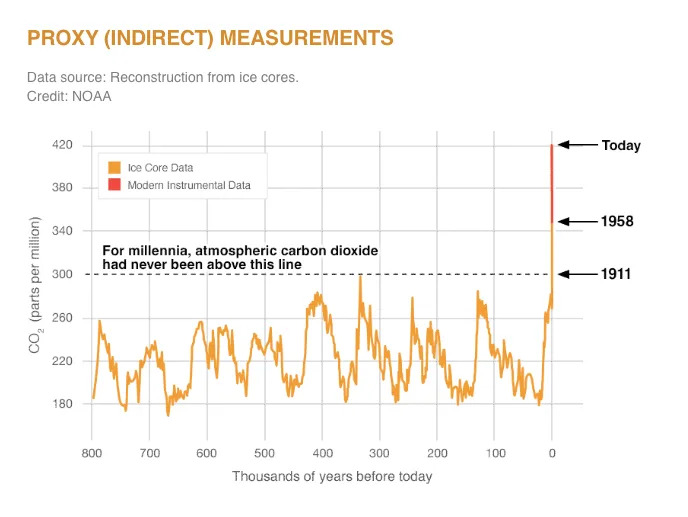
NASA graph showing the rise of carbon dioxide levels in the Earth’s atmosphere from 800,000 years ago to today.
The change has been underway for decades, but the extent of the shift is only now becoming clearly evident. In the 1980s, the country experienced on average a $1 billion, adjusted for inflation, disaster every four months. It now experiences one every three weeks. This year, the country has set a new record with 25 billion-dollar disasters.
The Earth crossed a key warming threshold in 2023, with one-third of the days so far having an average temperature at least 1.5 degrees Celsius higher than preindustrial levels. On Nov. 17, it reached 2.07 degrees above. This year is expected to be the warmest in recorded history, warmer than any other in 125,000 years.
What is COP28?
COP28 is the annual United Nations meeting of the 197 parties that have agreed to the U.N. Framework Convention on Climate Change, originally adopted in 1992. The meeting is the decision-making body of the countries that signed onto the U.N. framework. It is held to assess how well nations are dealing with climate change and set agendas and goals.
How important is this COP?
In a major report, the UN’s climate change body said earlier this month that global greenhouse gas emissions need to fall by 45% by the end of this decade compared to 2010 levels to meet the goal of limiting global temperature rise to 1.5 degrees Celsius.
Things are not going in the right direction. Instead, emissions are set to rise by 9%.
COP28 is where changes can be made.
Scientists say humanity has about a decade to dramatically reduce heat-trapping gas emissions before thresholds are passed that may make recovery from climate collapse impossible.
To do so will require cutting nearly two-thirds of carbon pollution by 2035, the Intergovernmental Panel on Climate Change said. That means ending new fossil fuel exploration and weaning wealthy nations away from coal, oil and gas by 2040.
“Humanity is on thin ice – and that ice is melting fast,” United Nations Secretary-General Antonio Guterres said in the spring. “Our world needs climate action on all fronts – everything, everywhere, all at once.”
Trump’s 48-Hour Manic Rant Had Immediate Consequences
Ellie Quinlan Houghtaling – November 30, 2023
The GOP’s presidential front-runner had himself a bit of an unhinged social media binge over the last couple of days, using Truth Social to air his scattered grievances, attack the wife of the judge overseeing his New York bank fraud trial, and take a wild left turn by claiming sudden allyship with the broader Black Lives Matter movement.
Kicking off the rapid-fire onslaught of posts late Tuesday, Trump called MSNBC’s coverage of the Republican Party “illegal activity,” adding that the “so-called ‘government’ should come down hard” on the news outlet and “make them pay.”
Then the former president revived an old gripe that “Obamacare sucks”—thus reopening the possibility that his campaign will renew the call to “repeal and replace” the Affordable Care Act that has dogged the GOP since that law’s inception. Less than 20 minutes later, he redirected his attention to the sexual assault allegations made against him by columnist E. Jean Carroll, spewing comments eerily similar to the ones that have already lost him two defamation cases brought by the writer, in which he claimed that the allegations were a “made up fairytale” that was “funded by political operatives” to interfere with the 2020 presidential election results.
Over the ensuing hours, Trump also warned that the indictments against him had opened up “pandora’s box,” which he followed by snubbing his Koch-backed GOP opponent Nikki Haley as “a very weak and ineffective Birdbrain.”
In yet another post, Trump said he had done “more for Black people than any other President,” including Lincoln. He also confused the support of Mark Fisher, the founder of Black Lives Matter Incorporated, for that of the larger, national movement, despite statements front and center on BLM INC.’s web page that they’re not affiliated with “any other Black Lives Matter Movement.”
But the pièce de résistance of Trump’s 48-hour digital diatribe was a string of attacks on the wife of the judge overseeing his business fraud trial, Manhattan Supreme Court Justice Arthur Engoron, whose gag order on Trump had been repealed. In five separate posts, Trump uplifted a conspiracy theory that Dawn Engoron and her husband were inherently biased in his case and that Mrs. Engoron had attacked Trump and other “white male politicians” online.
“Judge Engoron’s Trump Hating wife, together with his very disturbed and angry law clerk, have taken over control of the New York State Witch Hunt Trial aimed at me, my family, and the Republican Party,” Trump wrote on Truth Social.
In a statement to Newsweek, Engoron denied ownership of the account and any of its content.
“I do not have a Twitter account. This is not me. I have not posted any anti-Trump messages,” she told the outlet.
That may have been enough to convince a New York appeals court that Trump wasn’t capable of playing nice without his recently stayed gag order, which the four-judge panel dutifully reinstated on Thursday, in an attempt to halt the verbal onslaught against the judge, his court staff and, apparently, his family.
If you haven’t heard much about Russia’s war in Ukraine lately, it’s not because no news is good news. In fact, the war in Ukraine may be tipping in exactly the direction Russian President Vladimir Putin wants.
Ukraine failed to make major breakthroughs in its much-touted 2023 offensive, intended to break Russian lines in eastern and southern Ukraine and push Russian forces back toward the Crimean peninsula. Billions of dollars’ worth of American and European military hardware arrived too late, giving Russian forces months to build stout defenses Ukraine proved unable to penetrate, except for small breakthroughs. Exhaustion and winter mud have now effectively ended that offensive.
Isolationist Republicans who now control the US House of Representatives have so far scotched $61 billion in additional aid President Biden wants for Ukraine, and some weaponry designated for Ukraine is now instead headed to Israel as it wages war with the Hamas terrorist group. Nobody’s going soft in Russia, however, where Putin is boosting defense spending from 4% of GDP to 10%.
Despite devastating losses, Russia’s posture in Ukraine is getting stronger, with some analysts saying it is Ukraine that now needs to shift to defense. “Russia will be materially advantaged in 2024,” military analyst Michael Kofman of the Carnegie Endowment for International Peace said on a recent podcast. “If the West just assumes it’s a stalemate and can reduce its commitment to Ukraine, Russian advantages will compound because Russia doesn’t accept the stalemate.”
A slim majority of Americans still support robust US aid for Ukraine, but opposition has grown during the last six months. Most Republicans now say the United States is doing too much for Ukraine, while only 44% of Independents and 14% of Democrats feel that way. A chief complaint among Ukraine objectors is that President Biden should be focusing more on homegrown problems such as inflation and the influx of undocumented migrants.
Plus, the stakes in Ukraine could be far higher than many Americans appreciate. If Putin reverses his losses in Ukraine and ends up victorious, it would validate his view that the West doesn’t have the stomach for an ugly, drawn-out war, even if its own troops aren’t involved. Putin has ambitions beyond Ukraine, and if the West gives up on Ukraine it could meet Putin in Poland or the Baltic states, all members of the NATO military alliance.
Ambitions beyond Ukraine: Russian President Vladimir Putin (Sputnik/Valery Sharifulin/Pool via REUTERS) (Sputnik Photo Agency / reuters)
Also watching closely is Chinese President Xi Jinping, who has ordered his nation’s military to be capable of invading and conquering Taiwan by 2027. A key factor in Xi’s decision to invade will undoubtedly be his estimate of US and allied resolve in their vows to help defend the breakaway democratic island. If the US-led alliance fails Ukraine, it would be rational for Xi to conclude they’d bail on Taiwan, too. And a Chinese invasion of Taiwan would be an economic earthquake that makes Putin’s energy war, waged in parallel with his military war in Ukraine, seem tame.
Ukraine isn’t losing. Early in the war, it repelled invading Russia forces from northern Ukraine, and later in 2022, from key strongholds in the northeast and southeast. Ingenious naval drones have chased Russian warships away from Ukraine’s Black Sea ports and allowed the export of grain and other products, an astonishing feat for a country that basically lacks a navy. Russia still controls 18% of the Ukraine, but has gained basically no ground all year.
Two Western assumptions about the war have collapsed, however. The first is that Western training, intelligence, and equipment would tilt the war in Ukraine’s favor. It hasn’t. The second is that Russia would continue the shambolic battlefield performance of the invasion’s early days, when poorly prepared units expecting a cakewalk instead met determined resistance that sent them reeling. But the Russians have learned to plug holes, adapt to Ukrainian innovations, and keep their war machine rumbling along.
Some analysts snickered when Russia made a deal to buy ammunition from hermetic North Korea, but that deal may provide Russia with more artillery shells in 2024 than Ukraine will get from its own allies. That’s a key edge in a war where artillery is one of the most important weapons. Russia showed another weakness by buying relatively low-tech attack drones from Iran. But now Russia is building those drones on its own, by the hundreds, and using them in attempts to overwhelm Ukraine’s air defenses in a likely effort to wreck the country’s energy infrastructure again this winter, as it tried to do last year.
Ukraine pioneered some of the early innovations using armed drones to penetrate enemy lines. But Russia’s state machinery is now cranking out more drones than Ukraine can produce, and using them to deadly effect. As for battle tactics, Russia continues to expend soldiers in appalling human-wave attacks in which commanders seem to treat bodies as receptacles for bullets. There are sporadic protests in Russia of long deployments for troops and other concerns, but nothing approaching mass discontent with the war, suggesting Putin sees no constraint on sacrificing his own troops — another advantage over Ukraine, which husbands its human resources much more carefully.
Meanwhile, some Ukraine backers are beginning to say it’s time for Ukraine and its allies to change strategies.
“Kyiv’s war aims — the expulsion of Russian forces from Ukrainian land and the full restoration of its territorial integrity, including Crimea — remain legally and politically unassailable,” Richard Haass and Charles Kupchan wrote in Foreign Affairs recently. “But strategically they are out of reach, certainly for the near future and quite possibly beyond. [Ukraine’s] near-term priorities need to shift from attempting to liberate more territory to defending and repairing the more than 80 percent of the country that is still under its control.”
Haass and Kupchan argue that Ukraine should dig its own defensive fortifications, similar to Russia’s, and push for an enforceable cease-fire, while letting Russia worry about further territorial gains.
Since Russia invaded in February 2022, the Biden administration has armed Ukraine incrementally, first withholding and then providing key equipment such as armor, air defenses, and missiles that can reach far behind enemy lines. Biden has been careful not to push a nuclear-armed Russia over some perceived red line that would trigger a disproportionate Russian response. Europe has broadly followed the same pattern. But Russia never responded as more and more advanced Western weaponry arrived in Ukraine, prompting complaints that Washington has been too timid, and is not in it to win it.
So, the weapon tease continues. In October, the United States provided Ukraine with a small number of long-range ATACMS missiles capable of reaching Russian targets more than 100 miles away, threatening airfields, headquarters, and other crucial nodes. In the first strike using the new missiles, Ukraine reportedly destroyed more than a dozen Russian helicopters used to strafe Ukraine’s front-line troops. But there has been only one other known ATACMS firing since then. “This is a sign that the Biden Administration never wanted to give them in the first place, and is still strictly limiting what they will give Ukraine,” O’Brien wrote.
The next 12 months are likely to be momentous. Putin faces reelection in March, and while there’s no doubt he’ll win, Putin wants high turnout and a lopsided victory, so he may keep the war on simmer until then. Once the election’s over, Russia seems likely to mount a new mobilization effort to funnel more troops into Ukraine and press its manpower advantage. Sanctions are stifling the Russian economy, yet Russia is still selling plenty of oil, its main source of revenue, and finding most of the components it needs to boost defense production.
Putin also has a keen interest in next year’s US presidential election.
Republican front-runner Donald Trump is broadly viewed as a Putin patsy who would end the war in one day, as he says, by suspending US aid to Ukraine and giving Putin much or all of what he wants. “The event most likely to bring US backing for Ukraine to a juddering halt would be a victory by Donald Trump,” historian Lawrence Freedman of King’s College wrote on Nov. 23. “Putin might assume this to be such a positive possibility that it is one worth waiting for.”
No outcome is preordained.
Ukraine’s allies might yet rally and overcome the war fatigue that seems to settle more easily on allies far from the fighting than on those in the midst of it. In Washington, the new House Speaker, Mike Johnson, says he’s “confident” that Congress will provide more aid for Ukraine, though it may be far less than the $61 billion Biden wants. In Europe, several nations are ramping up weapons production to fill gaps the United States might leave. At some point in 2024, Ukraine seems likely to get Western fighter jets and finally be able to provide consistent air cover for infantry, a condition so fundamental to American military doctrine that the Pentagon would never consider fighting as the Ukrainians have been doing.
The Carnegie Endowment’s Kofman argues that the biggest American shortcoming in Ukraine isn’t some miracle weapon system, but the lack of advisers in-country who can understand how the plucky Ukrainians fight and tailor American aid to that. There’s a good reason Americans aren’t doing that: It conjures the specter of Vietnam, when advisers morphed into combatants and a slippery slope became a mudslide. It would be more fraught still if Americans ended up in direct combat with Russians.
But something needs to change if American resolves means anything, and it may start with America determining if it has that resolve in the first place.
Rick Newman is a senior columnist for Yahoo Finance.
Donald Trump Wants Federal Government To “Come Down Hard” On MSNBC For Its Criticism Of Him
Ted Johnson – November 29, 2023
Former President Donald Trump’s attacks on the media are central to his image, but he’s once again calling on the federal government to take action against NBCUniversal for its MSNBC criticism of him.
In a late night post on his social media platform Truth Social, Trump complained that MSNBC “uses FREE government approved airwaves, and yet it is nothing but a 24 hour hit job” on him and “the Republican party for the purposes of ELECTION INTERFERENCE.”
He also attacked Brian Roberts, the CEO of NBCU parent Comcast, as a “slimeball who has been able to get away from these constant attacks for years.”
“It’s the world’s biggest political contribution to the Radical Left Democrats who, by the way, are destroying our Country. Our so-called ‘government’ should come down hard on them and make them pay for their illegal political activity. Much more to come, watch!”
A bit of background: MSNBC is a cable network, so it does not use the public airwaves. Yet even if it was a broadcast outlet, the FCC has been clear that it will not regulate news programming content. The Fairness Doctrine, which required that broadcasters present an array of viewpoints on controversial issues, was abandoned more than 35 years ago during Ronald Reagan’s presidency.
The Federal Election Commission expenditure rules, meanwhile, exclude the news media, or more specifically, “any cost incurred in covering or carrying a news story, commentary, or editorial by any broadcasting station (including a cable television operator, programmer or producer).”
Trump’s attacks on NBC, MSNBC and Roberts are nothing new. In the first year of his presidency, he was upset over the network’s reporting and suggested that NBC’s broadcast license be challenged. Ajit Pai, who Trump appointed to chair the FCC, said a week later that the FCC “under the law does not have the authority to revoke the license of a broadcast station based on the content of a particular newscast.”
While Trump’s Truth Social post was one of many, many outbursts at the news media, his suggestion of government retaliation, something that would surely raise a First Amendment challenge, also comes as many of his allies and others on the right chide tech platforms for censorship over their content moderation practices.
The Republican attorneys general of Missouri and Louisiana have been challenging the Biden administration’s contacts with social media platforms, claiming that they were efforts to curb misinformation about Covid vaccines and elections were in fact censoring conservative speech. The administration has argued that it is merely pointing out the spread of misinformation on platforms about urgent issues of public health and election integrity. Supreme Court last month lifted a preliminary injunction on Biden administration contacts while it will hear arguments in the case in a hearing next year.
Trump has told supporters that he would be their “retribution” in a second term, and has vowed to appoint a special prosecutor to go after Joe Biden and his family. The New York Times and The Washington Post also have been reporting in recent weeks on Trump and his allies’ plans for a second term, including taking greater hold over the federal workforce.
Russia is preparing a ‘loyalty agreement’ requirement for foreigners
Guy Faulconbridge and Lidia Kelly – November 29, 2023
Steam rises from chimneys of a heating power plan over the skyline of central Moscow
MOSCOW (Reuters) -Russia’s interior ministry has prepared draft legislation that would force foreigners to sign a “loyalty agreement” forbidding them from criticising official policy, discrediting Soviet military history, or contravening traditional family values.
Since President Vladimir Putin ordered troops into Ukraine in February 2022, Russia has introduced a slew of tough laws that outlaw discrediting the military, and courts have handed down long jail sentences to opposition activists.
As the 2024 presidential election approaches, Putin has cast the war as part of an existential battle with the West, saying he will defend Russia’s “sacred” civilisation from what he portrays as the West’s decadence.
The TASS state news agency reported on Wednesday that the draft legislation had been prepared by the interior ministry and would force all foreigners entering Russia to sign an agreement that essentially restricts what they can say in public.
A foreigner entering Russia would be prohibited from “interfering with the activities of public authorities of the Russian Federation, discrediting in any form the foreign and domestic state policy of the Russian Federation, public authorities and their officials”, TASS said.
The proposed agreement would include clauses about morality, family, “propaganda about non-traditional sexual relations” and history.
In particular, foreigners would be barred from “distorting the historical truth about the feat of the Soviet people in the defence of the Fatherland and its contribution to the victory over fascism”.
The Soviet Union is estimated to have lost at least 27 million people in World War Two and eventually pushed Nazi forces back to Berlin. Governments loyal to Moscow then took power across swathes of eastern Europe.
It was not clear from Russian media reports which foreigners the draft legislation – if it becomes law – would apply to or what the punishment would be for not adhering to the “agreement” which foreigners would have to sign upon entry to Russia.
The Kremlin declined to comment on the initiative.
‘LOYALTY AGREEMENT’
Opposition activists and foreign diplomats in Moscow have for months been warning that the authorities are toughening their stance on any dissent ahead of the presidential election.
The Kremlin said earlier this month that some measure of censorship was needed as Russian troops were fighting in Ukraine, and cautioned those who wanted to criticise the military to think carefully before they did.
For the draft to become law, it has to be introduced to the State Duma, Russia’s lower house of parliament, and to go through committee review and several readings before being submitted to Putin for signing.
The chairman of the Duma’s CIS Affairs Committee said that the draft law was well advanced and was being worked on by the interior ministry, the government, the presidential administration as well as his committee.
“The draft law on the so-called ‘loyalty agreement’ with migrants entering the Russian Federation is in a high degree of readiness,” Leonid Kalashnikov told Interfax.
Kalashnikov said some details of the proposed law were still to be worked out. The interior ministry did not immediately respond to requests for a comment.
The law has not yet been introduced formally in parliament, according to Reuters searches of the Duma’s database.
Since the start of its war in Ukraine, Russia has imposed a number of restrictions on foreigners from what it calls “unfriendly countries” – meaning those that have imposed sanctions on it over its war in Ukraine.
(Reporting by Lidia Kelly in Melbourne and Guy Faulconbridge in Moscow; Editing by Andrew Osborn and Nick Macfie)
In an investigation published over the weekend, the Times wrote that the commutation for Jonathan Braun, a drug smuggler, had “broader implications than previously known.”
Braun was two and a half years into a 10 year sentence for running a major marijuana ring, and was also being pursued by the Justice Department for predatory lending to small businesses.
According to the Times, Braun’s family used a connection to Jared Kushner, Trump’s son-in-law and a senior White House adviser, to secure the commutation.
Freeing Braun reportedly jeopardized a Justice Department criminal investigation into predatory lenders, in which prosecutors had been negotiating with Braun to flip on industry insiders in exchange for clemency.
That deal went out the window when Braun was freed, the Times reported.
“What does this all tell us?” Psaki, a former White House press secretary under President Joe Biden, asked on “Inside With Jen Psaki.”
“For one, it tells us that ‘tough on crime’ Donald Trump upended a federal investigation by his own Justice Department. That’s not how it’s supposed to work.”
She continued: “It also tells us how Trump and his administration ran pretty fast and loose with presidential pardons — a tremendous power that usually runs through a highly vetted process out of the Department of Justice.”
She referred to an “old quote” and maxim of dictators: “For my friends, everything; for my enemies, the law.”
Psaki warned: “That is how Donald Trump has operated. And that is how he will continue to operate if he ever gets the leverage of government again.”
Russia’s Putin, shown alongside Orthodox icon image, warns West against meddling
Guy Faulconbridge – November 28, 2023
Russian President Putin attends a plenary session of the World Russian People’s Council, via video link in Sochi
MOSCOW (Reuters) – President Vladimir Putin, whose picture was shown between two giant images of an ancient Orthodox icon on Tuesday, warned the West ahead of elections in March 2024 that any foreign meddling in Russia would be considered an act of aggression.
Russia’s full-scale invasion of Ukraine in February 2022 has led to the most serious confrontation between Moscow and the West since the 1962 Cuban missile crisis, prompting Putin to pivot towards China.
Since the invasion, Putin has changed the narrative of the war, casting it as an existential battle between sacred Russian civilisation and an arrogant West which he says is in cultural, political and economic decline.
Speaking to the World Russian People’s Council, led by the head of Russia’s Orthodox church, Patriarch Kirill, Putin’s picture was shown on a giant screen beside two copies of an ancient Orthodox icon. Such icons are stylised, often gilded, religious paintings considered sacred in Orthodox churches.
The Russian Orthodox Church is an ardent institutional supporter of Russia’s war in Ukraine, and Putin has espoused its conservatism as part of his vision for Russia’s national identity.
The Kremlin chief said that the West was gripped by racist Russophobia which casts Russians as a people of backward “slaves” and warned that the United States allegedly wanted to dismember and plunder Russia’s vast resources.
Putin, 71, cautioned that Russians themselves should remember the lessons of the 1917 Bolshevik Revolution, the civil war and the 1991 fall of the Soviet Union, which he said had allowed the division of the Russian people.
“I want to underscore: We consider any interference from outside, provocations aimed at causing inter-ethnic or inter-religious conflicts as aggressive acts against our country,” Putin said.
“I want to emphasise again that any attempt to sow inter-ethnic and inter-religious discord, to split our society is a betrayal, a crime against the whole of Russia. We will not allow anyone to divide Russia.”
The West casts Putin as a dictator who has led Russia into an imperial-style land grab that has weakened Russia and forged Ukrainian statehood, while uniting the West and handing NATO a post-Cold War mission.
Putin says that the West is now failing in Ukraine and that its attempt to defeat Russia has also failed.
The Kremlin chief claims Western attempts to isolate Russia with the toughest-ever sanctions imposed on a major economy were evidence for what he believed is historic Western racism against Russians.
The West, which denies it wants to rip Russia apart, has said it wants to help Ukraine defeat Russian forces on the battlefields of Ukraine, eject Russian soldiers and punish Putin for the war.
Putin thanked Russian businessmen for evading the West’s sanctions.
“It was by combining the efforts of the state and business that we thwarted the unprecedented economic aggression of the West: its sanctions blitzkrieg failed,” Putin said.
The presidential election campaign is due to start next month and Putin is expected to run, a step that would ensure at least another six years at the helm for the former KGB spy, who has been in power since 2012, and before that, from 2000 to 2008.
Patriarch Kirill said he would pray for Putin to continue his work for the “benefit” of Russia and its people.
(Reporting by Guy Faulconbridge; Editing by Bernadette Baum)
Putin accuses the West of trying to ‘dismember and plunder’ Russia in a ranting speech
Associated Press – November 28, 2023
Russian President Vladimir Putin listens to VTB Bank Chairman Andrei Kostin during their meeting in Moscow, Russia, Monday, Nov. 27, 2023. (Mikhail Klimentyev, Sputnik, Kremlin Pool Photo via AP) (ASSOCIATED PRESS)
MOSCOW (AP) — Russian President Vladimir Putin on Tuesday, in a ranting speech before a presidential election campaign, cast Moscow’s military action in Ukraine as an existential battle against purported attempts by the West to destroy Russia.
Putin, who has been in power for more than two decades and is the longest-serving Russian leader since Soviet dictator Josef Stalin, is expected to soon declare his intention to seek another six-year term in a presidential election next March.
“We are defending the security and well-being of our people, the highest, historical right to be Russia — a strong, independent power, a country-civilization,” Putin said, accusing the U.S. and its allies of trying to “dismember and plunder” Russia.
Ukraine and its Western allies have condemned the Russian action against Ukraine as an unprovoked act of aggression.
“We are now fighting for the freedom of not only Russia, but the whole world,” Putin said in a speech to participants of a meeting organized by the Russian Orthodox Church.
He denounced what he described as Western “Russophobia,” claiming that “our diversity and unity of cultures, traditions, languages, and ethnic groups simply don’t fit into the logic of Western racists and colonialists, into their cruel scheme of total depersonalization, disunity, suppression and exploitation.”
“If they can’t do it by force, they will try to sow strife,” he said, vowing to block “any outside interference, provocations with the aim of causing interethnic or interreligious conflicts as aggressive actions against our country, as an attempt to once again foment terrorism and extremism in Russia as a tool to fight us.”
Russian authorities have intensified their crackdown on dissent amid the fighting in Ukraine, arresting and imprisoning protesters and activists and silencing independent news outlets.
Putin said that the U.S.-dominated global order has become increasingly decrepit, declaring that “it is our country that is now at the forefront of creating a more equitable world order.”
“And I want to emphasize: without a sovereign, strong Russia, no lasting, stable world order is possible,” he said.
To commemorate Munger’s monumental legacy, we’ve compiled some of our favorite Charlie quotes:
On life:
“I think life is a whole series of opportunity costs. You know, you got to marry the best person who is convenient to find who will have you. Investment is much the same sort of a process.” — 1997 Berkshire Hathaway Annual Meeting
“Another thing, of course, is life will have terrible blows, horrible blows, unfair blows. Doesn’t matter. And some people recover and others don’t. And there I think the attitude of Epictetus is the best. He thought that every mischance in life was an opportunity to behave well. Every mischance in life was an opportunity to learn something and your duty was not to be submerged in self-pity, but to utilize the terrible blow in a constructive fashion. That is a very good idea.” — 2007 USC Law School Commencement Address
“You don’t have a lot of envy, you don’t have a lot of resentment, you don’t overspend your income, you stay cheerful in spite of your troubles, you deal with reliable people and you do what you’re supposed to do. All these simple rules work so well to make your life better.” — 2019 CNBC interview
“With everything boomed up so high and interest rates so low, what’s going to happen is the millennial generation is going to have a hell of a time getting rich compared to our generation. The difference between the rich and the poor in the generation that’s rising is going to be a lot less. So Bernie has won. He did it by accident, but he won.” — 2021 Berkshire Hathaway Annual Meeting
Vice-chairman of Berkshire Hathaway Charlie Munger speaks to Reuters during an interview in Omaha, Neb., May 3, 2013. (Lane Hickenbottom/REUTERS) (Lane Hickenbottom / reuters)
On learning
“Without the method of learning, you’re like a one-legged man in an ass-kicking contest. It’s just not going to work very well.” — 2021 Daily Journal Annual Meeting
“In my whole life, I have known no wise people (over a broad subject matter area) who didn’t read all the time — none, zero. You’d be amazed at how much Warren reads — and at how much I read. My children laugh at me. They think I’m a book with a couple of legs sticking out.” — Poor Charlie’s Almanack
“I constantly see people rise in life who are not the smartest, sometimes not even the most diligent, but they are learning machines. They go to bed every night a little wiser than when they got up and boy does that help — particularly when you have a long run ahead of you.” — 2007 USC Law School Commencement Address
“Acquire worldly wisdom and adjust your behavior accordingly. If your new behavior gives you a little temporary unpopularity with your peer group then to hell with them.” — Poor Charlie’s Almanack
“I think value investors are going to have a harder time now that there’s so many of them competing for a diminished bunch of opportunities. So my advice to value investors is to get used to making less.” — 2023 Berkshire Hathaway Annual Meeting
“There is so much money now in the hands of so many smart people all trying to outsmart one another. It’s a radically different world from the world we started in.” — 2023 Berkshire Hathaway Annual Meeting
“What everybody has learned is that everybody needs some significant participation in the 12 companies that do better than everybody else. You need two or three of them, at least.” — Acquired podcast in 2023
“I wish everything else in America was working as well as Costco does. Think what a blessing that would be for us all.” — 2022 Daily Journal Annual Meeting
On meme stocks: “What we’re getting is wretched excess and danger for the country. A lot of people like a drunken brawl, and so far those are the people that are winning, and a lot of people are making money out of our brawl.” 2021 Daily Journal Annual Meeting
Berkshire Hathaway chairman and CEO Warren Buffett, left, and vice chairman Charlie Munger briefly chat with reporters May 3, 2019, one day before Berkshire Hathaway’s annual shareholders meeting in Omaha, Neb. (Nati Harnik/AP Photo, File) (ASSOCIATED PRESS)
On investing
“One of the inane things [that gets] taught in modern university education is that a vast diversification is absolutely mandatory in investing in common stocks. That is an insane idea. It’s not that easy to have a vast plethora of good opportunities that are easily identified. And if you’ve only got three, I’d rather it be my best ideas instead of my worst. And now, some people can’t tell their best ideas from their worst, and in the act of deciding an investment already is good, they get to think it’s better than it is. I think we make fewer mistakes like that than other people. And that is a blessing to us.” — 2023 Berkshire Hathaway Annual Meeting
“I find it much easier to find four or five investments where I have a pretty reasonable chance of being right that they’re way above average. I think it’s much easier to find five than it is to find 100. I think the people who argue for all this diversification — by the way, I call it ‘deworsification’ — which I copied from somebody — and I’m way more comfortable owning two or three stocks which I think I know something about and where I think I have an advantage.” — 2021 Daily Journal Annual Meeting
“If you’re going to invest in stocks for the long term or real estate, of course there are going to be periods when there’s a lot of agony and other periods when there’s a boom. And I think you just have to learn to live through them. As Kipling said, treat those two imposters just the same. You have to deal with daylight and night. Does that bother you very much? No. Sometimes it’s night and sometimes it’s daylight. Sometimes it’s a boom. Sometimes it’s a bust. I believe in doing as well as you can and keep going as long as they let you.” — 2021 Daily Journal Annual Meeting
“Mimicking the herd invites regression to the mean (merely average performance).” — Poor Charlie’s Almanack
“I think that the modern investor, to get ahead, almost has to get in a few stocks that are way above average. They try and have a few Apples and Googles or so on, just to keep up, because they know that a significant percentage of all the gains that come to all the common stockholders combined is going to come from a few of these supercompetitors.” — 2023 Wall Street Journal interview
“There are huge advantages for an individual to get into a position where you make a few great investments and just sit on your ass: You are paying less to brokers. You are listening to less nonsense. And if it works, the governmental tax system gives you an extra 1, 2 or 3 percentage points per annum compounded.” —Worldly Wisdom by Charlie Munger 1995-1998
American billionaire investor Charles Munger poses for a portrait with his arms folded in Los Angeles, March 9, 1988. (Bonnie Schiffman/Getty Images) (Bonnie Schiffman Photography via Getty Images)
“I have a friend who’s a fisherman. He says, ‘I have a simple rule for success in fishing. Fish where the fish are.’ You want to fish where the bargains are. That simple. If the fishing is really lousy where you are you should probably look for another place to fish.”— 2020 Daily Journal Annual Meeting
“The world is full of foolish gamblers and they will not do as well as the patient investors.” — 2018 Weekly in Stocks interview
“It takes character to sit with all that cash and to do nothing. I didn’t get to be where I am by going after mediocre opportunities.” — Poor Charlie’s Almanack
“Understanding both the power of compound interest and the difficulty of getting it is the heart and soul of understanding a lot of things.” — Poor Charlie’s Almanack
On new technologies
“The electric vehicle is coming big time, and that’s a very interesting development. At the moment, it’s imposing huge capital costs and huge risks, and I don’t like huge capital costs and huge risks.” — 2023 Berkshire Hathaway Annual Meeting
“I am personally skeptical of some of the hype that has gone into artificial intelligence. I think old-fashioned intelligence works pretty well.” — 2023 Berkshire Hathaway Annual Meeting
On Big Tech regulation: “I would not break them up. They’ve got their little niches. Microsoft maybe has a nice niche, but it doesn’t own the Earth. I like these high-tech companies. I think capitalism should expect to get a few big winners by accident.” — 2023 “Acquired” podcast
“We now have computer algorithms trading with other computers. And people buying stocks who know nothing, being advised by people who know even less. It’s an incredibly crazy situation … All this activity makes it easier for us.” — 2022 Berkshire Hathaway Annual Shareholders Meeting
“We are going to miss these newspapers terribly. Each newspaper… was an independent bastion of power. The economic position was so impregnable … and the ethos of a journalist was to try to tell it like it is. And they really were a branch of the government — they called them the Fourth Estate, meaning the fourth branch of the government. It arose by accident. Now about 95% of [newspapers are] going to disappear and go away forever. And what do we get in substitute? We get a bunch of people who attract an audience because they’re crazy ….
I have my favorite crazies, and you have your favorite crazies, and we get together and all become crazier as we hire people to tell us what we want to hear. This is no substitute for Walter Cronkite and all those great newspapers of yesteryear. We have suffered a huge loss here. It’s nobody’s fault. It’s the creative destruction of capitalism, but it’s a terrible thing that’s happened to our country.” — 2022 Daily Journal Annual Meeting
Berkshire Hathaway vice chairman Charlie Munger arrives to begin the company’s annual meeting in Omaha May 4, 2013. (Rick Wilking/REUTERS) (Rick Wilking / Reuters)
On crypto
“A cryptocurrency is not a currency, not a commodity, and not a security. Instead, it’s a gambling contract with a nearly 100% edge for the house, entered into in a country where gambling contracts are traditionally regulated only by states that compete in laxity.” — 2023 Wall Street Journal op-ed
“I am not proud of my country for allowing this crap — well, I call it crypto shit. It’s worthless, it’s crazy, it’s not good, it’ll do nothing but harm, it’s antisocial to allow it.” — 2023 Daily Journal Annual Meeting
“I think the people that oppose my position are idiots. And so I don’t think there is a rational argument against my position.” — 2023 Daily Journal Annual Meeting
“When you’re dealing with something as awful as crypto shit, it’s just unspeakable. I’m ashamed of my country that so many people believe in this kind of crap and the government allows it to exist.” — 2023 Daily Journal Annual Meeting
“I’m proud of the fact that I avoided it. It’s like some venereal disease. I just regard it as beneath contempt. Some people think it’s modernity, and they welcome a currency that’s so useful in extortions and kidnappings [and] tax evasion.” —2022 Berkshire Hathaway Annual Meeting
“When you have your own retirement account and your friendly adviser suggests you put all the money into bitcoin, just say no.” — 2022 Berkshire Hathaway Annual Meeting
“I hate the bitcoin success and I don’t welcome a currency that’s useful to kidnappers and extortionists, and so forth. Nor do I like just shuffling out a few extra billions and billions and billions of dollars to somebody who just invented a new financial product out of thin air. So, I think I should say modestly that I think the whole damn development is disgusting and contrary to the interests of civilization.” — 2021 Berkshire Hathaway Annual Shareholders Meeting
On the US economy and business:
“What makes capitalism work is the fact that if you’re an able-bodied young person, if you refuse to work, you suffer a fair amount of agony, and because of that agony, the whole economic system works … You take away that hardship and say, ‘You can stay home and get more than if you come in to work,’ that’s quite disruptive to an economic system like ours. The next time we do this, I don’t think we ought to be so liberal.” — 2022 Daily Journal Annual Meeting
“Usually, I don’t use formal projections. I don’t let people do them for me because I don’t like throwing up on the desk, but I see them made in a very foolish way all the time, and many people believe in them, no matter how foolish they are. It’s an effective sales technique in America to put a foolish projection on a desk.”—2003 Herb Kay Undergraduate Lecture, University of California, Santa Barbara Economics Department
Berkshire Hathaway chairman and CEO Warren Buffett, right, and his vice chairman Charlie Munger, left, speak during an interview in Omaha, Neb., Monday, May 7, 2018. (Nati Harnik/AP Photo, File) (ASSOCIATED PRESS)
On mental models and decision-making frameworks:
“We’ve had enough good sense when something is working very well to keep doing it. I’d say we’re demonstrating what might be called the fundamental algorithm of life — repeat what works.” — 2010 Berkshire Hathaway Annual Meeting
“I spent a lifetime trying to avoid my own mental biases. A.) I rub my own nose into my own mistakes. B.) I try and keep it simple and fundamental as much as I can. And, I like the engineering concept of a margin of safety. I’m a very blocking and tackling kind of thinker. I just try to avoid being stupid. I have a way of handling a lot of problems — I put them in what I call my ‘too hard pile,’ and just leave them there. I’m not trying to succeed in my ‘too hard pile.’” — 2020 CalTech Distinguished Alumni Award interview
“Charlie and I think pretty much alike. But what it takes me a page to explain, he sums up in a sentence. His version, moreover, is always more clearly reasoned and also more artfully — some might add bluntly — stated.
Here are a few of his thoughts, many lifted from a very recent podcast:
• The world is full of foolish gamblers, and they will not do as well as the patient investor.
• If you don’t see the world the way it is, it’s like judging something through a distorted lens.
• All I want to know is where I’m going to die, so I’ll never go there. And a related thought: Early on, write your desired obituary — and then behave accordingly.
• If you don’t care whether you are rational or not, you won’t work on it. Then you will stay irrational and get lousy results.
• Patience can be learned. Having a long attention span and the ability to concentrate on one thing for a long time is a huge advantage.
• You can learn a lot from dead people. Read of the deceased you admire and detest.
• Don’t bail away in a sinking boat if you can swim to one that is seaworthy.
• A great company keeps working after you are not; a mediocre company won’t do that.
Warren Buffett (L) and Berkshire-Hathaway partner Charlie Munger address members of the press May 5, 2002, in Omaha, Neb. (Eric Francis/Getty Images) (Eric Francis via Getty Images)
• Warren and I don’t focus on the froth of the market. We seek out good long-term investments and stubbornly hold them for a long time.
• Ben Graham said, ‘Day to day, the stock market is a voting machine; in the long term it’s a weighing machine.’ If you keep making something more valuable, then some wise person is going to notice it and start buying.
• There is no such thing as a 100% sure thing when investing. Thus, the use of leverage is dangerous. A string of wonderful numbers times zero will always equal zero. Don’t count on getting rich twice.
• You don’t, however, need to own a lot of things in order to get rich.
• You have to keep learning if you want to become a great investor. When the world changes, you must change.
• Warren and I hated railroad stocks for decades, but the world changed and finally the country had four huge railroads of vital importance to the American economy. We were slow to recognize the change, but better late than never.
• Finally, I will add two short sentences by Charlie that have been his decision-clinchers for decades: ‘Warren, think more about it. You’re smart and I’m right.’
And so it goes. I never have a phone call with Charlie without learning something. And, while he makes me think, he also makes me laugh.”