Bill Maher Has No Tears For David Koch: “I’m glad he’s dead & I hope the end was painful.”
Geoff Boucher, Deadline August 23, 2019
The proverb “Don’t speak ill of the dead” is credited to Chilon the Wise, the same Greek sage from 500 B.C. who said “Do not laugh at a person in misfortune.” Chilon, no surprise, has never been a fan of HBO’s Real Time with Bill Maher most likely due to philosophical differences with the show’s host.
On Friday night’s show Maher had his audience cringing with the post-mortem zingers he aimed at two recently deceased (and widely reviled) news figures, wealthy sex predator Jeffrey Epstein and billionaire conservative activist David Koch.
“And now, some funeral news to report [from] yesterday: David Koch, of the zillionaire Koch brothers, died of prostate cancer,” Maher said early in his monologue. “I guess I’m going to have to re-evaluate my low opinion of prostate cancer. He was 79, but his family says they wish he could live longer, but at least he lived long enough to see the Amazon catch fire. Condolences poured in from all the politicians he owned, and mourners have been asked in lieu of flowers to just leave their car engines running. As for his remains, he’s been asked to be cremated and have his ashes blown into a child’s lungs.”
The laughter from the audience was tinged with an audible discomfort so Maher acknowledged their reaction by doubling down.
“Now, I know these may seem like harsh words and harsh jokes, and I’m sure I will be condemned for them on Fox News, which will portray Mr. Koch as a principled Libertarian who believed in the free market. He and his brother have done more than anybody to fund climate-science deniers for decades, so f— him. The Amazon is burning. I’m glad he’s dead and I hope the end was painful.”
Wow. You don’t hear that kind of commentary very often from major television talk show hosts — well, unless you’re watching Maher. Other comedians may be too conservative, timid, or cautious to take a dig at someone six feet under but Maher reaches for that shovel all the time.
Last week, for instance, his target was Epstein, whose death by hanging in a New York jail cell prevented his trial on sex crimes: “Well, did you see what happened in the stock market this week? I spent more time gasping for breath than Jeffrey Epstein…yes, Jeffrey Epstein was found dead in his jail cell. And they say America can’t do anything anymore.”
On Friday, Maher circled back to the disgraced financier for another round of stiff insults. It was during Maher’s exasperated riff on the limited mental capacities of President Donald J. Trump, “I don’t want to say he has the mind of a child but today Jeffrey Epstein’s ghost tried to f— him.”
Some in the audience howled, some likely winced, but Maher definitely stirs up a different energy when he treads past the vague line that usually separates corpse wisecracks from socially comfortable topics. Maher clearly recognized and enjoyed the subversive moment. “Gentle good humor, that’s what we do here, gentle good humor…”
Related:
AFP
David Koch, billionaire donor to Republican causes, dies age 79
AFP, August 23, 2019
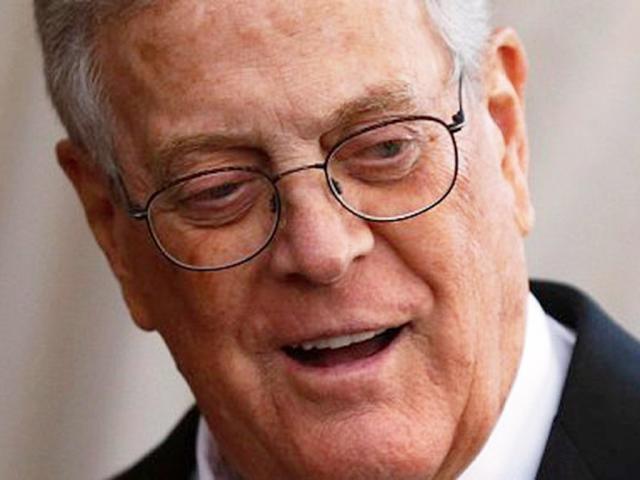
Billionaire David Koch, pictured in 2011, was estimated to be worth $42.4 billion (AFP Photo/NICHOLAS KAMM)
Washington (AFP) – David Koch, a billionaire American libertarian and influential donor to conservative causes, has died at age 79 after a long battle with cancer, his brother Charles said Friday.
Koch retired last year as executive vice president of Koch Industries, the conglomerate he co-owned with his older brother and built into the second largest family-owned company in the United States.
“We wish for all to celebrate the life and impact of this most generous and kind man,” Charles Koch said in a statement.
“He believed he had a responsibility to a world that had given him so many opportunities to succeed.”
Both brothers were a force behind the scenes in Republican politics, donating heavily to candidates and causes that reflected their conservative economic positions.
But David was socially liberal — a supporter of abortion rights and same-sex marriage as well as a non-interventionist foreign policy.
Both brothers were recognized in 2015 for bipartisan work on prison reform in the United States.
Among those offering condolences was Secretary of State Mike Pompeo who, like the Koch brothers, is from Kansas.
David Koch ran as the Libertarian Party’s vice presidential candidate in 1980, but later broke with it and swung to the Republicans.
He joined his brother Charles in financing a network of conservative organizations, in particular Americans for Prosperity, centered on demands for low taxes and deregulation with the aim of influencing US elections.
Those organizations helped fuel the rise of the Tea Party movement in 2010, mounting a frontal Republican challenge to former Democratic president Barack Obama.
The Kochs’ power was such that in the next presidential elections, Republican candidates vied for their endorsement, attending exclusive conferences the brothers organized.
Donald Trump, whose conservative credentials the brothers viewed with suspicion and who in turn often mocked them, was the exception.
Of the two, Charles has been most involved in the political networks while David had been more active in philanthropic endeavors, mainly in New York.
He was remembered as an important financial contributor to cultural organizations and medical research.
He was diagnosed with advanced prostate cancer 27 years ago but through “a combination of brilliant doctors, state-of-the-art medications and his own stubbornness kept the cancer at bay,” Charles said.
Born in Wichita, Kansas, Koch studied chemical engineering at the Massachusetts Institute of Technology before joining Koch Industries.
Forbes estimated his wealth at the end of his life at $42.4 billion, making him one of the world’s richest people.
Related:
The Independent
David Koch’s legacy wasn’t perfect – but it was far more positive than you’ve been led to believe
Caleb Franz, The Independent August 23, 2019
David Koch, the political philanthropist who nearly everyone has an opinion on, has passed away at the age of 79. Many remember him as a cartoon villain of modern politics; however, the truth of his legacy is that, along with his brother, he championed many positive and noble causes that tend to be supported across the political aisle.
David was philosophically a libertarian, and even once, in 1980, ran as the VP candidate on the Libertarian Party ticket.
When he stepped down from his position at Koch Industries due to his failing health during June of last year, the LP reflected on all he and his brother gave to the movement: “The Kochs have teamed with the American Civil Liberties Union, the Center for American Progress, Families Against Mandatory Minimums, the Coalition for Public Safety, and the MacArthur Foundation to reduce incarceration and promote criminal justice reform. It’s informative that Koch political activism and charitable activities are motivated by classical liberal idealism, not by crony capitalist self-interest. They have changed the political atmosphere in a way that both conservatives and liberals can comfortably move in a more libertarian direction.”
Of course, since then it is well known that David and his brother, Charles, have supported candidates who didn’t always reflect libertarian ideology. It is not uncommon for people of any ideology to support the “lesser evil” candidate in their eyes. Much like how many liberals in 2016 only voted for Hillary Clinton to try to keep Trump out of the White House, so too did David Koch support candidates who were the closest aligned to his belief in liberty.
But even that rationality has its limitations, as neither David nor Charles supported President Trump in 2016. While many may understandably be frustrated by his choice of candidates to support, when it came to the issues themselves, David was a titan for several worthy causes.
Criminal justice reform is perhaps the one issue that is universally supported, more or less, by all political persuasions. Indeed, it is currently enjoying its moment in the sun due to the recent passage of the First STEP Act, as well as several State initiatives sweeping the country. The wide-reaching support the issue is currently receiving is thanks in large part to the Koch Brothers being early supporters. Through Koch-backed groups such as American’s for Prosperity, thousands of conservative activists who may otherwise have been “tough-on-crime” as a default have heard and now advocate for smart and effective reform measures. Even individuals such as Van Jones and President Obama have applauded both David and Charles for the positive work they did where justice reform was concerned.
Likewise, David was just as strong in his convictions towards issues such as privacy, a more sober foreign policy, a more open immigration system, and tolerance for other people. In some ways, David was actually better on “left-wing issues” than even a lot of prominent Democrats have been. In 2015, Senator Bernie Sanders went after the Koch Brothers for essentially being too pro-open borders. In an interview with Vox, Sanders specifically called open borders “a Koch Brothers proposal… which essentially says there is no United States.”
For many, this may come as a shock, but for those who understand libertarian ideology, and how closely associated David Koch was to it, it is of no surprise. One could easily make that argument that because of the work that David has done on many of these issues that are commonly thought of as “left of center,” the GOP has become a better version of itself as a result.
Certainly, David was not a perfect man, and he didn’t leave the world a perfect place, but it is better than when he entered it, and he made a significant contribution to make that happen.
For many of the right, David was far too liberal, and for many on the left, he was way too conservative. Both sides, however, should look back on his legacy and acknowledge the positive reforms he pushed for and helped enact. While it certainly may not feel like it at times, we understand our fellow countrymen a lot better because of the work David Koch has done.
Support free-thinking journalism and subscribe to Independent Minds
And during a time when there are those in power who seek to divide us, he left a positive legacy that unified thousands around noble causes.
Clashes ripple across Hong Kong as student-led protests defy government
August 13, 2019
“They’re calling for a revolution.” Clashes between police and protesters have brought Hong Kong to a standstill, with thousands of citizens continuing to peacefully march despite tear gas and forceful removal by police. Here’s what protesters are demanding, and how the standoff is bringing the city of more than 7 million to the brink. Warning: The following video contains graphic content. Viewer discretion is advised.
“They’re calling for a revolution.” Clashes between police and protesters have brought Hong Kong to a standstill, with thousands of citizens continuing to peacefully march despite tear gas and forceful removal by police. Here's what protesters are demanding, and how the standoff is bringing the city of more than 7 million to the brink. Warning: The following video contains graphic content. Viewer discretion is advised.
Trump Is Making The Same Trade Mistake That Started The Great Depression
John Mauldin, Senior Contributor – Markets June 2019
GETTY
We all wonder if Trump’s trade actions are as random as they appear or if there is a broader strategy.
Some of my contacts argue that the relatively strong U.S. economy allows the administration to take a harder line than would normally be advisable.
The thinking is that we can ride out a trade war better than China can.
This only works if the U.S. economy keeps growing long enough for the tariffs to make China bend. We can postpone a recession for another year or two if the trade war doesn’t intensify and Europe holds together.
Since it is intensifying, we may not get that time. In other words, tariffs could end the conditions that justified them.
Something similar happened before, during the most famous trade mistake in U.S. and global history.
The 1930’s Smoot-Hawley Tariffs
Similar to today, the Roaring 1920’s saw rapid technological change, namely automobiles and electricity.
This created a farm surplus as fewer horses consumed less feed. Prices fell and farmers complained of foreign competition.
Herbert Hoover promised higher tariffs in his 1928 presidential campaign. He won, and the House passed a tariff bill in May 1929.
The Senate was still debating its version of the bill when the stock market crashed in October 1929. Today, we use that event to mark the Great Depression’s beginning.
But at the time, people didn’t know they were in a depression or even a recession. Most economists expected a quick recovery. Stocks did recover quite a bit in the following months, though not back to their prior highs.
So, when the Senate finally passed a tariff bill in March 1930, the thinking was not that different from what we see today. They thought they could preserve and even extend the good times.
But conditions worsened quickly, and by 1931, unemployed men were standing in soup lines.
In 1932, both Smoot and Hawley lost their seats as Franklin Roosevelt beat Hoover in a landslide—57% of the popular vote.
That history won’t necessarily repeat this time, but it’s not a good sign.
Throwing Caution to the Wind
Last year, I wrote about a sandpile experiment conducted by physicists back in the 1980’s. I described how a sandpile can slowly grow in size, apparently stable. At any moment, however, something could trigger an avalanche.
The global trade system is something like that. Of course, it’s not perfect or even optimal. Countries erect barriers to their advantage.
I can point to several countries whose economic policies are mercantilistic, but at least everyone knows about them. We see the the dangers and back off to avoid an avalanche whose victims are impossible to predict.
It is a kind of equilibrium.
Everyone’s incentive is to avoid catastrophe and make incremental improvements. That makes trade talks extraordinarily difficult.
The Trump administration doesn’t seem to care about equilibrium. Whether it’s coming from the president himself or those around him, the strategy appears to be “kick apart the sandpile and make everybody rebuild it.”
And whether we like it or not, many of Trump’s supporters actually like the concept of throwing a wrench into the system.
So, it is not the case that the U.S. has no choices. We have many choices. Tariffs are the wrong one. But then, that is just me, and I am one lone voice and vote.
John Mauldin is President of Mauldin Economics and a financial writer, publisher, and New York Times bestselling-author. Each week, nearly a million readers around the world receive my Thoughts From the Frontline free investment newsletter.
Show this handy video to all of your conservative friends who claim that President Obama didn’t accomplish anything in his two terms. He makes President Trump look like a lazy amateur.
Show this handy video to all of your conservative friends who claim that President Obama didn't accomplish anything in his two terms. He makes President Trump look like a lazy amateur.
Opinion: Trump’s cuts to food stamps are indefensible, economically and morally
By Karen Dolan July 31, 2019
SNAP program reduces poverty better than anything else, with very little fraud
Getty Images
A half a million kids will lose their school lunch assistance if the Trump administration changes the rules for food stamps.
Under new changes proposed by the Trump administration, over 3 million struggling parents, children, people living with disabilities, and older American may lose access to food stamps, also known as the Supplemental Nutrition Assistance Program (SNAP). Children in families who are slated to lose their SNAP benefits will also lose critical school-lunch assistance.
The Trump administration wants to eliminate an eligibility criterion known as broad-based categorical eligibility (BBCE), which enables states to expand access to those in need of food assistance based on other programs they qualify for.
By eliminating it, the administration is effectively creating a benefits cliff, where a parent’s small raise at work — or a modest amount of savings — could end up disqualifying a family from SNAP entirely. That leaves them poorer for getting a raise or saving money, or else puts them at risk of their food aid falling through the bureaucratic cracks.
Failed twice
Trump and the Republicans attempted to get this reduction in the nation’s most effective social safety-net program rammed through Congress last year — and failed. They also failed in their attempt to significantly defund the program. So now Trump is attempting to reduce food access to families in need via executive fiat.
SNAP reduces poverty more simply and directly than nearly any other program. Because it’s responsive to the overall economy, it expands during economic downturns and contracts when poverty levels fall. This enables people to weather temporary economic hardship, stay above the official poverty level, and gets money more quickly into the economy.
It also literally puts food into children’s mouths, while their parents work and save.
Why would the administration want to take critical food assistance away from children and families who need it? The administration has claimed ineligible people are using the program, perhaps fraudulently. But that’s unlikely.
Looking at figures through 2016, Forbes contributor Simon Constable calculated potentially fraudulent SNAP expenditures at under 1% of the cost of the program — a minuscule amount compared to behemoth agencies like the Pentagon, which can’t even pass an audit, and which nonetheless keeps getting budget increases.
Rigorous standards
SNAP, by contrast, “has some of the most rigorous program integrity standards and systems of any federal program,” adds Robert Greenstein of the Center of Budget and Policy Priorities, including for recipients who qualify by their participation in other programs.
According to the center, SNAP is one of the most effective economic stimulators per federal dollar spent of any program. During the economic downturn of 2009, for example, Moody’s Analytics estimated that for every dollar increase in SNAP benefits that year, $1.70 economic activity was generated.
Further, the administration has repeatedly claimed — also falsely — that poverty is all but solved.
That’s not remotely true.
According to research by the Poor People’s Campaign and the Institute for Policy Studies, 140 million Americans are either poor or low-income. In this wealthiest nation on the planet, even as more wealth concentrates at the top, some 43% of us struggle to make ends meet — a number that far outpaces the official poverty measure, not to mention Trump’s mis-characterization of it.
Our social safety net, which includes assistance for basic needs such as housing, health, and nutrition, is insufficient and under attack.
Neglecting children
The impact of this neglect on the health and well being of our children, in particular, reverberates through our entire economy.
Our report compiles reams of data on the enormous economic costs of child poverty, such as the Children’s Defense Fund’s estimation that the economic cost of lost productivity, worsened health, and increased crime rates that stem from child poverty total roughly $700 billion per year — 3.5% of GDP.
Strengthening SNAP is key to reducing this damage. So on economic grounds alone, the Trump proposed rule change to kick millions struggling children, families — and not to mention people living with disabilities and older people — off critical food assistance makes no sense. On moral grounds, it’s indefensible.
As the Rev. Dr. William Barber and the Poor People’s Campaign often says, “Everybody’s got the right to live.” That right belongs to America’s 140 million poor and low-income people, including the 3.1 million children and families experiencing hardship that rely on the nutritional assistance provided by the SNAP program.
Karen Dolan directs the Criminalization of Race and Poverty Project at the Institute for Policy Studies. She’s a co-author of the IPS-Poor People’s Campaign Report, “A Poor People’s Moral Budget: Everybody Has the Right to Live.” The IPS is funded by private foundations and individual donors.
Going green: Ethiopia’s bid to plant four billion trees
Robbie Corey – Boulet, AFP July 30, 2019
The government said a record-breaking 350 million trees were planted in a single day on Monday (AFP Photo/MICHAEL TEWELDE)
Addis Ababa (AFP) – These days whenever Ethiopia’s Prime Minister Abiy Ahmed appears in public, he removes his jacket, rolls up his sleeves, grabs a shovel and gets to planting a tree.
Abiy is leading by example as Ethiopia plans to plant a mind-boggling four billion trees by October, as part of a global movement to restore forests to help fight climate change and protect resources.
The country says it has planted nearly three billion trees already since May.
On Monday, state employees were given the day off as Abiy sought to get the rest of the country involved, and the government claimed a “record-breaking” 350 million trees were planted in only one day.
“I think we demonstrated the capacity for people to come together collectively and deliver on a shared vision,” Billene Seyoum, Abiy’s press secretary, told AFP.
The figure has attracted scepticism about the sheer number of volunteers this would require, and the logistics involved.
“I personally don’t believe that we planted this much,” said Zelalem Worqagegnehu, a spokesman for the opposition Ezema party.
“It might be impossible to plant this many trees within a day.”
Yet Zelalem also noted that hundreds of members of his party planted trees of their own on Monday, and suggested the actual total was beside the point.
“We took this as a good opportunity to show solidarity with the citizens,” he said. “Our concern is the green legacy, making Ethiopia green.”
– Planting only first step –
Ethiopia’s forest cover declined from around 40 percent half a century ago to around 15 percent today, said Abiyot Berhanu, director of the Ethiopian Environment and Forest Research Institute.
“Deforestation has become very grave in many parts of Ethiopia,” he said.
The recent tree-planting drive has targeted areas that have been stripped of their trees over the years, Billene said.
The types of new trees planted have varied from region to region.
“A lot of nurseries have been working on producing more saplings over the past couple months,” Billene said, while some of the saplings and seedlings had come from abroad.
Reforestation is a major component of global initiatives to recapture carbon emissions. It can also purify water, produce oxygen and bolster farmers’ incomes, said Tim Christophersen, chair of the Global Partnership on Forest and Landscape Restoration.
But Christophersen said planting trees was only the first step.
“The most important factor is grazing pressure. If you plant a tree and a day later the goats come along they will absolutely eat the tree first before they eat the dry grass next to it,” he said.
“We don’t speak so much about planting trees but about growing trees.”
He said planting 350 million trees would require about 350,000 hectares (864,000 acres) — an area bigger than Luxembourg — and added that a volunteer could realistically plant about 100 trees a day.
“It is not impossible, but it would take a very well organised effort,” he told AFP.
He said that Ethiopia was one of only five countries ranked as having a “sufficiently ambitious” contribution to the 2015 Paris climate agreement, the UN’s pact to curb global warming.
Trees take in carbon from the air as part of the process of synthesis and store it in their leaves, branches and trunks.
Abiy’s tree-planting drive is part of a national environmental campaign, known as the Green Legacy Initiative, that includes cleaning waterways and making agriculture more sustainable.
Billene said the turnout Monday indicated that the prime minister’s environmentally friendly message was resonating.
“Everyone was clear and understood the long-term vision,” she said. “They actually bought into the benefits of what it means to have a green country.”
If Ethiopia really did plant 350 million trees on Monday, it would have smashed the current world record of around 50 million held by the Indian state of Uttar Pradesh.
However an official determination may have to wait.
So far, Ethiopia has not attempted to register its achievement with Guinness World Records Limited, spokeswoman Jessica Dawes told AFP in an email.
“We are always on the lookout for new record breaking achievements however, and so we would encourage the organizers of this event to get in touch with us to register an application,” Dawes said.


 Getty Images
Related: