US governor defends ban on African American history course
January 23, 2023
The Republican leader of the US state of Florida defended his ban on an African American studies course Monday, railing against its pushing of “social justice” topics such as “queer theory.”
“We want education, not indoctrination. If you fall on the side of indoctrination, we’re going to decline. If it’s education, then we will do (it),” Governor Ron DeSantis, who is considered one of the favorites for his party’s 2024 presidential nomination, told reporters.
“This course on Black history: what is one of the lessons about? Queer theory. Now who would say that an important part of Black history is queer theory? That is somebody pushing an agenda on our kids,” he added.
The class covers more than 400 years of African American history and is being rolled out as part a nationwide “advanced placement” program giving high school students the chance to take college-level subjects before graduation.
But Florida’s Department of Education has objected to the inclusion of “Black Queer Studies” and topics such as Black feminism and the alleged promotion of critical race theory, an academic discipline investigating systemic racism in American society.
Officials have also complained about its approach to the debate over reparations — the argument for compensating Black Americans for slavery — telling organizers the program violated state law and rejecting its inclusion in Florida schools.
DeSantis has seen his political stock rise following a big election win in November and he is now considered former president Donald Trump’s main rival in the race for the 2024 Republican nomination.
He has gained support on the right for his hardline stances on “culture war” issues such as public health restrictions during the pandemic and alleged “woke” indoctrination in education.
He argued Monday that the purpose of education was the “pursuit of truth,” and not to use schools as “an instrument of what they consider social justice and social change.”
“We believe in teaching kids facts and how to think, but we don’t believe they should have an agenda imposed on them,” DeSantis said. “When you try to use Black history to shoehorn in queer theory, you are clearly trying to use that for political purposes.”
The decision to block the course has been met with outrage from the American Civil Liberties Union, which said DeSantis had “no right to censor speech he disagrees with” while Vice President Kamala Harris said at the weekend anyone banning teaching US history “has no right to shape America’s future.”
Comet last seen during Ice Age will be visible over Idaho. Here’s when and how to watch
Shaun Goodwin, Patrick McCreless, Genevieve Belmaker – January 11, 2023
A comet last visible by the naked eye when Neanderthals roamed the Earth should be observable in Idaho skies again soon.
The comet C/2022 E3 (ZTF) is passing through the inner solar system and will get closest to the sun on Jan. 12, according to space.com. The comet will continue to travel near the Earth, making its closest passage between Feb. 1 and Feb. 2.
The comet could be visible to the naked eye if it continues to brighten. Such a sight can be difficult to predict for comets, space.com states. However, even if the comet does dim a bit, it should still be visible with binoculars or a telescope for several days around its approach.
Though ancient, C/2022 E3 (ZTF) was only discovered by astronomers at the Zwicky Transient Facility at CalTech in March 2022. The facility operates at the Palomar Observatory at California’s Palomar Mountain, about 90 minutes northeast of San Diego.
The comet has a period of about 50,000 years, NASA Jet Propulsion Laboratory states. As such, the last time the comet came so close to the sun and Earth was during the last Ice Age, when humans and Neanderthals existed on the planet at the same time.
According to NASA, observers in Idaho and throughout the northern hemisphere should be able to find the comet in the morning sky as it travels northwest in late January.
Viewers should look for the comet when the moon is dim in the sky. The new moon on Jan. 21 will offer an excellent opportunity. Although the National Weather Service only provides accurate day-by-day forecasts five days out, the Climate Prediction Center predicts a 40-50% higher-than-normal chance for rain in the next eight to 14 days.
Although a higher chance of precipitation does not necessarily mean more cloud cover, clouds form when the atmosphere reaches its saturation point; more moisture in the atmosphere means a higher chance for clouds.
Brian Jackson, an associate professor at Boise State’s Physics Department, has previously told the Idaho Statesman that Camel’s Back Park in North Boise is an excellent spot to look toward the night sky. The park allows watchers to turn their backs on the light pollution from Boise and look out toward the Boise Mountains.
Jackson also recommended the Central Idaho Dark Sky Reserve in the Sun Valley, which offers one of the darkest night skies in the United States. The Light Pollution Map website also shows the best spots in Idaho to escape light pollution.
Weather Service meteorologist Josh Smith told the Statesman that Bogus Basin is an excellent place to stargaze and look for comets if there is cloud cover. Bogus Basin’s base sits at 5,800 feet, meaning it should be above any low cloud ceiling above the Treasure Valley.
What are comets?
Comets consist of ice and frozen gases, along with rocks and dust left after the solar system’s formation more than 4 billion years ago. They orbit the sun in highly elliptical orbits. When a comet approaches the sun, it heats up quickly, causing some ice to turn into gas. This heated gas and dust are what form a comet’s tail.
The ‘runner’s high’ may result from molecules called cannabinoids – the body’s own version of THC and CBD
Hilary A. Marusak, Assistant Professor of Psychiatry and Behavioral Neurosciences, Wayne State University – January 7, 2023
Exercise spurs the release of the body’s natural cannabinoids, which have myriad benefits for mental health and stress relief. Luca Sage/Stone via Getty Images
Many people have experienced reductions in stress, pain and anxiety and sometimes even euphoria after exercise. What’s behind this so-called “runner’s high”? New research on the neuroscience of exercise may surprise you.
The “runner’s high” has long been attributed to endorphins. These are chemicals produced naturally in the body of humans and other animals after exercise and in response to pain or stress.
However, new research from my lab summarizes nearly two decades of work on this topic. We found that exercise reliably increases levels of the body’s endocannabinoids – which are molecules that work to maintain balance in the brain and body – a process called “homeostasis.” This natural chemical boost may better explain some of the beneficial effects of exercise on brain and body.
I am a neuroscientist at the Wayne State University School of Medicine. My lab studies brain development and mental health, as well as the role of the endocannabinoid system in stress regulation and anxiety disorders in children and adolescents.
This research has implications for everyone who exercises with the aim of reducing stress and should serve as a motivator for those who don’t regularly exercise.
More recently – over about the past two decades – mounting research shows that exercise is also highly beneficial for mental health. In fact, regular exercise is associated with lower symptoms of anxiety, depression, Parkinson’s disease and other common mental health or neurological problems. Consistent exercise is also linked to better cognitive performance, improved mood, lower stress and higher self-esteem.
It is not yet clear what is behind these mental health boosts. We do know that exercise has a variety of effects on the brain, including raising metabolism and blood flow, promoting the formation of new brain cells – a process called neurogenesis – and increasing the release of several chemicals in the brain.
Some of these chemicals are called neurotrophic factors, such as brain-derived neurotrophic factor. BDNF is intricately involved in brain “plasticity,” or changes in activity of brain cells, including those related to learning and memory.
Scientists have also shown that exercise increases blood levels of endorphins, one of the body’s natural opioids. Opioids are chemicals that work in the brain and have a variety of effects, including helping to relieve pain. Some early research in the 1980s contributed to the long-standing popular belief that this endorphin release is related to the euphoric feeling known as the runner’s high.
However, scientists havelong questioned the role of endorphins in the runner’s high sensation, in part because endorphins cannot cross into the brain through the blood-brain barrier, which protects the brain from toxins and pathogens. So endorphins are not likely to be the main driver for the beneficial effects of exercise on mood and mental state.
This is where our research and that of others points to the role of our body’s natural versions of cannabinoids, called endocannabinoids.
The surprising role of endocannabinoids
You may be familiar with cannabinoids such as tetrahydrocannabinol – better known as THC – the psychoactive compound in cannabis (from the Cannabis sativa L. plant) that causes people to feel high. Or you may have heard of cannabidiol, commonly known as CBD, an extract of cannabis that is infused in some foods, medicines, oils and many other products.
But many people do not realize that humans also create their own versions of these chemicals, called endocannabinoids. These are tiny molecules made of lipids – or fats – that circulate in the brain and body; “endo” refers to those produced in the body rather than from a plant or in a lab.
Endocannabinoids work on cannabinoid receptors throughout the brain and body. They cause a variety of effects, including pain relief, reduction of anxiety and stress and enhanced learning and memory. They also affect hunger, inflammation and immune functioning. Endocannabinoid levels can be influenced by food, time of day, exercise, obesity, injury, inflammation and stress.
It’s worth noting that one should not be tempted to forgo a run or bike ride and resort to smoking or ingesting cannabis instead. Endocannabinoids lack the unwanted effects that come with getting high, such as mental impairment.
Understanding the runner’s high
Studies in humans and in animal models are pointing to endocannabinoids – not endorphins – as the star players in the runner’s high.
These elegant studies demonstrate that when opioid receptors are blocked – in one example by a drug called naltrexone – people still experienced euphoria and reduced pain and anxiety after exercise. On the flip side, the studies showed that blocking the effects of cannabinoid receptors reduced the beneficial effects of exercise on euphoria, pain and anxiety.
While several studieshave shown that exercise increases the levels of endocannabinoids circulating in the blood, some have reported inconsistent findings, or that different endocannabinoids produce varying effects. We also don’t know yet if all types of exercise, such as cycling, running or resistance exercise like weightlifting, produce similar results. And it is an open question whether people with and without preexisting health conditions like depression, PTSD or fibromyalgia experience the same endocannabinoid boosts.
To address these questions, an undergraduate student in my lab, Shreya Desai, led a systematic review and meta-analysis of 33 published studies on the impact of exercise on endocannabinoid levels. We compared the effects of an “acute” exercise session – like going for a 30-minute run or cycle – with the effects of “chronic” programs, such as a 10-week running or weightlifting program. We separated them out because different levels and patterns of exertion could have very distinct effects on endocannabinoid responses.
We found that acute exercise consistently boosted endocannabinoid levels across studies. The effects were most consistent for a chemical messenger known as anandamide – the so-called “bliss” molecule, which was named, in part, for its positive effects on mood.
Interestingly, we observed this exercise-related boost in endocannabinoids across different types of exercise, including running, swimming and weightlifting, and across individuals with and without preexisting health conditions. Although only a few studies looked at intensity and duration of exercise, it appears that moderate levels of exercise intensity – such as cycling or running – are more effective than lower-intensity exercise – like walking at slow speeds or low incline – when it comes to raising endocannabinoid levels. This suggests that it is important to keep your heart rate elevated – that is, between about 70% and 80% of age-adjusted maximum heart rate – for at least 30 minutes to reap the full benefits.
There are still a lot of questions about the links between endocannabinoids and beneficial effects from exercise. For example, we didn’t see consistent effects for how a chronic exercise regimen, such as a six-week cycling program, might affect resting endocannabinoid levels. Likewise, it isn’t yet clear what the minimum amount of exercise is to get a boost in endocannabinoids, and how long these compounds remain elevated after acute exercise.
Despite these open questions, these findings bring researchers one step closer to understanding how exercise benefits brain and body. And they offer an important motivator for making time for exercise during the rush of the holidays.
Germ Experts Share How Often You Should Really Be Washing Your Sheets
Emily Laurence – January 6, 2023
It’s probably more often than you think.
A recent survey conducted in the UK found that almost half of single men wash their sheets once every four months. How do your bed linen habits compare? Maybe you aren’t quite as neglectful as these bachelors and are in the habit of washing your sheets once a month. Or maybe you don’t have a set schedule; you can just tell when it’s time.
According to germ experts (yep, they exist), it’s important to wash your sheets regularly. Otherwise, you’ll be sleeping in a bed of bacteria—literally. But how often should you really change your sheets? Keep reading to find out.
While there aren’t any scientific studies on people’s bed linens at home, Dr. Charles Gerba, PhD., a professor of virology in the Department of Environmental Science at The University of Arizona, says that there have been studies of sheets in hospitals. Dr. Gerba says that these studies have found that bacteria from the human skin is transferred to bedding and about one-third of this bacteria is fecal bacteria (E.coli). “Fungi also appears to be common,” he adds.
“Sheets are a great place for bacteria to reside and grow. All they need are water and food, which our bodies provide,” says Jason Tetro, a scientist and author of The Germ Files. If you go too long without washing your sheets, Tetro says that the bacteria will continue to grow, which could then potentially lead to skin irritation and possibly infection.
Tetro says that in a laboratory, bacteria can multiply as quickly as every 20 minutes. In the real world, he says it takes several hours. With this in mind, Tetro recommends washing your sheets every two weeks. If you tend to sweat in bed or eat in bed, both experts recommend washing them even more often. “What matters more is the amount of bacteria transferred—the inoculum if you wish,” Tetro says. “If you are not sweating much, the inoculum won’t be too significant from night to night and two weeks should be sufficient. If you tend to sweat a significant amount, then the nightly inoculum goes up and you may want to clean them every week.”
Interestingly, Tetro says that polyester has been found to hold more bacteria than cotton. “It also took in more of the body’s natural secretions meaning the bacteria would be able to grow to higher numbers,” he adds. So if your sheets are made of polyester, you may want to wash your sheets more often.
You may want to wash your pillowcases even more often than you wash your sheets. Dr. Gerba says that’s where most bacteria and fungi are found.
As for comforters, duvets and throw blankets, Tetro says that anything that comes in direct contact with the skin regularly should be washed as frequently as your sheets. But if your throw blankets or comforter is coming into contact with the sheets instead of your skin, he says they can be washed less frequently, roughly once a month.
Even with all this in mind, if you’re still debating whether or not you should throw your bed linens in the wash, Tetro says to give them a sniff. “One can never discount the smell test,” he says. “Bacteria tend to stink once they get to high enough numbers. If your sheets—and clothes for that matter—tend to have an odor, then there’s a good likelihood that there’s a high bacterial count and a wash may be needed.”
Put this advice into practice and you’ll be able to sleep easy. (And maybe pass the info along to the single men in your life too.)
Dictionary.com announces word of the year: ‘woman’
Erum Salam – December 14, 2022
Photograph: Nathan Posner/Rex/Shutterstock
The website Dictionary.com has named its word of the year for 2022: woman.
In a statement, the website said: “Our selection of woman … reflects how the intersection of gender, identity and language dominates the current cultural conversation and shapes much of our work as a dictionary.”
It also said: “Searches for the word woman on Dictionary.com spiked significantly multiple times in relation to separate high-profile events, including the moment when a question about the very definition of the word was posed on the national stage.”
That was a reference to a supreme court confirmation hearing in March, when the nominee, Ketanji Brown Jackson, was asked by Marsha Blackburn, a Republican senator from Tennessee, to define the word woman.
Soon after, Jackson became the first Black woman confirmed to the court.
Searches for woman increased by 1,400% after the hearing, Dictionary.com said, the highest spike for the word this year.
According to Dictionary.com, the definition of woman is “an adult female person”.
Other key moments that led to the word being chosen included the supreme court voting to overturn Roe v Wade and thereby revoke the constitutional right to abortion; the death of Queen Elizabeth II; tennis player Serena William’s retirement announcement; freedom protests led by women in Iran; and more.
Referring to the supreme court abortion decision, Dictionary.com said: “Unsurprisingly, it resulted in both polarization and galvanization. That dynamic played out in November’s midterm elections, which upended trends and expectations.
“The outcome has been attributed in part to an electorate, and particularly women, voting in reaction to the Dobbs ruling. The election also added to the ranks of the nation’s women governors, resulting in what will be a record number of women – 12 – serving as governors in 2023.”
Dictionary.com’s senior director of editorial, John Kelly, said that to qualify as word of the year, a word must see “a significant increase in searches” and “capture the major cultural themes and trends in language” for the 12 months in question.
In 2022, shortlisted words included inflation, quiet quitting, democracy, the Ukraine flag emoji and Wordle – the last a popular word game bought by the New York Times.
In 2021, Dictionary.com named allyship as its word of the year. Previous words of the year were pandemic (2020), existential (2019), misinformation (2018), complicit (2017), xenophobia (2016), identity (2015), exposure (2014), privacy (2013), bluster (2012), tergiversate (2011), and change (2010).
How nuclear fusion works, and why it’s a big deal for green energy that scientists made a ‘breakthrough’
Paola Rosa-Aquino – December 12, 2022
Engineers work at the National Ignition Facility in California’s Lawrence Livermore Laboratory.David Butow / Contributor
Scientists produced a nuclear fusion reaction that created a net energy gain, preliminary results suggest.
The Department of Energy is expected to make an official announcement about the finding on Tuesday.
Fusion energy advocates say it’s a step forward in clean, cheap, and almost limitless electricity.
Scientists have reportedly made a “breakthrough” in their quest to harness nuclear fusion.
The US Department of Energy is expected to make an official announcement regarding the milestone in fusion energy research on Tuesday, the the Financial Times reported.
For the first time, researchers created a nuclear fusion reaction that produced more energy than they put into it, FT and the Washington Post reported.
The experiment, conducted within the last two weeks at Lawrence Livermore National Laboratory in California, generated 2.5 megajoules of energy, 120% more than the 2.1 megajoules put into creating it, FT reported, citing preliminary data.
“Scientifically, this is the first time that they showed that this is possible,” Gianluca Sarri, a physicist at Queen’s University Belfast, told New Scientist. “From theory, they knew that it should happen, but it was never seen in real life experimentally.”
What is fusion energy and why is it a big deal?
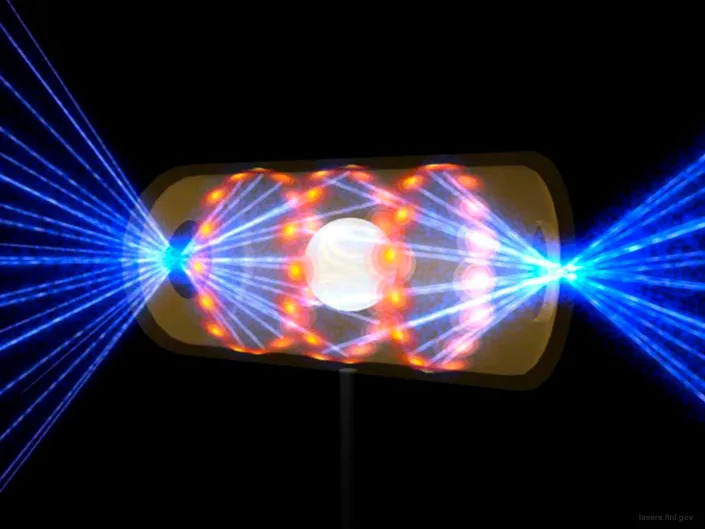
This illustration shows how lasers heat a target to the necessary conditions for nuclear fusion to occur.Lawrence Livermore National Laboratory
Nuclear fusion works by forcing together two atoms — most often hydrogen — to make a heavier one — like helium.
This explosive process releases massive amounts of energy, the Department of Energy explains. Fusion is the opposite of fission, the reaction that powers nuclear reactors used commercially today.
Fusion occurs naturally in the heart of the sun and the stars, providing these cosmic objects with fuel.
Since the 1950s, scientists have been trying to replicate it on Earth in order to tap into what nuclear energy advocates suggest is clean, cheap, and almost limitless electricity.
According to the International Atomic Energy Agency, fusion generates four times more energy per kilogram than the fission used to power nuclear plants, and nearly 4 million times more energy than burning oil or coal.
What’s more, unlike fossil fuels, fusion doesn’t release carbon dioxide — the greenhouse gas that’s the main driver of climate change — into the atmosphere. And unlike nuclear fission, fusion doesn’t create long-lived radioactive waste, according to the Department of Energy.
A view of Leningrad Nuclear Power Plant, in Leningrad, Russia on September 14, 2022.Sezgin Pancar/Anadolu Agency via Getty Images
But so far, nuclear fusion hasn’t solved our energy problems on a grand scale.
What Tuesday’s ‘breakthrough’ announcement means for the future
Tuesday’s announcement is likely a huge step forward in nuclear fusion energy, but applying the technology at commercial scale is likely still years away.
Chanda Prescod-Weinstein, a theoretical physicist, pointed out that the process the Department of Energy uses requires tritium, a rare and radioactive isotope of hydrogen.
“It may yet yield important information that is ultimately transformative. We don’t know yet,” Prescod-Weinstein tweeted on Monday. “Being able to do this once a day with a laser does not at all mean that this mechanism will scale!”
What is nuclear fusion, and could it power our future?
Haley Ott – December 12, 2022
What is nuclear fusion, and could it power our future?
Scientists, governments, and companies from around the world have been increasingly investing in a potential source of energy that could provide unlimited, clean power to everyone on Earth: nuclear fusion. Fusion is the process that powers the sun and the stars. It’s the opposite of nuclear fission, the process used in today’s nuclear power plants, which splits atoms apart.
U.S. Department of Energy was expected to announce in mid-December a major breakthrough in the quest to harness the power of nuclear fusion. The Financial Times reported that scientists at the government-run Lawrence Livermore National Laboratory (LLNL) in California had managed for the first time ever to create more energy in a fusion reactor than was required to drive the process — a “net energy gain.”
U.S. Rep. Ted Lieu, a California Democrat, said if confirmed it “could be a game changer for the world” in the bid to create sustainable electricity.
The interior of the Joint European Torus (JET) tokamak in the United Kingdom is shown with a superimposed plasma. / Credit: EUROfusion
In fusion, two atomic nuclei are combined to create a heavier nucleus, and the process releases energy. The reaction takes place in a state of matter called plasma, which is distinct from liquids, solids or gasses.
In the sun, nuclei collide at hot enough temperatures to overcome the electric repulsion that would normally keep them apart. When they are very close together, the attractive nuclear force between them becomes stronger than the electric repulsion, and they are able to fuse. The gravity of the sun ensures that nuclei are kept close enough together to increase their chances of colliding.
If humans can harness the power of fusion on an industrial scale, it could help create a virtually limitless source of clean energy on earth, with the power to generate four million times more energy than burning coal or oil, according to the U.N.’s International Atomic Energy Agency.
Scientists believe fusion plants would be much safer than today’s nuclear fission plants — if the process can be mastered.
Parts of the ITER tokamak are prepared for assembly, August 3, 2022. / Credit: Haley Ott/CBS News
“It can’t run away. It’s a very difficult reaction to sustain; it needs to be driven. Whereas fission can run on a chain reaction, and it has to be controlled,” Tim Luce, the head of science at ITER, told CBS News.
Fusion also creates much less radioactive byproduct than fission, and what it does leave behind is “not water soluble — they won’t get into the food supply, the water supply,” Luce said.
Some concepts for fusion reactors being developed today will use two types of hydrogen atoms, deuterium and tritium, for fuel.
Deuterium can be easily and cheaply extracted from sea water. Tritium, which does not exist abundantly in nature, could potentially be produced by a reaction between fusion-generated neutrons and lithium. It is also a byproduct of the nuclear fission process used in power plants around the world today.
Scientists have already managed to produce fusion reactions, but not without using more energy to trigger the process than they were able to produce through it.
Assuming scientists are able to achieve “net energy” — producing more energy than they use to create the fusion reaction — other things will still need to fall in place for fusion to become a secure, viable energy source for the world.
“We must also prepare the path broadly for fusion commercialization, going well beyond R&D,” Dr. Scott C. Hsu, lead fusion coordinator in the Office of the Undersecretary for Science and Innovation at the U.S. Department of Energy, said in a Senate hearing last month.
“This includes public engagement and energy justice, diverse workforce development, a regulatory framework that engenders public trust and supports timely deployment, market identification, attracting investment and commercialization partners, export controls, nuclear nonproliferation, cybersecurity, international coordination, building critical supply chains and manufacturing capabilities, and waste disposition,” Hsu said.
If There Is a ‘Male Malaise’ With Work, Could One Answer Be at Sea?
Talmon Joseph Smith – December 6, 2022
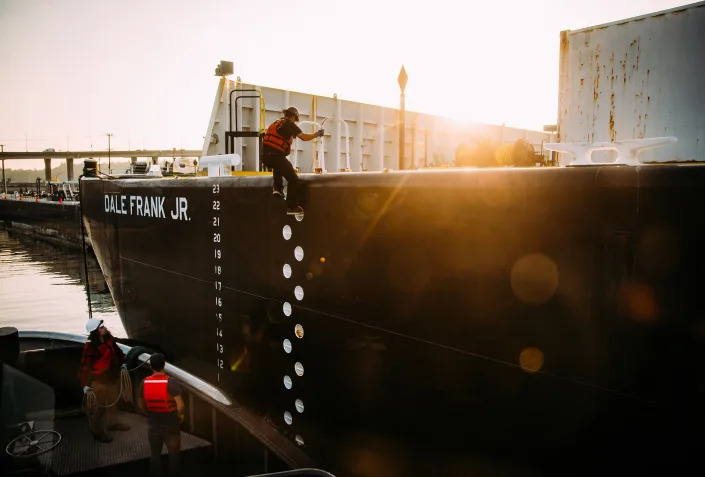
A crew member of the tugboat Millennium Falcon boards the tank barge Dale Frank Jr. in Seattle’s Elliott Bay, Oct. 5, 2022. (Lindsey Wasson/The New York Times)
SEATTLE — Before dawn on a recent day in the port of Seattle, dense autumn fog hugged Puget Sound and ship-to-shore container cranes hovered over the docks like industrial sentinels. Under the dim glimmer of orange floodlights, the crew of the tugboat Millennium Falcon fired up the engines for a long day of towing oil barges and refueling a variety of large vessels, like container ships.
The first thing to know about barges is that they don’t move themselves. They are propelled and guided by tugs like the Falcon, which is owned by Centerline Logistics, one of the largest U.S. transporters of marine petroleum. Such companies may not be household names, but the nation’s energy supply chain would have broken under the pandemic’s pressure without the steady presence of their fleets — and their crews.
“We’re a floating gas station,” said Bowman Harvey, a director of operations at Centerline, as he stood aboard the Falcon, his neck tattoo of the Statue of Liberty pivoting from the base of his flannel whenever he gestured at a machine or busy colleague nearby. Demand is solid, he said, and the enterprise is profitable. The company’s client list, which includes Exxon Mobil and Maersk, the global shipping giant, is robust. But manning the fleet has become a struggle.
Multiyear charter contracts for key lines of business — refueling ships, transporting fuel for refineries and general towing jobs — are locked in across all three coasts, plus Hawaii, Alaska and Puerto Rico, Harvey said. Yet as pandemic-related staffing shortages have eased in other industries, Centerline is still short on staff.
“Hands down,” Harvey said, “our biggest challenge right now is finding crew.”
Safely moving, loading and unloading oil at sea requires both simple and highly skilled jobs that cannot be automated. And the labor supply issues in merchant marine transportation are emblematic of the conundrum seen in a variety of decently paying, male-heavy jobs in the trades.
Over the past 50 years, male labor force participation, the share of men working or actively looking for work, has steadily fallen as female participation has climbed.
Some scholars have a grim explanation for the trend. Nicholas Eberstadt, the conservative-leaning author of “Men Without Work,” argues that there has been a swell in men who are “inert, written off or discounted by society and, perhaps, all too often, even by themselves.” Others, like Brookings Institution senior fellow Richard V. Reeves, put less emphasis on potential social pathologies but say a “male malaise” is hampering households and the economy.
Centerline employees are among about 75,000 categorized by the Department of Labor as water transportation workers, a group in which men outnumber women 5-to-1.
Though the gender split in the industry is more even for onshore office roles, workers and applicants for jobs on the water are predominantly male. Centerline says it has roughly 220 offshore crew members and about 35 openings.
Captains and company managers agree that changing attitudes toward work among young men play a part in the labor shortage. But the strongest consensus opinion is that structural demographic shifts are against them.
“We’re seeing a gray wave of retirement,” Harvey, 38, said.
Even though replacements are needed and, on the whole, lacking, there are new young recruits who are thriving, such as Noah Herrera Johnson, 19, who has joined Centerline as a cadet deckhand, an entry-level role.
On a Thursday morning out in the harbor, Herrera Johnson deftly unknotted, flipped and refastened a series of sailing knots as the crew unmoored from a sister boat that was aiding the refueling of a Norwegian Cruise Line ship. A small crowd of curious cruise passengers peeked down as he bopped through the sequences and the sun’s glare began to pierce the fog, bouncing off the undulating waves.
“I enjoy it a lot,” Herrera Johnson said of his work as he sliced some meat in the galley later on. (Some kitchen work and cleaning are part of the gig and the fraternal ritual of paying dues.)
“I get along with everyone — everyone has stories to tell,” he said. “And I was never good at school.”
Herrera Johnson, who is Mexican American and whose mother is from Seattle, spent most of his life in Cabo San Lucas, in Baja California, until he moved back to the United States shortly after turning 18.
Though entry-level roles aboard don’t require college credentials, new regulations have made at least briefly attending a vocational maritime academy a necessity for those who want to rise quickly up the crew ladder.
Because he is interested in becoming a captain by his late 20s, he began a two-year program at the nearby Pacific Maritime Institute in March, and he earns course credits for work at Centerline between classes.
He got his “first tug” in May: an escapade from New Orleans through the Panama Canal to San Francisco, patched with some bad weather.
“Two months, two long months. It was fun,” he said. “We had a few things going on. We lost steering a few times. But it was cool.”
In short, the industry needs far more Noahs. Many Centerline employees have informally become part-time recruiters — handing out cards, encouraging seemingly capable young men who may be between jobs, undecided about college or disillusioned with the standard 9-to-5 existence to consider being a mariner instead.
“When I’m trying to get friends or family members to come into the business,” Harvey said, “I make sure to remind them: Don’t think of this as a job, think of it as a lifestyle.”
Internet connections aboard are common these days, and there is plenty of downtime for movies, TV, reading, cooking and joking around with sea mates. (On slow days, captains will sometimes do doughnuts in the water like victorious race car drivers, turning the whole vessel into a Tilt-a-Whirl ride for the crew: Sea legs required.)
Of course, those leisurely moments punctuate days and nights of heaving lines, tying knots, making repairs, executing multiple refueling jobs and helping to navigate the tugboat: rain or shine, heat or heavy seas.
It’s “an adventurous life,” Harvey said, one that he and others acknowledge has its pros and cons. Mariners in this sector — whether they are entry-level deckhands, midtier mates and engineers, or crew-leading tankermen and captains — are usually on duty at sea in tight quarters and bunk beds for a month or more.
On the bright side, however, because of an “equal time” policy, full-time crew members are given roughly just as much time off for the same annual pay.
“When I go home, you know, I’m taking essentially 35 days off,” said Capt. Ryan Buckhalter, 48, who’s been a mariner for 20 years. For many, it’s a refreshing work-life balance, he said: none of the nettlesome emails or nagging office politics in between shifts often faced by the average modern office worker trying to get ahead.
Still, Buckhalter, who has a wife and a young daughter, echoed other crew members when he admitted that the setup could also be “tough at times” for families, including his own.
Crew members say they value knowing that their work, unlike more abstract service jobs, is essential to world trade. Average starting salaries for deckhand jobs are $55,000 a year (or about $26 an hour) and as high as $75,000 in places like the San Francisco area, with higher living costs.
The company also offers low-cost health, vision and dental care for employees, and a 401(k) plan with a company match. So CEO Matt Godden said in an interview that he didn’t think wages or benefits were a central reason that his company and competitors with similar offerings had struggled to hire.
“Right now a lot of companies are really hurting,” Buckhalter said. “You kind of got a little gap here with the younger generation not really showing up.”
If the labor market, like any other, operates by supply and demand, managers in the maritime industry say the supply side of the nation’s education and training system is also at fault: It has given priority to the digital over the physical economy, putting what are often called “the jobs of the future” over those society still needs.
Harvey adds that his industry is also grappling with increased Coast Guard licensing requirements for skilled roles, like boat engineers and tankermen, who lead the loading and discharging of oil barges. The regulations help ensure physical and environmental safety standards, Harvey said, but reduce the already limited pool of adequately credentialed candidates.
Women remain a rare sight aboard. Some captains make the case that this stems from hesitance toward a life of bunking and sharing a bathroom with a crop of guys at sea — a self-reinforcing dynamic that company officials say they are working to alleviate.
“We actually do have women that work on the vessels!” said Kimberly Cartagena, senior manager for marketing and public relations at Centerline. “Definitely not as much as men, but we do have a handful.”
Several economists and industry analysts suggested in interviews that another way for companies like Centerline to add crew members would be to expand their digital presence and do social media outreach. Godden said he remained wary.
“If you did something very simple, like you set up a TikTok account, and you sent somebody out every day to create varied little snippets, and you get viral videos of strong men pulling lines and big waves and big pieces of machinery,” Godden said, then a company would risk introducing an inefficient churn of young recruits who would “like the idea of being on a boat” but not be a fan of the unsexy “calluses” that come with the job.
But in the long term, he said, there is reason for optimism. He pointed to the recent establishment of the Maritime High School, which opened a year ago just south of the Seattle-Tacoma airport with its first ninth grade class.
“I think their first class is looking to graduate a hundred people, and then they got goals of getting up to 300, 400 graduates a year,” Godden said. He has been meeting with the school’s leaders this fall and is convinced they will help create the next pipeline in the profession.
“Yes, labor shortages may increase or decrease depending upon how the market works, but I always have this sense that there’s always going to be this sort of built-in group of folks who cannot — just cannot — stand seeing themselves sitting at a desk for 30, 40, 50 years,” Godden said.
“It’s this hands-on business almost like, you know, when you’re a kid and you’re playing with trucks or toys, and then you get to do it in the life-size version.”
‘We the People’ at heart of White House holiday decorations
Darlene Superville – November 28, 2022
Cross Hall of the White House is decorated for the holiday season during a press preview of holiday decorations at the White House, Monday, Nov. 28, 2022, in Washington. (AP Photo/Patrick Semansky)The Green Room of the White House is decorated for the holiday season during a press preview of holiday decorations at the White House, Monday, Nov. 28, 2022, in Washington. (AP Photo/Patrick Semansky)The East Colonnade of the White House is decorated for the holiday season during a press preview of holiday decorations at the White House, Monday, Nov. 28, 2022, in Washington. (AP Photo/Patrick Semansky)The White House Christmas Tree is on display in the Blue Room of the White House during a press preview of holiday decorations at the White House, Monday, Nov. 28, 2022, in Washington. (AP Photo/Patrick Semansky)A gingerbread replica of the White House and a sugar cookie replica of Independence Hall are on display in the State Dining Room of the White House during a press preview of holiday decorations at the White House, Monday, Nov. 28, 2022, in Washington. (AP Photo/Patrick Semansky)Depictions of Willow, bottom left, and Commander, the Biden family’s cat and dog, are part of decorations in the Vermeil Room of the White House during a press preview of holiday decorations at the White House, Monday, Nov. 28, 2022, in Washington. (AP Photo/Patrick Semansky)Cross Hall and the Blue Room of the White House are decorated for the holiday season during a press preview of holiday decorations at the White House, Monday, Nov. 28, 2022, in Washington. (AP Photo/Patrick Semansky)Former President Barack Obama’s portrait is on display alongside decorations in the Grand Foyer of the White House during a press preview of holiday decorations at the White House, Monday, Nov. 28, 2022, in Washington. (AP Photo/Patrick Semansky)The Blue Room of the White House is decorated for the holiday season during a press preview of holiday decorations at the White House, Monday, Nov. 28, 2022, in Washington. (AP Photo/Patrick Semansky)
WASHINGTON (AP) — “We the People” is Jill Biden’s holiday theme with White House decorations designed for “the people” to see themselves in the tree ornaments, mantel displays, mirrors and do-it-yourself creations that have turned the mansion’s public spaces into a winter wonderland.
“The soul of our nation is, and has always been, ‘We the People,’” the first lady said at a White House event honoring the volunteers who decorated over Thanksgiving weekend. “And that is what inspired this year’s White House holiday decoration.”
“The values that unite us can be found all around you, a belief in possibility and optimism and unity,” Jill Biden said. “Room by room, we represent what brings us together during the holidays and throughout the year.”
Public rooms are dedicated to unifying forces: honoring and remembering deceased loved ones, words and stories, kindness and gratitude, food and traditions, nature and recreation, songs and sounds, unity and hope, faith and light, and children.
A burst of pine aroma hits visitors as they step inside the East Wing and come upon trees adorned with mirrored Gold Star ornaments bearing the names of fallen service members.
Winter trees, woodland animals and glowing lanterns placed along the hallway help give the feeling of walking through snow.
Likenesses of Biden family pets — Commander and Willow, the dog and cat — first appear at the end of the hallway before they are seen later in the Vermeil Room, which celebrates kindness and gratitude, and the State Dining Room, which highlights children.
Recipes contributed by the small army of volunteer decorators spruce up the China Room’s mantel. Handwritten ones — for apple crisp and pizzelle, an Italian cookie — are family recipes shared by the first lady.
Aides say she was inspired by people she met while traveling around the country and by the nation’s founding documents, the Declaration of Independence and the Constitution.
A copy of the Declaration of Independence is on display in the library, while the always-show-stopping 300-pound (136 kilogram) gingerbread White House this year includes a sugar cookie replica of Philadelphia’s Independence Hall, where the documents were signed.
The executive pastry chef used 20 sheets of sugar cookie dough, 30 sheets of gingerbread dough, 100 pounds (45 kilograms) of pastillage, 30 pounds (14 kilograms) of chocolate and 40 pounds (18 kilograms) of royal icing to create the gingerbread and sugar cookie masterpiece.
A new addition to the White House collection this year is a menorah, which is lit nightly during the eight-day Jewish festival of Hanukkah. White House carpenters built the menorah out of wood that was saved from a Truman-era renovation and sterling silver candle cups.
Some 50,000 visitors are expected to pass through the White House for the holidays, including tourists and guests invited to nearly a month’s worth of receptions. Among them will be French President Emmanuel Macron, who will meet with President Joe Biden at the White House on Thursday and be honored at a state dinner, the first of the Biden administration.
More than 150 volunteers, including two of the first lady’s sisters, helped decorate the White House during the long Thanksgiving holiday weekend.
The decorations include more than 83,000 twinkling lights on trees, garlands, wreaths and other displays, 77 Christmas trees and 25 wreaths on the White House exterior. Volunteers also used more than 12,000 ornaments, just under 15,000 feet (4,500 meters) of ribbon and more than 1,600 bells.
Some of the decorations are do-it-yourself projects that the first lady hopes people will be encouraged to recreate for themselves, aides said. They include plastic drinking cups turned into bells and table-top Christmas trees made from foam shapes and dollar store ramekins.
Groupings of snowy trees fill corners of the East Room, which reflects nature and recreation, and scenes from four national parks are depicted on each fireplace mantel: Grand Canyon, Yellowstone, Great Smoky Mountains and Shenandoah.
In the Blue Room, the official White House Christmas tree — an 18 1/2-foot (5.6-meter) Concolor fir from Auburn, Pennsylvania — is decorated to represent unity and hope with handmade renderings of the official birds from all 57 territories, states and the District of Columbia.
The State Dining Room is dedicated to the next generation — children — and its trees are decorated with self-portrait ornaments made by students of the 2021 Teachers of the Year, “ensuring that children see themselves” in the décor, the White House said.
Hanging from the fireplace in the State Dining Room are the Biden family Christmas stockings.
“We the People” are celebrated again in the Grand Foyer and Cross Hall on the State Floor, where metal ribbons are inscribed with the names of all the states, territories and the District of Columbia.
As part of Joining Forces, her White House initiative to support military families, Jill Biden was joined by National Guard leaders from across the country, as well as National Guard families. Her late son, Beau Biden, was a major in the Delaware Army National Guard.
She met before the event with children from National Guard families, telling them she wanted to hear their stories because “you have served right alongside of your parents and you deserve to have your courage, and your sacrifice, recognized, too.”
The White House noted that the holiday guide book given to visitors was designed by Daria Peoples, an African American children’s book author who lives in Las Vegas. Peoples is a former elementary school teacher who has written and illustrated a series of picture books to support children of color, including those who have experienced race-based trauma.
Former surgeon general faces his wife’s cancer – and the ‘Trump Effect’
Manuel Roig-Franzia, The Washington Post – November 25, 2022
Former surgeon general faces his wife’s cancer – and the ‘Trump Effect’
Former surgeon general Jerome Adams and his wife, Lacey, often find themselves talking about what they have named the “Trump Effect.”
It followed them from Washington to their home in the Indianapolis suburbs. They felt it when he was exploring jobs in academia, where he would receive polite rejections from university officials who worried that someone who served in the administration of the former president would be badly received by their left-leaning student bodies. They felt it when corporations decided he was too tainted to employ.
Now, two years after Adams left office as only the 20th surgeon general in U.S. history, the couple feel it as acutely as ever. As Donald Trump announced this month that he will run for president again, they had hoped it all would have faded away by now.
They would rather talk about public health, in a very personal way. This summer, Lacey Adams was diagnosed with a third recurrence of melanoma. Both Adamses have been sharing her experiences on social media and in public appearances, hoping to spread a message about skin-cancer prevention. But the stigma of his association with Trump, even though neither of them is a supporter of his political campaign, remains.
Trump is “a force that really does take the air out of the room,” Adams, 48, said. “The Trump hangover is still impacting me in significant ways.” He said the 2024 Trump campaign “will make things more difficult for me.”
The former surgeon general’s predicament underscores one of the givens of today’s political environment: Association with Trump becomes a permanent tarnish, a kind of reverse Midas touch. Whether indicted or shunned or marginalized, a cavalcade of former Trump World figures have foundered in the aftermath of one of the more chaotic presidencies in modern American history.
Lacey saw it coming. She said she “hated Trump” and did not want her husband to leave his comfortable life in Indiana, where he practiced anesthesiology and served as state health commissioner under then-Indiana governor Mike Pence, who was Trump’s vice president when Jerome became surgeon general. Lacey, 46, worried about a lasting “stigma” but her husband talked her into supporting their move by saying he thought he could make a bigger difference inside the administration than outside it, especially when it came to his efforts to combat opioid addiction.
Now Jerome bristles at his forever label as “Trump’s surgeon general,” an image sealed by his highly public role during the much-criticized early White House response to the coronavirus pandemic. Other surgeons general, he feels, have been less intensely identified with the president who appointed them, permitting them to glide into a life of prestigious and sometimes lucrative opportunities, unencumbered by partisan politics.
Not him. “It was a lot harder than he thought to find a landing spot because of the Trump Effect,” Lacey said. For eight months after leaving office, Jerome could not find a job. The couple started to worry about how they would support their three children, especially since Lacey does not work outside the home.
“People still are afraid to touch anything that is associated with Trump,” Jerome said. Though he was quick to add in the interview that he is “not complaining.” He added, “It is context.”
Finally, in September 2021, Purdue University President Mitch Daniels, a former Indiana governor and Republican stalwart, hired Adams as the first executive director of health equity initiatives at the school.
Even as Adams was seeking to define the next chapter of his life, he was engaged in an almost constant battle on social media. His frequent tweets about everything from his personal life to public health issues have invariably drawn attacks from both the right and the left. Rather than ignore his critics, he has often punched back, engaging in Twitter spats that stretch for days.
He has battled on social media over his recommendation that people continue to wear masks in crowded indoor settings, his criticism of President Biden’s declaration of an end to the pandemic and about his advocacy for coronavirus vaccinations for children and for adults to get booster shots. He takes heat from the left for a pro-life stance on abortion and from the right for his opposition to laws that dictate what a doctor can say to a patient about abortion.
“I get mad at him for being addicted to Twitter,” Lacey said. “People hated him because he was part of Trump’s administration. Now the Trump people hate him.”
Carrie Benton, an Ohio medical lab scientist who has tangled with Jerome Adams on social media, is critical of what she considers “blanket statements” he is now making about topics such as masking. But she also feels he should still be held accountable for errors committed by the Trump administration early in the pandemic.
The pushback has done little to dissuade Adams. He invites debate. He wants to argue, genially. He tries to search for ways to use his platform as a former surgeon general that do not turn into politically charged spats.
“It is hard to find an issue,” he said.
In August, an issue found him, and it was precisely the topic that he had hoped would not feel so personal anymore. During a routine follow-up check, doctors discovered tumors on the outside of Lacey’s right thigh.
“Here we go again,” Lacey said to herself.
She had first been diagnosed with melanoma 12 years ago, in 2010, when she spotted a “weird mole.” She had it removed. She thought she was in the clear.
“No big deal,” she said.
As an adolescent growing up in the Midwest, she had been a frequent visitor to tanning beds. She did not worry much about the sun, even though she is very light-skinned. After having the mole removed, she changed her ways. Sunscreen. Long sleeves. She joked that her mother would chase her around with floppy hats. She started getting regular dermatology checks. It was all good. Until it was not.
In early 2018, just as her anesthesiologist husband was starting as surgeon general under Trump, she noticed lumps on her groin while shaving her bikini line. The doctor in her house, newly minted as America’s doctor, was constantly on the go as he sought to get a grasp on his job, serving as a public health advocate and overseeing thousands of members of the U.S. Public Health Service Commissioned Corps. “The doctor in my house is my absent-minded professor, always running in 100 directions,” she said.
So Lacey called the doctor next door: her neighbor in Indiana and dear friend, Amy Hoffman, an emergency room physician. When Hoffman realized why her friend was calling, she put her on the speakerphone, so that her husband, an oncologist, could listen in.
He just had one question: Was it on the same side as the melanoma from years earlier? Yes, she said. She could hear the worry in their voices.
“Stop unpacking,” she said they told her. “Stop going to fancy events with your husband. You need to make this a priority.”
She was soon ushered into a special area of Walter Reed National Military Medical Center reserved for high-ranking officials and their families. She was given a fuzzy robe with an embroidered White House logo.
“All of a sudden it is like you are in the Ritz-Carlton,” she recalled, and asked herself, “Why am I deserving of this special attention?”
A scan showed a tumor somewhere between the size of a pea and a grape. She needed to have surgery. Doctors eventually removed 12 lymph nodes, some of which were cancerous. While she was recovering from surgery, still groggy from the anesthesia, her husband came into the room with a request that was hard for her to comprehend through the fog of the drugs: He wanted her Facebook password.
She had taken a selfie at the medical center and posted it to her Facebook page, and she also took a little dig at the administration. The White House was not happy, he told her. They wanted it taken down.
In the months to come, she would again think she had beaten cancer. She underwent a year of immunotherapy treatments. She rang the bell, a tradition among cancer patients completing treatments, at Walter Reed after scans showed she was cancer free.
“Cancer, schmancer,” she thought.
There were other things to worry about. Her husband had come to Washington hoping to focus on opioid addiction, a plague that had hit members of his family. Instead, he was thrust into a much more public role with the arrival of the coronavirus. As the Trump administration struggled with effective responses, the new surgeon general kept setting off firestorms.
He shared a Valentine’s Day poem on social media that said the regular flu was a greater risk than covid and urged people to get flu shots. He told African Americans, who were contracting the coronavirus in disproportionate numbers, to take precautions to protect their “Big Mama.”
In each instance, he fumbled the messaging, making incomplete or poorly explained statements. He asked people not to buy masks because there was a shortage. He said people were at a greater risk of catching the regular flu than covid because projections by the Trump administration, later shown to be inaccurate, suggested more people would get the regular flu.
He used the words “Big Mama,” which led to accusations that he was using Trump-style racist dog whistles, because it was a term of affection in his own family that he thought would help him connect with African Americans.
Those missteps, which Adams has blamed on a partisan atmosphere, drew heavy criticism, which might be expected. What he had not anticipated was how people would come for his loved ones. On social media, trolls called his family ugly. They criticized Adams, who is Black, for marrying a White woman.
While her husband was trying to fend off critics and nasty commenters by sharpening his messaging, Lacey, like many Americans, was putting off medical appointments while limiting her movements because of the risk of contracting the coronavirus. She had a clear scan in January 2020. It was not until July that year that she returned for another scan. It revealed a tumor on her back.
The cancer had returned for a second round: This time it was Stage 4. She started immunotherapy. And again she beat it. For two years she passed routine scans, with good results. Then, this past summer, came the tests that revealed the cancer had returned. His wife cries herself to sleep some nights. He marvels at her resilience.
She has been speaking and writing about the disease that lurks inside her and threatens to deprive her of so many things she looks forward to, like the days her children, now 18, 16 and 12, graduate or get married.
Some days she is too ill from side effects of her treatments to do much. But other times she is full of energy and ready to go. People might look at her and not know she is sick, and that is one of her points: Melanoma is a stealthy disease, the doctors keep telling her. It can hide inside people without any outward signs. She had once had a mole, but other times nothing showed up on her skin. The disease was hiding from her.
She understands that she has been given a platform few have. No one would be listening to a mom from Indiana if she were not the wife of the former surgeon general.
The other day, her husband asked if he could post a photo of her on Twitter. She said for him to go ahead. It showed her in profile, lying in bed with the covers partly obscuring her face, on a day when she was not feeling great. He asked for prayers, but he also gave some advice: “See a dermatologist right away if a mole changes/looks different from your others!”
What happened next was nothing short of amazing to them. People wished the best for Lacey even though they were not fans of Jerome: “I don’t agree with your politics. God bless your sweet wife.” “I’m sorry your wife has cancer, even though I completely disagree with some of your decisions.”
Some people even wanted advice. “Should we worry about a single mole or look for odd shapes and changes in several?” That person did not mention Trump at all. That might be a person they could help. That might be, they dared to imagine, the end of the Trump Effect, and the beginning of a Lacey Effect.