As suicide rate keeps rising in Wisconsin, concentration in rural areas raises alarm

USA Today

As suicide rate keeps rising in Wisconsin, concentration in rural areas raises alarm

Natalie Eilbert – February 2, 2023

If you or someone you know is dealing with suicidal thoughts, call the National Suicide Prevention Lifeline at 988 or text “Hopeline” to the National Crisis Text Line at 741-741.

Karen Endres knows that farming involves stress unlike other occupations.

Its main variables — weather, livestock, crops, sales — are largely beyond control. Physical demands and time commitment never ease. Family relationships, management practices and work-life balance all overlap. In how many jobs, after all, might three generations of a family work, live and plan for the future together?

And if that business isn’t going well, who do they talk to?

“We don’t have a community to connect with others about mental health and stressors,” said Endres, who operates a dairy farm with her husband, and works as the farmer wellness coordinator at Wisconsin Farm Center’s Farmer Wellness Program, part of the state Department of Agriculture, Trade and Consumer Protection. “It can lead us to very dangerous places.”

The most recent Suicide in Wisconsin report shows a 32% increase in suicides in Wisconsin from 2000 to 2020. Suicide is now the state’s 10th leading cause of death. Over the last three years combined, suicide rates were higher among rural residents than among urban residents. And overwhelmingly, the suicides were among men.

Some rural counties dwarf the state suicide rate.

According to the Wisconsin Violent Deaths Reporting System, Milwaukee County’s rate of suicide deaths was about 12 per every 100,000 people in 2018, the most recent year of comprehensive reporting. Nearly 300 miles north in Ashland County, the rate of suicide deaths was about 25 per every 100,000. Milwaukee County has a population of nearly 930,000. Ashland’s population: About 16,000.

“North of Green Bay, the population is very sparse and resources are very sparse. You have a high proportion of veterans living in those counties, higher proportions of firearm ownership in those counties, and so there’s just a number of factors that play into that,” said Sara Kohlbeck, an assistant professor in the Department of Psychiatry at the Medical College of Wisconsin.

Kohlbeck conducts research in suicide and suicide prevention across different communities in Wisconsin. In 14 years, Kohlbeck has analyzed the deaths of nearly 200 Wisconsin farmers who died by suicide.

One farmer ended his life the day after receiving a change of address card in the mail from his wife, who’d recently left him. Another died a week after being “disgusted” over not being able to cut his own toenails, a result of new physical limitations. Yet another had just finished a phone call with a loan company. Another had a disappointing crop, the latest in a string of bad years. Still, others had blood alcohol content many, many times the legal limit.

Over 70% of farmer suicides involved firearms.

Kohlbeck and her team divided the hardships faced by farmers into five categories: acute interpersonal loss (a wife leaving), rugged individualism (a man facing new limitations), financial stress (a phone call from a loan company), the pressure of providing (struggling with the crops) and the lethal combination of alcohol and firearms.

“They’re just in an untenable scenario of inescapable pain,” Kohlbeck said. “Physical health issues, substance abuse, not having access to care, not being able to put food on the table — a lot of what I see is basic needs-related issues … that lead them to wanting to escape the situation they’re in.”

Chris Frakes is the group director of the Southwestern Wisconsin Community Action Program, an anti-poverty agency. Every three years, it does a community needs assessment for the five counties it oversees. In 2017, Frakes had heard so many stories of farmers struggling to get by, she expected them to reach out for help. But few did.

The silence and the growing farm crisis led to the program getting creative about upstream prevention. In 2021, it received nearly $1 million from the Wisconsin Partnership Program at the University of Wisconsin School of Medicine and Public Health to target farmers’ mental health over a five-year period.

But Frakes is the first to admit that assessing the needs of farmers involves face-to-face interactions, ability to crack coded language and, above all things, development of trust. To do so requires people to understand the culture.

“We’re trying to really empower community members to not only recognize when somebody’s in a crisis, or when somebody’s struggling with thoughts of suicide but also to notice when somebody’s really stressed or struggling,” Frakes said.
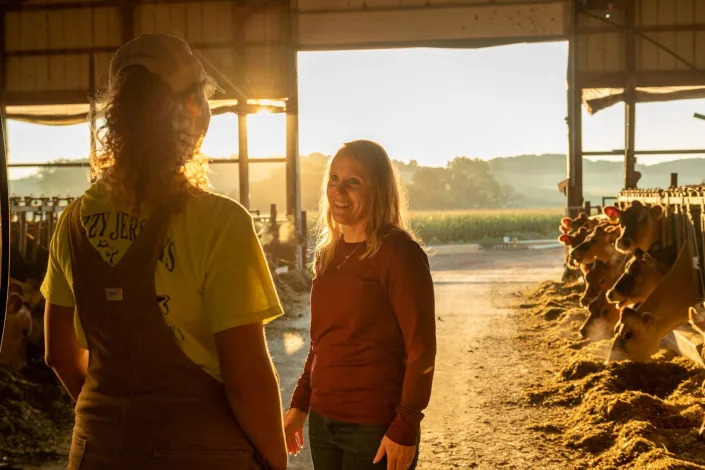
Karen Endres works as the farmer wellness coordinator at Wisconsin Farm Center's Farmer Wellness Program, part of the Wisconsin Department of Agriculture, Trade and Consumer Protection. She frequently pays visits to fellow farmers to learn about their specific mental health needs.
Karen Endres works as the farmer wellness coordinator at Wisconsin Farm Center’s Farmer Wellness Program, part of the Wisconsin Department of Agriculture, Trade and Consumer Protection. She frequently pays visits to fellow farmers to learn about their specific mental health needs.
Domino effects of self-blame in farmer culture

Brenda Statz, a cattle farmer in Loganville, lost her husband to suicide in 2018. Leon Statz had struggled with depression, and four months to the day after he made the decision to sell his dairy cows, he was rushed to the hospital following an overdose. It was his first suicide attempt.

But Statz found it hard to talk about his mental health. Instead, he talked about the torrential rainfall at the end of 2016 and throughout 2017 that left his hay perpetually damp. He talked about crops growing moldy, cows getting sick from mycotoxins in their feed, vet bills shooting through the roof, tractors running aground in the mud. He talked about corn left unharvested.

Something that will always stay with Brenda Statz is a conversation she had with a psychiatrist in Iowa who told her farmers are a specific breed of people who will “always find a way to blame themselves.” If milk price falls, they’ll berate themselves for not forward contracting. If the rainfall ruins the hay, they should have cut the hay earlier.

“They will always turn it around that it’s their fault that they did something wrong — whether this stuff is totally out of their control, they will still find a way to say they did something wrong, that they should have been paying attention,” Statz said. “That’s farming.”

Kohlbeck’s studies suggest that fewer than half of the people who die by suicide have a diagnosed mental health condition. In connection with self-blame and lost control, what has jumped out to her is a sense of having lost usefulness.

“When a farmer is stymied by physical health issues, an ability to care for the farm and for those relying on them is compromised—in fact, they may see themselves as ‘no good.’ Their identity as a strong, physically able hard worker may be shaken,” Kohlbeck wrote in a study published by The Journal of Rural Health.

Lethal combinations of firearms and substances

What makes Wisconsin’s farmer suicides stand out isn’t the number of deaths the state sees every year; those numbers are proportionate across Midwestern farmlands. It’s the fact that Wisconsin holds the troubling distinction of more binge drinkers than any other state in the United States, with 23.5% of its adult population drinking excessively, according to the Centers for Disease Control and Prevention.

“There’s a higher number of suicides here because we have three things: We’re readily accessible to guns, firearms, because people hunt; you can isolate out on your farm very easy and you don’t ever have to leave the farm; and another thing is, as a state, we’re known for drinking,” said Brenda Statz. “So, you mix those three things together and it could spell disaster for some.”

Brenda Statz, widow and the wife for 34 years to Leon Statz. Leon died by suicide after struggling to keep his farm solvent.

Kohlbeck noted that nearly 20% of the farmers who used a firearm in their suicides also had alcohol in their systems at the time of their death.

Statz knows all too well that farmers won’t go to doctors, even if they need to, partly because they’re “fixers, even when everything’s going wrong,” and partly because, she said, even if they’re on death’s door, “there’s always work to do on the farm,” she said.

“Many individuals use alcohol as a means for coping with the stress they encounter in their daily life,” Kohlbeck said. “And, unfortunately, alcohol alters your decision-making when you’re in a crisis.”

Self-medicating with alcohol and opioids, Endres said, is a big problem. Frakes, from Southwestern Wisconsin Community Action Program, said farmers keep what she calls a “rainy day” stock of opioids from previous injuries. At a time when opioids are reaching historic levels in the state, especially in rural areas, the combination leads to catastrophic outcomes for farmers, Frakes said.

In less than a decade, overdose deaths in Wisconsin have more than doubled, from 628 in 2014 to 1,427 in 2021, according to the state Department of Health Services. Hospitalizations for overdoses are rising as well, from 1,489 hospital visits in 2014 to 3,133 in 2021. It’s suspected that, in 2022, 8,622 ambulance runs within Wisconsin were the result of opioid overdose cases.

Largely rural counties — Menominee, Ashland, Forest, Douglas, Jackson and La Crosse counties — had suspected rates of opioid overdoses that far exceeded the state average, sometimes 100 times the state rate. Further, both deaths and misuse of opioids are higher in Wisconsin than the national average.

Finding a trustworthy doctor is a challenge

Since she lost her husband to suicide, Statz travels to churches across the state to promote mental health in farmers as part of her work with the Farmer Angel Network, a project out of the Wisconsin Farm Bureau Federation.

Part of the mindset for farmers is to work hard and work constantly. Farmers aren’t the type to ask for — or able to take even if they want it — time off and, instead, see it as a success when somebody works years without a break.

"Suicide doesn't just impact that one person; it impacts the whole family," says Brenda Statz, Sauk County Farm Bureau member who lost her husband Leon in 2018 following his third suicide attempt.
“Suicide doesn’t just impact that one person; it impacts the whole family,” says Brenda Statz, Sauk County Farm Bureau member who lost her husband Leon in 2018 following his third suicide attempt.

When she spoke as a representative of Farmer Angel Network with Reedsburg Area Medical Center, Statz explained to the staff there that farmers come to counseling because their spouses have “nagged them” or they’ve run out of other options.

That doesn’t mean they’re ready to talk, though.

“He’s going to come in your office and he’s going to talk about the weather, he’s going to talk about his dog, he’s going to talk about everything, except why he’s there,” Statz said. “You’re going need a little more time when a farmer comes in. They’re going to not be upfront right away, because they’re still checking you out to see how much they can trust you.”

Many farmers use small talk to gain trust, Frakes said. And they’re not prone to come out and say they’re struggling. Farmers can shoo terms like anxiety and depression away like flies, but when they start to talk about issues like crops failing, that’s the time to start paying attention, she said. Crop failure can mean livestock feed is short for the winter, which can interfere with farm operations.

“Instead of asking if a farmer is depressed, it’s better to ask them what’s keeping them up at night. Asking a slightly different set of questions to try and get at what’s really happening, plus small talk, is a way to build trust,” Frakes said.

The lack of access to counseling services — and an evergreen reluctance to seek care — means when a farmer does feel mental distress, it’s usually already an emergency. And for 21 Wisconsin counties, the closest option for residential crisis stabilization involves a trip across county lines.

Statz’s husband Leon attempted suicide three times in 2018. After Leon’s first attempt on April 21, it would be another six weeks before he could see a counselor. His second attempt happened in July.

He was dead by October.

Resources for farmers
  • Wisconsin Farm Center has a toll-free, 24/7 farmer wellness line for anyone experiencing depression or anxiety, or who just needs to talk, at (888) 901-255​8.
  • The Farmer Wellness Program offers weekly support groups for farmers and farmer couples to share challenges and offer encouragement, comfort, and advice nine months out of the year (except between July and September). Zoom meetings take place either on the first Monday or the first Tuesday​ of every month at 8 p.m.
  • The Farmer Angel Network provides its members with access to mental health resources through educational programs, informational flyers and trained personnel. Summer months include all-expense paid ice cream socials, kid-friendly drive-in movies and more for over 50 farm families to enjoy a night off.
  • Farm Well Wisconsin partners with local experts to build on and connect existing community resources, gives community leaders the tools they need to support and intervene in crises, and improves knowledge of health providers serving rural populations.
  • Wisconsin Farmers Union is a member-driven organization committed to enhancing the quality of life for family farmers, rural communities and all people through educational opportunities, cooperative endeavors and civic engagement.

More: One mom’s journey: The (lack of) paint on the walls colors the stigma surrounding mental health

Natalie Eilbert covers mental health issues for USA TODAY NETWORK-Central Wisconsin. She welcomes story tips and feedback. 

Republican-sponsored bill would fine teachers $5,000 for telling the truth

AZ Central – The Arizona Republic

Republican-sponsored bill would fine teachers $5,000 for telling the truth

EJ Montini, Arizona Republic – February 2, 2023

Yes, there’s a bill in the Arizona House that, if made into law, would allow confused, disgruntled, ignorant or just plain unhinged individuals to file a complaint that could lead to a teacher or professor receiving a $5,000 fine for the offense of telling the truth.

About race.

Republican-sponsored House Bill 2458 is one of many misguided pieces of legislation being pushed in state legislatures around the country to prevent “critical race theory” from being taught in schools.

In essence, it’s a way of trying to whitewash history, as if our children would be better served by ignorance than knowledge. Beyond that, the only education level at which the theory has been discussed is college or above, so banning it for lower levels is a solution for a problem that does not exist.

Republican lawmakers are playacting

Not that any of this matters. HB 2458 will not become law. The sponsor knows it. The Republicans attempting to push it through the House know it. The opposition knows it. Those members of the legislative staff who do all the work know it.

Still, it proceeds. Why?

Is CRT being taught?How the state’s new superintendent views it

Because right now, your tax dollars and mine are funding a very elaborate, very calculated, very expensive game of political make-believe being played by grown-ups in elected office who are trying to convince us their charade is real. But it is not.

It’s playacting. A fairy tale. A sham.

It is happening in Washington, D.C., in the Republican-controlled House of Representatives, and it is happening here in the Republican-controlled Arizona Legislature.

It’s a performance that accomplishes nothing

The people behind HB 2458 know that if it makes it through the House and the Senate, both narrowly controlled by Republicans, it would not be signed by Gov. Katie Hobbs.

If they were interested in finding common ground about the issue and fashioning some form of legislation that would pass they would have contacted the governor’s office and tried to negotiate a compromise.

But bills like this are meant to promote fantasy, not serve reality.

They’re meant show constituents how vehement and committed the people they elected can be when they get into office. Even though it accomplishes … nothing.

And lawmakers here are simply mimicking their brothers and sisters in D.C.

Arizona House mimics the theater in D.C.

A while back, for example, Arizona Republican Rep. Andy Biggs tweeted, “Last night, my Republican colleagues and I defeated the Democrats’ 87,000-person IRS army. We are working quickly to reverse the Democrats’ negligent policies. This is already a very good start to the 118th Congress!”First, there is no “87,000-person IRS army.” Second, the Republicans who control the House defeated nothing.

Before becoming law, any legislation passed by the House must get through the Senate, and then be signed by the president.

Republican members of the House from all over the country are boasting to constituents about bills that will never become law. And that they know will never become law because they never bothered to find common ground about the issue and fashion some form of legislation that would pass.

Biggs also is among a group of House members who filed a resolution to impeach Homeland Security Secretary Alejandro Mayorkas for “high crimes and misdemeanors.”

There’s an adage about politics, show business

Again, pure show.

That we’re paying for.

Even if House members squeezed their impeachment through, Biggs knows the Constitution requires a two-thirds vote of the Senate to convict. And he knows that would never happen.

What’s going on within our divided government these days, here and in Washington, is not governing. It’s burlesque. It’s opera. It’s vaudeville.

It’s musical theater, melodrama, comedy, tragedy and farce, all rolled into one.

It’s proof of a political adage that’s been around for decades: Politics is show business for ugly people.

While Ron DeSantis Is Fighting Culture Wars, Millions Of Floridians Are Losing Their Health Care

HuffPost

While Ron DeSantis Is Fighting Culture Wars, Millions Of Floridians Are Losing Their Health Care

Jonathan Cohn – January 31, 2023

Florida Gov. Ron DeSantis keeps making news with his self-described campaign to fight “woke” ideology. The latest headlines came about two weeks ago, when the Republican announced that he was prohibiting public high schools from offering a new Advanced Placement course in African American history. The course, his administration explained, “lacks significant educational value.” 

The announcement thrilled his supporters on the political right while infuriating his critics on the left. It’s safe to assume these were precisely the reactions that DeSantis wanted because they elevate his national profile and improve his chances of winning the 2024 Republican presidential nomination, which, as you may have heard, he is likely to seek.

But DeSantis has some other governing responsibilities, too. One of them is looking out for the health and economic well-being of Florida residents, including those who can’t pay for medical care on their own because they don’t have insurance. 

Florida has quite a lot of them ― nearly 2.6 million as of 2021, according to the most recent U.S. census figures. That’s about 12% of its population, which is well above the national average of 8.6%. It’s also more than all but four other states.

Floridians without insurance suffer because when they can’t pay for their medical care, they end up in debt or go without needed treatment or both. The state suffers, too, because it ends up with a sicker, less productive workforce as well as a higher charity care load for its hospitals, clinics and other pieces of the medical safety net.

DeSantis could do something about this. He has refused. In fact, as of this moment, his administration is embarking on a plan that some analysts worry could make the problem worse.

This story probably deserves some national attention as well.

DeSantis Has A Clear Record On Health Care

The simple, straightforward reason so many Floridians have no health insurance is that its elected officials won’t sign on to the Affordable Care Act’s Medicaid expansion, which offers states extra federal matching funds if they make the program available to everybody with incomes below or just above the poverty line.

Most states have now done just that. It’s the single biggest reason that the uninsured rate nationwide is at a record low. But eleven states have held out, leaving in place the much more limited eligibility standards they had established before the Affordable Care Act took effect. 

Florida is one of them. Childless adults in the Sunshine State can’t get Medicaid unless they fall into a special eligibility category, like having a disability. And even adults with kids have a hard time getting onto the program because the standard income guidelines are so low ― about 30% of the poverty line, which last year worked out to less than $7,000 for a family of three. That’s not enough to cover rent, food and other essentials, let alone buy a health insurance policy.

The non-expansion states all have Republican governors or legislatures or both, and are nearly all in the Deep South. They represent the last line of resistance against Obamacare, which Republicans have spent more than a decade fighting and, famously, came very close to repealing in 2017.

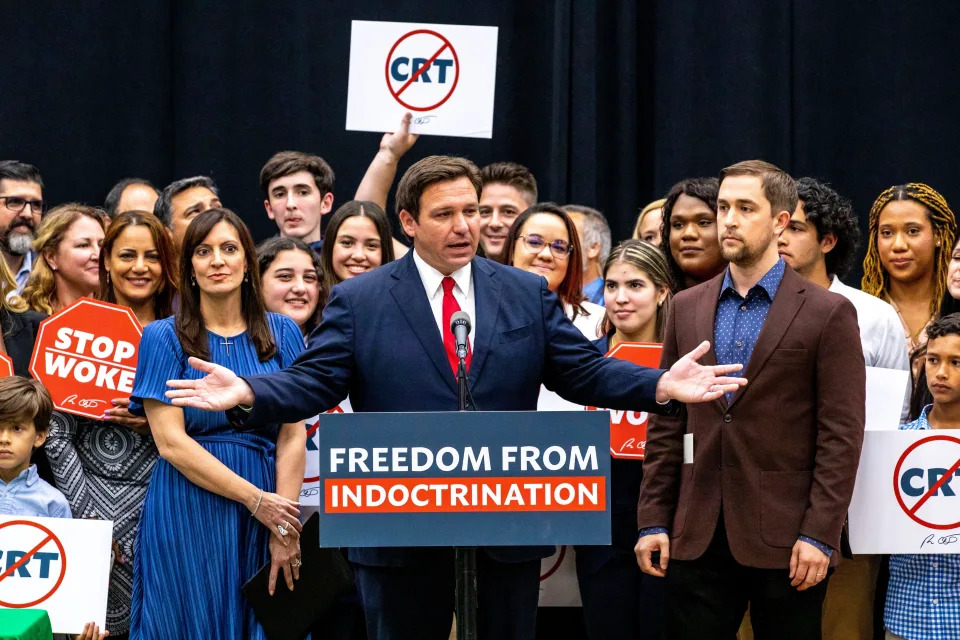
Gov. Ron DeSantis, shown at a recent appearance in Daytona Beach, doesn't have much to say about Medicaid expansion -- or why he's opposed it.
Gov. Ron DeSantis, shown at a recent appearance in Daytona Beach, doesn’t have much to say about Medicaid expansion — or why he’s opposed it.

Gov. Ron DeSantis, shown at a recent appearance in Daytona Beach, doesn’t have much to say about Medicaid expansion — or why he’s opposed it.

DeSantis was no mere bystander to that effort. As a Republican serving in the U.S. House, he was part of a far-right caucus that voted against the first ACA repeal bill that leadership brought to the floor because, DeSantis and his allies said, it didn’t undo enough of the law’s protections for people with pre-existing conditions. 

GOP leaders eventually put forward a more aggressive repeal. DeSantis and his colleagues voted yes on that one, but it failed in the Senate.

With repeal now off the political agenda, the main question about the Affordable Care Act is whether states like Florida will follow the lead of all the others and finally open up its Medicaid program to everybody living at or just above the poverty line.

If it did, several hundred thousand currently uninsured residents would become eligible for the program, according to independent estimates. 

End of a Pandemic Relief Effort And Its Impact

Florida’s refusal to expand Medicaid is not a new story. But it is newly relevant because of an expiring federal pandemic measure and its likely effect on access to health care for low-income residents.

When COVID-19 hit, the federal government offered states extra money to fund Medicaid as long as states agreed not to disenroll anybody who joined or was already on the program ― on the theory that in the midst of a public health emergency, the overwhelming priority was maximizing the number of people with insurance. 

That arrangement is about to end. States will have a year to go through their Medicaid enrollment files, removing anybody who cannot reestablish their eligibility. And in every state, significant numbers of people are likely to lose coverage ― in some cases simply because they aren’t aware their coverage is in jeopardy or because they can’t make their way through a complex, confusing process their state has put in place. 

Officials in some states are going out of their way to minimize coverage losses. Oregon, for example, will be letting all children younger than 6 stay on Medicaid automatically. Illinois is making it easier for adults to stay on the program while taking more time to go through the process of reestablishing eligibility.

Florida just announced its plan and, according to Joan Alker, executive director of Georgetown University’s Center for Children and Families, the state seems intent on pushing ahead quickly even though its own projections suggest 1.75 million Floridians could lose insurance as a result. 

“They’re very anxious to get almost 2 million people off of Medicaid, which is scary,” Alker told HuffPost. She added that she is especially worried about children, who represent a disproportionate number of Florida’s Medicaid population because the income guidelines for young people are looser than they are for adults.

Alker was careful to say that it was impossible to be sure how Florida will ultimately handle the process of reviewing Medicaid enrollment. She also said she was pleased that state officials made statements acknowledging the special predicament of children. 

A spokesperson for the Florida Policy Institute, a nonprofit organization that has been tracking the state’s plans, offered a similarly mixed assessment ― crediting state officials with an “intentional” plan that stressed communicating with parents clearly about their options while stating that it’s “too soon to tell whether the efforts outlined in the plans will be enough to make sure that Medicaid-eligible Floridians keep their coverage.”

But however Florida officials decide to handle this process, and however it works out, one thing is clear: If Florida were part of the Medicaid expansion, the number of people losing health coverage would be a lot lower.

The Uninsured In Florida Have A Difficult Time

Frederick Anderson, a family medicine physician, knows better than most what a difference health insurance can make for people in Florida. He oversees medical operations at a Miami-area clinic focusing on underserved populations, where large numbers of people have no insurance. He thinks a lot about one woman in particular. 

She’s the primary caregiver for a son with autism, Anderson told HuffPost, and she has no insurance because her below-poverty income is too high for the state’s Medicaid threshold. She’s been suffering from serious, debilitating headaches, but she can’t pay for the MRI she needs or find a neurologist with an open appointment.

It’s a problem he sees all the time, Anderson explained, because there just aren’t enough safety net providers to meet the demand. Patients end up waiting for the care they need or skipping it altogether. “We do the best we can,” Anderson said, “but many of our patients will need to see orthopedists, or neurologists or you name it, and these individuals have no easy access to those services. Or they would benefit from certain medications that I would like to prescribe for them, but … it’s just unaffordable.”

Anderson lives and works in Miami-Dade County, where the uninsured rate is among the highest in Florida. But rural areas of Florida face their own, special challenges.

The economics of health care make it more difficult for rural hospitals to survive without help from Medicaid, which is why in states like Florida that haven’t expanded eligibility, rural hospitals are struggling and in some cases closing, depriving communities of more than just acute care.

“We think of hospitals as places to go when you have something major that is wrong,” Scott Darius, executive director of the advocacy group Florida Voices for Health Care, told HuffPost. “But in those rural areas, we’ve learned, hospitals are the primary care location for large portions of the population.”

DeSantis Hasn’t Had Much To Say On Medicaid

These accounts are consistent stories reporters covering health care hear all the time. They also echo some of the anecdotes that an organization called the Florida Health Justice Project has collected on its website as part of an ongoing campaign, in conjunction with other advocacy groups, to bring expansion to Florida.

“Florida ranks [near the bottom] for the rate of uninsured residents,” Alison Yager, executive director at the Health Justice project, told HuffPost. “Expanding Medicaid, as all but 11 of our sister states have done, would surely boost our shameful showing.”

But the cause has been a tough sell in Tallahassee, where Republicans have had nearly uninterrupted control of the Florida’s lawmaking process since 1999. Two previous efforts to get expansion through the state legislature failed. DeSantis’ spokesperson confirmed in 2021 that he remained opposed to it.

That was two years ago, and since then he’s managed to avoid saying much about the issue, including to HuffPost, despite several inquiries to his office over the past three weeks. Medicaid expansion got only sporadic attention in the 2022 gubernatorial campaign, although Democrats tried initially to make it an issue, and it didn’t draw so much as a mention in the lone debate DeSantis had with Democratic nominee Charlie Crist.

A year before that, DeSantis signed a much narrower measure: a 2021 bipartisan bill increasing Medicaid’s postpartum coverage from 60 days to a year. It was a priority for the outgoing GOP House speaker, and it’s always possible political circumstances will align and lead to more legislation like that in the future.

But DeSantis’ hostility to government health care programs runs deep.

Protesters rally near the U.S. Capitol after House Republicans voted to repeal the Affordable Care Act in 2017. DeSantis was one of those House Republicans.

Protesters rally near the U.S. Capitol after House Republicans voted to repeal the Affordable Care Act in 2017. DeSantis was one of those House Republicans.

Long before he was attacking “critical race theory” lessons and supposed sexual brainwashing in the schools, he was railing against Obama-era programs generally (as New York magazine’s Jonathan Chait has explained) and the Affordable Care Act specifically (as The New York Times’ Jamelle Bouie has written) as fundamentally incompatible with American principles of freedom and private property.

DeSantis may also have more practical objections to expanding Medicaid. Maybe he thinks it’s too big a drain on state finances or too wasteful a program, as many conservatives and libertarians argue. Maybe he thinks Medicaid does more harm than good for beneficiaries or that people on the program could find insurance on their own if only they were more industrious and got paying jobs. 

Those latter claims don’t hold up well under scrutiny. The majority of Floridians missing out on Medicaid expansion are in families with at least one worker, according to the Center on Budget and Policy Priorities. And when the uninsured get Medicaid, their access to care and financial security improves, according to a large and still-growing pile of research

Their health outcomes also seem to improve, though the evidence on how the Medicaid expansion has affected mortality specifically remains the subject of some debate.

The Politics of Medicaid May Be Different Nationally

Advocates today have their eyes on trying to expand Medicaid through a ballot initiative, which is the way it’s happened in Idaho, Missouri and several other states where Republican lawmakers had blocked it. 

But Florida Republicans are already working to make that process more difficult because it’s a way for voters to circumvent GOP opposition to popular causes. And it’s not like waging a ballot campaign is easy now. Organizers recently told the Tampa Bay Times that 2026 is the earliest they could realistically get a Medicaid measure on the ballot.

As for DeSantis, his record on health care could become a key point of contrast in a hypothetical 2024 White House campaign. President Joe Biden, after all, is the guy who called Obamacare a “big fucking deal” and just signed into law reforms that make the program’s financial assistance more generous. Any conceivable replacement on the Democratic ticket would have a similar record of votes in Congress or state actions to support coverage expansions

There’s no way to be sure how an issue will play out in the next election ― or whether it will even matter at all. But it’s not hard to imagine the contrast on health care working to the Democrats’ advantage. The Affordable Care Act is relatively popular these days, and Medicaid expansion tends to poll well even among Republican voters

That may help explain why DeSantis and his spokespeople have so little to say on the subject. But that silence doesn’t change the real-world impact of his posture ― or what it reveals about his priorities.

DeSantis Takes On the Education Establishment, and Builds His Brand

The New York Times

DeSantis Takes On the Education Establishment, and Builds His Brand

Stephanie Saul, Patricia Mazzei and Trip Gabriel – February 1, 2023

Patricia Okker, facing camera, president of New College of Florida in Sarasota, is embraced by a supporter on Tuesday, Jan. 31, 2023.  (Todd Anderson/The New York Times)
Patricia Okker, facing camera, president of New College of Florida in Sarasota, is embraced by a supporter on Tuesday, Jan. 31, 2023. (Todd Anderson/The New York Times)

Gov. Ron DeSantis of Florida, as he positions himself for a run for president next year, has become an increasingly vocal culture warrior, vowing to take on liberal orthodoxy and its champions, whether they are at Disney, on Martha’s Vineyard or in the state’s public libraries.

But his crusade has perhaps played out most dramatically in classrooms and on university campuses. He has banned instruction about gender identity and sexual orientation in kindergarten through third grade; limited what schools and employers can teach about racism and other aspects of history; and rejected math textbooks en masse for what the state called “indoctrination.” Most recently, he banned the College Board’s Advanced Placement courses in African American studies for high school students.

On Tuesday, DeSantis, a Republican, took his most aggressive swing yet at the education establishment, announcing a proposed overhaul of the state’s higher education system that would eliminate what he called “ideological conformity.” If enacted, courses in Western civilization would be mandated; diversity and equity programs would be eliminated; and the protections of tenure would be reduced.

His plan for the state’s education system is in lockstep with other recent moves — banning abortions after 15 weeks of pregnancy, shipping a planeload of Venezuelan migrants to Martha’s Vineyard in Massachusetts and stripping Disney, a once politically untouchable corporate giant in Florida, of favors it has enjoyed for half a century.

His pugilistic approach was rewarded by voters, who reelected him by a 19 percentage-point margin in November.

Appearing on Tuesday at the State College of Florida, Manatee-Sarasota, one of the state’s 28 publicly funded state and community colleges, DeSantis vowed to turn the page on agendas that he said were “hostile to academic freedom” in Florida’s higher education system. The programs “impose ideological conformity to try to provoke political activism,” DeSantis said. “That’s not what we believe is appropriate for the state of Florida.”

He had already moved to overhaul the leadership of the New College of Florida, a small liberal arts school in Sarasota that has struggled with enrollment but calls itself a place for “freethinkers.” It is regarded as among the most progressive of Florida’s 12 public universities.

DeSantis pointed to low enrollment and test scores at New College as part of the justification for seeking change there.

“If it was a private school, making those choices, that’s fine, I mean, what are you going to do,” he said. “But this is paid for by your tax dollars.”

The college’s board of trustees, with six new conservative members appointed by DeSantis, voted in a raucous meeting Tuesday afternoon to replace the president and agreed to appoint Richard Corcoran, a former state education commissioner, as the interim president beginning in March.

Corcoran will replace Patricia Okker, a longtime English professor and college administrator who was appointed in 2021.

While expressing her love for the college and its students, Okker called the move a hostile takeover. “I do not believe that students are being indoctrinated here at New College,” she said. “They are taught. They read Marx and they argue with Marx. They take world religions. They do not become Buddhists in February and turn into Christians in March.”

DeSantis also announced Tuesday that he had asked the Legislature to immediately free up $15 million to recruit new faculty and provide scholarships for New College.

In all, he requested from the Legislature $100 million a year for state universities.

“We’re putting our money where our mouth is,” he said.

New College is small, with nearly 700 students, but the shake-up reverberated throughout Florida, as did DeSantis’ proposed overhaul.

Andrew Gothard, president of the state’s faculty union, said the governor’s statements on the state’s system of higher education were perhaps his most aggressive yet.

“There’s this idea that Ron DeSantis thinks he and the Legislature have the right to tell Florida students what classes they can take and what degree programs,” said Gothard, who is on leave from his faculty job at Florida Atlantic University. “He says out of one side of his mouth that he believes in freedom and then he passes and proposes legislation and policies that are the exact opposite.”

At the board meeting, students, parents and professors defended the school and criticized the board members for acting unilaterally without their input.

Betsy Braden, who identified herself as the parent of a transgender student, said her daughter had thrived at the school.

“It seems many of the students that come here have determined that they don’t necessarily fit into other schools,” Braden said. “They embrace their differences and exhibit incredible bravery in staking a path forward. They thrive, they blossom, they go out into the world for the betterment of society. This is well documented. Why would you take this away from us?”

Corcoran, a DeSantis ally, had been mentioned as a possible president of Florida State University, but his candidacy was dropped following questions about whether he had a conflict of interest or the appropriate academic background.

A letter from Carlos Trujillo, the president of Continental Strategy, a consulting firm where Corcoran is a partner, said the firm hoped that his title at New College would become permanent.

Not since George W. Bush ran in 2000 to be “the education president” has a Republican seeking the Oval Office made school reform a central agenda item. That may have been because, for years, Democrats had a double-digit advantage in polling on education.

But since the pandemic started in 2020, when many Democratic-led states kept schools closed longer than Republican states did, often under pressure from teachers unions, some polling has suggested that education now plays better for Republicans. And Glenn Youngkin’s 2021 victory in the Virginia governor’s race, after a campaign focused on “parents’ rights” in public schools, was seen as a signal of the political potency of education with voters.

DeSantis’ attack on diversity, equity and inclusion programs coincides with the recent criticisms of such programs by conservative organizations and think tanks.

Examples of such initiatives include campus sessions on “microaggressions” — subtle slights usually based on race or gender — as well as requirements that candidates for faculty jobs submit statements describing their commitment to diversity.

“That’s basically like making people take a political oath,” DeSantis said Tuesday. He also attacked the programs for placing a “drain on resources and contributing to higher costs.”

Supporters of diversity, equity and inclusion programs and diverse curricula say they help students understand the broader world as well as their own biases and beliefs, improving their ability to engage in personal relationships as well as in the workplace.

DeSantis’ embrace of civics education, as well as the establishment of special civics programs at several of the state’s 12 public universities, dovetails with the growth of similar programs around the country, some partially funded by conservative donors.

The programs emphasize the study of Western civilization and economics, as well as the thinking of Western philosophers, frequently focusing on the Greeks and Romans. Critics of the programs say they sometimes gloss over the pitfalls of Western thinking and ignore the philosophies of non-Western civilizations.

“The core curriculum must be grounded in actual history, the actual philosophy that has shaped Western civilization,” DeSantis said. “We don’t want students to go through, at taxpayer expense, and graduate with a degree in zombie studies.”

The shake-up of New College, which also included the election of a new board chair, may be ongoing and dramatic, given the six new board members appointed by DeSantis.

They include Christopher Rufo, a senior fellow at Manhattan Institute who is known for his vigorous attacks on “critical race theory,” an academic concept that historical patterns of racism are ingrained in law and other modern institutions.

At the time of his appointment, Rufo, who lives and works in Washington state, tweeted that he was “recapturing” higher education.

Another new board member is Eddie Speir, who runs a Christian private school in Florida. He had recommended in a Substack posting before the meeting that the contracts of all the school’s faculty and staff be canceled.

The other new appointees include Matthew Spalding, dean of the Washington, D.C., campus of Hillsdale College, a private college in Michigan known for its conservative and Christian orientations. An aide to the governor has said that Hillsdale, which says it offers a classical education, is widely regarded as the governor’s model for remaking New College.

In addition to the governor’s six new appointees, the university system’s board of governors recently named a seventh member, Ryan T. Anderson, the head of a conservative think tank, the Ethics and Public Policy Center, which applies the Judeo-Christian tradition to contemporary questions of law, culture and politics. His selection was viewed as giving DeSantis a majority vote on the 13-member board.

These jobs are most likely to be replaced by ChatGPT and AI

CBS News

These jobs are most likely to be replaced by ChatGPT and AI

Megan Cerullo – February 1, 2023

Chatbots and artificial intelligence tools like ChatGPT that can almost instantly produce increasingly sophisticated written content are already being used to perform a variety of tasks, from writing high school assignments to generating legal documents and even authoring legislation.

As in every major cycle of technological innovation, some workers will be displaced, with artificial intelligence taking over their roles. At the same time, entirely new activities — and potential opportunities for employment — will emerge.

Read on to learn what experts say are the kinds of workplace tasks that are most vulnerable to being taken over by ChatGPT and other AI tools in the near term.

Computer programming

ChatGPT can write computer code to program applications and software. It can check human coders’ language for errors and convert ideas from plain English into programming language.

“In terms of jobs, I think it’s primarily an enhancer than full replacement of jobs,” Columbia Business School professor Oded Netzer told CBS MoneyWatch. “Coding and programming is a good example of that. It actually can write code quite well.”

That could mean performing basic programming work currently done by humans.

“If you are writing a code where really all you do is convert an idea to a code, the machine can do that. To the extent we would need fewer programmers, it could take away jobs. But it would also help those who program to find mistakes in codes and write code more efficiently,” Netzer said.

Basic email

Writing simple administrative or scheduling emails for things like setting up or canceling appointments could also easily be outsourced to a tool like ChatGPT, according to Netzer.

“There’s hardly any creativity involved, so why would we write the whole thing instead of saying to the machine, ‘I need to set a meeting on this date,'” he said.

Mid-level writing

David Autor, an MIT economist who specializes in labor, pointed to some mid-level white-collar jobs as functions that can be handled by AI, including work like writing human resources letters, producing advertising copy and drafting press releases.

AI ChatGPT is helping CEOs think. Will it also take your job?AI experts on whether you should be “terrified” of ChatGPTPrinceton student says his new app helps teachers find ChatGPT cheats

“Bots will be much more in the realm of people who do a mixture of intuitive and mundane tasks like writing basic advertising copy, first drafts of legal documents. Those are expert skills, and there is no question that software will make them cheaper and therefore devalue human labor,” Autor said.

Media planning and buying

Creative industries are likely to be affected, too. Noted advertising executive Sir Martin Sorrell, founder of WPP, the world’s largest ad and PR group, said on a recent panel that he expects the way companies buy ad space will become automated “in a highly effective way” within five years.

“So you will not be dependent as a client on a 25-year old media planner or buyer, who has limited experience, but you’ll be able to pool the data. That’s the big change,” he said.

Legal functions

ChatGPT’s abilities translate well to the legal profession, according to AI experts as well as legal professionals. In fact, ChatGPT’s bot recently passed a law school exam and earned a passing grade after writing essays on topics ranging from constitutional law to taxation and torts.

“The dynamic that happens to lawyers now is there is way too much work to possibly get done, so they make an artificial distinction between what they will work on and what will be left to the wayside,” said Jason Boehmig, co-founder and CEO of Ironclad, a legal software company.

Common legal forms and documents including home lease agreements, wills and nondisclosure agreements are fairly standard and can be drafted by a an advanced bot.

“There are parts of a legal document that humans need to adapt to a particular situation, but 90% of the document is copy pasted,” Netzer of Columbia Business School said. “There is no reason why we would not have the machine write these kinds of legal documents. You may need to explain first in English the parameters, then the machine should be able to write it very well. The less creative you need to be, the more it should be replaced.”

AI-powered “robot” lawyer won’t argue in court after jail threatsChatGPT bot passes law school exam

“There aren’t enough lawyers to do all the legal work corporations have,” Boehmig added. “The way attorneys work will be dramatically different. If I had to put a stake down around jobs that won’t be there, I think it’s attorneys who don’t adapt to new ways of working over the next decade. There seem to be dividing lines around folks who don’t want to change and folks who realize they have to.”

Florida rejected AP African American Studies. Here’s what’s actually being taught in the course

USA Today

Florida rejected AP African American Studies. Here’s what’s actually being taught in the course

Marina Pitofsky, USA TODAY – February 1, 2023

The head of the College Board defended its new Advanced Placement course on African American studies, weeks after Florida said it would ban the class.

The College Board on Wednesday released its official – and revised–framework for the course, and CEO David Coleman told USA TODAY that “at the College Board, we don’t really look to the statements of political leaders.

“We look to the record of history.”

About a week earlier, on Jan. 24, a spokesperson for Republican Gov. Ron DeSantis claimed on Twitter that the College Board “will be revising the course for the entire nation” due to the governor’s “principled stand for education over identity politics.”

The new framework does address many of the concerns Florida raised, and those topics are not included, or they are included only as optional project topics. But Coleman was firm that the changes to the framework have been in the works for a year.

Board shake-ups, threats to tenure and money: How conservatives are reshaping colleges

The course, which is 10 years in the making, already is being taught in 60 high schools. Next school year, it will be taught at approximately 500 high schools nationwide before being offered at any school interested in providing the course. It emerges at the same time as a racial reckoning in the United States and the debate over the teaching of critical race theory, a college-level concept about systemic racism.

“We hope that everyone will give (the course) a fresh look, a fresh read because we think that that people will be impressed with what they see there,” he said. “What they’ll find is an unflinching encounter with the facts and evidence of African American history and culture.”

‘Lacks educational value’: Florida Gov. Ron DeSantis blocks high school African-American AP studies class

What do CRT and DEI really mean? Schools keep talking about critical race theory and ‘diversity, equity and inclusion’

Why is AP African American Studies in the spotlight?

Officials in Florida rejected the new AP course, arguing that the class for high school students does not comply with state law.

Florida Gov. Ron DeSantis addresses a crowd before publicly signing the Stop Woke bill in April 2022.

Florida education Commissioner Manny Diaz Jr. last month shared a list of concerns about the course, ranging from broad concepts to specific authors. DeSantis said the state rejected the course because it included the study of “queer theory” and movements that advocate for “abolishing prisons.” 

The decision quickly drew criticism inside and outside of the state.

White House press secretary Karine Jean-Pierre called the move “incomprehensible,” responding to a question from USA TODAY “Let’s be clear. They didn’t block AP European history. They didn’t block our art history. They didn’t block our music history.”

And last week, civil rights attorney Ben Crump said if Florida officials continue to reject the course, legal action could follow. 

‘Black history is not inferior’: Black leaders object to Florida’s ‘culture war against African Americans’

What’s actually being taught in this class for teenagers? What can high school students expect to learn? USA TODAY analyzed the official framework for AP African American Studies.

‘Incomprehensible’ White House slams DeSantis administration for rejecting AP Black studies

What’s actually being taught in AP African American Studies

Brandi Waters, AP African American Studies’ senior director, told USA TODAY the class is “an exciting course for students because it helps them to see a fuller picture of the world around them.”

The course – which students can use to earn college credit depending on their scores on its exam and whether an institution accepts the class – is broken up into four units, each of which includes dozens of potential topics and assignments.

“So what (students are) really asking for when they asked for this class is the tools that the field of African American Studies gives them, which is this picture of how different communities are really interrelated,” Waters said, “a diversity of lived experience and feeling like they now have more lenses through which to view American life and how disparate communities in America are connected to the broader world.”

AP exam changes: Helpful for test prep, or more money for the College Board?

National Education Association president: Black history is American history. DeSantis is stealing our students’ freedom to learn it.

The framework also includes a research project for students, asking them to analyze a topic or theme from the field of African American Studies. The document stresses that the project topics can “be refined by local states and districts.”

Here’s how the class is laid out for educators and students:

  • Origins of the African Diaspora: This unit includes information on early African empires and kingdoms, before and during the transatlantic slave trade.
  • Freedom, Enslavement and Resistance: Students may learn about the slave trade, how slavery worked to “assault the bodies, minds and spirits of enslaved Africans and their descendants,”  the abolition of slavery and more. It includes sources such as maps snowing the slave trade out of Africa, Frederick Douglass’ speech “What to the Slave is the Fourth of July” and other materials.
  • The Practice of Freedom: This section includes the period known as Reconstruction in America, as well as Jim Crow laws and other political, social and cultural movements. Students might explore the 13th, 14th and 15th amendments to the Constitution, writings from W.E.B. Du Bois and Booker T. Washington or the Supreme Court’s 1896 ruling in Plessy v. Fergusonwhen the court ruled racial segregation was constitutional. 
  • Movements and Debates: Students may learn about the Civil Rights Movement, housing discrimination against Black Americans, the Black Power Movement, feminist movements and “diversity within Black communities.” The course materials for the final unit include writings from Martin Luther King Jr., Malcolm X and other political figures, in addition to Maya Angelou, Toni Morrison and others.

Mock slave auctions, racist lessons: How US history class often traumatizes, dehumanizes Black students

‘History is messy’: Some teachers worry ‘critical race theory bills’ threaten AP classes

The Florida Department of Education did not respond to a request for comment about the framework published Wednesday

Coleman noted that the process of “moving beyond the pilot materials” of the course has taken a year and involved consulting with about 300 professors. He also said no state has seen the framework before it was released on Wednesday.

Police Were Called on Black Girl For Spraying Lanternflies, Now Yale Celebrates Her Brilliance

The Root

Police Were Called on Black Girl For Spraying Lanternflies, Now Yale Celebrates Her Brilliance

Candace McDuffie – January 31, 2023

Photo:  Andrew Hurley/Yale
Photo: Andrew Hurley/Yale

Last October, Bobbi Wilson—a curious 9-year-old who wanted to preserve trees in her New Jersey neighborhood by spraying destructive lanternflies with a solution of water, apple cider vinegar and dish soap—had the cops called on her for no other reason than being Black. Now, she’s being honored by Yale.

The cops who questioned Wilson said they were answering a report from a neighbor (who was obviously a Karen) who called a non-emergency line to report a “little Black woman, walking, spraying stuff on the sidewalks and trees.” She said that she was “scared” of Wilson, who was allegedly donning a hood at the time.

Now Yale University is recognizing Wilson a few months after the racial profiling incident occurred. Better known as “Bobbi Wonder,” the young scientist was celebrated for eradicating spotted lanternflies in her hometown of Montclair.

Yale School of Public Health Assistant Professor Ijeoma Opara said: “Yale doesn’t normally do anything like this … this is something unique to Bobbi. We wanted to show her bravery and how inspiring she is, and we just want to make sure she continues to feel honored and loved by the Yale community.”

In a news release, Wilson’s mother Monique Joseph, thanked the institute for nurturing her daughter’s inquisitive mind. “You know, you hear about racism; you kind of experience it in your peripheral if you’re lucky in your life. It doesn’t come knocking on your door. That morning when it happened, my world stopped.”

Joseph also commented: “I am aware this happened for us, not to us. The reason that Bobbi is here, and we are not grieving, is because someone above wanted us to be a part of changing racism in our town. … It is because we have Bobbi that we are able to stand here and do something about it, to speak up for ourselves.”

The young child was also honored by police and police and Rep. Mikie Sherrill (D-N.J.) at an event in New Jersey.

Big Tech was moving cautiously on AI. Then came ChatGPT.

The Washington Post

Big Tech was moving cautiously on AI. Then came ChatGPT.

Nitasha Tiku – January 27, 2023

Big Tech was moving cautiously on AI. Then came ChatGPT.

Three months before ChatGPT debuted in November, Facebook’s parent company Meta released a similar chatbot. But unlike the phenomenon that ChatGPT instantly became, with more than a million users in its first five days, Meta’s Blenderbot was boring, said Meta’s chief artificial intelligence scientist, Yann LeCun.

“The reason it was boring was because it was made safe,” LeCun said last week at a forum hosted by AI consulting company Collective[i]. He blamed the tepid public response on Meta being “overly careful about content moderation,” like directing the chatbot to change the subject if a user asked about religion. ChatGPT, on the other hand, will converse about the concept of falsehoods in the Quran, write a prayer for a rabbi to deliver to Congress and compare God to a flyswatter.

ChatGPT is quickly going mainstream now that Microsoft – which recently invested billions of dollars in the company behind the chatbot, OpenAI – is working to incorporate it into its popular office software and selling access to the tool to other businesses. The surge of attention around ChatGPT is prompting pressure inside tech giants including Meta and Google to move faster, potentially sweeping safety concerns aside, according to interviews with six current and former Google and Meta employees, some of whom spoke on the condition of anonymity because they were not authorized to speak.

At Meta, employees have recently shared internal memos urging the company to speed up its AI approval process to take advantage of the latest technology, according to one of them. Google, which helped pioneer some of the technology underpinning ChatGPT, recently issued a “code red” around launching AI products and proposed a “green lane” to shorten the process of assessing and mitigating potential harms, according to a report in the New York Times.

ChatGPT, along with text-to-image tools such as DALL-E 2 and Stable Diffusion, is part of a new wave of software called generative AI. They create works of their own by drawing on patterns they’ve identified in vast troves of existing, human-created content. This technology was pioneered at big tech companies like Google that in recent years have grown more secretive, announcing new models or offering demos but keeping the full product under lock and key. Meanwhile, research labs like OpenAI rapidly launched their latest versions, raising questions about how corporate offerings, like Google’s language model LaMDA, stack up.

Tech giants have been skittish since public debacles like Microsoft’s Tay, which it took down in less than a day in 2016 after trolls prompted the bot to call for a race war, suggest Hitler was right and tweet “Jews did 9/11.” Meta defended Blenderbot and left it up after it made racist comments in August, but pulled down another AI tool, called Galactica, in November after just three days amid criticism over its inaccurate and sometimes biased summaries of scientific research.

“People feel like OpenAI is newer, fresher, more exciting and has fewer sins to pay for than these incumbent companies, and they can get away with this for now,” said a Google employee who works in AI, referring to the public’s willingness to accept ChatGPT with less scrutiny. Some top talent has jumped ship to nimbler start-ups, like OpenAI and Stable Diffusion.

Some AI ethicists fear that Big Tech’s rush to market could expose billions of people to potential harms – such as sharing inaccurate information, generating fake photos or giving students the ability to cheat on school tests – before trust and safety experts have been able to study the risks. Others in the field share OpenAI’s philosophy that releasing the tools to the public, often nominally in a “beta” phase after mitigating some predictable risks, is the only way to assess real world harms.

“The pace of progress in AI is incredibly fast, and we are always keeping an eye on making sure we have efficient review processes, but the priority is to make the right decisions, and release AI models and products that best serve our community,” said Joelle Pineau, managing director of Fundamental AI Research at Meta.

“We believe that AI is foundational and transformative technology that is incredibly useful for individuals, businesses and communities,” said Lily Lin, a Google spokesperson. “We need to consider the broader societal impacts these innovations can have. We continue to test our AI technology internally to make sure it’s helpful and safe.”

Microsoft’s chief of communications, Frank Shaw, said his company works with OpenAI to build in extra safety mitigations when it uses AI tools like DALLE-2 in its products. “Microsoft has been working for years to both advance the field of AI and publicly guide how these technologies are created and used on our platforms in responsible and ethical ways,” Shaw said.

OpenAI declined to comment.

The technology underlying ChatGPT isn’t necessarily better than what Google and Meta have developed, said Mark Riedl, professor of computing at Georgia Tech and an expert on machine learning. But OpenAI’s practice of releasing its language models for public use has given it a real advantage.

“For the last two years they’ve been using a crowd of humans to provide feedback to GPT,” said Riedl, such as giving a “thumbs down” for an inappropriate or unsatisfactory answer, a process called “reinforcement learning from human feedback.”

Silicon Valley’s sudden willingness to consider taking more reputational risk arrives as tech stocks are tumbling. When Google laid off 12,000 employees last week, CEO Sundar Pichai wrote that the company had undertaken a rigorous review to focus on its highest priorities, twice referencing its early investments in AI.

A decade ago, Google was the undisputed leader in the field. It acquired the cutting edge AI lab DeepMind in 2014 and open-sourced its machine learning software TensorFlow in 2015. By 2016, Pichai pledged to transform Google into an “AI first” company.

The next year, Google released transformers – a pivotal piece of software architecture that made the current wave of generative AI possible.

The company kept rolling out state-of-the-art technology that propelled the entire field forward, deploying some AI breakthroughs in understanding language to improve Google search. Inside big tech companies, the system of checks and balances for vetting the ethical implications of cutting-edge AI isn’t as established as privacy or data security. Typically teams of AI researchers and engineers publish papers on their findings, incorporate their technology into the company’s existing infrastructure or develop new products, a process that can sometimes clash with other teams working on responsible AI over pressure to see innovation reach the public sooner.

Google released its AI principles in 2018, after facing employee protest over Project Maven, a contract to provide computer vision for Pentagon drones, and consumer backlash over a demo for Duplex, an AI system that would call restaurants and make a reservation without disclosing it was a bot. In August last year, Google began giving consumers access to a limited version of LaMDA through its app AI Test Kitchen. It has not yet released it fully to the general public, in spite of Google’s plans to do so at the end of 2022, according to former Google software engineer Blake Lemoine, who told The Washington Post that he had come to believe LaMDA was sentient.

But the top AI talent behind these developments grew restless.

In the past year or so, top AI researchers from Google have left to launch start-ups around large language models, including Character.AI, Cohere, Adept, Inflection.AI and Inworld AI, in addition to search start-ups using similar models to develop a chat interface, such as Neeva, run by former Google executive Sridhar Ramaswamy.

Character.AI founder Noam Shazeer, who helped invent the transformer and other core machine learning architecture, said the flywheel effect of user data has been invaluable. The first time he applied user feedback to Character.AI, which allows anyone to generate chatbots based on short descriptions of real people or imaginary figures, engagement rose by more than 30 percent.

Bigger companies like Google and Microsoft are generally focused on using AI to improve their massive existing business models, said Nick Frosst, who worked at Google Brain for three years before co-founding Cohere, a Toronto-based start-up building large language models that can be customized to help businesses. One of his co-founders, Aidan Gomez, also helped invent transformers when he worked at Google.

“The space moves so quickly, it’s not surprising to me that the people leading are smaller companies,” said Frosst.

AI has been through several hype cycles over the past decade, but the furor over DALL-E and ChatGPT has reached new heights.

Soon after OpenAI released ChatGPT, tech influencers on Twitter began to predict that generative AI would spell the demise of Google search. ChatGPT delivered simple answers in an accessible way and didn’t ask users to rifle through blue links. Besides, after a quarter of a century, Google’s search interface had grown bloated with ads and marketers trying to game the system.

“Thanks to their monopoly position, the folks over at Mountain View have [let] their once-incredible search experience degenerate into a spam-ridden, SEO-fueled hellscape,” technologist Can Duruk wrote in his newsletter Margins, referring to Google’s hometown.

On the anonymous app Blind, tech workers posted dozens of questions about whether the Silicon Valley giant could compete.

“If Google doesn’t get their act together and start shipping, they will go down in history as the company who nurtured and trained an entire generation of machine learning researchers and engineers who went on to deploy the technology at other companies,” tweeted David Ha, a renowned research scientist who recently left Google Brain for the open source text-to-image start-up Stable Diffusion.

AI engineers still inside Google shared his frustration, employees say. For years, employees had sent memos about incorporating chat functions into search, viewing it as an obvious evolution, according to employees. But they also understood that Google had justifiable reasons not to be hasty about switching up its search product, beyond the fact that responding to a query with one answer eliminates valuable real estate for online ads. A chatbot that pointed to one answer directly from Google could increase its liability if the response was found to be harmful or plagiarized.

Chatbots like OpenAI routinely make factual errors and often switch their answers depending on how a question is asked. Moving from providing a range of answers to queries that link directly to their source material, to using a chatbot to give a single, authoritative answer, would be a big shift that makes many inside Google nervous, said one former Google AI researcher. The company doesn’t want to take on the role or responsibility of providing single answers like that, the person said. Previous updates to search, such as adding Instant Answers, were done slowly and with great caution.

Inside Google, however, some of the frustration with the AI safety process came from the sense that cutting-edge technology was never released as a product because of fears of bad publicity – if, say, an AI model showed bias.

Meta employees have also had to deal with the company’s concerns about bad PR, according to a person familiar with the company’s internal deliberations who spoke on the condition of anonymity to discuss internal conversations. Before launching new products or publishing research, Meta employees have to answer questions about the potential risks of publicizing their work, including how it could be misinterpreted, the person said. Some projects are reviewed by public relations staff, as well as internal compliance experts who ensure the company’s products comply with its 2011 Federal Trade Commission agreement on how it handles user data.

To Timnit Gebru, executive director of the nonprofit Distributed AI Research Institute, the prospect of Google sidelining its responsible AI team doesn’t necessarily signal a shift in power or safety concerns, because those warning of the potential harms were never empowered to begin with. “If we were lucky, we’d get invited to a meeting,” said Gebru, who helped lead Google’s Ethical AI team until she was fired for a paper criticizing large language models.

From Gebru’s perspective, Google was slow to release its AI tools because the company lacked a strong enough business incentive to risk a hit to its reputation.

After the release of ChatGPT, however, perhaps Google sees a change to its ability to make money from these models as a consumer product, not just to power search or online ads, Gebru said. “Now they might think it’s a threat to their core business, so maybe they should take a risk.”

Rumman Chowdhury, who led Twitter’s machine-learning ethics team until Elon Musk disbanded it in November, said she expects companies like Google to increasingly sideline internal critics and ethicists as they scramble to catch up with OpenAI.

“We thought it was going to be China pushing the U.S., but looks like it’s start-ups,” she said.

Can Anything Be Done to Assuage Rural Rage?

By Paul Krugman – January 26, 2023

At the center of a photo, a small American flag is stuck in vines surrounding a telephone pole on an overgrown side of a one-lane road. Across the road are scrubby trees with brownish leaves in the distance under a later afternoon sky.
Credit…Alyssa Schukar for The New York Times

Rural resentment has become a central fact of American politics — in particular, a pillar of support for the rise of right-wing extremism. As the Republican Party has moved ever further into MAGAland, it has lost votes among educated suburban voters; but this has been offset by a drastic rightward shift in rural areas, which in some places has gone so far that the Democrats who remain face intimidation and are afraid to reveal their party affiliation.

But is this shift permanent? Can anything be done to assuage rural rage?

The answer will depend on two things: whether it’s possible to improve rural lives and restore rural communities, and whether the voters in these communities will give politicians credit for any improvements that do take place.

This week my colleague Thomas B. Edsall surveyed research on the rural Republican shift. I was struck by his summary of work by Katherine J. Cramer, who attributes rural resentment to perceptions that rural areas are ignored by policymakers, don’t get their fair share of resources and are disrespected by “city folks.”

As it happens, all three perceptions are largely wrong. I’m sure that my saying this will generate a tidal wave of hate mail, and lecturing rural Americans about policy reality isn’t going to move their votes. Nonetheless, it’s important to get our facts straight.

The truth is that ever since the New Deal rural America has received special treatment from policymakers. It’s not just farm subsidies, which ballooned under Donald Trump to the point where they accounted for around 40 percent of total farm income. Rural America also benefits from special programs that support housing, utilities and business in general.

In terms of resources, major federal programs disproportionately benefit rural areas, in part because such areas have a disproportionate number of seniors receiving Social Security and Medicare. But even means-tested programs — programs that Republicans often disparage as “welfare” — tilt rural. Notably, at this point rural Americans are more likely than urban Americans to be on Medicaid and receive food stamps.

And because rural America is poorer than urban America, it pays much less per person in federal taxes, so in practice major metropolitan areas hugely subsidize the countryside. These subsidies don’t just support incomes, they support economies: Government and the so-called health care and social assistance sector each employ more people in rural America than agriculture, and what do you think pays for those jobs?

What about rural perceptions of being disrespected? Well, many people have negative views about people with different lifestyles; that’s human nature. There is, however, an unwritten rule in American politics that it’s OK for politicians to seek rural votes by insulting big cities and their residents, but it would be unforgivable for urban politicians to return the favor. “I have to go to New York City soon,” tweeted J.D. Vance during his senatorial campaign. “I have heard it’s disgusting and violent there.” Can you imagine, say, Chuck Schumer saying something similar about rural Ohio, even as a joke?

So the ostensible justifications for rural resentment don’t withstand scrutiny — but that doesn’t mean things are fine. A changing economy has increasingly favored metropolitan areas with large college-educated work forces over small towns. The rural working-age population has been declining, leaving seniors behind. Rural men in their prime working years are much more likely than their metropolitan counterparts to not be working. Rural woes are real.

Ironically, however, the policy agenda of the party most rural voters support would make things even worse, slashing the safety-net programs these voters depend on. And Democrats shouldn’t be afraid to point this out.

But can they also have a positive agenda for rural renewal? As The Washington Post’s Greg Sargent recently pointed out, the infrastructure spending bills enacted under President Biden, while primarily intended to address climate change, will also create large numbers of blue-collar jobs in rural areas and small cities. They are, in practice, a form of the “place-based industrial policy” some economists have urged to fight America’s growing geographic disparities.

Will they work? The economic forces that have been hollowing out rural America are deep and not easily countered. But it’s certainly worth trying.

But even if these policies improve rural fortunes, will Democrats get any credit? It’s easy to be cynical. Sarah Huckabee Sanders, the new governor of Arkansas, has pledged to get the “bureaucratic tyrants” of Washington “out of your wallets”; in 2019 the federal government spent almost twice as much in Arkansas as it collected in taxes, de facto providing the average Arkansas resident with $5,500 in aid. So even if Democratic policies greatly improve rural lives, will rural voters notice?

Still, anything that helps reverse rural America’s decline would be a good thing in itself. And maybe, just maybe, reducing the heartland’s economic desperation will also help reverse its political radicalization.

Science has finally cracked the mystery of why so many people believe in conspiracy theories

Insider

Science has finally cracked the mystery of why so many people believe in conspiracy theories

Adam Rogers – January 26, 2023

Man sitting cross-legged, using laptop underneath a very big brain filled with conspiracies theories, from the Illuminati, September 11 attacks and COVID hoax
People don’t buy into conspiracy theories because of ignorance or social isolation. They do it because of a more prevalent personality quirk: overconfidence.Getty Images; iStock; Alyssa Powell/Insider

When it comes to the spread of cockamamie conspiracy theories, Twitter was a maximum viable product long before Elon Musk paid $44 billion for the keys. But as soon as he took the wheel, Musk removed many of the guardrails Twitter had put in place to keep the craziness in check. Anti-vaxxers used an athlete’s collapse during a game to revive claims that COVID-19 vaccines kill people. (They don’t.) Freelance journalists spun long threads purporting to show that Twitter secretly supported Democrats in 2020. (It didn’t.) Musk himself insinuated that the attack on Nancy Pelosi’s husband was carried out by a jealous boyfriend. (Nope.) Like a red thread connecting clippings on Twitter’s giant whiteboard, conspiratorial ideation spread far and wide.

By some measures more than half of Americans believe at least one tale of a secret cabal influencing events. Some are more plausible than others; a few are even true. But most — from classics like the faked moon landing to new-school stuff like 5G cell towers causing COVID — defy science and logic. And while social-media platforms like Twitter and Meta may help deranged conspiracy theories metastasize, a fundamental question remains: Why does anyone fall for stuff like that?

Social scientists are closing in on some answers. The personality traits known as the “Dark Triad” — that’s narcissism, psychopathy, and a tendency to see the world in black-or-white terms — play a part. So do political beliefs, particularly populism and a tolerance for political violence. Cognitive biases, like believing only evidence that confirms what you already think, also make people more vulnerable.

But according to new research, it isn’t ignorance that makes people most likely to buy into conspiratorial thinking, or social isolation or mental illness. It’s a far more prevalent and pesky personality quirk: overconfidence.

The more you think you’re right all the time, a new study suggests, the more likely you are to buy conspiracy theories, regardless of the evidence. That’d be bad enough if it applied only to that one know-it-all cousin you see every Thanksgiving. But given how both politics and business reward a faith in one’s own genius, the news is way worse. Some of the same people this hypothesis predicts will be most prone to conspiracy thinking also have the biggest megaphones — like an ex-president who believes he’s never wrong, and a CEO who thinks that building expensive cars makes him some sort of visionary. It’d be better, or at least more reassuring, if conspiracy theories were fueled by dumb yahoos rather than self-centered monsters. Because arrogance, as history has repeatedly demonstrated, is a lot harder to stamp out than stupidity.

Have faith in yourself (but not too much)

A decade or so ago, when Gordon Pennycook was in graduate school and wanted to study conspiracist thinking, a small but powerful group of unelected people got together to stop him. It wasn’t a conspiracy as such. It was just that back then, the people who approved studies and awarded grants didn’t think that “epistemically suspect beliefs” — things science can easily disprove, like astrology or paranormal abilities — were deserving of serious scholarship. “It was always a kind of fringe thing,” Pennycook says. He ended up looking into misinformation instead.

Still, the warning signs that conspiracy theories were a serious threat to the body politic go way back. A lot of present-day anti-semitism can be traced back to a 19th-century forgery purporting to describe a secret meeting of a Jewish cabal known as the Elders of Zion (a forgery based in part on yet another antisemitic conspiracy theory from England in the 1100s and re-upped by the industrialist Henry Ford in the 1920s). In 1962, the historian Richard Hofstadter warned against what he called the “paranoid style” of America’s radical right and its use of conspiracy fears to whip up support. Still, most scientists thought conspiracy theories weren’t worth their time, the province of weirdos connecting JFK’s death to lizard aliens.

Then the weirdos started gaining ground. Bill Clinton, they claimed, murdered Vince Foster. George W. Bush had advance knowledge of the September 11 attacks. Barack Obama wasn’t born in the United States. Belief in baseless theories could lead to actual violence — burning cellphone towers because of that COVID thing, or attacking the Capitol because Hugo Chávez rigged the US election. By the time of the January 6 insurrection, Pennycook had already switched to studying conspiracy.

It still isn’t entirely clear whether more people believe conspiracy theories today. Maybe there are just more theories to believe. But researchers pretty much agree that crackpot ideas are playing a far more significant role in politics and culture, and they have a flurry of hypotheses about what’s going on. People who believe in conspiracies tend to be more dogmatic, and unable to handle disagreement well. They also rate higher on those Dark Triad personality traits. They’re not stark raving mad, just a tick more antisocial.

But at this point, there are just way too many believers in cuckoo theories running around for the explanation to be ignorance or mental illness. “Throughout most of the 1970s, 80% — that’s eight zero — believed Kennedy was killed by a conspiracy,” says Joseph Uscinski, a political scientist at the University of Miami. “Would we say all of those people were stupid or had a serious psychological problem? Of course not.”

Which brings us to the overconfidence thing. Pennycook and his collaborators had been looking at the ways intuition could lead people astray. They hypothesized that conspiratorial thinkers overindex for their own intuitive leaps — that they are, to put it bluntly, lazy. Most don’t bother to “do their own research,” and those who do believe only things that confirm their original conclusions.

“Open-minded thinking isn’t just engaging in effortful thought,” Pennycook observes. “It’s doing so to evaluate evidence that’s directed toward what’s true or false — to actually question your intuitions.” Pennycook wanted to know why someone wouldn’t do that. Maybe it was simple overconfidence in their own judgment.

Sometimes, of course, people are justified in their confidence; after four decades in journalism, for example, I’m right to be confident in my ability to type fast. But then there’s what’s known as “dispositional” overconfidence — a person’s sense that they are just practically perfect in every way. How could Pennycook’s team tell the difference?

Their solution was pretty slick. They showed more than 1,000 people a set of six images blurred beyond recognition and then asked the subjects what the pictures were. Baseball player? Chimpanzee? Click the box. The researchers basically forced the subjects to guess. Then they asked them to self-assess how well they did on the test. People who thought they nailed it were the dispositional ones. “Sometimes you’re right to be confident,” Pennycook says. “In this case, there was no reason for people to be confident.”

Sure enough, Pennycook found that overconfidence correlated significantly with belief in conspiracy theories. “This is something that’s kind of fundamental,” he says. “If you have an actual, underlying, generalized overconfidence, that will impact the way you evaluate things in the world.”

The results aren’t peer-reviewed yet; the paper is still a preprint. But they sure feel true (confirmation bias aside). From your blowhard cousin to Marjorie Taylor Greene, it seems as if every conspiracist shares one common trait: a supreme smugness in their own infallibility. That’s how it sounds every time Donald Trump opens his mouth. And inside accounts of Elon Musk’s management at Twitter suggest he may also be suffering from similar delusions.

“That’s often what happens with these really wealthy, powerful people who sort of fail upwards,” says Joe Vitriol, a psychologist at Lehigh University who has studied the way people overestimate their own expertise. “Musk is not operating in an environment in which he’s accountable for the mistakes he makes, or in which others criticize the things he says or does.”

An epidemic of overconfidence

Pennycook isn’t the first researcher to propose a link between self-regard and epistemically suspect beliefs. Anyone who has attended a corporate meeting has experienced the Dunning-Kruger effect — the way those who know the least tend to assume they know the most. And studies by Vitriol and others have found a correlation between conspiracy thinking and the illusion of explanatory depth — when people who possess only a superficial understanding of how something works overestimate their knowledge of the details.

But what makes Pennycook’s finding significant is the way it covers all the different flavors of conspiracists. Maybe some people think their nominal expertise in one domain extends to expertise about everything. Maybe others actually believe the conspiracy theories they spread, or simply can’t be bothered to check them out. Maybe they define “truth” legalistically, as anything people can be convinced of, instead of something objectively veridical. Regardless, they trust their intuition, even though they shouldn’t. Overconfidence could explain it all.

Pennycook’s findings also suggest an explanation for why conspiracy theories have become so widely accepted. Supremely overconfident people are often the ones who get handed piles of money and a microphone. That doesn’t just afford them the means to spread their baseless notions about Democrats running an international child sex-trafficking ring out of the basement of a pizza parlor, or Sandy Hook being a hoax. It also connects them to an audience that shares and admires their overweening arrogance. To many Americans, Pennycook suggests, the overconfidence of a Musk or a Trump isn’t a bug. It’s a feature.

coronavirus protest disinformation fake news
To many Americans, new research suggests, the overconfidence of an Elon Musk or a Donald Trump isn’t a bug. It’s a feature.Stanton Sharpe/SOPA Images/LightRocket

It’s not necessarily unreasonable to believe in dangerous conspiracies. The US government really did withhold medical treatment from Black men in the Tuskegee trial. Richard Nixon really did cover up an attempted burglary at The Watergate HotelJeffrey Epstein really did force girls to have sex with his powerful friends. Transnational oil companies really did hide how much they knew about climate change.

So distinguishing between plausible and implausible conspiracies isn’t easy. And we might be more likely to fall for the implausible ones if they’re being spouted by people we trust. “The same thing is true for you,” Pennycook tells me. “If you hear a scientist or a fellow journalist at a respected outlet, you say, ‘This is someone I can trust.’ And the reason you trust them is that they’re at a respected outlet. But the problem is, people are not that discerning. Whether the person says something they agree with becomes the reason they trust them. Then, when the person says something they’re not sure about, they tend to trust that, too.”

The next step, or course, is to figure out how to fight the spread of conspiratorial nonsense. Pennycook is trying; he spent last year working at Google to curb misinformation; his frequent collaborator David Rand has worked with Facebook. They had some meetings with TikTok, too. That pop-up asking whether you want to read the article before sharing it? That was them.

And what about the bird site? “Twitter? Well, that’s another thing altogether,” Pennycook says. He and Rand worked on the crowdsource fact-check function called Community Notes. But now? “It’s all in flux, thanks to Elon Musk.”

But Pennycook’s new study suggests that the problem of conspiracy theories runs far deeper — and may prove far more difficult to solve — than simply tweaking a social-media algorithm or two. “How are you going to fix overconfidence? The people who are overconfident don’t think there’s a problem to be fixed,” he says. “I haven’t come up with a solution for that yet.”

Adam Rogers is a senior correspondent at Insider.