Russia’s economy is paralyzed, and Putin’s war machine survives on cannibalizing state-owned firms, Yale researchers say
Jason Ma – December 27, 2023
Russia’s economy is paralyzed, and its war machine survives by cannibalizing state-owned firms.
That’s according to Yale professors pushing back on commentary that Putin is one 2023’s big winners.
“We cannot fall into the trap of thinking that all is good for Putin,” they said.
Russia’s economy is paralyzed, and its war machine survives on cannibalizing state-owned firms, two Yale researchers said.
In an op-ed in Foreign Policy on Friday, Jeffrey Sonnenfeld and Steven Tian pushed back on recent commentary that cast Russian President Vladimir Putin as one of 2023’s big winners amid signs of economic resilience.
But Western sanctions and the mass exodus of multinational companies from Russia have inflicted huge costs on the nation’s economy, they said.
“We cannot fall into the trap of thinking that all is good for Putin, and we cannot jettison effective measures to pressure him,” Sonnenfeld and Tian wrote, adding that transferring “worthless” expropriated assets from Western firms to Putin’s cronies didn’t make Russia wealthier.
They also listed several other signs that Russia’s economy had been reeling.
Since Russia invaded Ukraine in early 2022, at least 1 million Russians have fled to other countries, including top tech talent. That’s contributed to a labor shortage that’s nearing 5 million workers and has stoked high inflation.
Meanwhile, $253 billion in private capital left Russia between February 2022 and June 2023, Sonnenfeld and Tian said, citing the Russian central bank’s data.
In addition, Russia has lost access to Western technology and expertise that its companies relied on, while foreign direct investment has nearly dried up.
Making matters worse are strict capital controls that have rendered Russian assets valued in rubles virtually worthless on global markets.
And sanctions that cut off Moscow from much of international finance have prevented Russian companies from issuing any new stock or bond in a Western market.
“Russia, which never supplied any finished goods — industrial or consumer — to the global economy, is paralyzed,” Sonnenfeld and Tian said. “It is not remotely an economic superpower, with virtually all of its raw materials easily substituted from elsewhere. The war machine is driven only by the cannibalization of now state-controlled enterprises.”
Even the Kremlin is bracing for more pain. On Monday, Russia’s central-bank governor, Elvira Nabiullina, said she’s expecting more sanctions.
While Russia has weathered the economic storms of the past two years, Nabiullina warned against thinking the country was “10 feet tall,” a translation from TASS, a state news agency, said. She added that the pressure from sanctions could intensify and the country must prepare for it.
It’s a trap! Small towns across US use traffic tickets to collect big money from drivers.
Matthew Prensky and Rob Johnson – December 26, 2023
Towns across America are once again relying on an old scheme to generate revenue: Turn their police forces into collection agencies to squeeze money out of the citizens they are sworn to protect.
From Texas to Ohio, municipalities are using law enforcement to counteract declining tax bases through the aggressive enforcement of fineable offenses such as speeding. A 2019 report estimated that nearly 600 jurisdictions nationwide generate at least 10% of their general fund revenue through fines and forfeitures.
Yet, the current initiatives erode community trust, harm public safety and violate Americans’ constitutional rights. And the scale, of both the number of tickets written and the amount of money collected, is astounding.
In Peninsula, Ohio, police used handheld speed cameras to issue 8,900 speeding tickets in only five months this year, generating at least $1.3 million in fines. That’s more than 16 tickets per resident in the community of 536 people.
The village, with an annual budget of about $1 million, collected $400,000 in fines. The private company that supplies the cameras, Targeting and Solutions Ltd., received more than $250,000 in fines issued to motorists.
Worse, Peninsula requires individuals to pay a $100 fee to contest a citation in municipal court. Those who can’t afford the fee are stripped of their constitutional right to due process. Even those who can afford the fee risk nearly doubling the cost of their ticket if the fine is upheld. Even if you believe you’re innocent, the rational thing to do is just to pay.
Other municipalities have enacted their own policing-for-profit programs. In Brookside, Alabama, the town of about 1,200 residents saw its revenue increase more than 640% in only two years, according to AL.com, after police began an aggressive traffic stop and ticket-writing campaign. Fines and forfeitures made up almost half of the town’s budget.
In Texas, Coffee City, with a population of about 250 people, hired 50 full-time and reserve police officers, who wrote more than 5,000 citations last year. The town collected more than $1 million in fines.
Moreover, these programs often violate other constitutional rights like protections against unreasonable searches and seizures, or the prohibition against the issuance of excessive fines.
Beyond these constitutional problems, a 2019 study performed by the Institute for Justice showed that a heavy reliance on fines or fees can reduce a community’s trust and cooperation with its police department. An unrelated 2018 study found cities that rely on fines solve violent and property crimes at significantly lower rates.
Nothing about these schemes has anything to do with helping the public. If it did, municipalities wouldn’t need to engineer bogus reasons to pull someone over or impose fees designed to dissuade individuals from appealing their tickets.
If Peninsula’s program was meant to promote public safety, as officials claim, the village would’ve done more to warn the 12,000 visitors who pass through town while visiting Cuyahoga Valley National Park. Instead, Peninsula warned its residents that the tickets would be coming, but provided no such alert to visitors.
Government shouldn’t treat citizens like a piggy bank
No government should be allowed to treat citizens like ATMs. The Constitution is meant to safeguard the American people from government abuses like this.
The Institute for Justice has sued dozens of local governments for infringing on citizens’ rights by collecting unreasonable fees through procedures that violate individuals’ rights to due process. In Peninsula, the institute warned village officials that they needed to bring their speed enforcement program into compliance with the Constitution or face a lawsuit.
These revenue-generating initiatives are a nuisance to communities across America. They abuse people’s civil liberties, destroy community trust and harm public safety. Luckily, the liberties enshrined in the Constitution can help Americans stand up to towns like Peninsula and force them to stop treating citizens like walking piggy banks.
Matthew Prensky is a writer and Rob Johnson is a senior attorney at the Institute for Justice.
Why a 100-year supply? How Arizona got its famous, yet arbitrarily numbered groundwater rule
Ray Stern, Arizona Republic – December 26, 2023
Arizona’s 100-year water supply requirement came into sharp focus this year when Gov. Katie Hobbs announced news of a potential shortfall.
It came up again recently when state Senate President Warren Petersen publicly discussed why the requirement is 100 years and not some other number.
Petersen, R-Gilbert, said the number is arbitrary during a meeting about the state’s financial health in November. Petersen denied he’s planning, or has heard of plans, for new legislation next year to change the number.
The longtime politician hailing from a family of homebuilders said in the aftermath of Hobbs’ announcement he wants the public to know Arizona has “plenty of water” to continue building homes. He stood by the position in a Dec. 13 interview on azcentral.com’s Gaggle podcast.
“Why is it 100 years?” he said on the podcast. “Why isn’t it 105 years — why isn’t it 95 years? California’s (rule) is 25 years … You don’t go to the gas station and buy 100 years of gas.”
What is the 100-year requirement?
The Indigenous Hohokam, forefathers of the Pima, Maricopa and other Native American tribes, thrived for centuries in what are now called the Phoenix and Pinal Active Management Areas.
These parts of the state are flush with surface water in certain areas, augmented by the Central Arizona Project canal that moves water from Colorado River reservoirs to communities including Tucson.
They also contain untold acre-feet of groundwater, which experts say is still being pumped out at unsustainable rates. An acre-foot of water is roughly enough to serve two to three households for a year.
The amount pumped from the Active Management Areas is regulated because of the Groundwater Management Act. The law, passed in 1980 by the Arizona Legislature and former Democratic Gov. Bruce Babbitt, is still praised as one of the most forward-thinking water laws in the country.
It requires developers of housing subdivisions in the Active Management Areas to prove a 100-year water supply actually exists on the land before they fire up the bulldozers.
One of its goals was to steer the state’s fast-growing development into the Active Management Areas that have more water than other parts of Arizona. It also helped ensure the CAP canal would receive help from federal officials, who required a check on groundwater pumping.
The requirement has two major provisions. The first is that metro Phoenix developers must either obtain an agreement to build homes from a city or another “designated assured water supply,” which includes some water companies. These water-distributing entities use surface water to replenish the groundwater they use.
Developers outside of major city areas, but still in Active Management Areas, must obtain a certificate from the state Department of Water Resources showing that a property has a 100-year water supply.
The act doesn’t affect rural Arizona or parts outside of the management areas. It also doesn’t generally affect industrial, agricultural or commercial sites that weren’t built as part of subdivided lands.
Is 100 years the right number?
Fraudulent land sales in Arizona led the state to pass a law in 1973 forcing developers to disclose if there’s an “adequate” water supply on land they sell. Arizona officials determined a few years later that “adequate” meant water “continuously available” for at least 100 years.
Critics at the time argued for 30 to 50 years, saying that would be more in line with the 30-year mortgage typically used in borrowing money to buy a home. A former land commissioner called the 100-year requirement “unrealistic, arbitrary and capricious.”
State officials ignored their concerns and stuck with 100 years. The number was soon codified in the 1980 Groundwater Management Act, which banned development in the Active Management Areas where at least a century’s worth of water could not be proven.
Kathy Ferris, a lawyer and one of the architects of the 1980 law, said that she and the late Jack DeBolske, former executive director of the League of Arizona Cities and Towns, pushed for the “adequate water supply” rule of “at least 100 years” to be included in their sweeping new law.
“We really didn’t discuss the number of years,” said Ferris, now a senior researcher for the Kyl Center for Water Policy at Arizona State University’s Morrison Institute.
Water expert Sarah Porter, executive director for the Kyl Center for Water Policy at Arizona State University’s Morrison Institute, agrees with Petersen that the number “100” isn’t validated scientifically. But she doesn’t think it should be lowered.
“In the minds of greatest water planners and industry leaders, 100 years was the right time frame,” Porter said. “New water-supply projects have very long timelines because of the vulnerability of cities and how devastating it could be for a city to have a serious water shortage.”
Considering the growth in Maricopa County over the past 40 years, “I’m very thankful it’s a 100-year timeline.”
If it were only 40 years, for example, it might be tougher to convince people that buying a home in metro Phoenix would still be a good investment decades from now, she said.
Arizona’s water supply is well-managed
Porter pointed out that in most Phoenix-area cities, the 100-year rule gets extended every 15 years.
For now, scientific modeling shows the system can go on almost indefinitely in these better-watered areas. Yet outlying parts of metro Phoenix that require a 100-year certificate for development don’t provide the same assurance.
In Petersen’s view, the 4% deficit means that some areas “only have a 96-year supply.”
If Arizona’s rule required only a 95-year supply, or 25-year supply like in California, “nobody would be talking about how Arizona is out of water,” Petersen said on the podcast.
Yet the problem is that “some areas would be hit harder than others, especially in Buckeye,” Ferris said. She added she believes Petersen is “in denial” about the water supply.
“We have a problem in some places. California has a problem in many places. There is not plenty of water for everyone to do just do as they please,” she said.
With climate change, drought and fights over dwindling levels of Colorado River water available for all of the states that use it, water researchers want to see more regulation, not less.
“In 1980, 100 years was a big lift,” Ferris said. “Now I definitely think it’s not long enough.”
CEOs will finally admit next year that return-to-office mandates didn’t move the productivity needle, future of work experts predict
Jane Thier – December 26, 2023
vorDa – Getty Images
Happy holidays, remote workers. In software firm Scoop’s 2024 Flex Report, which includes flexible work predictions from an array of industry experts, one idea bubbled to prominence: CEOs might finally give up the effort on making mandated in-office days happen.
“By the end of 2024, executives will be forced to admit their RTO mandates did not improve productivity,” read the top-line prediction from Annie Dean, longtime flexible work evangelist and head of Team Anywhere at software firm Atlassian.
For years now, experts like Dean have said flexibility is key, and employees have made that priority clear on their own terms, too—often with their feet. So why do so many bosses nonetheless hold out?
“There are two camps on RTO mandates: Small companies and large companies,” Robert Sadow, Scoop’s CEO and co-founder, tells Fortune. Small companies, those with under 500 employees, “overwhelmingly” let workers choose whether or not to go in. It’s the bigger companies, especially those with over 25,000 employees, that tend to set mandates.
Dean went on to cite a recent Atlassian survey of Fortune 500 executives, which concluded that low productivity is expected to be a prime challenge for most of them in the coming year—as it’s been in years past. That’s despite the fact that nearly all (91%) of the leaders surveyed currently mandate some amount of in-office presence per week.
“It seems like many already know that these mandates aren’t the answer,” Dean commented. “Only one in three executives with an in-office mandate are convinced that their in-office policies have had a positive effect on productivity.” Rather than where work happens being of significance next year, how work gets done will become the “key cultural touchpoint.”
Dean’s held this line for over a decade, even before the pandemic forced everyone to be a remote work proponent, if only temporarily. Another leader featured in the report, Cara Allamano, who heads up people operations at management software firm Lattice—which, like Atlassian, is remote-first—agreed with her.
Return to office mandates will not provide a “quick fix” to productivity and engagement issues, Allamano wrote, despite how badly bosses want that to be true. Amid continued uncertainty in the larger economy and workforce, she added, company leaders will remain focused on productivity and performance next year. To that end, many bosses will, as they did in 2023, continue to default to dragging employees back into the office to “solve” what they see as engagement problems.
It will be a wasted effort. “RTO will not solve challenges in engagement,” Allamano wrote plainly. Instead, companies should extend that effort diving deep into their business needs, evaluating their overall approach to gauging performance and engagement, and then come to an agreement on the strategies that will align those two. Their RTO policy, she advised, “should follow from there.”
Innovative organizations are defined by how their people work—and what, if anything, keeps them from succeeding. Dean posited that efficient processes, leaders who are willing to disrupt the norms with new tools and AI, and well-run meetings will define companies instead. Leaders who actively seek out more effective tech will undoubtedly attract and retain the best talent. Any other way will be a non-starter.
Who needs an office anyway?
As in Dean’s prediction, Allamano said the real draw for workers will be companies who clearly prioritize flexibility wherever it’s possible. “Organizations with best-in-class management practices, led by HR teams who have centered their programs around what’s best for the business and managed towards that, will be able to navigate flexible work changes just fine,” she said.
She also noted that a recent Lattice report found that nearly half (48%) of employees said they’d consider quitting an otherwise great job if it doesn’t offer a satisfying flexible work policy. That dovetails with recent FlexJobs data finding that most companies would even take a pay cut to work a remote job.
For his part, Sadow doesn’t expect mandates to totally disappear among those big, insistently pro-office companies in 2024. Rather, he anticipates that they’ll give workers more flexibility on how to implement mandates. That may mean shifting away from requiring specific days or weeks to be in-person in favor of outlining a minimum amount of in-person time which each team can decide how to use for themselves. (Which experts say is the best approach to hybrid plans anyway.)
“It’s like bumpers on a bowling lane,” Sadow says. “Big companies may set bumpers, but they’ll let teams decide where they want to deliver the ball.”
“MAY THEY ROT IN HELL”: Trump blasted for hitting “new low” in Christmas Truth Social meltdown
Gabriella Ferrigine – December 26, 2023
Donald Trump KAMIL KRZACZYNSKI/AFP via Getty Images
Former President Donald Trump spent much of the holiday weekend firing off posts from his Truth Social platform, haranguing President Joe Biden and special counsel Jack Smith, and bemoaning a perceived fall from grace of “our once great U.S.A.”
Trump on Christmas Eve shared a series of messages targeting the committee investigating the Jan 6 Capitol insurrection and the “DERANGED” Smith.
“JOE BIDEN’S MISFITS & THUGS, LIKE DERANGED JACK SMITH, ARE COMING AFTER ME,” Trump wrote. “AT LEVELS OF PERSECUTION NEVER SEEN BEFORE IN OUR COUNTRY???”
“WHY DID THE UNSELECT JANUARY 6th COMMITTEE OF POLITICAL HACKS & THUGS ILLEGALLY DELETE & DESTROY ALL OF THE EVIDENCE THEY USED TO WRITE THEIR FAKE REPORT,” the ex-president fumed on Sunday evening. “WHY DO THEY NOT SHOW THAT I USED THE WORDS ‘PEACEFULLY & PATRIOTICALLY’ IN MY SPEECH? THEY ACTUALLY PRETENDED THAT THESE WORDS WERE NEVER UTTERED. CROOKED POLITICS!!!”
“THEY SPIED ON MY CAMPAIGN,” Trump continued, “LIED TO CONGRESS, CHEATED ON FISA, RIGGED A PRESIDENTIAL ELECTION, ALLOWED MILLIONS OF PEOPLE, MANY FROM PRISONS & MENTAL INSTITUTIONS, TO INVADE OUR COUNTRY, SCREWED UP IN AFGHANISTAN, & JOE BIDEN’S MISFITS & THUGS, LIKE DERANGED JACK SMITH, ARE COMING AFTER ME, AT LEVELS OF PERSECUTION NEVER SEEN BEFORE IN OUR COUNTRY??? IT’S CALLED ELECTION INTERFERENCE. MERRY CHRISTMAS!”
Trump’s Christmas Eve invective followed a major blow to the special counsel’s team, in which the Supreme Court rejected a request to hasten arguments on whether Trump had presidential immunity from federal prosecution for crimes he is accused of commuting while in the White House in election subversion case.
On Monday, the ex-president continued his tirade.
“Merry Christmas to all, including Crooked Joe Biden’s ONLY HOPE, Deranged Jack Smith, the out of control Lunatic who just hired outside attorneys, fresh from the SWAMP (unprecedented!), to help him with his poorly executed WITCH HUNT against ‘TRUMP’ and ‘MAGA,’” he wrote.
“Included also are World Leaders,” Trump added, “both good and bad, but none of which are as evil and ‘sick’ as the THUGS we have inside our Country who, with their Open Borders, INFLATION, Afghanistan Surrender, Green New Scam, High Taxes, No Energy Independence, Woke Military, Russia/Ukraine, Israel/Iran, All Electric Car Lunacy, and so much more, are looking to destroy our once great USA. MAY THEY ROT IN HELL. AGAIN, MERRY CHRISTMAS!”
As noted by the Daily Beast, Trump’s Christmas post included a reference to Smith’s addition of attorney Michael Dreeben — a former member of special counsel Bob Mueller’s team who has argued before SCOTUS more than one hundred times — to his legal team.
MSNBC’s “Morning Joe” panel on Tuesday sharply criticized Trump’s “anger” and “bad faith attacks” to close out the year.
“I think it shows that these indictments and the civil case, despite his pretense otherwise, has gotten to him, because he’s reacting and responding in a way of no one projecting self-confidence or like this is nothing,” panelist Al Sharpton said.
“I also think it shows an inner kind of anger and displacement that he has, because who spends the holiday with this kind of venom, particularly when he is a guy that claims to be this self-confident, self-made guy with this kind of darkness, unless you are just that kind of dark person,” he continued.
“We’ve certainly gotten used to Trump’s unorthodox holiday messages, ‘the haters,’ but this one hit a new low, even for him,” host Jonathan Lemire agreed.
Step by step, Florida Guard inches toward becoming DeSantis’ personal army | Opinion
The Miami Herald Editorial Board – December 25, 2023
The creeping threat of Florida Gov. Ron DeSantis’ new State Guard has increased again, this time with the news that a special unit within the organization recently took lessons at a Panhandle combat training center on things like “aerial gunnery” and treating “massive hemorrhages.”
Gun training? “Massive hemorrhages”? That sounds ominous.
This is the same guard that was supposed to be a civilian disaster response organization but has become increasingly militarized, according critics, including some former guard members. As we have said before, the big danger is that DeSantis will turn the State Guard into his personal militia. In a state that is already trying to squelch dissent and target vulnerable groups, that’s a scary prospect. This latest information only bolsters that fear.
Fleeing strongmen
That holds especially true in Miami. The push to give the governor what amounts to a personal law enforcement unit should ring some terrifying bells of recognition: Too many people here have had to flee countries run by authoritarians or strongmen who keep power through force.
The reason for the special training, which was reported by the Miami Herald, apparently is to allow DeSantis to use the guard, which reports only to him — a recipe for abuse — to stop migrants at sea. That’s a far cry from using the group to distribute hurricane relief supplies or help out an overworked National Guard.
That this is happening, though, can’t surprise anyone who has been paying attention. Florida’s governor has gone ever more extreme as he has watched his GOP presidential nomination hopes slipping away as Donald Trump’s have grown. His language has grown increasingly incendiary. He has described his plan to shoot and kill drug smugglers at the U.S. southern border using in bloodthirsty, B-movie terms: “We’re gonna shoot them stone cold dead.”
And yet his poll numbers keep going down. According to one recent Quinnipiac University poll, former South Carolina Gov. Nikki Haley has now pulled even with him for second place in the primary — both at a mere 11%. In February, DeSantis polled at 36%. Trump, despite his betrayal of the country that many Republicans once spoke against, now has about 67% support, with less than a month before the first primary votes will be cast.
Political points?
With the State Guard, Florida’s governor is no doubt hoping for a wave of people fleeing their country on the high seas so he can unleash his soldiers on them for political purposes. When the State Guard was revived last year by the Legislature at DeSantis’ behest, there was an actual surge of migrants in the Florida Keys, mostly from Cuba and Haiti. But since then, the surge has mostly dried up.
That makes no difference to the governor. Clearly, DeSantis wants to use the State Guard as a pawn in his fight to stay relevant in the primary by focusing on a sure-fire hit with Republicans: the evils of immigration.
It’ll be hard to go any lower than Trump has, though. He recently launched a particularly horrendous attack, saying that migrants crossing the southern border are “poisoning the blood” of the United States. Afterward, he insisted — in his usual attempt at manipulation — that any similarity between his words and those in Hitler’s “Mein Kampf” manifesto — “All great cultures of the past perished only because the original creative race died out from blood poisoning” — was simply all in our heads.
DeSantis’ push to revive the State Guard during his presidential run was political from the start and has only become more so. This latest weapons and wounds training is part of the progression toward a potential abuse of power in Florida that he has created with the full-on support of the Legislature. And we’re the ones who will be stuck with the results after he’s gone from office.
DeSantis delivers a political smackdown as Miami teachers union struggles to survive | Opinion
The Miami Herald Editorial Board – December 25, 2023
Trashing labor unions, in particular teachers unions, has become a talking point for Florida Gov. Ron DeSantis on the presidential trail. He told California Gov. Gavin Newsom during their Fox News debate that Democrats are “owned lock, stock and barrel, by the teachers union.”
What does that look on the ground, when laws DeSantis signed singling out some types of public-sector unions start to take effect?
The results may be upwards of 30,000 school employees being left without representation to bargain for better pay and working conditions.
The state’s largest teachers union, United Teachers of Dade, is close to decertification thanks to a new law that requires unions have at least 60% of union members pay dues, the Herald reported. The law — Senate Bill 256 — was a union-busting one-two-punch that not only raised the threshold for certification from 50%, but also prohibited unions from deducting dues directly from members’ paychecks. UTD, which represents teachers in the state’s biggest school district in Miami-Dade County, has gained 800 new members, but still failed to meet the state’s stringent requirements. In November, the Herald reported union membership was at 58.4%.
‘Right to work’
The Republican anti-union spiel usually leaves out the fact that Florida, unlike many blue states, is among 26 states that have “right to work” laws. That means workers cannot be forced to join a union and pay dues as a condition of employment. In other words, teachers and school staff do not have to be part of United Teachers of Dade to benefit from the 7% to 10% pay raise the union negotiated with the school district this year,
Teacher unions became a preferred target of DeSantis during his fight to reopen schools during the pandemic and to eliminate anything he deems “woke” indoctrination in schools. The governor has gone even further by demonizing teachers, who have been muzzled on what they say about race and LGBTQ issues in the classroom.
Unions, like all organizations, have had very public shortcomings, such as protecting bad employees from accountability. But if we’re talking about unions that are too powerful, we cannot leave out police and firefighter unions, whose endorsements DeSantis and other Republican gladly accept. It turns out SB 256 exempted those unions — along with those representing corrections officers — from that 60% threshold requirement.
Union pushed back
In other words, the law affects organizations that have directly clashed with DeSantis and the Republican-led Legislature. United Teachers of Dade was among the most vocal groups pushing back against the parental-rights law critics call “Don’t say gay,” laws that made it easier for organizations like Moms for Liberty to push schools to ban books, and DeSantis’ infamous “Stop Woke Act,” which bans instructions that some may interpret as making students feel guilty about being white. UTD President Karla Hernandez-Mats ran against DeSantis in 2022 as Charlie Crist’s running mate.
Meanwhile, groups like the Police Benevolent Association, the largest police union in the state, have been in lockstep with Republicans. In June, the PBA endorsed DeSantis for president, despite supporting Donald Trump in 2020.
Masked as a measure to hold unions accountable, SB 256 was a version of the same kind of political payback Disney received when it opposed the “Don’t say gay” law.
United Teachers of Dade will not face decertification immediately. It must now prove to the state that it has support from at least 30% of its bargaining unit. After that, the union must hold a vote seeking recertification and show at least 50% support. Next year, UTD must try again to meet that 60% threshold, the Herald reported, which could put it in a potentially never-ending cycle.
This is exactly the type of pain the new state law appears to seek to inflict. In Florida, opposition to the party in power comes with a high cost.
Ukraine’s effort to isolate Russia’s economy through ‘International Sponsors of War’ list
Daniil Ukhorskiy – December 25, 2023
Editor’s Note: This story was sponsored by the Ukrainian think-tank Center for Democracy and Rule of Law (CEDEM).
What do a Snickers bar, an Oreo cookie, and Haagen-Dazs ice cream have in common?
Apart from being beloved sweet treats, these products are manufactured by companies that were named “international sponsors of war” by Ukraine’s National Agency on Corruption Prevention (NACP) for fuelling Russia’s economy and its war effort against Ukraine.
While some multinational corporations left Russia following the full-scale invasion in 2022, many stayed behind. Household names such as Unilever, Nestlé, and Mondelez offered a range of excuses for their continued presence in Russia. These companies are not targeted by international sanctions since they do not directly contribute to Russia’s war machine. But according to Ukrainian officials, they might as well be: the tax money that these companies pay into Russia’s coffers may be used to finance its military.
The sponsors of war list is a form of “soft sanctions” that harnesses the power of public pressure. Some companies left Russia after being listed, which the NACP claims as their success. In other cases, the Agency negotiated with companies, securing promises to cut ties with Russia. Some of these commitments are yet to be fulfilled.
The “soft sanctions” approach is praised by academia and civil society alike. Yet, some say Ukraine’s policy on isolating Russia’s economy is too arbitrary, and a centralized policy is needed to achieve victory on the economic front.
Multinationals’ Russia Problem
At the start of Russia’s full-scale invasion of Ukraine, the thousands of international businesses operating in Russia faced immense pressure to leave the Russian market.
McDonald’s was one of the first massive corporations to cut ties, halting sales in March 2022 and announcing a complete withdrawal two months later.
Multinationals are an important part of Russia’s economy. According to the Kyiv School of Economics (KSE), which hosts the most comprehensive tracker of international businesses operating in Russia, these companies contributed $25 billion to the Russian GDP in 2021, and paid $2.9 billion in taxes in 2022, according to KSE and their NGO partner on the project, the B4Ukraine coalition.
According to KSE and B4Ukraine, the three most profitable sectors for multinationals in Russia are alcohol and tobacco, mass-market consumer goods, and automobiles.
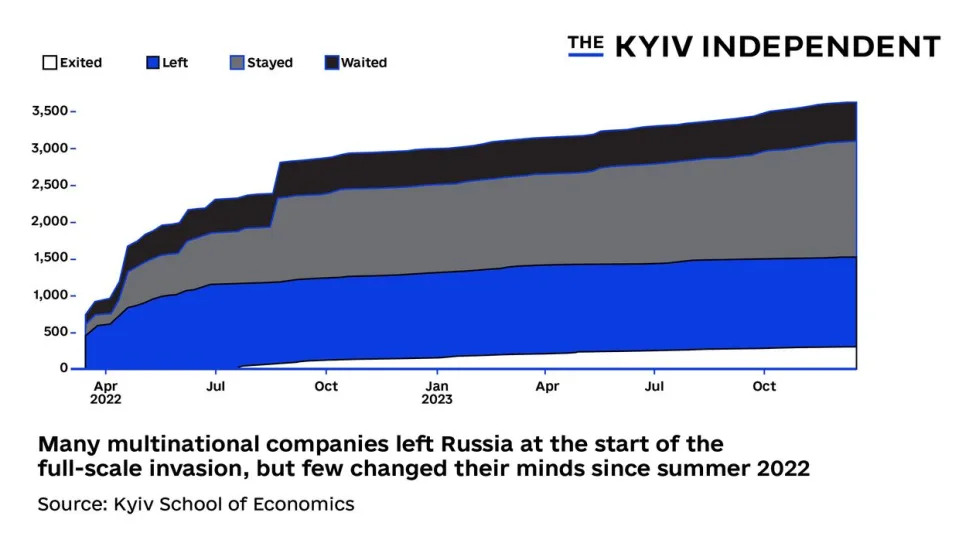
According to the KSE, after April 2022, the flood of companies leaving Russia turned into a drip. The KSE chart shows that most companies decided on whether to leave by summer 2022 at the latest.
A plateau of companies that made commitments to leave (in blue) shows that after an initial surge, few multinationals decided to exit Russia. (Graph by Nizar Al-Rifai)
Shutting the door on Russia isn’t always simple, even for the companies that want to. A recent investigation by the New York Times showed that Russian dictator Vladimir Putin is making withdrawal difficult and costly for foreign companies and enriching Russia in the process.
More than 1,600 foreign companies have continued business as usual in Russia. When challenged about their continued presence, some companies such as Unilever claim only to sell essential goods, while Nestlé cited worries about abandoning their staff, and Carlsberg claims to be unable to find buyers for their business.
These excuses proved thin. Dutch brewer Heineken sold its entire Russian business for the symbolic sum of one euro, showing that withdrawal is possible if a company is ready to take a financial hit. Unilever continued to sell ice cream, under the guise of “essential goods.”
The Kyiv Independent reached out to Unilever, Nestle, and Carlsberg but hasn’t gotten a response as of publication time.
Ultimately, most companies are cynical and profit-driven, and we cannot expect otherwise, says Glib Kanievskyi, co-founder of StateWatch, a Ukrainian transparency watchdog. Any tools that seek to isolate Russia economically must take this into account.
Who are the “sponsors of war’?
The International Sponsors of War list, launched in summer 2022, is an initiative that seeks to turn public opinion against multinationals that stay in Russia and use public pressure to incentivize withdrawal.
Of more than 1,600 foreign companies that stayed in Russia according to KSE, only 45 are listed as sponsors of war. According to Agia Zagrebelska, who oversees the sanctions policy direction at the NACP, there are three main criteria for inclusion: a substantial amount paid in taxes to Russia, any direct connections to the military, and broken promises to withdraw from Russia.
She says the NACP receives suggestions about companies from the public and civil society organizations such as StateWatch. These suggestions are then reviewed in line with the Agency’s criteria.
Some listed companies, like Unilever, snack titan Mondelez, and supermarket chain Auchan, are known worldwide for their consumer goods. Thirteen companies are based in China, a key Russian ally and its largest trading partner.
Of the three most profitable sectors identified by KSE and B4Ukraine, the NACP has widely listed alcohol and tobacco, and mass-market consumer product companies, but the automobile sector is still untouched – no Western automobile companies are on the list.
The list’s purpose is to go after a “gray zone” of companies that are not eligible for sanctions, says Zagrebelska. While there are no legal consequences to being listed, the risk of reputational damage can be enough to change company behavior.
Zagrebelska says the list allows consumers to make informed choices about their purchases, thus enacting a “direct democracy” where the public can vote with their wallets.
‘Soft sanctions’ in action
The NACP points to several companies that stopped dealing with Russia as signs of a successful policy. For instance, British manufacturing group Mondi was listed as a sponsor of war in February 2023, given their sizeable operations in Russia. They were removed from the list in November 2023 following a complete withdrawal.
While Zagrebelska admits that it is difficult to prove that the sponsors of war list had a decisive impact, she says the NACP is confident it pushes companies in the right direction.
In other instances, the NACP negotiated extensively with companies. Three Greek shipping companies saw their status change four times as they made and broke promises to the NACP. Finally, the companies were removed for good when they committed to stop shipping Russian oil entirely.
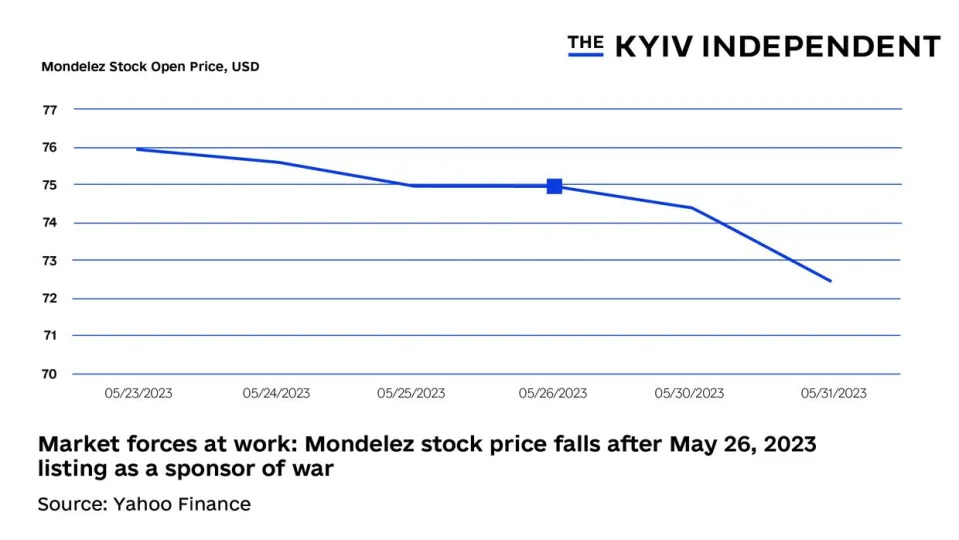
A graph of the Mondelez stock price, the blue square showing the day the company was listed as a sponsor of war by Ukraine’s National Agency on Corruption Prevention. (Graph by Nizar Al-Rifai)
The stock price of Mondelez, the company behind Oreos, Toblerone, and Milka, tumbled by almost five percent after it was labeled a sponsor of war in May 2023. Mondelez has continued its operations in Russia, and its stock price has not recovered.
The snack maker’s financial troubles were likely exacerbated due to a boycott by clients in Sweden and Norway such as Scandinavian Airlines since June 2023. The Nordic companies cited the listing as a sponsor of war as the reason for their decision. Mondelez claimed they were unfairly “singled out.”
The Kyiv Independent reached out to Mondelez but hasn’t heard back as of publication time.
Wrangling with banks
One of the NACP’s most high-profile clashes was with Hungary’s OTP Bank, which operates in Russia and Ukraine and was listed as a sponsor of war in May 2023.
Viktor Orban, Hungary’s prime minister known for pro-Russia stances, was outraged by the listing, and Hungarian diplomats pushed back hard, threatening to derail EU sanctions and Ukraine aid discussions in Brussels.
According to NACP’s Zagrebelska, OTP Bank made significant concessions in discussions with EU and Ukrainian officials and demonstrated a concrete plan for withdrawing from Russia, after which the bank was removed from the list in October 2023. She could not share any details of the plan, which is set to be announced in January 2024, with the Kyiv Independent.
Kanievskyi of StateWatch was skeptical of the NACP’s claim of victory over OTP Bank. He said the likelier explanation is that NACP backed down after internal and external pressure. Passing EU sanctions was more important to the Ukrainian government, he said.
A Ukrainian official who worked closely on negotiations over OTP Bank but was not authorized to speak on the record said the NACP listing caused “a lot of fuss.” They said that the listing of OTP Bank held up the 11th EU sanctions package for up to four weeks and that Ukraine’s Ministry of Foreign Affairs was frustrated with the NACP’s position.
Similar discussions are ongoing about Raiffeisen, an Austrian bank with huge operations in Russia. The bank’s status as a sponsor of war was suspended last week, and Zagrebelska said that NACP is awaiting concrete documentation to show its commitment to withdrawing from Russia.
Once again, the NACP’s decision to remove the bank coincided with Austria’s approval of the latest EU sanctions package. Kanievskyi said the NACP folded to pressure, but Zagrebelska maintained her confidence that Raiffaisen will take concrete steps to withdraw from Russia. She also noted that the bank’s status is only suspended, meaning it can be easily reinstated.
Reflecting on the OTP and Raiffeisen cases, Andrii Onopriienko, a policy expert at KSE, recognized that the sponsors of war list is ultimately a political process that uses these negotiations to try and find a favorable compromise for Ukraine.
On OTP and Raiffeisen, the jury is still out. Should the banks’ promises to exit Russia prove empty, the deterrent power of the list may be weakened. On the other hand, if OTP and Raiffeisen show a real commitment to withdrawing from Russia, the “soft sanctions” and negotiation approach may be vindicated as a powerful tool of economic warfare.
Dealing with the devil?
Another source of criticism has been the inclusion of companies that continue to do business in Ukraine. Philip Morris, one of the “big four” tobacco companies, was listed among sponsors of war in August 2023, having announced a $30 million factory project in Lviv Oblast just two months before.
Japan Tobacco International (JTI), another “big four” cigarette maker is also one of the biggest multinationals still active in Russia and Ukraine, and was also listed as a sponsor of war in August 2023.
Kanievskyi questioned the coherence of listing Philip Morris as a sponsor of war and continuing close cooperation with the company. Many companies on the list maintain significant operations in Ukraine, including Unilever, Nestlé, and Mondelez.
According to Kanievskyi, the cause is a lack of a unified policy and legislative framework.
On the Philip Morris deal, Phil Chamberlain from the campaigning organization Expose Tobacco said that preying on countries in difficult situations to get a better deal was straight out of the “Big Tobacco” playbook. According to Chamberlain, a lack of coherent policy only makes it easier for multinationals to take advantage of the war to increase profits.
According to Hlib Kolesov, a lawyer with the Ukrainian think-tank Center for Democracy and Rule of Law, it is hypocritical of tobacco companies to be contributing to Russia’s economy as they claim to support Ukraine amid war.
“On the one hand, tobacco companies position themselves as good partners of Ukraine, investors in its economy, in recovery, but, on the other hand, the same tobacco companies earn money in Russia and pay huge taxes to the budget of the Russian Federation,” Kolesov told European Pravda.
A picture taken on Aug. 21, 2018, shows the research and development campus of cigarette and tobacco manufacturing company Philip Morris International, in Neuchatel, western Switzerland. (Photo by Fabrice Coffrini/AFP via Getty Images)
Yet, Ilona Sologoub, an economist and head of the VoxUkraine think tank, recognized the challenges faced by Ukraine’s government in elaborating a coherent policy in this area.
Ultimately, Sologoub agreed with the NACP’s “gray area” logic. She said that “soft sanctions” fill a valuable gap, targeting companies that cannot be sanctioned because of the possible negative impact on Ukraine’s economy.
For NACP’s Zagrebelska the presumable “whitewashing” efforts by Philip Morris and other companies are too little, too late. She said she was confident that consumers can see through the efforts and will continue to pressure companies to exit Russia.
The Kyiv Independent requested a comment from Philip Morris but hasn’t heard back as of publication time.
Coordinated policy
Experts were broadly positive about the sponsors of war list and its contribution to Russian economic isolation. “There is no perfect solution,” said KSE’s Onopriienko, “but it is an all-out war. We all do our part.”
Kanievskyi, whose organization StateWatch collaborates extensively with the NACP, emphasized the lack of central government policy as the biggest challenge for Ukraine in this area.
He said that in the early months of the all-out war, companies were more afraid of reputational damage for staying in Russia, while now many are ready to take the risk. For him, this highlights an urgent need for a centralized policy on sanctions and other economic restrictions from the authorities. Ultimately, he says a lack of a clear policy undermines the communications efforts of the NACP which is crucial to the list’s success.
A lack of centralized policy also led to tensions over OTP Bank, with different Ukrainian government agencies pushing for different outcomes, as recounted by the Ukrainian official who worked closely on internal and external negotiations and who is not authorized to speak with the media.
The NACP and partners are looking to develop new initiatives to isolate Russia economically and increase the effectiveness of sanctions. A newly launched project tracks electronic components used in Russian weapons that continue to bypass sanctions. Zagrebelska said that in early 2024, the Agency plans to launch a mobile application allowing consumers to spot products by companies listed as sponsors or war.
In the meantime, Kanievsky underscores the importance of having a coordinated policy on the sponsors of war list. Lacking proper guidance from the central government, Ukrainian officials and civil society may struggle to do their part in isolating Russia’s wartime economy.
No ruling by the courts, not even one by the U.S. Supreme Court, will change the fact that Los Angeles’ housing costs are out of reach for most people. Many of us are one missed paycheck, illness or mistake away from ending up in a tent on the sidewalk, and an anti-camping ordinance won’t stop people from doing what they must to survive.
We are all frustrated by the street conditions, but instead of brutal sweeps that shuffle people like trash from one corner to the next, our leaders should focus on affordable housing and protecting tenants from eviction.
Rae Huang, Los Angeles
The writer is senior organizer with the group Housing Now.
..
To the editor: Those of us who grew up in the 1950s never saw our cities’ sidewalks or parks overrun with tents pitched by the unhoused.
Yes, we had seen homeless encampments elsewhere. They typically were located on the outskirts of towns, along railroad tracks and on stream beds.
Back then, vagrancy laws barred people from camping within city limits. Furthermore, the number of unhoused people was kept low by two factors: Jobs were abundant, and state mental hospitals housed thousands of people who would have otherwise lived on the street.
Within a few decades momentous changes steadily accelerated homelessness. Courts struck down vagrancy laws. Psychiatric hospitals were emptied. Automation, computerization and job outsourcing to foreign countries diminished employment opportunities.
Evidently the foreseeable downsides of those changes escaped our leaders’ notice — that, or there was no political upside to addressing these downsides. It’s time to pay the homelessness piper.
Betty Turner, Sherman Oaks
..
To the editor: Unfortunately, homeless encampments eventually become public health hazards. How do we balance the rights of unhoused individuals against the rights of the communities affected by encampments?
Despite all the good intentions and funds that have been directed toward alleviating the problem, nothing seems to have long-term impact.
There are deeper systemic issues at play here that have to do with the income inequalities that exist in our society and need to be solved at the federal level. Until that happens (and I’m not holding my breath), local efforts will continue to have limited effect.
John Beckman, Chino Hills
..
To the editor: Cities can’t remove encampments unless there is a place for unhoused residents to go.
A few months ago, The Times reported on a study that found there were more than 100 vacant, government-owned parcels in L.A. that could be used for housing. These properties could provide toilets, water, electricity and even a physical address where one could get mail.
STORY: Mexican authorities on Friday sent a planeload of migrants from Piedras Negras, near the US border, to southern Mexico to be returned to their countries of origin.
The move came just hours after Mexican President Andres Manuel Lopez Obrador announced that his government will reinforce measures to contain migration.
As the United States copes with record numbers of people trying to reach the U.S. border, Mexico is looking to help.
“We will boost as much as we can to help maintain an orderly flow,” said Lopez Obrador, adding “Recently, there was an abnormal surge.”
Lopez Obrador’s comments came a day after he spoke with U.S. President Joe Biden.
Both agreed that more enforcement was needed at their shared frontier, as record numbers of migrants disrupt border trade.
This year, the number of migrants crossing the perilous Darien Gap straddling Colombia and Central America topped half a million – double that of last year’s record.
News of Lopez Obrador’s comments reached migrants as they made their way through Mexico to the U.S. border.
Honduran migrant Kerlin Silva said the new rules might mean he won’t be able to, (quote) “fulfill the American dream.”
According to the United Nations, migrants are heading through Mexico to the U.S. to escape violence, economic distress, and the negative impacts of climate change.
Lopez Obrador said Mexico would also step up containment efforts on its southern border with Guatemala as his government seeks agreements with other countries to manage the northbound migrant flows.
Top U.S. officials are set to visit Mexico next week to follow up on the call between Lopez Obrador and Biden.