Greg Abbott Laments That Texas Can’t Shoot Migrants Because Murder Is Illegal
Nikki McCann Ramirez – January 11, 2024
Texas Governor Greg Abbott lamented that Texas can’t shoot migrants trying to cross the border illegally because “the Biden administration would charge us with murder.”
On Jan. 5, Abbott appeared on the radio show of former NRA spokesperson Dana Loesch. During a discussion of Texas’ efforts to curb the illegal entry of migrants through the southern border, Loesch asked “what can be done, like right up to the line, where maybe they would come and say, ‘Governor you’re breaking the law we’re going to arrest you,’” in terms of border enforcement.
Abbott responded that his administration is “deploying every tool and strategy that we possibly can,” to stem the flow of immigration, including building a border wall, placing barriers in the Rio Grande, and passing legislation making illegal border crossings a state crime.
“The only thing that we’re not doing is we’re not shooting people who come across the border because of course, the Biden administration would charge us with murder,” Abbott added. The governor’s comments were resurfaced on Thursday by Heartland Signal.
Earlier this month, the Biden administration sued Texas over a law signed by Abbott that would grant local law enforcement the authority to arrest migrants and allow judges to order deportations. The administration argues that the law goes against constitutional mandates granting the federal government authority over border enforcement.
Shooting unarmed civilians attempting to cross the border would absolutely constitute murder. It would also violate a myriad of state, federal, and international laws protecting migrants and asylum seekers.
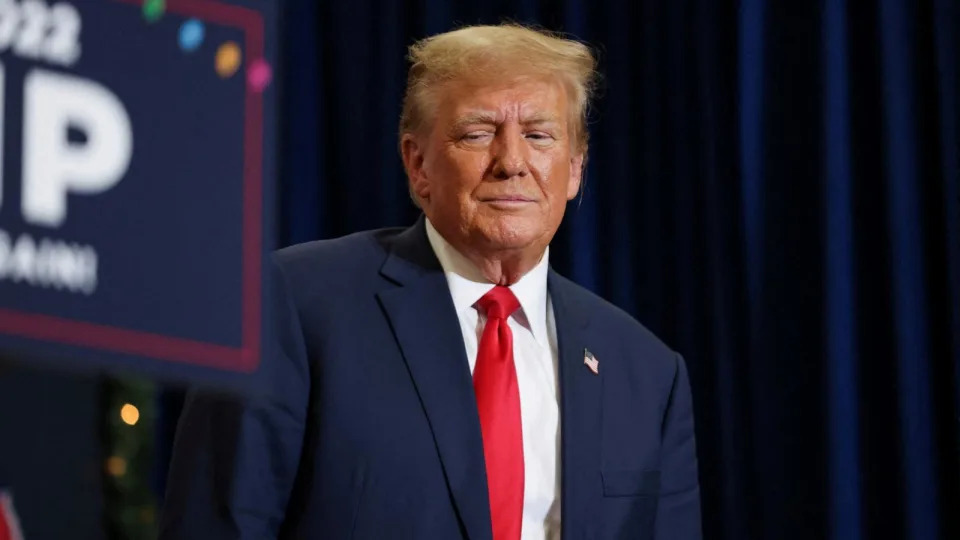
That potential retaliation from the Biden administration is the only thing Abbott referenced as a reason not to shoot migrants signals how extreme the Republican position on immigration has become. In 2019 The New York Times reported that former President Donald Trump privately suggested in a meeting that border patrol be allowed to shoot migrants in the legs to slow them down. As reported by Rolling Stone in June, former Trump immigration adviser Stephen Miller once reportedly suggested the use of predator drones to blow up migrant boats.
Trump has also floated granting himself widespread executive powers if reelected in November to completely reshape the American immigration landscape. The former president and his allies prepared to conduct mass deportations and construct a network of detainment camps to facilitate their rounding up of undocumented people. It’s safe to say that if Trump wins the White House in 2024, the already thin barriers preventing more extreme brutality against migrants may crumble very quickly.
Abortion rights groups reach petition threshold to put abortion on Florida ballot in 2024
Carlos Suarez and Denise Royal – January 5, 2024
A coalition of Florida abortion rights supporters announced on Friday they have gathered enough signatures to put a state constitutional amendment protecting the right to an abortion on the ballot in 2024. Election officials have verified 910,946 petitions submitted by Floridians Protecting Freedom, according to the Florida Division of Elections website.
The group said it needed 891,523 verified petitions to make it on the ballot. They said they expect to receive official notification from the Florida Division of Elections in the coming weeks.
If the measure makes it on to the ballot, Florida will join several other states where voters have weighed in directly on reproductive rights since the Supreme Court overturned Roe v. Wade. The initiative could also boost voter turnout, as it has in states like Ohio, which could give Democrats an advantage as President Joe Biden looks to secure another term.
“The fact that we only launched our campaign eight months ago and we’ve already reached our petition goal speaks to the unprecedented support and momentum there is to get politicians out of our private lives and health care decisions,” said campaign director Lauren Brenzel.
“Most initiative campaigns never make it this far. The ones that do usually spend far more or take much longer to qualify, which is why we’re so confident that voters will approve our amendment once they’re given a chance to vote,” Brenzel added.
The Florida Supreme Court still must approve the language of the ballot measure which is being challenged by Florida Attorney General Ashley Moody.
The proposed amendments reads, “No law shall prohibit, penalize, delay, or restrict abortion before viability or when necessary to protect the patient’s health, as determined by the patient’s healthcare provider.’
In a legal brief filed in October, Moody asked the Court to kill the amendment, arguing the language is vague and confusing.
Moody argued that it uses language aimed at tricking voters. The brief specifically takes aim at terms like “health,” “viability” and “healthcare provider” and says they are too ambiguous.
Oral arguments are scheduled on February 7 in front of the Florida Supreme Court.
Florida Gov. Ron DeSantis, a Republican, appointed five of the seven justices on the current court, giving it a conservative majority.
Should the measure make it on the ballot and be approved by at least 60% voters, the amendment would undo Florida’s current 15-week ban on abortions. In 2023, lawmakers passed a 6-week ban, which will only go into effect if the 15-week ban is upheld by the Florida Supreme Court.
This story has been updated with additional information.
Abortion initiative hits milestone for getting in front of Florida voters
Mike Schneider – January 5, 2024
FILE – Florida Attorney General Ashley Moody speaks at a news conference, Jan. 26, 2023, in Miami. A petition initiative that would enshrine abortion rights in the Florida constitution on Friday, Jan. 5, 2024, reached the necessary number of verified signatures to qualify for the 2024 ballot. (AP Photo/Marta Lavandier, File)
ORLANDO, Fla. (AP) — A petition initiative that would enshrine abortion rights in the Florida constitution on Friday reached the necessary number of verified signatures to qualify for the 2024 ballot, officials said.
More than 911,000 signatures have been verified, according to the Florida Division of Elections, surpassing the more than 891,500 petition signatures required by the state to put a ballot initiative before voters.
If the measure ultimately makes it on the fall ballot, voters in the third-most populous U.S. state could join citizens of other states in deciding what, if any, abortion protections or restrictions there should be following the U.S. Supreme Court’s decision to overturn Roe v. Wade in 2022.
Since that landmark 1973 case giving constitutional protections for abortion across the United States was overturned in the Dobbs decision, voters in at least seven states have supported ballot measures protecting abortion rights or rejected measures aimed at limiting access. Constitutional amendments to protect access are already on the ballots for 2024 in Maryland and New York.
“We know what will happen if reproductive rights make it onto the ballot in 2024 — just like in every other state since Dobbs, Florida voters will choose to keep the government out of their health care decisions,” said Nikki Fried, chair of the Florida Democratic Party.
The proposed amendment would allow abortions in Florida to remain legal until the fetus is viable, as determined by the patient’s health care provider. If the amendment makes the ballot, it will need at least 60% voter approval to take effect.
Florida Attorney General Ashley Moody says that abortion rights proponents and opponents have differing interpretations as to what viability means. Those differences along with the failure to define “health” and “health-care provider,” she said, are enough to deceive voters and potentially open a box of legal questions in the future.
Because of that, the Republican attorney general has asked the state Supreme Court to keep the proposed measure off the ballot, saying proponents are waging “a war” to protect the procedure and ultimately will seek to expand those rights in future years.
The court will hear arguments Feb. 7 on whether the ballot language should be approved.
A law Florida Gov. Ron DeSantis approved last year banning abortion after 15 weeks is being challenged in court.
If the courts uphold the law — DeSantis appointed five of the Supreme Court’s seven justices — a bill DeSantis signed this year will ban abortion after six weeks, which is before many women know they are pregnant. DeSantis, who is running for president, has said he would support a federal abortion ban after 15 weeks.
Any change in abortion access in Florida will be felt out of state as well because the Sunshine State traditionally has been a haven for women in the southeastern U.S. seeking abortions. There are bans on abortion at all stages of pregnancy in nearby Alabama, Louisiana and Mississippi and a ban on terminating pregnancies in Georgia after cardiac activity can be detected.
Houthis launch sea drone to attack ships hours after US, allies issue final warning
Tara Copp – January 4, 2024
FILE – U.S. Navy Vice Adm. Brad Cooper, who heads the Navy’s Bahrain-based 5th Fleet, speaks at an event at the International Defense Exhibition and Conference in Abu Dhabi, United Arab Emirates, Feb. 21, 2023. The top commander of U.S. naval forces in the Middle East says Yemen’s Houthi rebels are showing no signs of ending their “reckless” attacks on commercial ships in the Red Sea. But Vice Adm. Brad Cooper said in an Associated Press interview on Saturday that more nations are joining the international maritime mission to protect vessels in the vital waterway and trade traffic is beginning to pick up. (AP Photo/Jon Gambrell, File)More
WASHINGTON (AP) — An armed unmanned surface vessel launched from Houthi-controlled Yemen got within a “couple of miles” of U.S. Navy and commercial vessels in the Red Sea before detonating on Thursday, just hours after the White House and a host of partner nations issued a final warning to the Iran-backed militia group to cease the attacks or face potential military action.
Vice Admiral Brad Cooper, the head of U.S. Navy operations in the Middle East, said it was the first time the Houthis had used an unmanned surface vessel, or USV, since their harassment of commercial ships in the Red Sea began after the outbreak of the Israel-Hamas war. They have, however, used them in years past.
Fabian Hinz, a missile expert and research fellow at the International Institute for Strategic Studies, said the USV’s are a key part of the Houthi maritime arsenal and were used during previous battles against the Saudi coalition forces that intervened in Yemen’s war. They have regularly been used as suicide drone boats that explode upon impact.
Most of the Houthis’ USVs are likely assembled in Yemen but often fitted with components made in Iran, such as computerized guidance systems, Hinz said.
At the United Nations, U.S. deputy ambassador Christopher Lu said at a emergency Security Council meeting on Wednesday that Iran has supplied the Houthis with money and advanced weapons systems, including drones, land attack cruise missiles and ballistic missiles. He said Iran also has been deeply involved in planning the Houthis’ attacks on commercial vessels in the Red Sea.
He said the United States isn’t seeking a confrontation with Iran, but Tehran has a choice.
“It can continue its current course,” Lu said, “or it can withhold its support without which the Houthis would struggle to effectively track and strike commercial vessels navigating shipping lanes through the Red Sea and Gulf of Aden.”
This raises questions as to whether any action against the Houthis would also address Iran’s role in any way, which could risk widening the conflict.
A statement Wednesday signed by the United States, Australia, Bahrain, Belgium, Canada, Denmark, Germany, Italy, Japan, Netherlands, New Zealand, Singapore and the United Kingdom gave the Houthis what a senior Biden administration official described as a final warning.
“Let our message now be clear: we call for the immediate end of these illegal attacks and release of unlawfully detained vessels and crews,” the countries said in the statement. “The Houthis will bear the responsibility of the consequences should they continue to threaten lives, the global economy, and free flow of commerce in the region’s critical waterways.”
Pentagon spokesman Maj. Gen. Pat Ryder would not say whether any military action would follow Thursday’s launch of the sea drone.
″I’ll let the statement speak for itself, which, again, represented many nations around the world and highlighted that if these strikes don’t stop, there will be consequences,” Ryder said.
Since late October, the Houthis have launched scores of one-way attack drones and missiles at commercial vessels transiting the Red Sea. U.S. Navy warships have also intercepted ballistic missiles the Pentagon says were headed toward Israel. Cooper said a total of 61 missiles and drones have been shot down by U.S. warships.
In response to the Houthi attacks, Defense Secretary Lloyd Austin in December announced Operation Prosperity Guardian, with the United States and other countries sending additional ships to the southern Red Sea to provide protection for commercial vessels passing through the critical Bab el-Mandeb Strait.
Cooper said 1,500 commercial ships have been able to transit safely since the operation was launched on Dec. 18.
However, the Houthis have continued to launch missiles and attack drones, prompting the White House and 12 allies to issue what amounted to a final warning Wednesday to cease their attacks on vessels in the Red Sea or face potential targeted military action.
Cooper said Operation Prosperity Guardian was solely defensive in nature and separate from any military action the U.S. might take if the Houthi attacks continue.
The U.S., United Kingdom and France are providing most of the warships now, and Greece and Denmark will also be providing vessels, he said.
Associated Press writer Jack Jeffery in London and Edith M. Lederer at the United Nations contributed to this report.
How Rep. Andy Biggs proves House Speaker Mike Johnson’s Texas border bonanza was bogus
EJ Montini, Arizona Republic – January 4, 2024
Arizona Rep. Andy Biggs was at the border community of Eagle Pass, Texas, on Wednesday, part of a group of 60-plus Republicans led by House Speaker Mike Johnson, all of whom made the trip to make speeches, make the news, make (perhaps) some campaign cash, and accomplish … nothing.
Accomplishing nothing is something Biggs has proven to be very good (?) at.
“No more money for this bureaucracy of his (President Joe Biden’s) government until you’ve brought this border under control,” Biggs is quoted as saying in The New York Times. “Shut the border down or shut the government down.”
The congressman made the same threat on X, formerly Twitter.
”Shut the border down, or we’ll shut the government down,” he posted, standing with three other Republicans, including Arizona Rep. Eli Crane, who appears to have spent his time in Congress being tutored by Biggs on how to get zero done.
Some make progress. Biggs make noise
U.S. House Speaker Mike Johnson, center left, and Texas Department of Public Safety chief Steve McCraw, center right, lead a group of Republican members of Congress during a tour of the Texas-Mexico border, Wednesday, Jan. 3, 2024, in Eagle Pass, Texas.
There are two groups of elected officials operating in Washington, D.C.
There is a very small collective who want to make progress. And there is an overwhelming majority who want to make noise. You can guess which group Biggs, Speaker Johnson and the other Texas tinhorns belong to.
Meantime, back at the Capitol, there is a small working group of senators, including Arizona’s independent Sen. Kyrsten Sinema, Oklahoma Republican Sen. James Lankford and Democratic Sen. Chris Murphy of Connecticut, who are trying to hammer out a bipartisan agreement on border measures.
Sinema told The Arizona Republic, “We’re dealing with very, very difficult, complex issues. Drafting is very technical. It must be done incredibly precise and to avoid unintended consequences and decades of litigation. And so this is really hard. But everyone is working in good faith to solve this crisis.”
Not everyone.
Border isn’t a crisis, it’s a GOP gold mine
Republicans already are using the border crisis as their primary campaign argument for the 2024 election. It’s how they hope to help Donald Trump get back to the White House.
The worst thing that could happen to them, politically, would be for Republicans and Democrats of good faith to reach a bipartisan deal on the border.
Speaker Johnson, like Biggs and Arizona Republican Rep. Paul Gosar, was among those who tried to stage a nonviolent coup to keep Trump in office after he lost the election in 2020.
The bogus bonanza in Texas on Wednesday wasn’t about the border. It was about Trump.
Congress can solve this, but will it?
It wasn’t even the first time Biggs threatened a government shutdown.
He did that last year when he and some Republican cronies were trying to strongarm then Speaker Kevin McCarthy.
On Wednesday, Democratic Sen. Chuck Schumer in Washington said of the Republicans and their Texas two-step, “It’s very nice that they have a trip to the border, but the only way to solve this is here, working in a bipartisan way with Senate Republicans, Senate Democrats and House Democrats to get it done, period.
“I hope the speaker will realize that if he wants to solve the problem on the border.”
Trump’s businesses received millions from foreign entities during his presidency, House report says
Will Steakin – January 4, 2024
Former President Donald Trump’s businesses received millions of dollars from foreign entities located in 20 different countries during his presidency, according to a new report released Thursday by Democrats on the House Oversight committee.
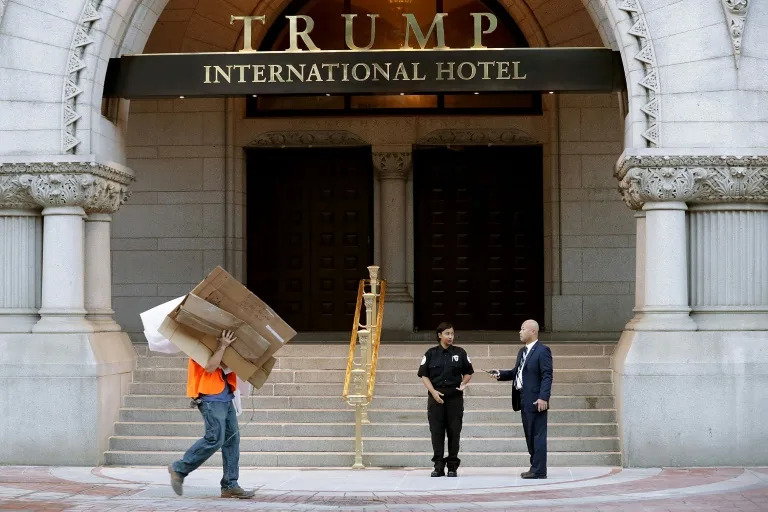
The top Democrat on the Oversight Committee, Rep. Jamie Raskin, released the report and provided documents from Trump’s former accounting firm that show that 20 governments, including China and Saudi Arabia, paid at least $7.8 million during Trump’s presidency to business entities that included Trump International Hotels in Washington, D.C., and Las Vegas, and Trump Towers in New York.
The 156-page report by House Democrats is entitled “White House For Sale.”
In the forward to the report, Raskin wrote, “By elevating his personal financial interests and the policy priorities of corrupt foreign powers over the American public interest, former President Trump violated both the clear commands of the Constitution and the careful precedent set and observed by every previous commander in chief.”
The reports says that, according to “limited records” obtained by the committee, Saudi Arabia likely paid Trump-owned business at least $615,422 during Trump’s first term in office.
“While the Kingdom of Saudi Arabia was making these payments, President Trump chose Saudi Arabia as the destination of his first overseas trip — a choice that was unprecedented among U.S. presidents,” the report says.
PHOTO: Republican presidential candidate and former President Donald Trump attends a campaign event in Waterloo, Iowa, Dec. 19, 2023. (Scott Morgan/Reuters, FILE)
The report claims that the payments violated the Constitution’s foreign emoluments clause, a rule that bars the president and other federal officials from accepting money or gifts from foreign governments without Congressional approval.
In 2021, the U.S. Supreme Court dismissed lawsuits accusing Trump of profiting from his presidency, on the grounds that he is no longer in office.
“Through entities he owned and controlled, President Trump accepted, at a minimum, millions of dollars in foreign emoluments in violation of the United States Constitution,” Democrats write in the report. “The documents obtained from former President Trump’s accounting firm demonstrate that four Trump-owned properties together collected, at the least, millions of dollars in payments from foreign governments and officials that violated the Constitution’s prohibition on emoluments ‘of any kind whatever’ from foreign governments.”
ABC News has reached out to Trump’s representatives for comment on the report.
Related:
AFP
Foreign govts paid Trump firms millions while president: report
AFP – January 4, 2024
A Chinese embassy delegation spent $19,391 at the Trump International Hotel in Washington, DC (CHIP SOMODEVILLA)
Former US president Donald Trump‘s businesses received at least $7.8 million from foreign governments including China during his time in the White House, a congressional report claimed Thursday.
Officials from Saudi Arabia, India, Turkey and Democratic Republic of Congo were among some 20 countries’ representatives who paid money to Trump’s hotel and real estate businesses during his presidency, Democrats on the House Oversight Committee wrote in their report.
The authors claim that such revenues from overseas governments violated a constitutional ban on “foreign emoluments.”
“As President, Donald Trump accepted more than $7.8 million in payments from foreign states and their leaders, including some of the world’s most unsavory regimes,” said the report titled “White House for Sale.”
“We know about only some of the payments that passed into former President Trump’s hands during just two years of his presidency from just 20 of the more than 190 nations in the world through just four of his more than 500 businesses.”
– ‘Prohibited emoluments’ –
In the case of China, the report alleged that Beijing as well as businesses including ICBC bank and Hainan Airlines spent $5.5 million at Trump-owned properties.
“Former President Trump violated the Constitution when the businesses he owned accepted these emoluments paid by (Beijing) without the consent of Congress,” the report said.
The authors say that the full amount could be higher as the $5.5 million figure is based only on limited disclosures from Trump’s accountants Mazars and filings with the American financial regulator, the SEC.
In one expenditure dated August 27, 2017, a Chinese embassy delegation spent $19,391 at the Trump International Hotel in Washington.
The report also claims that “Saudi Arabia paid at least $615,422 in prohibited emoluments to former President Trump’s businesses over the course of his term in office from just (the Trump World Tower) and the March 2018 stay at the Trump International Hotel in Washington, DC.”
“Former President Trump has also boasted about the continued willingness of the Saudis to do business on terms highly favorable to him,” the report stated.
Trump’s Washington hotel was sold in 2022 to a private investor group and rebranded under the luxury Waldorf Astoria line.
The frontrunner for the 2024 Republican presidential nomination, Trump separately faces a civil fraud trial in New York over claims that his real estate businesses fraudulently inflated the value of their assets.
He is to go on trial in Washington in March for conspiring to overturn the results of the 2020 election, and in Florida in May on charges of mishandling top secret government documents.
The twice-impeached former president also faces racketeering charges in Georgia for allegedly conspiring to upend the election results in the southern state after his 2020 defeat by Democrat Joe Biden.
Related:
CNN
China spent over $5.5 million at Trump properties while he was in office, documents show
Zachary Cohen and Kara Scannell, CNN – January 4, 2024
Gabriella Demczuk/Getty Images
The Chinese government and its state-controlled entities spent over $5.5 million at properties owned by Donald Trump while he was in office, the largest total of payments made by any single foreign country known to date, according to financial documents cited in a report from House Democrats released Thursday.
Those payments collectively included millions of dollars from China’s Embassy in the United States, a state-owned Chinese bank accused by the US Justice Department of helping North Korea evade sanctions and a state-owned Chinese air transit company. Accounting records from Trump’s former accounting firm, Mazars USA, were obtained by Democrats on the House Oversight Committee.
China is one of 20 countries that made at least $7.8 million in total payments to Trump-owned businesses and properties during the former president’s stint in the White House, including his hotels in Washington DC, New York and Las Vegas, the report states.
The documents offer additional evidence of the rare practice of foreign governments spending money directly with businesses owned by a sitting president but are not a complete record of all foreign payments made to Trump’s businesses during his time in the White House.
At the time, Trump’s lawyer said the former president planned to donate foreign profits from his hotels to the US Treasury Department. However, the amount reportedly donated by the Trump Organization in 2017 and 2018 falls well short of estimated foreign payments that were made to its properties.
Trump refused to divest himself of corporate assets and properties prior to taking office, meaning he could still profit from his various businesses with little transparency.
Democrats say the additional accounting records raise new questions about possible efforts to influence Trump through his companies while he was in the White House.
As an example, committee Democrats point to the fact that Trump declined to impose sanctions on the Industrial and Commercial Bank of China (ICBC), a state-owned entity that leased property at Trump Tower in New York.
A Securities and Exchange Commission filing from 2012 shows that the Chinese bank’s base rent paid was $1.9 million and documents produced by Mazars confirm the bank stayed in Trump Tower through 2019 at least.
In 2016, the Justice Department accused the bank of conspiring with a North Korean bank to evade US sanctions.
But upon taking office, Trump did not sanction ICBC despite calls from Republican members of Congress to “apply maximum financial and diplomatic pressure” by “targeting more Chinese banks that do business with North Korea,” House Oversight Committee Democrats wrote in a report summarizing the contents of the Mazars USA records.
Asked about China’s payments to Trump-owned properties, Chinese Embassy spokesperson Liu Pengyu told CNN, “China adheres to the principle of non-interference in internal affairs and does not comment on issues related to US domestic politics.”
“At the same time, I want to stress that the Chinese government always requires Chinese companies to operate overseas in accordance with local laws and regulations. China-US economic and trade cooperation is mutually beneficial. China opposes the US politicizing China-US economic and trade issues,” Pengyu added.
The Trump Organization says it donated over $450,000 in estimated profits from foreign government patronage to the US Treasury over the time of Trump’s term. The company also worked to track all foreign government business across its entire portfolio and did not make new business investments overseas while Trump was in office.
In a statement, Eric Trump said that the former president was tough on China regardless of any business interests.
“There is no President in United States history who was tougher on China than Donald Trump … a President who introduced billions and billions of dollars worth of tariffs on their goods and services,” Eric Trump said.
Democrats also argue that the Mazar documents show Trump repeatedly violated the US Constitution’s Emoluments Clause, which prohibits a president from receiving an “emolument,” or profit, from any “King, Prince, or foreign State” unless Congress consents. Yet despite ethical concerns that have been raised about Trump’s lack of adherence to constitutional norms that were embraced by his predecessors, legislation to enforce the Emoluments Clause has gone nowhere in Congress.
The committee, which has investigated Trump’s businesses and his lease of the Old Post Office in Washington from the US government that housed his hotel, was provided the records following a years-long court battle that ended in a settlement in 2022.
Many of the documents in the subset released Thursday have not been previously made public.
“These countries spent – often lavishly – on apartments and hotel stays at Donald Trump’s properties – personally enriching President Trump while he made foreign policy decisions connected to their policy agendas with far-reaching ramifications for the United States,” Democrats wrote in their report.
Saudi Arabia, for example, spent roughly $600,000 at Trump-owned properties during his time in office and was making significant payments in May 2017 when it signed a massive arms deal with the Trump administration.
The Trump administration agreed to the controversial arms deal, worth over $100 billion, despite bipartisan concerns about civilian casualties resulting from Saudi Arabia’s military intervention in Yemen.
The report produced by House Democrats also highlighted comments made by Trump during a 2015 campaign rally regarding his view of Saudi Arabia.
“Saudi Arabia, I get along great with all of them. They buy apartments from me. They spend $40 million, $50 million.” He continued, “Am I supposed to dislike them? I like them very much!” Trump said at the time.
Committee Democrats have previously released some of the accounting records, but those documents only accounted for a fraction of the foreign payments to Trump-owned businesses during the years he occupied the White House.
Foreign spending at Trump World Tower
A sizable percentage of foreign spending disclosed in the latest report comes from leases or common charge payments countries made for apartments their diplomatic missions rent or own at Trump World Tower, an apartment building across the street from the United Nations.
Many of the countries bought properties years before Trump ran for office, but they continued to make payments to the Trump Organization during the presidency.
Saudi Arabia, India, Qatar, Kuwait, Afghanistan, and a Chinese-government linked petroleum company each owned or rented apartments at Trump World Tower and combined paid the Trump Organization an estimated $1.7 million in charges and fees, according to House Democrats.
The figure is based on records the Democrats received from Mazars for the year 2018 – the only year Mazars gave to the committee – and then an extrapolation based on the assumptions the charges remain the same during the course of Trump’s presidency.
The biggest payment to the UN property came from Saudi Arabia, which owns the 45th floor of the apartment tower. Democrats estimate the Saudi government paid $537,080 during Trump’s presidency – out of a total $615,422 in emoluments. The remainder came from payments to Trump’s hotel in Washington DC.
Qatar paid an estimated $465,744 for the properties it owned during Trump’s presidency; India paid at least $264,184; Afghanistan spent an estimated $153,208 for its unit; and Kuwait paid Trump’s company $152,664 for the Trump World Tower.
Kuwait also spent roughly $150,000 to the Washington hotel for National Day events held by its embassy in 2017 and 2018, according to Mazars records.
The national day event was also held at the hotel in 2019, but the Democrats said they did not receive records from Mazars related to the cost. The events were attended by Trump administration officials, the Democrats said citing press releases from the Kuwaiti embassy.
This story has been updated with additional details.
Related:
BBC News
Trump companies got millions from foreign governments, Democrats say
Natalie Sherman – BBC News – January 4, 2024
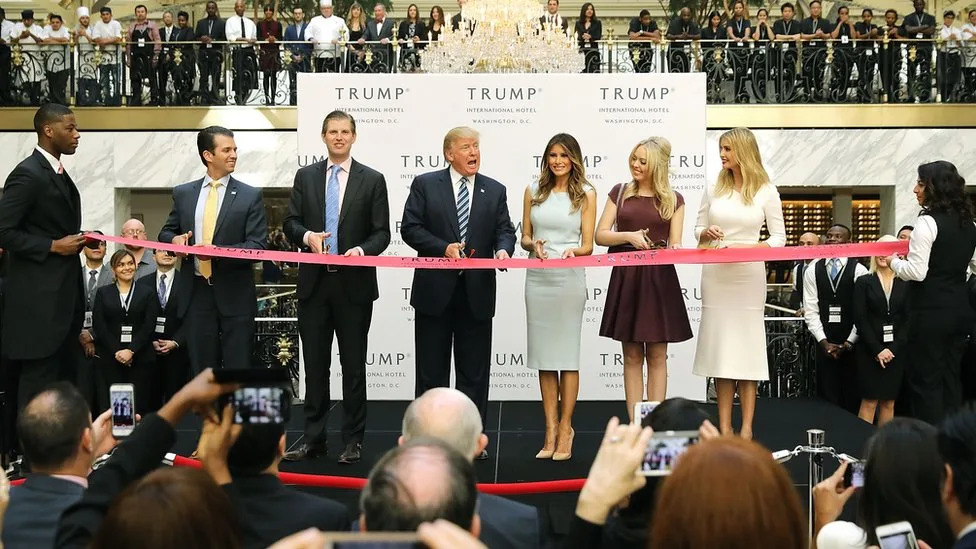
Trump International Hotel opened in 2016 in Washington
Donald Trump‘s hotels and other businesses accepted more than $7.8m (£6.1m) from foreign governments during his presidency, according to a new report from Democrats in Congress.
They found that China was responsible for more than $5.5m of those payments, which Mr Trump is accused of accepting in violation of the US constitution.
The report is based on documents released by Mr Trump’s former accounting firm after a court battle.
Mr Trump did not immediately comment.
The US constitution bars presidents from accepting gifts or other benefits derived from their position without express permission from Congress.
The former businessman, who made his name as a hotel and property developer, has been dogged by questions about his firms’ dealings since he entered the White House in January 2017.
At the time, he placed his sons in charge of the companies’ day-to-day operations but maintained ownership of the businesses, which included the Trump International Hotel in Washington, which became a known haunt for lobbyists, foreign delegations and others.
Mr Trump, who is currently campaigning for a second term, faced numerous lawsuits alleging conflicts-of-interest.
In 2021, America’s highest court threw out the cases, saying they were moot after he lost the 2020 election.
Representative Jamie Raskin, the top Democrat on the House Oversight Committee, said the investigation showed Mr Trump “put lining his pockets with cash from foreign governments seeking policy favors over the interests of the American people”.
“The report’s detailed findings make clear that we don’t have the laws in place to deal with a president who is willing to brazenly convert the presidency into a business for self-enrichment and wealth maximization with the collusive participation of foreign state,” he wrote in the introduction to the report.
Democrats said their investigation showed that Mr Trump’s loyalties were split by the payments, which came from at least 20 governments many of which had sensitive or politically charged matters before the US.
They cite as an example that Mr Trump supported arms sales to Saudi Arabia that were opposed by Congress due to fears the weapons would be used against civilians.
The report also notes he cast doubt on US intelligence assessments that the Crown Prince Mohammad bin Salman had ordered the murder of Washington Post journalist Jamal Khashoggi.
After China, Saudi Arabia and its royal family was the second biggest patron of the Trump businesses, spending more than $600,000 at his properties, according to the report.
Qatar, Kuwait and India rounded out the top five list.
Democrats said that the findings reflect just the first two years of his presidency and only four of his properties, claiming it likely represented just a fraction of the money Mr Trump’s businesses made from foreign governments during his time as president.
In 2022, Democrats lost control of Congress and could no longer compel release of documents, cutting short the investigation.
Republican James Comer, who is leading an inquiry into the business dealings of President Joe Biden’s son, Hunter, during his father’s vice presidency, dismissed the findings.
“It is beyond parody that Democrats continue their obsession with former President Trump,” he said in a statement. “Former President Trump has legitimate businesses but the Bidens do not.”
Mr Trump’s tax records, released in 2022, revealed significant business losses during his presidency and he has scaled back his business.
The Trump Organization sold the Washington hotel to an investment group for $375m in 2022.
Related:
CBS News
Trump businesses got millions in foreign payments while he was president, Dems say
Kathryn Watson, Stefan Becket – January 4, 2024
Washington — Donald Trump‘s businesses received at least $7.8 million in payments from foreign governments and government-backed entities from 20 countries while he was in the White House, according to a new report by House Democrats.
Drawing upon 451 pages of documents received from Trump’s longtime accounting firm Mazars and a federal agency, Democratic staffers on the House Oversight Committee on Thursday issued their 156-page report entitled “White House for Sale: How Princes, Prime Ministers, and Premiers Paid Off President Trump.”
The records, the report said, “demonstrate that four Trump-owned properties together collected, at the least, millions of dollars in payments from foreign governments and officials.” The Democrats alleged these payments violated what’s known as the Constitution’s Foreign Emoluments Clause, which prohibits federal officials from accepting gifts or other benefits from foreign countries without congressional approval.
“This report sets forth the records showing foreign government money — and all the spoils from royals we can find — pouring into hotels and buildings that the President continued to own during his presidency, all in direct violation of the Constitutional prohibition,” said Rep. Jamie Raskin of Maryland, the top Democrat on the committee.
The Democrats noted that they had access to a limited number of financial documents and that “the foreign payments to President Trump identified in this report are likely only a small fraction of the total amount of such payments he received during his presidency.”
Where the payments came from
The Democratic report focuses on payments to four Trump-controlled businesses: the Trump hotels in Washington, Las Vegas and New York, and Trump Tower in Manhattan.
While Trump turned over day-to-day operations of his businesses to his sons when he entered the White House in 2017, he declined to divest his assets and retained “personal ownership and control of all his businesses, as well as the ability to draw funds from them without any outside disclosure,” the report alleged. This arrangement, Democrats said, “reinforced (rather than severed) his ties to his businesses and enabled him to prioritize his personal interests over those of the nation.”
During his presidency, the Trump International Hotel in Washington attracted many foreign diplomats and dignitaries hoping to mingle with Trump allies and administration officials. According to Trump’s financial disclosure reports from when he was president, he earned more than $40 million from the D.C. hotel in 2017, and $40.8 million the following year.
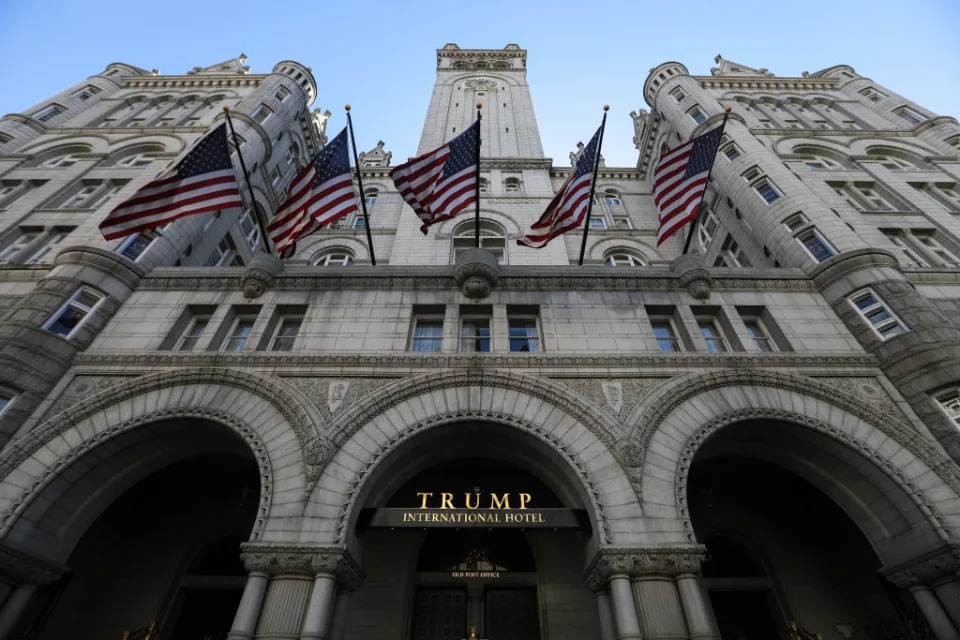
A view of the Trump International Hotel in Washington, D.C., on Oct. 18, 2021. / Credit: Yasin Ozturk/Anadolu Agency via Getty Images
Despite Trump’s frequent criticism of China and insistence that the country was taking advantage of the U.S., the majority of foreign payments included in Thursday’s report came from the Chinese government and two state-owned entities.
The payments totaled nearly $5.6 million at properties including Trump Tower, and the Trump International Hotels in Washington and Las Vegas, the report found. The bulk of the payments came from the state-owned Industrial and Commercial Bank of China, which paid $5.35 million in rent for space in Trump Tower from February 2017 to October 2019.
The nation that spent the second-most at the Trump properties, according to the report, was Saudi Arabia. The Saudi government spent more than $615,000 at Trump World Tower in New York and the Trump hotel in Washington from 2017 to 2020.
The report noted that Trump praised Saudi Arabia and mentioned “his transactional relationships” with the kingdom before taking office. During an August 21, 2015, rally in Alabama, Trump said Saudi nationals had spent millions of dollars on his apartments.
“Saudi Arabia, I get along great with all of them. They buy apartments from me. They spend $40 million, $50 million,” he said. “Am I supposed to dislike them? I like them very much!”
The report said that Trump “oversaw several highly consequential decisions on a range of issues involving U.S. policy towards Saudi Arabia” while his businesses were receiving payments from the Saudi government. The Democrats noted Trump’s response to the 2018 death of Washington Post columnist and Saudi dissident Jamaal Khashoggi, in which he publicly doubted the conclusion of the intelligence community that the Saudi crown prince had ordered his killing.
Qatar follows Saudi Arabia’s spending, with $465,744 spent at Trump World Tower. Nearly all of the remaining payments, from countries including Kuwait, India, Malaysia, Afghanistan, the Philippines and the United Arab Emirates, occurred at the Trump International Hotel in Washington.
The fight over emoluments
Trump’s business dealings as president were the subject of three major court cases while he was in office, the first of which was filed in 2017. The cases, brought by Democratic lawmakers, several states and an oversight group, were the first legal battles over the Emoluments Clause, but failed to resolve questions about the definition of an “emolument” or the scope of constitutional provision. The Supreme Court dismissed two of them once Trump left office and declined to review the third.
The Trump campaign didn’t immediately respond to a request for comment on the new report. Trump dismissed the “phony Emoluments Clause” and concerns about his business dealings in 2019.
The Trump Organization has said it voluntarily donated proceeds from foreign governments to the U.S. Treasury every year from 2018 to 2021. In 2017, the Trump Organization said it would rely on foreign representatives to self-report if they were paying a Trump company for something in their official capacity.
The company said it donated $191,538 in foreign payments in 2019, $105,465 in 2020 and $10,577 in 2021.
Xi Jinping rings in 2024 with rare admission that China’s economy is in trouble
Laura He and Simone McCarthy – January 1, 2024
China’s businesses are struggling and job seekers have trouble finding work, President Xi Jinping acknowledged during his Sunday New Year’s Eve speech.
This is the first time Xi has mentioned economic challenges in his annual New Year’s messages since he started giving them in 2013. It comes at a critical juncture for the world’s second largest economy, which is grappling with a structural slowdown marked by weak demand, rising unemployment and battered business confidence.
Acknowledging the “headwinds” facing the country, Xi admitted in the televised speech: “Some enterprises had a tough time. Some people had difficulty finding jobs and meeting basic needs.”
“All these remain at the forefront of my mind,” Xi saidin remarks which were also widely circulated by state media.“We will consolidate and strengthen the momentum of economic recovery.”
Hours before Xi spoke, the National Bureau of Statistics (NBS) published its monthly Purchasing Managers’ Index (PMI) survey, which showed that factory activity declined in December to the lowest level in six months.
The official manufacturing PMI dropped to 49 last month, down from 49.4 in November, according to a statement from the NBS.
A PMI reading above 50 indicates expansion, while any reading below represents a contraction. December also marked the third straight month the manufacturing PMI has contracted.
Manufacturing downturn
The country’s massive manufacturing sector had been weak for most of 2023. After a brief pickup in economic activity in the first quarter of last year, the official manufacturing PMI contracted for five months until September. Then it dipped below 50 again.
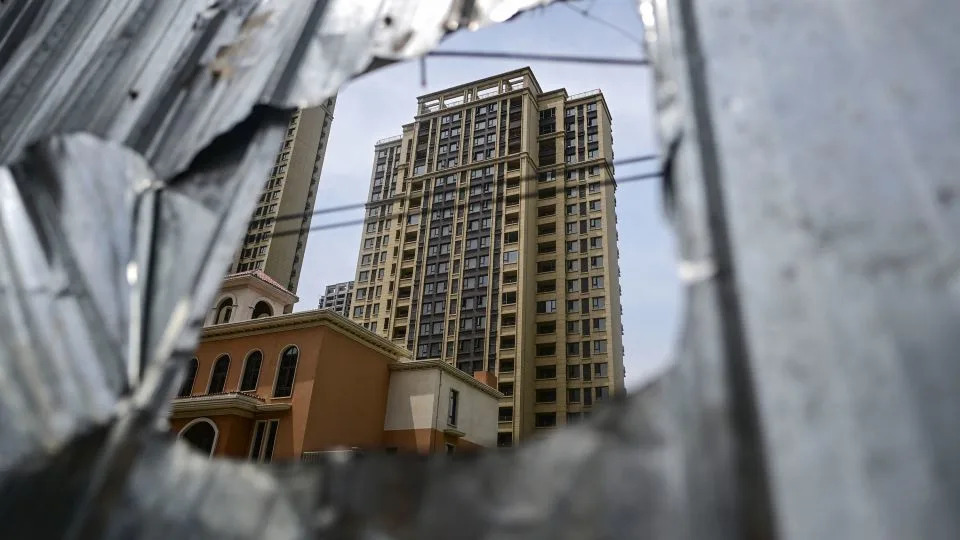
An unfinished apartment building in Xinzheng City, Zhengzhou, China’s central Henan province, seen on June 20, 2023. – Pedro Pardo/AFP/Getty Images/File
Beijing is scrambling to revive growth and spur employment, having rolled out a flurry of supportive measures last year and vowed to step up fiscal and monetary policy in 2024.
But its increasingly statist approach to the economy, which emphasises the party-state’s control of economic and social affairs at the expense of the private sector, has spooked entrepreneurs. The government’s crackdown on businesses in the name of national security has also scared away international investors.
On Saturday, the People’s Bank of China announced that it had approved an application to remove controlling shareholders at Alipay, the ubiquitous digital payment platform run by Jack Ma’s Ant Group. The move means Ma has officially ceded control of the company that he co-founded.
Ma, who also co-founded Alibaba Group, said last January that he would relinquish control of Ant, as part of his withdrawal from his online businesses. His companies were the early targets of Beijing’s unprecedented crackdown on Big Tech which were perceived to have become overly powerful in the eyes of the Communist Party.
Tough on Taiwan
Xi also pledged that the Chinese mainland would be “reunified” with Taiwan, reiterating Beijing’s long-held stance on the self-ruled island democracy, with a strongly worded comment ahead of a crucial election there.
“China will surely be reunified, and all Chinese on both sides of the Taiwan Strait should be bound by a common sense of purpose and share in the glory of the rejuvenation of the Chinese nation,” Xi said during a section of his speech dedicated to his plans for China’s modernization and development.
The comments comejust two weeks ahead of Taiwan’s presidential elections on January 13, and struck a more pointed tone than those in his New Year address the year before.
Then, Xi said: “The people on both sides of the Taiwan Strait are members of one and the same family. I sincerely hope that our compatriots on both sides of the Strait will work together with a unity of purpose to jointly foster lasting prosperity of the Chinese nation.”
Xi has made taking control of Taiwan a cornerstone of his broader goal to “rejuvenate” China to a position of power and stature globally. China’s Communist Party claims Taiwan as its own territory, despite never having controlled it and has not ruled out using force to take the island.
Taipei has accused the party of running influence operations ahead of the election, where current Vice President Lai Ching-te, a candidate openly loathed by Beijing, has been seen as a frontrunner.
Almost four years have passed since Covid-19 struck. In America, the pandemic killed well over a million people and left millions more with lingering health problems. Much of normal life came to a halt, partly because of official lockdowns but largely because fear of infection kept people home.
The big question in the years that followed was whether America would ever fully recover from that shock. In 2023 we got the answer: yes. Our economy and society have, in fact, healed remarkably well. The big remaining question is when, if ever, the public will be ready to accept the good news.
In the short run, of course, the pandemic had severe economic and social effects, in many ways wider and deeper than almost anyone expected. Employment fell by 25 million in a matter of weeks. Huge government aid limited families’ financial hardship, but maintaining Americans’ purchasing power in the face of a disrupted economy meant that demand often exceeded supply, and the result was overstretched supply chains and a burst of inflation.
At the same time, the pandemic reduced social interactions and left many people feeling isolated. The psychological toll is hard to measure, but the weakening of social ties contributed to a range of negative trends, including a surge in violent crime.
It was easy to imagine that the pandemic experience would leave long-term scars — that long Covid and early retirements would leave us with a permanently reduced labor force, that getting inflation down would require years of high unemployment, that the crime surge heralded a sustained breakdown in public order.
But none of that happened.
You may have heard about the good economic news. Labor force participation — the share of adults in today’s work force — is actually slightly higher than the Congressional Budget Office predicted before the pandemic. Measures of underlying inflation have fallen more or less back to the Federal Reserve’s 2 percent target even though unemployment is near a 50-year low. Adjusted for inflation, most workers’ wages have gone up.
For some reason I’ve heard less about the crime news, but it’s also remarkably good. F.B.I. data shows that violent crime has subsided: It’s already back to 2019 levels and appears to be falling further. Homicides probably aren’t quite back to 2019 levels, but they’re plummeting.
None of this undoes the Covid death toll or the serious learning loss suffered by millions of students. But overall both our economy and our society are in far better shape at this point than most people would have predicted in the early days of the pandemic — or than most Americans are willing to admit.
For if America’s resilience in the face of the pandemic shock has been remarkable, so has the pessimism of the public.
By now, anyone who writes about the economic situation has become accustomed to mail and social media posts (which often begin, “You moron”) insisting that the official statistics on low unemployment and inflation are misleading if not outright lies. No, the Consumer Price Index doesn’t ignore food and energy, although some analytical measures do; no, grocery prices aren’t still soaring.
Rather than get into more arguments with people desperate to find some justification for negative economic sentiment, I find it most useful to point out that whatever American consumers say about the state of the economy, they are spending as if their finances are in pretty good shape. Most recently, holiday sales appear to have been quite good.
What about crime? This is an area in which public perceptions have long been notoriously at odds with reality, with people telling pollsters that crime is rising even when it’s falling rapidly. Right now, according to Gallup, 63 percent of Americans say that crime is an “extremely” or a “very” serious problem for the United States — but only 17 percent say it’s that severe a problem where they live.
And Americans aren’t acting as if they’re terrified about crime. As I’ve written before, major downtowns have seen weekend foot traffic — roughly speaking, the number of people visiting the city for fun rather than work — recover to prepandemic levels, which isn’t what you’d expect if Americans were fleeing violent urban hellscapes.
So whatever Americans may say to pollsters, they’re behaving as if they live in a prosperous, fairly safe (by historical standards) country — the country portrayed by official statistics, although not by opinion polls. (Disclaimer: Yes, we have vast inequality and social injustice. But this is no more true now than it was in earlier years, when Americans were far more optimistic.)
The big question, of course, is whether grim narratives will prevail over relatively sunny reality in the 2024 election. There are hints in survey data that the good economic news is starting to break through, but I don’t know of any comparable hints on crime.
In any case, what you need to know is that America responded remarkably well to the economic and social challenges of a deadly pandemic. By most measures, we’re a nation on the mend. Let’s hope we don’t lose our democracy before people realize that.
Will the Economy Help or Hurt Biden ’24? Krugman and Coy Dig Into Data.
Paul Krugman and Peter Coy – December 31, 2023
Credit…Photo illustration by Sam Whitney/The New York Times
Mr. Krugman is an Opinion columnist. Mr. Coy is an Opinion newsletter writer.Sign up for the Opinion Today newsletter Get expert analysis of the news and a guide to the big ideas shaping the world every weekday morning. Get it sent to your inbox.
Peter Coy: Paul, I think the economy is going to be a huge problem for President Biden in 2024. Voters are unhappy about the state of the economy, even though, by most measures, it’s doing great. Imagine how much unhappier they’ll be if things get worse heading into the election — which I, for one, think is quite likely to be the case.
Paul Krugman: I’m not sure about the politics. We can get into that later. But first, can we acknowledge just how good the current state of the economy is?
Peter: Absolutely. Unemployment is close to its lowest point since the 1960s, and inflation has come way down. That’s the big story of 2023. But 2024 is a whole ’nother thing. I think there will be two big stories in 2024. One, whether the good news continues and, two, how voters will react to whatever the economy looks like around election time.
Paul: Right now many analysts, including some who were very pessimistic about inflation last year, are declaring that the soft landing has arrived. Over the past six months, the core personal consumption expenditures deflator — a mouthful, but that’s what the Federal Reserve targets — rose at an annual rate of 1.9 percent, slightly below the Fed’s 2 percent target. Unemployment is 3.7 percent. The eagle has landed.
Peter: I question whether we’ve stuck the soft landing. I do agree that right at this moment, things look really good. While everyone talks about the cost of living going up, pay is up lately, too. Lael Brainard, Biden’s national economic adviser, points out that inflation-adjusted wages for production and nonsupervisory workers are higher now than they were before the Covid pandemic.
So let’s talk about why voters aren’t feeling it. Is it just because Biden is a bad salesman?
Paul: Lots of us have been worrying about the disconnect between good numbers and bad vibes. I may have been one of the first people to more or less sound the alarm that something strange was happening — in January 2022! But we’re all more or less making this up as we go along.
The most informative stuff I’ve seen recently is from Briefing Book, a blog run by former White House staff members. They’ve tried to put numbers to two effects that may be dragging consumer sentiment down.
One effect is partisanship. People in both parties tend to be more negative when the other party controls the presidency, but the Briefing Book folks find that the effect is much stronger for Republicans. So part of the reason consumer sentiment is poor is that Republicans talk as if we’re in a depression when a Democrat is president, never mind reality.
Peter: That is so true. And I think the effect is even stronger now than it used to be because we’re more polarized.
Paul: The other effect affecting consumer sentiment is that while economists tend to focus on relatively recent inflation, people tend to compare prices with what they were some time in the past. The Briefing Book estimates suggest that it takes something like two years or more for lower inflation to show up in improved consumer sentiment.
This is one reason the economy may be better for Democrats than many think. If inflation really has been defeated, many people haven’t noticed it yet — but they may think differently a little over 10 months from now, even if the fundamentals are no better than they are currently.
I might add that the latest numbers on consumer sentiment from several surveys have shown surprising improvement. Not enough to eliminate the gap between the sentiment and what you might have expected from the macroeconomic numbers, but some movement in a positive direction.
Peter: That makes sense. Ten months from now, people may finally be getting over the trauma of high inflation. On the other hand, and I admit I’m not an economist, I’m still worried we could have a recession in 2024. Manufacturing is soft. The big interest rate increases by the Fed since March 2022 are hitting the economy with a lag. The extra savings from the pandemic have been depleted. The day after Christmas, the Federal Reserve Bank of St. Louis said the share of Americans in financial distress over credit cards and auto loans is back to where it was in the depths of the recession of 2007-9.
Plus, I’d say the labor market is weaker than it looked from the November jobs report. (For example, temp-agency employment shrank, which is an early warning of weak demand for labor.)
Paul: Glad you brought up small business confidence — I wrote about that the other week. Hard indicators like hiring plans are pretty strong. Soft indicators like what businesses say about future conditions are terrible. So small businesses are, in effect, saying, “I’m doing OK and expanding, but the economy is terrible” — just like consumers.
I’m not at all sure when the Fed will start cutting, although it’s almost certain that it eventually will, but markets are already effectively pricing in substantial cuts — and that’s what matters for the real economy. As I write this, the 10-year real interest rate is 1.69 percent, down from 2.46 percent around six weeks prior. Still high compared with prepandemic levels, but financial conditions have loosened a lot.
Could there be a recession already baked in? Sure. But I’m less convinced than I was even a month ago.
Peter: The big drop in interest rates can be read two ways. The positive spin is that it’ll be good for economic growth, eventually. That’s how the stock market is interpreting it. The negative spin is that the bond market is expecting a slowdown next year that will pull rates down. Also, what if the economy slows down a lot but the Fed doesn’t want to cut rates sharply because Fed officials are afraid of being accused by Donald Trump of trying to help Biden?
Paul: I guess I think better of the Fed than that. And always worth remembering that the interest rates that matter for the economy tend to be driven by expectations of future Fed policy: The Fed hasn’t cut yet, but mortgage rates are already down substantially.
Peter: Yes.
Paul: OK, about the election. The big mystery is why people are so down on the economy despite what look like very good numbers. At least part of that is that people look not at short-term inflation but at prices compared with what they used to be some time ago — but people’s memories don’t stretch back indefinitely. As I said, the guys at Briefing Book estimate that the most recent year’s inflation rate is only about half of what consumers look at, with a lot of weight on earlier inflation. But here’s the thing: Inflation has come way down, and this will gradually filter into long-term averages. Right now the average inflation rate over the past 2 years was 5 percent, still very high; but if future inflation runs at the 2.4 percent the Fed is now projecting, which I think is a bit high, by next November the two-year average will be down to 2.7 percent. So if the economy stays where it is now, consumers will probably start to feel better about inflation.
Peter: Except that perceptions of inflation are filtered through politics. Food and gasoline are more expensive for Trump supporters than Biden supporters, if you believe what people tell pollsters. That’s not going to change between now and November.
The Obama-Biden ticket beat the McCain-Palin ticket in 2008 because voters blamed Republicans for the 2007-9 recession. Obama-Biden had a narrower win in 2012 against Romney-Ryan, and I think one factor was the so-called jobless recovery from that recession. That’s why Biden is supersensitive about who gets credit and blame for turns in the economy.
For the record, Trump might be president right now if it hadn’t been for the Covid pandemic, which sent the unemployment rate to 14.7 percent in April 2020. The economy was doing quite well before that happened. A lot of Republicans are nostalgic for Trumponomics, although I think the economy prospered more in spite of him than because of him. Thoughts?
Paul: Most of the time, presidents have far less effect on the economy than people imagine. Big stimulus packages like Barack Obama’s in 2009 and Biden’s in 2021 can matter. But aside from pandemic relief, which was bipartisan, nothing Trump did had more than marginal effects. His 2017 tax cut didn’t have much visible effect on investment; his tariffs probably on net cost a few hundred thousand jobs, but in an economy as big as America’s, nobody noticed.
Peter: Just speculating, but I wonder if when people say they trust Trump more than Biden on the economy, they’re feeling vibes more than parsing statistics. You know, “We need a tough guy in the White House!”
Paul: People definitely aren’t parsing statistics. Only pathetic nerds like us do that. And while Trump wasn’t actually a tough economic leader, he literally did play one on TV.
But we don’t really know if that matters or whether people are still reacting to the shock of inflation and high interest rates, which they hadn’t seen in a long time. Again, the best case for Biden pulling this out is that voters get over that shock, with both inflation and interest rates rapidly declining.
Oh, and falling interest rates mean higher bond prices and often translate into higher stock prices, too — which has also been happening lately.
Peter: True, Paul. But cold comfort for people who don’t own stocks and bonds. Or who do own stocks and bonds in their retirement plans but don’t think of themselves as part of the capitalist class. To win in November, Biden and his team are going to need to be perceived as doing something for the working class and the middle class. That’s why you see the White House talking about eliminating junk fees and capping insulin prices.
Paul: For what it’s worth, I think a lot of people judge the economy in part by the stock market, even if they don’t have a personal stake. That’s why Trump boasted about it so much and has lately been trying to say that Biden’s strong stock market is somehow a bad thing.
Finally, there are some indications that Democrats in particular are feeling better about the Biden economy. The Michigan survey tracks sentiment by partisanship. The numbers are noisy, but over the past few months Democratic sentiment has been slightly more positive than in the months just before the pandemic struck.
Peter: Paul, how important do you think the economy will be to voters compared with other issues, such as Trump’s fitness for office, Biden’s age, abortion access, et cetera? I mean, if it’s not important, why are we even having this conversation?
Paul: The economy surely matters less than it did when Republicans and Democrats lived in more or less the same intellectual universe — everyone agreed that the economy was bad in 1980 or 2008; now, Dems are fairly positive, while Republicans claim to believe that we’re in a severe downturn. But there are still voters on the margin and weak Democratic supporters who will turn out if they have a sense that things are improving.
Peter: Democratic strategists think the election might come down to Pennsylvania and Wisconsin, assuming that Biden holds Michigan and New Hampshire and loses Arizona and Georgia. Any thoughts about the economic outlook for Pennsylvania and Wisconsin?
Paul: No strong sense about either state. But one little-noticed fact about the current economy is how uniform conditions are. In 2008, so-called sand states that had big housing bubbles were doing much worse than states that didn’t; now unemployment is low almost everywhere.
Of course, all political bets are off if we have a recession. But there’s a reasonable case that the economy will be much less of a drag on Democrats by November, as the reality of a soft landing sinks in.
Oh, and my subjective sense is that for whatever reason, media coverage of the economy has turned much more positive lately. I have to think this matters, otherwise, what are we even doing? And until recently, media reports tended to emphasize the downsides; “Great jobs numbers, and here’s why that’s bad for Biden” has become a sort of running joke among people I follow. These days, however, we’re starting to see reports acknowledging that we’ve had an almost miraculous combination of strong employment and falling inflation.
Peter: Paul, what economic indicators will you be paying the most attention to in the next few months with regard to the election? I’ll nominate inflation and unemployment, although those are kind of obvious.
Paul: Unemployment, for sure. On inflation, I’ll be watching longer-term measures: Will inflation be low enough to bring down two- or three-year averages? And especially highly visible stuff, like groceries. Thanksgiving dinner was actually cheaper in 2023 than in 2022. Will grocery prices be subdued enough to reduce the amount of complaining?
Oh, and I’ll be looking at consumer sentiment, which as we’ve seen can be pretty disconnected from the economy but will matter for the election.
Seven ways the exodus of Western companies has cratered the Russian economy.
By Jeffery A. Sonnenfeld, the Lester Crown professor in management practice and a senior associate dean at the Yale School of Management, and Steven Tian, the director of research at the Yale Chief Executive Leadership Institute. – December 22, 2023
Russian President Vladimir Putin holds his year-end press conference at Gostiny Dvor exhibition hall in central Moscow.
This is perhaps the most dire moment for Ukraine since Russia’s invasion in February 2022, with the military situation on the battlefield seemingly stalemated, Western political support wavering under the weight of political dysfunction, and war in the Middle East diverting resources and attention.
Nevertheless, many reflexive cynics in the Western press are going too far in crediting Ukraine’s adversary, Russian President Vladimir Putin, with one Wall Street Journal columnist even declaring Putin one of the “winners of the year.” We cannot fall into the trap of thinking that all is good for Putin, and we cannot jettison effective measures to pressure him. Just this week, the New York Times even suggested that the exit of more than 1,000 multinational companies from Russia has backfired by enriching Putin and his cronies.
All the evidence suggests there are, in fact, ample costs of the business exodus. Economic data clearly shows that the Russian economy has paid a huge price for the loss of those businesses. Putin continues to conceal the required disclosure of Russia’s national income statistics—obviously because they are nothing to brag out.
Transferring nearly worthless assets does not make Russia or Putin cronies wealthier. While Putin expropriated some assets of Asian and Western companies, most firms simply abandoned them, eagerly writing down billions of dollars in assets. They were rewarded for doing so as their market capitalization soared upon the news of their exits. Russia is not only suing foreign companies for leaving, as ExxonMobil’s and BP’s departures ended the technology needed for exploration, but Russian oil giant Rosneft even sued Reuters for reporting on it. The massive supply disruptions shuttering Russian factories across sectors were described in on-the-ground reporting by the Journal, which resulted in the arrest and now nine-month imprisonment of the heroic journalist who documented the truth.
Consider the following economic statistics we have verified.
Talent flight. In the first months after the invasion, an estimated 500,000 individuals fled Russia, many of whom were exactly the highly educated, technically skilled workers Russia cannot afford to lose. In the year-plus since, that number has ballooned to at least 1 million individuals. By some counts, Russia lost 10 percent of its entire technology workforce from this unprecedented talent flight.
Capital flight. Per the Russian Central Bank’s own reports, a record $253 billion in private capital was pulled out of Russia between February 2022 and June 2023, which was more than four times the amount of prior capital outflows. By some measures, Russia lost 33 percent of the total number of millionaires living in Russia when those individuals fled.
Loss of Western technology and knowhow. This occurred across key industries such as technology and energy exploration. For example, Rosneft alone has had to spend nearly $10 billion more on capital expenditure over the last year by its own disclosure, which amounts to roughly $10 of additional expenses for every barrel of oil exported, on top of difficulties continuing its Arctic oil drilling projects, which were almost solely dependent on Western tech and expertise.
Near-complete halt in foreign direct investment into Russia. Foreign direct investment (FDI) into Russia has come to a near-complete stop by several measures. There has been only one month of positive inflows in the 22 months since the invasion, compared with approximately $100 billion in FDI annually before the war.
Loss of the ruble as a freely convertible and exchangeable currency. With global multinationals fleeing in such droves, there was little to stop Putin from implementing unprecedented, strict capital controls on the ruble post-invasion, such as banning citizens from sending money to bank accounts abroad; suspending cash withdrawals from dollar banking accounts beyond $10,000; forcing exporters to exchange 80 percent of their earnings for rubles; suspending direct dollar conversions for individuals with ruble banking accounts; suspending lending in dollars; and suspending dollar sales across Russian banks. No wonder ruble trading volumes are down 90 percent, making Russian assets valued in rubles virtually worthless and unexchangeable in global markets.
Loss of access to capital markets. Western capital markets remain the deepest, most liquid, and cheapest source of capital to fund business and risk-taking. Since the start of the invasion, no Russian company has been able to issue any new stock or any new bonds in any Western financial market—meaning they can only tap the coffers of domestic funding sources such as Putin’s state-owned banks for loans at usurious rates (and still increasing, with the benchmark interest rate at 16 percent). And with multinational companies having fled, Russian business ventures have no alternative sources of funding and no global investors to tap.
Massive destruction of wealth and plummeting asset valuations. Thanks in part to the mass exodus of global multinational businesses, asset valuations have plummeted across the board in Russia, with even the total enterprise value of some state-owned enterprise down 75 percent compared with prewar levels, according to our research, on top of 50 percent haircuts in the valuation of many private sector assets, as cited in the Times.
The Liberian-flagged oil tanker Ice Energy (left) transfers crude oil from the Russian-flagged oil tanker Lana (right), off the coast of Greece, on May 29, 2022.Ukrainian President Volodymyr Zelensky gestures with an open hand while speaking during a TV news interview. Zelensky is dressed in his typical black t-shirt and is seated at a desk in front of a bright blue wall.A woman poses for a photo in front of a tall decorated Christmas tree in front of a war-damanged building in Melitopol in Ukraine’s Zaporizhzhia region with a Russian flag flying from a tall pole overhead.
These are just some of the costs imposed on Putin by the withdrawal of 1,000-plus global businesses; it does not consider the deleterious impact on the Russian economy of economic sanctions, such as the highly effective oil price cap devised by the U.S. Treasury Department. More than two-thirds of Russia’s exports were energy, and that is now slicedin half. Russia, which never supplied any finished goods—industrial or consumer—to the global economy, is paralyzed. It is not remotely an economic superpower, with virtually all of its raw materials easily substituted from elsewhere. The war machine is driven only by the cannibalization of now state-controlled enterprises.
Based on our ample economic data, the verdict is clear: The unprecedented, historic exodus of 1,000-plus global companies has helped cripple Putin’s war machine. At such a dire moment for Ukraine, it would be a mistake to be too Pollyannaish—just as it would be a mistake to be too cynical.