Do Anti-ESG States Know They’re Facing Some of the Worst Climate Change Hazards?

The Motley Fool

Do Anti-ESG States Know They’re Facing Some of the Worst Climate Change Hazards?

By The Daily Upside   – March 24, 2023 

Unless the data are dead wrong, it is increasingly clear that many of the U.S. states facing some of the greatest climate change hazards appear to be the ones most virulently opposed to environmental, social and governance (ESG) policies.

The data also show something else that we don’t like to talk about: Americans are already dying due to climate change and have been since around 2005. U.S. cities from coast to coast are experiencing fatalities in the double digits yearly, especially south of the Mason-Dixon line, according to an in-depth project surveying more than 24,000 regions of the world, led by the United Nations Development Program and New York-based Rhodium Group, a provider of independent research, data and analytics tackling mission-critical global topics.

In Texas, the fatality rate due to climate change – for instance, from heat stroke or other underlying causes – is estimated to be 14 people a year per 100,000 of the population in both Dallas and Austin. Those numbers will rise to 38 and 39, respectively, by 2040, and leap to 130 and 131 people a year, respectively, by 2080, according to the data.

The situation in Phoenix is even more dire, with an annual fatality rate of 17 people per 100,000 of the population, climbing to 46 by 2040 and 148 people a year by 2080. In Atlanta, the fatality rate is estimated to be around 10 people a year per 100,000, with that number at 29 by 2040 and shooting to 100 people by 2080.

“The mortality impact is some of the most striking of the data,” says Hannah Hess, associate director at Rhodium, who worked on the project. “When you look at the year 2040, it can seem really far out and distant in the future, but the people most affected by the heat are 65 and older – those are people in their 40s today who will be impacted.” 

By the same token, those in their 20s and 30s will be confronting even higher temperatures, and those who are currently in their teens or younger will be forced to contend with some of the most extreme climate challenges of anyone alive.

This week, President Biden cast his first veto since taking office, rejecting a bill that would have scuttled a Labor Department rule he put in place allowing money managers to account for climate change when making investment decisions for their clients’ retirement savings. The Biden rule supplanted a Trump-era rule that sought to impede the consideration of ESG principles in investing, “even in cases where it is in the financial interest of plans to take such considerations into account.”

In issuing the veto, Biden blasted “MAGA House Republicans” and others for risking Americans’ retirement plan savings by making it illegal to weigh ESG principles. “Your plan manager should be able to protect your hard-earned savings, whether Rep. Marjorie Taylor Greene likes it or not,” he said, noting strong opposition from the Republican congresswoman from Georgia.

Two Democrats also backed the bill. Sen. Joe Manchin of West Virginia, who charged that Biden’s veto was “absolutely infuriating” and denounced the administration’s “radical” and “progressive agenda,” and Jon Tester of Montana, who voted alongside the Senate’s Republicans to overturn the Biden rule.

Both Georgia and West Virginia are forecast to sustain pronounced effects from climate change relative to northern states, like Montana.

The ESG fight, not surprisingly, is focused on money – primarily, how resources will be marshaled or redirected in anticipation of future shifts that are expected to devastate real estate, housing and jobs markets. “Without concerted and urgent action, climate change will exacerbate inequalities and widen gaps in human development,” the UNDP projected at the end of last year.

A smattering of top money managers and private equity firms have begun to prepare for the transition, touting pro-ESG investing principles that aim to capture a profit. But they have also warned adopting these strategies poses heightened financial and reputational risks with the growing anti-ESG backlash.

The world’s biggest private-equity firm, Blackstone, disclosed in a recent filing that pushback from states across the country over so-called “boycotts” of investments in the fossil fuel industry could affect the company’s fundraising and revenue and will be perceived negatively by some stakeholders. Others signaling similar headwinds include KKR & Co., State Street, Carlyle Group, T. Rowe Price, TPG Inc., Ares Private Equity Group, Raymond James, and BlackRock.

While partisanship seems to be ruling the debate, it’s worth looking closely at what is forecast for some of the states that are most assiduously pursuing anti-ESG legislation, many of which are expected to experience some of the most serious fallout of climate change. Among them are Texas, Arizona, Oklahoma, Idaho, Louisiana, Arkansas, Tennessee, Kentucky, West Virginia, South Carolina and Florida.  

Over the past few years, these states have sought to introduce or pass legislation barring companies from discriminating against investing in fossil fuel developers or energy companies contributing to climate change. Those succeeding in passing legislation against so-called “woke capitalism” include Texas, Arizona, Oklahoma, Idaho, Louisiana, Tennessee, Kentucky, West Virginia, South Carolina and Florida. 

Other states that have tried or are still trying to pass anti-ESG legislation include North Dakota, South Dakota, Colorado, Wyoming, Montana, Arkansas, Nebraska, Minnesota, Pennsylvania and New Hampshire, according to the National Conference of State Legislatures, a Denver nonpartisan research organization. Meanwhile, Arizona, Texas, Oklahoma, South Carolina, Tennessee and Florida have more anti-ESG legislation pending, in addition to what they’ve already enacted, even though all of them are now dealing with fatalities from climate change.

Hess says research shows that some states’ attitudes may change on climate change as “those places start to feel the impact,” but, until then, states suffering the ongoing fatalities of climate change while fighting to ban ESG-friendly policies, sustainability practices and “social credit scores” to protect investments in fossil fuels is “an odd reality.”

Worth noting are the states that have pursued anti-ESG legislation, but will not feel the impact of climate change as strongly as some of the states mentioned above. They are Pennsylvania, New Hampshire, Indiana, Missouri, Kansas, Nebraska, Utah, Wyoming, Montana, Minnesota, North Dakota, South Dakota and Alaska.

The one state that will be hard hit by climate change but is working to bolster pro-ESG initiatives – and block any attempts to stop it from doing so – is California. According to the UNDP-Rhodium data, the state’s cities are already sustaining some of the highest annual fatality rates in the country due to climate change. At present, the death toll is estimated to be around a dozen people per 100,000 of the population in San Francisco and Sacramento, but is seen rising to 30 and 33, respectively, by 2040, and 104 and 113 people a year, respectively, by 2080.

Other cities that are being impacted by climate change include Los Angeles, Houston, San Antonio, Las Vegas, Nashville, Memphis, New Orleans, Miami, Virginia Beach, Raleigh, Charlotte and Washington, DC, according to the data.

Interestingly, the data show a handful of states will see some benefits from climate change, at least in theory. Rising temperatures likely will contribute to fewer mortality rates in cooler cities such as Seattle, Portland, Denver, Kansas City, Minneapolis, Milwaukee, Chicago, Indianapolis, Louisville, Cincinnati, Pittsburg, Philadelphia, New York and Boston. These benefits stem from the fact that, as temperatures rise, annual fatality rates resulting from cold weather will ease, Hess says.

Even with fewer fatalities in some regions, by the end of the century, the effects of climate change will eventually overtake much of the U.S., whether through rising temperatures, changes in precipitation, droughts, serious weather patterns, or what is expected to be an influx of displaced populations – also known as “climate refugees” – who will need to migrate to safer locations to survive. That means anyone living in safe zones will find their regions more and more crowded. 

“Income will matter a lot in how people will be able to adapt and respond to the impact of climate,” Hess says.

Banking industry intent on killing the golden goose: Bye banks: Recent turmoil is spurring many to move their money

The Washington Post

Bye, banks: Recent turmoil is spurring many to move their money

Abha Bhattarai, The Washington Post – March 24, 2023

FILE – Customers and bystanders form a line outside a Silicon Valley Bank branch location, Monday, March 13, 2023, in Wellesley, Mass. The sudden crisis in the U.S. banking industry is sure to cause some tightening of lending and credit and a slowdown in the pace of borrowing and spending. If it does, the crisis could actually end up aiding the Federal Reserve in the elusive goal the Fed has been pursuing for a full year: A much lower inflation rate. (AP Photo/Steven Senne, File) (ASSOCIATED PRESS)

Dan Ushman isn’t sure where he’ll end up stashing his company’s money. But he’s been thinking a lot about it these days.

The start-up founder recently moved savings out of Silicon Valley Bank, whose spectacular collapse this month set off tremors across the financial industry, and parked it in accounts at Bank of America and Chase while he contemplates what’s next – brokerage accounts, perhaps, or money market funds, Treasury-backed trusts or certificate of deposit accounts.

The goal, he says, is simple: to reduce risk while maximizing interest.

“Having SVB collapse out from under us gave us a lot of pause,” said Ushman, 38, founder of a software firm in Chicago. “We’re thinking hard about how to spread our cash around. We want higher yields and safety. But the thing about business savings is that they’re savings until you need them, so we don’t want to lock anything up long-term.”

Across the country, millions of Americans are making similar calculations, trying to figure out how to best allocate their money following the implosion of two U.S. banks and the emergency takeover of European banking giant Credit Suisse last weekend, which set off fears of a global financial crisis.

The crisis so far doesn’t seem to have come, and the government has taken great pains to reassure depositors that bank accounts are safe. But that hasn’t stopped people from shifting their money around. Americans are moving hundreds of billions of dollars out of banks – especially smaller, regional banks – into larger institutions, as well as money market funds, government bonds, high-yield online savings accounts, even cryptocurrencies and gold.

In the two weeks since SVB’s dramatic collapse, investments in money market funds, a type of mutual fund focused on low-risk securities, have ballooned by nearly $240 billion, according to the Investment Company Institute. Yields on 2-year Treasury bonds have fallen 24 percent as a result of booming demand. Money market funds are not insured by the government the way bank accounts less than $250,000 are. But even riskier investments are thriving, too: Bitcoin prices have risen 40 percent, and gold is up about 10 percent.

Overall, an estimated $550 billion in deposits have moved from smaller and regional banks to large banks and money market funds in the past two weeks, according to an analysis by JPMorgan.

“Turmoil in the markets always puts money in motion,” said Danielle Lucht, a financial adviser in Cape Coral, Fla., who is fielding twice as many calls from clients as she was a few weeks ago. “The big concern right now is: Is my money safe? How can I make it safer? People who have cash in simple savings accounts are using this as an opportunity to move their money.”

About 12 percent of Americans say they have taken money out from the bank “because of the collapse of Silicon Valley Bank,” and 18 percent say they are considering doing so, according to a Yahoo News/YouGov poll released Tuesday. (It is also worth noting, though, that most people – 55 percent – said they are confident the banking system is safe.)

The recent shift builds on a trend that began a year ago, when the Federal Reserve began raising interest rates after years of keeping them near zero. Suddenly regular bank accounts – that pay very little, if any, interest – became much less attractive than other investments offering higher returns.

That steady movement out of bank accounts took on a life of its own this month after fears of bank failures led customers at SVB and Signature Bank of New York to take out billions of dollars in cash in a matter of a few hours. The result was a bank run that triggered the collapse of both institutions.

The Federal Reserve and other regulators were quick to step in with emergency measures aimed at stemming similar runs at other banks. But panic persists: This week, shares of PacWest Bancorp, a regional California institution, tumbled 17 percent after it said it had lost 20 percent of its deposits this year. Economists say that lack of confidence in a company’s stock can be self-fulfilling if it prompts customers to remove their money, leaving the bank in even worse shape.

At First Republic Bank, not even a $30 billion rescue package from the nation’s biggest banks has been enough to keep people from taking out their money. In all, customers have withdrawn about $70 billion in recent weeks, or roughly 40 percent of the bank’s deposits, the Wall Street Journal reported this week.

“People are looking around and saying, ‘I really don’t want to be uninsured,'” said Itamar Drechsler, a finance professor at the Wharton School at the University of Pennsylvania. “They’re buying government bonds and going to bigger banks at the expense of regionals.”

The federal government insures deposits of up to $250,000 in any given bank account, though there are looming questions about whether it might raise that cap or extend protection to all deposits as it did at SVB and Signature Bank of New York this month. Treasury Secretary Janet L. Yellen struggled to manage the fallout from remarks Wednesday over the extent to which the federal government could insure deposits over the limit at other banks if they failed; markets fell after she spoke, and she later amended her written testimony to stress that the government has “tools we could use again” and would be “prepared to take additional action if warranted.”

Still, the recent panic has been enough to spook those with large sums piled into traditional bank accounts. Brenton Wickam, 53, a commercial real estate investor in Silicon Valley, hadn’t thought twice about keeping his personal savings in one bank account – until recently.

When SVB collapsed, Wickam started getting a barrage of text messages all saying the same thing: “First Republic’s next.” That was particularly troubling to Wickam, who had been banking there for years.

Last week, he showed up at a local branch to begin moving his savings into new accounts, in $250,000 chunks so they’d be insured by the government. The leftover money he took to Wells Fargo, though he plans to invest it in money markets or Treasurys.

“I felt like the dumbest guy in the room, keeping all of my cash in one bank account,” Wickam said. “I’ve been around awhile – 2000, 2008, I’ve seen what a financial crisis looks like – but I was just being lazy.”

The exodus of deposits, particularly from smaller banks, is particularly worrisome because it could have a chilling effect on how much those institutions are able to loan. Nearly 70 percent of commercial real estate loans, for example, come from small and midsize banks, Fed data shows.

“The consequence of this is manyfold,” said Torsten Slok, chief economist at Apollo Global Management. “The reality is, banks finance themselves through deposits.”

A drop in deposits, he said, would mean banks have less money on hand to make loans. If someone walked in looking for a $40,000 car loan, for example, and a bank didn’t have much in deposits, it would have to borrow that money from wholesale markets, where interest rates have risen rapidly in the past year. As a result, borrowers could face higher interest rates and stricter standards, Slok said.

“If banks across the country suddenly say, ‘We’re going to tighten lending standards for anyone who would like to buy a car or a house or get a corporate loan’ – if they stop lending money out, you could have a sudden stop in the economy,” he said. “That begins to raise the risk of a recession.”

Fed Chair Jerome H. Powell pushed back against that fear this week, saying the banking system is “sound and resilient.”

“We took powerful actions with Treasury and the FDIC, which demonstrate that all depositor savings are safe and that the banking system is safe,” Powell said in a news conference on Wednesday. “Deposit flows in the banking system have stabilized over the last week.”

Verbal assurances aside, the interventions of regulators have raised more questions than answers for many Americans. They’ve also prompted many people to stop and consider their investment habits, since interest rates are at their highest level in 16 years.

“The silver lining in this debacle is that it’s caused people to pause and ask, ‘Is my money OK at the bank?,'” said Rick Salmeron, a financial adviser in Dallas, who has seen a rush toward high-yield online savings accounts. “They’re realizing, ‘Wow, I have all of this cash making a paltry 0.01 percent interest in the bank when I could be getting 3.5 percent.'”

Steve Miller, 51, a stay-at-home dad in Orange County, Calif., recently moved his family’s savings from a large bank to a Vanguard federal money market account. It wasn’t so much panic over recent bank failures that prompted the move, he said, but rather the realization that he could be earning much higher interest on his money. Now he’s earning 4.65 percent interest.

“We have always kept our cash reserves parked in the bank, but this was a good trigger,” he said. “It made me realize we could be earning much more by being invested in Treasury bills.”

The Washington Post’s Jeff Stein contributed to this report.

‘Gerbil banking’ preceded the Great Depression. We’re seeing it again today

Fortune

‘Gerbil banking’ preceded the Great Depression. We’re seeing it again today

Maureen O’Hara – March 23, 2023

‘Gerbil banking’ preceded the Great Depression. We’re seeing it again today

The recent action by a consortium of banks to deposit money in First Republic Bank harkens back to an earlier attempt to counter bank runs: the U.S. Postal Savings system.

Banking in the 19th century was notoriously unstable, with bank runs or “panics” coming all too frequently. By the turn of the 20th century, such runs were almost seasonal, prompting depositors to withdraw in advance of what might be a coming run, thereby, of course, precipitating liquidity crises at banks. This came to a head in the Panic of 1907, the granddaddy of panics, when the banking system collapsed.

Congress at that time considered an array of solutions to bank instability such as deposit insurance (favored by the Democrats), postal savings (favored by the Republicans), and a central bank (favored by almost none of them but viewed as something to study). Republican William Howard Tafts’ election in 1908 sealed the deal, and we got a Postal Savings system.

The idea of Postal Savings was simple. There were post offices everywhere and they would take deposits from individuals, paying them a slightly lower interest rate than the banks offered (a maximum deposit of $2,000 was also imposed to reduce competition with the banks). Now, when individuals became concerned about bank solvency and withdrew their funds, they could put the money in Postal Savings instead of under their mattresses. And what would the Postal Savings system do with the funds? Put the money back into the banks!

This gerbil-like treadmill would thus keep the funds in the banking system, while giving the Postal Savings system interest on its bank deposits to pay the system’s depositors. The circularity of flows out of and then back into the banking system at the heart of the Postal Savings system did have a certain cleverness to it.

As David Easley and I showed in a research paper, this system worked pretty well until the onset of the Great Depression. Faced with growing numbers of bank failures, even the Postal Savings system lost faith in the banks, and so shifted its investments from deposits to government bonds. While certainly not the major cause of banking’s problems, we showed that this action contributed to the liquidity problems undermining the banking system. With the collapse of the banking system in 1933, the view that the Postal Savings system could restore stability to the banking system similarly vanished, setting the stage for the establishment of FDIC deposit insurance.

The latest banking woes demonstrated once again that when concerns arise, depositors flee–but this time to the largest banks which are viewed as “Too Big to Fail”. And what did they do with the money? Already awash with deposits, they made the decision to put some back into First Republic. The gerbil lives again!

The actions of the large banks are admirable, but clearly, this is only a short-run answer. Is a new U.S. Postal Savings System the answer? No. Deposit insurance has proven its worth in protecting retail depositors, who, if they have amounts above the insurance cut-off can simply open accounts at multiple banks.

Corporations also qualify for deposit insurance and they face the same $250,000 limit–but is this the appropriate level? The reported inability of some companies to make payroll payments following Silicon Valley Bank’s closure and the need for a larger scale to meet basic corporate banking needs suggests it’s not.

The argument for insurance limits is based on limiting moral hazard at banks. But where this cut-off limit should be is debatable, and the FDIC’s willingness to deviate from its stated level when the need arises underscores the arbitrary nature of this guarantee limit. SVB’s corporate customer-driven bank run underscores why it is time to re-examine this important aspect of our banking system protection.

Maureen O’Hara is the Purcell Professor of Finance at the Johnson College of Business, Cornell University, and a former President of the American Finance Association.

The opinions expressed in Fortune.com commentary pieces are solely the views of their authors and do not necessarily reflect the opinions and beliefs of Fortune.

More must-read commentary published by Fortune:

California’s relentless rains affect farmworkers, strawberry prices

Yahoo! News

California’s relentless rains affect farmworkers, strawberry prices

Ben Adler, Senior Editor – March 23, 2023

Strawberry fields in Pajaro, Calif.
Strawberry fields in Pajaro, Calif. (David Paul Morris/Bloomberg via Getty Images)

A spate of heavy rains in California that have interfered with the strawberry harvest are having a negative economic impact on farmworkers and may soon hit consumers in the wallet too.

Since December, the state has been battered by unusually heavy snows and rains, and the effects of the extreme weather — which scientists say has been exacerbated by climate change — are hurting California’s key agricultural regions.

Tricia Stever Blattler, executive director of the Tulare County Farm Bureau in the San Joaquin Valley, told ABC News on Wednesday that the state’s Central Valley is dealing with a “catastrophic level of water.”

Damaged strawberry fields
Flooded strawberry fields damaged beyond repair in Ventura, Calif. (Mel Melcon/Los Angeles Times via Getty Images)

“There’s a lot of cropland underwater right now,” Stever Blattler said. “I can’t even begin to tell you the numbers — north of 50,000 acres. Maybe closer to 75,000, 100,000.”

Acreage for growing crops including tomatoes, onions, garlic and cotton “will be diminished for a while,” she said.

On Wednesday, the Community Alliance With Family Farmers told KCRA, a TV station in Sacramento, that hundreds of thousands of acres of California farms have been affected by the latest deluge, which hit the state earlier this week.

“The area some call ‘America’s salad bowl’ more resembles a soup bowl,” a reporter on Fox Weather quipped on Sunday, in reference to inundated portions of California’s Central Valley and coast. The state grows about half of all the fruits and vegetables produced in the United States, including 91% of U.S. strawberries, according to the Department of Agriculture.

“For the farms that were flooded, this catastrophe hit at the worst possible time,” California Strawberry Commission president Rick Tomlinson said in a statement. “Farmers had borrowed money to prepare the fields and were weeks away from beginning to harvest.”

Monterey County Farm Bureau executive director Norm Groot told Fox Weather that the latest round of flooding will likely cause even more damage than the estimated $330 million crop losses from the flooding that occurred in January.

Farmworkers wear protective gear while picking strawberries
Farmworkers wear protective gear while picking strawberries in a field in Oxnard. (Mel Melcon/Los Angeles Times via Getty Images)

California farmworkers are also feeling the effects. Last week, more than 8,000 residents in Pajaro were forced to flee when a levee on the nearby Pajaro River broke. The community is composed largely of Latino farmworkers, and many saw their homes destroyed.

Last week, agricultural experts told the Associated Press that roughly one-fifth of strawberry farms in Watsonville and Salinas, areas near Pajaro, had been flooded. “When the water recedes, what does the field look like — if it is even a field anymore?” said Jeff Cardinale, a spokesperson for the California Strawberry Commission. “It could just be a muddy mess where there is nothing left.”

Cardinale told Bloomberg News that it’s too soon to know how much strawberry prices will be affected, but the outlet reported that they “almost are certain to rise.”

“There’s going to be an impact on national supply,” Nick Wishnatzki of Wish Farms, a berry grower that has farms all over the Americas, told Bloomberg.

Pajaro and its neighbors are just the latest in a series of California towns that were flooded this winter. In January, Fidencio Velasquez, a supervisor at Santa Clara Farms in Ventura County, told the Los Angeles Times that flooding had cost the farm upwards of $900,000 in damage to crops and equipment, and that 150 of its employees would be furloughed for weeks.

Raul Ortiz, 52, looks at destroyed strawberry fields in Ventura
A worker at American Berry Farm in Ventura surveys the damage after a recent flood destroyed strawberry fields there. (Mel Melcon/Los Angeles Times via Getty Images)

Thousands of residents of Planada, an agricultural community an hour west of Yosemite National Park, saw their homes and cars laid to waste in January by a series of dramatic rainfall events. Now they must rebuild at a time when flooded fields cannot be harvested, crops are rotting and the workers have no income.

“The very workers who put food on our table are getting hot meals from the Salvation Army,” Antonio De Loera-Brust, a spokesperson for the United Farm Workers of America, told the New York Times in late February. “Whether California is on fire or underwater, the farmworkers are always losing.”

Wildfires and floods are both becoming more severe because of climate change. As UCLA climate scientist Daniel Swain recently explained to Yahoo News, warmer temperatures are causing more evaporation, resulting in more moisture in the Earth’s atmosphere. But climate change is also increasing the likelihood of droughts.

Intense heat waves have led to worse wildfire seasons throughout the West in recent years. Smoke from those fires can destroy crops — ruining the taste of grapes, for example. Inhalation of wildfire smoke is also harmful to farmworkers, and working in extreme heat is a growing health hazard.

“We have compounding and cascading disasters from extreme storms, flooding, wildfires, heat waves and drought that are all impacting farmworkers,” Michael Méndez, assistant professor of environmental planning and policy at the University of California, Irvine, told the Los Angeles Times.

Women are skipping marriage and becoming a force in the workplace

Fortune

Women are skipping marriage and becoming a force in the workplace

Megan Leonhardt – March 22, 2023

Hero Images/Getty Images

The number of single, unmarried women in the workforce has grown three times faster than the overall pool of workers in the past decade.

Women today are spending a larger portion of their lives single, many of whom are waiting longer to marry or start families, while others are opting to remain permanently unattached. It’s a global trend, according to Dinah Hannaford, associate professor of anthropology at the University of Houston. In the U.S., the median age of first marriage for women has risen from a low of 20.1 in 1956 to an estimated age of 28.2 last year, according to the Census Bureau.

More than half (52%) of women are unmarried or separated as of 2021, according to a recent report from Wells Fargo Economics. “As women spend a greater portion of their lives as a single economic unit, it is ushering in changes to their relationship with the labor market,” the report notes.

Although the reasons behind delaying or skipping marriage vary, careers play a large role—as the numbers show. Single, unmarried women, as it turns out, are a rapidly growing segment of the labor force, holding the highest participation rate of all women. The participation rate for married women, for example, is about 7 percentage points lower than that for single women, according to research from the Federal Reserve Bank of Cleveland. Unmarried single women now account for 16% of workers, up from 13.9% in 2012, according to the Wells Fargo research.

These unmarried women are increasing their share of the labor force not only because of their growing population numbers, but also because they tend to have a greater financial need for work. Single women, particularly those who have never married, usually only have their own earnings to rely on, creating more of an imperative to hold down employment. Researchers found that the labor force participation rate of never-married women has increased 1.9 percentage points over the last 10 years—higher than the rate of never-married men.

The growing labor force participation rate among unmarried women also stands in contrast to an overall steady decline in the total U.S. participation rate (even prior to the COVID-19 pandemic). “The rising number of single women in the United States has thus provided some much-needed support to the U.S. labor force over the past decade,” the report says.

The labor force participation rate of working women (ages 25 to 54) has finally, fully rebounded after 13.6 million women lost their jobs during the onset of the COVID-19 pandemic three years ago. In February, 77.2% of prime-age women were working or actively looking for a job, on par with the pre-pandemic rate of 77%.

But women—even single unmarried women—are still employed at lower rates in the U.S. than men due to a number of headwinds, including a lack of childcarewage disparitiestax policies, and even government benefits. The latest data shows men’s workforce participation is still roughly 12 points higher than women.

So while single women who have never married are increasingly a critical labor source—particularly as employers continue to struggle with recruiting—there are still challenges to overcome to see continued financial and economic improvement for this sector of the population.

US semiconductor firm Marvell lays off entire China research and development team in latest round of job cuts amid industry slowdown

South China Morning Post

US semiconductor firm Marvell lays off entire China research and development team in latest round of job cuts amid industry slowdown

South China Morning Post – March 22, 2023

US semiconductor company Marvell Technology is laying off its entire research and development team in mainland China, about five months after the firm initiated job cuts to scale down its operations in the world’s largest chip market.

Santa Clara, California-based Marvell said it is eliminating about 320 jobs, or 4 per cent of its global workforce, in response to what the company described as an industry slowdown, according to a statement from the firm on Wednesday.

“We are streamlining our organisation to ensure that our workforce is positioned to take advantage of our most promising opportunities, both now and when we emerge from the current industry downcycle,” Stacey Keegan, Marvell’s vice-president of corporate marketing, said in the statement.

Do you have questions about the biggest topics and trends from around the world? Get the answers with SCMP Knowledge, our new platform of curated content with explainers, FAQs, analyses and infographics brought to you by our award-winning team.

While China remains a large and important market for Marvell, Keegan said the company has decided to “concentrate our China-based resources on customer-facing teams to best support our local customers and business opportunities”. She added, however, that this move has “resulted in the elimination of certain R&D roles”.

The logo of US semiconductor company Marvell Technology is seen at its headquarters in Santa Clara, California. Photo: Shutterstock alt=The logo of US semiconductor company Marvell Technology is seen at its headquarters in Santa Clara, California. Photo: Shutterstock>

Most of Marvell’s latest job cuts will directly affect the firm’s entire research and development operation in mainland China, while only about 5 per cent of these lay-offs will be conducted in the US, according to a report on Wednesday by Chinese semiconductor industry portal Ijiwei, which cited sources familiar with the matter.

Marvell is expected to immediately notify its affected Chinese employees and offer a severance package similar to that provided during the lay-offs last October, the Ijiwei report said.

Multiple departments at Marvell’s offices in Shanghai and in Chengdu, capital of southwestern Sichuan province, were either downsized or entirely cut last October.

Before the lay-offs, Marvell had nearly 1,000 employees in China at its peak. About 800 of these workers were located in Shanghai, which had the company’s third-largest research and development team behind its operations in the US and Israel.

Marvell’s latest round of job cuts reflect the increased pressure on the world’s major semiconductor companies owing to the large imbalance between supply and demand in the global market, where chip inventories have risen to record levels.

Arm China, the mainland joint venture of SoftBank Group Corp-owned Arm, last month laid off more than 100 people across three departments, following a tough 2022 that saw profits plummet by 96 per cent.

Meanwhile, US memory chip giant Micron Technology closed its DRAM design operations in Shanghai at the end of last year, with some 150 Chinese engineers asked to relocate to either the US or India amid rising tensions between Beijing and Washington.

Marvell, which designs advanced chips for cloud computing, automotive, 5G mobile communications and enterprise networking applications, earlier this month reported record revenue of US$5.92 billion for its financial year ended January 28, up 33 per cent from a year earlier, on the back of growth from those business segments. But it also posted a US$164 million net loss in its past financial year.

This article originally appeared in the South China Morning Post (SCMP), the most authoritative voice reporting on China and Asia for more than a century.

Judge in Fox News, Dominion Case Says Network’s Legal Woes Mostly the Fault of One ‘Problem’ Host

The Wrap

Judge in Fox News, Dominion Case Says Network’s Legal Woes Mostly the Fault of One ‘Problem’ Host

Josh Dickey – March 21, 2023

In what’s playing out like an extended preview to the $1.6 billion First Amendment prize fight between Dominion Voting Systems and Fox News, both sides threw opening punches Tuesday in a Delaware court, where a judge is hearing summary arguments and other matters ahead of next month’s scheduled trial.

Dominion Voting systems opened this round, arguing before Judge Eric Davis that Fox News made a “household name” out of Sidney Powell, let hosts “run wild” and developed what the judge called a “Lou Dobbs problem.” Fox countered in the afternoon, arguing that a “reasonable” viewer could easily discern that the network was reporting on allegations and newsmakers’ theories.

Both sides have asked Davis to rule summarily in their favor, a routine stop for any civil trial that rarely works. But Fox and Dominion each put significant resources into their summary arguments and supporting documents, which have been widely picked over and scrutinized.

By the time the lawyers assembled Tuesday for their first live arguments before Davis, many details had already become familiar, as each side released troves of sworn deposition testimony, text messages, emails and other discovery-phase records this month – most of them rather embarrassing to Fox News. Davis was not expected to rule on the motions for summary judgment during the pre-trial hearing spanning Tuesday and Wednesday.

Also Read:
Even Rupert Murdoch Admits It: Fox News Hosts ‘Endorsed’ a Stolen-Election Narrative They Knew Was a Lie

However, Davis could rule this week on whether certain redacted material in those evidentiary depositions should be revealed, which could bring another wave (or trickle) of bombshell revelations. Those arguments and other minor pretrial matters were expected to be resolved before the April 17 start date.

Dominion is asking for $1.6 billion in damages – significant, but not a potential death-blow for the crown jewel of Rupert Murdoch’s media empire – for what it says are defamatory statements about its voting machines in multiple reports, guest segments and host commentary immediately following the 2020 election. Defamation cases hinge on “actual malice,” proof that the defendant intended harm – and Dominion has been pushing hard on that front in it pretrial efforts.

Fox has maintained it was merely doing the news, and was protected by its framing of even the wildest election conspiracy theories as allegations and speculation. Fox’s lawyers also argued Tuesday that there were, and still are, legitimate questions about security around Dominion machines.

Dominion’s receipts include 20 on-air instances of what it says are defamation – a notable number of them featuring Lou Dobbs. “Lou Dobbs Tonight” was an engine of the stolen-election narrative, and though Dobbs was fired abruptly after Joe Biden’s win was certified, depositions revealed that Fox brass had been looking to move him out up to a year before.

“This seems to be a Lou Dobbs problem,” Davis commented as Fox attorneys were going through the instances one by one.

The pre-trial hearing was expected to resume Wednesday.

It’s mid-March and the Great Lakes are virtually ice-free. That’s a problem.

Akron Beacon Journal

It’s mid-March and the Great Lakes are virtually ice-free. That’s a problem.

Caitlin Looby, Akron Beacon Journal – March 19, 2023

Trumpeter swans find some open water along the Lake Erie shore last month. The ice in Ottawa County has melted since then as temperatures have been unseasonably warm.

It’s the middle of March and the Great Lakes are virtually ice-free.

Ice has been far below average this year, with only 7% of the lakes covered as of last Monday — and no ice at all on Lake Erie. Lake Erie’s average ice coverage for this time of year is 40%, based on measurements over the past half-century. The lake typically freezes over the quickest and has the most ice cover because it’s the shallowest of the five Great Lakes.

But communities along Ohio’s north coast, including Cleveland, Sandusky and Port Clinton, have seen considerably less ice forming on Lake Erie in recent years.

According to the National Oceanic and Atmospheric Administration’s Great Lakes Environmental Research Laboratory, Lake Erie’s ice coverage peaked in early February at 40%, a nearly 20% decrease from the historical average.

No ice isn’t a good thing for the lakes’ ecosystem. It can even stir up dangerous waves and lake-effect snowstorms.

So, what happens when the lakes are ice-free? What does it mean for the lakes’ food web? Is climate change to blame?

Little ice cover can be disastrous

This winter has already proved how dangerous lake-effect snow can be.

At the end of November, more than 6 feet of snow fell on Buffalo, New York, which sits on the shores of Lake Erie. A few weeks later on Dec. 23, more than 4 feet of snow covered the city and surrounding areas once again. The storm resulted in 44 deaths in Erie and Niagara counties, which sit on Lakes Erie and Ontario, respectively.

December 2022 storm:Winter storm leads to more than 1,300 crashes, multiple fatalities on Ohio roads

Cleveland and Sandusky reside on the shores of Lake Erie as well. The 2022 storm that swept the region on Dec. 23 dropped relatively little snow, only about 2-4 inches, but created dangerous conditions nonetheless.

In some places in Northeast Ohio, temperatures dropped from nearly 40 degrees to zero and below. Wind chills fueled by hurricane-force winds dragged the temperature even lower to minus 30 or even 35 below zero. This storm was the first time in almost a decade that the Cleveland Weather Forecast Office issued a blizzard warning.

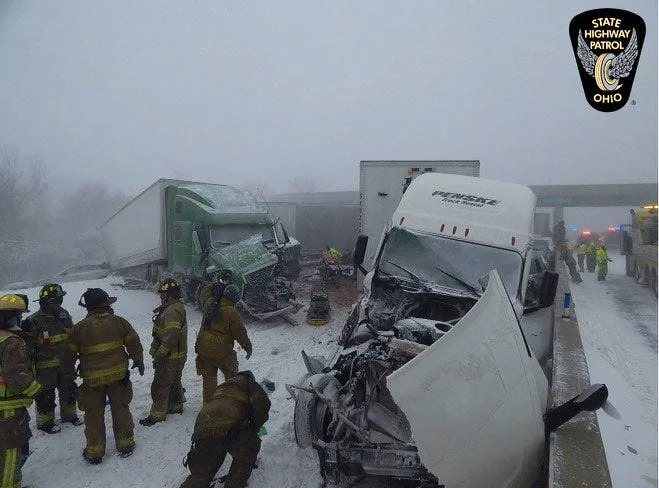
A 46-vehicle pileup on the Ohio Turnpike near Sandusky claimed four lives.

A 46-vehicle pileup killed four people injured many others on the Ohio Turnpike during a winter storm with whiteout conditions Dec. 23.

During stormy winter months, ice cover tempers waves. When there is low ice cover, waves can be much larger, leading to lakeshore flooding and erosion. That happened in January 2020 along Lake Michigan’s southwestern shoreline. Record high lake levels mixed with winds whipped up 15-foot waves that flooded shorelines, leading Gov. Tony Evers to declare a state of emergency for Milwaukee, Racine and Kenosha counties.

And while less ice may seem like a good thing for the lakes’ shipping industry, those waves can create dangerous conditions.

The Great Lakes are losing ice with climate change

The Great Lakes have been losing ice for the past five decades, a trend that scientists say will likely continue.

Of the last 25 years, 64% had below-average ice, said Michael Notaro, the director of the Center on Climatic Research at the University of Wisconsin-Madison. The steepest declines have been in the north, including Lake Superior, northern Lake Michigan and Huron, and in nearshore areas.

Record high temperatures:Another weather record broken in Greater Akron; third record high set this month

More: What’s the state of the Great Lakes? Successful cleanups tempered by new threats from climate change

But this also comes with a lot of ups and downs, largely because warming is causing the jet stream to “meander,” said Ayumi Fujisaki Manome, a scientist at the Cooperative Institute for Great Lakes Research at the University of Michigan who models ice cover and hazardous weather across the lakes.

There is a lot of year-to-year variability with ice cover spiking in years like 2014, 2015 and 2019 where the lakes were almost completely iced over.

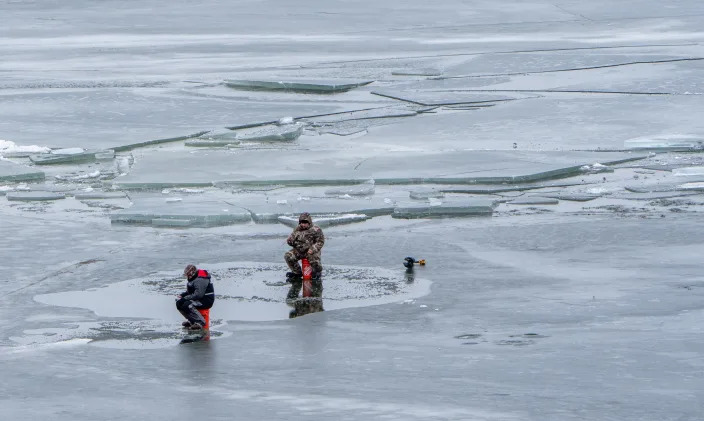
Ice fishermen stay close to shore off of Bay Shore Park in New Franken, Wisconsin, in January, which saw relatively little ice cover on the Great Lakes.
No ice makes waves in the lakes’ ecosystems

A downturn in ice coverage due to climate change will likely have cascading effects on the lakes’ ecosystems.

Lake whitefish, a mainstay in the lakes’ fishing industry and an important food source for other fish like walleye, are one of the many Great Lakes fish that will be affected, said Ed Rutherford, a fishery biologist who also works at the Great Lakes Environmental Research Laboratory.

Lake whitefish spawn in the fall in nearshore areas, leaving the eggs to incubate over the winter months. When ice isn’t there, strong winds and waves can stir up the sediment, reducing the number of fish that are hatched in the spring, Rutherford said.

Whitefish haul from the Great Lakes.

Walleye and yellow perch also need extended winters, he said. If they don’t get enough time to overwinter in cold water, their eggs will be a lot smaller, making it harder for them to survive.

Even so, the Ohio Department of Natural Resources Division of Wildlife released a report stating that Lake Erie’s 2022 walleye and yellow perch populations in the central and western basins are above average. Yellow perch hatches in the central basin are below average, however.

Declining ice cover on the lakes is also delaying the southward migration of dabbling ducks, a group of ducks that include mallards, out of the Great Lakes in the fall and winter, Notaro said. And if the ducks spend more time in the region it will increase the foraging pressure on inland wetlands.

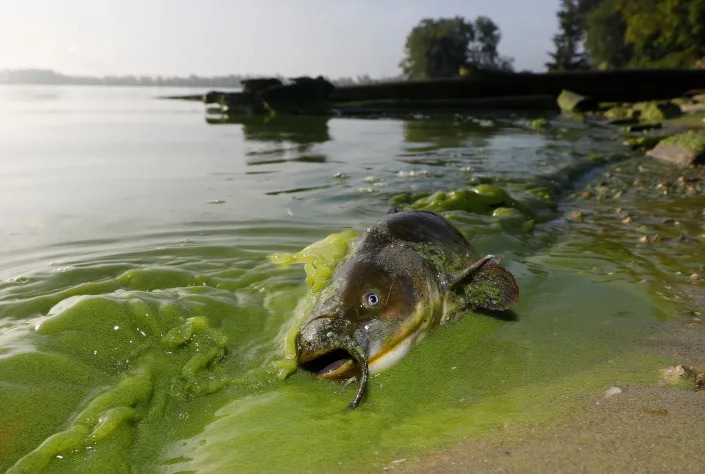
Warming lakes and a loss of ice cover over time also will be coupled with more extreme rainfall, likely inciting more harmful algae blooms, said Notaro. These blooms largely form from agricultural runoff, creating thick, green mats on the lake surface that can be toxic to humans and pets.

In this 2017 photo, a catfish appears on the shoreline in the algae-filled waters of Lake Erie in Toledo.

Lakes Erie and Michigan are plagued with these blooms every summer. And now, blooms cropping up in Lake Superior for the first time are raising alarm.

“Even deep, cold Lake Superior has been experiencing significant algae blooms since 2018, which is quite atypical,” Notaro said.

More: Blue-green algae blooms, once unheard of in Lake Superior, are a sign that ‘things are changing’ experts say

There is still a big question mark on the extent of the changes that will happen to the lakes’ ecosystem and food web as ice cover continues to decline. That’s because scientists can’t get out and sample the lakes in the harsh winter months.

“Unless we can keep climate change in check … it will have changes that we anticipate and others that we don’t know about yet,” Rutherford said.

Caitlin Looby is a Report for America corps member who writes about the environment and the Great Lakes. Beacon Journal reporter Derek Kreider contributed to this article.

A Sandwich Shop, a Tent City and an American Crisis

The New York Times

A Sandwich Shop, a Tent City and an American Crisis

Eli Saslow – March 19, 2023

Joel Coplin unlocks a gate on the fence surrounding the building where he lives and operates an art gallery, four blocks from the location where Joe Faillace operates The Olde Station Subway Shop, in Phoenix, Ariz. on Feb. 11, 2023. (Todd Heisler/The New York Times)

PHOENIX — He had been coming into work at the same sandwich shop every weekday morning for the past four decades, but now Joe Faillace, 69, pulled up to Old Station Subs with no idea what to expect. He parked on a street lined with three dozen tents, grabbed his Mace and unlocked the door to his restaurant. He picked up the phone and dialed his wife and business partner, Debbie Faillace, 60.

“All clear,” he said. “Everything looks good.”

“You’re sure? No issues?” she asked. “What’s going on with the neighbors?”

He looked out the window toward Madison Street, which had become the center of one of the largest homeless encampments in the country, with as many as 1,100 people sleeping outdoors. On this February morning, he could see a half-dozen men pressed around a roaring fire. A young woman was lying in the street. A man was weaving down the sidewalk in the direction of Joe’s restaurant with a saw, muttering to himself and then stopping to urinate.

“It’s the usual chaos and suffering,” he told Debbie. “But the restaurant’s still standing.”

That had seemed to them like an open question each morning for the past three years, as an epidemic of unsheltered homelessness began to overwhelm Phoenix and many other major American downtowns. Cities across the West had been transformed by a housing crisis, a mental health crisis and an opioid epidemic, all of which landed at the doorsteps of small businesses already reaching a breaking point because of the pandemic. In Phoenix, where the number of people living on the streets had more than tripled since 2016, businesses had begun hiring private security firms to guard their property and lawyers to file a lawsuit against the city for failing to manage “a great humanitarian crisis.”

The Faillaces had signed onto the lawsuit as plaintiffs along with about a dozen other nearby property owners. They also bought an extra mop to clean up the daily flow of human waste, replaced eight shattered windows with plexiglass, installed a wrought-iron fence around their property and continued opening their doors at exactly 8 each morning to greet the first customer of the day.

Debbie arrived to help with the lunch rush, and she greeted customers at the register while Joe prepared tomato sauce and weighed out turkey for chef’s salads. Their margins had always been tight, but they saved on labor costs by both going into work every day. They remodeled the kitchen to make room for a nursery when their children were born and then expanded into catering to help those children pay for college. They kept making sandwiches for a loyal group of regulars even as the city transformed around them — its population growing by about 25,000 each year, housing costs soaring at a record pace, until it seemed that there was nowhere left for people to go except onto sidewalks, into tents, into broken-down cars, and increasingly into the air-conditioned relief of Old Station Subs.

Their restaurant was located in an industrial neighborhood that had always attracted a small number of transients. Over the years, Joe and Debbie came to know many by name and listened to their stories of eviction, medical debt, mental illness and addiction, and together they agreed that it was their job to offer not only compassion but help.

They had given out water, opened their bathroom to the public and cashed unemployment and disability checks at no extra cost. They hired a sandwich maker who was homeless and had lost his teeth after years of addiction; a dishwasher who lived in the women’s shelter and first came to the restaurant for lunch with her parole officer; a cleaner who slept a few blocks away on a wooden pallet and washed up in the bathroom before her shift.

But the homeless population in Phoenix continued to grow. Soon there were hundreds of people sleeping within a few blocks of Old Station, most of them with mental illness or substance abuse issues. They slept on Joe and Debbie’s outdoor tables, defecated behind their back porch, smoked methamphetamine in their parking lot, washed clothes in their bathroom sink, pilfered bread from their delivery trucks, had sex on their patio, masturbated within view of their employees and lit fires that burned down trees and scared away customers. Finally, Joe and Debbie could think of nothing else to do but to start calling police.

Within a half-mile of their restaurant, police had been called to an average of eight incidents a day in 2022. There were at least 1,097 calls for emergency medical help, 573 fights or assaults, 236 incidents of trespassing, 185 fires, 140 thefts, 125 armed robberies, 13 sexual assaults and four homicides. The remains of a 20- to 24-week-old fetus were burned and left next to a dumpster in November. Two people were stabbed to death in their tents. Sixteen others were found dead from overdoses, suicides, hypothermia or excessive heat. The city had tried to begin more extensive cleaning of the encampment, but advocates for people without housing protested that it was inhumane and in December the American Civil Liberties Union successfully filed a federal lawsuit to keep people on the street from being “terrorized” and “displaced.”

Shina Sepulveda had been living in the encampment for a few weeks or maybe for a few months. It was hard to know for sure, she said, because she had been experiencing delusions. What she remembered was escaping from a cult in Mesa, Arizona, building the first internet search engine, losing billions of dollars to a government conspiracy, cutting wiretaps out of her brain, retaking her dynastic name of Espy Rockefeller and then moving onto a sidewalk across the street from Old Station Subs.

For as long as she had been homeless, she tried to nap during the relative safety of the day and stay up late at night to help look over her small corner of the encampment. She put on makeup and sat down at a plywood desk, where a handwritten nameplate introduced her as “Doctor, Poet, Psychologist, Partner at Law,” and where in reality she was now the 47-year-old caretaker of a half-dozen people — because, even if many of her stories were fantastical, she had earned a reputation for being generous and kind and for knowing a bit about everything.

“Hey, Espy, can you help me?” Brandon Mack said as he walked over from his nearby tent. He lifted his shirt to reveal two stab wounds from a few days earlier. He had fought with a neighbor over a coveted corner spot on the sidewalk, walked to the emergency room, gotten 18 stitches and then returned to recover on a molding mattress in a partly burned tent.

Espy took out a pair of scissors, scrubbed them with hand sanitizer and started to cut away a few of his stitches. She wiped away the pus and blood with napkins, tossing them into the street. Then she turned her attention to the next person in need of help. Cecilia wanted soap, so Espy handed her a bar she had scavenged from the nearby shelter. C.J. was drunk and needed help getting into the street to go to the bathroom. A man known as K.D. was moving his tent down the sidewalk because he’d gotten into an argument with a neighbor who insulted his pit bull. “Nobody talks down to Dots,” K.D. said. “I’m ready to go off. I’m armed and dangerous.”

“I was a police officer,” Espy told him. “If you really have to shoot, don’t aim to kill. Just fire a warning shot.”

Joe came into work the next morning and saw a bag of drugs in the road, human waste on the sidewalk, a pit bull wandering the street and blood-soaked napkins blowing toward his restaurant patio, where he and Debbie were scheduled to meet with a real estate agent about the future of Old Station. Debbie still insisted that she was ready to be done with the restaurant. Joe didn’t want to run it without her, but he also didn’t want to walk away with nothing. They had spent the past several months exploring a compromise, seeing if they could sell the business and retire together.

“Are we getting any bites?” Joe asked the agent, Mike Gaida.

“Oh, yeah. I get calls every week,” Mike said, and he explained that at least 25 potential buyers had looked over the financials and recognized a strong family business for the reasonable price of $165,000. Several bailed once Mike mentioned the encampment, but at least a dozen potential buyers secretly came to check out the property. “Most of the time, they don’t call back,” Mike said. “If I track them down, it’s like, ‘God bless those people for staying in business, because I couldn’t do it.’”

“It’s taken years off my life,” Debbie said.

“For her it’s, ‘Get me out. We’ve got to sell, sell, sell,’” Joe said. “But we refused an offer for $250,000 eight years ago, and it keeps dropping. I don’t want to give this place away.”

“I get it,” Mike said. “If you were a half-mile in another direction, you’d be sitting on a million bucks. Instead, it’s, How can you dispose of it?”

A few days later, Joe arrived for work to the sound of a gunshot coming from across the street and a bullet pinging off a nearby fence. He hurried inside and called police. “Yeah, it’s Joe again, over at Old Station,” he said, and a few minutes later two police officers were walking the perimeter of his restaurant, searching for the bullet. Soon Debbie would be waking up and getting ready for work.

“What the heck am I going to tell her to keep her from losing it?” Joe wondered, and he began to rehearse the possibilities in his head. It was only one bullet. Nobody had gotten hurt. Police had come right away. The shooter wasn’t targeting the restaurant. The gunshot was random. It could have happened anywhere.

Joe went outside to get some air. K.D. was ranting on the sidewalk, banging his hand against a fence, contorting his fingers into the shape of a gun and then firing it off at the sky.

“This could be the last straw for her,” Joe said, and then he saw Debbie driving toward the parking lot, steering around K.D. and hurrying through the gate.

“Wow. Tough morning?” she asked.

He took her inside the restaurant while he tried to come up with the right words. It was only one shot. The restaurant was still standing. They’d run Old Station together for 37 years, and maybe they could hang on for a while longer. But instead Joe told her the only thing that felt true.

“The whole thing’s a disaster,” he said. “I get it. It’s OK. I understand why you’re done.”

Trump deregulated railways and banks. He blames Biden for the fallout

The Guardian

Trump deregulated railways and banks. He blames Biden for the fallout

David Smith in Washington – March 18, 2023

<span>Photograph: Scott Olson/Getty Images</span>
Photograph: Scott Olson/Getty Images

When a fiery train derailment took place on the Ohio-Pennsylvania border last month, Donald Trump saw an opportunity. The former US president visited East Palestine, accused Joe Biden of ignoring the community – “Get over here!” – and distributed self-branded water before dropping in at a local McDonald’s.

Related: Levels of carcinogenic chemical near Ohio derailment site far above safe limit

Then, when the Silicon Valley Bank last week became the second biggest bank to fail in US history, Trump again lost no time in making political capital. He predicted that Biden would go down as “the Herbert Hoover of the modrrn [sic] age” and predicted a worse economic crash than the Great Depression.

Yet it was Trump himself who, as US president, rolled back regulations intended to make railways safer and banks more secure. Critics said his attacks on the Biden administration offered a preview of a disingenuous presidential election campaign to come and, not for the first time in Trump’s career, displayed a shameless double standard.

“Hypocrisy, thy name is Donald Trump and he sets new standards in a whole bunch of regrettable ways,” said Larry Sabato, director of the Center for Politics at the University of Virginia. “For his true believers, they’re going to take Trump’s word for it and, even if they don’t, it doesn’t affect their support of him.”

The collapse of Silicon Valley Bank on 10 March and of New York’s Signature Bank two days later sent shockwaves through the global banking industry and revived bitter memories of the financial crisis that plunged the US into recession about 15 years ago.

Fearing contagion in the banking sector, the government moved to protect all the banks’ deposits, even those that exceeded the Federal Deposit Insurance Corporation $250,000 limit for each individual account. The cost ran into hundreds of billions of dollars.

Trump with crates of Trump water in East Palestine after a train derailed in Ohio.
Trump with crates of Trump water in East Palestine after a train derailed in Ohio. Photograph: Alan Freed/Reuters

The drama reverberated in Washington, where Trump’s criticism was followed by that of Republicans and conservative media, seeking to blame Biden-driven inflation or, improbably, to Silicon Valley Bank’s socially aware “woke” agenda. Opponents saw this as a crude attempt to deflect from the bank’s risky investments in the bond market and more systemic problems in the sector.

The 2008 financial crisis, triggered by reckless lending in the housing market, led to tough bank regulations during Barack Obama’s presidency. The 2010 Dodd-Frank Act aimed to ensure that Americans’ money was safe, in part by setting up annual “stress tests” that examine how banks would perform under future economic downturns.

But when Trump won election in 2016, the writing was on the wall. Biden, then outgoing vice-president, warned against efforts to undo banking regulations, telling an audience at Georgetown University: “We can’t go back to the days when financial companies take massive risks with the knowledge that a taxpayer bailout is around the corner when they fail.”

But in 2018, with Trump in the White House, Congress slashed some of those protections. Republicans – and some Democrats – voted to raise the minimum threshold for banks subject to the stress tests: those with less than $250bn in assets were no longer required to take part. Many big lenders, including Silicon Valley Bank, were freed from the tightest regulatory scrutiny.

Sabato commented: “The worst example is the bank situation because that is directly tied to Trump and his administration and changes made in bank regulations in 2018. Yes, some Democrats voted for it, but it was overwhelmingly supported by Republicans and by Trump who heralded it as the real solution to future bank woes.

The minority of Democrats who supported the 2018 law have denied that it can be directly tied to this month’s bank failures, although Bernie Sanders, an independent senator from Vermont, was adamant: “Let’s be clear. The failure of Silicon Valley Bank is a direct result of an absurd 2018 bank deregulation bill signed by Donald Trump that I strongly opposed.”

You do need government to regulate finance … but that point cannot be made if you’ve got Donald Trump inventing reality

Larry Jacobs

Sherrod Brown, a Democratic senator for Ohio who introduced bipartisan legislation to improve rail safety protocols, drew a parallel between the banks’ collapse to rail industry deregulation lobbying that contributed to the East Palestine train disaster. “We see aggressive lobbying like this from banks as well,” he said.

Trump repealed several Barack Obama-era US Department of Transportation rules meant to improve rail safety, including one that required high-hazard cargo trains to use electronically controlled pneumatic brake technology by 2023. This rule would not have applied to the Norfolk Southern train in East Palestine – where roughly 5,000 residents had to evacuate for days – as it was not classified as a high-hazard cargo train.

But the debate around the railway accident and bank failures points to a perennial divide between Democrats, who insist that some regulation is vital to a functioning capitalism, and Republicans, who have long claimed to believe in small government. Steve Bannon, an influential far-right podcaster and former White House chief strategist, framed the Trump agenda as “the deconstruction of the administrative state”.

Antjuan Seawright, a Democratic strategist, said: “The Republican party has gotten by for many years on this idea that less is better. However, we’re now learning in this country that, as America continues to mature, in some cases more is better, and more has to be how we get to better. Otherwise the mistakes can spin out of control and cause generations of people long-term damage.”

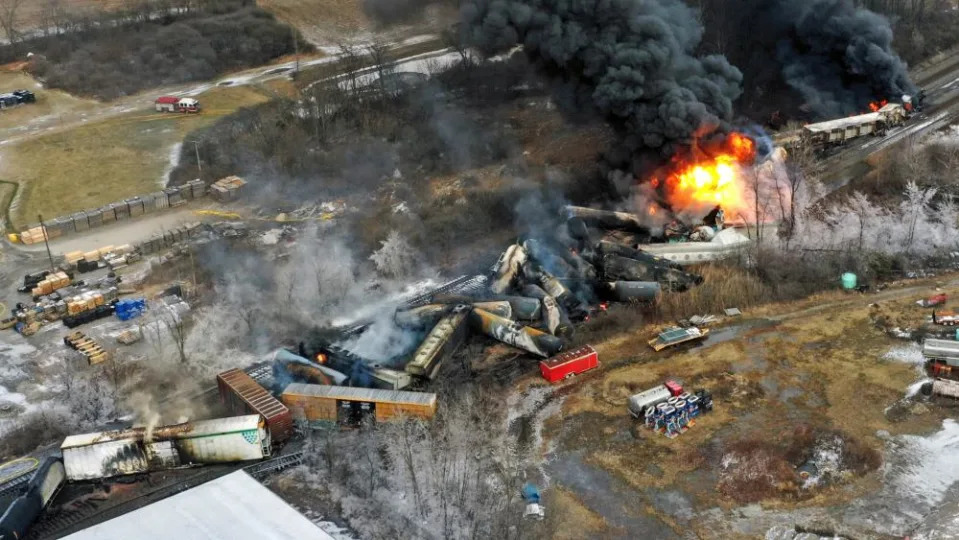
A Norfolk Southern freight train that derailed in East Palestine, Ohio, on fire on 4 February 2023.
A Norfolk Southern freight train that derailed in East Palestine, Ohio, on fire on 4 February 2023. Photograph: Gene J Puskar/AP

Biden called on Congress to allow regulators to impose tougher penalties on the executives of failed banks while Warren and other Democrats introduced legislation to undo the 2018 law and restore the Dodd-Frank regulations. It is likely to meet stiff opposition from the Republican-controlled House of Representatives and even some moderate Democrats.

Biden has also insisted that no taxpayer money will be used to resolve the current crisis, keen to avoid any perception that average Americans are “bailing out” the two banks in a way similar to the unpopular bailouts of the biggest financial firms in 2008.

But Republicans running for the 2024 presidential nomination are already contending that customers will ultimately bear the costs of the government’s actions even if taxpayer funds were not directly used. Nikki Haley, the former governor of South Carolina, said: “Joe Biden is pretending this isn’t a bailout. It is.”

Another potential 2024 contender, Senator Tim Scott, the top Republican on the Senate banking committee, also criticised what he called a “culture of government intervention”, arguing that it incentivises banks to continue risky behavior if they know federal agencies will ultimately rescue them.

Larry Jacobs, director of the Center for the Study of Politics and Governance at the University of Minnesota, said: “This is familiar ideological territory. The battle lines between liberalism and a fake conservatism appear to be playing out here. But the tragedy of the situation is that the liberals are right.

It’s not new that the Republicans will deregulate an industry and then it collapses … look at American political and economic history of the last 50 years

Wendy Schiller

“You do need government to regulate finance and, when you don’t, you get mischief making and bank failures but that point cannot be made if you’ve got Donald Trump inventing reality. He’s demonstrated that facts and position taking don’t matter. It’s an extraordinary political strategy but it’s even more devastating to our whole political system and our media that this could be allowed.”

This poses a huge messaging challenge for Democrats, who after the 2008 financial crisis came up against the Tea Party, a populist movement feeding off economic and racial resentments. Long and winding explanations about the negative impacts of Trump era deregulation are a hard sell compared to the former president’s sloganeering in East Palestine.

Wendy Schiller, a political science professor at Brown University in Providence, Rhode Island, said: “Once again we see that Trump is taking advantage of the Achilles’ heel of the Democratic party by telling voters that the Democrats like big government because it bails out industries and it never provides a bailout for the little guy.”

Democrats’ efforts to point out that Trump was responsible for deregulation are unlikely to cut through, Schiller added.

“Any time it takes more than 10 seconds to explain something, you’re done in politics. This is why Trump has catchy phrases, sound bytes. He understands that all voters see is that rich people made a bad investment and then more rich people are making sure that their money’s available to them within three days, coming off the heels of all the closures during Covid, lost business, lost income, people struggling, inflation.

“Democrats don’t want to call it a bailout but it is a bailout. The high visibility of this bailout smothers anything else the Democrats are doing for the average voter. It’s a perfect issue for the Republicans. It’s not new that the Republicans will deregulate an industry and then it collapses and the Democrats have to save it. Look at American political and economic history of the last 50 years: this is exactly what happens.