Read About The Tarbaby Story under the Category: About the Tarbaby Blog
Author: John Hanno
Born and raised in Chicago, Illinois. Bogan High School. Worked in Alaska after the earthquake. Joined U.S. Army at 17. Sergeant, B Battery, 3rd Battalion, 84th Artillery, 7th Army. Member of 12 different unions, including 4 different locals of the I.B.E.W. Worked for fortune 50, 100 and 200 companies as an industrial electrician, electrical/electronic technician.
Andrey Rublev: I do not deserve support of Wimbledon crowd because I am Russian
Molly McElwee – July 11, 2023
Andrey Rublev was cheered on by the Centre Court crowd against Novak Djokovic – Shutterstock/Tolga Akmen
Andrey Rublev admitted he felt like he “does not deserve” the support of the Wimbledon crowd, due to being Russian.
Rublev, 25, missed last year’s tournament along with his compatriots and all Belarusian players, due to Wimbledon imposing a ban in response to Russia’s invasion of Ukraine.
Upon his return this year he reached the quarter-finals, and on Tuesday had the Centre Court crowd on their feet on more than one occasion as they tried to will him on against Novak Djokovic.
After bowing out in four sets, Rublev said he felt “grateful” that the British public had got behind him, especially considering where he is from.
”I felt really great support during all these two weeks. Today, as well. To be from the country where I am, to have this support, it’s special. I don’t know, I feel sometimes I don’t deserve it or something like that. To have it, I don’t know… I don’t know what you need to do to have this support. I’m really grateful for this.”
Ever since the war broke out, Rublev has been a leading Russian voice in opposition to the conflict. In fact, the night before the invasion began in February 2022, he made headlines around the world for writing “no war please” on a camera lens after his match in Dubai.
Asked whether he felt guilty to hail from Russia, Rublev said he did not: “No. I don’t know what to say. I made so many statements. I think my opinion is very clear, so it’s not guilty. It’s more just the situation is terrible. Of course, you don’t wish this on anyone. You want these terrible things to be able to finish as fast as possible for all the people in the world just to have a chance to have a good life.”
Rublev played some brilliant tennis on his way to the last-eight – AFP/Daniel Leal
Rublev’s comments followed a weekend of high tensions at Wimbledon, where the war in Ukraine played a central role.
On Sunday Belarus’s Victoria Azarenka was booed off court after losing to Ukraine’s Elina Svitolina, the crowd seemingly unaware that it was Svitolina who had opted out of their handshake.
While other players from last year’s banned list have had unpleasant moments with the crowd, Rublev only had good feedback.
On the eve of Wimbledon, he told Telegraph Sport that he was glad the tournament was giving extra support to Ukrainian players competing here and also said he had received support from fans ahead of arriving at the Championships.
”Being here this year, I felt grateful,” Rublev said on Tuesday. “I’m happy that I was able to have a really, really good two weeks of my tennis. I’m happy that I was able, I think for the first time, to give my best in a quarter-final so far compared to all the other quarters that I have been in. This one I feel proud of myself for the first time.”
WANTAGH, NEW YORK – JULY 07: A new shark-monitoring drone monitors the waters for sharks as people swim at Jones Beach State Park on July 07, 2023 in Wantagh, New York. Governor Kathy Hochul announced that local beach communities on Long Island and New York City will receive shark-monitoring drones as the state addresses beachgoer safety in response to shark sightings over the 4th of July holiday and reports of people being bitten by sharks at some of New York’s most popular beaches. (Photo by Michael M. Santiago/Getty Images) (Michael M. Santiago via Getty Images)More
Try not to think about the ocean. Because if you’re the type of person prone to listless anxiety, a simple question – What’s a submersible? Where do orcas live? – might take you to a deep, dark place. A place like the Hadal Zone, named for the Greek god of hell, where there is absolutely no light and the only creatures that can survive the crushing pressure are characterized by their transparent, gooey skin. Or maybe a place in the Gulf of Mexico called the “Hot Tub of Despair,” an underwater lake full of methane that kills any organism that enters it. Or perhaps a remote part of the Pacific Ocean that has earned the nickname “White Shark Cafe.”
We are having a “Jaws” Girl Summer. It’s giving Moby-Dick Energy. We’re in our Ancient Mariner Era. Is the ocean more terrifying than usual this year, or are we suddenly just more aware of how terrifying the ocean can be?
Here’s an illustrative roundup of recent horrors. Orcas have trained one another to attack boats off the coast of Spain and Portugal. Over the July Fourth holiday, four people were bitten by sharks on New York beaches, and approximately 200 people needed to be rescued from rip currents in Virginia and North Carolina. A man on a fishing trip to a Freeport, Tex., beach last month arrived to discover that tens of thousands of dead fish had washed ashore. Homes in the Outer Banks are toppling into the waves.
Don’t forget the beach where severed human feet wash ashore on a regular basis in a northwest Washington county that recently announced that it is crowdfunding an investigation to identify a recent set of remains. Or the awful video of the teen who jumped off the party boat in the Bahamas in May, only to be swallowed up by the inky black water, and never seen again. Or the fact that Japan is planning to release more than 1 million cubic meters of treated radioactive water – approximately 500 Olympic-size swimming pools, an amount that is considered “safe” – from the 2011 Fukushima nuclear disaster into the Pacific this summer.
Then there was the OceanGate catastrophe, which made millions of people ponder the specifics of an excruciating death: Trapped at the bottom of the ocean in a claustrophobic metal coffin-like tube, in a dark blacker than any night, with 96 hours of oxygen left to contemplate the unlikelihood of rescue and your imminent suffocation. What actually happened was no less horrific, but somehow seemed kinder: being crushed to death in milliseconds by as much as 6,000 pounds of pressure per square inch.
In the ocean, that’s a good way to go.
That’s what Alexandria Neonakis realized during the days she spent transfixed by the submersible crisis.
“At every step, every fact that you learned about it” – The video game controllers! The strange knocking noises! The fact that it was bolted shut from the outside! – “was so much worse, and it kept getting worse,” says the 38-year-old artist. “Social media just enabled that to go even crazier, because it takes your imagination and it amplifies it, because everybody’s thinking insane things,” such as: Did one of the rich men on the submersible kill another one of the rich men to conserve oxygen?
The speculation became “a feeding frenzy,” she says. Which is yet another terrifying thing you find in the ocean.
Space is also a terrifying void, but “that’s pretty far. I don’t have to worry about that,” Neonakis says. She does not have a quarter of a million dollars to spend on space tourism, so she won’t end up on a rocket anytime soon. And, yes, that’s the same price the now-defunct OceanGate charged people for a trip down to the wreckage of the Titanic, but unlike space, you can get swept away by the ocean for free. “It’s like, right there,” Neonakis says. Near Los Angeles. Where she lives.
The term for fear of the ocean is thalassophobia. Myths about deep-sea monsters can be found in ancient cultures from all across the globe. “The lack of adoration, desire for interaction, or simply fear itself, towards the deep sea is not irrational but rather primal,” wrote a team of marine researchers in a 2021 paper examining why the public seems to not care about deep-sea exploration as much as space exploration. We associate “up” with heaven, and “down” with hell.
And the fear of the unknown, combined with the vastness of a seemingly infinite horizon and improbability of rescue, makes great horror fodder, which is why the ocean has been the setting for so many scary movies. Most are fiction, such as “The Meg” and “The Shallows,” but some, such as 2003’s “Open Water,” about a couple mistakenly left to die during a scuba expedition, are based on true stories. As “Jaws” taught us, you don’t have to be out in the deep ocean to encounter its frights: Just last week, a dorsal fin popped up at Navarre Beach near Pensacola, Fla., prompting a chaotic scramble amid screams of, “Get out of the water!” Jellyfish wrap their tentacles around an ankle. Stingrays slink around the shallows. Something you can’t see just brushed past your thigh.
Mark Fryers, a British researcher who studies media representations of marine culture, says he wouldn’t be surprised if we eventually get a movie based on the ill-fated submersible.
“The sea is something of a castigating mirror: It reflects back our bad deeds,” Fryers says. “We know we’re creating, as a species, more damage in the ocean. It comes back to haunt us. It all washes back to us. There’s a pervasive sense of death and decline and self-examination.”
The problem, too, is that we focus on the unlikely catastrophes and ignore the more commonplace ones: A coast guard that allows a boat full of migrants to capsize. An ocean that is rapidly warming. Microplastics. Instead, we think about the sharp fangs of the anglerfish, or the tentacles of a colossal squid, or the spindly six-foot-long (!) legs of the Japanese spider crab. Those glow-in-the-dark fish with a bajillion fangs. Something called a goblin shark. Even the most delicious creatures in the ocean can be kind of gross, when you think about it: As a popular meme reminds us, shrimps is bugs.
Even if those creatures don’t give you anxiety, there is one that might: the great white shark.
We may have been hearing more about sharks lately – Cape Cod has become “one of the largest white shark hotspots in the world,” according to Scientific American – but it’s been a pretty typical year so far, says Gavin Naylor, director of the Florida Program for Shark Research at the University of Florida.
“We’ve had a similar number of bites thus far this year as we did at this stage last year,” Naylor tells us via email. “Every year people seem to think ‘This year is different.’ I guess they must forget how they felt this time last year.”
It’s related to a phenomenon researchers call “sea blindness,” which sounds like something that afflicted pirates and castaways, but is actually contemporary: It refers to how oceanic issues “tend to disappear from our consciousness, our daily life,” Fryers says, until an event or flash point brings them abruptly back. Like the submersible.
“Every horrifying story about the ocean is so f—ing horrifying. It’s not like it’s a little horrifying. It’s like, ‘Wow, that’s the worst thing I’ve ever heard,'” Neonakis says. Better to just brave the myriad horrors on dry land.
‘It’s brutal’: As premiums continue to soar, another home insurer is leaving Florida
Alex Harris, Lawrence Mower – July 11, 2023
Pedro Portal/pportal@miamiherald.com
Another insurer is leaving Florida, where homeowners are paying more than ever for insurance, despite the state’s attempt to shore up the wobbling market.
Tuesday, Farmers Insurance informed the state it was dropping home, auto and umbrella policies across Florida, potentially affecting tens of thousands of people. It’s the fourth company to leave the Florida market in the last year — most citing rising risks from hurricanes. Farmers, a large company with a national presence, also has reduced new business in California, citing extreme weather and wild fire threats.
“This business decision was necessary to effectively manage risk exposure,” the company wrote in a statement.
Farmers said the decision to withdraw affects about 30% of its overall policies around the state, but not ones issued through its subsidiary companies. Those — including auto insurer Bristol West and home insurer Foremost — are unaffected.
The company declined to speak on the record about how many people would lose coverage. Figures from Florida’s Office of Insurance Regulation show that Farmers has about 93,000 current home and auto policies, but an industry source suggests that number is currently closer to 100,000.
The day before Farmers made the decision public, Florida’s Chief Financial Officer Jimmy Patronis tweeted that his office has “zero communication” with the company and vowed to “explore every avenue possible for holding them accountable” for leaving Florida.
Florida’s Office of Insurance Regulation said in a statement that the office was reviewing Farmers’ notice, which was sent to the office on Monday and marked a “trade secret,” limiting what regulators could say about it.
Under state law, insurers are required to give 120 days’ notice to customers before their policies are dropped. Customers who receive a notice are encouraged to contact their agent immediately to find alternative coverage, the office said in a statement.
Later Tuesday, the office also formally chastised Farmers for not giving the office a heads-up before deciding to pull out of the state. In a letter, Florida Insurance Commissioner Michael Yaworksy also noted that Farmers made the decision to leave Florida “independently” of the state’s insurance reforms.
“We are disappointed by the hastiness in this decision and troubled by how this decision may have cascading impacts to policyholders,” Yaworsky wrote. “Farmers has noted this decision only impacts about 26.6% percent of their Florida policyholders, but any impact which impacts policyholders should not be taken lightly.”
Leaving despite reforms
Tuesday’s announcement follows a mid-June decision from Farmers to stop writing new policies in Florida due to the skyrocketing costs of hurricane recovery and rebuilding.
“With catastrophe costs at historically high levels and reconstruction costs continuing to climb, we implemented a pause on writing new homeowners policies to more effectively manage our risk exposure,” Farmers said in a statement.
Notably, Farmers did not mention lawsuits, which has been the main culprit Florida insurers point to when asked why costs are rising so fast. However, financial autopsies of failed insurers in Florida regularly point to excessive payouts, high salaries and fees to affiliated companies as the main problem that leads to bankruptcy.
The decision by Farmers follows years of turmoil in the state’s property insurance market, triggered by a series of hurricanes starting in 2017. Floridians pay the highest property insurance premiums in the nation, and 13 companies have gone insolvent in recent years. Many others have stopped writing new policies or pulled out of Florida.
Gov. Ron DeSantis and state lawmakers have responded by making it harder to sue insurance companies and assigning $3 billion to help them withstand storm seasons. A report by the state’s Office of Insurance Regulation released last week indicated that the industry broke even during the first quarter of 2023, after years of heavy losses.
But the legislation has failed to reduce premiums for homeowners. Premiums continue to go up, according to the office’s report. Between November and March, rates increased 5% in Miami-Dade County, to an average of $5,665.
But the rate increases were higher in Hillsborough and Pinellas counties, rising 9.5% and 9.25%, respectively. Homeowners in Hillsborough County are paying an average of $2,752 and $3,210 in Pinellas County.
Friedlander said the average premium in Florida is 42% higher than last year’s and miles ahead of the average premium nationwide — $1,700.
“It’s brutal, said Vince Perri, head of Key Biscayne-based public adjuster firm Elite Resolutions. “The premiums are through the roof. It’s always been high here but it’s worse now.”
Perri, who’s been in the business for more than a decade, said he sees the back-to-back storms in recent years as a major factor in rising prices. Hurricane Ian last year was Florida’s most expensive storm, causing more than $109 billion in damages across the state.
If Florida can scrape by a few more years without a hurricane landfall, Perri said, he believes insurance costs will start to go down again.
“It’s going to take a couple of years for the market to level out again,” he said. “I think insurance premiums are going to be high for awhile.”
Dirty Socks and Rotting Bodies: What Russians Left Behind in the Trenches
Andrew E. Kramer – July 11, 2023
Ukrainian soldiers making their way through Novodarivka, a village formerly occupied by Russian forces. (NYT)
NOVODARIVKA, Ukraine — A bottle of syrup made from Siberian berries, legions of dirty socks and a military-issued tea bag stamped with “For Victory!”
For Ukrainian soldiers, one advantage of achieving at least creeping advances in the now month-old counteroffensive in southern Ukraine is appropriating ready-made fortifications from the retreating Russians, who in months of preparations dug deep, well-protected trenches.
For the Ukrainians, eerily enough, it also means living and fighting in positions long held by the Russians — with a huge sprawl of military debris and personal items of Russian soldiers scattered about.
“It’s not very pleasant,” said Pvt. Maksim, a soldier with Ukraine’s 36th Marine Brigade, who has collected a number of curiosities, including what he thinks was a talisman: several bullets covered in sparkles and attached to a key ring.
“It’s our land but it’s not very comfortable to be here,” said the private, who like the other soldiers gave only his first name and rank for security reasons. “It doesn’t feel like home.”
In early June, Ukrainian troops, including thousands of soldiers trained and equipped by the United States and other Western allies, began a counteroffensive aimed at driving a wedge through Russian-occupied southern Ukraine. Lying in wait were thousands of Russian troops stationed in miles of trenches and other fortifications amid tank traps and thousands upon thousands of mines.
The Ukrainian forces are attacking in at least three locations on the Russian defensive front. At their farthest point of advance, they have pushed south to form a bulge about 5 miles into the defensive lines.
Ukrainian commanders want to reach the Sea of Azov, about 55 miles away across open plains that offer little cover. If they succeed, they will divide the Russian occupied south into two zones, cutting the land bridge from Russia to the occupied Crimean Peninsula and greatly compromising Russia’s ability to resupply its forces farther west.
As they have advanced, the Ukrainians have seized Russian trench lines, bunkers and firing positions in abandoned buildings, but under continual artillery bombardment they have had little time to clear the refuse and abandoned clothing, body armor, ponchos, bedding and leftover military rations of their enemy.
Take, for example, the village of Novodarivka, on the plains of the Zaporizhzhia region in southern Ukraine, south of the city of Orikhiv. A month after soldiers with Ukraine’s 110th Territorial Defense Brigade and other units reclaimed it, the village is still littered with the detritus of the occupying forces.
In the baking sun on a recent day, the village appeared deserted, with the occasional military vehicle rumbling along the single dirt road between destroyed, abandoned houses, kicking up dust.
Amid the boom of artillery shelling, Ukrainian soldiers hunkered down in the captured Russian trenches. On the village’s main road lay an incinerated Russian tank; in a field nearby, two blown-up American-provided mine-resistant vehicles called MaxxPros.
One grim task has been retrieving the remains of Ukrainian soldiers who died defending the village in the first months of the war as the Russian forces were advancing rapidly.
Seven bodies had been lying in the vicinity since April 2022, said one of the soldiers, Lt. Volodymyr.
The Ukrainians had occasionally flown drones over the village while it was occupied, to make sure the Russians had not moved the bodies. On Wednesday, they finally had the chance to retrieve them. “They were just skeletons” that would have to be identified by their DNA, Volodymyr said.
As for the Russian dead, he added, the Ukrainians retrieved those that could be removed without risk and are covering others in heaps of dirt, to try to control the foul odor. Nevertheless, an awful stench wafted about the trenches, and swarms of flies buzzed everywhere.
In an abandoned house, Russian soldiers had scraped into the plaster walls the names of their hometowns or regions: Vladikavkaz, a city in southern Russia, and Primorye, a region on the Pacific coast, near Japan.
Maksim, interviewed in the trenches, had collected a small pile of curiosities left behind, including the cowberry syrup made in Yakutia, a region in northern Siberia. Gesturing to the “For Victory!” brand of Russian tea, he said of its former Russian owner, “he didn’t have time to drink it.”
Speaking of the back-and-forth nature of the fighting, Maksim said, “We push them back, they push us back, we push them, they push us, and so on,” adding: “They had a lot of time to dig.”
Soldiers said in interviews that the slow progress was to be expected, given the minefields, trenches and open countryside.
The 110th Territorial Defense Brigade, in contrast to the newly trained and equipped units deployed specifically for the counteroffensive, has been fighting in southern Ukraine for more than a year.
One soldier with the 110th, who identified himself as Sgt. Igor, said his unit has been crawling forward to the relative safety of tree lines between fields to assault Russian trenches, moving in small bursts of a few dozen or hundred yards at a time. Such slow advances were preferable to all-out assaults, he said.
“We need to creep forward bit by bit, with infantry, and break them in this way,” Igor said. “Crawl forward, fight them, then dig in again.”
Time must pass, he said, for the advancing Ukrainian soldiers trained by Kyiv’s Western allies to become skilled at fighting in the open farmland.
Soldiers deployed in the area develop a finely tuned ear for the whistles and booms of outgoing and incoming artillery, he said, adding, “You hear it and should understand in a second whether to fall down or not.”
Soldiers must steel themselves to maneuver in the trenches and fire their guns at enemy troops approaching in an assault, even if bullets are zipping overhead, he said.
“Training abroad is not the same as real combat,” he said. “They are gaining combat experience now,” he added, and as they do, the pace of the advance could pick up. American officials have said the Ukrainian commanders are reassessing tactics after the offensive’s slow start and soldiers’ harrowing forays into minefields.
Green recruits are demoralized when fellow soldiers are wounded or killed, Igor said. “Their morale is affected quickly,” he said.
“The soldiers will learn,” he added. “It’s complicated. And yes, it’s going slowly. But importantly, it’s going.”
MyPillow auctions equipment after retailers pull its products
Briana Bierschbach and Brooks Johnson – July 10, 2023
Glen Stubbe, Star Tribune file/Star Tribune/TNS
MyPillow is auctioning off hundreds of pieces of equipment and subleasing manufacturing space after several shopping networks and major retailers took the company’s products off shelves.
The Chaska-based manufacturer recently listed more than 850 “surplus equipment” items on the online auction site K-Bid. Sewing machines, industrial fabric spreaders, forklifts and even desks and chairs are up for auction.
Founder and CEO Mike Lindell said MyPillow has experienced a loss in revenue and the items are no longer needed as the company consolidates its operations.
Major retailers such as Walmart, Bed Bath & Beyond and Slumberland Furniture all said they will no longer sell MyPillow products as Lindell continues to falsely claim that the 2020 election was stolen from former President Donald Trump.
“It was a massive, massive cancellation,” Lindell said in a phone interview Monday. “We lost $100 million from attacks by the box stores, the shopping networks, the shopping channels, all of them did cancel culture on us.”
Dominion Voting Systems alleges Lindell defamed the company as part of his campaign to paint the 2020 presidential election as “rigged.” Dominion makes voting machines and election software.
Lindell has not backed down from his assertions that there was something wrong with the 2020 election and its results. He said he plans to host an event next month detailing a new way to hold elections.
But the ongoing controversy over his claims has forced major shifts in his business. After some shopping networks dropped his products, the company has moved to direct sales, shooting new television commercials and trying to boost its presence through email marketing, radio spots and direct mailing.
Lindell said the company is subleasing some of its manufacturing space in Shakopee because the packaging for direct sales is different than what they needed when working with big retailers.
“We kind of needed a building and a half, but now with these moves we’re making, we can get it down to our one building,” he said.
“If the box stores ever came back we could have it if we needed it, but we don’t need that,” he added. “It affected a lot of things when you lose that big of a chunk [of revenue].”
The same is true for the equipment he’s auctioning off. He said he will need to replace whatever he auctions off if the retailers “ever came back.”
There were several months after MyPillow was dropped by retailers when there was “hardly anything” for some workers to do, Lindell said. He shifted employees to work for MyStore, an online marketplace he created. Others moved over to his addiction resource organization, the Lindell Recovery Network.
Most hardware stores, such as Menards, Fleet Farm and Ace, continue to carry MyPillow products, he said. He hasn’t had to lay off any employees yet, but some may have left the company after being reassigned new roles, Lindell said.
When asked if the matter of the pending lawsuits has added to the challenges in his business, Lindell said “of course it has.”
In April, an arbitration panel ruled that Lindell needed to pay $5 million to a software forensics expert who disproved several of his election claims in a “Prove Mike Wrong” contest. Lindell has challenged that ruling, calling it “frivolous.”
“The $5 million is the lowest one,” he said. “I will be vindicated in every single one.”
Relentless rain causes floods in Northeast, prompts rescues and swamps Vermont’s capital
Lisa Rathke and John Minchillo – July 10, 2023
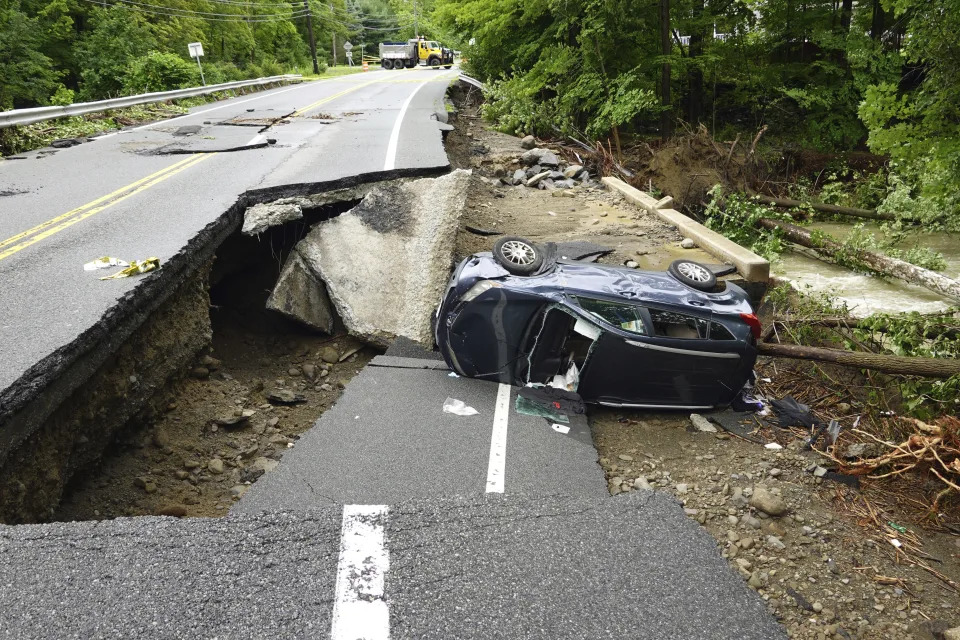
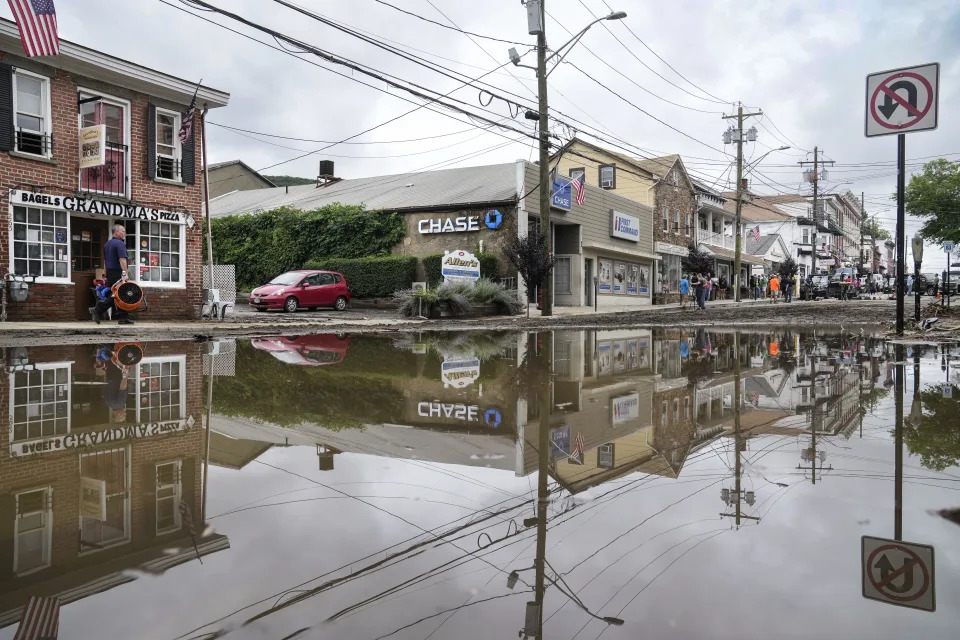
A damaged car lays on a collapsed roadway along Route 32 in the Hudson Valley near Cornwall, N.Y., Monday, July 10, 2023. Heavy rain has washed out roads and forced evacuations in the Northeast as more downpours were forecast throughout the day. (AP Photo/Paul Kazdan)Residents, journalists, and emergency service workers walk around a flooded Main Street, Monday, July 10, 2023, in Highland Falls, N.Y. Heavy rain has washed out roads and forced evacuations in the Northeast as more downpours were forecast throughout the day. One person in New York’s Hudson Valley has drowned as she was trying to leave her home. (AP Photo/John Minchillo)Mud, rocks and debris from Sunday’s flash flood cover a road on the campus of the United States Military Academy at West Point, Monday, July 10, 2023 in West Point, N.Y. Heavy rain has washed out roads and forced evacuations in the Northeast as more downpours were forecast throughout the day, Monday. (Courtesy of the USMA via AP)Erosion damage is seen after heavy rains washed down Bear Mountain near the Popolopen Bridge along U.S. Route 9W in Highland Falls, N.Y., rendering the bridge unsafe and impassable for vehicles, on Monday, July 10, 2023. (AP Photo/Ted Shaffrey)
ANDOVER, Vt. (AP) — Rescue teams raced into Vermont on Monday after heavy rain drenched parts of the Northeast, washing out roads, forcing evacuations and halting some airline travel. One person was killed in New York’s Hudson Valley as she tried to escape her flooded home.
Mike Cannon of Vermont Urban Search and Rescue said crews from North Carolina, Michigan and Connecticut were among those helping to get to towns that have been unreachable since torrents of rain belted the state. The towns of Londonderry and Weston were inaccessible, Cannon said, and rescuers were heading there to do welfare checks. Water levels at several dams were being closely monitored.
The U.S Army Corps of Engineers said late Monday they expected two dams to release water overnight, causing “severe flooding” downstream likely to affect multiple towns.
Flooding hit Vermont’s state capital, with Montpelier Town Manager Bill Fraser estimating Monday night that knee-high waters had reached much of downtown and were expected to rise a couple more feet during the night. Montpelier had largely been spared during Tropical Storm Irene, which struck the region in 2011.
“For us, this is far worse than Irene. We got water but it went up and down. There were some basements flooded but it didn’t last long,” Fraser said, comparing this flooding to the Montpelier Ice Jams in 1992. “We are completely inundated. The water is way, way higher than it ever got during Irene.”
During Irene, Vermont got 11 inches (28 centimeters) of rain in 24 hours. Irene killed six in the state, washed homes off their foundations and damaged or destroyed more than 200 bridges and 500 miles (805 kilometers) of highway.
There have been no reports of injuries or deaths related to the latest flooding in Vermont, according to state emergency officials. Roads were closed across the state, including many along the spine of the Green Mountains.
Some people canoed their way to the Cavendish Baptist Church in Vermont, which had turned into a shelter. About 30 people waited it out, some of them making cookies for firefighters who were working to evacuate and rescue others.
“People are doing OK. It’s just stressful,” shelter volunteer Amanda Gross said.
Vermont Rep. Kelly Pajala said she and about half dozen others had to evacuate early Monday from a four-unit apartment building on the West River in Londonderry.
“The river was at our doorstep,” said Pajala. “We threw some dry clothes and our cats into the car and drove to higher ground.”
The slow-moving storm reached New England in the morning after hitting parts of New York and Connecticut on Sunday. Additional downpours in the region raised the potential for flash flooding; rainfall in certain parts of Vermont had exceeded 7 inches ( 18 centimeters), the National Weather Service in Burlington said.
One of the worst-hit places was New York’s Hudson Valley, where a woman identified by police as Pamela Nugent, 43, died as she tried to escape her flooded home in the hamlet of Fort Montgomery.
The force of the flash flooding dislodged boulders, which rammed into the woman’s house and damaged part of its wall, Orange County Executive Steven Neuhaus told The Associated Press. Two other people escaped.
“She was trying to get through (the flooding) with her dog,” Neuhaus said, “and she was overwhelmed by tidal wave-type waves.”
Officials say the storm has already wrought tens of millions of dollars in damage. In New York, Gov. Kathy Hochul said at a news conference Monday the storm sent “cars swirling in our streets” and dumped a “historic” amount of rain.
“Nine inches of rain in this community,” Hochul said during a briefing on a muddy street in Highland Falls. “They’re calling this a ‘1,000 year event.’”
As of Monday evening, several washed-out streets in Highland Falls remained impassable, leaving some residents stuck in their homes but otherwise OK, Police Chief Frank Basile said in a telephone interview.
Massachusetts Gov. Maura Healey said there were reports of flooding in central and western Massachusetts and that state emergency management officials were in touch with local authorities.
The U.S. Military Academy at West Point was pounded with more than 8 inches (20.32 centimeters) of rain that sent debris sliding onto some roads and washed others out. Superintendent Lt. Gen. Steven W. Gilland said recently arrived new cadets and others at the historic academy on the Hudson River were safe, but that assessing the damage will take time.
Atmospheric scientists say destructive flooding events across the globe have this in common: Storms are forming in a warmer atmosphere, making extreme rainfall a reality right now. The additional warming that scientists predict is coming will only make it worse.
The storm also interrupted air and rail travel. There were hundreds of flight cancellations at Kennedy, LaGuardia and Newark airports and more than 200 canceled at Boston’s Logan Airport in the last 24 hours, according to the Flightaware website. Amtrak temporarily suspended service between Albany and New York.
Swift water rescue teams in Vermont have done more than 50 rescues, mainly in the southern and central areas of the state, Vermont Emergency Management said Monday night.
Among the buildings flooded Monday was the Weston Playhouse in Weston, Vermont, which had been performing “Buddy — The Buddy Holly Story” to sold-out audiences.
The Weston Theater Company’s executive artistic director Susanna Gellert said the call was made at around 4 a.m. to evacuate 11 people associated with the production to higher ground and another 15 in nearby Ludlow. The three-floor playhouse, which had been damaged during Irene, was also flooded, with the dressing room and props room under water.
“As a theater, we were just starting to get back from the COVID shutdown,” Gellert said. “To have this happen right now is painfully heartbreaking.”
Cara Philbin, 37, of Ludlow, Vermont, was awakened by a neighbor early Monday and told to clear out of her second-floor apartment because the parking lot was already flooded.
“He told me me, ‘You need to get out of here … your car is going to float away, and I suggest you do not stay,’” said Philbin. The neighbor took her car keys and moved her car to a higher spot, while she called her parents and then drove to their home to ride out the storm, she said.
Ross Andrews and his wife were driving back home to Calais, Vermont, on Monday when he saw trucks parked at a 230-year-old dam with crews trying to keep it from failing. There were trees down everywhere.
“The interstate was closed right at our exit. Our road was closed right at our driveway. We managed to thread our way back just in the nick of time,” he said.
Minchillo reported from Highland Falls, New York. Kathy McCormack in Concord, New Hampshire; Michael Hill in Albany, New York; and Mark Pratt and Steve LeBlanc in Boston contributed.
The latest jobs data suggest that workers may be losing some of the leverage they gained during the pandemic.
By Lora Kelley – July 10, 2023
Frederic J. Brown / AFP via Getty
The latest jobs data give a mixed picture of the economy—and raise questions about how America’s workers will fare.
Losing Ground?
In the spring of 2021, I traveled to Pennsylvania to attend a graduation. Driving around the area, I was struck by all the signs in diner and fast-food storefronts seeking workers. As I recall, the signs had a desperate tone, advertising bonuses and high wages to anyone willing to work. I was witnessing in real time a fascinating economic moment: Low-wage workers were in high demand, and that meant they were gaining leverage.
The signs I saw in Pennsylvania were emblematic of what was happening across the economy. Restaurants are a “microcosm” of the Great Resignation, the pattern that took off in 2021 in which workers quit their jobs to seek higher wages and better benefits‚ Nick Bunker, an economist at Indeed’s Hiring Lab, told me. That spring, as freshly vaccinated Americans went out to spend their stimulus checks, they frequented restaurants. Demand for services soared, and so in turn did the demand for service workers. Businesses had to compete for staff. And when workers saw that they could find better wages and conditions elsewhere, many quit their jobs in favor of new ones.
The latest jobs data suggest that workers might be losing some of this power. The economy added about 209,000 jobs in June, according to data from the Bureau of Labor Statistics released last week. It was the 30th consecutive month of job gains, but gains were at their lowest rate since the streak began. “The picture that emerged was a mixed one,” Julia Pollak, the chief economist at ZipRecruiter, told me. “Workers are still in the driver’s seat in many industries, other than tech, but they are losing leverage.” However, she added, the job market is “still more favorable to workers than before the pandemic.”
What’s happening in hospitality, a sector that includes restaurants and bars, tells us a lot about the job market more broadly. That was true in 2021, Bunker told me, and it’s still true now. Looking at the behavior of the hospitality sector in last week’s report, Bunker noted, we can see that “the labor market is moderating but still strong.”
As the job market softens somewhat, workers may be losing some of the leverage they gained when the market was tighter. As Ben Casselman reported in The New York Times last week, “The rate at which workers voluntarily quit their jobs has fallen sharply in recent months—though it edged up in May—and is only modestly above where it was before the pandemic disrupted the U.S. labor market.” When workers quit jobs, it reflects their confidence that they can find another, better job. Casselman reported that hourly earnings for hotel and restaurant workers rose 28 percent from the end of 2020 to the end of 2022, which was faster than the rates of both inflation and overall wage growth. But now, after surging in late 2021 and early 2022, growth for low-wage workers has slowed, and fewer workers in the hospitality industry are separating from their jobs now compared with the same period last year.
This slowing wage growth could be seen as a sign that workers are losing ground. But another possible reason that wage growth has slowed, Bunker explained, is that many workers’ base pay has gone up compared with a couple of years ago. Employers are “giving raises off a wage rate that has risen a lot since the spring of 2021,” Bunker said.
The Fed will be happy to see the job market cooling off, Bunker told me, so we might see fewer interest-rate hikes in the months to come: “Reduced competition for workers is going to reduce wage growth, which is—in the Fed’s view—going to put less pressure on employers to raise prices, so that should bring inflation down.” But after pausing their hikes last month, following 10 consecutive rate hikes, the Fed is still widely expected to raise rates at its meeting at the end of this month.
The monthly job-openings report tells us more about the recent past than it does about our current reality. The patterns we saw in last week’s numbers contain new information about a moment that’s already slightly dated. And they raise fresh questions about whether the Great Resignation is over. Bunker, for his part, riffed on Mark Twain, saying that in his opinion, “rumors of the Great Resignation’s demise are greatly exaggerated.” But, he added, in a few months, we may be able to say more definitively whether the heyday of the Great Resignation really is behind us.
Nearly half of U.S. adults over 30 show signs of gum disease, which can cause tooth loss. (Hoi Chan/The New York Times)
If your spit is sometimes tinged pink at least a couple of times a week after you brush or floss, it’s possible you have early-stage gum disease. This condition can also have other surprising symptoms — or none.
“It’s a very, very quiet disease,” said DRodrigo Neiva, chair of periodontics at Penn Dental Medicine.
According to the U.S. Centers for Disease Control and Prevention, nearly half of American adults older than age show signs of gum disease, and 9% have severe gum disease, known as periodontal disease.
When left untreated, gum disease can become more difficult to remedy. “Patients may eventually end up losing their teeth,” Neiva said. And some research has connected periodontal disease with other health conditions, such as dementia, diabetes and heart disease.
Early gum disease is called gingivitis, and it is characterized by inflammation of the gums, also known as gingiva.
“It is caused by bacteria on teeth — plaque — that release products that irritate the gums,” said Deborah Foyle, interim department head of periodontics at Texas A&M University School of Dentistry.
Good oral hygiene is key to preventing gum disease, because it removes plaque from the teeth before bacteria can harm the gums. Often, people develop gingivitis because they aren’t brushing and flossing adequately. Sometimes, only parts of the gums become affected — especially the gums around the backs of the teeth where people often don’t brush as well, Neiva said.
Dentists can diagnose gingivitis by using a special instrument that measures the distance between gums and teeth, said Y. Natalie Jeong, professor and chair of the department of periodontology at Tufts University School of Dental Medicine. Larger spaces are indicative of the condition.
When gingivitis is left untreated, the bacteria can invade and destroy the tissues under the gums, causing advanced gum disease. “The bone supporting the teeth starts to break down, leaving the roots of the teeth exposed and sensitive in some cases,” Foyle said. “Spaces develop between the teeth, and the teeth start to get loose.”
People who smoke, have diabetes or grind their teeth have an increased chance of developing gum disease, Jeong said. Some medications, such as steroids, and certain epilepsy and cancer drugs, can also increase the risk. Genetics can also make people more or less susceptible, she noted.
People who rarely get cavities may be more likely than other people to get gum disease, too, Neiva said. That’s because the bacteria that cause gum disease outcompete and suppress the bacteria that cause cavities.
“It’s very common to see patients with very, very advanced periodontal disease not having a single cavity,” he said.
Gingivitis often goes unnoticed because it doesn’t cause pain. But people with gingivitis may notice that their gums bleed when they brush or floss, Neiva said. The part of the gums adjacent to their teeth may also look red rather than pink.
Smokers with gingivitis may not experience any bleeding or other symptoms, Jeong said. “People tend to think, ‘OK, my gums never bleed, I should be just fine,’” she said — but that’s a misconception.
Regular brushing and flossing can help prevent gum disease, but once gingivitis has set in, good oral hygiene at home may not be enough. That’s because the bacteria may have started to accumulate below the gum level, Neiva said. In these cases, a professional cleaning and, sometimes, antibiotics, can treat — and cure — gingivitis.
Once gingivitis has progressed into more advanced periodontal disease, people’s gums may start to recede, causing their teeth to look longer, Jeong said. They may also experience increased sensitivity around the gums. Their teeth may not fit together the same way when they bite because they have shifted, and they might have chronic bad breath. Eventually, their teeth may start to loosen and even fall out.
Advanced periodontal disease can be incurable. Dentists and periodontists can, however, recommend treatments that slow down or prevent further gum and bone loss. They may also deep-clean the roots of affected teeth and recommend gum surgery.
Keeping your gums healthy is ultimately simple: Brush twice a day, floss once a day and see your dentist for cleanings at least every six months, Neiva said.
“The sooner we detect it,” he said, “the more we can do.”
Republican’s hold on nominations leaves Marines without confirmed leader for 1st time in 100 years
Lolita C. Baldor – July 10, 2023
Acting Commandant of the U.S. Marine Corps Gen. Eric Smith speaks during a relinquishment of office ceremony for U.S. Marine Corps Gen. David Berger on Monday, July 10, 2023, at the Marine Barracks in Washington. Smith has been nominated to be the next leader, but will serve in an acting capacity because he hasn’t been confirmed by the Senate. Berger’s term as Commandant of the U.S. Marine Corps expired Monday. (AP Photo/Manuel Balce Ceneta) ASSOCIATED PRESSU.S. Marine Corps Gen. David Berger, left, whose term as Commandant of the U.S. Marine Corps expires Monday, holds the battle colors during a relinquishment of office ceremony, Monday, July 10, 2023, at the Marine Barracks in Washington. Assistant Commandant Gen. Eric Smith, right, has been nominated to be the next leader, but will serve in an acting capacity because he hasn’t been confirmed by the Senate. (AP Photo/Manuel Balce Ceneta) ASSOCIATED PRESS
WASHINGTON (AP) — The U.S. Marine Corps is without a confirmed leader for the first time in a century as Gen. David Berger stepped down as commandant on Monday and a Republican senator is blocking approval of his successor.
Berger took over as the 38th commandant in July 2019, and is required to leave the job after four years. Gen. Eric Smith, currently the assistant commandant, has been nominated to be the next leader, but will serve in an acting capacity because he hasn’t been confirmed by the Senate.
Under the law, Smith can serve as the acting commandant, but he can do nothing that would presume confirmation. As a result, he can’t move into the main residence or the commandant’s office, or issue any new formal commandant’s planning guidance, which is traditional for a new leader. He has the authority to implement new policies such as budget, training and other personnel decisions.
Smith’s promotion delay is the first of what could be many top level military officers held up by Sen. Tommy Tuberville, R-Ala. Tuberville has stalled all nominations for senior military jobs because he disagrees with Defense Secretary Lloyd Austin’s decision to have the Defense Department pay for travel when a service member has to go out of state to get an abortion or other reproductive care. Abortion is now illegal in Alabama.
Speaking at a ceremony at the Marine Barracks Washington, just down the street from Capitol Hill, Austin and Berger called on the Senate to take action.
“We need the Senate to do their job so that we can have a sitting commandant that’s appointed and confirmed. We need that house to be occupied,” said Berger, with a nod to the commandant’s quarters at the edge of the parade field.
Austin and other Pentagon officials have pressed the Senate to move forward, saying that delays are already impacting more than 200 military officers, and many key leaders.
“You know, it’s been more than a century since the U.S. Marine Corps has operated without a Senate confirmed commandant,” Austin said during the ceremony.
Because of Berger’s requirement to step down in July, the Marine job is the first of the military chiefs to be affected by Tuberville. The Army, Navy and Air Force are all expected to face the same delay later this year, as could the nomination of the next chairman of the Joint Chiefs of Staff.
The current chairman, Army Gen. Mark Milley, leaves his job at the end of September. Gen. CQ Brown, the current chief of the Air Force, has been nominated to replace Milley, and is scheduled to go before the Senate Armed Services Committee for his hearing on Tuesday.
The hold, however, is also impacting scores of one, two and three-star officers who are assigned to new commands but can’t move on. It also affects their families, who usually relocate over the summer to their new military communities so school-age children can settle in before fall.
“Smooth and timely transitions of confirmed leadership are central to the defense of the United States and to the full strength of the most powerful fighting force in history,” said Austin. “Stable and orderly leadership transitions are also vital to maintaining our unmatched network of allies and partners. And they’re crucial for our military readiness.”
Smith hit the thorny issue head on during his remarks at the ceremony Monday — saying he wanted to get one thing out fast.
“If you’re saying, ‘what am I supposed to call you?’ ACMC. That is my title, and one that I’m proud of,” said Smith, using the shorthand for his assistant commandant role. But he quickly added, “to make sure that there is no confusion — all orders, directives and guidance, which were in effect this morning remain in effect, unless I direct otherwise. Further guidance to the force will follow.”
Sabrina Singh, a Pentagon spokeswoman, said Monday that as of last Friday, there were 265 senior officers whose promotions have been held up by Tuberville, and that number could leap to 650 by the end of the year if the issue isn’t corrected. She noted that in more than 100 cases, officers — like Smith — would be forced to do two jobs at the same time because no one can move up.
She said the Pentagon is asking officers to delay planned retirements and stay on, while in other cases officers are doing more senior ranking jobs without getting the pay for that new rank.
Later in the day, Jack Reed, D-R.I., chairman of the Senate committee, spoke on the Senate floor, asking that Smith be confirmed and criticizing Tuberville for what he called an unprecedented hold that is driving the U.S. military “to a potential breaking point.
“In General Smith we have a Purple Heart recipient — this man has literally shed his blood for his country,” said Reed, who attended the Marine ceremony. “He stands ready to continue his service to our nation and the Marines he will lead for four more years. He simply awaits our action.”
Tuberville, however, blocked a vote and in a Senate floor speech said the holds would have “minimal effect” on Smith’s ability to lead.
“There may be a delay in his planning guidance, and yet he cannot move into the commandant’s residence, but there is little doubt about General Smith’s ability to lead effectively,” said Tuberville.
The last time the Corps was led by an acting commandant was in 1910. Then-Maj. Gen. George Elliott, who was the commandant, reached the required retirement age in November 1910 and left the office. Col. William Biddle served as the acting commandant until he was promoted to major general and became commandant in February 1911.
Berger, a native of Woodbine, Maryland, graduated from Tulane University and was commissioned in 1981. He commanded at every level including tours in Iraq and Afghanistan.
During his tenure, he spearheaded a broad campaign to transform the Marine Corps to better be able to fight amphibious wars in the Pacific after years of battling terrorist groups in the Middle East. The plan was lauded by many in the Pentagon and Congress as a critical way for the Marines to prepare for a potential conflict with China.
Smith, a career infantry officer, is a highly decorated Marine who served multiple tours in Afghanistan and Iraq, including time in Fallujah and Ramadi during heavy combat in 2004 and 2005 in Operation Iraq Freedom. He later was the senior military adviser to Defense Secretary Ash Carter.
Associated Press writer Mary Clare Jalonick contributed to this report.
Be on the lookout for invasive, jumping “earthworms on steroids”
Li Cohen – July 10, 2023
As you tend to your garden this summer, there’s a creepy, crawly creature to be on the lookout for: an invasive worm that moves like a snake, thrashes around, jumps into the air and will even shed its tail in an attempt to escape.
While worms are generally considered to be an excellent addition to help soil and gardening, there are thousands of species — not all of them equally welcome. Invasive jumping worms are one species known to actually worsen soil and make it “inhospitable” to many plants. They have been spotted in recent years, and most recently, may have even been seen in Wisconsin.
Here’s what to know about the invasive species.
What are invasive jumping worms?
Invasive jumping worms, Amynthas agrestis, go by many names, according to the USDA: Alabama jumpers, Jersey wriggles, wood eel, crazy worms, snake worms and crazy snake worms. But all those names stem from one notable feature of the critter.
“Invasive Asian jumping worms got their name because of the way they thrash around,” Forest Service researcher Mac Callaham said in a post by the USDA last year. “They can flip themselves a foot off the ground.”
The worms are thought to have first made it to the U.S. some time in the early to mid 1900s from eastern Asia, and can be transported to new areas in shipments of mulch or potted plants.
The invasive jumping worm has popped up across the U.S. in summer months after they reach maturity. / Credit: DNR
Where are they found?
The critters, which been described as “earthworms on steroids,” had infiltrated Connecticut and more than 30 other states as of last summer. According to the Connecticut Agricultural Experiment Station, the worms are often found in the eastern U.S. and parts of Canada, where the climate is “similar to the area in Japan where jumping worms come from.”
“Jumping worms are well adapted to these humid continental and humid subtropical climates, and so they have a strong potential to invade the entire eastern half of the United States and parts of Canada,” the department says.
And most recently, they may have been found in Wisconsin.
Wisconsin officials said the Door County Invasive Species Team received a report from a local resident that there may be jumping worms in a mulch pile at Sturgeon Bay’s compost site. The city, which issued a statement on July 6, said it is investigating the report and that the site will be treated “as if it is infested” until it is proved otherwise.
The Wisconsin Department of Natural Resources says the worms typically live within the top inch or two of the soil’s surface, often in debris and leaves, and can be found in yards, gardens, mulch, compost and potted plants. They spend the summer months eating and growing and are most noticeable in the late summer and early autumn once they reach maturity and start to reproduce — which they can do without mates.
Why are jumping worms bad?
Wisconsin officials explain that the worms eat the organic matter in soil and leave behind waste that looks like “hard little pellets,” known as castings, that “alter the texture and composition of soil” to make it look like large coffee grounds. That soil lacks the structure and support necessary for many native plants to survive.
The worms are also known to have build-ups of toxic metals within their systems, including mercury, cadmium, copper and lead, according to the Connecticut Agricultural Experiment Station. If those metals, which are found in soil, reach high levels within the worms, it can “negatively impact” the birds that may feed on them, researchers said.
What do invasive jumping worms look like?
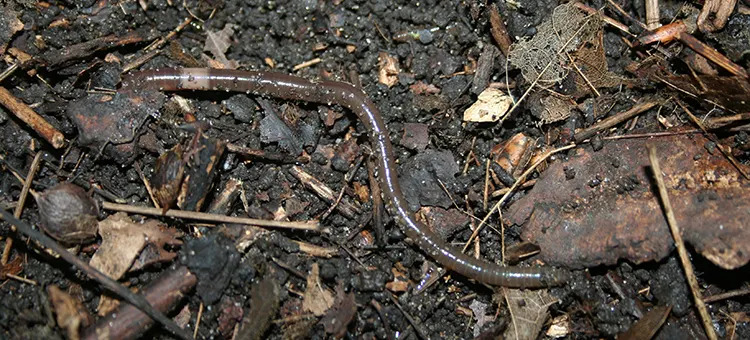
The Wisconsin Department of Natural Resources describes invasive jumping worms as having a “smooth, glossy dark gray/brown color” with a cloudy-white to gray-colored band, known as the clitellum. The worms are known to have a “snake-like movement,” are often found in large numbers, and will “thrash, spring into the air and can even shed their tails to escape,” when they are disturbed, the department says.
Invasive jumping worms often have a gray or milky white clitellum band that’s flat against the rest of their bodies. / Credit: Shikha Singh, JLW CISMA/Michigan Invasive Species Program
How can you prevent and get rid of invasive jumping worms?
There are not yet any official methods to help control or prevent jumping worms, but Wisconsin officials say the best thing people can do is to educate themselves about how to recognize the creatures. People are also encouraged to clean soil and debris if moving it between areas, and only sell or purchase plants and gardening materials inspected and believed to be jumping worm-free.
If jumping worms are found, remove and destroy them by sealing them in a bag and throwing that bag in the trash, Wisconsin officials say. They also said research has shown that the worms and their cocoons can’t live through temperatures of 104 degrees Fahrenheit or above for more than three days — a temperature that can be easily hit in compost piles or can be reached by putting clear plastic over garden topsoil exposed to the sun.