The world’s 100 worst polluted cities are in Asia — and 83 of them are in just one country

CNN – World – Climate

The world’s 100 worst polluted cities are in Asia — and 83 of them are in just one country

By Helen Regan, CNN – March 19, 2024
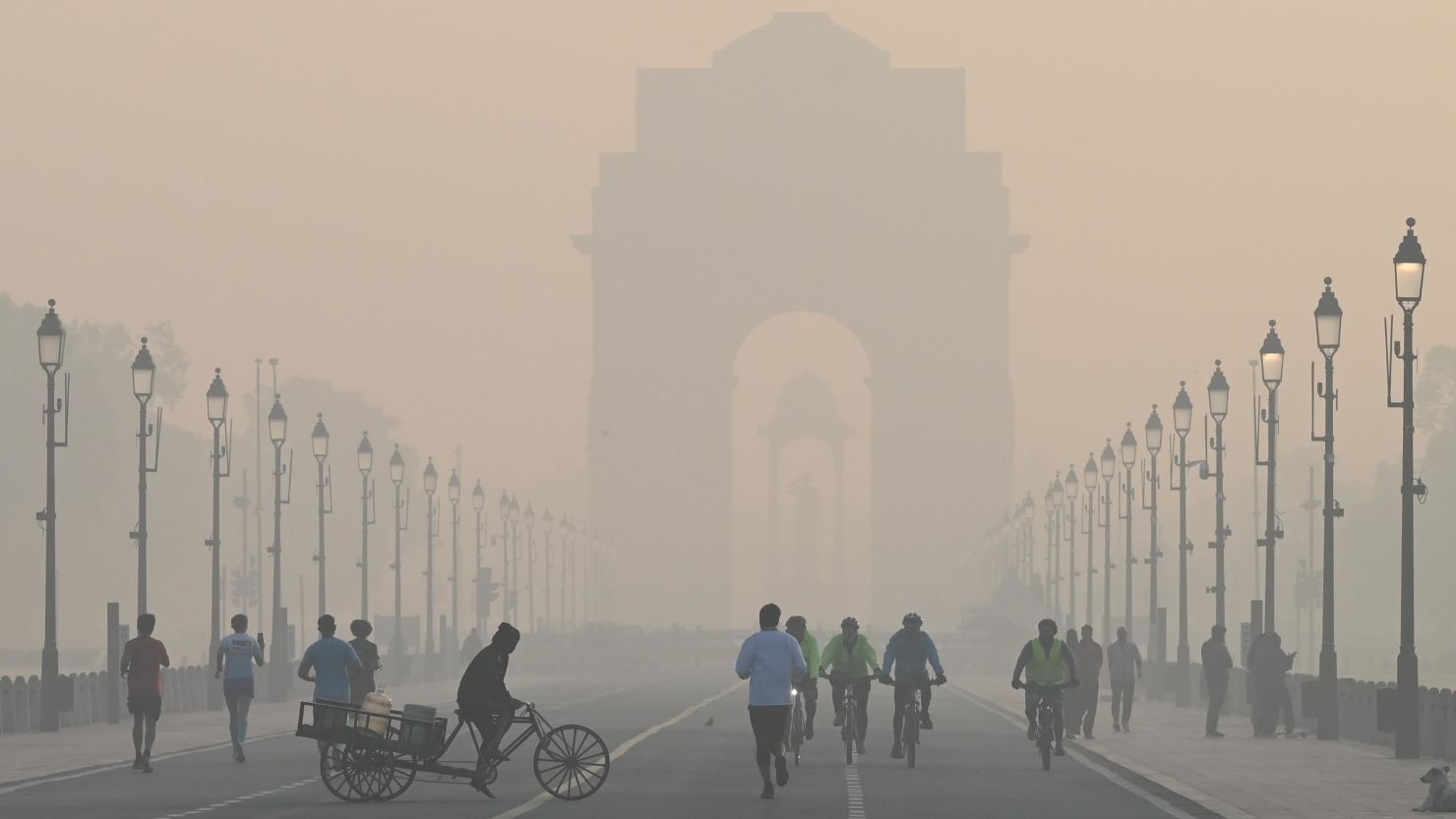
Morning walkers seen during a cold and hazy morning at Kartavya Path near India Gate on December 9, 2023 in New Delhi, India.
Morning walkers seen during a cold and hazy morning at Kartavya Path near India Gate on December 9, 2023 in New Delhi, India. 
Arvind Yadav/Hindustan Times/Getty Images

All but one of the 100 cities with the world’s worst air pollution last year were in Asia, according to a new report, with the climate crisis playing a pivotal role in bad air quality that is risking the health of billions of people worldwide.

The vast majority of these cities — 83 — were in India and all exceeded the World Health Organization’s air quality guidelines by more than 10 times, according to the report by IQAir, which tracks air quality worldwide.

The study looked specifically at fine particulate matter, or PM2.5, which is the tiniest pollutant but also the most dangerous. Only 9% of more than 7,800 cities analyzed globally recorded air quality that met WHO’s standard, which says average annual levels of PM2.5 should not exceed 5 micrograms per cubic meter.

“We see that in every part of our lives that air pollution has an impact,” said IQAir Global CEO Frank Hammes. “And it typically, in some of the most polluted countries, is likely shaving off anywhere between three to six years of people’s lives. And then before that will lead to many years of suffering that are entirely preventable if there’s better air quality.”

When inhaled, PM2.5 travels deep into lung tissue where it can enter the bloodstream. It comes from sources like the combustion of fossil fuels, dust storms and wildfires, and has been linked to asthmaheart and lung disease, cancer, and other respiratory illnesses, as well as cognitive impairment in children.

Begusarai, a city of half a million people in northern India’s Bihar state, was the world’s most polluted city last year with an average annual PM2.5 concentration of 118.9 — 23 times the WHO guidelines. It was followed in the IQAir rankings by the Indian cities of Guwahati, Assam; Delhi; and Mullanpur, Punjab.

Asian countries top air pollution ranking for 2023

In 2023, the average air quality in Bangladesh exceeded the World Health Organization’s (WHO) safety guidelines by nearly 16 times, making it the country with the worst air quality globally. Pakistan and India followed closely behind, with India occupying nine of the top 10 spots for the most polluted cities.

Countries where avg. PM2.5 concentration (micrograms per cubic meter) exceeded WHO guideline seven to 10 times in 2023

A bar chart showing 15 most polluted countries on average in 2023, with Bangladesh at the top. Bangladesh 79.9 – Pakistan 73.7 – India 54.4- Tajikistan 49 – Burkina Faso 46.6 – Iraq 43.8 – United Arab Emirates 43 -Nepal 42.4 – Egypt 42.4 – DR Congo 48.8 – Kuwait 39.9 – Bahrain 39.2 -Qatar 37.6 – Indonesia 37.1 – Rwanda 36.8

Note: The concentration of small air particles called PM2.5 is used to compare air quality as they are responsible for most air pollution today.

Source: IQAirGraphic: Rosa de Acosta and Krystina Shveda, CNN

Across India, 1.3 billion people, or 96% of the population, live with air quality seven times higher than WHO guidelines, according to the report.

Central and South Asia were the worst performing regions globally, home to all four of the most polluted countries last year: Bangladesh, Pakistan, India and Tajikistan.

South Asia is of particular concern, with 29 of the 30 most polluted cities in India, Pakistan or Bangladesh. The report ranked the major population centers of Lahore in 5th, New Delhi in 6th and Dhaka in 24th place.

Hammes said no significant improvement in pollution levels in the region is likely without “major changes in terms of the energy infrastructure and agricultural practices.”

“What’s also worrisome in many parts of the world is that the things that are causing outdoor air pollution are also sometimes the things that are causing indoor air pollution,” he added. “So cooking with dirty fuel will create indoor exposures that could be many times what you’re seeing outdoors.”

Video Ad Feedback. This is what happens to your body when you breathe polluted air03:08 – Source: CNN

A global problem

IQAir found that 92.5% of the 7,812 locations in 134 countries, regions, and territories where it analyzed average air quality last year exceeded WHO’s PM2.5 guidelines.

Only 10 countries and territories had “healthy” air quality: Finland, Estonia, Puerto Rico, Australia, New Zealand, Bermuda, Grenada, Iceland, Mauritius and French Polynesia.

Millions of people die each year from air pollution-related health issues. Air pollution from fossil fuels is killing 5.1 million people worldwide every year, according to a study published in the BMJ in November. Meanwhile, WHO says 6.7 million people die annually from the combined effects of ambient and household air pollution.
Traffic on a Los Angeles freeway during the evening rush hour commute on April 12, 2023 in Alhambra, California. - US President Joe Biden's administration unveiled new proposed auto emissions rules, aiming to accelerate the electric vehicle transition with a target of two-thirds of the new US car market by 2032. (Photo by Frederic J. BROWN / AFP) (Photo by FREDERIC J. BROWN/AFP via Getty Images)

RELATED ARTICLE: Switching to electric vehicles could prevent millions of illnesses in US children by 2050, report estimates

The human-caused climate crisis, driven by the burning of fossil fuels, plays a “pivotal” role in influencing air pollution levels, the IQAir report said.

The climate crisis is altering weather patterns, leading to changes in wind and rainfall, which affects the dispersion of pollutants. Climate change will only make pollution worse as extreme heat becomes more severe and frequent, it said.

The climate crisis is also leading to more severe wildfires in many regions and longer and more intense pollen seasons, both of which exacerbate health issues linked to air pollution.

“We have such a strong overlap of what’s causing our climate crisis and what’s causing air pollution,” Hammes said. “Anything that we can do to reduce air pollution will be tremendously impactful in the long term also for improving our climate gas emissions, and vice versa.”

Regional rankings

North America was badly affected by wildfires that raged in Canada from May to October last year. In May, the monthly average of air pollution in Alberta was nine times greater than the same month in 2022, the report found.

And for the first time, Canada surpassed the United States in the regional pollution rankings.

The wildfires also affected US cities such as Minneapolis and Detroit, where annual pollution averages rose by 30% to 50% compared to the previous year. The most polluted major US city in 2023 was Columbus, Ohio for the second year running. But major cities like Portland, Seattle and Los Angeles experienced significant drops in annual average pollution levels, the report said.

A coal fired power plant near a large floating solar farm project under construction on June 16, 2017 in Huainan, Anhui province, China.

RELATED ARTICLE: Global carbon pollution hits record high even as renewables surge

In Asia, however, pollution levels rebounded across much of the region.

China reversed a five-year trend of declining levels of pollution, the report found. Chinese cities used to dominate global rankings of the world’s worst air quality but a raft of clean air policies over the past decade has transformed things for the better.

study last year had found the campaign meant the average Chinese citizen’s lifespan is now 2.2 years longer. But thick smog returned to Beijing last year, where citizens experienced a 14% increase in the annual average PM2.5 concentration, according to the IQAir report. China’s most polluted city, Hotan, was listed at 14 in the IQAir ranking.

In Southeast Asia, only the Philippines saw a drop in annual pollution levels compared to the previous year, the report found.

Indonesia was the most polluted country in the region, with a 20% increase compared to 2022. Indonesia, Vietnam and Thailand all had cities that exceeded WHO PM2.5 guidelines by more than 10 times, according to the report.

Last month, Thai authorities ordered government employees to work from home due to unhealthy levels of pollution in the capital Bangkok and surrounding areas, according to Reuters. On Friday, tourism hot spot Chiang Mai was the world’s most polluted city as toxic smog brought by seasonal agricultural burning blanketed the northern city.

Inequality… and one bright spot

The report also highlighted a worrying inequality: the lack of monitoring stations in countries in Africa, South America and the Middle East, which results in a dearth of air quality data in those regions.

Although Africa saw an improvement in the number of countries included in this year’s report compared with previous years the continent largely remains the most underrepresented. According to IQAir, only 24 of 54 African countries had sufficient data available from their monitoring stations.

Seven African countries were among the new locations included in the 2023 rankings, including Burkina Faso, the world’s fifth most polluted country, and Rwanda, in 15th.

Several countries that ranked high on the most polluted list last year were not included for 2023 due to a lack of available data. They include Chad, which was the most polluted country in 2022.

“There is so much hidden air pollution still on the planet,” said Hammes.

One bright spot is increasing pressure and civic engagement from communities, NGOs, companies, and scientists to monitor air quality.

“Ultimately that’s great because it really shows governments that people do care,” Hammes said.
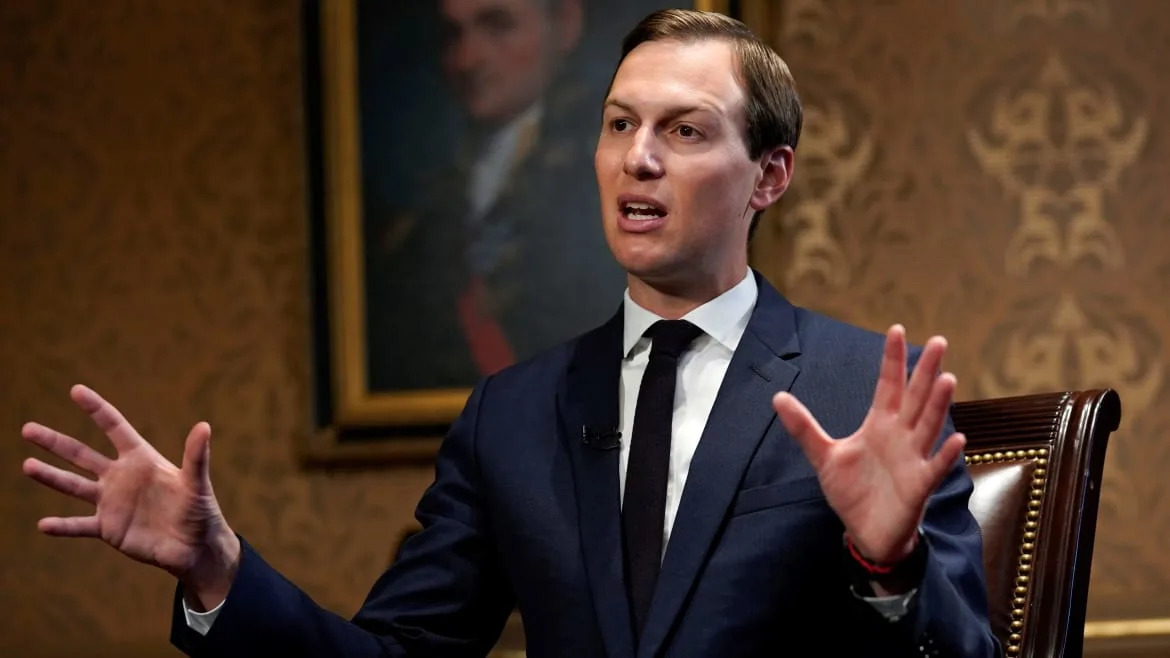
Kushner Pitches Moving Palestinians Out of Gaza’s ‘Valuable’ Waterfront

Daily Beast

Kushner Pitches Moving Palestinians Out of Gaza’s ‘Valuable’ Waterfront

Edith Olmsted – March 19, 2024

Kevin Lamarque/Reuters

Donald Trump’s son-in-law Jared Kushner has offered his own solution to the mass bloodshed and displacement in Gaza: some good, old-fashioned real estate development.

During an interview with Tarek Masoud, the faculty chair of Harvard’s Middle East Initiative, Kushner proposed moving Palestinians to Israel’s arid desert region to “clean up” Gaza’s “valuable” waterfront.

“Gaza’s waterfront property could be very valuable to—if people would focus on building up livelihoods,” Kushner said, without clarifying who exactly would profit off such a project. He added that the area could’ve had great potential if “all the money” in Gaza had gone into “education and innovation,” instead of its tunnel network and munitions.

Kushner’s statement comes on the heels of warnings from the United Nations that the people of Gaza are facing an “imminent famine” as Israel continues its offensive.

Kushner suggested displacing the remaining Palestinians from the “valuable” waterfront, and dropping them in the Negev desert.

“I would just bulldoze something in the Negev, I would try to move people in there, I know that that won’t be the popular thing to do, but I think that that’s a better option to do, so that you can go in and finish the job,” he said. The Jewish Virtual Library describes the Negev as “oppressively hot” and “filled more with dirt, rocks and canyons, which are no less forbidding” than sand dunes.

When asked about concerns that Palestinians would be prohibited from returning to Gaza, Kushner said, “I am not sure there’s much left of Gaza at this point.”

Kushner clarified that he didn’t know if Israeli officials were seriously considering displacing Palestinians to the Negev.

“I’m sitting in Miami Beach right now, and I’m looking at the situation and I’m thinking: what would I do if I was there?” Kushner said.

When asked if Israel should allow a Palestinian state, Kushner said it was a “super bad idea” and would “essentially be rewarding an act of terror.”

Stormy Daniels, Michael Cohen permitted to testify on Donald Trump hush money, judge rules

USA Today

Stormy Daniels, Michael Cohen permitted to testify on Donald Trump hush money, judge rules

Aysha Bagchi, USA TODAY – March 18, 2024

Adult film actress Stormy Daniels and former lawyer Michael Cohen, two potential star witnesses in former President Donald Trump’s upcoming New York criminal hush money trial, will be allowed to testify, a judge ruled Monday.

The ruling rebuffed a call by Trump’s legal team to exclude the pair’s testimony. Both Daniels and Cohen have claimed that Daniels, whose real name is Stephanie Clifford, was paid ahead of the 2016 presidential election to keep quiet about a sexual encounter she had with Trump.

Manhattan District Attorney Alvin Bragg charged Trump with 34 felony counts of falsifying business records to cover up his reimbursing Cohen for the $130,000 hush money payment. Trump repaid Cohen in 2017 through monthly checks that were disguised as payments for legal services and falsely documented at the Trump Organization, according to prosecutors.

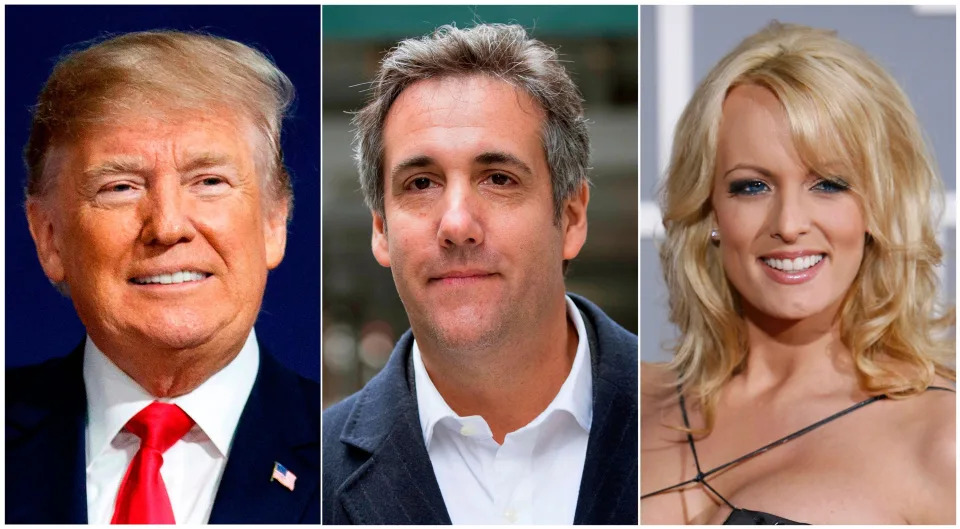
Former President Donald Trump, disbarred  attorney Michael Cohen and adult film actress Stormy Daniels.
Former President Donald Trump, disbarred attorney Michael Cohen and adult film actress Stormy Daniels.

Judge Juan Merchan’s ruling on the testimony maps out the potential contours of the trial, which was previously slated to begin March 25 but has been delayed until at least mid-April after Trump’s legal team asked for more time to review new documents.

Merchan will instead hold a hearing March 25 to deal with what happened with the new documents and potentially set a new trial date. The trial is expected to last several weeks.

Why Trump said Cohen should be kept out

“Michael Cohen is a liar,” Trump’s legal team wrote in their request to exclude Cohen’s testimony. They said Cohen has a history of lying that ranged from minimizing his own criminal conduct to distorting his background.

The Trump team pointed specifically to Cohen’s statement at Trump’s New York civil fraud trial that he had previously lied to a federal judge when he pleaded guilty to tax evasion. Cohen said at the civil fraud trial that he engaged in “tax omission,” not tax evasion.

“The People’s desire to rush ahead with these proceedings rather than look into the ongoing criminal conduct of their star witness is troubling and violates the People’s ethical and constitutional obligations,” Trump’s team argued, referring to the DA’s office.

However, Merchan said he wasn’t aware of any perjured testimony from Cohen in the hush money case.

“Defendant provides examples of situations where Cohen’s credibility has been called into question. However, he offers no proof of perjury in the case at bar,” Merchan wrote.

Merchan said he wasn’t able to find any applicable law or court holding that blocked a prosecution witness because the witness’s credibility was previously called into question.

Trump was found liable for fraud in that case and ordered to pay more than $450 million. He has appealed that ruling.

The 2024 Republican presumptive nominee’s hush money case will mark the first-ever criminal trial of a former president.

Why Trump said Daniels should be kept out

In trying to get Daniels’ testimony blocked, Trump’s legal team described her stories as “contrived” and “inflammatory,” and quoted her as having said, in the context of testifying, she has “been asked to kind of behave.”

Prosecutors “appear to have recognized the risks of presenting this irrelevant and untrue testimony by warning their witness,” Trump’s team said in their request to exclude her testimony.

In allowing Daniels’ testimony, Merchan said its value is “evident.”

“Locating and purchasing the information from Daniels not only completes the narrative of events that precipitated the falsification of business records but is also probative of the Defendant’s intent,” he wrote.

Merchan did grant Trump’s request to block the jury from hearing about the results of any polygraph test Daniels took.

Testimony but not video on Access Hollywood tape allowed

In a separate ruling Monday, Merchan also made several determinations about the government’s requests around evidence, including about the infamous Access Hollywood tape, in which Trump stated that he kisses women without consent.

“You know, I’m automatically attracted to beautiful (women) — I just start kissing them,” Trump said. “It’s like a magnet. Just kiss. I don’t even wait.” He added, “And when you’re a star, they let you do it. You can do anything … Grab them by the p—-y. You can do anything.”

Merchan said the tape “is relevant to the critical issues in this case,” noting the government’s argument that Trump and his campaign team were worried after the tape was released that it would hurt his candidacy.

“Thus, the tape helps establish Defendant’s intent and motive for making the payment to Daniels and then” trying to hide it, Merchan wrote.

Merchan said, however, that there should be a compromise to avoid undue prejudice against Trump.

“This Court rules that the proper balance lies in allowing the People to elicit testimony about a videotaped interview which surfaced on October 7, 2016, that contained comments of a sexual nature which Defendant feared could hurt his presidential aspirations,” Merchan wrote.

“However, it is not necessary that the tape itself be introduced into evidence or that it be played for the jury,” Merchan added.

Merchan said he may reconsider his ruling on the tape if Trump opens the door to more evidence about it at trial.

Merchan also said Trump won’t be allowed to offer any evidence that the Justice Department chose not to prosecute him for potential campaign finance law violations. The department’s decision didn’t prove anything for purposes of the hush money case, Merchan said.

MAGA Reps Suddenly Face an Existential Threat: Themselves

Daily Beast

MAGA Reps Suddenly Face an Existential Threat: Themselves

Sam Brodey, Reese Gorman – March 18, 2024

Photo Illustration by Thomas Levinson/The Daily Beast/Getty

It would be hard to argue that Rep. Mike Bost (R-IL) is guilty of the worst sin in today’s GOP—being a dreaded RINO, or “Republican In Name Only.”

The Illinois congressman endorsed Donald Trump for president and voted with him 93 percent of the time during his administration. Bost voted to throw out the electoral votes of states Joe Biden won in 2020. And Trump has even endorsed his 2024 re-election bid, saying Bost is doing a “fantastic job.”

None of it has been enough to stop a far-right challenger from casting Bost as the epitome of a RINO—forcing the incumbent into a brutal political dogfight ahead of Tuesday’s primary election.

GOP Challenger Ridicules Barron Trump During YouTube Show

Darren Bailey, a far-right state senator who was the GOP nominee for governor in 2022, is arguing that Illinois’ most conservative district needs the most MAGA possible representative.

On Steve Bannon’s War Room podcast last week, Bailey told the former Trump strategist that Bost “will not stick his neck out like you, and like Mike Lindell, because obviously these people are career politicians, they’re concerned about the next election cycle.” Bannon, for his part, hyped up his guest’s opponent as “one of the worst, as bad as they come,” calling Bost a “mini-McCarthy” and fixating on reports that he had threatened to punch “our own” Rep. Matt Gaetz (R-FL). (On top of regularly guest-hosting the War Room podcast, Gaetz has traveled to Bost’s district to campaign for Bailey.)

With his résumé, Bost would have been all but immune to a challenge from his right in years past. Since he was elected in 2014, in fact, he’s only faced one other primary challenge—in 2018, when he won by nearly 70 points.

But 2024 is poised to be a very different election year, one in which no House Republican is safe, no matter how MAGA they may be.

At least 21 House Republican incumbents are facing primary challenges from candidates who are seriously campaigning and raising at least some funds, according to a Daily Beast review of campaign filings and other materials.

Three lawmakers have already survived, but by slim margins. In March 5 primaries, Reps. Dan Crenshaw (R-TX), Steve Womack (R-AR), and Jake Ellzey (R-TX) defeated underfunded MAGA challengers, but with less than 60 percent of the vote. Womack, a critic of hardline conservatives, won by just 7 points.

In a brief interview with The Daily Beast last week, Bost lamented what he saw as the driving factors behind many of these challenger campaigns: attention and purity tests.

“What that is is all about your own ego, and that’s the problem,” Bost said. “And they find like people that think like they do, and then try to drag them up against somebody that doesn’t think like they do.”

Some of the incumbents are familiar primary targets, like Reps. Brian Fitzpatrick (R-PA) and Don Bacon (R-NE), considered among the most centrist members of the GOP conference. Some are being challenged simply because they aren’t loud or combative enough—or even if they cast a vote in favor of funding the government, which is now a punishable offense in the MAGA base.

But many are as conservative and Trump-supporting as Bost, if not more so. Rep. William Timmons (R-SC), who has a 95 percent lifetime score from the right-wing Heritage Foundation, is facing an aggressive primary challenge.

Some archconservatives are being targeted because they backed Ron DeSantis for president, like Reps. Bob Good (R-VA) and Thomas Massie (R-KY), while others are being challenged in part because they didn’t support Rep. Jim Jordan (R-OH) in his bid for the House speakership last fall.

House Freedom Caucus Chairman Rep. Bob Good (R-VA) speaks with reporters at the U.S. Capitol.
1920481347House Freedom Caucus Chairman Rep. Bob Good (R-VA) speaks with reporters at the U.S. Capitol.Photo by Kent Nishimura/Getty Images

What nearly all of these incumbents have in common is that their opponents hail from the far-right fringes of the party. Where the incumbents are on Fox and Newsmax, the challengers are regulars on Bannon’s show, hoping to land endorsements from figures like Mike Lindell, Roger Stone and Michael Flynn.  

One primary hopeful is a pro-gun YouTuber; another has based his campaign around having served prison time for participating in the Jan. 6 attack on the Capitol. Far-right troll Laura Loomer, who came within 7 points of defeating Rep. Daniel Webster (R-FL) in 2022, is running again. Often lost in the noise from these ultra-MAGA figures is that their beloved party leader has endorsed their opponent.

That’s what’s so different about this primary cycle, say Republicans and election analysts.

“The threshold of what it takes to offend Republican primary voters has fallen lower,” said Dave Wasserman, the election expert and senior editor for U.S. House races at the Cook Political Report.

At this point, GOP strategist Ken Spain said, “many of the Republicans in the House have taken on a Trump-like persona, where you either fight to the death, or you’re simply not committed to the cause—and that’s what we’re seeing play out.”

Like in every election year, at least one of these challenges will almost certainly be successful. It’s possible many could lose, or 2024 could be a better year for incumbents than 2022, when five lost primary challenges in non-redistricting related races.

But the more important upshot of any member having to worry about a primary threat, no matter how marginal, may not be who wins—it may be how members adjust their behavior to survive.

Pointing to weak incumbent performances on March 5, Wasserman said, “the combined impact of those three outcomes will be a chilling effect on other Republican members who have been willing to speak out against Trump or vote for things that Trump doesn’t like.”

While Trump often put Republicans in a difficult position when they had to defend his near-daily controversies, he offered many of them something they desperately desired: a cheat code to avoid primary challenges.

Far-Right Trump Favorite Mark Robinson Wins North Carolina Governor Primary

Republicans during the Trump era were largely measured by their support of Trump. Gone were the Heritage Action or Club for Growth scores to rank a Republican’s conservatism, or the need to collect endorsements from across the GOP spectrum, or even the need to spend considerable time in the district.

Republicans, by and large, only needed Trump’s endorsement to be considered sufficiently conservative and avoid a credible threat. That fealty of Republicans to Trump further reinforced his power in the party, and further exacerbated the transformation of the party into his image.

Even with Trump out of office for three years, his influence has been constant. What has changed, however, is just the number of anti-Trump—or, really, insufficiently pro-Trump—Republicans that are left in Congress.

With just about every Republican claiming the mantle of a ‘Trump Republican,’ being ‘pro-Trump’ might not be the same prophylactic that it once was against primary challengers. (If every Republican is pro-Trump, is anyone really pro-Trump?)

Combine it all with the dearth of successful challenges in recent years—which has just increased the internal tension in the party—and there’s a pressure cooker situation developing.

After a year that unleashed unprecedented internal animosity in the House GOP, members’ increased eagerness to campaign against their own colleagues is adding yet another layer of drama in a majority already ripped apart by it.

Gaetz, naturally, is a ringleader, having stumped for primary challengers to Bost and Rep. Tony Gonzalez (R-TX). Timmons’ challenger, meanwhile, has been endorsed by a remarkable seven colleagues.

Many Republicans, of course, would rather see these members using their campaign time and resources working to protect and expand the House GOP’s increasingly slim majority instead of trying to replace conservative colleagues with even more conservative colleagues.

On the Democratic side of the aisle, the primary fever that helped put the left-wing “Squad” into office in 2018 and 2020 has abated. The most high-profile challenges to incumbents this cycle are from the center, not the left, targeting Squad-aligned Reps. Jamaal Bowman (D-NY) and Cori Bush (D-MO). Meanwhile, just two members of the party’s center and center-left wing are facing viable primaries from progressives.

Occasionally, this frustration has emanated from the top of the House GOP. During House Republicans’ annual retreat last week, Speaker Mike Johnson (R-LA) privately—and showing real frustration—admonished members who were campaigning against each other, a source familiar with his remarks told The Daily Beast.

A House Divided: Republicans Retreat From Their Annual GOP Retreat

“I’ve asked them all to cool it,” Johnson told CNN on Sunday. “I am vehemently opposed to member-on-member action in primaries because it’s not productive… So I’m telling everyone who’s doing that to knock it off.”

In response to a question from The Daily Beast about primaries, Rep. Elise Stefanik (R-NY), the fourth-ranking House Republican, declared her support for all GOP incumbents and urged members to work as a team.

“It’s a slim majority, and we need to make sure that everyone feels the support from their colleagues,” she said. “Even if you vote differently based upon your district, it’s important to know that we’ve all heard the support of our constituents to be here.”

Perhaps more than any other primary fight, the one in West Virginia’s 1st District illustrates the singular dynamics at this fraught moment within the Republican Party.

The incumbent, Rep. Carol Miller, has represented this district since 2019. Trump won it by over 40 points in 2020. Miller voted to throw out Biden’s Electoral College votes on Jan. 6 and has been a Trump ally. But in general, she has quietly gone about her business in Congress, and has cast votes to keep the government open and avoid defaults on the national debt.

Miller’s opponent is Derrick Evans, a former West Virginia state lawmaker who might be the purest expression of the MAGA id and political incentive structure on display anywhere in the country.

Evans’ proudest credential appears to be the fact that he was charged with crimes for his actions at the Capitol on Jan. 6. The high point of his campaign was Trump himself sharing Evans’ post on the Truth Social platform of their mugshots side by side. (In accepting a three-month prison sentence for his crimes in 2022, Evans expressed remorse.)

Now, the candidate’s feed on X is full of daily outrage bait. “White liberal women are the greatest threat to the future of our constitutional republic,” he posted recently. He has called for “arresting the people who stole the 2020 election.” He has been endorsed by QAnon favorite Michael Flynn and Trump acolyte Roger Stone. For some reason, he traveled to Delaware last Friday to give a speech about Joe Biden.

While he has dinged her for such offenses as appearing in a photo with Bill Gates, Evans has occasionally made a succinct case for his primary campaign. “My opponent,” Evans once tweeted, “is a total RINO representing an Ultra MAGA District.”

Convicted Capitol Rioter Announces Run for Congress

Evans has also raised real money: over $290,000 in 2023, according to his Federal Election Commission filings. (Miller has raised just over $560,000.)

In a brief interview with The Daily Beast at the House GOP retreat last week, which took place in her district, Miller demonstrated how starkly different she is from her opponent.

“My mama told me not to say anything if I can’t say anything nice,” Miller said. “I welcome people challenging me. His lack of experience is a little different to me. I’ve worked very hard the last six years. I represent my district well. I’ve listened to them, I’ve voted conservatively, and it’s been my honor to serve.” (Evans did not respond to a request for comment from The Daily Beast.)

There is another potent GOP primary dynamic adding to the 2024 chaos: incumbents who may face challenges stemming from their votes to remove Kevin McCarthy as Speaker last year. The furious deposed leader has taken verbal potshots at the eight GOP lawmakers who ousted him, and he and his powerful allies are moving to hamper their re-election campaigns.

Rep. Nancy Mace (R-SC) is considered one of the top targets, along with Rep. Good in Virginia. One of the McCarthy Eight, Rep. Matt Rosendale (R-MT), is not even seeking re-election, citing a personal smear campaign against him.

In Good’s 5th Congressional District of Virginia, all the strains of GOP drama converge. The chairman of the hard-right House Freedom Caucus, it’s hard to get more conservative than Good. But he earned establishment enemies with his support for removing McCarthy—and earned enemies in the MAGA movement for his support of DeSantis for president.

His opponent is John McGuire, a Virginia state senator who has touted his support for Trump at every turn possible. Ahead of the June 18 primary, Good’s standing among primary voters is so poor that he was thrown out of a pro-Trump store in his district that had hosted an event for McGuire.

Massie, the Kentucky Republican, also was a prominent DeSantis backer, and his opponent has touted that as his No. 1 reason to dump the incumbent. But Massie has been here before; in 2020, Trump backed his primary challenger. He won easily anyway.

“This would be the third person who’s tried to run to the Trump of me, and that’s the only direction you can go where I might not be 100 percent in terms of the MAGA scorecard,” Massie told The Daily Beast.

But Massie acknowledged that not all of his colleagues have cultivated as strong a brand that lets them survive getting crosswise with Trump.

“If you’re not known in your district,” Massie said, a Trump endorsement could “cost you 10 points in your primary.”

“If somebody gets endorsed on the other side they can go up 10 points, and the other person could go down 10 points if they’re not very well defined in their district,” he said.

How Massie fares in his own state’s primary could show how acute the party’s MAGA angst really is. But he’s not sweating the challenge.

“People would rather I support the Constitution,” he said, “than any particular president.”

Supreme Court Puppetmaster Explains How Billionaires Can Push America Right

Rolling Stone

Supreme Court Puppetmaster Explains How Billionaires Can Push America Right

Andrew Perez – March 18, 2024

Conservative activist and Supreme Court puppetmaster Leonard Leo recently outlined his pitch for billionaires on how they can help move the United States government and society to the right.

“It’s really important that we flood the zone with cases that challenge misuse of the Constitution by the administrative state and by Congress,” Leo said in a new podcast interview, calling on the ultra-wealthy to support these litigation efforts.

“We have a great Overton window in the next couple of decades to really try to create a free society,” Leo said of the Supreme Court. “And I think we should take full advantage of it.”

The co-chair of the Federalist Society, the conservative lawyers network, Leo is best known as the man who helped build the Supreme Court’s conservative 6-3 supermajority, in his role as President Donald Trump’s judicial adviser. Leo’s dark money network, which received a historic $1.6 billion infusion in 2021, additionally helps bring cases before the high court, influence which cases the justices consider, and shape the court’s decisions. As Rolling Stone reported last month, Leo has been working to expand his network in recent months.

Leo has been at the center of the ethics questions swirling around the Supreme Court in the past year. ProPublica reported that Leo arranged Justice Samuel Alito’s seat on a private jet — paid for by a billionaire hedge-fund chief — as part of an undisclosed luxury fishing trip in Alaska in 2008. He also reportedly steered secret consulting payments to Justice Clarence Thomas’ wife.

Long averse to media attention, Leo recently taped a podcast interview with Joe Lonsdale, the co-founder of surveillance company Palantir and the University of Austin, a conservative alternative college he started with journalist Bari Weiss. The discussion was first highlighted by the watchdog group Accountable.US.

In the interview, Leo spoke about his $1.6 billion dark money fund, called the Marble Freedom Trust, explaining: “We’re trying to really institute a lot of legal and social change through philanthropy.” He also offered his thoughts on how billionaires can help conservatives limit regulations, take over corporate C-suites, reshape America’s education system, and influence our culture. Leo, a devout Catholic, additionally discussed his interest in reforming religious institutions.

Leo outlined how conservatives can chip away at the administrative state by flooding the courts with legal challenges. Touting a Supreme Court ruling that limited the Environmental Protection Agency’s authority to regulate some carbon emissions, he said that “there needs to be constraints on agencies’ interpretations of their own power,” and that “courts have a role to play in interpreting agency power and constraining them when necessary.” He added, “There are many more of those cases that are going to be brought over the next three to five years.”

In the business realm, he argued, “We need to be building pipelines of talent — pipelines of people who understand that the Constitution matters, and that the private sector and civil society matter. And that means building talent pipelines of people who can be in the C-suite and in boardrooms, because corporate America plays an enormously important role in potentially constraining government.”

He continued: “Corporate America, [the] finance world, banks — they have an enormous amount of influence over our culture and our social life. And we need to be finding ways of getting folks in the C-suites and in the boardrooms who are just tired of our woke culture.”

Leo has financed the right-wing campaign against so-called “woke capitalism,” targeting the use of ESG — environmental, social, and governance — criteria in investment decisions.

Twice in the interview, Leo talked about the need for conservatives to “build talent pipelines in the media and entertainment industry,” adding: “There are a lot of people in the entertainment world who really understand limited government and free society. And they’re not happy with the entertainment world, and they’re looking for opportunities to band together, and to be a part of new enterprises.”

Leo’s network has funded the conservative National Review Institute as well as the RealClearFoundation, a nonprofit affiliated with the political news aggregator RealClearPolitics.

Another key element in Leo’s pitch to prospective donors centered around education — both K-12 and higher education. “We need to create talent pipelines for K-12 education and for higher ed, something like you’re doing with the University of Austin,” he told Lonsdale, “so that we remind people that the purpose of higher ed, for example, is to basically build a citizenry that’s committed to the Constitution as it was originally written.”

Leo explained this means recruiting teachers and working to influence education board races, “so that we can begin to have some sanity and local education.”

He added, “The idea behind education, as [Thomas] Jefferson put it, was to create good engaged citizens. So if we teach them civics, in a way that’s understandable, and comprehensible, and appealing, the idea that limited government advances human dignity, and I really believe that, if we can, if we can have educational institutions that instill that, we’ll create a better electorate. And if we create a better electorate, I think ultimately, we’ll have a government, including an administrative state, that’s much more reflective of a free and just society.”

One group in Leo’s network, Free to Learn, has been involved in local school board elections. His network recently created a new group called the American Parents Coalition.

Lastly, Leo talked about the need to reform the clergy. “This is one that I just started thinking about, there’s the whole issue of clergy, and this is a tough one to crack,” he said, adding: “This may not be for everybody, but my own perspective is: God made us to know him, to love him, and to serve him. And I think our religious leaders need to center more on that, and less on knowing, loving, and serving ourselves, and whatever personal desires or affections we may have.”

Leo leads a separate nonprofit entity, called the Sacred Spaces Foundation, which he used to purchase a Catholic church near his summer home in Northeast Harbor, Maine, last year.

More from Rolling Stone

Trump’s ‘blood bath’ threat wasn’t even the most dangerous thing he said all weekend

USA Today – Opinion

Trump’s ‘blood bath’ threat wasn’t even the most dangerous thing he said all weekend

Rex Huppke, USA TODAY – March 18, 2024

You might have heard some controversy over former President Donald Trump’s use of “blood bath” this weekend.

Here’s a quick summary: At an Ohio rally on Saturday, Trump was talking about the auto industry and said if he doesn’t get elected in November “it’s going to be a blood bath for the country,” prompting a number of news outlets to report things along the lines of “Trump predicts ‘blood bath’ if not elected,” which seemed pretty on point, but then a bunch of MAGA types got bent out of shape and said, “No, he was talking about it being a blood bath for the auto industry,” which still seems kind of bad and unnecessarily apocalyptic but … you know … whatever, and so a bunch of news outlets started writing about the possibility that the “blood bath” comment was taken out of context and all sorts of hand-wringing ensued and it was, to borrow a phrase, a bit of a blood bath.

Here’s the full quote, which came on the heels of his comments about the auto industry: “Now if I don’t get elected, it’s going to be a blood bath for the whole – that’s going to be the least of it. It’s going to be a blood bath for the country.”

Here’s what matters: A number of media outlets and President Joe Biden’s campaign pounced on one unhinged Trump comment that had questionable context when there were SO MANY OTHER absolutely despicable comments to choose from.

Trump’s ‘blood bath’ line overshadowed more dangerous comments

If the media erred, it was in focusing on the “blood bath” comment rather than – (please imagine me waving my hands in all directions) – everything else.

Of greater importance, I’d argue, was the fact that Trump’s Saturday rally in Dayton began with an announcer saying, “Ladies and gentlemen, please rise for the horribly and unfairly treated Jan. 6 hostages.”

I guess insurrection is now A-OK: Supreme Court sides with Donald Trump, affirming each president gets one free insurrection

The presumptive GOP presidential nominee has taken to calling the charged, tried, convicted and imprisoned insurrectionist-lunkheads who attacked the U.S. Capitol in 2021 “hostages.” He referred to them as “unbelievable patriots.”

The fact that a former president of the United States is treating domestic terrorists as heroes – they are so horribly and unfairly treated! – is certainly as newsworthy as any “blood bath” comment.

Trump calling migrants ‘animals’ should alarm everyone

Trump also continued his dehumanizing anti-immigrant rhetoric, painting a wildly inaccurate picture of “hardened criminals” by the “hundred of thousands” crossing the border and “destroying our country.”

“I don’t know if you call them people, in some cases they’re not people, in my opinion,” Trump said. “But I’m not allowed to say that because the radical left say it’s a terrible thing to say.”

Former President Donald Trump campaigns at the Dayton International Airport on March 16, 2024, in Ohio. The state holds its Republican Senate primary on the following Tuesday.

That’s correct. It’s a terrible thing to say. The vast majority of migrants are people fleeing violence or economic hardship, and there’s no evidence that immigrants cause an increase in crime.

On Saturday, Trump called them “animals.” That is vile rhetoric, though not at all surprising since he has previously echoed Adolf Hitler’s language by claiming immigrants are “poisoning the blood of our country.”

When you sound like Hitler, that’s a very bad thing

Asked about similarities between his words and Hitler’s on Fox News on Sunday, Trump said: “That’s what they say; I didn’t know that.”

Sure, buddy. He apparently missed the classes on World War II in high school history. And it seems worth noting that even “accidentally” saying something that sounds like Hitler is neither good nor normal.

Unfazed by his Fox News interviewer, Trump continued to repeat the same horrendous crap: “Our country is being poisoned.”

The presumptive Republican nominee: Want to know how weird Donald Trump is? Just read this transcript.

Predicting a ‘blood bath’ was the tip of Trump’s iceberg

Here are a few other disturbing moments from Trump’s weekend:

One weekend of Trump babble should disqualify him

To sum things up, the “blood bath” comment, whatever the context, was bad.

But beyond that, the man a majority of Republicans believe should be the next president spent the weekend: calling the sitting president a “numbskull”; calling former Republican primary candidates “terrible”; continuing to deny the results of a free-and-fair election; calling immigrants “animals” while continuing to embrace Hitlerian rhetoric, even after being reminded it’s Hitlerian rhetoric; swearing; crudely making fun of someone’s weight and another person’s name; and calling the people who quite literally attacked the U.S. Capitol and assaulted more than 100 police officers “unbelievable patriots.”

I’d say the real controversy is the media failed to point out that Trump’s “blood bath” comment, disturbing as it is, might have been the least-bad thing he said all weekend.

With the election behind him, Putin says Russia aims to set up a buffer zone inside Ukraine

Associated Press

With the election behind him, Putin says Russia aims to set up a buffer zone inside Ukraine

The Associated Press – March 18, 2024

Ukrainian and Russian soldiers are depicted in a tug-of-war game on a memorial in Izium, Kharkiv region, Ukraine, Sunday, March 17, 2024. (AP Photo/Efrem Lukatsky)
Family members of Vitaliy Alimov, his mother Maria and his wife Natalia, mourn over his body before his funeral in Bilhorod-Dnistrovskyi, Ukraine, Monday March 18, 2024. Alimov, a firefighter, was killed in the Russian attack on Odesa on Friday March 15. (AP Photo/Victor Sajenko)
FILE - Men in unmarked uniforms stand guard during the seizure of the Ukrainian corvette Khmelnitsky in Sevastopol, Crimea, Thursday, March 20, 2014. When Ukraine's Kremlin-friendly president was ousted in 2014 by mass protests that Moscow called a U.S.-instigated coup, Russian President Vladimir Putin responded by sending troops to overrun Crimea and staging a plebiscite on joining Russia, which the West dismissed as illegal. (AP Photo, File)
Men in unmarked uniforms stand guard during the seizure of the Ukrainian corvette Khmelnitsky in Sevastopol, Crimea, Thursday, March 20, 2014. When Ukraine’s Kremlin-friendly president was ousted in 2014 by mass protests that Moscow called a U.S.-instigated coup, Russian President Vladimir Putin responded by sending troops to overrun Crimea and staging a plebiscite on joining Russia, which the West dismissed as illegal. (AP Photo, File)
Emergency services workers look on as Military chaplain Archpriest Ioann shovels earth into the grave of Vitaliy Alimov during his funeral in Bilhorod-Dnistrovskyi, Ukraine, Monday March 18, 2024. Alimov, a firefighter, was killed in the Russian attack on Odesa on Friday March 15. (AP Photo/Victor Sajenko)

Russian President Vladimir Putin said after extending his rule in an election that stifled opposition that Moscow will not relent in its invasion of Ukraine and plans to create a buffer zone to help protect against long-range Ukrainian strikes and cross-border raids.

The Kremlin’s forces have made battlefield progress as Kyiv’s troops struggle with a severe shortage of artillery shells and exhausted front-line units after more than two years of war. The front line stretches over 1,000 kilometers (620 miles) across eastern and southern Ukraine.

Advances have been slow and costly, and Ukraine has increasingly used its long-range firepower to hit oil refineries and depots deep inside Russia. Also, groups claiming to be Ukraine-based Russian opponents of the Kremlin have launched cross-border incursions.

“We will be forced at some point, when we consider it necessary, to create a certain ‘sanitary zone’ on the territories controlled by the (Ukrainian government),” Putin said late Sunday.

This “security zone,” Putin said, “would be quite difficult to penetrate using the foreign-made strike assets at the enemy’s disposal.”

He spoke after the release of election returns that showed him securing a fifth six-year term in a landslide in an election devoid of any real opposition following his relentless crackdown on dissent.

Monday marks the 10th anniversary of Russia’s seizure of Ukraine’s Crimea Peninsula, which set the stage for Russia to invade its neighbor in February 2022. However, Putin has been vague about his goals in Ukraine since that full-scale invasion floundered.

Putin again warned the West against deploying troops to Ukraine. A possible conflict between Russia and NATO would put the world “a step away” from World War III, he said.

French President Emmanuel Macron recently said that sending Western troops into Ukraine should not be ruled out, though he said the current situation does not require it.

Commenting on the prospects for peace talks with Kyiv, Putin reaffirmed that Russia remains open to negotiations but won’t be lured into a truce that will allow Ukraine to rearm.

However, Ukrainian President Volodymyr Zelenskyy has apparently shut the door on such talks, saying Putin should be brought to trial at the International Criminal Court in The Hague, which last year issued an arrest warrant for Putin on war crime charges.

With crucial U.S. aid being held up in Washington, U.S. Sen. Lindsey Graham arrived in Kyiv on Monday, the U.S. Embassy said. Ukraine desperately needs the around $48 billion that the package of support would provide, especially artillery shells and air defense systems.

Ukraine’s air force said it intercepted 17 out of 22 Shahed drones launched by Russia over various regions of the country overnight. Russia also fired five S-300/S-400 missiles at the Kharkiv region and two Kh-59 at the Sumy region, both in northeastern Ukraine, it said.

Authorities say the intensity of ground attacks and airstrikes has increased recently in the Sumy region, prompting the evacuation of 56 people, including 26 children, from one border village over the past week.

In the past two and a half months the region has been struck more than 3,000 times, after some 8,000 strikes over all of last year, the Ukrainian regional government says. The number of aerial bomb attacks has tripled, and Russian saboteurs are highly active, according to officials.

This story corrects the name of the court to the International Criminal Court.

Follow AP’s coverage of the war in Ukraine at https://apnews.com/hub/russia-ukraine

Trump has failed to get appeal bond for $454 million civil fraud judgment, lawyers say

Reuters

Trump has failed to get appeal bond for $454 million civil fraud judgment, lawyers say

Luc Cohen – March 18, 2024

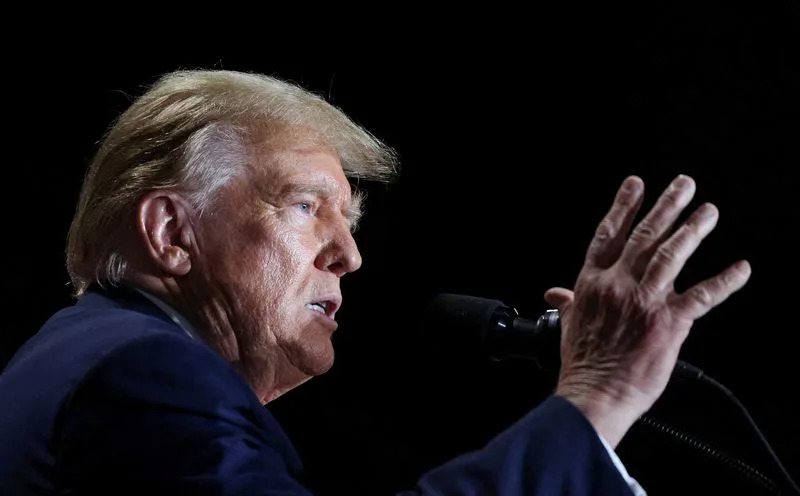
FILE PHOTO: Republican presidential candidate and former U.S. President Donald Trump holds rally in Richmond

NEW YORK (Reuters) – Donald Trump – has so far been unable to obtain a bond that would allow him to appeal a $454 million judgment against the former U.S. president in a New York civil fraud case without posting the full amount himself, his lawyers said on Monday.

Trump must either find the cash or post a bond to prevent the state’s authorities from seizing his properties while he appeals Justice Arthur Engoron’s Feb. 16 decision ordering him and co-defendants to pay $464 million in penalties and interest for misstating property values to dupe lenders and insurers.

In a court filing on Monday, the Republican presidential candidate’s lawyers urged a mid-level state appeals court to delay enforcement of the judgment, arguing the amount was excessive.

They said the defendants had so far approached 30 surety companies through four separate brokers to obtain a bond.

“Enforcing an impossible bond requirement as a condition of appeal would inflict manifest irreparable injury on Defendants,” Trump’s lawyers wrote.

The lawyers asked that he instead be allowed to post a $100 million bond while he appeals the judgment. A bonding company would be on the hook for any payout if Trump loses his appeal and proves unable to pay.

Trump’s lawyers included a statement by Gary Giulietti, an executive with insurance brokerage the Lockton Companies, which Trump has hired to help get a bond.

Giulietti wrote that a bond for the full $464 million “is not possible under the circumstances presented,” noting that many sureties would not issue bonds above $100 million and were willing to accept only cash or securities – not real estate – as collateral.

Trump denied wrongdoing in the case, which was brought by New York Attorney General Letitia James in New York state court in Manhattan.

Trump earlier this month posted a $91.6 million bond to cover an $83.3 million defamation verdict for the writer E. Jean Carroll while he appeals, in a case that arose from his branding her a liar after she accused him of raping her decades ago.

(Reporting by Luc Cohen in New York – Editing by Nick Zieminski)

7 battlegrounds that will decide who wins the presidency

The Hill

7 battlegrounds that will decide who wins the presidency

Niall Stanage – March 18, 2024

7 battlegrounds that will decide who wins the presidency

It’s a rematch.

President Biden and former President Trump each hit a key marker last week, clinching enough delegates to become the presumptive nominee of their respective party.

The outcome of the general election will come down to a handful of states, as usual.

The map maintained by The Hill and Decision Desk HQ lists seven contests as toss-ups.

Those key states are Arizona, Georgia, Michigan, Nevada, North Carolina, Pennsylvania and Wisconsin.

In 2020, Biden won six of the seven — the exception being North Carolina — on his way to a 306-232 victory over Trump in the Electoral College.

The seven battlegrounds in aggregate count for 93 Electoral College votes this year.

Trump leads in all seven in current polls.

Here’s the state-by-state breakdown.

Arizona

Arizona was second to Georgia as the tightest race in the nation in 2020. Biden prevailed by about one-third of a percentage point.

The president will struggle to replicate that performance this year, if the current polls are anything to go by.

An Emerson College poll for The Hill and Nexstar last month put Trump up by 3 points in a head-to-head match-up. Trump’s lead grew to 6 points when Robert F. Kennedy Jr. was added as a choice.

A pro-Kennedy super PAC, American Values, claims it has already secured more than enough signatures to get him on the ballot in Arizona.

There are two other factors to consider.

First, Latinos make up a larger share of Arizona’s population than they do in any other battleground state — 33 percent, according to the Census Bureau.

Trump allies contend the former president is making big inroads with this demographic nationally. But in 2020, Biden bested Trump by 28 points among Latino voters, according to the VoteCast survey commissioned by The Associated Press and Fox News.

Second, Arizona could see one of the most dramatic — and polarizing — Senate races in the nation, with left-leaning Rep. Ruben Gallego (D) and fervent Trump backer Kari Lake (R) widely expected to become the major-party nominees.

Such a dramatic Senate battle could nudge up presidential turnout to even higher than expected levels. But it’s not clear who would get an advantage from such a scenario.

Georgia

Georgia has made plenty of political headlines recently, relating to the effort by Trump and his allies to overturn the 2020 result in the state.

Trump faces 10 charges over that push, even after a judge threw out three additional charges against him Wednesday.

Back in 2020, Biden won by about one-quarter of 1 percent in the state.

A CBS News/YouGov poll released this week gave Trump a 3-point edge in a head-to-head match-up.

One-third of Georgians are Black — a significantly higher proportion than in any other battleground state. Obviously, that makes Black voter enthusiasm for Biden critical if he is to have any real shot at holding on.

There is some pessimism in Democratic circles about Georgia, with some strategists arguing that North Carolina presents a more inviting target for Biden this time around.

Four years ago, Biden was the first Democrat to carry Georgia in a presidential election since 1992.

Michigan

Biden carried Michigan with a smidgen of comfort in 2020, defeating Trump by almost 3 percentage points.

In current polling, it is one of the tightest of the battleground states.

The Emerson College/The Hill/Nexstar poll in February found Trump leading by 2 points with just him and Biden on the ballot.

Trump’s edge doubled to 4 points with Kennedy on the ballot. As with Arizona, the pro-Kennedy super PAC contends it has enough signatures to make that happen.

A big warning sign for Biden came in the Democratic primary, when more than 100,000 people voted “uncommitted.”

Michigan is home to more than 200,000 Arab Americans, representing about 2 percent of the state’s population.

If the conflict in Gaza rages on to November, or even close to it, Biden is facing very serious trouble here.

Nevada

No Republican seeking the White House has carried the Silver State since then-President George W. Bush in 2004.

But Trump clearly has a fighting chance.

A Morning Consult/Bloomberg poll last month gave the former president a lead of either 6 points or 7 points — the slightly bigger margin coming if Kennedy is in the race.

Thirty percent of Nevadans are Latino, making the battle within that demographic critical.

Among the seven battlegrounds, Nevada also has the lowest share of the population with a bachelor’s degree or higher — 27 percent, according to the Census Bureau.

That could be good news for Trump, who is markedly stronger among voters without a college education.

North Carolina

This is Biden’s one semirealistic chance to flip a battleground state this year.

Trump won North Carolina by roughly 1 point in 2020. The state’s major cities, notably Charlotte and Raleigh, have seen their populations swell with new arrivals from more Democratic-leaning states in the north.

Black voters will be critical here too, representing 22 percent of the overall population.

The headwinds Biden faces right now make a North Carolina victory look like an uphill climb, however.

A poll this month from Raleigh TV station WRAL and SurveyUSA found Trump leading by 5 points among likely voters.

The wild card could be the gubernatorial race.

North Carolina Gov. Roy Cooper (D), ending his second term, cannot run again because of term limits.

Attorney General Josh Stein last week secured the Democratic nomination to try to succeed Cooper.

But the bigger story came with the choice by North Carolina’s Republicans to nominate Lt. Gov. Mark Robinson.

Robinson’s history includes a series of controversial remarks about the Holocaust, describing “homosexuality” as “filth,” and suggesting that God has ordained that Christians should be “led by men.”

Could moderate suburbanites come out to thwart Robinson and, in the process, nudge up Biden’s chances? It’s at least possible.

Pennsylvania

Pennsylvania is the biggest prize of the seven battlegrounds, with 19 Electoral College votes up for grabs.

Trump leads by 4 points in the latest Emerson poll for The Hill and Nexstar. A poll a few days prior for Fox News put the margins tighter, including a dead heat between Biden and Trump if Kennedy is on the ballot.

Pennsylvania was one of three Democratic ‘blue wall’ states Trump demolished in 2016 against Hillary Clinton, becoming the first Republican presidential nominee to win there since 1988.

Biden carried the Keystone State by roughly 1 point four years ago.

People older than 65 make up a slightly larger share of the population in Pennsylvania than any other battleground. The state is also 75 percent white. Both factors should make it fertile ground for Trump.

But it’s also a state Biden has a real affinity for, given that it’s adjacent to his home state of Delaware.

This could be the decisive battle in November.

Wisconsin

Wisconsin was the narrowest Midwest win for Biden in 2020, where he scraped home by about half a percentage point.

It has fewer nonwhite voters than any other battleground, with Latinos representing roughly 8 percent of the population and African-Americans 7 percent.

The most recent Hill/Nexstar poll puts Trump up by 3 or 4 points, depending on the Kennedy ballot access question.

The state has a relatively strong history for Democrats in the recent past. Gov. Tony Evers (D) won reelection in 2022, and Sen. Tammy Baldwin (D) is seeking a third term in November.

Still, Trump should not be underestimated. He beat Clinton in Wisconsin in 2016, becoming the first Republican presidential candidate to carry the state since 1984.

Trump faces ‘insurmountable difficulties’ in securing $464M bond in civil fraud case, his attorneys say

ABC News

Trump faces ‘insurmountable difficulties’ in securing $464M bond in civil fraud case, his attorneys say

Aaron Katersky and Peter Charalambous – March 18, 2024

Trump faces 'insurmountable difficulties' in securing bond in civil fraud case

Former President Donald Trump is facing “insurmountable difficulties” in obtaining a bond to satisfy the $464 million civil fraud judgment, his attorneys said Monday in a new appellate court filing, and the magnitude of which would require him to use real estate as collateral.

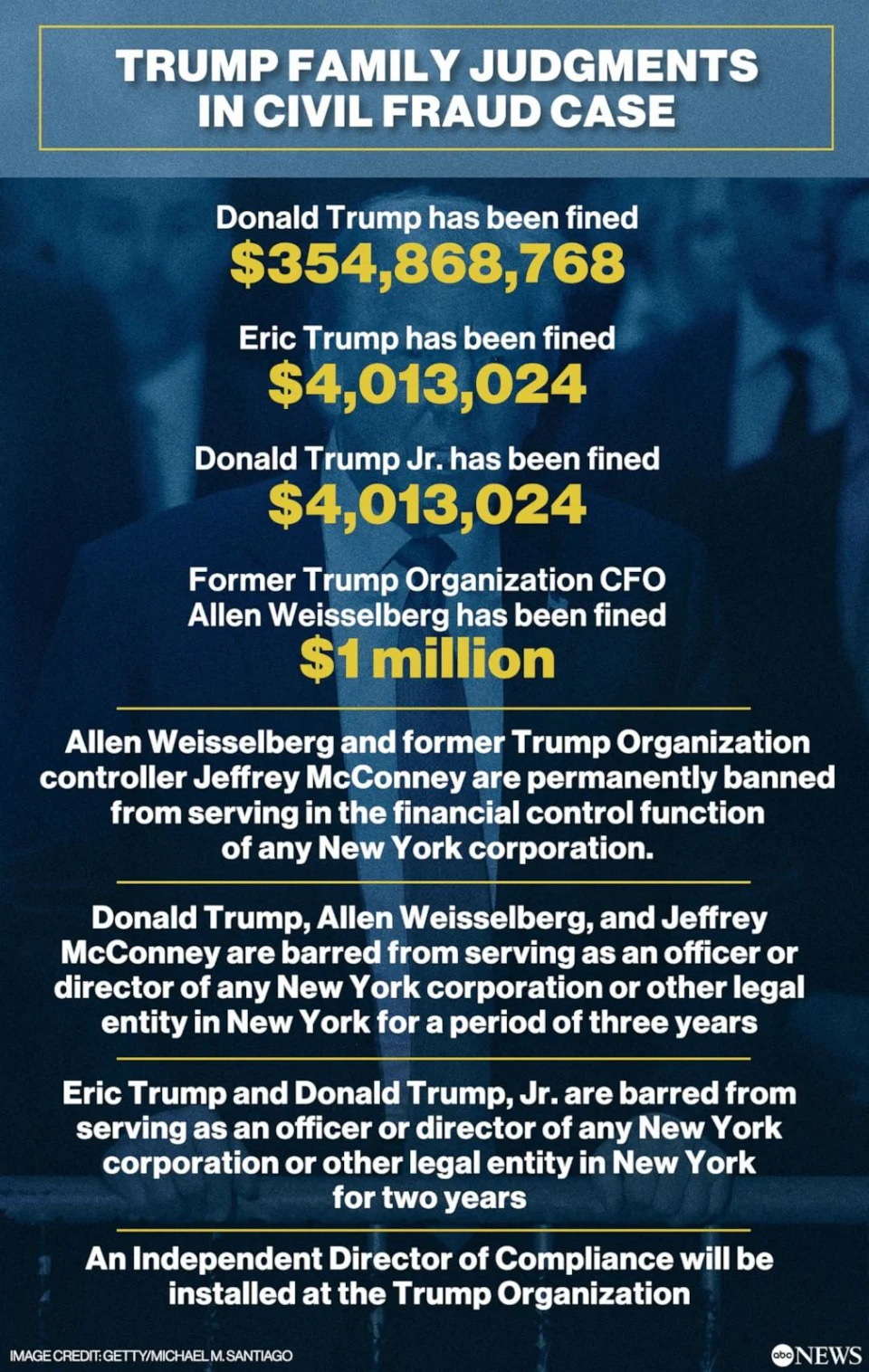
Judge Arthur Engoron in February ordered Trump to pay $464 million in disgorgement and interest after holding him liable for doing a decade’s worth of business with fraudulent financial statements that overvalued his real estate holdings and hyped his wealth. Trump was also barred from leading any New York company for three years. His sons Donald Trump Jr. and Eric Trump were also fined $4 million apiece and barred for two years.

“Defendants have faced what have proven to be insurmountable difficulties in obtaining an appeal bond for the full $464 million,” according to an affirmation by Trump Organization general counsel Alan Garten.

While Garten said Trump is “financially stable” and maintains “substantial assets,” the magnitude of the judgment would require him to use his real estate as collateral for the bond. So far, according to Garten’s affirmation, no surety bond provider approached by Trump is willing to accept real estate as collateral, including Chubb, the insurance giant underwriting Trump’s $91.6 million bond to cover the $83 million judgment in the E. Jean Carroll defamation case, plus interest.

“For Defendants, this presents a major obstacle,” Garten wrote.

MORE: Judge denies Trump’s request to delay enforcement of $355M fraud case penalties

Trump’s attorneys, who have called the judgment “unconstitutionally excessive,” asked an appellate court again on Monday to allow Trump to secure a bond in a lesser amount.

“Obtaining such cash through a ‘fire sale’ of real estate holdings would inevitably result in massive, irrecoverable losses — textbook irreparable injury,” defense lawyers Alina Habba and Clifford Robert wrote.

According to the filing, Gary Guilietti — the president of insurance surety Lockton Companies who testified in Trump’s defense at trial — has helped coordinate the Trump Organization’s outreach to bond companies. Guilietti said in an affidavit that surety companies have not allowed the Trump Organization to use its properties as collateral, leaving the company with the only option of posting 120% of the bond in the form of cash and cash equivalents, totaling $557,491,716.

“While it is my understanding that the Trump Organization is in a strong liquidity position, it does not have $1 billion in cash or cash equivalents,” Guilietti wrote.

MORE: ‘A lot of money’: Trump owes $87K in interest per day until he pays the fine in his civil fraud case

PHOTO: Trump family judgments in civil fraud case (ABC News)

The New York Attorney General’s Office has objected to a lesser bond, arguing Trump and his co-defendants “will attempt to evade enforcement of the judgment or to make enforcement more difficult.”

The former president has denied all wrongdoing and has said he will appeal.

Engoron ordered Trump to pay pre-judgment interest on each ill-gotten gain — with interest accruing based on the date of each transaction — as well as a 9% post-judgment interest rate once the court enters the judgment in the case.

University of Michigan business law professor Will Thomas previously told ABC News the interest not only adds to Trump’s mounting legal bills but will likely also guide the former president’s approach to his appeal.

Trump will continue to accrue interest on the fine during his lengthy appeal of Engoron’s ruling, unless he deposits the full amount of the fine into an escrow account, according to Thomas.

While Trump’s appeal will prompt an automatic stay of the enforcement of Engoron’s ruling, Trump needs to first put money into an escrow account or post a bond in order to appeal.

If Trump decides to post a bond to cover the fine during his appeal, the interest will continue to accrue during his appeal, adding potentially tens of millions of dollars in the process.