Far-Right Republican Who Called For ‘More Gallows’ Wonders If GOP Had A Messaging Problem
Matt Shuham – November 15, 2022
Far-Right Republican Who Called For ‘More Gallows’ Wonders If GOP Had A Messaging Problem
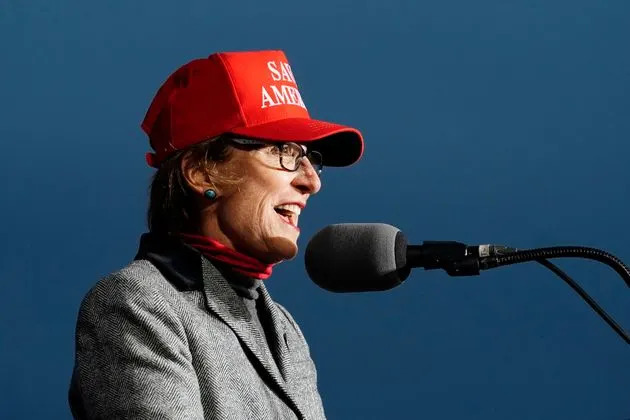
As updated vote tallies began to cement a loss for Trump-backed Arizona governor candidate Kari Lake on Monday, a far-right state lawmaker who told a gathering of white nationalists that “we need to build more gallows” started to have second thoughts about her party’s pitch to voters.
“We wonder now if we were in an echo chamber,” said state Sen. Wendy Rogers (R), who has also suggested throwing county officials in solitary confinement and spent years lying about the 2020 election.
“I don’t know, I’m just beginning to get some perspective,” added Rogers.
Rogers’ realization about echo chambers occurred in an interesting place: She was speaking to Charlie Kirk on his YouTube show, which is also broadcast on the Salem Radio Network.
Kirk is the founder of the right-wing youth group Turning Point USA, which has close ties to the Trump family and spent considerable time and money working to elect Arizona Republicans. The group’s nationwide endorsement page is now sprinkled with painful losses, including Lake and U.S. Senate candidate Blake Masters (R).
“Every pollster was wrong, every single one,” Kirk told Rogers. Later, he apologized to listeners for getting the projections wrong ― referring to positive polling for Lake as “Kool-Aid” ― and mentioned that he’d heard “they didn’t run an internal poll the whole campaign.”
“Never again are we going to trust polls, or tracking, or any of that stuff,” Kirk said.
As the results rolled in, the crew speculated that Lake, who in many ways emulated former President Donald Trump’s election denialism and theatrical antagonism of the press, was simply too much for some otherwise winnable Arizona voters.
“If every person who voted to retire [House Speaker Nancy] Pelosi in Arizona voted for Kari Lake, she’s governor,” Kirk said, referring to Arizona’s U.S. House delegation, which went from 5-4 Democratic to 6-3 Republican with this election.
“What that means … is a Republican undervote, and it looks like that happened,” he added, referring to voters who supported Republicans other than Lake.
Arizona state Sen. Wendy Rogers (R) has spent years making false claims about the 2020 election.
Arizona state Sen. Wendy Rogers (R) has spent years making false claims about the 2020 election.
Tyler Bowyer, TPUSA’s chief operating officer and a falsepresidential “elector” for Trump’s 2020 campaign, said “the same Trump attack messaging seemed to work” against Lake.
“I love Trump, I love him to death, but the Trump rally is an echo chamber,” Bowyer said separately, responding to Rogers’ comment. He recalled warning Lake’s political team against having “all the same people showing up to the same events” and not bringing in new supporters but rather “fangirls and fanboys.”
Rogers agreed that Trump’s more recent rallies felt like a “family reunion.”
“I do think voters are telling us that they’re fatigued,” Kirk said. “I think people are telling us, they’re trying to send it in more ways than one: ‘I’m going to vote for the more boring person.’”
A few minutes later, Kirk read the latest returns from Maricopa County ― home to more than half of Arizona’s residents ― which sealed the deal on Hobbs’ projected victory.
Then he read an email from a listener as he and his guests’ heads sank. “We all have Trump fatigue syndrome,” he read. “I reluctantly voted for Kari Lake but all my friends couldn’t do it. We don’t want all the bombast.”
When Kirk announced that Lake was trailing Hobbs by 20 points in Pima County, the second largest county in the state, Rogers did a double take. “You said 20 points?” she confirmed, seemingly stunned as she looked at her phone.
Trump was worried he wouldn’t get enough credit for GOP midterm successes, report says. Since then he has the opposite problem.
Tom Porter – November 15, 2022
Donald Trump waves to guests during an election night party at Mar-a-Lago, Tuesday, November 8, 2022 in Palm Beach, Florida.Phelan M. Ebenhack for The Washington Post via Getty Images
Trump had anticipated his candidates would sweep to success in the midterms, Axios reported.
He was planning on launching his 2024 presidential bid on the back of GOP triumphs.
But in the wake of disappointing results, his political future could now be in jeopardy.
Former President Donald Trump was so assured that Republicans would sweep to success in the midterms that his main concern was that he wouldn’t get enough credit, Axios reported.
Instead, Trump is now fending off attacks after being blamed for the party’s dismal performance, with some questioning his political future.
A Trump advisor told the publication that the former president had sparked chaos on the eve of last Tuesday’s midterm elections when he told aides he was planning to announce his 2024 presidential bid at a rally in Ohio that night.
Though Trump was more skeptical of bullish Republican hopes of a sweeping Republican victory than some, the report said, his main concern ahead of the election was to maximise the credit he got for Republican successes.
Allies reportedly scrambled to stop him making the announcement on the eve of the elections, fearing it would increase Democratic turnout. In the end, Trump confined himself at the rally to teasing that he would be launching his 2024 bid shortly.
Republicans massively underperformed in last week’s midterms — failing to win back control of the Senate and likely winning only a small House majority, with many of the high-profile candidates Trump endorsed crashing to defeat.
Some Republicans have blamed Trump, saying that he championed divisive candidates espousing fringe beliefs who repelled many moderate voters.
Long-time allies have also urged the former president to hold off announcing his 2024 bid in the wake of the midterm results, but Trump is reportedly determined to go ahead with the announcement on Tuesday, believing that backing away would be humiliating for him.
Russia pounds Ukraine in heaviest missile strikes of war
Max Hunder, Pavel Polityuk and Dan Peleschuk – November 15, 2022
KYIV (Reuters) – Russia pounded cities and energy facilities across Ukraine on Tuesday, killing at least one person and causing widespread power outages in what Kyiv said was the heaviest wave of missile strikes in nearly nine months of war.
Missiles rained down on cities including the capital Kyiv, Lviv and Rivne in the west, Kharkiv in the northeast, Kryvyi Rih and Poltava in the centre, Odesa and Mikolaiv in the south and Zhytomyr in the north.
A body was pulled out of a residential building that was hit and set ablaze in central Kyiv, and a senior presidential official said the power situation was “critical” after heavy damage to energy infrastructure.
In a video posted online, President Volodymyr Zelenskiy warned Ukrainians that more missile strikes were possible but added: “We are working, we will restore everything, we will survive.”
Power was knocked out in areas of several cities including Kyiv, Lviv and Kharkiv, and the national grid operator announced emergency electricity outages in northern and central regions, and in Kyiv.
Kyiv’s mayor said half of the capital was without electricity. The mayor of Lviv said 80% of the city had no electricity so lighting, water and heating supplies were off. City authorities in Vinnytsia in west-central Ukraine were told to stock up on water following damage to a pumping station.
“This is the most massive shelling of the power system since the beginning of the war,” Energy Minister German Galushchenko said.
Air force spokesperson Yuiy Ihnat said more than 100 missiles had been fired at Ukraine, surpassing the 84 fired by Russia on Oct. 10 in what was previously the heaviest air strikes.
The country’s biggest mobile phone provider warned of possible signal outages, and the transport system suffered disruptions in several areas.
SMOULDERING BUILDING
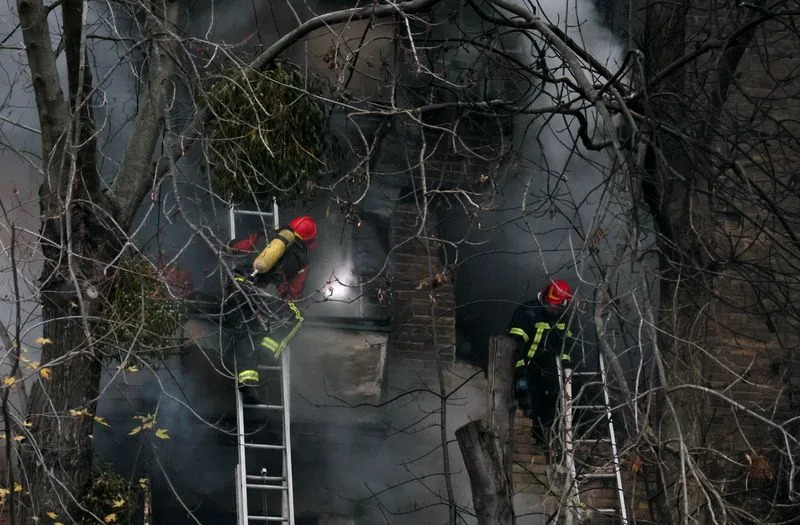
In the capital, a five-storey apartment block was left smouldering after being hit by what residents said appeared to be shot-down missile parts. Rescue workers and medics were quickly on the scene.
“I was in the apartment during the air raid warning. I saw a bright light in my window, and understood that something was coming. Then I heard the sound, as it was nearing,” said Oleksandra, 22, who lives in the apartment block.
“I saw from my window as the rocket was flying, a bright fire, and the sound of something flying very close by. I immediately went outside… I saw people were running out of our building and that there was smoke.
“The he last flat I lived in was also hit,” she added. “Thankfully I was abroad at the time.”
The attacks followed days after a humiliating retreat by Russian forces from the southern city of Kherson and coincided with a summit of the Group of 20 nations in Bali that was dominated by discussion of the war Ukraine.
“This is what Russia has to say on the issue of peace talks,” Foreign Minister Dmytro Kuleba wrote on Twitter. “Stop proposing Ukraine to accept Russian ultimatums! This terror can only be stopped with the strength of our weapons & principles.”
(Additional reporting by Aleksandar Vasovic; Editing by Timothy Heritage and Alex Richardson)
The MAGA energy that swept Kari Lake to victory in her primary has become hemlock in general elections.
Lake joins the list of hapless MAGA candidates who lost the governor’s offices in Michigan, Pennsylvania, New York and now Arizona.
Donald Trump recently boasted he created the modern Republican brand. Well, today the modern Republican brand is what, Edsel? Polaroid? Enron?
Nope.
It’s Old Hat.
Many of us dismissed Katie Hobbs
The temptation will be great to say Hobbs didn’t win the governor’s seat. Kari Lake lost it. Had Lake run as a normal Republican with her polished delivery and anchorwoman looks she’d be recarpeting the hallways right now on the Ninth Floor.
But let’s give Hobbs her due. This was a candidate widely underestimated by not only the Republicans but the media and even her own party, the Democrats.
Soft-spoken and understated, she was dismissed from the beginning as a lightweight and novice filled with self-doubt and struggling to find the right words in front of TV cameras. She stuck with her much-maligned strategy (that also took criticism from this corner) to skip debates in the primary and general elections.
What we didn’t know was that Hobbs had a brought a sledgehammer of her own to this race. She used it to smash conventional wisdom.
But Democrats have real reason to celebrate
Now that Hobbs has won the all-important Arizona governor’s race, Democrats are aglow. They should be.
To call what happened in Arizona and nationally a “red ripple” suggests the Republicans eked out a victory that could have been much larger. But this was not a Republican win. It was an indisputable and historic triumph for the Democratic Party and its candidates.
In a year when inflation was pushing up the price of milk and eggs, when the Democratic president was drowning in dismal approval ratings, when border crossings were at record highs and urban crime was beginning to scare people, the liberal party defied predictions and proved it is more in tune with the American people than its rival.
Democrats retained control of the Senate, and lost the House by such a fine margin, Republicans will be dancing with the devil trying to manage it.
Beneath the angst, Katie Hobbs has steel
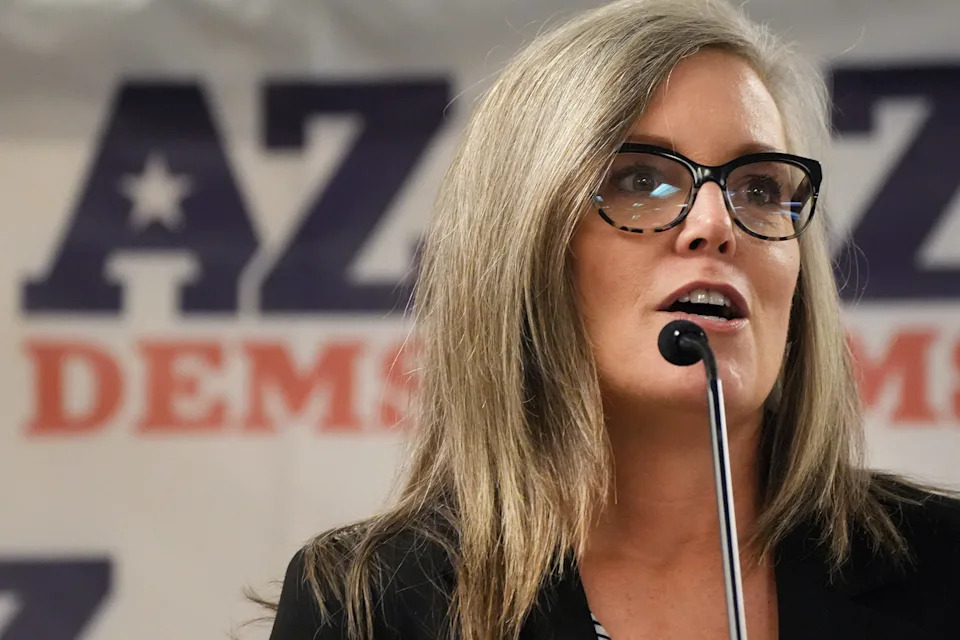
Gubernatorial candidate Katie Hobbs speaks as the Arizona Democratic Party hosts a Unity Rally with statewide candidates to energize Democratic voters and volunteers ahead of the November election at Carpenters Union Hall on Saturday, Aug. 27, 2022.
In Arizona, Democrats could not wait to start their well-earned gloating. Lobbyist and former state lawmaker Chris Herstam got the jump on it Sunday night by picking a Twitter fight with me:
“@boas_phil’s so-called “leftists” have done quite well in the midterm (in Arizona & DC). Arizona Democrats will do even better in ‘24 with a presidential election turnout & a reproductive freedom initiative on the ballot.”
I bring this up to illustrate just what a long haul this has been for Hobbs and to show that beneath all the surface angst and insecurity, Katie Hobbs has some steel.
Herstam’s tweet reminded me that from the very beginning Hobbs had to endure attacks from a large part of the Democratic establishment.
When she got into the race, Herstam tried to bury her campaign.
He pointed loudly to a recent jury verdict that found that Democratic legislative leadership had discriminated against Senate aide Talonya Adams when they fired her in 2015.
Hobbs faced a torrent of criticism
Hobbs was Senate Democratic leader at the time, so she faced a storm of criticism.
“I think she’s in real trouble,” Herstam told KJZZ radio. “Katie Hobbs needs to apologize profusely and compassionately, and she hasn’t really done that yet.
“Frankly, she should have apologized very directly when she announced her candidacy. … And she didn’t do so. … That was a bonehead political move by her team.”
Herstam at the time was plumping the potential candidacy of U.S. Rep. Greg Stanton, the former Phoenix mayor who had not yet decided to skip the gubernatorial race.
“The anti-Hobbs storm, it’s still to come,” said Herstam, predicting the Republicans would run ads on the discrimination verdict. “They will be a real blow to her candidacy, as well as the entire Democratic ticket.”
Republicans ran with the ‘bigot’ theme
Herstam was prescient in one sense. The Republicans did pick up the “Hobbs is a bigot” theme. They got the idea from Democrats.
No. Hobbs was never convicted. Never charged. This was a civil case, not criminal. Chainsaws are poor instruments for making such distinctions.
Still, it’s worth remembering that before Republicans got to Hobbs many Democrats were on a tear.
Even Democrats criticized her in the primary
Five high-profile leaders of the Phoenix African American community put out this statement: “We ask that all persons, especially people of color, reconsider any support for Katie Hobbs to become the next governor of Arizona.”
Understand that this was during the social upheaval sparked by the police killing of George Floyd. Feelings were raw. And a number of Democrats were working hard to destroy her campaign.
Warren Stewart, once a centrist Democrat who morphed into a sharper-edged social-justice hawk, said he was done with Hobbs.
Now that Hobbs has won the main prize in Arizona’s 2022 election, many will forget the onslaught she survived just to get her party’s nomination.
They’ll forget she showed up for the fight as other big-name Democrats demurred. That she fought through all the insults from her own party before Kari Lake fired her artillery.
It’s one thing to bring Kari Lake-level confidence to an election, throwing flames and spitting nails. It’s another to wrestle down your self-doubt every day before you armor up to compete.
Hobbs could not match the smooth delivery of Kari Lake and always seemed self-conscious of it.
She looked like she was fighting through private doubts that may have been her most formidable opponent. And yet she stayed with it. No one was going to push her out.
That takes guts.
And we would all do well never to underestimate her again.
Phil Boas is an editorial columnist with The Arizona Republic.
Will Florida’s red tide get worse because of Hurricane Nicole? Here’s what experts say
Max Chesnes – November 15, 2022
Red tide was found this week in the waters off Anna Maria Island, and now experts fear Hurricane Nicole could possibly make conditions worse for Tampa Bay.
Extra runoff from rainfall could mean more algal-bloom-fueling nutrients dump into the bay. That may — or may not ― spark more Red Tide.
“Of course our eyes are on any additional rainfall and runoff that might occur in response to . . . Nicole’s passage,” said Ed Sherwood, executive director of the Tampa Bay Estuary Program. “With red tide now present in lower Tampa Bay, additional nutrient loads may exacerbate the bloom if salinities remain high.”
It’s a big if, with plenty of variables. The organism that causes red tide, karenia brevis, prefers salty marine environments. Rainwater is fresh, but brings pollution along with it as it flows into the bay. That pollution, in turn, can fuel red tide blooms.
“Any additional nutrient loads to our coast — especially when a red tide is already present in the estuary — is a concern,” Sherwood wrote in an email. “As the red tide bloom that formed further south is carried by winds and currents into our estuary, any additional stormwater nutrient loads caused by (Nicole) may promote water quality declines this winter.”
State water samplers detected medium concentrations of red tide-causing karenia brevis, between 100,000 and 1,000,000 cells per liter, on the northern tip of Anna Maria Island Monday, according to the latest Florida Fish and Wildlife Conservation Commission data. Scientists consider that level a “bloom,” meaning breathing problems are possible and fish kills are probable.
On Nov. 2, small amounts were measured 11 miles offshore of Tampa Bay, data show.
There’s cause for concern for residents in the Tampa Bay area, “because it is likely that a red tide bloom will evolve here,” according to Bob Weisberg, a physical oceanographer at the University of South Florida. Once Red Tide is measured at the mouth of Tampa Bay, tidal currents could easily bring it into the estuary. Now, add the winds from Nicole into the mix.
Medium concentration levels of Karenia brevis, the algae that causes red tide, were detected in water samples taken Monday by the Florida Fish and Wildlife Conservation Commission near Longboat Pass.
The storm is currently pushing northerly winds, which makes conditions more favorable for the spread of red tide here, according to Weisberg. “Such winds will result in red tide cells located offshore along the bottom being transported toward the shore and hence an increase in what may be observed here in subsequent days.”
Still, the mixing of wind and water during storm events are speculated to hurt red tide, so there may also be a die-off of some karenia brevis cells, Weisberg wrote in an email. Nicole isn’t nearly as strong as the recent Hurricane Ian, though, so there’s a chance that more Red Tide organism feeds on runoff entering the bay versus being killed off in turbulent water.
“Red tide ecology is the whole shebang,” Weisberg wrote.
The most recent models from the University of South Florida’s Ocean Circulation Lab show traces of the red tide organism — resembling green strands of spaghetti on the chart — in small amounts entering into Tampa Bay over the next few days, beginning from where it was first measured on Anna Maria Island.
The takeaway is that there’s no immediate threat of dangerous red tide exposure through the weekend, but it’s definitely something to watch, according to Yonggang Liu, the lab’s director.
The latest Red Tide models from the University of South Florida, which run through Nov. 12, show small concentrations of the Red Tide-causing organism flowing into Tampa Bay over the next few days.
“It may still be OK for Tampa Bay area in the next three days,” Liu wrote in an email. “You may go to a beach and enjoy water activities without issues of red tide.”
With Nicole expected to drop as much as four inches of rain in the area, it’s still to be determined just how much runoff the bay will receive. But storm surge shouldn’t be a major issue for the estuary, according to tide models provided by Liu. Sea level will first recede, but not nearly as much as what was documented with Hurricane Ian earlier this year and Hurricane Irma in 2017.
Once Nicole passes, the bay should hopefully start to see a reprieve, according to Sherwood.
“We’re coming to the tail-end of our rainy season, so with the exception of the recent tropical storms that are impacting our region, we should start to see a decline in storm-water nutrient loads from our coast,” Sherwood said. “That in combination with cooling temperatures will hopefully lead to some water quality improvements over the next several months.”
Why a Trump-appointed Texas judge blocked Biden’s student-debt cancellation plan
Ayelet Sheffey – November 14, 2022
A view of the US Capitol before a news conference to discuss student-debt cancellation on September 29, 2022.Drew Angerer/Getty Images
Trump-appointed Judge Mark Pittman struck down Biden’s debt relief in Texas last week.
He argued the two student-loan borrowers who sued have sufficient standing to block the plan.
But some legal experts and Democrats said Pittman should never have taken up the case in the first place.
A federal judge doesn’t think President Joe Biden’s plan to cancel student debt for millions of borrowers is legal.
On Thursday evening, Mark Pittman — a Texas judge appointed by former President Donald Trump — struck down Biden’s plan to forgive up to $20,000 in student-loans for federal borrowers making under $125,000 a year. He ruled in favor of two student-loan borrowers who filed the lawsuit because each of them didn’t qualify for the full amount of relief, and at this point, Pittman’s ruing bars the Education Department from discharging student loans until a final verdict is made.
The Texas case, along with a number of other lawsuits backed by conservative groups, challenges Biden’s authority to use the HEROES Act of 2003, which gives the Education Secretary the ability to waive or modify student-loan balances in connection with a national emergency, like COVID-19. They claimed that enacting broad student-loan forgiveness is an overreach of the authority and should require Congressional approval, while Biden has maintained one-time student-loan forgiveness is well within the administration’s legal authority.
Pittman appeared sympathetic to the conservatives’ arguments in his ruling. “This case involves the question of whether Congress—through the HEROES Act—gave the Secretary authority to implement a Program that provides debt forgiveness to millions of student-loan borrowers, totaling over $400 billion,” Pittman wrote in his ruling. “Whether the Program constitutes good public policy is not the role of this Court to determine. Still, no one can plausibly deny that it is either one of the largest delegations of legislative power to the executive branch, or one of the largest exercises of legislative power without congressional authority in the history of the United States.”
The other lawsuits are also moving through the courts. The 8th Circuit Court of Appeals, for example, ruled on Monday that its temporary pause on student-debt relief will remain in place until further orders from the court on a separate lawsuit in which six Republican-led states sued the loan forgiveness, arguing it would hurt their states’ tax revenues.
One of the key parts of Pittman’s ruling is that the plaintiffs actually met the legal requirements for a valid lawsuit. He ruled that they have standing to sue the administration, but several prominent Democrats and legal experts have questioned that decision — and other courts have thrown out similar conservative lawsuits due to a lack of standing.
The plaintiffs’ standing to sue
Both of the plaintiffs who brought the Texas lawsuit hold student loans. The first plaintiff, Myra Brown, sued because her loans are commercially-held and therefore ineligible for Biden’s debt relief, which requires the borrower to owe their debt directly to the federal government. And the other plaintiff, Alexander Taylor, sued because he was eligible only for $10,000 in debt forgiveness and not the full $20,000 since he did not receive a Pell Grant in college.
They both argued they were not given the opportunity to challenge the relief before its announcement since it didn’t go through the Administrative Procedure Act’s notice-and-comment period, and they said that failure to go through typical rulemaking processes, along with overstepping authority granted through the HEROES Act, were reasons why the debt relief should be blocked.
Pittman ruled that the plaintiffs have valid reasons for suing the administration. In his opinion, Pittman wrote that standing contains three legal requirements: there must be concrete injury, there must be causation, and there must be redressability, which is the likelihood the requested relief — in this case, blocking debt cancellation — would repair the injury caused. Pittman said that Biden’s Justice Department argument that the plaintiffs’ standing does not exist is “untrue.”
“Plaintiffs do not argue that they are injured because other people are receiving loan forgiveness,” Pittman wrote. “Their injury—no matter how many people are receiving loan forgiveness—is that they personally did not receive forgiveness and were denied a procedural right to comment on the Program’s eligibility requirements.”
And while Pittman concluded that debt relief did not violate procedural requirements, he said it violates authority under the HEROES Act because the “pandemic was declared a national emergency almost three years ago and declared weeks before the Program by the President as ‘over.’ Thus, it is unclear if COVID-19 is still a ‘national emergency’ under the Act.”
Some Democrats and legal experts take issue with the ruling
While Republican lawmakers were quick to laud Pittman’s decision, some legal experts weren’t sold on the merits of the ruling. Steve Vladeck, a CNN legal analyst and professor at the University of Texas School of Law, wrote in an opinion piece that “the biggest problem with Pittman’s ruling isn’t its substance; it’s why he allowed the case to be brought in the first place.”
Vladeck referenced prior conservative lawsuits seeking to challenge the debt relief that had been dismissed for lack of standing, and that if “the complaint is just that the government is acting unlawfully in a way that doesn’t affect plaintiffs personally, that’s a matter to be resolved through the political process – not a judicial one.”
And Leah Litman, a professor at the University of Michigan School of Law, wrote on Twitter that the ruling “is just the latest example of Trump-appointed district judges doing completely outlandish, lawless things to rule against policies by Democratic administrations,” referring to what she said was a lack of standing on the plaintiffs’ side.
Massachusetts Sen. Elizabeth Warren also slammed the ruling, telling NBC News on Sunday that “we have a court down in Texas, and if they’re going to play politics instead of actually following the law, they do put the program at risk.”
Mexico releases ‘ambitious’ renewable energy targets to fight climate change
Ben Adler, Senior Editor – November 14, 2022
U.S. climate envoy John Kerry and Mexican Foreign Minister Marcelo Ebrard hold a press conference at the COP27 climate conference in the Egyptian Red Sea resort of Sharm el-Sheikh. (Ahmad Gharabli/AFP via Getty Images)
Mexico announced Monday that it plans to dramatically increase the amount of power it generates from renewable sources of energy, deploying more than 30 additional gigawatts of annual electricity generation from wind, solar, geothermal and hydropower by 2030.
The new clean energy targets were made public at a news conference at the United Nations climate change conference, known as COP27, in Sharm el-Sheikh, Egypt. By the end of the decade, Mexico aims to generate more than 40 gigawatts of power from wind and solar alone.
As of 2019, Mexico had 80 gigawatts of installed electricity generation capacity, according to the U.S. Energy Information Administration. The majority of that comes from natural gas, while renewables account for 10% and hydropower 7%, so the new target would represent a major shift toward a largely renewable energy portfolio if the country succeeds in meeting its new target.
John Kerry, the U.S. special presidential envoy for climate change, joined Mexican Foreign Secretary Marcelo Ebrard at Monday’s news conference.
U.S. Special Presidential Envoy for Climate John Kerry speaks at the COP27 climate conference in Sharm el-Sheikh, Egypt. (Sean Gallup/Getty Images)
“Secretary Kerry indicated his support for Mexico’s new renewable goal, and the United States intends to work closely with Mexico to achieve these ambitious goals, including through U.S. efforts to mobilize financial support and joint efforts to catalyze and incentivize investments into new Mexican renewable energy deployment and transmission,” the U.S. Embassy in Mexico reported.
Mexico is the 13th-largest global emitter of greenhouse gases. It is one of the few countries that updated its plan to reduce emissions at COP27, pledging to reduce emissions by 35% from business-as-usual levels by 2030. The renewable energy targets are intended to help it meet that goal. Mexico also said it plans to double its spending on clean energy by 2030, protect more of its forests, increase electric vehicle usage and cut down on methane emissions from its oil and gas drilling sectors.
“This is a huge, significant shift from where Mexico was last year in Glasgow,” Kerry told reporters on Saturday, in response to Mexico’s new emissions reduction promise and in reference to the last climate change conference, COP26, in Glasgow, Scotland. Kerry added that he had negotiated extensively with his Mexican counterparts and said Mexico has “extraordinary availability of sun, extraordinary availability of wind power.”
Earlier on Monday the U.S. and China achieved a diplomatic breakthrough when President Joe Biden and Chinese President Xi Jinping agreed to restart stalled climate change negotiations.
The sun sets behind the sign showing the logo of the COP27 climate conference at the Sharm el-Sheikh resort. (Ahmad Gharabli/AFP via Getty Images)
Kerry has been working to persuade large developing countries to take new actions to decarbonize their economies and offering assistance to do so. Last week, France, Germany, the United Kingdom, the United States and the European Union countries committed to jointly mobilizing $8.5 billion to finance South Africa’s deployment of electric vehicles and clean energy and a new low-carbon source of energy called ‘green hydrogen.'” On Monday, Indonesia announced the planned retirement of a coal-fired power plant with assistance from the Asian Development Bank, and it is expected to announce on Tuesday a similar plan to South Africa’s.
Still, COP27 is not expected to produce significant changes in the global emissions trajectory, as the biggest emitters, such as the United States and China, have not lowered their planned emissions in this decade. But on Monday, in what climate change activists consider a sign of potential progress, President Biden and Chinese President Xi Jinping announced that the two countries will put aside their differences over tense issues such as the fate of Taiwan and try to work together on climate change.
Democrat Katie Hobbs Defeats Trump-Backed Kari Lake in Arizona Governor’s Race
Charisma Madarang – November 14, 2022
Democratic Senate Candidate Mark Kelly Campaigns With Fellow Democrats In Phoenix – Credit: Getty Images
Democratic candidate Katie Hobbs, who has vigorously defended abortion rights during her campaign, has defeated Republican Kari Lake, the Associated Press reports. Lake joins the overwhelming list of MAGA wipeouts during the midterm elections.
Hobbs has defeated one of the most outspoken defenders of former President Donald Trump. Serving as Arizona’s Secretary of State, Hobbs has repeatedly rejected GOP lies about the election. Lake’s defeat follows the loss of two other high-profile election deniers — Republican Senate nominee Blake Masters and Secretary of State nominee Mark Finchem.
Hobbs, who will succeed Republican Gov. Doug Ducey, is the first Democrat to be elected governor in Arizona since Janet Napolitano in 2006.
Last month, Hobbs’ campaign headquarters were burglarized amid a heated race for the Senate. “Secretary Hobbs and her staff have faced hundreds of death threats and threats of violence over the course of this campaign. Throughout this race, we have been clear that the safety of our staff and of the secretary is our No. 1 priority,” said Nicole DeMont, the campaign manager for Hobbs, in a statement. “For nearly two years Kari Lake and her allies have been spreading dangerous misinformation and inciting threats against anyone they see fit.”
Once a Republican stronghold, Arizona was key to Trump and his supporters to casting doubt on Joe Biden’s 2020 presidential victory. Pre-election polls leading to the 2022 midterms indicated that the race was tied, but Hobbs’ victory was still a surprise to Democrats who feared her understated approach during the campaign would turn voters away. Hobbs exceeded expectations in Maricopa and Pima counties, where the majority of Arizona voters reside and where she made sure to spend a significant amount of her time campaigning in rural areas that traditionally vote Republican.
After Hobbs was declared the winner in the Arizona governor’s race, Congresswoman Liz Cheney reposted a letter from Lake mocking Cheney’s television ad targeting Arizona election deniers.
“Your recent television ad urging Arizonians not to vote for me is doing just the opposite,” wrote Lake. “Your commercial should add another 10 points to our lead! I guess that’s why they call the Cheney anti-endorsement the gift that keeps on giving.”
Yet while Cheney’s gratitude towards Lake is feigned, the votes in this race are very much real.
After a Senate Loss in Wisconsin, Democrats Turn on Each Other
Kara Voght – November 13, 2022
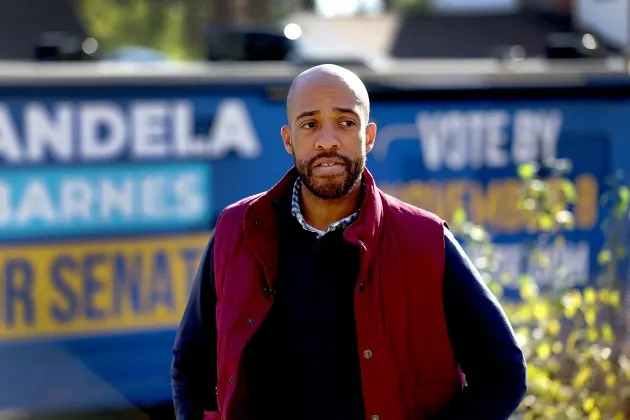
how-did-mandela-barnes-lose.jpg Mandela Barnes Campaigns Across Wisconsin On Eve Of Midterm Election – Credit: Scott Olson/Getty Images
In the weeks leading up to Election Day, Mandela Barnes’ supporters felt frustrated. They believed in Barnes as the best Democrat to take on Sen. Ron Johnson (R-Wisc.), and election forecasts all but guaranteed a Johnson victory. That frustration gave way to fury, however, once the ballots were counted on Wednesday. Barnes lost to Johnson by a single point.
It was a performance far stronger than what former Sen. Russ Feingold (D-Wisc.) achieved in his back-to-back runs against Johnson in 2010 and 2016. It also shouldn’t have been a shock. “This was a result that tracks with what our model suggested might happen,” says Ben Wikler, the chair of the Wisconsin Democratic Party. He’d spent the last few weeks explaining, both publicly and privately, that the race was tied — even as credible public polls found Barnes uncomfortably behind.
The unexpectedly sunny outcomes for Democrats on Tuesday night mostly staved off party soul searching — with one notable exception: The U.S. Senate race in Wisconsin. It wasn’t as if Democrats couldn’t win statewide there. Gov. Tony Evers won his reelection on Tuesday by more than 90,000 votes. The Senate race, meanwhile, had been the Democrats’ top target in 2022 as polls consistently deemed Johnson unpopular among Wisconsin voters. His reported efforts to help overturn Wisconsin’s 2020 presidential election results only made his ousting more desirable.
Barnes’ near miss has reopened intraparty wounds as Democrats lament the Senate seat that got away. At the root of it is a perennial question that follows high-profile losses: Was the candidate the wrong choice, or did he have insufficient resources to make his case? Barnes’ progressive allies point fingers at the Democratic establishment, whom they blame for discouraging big money from stepping in to counter tens of millions in attack ads unleashed upon Barnes after the primary. Democratic operatives, meanwhile, blame the Barnes campaign for not doing enough to counter those attacks with his own messaging — and for not putting enough distance between himself and past progressive positions they believe are toxic to Democrats running in tight races.
Barnes had been the early favorite to take on Johnson. The 35-year-old Black lieutenant governor had been a Democratic rising star ever since he’d won a Milwaukee-area seat in the Wisconsin legislature at age 25. He shared the winning gubernatorial ticket with Gov. Evers in 2018, a victory that boosted his visibility statewide. Barnes didn’t fit squarely in any ideological frame; both progressive stalwarts like Sen. Elizabeth Warren (D-Mass.) and moderate Black leaders like Rep. Jim Clyburn (D-S.C.) claimed Barnes as their own. It was a seemingly winning quality he shared with Pennsylvania’s John Fetterman, another Democratic lieutenant governor trying to flip a U.S. Senate seat. (”Just two tall bald dudes trying to get the job done,” Barnes toldPolitico of their very online bromance in July.)
He and Fetterman also shared a vulnerability: Liberal sensibilities to criminal justice reform. Barnes became the face of the Evers administration during the Kenosha riots that followed the police shooting of Jacob Blake, a Black man, in August 2020. He made frequent cable news appearances to demand police accountability. At one point, he suggested diverting funding from “over-bloated budgets in police departments” to community programs. The sentiment seemed to align Barnes with the goals of “defund the police,” the left-wing rallying cry that had grown radioactive in Democratic circles. Barnes had also been photographed holding an “Abolish ICE” T-shirt, another liberal slogan the GOP insisted on weaponizing.
Barnes tailored his campaign to neutralizing those attacks. He introduced himself as a candidate with a middle-class upbringing and a pocketbook-oriented platform. When asked about his criminal justice positions, Barnes would say he supported investing in both crime-prevention measures and law enforcement in equal measure. The strategy worked for the Democratic primary: He cleared a crowded field before any votes were cast as challengers, seeing Barnes as the clear frontrunner, dropped out and threw their support behind him.
The view from Washington, however, hadn’t been so convinced of Barnes’ obvious ascent. The Senate Democrats’ campaign arm had seen multiple candidates as strong contenders to challenge Johnson, declining to put its thumb on the scales for any candidate during the race. In the months leading up to the primary, a number of influential Democrats had privately raised doubts over Barnes’ electability — including Senate majority leader Chuck Schumer (D-N.Y.), according to several sources with knowledge of conversations. (“That’s ridiculous,” says a Schumer spokesperson, who noted that Schumer transferred $1 million from his own campaign coffers to Barnes’ efforts. “Sen. Schumer worked tirelessly to ensure Mandela Barnes and other Democratic candidates across the country had the resources they needed to run strong and competitive campaigns.”)
Then, just two weeks after the primary, the predictable happened. Four Johnson-aligned super PACs blanketed Wisconsin airwaves with ten different ads tying rising crime rates to Barnes. The spots preyed on the trauma of the Kenosha riots as well as a violent scene in Waukesha, where a man killed five attendees at the city’s annual Christmas parade as drove his car in November 2021. Nearly $25 million was spent in TV, radio, and digital advertising against Barnes during that period — including more than $10 million from Wisconsin Truth, a super PAC founded by three billionaire Johnson backers.
Barnes led Johnson by seven points in the first Marquette University poll taken after the primary, a time when a third of the Wisconsin electorate still hadn’t formed any opinion of Barnes. By the beginning of October, the Marquette poll found that Johnson had pulled ahead of Barnes by six points. “They were able to make Mandela look like a scary black man,” says Angela Lang, the executive director of BLOC, a Milwaukee-based Black civic engagement organization. The crime-ridden messaging had even penetrated among the city’s older Black voters, according to Lang. As BLOC’s organizers went door-to-door, they’d sometimes be asked: “Is Mandela really trying to let all these violent criminals out?”
“If the GOP smears had been met with equal intensity, I don’t think the country would have lost track of the fact that he really did have the chance,” Wikler, the Wisconsin Democratic chair, says. But Democrats disagree on what meeting those smears should have looked like. To Barnes’ progressive allies, the major Democratic party organs didn’t hit back hard enough during the GOP’s August and September blitz. They blame the lack of pushback on doubts prominent democrats raised over Barnes’ electability, saying it discouraged key donors from investing in the race. That attitude, according to Barnes’ boosters, delivered his campaign a fatal blow at a key moment. “That window was such a critical window — Mandela was ascendant,” says Maurice Mitchell, the executive director of the progressive Working Families Party, which backed Barnes in the race.
Indeed, the Senate Democrats’ campaign arm had, by that point, viewed Fetterman’s race for Pennsylvania’s open seat as a safer bet and decided to focus its resources on winning that race. Even so, Democrats had thrown $11.6 million behind opposing Johnson in those post-primary weeks — including $3 million from the DSCC in airtime “with the hopes that our nominee would use the air cover during this period to get their own advertising plans in order,” says a DSCC spokesperson. But Democrats defending those efforts point out that no amount of anti-Johnson spending would be as effective as hearing from Barnes himself. Research from the Center for American Progress, shared with Democratic campaigns in September, had found that the most effective strategies for combating crime attacks came from the candidates deflecting allegations themselves. Democratic Senate strategists had relayed these finds to the Barnes campaign and encouraged him to be prepared to face attacks on his record.
The Barnes campaign, attuned to this, stayed on the air throughout August and September with a seriesofads that featured Barnes refuting GOP claims. One from late August opened with Barnes in his kitchen in the midst of the quotidian tasks of putting away groceries. “Now they’re claiming I’m going to defund the police and abolish ICE,” Barnes said directly to camera. “That’s a lie.” It still wasn’t enough to counter the Republican onslaught with so many GOP attacks going unanswered; the Barnes campaign, still rebuilding its fundraising coffers from the primary, couldn’t match the spending. “We knew people needed to hear directly from him — ‘This is nonsense, this is what I believe,’” says Barnes campaign manager Kory Kozlowski. “The thing you can’t control is three of their ads for one of yours.”
Still, other Democrats point out that the attacks would have lost their sting if the candidate hadn’t held controversial positions in the first place. Matt Bennett, a cofounder of Third Way, a centrist Democratic political organization that supported Barnes in the general election, admits money was a huge factor — as was race, especially given the 120,000-vote delta between Barnes and Evers. “But it also can be true that Barnes did not effectively put distance between himself and his positions,” Bennett adds. Other Democrats point out that Barnes never walked away from his support of ending cash bail, a vulnerability Republicans successfully linked to the Waukesha tragedy, which had been perpetrated by a freed felon. “Proof points like that become really hard to overcome,” says Navin Nayak, the president of the Center for American Progress Action Fund. “That’s where good policy can bump up against scare tactics.”
But the Barnes campaign did find a potent strategy to crawl back into contention. Much of that was premised on hammering Johnson over his anti-abortion stances, a charge the Barnes campaign learned performed best against Johnson’s crime accusations. The Barnes campaign outraised Johnson in the final stretch and achieved a spending parity — and, at times, an advantage — as it got its own attack ads up in early October. Education among voters, too, softened the attack lines. “Naming the racism was important,” BLOC’s Lang says. “He’s talking about getting rid of cash bail, but that doesn’t actually keep our community safe.”
Barnes’ poll numbers steadily climbed each week leading up to the election. “One more week and we would have won,” Kozlowski, Barnes’ campaign manager, laments.
Johnson’s victory has no bearing on Democrats retaining their Senate majority. The caucus will, however, fall short of the 52 senators they needed to kill the filibuster — perhaps just one short if Sen. Rapahel Warnock (D-Ga.) wins a December runoff election.
Farmland Values Hit Record Highs, Pricing Out Farmers
Linda Qiu – November 13, 2022
Farmland outside of Clark, S.D., on Oct. 26, 2022. (Tim Gruber/The New York Times)
Joel Gindo thought he could finally own and operate the farm of his dreams when a neighbor put up 160 acres of cropland for sale in Brookings County, South Dakota, two years ago. Five thousand or six thousand dollars an acre should do the trick, Gindo estimated.
But at auction, Gindo watched helplessly as the price continued to climb until it hit $11,000 an acre, double what he had budgeted for.
“I just couldn’t compete with how much people are paying, with people paying 10 grand,” he said. “And for someone like me who doesn’t have an inheritance somewhere sitting around, a lump sum of money sitting around, everything has to be financed.”
What is happening in South Dakota is playing out in farming communities across the nation as the value of farmland soars, hitting record highs this year and often pricing out small or beginning farmers. In the state, farmland values surged by 18.7% from 2021 to 2022, one of the highest increases in the country, according to the most recent figures from the Agriculture Department. Nationwide, values increased by 12.4% and reached $3,800 an acre, the highest on record since 1970, with cropland at $5,050 an acre and pastureland at $1,650 an acre.
A series of economic forces — high prices for commodity crops like corn, soybeans and wheat; a robust housing market; low interest rates until recently; and a slew of government subsidies — have converged to create a “perfect storm” for farmland values, said Jason Henderson, a dean at the College of Agriculture at Purdue University and a former official at the Federal Reserve Bank of Kansas City, Missouri.
As a result, small farmers like Gindo are now going up against deep-pocketed investors, including private equity firms and real estate developers, prompting some experts to warn of far-reaching consequences for the farming sector.
Young farmers named finding affordable land for purchase the top challenge in 2022 in a September survey by the National Young Farmers Coalition, a nonprofit group.
Already, the supply of land is limited. About 40% of farmland in the United States is rented, most of it owned by landlords who are not actively involved in farming. And the amount of land available for purchase is extremely scant, with less than 1% of farmland sold on the open market annually.
The booming housing market, among a number of factors, has bolstered the value of farmland, particularly in areas close to growing city centers.
“What we have seen over the past year or two was, when housing starts to go up with new building construction, that puts pressure on farmland, especially on those urban fringes,” Henderson said. “And that leads to a cascading ripple effect into land values even farther and farther away.”
Government subsidies to farmers have also soared in recent years, amounting to nearly 39% of net farm income in 2020. On top of traditional programs like crop insurance payments, the Agriculture Department distributed $23 billion to farmers hurt by President Donald Trump’s trade war from 2018 to 2020 and $45.3 billion in pandemic-related assistance in 2020 and 2021. (The government’s contribution to farm income decreased to 20% in 2021 and is forecast to be about 8% in 2022.)
Those payments, or even the very promise of additional assistance, increase farmland values as they create a safety net and signal that agricultural land is a safe bet, research shows.
“There’s an expectation in the market that the government’s going to play a role when farm incomes drop, so that definitely affects investment behavior,” said Jennifer Ifft, a professor of agricultural economics at Kansas State University.
Eager investors are increasingly turning to farmland in the face of volatility in the stock and real estate markets. Bill Gates, the Microsoft co-founder and billionaire, is the biggest private farmland owner in the country and recently won approval to buy 2,100 acres in North Dakota for $13.5 million.
The number of private equity funds seeking to buy stakes in farmland has ticked higher, said Tim Koch, a vice president at an agricultural financial cooperative in the Midwest, Farm Credit Services of America. Pension funds also consider farmland a stable investment, Ifft said.
Farmers, too, have witnessed an influx of outside interest. Nathaniel Bankhead, who runs a farm and garden consulting business in Chattanooga, Tennessee, has banded with a group of other agricultural workers to save up to $500,000 to buy about 60 acres of land. For months, the collective has been repeatedly outbid by real estate developers, investors looking to diversify their portfolios and urban transplants with “delusional agrarian dreams,” he said.
“Places that I have looked at as potential farmland are being bought up in cash before I can even go through the process that a working-class person has to do to access land,” he said. “And the ironic thing is, those are my clients — like I get hired by them to do as a hobby what I’m trying to do as a livelihood. So it’s tough to watch.”
Bankhead characterized the current landscape as a form of “digital feudalism” for aspiring working farmers. Wealthy landowners drive up land prices, contract with agricultural designers like himself to enact their vision and then hire a caretaker to work the land — pricing out those very employees from becoming owners themselves.
“They kind of lock that person to this new flavor of serfdom where it’s, you might be decently paid, you’ve got access to it, but it will never be yours,” he said.
Unable to afford land in her native Florida, Tasha Trujillo recently moved her flower farm to South Carolina. Trujillo had grown cut flowers and kept bees on a parcel of her brother-in-law’s 5-acre plant nursery in Redland, a historically agricultural region in the Miami area, about 20 miles south of downtown.
When she sought to expand her farm and buy her own land, she quickly found that prices were out of reach, with real estate developers driving up land values and pushing out agriculture producers.
A 5-acre property in the Redlands now costs $500,000 to $700,000, Trujillo said. “So I essentially didn’t have a choice but to leave Miami and Florida as a whole.”
“Farming is a very stressful profession,” she added. “When you throw in land insecurity, it makes it 20 times worse. So there were many, many times where I thought, oh, my God, I’m not going to be able to do this. This isn’t feasible.”
As small and beginning farmers are shut out — the latest agricultural census said that the average age of farmers inched up to 57.5 — the prohibitively high land values may have ripple effects on the sector at large.
Brian Philpot, CEO of AgAmerica, an agricultural lending institution, said his firm’s average loan size had increased as farms consolidated, squeezing out family farms. This, he argued, could lead to a farm crisis.
“Do we have the skills and the next generation of people to farm it? And two, if the answer is going to be, we’re going to have passive owners own this land and lease it out, is that very sustainable?” he said.
Henderson also warned that current farmers may face increased financial risk as they seek to leverage their high farmland values, essentially betting the farm to expand it.
“They’ll buy more land, but they’ll use debt to do it,” he said. “They’ll stretch themselves out.”
Economists and lenders said farmland values appear to have plateaued in recent months, as the Federal Reserve raised interest rates and the cost of fertilizer and diesel soared. But with high commodity prices forecast for next year, some believe values will remain high.
A native of Tanzania who moved to South Dakota about a decade ago, Gindo bought 7 acres of land to raise livestock in 2019 and currently rents an additional 40 acres to grow corn and soybeans — all the while working full time as a comptroller to make ends meet.
For now, he has cooled off his search for a farm of his own even as he dreams of passing on that land to his son. The more immediate concern, he said, was whether his landlord would raise his rent. So far, the landlord has refrained because Gindo helps him out around the farm.
“He really doesn’t have to lend me his land,” Gindo said. “He can make double that with someone else.”
In Florida, Trujillo said, the owner of the land where her brother-in-law’s nursery sits has spoken of selling the plot while prices remain high, so he too has begun looking for his own property.
“That’s a big fear for a lot of these farmers and nursery owners who are renting land, because you just never know when the owner’s just going to say, ‘You know what, this year, I’m selling, and you’ve got to go,’” she said.
In Tennessee, Bankhead said he considered giving up on owning a farm “multiple times a day” as friends who have been longtime farmers leave the profession.
But so far, he remains committed to staying in the field and doing “the work of trying to keep land in families’ hands and showing there’s more to do with this land than to sell it to real estate developers,” he said. “But the pain of not having my own garden and not being able to have my animals where I live, it never stings any less.”