Critics say Virginia’s Youngkin wants to rewrite history

Yahoo! News

With new standards draft, critics say Virginia’s Youngkin wants to rewrite history

Marquise Francis, National Reporter – November 18, 2022

Gov. Glenn Youngkin against a big blue sky with a few gray clouds.
Virginia Gov. Glenn Youngkin at a campaign rally in Smithfield, Va., on Oct. 27. (Alex Wong/Getty Images)

A number of cultural groups, historians and Virginia residents are sounding the alarm about historical inaccuracies and oversights in the latest draft of history standards for K-12 education in the state proposed last week by Republican Gov. Glenn Youngkin.

Chief among their frustrations is the draft’s omission of teaching about the ongoing legacy of slavery and the Civil War in Virginia today, as well as LGBTQ history. Critics believe this shows that the governor is using his political power to rewrite history and downplay unsavory episodes in American history.

“The Youngkin administration is proposing revised standards that are racist and factually incorrect,” James J. Fedderman, president of the Virginia Education Association, the state’s largest teachers’ union, told Yahoo News. “This attack on these standards continues to be a divisive approach to put parents against teachers and to put teachers against parents.”

Last week’s draft, which has since been slightly revised, removed mention of Martin Luther King Jr. Day from the K-5 standards and made no mention of Juneteenth. Both have since been restored to the draft.

A line of schoolchildren from behind, showing an array of backpacks.
Students line up to enter their classrooms for kindergarten orientation at Lyles-Crouch Traditional Academy in Alexandria, Va., on Aug. 19. (Craig Hudson for the Washington Post via Getty Images)

Charles Pyle, a spokesman for the Virginia Department of Education, said the omissions were unintentional.

“The August draft included the broad standards and much more granular curriculum frameworks for each grade level and course,” Pyle told Yahoo News in an email. “Much of the recent public comment has centered on content that is still in the draft curriculum frameworks.”

The latest draft put forth by the Virginia DOE contains a bevy of changes from a draft it released in July, written largely by the Democratic administration of then-Gov. Ralph Northam. The Northam administration’s draft standard attempted to include a full breadth of history that included eras in which racism and slavery were widely accepted and antisemitism and homophobia were rampant in American society. Youngkin’s proposed rewrite seeks to downplay the role of bigotry in U.S. history.

Words like “Nazis” and “Final Solution,” which are essential to understanding the Holocaust, are omitted in the latest version. Inaccuracies include a statement saying that Virginia’s capital was relocated from Jamestown to Williamsburg during the Revolutionary War, when it was in fact relocated to Richmond.

A view of from above shows Jamestown, surrounded on all sides by a river and a larger body of water.
An aerial view of Jamestown, Va., from a 17th century painting. (Universal History Archive/Universal Images Group via Getty Images)

The draft also states that the last U.S. president from Virginia was Zachary Taylor, who was elected in 1848, not Woodrow Wilson, elected in 1912. Wilson was born and raised in Virginia, though he served as governor of New Jersey before becoming U.S. president.

In August, the Virginia Board of Education was originally scheduled to vote on the recommended guidelines, which would have been the standards put together by the Northam administration. The decision was delayed after state Superintendent of Public Instruction Jillian Balow urged the board to give Youngkin’s five newly appointed board members additional time to review the documents.

Under Virginia law, history standards are required to be updated every seven years; the last time they were updated was 2015. They set Virginia’s expectations for student learning in history and social sciences statewide, which are eventually assessed through various tests.

The sweeping changes in this latest draft come less than 60 days after the department announced that it did not anticipate “any major changes or deletions of content” to a previous draft under Northam.

The original document under Northam was developed over nearly two years of consultation with a team of historians, professors, parents, students and museums, according to the Richmond Times-Dispatch.

Fedderman said the original version went through more than 400 experts, who devoted thousands of hours of their time on the standards, and he lamented that their work is now being “discredited” and “thrown out.”

“Gov. Youngkin continues to say, ‘We want to hear from parents.’ Well, there are educators who are parents,” Fedderman said, adding that he did not know why there had been no collaboration with his union.

Glenn Youngkin at the microphone surrounded by supporters carrying banners bearing his name and saying Latinos for Youngkin.
Youngkin, then Virginia’s Republican gubernatorial nominee, addresses a rally in Henrico, Va., on Oct. 23, 2021. (Zach Gibson/Getty Images)

“There’s never been a decision that has been made that impacted children and public education, the teaching profession, without the Virginia Education Association being consulted,” he said. “Whether they took our advice or not, we were always consulted, there was always a discussion.”

The process that was followed for the latest document proposed by the Youngkin administration is unclear. The DOE did not provide answers to a direct question on the process posed by Yahoo News.

But Balow, the state superintendent, has publicly acknowledged seeking consultation with the Thomas Fordham Institute, a conservative education policy think tank, and Michigan’s Hillsdale College, which played an instrumental role in the drafting of the “1776 Report” on U.S. history commissioned by then-President Donald Trump. That report sought to promote a “patriotic education” about race and the birth of the nation, a direct counter to the New York Times’s “1619 Project,” a Pulitzer Prize-winning report on the major role of slavery in the founding of the United States. The “1776 Report” was widely condemned by groups like the American Historical Association for being “written hastily in one month after two desultory and tendentious ‘hearings’” and “without any consultation with professional historians of the United States.”

Stacks of Nikole Hannah-Jones's book
Nikole Hannah-Jones’s book, “The 1619 Project: A New Origin Story,” displayed in a bookstore in 2021. (Spencer Platt/Getty Images)

The new document also does not once mention the word “racism,” which James Grossman, executive director of the American Historical Association, described as “a problem.”

“You can argue that the central concepts in American history are freedom or liberty or democracy, but you cannot teach American history without helping students to understand that racism has been a central theme,” Grossman told the Times-Dispatch. “You just can’t.”

Gail Flax, a retired Virginia educator, told the Virginia Mercury that learning accurate history is the best way to understand the world around us.

“You have to know what happened before and what happened afterward to be able to analyze and contextualize history,” she said.

In all, the revision was more than 300 pages shorter than its predecessor, mainly because it excluded a curriculum framework, a more detailed document that the Board of Education approves a year before its implementation.

Lindsey Lienau does a headcount of her small students.
Kindergarten teacher Lindsey Lienau does a headcount of her students at Lyles-Crouch Traditional Academy on Aug. 19. (Craig Hudson for the Washington Post via Getty Images)

Cassandra Newby-Alexander, an endowed professor of Virginia Black history and culture at Norfolk State University, told VPM, a Richmond-based NPR affiliate, that she is “disturbed and troubled” by the new draft.

“This is not an update. … This is an entirely different document,” she said. “I have never seen such a messy, incoherent and inaccurate document that is age-inappropriate for the content that is being taught.”

Fedderman objected that any revisions to date have not shown any “significant improvement.”

“I believe that this is another attempt to show that Virginia Public Schools are failing our students, because if they push these standards through in the middle of the year, and students are assessed on all of these new standards without preparation, it’s going to show that they don’t have the skill set to be successful,” he said. “And that’s not the case. It’s just that this administration continues to move the goalposts every day.”

Cover thumbnail photo: Demetrius Freeman/The Washington Post via Getty Images

Russia has spent a ‘substantial portion’ of its advanced missiles to destroy Ukraine’s energy grid

The Week

Russia has spent a ‘substantial portion’ of its advanced missiles to destroy Ukraine’s energy grid

Peter Weber, Senior editor – November 17, 2022

Russia fired another round of missiles across Ukraine early Thursday, once more aimed primarily at critical civilian infrastructure, two days after launching 96 cruise missiles at Ukraine, it’s largest barrage in nine months of war. “Continued strikes at this scale are drawing deeply upon Russia’s reserves of conventional cruise missiles, as degrading Ukrainian’s national infrastructure has become a key element of Russia’s strategic approach to the campaign,” Britain’s Ministry of Defense said early Thursday.

Russia’s military “likely used a substantial portion of its remaining high-precision weapon systems” in Tuesday’s coordinated missile strike, the Institute for the Study of War research group assessed.

Ukraine says its air defense systems shot down 75 of Tuesday’s missiles and 10 of 11 Iranian-made attack drones. Ukraine also shot down at least two cruise missiles over Kyiv on Thursday. Others got through, killing at least five civilians in Zaporizhzhia province.

NATO, Polish, and U.S. officials said a Soviet-era S-300 rocket that hit Poland on Tuesdaykilling two men, was likely a Ukrainian air defense misfire or possibly the remnants of a Ukrainian S-300 after it intercepted its targeted Russian missile. “Let me be clear: This is not Ukraine’s fault,” NATO secretary general Jens Stoltenberg said Wednesday. “Russia bears ultimate responsibility as it continues its illegal war against Ukraine.”

Russia’s “relentless and intensifying barrage of missiles” is systematically “destroying Ukraine’s critical infrastructure, depriving millions of heat, light, and clean water,” The New York Times reports. “With each loss on the battlefield, Moscow has stepped up its campaign the subjugate Ukraine by targeting civilian infrastructure.”

Volodymyr Kudrytskyi, the head of Ukrenergo, the national electric utility, told the Times on Wednesday that Russia’s military is using electrical engineers familiar with Ukraine’s Soviet-era energy grid to pick missile targets that will cause the most damage to critical infrastructure.

Through relentless work and shared sacrifice, “Ukraine has managed to find a way so far to weather the relentless assaults,” the Times reports. But after Tuesday’s attack, about 40 percent of Ukraine’s critical energy infrastructure is damaged or destroyed, as are crucial water systems.

“The deliberate targeting of the civilian power grid, causing excessive collateral damage and unnecessary suffering on the civilian population, is a war crime,” U.S. Gen. Mark Milley, chairman of the Joint Chiefs of Staff, said Wednesday. He added that while Russian can make Ukrainians suffer, its shot at conquering Ukraine is now “close to zero.”

6 Popular Supplements Don’t Lower ‘Bad’ Cholesterol, Study Finds

TODAY

6 Popular Supplements Don’t Lower ‘Bad’ Cholesterol, Study Finds

Kristin Kirkpatrick – November 17, 2022

Longhua Liao

About 94 million U.S. adults have cholesterol levels higher than normal laboratory values, yet only a little more than half of these individuals use pharmacological approaches to treat it. A new study found that six popular supplements didn’t lower “bad” cholesterol levels or improve cardiovascular health, but statin medications did.

The study, presented at the American Heart Association’s Scientific Sessions and published in the Journal of the American College of Cardiology, sheds light on the effectiveness of statin drugs in lowering LDL cholesterol versus supplements. It was conducted at the Cleveland Clinic and funded by AstraZeneca, which makes the statin that was used in the study.

The trial followed 190 adults between the ages of 40 to 75 with no history of cardiovascular disease for 28 days. Individuals were randomized into groups and given either a low-dose statin medication (5mg of rosuvastatin daily), placebo or supplement. The supplements included fish oil, cinnamon, garlic, turmeric, plant sterols or red yeast rice. At the end of the trial, researchers assessed the percentage change in LDL cholesterol from baseline. Researchers found that the statin drug reduced LDL cholesterol by more (a 37.9% decrease in LDL cholesterol and a 24% decrease in total cholesterol) than all the supplements and the placebo.

In fact, none of the supplements showed any significant reductions in LDL cholesterol compared to the placebo and each supplement. As an added benefit, the statin drug was also found to reduce triglycerides (a marker of fat in the blood) and total cholesterol.

Dr. Luke Laffin was the lead author on the trial and is a cardiologist and co-director for the Center for Blood Pressure Disorders at Cleveland Clinic. Laffin said that the popularity of supplements among his patients as a motivating factor in conducting the study. He explained that “we see our patients taking all the tested supplements for ‘heart health’ or ‘cholesterol management’ — and that’s why we chose to evaluate them in the study.” Laffin said the most common that he sees in clinical practice are fish oil, red yeast rice, turmeric, and garlic.

There were several limitations to the trial. For example, the duration of the intervention was only 28 days in length. Although this time frame falls within the timeline of assessing the impact of statins based on the 2018 American College of Cardiology and American Heart Association guidelines, more studies may be needed to determine more long-term results. “We cannot definitively say that supplements would not have an impact if taken for longer,” Laffin said.

Dr. Paul Jurgens, preventative cardiologist at South Denver Cardiology Associates in Littleton, Colorado, was not involved with the study but is familiar with the findings. Jurgens said he was not surprised by the results, noting that “there have been some studies in the past looking at red yeast rice and garlic. These studies have not shown significant reductions in LDL cholesterol which is a major risk factor for heart attack and stroke.”

What to know about supplements and cardiovascular health

While supplements have often received mixed data in terms of effectiveness for lowering lipids, other studies have demonstrated potential benefits to other cardiac risk factors. A 2022 study, for example, showed that fish oil supplementation might help lower blood pressure. A study in the Journal of the American Medical Association found that folic acid and B12 supplementation may reduce the risk of heart attack and stroke.

Despite some positive data, the Food and Drug Administration regulates supplements differently than foods and drug products so consumers may need professional guidance in identifying which options are high quality, appropriate — and without added risk.

Laffin cautioned that patients need to assess the risk of treating high cholesterol with supplements. “One potential risk of supplements is that patients are not addressing a known cardiovascular risk factor — high cholesterol. Another risk of supplements is drug to drug interactions. We often do not know what is in these products, and they can interact with medications taken for any number of medical conditions,” he explained.

Lifestyle changes and, for some, medication play a role in lowering cholesterol

Lifestyle approaches, such as diet, exercise, and stress management, have also been cited as contributing factors in lowering and managing high cholesterol. Studies have shown that specific dietary patterns, such as the Nordic diet, may also help reduce cholesterol. Particular foods such as avocados, walnuts, and soy have also been implicated in reductions and incorporation of physical activity, and relaxation techniques such as yoga may also play a role.

Laffin explained that lifestyle changes “clearly play a role and can help not only with cholesterol reduction but reducing overall cardiovascular risk.” He also pointed out that genetics play a role as well, stating that a “large contribution to cholesterol levels are genetically mediated so certain individuals even with great lifestyle habits also need cholesterol-lowering medications.”

Jurgens agreed that lifestyle intervention is a key factor in management, stating, “For all of my patients, regardless of where they are in their heart health, I always recommend a combination of dietary interventions and physical activity.” He also frequently uses statins in his practice as well, explaining that, for his patients, he “calculates a unique and personalized risk assessment and then potentially recommends statins from there.”

Laffin explained that “cholesterol management is not one thing or another but rather a combination of factors. “An important point to remember is that it’s not a question of medications or lifestyle — the two go hand in hand. As I say to my patients, cardiovascular risk reduction takes a three-pronged approach: nutrition, exercise, and in certain cases, medications.”

Some studies have shown statin medication has benefits beyond improving cholesterol levels. A 2002 study showed that statin drugs might help reduce the risk of depression, and a 2022 analysis showed that they might even plan a role in preventing cancer cell metastasis. Statins have even been cited to positively impact the severity of COVID-19.

2018 review examining the treatment of cardiovascular disease found that diets heavy in plant-based foods, which provide a natural source of vitamins and minerals, should be reinforced as a treatment over the supplemental form. This advice aligns with the current trial’s findings: Eat more plants, move, and, if necessary, consider discussing stains with your physician. There is no one size fits all approach to health. Working with your physician on sustainable approaches that lead you towards a path of happiness, health, and longevity is perhaps the first step to better cholesterol levels.

Editor’s note: The author is a registered dietitian who works at the Cleveland Clinic, but had no role in the study.

CORRECTION (Nov. 18, 2022 at 8:41 a.m. ET): An earlier version of this article misstated that supplements are unregulated. The FDA regulates supplements under a different set of regulations than those covering food and drug products.

Teen’s eulogy to ‘racist, misogynistic, xenophobic, Trump-loving’ father at his funeral goes viral

Next Shark

Teen’s eulogy to ‘racist, misogynistic, xenophobic, Trump-loving’ father at his funeral goes viral

Michelle De Pacina – November 17, 2022

A 19-year-old TikTok user has gone viral after sharing a video of their eulogy to their deceased father at his funeral, in which they call him a “racist, misogynistic, xenophobic, Trump-loving” man.

The user, identified as Saga, goes by the handle @saginthesunforever and has self-described themselves as a “Black supremacist” on their TikTok bio. Saga, who uses the pronouns they/them, has received widespread backlash after their viral video was re-posted to Twitter by controversial conservative account Libs of TIkTok on Tuesday.

In the video, Saga can be seen on stage delivering their eulogy speech to their father at his funeral.

“Dad, please know that while I am grateful and highly aware of all that you’ve given this family, I still don’t miss you,” Saga says. “When you died, I felt like there was a hole. I missed something, but it wasn’t you. It was the idea of what you could [have] become. I missed being able to hope and wish that one day you’d turn a corner and see the world from my perspective. I missed the idea that one day you might help me fight for the things that matter. I miss my fantasy of you.”

More from NextShark: Man accused of murdering his boss’s family in Texas was rejected for a job promotion, docs reveal

“Because when you died, it solidified the fact that you’ll never be what you could have been, but only what you are,” they add. “And what you are is a racist, misogynistic, xenophobic, Trump-loving, cis, straight white man. That is all you will ever be to me.”

To conclude their eulogy, Saga says, “You are everything I aspire not to be…I swear to god, I will make this world a better place. Not at all because of you, but in exact opposition to you.”

More from NextShark: Police identify Asian man killed in California triple shooting

Although many viewers have praised Saga for their bravery, others condemned their “disrespectful” action at the funeral of their own father.

“What a dark, wicked heart this young lady has. I’m sure there were many there that loved this man and are grieving. Even if she hated her father, she had zero concern for the pain she caused those that were mourning his loss,” one user tweeted.

“He doesn’t have to deal with her relentless hatred anymore. He’s gone and she’ll still be perpetually outraged. She really made someone else’s funeral about her. Could have skipped it, but how would she get 15 minutes of internet attention then? She’s toxic,” another user wrote.

More from NextShark: Man who murdered 3 New York Asian restaurant workers in 2019 gets no jail time

However, the 19-year-old reportedly defended their speech to The National Desk (TND), noting that they wanted to “stand firm in their truth and speak it no matter what dissenting opinions would say.”

“Funerals and speeches are to provide solace to the people giving them,” Saga told TND. “My solace was in my truth. It was in expressing and condemning all of the trauma my father has caused me and expressing my grief the way I needed to express it.”

“Some people think the funeral wasn’t the right place but what was the right place? When EVER would I get another opportunity to speak my truth and not just on TikTok to a screen but REALLY speak it,” Saga added. “A part of me wanted to prove to myself that I had the bravery and the balls to be able to stand in my truth and belt it out to whoever could hear which is why I did it.”

Former U.S. President Donald Trump has infamously been known to spread anti-China rhetoric through his repeated use of terms like “Chinese virus,” “Wuhan virus” and “Kung Flu” amid the COVID-19 pandemic. His use of racist terms have been blamed for fueling anti-Asian hate in America amid the global pandemic.

Last year, Trump was sued by the Chinese American Civil Rights Coalition (CACRC) for defamation and infliction of emotional distress. The organization claimed that Trump’s rhetoric has contributed to the rise of violence against Chinese and other Asian Americans.

Last week, Trump took a swing at Virginia Gov. Glenn Youngkin, saying that his last name was Chinese-sounding, once again deploying the “Chinese” descriptive in a negative way. The incident was described by Maryland Gov. Larry Hogan as “racist” and “Asian hate against a white governor.”

“It was definitely distasteful and inappropriate, not only because I don’t think my friend Glenn Youngkin deserved to be attacked like that, but it was also — I mean, it’s Asian hate against a white governor, and making fun of Asians,” Hogan said.

“He didn’t even have his nationalities, right, because Young Kin would be Korean, as opposed to Chinese,” Hogan added. “But it’s just more of the same from Donald Trump, insults and attacks. And that’s one of the reasons why the party is in such bad shape.”

A ‘barbed wire curtain’ rises in Europe amid war in Ukraine


Associated Press

A ‘barbed wire curtain’ rises in Europe amid war in Ukraine

Vanessa Gerat – November 17, 2022

FILE - Guards and the military watching the start of work on the first part of a 180 kilometers (115 miles) and 5.5 meter (18ft)-high metal wall intended to block migrants from Belarus crossing illegally into EU territory, in Tolcze, near Kuznica, Poland, Jan. 27, 2022. When relations with Belarus deteriorated after its authoritarian President Alexander Lukashenko was declared the winner of an election widely seen as fraudulent, the government in Minsk sent thousands of migrants streaming across the EU's frontiers. In response, Poland and Lithuania erected walls along their borders with Belarus. (AP Photo/Czarek Sokolowski, File)
Guards and the military watching the start of work on the first part of a 180 kilometers (115 miles) and 5.5 meter (18ft)-high metal wall intended to block migrants from Belarus crossing illegally into EU territory, in Tolcze, near Kuznica, Poland, Jan. 27, 2022. When relations with Belarus deteriorated after its authoritarian President Alexander Lukashenko was declared the winner of an election widely seen as fraudulent, the government in Minsk sent thousands of migrants streaming across the EU’s frontiers. In response, Poland and Lithuania erected walls along their borders with Belarus. (AP Photo/Czarek Sokolowski, File)
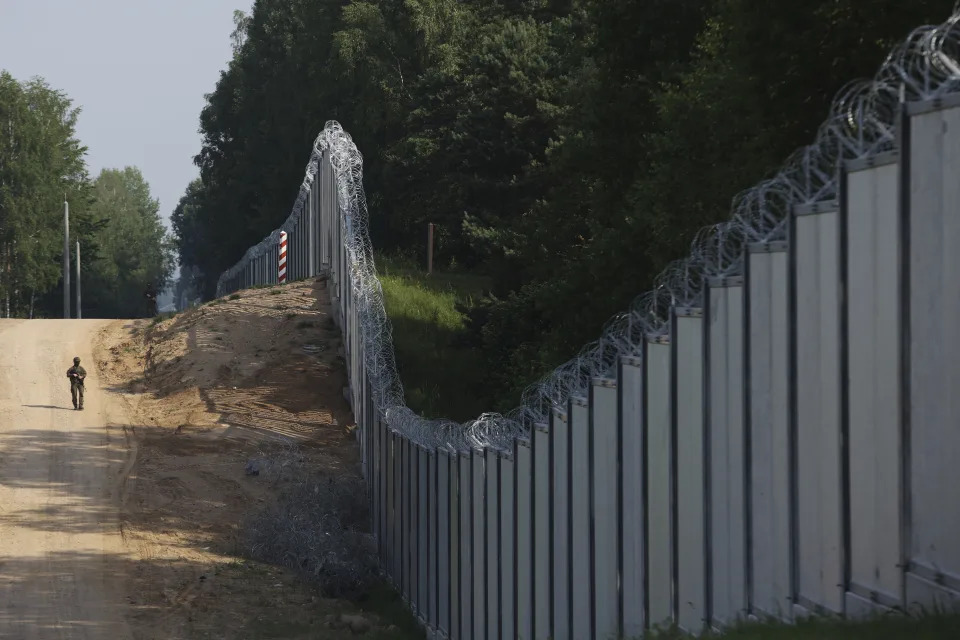
FILE - A Polish border guard patrols the area of a newly built metal wall on the border between Poland and Belarus, near Kuznice, Poland, Thursday, June 30, 2022. When relations with Belarus deteriorated after its authoritarian President Alexander Lukashenko was declared the winner of an election widely seen as fraudulent, the government in Minsk sent thousands of migrants streaming across the EU's frontiers. In response, Poland and Lithuania erected walls along their borders with Belarus. (AP Photo/Michal Dyjuk, File)
A Polish border guard patrols the area of a newly built metal wall on the border between Poland and Belarus, near Kuznice, Poland, Thursday, June 30, 2022. When relations with Belarus deteriorated after its authoritarian President Alexander Lukashenko was declared the winner of an election widely seen as fraudulent, the government in Minsk sent thousands of migrants streaming across the EU’s frontiers. In response, Poland and Lithuania erected walls along their borders with Belarus. (AP Photo/Michal Dyjuk, File)
FILE - Polish border guards patrol the area of a newly built metal wall on the border between Poland and Belarus, near Kuznice, Poland, Thursday, June 30, 2022. When relations with Belarus deteriorated after its authoritarian President Alexander Lukashenko was declared the winner of an election widely seen as fraudulent, the government in Minsk sent thousands of migrants streaming across the EU's frontiers. In response, Poland and Lithuania erected walls along their borders with Belarus. (AP Photo/Michal Dyjuk, File)
Polish border guards patrol the area of a newly built metal wall on the border between Poland and Belarus, near Kuznice, Poland, Thursday, June 30, 2022. When relations with Belarus deteriorated after its authoritarian President Alexander Lukashenko was declared the winner of an election widely seen as fraudulent, the government in Minsk sent thousands of migrants streaming across the EU’s frontiers. In response, Poland and Lithuania erected walls along their borders with Belarus. (AP Photo/Michal Dyjuk, File)
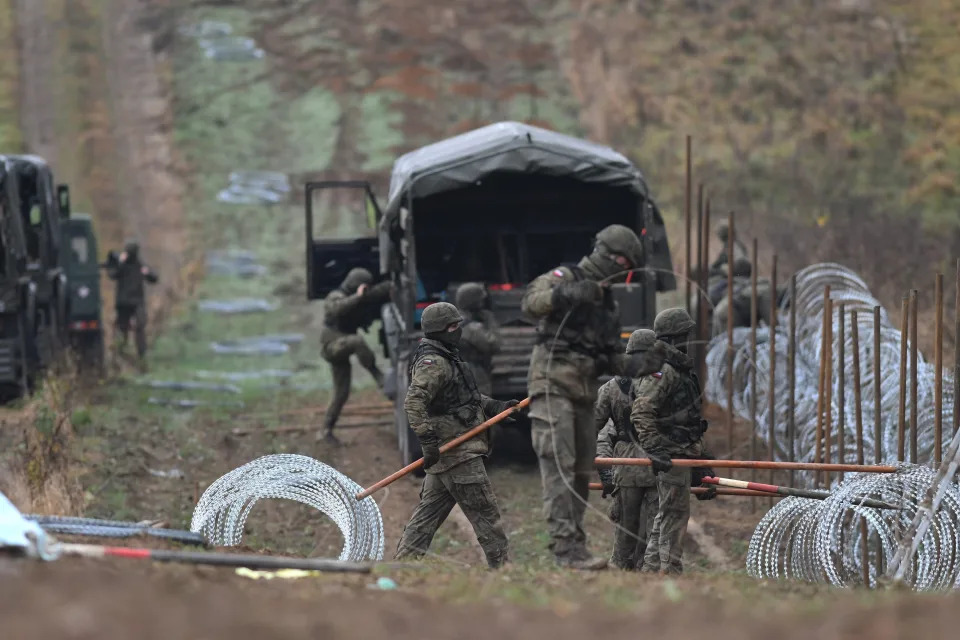
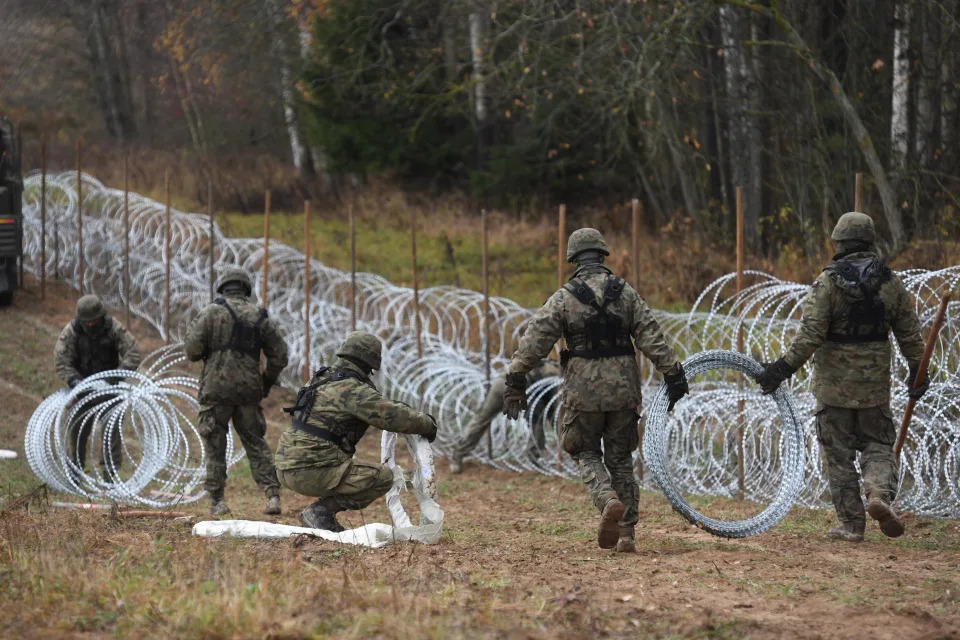
FILE - Polish soldiers begin laying a razor wire barrier along Poland's border with the Russian exclave of Kaliningrad in Wisztyniec, Poland, on Wednesday Nov. 2, 2022. At the beginning of November 2022, Polish soldiers began laying coils of razor wire on the border with Kaliningrad, a Russian region wedged between Poland and Lithuania. (AP Photo/Michal Kosc, File)
Polish soldiers begin laying a razor wire barrier along Poland’s border with the Russian exclave of Kaliningrad in Wisztyniec, Poland, on Wednesday Nov. 2, 2022. At the beginning of November 2022, Polish soldiers began laying coils of razor wire on the border with Kaliningrad, a Russian region wedged between Poland and Lithuania. (AP Photo/Michal Kosc, File)
FILE - Polish soldiers begin laying a razor wire barrier along Poland's border with the Russian exclave of Kaliningrad in Wisztyniec, Poland, on Wednesday Nov. 2, 2022. At the beginning of November 2022, Polish soldiers began laying coils of razor wire on the border with Kaliningrad, a Russian region wedged between Poland and Lithuania. (AP Photo/Michal Kosc, File)
Polish soldiers begin laying a razor wire barrier along Poland’s border with the Russian exclave of Kaliningrad in Wisztyniec, Poland, on Wednesday Nov. 2, 2022. At the beginning of November 2022, Polish soldiers began laying coils of razor wire on the border with Kaliningrad, a Russian region wedged between Poland and Lithuania. (AP Photo/Michal Kosc, File)
FILE - Polish soldiers begin laying a razor wire barrier along Poland's border with the Russian exclave of Kaliningrad in Wisztyniec, Poland, on Wednesday Nov. 2, 2022. At the beginning of November 2022, Polish soldiers began laying coils of razor wire on the border with Kaliningrad, a Russian region wedged between Poland and Lithuania. (AP Photo/Michal Kosc, File)
 Polish soldiers begin laying a razor wire barrier along Poland’s border with the Russian exclave of Kaliningrad in Wisztyniec, Poland, on Wednesday Nov. 2, 2022. At the beginning of November 2022, Polish soldiers began laying coils of razor wire on the border with Kaliningrad, a Russian region wedged between Poland and Lithuania. (AP Photo/Michal Kosc, File)
FILE - Russian passengers exit a bus to the passport control at the Vaalimaa border check point between Finland and Russia in Virolahti, Eastern Finland Wednesday, Sept. 28, 2022. The long border between Finland and Russia runs through thick forests and is marked only by wooden posts with low fences meant to stop stray cattle. Soon, a stronger, higher fence will be erected on parts of the frontier. (Sasu M'kinen/Lehtikuva via AP, File)
Russian passengers exit a bus to the passport control at the Vaalimaa border check point between Finland and Russia in Virolahti, Eastern Finland Wednesday, Sept. 28, 2022. The long border between Finland and Russia runs through thick forests and is marked only by wooden posts with low fences meant to stop stray cattle. Soon, a stronger, higher fence will be erected on parts of the frontier. (Sasu M’kinen/Lehtikuva via AP, File)
FILE - People traveling from Russia in cars and coaches queue to cross the border to Finland at the Vaalimaa border check point in Virolahti, Finland, Sunday, Sept. 25, 2022. MThe long border between Finland and Russia runs through thick forests and is marked only by wooden posts with low fences meant to stop stray cattle. Soon, a stronger, higher fence will be erected on parts of the frontier. (Jussi Nukari./Lehtikuva via AP, File)
People traveling from Russia in cars and coaches queue to cross the border to Finland at the Vaalimaa border check point in Virolahti, Finland, Sunday, Sept. 25, 2022. MThe long border between Finland and Russia runs through thick forests and is marked only by wooden posts with low fences meant to stop stray cattle. Soon, a stronger, higher fence will be erected on parts of the frontier. (Jussi Nukari./Lehtikuva via AP, File)

WARSAW, Poland (AP) — The long border between Finland and Russia runs through thick forests and is marked only by wooden posts with low fences meant to stop stray cattle. Soon, a stronger, higher fence will be erected on parts of the frontier.

Earlier this month, Polish soldiers began laying coils of razor wire on the border with Kaliningrad, a part of Russian territory separated from the country and wedged between Poland and Lithuania. Cameras and an electronic monitoring system also will be installed on the area that once was guarded only by occasional patrols of border guards.

The fall of the Berlin Wall more than 30 years ago symbolized hope for cooperation with Moscow. Now, Russia’s war in Ukraine has ushered in a new era of confrontation in Europe — and the rise of new barriers of steel, concrete and barbed wire. These, however, are being built by the West.

“The Iron Curtain is gone, but the ‘barbed wire curtain’ is now unfortunately becoming the reality for much of Europe,” said Klaus Dodds, a professor of geopolitics at Royal Holloway, University of London. “The optimism that we had in Europe after 1989 is very much now gone.”

Fear and division have replaced the euphoria when Germans danced atop the Berlin Wall and broke off chunks of the barrier erected in 1961 by Communist leaders. It stretched for 155 kilometers (nearly 100 miles), encircling West Berlin until 1989, when East German authorities opened crossings following mass protests. Within a year, East and West Germany were reunited.

Some countries in the European Union began building border fences as a response to more than 1 million refugees and other migrants entering southern Europe from the Middle East and Africa in 2015 alone. In 2015 and 2016, Russia ushered thousands of asylum-seekers, also mostly from the Middle East, to border checkpoints in northern Finland.

When relations with Belarus deteriorated after its authoritarian President Alexander Lukashenko was declared the winner of the 2020 election widely seen as fraudulent, the government in Minsk sent thousands of migrants across the EU’s frontiers in what Dodds called “hybrid warfare.” In response, Poland and Lithuania erected walls along their borders with Belarus.

Michal Baranowski, head of the Warsaw office of the German Marshal Fund think tank, said most security analysts believe Belarus coordinated its effort with Moscow, “in effect destabilizing our borders ahead of war in Ukraine.”

Fearing another migration crisis as a response to sanctions against Moscow because of the nearly nine-month war in Ukraine, European leaders have begun hardening their borders.

Finnish Prime Minister Sanna Marin announced plans to fortify parts of her country’s 1,340-kilometer (830-mile) border — the longest with any EU member. Moscow has threatened “serious military-political consequences” against Finland and Sweden for seeking to join NATO, and Marin said the fortifications would help defend the nation against the “hybrid threat” of possible large-scale and irregular migration orchestrated by the Kremlin.

The new barriers offer little protection from missiles or tanks. Governments instead expect the walls, fences and electronic surveillance to provide better control of their borders and to stop large migrant surges.

Dodds says Russia has been weaponizing migration for several years as it engages in a “civilization conflict with its European neighbors.”

Russia bombed and harassed Syria’s population in 2015 “in a deliberate attempt to create a humanitarian crisis,” he said.

“I think one of the difficulties we sometimes have outside of Russia is in actually appreciating quite how cynical, quite how calculating, quite how deliberate some of this work is,” said Dodds, author of “The New Border Wars: The Conflicts that Will Define Our Future.”

Russia’s use of migrants to create social discord in places like Poland, Lithuania and Latvia has led to those governments not offering them the chance to apply for asylum and refusing them entry in many cases — as has happened in other European countries like Greece and Hungary.

Those pushed back to Belarus have been subjected to abuse by Belarusian guards who initially helped them cross the borders, according to human rights groups.

Human rights activists in Poland have protested the the 5½-meter (18-foot) steel wall erected along 186 kilometers (115 miles) of its border with Belarus, arguing that it keeps out the weakest people but not the most determined.

Anna Alboth of the Minority Rights Group has spent months at that border and said she has seen people use ladders to scale the fence or tunnel under it.

Since the wall was finished last summer, about 1,800 migrants who made it inside Poland and found themselves in forests desperate for food, water or medicine have called Grupa Granica, an umbrella organization Alboth co-founded.

“It’s very difficult territory, the east of Poland,” she said. “There are a lot of animals. I had a situation where I went to one group and I stepped on people who were half-conscious. I am sure there were many people like this.”

She said she recently encountered groups of women from Sudan who appeared to be human trafficking victims, as well as medical students from Africa who were in their fifth year of studies in Russia.

“They said ‘Russia is falling apart and we want to live in a normal country,’” Alboth said.

A Polish government security official, Stanislaw Zaryn, acknowledged the border wall doesn’t stop everyone seeking to cross illegally, but added: “It does allow our forces to act rapidly and more efficiently, without the need to deploy as much manpower as before.”

Both that wall and the fence with Kaliningrad “convey a strong message to Minsk and Moscow that Poland takes the security and integrity of its borders extremely seriously,” Zaryn said. “I believe that Belarus and Russia will think twice before pursuing again the weaponization of migration.”

Dodds said he understands the impulse to build walls but warns that they rarely work as intended, often pushing migrants onto more hazardous journeys.

While militarized borders might be popular, they also tend to dehumanize desperate migrants, who often are willing to risk the danger of border crossings for a better life.

Building such walls and fences “sucks empathy and compassion from our societies,” Dodds said.

Jari Tanner contributed to this report from Helsinki.

Julia Brownley wins House race as lead grows to nearly double digits; Jacobs concedes

VC Star – Ventura County Star

Julia Brownley wins House race as lead grows to nearly double digits; Jacobs concedes

Tom Kisken, Ventura County Star – November 17, 2022

U.S. Rep. Julia Brownley has won a sixth term in Congress.

The Democrat from Westlake Village declared victory in her race on Saturday and Republican challenger Matt Jacobs conceded on Tuesday. Election updates two days later left Brownley with 54% of the votes to 46% for Jacobs.

U.S. Rep. Julia Brownly has won a sixth term in Congress. Here, she's shown the day after the election at a dedication ceremony of the new Veterans Affairs clinic in Ventura.
U.S. Rep. Julia Brownly has won a sixth term in Congress. Here, she’s shown the day after the election at a dedication ceremony of the new Veterans Affairs clinic in Ventura.

Districtwide, Brownley received 117,609 votes as of the latest tally. Jacobs, a former federal prosecutor who lives in Westlake Village, had 100,018 votes.

“I am humbled and honored by the voters’ decision to elect me once again to represent our community in Congress,” she said in a victory statement issued Saturday after CNN, NBC and ABC declared her the winner. Several hours later, the Associated Press also called Brownley the winner.

“This was a race about values, about the economy and the economic prosperity of America’s working families and about our future,” she said.

Election central: Your guide to Ventura County races

Jacobs, a former federal prosecutor making his first race for office, conceded late Tuesday afternoon.

“The election was fair, the result is legitimate and I sincerely wish Congresswoman Brownley and her family all the best, both personally and as our representative in Congress,” he said in a written statement that also expressed pride in his campaign.

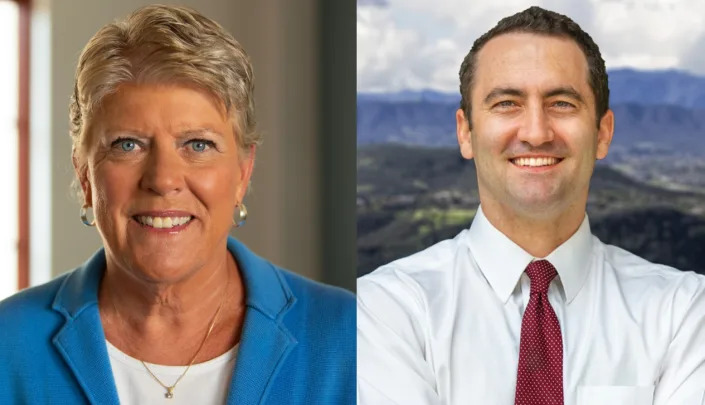
Julia Brownley and Matt Jacobs

Election officials estimated about 79,000 votes are still to be processed across Ventura County though some are from outside of the district, which does not include Ventura and Ojai. It’s unclear how many ballots are still to be counted in the small part of the district in Los Angeles County.

In her victory statement and in her campaign, Brownley focused on abortion rights.

“While the Republican party focused solely on inflation with no plan to address it, they failed to understand that protecting a woman’s right to choose is not only a moral issue but an economic one,” she said.

The race was one of several being tracked nationally as Republicans and Democrats vied for control of the House. The contest gained more attention immediately before the election amid a flurry of fundraising and reports of polls showing a tight race.

Redistricting brought all of more conservative Simi Valley into the 26th but Democrats still accounted for 43% of the registered voters across the district as of late October, compared to 28% for Republicans

Red tide update: State report shows toxic algae levels from Sarasota south to Marco Island

The Fort Myers News Press

Red tide update: State report shows toxic algae levels from Sarasota south to Marco Island

Chad Gillis, Fort Myers News-Press – November 17, 2022

Scientists are saying a red tide bloom that’s lingered along the coast for a few weeks is now being fed by nutrients running off the landscape in the wake of Hurricane Ian.

Red tide (Karenia brevis) is a naturally occurring organism in the Gulf of Mexico that sometimes blooms to toxic levels.

But research shows that nutrients from farm fields, lawns and septic tanks fuel red tide blooms close to shore — making them more frequent, longer-lasting and more intense.

“I don’t see any good evidence that hurricanes initiate a red tide, but once you have a red tide started, runoff will make it worse,” said Larry Brand, a water quality expert, scientist and professor at the University of Miami.

Fish kills: Red tide bloom moves into Lee County waters as fish kills reported in Pine Island Sound

Florida red tide map:  Check the current status

Why is it still so hot? Cold front to break up string of above-average highs, for a day

Ian didn’t create the conditions for the original bloom; but rain water and storm surge has helped fuel the bloom, which now stretches from the Sarasota area south to Marco Island.

Counts of 1 million cells per liter and higher have been reported at multiple locations along the Southwest Florida coast.

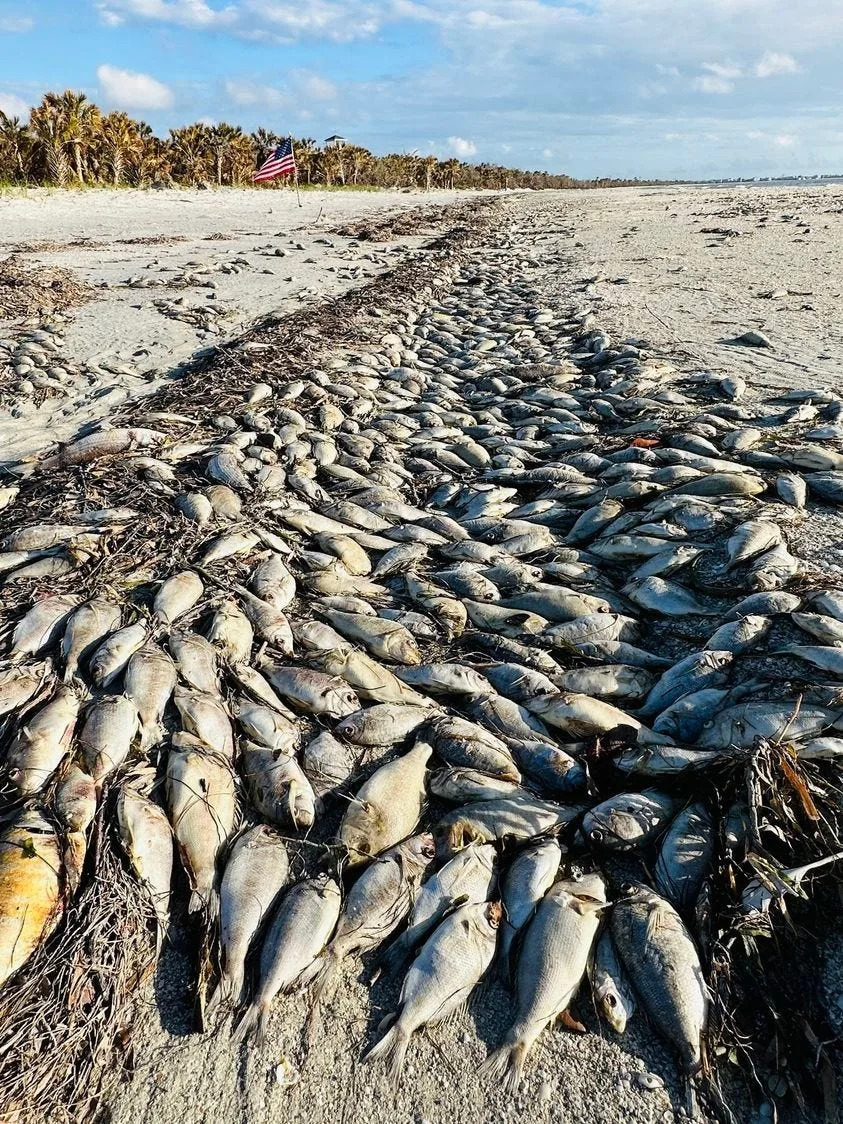
Dead fish litter many beaches in the region, and the Florida Department of Health in Collier County issued an exposure advisory Wednesday.

DOH agrees with Brand, that nutrients flowing off the landscape contribute to the intensity and duration of the bloom.

Thousands of dead fish line the high tide line at Cayo Costa State Park on Nov. 14, 2022. Red tide has moved into Lee County waters in recent weeks.

“Once inshore, these opportunistic organisms can use nearshore nutrient sources to fuel their growth,” a Wednesday DOH press release reads. “Blooms typically last into winter or spring, but in some cases, can endure for more than one year.”

What should Southwest Florida residents do?

DOH says people who live along the coast should even check their air conditioning filters.

“Residents living in beach areas are advised to close windows and run the air conditioner, making sure that the A/C filter is maintained according to manufacturer’s specifications,” DOH says. “If outdoors near an affected location, residents may choose to wear masks, especially if onshore winds are blowing.”

Carly Jones, spokeswoman for the Florida Fish and Wildlife Conservation Commission — the state agency charged with monitoring red tide, said offshore winds can help push the contaminated waters and the microscopic algae away from the coast.

Lake O levels: Herbert Hoover Dike around Lake O remains safe during Hurricane Nicole

More: Cassani calling it quits after six years as Calusa Waterkeeper for Caloosahatchee system

The latest FWC report show the strongest red tide counts have been found in northern Lee and Sarasota counties.

“Some people experience respiratory irritation (coughing, sneezing, tearing and an itchy throat) when the red tide organism is present and winds blow onshore,” Jones wrote in an email to The News-Press. “Offshore winds usually keep respiratory effects experienced by those on the shore to a minimum. The Florida Department of Health advises people with severe or chronic respiratory conditions, such as emphysema or asthma, to avoid red tide areas.”

Red tide can contaminate shellfish, and the DOH recommends against collecting and eating shellfish from this region at this time.

Locally caught, properly cleaned and cooked fish can be eaten, the press release says.

DOH recommends washing yourself and all clothing if you make contact with waters containing the toxic algae.

Hurricane Irma also stirred nutrients in toxic algae bloom in 2017

Calusa Waterkeeper John Cassani has been monitoring the bloom online.

“I’m hearing people aren’t seeing as many gamefish species as compared to (Hurricane) Irma (2017),” Cassani said. “It’s mostly foraging fish but most are decayed to the point you can’t determine the species.”

Hurricane Irma stirred up nutrients in the Lake Okeechobee/Caloosahatchee River system five years ago, and the following summer was virtually lost to a massive red tide and blue-green algae bloom in the river.

Lee County was part of a state of emergency for both blooms.

Some scientists have speculated that Hurricane Ian’s aftermath will cause similar conditions between now and the spring of 2024.

The Hurricane Irma-fed red tide lasted from the fall of 2017 until the spring of 2019.

“It’s a neurotoxin,” Cassani said. “There are neurological symptoms that have been defined in response for red tide. And people with asthma are showing up in emergency rooms. There’s an influx often during a bloom. It’s an unregulated contaminant.”

Red tide worsens and spreads to Tampa Bay. Dead fish found on Anna Maria Island

Bradenton Herald

Red tide worsens and spreads to Tampa Bay. Dead fish found on Anna Maria Island

Ryan Ballogg – November 16, 2022

A red tide bloom has worsened in Southwest Florida waters this week, the latest samples from the state show.

The algae that causes red tide, Karenia brevis, was observed at elevated levels in Tampa Bay, around Anna Maria Island, Longboat Key and in Sarasota Bay. Dead fish and breathing irritation have been reported on local beaches.

The bloom remains most intense further south offshore of Sarasota, Charlotte and Lee counties, according to samples from the Florida Fish and Wildlife Conservation commission.

On Monday, a very low concentration of red tide algae was detected in a water sample near the Rod and Reel Pier in Anna Maria —down from medium levels last week— and a medium concentration was again found in waters near Longboat Pass in Bradenton Beach.

University of South Florida’s red tide for predicts that very low levels of the algae will continue to circulate around Anna Maria Island through this weekend. At very low levels, respiratory irritation is possible.

USF predicts that low to medium levels of the algae will circulate around Longboat Key, with high levels persisting farther south in Sarasota Bay.

At levels of medium and above, which are considered “bloom concentrations” of the algae, respiratory irritation and fish kills are likely.

Slight breathing irritation and a few dead fish were reported on Anna Maria Island beaches this week, Mote Marine Laboratory’s red tide beach conditions report said. To the south, moderate breathing irritation and numerous dead fish were observed on several Sarasota County beaches.

Red tide’s patchy nature means that even beaches in close proximity can have very different conditions. Respiratory irritation and dead fish can also become more or less present as wind directions and tides change.

The National Oceanic and Atmospheric Administration forecasts the respiratory threat from red tide. On Wednesday, NOAA warned that beachgoers in Manatee, Sarasota, Charlotte, Lee and Collier counties could experience moderate to high levels of respiratory irritation over the next 36 hours.

On Monday, the Florida Department of Health Manatee County issued a red tide health alert for the following beaches:

  • Bayfront Park
  • Coquina Beach South
  • Longboat Pass/Coquina Boat Ramp
  • Rod and Reel Pier (City of Anna Maria Island)

FDOH-Manatee offers the following red tide safety tips:

  • Look for informational signage posted at most beaches.
  • Stay away from the water.
  • Do not swim in waters with dead fish.
  • Those with chronic respiratory problems should be especially cautious and stay away from these locations as red tide can affect your breathing.
  • Do not harvest or eat molluscan shellfish or distressed or dead fish from these locations. If caught live and healthy, finfish are safe to eat as long as they are filleted and the guts are discarded. Rinse fillets with tap or bottled water.
  • Wash your skin and clothing with soap and fresh water if you have had recent contact with red tide.
  • Keep pets and livestock away and out of the water, sea foam and dead sea life. If your pet swims in waters with red tide, wash your pet as soon as possible.
  • Residents living in beach areas are advised to close windows and run the air conditioner, making sure that the A/C filter is maintained according to manufacturer’s specifications.
  • If outdoors near an affected location, residents may choose to wear masks, especially if onshore winds are blowing.

FDOH-Sarasota issued a health advisory for all 16 of Sarasota County’s public beaches last week.

A map from University of South Florida’s Ocean Circulation Lab shows the red tide forecast in the Tampa Bay region over the coming days.

Global population passes 8 billion, says UN amid concerns of impact on climate crisis

Independent

Global population passes 8 billion, says UN amid concerns of impact on climate crisis

Sravasti Dasgupta – November 15, 2022

The world population has crossed eight billion, the United Nations said on Tuesday as it warned of the impact of climate change and resource scarcity.

John Wilmoth, director of the UN’s population division said that reaching eight billion people is “a sign of human success, but it’s also a great risk for our future”.

According to a statement by the UN, the global population is growing at its slowest rate since 1950.

UN projections suggest that the global population could grow to around 8.5 billion in 2030 and 9.7 billion in 2050.

It is projected to reach a peak of around 10.4 billion people during the 2080s and to remain at that level until 2100.

The figures were earlier released by the UN in a report ahead of World Population Day in July.

China and India, with more than 1.4 billion each, accounted for most of the population in these two regions,” the report said.

“India is projected to surpass China as the world’s most populous country in 2023,” it added.

Despite the global population increasing, experts say that the growth rate has fallen steadily to less than 1 per cent per year.

“A big part of this story is that this era of rapid population growth that the world has known for centuries is coming to an end,” Mr Wilmoth said.

Experts have warned that the rising population combined with the impact of climate change will adversely affect vulnerable nations and people.

Deborah Balk, a demographic researcher at the City University of New York, said: “African cities will, on average, grow.”

Ms Balk said that this will leave millions more urban dwellers exposed to climate threats such as rising seas.

Analysts warn that there will also be resource scarcity with the population rise.

“Every single person needs fuel, wood, water, and a place to call home,” said Stephanie Feldstein, population and sustainability director at Center for Biological Diversity.

UN officials have also said that rising population is likely to impact achieving sustainable development goals.

“The relationship between population growth and sustainable development is complex and multidimensional” said Liu Zhenmin, UN Under-Secretary-General for Economic and Social Affairs in a statement.

“Rapid population growth makes eradicating poverty, combatting hunger and malnutrition, and increasing the coverage of health and education systems more difficult.

“Conversely, achieving the Sustainable Development Goals, especially those related to health, education and gender equality, will contribute to reducing fertility levels and slowing global population growth.”

(Additional reporting by agencies)

Kari Lake has finally met her match: Arizona voters

AZ Central – The Arizona Republic

Kari Lake has finally met her match: Arizona voters

Elvia Díaz, Arizona Republic – November 15, 2022

Kari Lake, the leading lady of the Make America Great Again movement, has finally met her match: Arizona voters.

Lake’s hopes of becoming Arizona’s MAGA governor evaporated with every drop of new vote counts. But on Monday evening, some news networks and the Associated Press called the race for Hobbs.

Lake had been hanging by a thread, but her chances of pulling off a victory against Democrat Katie Hobbs seem more like an illusion than a realistic possibility, given the number of remaining votes in key Maricopa County.

As of Monday night, she was losing by 20,481 votes – just under 1 percentage point. If the final margin is a half a percentage point or less, there would be an automatic recount. That would mean dragging out this whole drama for weeks.

But the voters who turned on Lake must pat themselves on the back. These voters are the defenders of democracy, who successfully built a wall to hold off the MAGA restrictionists’ scheme.

None of Lake’s or other MAGA claims are sticking
Kari Lake gives a press conference on the sidewalk outside of the Downtown Phoenix Post Office after casting her ballot on Nov. 8, 2022.

For days now, we’ve seen and heard voters’ powerful message. None of the MAGA candidates’ tantrums are sticking, and that’s a great thing.

On Election Day, they huffed and puffed over a computer glitch that affected some vote-counting machines. They screamed voter fraud.

That was a serious glitch, but it didn’t keep voters from casting their ballots. And so, it didn’t stick with Arizonans who are tired of hearing conspiracy theories and the lies of a stolen election.

In the midterm: Arizona’s politically purple credentials are hard to top

Lake and other MAGA candidates later accused Maricopa County election officials of purposefully “dragging their feet” in counting votes – conveniently forgetting those overseeing the vote count are mostly Republicans merely following state law set by a Republican-controlled government.

That didn’t stick, either.

Cue Donald Trump. The former president was fuming to see that his hand-picked candidates, including Lake, were losing. Predictably, he fired off accusations of a stolen election.

That didn’t stick, either.

Their reaction is reassurance: You voted wisely

Over the weekend, some of Lake’s supporters called for military intervention because she’s losing.

“We the people are requesting the military to step in and redo our election,” a protester outside the Maricopa County ballot counting center said.

I kid you not. Lake’s supporters want the U.S. military to take over elections and presumably make sure she wins.

Don’t dismay, though. That call isn’t sticking, either.

If anything, those few protesters calling for military intervention make Lake look like a dictator wanna be – reassuring the Arizona voters who rejected her of their decision.

The slow vote count was exasperating, but that also gave us – the people – a real sense of normalcy.

There was actual excitement and gasps with every vote count revealed. That’s because we, the people, were hungry for mutual respect at the ballot box.

Elvia Díaz is the editorial page editor for The Republic and azcentral.